
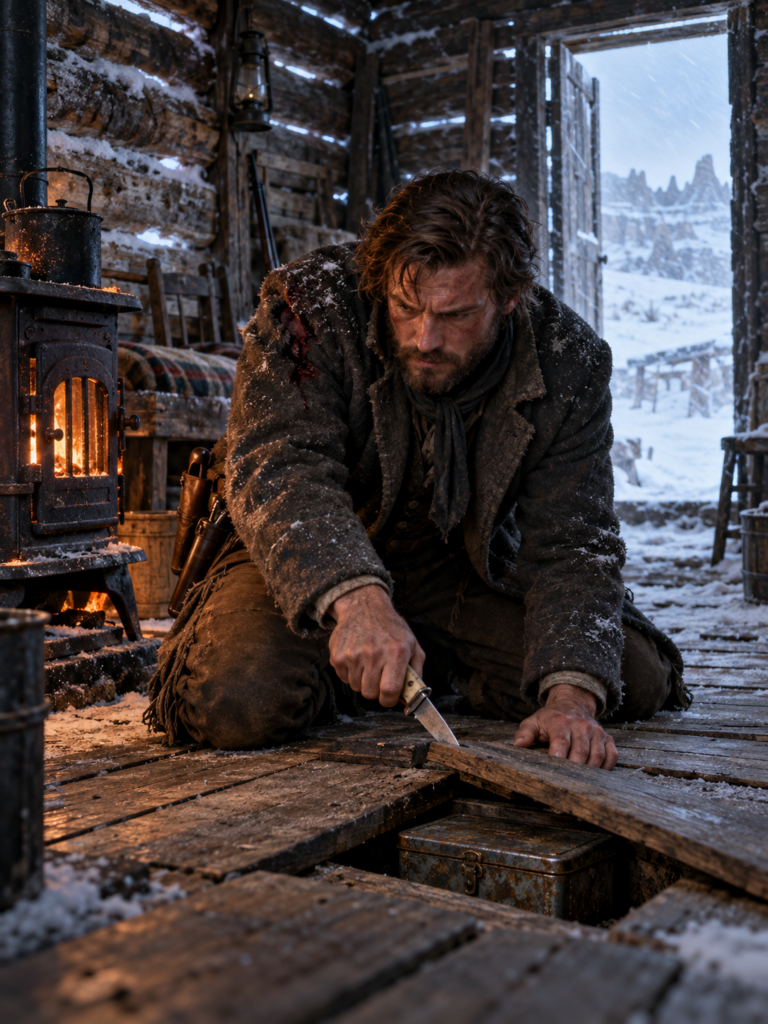
The tin box rose another inch into the stove light as Matthew hooked his fingers beneath one corner and pulled.
Pain flashed across his wounded shoulder hard enough to blur the room, but he did not let go.
The box came free.
He set it on the bunk and waited until the grayness cleared from his vision.
It was roughly the size of a family Bible, with two small hasps and no lock.
Matthew listened.
Wind.
The ticking stove.
Nothing else.
Still, he crossed to the window and looked through the remaining panes before opening it.
No riders moved across the snow.
He returned to the bunk.
The first hasp lifted.
Then the second.
Inside lay three things arranged on folded oilcloth: a canvas sack tied with leather, a bundle of papers, and something smaller wrapped in faded blue calico.
Matthew reached for the sack.
The weight surprised him.
He loosened the thong and poured its contents into his palm.
Gold struck gold.
For several seconds he simply stared.
Double eagles.
He counted once.
Then again, because Wesley had taught him never to trust arithmetic performed while frightened, angry, hungry, or astonished.
Forty-two double eagles.
Eleven half eagles.
Silver besides.
Eight hundred ninety-seven dollars and fifty cents.
A man could buy land with less.
He could buy cattle.
Horses.
A winter.
Time.
But Matthew had been poor too long to mistake money for an answer.
Someone had hidden nearly nine hundred dollars beneath a floor and vanished without returning for it.
That required an explanation.
He replaced every coin except two double eagles and untied the papers.
The first sheet was a letter.
The handwriting was old-fashioned but steady.
The name at the bottom was Josiah Fenn.
Matthew knew the name only faintly. An old horse trader. A man associated with the badlands before Matthew was grown.
The letter said Fenn had stayed in the shack through three winters beginning in 1878.
It said he had reached the place poor, cold, and desperate.
It said the money had come from a part of his life he regretted.
And it ended with a sentence that made Matthew read the entire page again.
Fenn hoped whoever eventually found the box would be cold and hungry and in need, as he once had been, and would do better with what was inside than he had done.
Matthew lowered the paper.
For the first time since the rifle fired, something inside him loosened.
Not gratitude.
Not yet.
The country had taught him to be suspicious of gifts.
He opened the next papers.
A deed.
One hundred sixty acres.
The shack.
The sandstone shoulder behind it.
The seep below.
Filed in Josiah Fenn’s name in 1879.
Matthew’s attention sharpened.
The last item among the papers was a hand-drawn map.
Three names had been written beside markings along an old North Platte route.
Matthew recognized none of the first two.
The third stopped him.
Beck.
Not Harlan.
The given name was different.
But the surname was the same.
Matthew sat motionless.
The two riders had not robbed him.
They had barely searched him.
They had spoken Beck’s name before the rifle fired.
And somewhere beneath the floor of a shack abandoned for decades, a dead man had left a map carrying the same family name.
Coincidence was possible.
Wesley had also taught Matthew something about coincidence.
Once was weather.
Twice deserved watching.
Matthew folded the map.
He could stay hidden until the wound healed and take the money somewhere far from Dry Pine.
Or he could carry the papers back toward the very men who apparently wanted him buried beneath the snow.
Neither choice was safe.
Then, outside the cabin, something broke the crusted snow with a hard, distinct crunch.
Matthew killed the stove light, slid the map inside his coat beside his father’s knife, and reached for the short-handled axe behind the door.
Matthew closed his right hand around the axe handle and waited beside the door.
Another crunch came from outside.
Closer.
He held his breath.
A shadow moved past the rag-stuffed pane.
Then came a low snort.
Matthew shut his eyes for one relieved second.
Not a man.
An animal.
He edged the door open and found a mule deer pawing through the snow beside the wall, looking for grass protected by the eave.
It bounded away when the door moved.
Matthew watched until it disappeared between the ridges.
Only then did he lower the axe.
The fright clarified something.
He could not remain here much longer.
The beans were nearly gone. The wood would last perhaps a week if he burned carefully. More important, anyone searching the badlands for a body might eventually look inside the only roof for miles.
He needed help.
And there was only one kind of person he trusted enough to ask for it.
Not a rich man.
Not a ranch owner.
Not anyone connected to Harlan Beck.
Someone who had already proved what she was without needing to say it.
Ada Rennick.
Matthew knew her place lay south of the wagon road outside Dry Pine. Wesley had traded horses with her husband years ago, and Matthew had repaired a fence there once after a spring storm.
Ada was a widow now, nearly seventy, with two hundred head of stock and a reputation for asking few foolish questions.
For four more days Matthew let the wound close.
He rationed beans.
Melted snow.
Slept sitting against the bunk.
He read Josiah Fenn’s letter twice more but avoided the map.
He did not want himself inventing connections merely because pain and loneliness made patterns tempting.
On the fifth morning the sky cleared.
Matthew wrapped himself in an old saddle blanket he found behind the bunk, put two double eagles in his coat, returned the rest of the gold and the deed to the tin box, and placed the box under the plank.
He carried the map and Fenn’s letter.
If someone found him on the road, he wanted the evidence close.
Six miles took most of the day.
He walked until his shoulder throbbed.
Rested.
Walked again.
By the time he reached the wagon track, he was no longer certain he could cover another hundred yards.
That was when a light spring wagon appeared around the bend.
Ada Rennick held the reins.
She saw him.
Stopped.
Looked once at the blanket around his shoulders and the way his left arm hung.
“Get in.”
Matthew opened his mouth.
She lifted one eyebrow.
“I said get in, Matthew.”
He obeyed.
Not because she commanded him.
Because she had already moved the sack of cracked corn off the seat to make room.
At her kitchen table, she placed hot beef broth in front of him before asking a single question.
Later she cut away the bandage and cleaned the bullet wounds with corn whiskey.
“You did this yourself?”
“Yes, ma’am.”
“Poorly.”
“Yes, ma’am.”
“Good enough to stay alive.”
Matthew almost smiled.
That evening, in a small back room facing the badlands, he slept beneath two quilts and woke only when Ada came in to check whether he was still breathing.
She asked nothing for two days.
On the third morning she set coffee in front of him and sat opposite.
“Who?”
Matthew knew what she meant.
“Two men. Didn’t know either well enough to name them.”
“Why?”
“One of them said Beck.”
Ada’s face changed very little.
That was why Matthew trusted her.
She did not gasp.
Did not rush to conclusion.
“Harlan?”
“They didn’t say Harlan. Just Beck.”
“Different thing.”
“Yes.”
“Anything else?”
Matthew took Josiah Fenn’s map from his coat.
Ada did not touch it immediately.
When she finally unfolded it, her eyes moved to the three names.
Then stopped.
“You know something,” Matthew said.
“I know that people who lived here before us had lives before we knew them.”
“That’s not an answer.”
“No.”
She met his eyes.
“It’s caution.”
The distinction mattered.
Matthew nodded.
Ada refolded the map.
“Sheriff Halloran needs to see this.”
Matthew’s jaw tightened.
Ada noticed.
“Tom knew Wesley.”
“That doesn’t make him honest.”
“No.”
She pushed the map back across the table.
“But it earns him the chance to prove whether he is.”
That was more persuasive than reassurance would have been.
Doctor Samuel Pike arrived that afternoon because Ada had sent a hired boy into town before breakfast.
He was fifty-five, broad-handed, gray at the temples, and unimpressed by Matthew’s attempt at self-doctoring.
“You missed the artery,” Pike said after probing the wound.
“I considered that fortunate.”
“You missed infection too.”
“So far.”
Pike looked at him.
“You always this cheerful?”
“No.”
That earned the first laugh Matthew had heard in the room.
Pike cleaned and stitched the exit wound again.
When Matthew offered him a double eagle, the doctor frowned.
“You hiding a Denver bank robbery under that blanket?”
Matthew glanced toward Ada.
She said nothing.
“Take it,” Matthew told him.
Pike turned the coin between two fingers.
“I’ll take it for the next man who can’t pay me.”
That answer told Matthew more about the doctor than any introduction could have.
Pike left without asking where the gold came from.
Sheriff Tom Halloran arrived a week later.
Matthew knew him by sight and by Wesley’s old stories. Halloran had stood near the corral the morning they buried Wesley.
He entered Ada’s kitchen without his gun belt, leaving it with his coat by the door.
Matthew noticed that.
Perhaps Halloran intended the gesture to be noticed.
Either way, it was better than arriving armed.
Halloran listened to the account of the shooting without interrupting.
“Could you identify either man?”
“Maybe the nearer one if I heard him speak again.”
“Horse?”
“Dark. Both. Snow was thick.”
“Weapon?”
“Short rifle.”
“Anything taken?”
“Pete.”
“Your horse.”
“Yes.”
“Money?”
“No.”
Halloran leaned back.
“So this wasn’t robbery.”
“No.”
Matthew set Fenn’s letter and map on the table.
Then he told Halloran about the box.
He did not mention every coin.
Only enough.
Halloran read the letter first.
The deed next.
The map last.
His expression remained still until he saw the third name.
Then his thumb stopped moving along the paper.
“You know him,” Matthew said.
“I know the name.”
“Beck.”
“Harlan Beck’s father.”
The room seemed to contract.
Ada, standing by the stove, folded her arms.
Matthew said, “Was?”
“Dead eight years.”
“What are the other marks?”
Halloran opened the map flat.
“Places along an old North Platte stage route.”
Matthew waited.
The sheriff looked toward Ada, then back at him.
“In 1880, a stage payroll disappeared. Not one of the famous robberies. No bodies. Driver claimed three masked men stopped him and took the strongbox.”
“How much?”
“A good deal more than eight hundred dollars.”
Matthew looked at Josiah’s letter.
“Fenn?”
“Maybe.”
Halloran tapped the three names.
“His letter says he regretted how he got the money. These names suggest he didn’t get it alone.”
Matthew felt no triumph.
The revelation made the shooting worse.
A ranch buyer firing men was ordinary enough.
A ranch buyer whose father might have been connected to an old robbery was not.
But Matthew still saw a gap.
“If Harlan knew this box existed, why leave it in the shack for decades?”
Halloran’s eyes narrowed slightly.
“That’s the right question.”
Ada spoke from the stove.
“And if he didn’t know it existed, why shoot Matthew?”
Halloran nodded.
“That’s the better one.”
There it was.
The map did not solve the shooting.
It complicated it.
Halloran gathered none of the papers.
Matthew noticed.
“You don’t want them?”
“I want copies eventually. Originals stay with you.”
“You trust me?”
“No,” Halloran said calmly. “I trust chain of possession.”
Matthew almost smiled again.
Halloran continued.
“I can investigate the attack without this old robbery. Men tried to kill you. That’s enough. If Beck ordered it, I need something stronger than a surname spoken in a snowstorm.”
“That may take time.”
“Yes.”
“They may try again.”
“Yes.”
Ada set down the coffeepot harder than necessary.
Halloran looked at her.
“What?”
“You tell him that as if he can spend the next month under my kitchen table.”
“I was getting to that.”
“Get faster.”
The sheriff looked back at Matthew.
“I can put a deputy here.”
“No.”
“Matthew—”
“No armed man sitting outside Ada’s house because of me.”
Ada cut in.
“Do not make that decision for my house.”
Matthew looked at her.
She held his gaze.
“My property. My risk to accept.”
The correction struck cleanly.
He inclined his head.
“You’re right.”
Halloran watched both of them.
Ada said, “But I don’t want a deputy either.”
“Why?”
“Because anyone watching the road will know exactly where Matthew is.”
Halloran considered that.
Then nodded.
“Fair.”
Matthew asked, “What do you need from me?”
“Stay alive. Heal. Tell nobody about the papers.”
“I need to go back.”
“To the shack?”
“Yes.”
Ada stared at him as if he had announced plans to walk into the Missouri.
Halloran said, “Why?”
“The deed is there. The rest of the gold is there. Everything Fenn left.”
“You hid nearly nine hundred dollars under a floor and walked away from it?”
“I found it under a floor. Felt disrespectful to improve on the arrangement.”
Ada sat down and covered her eyes with one hand.
Halloran’s mouth twitched.
Then his face hardened again.
“You’re not going back alone.”
Matthew’s first instinct was refusal.
He stopped himself.
Ada had just corrected him for making her decision.
He could not demand that same freedom while denying Halloran the responsibility of his office.
“Not yet,” Matthew said. “When Pike says I can ride.”
“That’s reasonable.”
“And I choose when.”
Halloran studied him.
“Provided you tell me before you go.”
Matthew nodded.
That was agreement, not surrender.
The sheriff rose.
At the door, he paused.
“One other thing.”
Matthew waited.
“Beck dismissed five men in two weeks.”
“I know.”
“I’ve talked to three. Nothing happened to them.”
Meaning Matthew had been singled out.
“Why me?”
“That,” Halloran said, “is what I intend to ask Mr. Beck.”
The answer came sooner than any of them expected.
On the tenth day after Matthew reached Ada’s house, a deputy rode into the yard carrying a folded summons.
Halloran had served it on Harlan Beck that morning.
The deputy looked uncomfortable.
“He won’t answer it.”
“Why not?” Matthew asked.
The deputy removed his hat.
“Because Beck bought a seat on the noon coach for Denver.”
Ada’s mouth tightened.
Matthew looked toward the pale badland ridges visible through the kitchen window.
A man could leave town for many reasons.
But a man did not usually flee a lawful summons because an employee he had fired survived being shot.
Halloran’s investigation had finally forced Harlan Beck to move.
And by moving, Beck had revealed that he was afraid of something.
Matthew did not mistake fear for guilt.
That distinction mattered to him.
He had spent too many years around cattlemen who decided what another man was before hearing what he had to say. Harlan Beck had treated him that way with a pencil and a payroll ledger.
Matthew would not answer contempt with the same carelessness.
But he would remember that Beck had left.
Two days later Halloran returned with news.
The sheriff and a deputy had found the two riders near Belle Fourche.
One carried a short-barreled rifle.
The other had Matthew’s sorrel, Pete, listed under a false bill of sale at a livery stable.
“That enough?” Matthew asked.
“For horse theft, yes.”
“For shooting me?”
Halloran sat at Ada’s table.
“One’s talking.”
Matthew waited.
The sheriff did not dramatize it.
“Harlan Beck paid them.”
Ada exhaled through her nose.
Matthew’s reaction was quieter.
“What did Beck want?”
“You frightened.”
“Shot through the chest is ambitious for frightening.”
“Shoulder.”
“They aimed poorly.”
Halloran acknowledged that with a small nod.
“He told them to stop you from getting to the Two Bar.”
Matthew frowned.
“Why?”
“That’s the part you won’t like.”
“Try me.”
Halloran laid a folded statement on the table but kept one hand over it.
“Beck believed you had taken something from the JT office.”
Matthew stared at him.
“What?”
“A page from one of the old acquisition ledgers.”
“I never entered the office except for wages.”
“I know.”
“How?”
“The man in custody says Beck realized that too.”
“After they shot me?”
“Yes.”
Anger arrived slowly.
Not hot.
Matthew’s anger had always been the kind that settled.
Heavy.
Difficult to move once placed.
Halloran removed his hand from the statement.
“When Beck bought control of the JT, he received old land and transaction records with the ranch. One ledger contained references to parcels his father had tried to acquire years earlier. One of those parcels was Fenn’s one hundred sixty.”
Matthew looked toward his coat hanging beside the stove.
Inside it, against the worn place over his ribs, were his father’s knife and the firing notice Beck had nailed to the tack-room door.
“Fenn’s land.”
“Yes.”
“Beck knew about the land before I did.”
“He knew about the deed problem. He may not have known the deed itself still existed.”
Ada said, “Then why Matthew?”
Halloran’s eyes shifted to him.
“Because you noticed things.”
Matthew almost laughed.
“That’s a reason to shoot a man?”
“To someone hiding something, sometimes.”
The story, once Halloran assembled it, was smaller and uglier than Matthew had imagined.
Harlan Beck had spent September reviewing the JT’s old papers because several neighboring parcels could potentially increase grazing control.
Among them was the abandoned Fenn tract.
The JT had used part of its northern grazing edge casually for years, but nobody possessed a valid deed transferring the land from Josiah Fenn.
Beck wanted the tract.
Worse, one old ledger suggested his father had known Fenn personally.
Another notation referred to a payment connected to “N.P. shares,” language meaningless to most readers but dangerous if paired with Josiah Fenn’s surviving map and confession.
Matthew had happened to be in the tack room one evening when Beck carried several old ledgers through.
He had seen Matthew looking.
Matthew remembered the moment only after Halloran described it.
A leather ledger had slipped.
Several papers fell.
Matthew had bent to pick them up.
One sheet contained a sketched boundary.
He had handed it back without reading more than a few words.
To Matthew, it had been nothing.
To Beck, already worried about what the old records might reveal, it had become a threat.
“So he fired me.”
“Yes.”
“And when I rode north—”
“He assumed you were going to someone.”
“The Two Bar.”
“He didn’t know that.”
Matthew looked at the statement.
“Did he order them to kill me?”
Halloran’s jaw tightened.
“The man says Beck told them to take back anything you carried from the office and make sure you stopped talking.”
“That’s not an answer.”
“No.”
“Do you believe him?”
“I believe men become precise about language when a hanging might depend on it.”
Matthew understood.
The riders insisted they had exceeded their instructions.
Beck would likely insist he never authorized murder.
There would be hearings.
Statements.
Lawyers.
Perhaps a trial.
The truth would be sorted imperfectly, as truth often was when men were frightened of consequences.
But Matthew now knew why he had been attacked.
Not because he had discovered Josiah Fenn’s secret.
Because Harlan Beck had feared he might.
The strange part was that by trying to prevent Matthew from finding an old truth, Beck had driven him directly toward it.
Had Beck simply let him ride away, Matthew might have reached the Two Bar, worked another winter, and never seen the line shack again.
The shot had changed the road.
Matthew sat with that for a long time.
Then Ada said, “What about the deed?”
Halloran looked at him.
“It appears valid.”
“Appears?”
“Nothing involving land is simple after thirty years. But it was filed. Never legally transferred. Fenn disappeared. No heir ever contested it.”
“Then whose land is it?”
“For now? Fenn’s estate.”
Matthew leaned back.
“So not mine.”
“Not yet.”
The words surprised him with how little disappointment they caused.
Ten days earlier, eight hundred dollars had seemed impossible wealth.
Now he wanted something else more.
Clarity.
Halloran continued.
“Fenn’s letter contains instructions.”
Matthew looked up.
Halloran had read them more carefully than Matthew had.
The letter did not merely leave the money to whoever found it.
Josiah Fenn had written that if no rightful heir came forward and the finder had genuine need, he wanted the property and remaining money put to decent use rather than returned to the men associated with his former life.
It was not a perfect will.
But it was evidence of intent.
Halloran contacted the territorial court.
Not quickly.
Nothing happened quickly in winter.
Matthew healed while papers moved.
He began using his left hand again.
At first, lifting a coffee cup made the shoulder tremble.
Then he could button his coat without stopping.
Doctor Pike returned and tested the joint.
“Don’t rope anything stupid.”
“Define stupid.”
“Anything you’d enjoy.”
Ada laughed from the stove.
By early December Matthew could saddle a horse.
He wanted to return to the shack.
This time he told Halloran before going.
The sheriff did not order him not to.
That mattered.
Instead Halloran said, “Take someone.”
Matthew looked at Ada.
She shook her head.
“I have cattle.”
He looked at the deputy.
“No.”
Halloran sighed.
“You enjoy making simple things difficult.”
“I’ve noticed simple things rarely stay that way.”
In the end Ada loaned him a steady bay mare and made him carry enough food for three days despite his intention to return before dark.
“You are not proving anything by freezing twice,” she told him.
The ride into the badlands felt different.
Snow covered the folds where the two men had emerged.
Matthew slowed there.
He could almost hear the rifle again.
Pete’s frightened movement beneath him.
The voice saying the cold would finish it.
His shoulder tightened.
For a moment he considered turning around.
Not from fear of another attack.
From the strange knowledge that a place could hold two versions of a man at once.
The one who had fallen there.
The one riding through now.
He touched the inside of his coat.
His father’s knife remained where it always had.
Then he rode on.
The shack appeared beneath the sandstone shoulder near noon.
Matthew dismounted slowly.
The door still hung crooked.
Snow had blown under one corner.
Inside, the stove was cold.
The bunk remained.
The bent spoon.
The wired coffee pot.
The floor.
He knelt beside the short plank.
This time there was no mystery in lifting it.
The tin box waited below.
Matthew brought it into daylight.
He counted the coins again.
Nothing missing.
He unfolded Fenn’s letter.
Read the final lines.
The dead horse trader had not asked to be forgiven.
That impressed Matthew.
Fenn had not excused himself.
He admitted he had once taken money dishonestly.
He had hidden what remained rather than spend it.
He had hoped somebody in real need might one day use it better.
That was all.
No grand redemption.
No claim that one good act erased an old crime.
Just a request that the next pair of hands make a cleaner choice.
Matthew understood that.
He had known good men who made mistakes.
Hard men who showed kindness.
Respectable men who behaved cruelly.
He had learned early that one action did not contain the whole of anyone.
But choices accumulated.
Eventually they built a life.
He replaced the letter.
Then he noticed the object wrapped in blue calico.
In all the confusion, he had barely examined it.
He unfolded the cloth.
Inside lay a small brass key.
Nothing in the shack required it.
Matthew searched carefully and found no lock it fit.
For a moment the old mystery threatened to open another door.
Then he stopped.
The source of the key was unknowable.
He would not invent an answer merely because uncertainty irritated him.
He wrapped it again and returned it to the box.
Some things could remain unanswered.
The central truth was already enough.
Josiah Fenn had once participated in a robbery with three men.
One had been Harlan Beck’s father.
Fenn had hidden his remaining share, a deed, and the names.
Decades later Harlan Beck discovered enough of his father’s old connection to fear exposure.
Matthew, through no intention of his own, became someone Beck suspected might know too much.
Beck fired him.
Then hired men to stop him from talking.
Those men shot Matthew and abandoned him in the snow.
And Matthew survived by crawling into the one shack containing the evidence Beck feared.
There was no design in it that Matthew could prove.
No promise that suffering had happened for a reason.
Only consequence.
Choice.
Chance.
And what a man did after surviving them.
By Christmas, Halloran had Pete returned from the Belle Fourche livery.
Matthew stood in Ada’s yard with his good hand on the sorrel’s scarred shoulder.
Pete turned his head and breathed against Matthew’s coat.
“That horse has more sense than you,” Ada observed.
“Most do.”
The two shooters were sent on toward territorial prison after one testified against the other.
Harlan Beck remained in Denver through the winter.
His lawyers answered the summonses he did not.
Eventually evidence from the JT ledgers, the hired men’s statements, and financial records connected Beck to the attempt to silence Matthew.
Whether Beck had used the exact words “kill him” mattered less to Matthew than it mattered to the court.
He had made a decision that another man’s freedom and safety were acceptable prices for his own secrecy.
That was enough for Matthew to know what kind of man he was.
Matthew did not ask Halloran to hang anybody.
“I want the truth entered,” he said.
“And after that?”
“To be left alone.”
Halloran looked at him.
“You spent twenty-four years being left alone.”
Matthew considered that.
“Then maybe not exactly that.”
The first Monday of the new year, Matthew entered the courthouse in Dry Pine carrying Josiah Fenn’s deed.
The legal work had finally been settled.
No heirs had appeared.
Fenn’s letter, original filing, territorial procedure, and the disposition of his abandoned estate gave Matthew a lawful path to claim the tract.
The clerk stamped the papers.
One hundred sixty acres.
The shack.
The seep.
The sandstone shoulder.
Matthew Ward stood at the counter with the deed in his hand.
For most of his life, land had belonged to someone else.
He repaired someone else’s fences.
Rode someone else’s horses.
Protected someone else’s cattle.
Slept in bunkhouses whose doors he could be told to leave by morning.
Now the clerk pushed the document toward him.
“Mr. Ward.”
Matthew looked behind himself before realizing the clerk meant him.
He took the deed.
Outside, Dry Pine had not changed.
Wagons still rattled through frozen ruts.
A dog slept beneath the mercantile porch.
Smoke rose from chimneys into a white sky.
But people addressed him differently.
Matthew disliked that at first.
Miriam Cole at the store said, “Morning, Mr. Ward.”
She had known him for years without using the title.
Matthew almost told her not to start.
Then he understood.
The word did not mean he had suddenly become more valuable.
It meant people had finally found a social category that allowed them to show respect they should have shown before.
That distinction made the courtesy easier to accept.
Nate Ivers, the blacksmith, forged him new door hinges and a longer stovepipe.
When Matthew offered payment, Nate shook his head.
“Wesley once worked three days helping me shoe government remounts after my hand got crushed.”
“That was Wesley.”
“Exactly.”
Matthew understood the accounting.
Not debt.
Continuity.
Miriam sold him nails, wire, an axe head, and mattress ticking at cost.
A tin of coffee appeared in the sack after he left the counter.
Matthew found it outside.
He went back inside.
Miriam did not look up.
“If you put that on my counter, I’ll charge you double next week.”
He kept the coffee.
Ben Coyle, twenty-two and recently dismissed by Beck too, came to help rechink the shack.
Matthew offered wages.
Ben said, “You feeding me?”
“Yes.”
“Coffee?”
“Yes.”
“Then stop talking.”
They worked for a week.
Fresh clay sealed the walls.
New shakes straightened the sagging roof.
The short axe handle split in the cold.
Matthew sat beside the stove and wound wet rawhide around it.
Ben watched.
“Where’d you learn that?”
“Wesley.”
“Man who raised you?”
Matthew paused.
No one had ever put it exactly that way.
“Yes.”
The answer felt right.
By first thaw, the line shack no longer looked abandoned.
Matthew built a pole corral behind the sandstone shoulder.
Ada loaned him a team without pretending the loan was charity.
He bought four heifers and a young bull with part of Fenn’s money.
Every expenditure went into a ledger.
Date.
Amount.
Purpose.
He recorded Doctor Pike’s visit.
Halloran taking copies of the map.
Ben helping with the roof.
The purchase of cattle.
The repair of the well rope.
He had spent his working life watched by men who believed records existed to measure whether workers deserved to remain.
Matthew used his ledger differently.
He wanted whoever came after him to know where things came from.
What had been paid.
What had been borrowed.
What kindness had been given.
What had been returned.
In February, Pete came home.
Matthew rode him slowly at first.
The old scar on the sorrel’s shoulder caught white sunlight as if nothing had happened.
Matthew’s own shoulder ached in cold weather.
He found he did not resent the ache.
It reminded him of the road bending.
He still carried Harlan Beck’s dismissal notice.
Not because he wanted revenge.
Because Wesley had taught him memory could keep a man from stepping twice into the same hole.
By April, Dry Pine called the property the Fenn place again.
Matthew did not rename it.
Josiah Fenn had done something wrong there long before Matthew’s birth.
He had also left behind the means for another man to do something better.
Both truths could remain.
Ada came to see the finished corral one afternoon.
She inspected every post with the severity of a government surveyor.
“This corner leans.”
“It doesn’t.”
“It does.”
Matthew looked.
It leaned.
Barely.
“I’ll reset it.”
“No need.”
“You just said—”
“I wanted to know if you’d argue with obvious evidence.”
Matthew stared at her.
Then laughed.
The sound surprised both of them.
Ada smiled.
“You should do that more.”
“I’ve had limited cause.”
“Cause is overrated.”
She accepted coffee inside the shack.
Sitting at the table, Ada glanced at the plank near the stove.
“That the one?”
“Yes.”
“You put the box back?”
“Yes.”
“Why?”
Matthew looked toward the floor.
“Felt right.”
Ada nodded.
She did not tell him that keeping nearly nine hundred dollars under a plank was foolish.
Possibly because she knew he had moved most of it into cattle and improvements.
Possibly because she understood what the hiding place meant.
Doctor Pike stopped in May.
He tested the shoulder and announced it sound.
“Swing an axe?”
“Yes.”
“Rope a calf?”
“Yes.”
“Do anything I told you not to?”
“Yes.”
Pike sighed.
“Excellent recovery.”
After he left, Matthew stood in the doorway watching the doctor’s horse disappear over the ridge.
There had been a time he thought having no family meant having no claim on anybody.
Now he understood that claim was the wrong word.
Wesley had never owned him.
Ada had not rescued him in exchange for obedience.
Pike had not demanded gratitude.
Halloran had not taken his evidence and treated him like an ignorant hired hand.
Ben had helped because help sometimes traveled between men without needing a contract.
Belonging, Matthew discovered, had less to do with who possessed you than with who allowed you to remain fully yourself in their company.
Late in June, he sat inside the shack with the door propped open.
Evening light stretched gold across the new floorboards.
Pete grazed above the seep.
The heifers moved in the draw.
The stove was cold.
Matthew took his father’s folding knife from his coat.
The bone handle had been worn smooth first by John Ward’s thumb and then by his own.
He opened the blade.
Drew it once across the whetstone.
Closed it.
On the shelf stood the daguerreotype of his mother.
Beside it lay his father’s Bible.
Matthew placed the knife between them.
Then he took Josiah Fenn’s letter from the cedar box he had built from scrap.
He unfolded it.
This time he did not read the words.
He looked at the handwriting.
A man dead for decades had once sat inside these same walls believing his life contained things worth regretting and perhaps one final thing worth doing differently.
Matthew thought of Wesley Marsh taking in a fourteen-year-old boy and never making tenderness into a debt.
He thought of John Ward teaching his son to touch the brim of his hat even when the other man had not earned respect.
He thought of his mother mostly as wood smoke, a slate-colored dress, and a melody he could no longer fully remember.
Then he thought of Harlan Beck counting ranch hands with a pencil tip.
Beck had looked at Matthew and seen a monthly expense.
Later he had looked at him and seen a possible threat.
Both judgments had been wrong.
Matthew had not been important because he might expose Beck.
He had not become important because he owned land.
He had always been a man whose life carried weight.
The difference was that he finally lived somewhere that allowed him to recognize it.
He folded Fenn’s letter.
Set it beside the knife.
Then he lowered himself beside the stove and lifted the short plank one last time.
The tin box remained beneath it.
Matthew placed the letter inside, along with a copy of his ledger’s first page.
He added a note of his own.
Not a grand speech.
Only a record.
He wrote that Josiah Fenn’s money had purchased cattle, repairs, seed, tools, and a beginning.
He wrote that the land had been claimed lawfully.
He wrote that the man who found the box had once entered the shack wounded, hungry, and expecting to die.
And he wrote that the place had given him enough shelter to choose otherwise.
Matthew closed the lid.
Returned the box beneath the floor.
Then fitted the plank carefully over it until the seams disappeared again.
Someone might lift that board in five years.
Or fifty.
Maybe nobody ever would.
That no longer troubled him.
Not every kindness required an audience.
He stood and walked outside.
The sky above the badlands was turning copper.
Pete raised his head.
Matthew crossed the yard toward the horse, his shoulder strong enough now to swing an axe, mend a fence, lift a saddle, and do the work of his own ground.
Behind him stood a shack two generations had walked past without looking twice.
Ahead lay one hundred sixty acres that asked nothing from him except honest labor.
Matthew Ward had entered those walls carrying sixty-five dollars and sixty cents, a firing notice, his father’s knife, and a bullet wound.
He had thought he was crawling into the last room he would ever see.
Instead, it became the first place he could truly call home.


