Part 1
The ring box felt like it weighed a thousand pounds in my jacket pocket.
I was twenty-seven years old, standing outside a pawn shop on a cold Tuesday morning, trying to convince myself that selling an engagement ring eight days after being rejected was a reasonable thing to do.
Maybe it was.
Maybe buying it had been the mistake.
Everyone seemed to have an opinion about that part.
My buddy Jake had told me I was moving too fast. A couple of guys at Patterson’s Auto Repair had warned me marriage was expensive. My sister had asked whether Sophie and I had actually talked about getting married, and I’d laughed because after three years together, what else were we heading toward?
I thought I knew.
Eight days earlier, I’d been sitting across from Sophie at Riley’s Steakhouse wearing the blue shirt she always said made my eyes look good.
I’d taken extra shifts for four months to buy the ring.
Sunday shifts. Late jobs. The brake jobs nobody wanted because the bolts were rusted solid. A transmission replacement that kept me at the garage until almost midnight.
I stopped buying lunch and started bringing sandwiches from home.
Every twenty-dollar bill I’d normally spend without thinking became part of the ring.
It wasn’t huge.
I couldn’t afford huge.
But the diamond caught the light in a way that had made me picture Sophie’s face when she saw it.
That picture had carried me through every extra hour.
Then I opened the box at Riley’s.
And Sophie didn’t smile.
She stared at the ring.
Then at me.
Then back at the ring.
“Marcus…”
One word.
That was all it took for something inside me to understand before she said the rest.
“I need more time.”
I remember noticing stupid things while she talked. A waiter dropping a fork two tables away. Someone laughing near the bar. The candle between us flickering every time the air-conditioning kicked on.
“I’m not sure about us anymore,” she whispered.
Three years together.
An apartment above the Chinese restaurant on Maple Street.
Sunday mornings.
Grocery lists.
Her shampoo in my shower.
Her shoes beside my front door.
And somehow she’d been unsure while I’d been working overtime to buy a ring.
“What do you mean?” I asked.
She cried harder.
She said she’d been thinking about her future. About whether we wanted the same things. About how loving someone didn’t always mean you should marry them.
Then came the sentence I heard every night afterward.
“Maybe I’m not ready for marriage.”
A pause.
“Maybe not with you.”
I closed the box.
Paid the bill.
Drove her to her sister’s house.
She cried quietly in the passenger seat while I kept both hands on the wheel because I didn’t trust myself to do anything else.
After she went inside, I drove around town for hours.
Past the high school.
Past the park where we’d had summer picnics.
Past Patterson’s, where three of the guys already knew I was proposing that night.
I didn’t go home until midnight.
The ring went on my nightstand.
For eight mornings, it was the first thing I saw.
Then Sophie came to collect her things.
I carried her boxes down the stairs.
She thanked me like I’d held a door open for a stranger.
“I’m sorry,” she said.
I nodded.
“It isn’t your fault.”
I nodded again.
“I just need to figure myself out.”
That one almost made me laugh.
Instead, I put the last box in her car and watched her leave.
The next morning, I picked up the ring.
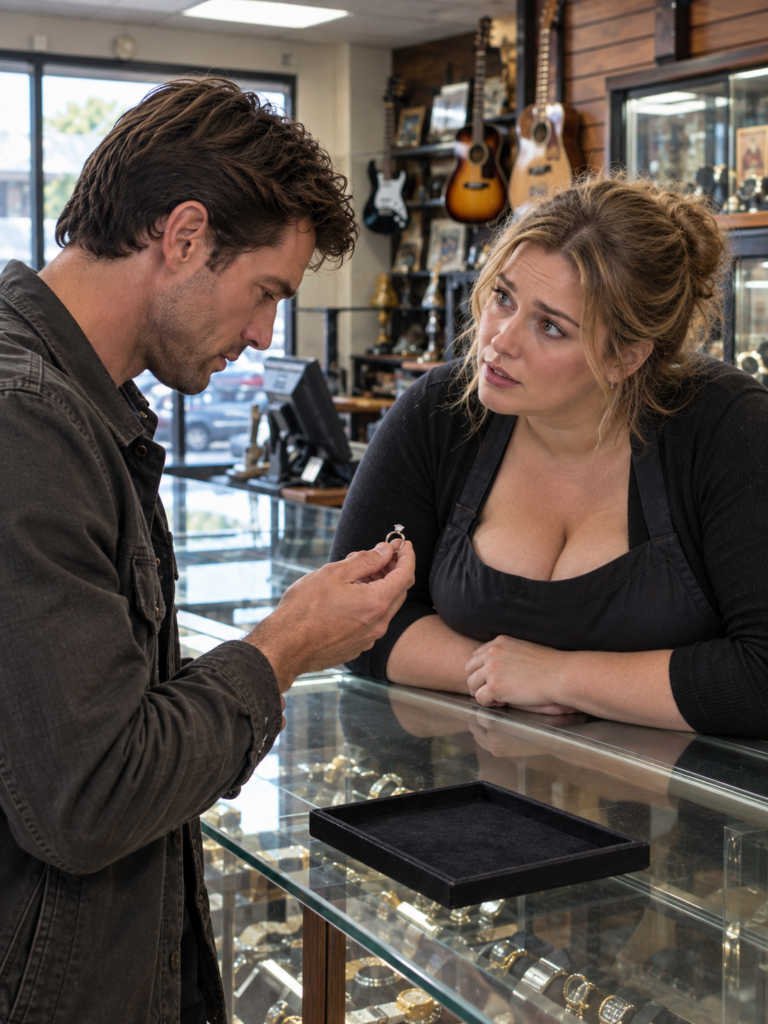
Two blocks from my apartment stood the pawn shop I’d walked past hundreds of times. It sat between a laundromat and a pizza place, with dusty windows crowded by old guitars, cameras, watches and things nobody seemed to need anymore.
I understood that window differently now.
The bell over the door gave a tired little jingle when I stepped inside.
The place smelled faintly of old paper, dust and metal.
Shelves covered every wall.
Tools.
Electronics.
Musical instruments.
Jewelry.
The inventory of people deciding that something they once wanted wasn’t worth keeping anymore.
Behind the counter stood a woman with reddish-brown hair pulled into a ponytail.
She looked around thirty.
She wore a gray sweater with the sleeves pushed to her forearms, and she was writing something in a ledger when she heard the bell.
“Morning.”
Her voice was calm.
Not cheerful in the fake customer-service way.
Just calm.
“What can I help you with?”
I walked to the counter.
My hand stayed in my pocket longer than it needed to.
Then I pulled out the velvet box and placed it between us.
“I need to sell this.”
She looked at me before she touched it.
Noticed the way I said need, maybe.
Then she opened the box.
The diamond caught a strip of morning light coming through the dusty window.
She turned it carefully.
“You sure about this?”
“Yeah.”
She looked at the ring again.
“It’s beautiful.”
I said nothing.
“Good-quality diamond too.” She glanced at me. “Whoever this was for is pretty lucky.”
A laugh escaped me.
There wasn’t anything funny in it.
“She didn’t think so.”
The woman went still.
Not dramatically.
Just enough that I knew she’d heard everything I hadn’t said.
She closed the box gently.
“I’m Rachel.”
“Marcus.”
“And I’m guessing there’s a story.”
“Not much of one.”
Her expression suggested she didn’t believe that, but she didn’t challenge me.
“I asked my girlfriend to marry me. She said she needed time.”
Rachel waited.
“Which meant no.”
She gave a small nod.
“Now I want the ring gone.”
That was when she did something I wasn’t expecting.
She didn’t tell me I was better off.
Didn’t insult Sophie.
Didn’t ask what happened.
She took a jeweler’s loupe from beneath the counter and said, “Give me a minute to look at it properly.”
So I stood there while she worked.
That simple decision—to treat the ring like an object instead of my entire ruined future—was probably the first kind thing she did for me.
I looked around while she examined it.
An old trumpet sat on a shelf beside a cordless drill.
There were watches in a glass display case.
A stack of cameras.
A guitar missing two strings.
I wondered how many objects in the store had entered through the same door with someone saying, I just need it gone.
Rachel straightened.
“I can give you two hundred.”
I didn’t even think about whether that was a good price.
“Okay.”
“You want a minute?”
“No.”
She studied me again.
Then she reached for the paperwork.
Her handwriting was neat and compact. She wrote down the ring’s description, identification information and whatever else pawn shops needed to record.
I watched her because watching the paperwork was easier than watching the ring.
Then, without looking up, she said, “For what it’s worth, whoever said no to this must’ve been out of her mind.”
I blinked.
“What?”
Now she looked at me.
“If somebody cared enough about me to work and save for a ring like that, then plan a whole proposal…” She gave one shoulder a slight lift. “I’d have said yes without thinking twice.”
She didn’t say it flirtatiously.
That mattered.
She wasn’t trying to pick up the recently rejected guy across the counter.
It sounded almost like she was correcting a fact I’d gotten wrong about myself.
I looked down.
“Thanks.”
“I mean it.”
Something loosened in my chest.
Not much.
Enough to notice.
Rachel slid the paperwork toward me.
“Sometimes things don’t work out the way we planned. Doesn’t automatically mean we did something wrong.”
I signed my name.
She counted out two hundred dollars.
I put it in my wallet.
The ring stayed on her side of the counter.
For the first time in months, it was no longer mine.
I expected that to hurt.
Instead, I mostly felt tired.
At the door, Rachel said, “Take care of yourself, Marcus.”
I nodded and walked home.
The apartment was still empty.
Sophie’s side of the closet was still bare.
Her coffee mug was still missing from the cabinet.
But the nightstand held nothing.
That helped.
A little.
The next few days, I worked.
I rebuilt part of a transmission on a Ford pickup.
Changed brakes on an old Honda.
Did an oil change on a Mercedes whose owner spent the entire time complaining about how long oil changes took.
Grease under my nails made sense.
Engines made sense.
A problem produced symptoms. You found the cause. You replaced the bad part or repaired what could be repaired.
People weren’t like that.
At night, though, I kept remembering Rachel.
Not the way she looked.
What she’d said.
I’d told myself Sophie’s rejection meant I’d been foolish.
Rachel had looked at the same evidence and reached a completely different conclusion.
On Friday after work, I found myself walking down the block where the pawn shop was.
My apartment was in the opposite direction.
I knew that.
My feet apparently didn’t.
I reached the dusty window and saw Rachel helping an older man inside.
Immediately, embarrassment hit me.
What was I doing?
Returning to visit the woman who had bought my failed engagement ring?
I turned around.
“Marcus?”
I stopped.
Rachel stood in the doorway.
“Thought that was you.”
“Hey.”
“You okay?”
“Yeah. Just walking.”
She looked toward the direction I’d come from, then toward the street leading to my apartment.
I wondered if she knew enough about the neighborhood to realize what a bad lie that was.
If she did, she let me keep it.
“I made coffee,” she said. “Want some?”
I should have said no.
Instead, I said, “Sure.”
The coffee was awful.
Strong, burnt and served in cheap paper cups.
I drank it anyway.
We stood by the counter.
For a while neither of us seemed in a hurry to fill the silence.
Then Rachel asked, “How’ve you been?”
“Getting through it.”
“Work helping?”
“Yeah.”
“What do you do?”
“I’m a mechanic.”
Her eyebrows lifted.
“That explains the hands.”
I looked down.
Even after washing, there was a dark line of grease beside one thumbnail.
“Occupational hazard.”
“I’m useless with anything mechanical.”
“That’s what mechanics are for.”
She smiled.
It was the first time I’d tried to be funny in more than a week.
We talked.
She told me she’d owned the pawn shop for four years.
Her father had run it before her.
“I never planned to take over,” she said. “Then he died, and selling it felt wrong.”
She looked around the crowded room.
“It’s funny. You make plans. You think you know where you’re headed. Then everything shifts and you end up somewhere completely different.”
“Yeah.”
I looked at my paper cup.
“I’m learning that.”
Rachel was quiet.
Then she said, “Can I ask you something?”
“Sure.”
“You don’t have to answer.”
“Go ahead.”
“Do you regret proposing?”
The question surprised me.
I’d spent eight days asking myself whether proposing had been stupid.
I hadn’t asked whether I regretted doing it.
“No,” I said finally.
Rachel waited.
“I regret that she said no. But asking her…” I rubbed the edge of the paper cup with my thumb. “It felt right at the time. I loved her. I thought she was the one.”
“That takes courage.”
I laughed softly.
“Doesn’t feel courageous when you’re eating cereal alone for dinner.”
Rachel laughed.
Not politely.
Really laughed.
I laughed too.
And for about five seconds I forgot I was supposed to be miserable.
When I left, sunset had turned the windows across the street orange.
Rachel walked me to the door.
“You’re welcome back anytime.”
I looked at her.
“Even if I don’t have another engagement ring?”
“Especially then.”
I smiled.
“Thanks.”
I walked home feeling lighter.
Not healed.
Not suddenly okay.
Just lighter.
At the time, I thought Rachel had helped me survive an embarrassing week.
I didn’t know I’d just started building a routine around the person who would eventually change what that ring meant.
Part 2
At first, I kept pretending I had business at the pawn shop.
I brought in an old camera that hadn’t worked properly in years.
Then a watch my uncle had given me that lived permanently in a drawer.
Then a duplicate toolbox.
Rachel inspected each item with the seriousness of someone who understood I didn’t actually care what any of it was worth.
After the transaction, one of us would make coffee.
We’d talk.
The first visits lasted twenty minutes.
Then forty.
Then an hour.
Rachel told me stories about the things people tried to pawn.
“A stuffed parrot,” she said one afternoon.
“A real parrot?”
“Taxidermy.”
“That’s worse.”
“He was offended I didn’t want it.”
Another customer had brought a grocery bag full of bottle caps and claimed they were collectible.
“Maybe they were.”
“You want me to call him? I still have the number.”
“I’m good.”
By the third week, I stopped bringing objects.
I’d walk in after work wearing my Patterson’s shirt and work boots.
Rachel would see me through the glass and start pouring coffee.
There was comfort in that.
A cup waiting before I asked.
A stool behind the counter that became mine without anyone saying so.
A person who expected me.
Sophie and I had shared routines too.
That realization bothered me at first.
Then I noticed the difference.
With Sophie, toward the end, routine had become something I stopped seeing.
With Rachel, every small habit felt chosen.
One Thursday afternoon, business was slow.
Rachel locked the display case she’d been rearranging and sat on the stool beside mine.
We were talking about food.
I told her no restaurant had ever made meatloaf as good as my mother’s.
She accused me of judging food based entirely on nostalgia.
Then she became quiet.
“I was married once.”
I turned toward her.
She looked into her coffee.
“For two years.”
There was something in her voice that told me not to say the first reassuring thing that came into my head.
So I waited.
“We were young. I was twenty-three when we got married. Thought we had everything figured out.”
She smiled, but there wasn’t much humor in it.
“We wanted kids.”
My stomach tightened before she continued.
“I got pregnant about a year later.”
Her fingers pressed against the paper cup.
“We lost the baby at five months.”
“Rachel…”
“The doctors said these things happen. Nobody’s fault.”
She stared ahead.
“I heard the words. Didn’t believe them.”
“I’m sorry.”
She nodded once.
“My husband couldn’t handle it either. We stopped being good at being sad together.”
That sentence stayed with me.
She didn’t make him a villain.
Didn’t excuse him either.
“He started staying late at work. We barely talked. Six months later, he said he couldn’t do it anymore.”
“He left?”
“Yeah.”
I didn’t know what to say.
Compared with that, being rejected at a steakhouse felt embarrassingly small.
Apparently my face gave me away.
Rachel turned toward me.
“Don’t do that.”
“Do what?”
“Decide your pain doesn’t count because somebody else had worse pain.”
I looked at her.
“I wasn’t—”
“You were.”
A reluctant smile touched my mouth.
“Okay. Maybe.”
“Pain isn’t a competition, Marcus.”
She looked away.
“I was angry for a long time. At him. At myself. At every woman pushing a stroller in the grocery store.”
Her voice stayed steady.
“Then my dad died two years later.”
I exhaled.
“Rachel.”
“Yeah. That stretch wasn’t exactly my favorite.”
She looked around the pawn shop.
“He left me this place. I had to decide whether I was going to keep drowning or start swimming.”
“You chose swimming.”
“Eventually.”
That word felt more honest than some inspirational answer.
“Some days I’m still just treading water.”
We sat quietly.
People passed outside the front window.
Cars moved through the intersection.
Life doing what it always did—continuing whether you were ready or not.
Finally Rachel stood.
“Sorry. Didn’t mean to dump all that on you.”
“Don’t apologize.”
She looked at me.
“Thank you for telling me.”
Something changed then.
Not attraction exactly.
Or not only attraction.
Trust had weight.
She’d handed me part of her history that couldn’t be turned into a joke over burnt coffee.
I wanted to handle it carefully.
Rachel stretched her shoulders.
“Okay. Enough emotional excavation. Want to help me reorganize the back room?”
I laughed.
“That’s your transition?”
“Yes.”
“From devastating personal trauma to manual labor?”
“I contain multitudes.”
The back room was chaos.
Boxes stacked behind boxes.
Old records.
Broken radios.
Vintage comics.
And seventeen snow globes.
I counted.
“Why do you own seventeen snow globes?”
“I don’t own them emotionally.”
“Pretty sure that’s not how inventory works.”
She picked up one with a miniature Statue of Liberty.
“People pawn weird things.”
We spent two hours moving shelves and sorting boxes.
Rachel had a system in her head that made no sense until suddenly it did.
I noticed she was good at the work.
She remembered which customer had pawned which guitar six months ago. She knew watches by manufacturer and tools by resale value. She could tell from a person’s first two sentences whether they wanted money or simply wanted someone to listen.
She noticed things.
Maybe that was why she’d noticed me.
When we finished, she stood in the doorway of the back room with her hands on her hips.
“Okay. That’s actually impressive.”
“You’re welcome.”
“You’re pretty handy to have around.”
“I’m a mechanic.”
“You’ve mentioned.”
“Organization is half the job.”
“The other half?”
“Swearing at bolts.”
Rachel laughed.
Then she said, “Let me buy you dinner.”
“You don’t owe me dinner.”
“I know.”
That was why I went.
The diner was three blocks away.
Red vinyl booths.
Laminated menus.
A waitress who called everyone honey.
Rachel ordered a burger and fries.
I ordered the same.
No candles.
No blue shirt.
No velvet ring box in my pocket.
It was one of the easiest meals I’d had in years.
She told me she’d once tried to dye her hair blonde and accidentally turned it green.
I told her I knocked over a mailbox the day I got my driver’s license.
“Did you fix it?”
“Eventually.”
“Your poor father.”
“He made me dig the post hole myself.”
“Good man.”
“He enjoyed it too much.”
When we left, streetlights were coming on.
We walked toward the pawn shop slowly.
“This was nice,” Rachel said.
“Yeah.”
“We should do it again.”
“I’d like that.”
At her car, she unlocked the door, then paused.
“Marcus?”
“Yeah?”
“Can I say something without making it weird?”
“Depends how weird.”
That got a small smile.
“I’m glad you came into my shop that day.”
She glanced toward the dark window.
“Even if the reason was awful.”
I looked at her.
“Me too.”
Driving home, I realized Sophie hadn’t entered my mind all day.
The realization produced guilt first.
Then relief.
Then guilt about the relief.
Healing apparently wasn’t organized either.
The next week, Sophie texted.
I was eating lunch in my truck outside Patterson’s when her name appeared on my screen.
For a second, everything inside me reacted the old way.
Immediate attention.
Hope.
Fear.
The message was short.
Hey. I’ve been thinking about you a lot. Can we talk? I think I made a mistake.
I read it again.
And again.
Three weeks earlier, I would have responded before finishing the sentence.
I would have driven across town.
I would have taken her back before she could explain why she wanted to return.
Instead I sat there with grease under my fingernails and Rachel’s laugh still somewhere in my memory.
For the first time, wanting Sophie back wasn’t automatic.
That frightened me.
I finished my shift without replying.
Went home.
Changed clothes.
The phone sat on my kitchen counter.
At eight, I picked it up.
Then walked to the pawn shop.
Rachel was pulling the metal grate over the front entrance when I reached her.
“Hey.”
She turned.
“Marcus?”
Then she saw my face.
“What happened?”
“Sophie texted.”
Rachel’s expression changed.
Only slightly.
“Says she made a mistake. Wants to talk.”
“Oh.”
She locked the grate.
“What did you say?”
“Nothing.”
Rachel leaned against the doorway.
“What do you want to say?”
“I don’t know.”
“Then don’t answer until you do.”
I shoved my hands into my jacket pockets.
“A month ago, I would’ve said yes immediately.”
“Okay.”
“I’d have taken her back without asking a single question.”
Rachel didn’t interrupt.
“And now…”
I looked down the street.
“Now I’m not sure I want that.”
“Why?”
“Because I’ve been happy.”
That word surprised me.
So I said it again.
“Actually happy.”
Rachel’s eyes met mine.
“Not all the time. I’m still angry sometimes. I still feel stupid. But lately I wake up and I want to go to work. I want to come here.”
My voice caught slightly on the last part.
“I don’t want to go backward just because the old door opened again.”
Rachel nodded.
“That makes sense.”
Something in her restraint made the next words possible.
She wasn’t telling me to choose her.
Wasn’t even asking to be chosen.
“Rachel.”
“Yeah?”
“I need to tell you something.”
Her shoulders became very still.
“Okay.”
“I didn’t come here because I needed advice about Sophie.”
A pause.
“Not completely.”
I moved a little closer.
“I came because I wanted to see you.”
Rachel looked at me for a long moment.
“Marcus…”
“I know it’s only been a few weeks. I know I’m probably still a disaster.”
“You’re not a disaster.”
“Pretty close.”
“No.”
She said it firmly.
“You’re somebody who got hurt and is healing. That’s different.”
I looked toward the phone in my hand.
“So what do I do about Sophie?”
Rachel smiled, but there was sadness in it too.
“That’s your decision.”
Of course it was.
She would not make it for me.
That was probably why I trusted her enough to make it myself.
“But,” she added, “I think you already know what you want.”
I did.
I looked at Sophie’s message one last time.
Then deleted it.
No dramatic reply.
No speech.
No punishment.
Just a closed door.
Rachel didn’t celebrate.
She simply stood beside me.
That mattered too.
Things between us changed after that, but slowly.
Neither of us wanted to confuse relief with love.
Rachel had already built a life after one person left.
I had almost built my future around someone who didn’t want the same one.
So we kept doing ordinary things.
I repaired the pawn shop’s old heater.
Changed a broken shelf.
Painted the back wall where an old leak had left a brown stain.
Rachel tried to pay me.
I refused.
She threatened to start deducting my coffee.
“You can’t,” I said.
“Why not?”
“It’s terrible coffee.”
“Then you’re losing nothing.”
Sometimes we ate at the diner.
Sometimes pizza.
Sometimes Chinese food on the bench outside the shop.
One cold night in late February, we sat in her blue sedan eating tacos because it was too cold to sit outdoors.
The windows fogged.
Rachel wiped a circle in the glass with one finger.
“I need to tell you something.”
I lowered my taco.
“What?”
“I’m scared.”
“Of me?”
“Of this.”
She gestured vaguely between us.
“Us.”
I waited.
“I like you.”
The simplicity of the words hit harder than a dramatic confession would have.
“I like you enough that I can already see how much it would hurt if this went wrong.”
She looked embarrassed saying it.
“I spent years getting okay by myself. I don’t know if I know how to trust somebody with that again.”
I set my food down.
“I’m scared too.”
Rachel looked at me.
“Every time I realize how important you’ve become, part of me remembers Sophie.”
She flinched, barely.
I kept going.
“Not because you’re like her. Because you’re not.”
I reached across the center console.
Rachel looked at my hand before placing hers in it.
“I spent three years believing loving somebody meant I knew where the story was going.”
Her fingers tightened around mine.
“I don’t think that anymore.”
“What do you think?”
“That maybe you choose the next part without pretending you know the ending.”
Rachel looked at me for a while.
Then she smiled.
“That sounds terrifying.”
“It does.”
“Okay.”
“Okay?”
“Let’s keep being honest.”
“Deal.”
“And slow.”
“Deal.”
“And if you ever compare my coffee to Sophie’s—”
I laughed.
“I promise.”
There was no kiss in the rain.
No sweeping declaration.
Just two people in a fogged-up car eating tacos and agreeing not to lie about being afraid.
That was the night trust became something else.
Part 3
By April, I had saved enough money to take a risk I’d been thinking about for years.
My own repair shop.
Nothing big.
One garage bay on the edge of town.
An office that had probably started life as a storage closet.
A cracked concrete floor.
A heater that sounded like it resented being turned on.
Cheap rent because everything needed work.
I loved it immediately.
I told Rachel one afternoon while she was examining a necklace behind the counter.
“I think I’m opening my own shop.”
She looked up so quickly she almost dropped the necklace.
“What?”
“I found a place.”
“Marcus.”
“It’s small.”
“You’re serious.”
“Pretty serious.”
Rachel came around the counter and hugged me.
She wasn’t someone who hugged casually.
That made it different.
“I’m so proud of you.”
Four words.
I didn’t realize how badly I’d needed somebody to say them until she did.
For the next month, I spent every free hour preparing the garage.
Rachel painted walls.
Jake helped move equipment.
A couple guys from Patterson’s came over after work.
Even my boss donated an old tool chest.
“You’re doing good, kid,” he told me.
“Don’t forget about us when you’re rich.”
I laughed.
“It’s a one-bay garage.”
“Still yours.”
Opening day came on a Saturday in May.
I hung a simple sign outside.
MARCUS’ AUTO REPAIR.
Black letters.
Nothing fancy.
Rachel brought coffee and donuts.
The coffee was still terrible.
I drank two cups.
Only two customers actually needed work that day—an oil change and a brake inspection—but when I lowered the bay door that evening, I felt like I’d built an empire.
Rachel and I sat on the concrete floor with our backs against the wall.
The open bay framed the sunset.
“You did it,” she said.
“We did it.”
“I painted.”
“You did more than that.”
“I also brought donuts.”
“True.”
“Essential contribution.”
I laughed.
Then I looked around.
The lift.
The tools.
The sign visible backward through the window.
“You made me believe I could do this.”
Rachel’s teasing disappeared.
She reached for my hand.
“That’s what people who care about each other do.”
Something settled inside me.
Not excitement.
Not panic.
Certainty, maybe.
But different from the certainty I’d felt with Sophie.
Back then, certainty meant I thought I knew what would happen.
With Rachel, it meant I knew who she was when things were uncertain.
That mattered more.
The following Monday, I went to the pawn shop during lunch.
Rachel was helping a customer.
I waited near the counter until the man left.
“What brings you here in the middle of the day?” she asked.
“I need to buy something.”
She smiled.
“Finally. A legitimate customer.”
“Buy something back.”
The smile vanished.
“What?”
“The ring.”
Rachel stared at me.
“The engagement ring I sold you.”
Her face became unreadable.
“Marcus.”
“Do you still have it?”
“Yes.”
I exhaled.
“How much?”
She shook her head.
“You don’t have to do this.”
“I know.”
“That ring has bad memories.”
I thought about Riley’s.
Sophie’s tears.
My empty apartment.
The nightstand.
Then I looked at the woman standing behind the same counter where I’d tried to get rid of all of it.
“It has a history,” I said. “That’s not the same thing.”
Rachel didn’t speak.
“I’m ready to give it a new story.”
She walked into the back room.
When she returned, she carried the same small velvet box.
She placed it on the counter.
For a second neither of us touched it.
“Two hundred,” she said.
“That’s all?”
“That’s what I paid you.”
“Rachel—”
“Two hundred.”
I took the cash I’d brought from my wallet.
She accepted it slowly.
Then I picked up the box.
The weight of it was familiar.
But it didn’t feel like a thousand pounds anymore.
“Marcus.”
I put it into my jacket.
“What are you doing?”
“Something I’ve been thinking about for a while.”
Her eyes widened slightly.
I smiled.
Then left before she could stop me.
I waited until Friday.
Not because I doubted her.
Because I didn’t want the proposal to be about escaping my last proposal.
I’d learned that much.
I cleaned the garage after closing.
Swept the concrete.
Put my tools away.
My sister had once given me battery-powered candles as a joke after hearing about my disastrous steakhouse proposal.
I finally found a use for them.
Rachel arrived around seven.
She stepped inside and looked around at the candles.
“Oh no.”
I laughed.
“That’s your reaction?”
“You know this looks suspicious.”
“Come here.”
She walked toward me.
I was nervous.
More nervous than I had been at Riley’s.
But fear didn’t mean the same thing anymore either.
I looked at Rachel and thought about the first morning in the pawn shop.
The gray sweater.
The bad coffee.
The way she’d asked whether I was sure before taking the ring.
“Remember when I sold you something?”
Her mouth opened slightly.
“Marcus.”
“You said something that day.”
I reached into my pocket.
Rachel covered her mouth.
“You said if somebody cared enough to save for a ring like that, you’d say yes.”
I pulled out the velvet box.
Her eyes filled instantly.
“I bought this ring because I thought I understood love.”
I opened the box.
The diamond caught the garage lights.
“I thought love was knowing. Knowing somebody was the one. Knowing what the future looked like. Knowing there would be a yes because you’d planned everything correctly.”
Rachel’s eyes stayed on mine.
“I was wrong.”
My voice wasn’t perfect.
I didn’t need it to be.
“Real love isn’t knowing everything.”
I thought of burnt coffee.
Snow globes.
A back room full of boxes.
Tacos in a fogged car.
Paint on Rachel’s cheek while she helped me fix the garage.
“It’s somebody staying when you’re not impressive. It’s being honest when you’re scared. It’s helping paint a wall because it matters to the person you’re painting it with.”
Rachel laughed through her tears.
“It’s remembering how somebody drinks terrible coffee.”
“My coffee is not terrible.”
“It absolutely is.”
She laughed again.
So did I.
Then I grew serious.
“You didn’t fix me, Rachel.”
Her expression softened.
“You didn’t rescue me from Sophie. You just gave me room to become myself again.”
My throat tightened.
“And somewhere along the way, I started wanting a future not because I was afraid of being alone, but because I wanted you in it.”
I got down on one knee.
Rachel pressed both hands over her mouth.
“When I bought this ring, I thought it was meant for the love of my life.”
I looked at her.
“Turns out I just hadn’t met her yet.”
Tears slipped down her cheeks.
“Rachel, will you marry me?”
For one terrible second, my body remembered Riley’s.
Silence.
A ring.
A woman crying.
The memory passed through me like an old scar aching in cold weather.
Then Rachel nodded.
“Yes.”
I almost laughed from relief.
“Yes, Marcus.”
She was crying harder now.
“Absolutely yes.”
I stood.
Rachel threw her arms around me.
I held her in the middle of my garage, surrounded by tool cabinets and cheap battery candles.
There was no restaurant.
No waiter.
No audience.
Just us.
When we finally separated, I took the ring from the box.
Her hand shook as I slid it onto her finger.
It fit perfectly.
Rachel stared at it.
“I can’t believe you came back for it.”
“I can’t believe you kept it.”
She smiled.
“I couldn’t sell it.”
“What?”
“Every time I thought about putting it out, something stopped me.”
“Why?”
She looked at the diamond.
“I don’t know. Maybe I thought it wasn’t finished with its story.”
I laughed.
She wiped her face.
“When people ask how we met, I’m telling them you came into my shop trying to pawn your broken heart.”
“That’s terrible.”
“And I refused to take it.”
“Technically you did take the ring.”
“Don’t ruin my version.”
“Best business decision you ever made.”
“Obviously.”
We married four months later at the courthouse.
Family.
Close friends.
Nothing elaborate.
Rachel wore a simple white dress.
I wore the blue shirt.
The same one I’d worn to Riley’s.
My sister asked whether that was intentional.
It was.
I didn’t want to spend the rest of my life treating everything connected to Sophie like it had been poisoned.
A shirt could just be a shirt again.
A ring could become someone else’s promise.
A man could survive being wrong about his future.
Rachel and I kept both businesses.
Most mornings, she’d open the pawn shop while I headed to the garage.
Some afternoons, I’d cross over to fix something she’d been ignoring.
Sometimes she’d appear at my place carrying paperwork, food or coffee.
People around town got used to us.
The mechanic and the pawn shop owner.
Seven years apart in age.
Two businesses.
Two people who hadn’t been looking for each other when they met.
On our first anniversary, Rachel handed me coffee in one of the cheap paper cups she still kept behind the counter.
I took a drink.
Made a face.
“Still burnt.”
“Some things never change.”
She leaned against the counter.
The ring caught the light when she lifted her own cup.
I looked at it for a moment.
The first time I carried that ring into the pawn shop, I thought getting rid of it would erase something.
It didn’t.
Nothing erases what happened.
The rejection happened.
Sophie’s tears happened.
Rachel’s loss happened.
Her husband leaving happened.
Her father dying happened.
Those things remained part of us.
They simply stopped being the only things that defined what came next.
I wasn’t the man staring at an empty nightstand anymore.
Rachel wasn’t the woman who believed loving someone meant eventually losing them.
We hadn’t rescued each other.
We’d done something quieter.
We’d paid attention.
We’d told the truth.
We’d kept showing up.
The ring made two trips through the pawn shop.
The first time, I carried it inside because I thought the story attached to it was over.
The second time, I carried it out because I finally understood something.
Objects don’t decide what they mean.
People do.
And sometimes the place you walk into because you’re desperate to let go of the past becomes the place where the rest of your life begins.