Part 1
Three days after my unit landed back on American soil, I drove the last stretch into Colton Falls with both hands on the wheel and no idea what I was supposed to feel.
Relief, probably.
That was what everybody kept saying.
Good to be home, Sergeant.
Bet you’re glad to sleep in your own bed.
There’s no place like it.
The problem was that home, as I remembered it, contained my mother.
And my mother had been dead for four months.
So when I turned onto Birch Hollow Road just before midnight and saw the dark outline of the little two-story house at the end of it, relief wasn’t the first thing that came.
It was guilt.
Then grief.
Then the stubborn, useless thought that if I had gotten the Red Cross message sooner, or if leave had moved faster, or if the hospital had managed to keep her alive three more days, maybe I could have been there.
I knew better than most men that death did not negotiate with schedules.
Knowing something professionally did not mean you believed it personally.
I parked my truck beneath the maple tree she used to complain was killing the lawn, carried my duffel to the porch, and stood there longer than necessary with the key in my hand.
The brass was worn smooth.
I had carried it since I was twelve.
Two deployments. Three moves. More field rotations than I cared to count.
Somehow I had never considered that one day I would use it to unlock a house that no longer contained the person who had given it to me.
The porch light didn’t come on.
Halfway through the door, I remembered why.
Nobody had paid the electricity in four months because nobody was supposed to be living here.
Which was why the light beneath the kitchen door stopped me cold.
Not electric light.
It flickered.
Candlelight.
My duffel lowered silently to the floor.
Something inside me changed gears without permission.
The exhaustion disappeared. The ache in my shoulders disappeared. Even the grief stepped aside.
I listened.
A drawer.
Wood sliding against wood.
Then a soft knock, like a cutting board being set on a counter.
Someone was in my mother’s kitchen at eleven forty-five at night.
I moved down the hall with my weight toward the outside edges of my boots, shoulder close to the wall, breathing shallowly enough that I could hear beyond it.
Ten months overseas had trained certain reactions past thought.
You did not wonder whether a room was dangerous.
You cleared it.
I pushed open the kitchen door.
The woman at the table rose so fast her chair scraped backward.
Her hand closed around a paring knife.
Mine lifted automatically.
“Don’t move.”
The command came out flat.
Too flat.
She froze.
For one second we simply stared at each other across the candle.
Her hair had been pulled into a practical braid, though several strands had come loose around her face. She wore an oversized sweater and jeans. No shoes. There was a half-peeled apple on the cutting board and one dented can of soup beside the sink.
Her grip on the knife was wrong for someone planning to attack.
Too tight.
Too defensive.
More important, she wasn’t watching my hands.
She was watching the doorway behind me.
Counting distance.
Planning escape.
“I’m not going to hurt you,” I said.
Her eyes finally shifted to mine.
“This is my house. I need you to tell me who you are and why you’re in it.”
Something happened when I said my house.
Not fear.
Recognition.
Her hand loosened.
Then she set the knife down carefully.
Not dropped.
Set.
A distinction I noticed because I had spent the better part of a year noticing distinctions people thought were too small to matter.
She turned fully toward me.
The candle caught the edge of her face.
There was something familiar there.
Not the face itself.
The way she lifted her chin.
A fraction too high.
Like she had learned a long time ago that if you looked afraid, some people enjoyed it.
“Caleb.”
My name landed harder than it should have.
I searched her face.
Nothing.
Thirty-one years of memory and thirteen years of distance moved behind my eyes, and I hated the moment I saw the understanding in hers.
She knew I didn’t know her.
Her mouth tightened.
“Don’t you recognize me?”
I set my duffel against the wall.
Slowly.
“I don’t.”
The answer felt cruel despite being true.
She looked away.
“Josie.”
Still nothing.
“Josie Hale.”
Then, almost reluctantly, “Your mom used to call me Bird.”
The room changed.
I saw a skinny sixteen-year-old sitting cross-legged on our living-room floor with algebra homework spread around her.
A girl who hoarded crackers in dresser drawers because some previous house had taught her food disappeared if you didn’t hide it.
A girl my mother had brought home on a Friday night because the county had nowhere else to place her.
Bird.
She had lived with us nine months.
I’d been eighteen, impatient to graduate, already enlisted, certain my life was waiting somewhere larger than Colton Falls.
Then Josie had been transferred to a foster placement two counties away.
No real goodbye.
Just an empty spare room and my mother saying, She needed somewhere else for a while.
“Bird,” I said.
Her eyes came back to me.
There she was.
Not the girl.
Something harder to explain.
“You grew up.”
A faint, almost disbelieving smile touched her mouth.
“So did you.”
It was such an obvious thing to say that, under different circumstances, I might have laughed.
Instead I looked around the dead-dark kitchen.
“Why are you here?”
The smile disappeared.
“My mother told you where the spare key was?”
“Years ago.”
“Behind the loose brick.”
She nodded.
I remembered the brick.
Mom had hidden emergency cash there when I was a kid, until she realized I knew where it was.
“You two stayed in contact?”
“Not at first.”
Josie folded her arms across herself.
Fourteen-year-old me would have thought she was cold.
Thirty-one-year-old me knew better.
“I found her again four years ago. I wrote to thank her.”
“For what?”
Her expression shifted.
“For feeding me dinner without making me feel like somebody was keeping a receipt.”
I had no answer to that.
“She wrote back,” Josie continued. “Then I wrote again.”
“Four years.”
Something ugly moved under my ribs.
Not anger at her.
Maybe jealousy.
Which was worse, because jealousy of a dead woman’s letters was an embarrassing thing for a grown man to discover about himself.
“You knew my mother for the last four years, and I didn’t even know you were back in her life.”
“I asked her not to tell you.”
That stopped me.
“Why?”
“I wasn’t ready.”
“For what?”
“For you.”
The answer came too quickly to be invented.
Then she looked away like she regretted saying even that much.
I should have pressed.
I didn’t.
“Why are you here tonight, Josie?”
Her attention moved to the back door again.
“Because I didn’t have anywhere else that felt safe.”
Every instinct I had sharpened.
“Safe from who?”
She went still.
Not frozen.
Controlled.
“There’s a man named Derek.”
I waited.
“I was supposed to marry him this spring.”
Was.
“I left nine days ago.”
She drew a breath.
“I don’t think he’s stopped looking for me.”
The soldier in me wanted facts.
Description.
Vehicle.
Weapons.
Known associates.
Last confirmed location.
The medic in me saw something else.
The too-careful way she kept her left arm near her body.
The shadows beneath her eyes.
The fact she had chosen a house with no electricity because dark and cold felt safer than wherever she had come from.
The woman standing in front of me was exhausted enough to shake and still tracking exits.
Questions could wait.
“Okay.”
She blinked.
“Okay?”
“You can stay tonight.”
Her mouth opened.
I held up a hand.
“Not forever. Not because I understand any of this yet. But you’re not going back outside at midnight.”
“You just got home.”
“I noticed.”
“Caleb—”
“We’ll figure it out in the morning.”
Something in her face softened so briefly I almost missed it.
Not trust.
Not yet.
But maybe the possibility of it.
That first night, it was enough.
Morning exposed the house.
Cold rooms.
Dust on the furniture.
A stack of unopened mail.
My mother’s reading glasses exactly where she had left them beside the recliner.
It also exposed how Josie had been living.
A sleeping bag in the hall closet.
Canned food behind the water heater.
Two bottles of drinking water under the sink.
Everything she owned packed so that it could disappear in less than a minute.
I stood looking at it longer than I meant to.
“What?”
Josie was in the doorway behind me.
“Nothing.”
“That’s not a nothing face.”
“I didn’t know I had one.”
“You do.”
There was the faintest trace of the girl I remembered.
Not in her face.
In the dry delivery.
“You’ve been sleeping in the closet?”
“The hallway is visible from three windows.”
“And the closet isn’t.”
“No.”
I rubbed a hand over my mouth.
Then I called the power company.
Four months of unpaid charges turned out to be surprisingly easy to solve when the account holder’s son had a debit card and no energy left to argue about late fees.
The furnace came on that afternoon.
The ducts coughed.
Pipes clicked behind the walls.
Warm air rolled through the kitchen.
Josie stood over the vent.
Not dramatically.
She just stopped there.
For several seconds.
Like warmth was something she had forgotten she was allowed to notice.
“You didn’t have to pay all that because of me.”
“I didn’t.”
She frowned.
“I paid it because I’m living here.”
“You would have waited.”
Probably.
“That’s irrelevant.”
“It isn’t to me.”
I looked at her.
She looked back.
Thirteen years vanished for an instant—not because she looked sixteen, but because I remembered exactly how intensely she had always watched people when they did something kind, as if kindness was a trick she could learn if she studied hard enough.
“Then consider it rent,” I said.
“For what?”
“For not making me sit in this mausoleum alone.”
That was the first honest thing I had told her.
Her expression changed.
She didn’t thank me again.
I was grateful.
Mrs. Abernathy arrived the next day with casserole.
She had lived next door since before I was born and regarded privacy as a suspicious modern development.
She took one look at me, one look through the screen door where Josie was pretending not to listen, and handed me the dish.
“You didn’t tell me you had a girl here.”
“She’s not—”
“Mhm.”
“She’s an old friend.”
“Of course.”
I gave her a look.
Mrs. Abernathy ignored it.
“Your mother would’ve liked her.”
“She already did.”
That made the old woman’s face soften.
“I know.”
I stared.
Mrs. Abernathy patted my arm.
“Your mother told me more things than she told you, Caleb. Try not to take it personally.”
Then she walked home.
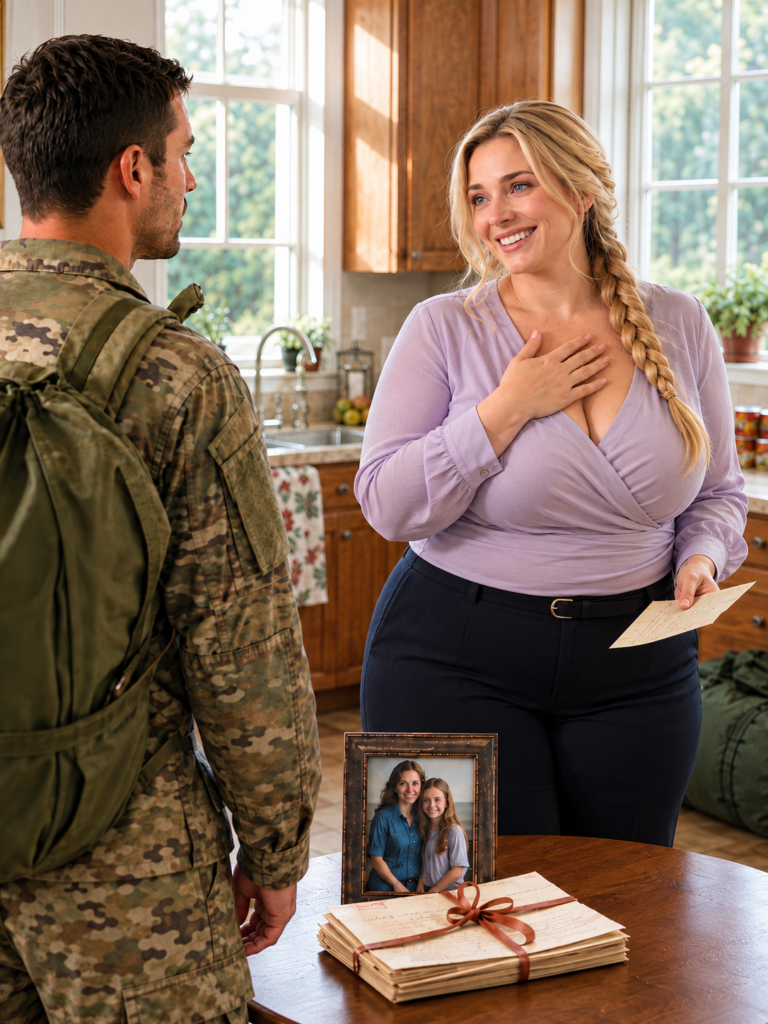
I found the letters four days later.
Twenty-seven.
Rubber-banded by year.
My mother had kept them in the cedar chest at the foot of her bed beneath insurance papers and an old knitted blanket.
Josie Hale.
The handwriting grew steadier from the oldest stack to the newest.
I knew I should stop.
I read them anyway.
A first apartment.
Community college.
A veterinary technician program.
A graduation my mother had apparently driven six hours to attend without ever mentioning it to me.
Then Derek.
At first he existed only in margins.
Someone new.
Someone attentive.
Someone who remembered what coffee she liked.
Later, engagement.
My mother’s reply had been tucked inside Josie’s next letter, because Mom saved copies of everything.
He seems like the kind of man who needs you smaller than you are, Bird.
Watch for that.
“You found them.”
I looked up.
Josie stood in the doorway.
Her face told me immediately that whatever apology I gave would not be enough.
“I was looking for the deed.”
“And accidentally read four years of mail?”
“No.”
The word surprised her.
I set the letters down.
“I read them because I wanted to know.”
She folded her arms.
“Know what?”
“What she knew about you that I didn’t.”
For a moment neither of us spoke.
Then she said, “They were the only thing that was mine.”
Her voice had gone quiet.
Everything about her became quiet when something hurt.
“Derek checked my phone. My email. My bank statements. He always had reasons. Those letters were the one place he never looked because I had them sent to a post-office box near work.”
I felt sick.
“I’m sorry.”
“I know.”
“No. I invaded something you protected for years.”
That made her look at me.
I continued because she deserved the whole sentence.
“I’m sorry.”
She considered me.
Then her mouth moved slightly.
“I guess that makes us even for me pulling a knife on you.”
“Not remotely.”
“Let me have this.”
A laugh escaped me before I could stop it.
Small.
Rusty.
The first one in months.
Her eyes widened, and then she smiled.
Not much.
Enough.
I looked at the letters between us.
It occurred to me that my mother had spent four years knowing a version of Josie I had missed entirely.
And somehow, by keeping every envelope, she had left me a way back.
Part 2
Mrs. Abernathy brought news before she brought another casserole.
“A man was asking around the diner.”
I had been replacing a loose porch board when she leaned over the fence.
“What man?”
“Dark hair. Expensive coat. Dark sedan with out-of-state plates.”
The hammer stopped in my hand.
“He showed Carla a picture of a woman. Said his fiancée was missing.”
“What did Carla tell him?”
“Nothing useful.”
Mrs. Abernathy’s mouth flattened.
“He offered money if she remembered anything.”
The porch beneath me suddenly felt too exposed.
“Did he leave a name?”
“No. Left a card.”
She reached into her cardigan pocket and handed it over.
Voss Development Foundation.
Derek Voss.
I found Josie behind the house pulling dead tomato vines from stakes.
“He’s here.”
Her hand stopped.
That was all.
“In town?”
“Diner. Yesterday, maybe the day before.”
She stared at the dead vine between her fingers.
“That’s faster than I hoped.”
“And?”
Her mouth twisted.
“Slower than I feared.”
I set the card on the garden bench.
“You need to tell me everything.”
She looked at me.
“Everything?”
“Not the version you think I can handle. Not the version that makes you sound less afraid. Everything.”
Her eyes dropped to the card.
Then she nodded.
“Inside.”
We sat at the kitchen table.
The same one where I had found her with the knife.
This time the lights were on.
Somehow that made what she told me worse.
Derek had not started cruel.
He had started attentive.
He learned her schedule because he wanted to bring her lunch.
He remembered the names of her coworkers.
He offered to handle bills because numbers stressed her out.
He disliked one friend because she was “negative.”
Another because she was “jealous.”
Another because she “didn’t respect relationships.”
He never said, Stop seeing them.
He simply made every visit cost enough emotionally that eventually Josie stopped making them.
“He was good at making things feel like my decision.”
Her fingers rested flat against the table.
“He didn’t tell me to quit the clinic. He just kept pointing out that planning the wedding was becoming a full-time job, and his family foundation needed help, and we’d save money on commuting, and eventually I heard myself saying maybe I should leave.”
“You loved that job.”
She looked surprised.
“You remember?”
“You used to bring injured birds into my mother’s garage.”
“I was sixteen.”
“You were terrifying.”
A tiny smile.
“They needed help.”
“You once made me drive forty minutes for bird formula.”
“It was a fledgling grackle.”
“I don’t know what that means.”
“It means you bought the right formula.”
For a few seconds, Derek vanished from the room.
Then Josie’s smile faded.
“He grabbed me three weeks before I left.”
Her voice went flat again.
“I told him I wanted to postpone the wedding.”
My attention went to the faint discoloration near her jaw.
I had noticed it.
I had chosen not to ask before she was ready.
“He said I was humiliating him. I tried to leave the room. He caught my wrist.”
Her left hand shifted.
There it was.
“He let go. Apologized. Cried, actually. Said planning pressure had gotten to him.”
She gave a small humorless laugh.
“I almost comforted him.”
I said nothing.
“I filed a report nine days ago. Got an emergency protection order the next morning.”
“Good.”
“His lawyer narrowed it within forty-eight hours.”
“How?”
“Money. Connections. Language. Pick one.”
She leaned back.
“He’s not supposed to come within five hundred feet of me. He’s violated it twice already.”
My jaw tightened.
“And?”
“Both times police called it a misunderstanding.”
The old instinct came back.
Facts.
Names.
Jurisdictions.
Documentation.
Not because facts solved everything.
Because they gave fear edges.
Something you could grab.
“We document this one.”
“It wasn’t technically a violation. He asked about me in a diner.”
“Then we document that he’s looking.”
“You think paper will stop him?”
“No.”
That answer surprised her.
“I think paper gives the next person less room to pretend they didn’t see what happened.”
She studied me.
Then nodded once.
“I used my debit card the first night.”
“Where?”
“Gas station forty minutes from here.”
“That’s probably how he got close.”
“I know.”
“You were driving alone for nine hours.”
Her face tightened.
“I know that too.”
“I’m not criticizing you.”
“You should.”
“No.”
“Caleb, it was stupid.”
“It was human.”
She looked down.
I leaned my forearms on the table.
“People escaping bad situations don’t suddenly become tactical experts because the situation got bad.”
That earned the faintest breath of a laugh.
“Is that your professional assessment?”
“Very expensive Army training.”
Silence settled again.
Then Josie said, “I missed your mother’s funeral.”
The subject change hit me harder than Derek’s name had.
“I found out through an obituary.”
She swallowed.
“Derek had a foundation gala. He didn’t want me traveling alone.”
I understood the euphemism.
“He wouldn’t let you come.”
“He never said couldn’t.”
She stared at the wood grain between us.
“He said he was worried. Said it wasn’t safe for me to drive while upset. Said everybody was counting on us.”
Her voice cracked only once.
“I hated myself for staying.”
Something in me shifted.
I had spent months carrying my own absence from my mother’s death like a private failure.
Now Josie sat across from me carrying the same shape of grief for entirely different reasons.
“I missed it too.”
She looked up.
“The funeral?”
“Everything.”
I stared at the window.
“The Red Cross message got delayed. By the time it reached me, she was already gone.”
“I know.”
I turned.
“She told you?”
“No.”
Josie shook her head.
“Mrs. Abernathy.”
Of course.
“I spent months thinking if I’d been somewhere else, if the message had gone faster, if I’d pushed harder—”
“You were deployed.”
“Doesn’t stop the math.”
“No.”
Her answer was immediate.
“No, it doesn’t.”
No reassurance.
No meaningless absolution.
Just recognition.
Strangely, it helped more.
Two nights later I saw the way she rolled her left wrist before picking up the cast-iron skillet.
“Let me see that.”
“It’s fine.”
“Josie.”
She looked at me.
“I didn’t ask if it was fine.”
Something almost playful touched her face.
“You always this bossy?”
“Professionally.”
She held out her hand.
I took it carefully.
Old swelling. Reduced range of motion. Tenderness on one side.
“Old sprain.”
“I figured.”
“He did this?”
Her gaze met mine.
I wished the question back.
Not because I didn’t want the answer.
Because she had already had to give enough testimony in her life.
“You don’t have to answer.”
Her shoulders lowered.
“Thank you.”
I got tape from my field kit.
“It healed wrong. It’ll ache when it’s cold.”
“Excellent. I’ve always wanted a weather-predicting joint.”
“I can tape it.”
She sat while I wrapped her wrist.
I kept my touch clinical.
Not because I felt nothing.
Because she deserved to know the difference between care and possession.
Her fingers were cold.
“You’re good at this,” she said.
“At wrapping wrists?”
“At making help feel normal.”
My hands paused.
Then continued.
“Occupational hazard.”
“No.”
Her voice softened.
“That’s not just the Army.”
I finished the final strip.
“You spend enough time treating people on the worst day of their life, you learn the worst day isn’t the whole person.”
She watched me.
“What was yours?”
I should have made a joke.
I should have stood up.
Instead, perhaps because her hand remained in mine, I said, “Nash.”
“Who’s Nash?”
“Guy in my unit.”
The kitchen seemed suddenly too bright.
I looked down at the tape.
“He was twenty-three.”
Josie didn’t speak.
“I had him stable for eleven minutes.”
There were sentences that remained complete no matter how many words you removed.
This was one of them.
“The helicopter got delayed by weather.”
My throat tightened.
“Then he wasn’t stable.”
“I’m sorry.”
“I keep thinking there was one thing.”
“One thing?”
“Airway. Pressure. Medication. Something I could’ve seen earlier.”
“You think you missed it.”
“I think if I stop believing there was something I could’ve done, I have to admit there are things I can’t fix.”
Josie was silent.
I forced a laugh without humor.
“Turns out I don’t like that.”
“I noticed.”
That drew my eyes to hers.
“When?”
“The first night.”
“You had a knife.”
“And you were trying to solve my electricity problem before you knew what happened to me.”
“That was the second day.”
“Exactly.”
She placed her taped hand over mine.
The contact was light.
No demand in it.
No fear either.
“That’s going to be a problem,” she said.
“What is?”
“Thinking you have to carry everything because you’re scared somebody else will drop it.”
I stared at our hands.
“Maybe.”
“Definitely.”
Then, quieter, “Because I think you’re going to have to trust somebody with half of this.”
The next morning I called Sheriff Callahan.
He came that afternoon.
Gray-haired, broad-shouldered, hat in his hands at my mother’s table.
He listened without interruption.
When Josie finished, he looked at her directly.
“I can’t arrest a man for asking questions in a diner.”
“I know.”
“But I can call the department that issued the order. I can get every violation properly recorded. And I can tell every deputy what vehicle we’re watching for.”
He wrote his personal cell number on the back of one of my mother’s church bulletins.
“You call me if anything feels wrong.”
Josie nodded.
“I mean it,” he said. “Not only if you can prove something. If it feels wrong.”
Something about that nearly undid her.
I saw it.
Callahan probably did too.
Neither of us pointed it out.
Three nights later, headlights crossed my bedroom ceiling at 1:17 a.m.
Too slow.
I was out of bed before thought caught up.
A dark sedan rolled past the house.
Paused.
Four seconds.
Five.
Then continued.
Josie appeared in the doorway behind me.
“Was it him?”
“Couldn’t see the plate.”
Her arms folded around herself.
“But?”
“But it wasn’t somebody looking for an address.”
We stood there in the dark.
The car disappeared.
Neither of us moved for several breaths.
After that, our routines changed without discussion.
I walked the property line before bed.
One night Josie came outside wearing my old field jacket.
“You stole my coat.”
“You left it on a chair.”
“That’s not the legal definition of abandoned property.”
“Call the sheriff.”
She walked beside me.
At the edge of the field, we stopped.
“You don’t have to do this every night,” I told her.
“Neither do you.”
“I can’t sleep otherwise.”
“Neither can I.”
That should have felt sad.
Instead it felt intimate in a way I was not prepared for.
Not because we were close.
Because neither of us had to pretend.
She knew why I checked windows.
I knew why she checked locks.
We stood together under a sky cold enough to sharpen every star.
“I used to hate this town,” she said.
“Really?”
“I thought if I ever got out, I’d never come back.”
“What changed?”
“Your mother.”
I smiled faintly.
“She had that effect.”
“She made this the one place I remembered being safe.”
Josie looked toward the house.
“I think that’s why I came.”
“Not because of me?”
Her expression turned sideways.
“I didn’t know what you’d become.”
“And now?”
“I’m still gathering data.”
“Very scientific.”
“I work with animals.”
“That explains your patience.”
She laughed.
Really laughed.
The sound went through me harder than it had any right to.
I looked away before she noticed.
Or maybe before I noticed too much myself.
Two mornings later, a zipper woke me at 4:40.
Careful.
Quiet.
I found Josie in the hall wearing her coat with a duffel over one shoulder.
A folded note lay on the table.
My name was written across it.
“Don’t.”
Her hand stopped on the doorknob.
She didn’t turn immediately.
Then she did.
“You didn’t sign up for this.”
“No.”
“You came home to deal with your mother’s house. Your grief. Whatever comes next.”
“And?”
“And now you’re walking your property with a flashlight every night because a man is circling it looking for me.”
“So your solution is what?”
“I leave.”
“Where?”
“I’ll figure it out.”
“When?”
“Caleb—”
“You have cash?”
Silence.
“A car?”
Silence.
“A place to go?”
Her eyes flashed.
“I had a life before I came here.”
“I know.”
“No, you don’t.”
She shifted the bag higher.
“I worked. I paid rent. I made my own choices. I’m not some helpless woman you found in a closet.”
“I never said you were.”
“You treat me like I’ll break if I’m alone.”
“No.”
I stepped closer.
“I treat you like someone is actively looking for you.”
“And I can’t let that get you hurt.”
There it was.
Not fear for herself.
For me.
“You think walking away fixes that?”
“It gets the problem off your porch.”
“You’re not a problem.”
“You say that now.”
“I’ll say it tomorrow.”
“You don’t know that.”
“I do.”
“How?”
“Because my mother opened this door for you thirteen years ago.”
Her face changed.
“She made that choice before either of us understood what it meant. You came because she told you this place was safe.”
My voice lowered.
“I get to decide whether it still is.”
Her grip tightened on the bag strap.
“I can’t be the reason something happens to you.”
“And I can’t be the reason you walk out at five in the morning because you’ve decided my life matters more than yours.”
“That’s not what I’m saying.”
“It is. You just made it sound selfless.”
Her eyes filled.
Not crying.
Holding.
I reached for the duffel slowly.
She let me take it.
“You told me I needed to trust somebody with half the weight.”
“That was different.”
“No.”
I placed the bag against the wall.
“It was easier because you were talking about me.”
Her mouth trembled.
“That’s unfair.”
“Probably.”
For a moment neither of us spoke.
Then she whispered, “I don’t know how to let somebody stand next to me.”
Not behind me.
Not in front of me.
The rest remained unsaid, but I heard it.
I touched her shoulder.
Nothing more.
“Then we learn.”
She closed her eyes.
“Together?”
“Starting now.”
When she opened them, there was no romance in the moment that either of us could afford to name.
There was something more dangerous.
Trust.
“Stay,” I said.
She did.
Part 3
Derek came two nights later.
He did not hide.
That was what made him frightening.
At 9:15, he walked directly up the porch steps and knocked like a man arriving at a house where he expected to be welcomed.
Josie went rigid at the first sound of his shoes on the boards.
I knew before I opened the door.
Derek Voss wore a charcoal overcoat and a controlled expression.
He looked expensive.
Educated.
Reasonable.
That last part mattered.
Men who looked dangerous were easy.
Everybody prepared for them.
Derek had built his life around looking like the person who should be believed.
His gaze moved over me once.
“I’m here for my fiancée.”
“She’s not your fiancée.”
His expression barely changed.
“This is a private matter.”
“It stopped being private when you came onto my property.”
“I’d like to speak to Josie.”
“No.”
He looked past me.
“Josie.”
Behind me, I heard her breathe.
I did not block her view.
That was deliberate.
I was not going to become another man who decided where she could stand.
She stepped into the hallway.
Her phone was already in her hand.
Derek’s face softened instantly.
There it was.
The performance.
“Thank God.”
Josie said nothing.
“I’ve been worried sick.”
Nothing.
“Your mother’s friend told me you might have come north.”
Still nothing.
Then Derek looked at me.
“Would you give us a minute?”
“No.”
His smile thinned.
“I’m not asking you.”
“I know.”
Josie lifted the phone.
“I am.”
Derek looked at her.
She pressed Callahan’s number.
The change in Derek was tiny.
A narrowing around the eyes.
Gone almost immediately.
But I saw it.
“You’re being dramatic.”
Josie spoke into the phone.
“Sheriff Callahan? It’s Josie Hale.”
Derek stepped forward.
“Put the phone down.”
Her voice remained steady.
“Derek Voss is at the house.”
He took another step.
I moved between them.
“You need to leave.”
“This is ridiculous.”
“One more step and you’re trespassing after being directly told to leave.”
“You think you understand what’s happening because she told you some story?”
“No.”
I met his eyes.
“I understand she said no.”
For the first time his calm broke.
“You have no idea what she’s like.”
Behind me, Josie flinched.
Derek saw it.
I saw him see it.
Something in me went cold.
He took the step.
Training moved faster than thought.
I caught his arm, turned him, and put him against the porch rail.
Controlled pressure.
Nothing more than necessary.
“Get off me.”
“Stop moving.”
“You’re assaulting me.”
“No,” Josie said.
Her voice came from behind us.
Strong.
Clear.
“You walked toward me after I told you to leave.”
Derek stilled.
For the first time that night, he looked uncertain.
Sirens never came.
Callahan arrived with lights only.
Four minutes.
He stepped onto the porch already knowing the shape of the situation.
Derek attempted reasonable again.
It didn’t work.
Not this time.
When Callahan put him in the cruiser, Josie stood beside me.
No touching.
No collapse.
She watched the vehicle pull away.
Then something happened I did not recognize at first.
Her eyes stayed on the road.
Not the door.
Not the windows.
The road.
The threat was leaving, and she allowed herself to believe it for several seconds.
“You okay?”
“No,” she said.
Then she looked at me.
“But I think I might be.”
At the sheriff’s office two days later, she gave a full statement.
This detective listened.
No misunderstanding.
No suggestion that Derek was simply emotional.
The previous protective-order violations were added to the record.
So were stalking and trespassing.
His family’s influence stretched far.
Apparently not far enough to erase four documented incidents and a local newspaper story.
He took a plea.
The final order of protection ran five years.
When Josie told me, we were sitting on the porch steps.
“Five.”
She stared at the paper.
“Five years.”
“How does that feel?”
“Weird.”
“Good weird?”
“Ask me tomorrow.”
“Fair.”
She folded the order carefully.
“I kept thinking there’d be some moment when he apologized.”
“You wanted one?”
“No.”
She considered that.
“I think I wanted proof he understood.”
“And now?”
“Now I don’t care whether he understands.”
She looked toward the road.
“I do.”
That mattered.
More than a courtroom could.
A veterinary clinic in town hired her the following week.
I learned about the interview after she had already gone.
“You didn’t tell me.”
She set a paper bag of groceries on the counter.
“I was gathering data.”
“That’s my line.”
“It’s not.”
“You stole my coat. Now my lines.”
“You should secure your belongings better.”
She reached into the bag.
“Also, I got the job.”
I stared.
“You got it?”
“I start Monday.”
A smile spread across her face before she could stop it.
It changed her completely.
Not because it made her prettier.
Because it made her look like someone moving toward something instead of away.
Without thinking, I crossed the kitchen and pulled her into a hug.
The second my arms closed around her, I realized what I had done.
I started to let go.
Josie held on.
Just for a moment.
Her forehead rested against my shoulder.
“Congratulations,” I said quietly.
“Thank you.”
When she stepped back, neither of us knew where to look.
The distance between us had changed.
We both knew it.
Neither of us named it.
That was the beginning of the hardest part.
Danger had been simpler.
Danger gave you instructions.
Watch the road.
Call the sheriff.
Lock the door.
Affection had no field manual.
Josie began working at the clinic.
I began dealing with the estate.
We built ordinary routines.
Coffee at six thirty.
She preferred too much cream.
I drank mine black.
She left for work at seven fifteen.
I learned to recognize the sound of her car returning.
She learned that I forgot to eat lunch if I was working on the house.
Sometimes I found a sandwich wrapped in foil beside my tools.
No note.
Sometimes she came home to find the kitchen light left on for her.
No explanation.
Weeks passed.
She slept better.
So did I.
Not perfectly.
But enough.
One night I woke from a dream about Nash and found myself sitting on the edge of my bed with my pulse hammering.
A light knock came at the open door.
Josie stood there.
“You okay?”
“Yeah.”
She leaned against the frame.
“Liar.”
“I’m fine.”
“Also a lie.”
I looked at the floor.
“You don’t have to fix this.”
“I know.”
That was why I let her come in.
She sat on the chair near the window.
Not beside me.
She had become good at understanding distance.
“What happened?”
“Same dream.”
“Nash?”
I nodded.
She waited.
“Sometimes I can hear the helicopter.”
“In the dream?”
“And after.”
She considered that without alarm.
“Want me to stay?”
“Yes.”
The word escaped before pride could stop it.
So she stayed.
No speech.
No touching.
Just another person breathing in the room until my own breathing remembered how.
A week later, she signed a lease.
Two streets over.
The news arrived at dinner.
“I found a place.”
My fork stopped.
She watched me carefully.
“A house.”
“That’s good.”
“It is.”
“Close to work?”
“Seven minutes.”
“Good.”
The word sounded wrong.
Too clipped.
Josie looked down at her plate.
“I can’t live here forever.”
“I know.”
“I need somewhere that’s mine.”
“I know that too.”
Silence.
Then she said, “You’re mad.”
“No.”
“Hurt?”
That was more accurate.
I set the fork down.
“A little.”
Her eyes softened.
“Caleb.”
“I said I know.”
“You can know something and hate it.”
Apparently she knew me too well.
“I got used to you being here.”
“I got used to being here.”
That did not help.
She traced the edge of her glass.
“I need to know I can leave somewhere because I choose to.”
There it was.
The central thing.
Not rejection.
Freedom.
And if I cared about her the way I was beginning to understand I did, then wanting her to stay could not matter more than her needing to go.
I forced myself to smile.
“When do you move?”
“Saturday.”
“I’ll help.”
“You don’t have to.”
“Careful.”
“What?”
“That sentence almost got you in trouble once.”
She smiled.
“Right.”
Saturday morning I carried boxes into a little blue house two streets away.
The place had crooked cabinets and a porch barely large enough for two chairs.
Josie loved it.
I hated it instantly.
Not the house.
What it meant.
She caught me looking around.
“What?”
“Nothing.”
“That’s still not a nothing face.”
“You remember that?”
“I remember everything.”
The sentence hung between us.
Her expression changed first.
Then mine probably did too.
I set the box down.
“You should have a dog.”
She laughed.
“That’s your response?”
“Veterinary technician. Small house. Obvious.”
“You’re terrible at emotional transitions.”
“So I’ve been told.”
“By who?”
“You.”
“Good.”
We stood too close.
For the first time, there was no immediate danger, no grief-heavy confession, no injury to tend, no reason for either of us to remain there except that neither wanted to move.
My attention dropped to her mouth.
I saw her notice.
She did not step away.
Neither did I.
Then she smiled slightly.
“Not today.”
I nodded.
“Not today.”
No embarrassment.
No rejection.
Just a boundary.
And because she trusted me enough to set one, respecting it felt more intimate than crossing it would have.
She moved into her house.
I returned to mine.
The first evening alone was unbearable.
Not because the rooms were empty.
Because I now knew exactly what they sounded like when they weren’t.
At six thirty the next morning, I made two coffees.
I stared at the second mug.
Then swore.
A knock sounded at the back door.
Josie walked in carrying a paper bag.
“I forgot my good skillet.”
I pointed at the coffee.
She looked at it.
Then me.
“You made two.”
“Habit.”
She smiled.
“Good.”
She stayed for breakfast.
That became another routine.
Not every day.
Enough.
Over the following weeks we learned the difference between needing each other and choosing each other.
It turned out the second was harder.
Also better.
She could sleep in her own house.
She could pay her own rent.
She could leave town if she wanted.
And still, some evenings, she came over.
I could survive nightmares alone.
I could walk the property without company.
I could sell my mother’s house, settle the estate, request another assignment.
And still, I stayed.
Ten weeks after the night I found her, sunlight filled the kitchen.
Real sunlight.
Warm across the counter.
I came in from repairing the fence and stopped.
Josie sat exactly where she had that first night.
Same chair.
Same table.
A paring knife in her hand.
For one violent second, memory overlaid the present.
Candlelight.
Fear.
A stranger’s face.
Then I saw the apples.
Pie crust waited on the counter.
Josie was humming.
She looked up when my boot creaked against the floor.
The old reflex remained.
But only partly.
Her eyes found me first.
Not the door.
Me.
“You’re staring.”
“Thinking.”
“Dangerous.”
I leaned against the frame.
“Been a while since I walked into this kitchen and knew exactly who was standing in it.”
She smiled.
All the way this time.
No almost.
No retreat.
Then she set the knife down.
Not because I asked.
Because she was finished with it.
“Well,” she said, sliding an apple slice across the table, “you know now.”
I took the slice.
“Yeah.”
She tilted her head.
“Yeah?”
I sat across from her.
“I know you hate weak coffee.”
“Correct.”
“You hum when you’re concentrating.”
“I do not.”
“You absolutely do.”
“Lies.”
“You leave cabinet doors open.”
“That one might be true.”
“You keep dog treats in every coat pocket even when you don’t own a dog.”
“Occupational necessity.”
“You pretend you don’t need help until someone offers it correctly.”
Her smile faded into something softer.
I continued.
“You’re brave, but not because you stayed.”
She went still.
“You were brave when you left too.”
Something moved in her face.
I had learned enough not to rush the next part.
“And you?”
she asked.
“What about me?”
“What do I know?”
I shrugged.
“Apparently everything.”
She stood.
Came around the table.
Stopped in front of me.
“I know you make two coffees when you’re lonely.”
I looked down.
“I know you check every lock twice when you’ve had a bad day.”
Her voice softened.
“I know you think fixing things is how you earn the right to stay.”
That landed.
Hard.
“And?”
“And I know your mother was right.”
“About what?”
“That you fix what’s broken before asking how it happened.”
I smiled faintly.
“That sounds flattering until you know me.”
“I do know you.”
Her hand found mine.
“But I don’t think that’s what I need from you anymore.”
“What do you need?”
She looked at me for a long time.
“Someone who stays when nothing needs fixing.”
Everything in me went quiet.
For months I had believed the important choice had been keeping her in the house.
Keeping Derek away.
Calling Callahan.
Taping her wrist.
Helping with boxes.
But that had been the simple version.
The real choice was this.
Could I stand beside someone I loved without turning her into a mission?
Could she stand beside someone without believing love required surrender?
I turned my hand beneath hers.
“No front.”
Her brow furrowed.
“No behind,” I said.
Understanding arrived.
Her fingers tightened.
“Next to.”
“Next to.”
The first time we almost kissed, she had told me not today.
This time I waited.
I did not close the distance for her.
Neither did she rush to close it for me.
Then Josie leaned forward.
Slowly.
Her forehead touched mine first.
A question.
I answered by staying exactly where I was.
She smiled.
Then she kissed me.
It was not dramatic.
No thunder.
No sudden certainty about the rest of our lives.
Just warmth.
Choice.
And thirteen years of distance finally reduced to nothing.
When we parted, she stayed close.
“You know,” she said, “Mrs. Abernathy thinks we’ve been dating since the casserole.”
“She thinks everybody is dating.”
“She told me she knew before you did.”
“That I believe.”
Josie laughed.
The sound filled my mother’s kitchen.
For once, it didn’t make me think about what was gone.
It made me think about what remained.
The house had been left to me because my mother died.
But some inheritances were not written in wills.
Some were habits.
Open doors.
Second chances.
The stubborn belief that frightened people deserved somewhere safe to stand until they remembered they could stand on their own.
My mother had given that to Josie thirteen years ago.
Somehow, without planning it, Josie had given part of it back to me.
I had come home believing I needed to settle an estate.
Instead, I found a woman in a dark kitchen with a knife in her hand, a dead woman’s promise behind her, and enough courage left to ask one terrible question.
Don’t you recognize me?
The answer had taken longer than it should have.
But eventually I did.
Not the sixteen-year-old my mother called Bird.
Not Derek’s runaway fiancée.
Not the frightened woman watching every door.
Josie.
Just Josie.
And this time, when she stood in my mother’s kitchen with sunlight on her face, I knew exactly who I was looking at.
More importantly, so did she.