
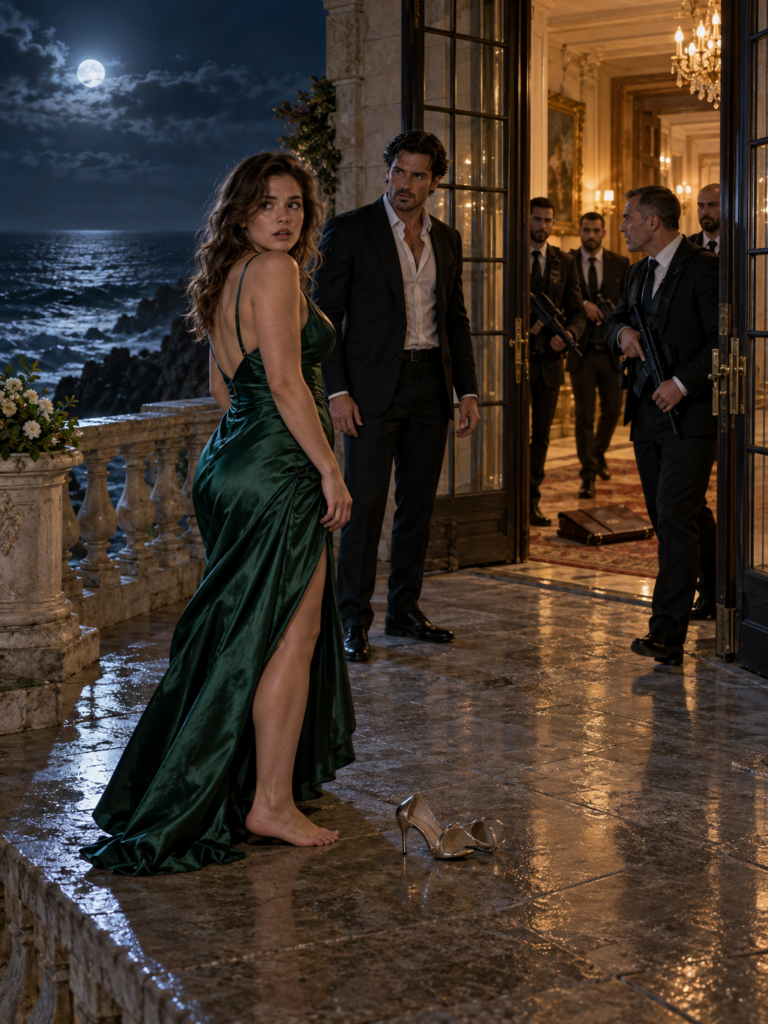
Her bare foot hovered above the rain-darkened step as Lorenzo answered from behind her.
“Three lenders. Vanguard carries most of it.”
Penelope turned so sharply the portfolio struck her hip.
“No.”
Gabriel’s gaze moved from Lorenzo to her.
She came back inside one step—not toward him, but toward the conversation.
“Whatever you’re thinking, don’t.”
Lorenzo’s eyebrows lifted.
Gabriel’s did not.
“You believe you know what I’m thinking?”
“I’ve known men like Richard my entire career. Men with power who decide fixing something for a woman means deciding everything for her.”
A muscle tightened along Gabriel’s jaw.
“You are comparing me to Harrison?”
“I’m warning you not to give me a reason to.”
Silence settled over the corridor.
The armed men behind him suddenly seemed less dangerous than the quiet between them.
Penelope hugged the portfolio against her chest.
“If you want to know whether he stole my work, ask me. If you want proof, I have it. Emails. Draft histories. client revisions. Files with timestamps.”
Gabriel looked at the leather case.
“You kept records.”
“I’m an architect. Documentation is how buildings stay standing and careers survive people like Richard.”
There it was again—that minute shift in his expression whenever she surprised him.
He looked at Lorenzo.
“Cancel my question.”
Lorenzo inclined his head.
Penelope exhaled.
Gabriel added, “For tonight.”
Her relief vanished.
“Gabriel.”
“You are quitting Monday.”
“That doesn’t make my career yours to rearrange.”
“No.”
His gaze held hers.
“It makes your career yours.”
For one dangerous second, she wanted to believe him.
Then alarms sounded somewhere deeper in the estate.
Lorenzo touched his earpiece.
“South gate is secure. Ballroom evacuation is beginning as a precaution.”
Penelope looked toward the noise.
“My boss is in there.”
Gabriel’s expression cooled.
“The man who stole your designs?”
“The man who employs thirty-two other people who didn’t.”
That answer surprised him more than anything else had.
“If you destroy him,” she said, “you don’t only destroy Richard.”
Gabriel considered her.
Then he spoke to Lorenzo.
“No financial action against the firm.”
Penelope watched him carefully.
“None?”
“None without her knowledge.”
“That is not what I said.”
Something almost amused crossed his face.
“No action tonight.”
She accepted that because the alternative was arguing while a security emergency unfolded around them.
“Good.”
A guard appeared from the ballroom.
“Mr. Costa, the guests are moving to the north drive.”
Gabriel nodded.
Then he looked at Penelope’s bare feet.
“Your shoes.”
“I know where they are.”
“You’re holding them.”
She looked down.
Both stilettos were hooked through two fingers.
Heat rose into her cheeks.
Gabriel’s mouth almost curved.
It was absurd.
She was terrified of him, furious with Richard, standing in a mansion under security lockdown—and Gabriel Costa was trying not to smile because she had forgotten she was carrying her own shoes.
Penelope hated that the moment steadied her.
“I’m leaving.”
“I’ll have a driver take you.”
“No.”
“Penelope.”
“That sounded dangerously like an order.”
He stopped.
The old instinct—to command, arrange, solve—was visible in his face.
Then he changed the sentence.
“Would you accept a driver?”
“No.”
A beat.
“All right.”
That answer unsettled her more than pressure would have.
She walked toward the exit again.
“Your portfolio,” Gabriel said.
“What about it?”
“Richard’s name is embossed on the case.”
She looked down.
He was right.
The drawings inside were hers.
The leather holding them belonged to the firm.
A petty technicality.
Except Penelope knew men like Richard survived on technicalities.
She opened the portfolio.
One by one, she removed every sheet bearing her signature or traceable revision code.
The original sketches.
The load calculations.
Her notes.
She stacked them against her chest.
Then she set the empty case back on the console table.
Gabriel watched without speaking.
Penelope looked at him.
“This is what taking something back looks like.”
His eyes darkened—not with anger.
With approval.
“Good night, Gabriel.”
She stepped into the rain.
This time he let her go.
The door closed behind her.
Penelope made it halfway down the drive before her phone rang.
Richard.
She stared at the screen, then answered.
“Where the hell are you?” he shouted. “Costa’s security is evacuating us and my portfolio is missing.”
“It’s on the east corridor console.”
“And the drawings?”
“Mine came with me.”
A stunned silence.
Then Richard laughed.
Not kindly.
“You think those are yours?”
Penelope stopped beneath the rain.
“I drew them.”
“You drew them while employed by my firm.”
Her stomach tightened.
“You signed an intellectual-property assignment your first week, Penny.”
She remembered a stack of onboarding papers.
Insurance.
Payroll.
Confidentiality.
Something else.
Richard’s voice softened.
“You walk into my office Monday morning with every page, or I’ll make sure no firm in New England hires you.”
The call ended.
Penelope stood motionless beneath the rain.
The portfolio pages suddenly felt heavier than stone.
Headlights appeared behind her.
A black car rolled slowly down the drive—then stopped twenty feet away.
The rear door did not open.
No one approached.
Her phone lit again.
Not Richard.
An unknown number.
One message.
I won’t send anyone after you. But before Monday, read Section 14 of your employment agreement.
Penelope stared at the words.
Then at the distant car.
Gabriel knew about the contract.
Which meant either he had already investigated Richard—
or he had already investigated her.
Penelope tightened her grip on the drawings and started walking again.
The black car remained behind her at exactly the same distance.
Penelope stopped beneath a streetlamp.
So did the car.
She turned and marched toward it.
The passenger window lowered.
Lorenzo sat behind the wheel.
Penelope planted both hands on the window frame.
“This is following me.”
“Yes.”
“Gabriel said no one would come after me.”
“He said no one would approach you.”
“That is lawyer language.”
Lorenzo considered that.
“Fair.”
“Leave.”
“I can’t.”
“Then call him.”
Lorenzo did.
Gabriel answered immediately.
Penelope held out her hand.
Lorenzo gave her the phone.
“What part of no driver was unclear?” she demanded.
Gabriel’s voice came quietly through the speaker.
“All of it was clear.”
“Then why is Lorenzo following me?”
“Because there was a security breach at my house and you left through the perimeter during it.”
“You don’t get to turn my refusal into a technicality.”
Silence.
Then Gabriel said, “You’re right.”
The simple admission disarmed half her anger.
“I’ll call him back.”
“You will not.”
Another pause.
Then, “May I explain?”
Penelope looked at Lorenzo, who appeared suddenly fascinated by the windshield.
“Thirty seconds.”
“The south breach involved people looking for access to me. You were seen with me. Until I know whether anyone photographed you, there is a possibility your departure was noticed.”
Fear slipped cold fingers beneath her ribs.
Gabriel continued.
“I should have told you before you left. I was trying to solve the risk without frightening you.”
“You chose control because information was inconvenient.”
“Yes.”
Again, no defense.
Penelope swallowed.
“What do you suggest now?”
“A driver of your choice, a taxi, a hotel car, Lorenzo at a distance, or no protection at all. Your decision.”
That was different.
Not perfect.
Different.
“Lorenzo can take me to my hotel,” she said. “He waits in the lobby until I’m upstairs. Then he leaves.”
“Agreed.”
“And nobody searches my room.”
“Agreed.”
“And nobody researches my family.”
A beat too long.
“Gabriel.”
“I had already asked for a professional background check before you left.”
Heat flashed through her.
“You had no right.”
“No.”
“You keep saying that like admitting it erases it.”
“It doesn’t.”
“Cancel it.”
“I will.”
Penelope looked through the windshield at the dark road.
“If I discover you lied—”
“You walk.”
“No, Gabriel. I decide what happens next.”
He exhaled softly.
“Yes.”
That was the first boundary he accepted because she demanded it.
It would not be the last.
Monday morning, Penelope walked into Harrison and Company carrying copies of her employment agreement, three flash drives, and twelve years of anger compressed into one calm expression.
The office was not bankrupt.
Not yet.
But panic had arrived first.
Richard was shouting at a lender when she entered his glass office.
He ended the call.
“You.”
Penelope placed the contract on his desk.
“Section 14.”
Richard leaned back.
“So Costa told you.”
“He told me to read it.”
“That sounds like interference.”
“It sounds like reading.”
She tapped the paragraph.
The assignment transferred work created specifically within Harrison project scope.
Richard smiled.
“Exactly.”
Penelope turned the page.
“But Section 14(c) excludes prior concepts, independent structural methods, and individually authored design systems disclosed in Schedule B.”
His smile faded.
“When I joined, I attached my university thesis methodology and registered design notebooks.”
Richard stared.
Penelope had remembered doing it only after rereading the documents at two in the morning.
The east-wing design did belong to the firm contractually.
But the method Richard had been presenting as his own—the adaptive load-distribution system that made the renovation possible—did not.
That belonged to her.
More importantly, every client presentation Richard had made claiming personal authorship created a record.
Not just of arrogance.
Potential misrepresentation.
Penelope placed a folder beside the contract.
“These are the presentations where you represented my proprietary methodology as yours.”
Richard’s face reddened.
“You ungrateful little—”
“Choose the rest carefully.”
He stopped.
For once, Penelope realized, he had no idea how to speak to her without confidence that she needed him.
“I’m resigning,” she said.
“You’ll never work in this city again.”
“That may be true.”
It hurt to admit.
“But if it is, it won’t be because I stayed here another day.”
She turned.
Richard laughed behind her.
“And where exactly are you going? Costa?”
Penelope stopped.
“Maybe nowhere.”
That was the answer she needed him—and herself—to hear.
She did not leave Richard for Gabriel.
She left because Richard had taught her what remaining would cost.
By noon she was unemployed.
By two, Gabriel Costa had sent no car, no messenger, and no flowers.
At three, an email arrived from Costa Holdings.
Not from Gabriel.
Human resources.
Lead Design Director, Eastern Properties.
Compensation extraordinary enough to make her reread it three times.
Reporting structure: independent design division.
Budget authority: hers.
Staffing authority: hers.
Termination: either party, thirty days.
Security services: optional.
Personal relationship clause: none.
At the bottom was a handwritten note scanned into the document.
You asked for professional. This is professional. If you decline, the offer disappears and nothing else changes.
Penelope stared at the page.
Then she laughed.
He was learning.
Slowly.
Dangerously.
But learning.
She accepted the interview.
Not the job.
Two days later she entered Costa Tower in Boston wearing a navy wrap dress and carrying her own portfolio.
Gabriel waited in a conference room with three executives Penelope had never met.
That pleased her.
No private penthouse.
No staged seduction.
A real meeting.
For ninety minutes they questioned her about hotel redevelopment, preservation restrictions, budgets, accessibility, structural reuse, and contractor oversight.
Penelope forgot to be intimidated.
She argued.
Drew.
Corrected one of Gabriel’s development directors when he misunderstood historic masonry.
When Gabriel tried to answer a technical question on her behalf, Penelope lifted one finger.
“I’ve got it.”
He stopped speaking.
The director across the table noticed.
So did she.
By the end, the job felt less like a gift and more like something she had won while Gabriel watched.
After the executives left, only he remained.
Penelope closed her portfolio.
“You could have hired me Saturday.”
“I wanted to.”
“That isn’t what I said.”
Gabriel leaned back.
“You think this process was theater.”
“I needed to know it wasn’t.”
“And?”
“You have intelligent people working for you.”
“A devastating compliment.”
“They disagreed with me twice.”
“Three times.”
“Your preservation director was wrong about the north façade.”
“She knows that now.”
Penelope’s mouth twitched.
Then she grew serious.
“If I accept, I need one more condition.”
“Name it.”
“You do not interfere with my employment because of whatever this is.”
His eyes sharpened.
“This?”
She gestured between them.
“Whatever keeps happening when you look at me.”
For perhaps the first time in his adult life, Gabriel Costa looked caught.
Penelope almost enjoyed it.
“If I tell you no personally,” she continued, “I keep my job. If we argue personally, I keep my authority. If we date and it fails, I keep my professional record and leave under the contract like anyone else.”
Gabriel stood.
He did not approach.
“You think I would punish you for refusing me.”
“I think powerful men are often most dangerous when they believe they are generous.”
The words landed.
He looked toward Boston Harbor.
“When I was twenty-six, someone close to me sold information about my business because she believed I would never let her leave.”
Penelope waited.
“I thought loyalty meant removing every reason someone might go.”
His jaw tightened.
“I was wrong then. I have apparently remained talented at being wrong in new forms.”
It was the first thing he had told her that did not sound designed to impress.
Penelope closed the distance by one step.
“Protection that removes choice is still control.”
“I know.”
“No. You understand the sentence. Knowing it requires behavior.”
He met her eyes.
“Then watch my behavior.”
She accepted the job.
Two months later, she was standing inside a gutted historic hotel in Boston’s Seaport District wearing work boots, a hard hat, and a plum coat dusted white at the sleeves.
This was the happiest she had been professionally in years.
Her crew listened because her decisions worked.
Her design team challenged her because she had hired people confident enough to disagree.
Gabriel visited often.
Too often, probably.
But after Penelope told him she did not need lunch delivered every day, the lunches stopped.
After she discovered plainclothes guards on her floor and threatened to resign, he removed them.
Security at active Costa properties remained.
Security attached personally to Penelope required her consent.
The distinction cost him visible effort.
Which was why she believed it mattered.
That Tuesday afternoon, Gabriel crossed the unfinished fourth floor with Lorenzo several paces behind.
Penelope looked up from a blueprint.
“You’re early.”
“I was told the eastern steel anchors finally passed inspection.”
“They did.”
“Then I came to congratulate the tyrant responsible.”
She smiled.
Mike, the foreman, pretended not to hear.
Gabriel reached inside his coat and produced a narrow wooden case.
Penelope gave him a warning look.
“What did we say about gifts?”
“That gifts requiring reciprocal affection are forbidden.”
“And?”
“Gifts worth more than your monthly rent make you uncomfortable.”
“That sounds suspiciously specific.”
“I remember things.”
Inside the case lay a vintage architect’s mechanical pencil.
Not diamonds.
Not jewels.
A beautifully restored drafting instrument from the period when the hotel had first opened.
Penelope touched it carefully.
“This is acceptable.”
Gabriel’s satisfaction was immediate.
Then tires screamed outside.
Lorenzo moved before anyone else.
“Down!”
Glass exploded on the level below.
Gunfire cracked through the skeletal building.
Workers shouted.
Penelope dropped behind the plywood drafting station.
Gabriel reached for her.
She slapped his hand away.
“East service core!”
He stared.
“What?”
“The concrete core. It’s reinforced. The stairwell isn’t finished on the north side.”
Another burst of gunfire tore through temporary panels.
Penelope pointed.
“If they entered from the street, the eastern corridor is the safest route.”
Gabriel’s security training said one thing.
Her knowledge of the building said another.
He chose hers.
“Everyone east!” he shouted.
Workers ran.
Lorenzo covered the open floor.
Gabriel stayed beside Penelope as she moved low behind concrete columns.
A round struck masonry twenty feet away.
He seized her wrist.
She yanked free.
“Don’t drag me.”
His expression flashed.
Then he released her.
“Lead.”
One word.
One surrender of control.
Penelope ran toward the service core.
Then she saw something on the floor beside the unfinished elevator shaft.
A black duffel bag.
Not construction equipment.
Fresh mud on the straps.
Someone had already been inside the building before the shooting began.
Penelope stopped.
Gabriel nearly collided with her.
“What?”
She pointed.
“That wasn’t brought through the street entrance.”
Lorenzo looked once and swore.
The attack outside was not the real breach.
Someone had prepared the building from within.
And the access route had required detailed knowledge of Penelope’s construction plans.
Gabriel moved toward the duffel.
Penelope caught his sleeve.
“Don’t.”
His eyes dropped to her hand.
Then to the bag.
“Why?”
“Because whoever left it expected someone to find it.”
Lorenzo raised a hand, stopping two security men behind them.
The gunfire below had slowed to scattered bursts.
Penelope studied the unfinished fourth floor as if it were a set of plans.
Temporary wall.
Elevator shaft.
Eastern service core.
Material lift.
Contractor access.
Her building.
Her responsibility.
Her mind steadied.
“The street attack pulled security toward the exterior,” she said. “If someone planted that before the shooting, they weren’t trying to enter during the chaos. They were already here.”
Gabriel’s face went hard.
“Who had access?”
“Dozens of people.”
“Names.”
“I said dozens.”
“Penelope—”
“No.”
That single word stopped him.
She pointed toward the stair core.
“Get the workers out first. Interrogate people later.”
His instinct to hunt collided visibly with her demand.
Then Gabriel looked at Lorenzo.
“Evacuate the crew through the east route. Nobody is detained unless there’s an immediate threat.”
Lorenzo nodded.
Penelope noticed the addition.
Nobody detained.
Gabriel had understood what she had not even said.
Do not turn frightened workers into prisoners because you are afraid.
They moved into the service core.
Mike stood below them, counting heads as workers descended.
“Twenty-seven!” he called. “Missing one electrician. Owen.”
Penelope frowned.
“Owen wasn’t scheduled today.”
Mike looked up.
“He swapped with Patel this morning.”
“Who approved it?”
“I thought your office did.”
Penelope’s stomach tightened.
Her office had not.
She pulled out her phone.
No signal.
Gabriel saw.
“Jammer.”
“That’s why the bag is here.”
Lorenzo crouched several feet from it.
“Probably.”
Penelope looked at the building again.
“If someone needed the jammer hidden where it would affect the floor but remain protected, they’d choose the elevator shaft.”
Gabriel followed her line of sight.
“And if they wanted another exit?”
“The freight lift isn’t operational, but the maintenance ladder reaches level two.”
Lorenzo immediately dispatched two men downward.
Gabriel stayed.
Penelope stared at him.
“You should go.”
“So should you.”
“This is my site.”
“And someone used your plans to breach it.”
“Exactly.”
She stepped closer.
“That means I understand the breach better than you do.”
His jaw flexed.
A month earlier he might have picked her up and removed her by force.
Penelope saw the impulse.
Saw him defeat it.
“What do you need?” he asked.
That question changed everything.
“Mike’s tablet. The live access log is local because the network isn’t commissioned yet.”
Gabriel retrieved it himself.
Penelope opened the contractor system.
Badge entries populated the screen.
Twenty-seven crew.
Four inspectors.
Three deliveries.
One temporary credential created at 6:12 that morning.
Owen Mercer.
The electrician who was not supposed to be there.
His badge showed entry at 7:03.
No exit.
Lorenzo received a message through his radio.
“Found him.”
Penelope’s pulse jumped.
“Alive?”
“Yes. Level two storage room. Zip-tied. Concussion.”
So someone had stolen his identity.
Gabriel’s voice dropped.
“They came in under a contractor badge.”
Penelope scrolled.
The replacement credential had been authorized using a login belonging to Costa Facilities.
Gabriel went utterly still.
Not an outside rival studying the building.
An insider.
Lorenzo swore softly.
Then a figure moved at the far end of the unfinished corridor.
Penelope saw the flash of orange safety fabric first.
A construction vest.
A hard hat.
Normal.
That was why it felt wrong.
Everyone else was evacuating.
This man was walking toward the western stairwell.
Penelope recognized the tool case in his hand.
It belonged to the electrical subcontractor.
“Owen!” Mike shouted from below, misunderstanding.
The man ran.
Gabriel started after him.
Penelope blocked his path.
“West stair isn’t finished.”
He stopped an inch from her.
“You’ll go through.”
“He might not know that.”
Realization hit.
The western stair ended at the third floor because the final flight had been removed for reinforcement.
A person using stolen plans from six weeks earlier would think it connected all the way down.
Someone using Penelope’s current set would know better.
The fleeing man shoved through the door.
Seconds later came the metallic crash of a barrier being struck.
Lorenzo’s men converged from below.
No gunfire.
No cinematic execution.
Just shouting, a struggle, then silence.
When they brought the intruder back, Gabriel looked at him with a coldness that made Penelope understand every rumor she had ever heard.
The man was young.
Bleeding from the lip.
Terrified.
Gabriel stepped forward.
Penelope touched his arm.
“Not here.”
His gaze remained fixed on the intruder.
“He put you in a kill zone.”
“He put twenty-seven workers in one.”
That reached him.
“This site is mine,” Penelope said. “Whatever happens next happens through the law on my site.”
Lorenzo glanced toward Gabriel.
Everyone waited.
Gabriel could have overridden her.
Penelope knew it.
So did he.
Finally he said, “Call the police.”
The intruder’s expression changed from terror to bewilderment.
Gabriel’s did not.
“And preserve every camera, badge record, device, and access log for them.”
Lorenzo nodded.
Penelope exhaled.
Later, after statements were taken and the workers were sent home, she stood alone near the shattered temporary glazing.
Boston Harbor glittered beyond the construction cranes.
Gabriel joined her.
No touching.
Not yet.
“The police will connect him to Volkov,” he said.
“You sound disappointed.”
“I’m accustomed to resolving threats differently.”
“I know.”
He looked at her.
“That frightened you.”
“The shooting frightened me.”
“Me.”
Penelope considered the distinction.
“Yes.”
He absorbed it without flinching.
“You looked like someone I didn’t know.”
“I am someone you don’t fully know.”
“That’s true of everyone.”
“Not like this.”
Gabriel turned toward the harbor.
“When I was younger, I believed fear was efficient. Men lied less when they feared consequences. Rivals calculated differently. Problems ended quickly.”
“And now?”
“Now the woman I love looks at me and asks whether she is safe from my decisions as well as my enemies.”
Penelope’s heart stumbled.
Not because he had said love.
Because he had finally identified the real problem.
She folded her arms.
“You bankrupted Harrison.”
Gabriel became motionless.
The words had been waiting between them for two months.
“No.”
Penelope stared.
“The Monday after the party, his credit line collapsed.”
“I know.”
“You asked Lorenzo who owned his debt.”
“I did.”
“You told me you took no action that night.”
“I didn’t.”
Her anger sharpened.
“That is very precise phrasing.”
“Yes.”
“Then tell me the imprecise truth.”
Gabriel met her eyes.
“Vanguard had already begun reviewing Harrison’s accounts before the party.”
Penelope frowned.
“Why?”
“Because Costa Holdings had commissioned an audit after irregular billing appeared on our east-wing project.”
Her pulse slowed.
“What irregular billing?”
“Your hours were invoiced under senior-consultant rates. You were paid junior wages. Harrison billed original design premiums for work his records credited to himself, but metadata identified multiple authors.”
Penelope felt the room tilt.
“How long did you know?”
“Three weeks before the party.”
“And you did nothing?”
“I asked for a quiet audit because litigation would have alerted him.”
“You knew my name before the balcony.”
“No.”
That surprised her.
“The audit used employee numbers and file histories. I knew someone inside Harrison was creating the work Richard claimed. I did not know who.”
“Until the portfolio.”
“Yes.”
Penelope replayed the night.
His surprise when she said she designed the east wing.
The way his expression had changed when he saw her signature.
“What happened Monday?”
“Vanguard froze Harrison’s credit after discovering he had pledged receivables twice. The firm collapsed because Richard had been hiding debt.”
“You didn’t destroy him.”
“No.”
“But you let me think you had.”
Gabriel’s silence answered.
Anger arrived not as fire but disappointment.
“Why?”
“Because you were afraid of me.”
“That explains nothing.”
“I was ashamed to admit that part of me liked what your fear implied.”
Penelope went still.
Gabriel continued because stopping would have been easier.
“That I had enough power to punish someone for hurting you. That you believed I would. I told myself I had protected you. In truth, I allowed you to believe something false because it made me feel powerful.”
There it was.
Not a heroic explanation.
Not protective deception dressed as devotion.
A flaw.
Ugly and human.
Penelope’s eyes burned.
“You knew I spent weeks wondering what you might do if I disappointed you.”
His face tightened.
“Yes.”
“And you still let me.”
“Yes.”
She looked away.
“I can’t fix that with an apology,” Gabriel said.
“No.”
“I can give you every audit record and every communication between Costa Holdings, Vanguard, and Harrison.”
“You will.”
“Tomorrow.”
“Today.”
He nodded.
“Today.”
“And if anything was altered—”
“It wasn’t.”
She looked back.
“Don’t ask me to trust your certainty.”
He corrected himself.
“You can verify it.”
Better.
Still painful.
Penelope stepped away from the window.
“I need space.”
Gabriel’s entire body resisted the sentence.
She saw it.
Then he moved aside.
“Take it.”
She left.
For six days Gabriel did not call.
No flowers arrived.
No gifts.
No car waited downstairs.
Costa security remained at the construction site because Penelope had approved site security in writing after the attack.
Nothing followed her home.
Nothing inserted itself into her silence.
On the second day, a courier delivered a sealed archive box.
Inside were the audit files.
Original invoices.
Bank communications.
Metadata.
A letter from the outside accounting firm confirming Harrison’s preexisting debt crisis.
Nothing from Gabriel except one line on a blank sheet.
You deserved the truth before you had to demand it.
Penelope spent evenings reading.
By Friday she knew exactly what had happened.
Richard had built the illusion of a successful firm on debt, inflated billing, and other people’s talent.
Costa’s audit had exposed discrepancies.
Vanguard had acted after its own investigation.
Gabriel had not destroyed the firm.
But he had been willing to let Penelope believe he had.
That distinction mattered.
Saturday morning, she drove to Newport.
Alone.
The estate gates opened after security called the house for permission.
Gabriel met her in the east corridor.
He wore no jacket.
No entourage.
“You came.”
“I said I needed space. I didn’t say I was gone.”
Hope flickered across his face and disappeared beneath discipline.
Penelope held up a roll of plans.
“I also came because your perimeter is terrible.”
He blinked.
“What?”
“The south garden.”
Despite everything, she almost smiled.
“Your walls create three blind approaches from the service road. Whoever breached the estate the night we met probably noticed the same thing.”
Gabriel stared at her.
“You want to redesign my security.”
“I want to redesign the property.”
“With security.”
“With architecture that accounts for reality.”
He took the plans.
“You don’t have to do this.”
“I know.”
That mattered too.
For three weeks they worked.
Not as lovers.
Not yet.
As architect and client.
Gabriel gave her access to security requirements without demanding tactical details she did not need.
Penelope redesigned sight lines, corridors, reinforced service entrances, landscaping barriers, and evacuation routes that could protect staff and guests without turning the house into a prison.
She refused hidden traps.
Refused features meant solely to injure.
Refused locks that could prevent occupants from leaving.
“A fortress should protect the people inside,” she told him, “not own them.”
Gabriel looked at the plans.
Then at her.
“I understand the metaphor.”
“I hoped you would.”
He approved every change.
No argument.
On the twenty-first night, they stood again on the balcony where they had met.
The estate was quiet.
Penelope wore a simple dark red dress and no diamonds.
Her choice.
Gabriel stood beside her, hands resting on the stone balustrade.
Lorenzo stepped through the glass doors.
“South-garden alert.”
Gabriel’s body tensed.
Penelope did too.
Lorenzo continued.
“Six men approached through the lower grounds. The new lighting corridor exposed them before they reached the inner wall. State police intercepted two vehicles on the access road. Security detained the others at the service boundary.”
Penelope looked at Gabriel.
“No injuries?”
“None,” Lorenzo said.
“No one killed?”
“No.”
Gabriel’s gaze remained on her.
“Your design worked.”
“Our procedures worked.”
She corrected him deliberately.
“Architecture gave people time. Security used it correctly.”
Lorenzo nodded once and left.
The balcony doors closed.
Atlantic wind lifted Penelope’s hair.
Gabriel gave a quiet laugh.
“What?”
“The first night you stood here, you told me the estate screamed that its owner needed everyone to know how powerful he was.”
“You were offended.”
“I was fascinated.”
“You hid it well.”
“I have practice.”
Penelope turned toward him.
“And now?”
“Now the strongest thing in this house may be the fact that every door you redesigned still opens from the inside.”
Her throat tightened.
There it was.
The callback she had not expected.
Not castle.
Not cage.
Choice.
Gabriel faced her fully.
“I love you.”
Penelope did not answer immediately.
He let the silence remain hers.
“I loved parts of you before I trusted the whole man,” she said.
Pain crossed his face, but he nodded.
“That was difficult to admit.”
“It should be.”
She stepped closer.
“I loved that you saw my work. That you listened. That you challenged people who dismissed me.”
She touched his hand.
“I also hated that you believed seeing my worth gave you the right to arrange my life.”
“I know.”
“You’re going to have that instinct again.”
“Yes.”
The honesty made her smile faintly.
“And?”
“I ask.”
“And if I say no?”
“I decide whether I dislike the answer.”
Penelope raised an eyebrow.
He continued.
“And then I respect it anyway.”
“Better.”
His thumb moved once across her knuckles.
“Are you staying tonight?”
She looked through the glass doors toward the east corridor she had once fled barefoot.
Then toward the stairs leading to the guest wing.
Her plans now hung in the design room upstairs under her own name.
Her firm—Hayes Studio, independently incorporated—occupied two floors of Costa Tower under a five-year services contract she could terminate.
She employed fourteen people.
Gabriel was her largest client.
He was not her owner.
Penelope looked back at him.
“Yes.”
Something fierce and tender crossed his face.
“May I kiss you?”
Two months earlier, he would have assumed.
Three weeks earlier, Penelope might have refused simply because she needed proof he could survive hearing it.
Tonight she rose onto her toes and touched his collar.
“Yes.”
Gabriel kissed her slowly.
No crushing possession.
No command.
No promise that nobody would ever look past her again.
Penelope no longer needed a dangerous man to make the world see her.
She had done that herself.
When they parted, Gabriel rested his forehead against hers.
“I still think Harrison was an idiot.”
“He was.”
“I still occasionally want to ruin him.”
“He managed that without you.”
“A continuing disappointment.”
She laughed.
The sound moved out over the Atlantic.
Below them, lights glowed along the new garden paths—not hidden weapons, but clear sight lines, reinforced boundaries, and routes designed to move people safely away from danger.
The estate had changed because Penelope understood something Gabriel had spent most of his life refusing to learn.
Strength was not measured by how impossible it was to escape.
Strength was measured by how safe someone felt choosing to stay.
Penelope looked through the open balcony doors.
The first night, she had run through them because she had discovered who Gabriel was.
Tonight they remained open behind her.
She could leave.
He knew it.
She knew it.
That was precisely why staying meant something.
Penelope slipped her hand into his.
“Come inside.”
Gabriel followed.
Not ahead of her.
Not pulling her after him.
Beside her.


