
Part 1
By the last quarter of the 19th century, London had become a city of such scale that even its institutions seemed to be struggling to comprehend it.
The population had swollen outward from the old center into districts that only a generation earlier had been fields, commons, market gardens, and rough pasture. Railways cut through neighborhoods. New streets multiplied. Factories drew workers from across Britain and beyond. Wealth accumulated in astonishing concentrations, yet so did poverty. With growth came pressure on every part of civic life, including the machinery of punishment.
Prisons that had once seemed adequate could no longer absorb the volume of men and women sentenced by crowded courts.
The government responded in the language governments often used when confronted with excess: expansion, reorganization, construction.
Existing prisons were repaired and enlarged.
New ones rose.
Among them was Wormwood Scrubs.
The name itself seemed suited to confinement long before a prison stood there. It was said to descend from an older form, “Wormholt Scrubs,” associated with scrubland near a snake-infested or serpent-named wood. Whatever the precise linguistic path, by the Victorian period the Scrubs referred to a broad tract in the borough of Hammersmith, open ground used for military exercises and still carrying something of its earlier character as common land.
In the winter of 1874, that openness began to change.
Authorities enclosed part of the ground and erected temporary corrugated structures. Selected prisoners were brought to the site.
They were not merely to inhabit the new institution.
They were to build it.
Convict labor supplied the hands.
Clay was dug from the ground beneath them and turned into bricks. Stone was dressed. Timber was carried. Metal was forged. Walls rose slowly across land where there had once been pasture.
Construction began with the great hall in 1875.
From there, the prison expanded piece by piece.
Cell followed cell.
Gallery followed gallery.
Block followed block.
By 1891, the complex had grown into 4 self-contained parallel blocks.
There was something severe in the logic of its construction.
The men destined for imprisonment made the bricks of the prison.
They carried the stone.
They raised the walls.
They fitted the doors.
They forged the bars.
The institution that would confine future offenders was literally assembled by people already under sentence.
Each portion of the building carried the labor of those whom society had placed outside ordinary freedom.
A prison arose from the ground because prisoners built it.
Pasture became penitence.
As Wormwood Scrubs settled into London’s landscape, the city became accustomed to its rhythms.
Black prison vans traveled the road regularly, bringing new arrivals through the gates.
Inside were men and women sentenced for offenses ranging from petty theft to fraud and more serious crimes. Some would remain only briefly. Others entered at the beginning of longer periods of penal servitude.
The traffic moved in both directions.
After breakfast on certain mornings came another procession: newly released prisoners leaving confinement and stepping again into London.
Some emerged ragged.
Some emerged exuberant.
Some emerged frightened.
A prison discharge returned a person to liberty, but liberty did not necessarily mean security. Outside the walls waited whatever had existed before arrest: poverty, bad housing, drink, unstable employment, criminal acquaintances, broken families, or simply the difficulty of finding respectable work while carrying the stain of conviction.
The black vans entering Wormwood Scrubs and the men walking away from it represented opposite motions in the same system.
One brought people under control.
The other returned them to the world and hoped that control had changed them.
A Victorian journalist named George Sims described the prison and its population with the curiosity of a man interested not only in architecture and punishment but in the strange human society produced behind walls.
In his account, the population of Wormwood Scrubs contained an extraordinary range.
At one end stood experienced offenders.
At the other were people who had committed no offense at all.
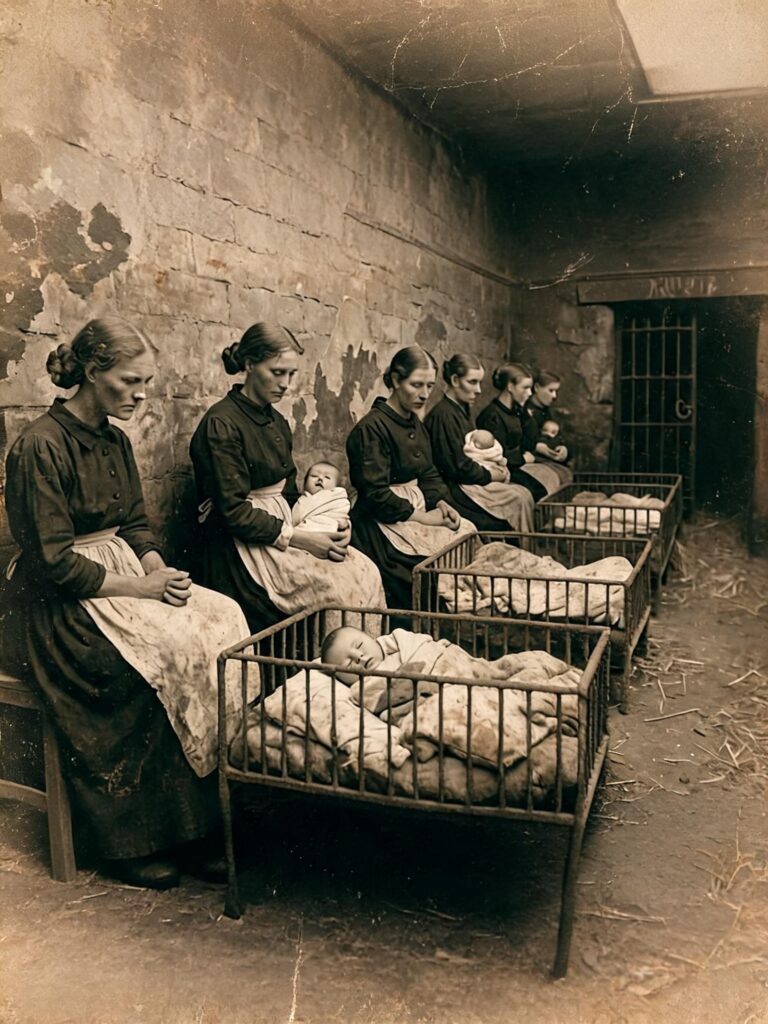
Infants.
Babies who had drawn their first breath in prison.
Children so young that they could not be separated from imprisoned mothers.
They had no sentence.
No conviction.
No guilt.
Yet the first ceiling some of them ever saw was a prison ceiling.
Their nursery could be a cell.
Their earliest sounds included keys, footsteps, locking doors, orders, bells, and the measured routine of confinement.
The Victorian imagination had a phrase for them.
They were children “cradled in crime.”
The expression carried the fatalism common to the age.
Victorian observers were deeply interested in heredity, environment, morality, vice, and the possibility that social circumstances might shape character long before adulthood. To be born inside a prison could therefore be described not merely as misfortune but almost as prophecy.
The child, some feared, might someday return to the place where life had begun.
Its birthplace could become its destination.
The prison infant stood at one pole of the institution’s population, while at the other stood the accomplished criminal: the burglar, forger, fraudster, or habitual thief whose familiarity with courts and cells made imprisonment less an interruption than part of a recurring pattern.
Between the 2 were almost every imaginable degree of offense and experience.
Yet the prison baby occupied a peculiar position.
Its presence exposed a contradiction in the whole idea of punishment.
Prison was supposed to separate the guilty from ordinary society.
But a mother with an infant could not always be separated from her child.
If the child was too young to live independently, the prison had to make room for innocence within an institution built for guilt.
The resulting arrangement was less uniformly harsh than the phrase “born behind bars” might suggest.
Indeed, contemporary descriptions sometimes argued that a prison-born infant might, in certain practical respects, receive better care than a child born in the most desperate districts of London.
This was not because prison had become a pleasant place.
It was because life outside could be extraordinarily brutal.
In the poorest quarters of the city, babies might be born into rooms overcrowded beyond sanitation, into lodging houses where several families occupied the same floor, or into cellars and narrow dwellings with little light or clean air.
Drink could consume household money.
Violent men could dominate families.
Mothers might be forced into long hours of labor with no reliable childcare.
Food could be uncertain.
Disease moved quickly through close rooms.
Under those conditions, a prison nursery could possess certain advantages precisely because prison life was regulated.
Inside the walls there was routine.
Food was measured.
Rooms were inspected.
Cleanliness was enforced.
Medical officers were available.
Matrons and warders observed prisoners constantly.
Whatever freedom had been removed from a mother, some of the chaos that might have characterized her life outside had been removed as well.
Victorian commentators could therefore describe imprisoned mothers as unexpectedly attentive parents.
A mother might be subject to discipline herself, but within the restricted world of the prison there were fewer competing influences.
There was no public house around the corner.
No drunken companion arriving at midnight.
No street gang drawing her away.
No pressure to leave an infant alone while seeking work.
No immediate temptation to steal.
No landlord waiting on the stairs.
For a woman whose life outside had been marked by instability, confinement imposed a structure in which maternal feeling might receive undivided attention.
The baby, consequently, could become a small center of tenderness in an otherwise rigid institution.
Officials noticed them.
Visitors noticed them.
Warders who maintained professional severity toward adult prisoners might soften in the presence of an infant.
A matron could lift the child.
An officer might stop beside a cot.
Even senior prison figures, accustomed to inspecting cells and enforcing regulations, were not immune to the presence of someone who did not belong to the moral categories on which prison discipline depended.
Babies invited affection because they had done nothing to deserve confinement.
They could be played with and comforted.
They had toys.
They were taken into fresh air.
They received appropriate food.
Their sleeping places, though still within a prison and perhaps within a cell, were described as bright, ventilated, orderly, and meticulously clean.
Comfortable cots replaced the bare arrangements associated with adult punishment.
When a mother was required elsewhere for prison work, the child could be taken to a nursery or crèche within the institution.
The mother therefore knew, at least during those hours, that the baby was being watched.
It was one of the odd inversions of Victorian poverty.
A woman might lose her liberty and temporarily gain a more dependable childcare arrangement than poverty had allowed her outside.
None of this removed the essential strangeness of the child’s circumstances.
The infant could not understand a sentence, yet lived according to one.
Its waking hours were shaped by rules written for adults.
Its mother could not simply carry it into a street or park at will.
Every movement took place inside a controlled world.
The child occupied a space between punishment and protection.
It was not a prisoner in law.
In practice, it could not leave.
Victorian writers sometimes looked at these children and saw a warning.
Environment, they believed, might mark a life from the beginning.
A child suckled inside prison walls might absorb criminal associations almost as if they were part of nourishment itself.
Such language now appears cruel in its certainty, particularly when directed toward children who possessed no responsibility for their circumstances.
But it reveals how strongly the period associated poverty, crime, family structure, and moral destiny.
The prison-born baby became more than a child.
It became a symbol.
To some observers, the child represented society’s failure before life had properly begun.
To others, it represented the possibility that disciplined care might interrupt a cycle.
The contradiction was never fully resolved.
Outside the nursery, the main population of Wormwood Scrubs lived under a system built around separation.
The principle was strict.
Prisoners were to be kept apart.
But separation was not supposed to mean the relentless solitary confinement associated with earlier penal experiments.
By the Victorian period, prison authorities had already learned something about what continuous isolation could do to the human mind.
Earlier systems had sometimes pushed the idea of solitude with terrifying confidence.
A prisoner might spend long periods with almost no meaningful human contact because theorists believed silence would produce reflection, penitence, and moral reform.
Instead, prolonged seclusion could produce psychological collapse.
Men deteriorated.
Some lost reason.
The horror became well enough known that solitary imprisonment itself could be condemned as a form of torture.
George Sims evoked an older satirical image in which even the devil might have found inspiration for improving hell by observing a solitary cell.
Wormwood Scrubs operated on a different understanding.
Prisoners had individual cells or small rooms.
They ate alone.
They slept alone.
Much work could be done alone.
When not engaged in supervised activity, each person returned to a confined individual space.
Yet the isolation was interrupted repeatedly.
The governor made rounds.
The chaplain visited.
The doctor appeared.
Senior officers inspected.
Trade instructors worked with prisoners.
Teachers entered cells or supervised education.
Divine service brought people from their separate rooms.
Exercise did the same.
The intention was segregation without total abandonment.
The distinction mattered.
A prisoner might spend much of the day without companionship, but he was not supposed to vanish completely from human contact.
Even so, the rule of separation weighed heavily.
Men leaving their cells were required to move in silence.
They filed along galleries.
They descended staircases.
They crossed into exercise yards under observation.
Speech could bring punishment.
But human beings are difficult to silence absolutely.
Prisoners invented ways around the rules.
Chapel offered one opportunity.
There, people sat close enough for proximity to defeat some of the architecture of separation.
Hymns became cover.
The singing could be vigorous, even enthusiastic, while beneath it brief words passed from one man to another.
A sentence might disappear inside a chorus.
A name could be exchanged.
News could move.
A warning could be given.
The hymn continued, and the warder heard only collective devotion.
Exercise yards offered another method.
Prisoners were said to communicate by moving their lips without producing audible sound.
Others relied on gestures.
A glance could be sufficient.
A hand movement.
A sign.
The mere sight of another person could reduce the oppressive force of separation.
These small exchanges mattered because the prisoner’s world was built upon restriction.
Any unauthorized communication therefore became a minor recovery of freedom.
The authorities themselves gradually acknowledged that absolute separation was not always necessary.
Well-behaved prisoners could, after an initial period, be permitted to work in association with one another.
At Wormwood Scrubs, this development transformed portions of the enormous halls into practical workshops.
The prison was not merely a warehouse for offenders.
It was an industrial institution.
And work would become one of the central facts of life behind its walls.
Part 2
Labor at Wormwood Scrubs served several purposes at once.
It filled time.
It imposed routine.
It supplied the government with goods.
It allowed skilled prisoners to continue trades they already understood.
It gave unskilled prisoners occupations they might learn.
Most importantly, it reflected a Victorian conviction that idleness and criminality were connected and that disciplined work possessed moral value of its own.
The prison day therefore revolved not simply around confinement but around production.
On the ground floors of the great halls, workshops were arranged for trades considered suitable to the institution.
Some required little previous expertise.
Prisoners made post bags.
They made mats.
They made baskets.
They worked with rope.
These activities could be taught, supervised, measured, and repeated.
The resulting products had practical use.
A finished item could be counted.
Work completed badly could be identified.
An idle prisoner could not easily conceal inactivity in a room where every stage of production was visible.
More experienced artisans were employed differently.
A man who entered prison already trained in a trade possessed something the institution could use.
Carpenters worked in wood.
Tailors cut and stitched.
Bootmakers continued their craft.
Bookbinders repaired volumes worn through constant circulation in the prison library.
The state benefited from the skill that existed inside its own walls.
There had long been tension around prison labor.
Free workers and businesses could reasonably object if government institutions used cheap captive labor to flood commercial markets with competing goods.
The more prison workshops produced for ordinary sale, the more they could threaten tradesmen outside who had to pay wages and bear all the normal costs of business.
One solution was for the government to direct prison labor toward the needs of government itself.
The state required immense quantities of practical objects.
The Post Office needed bags and boxes.
The Navy required sacks and supplies.
The Army required bedding, blankets, clothing, and other materials.
Government departments consumed goods continuously.
Prisons could manufacture part of that demand.
The result made Wormwood Scrubs resemble, in certain sections and at certain hours, an industrial hive contained inside a penal structure.
The same prison that imposed silence and locked men in individual cells also contained workshops in which hands cut, stitched, bent, hammered, bound, carried, sorted, and repaired.
The arrangement complicated any simple image of Victorian imprisonment as endless inactivity behind a barred door.
A prisoner’s cell remained central to his sentence.
But so did labor.
The female side of prison work operated with similar attention to usefulness.
Women worked as dressmakers.
Some cut cloth.
Some fitted garments.
Others operated sewing machines.
Millinery formed part of the work.
Uniforms for female officers were manufactured within the institution, along with cloaks, bonnets, and other articles of clothing.
Contemporary observers sometimes admired the quality of the finished products, noting that garments produced inside prison need not have looked out of place in a respectable West End establishment.
The compliment revealed another contradiction.
People described as criminals could produce skilled work of high quality.
A sentence did not remove craftsmanship from the hands.
The prison could punish the person while simultaneously depending upon the person’s ability.
In the bootmakers’ shop, men who had worked professionally before imprisonment were especially valuable.
They could continue using skills that might otherwise deteriorate.
For them, labor could be less degrading than compulsory tasks bearing no relationship to previous experience.
A competent craftsman might at least remain competent.
He could measure.
Cut.
Fit.
Stitch.
Repair.
For a few hours, his identity was not exclusively that of prisoner.
He was also a bootmaker.
The bookbinder occupied a similarly specialized position.
Prison books passed continually from hand to hand.
They wore out.
Bindings split.
Pages loosened.
Covers deteriorated.
Someone had to repair them.
An inmate trained in bookbinding could restore volumes neatly enough to keep the library functioning.
The work required patience and precision rather than brute strength.
Not every prison occupation did.
The kitchens demanded physical power.
Food for a large incarcerated population did not prepare itself delicately.
Heavy sides of beef had to be handled.
Large cans and trays were carried.
Meals had to be produced according to schedule.
The quantities were substantial, and the routine relentless.
A prison cook worked under pressure familiar to any institutional kitchen: large numbers, fixed times, limited tolerance for delay.
Strength mattered.
So did speed.
So did willingness.
Bread formed another essential part of the daily system.
Skilled bakers were not always plentiful among those entering prison, but the knowledge of breadmaking could be passed from one generation of prison worker to another.
The technique survived through practice.
Wholemeal loaves emerged from prison ovens in quantities sufficient to feed the institution.
Observers did not necessarily consider them poor.
Even in confinement, bread could be competently made.
The house itself required constant maintenance.
Prisoners cleaned.
They painted.
They whitewashed.
They worked in gardens.
They transported supplies and produce on handcarts.
Sometimes they pushed.
Sometimes they were effectively harnessed to the carts.
The physical environment of the prison was therefore maintained to a significant degree by the people confined within it.
The pattern echoed the origins of Wormwood Scrubs.
Prisoners had built the walls.
Later prisoners kept those walls functioning.
The institution consumed their labor from foundation to daily maintenance.
Victorian prison administrators did not regard work merely as economic extraction.
At least in official theory, work belonged to discipline and reformation.
A person who had lived through theft, fraud, drink, instability, or habitual idleness might, authorities hoped, learn regular habits through imposed routine.
Rise at a fixed hour.
Work.
Eat.
Return to work.
Attend instruction.
Exercise.
Sleep.
Repeat.
The day left little space for spontaneity.
That was intentional.
A disorderly life would be replaced by order.
Whether such order survived release was another question.
Inside the prison, however, it could be enforced.
The majority of disciplinary offenses at Wormwood Scrubs were not dramatic.
Victorian popular imagination often pictured prisons as places of constant violence, mutiny, assaults on guards, and desperate plots.
The surviving description offered a quieter reality.
Serious insubordination was uncommon.
Assaults upon warders occurred rarely.
Open mutiny was almost unknown.
Most offenses arose from smaller human frictions.
Temper.
Refusal.
Laziness.
Impatience.
A prisoner already angry at being confined could react badly to an order.
Another could resist work.
Some displayed what officials described as ingrained idleness, a determination to perform as little labor as possible.
Such misconduct was ordinary rather than theatrical.
It grew from the daily collision between institutional commands and people who possessed little control over anything else.
Prison discipline depended upon consequences.
But the penalties described at Wormwood Scrubs were generally measured rather than extreme by the standards of earlier prisons.
Diet could be reduced.
A prisoner could be placed in closer confinement.
Privileges could be removed.
Corporal punishment still existed, but it was not portrayed as routine.
Over a 12-month period, cases involving the birch might number only around half a dozen.
The instrument itself mattered.
The account distinguished the birch from the harsher cat-o’-nine-tails historically associated with flogging.
That distinction would hardly comfort a person facing punishment, yet it indicates the changing penal climate.
The prison still coerced.
It still punished bodies.
But administrators increasingly wished to present discipline as controlled rather than brutal.
The most understandable offense to many people outside prison was also among the most serious from an official point of view.
Escape.
To a prisoner, escaping confinement could seem instinctive.
To the institution, it was a direct attack on the prison’s purpose.
A prison that could not hold prisoners ceased to function.
Yet Wormwood Scrubs did not appear to suffer constant escape attempts.
One man managed an ingenious temporary success by cutting his way out.
For a brief period he was free.
London lay nearby.
The city offered crowds, streets, lodging houses, railways, darkness, and innumerable places where a man might disappear.
He did not disappear for long.
Authorities recaptured him the same evening.
That failed escape was memorable precisely because successful attempts were uncommon.
Confidence in control was high enough that prisoners could sometimes be sent to work at some distance from the main buildings under the supervision of only a small number of warders.
London remained visible and audible.
Freedom might seem physically close.
Yet most did not run.
This fact interested prison administrators.
Walls and locks mattered, but they were not the only form of control.
A person could be restrained by expectation.
By routine.
By the certainty of recapture.
By the additional punishment likely to follow.
By the knowledge that a short sentence could become more troublesome if challenged.
Moral control, as Victorian authorities described it, could be as effective as iron.
That belief marked a wider change in ideas about punishment.
The prison existed because a crime had occurred.
But an institution concerned only with retribution had limited ambition.
A newer view asked whether prison might alter future behavior.
Could crime be prevented rather than merely answered after the fact?
Could persuasion accomplish what terror had failed to accomplish?
Could a prisoner leave with some greater chance of not returning?
Those questions influenced Wormwood Scrubs.
Officials could not remove coercion.
The entire institution rested upon it.
A prisoner did not choose his cell.
Did not choose his schedule.
Did not choose when the door opened.
Did not freely decide whether to attend labor.
But within that structure, administrators increasingly described their aim as guidance rather than simple force.
Religious influence formed one part of that effort.
Chaplains visited.
Services were held.
Moral instruction accompanied discipline.
Friendly and charitable agencies also represented the possibility of intervention.
The hope was that a prisoner might understand the sentence not as a permanent identity but as a debt being discharged.
Commit offense.
Receive punishment.
Complete punishment.
Then leave and do not return.
That last requirement was the most difficult.
Inside prison, officials could organize nearly every hour.
Outside, they controlled almost nothing.
The newly released person returned to streets where criminal opportunity, desperate poverty, old companions, drink, unemployment, and social stigma might remain exactly as before.
Prison could teach a man to make baskets.
It could not compel an employer to hire him.
It could teach a woman to sew.
It could not guarantee housing.
It could regulate drinking inside because there was no alcohol.
It could not remove public houses from London.
It could forbid criminal associations.
It could not prevent an old acquaintance from waiting at a street corner after release.
The distance between reform inside and survival outside remained enormous.
In this sense, the prison baby and the released adult occupied opposite ends of a single question.
How much does environment determine a life?
The baby possessed no criminal past.
The adult prisoner carried one.
Yet both were shaped by surroundings they did not entirely choose.
The infant might receive warmth, milk, cleanliness, and routine inside prison, then later be returned to poverty.
The adult might acquire discipline inside prison, then step through the gate into precisely the conditions associated with the original offense.
Victorian observers often spoke as though character could be trained through order.
Their own descriptions also revealed how fragile that training might be.
A prison was a controlled experiment in routine.
London was not.
Within Wormwood Scrubs, even communication illustrated the tension.
Officially, prisoners remained separate.
In reality, they found one another.
They talked beneath hymns.
They moved their lips in exercise yards.
They made signs.
They sought companionship even when regulations discouraged it.
This was not necessarily criminal organization.
Often it was simply human behavior.
The system separated.
People reconnected.
The system imposed silence.
People found ways to speak.
The system defined individuals by offense.
Workshops revealed other identities: tailor, carpenter, baker, bookbinder, mother.
The cells reduced people to numbers and routines.
The prison nursery complicated that reduction because an infant could not be made morally responsible for its location.
In the nursery, the Victorian penal system encountered someone it could neither punish nor release independently.
That small child exposed the limit of every theory surrounding the prison.
If criminality resulted purely from wicked character, what did one make of a baby behind bars?
If environment created criminality, what future did confinement itself produce?
If prison discipline was reforming, when did reform begin?
And if society wished offenders never to return, what awaited them when the gates opened?
Wormwood Scrubs provided no single answer.
Instead, its daily life contained all of the contradictions at once.
Part 3
Morning in Wormwood Scrubs began not with individual preference but with institution.
Doors opened according to schedule.
Meals arrived according to schedule.
Labor commenced according to schedule.
Exercise, chapel, instruction, inspection, and rest all occurred within a timetable designed elsewhere.
A prisoner’s relationship with time was therefore peculiar.
The sentence itself was measured in time.
3 months.
6 months.
12 months.
Longer.
The punishment was, in one sense, simply the confiscation of days.
But those days still had to be filled.
Work became one answer.
Religion another.
Education another.
Separation itself consumed many hours.
The architecture reinforced the schedule.
Long galleries allowed observation.
Individual cells allowed segregation.
Staircases funneled prisoners in controlled groups.
Workrooms gathered them only under supervision.
Exercise yards offered movement without freedom.
The building was less a collection of rooms than a mechanism for regulating bodies through time and space.
Its origin in convict labor gave that mechanism another layer of meaning.
Every generation of prisoners entered an institution made partly by previous prisoners.
The walls inherited discipline.
A man might sit alone in a cell whose bricks had been shaped by someone sentenced before he was born.
The prison therefore preserved labor as surely as it preserved punishment.
Outside, London changed rapidly.
Inside, repetition dominated.
That contrast could be severe.
A short-term prisoner knew that the city continued moving beyond the walls.
Shops opened.
Families argued.
Children grew.
Employers replaced absent workers.
Rent came due.
Friends moved away.
Relationships altered.
The prisoner’s life slowed into routine while everyone else’s continued.
For mothers with babies, the distinction was stranger still.
The child changed daily.
An infant cared nothing for institutional time.
It needed feeding when hungry.
Comfort when distressed.
Sleep when exhausted.
A prison schedule might be rigid, but infancy imposed another rhythm.
This was why the prison nursery stood apart emotionally from workshops and punishment cells.
There, the logic of discipline yielded at least partly to care.
A crying baby could not be accused of insubordination.
A hungry child could not be punished for demanding food.
A mother holding her infant remained a prisoner, but the relationship between the 2 belonged to a world older than the institution.
Maternal affection could survive bars.
Victorian observers sometimes romanticized this fact.
They described imprisoned mothers as models of tenderness because confinement removed distractions and temptations.
Such judgments carried assumptions about poor women that were themselves severe.
Poverty, drink, violent relationships, and crime were treated not only as social conditions but as moral failures.
Yet beneath the moralizing language lay an observable truth: some imprisoned mothers cared deeply for their babies, and the prison’s structured environment could provide forms of cleanliness, nutrition, supervision, and medical attention that impoverished life outside did not always guarantee.
That did not make imprisonment desirable.
It made deprivation outside more visible.
If a baby could sometimes be better fed behind prison walls than in the streets of London, the fact said as much about London as about Wormwood Scrubs.
The same could be said of prison work.
A tailor inside prison had reliable materials and a defined task.
Outside, he might lack employment.
A woman sewing uniforms in custody had steady work.
Outside, she might compete for badly paid labor.
A baker behind bars could practice a trade.
Outside, his conviction might prevent a master baker from hiring him.
Prison could temporarily organize a person’s labor more successfully than the free economy organized his life.
The paradox troubled reformers.
If release returned someone immediately to hunger, disorder, and exclusion, punishment alone could not prevent further crime.
This helped strengthen the idea that crime prevention required something more than fear.
Authorities increasingly emphasized influence.
The governor’s manner mattered.
The chaplain’s advice mattered.
Education mattered.
Work habits mattered.
Good behavior could be recognized.
Association in labor could be permitted after a period of separation.
The system was still authoritarian, but it sought obedience partly through persuasion.
This shift should not be confused with softness.
Prison remained prison.
A reduced diet was not symbolic to a person whose meals were already regulated.
Close confinement intensified an already restricted existence.
The birch remained a bodily punishment.
Silence remained compulsory in many situations.
Privacy scarcely existed from the perspective of institutional observation, even though prisoners spent extensive time alone.
Everywhere there were officers, regulations, inspections, and locked boundaries.
What changed was the claim made for those things.
Punishment was increasingly expected to have a future purpose.
The prisoner’s conduct after release became part of how the sentence was judged.
If he returned, the institution had failed in some measure.
If he remained outside, perhaps something had worked.
Victorian commentators often feared recidivism almost as though the prison exerted a gravitational pull.
The person who had once entered might come back through misfortune, habit, renewed offense, or the failure of life beyond the walls.
The prison-born child gave this anxiety its darkest metaphor.
Imagine, they suggested, an infant beginning life in Wormwood Scrubs and returning years later as a convicted adult.
The first nursery becomes the later cell.
Birthplace becomes prison address again.
The image was powerful because it turned social failure into a circle.
Yet such fatalism could also excuse society from responsibility.
To say a prison-born child was destined for crime was easier than asking what opportunities the child received afterward.
Where did the mother go after release?
Was there stable housing?
Was there food?
Did the child attend school?
Was the family accepted or marked by disgrace?
Did poverty force decisions that comfortable observers later condemned as moral weakness?
The Victorian source could describe destiny.
The details it preserved suggested environment.
That difference matters.
Wormwood Scrubs itself stood as an attempt to control environment completely.
Everything inside had been arranged.
A cell had a function.
A corridor had a function.
A workshop had a function.
A nursery had a function.
A chapel had a function.
Even silence had a function.
Separation aimed to prevent contamination between prisoners.
Work aimed to discourage idleness.
Religion aimed to influence conscience.
Education aimed to improve understanding.
Discipline aimed to secure obedience.
Inspection aimed to preserve order.
The prison was therefore a machine built upon the belief that behavior could be shaped.
But the prisoners constantly demonstrated the limits of mechanical control.
They whispered during hymns.
They spoke without sound in exercise yards.
They made signs.
They resisted work.
They became angry.
One cut his way to temporary freedom.
Mothers formed attachments the rules could not manufacture.
Babies drew affection from officers whose duties required detachment.
Craftsmen retained pride in their ability even when their liberty had been removed.
Human behavior kept overflowing the categories designed for it.
The attempted escape illustrated this vividly.
A man found some weakness.
Perhaps he watched routines.
Perhaps he discovered a tool, an opening, a method.
He cut his way through.
For a few hours, the institution failed to contain him.
London received him back.
The escape did not last.
By evening he had been captured.
To authorities, the episode demonstrated the futility of resistance.
To prisoners, it may have demonstrated something different.
The walls could be crossed.
Only briefly, perhaps.
But crossed.
That single attempt also highlighted how relatively unusual escape was.
Prisoners could sometimes labor beyond the immediate interior under only limited guard because administrators believed that discipline had become internal as well as external.
The person was held not solely by a locked door but by calculations.
Where would he go?
How long before capture?
What additional punishment followed?
Would a short remaining sentence be turned into something worse?
The prison existed partly inside the prisoner’s own decisions.
This was what administrators meant when they praised moral control.
It was more efficient than constant physical force.
A warder did not need to strike a man who had already concluded that obedience served him better.
The same philosophy informed the wider hope of rehabilitation.
If good conduct could be produced only by bars, it vanished the moment a gate opened.
For reform to matter, some element of restraint had to leave prison with the prisoner.
Self-command.
Habits of labor.
Fear of returning.
Religious conviction.
A practical trade.
Any of these might serve.
Authorities at Wormwood Scrubs preferred, at least in principle, to persuade prisoners that once an offense had been expiated, the proper course was to remain free.
Do the sentence.
Leave.
Do not come back.
The simplicity of the formula concealed the difficulty of achieving it.
Release could be exhilarating.
The first unrestricted street.
The ability to turn left or right without an order.
Food chosen rather than issued.
Conversation without permission.
A door that did not lock from the outside.
Yet freedom also meant uncertainty.
The prison provided food, shelter, work, and routine by force.
The free world offered none automatically.
For some, release therefore brought relief and fear simultaneously.
This was why charitable and friendly agencies became relevant to penal thought.
If prison wished to prevent return, then something had to bridge the distance between the cell and society.
Moral instruction alone could not pay rent.
A trade helped only if someone offered work.
A prisoner’s determination could collapse under hunger.
The institution’s success depended partly on a world beyond its authority.
Wormwood Scrubs represented an important stage in that evolving philosophy.
It had been built in response to rising demand for incarceration.
Its physical existence reflected the expansion of the Victorian state.
Yet within its walls could be seen a gradual retreat from some older assumptions.
Unbroken solitary confinement had lost credibility.
Association in work became possible for prisoners who behaved well.
Industrial labor was organized in ways intended to be productive rather than purely punitive.
Corporal punishment existed but was comparatively uncommon.
Officials emphasized persuasion alongside coercion.
The stated goal extended beyond making a prisoner suffer.
The institution hoped he would not return.
That aspiration placed Wormwood Scrubs somewhere between older prisons designed primarily around punishment and later systems increasingly concerned with rehabilitation.
It remained a severe place.
But severity was no longer the only measure of seriousness.
Order mattered.
Work mattered.
Influence mattered.
And perhaps nowhere was the changing idea of imprisonment more visible than in the treatment of those who had never committed a crime.
The babies.
They entered no courtroom.
No judge pronounced sentence.
No jury considered evidence.
No police officer arrested them.
They came through the gate because their mothers could not leave them elsewhere.
Their presence forced the prison to become, briefly and imperfectly, something other than a place of punishment.
A cell became a nursery.
A matron became a caregiver.
A warder’s sternness softened.
Toys appeared inside an institution built around deprivation.
A cot stood where punishment might otherwise have been the only meaning of confinement.
Fresh air and exercise were arranged in a mother’s arms.
The prison, designed to respond to wrongdoing, found itself responsible for innocence.
For Victorian observers, this could become sentimental.
The baby behind bars was an irresistible image.
It could be used to warn of inherited misery, to praise maternal instinct, to criticize urban poverty, or to demonstrate the supposed humanity of prison management.
But beneath those interpretations remained an ordinary child.
The infant did not know that Wormwood Scrubs had been built by convicts.
It did not know that bricks came from clay dug on the site.
It did not know the difference between separation and solitary confinement.
It knew warmth.
Hunger.
Sound.
Touch.
Its mother’s face.
The opening of a door.
The closing of one.
Perhaps that is the clearest way to understand the prison as George Sims presented it.
Not as a single story of cruelty.
Not as a simple story of reform.
But as a place built from contradiction.
It was constructed by prisoners and intended to imprison others.
It separated people while permitting carefully controlled forms of association.
It punished idleness by imposing labor that could preserve skill and produce useful goods.
It restricted mothers while providing structured care for their babies.
It condemned criminal behavior while acknowledging that unrelieved solitude could itself destroy a human mind.
It punished escape yet trusted some prisoners beyond the immediate walls.
It sought obedience through force and increasingly through moral influence.
It released people into a society whose failures could help return them to custody.
Above all, Wormwood Scrubs exposed the uneasy Victorian belief that people could be remade by environment while simultaneously fearing that environment had already made them what they were.
The prison baby embodied that tension from the beginning.
Was the child’s birthplace a mark of destiny?
Or was destiny precisely the idea reformers were attempting to defeat?
No prison official could know.
No journalist could know.
The cot inside the cell offered no prophecy.
Only a beginning.
Beyond the nursery waited a city enormous enough to contain every possibility.
Beyond the outer wall lay streets in which some former prisoners would disappear successfully into ordinary life.
Others would return.
Some would work.
Some would steal.
Some would drink.
Some would build families.
Some would become names in police records again.
The prison could record who entered and who left.
It could not control the whole story afterward.
The black vans continued along the prison road.
They brought another group through the gates.
Another group eventually walked out.
Inside, workshops continued producing bags, rope, clothing, boots, boxes, repaired books, bread, and all the other ordinary objects required by institutions and government departments.
The governor made his rounds.
The doctor visited.
The chaplain spoke.
Teachers instructed.
Warders watched.
Prisoners communicated when they could.
A mother lifted her baby from a cot.
Somewhere in a cell, a man counted the remaining days of his sentence.
Somewhere else, another worked with wood or leather and wondered whether those same hands would find employment when he was free.
The prison went on performing the task Victorian society had given it: to hold, discipline, occupy, punish, and, increasingly, attempt to reform.
Outside its walls, London continued to grow.
Inside, time passed cell by cell.
The most hardened offender and the newborn child remained at opposite ends of the same enclosed world, one carrying the accumulated consequences of a life already lived, the other carrying none at all.
Between them stood the entire question of crime and punishment.
What makes a criminal?
What prevents one?
How much belongs to character?
How much to circumstance?
What can discipline repair?
What can punishment worsen?
And how much responsibility belongs not merely to the person in the cell but to the society waiting outside the gate?
Wormwood Scrubs offered no final answer.
Perhaps no prison could.
It offered instead a set of lives enclosed within brick walls built by other confined lives.
A place where London sent those it wished to correct, and where, among them, slept children too young even to know the meaning of guilt.
Their cradles stood behind bars.
But their futures did not yet.


