
Part 1
Dirt under the fingernails took on a different meaning when there was nowhere to wash it off.
After 3 months of sleeping in a Honda Civic, Chloe Reed had learned which inconveniences became intolerable first and which ones simply became part of the body. Hunger came and went in waves. Cold settled deeper. Shame lasted longest.
She was 19 years old and had become skilled at waking without moving.
The November morning was still dark when she opened her eyes. Frost had formed on the inside of the windshield, delicate white branching patterns spread across the glass like lace. There had been a time when she might have thought it beautiful.
Now it meant the temperature had dropped again.
Chloe was wedged behind the steering wheel with 1 knee pressed painfully against the center console. Her lower back ached. Her neck had stiffened sometime in the night.
In the passenger seat, Jess slept beneath a moth-eaten sleeping bag, curled so tightly that her knees nearly touched her chest.
Jess was 16.
Chloe watched her for several seconds, listening to the faint whistle of her breathing.
Their entire life was inside the Civic.
2 duffel bags.
A cardboard box of clothes.
A folder of school records.
A plastic grocery sack filled with toiletries collected from gas stations and discount stores.
A dead laptop that neither of them had been able to charge for weeks.
$14 in cash.
A quarter tank of gas.
Nothing else.
Living in a car had stripped away the illusion that homelessness was mainly about lacking a bedroom.
It was about vigilance.
Where could they park without attracting attention?
How long could they remain in the bathroom of a gas station before an employee noticed?
Which restaurants threw out food in sealed bags?
Which parking lots had cameras?
Which ones had police patrols?
Could Jess change clothes in the back seat without somebody walking past?
Could Chloe leave the car long enough to work if she found another job?
Every decision contained another decision inside it.
Every problem had a cost attached.
3 weeks earlier Chloe had still been waiting tables at a diner. She had arrived 10 minutes late after the Civic refused to start, and the manager had fired her before she finished explaining.
That job had been the last thin rope holding them above the drop.
Their mother was dead.
Their father had disappeared 9 years earlier.
Family existed mainly as names Chloe half remembered from arguments she had overheard as a child.
The sisters had stayed with acquaintances until goodwill turned to irritation, then with a friend of Chloe’s until the landlord noticed. After that came cheap motels, then nights in parking lots.
Now even the gas in the Civic had to be rationed.
Chloe reached for the ignition key.
She hated starting the engine simply for warmth, but Jess’s fingers looked pale where they had slipped from beneath the sleeping bag.
Before she could turn the key, the prepaid phone on the dashboard began to vibrate.
The sound was startling in the still car.
Chloe stared at it.
Almost nobody knew the number.
For a second she wondered whether the diner manager had changed his mind.
Then she saw an unfamiliar area code.
She answered cautiously.
“Hello?”
A man’s voice introduced himself as Mitchell.
He was an attorney.
He gave the name of a county several hundred miles north and asked whether he was speaking to Chloe Reed.
Her full legal name.
She sat straighter.
“Yes.”
“Are you related to Calvin Reed?”
The name moved through her memory without immediately finding a place.
Then she saw a photograph.
A faded one from the box of belongings their mother had kept after Dean Reed disappeared. Several men stood near an old pickup beside a barn.
One of them had been labeled Calvin.
Their father’s uncle.
A man who had effectively vanished from the family long before Chloe was born.
“I think so,” she said. “Great-uncle.”
Mitchell informed her that Calvin Reed had died.
A stroke.
Apparently sudden.
There were no children, no surviving spouse, and no will.
He had died intestate.
Mitchell had spent weeks tracing the family.
Chloe and Jess were the nearest surviving legal heirs.
The word estate momentarily transformed the inside of the frozen Civic.
Estate sounded like lawns.
Brick walls.
Libraries.
Money.
Then Mitchell continued.
The estate consisted primarily of an abandoned dairy farm in upstate New York.
The dairy operation had failed years earlier.
The house was in poor condition.
The barns were worse.
The property carried substantial unpaid taxes, and the county was preparing to foreclose.
They had less than 60 days.
Mitchell recommended that Chloe sign a quitclaim deed rather than assume responsibility for the debt.
He could send the documents.
She could walk away.
Cleanly.
His tone suggested the decision was so obvious that only politeness prevented him from making it on her behalf.
Chloe looked at Jess.
Her sister was awake now.
She had pushed the sleeping bag down and was watching Chloe’s face.
Chloe covered the phone.
“Great-uncle Calvin died.”
Jess blinked.
“The farm guy?”
“He left us his place.”
Jess glanced around the frost-lined Civic.
“What kind of place?”
Chloe lifted the phone again.
“Does the house have a roof?”
Mitchell paused.
“Technically.”
“And a door?”
“Yes.”
“One that locks?”
“I believe so.”
“We’ll take it.”
Another silence.
“I don’t think you understand the financial condition of the property.”
“I understand.”
“Ms. Reed, the back taxes alone—”
“Where do we sign?”
They drove north that day.
The trip took nearly 7 hours.
Chloe stopped only for gas, putting almost all their remaining money into the tank.
By late afternoon the landscape had changed completely.
Strip malls and multilane roads disappeared.
The highway narrowed between bare trees.
Old barns stood behind stone walls.
Fields had gone brown with the season.
Clouds gathered low over distant hills.
The Honda began making a knocking sound somewhere beyond the county line.
Chloe ignored it.
They reached Calvin’s road shortly before sunset.
The asphalt ended.
The Civic rattled along gravel bordered by leafless maples and collapsed fencing.
Then the property opened before them.
Jess said nothing.
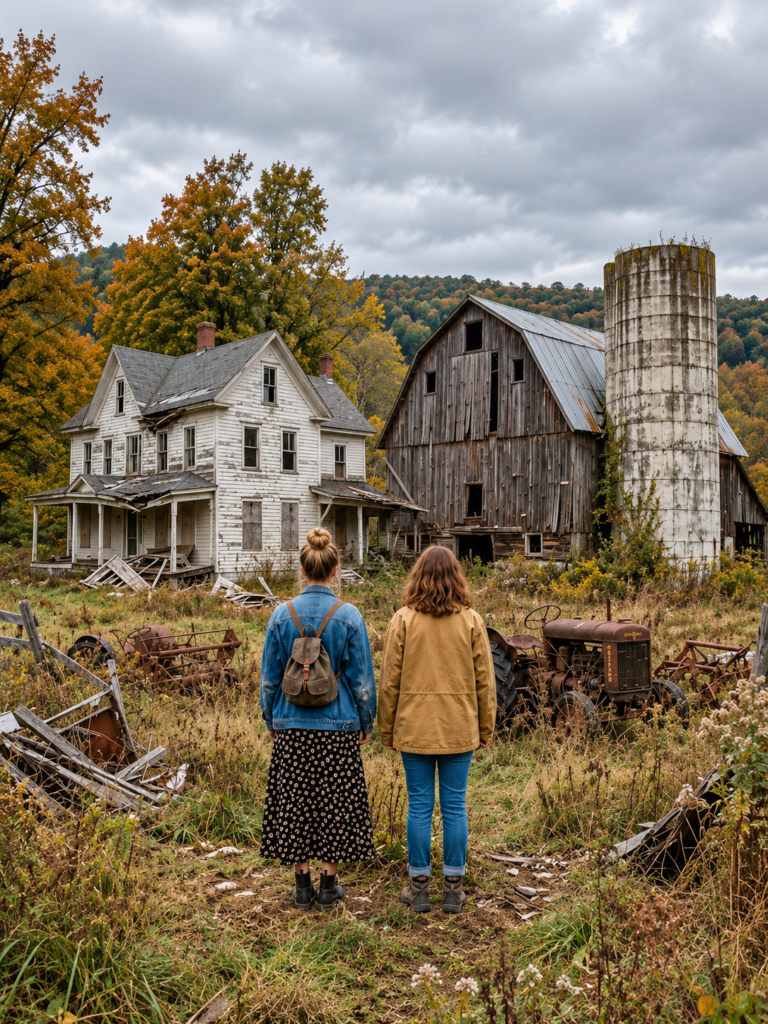
Calling it a farm required imagination.
Several rusted tractors sat abandoned in fields overgrown with dead weeds. Their tires had collapsed into the earth.
An empty concrete silo rose beside a barn whose roofline sagged noticeably toward 1 end.
The barn boards had weathered silver-gray and pulled away in places.
Old machinery lay scattered like bones.
Beyond it stood the farmhouse.
2 stories.
Victorian.
Once white.
The paint peeled in strips.
Several windows had been covered with plywood.
The front porch bowed toward the center.
The gutters hung broken.
The place looked less abandoned than exhausted.
Chloe stopped the car.
The Honda sputtered twice after she removed the key.
Then it became still.
Jess stared through the windshield.
“This is awful.”
Chloe looked at the house.
“It has walls.”
“It barely has walls.”
“We can sleep flat.”
Jess glanced at her.
That ended the argument.
They stepped into the cold.
Mitchell had met them briefly at his office on the way through town.
He had given Chloe a folder containing probate documents and a ring of old brass keys.
His office had smelled of stale coffee and cigarettes.
He had repeated his advice concerning the quitclaim deed.
Chloe had declined.
Now she carried the keys up the sagging steps.
The largest fit the front deadbolt.
It resisted until she leaned against it.
Then the lock opened with a hard metallic crack.
The door moved inward.
Cold air met them from inside.
Not fresher air.
Stillness.
Dust.
Mouse droppings.
Something sour and stale.
Chloe found a switch.
Nothing.
The electricity had been disconnected.
She took a cheap flashlight from the car.
Its beam revealed a hallway reduced to a narrow passage by stacks of newspapers.
Boxes leaned against walls.
Broken chairs.
Mason jars.
Tools.
Coiled wire.
Old mail.
The deeper they moved, the worse it became.
Calvin Reed had not merely neglected the house.
He had barricaded himself inside his possessions.
Jess remained close behind.
“He lived here like this?”
Chloe aimed the flashlight toward the living room.
A large stone fireplace occupied the far wall.
For the moment, that mattered more than anything.
Heat.
They could make heat.
Then Chloe noticed the floor.
Almost every part of the room was covered in dust except a square of hardwood directly in front of the fireplace.
That area was clean.
Not swept.
Worn.
Deep curved scratches scarred the boards surrounding it.
Something heavy had been moved repeatedly across the same section.
Recently enough that dust had not settled evenly again.
Jess noticed her staring.
“What?”
“Nothing.”
Chloe turned toward the fireplace.
“First we get warm.”
Poverty trained curiosity out of a person when curiosity did not solve immediate problems.
For 2 hours the sisters worked outside.
They tore down sections of an old fence and dragged dry boards into the house.
The fireplace smoked badly until Chloe managed to improve the draft.
At last flames took hold.
Smoke thinned.
The room began to warm by degrees.
They found an old mattress in a downstairs room and hauled it beside the hearth.
Wrapped in every layer they owned, they lay down.
The house settled around them.
Wind entered cracks around the windows.
Mice moved behind plaster.
Somewhere upstairs, wood contracted with a sound like a footstep.
Chloe remained awake for a long time.
There was comfort even in discomfort.
For the first time in 3 months, her legs could stretch fully.
Jess slept without waking each time headlights passed.
No police cruiser could order them to move along.
No motel owner could knock because checkout had passed.
No stranger had a key.
The ruined house belonged to them.
That fact was almost painful.
Morning revealed the scale of the work ahead.
The kitchen sink did not run.
The main water valve was rusted shut.
Food remained in cabinets, but much of it was decades old.
Several ceilings had leaked.
One staircase railing was loose.
The furnace did not function.
Still, daylight made the house feel marginally less hostile.
Jess remained asleep while Chloe explored.
At the rear she found Calvin’s office.
Compared with the rest of the house, it was almost organized.
A heavy desk faced a window overlooking the barn and silo.
Ledgers filled shelves and covered the desktop.
Chloe opened one.
At first the entries were conventional.
Feed.
Fuel.
Veterinary expenses.
Milk yields.
Equipment repairs.
The handwriting was compact.
Then, around 1998, the farm records changed.
The agricultural columns stopped.
In their place appeared strings of letters and numbers.
14 C — 400 — intact.
22 A — 150 — transferred.
Silo base secured.
Other pages contained rough sketches of buildings.
The barn.
The farmhouse.
The silo.
Dimensions had been added in the margins.
Some made no sense.
One drawing suggested an interior wall inside the barn where no such space should have existed.
Another showed a route leading beneath the silo.
Chloe flipped farther.
Bank statements had been folded into the back of a ledger.
She unfolded them.
Large deposits.
$10,000.
$20,000.
Then more.
Money appearing irregularly over several years.
Later, beginning around 2010, came withdrawals.
Huge withdrawals.
Cash.
Nearly everything.
Calvin had not been penniless.
At least not then.
So where had the money gone?
A crash from the living room interrupted the question.
Chloe ran.
Jess knelt in front of the fireplace with soot on both hands.
The heavy cast-iron grate had been pulled partly free.
“I was trying to clean it.”
She pointed.
Beneath years of ash, the floor of the hearth had been paved with uneven stones.
1 stone at the center sat strangely raised.
Chloe crouched.
Together they cleared the ash.
The stone was thick.
They tried lifting it with their fingers.
It would not move.
Chloe found a fireplace poker and worked the end into a seam.
She put her weight onto it.
Nothing.
Again.
The stone shifted.
A third effort broke it loose.
Jess dragged it aside.
Beneath was a square opening in the foundation.
Dry air escaped.
It smelled faintly of wax and paper.
Chloe reached down.
Her hand found a metal handle.
She pulled up an old military ammunition box sealed around the edges with hardened beeswax.
The sisters carried it onto the clean section of floor.
The scratch marks around them suddenly made sense.
Something had repeatedly been dragged across the hiding place to conceal access to the hearth.
Chloe scraped away the wax with a screwdriver.
The latch finally opened.
Inside lay a leather-bound journal.
A large brass key.
And a photograph.
Chloe picked up the photograph first.
Her father stood in front of the silo outside.
Dean Reed.
Younger than she remembered him.
Dirt on his clothes.
A shovel in both hands.
Chloe stopped breathing for a moment.
Jess leaned closer.
“That’s Dad.”
“Yes.”
Dean had left on a humid Tuesday 9 years earlier.
He had vanished after a final argument with their mother, leaving overdue utility notices, a microwave with a dent in the side, and 2 daughters who spent years believing every unfamiliar car might be his.
Chloe had eventually stopped imagining his return.
Seeing him on Calvin’s farm reopened something she had spent years burying.
She placed the photograph on the floor.
Then she opened the journal.
Unlike the frantic code in the ledgers, Calvin’s entries were deliberate.
The first passage that mentioned Dean was blunt.
Dean had come asking questions.
He believed there was something hidden near the silo.
Calvin described him as a boy with a nose for weakness and no stomach for real work.
He had warned Dean to stop digging.
Another entry said that if Dean touched the silo again, Calvin would bury him under it.
Jess read over Chloe’s shoulder.
“Do you think he killed him?”
Chloe continued reading.
“I don’t know.”
The journal shifted between farm maintenance, weather, taxes, and increasingly paranoid observations concerning county officials.
At first Chloe assumed Calvin had simply been losing his mind.
Then she reached the entries about property assessments.
Calvin believed local officials were deliberately raising his taxes.
Not because the farm was valuable as a dairy.
Because of what lay beneath it.
One entry read:
They want the land.
They know what is under the limestone ridge.
Let them foreclose.
They can have dirt.
They do not get the reserve.
Silo base secure.
Brass lock holds.
Chloe closed the journal.
The phrase reserve could mean many things.
Money.
Fuel.
Land.
Evidence.
Whatever it meant, the key from the ammunition box had clearly been left with it.
She looked at Jess.
Her sister was shivering hard.
Knowledge did not change their immediate situation.
It was afternoon.
Snow threatened.
The house had no reliable heat.
If Calvin had hidden something that could be converted into cash, they needed to find it before another night passed.
They walked to the silo.
The wind cut through their clothes.
Dead weeds slapped their legs.
The structure was more imposing up close.
Concrete.
Rotting timber.
Rusting steel.
The smell of old silage lingered in the cold.
Jess found the first sign.
Near the base, vegetation stopped growing in a rough square.
The soil was slightly raised.
Chloe knelt and dug.
Jess used a broken piece of wood.
About 5 in below the surface, they struck metal.
A steel hatch had been set into the concrete foundation and buried beneath soil and gravel.
At its center was a heavy padlock protected by a rusted cover.
Chloe removed the brass key.
It entered halfway.
Dirt blocked it.
She forced it.
The key slid deeper.
She turned.
Nothing.
Then a metallic snap sounded inside the lock.
It opened.
The hatch required both sisters.
They dragged it upright until the hinges screamed and the plate fell backward.
Beneath was a shaft.
A ladder descended through concrete walls.
Cool dry air moved upward.
Chloe aimed the flashlight down.
The bottom lay roughly 15 ft below.
A passage extended from there.
Jess stepped away.
“No.”
“Calvin used it.”
“That doesn’t make it safe.”
“He hid the key.”
“That makes it worse.”
Chloe looked at the dark opening.
They had slept in a car for 3 months.
They had eaten crackers for dinner more than once.
Their last $14 was gone.
Whatever Calvin had protected was down there.
She lowered herself onto the ladder.
“I’ll go first.”
The iron was cold enough to hurt her hands.
At the bottom she found poured concrete.
Dry.
Solid.
The tunnel ahead had been reinforced with wood and corrugated steel.
“It’s warmer down here.”
Jess appeared above.
She hesitated.
Then descended.
They followed the passage approximately 50 ft.
The flashlight beam revealed a rectangular room.
Shelving covered the walls.
Heavy canvas bags filled the shelves.
Some had split.
Chloe approached 1.
She touched the fabric.
It tore.
Metal bars spilled onto the floor.
The sound struck the room like gunfire.
Jess cried out.
Chloe picked up 1 bar.
It was remarkably heavy for its size.
Tarnish darkened the surface.
Stamped marks remained visible.
Silver.
Not a few pieces.
Hundreds.
Shelf after shelf.
Calvin had taken the money from the bank and converted it into bullion.
He had hidden his wealth underground where liens and account freezes could not reach it.
Jess turned slowly beneath the flashlight beam.
“How much?”
“I don’t know.”
“Thousands?”
Chloe looked around.
“More.”
At the far end stood a desk.
Black binders had been stacked neatly on top.
Chloe opened the first.
Property records.
Tax assessments.
Corporate filings.
Bank documents.
Newspaper articles.
Copies of correspondence.
Calvin had not merely hidden money.
He had built a case.
Over 15 years, farms in the area had been pushed into tax delinquency.
Assessments rose sharply on specific properties.
Owners lost land.
A company called Oak Haven Land Trust acquired much of it.
Buried among the documents were geological reports concerning natural gas beneath a limestone formation.
The formation crossed Calvin’s property.
It also passed beneath several farms already taken.
Then Chloe saw a familiar name.
Mitchell.
The lawyer.
She read faster.
His family controlled Oak Haven through a network of companies.
He had represented estates whose owners later surrendered land.
He had facilitated quitclaim deeds.
He had been part of the mechanism.
Chloe sat back.
The call from Mitchell changed meaning instantly.
He had not located 2 obscure heirs simply because professional ethics required him to.
He had expected them to sign.
2 homeless girls.
A failing farm.
Huge tax debt.
The easiest transaction imaginable.
Jess was still staring at the silver.
Chloe closed the binder.
“We’re not sleeping in the car again.”
Part 2
They did not attempt to move all the silver.
That would have been impossible.
Even the bars that fit easily in the hand became punishing when gathered in quantity.
Chloe estimated that each weighed around 10 oz.
They loaded 50 into 2 canvas bags.
The weight nearly tore the handles apart.
Getting them back through the passage and up the ladder took repeated trips.
Chloe’s shoulders burned.
Jess’s hands became raw.
Outside, snow began to move through the darkening air.
They locked the hatch when finished.
Chloe covered it again with dirt and leaves as carefully as possible.
Then they put the bags into the Civic’s trunk.
The back of the car sank noticeably.
They needed cash.
Not tomorrow.
Now.
But not in Calvin’s county.
If Mitchell’s family had influence over land records, county officials, and local banking relationships, Chloe wanted distance.
She remembered a bullion dealer advertised along the interstate.
They drove south.
The Honda’s fuel gauge fell toward empty.
The heater barely worked.
At last they reached a strip mall in the next county.
A neon sign announced a coin and bullion business.
Chloe left Jess in the locked car.
She placed 6 bars in her backpack and entered.
The shop was protected by thick glass.
Behind it sat a gray-bearded dealer examining something through a jeweler’s loupe.
He looked at Chloe’s clothes.
Her hands.
Her age.
Then at the silver bar she pushed through the slot.
“Where’d you get this?”
“My grandfather died.”
It was the first lie that came easily.
“He kept a box in his attic. Funeral costs.”
The dealer weighed the bar.
Tested it.
Scratched a small edge and applied acid.
The result satisfied him.
“Real.”
He quoted a price below market.
Chloe knew enough to understand it was poor.
She also understood that arguing over premium was absurd while Jess waited in a freezing car.
“I have 5 more.”
The man’s expression changed.
“Same source?”
“Yes.”
He examined each.
10 minutes later Chloe walked outside with $1,080.
Jess opened the envelope.
For several seconds she simply stared.
The amount was not wealth.
Compared with what waited beneath the silo, it was almost nothing.
But to girls who had counted quarters for gasoline, it felt transformative.
They filled the Honda’s tank.
At a large hardware store they bought 2 kerosene heaters, fuel, insulated sleeping bags, winter boots, coats, an industrial crowbar, new locks, batteries, and lanterns.
Then they went to a diner.
Jess ordered a cheeseburger and fries.
When the plate arrived, she looked at it for so long that Chloe thought something was wrong.
Then Jess took a bite.
A tear ran down her face.
She wiped it away angrily.
Chloe pretended not to notice.
She ate quickly.
Her mind remained in Calvin’s bunker.
Mitchell believed the farm was nearly lost.
He believed Chloe and Jess were desperate enough to exchange the property for relief from debt.
He did not know the bunker had been found.
He did not know the documents were in their hands.
Most importantly, he did not know Chloe understood his connection to Oak Haven.
“We go back tonight,” Chloe said.
Jess stopped eating.
“To the farm?”
“Yes.”
“What if Mitchell comes?”
“I hope he does.”
The house felt different after they returned.
Warmth altered it.
The kerosene heaters drove cold out of the living room.
New sleeping bags covered the mattress.
A battery lantern replaced the weak flashlight.
The rooms were still damaged, cluttered, and filthy, but the sisters were no longer entirely at their mercy.
Jess fell asleep early.
Chloe sat near the heater with Calvin’s black binders around her.
She read for hours.
The corruption was methodical.
Oak Haven had targeted farms positioned over the same geological formation.
Local assessors raised valuations.
Taxes climbed.
Owners already struggling with agricultural debt fell behind.
Then legal representatives offered relief through property surrender.
Quitclaim deeds.
Debt forgiveness.
Quick sales.
Mitchell appeared repeatedly.
Sometimes directly.
Sometimes through relatives.
Sometimes through companies sharing addresses or officers.
Calvin had cross-referenced everything.
He had copied internal correspondence.
He had preserved bank transfers.
He had obtained a geological survey suggesting a large natural gas deposit beneath the limestone ridge.
Calvin’s own farm sat directly above it.
He had understood before they understood him.
The ruined house had been camouflage.
Unpaid taxes had been partly strategic.
He had withdrawn his money from banks, converted much of it into silver, and hidden it beyond easy seizure.
He had allowed himself to look like an old paranoid farmer sliding toward insolvency while building evidence against the people waiting to take his land.
“He was waiting,” Chloe whispered.
Jess slept behind her.
“He knew they’d come.”
Morning arrived white.
About 2 in of snow covered the farm.
Chloe was heating water for instant coffee when an engine entered the driveway.
Not the Honda’s tired rattle.
A deep, smooth V8.
She looked through a gap beside the plywood on the front window.
A black SUV moved toward the house.
It stopped near the porch.
Mitchell got out.
He wore a charcoal overcoat.
Beside him emerged another man, larger and broader, dressed in a tan work jacket.
Jess came into the room.
“Who is it?”
“Mitchell.”
Chloe put down her mug.
“Stay inside.”
“No.”
“Jess.”
“I said no.”
Chloe turned.
Her sister’s expression was frightened but firm.
“Lock the door after me. If anything goes wrong, call the state police.”
“With what service?”
The prepaid phone barely had reception.
“Try anyway.”
Chloe placed the crowbar inside her coat where it would remain hidden.
Then she stepped onto the porch.
Cold hit her immediately.
Mitchell looked up.
His smile was professional and empty.
“Chloe. You made it.”
She said nothing.
“I tried calling.”
“We’ve been busy.”
He opened a leather briefcase.
“I brought the quitclaim documents. As I explained, foreclosure is moving quickly. If we complete this today, I can see that you’re released from the tax liability.”
He held out a pen.
Chloe remained at the top of the steps.
“I have a question.”
Mitchell’s smile tightened.
“Certainly.”
“The taxes.”
“What about them?”
“They’re strange.”
His expression changed almost invisibly.
Chloe continued.
“This farm hasn’t produced milk in years. Half the buildings are falling down. But the assessment kept climbing.”
Mitchell adjusted his glasses.
“Property tax formulas are complex.”
“Apparently. Because a farm 2 miles away had the same problem until Oak Haven bought it. Then suddenly its assessment dropped.”
The larger man beside the SUV glanced toward Mitchell.
Mitchell lowered the pen.
“I’m afraid you don’t understand how agricultural classifications work.”
“I understand Oak Haven.”
The name stopped him.
Chloe could hear her pulse.
She kept her voice even.
“I understand the limestone ridge too.”
Mitchell’s face went pale.
For the first time, the politeness disappeared completely.
“You should be careful.”
“I am.”
“You’re 19 years old. You’ve inherited a tax problem you can’t begin to manage. I’m trying to help you.”
“You were trying to get us to sign away a gas reserve.”
Mitchell took 1 step toward the porch.
“You have no idea what you’re dealing with.”
“That keeps being said to me by men who want something.”
Chloe reached into her pocket.
The large man stiffened.
She withdrew a silver bar.
Then tossed it down.
It landed in the snow beside Mitchell’s shoe.
His eyes followed it.
The metal sank slightly into the powder.
“Calvin wasn’t broke.”
Mitchell said nothing.
“And neither are we.”
His gaze lifted slowly.
Chloe understood what he was calculating.
Silver meant the hidden money had been found.
If the hidden money had been found, the hiding place might also contain Calvin’s documents.
Mitchell looked toward the silo.
Only for a second.
But Chloe saw it.
“You found something you don’t understand,” he said.
“I found enough.”
She pulled a folded sheet from her coat.
A copy of an Oak Haven filing.
“I know about the shell companies. I know about the reassessments. I know who signed them. I know which farms you took.”
Mitchell’s jaw tightened.
“A collection of old papers proves nothing.”
“Maybe.”
Chloe folded the page.
“But I’ll let the state attorney general decide.”
The man by the SUV stepped forward.
“Mr. Mitchell, you want me to handle this?”
“Stop.”
Mitchell’s voice cracked.
The larger man froze.
Chloe kept 1 hand inside her coat.
Her fingers were around the crowbar.
She had no idea whether she could actually use it.
Her body had already begun shaking, but the coat concealed that.
Mitchell looked at her differently now.
Not as a child.
Not as an heir.
As risk.
“You still owe the county,” he said. “That part isn’t imaginary.”
“$84,000.”
He stared.
Chloe had found the figure in Calvin’s files.
“I’ll pay it tomorrow.”
His mouth moved slightly.
“You don’t have $84,000.”
She looked down at the silver bar.
“There are more.”
Silence.
The wind moved through the silo opening behind the barn.
Chloe took a breath.
“At 9:00 tomorrow morning I’m walking into the clerk’s office with a cashier’s check. Once the debt is cleared, there is no foreclosure.”
“You think that ends this?”
“No.”
She allowed herself a small smile.
“Then I’m driving to Albany.”
Mitchell’s expression hardened.
“You’re making an enemy of people who have been doing business in this county since before you were born.”
“You made an enemy out of Calvin.”
“And look where that got him.”
The words escaped too quickly.
Even the larger man turned toward him.
Chloe felt cold move through her.
“Was that a threat?”
Mitchell recovered.
“It’s an observation. He died alone in a collapsing house guarding papers nobody cared about.”
“He died owning the farm.”
Mitchell looked at the silver again.
Chloe pointed toward the driveway.
“Leave it.”
He glanced up.
“The bar.”
She said it more quietly.
“Leave the silver. Get in your SUV. Never come down this driveway again.”
For nearly 10 seconds, nobody moved.
Then Mitchell turned.
The larger man hesitated.
Mitchell snapped his name.
They entered the vehicle.
The SUV reversed sharply.
Tires threw snow and gravel across the yard.
Chloe remained upright until it disappeared.
Then her knees failed.
She sat hard on the porch boards.
The crowbar slipped from her coat and struck the wood.
Her hands shook violently.
She had been terrified from the moment the SUV appeared.
Not brave.
Terrified.
Jess opened the door.
For once Chloe did not order her back inside.
Jess sat beside her.
She wrapped both arms around Chloe.
They remained there without speaking.
In front of them the silver bar rested in the snow.
Behind them stood the broken house.
Beyond it the barn and silo leaned beneath a pale winter sky.
For the first time, Chloe looked across the property and thought of it not as Calvin’s farm.
Not as Mitchell’s target.
Theirs.
The realization was different from the one she had felt on the first night.
Then the farm had been shelter.
Now it was territory.
And territory required defending.
The next 2 days were spent moving faster than either sister had ever moved before.
They returned to the bunker.
This time they took more silver.
Not enough to draw attention locally.
Enough to kill the foreclosure.
They drove south into Pennsylvania and found a larger dealer experienced with high-volume bullion transactions.
Chloe showed identification.
Explained inheritance.
The dealer tested the bars.
Treasury markings helped.
Questions remained, but money moved.
They liquidated approximately $100,000 worth.
A legitimate bank account was opened outside Calvin’s county.
The money cleared.
The following morning Chloe walked into the county clerk’s office carrying a cashier’s check.
$84,000.
The clerk behind the desk was middle-aged, tired, and apparently uninterested in whatever schemes had developed elsewhere in county government.
She examined the account.
Accepted payment.
Stamped several pages.
The sound of that stamp was almost disappointing.
Something that had threatened to erase the sisters’ future ended with red ink and paperwork.
The back taxes were paid.
The foreclosure stopped.
The deed was secure.
Chloe did not celebrate.
She returned to the Honda.
Jess was waiting.
“Done?”
“Done.”
Jess smiled.
Chloe started the engine.
“Now Albany.”
The state attorney general’s office occupied a building that made Chloe acutely aware of her age.
Stone walls.
Security.
Reception desks.
People in suits walking with files under their arms.
She carried 1 of Calvin’s black binders inside.
The receptionist asked whether she had an appointment.
“No.”
“What is this regarding?”
“County tax fraud.”
The woman began to explain a complaint process.
Chloe placed the binder on the desk.
It landed heavily.
“Please look at the first 10 pages.”
The receptionist did.
Her expression changed by page 4.
Chloe and Jess remained in that building for 6 hours.
Investigators joined.
Then another.
Copies were made.
Questions were asked.
How had Calvin obtained the materials?
Who was Mitchell?
Were original records still secure?
Did anyone else know where they were?
Had they been threatened?
Chloe told them about the visit to the farm.
She omitted the crowbar.
By the time the sisters left, subpoenas and warrants were already being discussed.
For the first time since answering the prepaid phone in a frozen parking lot, Chloe allowed herself to believe Mitchell might actually be more afraid than she was.
Part 3
Winter settled over the farm.
The transformation began with necessities.
Roof first.
Then water.
Then heat.
Chloe hired contractors from outside the immediate area whenever possible.
She paid deposits promptly.
The plumbing was repaired.
Broken sections of roof were replaced.
A large wood-burning furnace went into the basement.
Windows were sealed.
The front door received a new deadbolt.
The porch was braced.
The living room was cleared.
New wiring restored power to several essential rooms.
The work did not make the house beautiful.
Not yet.
It made it safe.
Safety altered the sisters in ways neither recognized immediately.
Jess stopped waking at every engine sound.
Chloe stopped sleeping with the prepaid phone in her hand.
They could leave food in the refrigerator.
They could buy groceries for a week instead of 1 day.
A towel remained theirs after they used it.
The shower turned hot.
There were clean socks.
Small luxuries became almost unbearable.
Jess cried again the first time she opened a kitchen cabinet and saw enough food that she did not need to count meals.
Chloe pretended not to notice that either.
They kept the bunker secret.
The state investigators knew Calvin had preserved financial evidence, but Chloe did not immediately disclose the full quantity of bullion underground.
She hired a reputable attorney in Albany with no ties to the county.
Then an accountant.
They cataloged the inheritance.
The silver would eventually have to be reported properly, valued, and integrated into legitimate financial planning.
Chloe had no intention of replacing homelessness with tax fraud.
She also had no intention of moving anything until she understood exactly what belonged to them and what obligations came with it.
Calvin’s binders proved more valuable than silver in another sense.
They contained the history of how several neighboring families had lost their farms.
The pattern was brutal because it was bureaucratic.
No masked men arrived at midnight.
No signatures were forged in dark rooms.
People simply received tax assessments that suddenly rose beyond anything their farm income could support.
Appeals were delayed.
Paperwork vanished.
Loans were denied.
Then a friendly intermediary appeared.
Sometimes Mitchell.
Sometimes another attorney.
Sometimes Oak Haven directly.
Sign here.
Walk away from the debt.
Take what little cash is offered.
Start over.
Families who had held the same land for generations vanished within months.
Oak Haven acquired parcels that, when placed together on Calvin’s geological maps, followed the buried gas formation almost perfectly.
Calvin had seen the design.
He also seemed to have known that openly fighting it would fail.
His journals revealed years of conflict.
He wrote letters.
Filed appeals.
Attended county meetings.
Asked for records.
Was ignored.
Then he changed tactics.
The dairy operation was already collapsing.
Rather than preserve the appearance of prosperity, he let the property deteriorate.
He stopped trusting banks.
Converted assets.
Collected records.
Made copies.
Hid them.
Calvin understood his enemies wanted the ground more than anything standing on it.
So he made the ground look worthless while ensuring they could not easily obtain it.
His hoarding in the house now looked less random.
Some of it was surely neglect.
But some piles concealed entry points.
Some furniture had been positioned deliberately.
The clean floor in front of the fireplace existed because Calvin had dragged a heavy object over the hiding place again and again.
Chloe eventually found it.
An old cast-iron stove pushed against another wall.
Scratches on the floor matched its legs.
Calvin had moved it whenever he needed access to the ammunition box.
Dean’s role remained more painful.
The journals provided pieces.
Not enough for certainty.
Their father had visited Calvin repeatedly years earlier.
He had discovered that his uncle was hiding wealth.
Dean asked for money.
Then demanded it.
He searched the barn.
Attempted to force access near the silo.
Calvin caught him.
The threats between them grew ugly.
One entry stated that Dean had offered to help expose the county corruption if Calvin gave him a share of whatever was hidden.
Calvin refused.
He did not trust him.
According to another entry, Dean tried to dig near the silo after midnight.
Calvin found him.
They fought.
Dean left.
The journal did not say Calvin killed him.
Quite the opposite.
A later entry mentioned hearing through another relative that Dean had been seen out west.
Alive.
Still chasing schemes.
That knowledge produced less relief than Chloe expected.
For 9 years some part of her had imagined tragedy.
An accident.
A body unidentified somewhere.
A reason.
Calvin’s account suggested something simpler.
Dean had left because Dean left.
He had gone looking for easier money.
He had known family existed on the farm.
He had known he had 2 daughters elsewhere.
He chose himself.
Jess read the entry once.
Then closed the journal.
“Don’t tell me if you find more about him.”
Chloe understood.
The county case expanded.
Mitchell’s law office was searched.
Oak Haven records were seized.
Several county officials were placed under investigation.
Property assessments became evidence.
So did internal correspondence Calvin had somehow obtained.
The sisters were repeatedly interviewed.
Chloe disliked the process.
Each meeting required retelling the same details.
How Mitchell contacted her.
What he said about the farm.
How strongly he encouraged the quitclaim.
When she discovered his name in Calvin’s papers.
What happened during the confrontation.
Investigators asked whether Mitchell or his associate had explicitly threatened physical violence.
Chloe thought of the large man asking whether he should handle the situation.
“No,” she said. “Not explicitly.”
The distinction irritated her.
Still, systems required precision.
Calvin had understood that.
That was why his binders mattered.
He had spent years converting suspicion into dates, transfers, deeds, signatures, and names.
Not stories.
Evidence.
News reached town gradually.
Mitchell stopped appearing publicly.
Oak Haven suspended acquisitions.
Several old farm families hired lawyers.
Some attempted to reopen settlements made years earlier.
The story people told about Calvin changed.
Before his death, many locals had regarded him as a bitter recluse.
A man who let a good farm rot.
A paranoid hoarder who distrusted banks and county officials.
After the investigation began, people remembered different things.
Calvin had asked strange questions because strange things were happening.
He had accused officials because officials were apparently taking bribes.
He had warned neighbors not to sign paperwork too quickly.
Some had laughed.
Now the laughter was remembered less clearly.
Chloe found herself angry on Calvin’s behalf.
Then angry with Calvin.
If he had known this much, why had he not done more?
Why leave everything buried until a stroke killed him?
The answer came gradually through the journals.
He had tried.
He simply trusted almost nobody by the end.
Witnesses withdrew.
Families wanted settlements more than investigations.
Local complaints disappeared into the same offices implicated in the scheme.
Calvin came to believe that evidence had to survive him before it could succeed.
He began storing copies underground.
His final years were not spent waiting for victory.
They were spent making erasure impossible.
Yet there was no note addressed directly to Chloe or Jess.
No sentimental explanation.
No declaration that he had chosen them.
The law had chosen them because no closer heirs remained.
That fact made the inheritance stranger and, in some ways, more honest.
Calvin had not rescued them intentionally.
He had died.
They had arrived because they had nowhere else to go.
What saved them was partly fortune.
But only partly.
Another heir might have signed Mitchell’s document.
A person with an apartment, job, and ordinary life might have looked at the farm, the taxes, the ruined house, and walked away.
Chloe had accepted because the front door locked.
Desperation had placed her where caution might not have.
Once there, survival had done the rest.
Spring revealed what winter concealed.
Fields emerged from snow.
Water gathered in ruts.
The barn looked even worse under clear daylight.
One wall bowed.
The silo showed several vertical cracks.
Chloe hired an engineer.
He inspected the structure, then the hidden chamber once their attorney had arranged appropriate documentation.
His conclusion was both reassuring and costly.
The underground bunker was stable.
The silo above it was not.
They would need either major reinforcement or controlled demolition.
Jess voted for demolition.
Chloe looked at the old photograph of Dean with the shovel.
Then at Calvin’s notes.
“Keep the base,” she said. “Take down the dangerous part.”
The silo came apart piece by piece.
The bunker entrance was rebuilt more securely and concealed inside a small utility structure.
The silver was professionally inventoried.
There was less than Jess had imagined during that first night but far more than either girl could comprehend comfortably.
Enough to pay the taxes.
Enough to restore the farmhouse carefully.
Enough to invest.
Enough that, handled correctly, neither sister would have to measure life in gasoline quarters again.
Chloe refused to treat it as limitless.
Poverty had permanently altered her sense of money.
She still compared prices automatically.
Still felt uneasy when the gas tank dropped below half.
Still saved motel soaps.
Still woke occasionally with the conviction that they had overslept in a parking lot and would be asked to leave.
Jess adapted faster.
She returned to school.
At first she avoided telling anyone where she lived.
Then curiosity around the investigation made secrecy impossible.
Some students treated her differently.
Others asked intrusive questions about the silver.
One wanted to know whether she was rich now.
Jess told Chloe afterward.
“What did you say?”
“I said our furnace works.”
Chloe laughed.
It surprised both of them.
Chloe completed the remaining requirements for her diploma through an alternative program.
She had imagined education becoming irrelevant during the months in the car.
Now Calvin’s records taught her otherwise.
The people who nearly stole the farm understood paperwork.
Assessments.
Corporate structures.
Probate.
Debt.
Contracts.
Chloe decided she would learn them too.
Not because she suddenly wanted an office.
Because she never again wanted to sign something simply because a man in a good coat told her it was the sensible thing to do.
The farm did not return to dairy production.
Neither sister knew cattle.
The old milking equipment was beyond salvage.
After the immediate repairs, Chloe leased some acreage to a neighboring farmer whose family had narrowly avoided an Oak Haven foreclosure.
Other fields remained fallow.
The barn was stabilized.
The tractors were hauled away.
One small machine that could be restored was kept.
Jess insisted.
“It looks like it belongs here.”
The farmhouse improved slowly.
They refused to erase Calvin completely.
Most of the hoarded newspapers went.
So did broken furniture, rotten food, mouse nests, and rusted debris.
But his office remained.
The oak desk was cleaned.
The ledgers were boxed properly.
Copies of the corruption records were stored in secure locations.
The original ammunition tin stayed under the hearth.
Not because Chloe believed she needed another secret hiding place.
Because the cavity felt like part of the house’s history.
The brass key went into a safe.
The Polaroid of Dean went into a drawer.
Not displayed.
Not destroyed.
Just contained.
Mitchell was eventually charged as part of a broader state and federal investigation.
So were several associates.
The case moved slowly.
Real cases did.
There was no single courtroom moment in which everyone gasped.
There were filings.
Hearings.
Pleas.
Motions.
Negotiations.
Some charges held.
Others changed.
Property owners brought civil claims.
The machinery Calvin had documented did not collapse in 1 dramatic blow.
It was dismantled through the same sort of paper that had built it.
Chloe came to appreciate that irony.
For years those men had used forms, notices, assessments, signatures, and deadlines to take land.
Now forms, notices, signatures, and deadlines took them apart.
One question remained.
Why had Mitchell called Chloe at all?
If his goal was to acquire the farm, why notify the heirs instead of allowing foreclosure to proceed?
The answer emerged through probate procedure.
He needed clean title.
Calvin’s death complicated seizure.
Unknown heirs could challenge a later transfer.
It was safer to locate them, convince them the property was worthless, have them relinquish any claim, then allow the tax process to continue.
Mitchell’s mistake was assuming poverty made Chloe predictable.
He had been partly right.
Poverty changed every decision she made.
Just not in the direction he expected.
She did not see an $84,000 tax debt and think liability.
She saw a locked door.
A roof.
Floor space enough for Jess to sleep without curling around a gearshift.
Mitchell had expected her to value freedom from debt.
She valued shelter more.
That small difference ruined the entire plan.
Months after the investigation began, Chloe found a final notebook behind a false panel in Calvin’s desk.
It was thin.
No codes.
No financial records.
Mostly observations from his last year.
He wrote of the farm more gently there.
Snow in the north field.
A fox crossing behind the barn.
Swallows returning.
He wrote of age.
Of failing strength.
Of the possibility that he had waited too long.
1 passage mentioned the girls.
Not by name.
Dean’s daughters.
Calvin wrote that he had heard their mother died.
He did not know where they were.
He did not know whether they would ever come to the farm.
He wrote that Dean had failed them the same way he failed everything requiring patience.
Then another line.
If they come, let them decide what dirt is worth when it is the only dirt anybody ever left them.
Chloe read the sentence 3 times.
She showed Jess.
Her sister sat at the kitchen table with the notebook open between them.
“So he did know about us.”
“A little.”
“Do you think he meant us to get it?”
“He didn’t write a will.”
“That’s not what I asked.”
Chloe looked through the kitchen window.
The field beyond had begun turning green.
“I think maybe he wanted somebody who hadn’t already been bought.”
Jess closed the notebook.
The farm’s transformation continued.
By summer the porch had been rebuilt.
Most of the house was painted again.
The boarded windows had glass.
The kitchen smelled of coffee instead of mouse droppings.
One evening Chloe stood in front of the fireplace.
The same hearth where they had found the ammunition tin.
She remembered the first night.
Fence posts burning badly.
Smoke filling the room.
Jess asleep on a dirty mattress.
The weight of fear.
The certainty that whatever happened next could not be worse because there had been almost nowhere lower to fall.
The floorboards had been refinished, but Chloe had asked the contractor not to sand out every mark.
A few curved scratches remained.
He had questioned the choice.
She told him they mattered.
Calvin’s cast-iron stove had once been dragged across those boards to conceal the only key to everything he had protected.
The damage was evidence of use.
Not every scar needed to disappear for a house to become livable.
Jess entered carrying 2 mugs.
She handed 1 to Chloe.
They went to the window.
The old tractors were gone.
Snow had been replaced by tall grass.
The remaining barn leaned less after reinforcement.
Beyond it, where the dangerous upper portion of the silo had been dismantled, a lower concrete ring remained.
Beneath it lay the bunker.
Most of the silver was no longer there.
It had been moved, documented, taxed where necessary, sold or stored securely.
The black binders existed in duplicate.
Calvin’s secret was no longer dependent on 1 old man in a collapsing farmhouse.
That, Chloe sometimes thought, might have been the real inheritance.
Not the metal.
Not even the land.
Evidence only became power when somebody carried it out into the light.
Jess sipped her coffee.
“It’s actually nice now.”
Chloe looked at her.
Jess was wearing clean sweatpants and wool socks.
Her hair was still damp from a shower.
She looked younger than she had during the months in the car.
More like 16.
For a long time homelessness had aged both of them.
Hunger made every face severe.
Fear reduced the world to exits.
Now Jess could stand at a window and simply look.
Outside, the farm rolled toward the distant tree line.
Calvin had allowed it to decay because decay had helped him hide.
Mitchell had looked at the same property and seen mineral rights.
Dean had looked at it and seen buried money.
County officials had seen assessments.
Oak Haven had seen parcels to assemble.
Chloe remembered what she had seen when she first arrived.
A roof.
A door.
Somewhere to stretch her legs.
Perhaps ownership began with that.
Not value on paper.
Not reserve estimates.
The knowledge that, when night came, no one could legally make you leave.
Chloe lifted the mug.
The coffee was hot.
She could smell new pine from repaired walls and distant wood smoke from the furnace.
The tightness she had carried beneath her ribs for months was gone.
Not all at once.
It had receded so gradually she had almost failed to notice.
There would still be lawyers.
Taxes.
Repairs.
School.
Investments.
Court dates.
Questions about Calvin.
Questions about Dean.
Money did not make family simpler.
It did not return lost years.
It did not make what happened fair.
It did something more basic.
It created room.
Room to decide.
Room to wait.
Room to make a mistake without losing everything.
Jess rested her forehead briefly against the cool window.
“Do you ever think about what would’ve happened if you signed Mitchell’s papers?”
“Yes.”
“Would you have?”
“If we still had an apartment?”
Jess looked over.
Chloe considered it.
“Probably.”
The answer surprised neither of them.
A person with something to protect might have rejected the ruined farm.
A person with nowhere to go saw possibility in the same wreckage.
Jess smiled faintly.
“So being homeless saved us.”
Chloe shook her head.
“No.”
She looked at the repaired house around them.
“Being homeless brought us here.”
There was a difference.
She thought of Calvin dying alone.
Of Dean walking away.
Of Mitchell standing in the snow beside the silver bar.
Of the clerk’s stamp landing on the paid tax file.
Of the first cheeseburger Jess had eaten after weeks of hunger.
Of the bunker opening beneath the silo.
For most of Chloe’s life, inheritance had seemed like something that happened to other people.
Families handed down houses.
Money.
Jewelry.
Businesses.
Traditions.
The Reed family had handed down absence.
Debts.
Silence.
Then Calvin died and left behind a farm everyone else had mistaken for worthless.
Under its collapsing buildings sat silver.
Inside its clutter sat proof.
Beneath the proof was a harder lesson.
Nothing protected itself.
Not land.
Not evidence.
Not sisters.
Someone had to stay.
Someone had to read the documents.
Someone had to refuse the signature.
Someone had to decide that the broken thing was worth holding long enough to discover what had been buried under it.
Chloe had not known any of that when the phone rang in the frozen Honda.
She had asked only 2 questions.
Did it have a roof?
Did the door lock?
At the time, those seemed like the questions of someone with no choices.
Looking out over the farm now, she understood they had been the first choices that mattered.

