
Part 1
In 1844, a man arrived at the southern edge of Iberville Parish with 14 wagons, a letter of credit from a bank whose name would eventually disappear from Louisiana commerce, and a reputation that respectable families in Baton Rouge preferred not to discuss over supper.
His name was Augustine Monontlair.
The surviving financial document gives it somewhat differently: Austin Étienne Monontlair. The distinction might have been clerical, deliberate, or simply one more uncertainty among the many that gathered around him. What mattered in Iberville Parish was not what he called himself but what he possessed. The letter authorized him to draw as much as $40,000 against an account belonging to an enterprise styled the Compagnie Maritime du Golfe. In 1843, that was a formidable sum. The company itself left almost no trace. No charter has been found, no registry, no record of incorporation in France, Spain, Louisiana, or anywhere else. Its name appears, so far as the surviving papers show, on a single document.
That document financed the house.
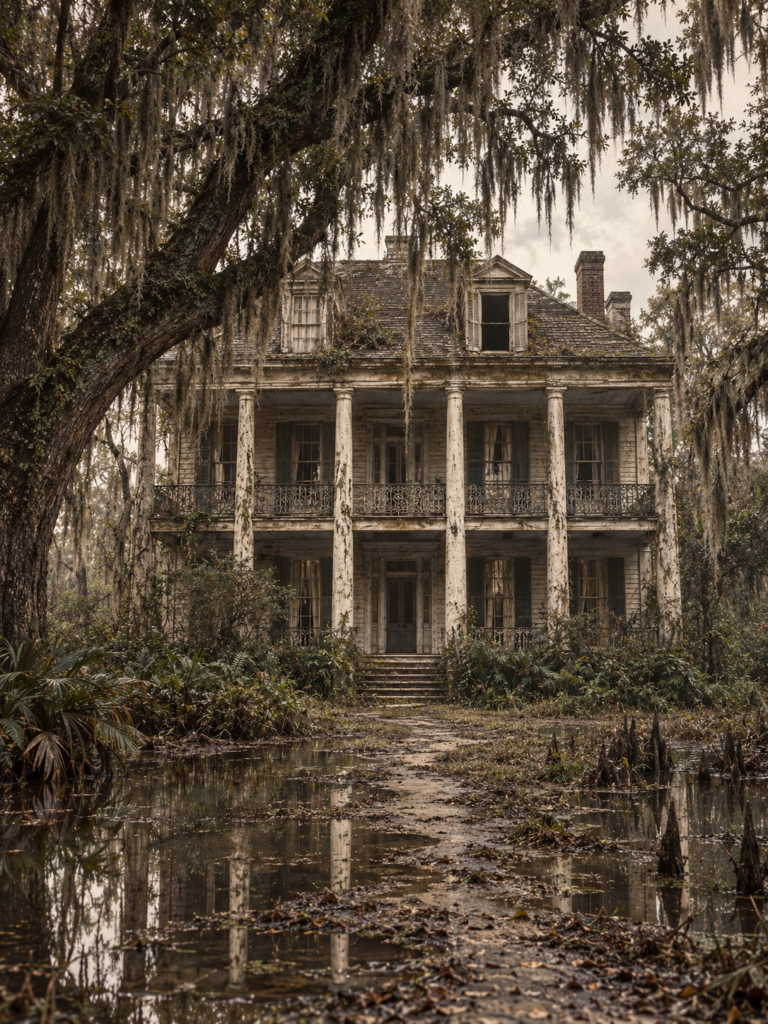
Within approximately 18 months, on a slight rise above the east bank of Bayou Maringuan, Monontlair built what was said to be the largest private residence in that part of the Louisiana bayou country. It contained 47 rooms. Its main body stood 3 stories high, and beneath it was a basement that should not have been possible.
Nothing about the house conformed to expectation.
The great plantation residences along the Mississippi announced themselves. Their columns, galleries, broad stairs, formal entrances, and river-facing façades were not merely architectural choices. They were statements of rank. The river was the road. Guests arrived by water. Crops departed by water. News came by water. A planter who wanted to be known placed the public face of his house toward that moving world.
Monontlair turned his back on it.
His house faced east, toward miles of cypress, wet ground, tangled undergrowth, and black water hidden beneath trees. Anyone approaching from the bayou saw the rear of the structure. There was no elegant portico waiting to receive visitors, no sweep of columns, no ornamental ironwork, nothing of the theatrical grace with which Louisiana wealth liked to disguise the violence beneath it.
The walls were brick, manufactured on the property from local clay. Witnesses remembered them as dark red-brown, so heavy in tone that even under bright sun the building seemed to absorb light rather than reflect it. The proportions were severe. Some compared the house to an institution. Others to a prison.
The first-floor windows were narrow and set approximately 6 ft above the ground. From outside, a man could not easily see in. From inside, a person could not easily climb out.
The windows on the second floor were larger, but later descriptions contain a detail stranger than their size. The wooden shutters, according to those accounts, were fitted so they could be secured from the exterior.
The third floor had no windows.
Then there was the cellar.
In the bayou country, people did not build downward. The water table made the idea absurd. Dig a shallow hole in much of Iberville Parish and water found it before a man finished his work. Houses rose above the earth on piers. Tombs in New Orleans rose above the earth for the same reason. The ground itself resisted enclosure.
Monontlair dug into it anyway.
Accounts differ on the basement’s exact depth, placing it between 8 and 12 ft beneath the surface. The method was never documented with certainty. Later speculation suggested a form of cofferdam engineering, with dense wooden pilings driven deep into the clay, the enclosed space pumped or drained, then lined in brick and sealed with tar, fat, and whatever else could be made to resist the constant pressure of water.
Whatever the method, the labor would have been immense.
So would the cost in human life.
Men would have worked half-submerged in Louisiana heat, driving timber by hand into clay beneath air alive with mosquitoes and disease. Fever could kill without warning. Infection could follow the smallest wound. Heavy construction in such ground was dangerous even for men who could stop when exhaustion overtook them.
The men working for Monontlair did not necessarily possess that choice.
Workers came from at least 4 parishes. Local memory later insisted that many never returned.
By early 1845, the main house was standing.
People near the property soon learned not to linger around it.
Families who had fished the neighboring stretch of Bayou Maringuan for years began avoiding the water beside Monontlair’s land. Some said the fish there tasted wrong. Others said the current behaved strangely along the bank. Things came to the surface after dark, they said, things no one wanted to identify in daylight.
There were sounds as well.
On still nights, when the moss hung motionless and not enough wind moved through the cypress to stir a leaf, people claimed they could hear something from the direction of the house.
Not screaming.
The stories were quite specific about that.
A low sound.
Continuous.
Almost rhythmic.
Some compared it to humming, except no human throat seemed capable of sustaining it. Others said it resembled breathing on a scale so large that the comparison became unbearable, as though something beneath the foundation were filling its lungs in the dark and slowly letting the air out again.
People learned not to ask.
To understand how such a house could exist without inquiry, it was necessary to understand the country surrounding it.
The polished image of antebellum Louisiana belonged largely to the river corridor: white façades, formal dinners, chandeliers, portraits, visiting Europeans, French conversation, elaborate hospitality performed before an audience conscious of rank. The wealthiest families recorded themselves carefully because they intended to be remembered.
Move away from the river, however, and the certainty thinned.
Roads became unreliable with the seasons. Mail vanished for weeks. Water covered paths that maps insisted were land. Authority weakened with distance. The federal government was remote, and local authority belonged to men entangled through marriage, debt, property, and politics with the same class they were supposed to restrain.
A wealthy planter could possess enormous influence.
A sufficiently wealthy planter could become difficult to see at all.
For the enslaved population, the distinction between visible and invisible power mattered only in degree. The sugar country was punishing even by the standards of American slavery. Work was relentless. Disease flourished. Heat, machinery, cutting implements, boiling houses, exhaustion, and insufficient rest shortened lives. On isolated properties, removed from neighboring observation, cruelty required no disguise.
Monontlair had chosen isolation deliberately.
His own history was similarly difficult to approach.
Years later, 3 theories would be offered for the origin of his wealth. One held that he had profited from the illegal transatlantic slave trade through front companies created to move people and money beyond ordinary scrutiny. Another connected him to the remnants of Gulf smuggling networks associated with piracy. The third came from a Jesuit priest who said he had heard Monontlair’s story from Monontlair himself.
Father Cyprian Boudreaux reached the property in 1851 while traveling through Iberville Parish to administer sacraments to Catholic families in remote settlements. Monontlair invited him to supper.
The priest accepted.
He later regretted doing so.
During the meal, Monontlair spoke of Saint-Domingue.
He said he had been born there during the early 1790s, into a wealthy French planting family caught in the violence of the Haitian Revolution. According to the account Father Boudreaux later committed to paper, the Monontlairs fled first to Cuba and then to New Orleans. Augustine’s father died of yellow fever within a year. The boy was raised by an uncle.
That uncle, Monontlair said, had taught him what he called the true science of managing property.
Boudreaux asked what he meant.
Monontlair’s answer stayed with the priest strongly enough that he recorded its substance afterward.
The Africans, Monontlair said, had destroyed his family’s world. They had burned the house. They had killed his mother and his sisters. His uncle had therefore taught him that preventing another uprising required more than chains, beatings, or ordinary terror. A man reduced only through fear still possessed enough imagination to desire escape.
That was not sufficient.
A slave must be denied community. Language. Trust. Identity. The possibility of conceiving himself as fully human.
An animal at least had instinct, Monontlair told him.
The enslaved person must be reduced even below that.
To an absence.
That, he said, was the science.
The supper continued, although Father Boudreaux had lost his appetite.
At some point he became aware of noises below them.
The sound did not seem to come from another room on the same floor. It came through the structure beneath his feet, faint enough that he could not identify it and persistent enough that he could not stop listening.
Monontlair offered him a guest room for the night.
Boudreaux refused.
He walked approximately 3 miles in darkness rather than sleep under that roof.
The letter he later wrote to his superior in New Orleans survived because institutions sometimes preserve what governments do not. It remained in Jesuit archives for more than a century before being discovered by a graduate researcher in 1971.
By then, the house had long since vanished.
But in the years immediately after Boudreaux’s visit, it still stood, and among the people who had the greatest reason to fear it, warnings had already been circulating for years.
Enslaved communities in antebellum Louisiana maintained their own networks of information. News moved through markets, churches, river traffic, labor exchanges, family connections, carriage routes, kitchens, docks, and fields. The official world might deny that enslaved people possessed organized social knowledge. The enslaved knew otherwise.
By 1847, one message concerning Monontlair’s plantation was traveling through those networks with unusual consistency.
Stay away.
Do not allow yourself to be taken there if escape is possible.
If a transport boat turned into Bayou Maringuan, some said, the water and the alligators offered better odds than the house.
The stories carried details.
New arrivals, according to repeated accounts, were separated immediately.
They were not housed in communal quarters. They did not eat together. They did not work in groups except under circumstances in which communication could be prevented. They were placed individually in confined rooms and observed closely.
No conversation.
No shared meals.
No family.
No songs.
No ordinary exchange of complaint or hope.
Isolation was not incidental to Monontlair’s method. It was the method.
A person alone long enough begins to lose the ordinary confirmation by which reality is maintained. Another voice says that the sound was real. Another face confirms that a day has passed. Another person’s anger proves that injustice is not imagination. Friendship preserves memory. Community preserves identity.
Monontlair understood this.
He removed witnesses even from the victims themselves.
Then there were the rooms below.
The phrase appeared in more than one later account.
The rooms below.
They lay beneath the main house, along a corridor enclosed in thick masonry. Heavy doors separated each chamber from the next. Packed soil and brick muffled sound. Darkness was complete when the doors shut.
These were not ordinary confinement rooms.
They were not designed simply for punishment.
According to later testimony, they were places of observation.
A man named Solomon, giving a deposition years after slavery ended, described instruments he had seen inside the Monontlair house. He did not know their purpose. Some were metal. Some glass. Some incorporated leather straps. Nothing about them suggested agricultural use.
What he remembered most clearly was not the equipment.
It was the smell.
Two decades later, he said, he could still summon it without effort.
He also remembered the sounds from behind the doors.
He could not always recognize them as human.
When asked to describe what he believed Monontlair had been doing, Solomon resisted the simplest explanation.
The master of that house, he said, had not merely been trying to hurt people.
That would have been easier to understand.
Monontlair was trying to discover something.
He was taking people apart, Solomon said, as a man might dismantle a clock to learn what made the mechanism move.
The difference was that no one was put back together afterward.
Between 1844 and 1855, Monontlair purchased at least 140 enslaved people through documented auctions in New Orleans and Baton Rouge.
The sales records survived outside the parish system.
What did not survive was any later trace of the people themselves.
Not one of the 140 appears in a subsequent sale.
Not one appears clearly in the 1850 census associated with the property.
No emancipation papers account for them.
No conventional death records close their lives.
They enter the documentary record at the moment Augustine Monontlair buys them.
Then they disappear.
Later researchers would argue that 140 was only the number that could still be proven. Private sales left thinner records. Kidnappings left none. Transfers between plantations might occur through arrangements never entered into any public ledger.
One reconstruction placed the possible total near 250.
The number cannot be known with certainty.
The pattern can.
People went onto the Monontlair property.
They did not come back.
Nor were all of them enslaved.
Travelers vanished in the same vicinity with enough frequency that even a society accustomed to unexplained death began to notice. The bayou could kill a man easily. A boat overturned. A snake struck. Fever rose in the blood. A trail disappeared under floodwater. A stranger became lost among cypress and never found dry ground again.
But coincidence weakens with repetition.
In September 1849, the postmaster in Plaquemine wrote to a regional inspector regarding mail addressed to 3 men known to have been traveling through eastern Iberville Parish. The letters had been returned.
None of the men had reached their destinations.
All had last been associated with the area near Bayou Maringuan.
The postmaster noted that travelers had gone missing there in successive years.
No surviving response to the letter has been found.
A free woman of color named Marie Claire later remembered a peddler’s wagon abandoned on the road near Monontlair’s gate. The mules remained harnessed. The merchandise remained untouched.
The peddler was gone.
She told a nearby farmer.
His advice was immediate.
Do not ask about that property.
Some doors, he told her, could not be closed after they had been opened.
The safest thing anyone in Iberville Parish could do was behave as though the house did not exist.
Other stories followed the same shape: a preacher stopping for water, a surveyor under state contract, 2 merchants transporting furs, a family traveling west.
Last seen nearby.
Never seen again.
At least 14 white travelers were eventually associated with disappearances around the property.
That should have changed matters.
It did not.
For 11 years, the law remained absent.
Monontlair had arranged more than wealth around himself. He had arranged dependence.
Later financial research suggested that during the late 1840s he extended significant credit to at least 3 sitting members of the Louisiana legislature. He held mortgages connected to 2 parish judges. Correspondence existed between him and the governor’s office, though the substance of those communications was never recovered.
A complaint against such a man entered a closed circle.
The judge might owe him money.
The legislator might owe him money.
The official responsible for appointing the sheriff might know him socially or financially.
Monontlair did not have to purchase silence repeatedly.
Debt did the work for him.
A bribe lasted until the money was spent.
Dependence could last for years.
By 1854, however, something altered the balance.
That summer and autumn, cholera spread through Louisiana.
It disrupted travel, commerce, plantation operations, and the usual rhythms by which disappearances could be ignored. During an epidemic, people tracked movement differently. A missing person could no longer be dismissed simply as a casualty of the swamp. Others needed to know where he had been, whom he had seen, whether sickness had accompanied him.
The old invisibility weakened.
There was another story from that same year.
In November 1854, a man was found wandering near Grosse Tête, approximately 12 miles from the Monontlair property.
He was emaciated almost beyond recognition.
His body carried injuries witnesses described as cuts and burns. He either could not speak or refused to. An Acadian family took him in, fed him, and tried to tend his wounds.
He died within a week.
He gave no name.
He made no accusation.
But local memory held that before he died, he used one finger to draw an image in the dirt.
Again and again, he made the same shape.
A house.
A tall house on a rise near water.
A house whose upper floor had no windows.
A house turned away from the bayou.
Whether the dying man truly made that drawing, or whether later generations joined his suffering to a story already circulating, could never be determined.
What was certain was that within months, after 11 years of silence, someone finally rode to Monontlair’s gate.
The sheriff of Iberville Parish was a man named Joachim Landry.
He had kept his office for 6 years by understanding when action was expected and when inaction was safer.
Early in 1855, for reasons no surviving document fully explains, Landry gathered a small party of men and headed toward Bayou Maringuan.
They expected, perhaps, to question Augustine Monontlair.
Instead, they found the gate standing open.
Beyond it, weeds had begun to take the yard.
The outbuildings were empty.
No laborers moved among them.
No animals called.
No servant appeared to ask their business.
The house stood silent with its back to the water.
Its front door was unlocked.
Landry opened it.
And for the first time in more than a decade, men carrying the authority of the parish stepped inside.
Part 2
Sheriff Landry’s own report, if he wrote one, did not survive.
What is known of his entry into the house comes largely from a document produced approximately 30 years later by his nephew, Alcide Landry, who said the sheriff had described the events to him on several occasions. The younger Landry committed the account to a privately printed family pamphlet in 1886.
Fewer than 50 copies were believed to have existed.
Only 3 were later known to survive.
One found its way into the Louisiana State Archives, not under Augustine Monontlair’s name but among miscellaneous family papers. It remained there, unrecognized, for nearly a century.
The account begins with emptiness.
The ground floor contained only a few pieces of furniture: a table, some chairs, a writing desk.
There were no portraits.
No rugs.
No family objects.
No evidence of the accumulated life expected after more than 10 years of habitation.
A wealthy man’s house ordinarily displayed him. His taste appeared in books, silver, paintings, weapons, furniture, correspondence, trophies, children’s things, gifts from visitors.
Monontlair’s rooms offered almost nothing.
The second floor was the same.
Bare walls.
Bare rooms.
No sign of hurried flight.
No sign of struggle.
Nothing suggesting that a household had ever inhabited the place in any normal sense.
Then Landry reached the stair leading upward.
The third-floor door was locked.
His men forced it.
Behind the door was a single great room occupying much of the building’s footprint.
There were no windows.
There did not need to be.
The walls were covered in writing.
Thousands upon thousands of words had been applied directly to brick from near the floor to as high as a man could reach and, in places, higher. The hand was small and close. The lines were disciplined. The writing had been made in what appeared to be ink mixed, according to the later description, with a darker substance no one cared to identify.
The text was French.
Landry himself could not read enough of it to understand the whole.
One of his deputies could.
The man stood before the wall and read a portion aloud.
Then he stopped.
He walked out of the room and refused to return.
Alcide Landry did not reproduce what the deputy had translated. He described the contents only in broad terms, perhaps because his uncle had done the same.
The walls held records.
Procedures.
Observations.
Responses.
Times.
Methods.
A catalog of suffering arranged not with frenzy but with the precision of accounts.
The third floor, sealed from sunlight, had been Monontlair’s archive.
Whatever he had done below, he had written it above.
He had converted human pain into a record.
Landry might have ended the search there.
He did not.
Somewhere on the lower floor, the men discovered the stair leading beneath the house.
It was narrow.
Dampness gathered along the masonry.
The deeper they descended, the cooler the air became, though the day outside was warm. Their lanterns threw weak circles across the walls.
Then came the smell.
Alcide Landry could offer no proper description of it.
His uncle, he wrote, had spoken of mold, standing water, old organic decay, and something beyond all of those. Something unfamiliar enough that he had described it only as a smell that did not belong in the world of ordinary things.
At the bottom waited the corridor.
The enslaved people who had carried stories away from the property had described it correctly.
It extended approximately 60 ft.
Small rooms opened from both sides.
Each was closed with a heavy door.
The brickwork was thick. Packed earth around the chambers absorbed noise. When the men entered, their lantern flames appeared to make little progress into the corners.
The rooms were empty.
No prisoners waited there.
No obvious instruments remained.
If Monontlair had known the sheriff was coming, he had removed what could be removed.
The walls could not be removed.
They were scored with marks.
Some had been cut into the brick around door height, concentrated where a standing person might have pressed both hands forward.
Others appeared lower, made close to the floor.
In one chamber, the sheriff’s party lifted the lantern and found marks above them.
Not scratches.
Handprints.
Dark impressions overlapped across the low ceiling.
Dozens.
Perhaps hundreds.
Whoever had made them had repeatedly placed both hands against the masonry overhead. There was no way to know how long it had taken, or why the motion had been repeated so many times.
Perhaps counting had become impossible.
Perhaps time had become impossible.
Perhaps there had been nothing else left to do.
Another room carried letters carved into brick.
3 of them.
Repeated over and over.
The surviving account allows 2 possible readings.
D I E.
Or D I U, perhaps an attempt at Dieu.
Death.
Or God.
The distinction, under those circumstances, may have mattered less than it would anywhere else.
At the far end of the corridor stood a larger room.
Unlike the others, it had furniture.
A table.
A chair.
A physician’s cabinet with numerous shallow drawers.
Inside or near it were glass containers.
Landry opened one jar.
He looked into it.
He closed it.
Then he ordered everyone out of the basement.
What he saw was never described in the surviving family account.
That absence did more than any explicit inventory could have done.
Landry did not search the rest of the house more thoroughly.
He did not remain to take testimony.
He did not wait for Monontlair to return.
He sealed the property.
The front door was nailed shut. A guard was posted.
Then the sheriff rode to Baton Rouge.
He went to see the governor.
Paul Octave Hébert had entered office in 1853. He was a West Point graduate, a veteran of the Mexican War, a planter, and a son of the same broad social order that governed the parish. If Monontlair had indeed maintained correspondence with the governor’s office, Hébert was now positioned above a system that had either protected Monontlair or failed conspicuously to notice him.
No account survives of the conversation between the sheriff and the governor.
There are no known meeting minutes.
No preserved letter summarizes what Landry reported.
No memorandum records what Hébert said after hearing it.
What survives is what happened next.
Within weeks, official records began to change.
Land documents covering the years of Monontlair’s ownership were removed from the parish courthouse at Plaquemine. Replacement records omitted the property or described the tract in ways that severed it from him.
Auction house documents in New Orleans remained beyond parish control, but some purchaser names were later found altered. Monontlair became Montlair in one place, a different spelling elsewhere, an inked uncertainty in another. Much later, researchers comparing separate copies concluded that some changes had been made after the original entries.
The house itself survived the first suppression.
For a little while.
Local tradition placed its burning sometime between 1855 and approximately 1858.
There was no celebrated public destruction.
No crowd watched justice done.
No official plaque marked a criminal site.
At some uncertain date, fire took the structure.
The upper floors burned.
The roof collapsed.
The written walls of the third floor, if they had not already been scraped or dismantled, disappeared into heat and rubble.
Rain entered what remained.
The swamp resumed its slow work.
Vegetation closed over paths.
Water shifted.
Bricks sank.
Within a generation, a stranger passing the tract might never have guessed that a 47-room house had stood there.
As for Augustine Monontlair, he had already vanished.
There was no arrest.
No trial.
No formal accusation.
No port record showing a man of his name leaving Louisiana.
No obituary.
No grave that could reliably be identified as his.
One theory held that someone among the men indebted to him warned him before Landry’s arrival. A wealthy fugitive could reach Cuba, Mexico, South America, or any number of ports where questions might be discouraged by money.
Another theory proposed that Monontlair’s protectors killed him.
A fugitive remained dangerous.
He could write letters.
He could bargain.
He could identify legislators, judges, bankers, traders, and officials who had aided him or looked away.
A dead man could be converted into silence.
Researchers later noted that some men connected financially to Monontlair appeared to experience unexpected improvement in their finances after his disappearance.
Debts ended.
Properties changed hands.
Mortgages disappeared.
Whether that money came from Monontlair’s fortune could not be proven.
Folklore offered a third possibility.
It was the least plausible and the hardest to extinguish.
Monontlair, the story said, had never left the house.
When Landry arrived, he had still been there.
Not in the rooms the sheriff searched.
Not on the empty ground floor or behind the locked third-floor door.
He had occupied some concealed space within the building: a cavity behind masonry, a forgotten passage, another underground corridor, a chamber beneath the chambers.
He remained, the story said, listening while Landry’s men moved through the house above him.
Some versions claimed he lived there until the fire.
Others claimed the fire never reached the deepest rooms.
It was almost certainly the language of ghost stories.
Yet the persistence of the belief rested on one unsettling fact.
No one could say with confidence that Landry had discovered the whole building.
In 1923, surveyors employed by the Louisiana Department of Transportation entered the general area while evaluating possible routes for a new road.
Nearly 70 years had passed since the house burned.
The site had changed.
Bayou Maringuan had shifted enough to alter the shape of the bank. During high water, part of the original rise was submerged. Trees and brush obscured the former yard.
There was little visible masonry.
The survey instruments noticed what eyes did not.
Elevation readings across the old site behaved irregularly. Ground levels changed too sharply over short distances. The pattern suggested subsurface walls, foundations, cavities, or other interruptions beneath the natural soil.
The team leader documented the anomalies and recommended further investigation before construction.
No public record of such an investigation survives.
More troubling was the size of the affected area.
Landry’s account described a basement corridor approximately 60 ft in length beneath the house.
The 1923 readings suggested subsurface disturbances across a zone as large as approximately 200 ft by 100 ft.
Either the later survey had been misinterpreted, or Monontlair’s underground construction extended far beyond the chambers Landry had entered.
The old stories about rooms that had never been found acquired new life.
But the true disturbance of the Monontlair story was not architectural.
It was philosophical.
If the surviving accounts were correct, what had happened there differed in character from impulsive cruelty.
The slaveholding South contained abundant violence without requiring any extraordinary explanation. A legal order that gave one person ownership over another created opportunities for brutality at every level. Owners could beat, confine, sell, separate, assault, starve, overwork, and kill with little fear of meaningful intervention.
There were already notorious cases of extreme sadism.
Monontlair could have been understood as one more man whose appetites were amplified by power.
But the walls of the third floor resisted that simple interpretation.
He had recorded.
He had measured.
He had organized.
The rooms below were controlled environments.
Isolation was systematic.
The instruments Solomon remembered were specialized.
The jars in the physician’s cabinet suggested preservation.
Monontlair did not appear merely to have enjoyed suffering.
He treated suffering as information.
That distinction was not a defense.
It made the house colder.
By the middle of the 19th century, ideas presented as racial science had found acceptance in respectable institutions. Human difference was measured, ranked, classified, and manipulated to justify systems already built on conquest and enslavement. Learned men gave prejudices the appearance of measurement. Medicine benefited from bodies whose owners could not consent and whose pain could be ignored.
Monontlair had no known medical license.
He held no university appointment.
He appears in no formal scientific society.
But he possessed money, education, privacy, subjects over whom the law allowed terrifying control, and, if Father Boudreaux’s letter was accurate, a theory inherited from childhood.
The true science.
The phrase no longer sounded metaphorical.
He may have meant it literally.
A person could be deprived of companionship.
Then language.
Then light.
Then sleep.
Then certainty.
One variable could be altered and a response observed.
A body could be stressed and measured.
Fear could be produced.
Endurance could be tested.
Pain could be recorded.
To Monontlair, the enslaved person was no longer even labor.
Labor had economic value and therefore implied preservation.
His subjects appear to have had another use.
Data.
The implications extended beyond 1 house.
If a society defined a population as property, then the horror at Bayou Maringuan was not an invasion from outside that society’s principles.
It was an extremity made possible by them.
That may explain the response of the state better than bribery alone.
To prosecute Monontlair publicly would require asking how a man had purchased at least 140 human beings without accounting for them afterward.
It would require asking why travelers had disappeared for years.
Why local officials had done nothing.
Why judges indebted to Monontlair had remained in office.
Why legislators accepted his money.
Why no one had entered the house earlier.
Why a system supposedly governed by law had allowed a private laboratory of human destruction to operate for more than a decade.
Burning the house solved none of those questions.
But it made them harder to ask.
The records were thinned.
The building vanished.
The perpetrator vanished.
Then came the Civil War.
Emancipation.
Reconstruction.
Political violence.
Jim Crow.
Generations passed, each carrying its own emergencies.
The Monontlair story receded from public record.
It did not disappear from memory.
Documents survived in places the men responsible for suppressing the affair had either overlooked or could not reach.
Father Boudreaux’s letter remained with the Jesuits.
Auction ledgers remained in private commercial collections.
Alcide Landry’s family pamphlet survived because almost no one knew it existed.
Depositions taken after the war survived among the papers of a Freedmen’s Bureau investigator named Captain William Harding. Solomon’s testimony and that of another man, Jean Pierre, were preserved far from Iberville Parish in federal storage.
Then there were the families.
Black.
White.
Creole.
Cajun.
People living near Bayou Maringuan told their children about the house long after its bricks disappeared.
They did not all tell the same story.
Oral memory never remains clean.
Names shifted.
Rooms multiplied.
Dates blurred.
The fire moved from year to year depending on who spoke.
But certain elements endured with remarkable stability.
A wealthy man appeared from nowhere.
He built a dark house facing away from the water.
People entered and did not return.
There were rooms underground.
There were sounds at night.
The law came too late.
The house burned.
The land remained wrong afterward.
In the early 1980s, Genevieve Ober began gathering those fragments.
She found elderly residents who had heard the story from grandparents, who had heard it from grandparents of their own.
One woman, already in her 90s when interviewed, remembered what her grandmother had said.
The grandmother had worked as a laundress for a nearby household.
On nights without wind, she claimed, the house made a sound.
Again, she insisted it was not screaming.
Screaming was human.
This was lower.
A humming without music.
A rhythm without a song.
Her grandmother had used a simpler description.
The house was alive.
It breathed.
It ate people.
It was not, she had said, truly a house.
It was a mouth.
Ober eventually sought permission to investigate the site itself.
In 1988, she requested authorization for a preliminary archaeological survey.
The request was denied.
The reason given was insufficient documentation.
For a place whose records had allegedly been deliberately erased, the logic had a brutal neatness to it.
Evidence could not be sought because evidence did not exist.
Evidence did not exist because it had been destroyed.
The circle closed perfectly.
The site remained unexcavated.
And below the wet ground, if the 1923 survey had been correct, something far larger than Sheriff Landry’s 60-ft corridor was still there.
Part 3
The longer researchers examined the Monontlair affair, the less complete the erasure appeared.
No single surviving document proved the entire story.
That was precisely what made reconstruction possible.
The fragments had been scattered across institutions that did not ordinarily speak to one another.
A Jesuit archive held the priest’s letter.
Private auction records preserved purchases omitted from parish files.
Federal collections held postwar testimony.
A family pamphlet preserved what a sheriff allegedly told his nephew.
A transportation survey preserved irregular measurements beneath empty ground.
Oral history kept the shape of the place alive after official records declared that the place had never existed.
Each fragment by itself could be questioned.
Together they formed a pattern.
Paul Thibodeaux, an independent researcher who spent years tracing Monontlair’s financial associations, later submitted a freedom-of-information request seeking state material related to the property.
The response eventually came back.
No such records existed.
Another historian, Robert Ko, attempted in the early 2000s to determine who owned the land.
The answer proved unexpectedly difficult.
The tract was held by a trust.
Its beneficiaries were not public.
The land itself was marsh, largely inaccessible, with no conventional development and, according to the official record, no history substantial enough to justify much interest.
Yet the legal entity remained active.
Taxes were paid.
Filings were maintained.
Ownership was preserved.
Someone cared enough about the property to keep control of it.
Why remained unanswered.
Then another archive opened a different line of inquiry.
In 2011, a researcher named David Hébert was conducting genealogical work on prominent families associated with Iberville Parish. His search eventually led him beyond Louisiana to European collections where correspondence connected to French colonial families had been preserved.
At the Bibliothèque nationale de France, he located letters written between 1795 and 1810 by a man named Étienne Monontlair.
The name alone was suggestive.
The content was more so.
Étienne described himself through his affairs as a sugar planter from Saint-Domingue who had fled during the Haitian Revolution and established himself for a time in Cuba.
It was, in broad form, the same family history Augustine Monontlair had given Father Boudreaux in 1851.
Most of Étienne’s surviving correspondence concerned business.
Sugar.
Shipping.
Purchases.
Sales.
Enslaved people treated as units within commercial transactions.
The prose was formal, precise, controlled.
2 letters differed.
In April 1802, Étienne wrote to a business associate in Bordeaux concerning the construction of what he called a facility for the management and study of the Negro.
He described architecture designed to isolate people from one another.
Their environment would be controlled.
Observation would be continuous.
Different forms of deprivation could be imposed while responses were measured.
Étienne gave the project a name.
The laboratory.
A second letter, written in November 1806 to the same correspondent, mentioned his son.
The child was identified only by an initial.
A.
Étienne wrote that the boy had shown a natural aptitude for the work.
He expected his son to continue the research when the father could no longer do so.
Suddenly, Augustine Monontlair’s language at supper with Father Boudreaux took on another meaning.
The uncle who had taught him the true science may have been only part of the inheritance.
The project itself appeared older.
If the letters belonged to his family, then the house on Bayou Maringuan had not been conceived in isolation in 1843.
Its intellectual foundation reached back toward the Caribbean and the aftermath of revolution.
For a slaveholding French family driven from Saint-Domingue, Haiti represented more than lost property.
It represented the destruction of an entire worldview by people that worldview had classified as property.
The Haitian Revolution demonstrated a fact the plantation order found unbearable: enslaved men and women could communicate, organize, plan, fight, remember, endure, and create political power.
To a person unwilling to question slavery itself, the lesson might be interpreted differently.
The problem was not the institution.
The problem was that those held in bondage had retained too much humanity.
Too much community.
Too much memory.
Too much capacity for coordinated action.
If Étienne Monontlair responded to that loss by studying how those capacities might be destroyed, then Augustine’s Louisiana house was not merely a private chamber of cruelty.
It was a continuation.
Isolation in the rooms below had a purpose.
Prevent communication.
Control environment.
Remove shared identity.
Deprive.
Observe.
Record.
The 47-room house was no longer best understood as a residence containing a laboratory.
The building itself was the instrument.
Even its orientation began to seem different under that interpretation.
Facing away from the bayou reduced observation from passing boats.
High windows prevented sight in either direction.
External shutters controlled light and exit.
The sealed third floor protected records.
The underground chambers contained sound.
The house had been designed not for domestic comfort but for concealment, separation, control, and documentation.
The basement’s impossible construction became less inexplicable once one accepted that it was the principal function of the property rather than an architectural eccentricity.
Monontlair had spent enormous effort building downward because what mattered most had always been below.
The house above concealed it.
The plantation surrounding the house supplied it.
The political relationships protected it.
The water isolated it.
The victims sustained it with their lives.
What became of the elder Monontlair’s first laboratory, if it ever existed in Cuba, was unknown.
No confirmed site was identified.
No archive of results was found.
But if Augustine inherited the project, he carried it further.
He had money enough to work without institutional supervision.
He had a legal order willing to define human beings as property.
He had a landscape remote enough to erase cries, deaths, and disappearances.
And he had 11 years.
That duration mattered.
Cruelty could erupt in minutes.
A system required maintenance.
Supplies had to be purchased.
Food had to arrive.
Brick repaired.
Locks replaced.
Boats unloaded.
People transported.
Payments made.
Letters written.
Someone kept accounts.
Someone knew enough not to ask questions.
A project lasting 11 years could not exist wholly outside society.
That was one of the reasons the later silence remained more disturbing than Augustine Monontlair himself.
One monstrous individual allowed a community to isolate evil inside a single name.
Monontlair.
The house.
The rooms below.
But a single man could not alter land records after disappearing.
A single man could not remove documents from a courthouse while absent.
He could not influence a governor after fleeing.
He could not make public institutions forget on command.
Other hands completed the erasure.
The coverup, if the surviving reconstruction was correct, was therefore not the final act of Monontlair’s crime.
It was the participation of respectable society in protecting itself from what his crime revealed.
A civilization built upon slavery had already accepted the premise necessary for the laboratory.
Certain lives belonged to other people.
Certain bodies could be bought.
Certain families could be divided.
Certain suffering did not create a legal injury if the victim occupied the wrong category.
Monontlair did not invent those ideas.
He followed them with terrible consistency.
That was what made the house dangerous as evidence.
It was not merely proof of what 1 depraved man had done.
It showed where accepted principles could lead when stripped of custom, sentiment, reputation, and restraint.
The house was not an exception that excused the system.
It was an indictment produced by the system’s own logic.
So the evidence disappeared.
Not completely.
Never completely.
But enough.
The distinction between a lost history and a buried one lay in intention.
Time loses things naturally.
Paper decays.
Names become illegible.
Families move.
Floods enter courthouses.
Fire destroys boxes.
People die before telling what they know.
A buried history is different.
Someone chooses.
A file is removed.
A name is altered.
A building is burned.
A witness is discouraged.
A site is denied excavation because the documentation proving its importance no longer exists.
Silence acquires structure.
By the late 20th century, Louisiana possessed museums, preservation offices, universities, archaeological programs, and scholars capable of investigating plantation sites in extraordinary detail.
Other places associated with slavery were mapped, excavated, interpreted, and preserved.
The Monontlair site remained untouched.
The reason might have been bureaucratic rather than conspiratorial.
It might have been lack of funds.
Unclear ownership.
Poor access.
Insufficient confidence in the records.
All explanations remained possible.
But they could not erase the irony.
The one place said to have been deliberately removed from the record continued to be denied investigation because the record was incomplete.
Meanwhile, the swamp continued closing over it.
The rise on which the house had stood was no longer as distinct as it had been in 1844.
Water altered the edges.
Roots spread through brick.
Clay shifted around buried voids.
Cypress grew where rooms had once existed.
To reach the place required entering a landscape that discouraged intrusion before any history was known.
Standing water.
Tall grass.
Insects.
Soft ground.
Heat settling beneath the trees.
The occasional unseen movement through shallow water.
No columns waited there.
No chimney rose above vegetation.
No plaque named the dead.
A visitor who knew nothing of Monontlair would see only marsh.
That invisibility suited the history almost too well.
Local stories, however, continued to attach themselves to the land.
Fishermen described the water near the old site as wrong.
Not cursed.
Not haunted in the theatrical sense.
Wrong.
Currents shifted strangely.
Fishing became poor.
Animals behaved differently.
Hunters told of deer abruptly changing direction near the cypress east of the old property. Birds sometimes fell silent in clusters. Dogs that tracked confidently elsewhere became reluctant.
People who entered the area out of curiosity sometimes spoke of heaviness.
A sharpened awareness.
The feeling of crossing a boundary without being able to identify it.
Such experiences proved nothing supernatural.
Landscape can influence expectation. Stories alter perception. A person who knows suffering occurred in a place will naturally experience that place differently.
But not everyone who reported discomfort knew the history first.
That fact kept the stories alive.
Some residents used the phrase their parents and grandparents had used.
The land remembers.
It was not necessary to make the phrase mystical.
Human violence changes places in ordinary, physical ways.
Buildings alter drainage.
Burial changes soil.
Fire leaves carbon.
Metal corrodes underground.
Contaminants remain.
Foundations redirect roots.
Trails influence later paths.
A location also changes socially. People avoid it. Parents warn children away. Property boundaries persist. Names disappear from speech. A silence can be inherited as readily as a story.
In that sense, land remembers because people teach one another where not to go.
Bayou Maringuan carried 2 histories at once.
The one written in surviving fragments.
And the one written in avoidance.
Yet one question remained more practical than folklore.
What happened to Monontlair’s records?
The writing on the third-floor walls was supposedly destroyed when the house burned.
Perhaps that had been his only archive.
Perhaps a man obsessive enough to cover an entire room in observations trusted brick more than paper.
But the basement cabinet complicated that assumption.
Glass jars were portable.
Specimens were portable.
Notes were portable.
Monontlair had spent more than a decade engaged in what he understood as systematic inquiry. A person who thought like a bookkeeper, who recorded procedures with care, who organized his work sufficiently for a deputy to recognize its structure from a few lines of French, might reasonably be expected to preserve copies.
If he fled before Landry arrived, what did he take?
Money, certainly, if he had warning.
Documents, perhaps.
Letters.
Notebooks.
Specimens.
If his political protectors killed him instead, what did they remove before the sheriff entered?
And if officials later destroyed the house, did they destroy everything found inside?
Or did someone decide that some portion of the material possessed value?
History provided uncomfortable precedents for knowledge obtained through atrocity being retained after the people responsible for the atrocity were condemned.
Data survives because somebody wants it.
A specimen can outlast both victim and collector.
A notebook can sit under the wrong title in an archive for 100 years.
A box can move from one institution to another until no living person remembers why it was created.
The Monontlair material, if it existed outside the house, might have suffered exactly that fate.
Misfiled.
Inherited.
Purchased.
Private.
Perhaps destroyed during the Civil War.
Perhaps lost in a warehouse.
Perhaps carried to Cuba.
Perhaps divided among men whose names never appeared in the story.
Perhaps stored with family papers no descendant has examined closely.
Perhaps connected somehow to the trust that continued to hold the land.
There was no evidence sufficient to choose among those possibilities.
Only the question remained.
And behind that question were the people.
The documentary trail reduced them cruelly, as the system itself had reduced them.
140 confirmed purchases.
Perhaps 250 victims.
Numbers.
Auction entries.
Missing lines in the census.
Testimony given decades later.
Marks on brick remembered by a sheriff and written down by his nephew.
The architecture of Monontlair’s work had attempted to deprive those people even of one another.
Then the destruction of the records deprived history of their names.
The surviving accounts tell much more about Augustine Monontlair than about those he imprisoned.
That imbalance is itself part of the violence.
He left a name.
They left absences.
A ledger says a person was purchased.
Nothing afterward says who that person loved, where they had been born, what language they spoke at home, what name their mother had used for them, whether they had children, what they hoped might happen if freedom ever came.
Monontlair sought, according to Boudreaux’s account, to reduce human beings to the absence of everything.
The historical erasure nearly completed his work.
Nearly.
Solomon survived long enough to speak.
Jean Pierre spoke.
Marie Claire remembered the empty wagon.
Father Boudreaux wrote his letter.
Alcide Landry printed what his uncle had told him.
Families along the bayou repeated warnings when official records would not.
An unknown surveyor in 1923 wrote down numbers that made no sense.
Researchers decades later opened boxes that had been ignored.
Every surviving fragment was a refusal of total disappearance.
The house had burned.
The record had not vanished entirely.
That was why the story could be reconstructed at all.
But reconstructed was not the same as resolved.
No excavation had opened the ground beneath the old rise.
No surviving trial record established what occurred in the basement.
No verified account explained where Augustine Monontlair went.
No inventory identified what Sheriff Landry saw in the glass jar.
No complete list named the dead.
No surviving memorandum explained why the governor’s office apparently acted after Landry’s visit.
No document revealed who ordered the destruction of the house.
No clear public record identified the beneficiaries of the trust that later controlled the land.
No notebook bearing Monontlair’s hand had been produced.
The most important evidence remained missing.
Perhaps forever.
At Bayou Maringuan, water continued its slow movement through cypress roots.
Flood seasons came and withdrew.
Mud settled into old depressions.
Trees died.
New trees rose from the wet ground.
The state changed around the place.
Governments passed.
Records moved into archives.
The institution of slavery was destroyed by war and constitutional amendment, though its consequences endured through everything that followed.
The families who once dominated parish politics lost power or transformed it.
The people who remembered the house firsthand disappeared one by one.
Then those who had heard about it from witnesses disappeared too.
Memory stretched across generations until history and folklore touched.
That was where the Monontlair house remained.
Between paper and memory.
Between architecture and marsh.
Between provable fact and the shape left behind when too many separate sources point toward the same absence.
If someone walked there now, there would be no dramatic revelation waiting in plain sight.
Only trees.
Water.
Heat.
Insects humming over the shallows.
Perhaps fragments of brick below the surface.
Perhaps nothing visible at all.
The bayou was good at erasing straight lines.
Good at making human ambition temporary.
A house could require 18 months and enormous labor to build, then become a few irregularities under mud.
A corridor could vanish.
A wall covered in thousands of words could become mineral, ash, and water.
A room could cease to exist so completely that later generations might argue whether it had ever been there.
That did not mean nothing had happened.
It meant disappearance could also be made.
Augustine Monontlair seemed to have understood that principle before anyone came looking for him.
Isolation erased witnesses.
Death erased testimony.
Distance erased scrutiny.
Debt erased official courage.
Fire erased architecture.
Altered records erased ownership.
Time erased faces.
Each layer covered another.
Yet somewhere within those layers lay stubborn remnants.
A priest too disturbed to keep silent.
A formerly enslaved man who remembered the smell.
A sheriff who told his nephew.
A woman who remembered an abandoned peddler’s wagon.
A dying stranger tracing the same house in the dirt.
A survey instrument registering emptiness beneath the earth where emptiness should not have been.
And the old people of Iberville Parish saying the house had breathed.
They may have meant only the sound traveling through its walls.
Water moving through foundations.
Air passing vents hidden in masonry.
Machinery somewhere below.
Human voices rendered unrecognizable through thickness and distance.
There were ordinary explanations for many strange things.
None made the house less terrible.
Perhaps that was the final deception created by the story’s darker folklore.
One did not need to believe that the house lived.
One did not need spirits beneath the floor.
One did not need a supernatural explanation for animals turning away.
Human beings had been sufficient.
Human intention had been sufficient.
Brick, money, isolation, law, and silence had been sufficient.
The darkest possibility was not that something inhuman had lived at Bayou Maringuan.
It was that everything necessary to build the place had been entirely human.
And perhaps that was why the story remained so difficult to bury.
The state could erase a property from a ledger.
It could remove a name.
It could allow a house to burn and let vegetation cover the foundation.
But history does not survive only in official records.
It survives in contradictions.
A sale without a later census entry.
A road survey over supposedly empty marsh.
A letter in a religious archive.
A family pamphlet printed for no public audience.
A story an old woman remembers because her grandmother once stood in the Louisiana dark and listened to a sound coming across still water.
The full archive, if it ever existed, remained missing.
So did Augustine Monontlair.
So did the explanation for what lay beneath an area far larger than the basement Sheriff Landry entered.
And somewhere, perhaps, the notes and specimens Monontlair believed important enough to preserve may have outlived the house that produced them.
There was no proof that they had.
There was no proof that they had not.
What remained certain within the story’s surviving fragments was smaller and heavier.
A man came to Iberville Parish in the 1840s with money whose origin was obscure.
He built a house deliberately removed from ordinary observation.
People disappeared around it.
Warnings spread among those least able to seek help from the law.
The law did not act for years.
When the sheriff finally entered, the house was empty.
What he reportedly found drove him out of the basement and toward the governor.
Soon afterward, records changed.
The house disappeared.
The man disappeared.
The ground was left alone.
And long after everyone responsible was dead, the place still resisted a clean ending.
Perhaps that is all a buried history ever gives back.
Not certainty.
Fragments.
Enough to know that something was removed.
Enough to see the shape of what should have been there.
Enough to understand that forgetting and erasure are not the same thing.
The bayou had nearly reclaimed the rest.
Water covered the old boundaries.
Cypress roots pushed through whatever masonry remained.
Mud filled spaces that once held air.
No voice came from beneath the ground.
No house stood above it.
Only the land endured, quiet beneath the Louisiana heat, carrying whatever remained of the rooms below.
And the question that followed Augustine Monontlair into disappearance remained where the house had left it:
If everything was truly destroyed, why had so much effort been spent making certain no one would ever look?


