
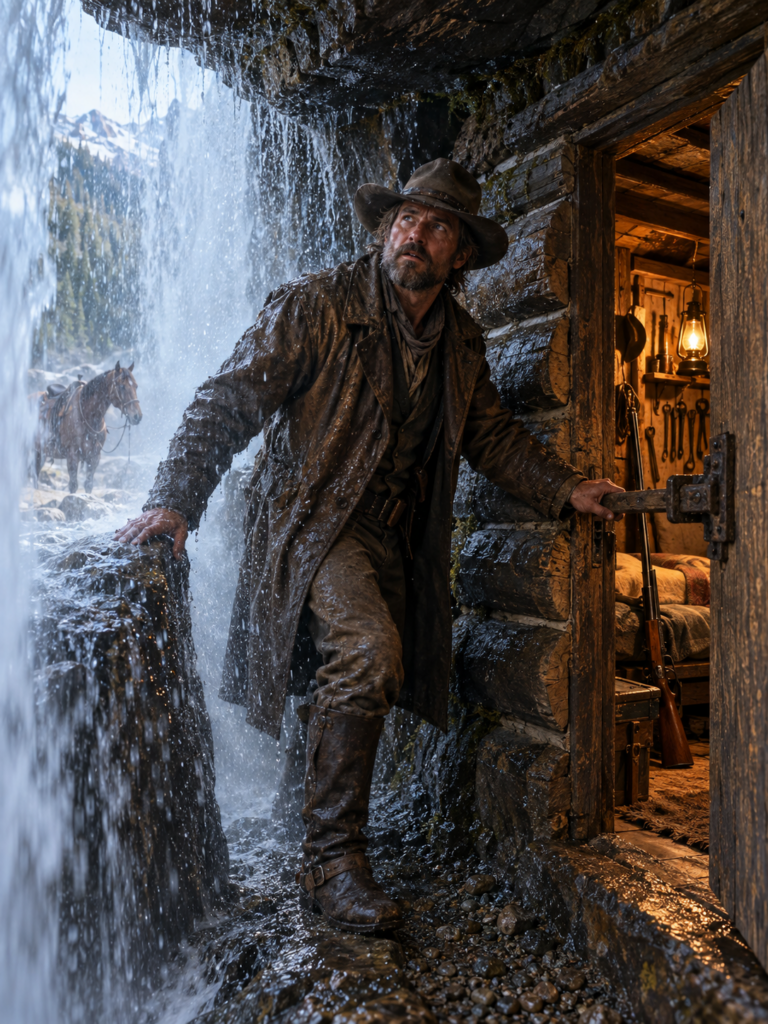
The lid rose with a dry wooden scrape, and silver flashed in the gray light.
Charles stopped breathing.
Paper-wrapped rolls of silver dollars filled one side of the crate.
A small cloth sack rested beside them.
He loosened its cord just enough to see gold.
Then he closed it again.
Money was the obvious discovery.
Which was precisely why Charles did not touch it.
Beneath the coins lay a leather wallet and a four-page letter sealed with candlewax.
He chose the letter.
The wax broke beneath his thumb.
Charles sat on the floor with his back against the bunk and read.
The writer’s name was Josiah Meek.
Prospector.
Missouri-born.
He had come to the North Fork in the winter of 1849.
He had lived behind Widow Falls for thirty-one years.
His wife, Ruth, had died during his second year there.
His son Thomas had followed two years later.
After burying them, Meek had remained.
He worked a narrow silver vein in the cut.
Cut timber.
Maintained the cabin.
Saved what the mountain gave him.
Charles read one paragraph twice.
Meek wrote that a man who had buried his people learned money was only a way of carrying work forward from one life into another.
The sentence unsettled Charles.
His father had spent his whole life working cattle on ground belonging to someone else.
When Wyatt finally had something to divide, he had given the useful pieces to Merritt and Jack.
Charles had believed that meant there was no work left for him to inherit.
Josiah Meek’s letter suggested otherwise.
The crates beneath the bunk held the silver.
But the tools on the wall held years.
The cabin held years.
The hidden road through the spray held years.
Someone had made all of this patiently and then left it to a stranger.
Meek wrote that he had no living kin.
That he had prayed whoever found the place would be a working man rather than a thief.
That the money should be used to make an honest stand of the ground below the falls.
Then came the final line.
I have been happy here. I hope you will be, too.
Charles lowered the pages.
He had expected treasure to produce excitement.
Instead it produced responsibility.
His eyes returned to the silver.
A younger man might have ridden directly back to the settlement and purchased everything he had ever lacked.
Charles was forty-one.
He knew how quickly money disappeared when it was asked to solve every hurt at once.
He put the letter inside his coat beside the deed.
Then he rose.
Before counting a single coin, he began inspecting the cabin.
The stove was sound.
The stovepipe had surface rust but no visible break.
The roof above the rear corner needed two shakes replaced.
The bunk ropes were tight.
The tools were serviceable.
The rifle was unloaded.
The dry gravel outside could be cleared.
Below the pool, he remembered a flat patch he had barely noticed when he arrived because disappointment had kept his eyes on the stone walls.
Perhaps enough grass for a small corral.
Perhaps more beyond it.
By afternoon Charles had carried his blanket roll behind the falls.
He brushed dust from the bunk.
Beat Meek’s wool blanket against a flat rock.
Swept the plank floor.
Then he filled his mother’s old tin coffee pot from the creek.
He lit the black cookstove.
The pipe drew perfectly.
When the first smell of coffee filled the cabin, Charles stood with both hands braced against the stove and closed his eyes.
His mother had once boiled coffee in that same pot before daylight while Wyatt prepared to ride out.
Now it sat on a dead prospector’s stove behind a waterfall his brothers had considered worthless.
Charles opened his eyes.
He would not return to them with this discovery.
Not to prove anything.
Not yet.
Maybe never.
He went outside and walked the property line as best he could before darkness.
The narrow parcel remained rough.
But he found the flat below the pool.
Enough grass for a small number of cattle.
Enough room for a pole corral.
A road might be cut down toward the settlement.
Not easily.
But possible.
After dark Charles reopened the crate.
This time he counted only what he intended to use.
Two silver dollars.
The rest stayed beneath the bunk.
At sunrise he saddled the sorrel.
He carried Josiah Meek’s letter in one inside pocket, Wyatt Gray’s deed in the other, and two silver dollars separate from the eighteen that had been his father’s last money.
Charles set his boot into the stirrup and turned the sorrel toward the narrow trail leading down the North Fork.
The sorrel picked his way carefully down the North Fork while Charles studied the country differently than he had on the ride up.
Two days earlier he had been searching for proof that his inheritance was useless.
Now he looked for possibility.
There was timber above the creek.
Not enough for commercial cutting, perhaps, but enough for building.
The flat below Widow Falls widened farther south than he had realized.
An old game trail crossed the slope where a wagon road might eventually run if a man was willing to clear stone and timber.
That realization embarrassed him slightly.
The ground had not changed.
Only his interpretation had.
Charles reached the small settlement at the mouth of the fork shortly before noon.
The courthouse was built of squared logs and had only two rooms.
He carried the deed inside.
The county clerk inspected Wyatt Gray’s signature, Halstead’s witnessing mark, and the parcel description.
“Your father owned this?”
“For twenty-some years.”
“Never recorded it here.”
Charles felt his stomach tighten.
“Is that a problem?”
“Only if somebody else claimed it.”
The clerk turned pages.
Nobody had.
He looked up.
“You want it recorded?”
“Yes.”
The fee took part of one silver dollar from Meek’s crate.
Charles paid it.
The clerk entered the parcel under Charles Gray’s name.
Charles watched every stroke.
He had spent his life working land whose ownership belonged elsewhere.
The sight of his own name beside a legal description produced no dramatic feeling.
Only steadiness.
“This includes the falls?” the clerk asked.
“Yes.”
The man smiled faintly.
“Pretty water.”
“Plenty of it.”
“Not much grazing.”
“No.”
Charles did not mention the cabin.
Nor the crates.
Those were not the clerk’s business.
He returned to Widow Falls the same day.
By the following week, however, the settlement knew a Gray had taken possession of the North Fork strip.
That was enough to bring Hollis Renner.
The blacksmith arrived on a mule carrying shoeing tools and a sack of nails.
He was fifty-eight, thick through the chest, with hands burned and scarred by work.
Charles met him below the pool.
“Something wrong with the sorrel?” Hollis asked.
“Not that I know of.”
“Good. I didn’t come for him.”
Charles glanced at the tools.
“What did you come for?”
“Heard you’re trying to build a corral.”
“I am.”
“Thought you might not own an auger.”
“I do.”
Hollis raised an eyebrow.
Charles almost smiled.
“Found one on the property.”
“Well, then maybe I rode six miles for coffee.”
“You’re welcome to it.”
Hollis stayed two days.
He asked no questions about the cabin beyond saying it was the strangest place he had ever drunk coffee.
They set posts on the flat.
Charles offered money.
Hollis refused.
“What do you want?”
“Show me where that gray ore by your stove came from.”
Charles had found several pieces near the rear wall of the hidden room.
He gave Hollis one.
The blacksmith turned it in his palm.
“Silver?”
“Looks like.”
“You mining it?”
“No.”
“Why not?”
Charles considered the question.
“Because I know cattle.”
Hollis laughed.
“That may be the wisest thing I’ve heard all month.”
The next visitor never came herself.
Mary Ann Doggett, a forty-seven-year-old widow who kept dairy cows on the lower flats, sent her nephew carrying a crock of butter and a wheel of hard yellow cheese.
A note lay beneath the cloth.
Welcome to the North Fork.
Charles read it twice.
He sent the boy back with thanks and no payment because the boy insisted his aunt would be offended.
Accepting generosity still sat awkwardly with him.
He had spent too many years watching his brothers keep accounts.
Who did the work.
Who owned which horse.
Who deserved which portion.
But Hollis had wanted only coffee and curiosity.
Mary Ann apparently wanted only to welcome a neighbor.
Those were different kinds of exchange.
Charles began learning the distinction.
Then Ned Purdy arrived.
Twenty-two.
Out of work.
Borrowed horse.
Hat badly patched.
He stopped below the corral.
“Mr. Gray?”
Charles looked behind him before realizing the boy meant him.
“Charles is fine.”
“I heard you might have work.”
“I might.”
“What kind?”
“The kind that starts with that fallen lodgepole and ends when enough timber is stacked for a shed.”
Ned looked at the slope.
“How much?”
“Dollar a day and meals.”
“Sleeping?”
“Not in my bunk.”
Ned grinned.
“I’ve slept worse places than a dry shed.”
“There isn’t a shed yet.”
The grin vanished.
Charles pointed at the trees.
“That’s why you’re here.”
Ned laughed.
“Fair enough.”
Charles paid him from Meek’s silver.
Every evening he wrote the amount down.
Not because the letter required it.
Because money left by a dead man deserved better than disappearing without record.
By the end of the second week they had enough timber.
The tools Josiah Meek had maintained for decades went back to work.
Drawknife.
Froe.
Augers.
Crosscut saw.
Charles oiled them every evening before returning them to the same pegs.
Ned noticed.
“You expecting somebody to inspect them?”
“No.”
“Then why?”
Charles looked at the broad ax.
“Because the last man did.”
Ned accepted that.
By first snow, the place no longer looked accidental.
A forty-foot corral stood below the pool.
A plank shed occupied the edge of the flat.
A rough road connected it to the settlement trail.
Charles bought twelve yearling heifers and one young red bull from a man breaking up his outfit north of town.
He paid cash from Meek’s crate.
It was the largest amount he had taken.
He read the letter before spending it.
Make an honest stand of the ground below the falls.
Cattle were something Charles knew.
He drove the animals home himself with Ned riding drag.
They reached the corral at dusk.
Thirteen cattle moved through the gate.
Charles swung it closed.
For a long moment he held the top rail.
All his life he had worked herds belonging to someone else.
These cattle were his.
That should have made him think of Merritt and Jack.
Instead he thought of Emmett Poe.
The old wrangler would have inspected the animals one by one.
Probably criticized the red bull’s feet.
Then nodded once.
Charles found himself smiling.
Word traveled.
At the mercantile, people began calling him Charles instead of “the youngest Gray.”
At the smithy, Hollis traded shoeing work for a week of split firewood.
Mary Ann sent word that she would consider placing butter cows with him on shares in spring.
Charles sent word back that he would ride down in April and discuss terms across her kitchen table.
Terms mattered.
Goodwill mattered.
Both could exist together.
Ned stayed.
When December came, Charles paid him on the exact day promised.
Ned counted the coins.
“You don’t need to pay all cash.”
“I said cash.”
“I’d take part in board.”
“You already get board.”
Ned looked at him.
Charles realized how stern he sounded.
He tried again.
“If we change the agreement, we change it before the work. Not after.”
Ned nodded slowly.
“All right.”
That became one of Charles’s rules.
A man should know the terms before he gives his labor.
He wished somebody had taught Wyatt Gray the same lesson before his sons grew up.
Winter narrowed their world.
Snow packed the North Fork.
Charles cut hatchet marks into the slick ledge behind the falls so a man carrying a lantern could cross without risking the pool.
He kept Meek’s letter in his inside coat pocket beside the deed.
His mother’s coffee pot hung above the table.
Emmett’s bone-handled folding knife remained in his right hip pocket.
Objects from three dead people began living together inside the hidden cabin.
Sometimes that struck Charles as strange.
More often it felt correct.
One evening in February, Ned sat repairing tack beneath the lantern while Charles read an old county paper aloud.
They had fallen into that habit during storms.
Ned looked up.
“You ever plan to build a house down below?”
Charles glanced around.
“This is a house.”
“You live behind a waterfall.”
“Yes.”
“You have to walk sideways across ice to reach your door.”
“I improved the footing.”
“That does not answer the concern.”
Charles lowered the paper.
“What concern?”
Ned considered.
“None, I suppose.”
Charles resumed reading.
A minute later Ned said, “Still strange.”
Charles ignored him.
But the question remained.
Was this cabin a refuge or a life?
By April, he knew the answer.
The snow left the flat in a week of rain.
Grass rose green beneath the black spruce.
The heifers were heavy with calf.
The red bull had settled.
Ned asked whether he might stay through calving.
“You can stay as long as the work suits you,” Charles said.
Ned frowned.
“That mean permanently?”
“It means I won’t decide your future for you.”
Ned looked at him strangely.
Then nodded.
Charles rode to the county office and, on Hollis Renner’s advice, filed a grass lease on state ground above the cut.
Two sections.
Enough summer range for the herd to grow.
The clerk entered that under Charles Gray’s name too.
Later that month, Mary Ann agreed to place several dairy cows on shares.
She insisted on written terms.
Charles liked her immediately for it.
“You’re laughing,” she said.
“I’m not.”
“You nearly are.”
“My family used to think keeping accounts meant trusting nobody.”
Mary Ann pushed the paper across her table.
“Keeping good accounts is how honest people avoid having to distrust each other later.”
Charles read every line.
Then signed.
By the end of April, he stood behind Widow Falls at dusk and counted what his life now contained.
Thirteen head had become the beginning of a herd.
A grass lease.
A hired hand who wanted to remain.
A passable road.
A corral.
A shed being enlarged.
Work arranged with Mary Ann.
Neighbors who called him Charles.
He took Emmett’s knife from his pocket and turned the bone handle in his palm.
Josiah Meek had never met Emmett Poe.
One man had taught Charles how to work.
The other had left him the means to make that work his own.
Charles set the folding knife on the plank table beside his mother’s coffee pot.
The two objects stood together in lantern light.
That was when Ned appeared through the doorway carrying a letter.
“Came from the settlement.”
Charles took it.
The handwriting on the envelope belonged to Lawyer Halstead.
For several seconds Charles only looked at his name.
Then he broke the seal.
Halstead’s message was brief.
Merritt and Jack Gray had heard that Charles was purchasing cattle and leasing range on the North Fork.
They wanted to discuss the property their father had left him.
Charles read the letter a second time.
Ned watched his face.
“Trouble?”
“No.”
Charles folded the paper.
But something old and familiar had tightened inside him.
His brothers had ignored Widow Falls when they thought it worthless.
Now they wanted to discuss it.
Charles slid Halstead’s letter beside Josiah Meek’s.
Then he looked through the open doorway at the white wall of falling water.
“What are you going to do?” Ned asked.
Charles reached for his coat.
“I’m going to make sure I know exactly what belongs to whom before anybody starts talking.”
Charles rode to the settlement the following morning instead of east toward the Gray ranch.
That choice confused Ned.
It did not confuse Charles.
He had spent too much of his life letting family urgency become his urgency.
Merritt and Jack wanted a conversation.
They could wait until Charles understood his legal position completely.
The county clerk pulled the deed.
Then the plat.
Then the state lease.
Charles stood at the counter while each boundary was checked again.
Widow Falls belonged to him.
The strip beneath it belonged to him.
The cabin stood inside it.
Nothing in Wyatt Gray’s will gave Merritt or Jack any retained interest.
The state lease had been issued solely to Charles.
“What about anything found on the property?” Charles asked.
The clerk looked at him.
“What did you find?”
“Old personal property.”
“Abandoned?”
“Left intentionally for whoever found it.”
“By somebody with no heirs?”
“So the letter says.”
The clerk considered.
“You planning to tell me what it is?”
“No.”
“Then I’ll refrain from becoming curious.”
Charles appreciated that.
He went next to Halstead.
The lawyer’s office smelled of paper, coal smoke, and leather bindings.
Halstead looked genuinely surprised to see him.
“I expected you to answer by letter.”
“I wanted the question clear.”
Halstead adjusted his spectacles.
“Your brothers are not challenging the will.”
“Good.”
“They are curious about your success.”
“That isn’t a legal question.”
“No.”
Charles waited.
Halstead looked uncomfortable.
“Merritt wondered whether there was a possibility of combining operations.”
There it was.
Not concern.
Not regret.
Business.
“What does combining mean?”
“He did not specify.”
“Then neither can I.”
Halstead gave the faintest smile.
“You’ve changed.”
“No.”
Charles thought about it.
Then corrected himself.
“Maybe I have.”
He rode east two days later.
Not because Merritt had summoned him.
Because Charles wanted the matter finished.
The home place appeared smaller than memory had preserved it.
Same barn.
Same corrals.
Same long roof.
Same windbreak of cottonwoods.
Jack saw him first.
He came out from the barn.
“Charles.”
“Jack.”
Neither moved closer.
Merritt emerged from the house a moment later.
He looked Charles over.
Good coat.
Well-kept horse.
New saddle blanket.
Things brothers noticed.
“You’re doing well,” Merritt said.
“I’m working.”
“We heard you bought cattle.”
“Yes.”
“How many?”
“Enough.”
Jack shifted.
Merritt’s mouth tightened.
Once Charles would have answered automatically.
He had mistaken family questions for rights.
That habit was gone.
Merritt led them into the house.
Charles removed his hat.
His father’s chair still stood near the stove.
For one moment the will reading returned so clearly that he could almost hear Halstead’s monotone.
Working ground to Merritt and Jack.
Widow Falls to Charles.
Nobody looking at him.
He sat.
Merritt remained standing.
“We were thinking,” his brother began, “that there might be sense in joining the operations.”
“What operations?”
“The home herd and yours.”
“For whose benefit?”
“All of us.”
Charles looked at Jack.
Jack looked away first.
Merritt continued.
“You’ve got access to summer range. We’ve got winter ground.”
“Then you’re asking about a grazing arrangement.”
Merritt hesitated.
“I suppose.”
“That’s different from joining operations.”
“We’re brothers.”
“Yes.”
The word did not create the agreement Merritt expected.
Charles folded his hands.
“What are you offering?”
Merritt seemed offended by the question.
“Do we have to speak like strangers?”
“No. Strangers usually state terms faster.”
Jack coughed into his fist, perhaps hiding a laugh.
Merritt ignored him.
“We’d winter some of your cattle. You’d summer some of ours.”
“At what rate?”
“Rate?”
“Yes.”
Merritt stared.
Charles understood then.
His brother had expected family to replace arithmetic.
The same family that had stood silent while Charles inherited rock and water.
“I’m willing to discuss grazing,” Charles said. “I’m not willing to combine ownership.”
Merritt’s face hardened.
“You think we’re trying to take something.”
“I think unclear agreements are how men discover later they remember different promises.”
“That how you talk to everybody now?”
“Yes.”
It was true.
Mary Ann used written terms.
Ned knew his wages before work began.
Hollis named a trade plainly.
Charles trusted each of them more because the obligations were visible.
Jack finally spoke.
“What did you find up there?”
Charles turned toward him.
“Why assume I found something?”
“Because nobody makes what you’ve made out of that rock strip in six months without money.”
Charles did not answer.
Merritt leaned forward.
“Father owned that parcel twenty years.”
“He did.”
“If there was value there—”
“He could have gone and looked.”
The words landed harder than Charles intended.
Silence followed.
But the truth remained.
Wyatt had owned Widow Falls for decades and never bothered to see it.
Merritt and Jack had watched the parcel pass to Charles without objection because they believed it worthless.
The value had not been taken from them.
They had declined to look for it.
Charles stood.
“I came because I thought you wanted a business arrangement. If you do, write the terms and send them.”
Merritt stared.
“And if we want to know what’s behind that waterfall?”
Charles put on his hat.
“Then ride six miles and look at the water.”
He left.
Jack caught him at the corral.
“Charles.”
Charles turned.
Jack rubbed one hand across the back of his neck.
“I didn’t know what Merritt planned to ask.”
“All right.”
“I knew he wanted your range.”
“That was obvious.”
Jack nodded.
Then he said, “I should’ve said something when Halstead read the will.”
Charles became still.
Jack looked toward the house.
“I knew you’d done more work on this place than either of us.”
“You signed.”
“Yes.”
“Why?”
Jack’s answer took time.
“Because it favored me.”
There it was.
No excuse.
Charles respected it more than apology dressed as misunderstanding.
“You could have refused.”
“I could have.”
“You didn’t.”
“No.”
Charles rested one hand on the saddle horn.
Jack looked at him.
“I’m sorry.”
Charles believed him.
That did not repair anything automatically.
But neither did Charles need to punish the truth when it finally appeared.
“Thank you for saying it.”
Jack nodded.
“Does that mean—”
“It means I heard you.”
Charles mounted.
Jack understood the boundary.
He stepped back.
That mattered.
On the ride north, Charles thought less about his brothers than he expected.
Years earlier he had imagined vindication as a moment when Merritt and Jack admitted they were wrong.
Now Jack had done something close to that, and Charles discovered the admission was smaller than the life he had already built.
He did not need the home ranch returned.
He did not need the will rewritten.
He did not need Merritt to envy him.
He needed clear ownership of his own work.
He had that.
Summer changed the North Fork.
The herd moved onto the leased sections.
Mary Ann’s dairy cows joined them under the share agreement.
Ned took increasing responsibility.
Charles raised his pay.
Before doing so, he sat down with him.
“I want you handling the lower herd three days a week.”
“What about the upper cattle?”
“I’ll take them.”
“Why?”
“Because the lower herd is harder.”
Ned looked suspicious.
Charles almost laughed.
“With more responsibility comes more money.”
“How much?”
Charles named it.
Ned considered.
“Done.”
They shook.
Protection without control.
Help without ownership.
Agreement before labor.
Charles had no language for those principles.
He simply knew how he wanted his place to work.
That summer the first calves born under Charles’s brand grew strong.
He sold several steers in autumn and used the proceeds—not Meek’s reserve—to improve the road.
That mattered to him.
The dead prospector’s money had created the beginning.
Charles did not want it carrying the entire future.
He wanted the operation to stand on its own earnings.
He returned money to the crates whenever possible.
Not literally the same coins.
But in his accounts.
Meek’s capital.
Charles’s income.
Expenses.
Wages.
Livestock.
Lease.
He kept everything plain.
When Hollis saw the ledger one winter evening, he whistled.
“You planning to become a banker?”
“No.”
“You account for nails.”
“I pay for nails.”
“Nobody accounts for nails.”
“I do.”
Hollis laughed.
“Your brothers must hate you.”
Charles looked up.
“They don’t know enough about my nails to have an opinion.”
By the second spring, the North Fork had become unmistakably an operating outfit.
The line shack gained a second room.
The corral expanded.
The road carried loaded wagons.
Charles hired seasonal help during calving.
Ned no longer introduced himself as Charles’s hand.
He called himself foreman because eventually that was what he became.
Charles did not object.
Mary Ann’s dairy agreement prospered.
She increased the number of cows.
Hollis remained incapable of visiting without fixing something.
People from the settlement began stopping for coffee when they rode the fork.
At first Charles found that strange.
The cabin had been hidden for thirty-one years.
Josiah Meek had chosen a room behind water because, after losing his wife and son, solitude may have been easier than risking attachment again.
Charles understood that instinct.
But he did not inherit Meek’s grief.
Only his opportunity.
So Charles left the latch accessible.
When weather allowed, he kept the door open.
The water still separated the cabin from the world.
It no longer sealed him away from it.
One September afternoon Jack arrived alone.
Charles saw him from the lower road.
No Merritt.
No papers.
No lawyer.
Jack dismounted beside the corral.
“Business?”
Charles asked.
“Maybe.”
Charles waited.
Jack looked toward the falls.
“Can I see it?”
Charles could have pretended not to understand.
Instead he said, “Yes.”
They climbed.
At the pool, Jack stared at the water.
“Where?”
Charles pointed toward the ledge.
“You’re joking.”
“No.”
They crossed slowly.
Jack cursed twice.
Charles did not laugh until the second time.
Behind the water, Jack stopped exactly where Charles had stopped that first day.
The cabin door stood open.
Lantern.
Stove.
Tools.
Coffee pot.
Bunk.
Crates beneath it.
Jack walked inside.
His eyes moved over everything.
“This was here?”
“Yes.”
“When Father owned it?”
“Yes.”
Jack sat slowly on the chair.
“All those years.”
Charles poured coffee.
“So it seems.”
“What’s in the crates?”
Charles met his gaze.
Jack understood.
“All right.”
He accepted the cup.
They drank without speaking.
Finally Jack said, “Merritt still thinks we should’ve gotten some of this.”
“Do you?”
Jack studied his coffee.
“I think if I’d inherited the waterfall, I would’ve sold it for twenty dollars without riding up here.”
Charles smiled.
“Probably.”
“So no.”
That answer healed something Charles had not asked to be healed.
Not all of it.
Enough.
Jack pointed at Emmett’s knife lying beside the tin coffee pot.
“That his?”
“Yes.”
“I remember Emmett.”
“You never listened to him.”
“I was sixteen and knew everything.”
“That condition lasted awhile.”
Jack laughed.
The sound entered the cabin strangely.
Not unwelcome.
When he left, Charles walked him to the pool.
Jack paused before crossing the ledge.
“Father ever know this place existed?”
“I don’t think so.”
Jack looked at the falls.
“Funny.”
“What?”
“He thought he gave you nothing.”
Charles considered.
“No. He gave me exactly what the paper said.”
“That’s not what I mean.”
“I know.”
Jack crossed.
Charles watched until his brother reached the trail.
Then he returned behind the water.
Years passed.
The eighteen dollars from Wyatt’s coat remained mostly untouched for a long time.
Charles eventually used part of it to replace his mother’s coffee pot after the bottom finally split.
He kept the original pot on its peg.
The new one boiled coffee.
The old one carried memory.
Emmett’s folding knife stayed in his hip pocket until the hinge loosened beyond practical repair.
Charles could have had Hollis fix it.
Instead he cleaned the blade, oiled the bone handle, and placed it beside the old coffee pot.
He bought another knife for work.
That choice surprised him.
For years he had believed honoring the dead required continuing to use what they left until nothing remained.
Josiah Meek taught him differently.
Maintenance preserved usefulness.
But preservation sometimes meant allowing an object to stop working before work destroyed it.
The crates beneath the bunk slowly diminished.
Charles never emptied them.
By the time his cattle operation could sustain itself, he stopped drawing from them almost entirely.
He kept Meek’s letter.
The silver became reserve against catastrophe.
A winter killing half the herd.
A fire.
Illness.
A year when grass failed.
Money carried work forward.
Charles finally understood the sentence.
It was not treasure.
It was stored effort.
That changed how he spent it.
Merritt never came behind Widow Falls.
He and Charles eventually settled a formal seasonal grazing agreement.
Written.
Signed.
Fair to both.
The first year Merritt grumbled about the rate.
Charles told him to lease elsewhere if he found better terms.
Merritt stared.
Then paid.
Oddly, their relationship improved after that.
Clear boundaries achieved what family sentiment never had.
Neither man had to pretend.
Jack visited occasionally.
Ned married a woman from the settlement and built his own small house farther down the fork.
He remained foreman.
Charles helped raise the walls.
He did not give Ned the house.
He paid him enough to build it.
There was dignity in the difference.
One April evening, years after Charles first rode north with eighteen dollars, he stood on the dry gravel behind Widow Falls.
The white water descended three paces in front of him.
Beyond it, distorted by spray, he could see the green flat below.
Cattle moved there.
The original twelve heifers were long gone, but their daughters and granddaughters grazed the valley.
The road reached the settlement.
The state lease had expanded.
Mary Ann’s dairy arrangement had eventually passed to her nephew.
Hollis had retired from full-time smithing and remained incapable of minding his own business.
People knew the place now.
Still, from across the pool, the cabin remained invisible.
Charles liked that.
Not because he wanted to hide.
Because some truths did not need advertising to remain real.
He stepped inside.
The lantern burned on the table.
His mother’s original coffee pot hung on its peg.
Emmett’s knife lay beneath it.
Josiah Meek’s tools remained arranged on the wall.
Every blade was oiled.
Every handle sound.
Once a week, Charles still wiped them down.
Not because he expected another man to find the cabin tomorrow.
Because one day somebody would come after him.
That was enough.
He opened the top crate.
Less silver than the first day.
Still plenty.
He removed the leather wallet containing Meek’s four-page letter.
The pencil had faded.
Years earlier Charles had made a careful copy, but he still read the original whenever his eyes allowed it.
Ruth.
Thomas.
Thirty-one years behind the falls.
Silver from the mountain.
Work carried forward.
I have been happy here.
I hope you will be, too.
Charles sat down.
At forty-one, when he first read those words, happiness had seemed too grand a word for what he wanted.
He had wanted ground nobody could order him off.
Work nobody could claim afterward.
A bed he did not occupy by another man’s tolerance.
That had been enough.
Now he understood Meek better.
Happiness had not meant ease.
Meek had buried a wife and son.
Charles had buried both parents, a mentor, and eventually friends.
Cattle died.
Winters came hard.
Deals failed.
Men disappointed one another.
Bodies aged.
Nothing about owning land prevented loss.
But there was another side.
Coffee with Ned after calving.
Mary Ann arguing over butter prices.
Hollis arriving with some tool he claimed Charles had been misusing for twenty years.
Jack sitting awkwardly in the cabin the first time he saw what their father had overlooked.
A herd moving through autumn grass under Charles’s own brand.
Wages paid on time.
A door nobody could close against him.
That was enough to justify Meek’s word.
Charles folded the letter.
He stood and placed it beside Emmett’s knife and his mother’s coffee pot.
Three inheritances.
One had come from his mother through memory.
One from a patient old wrangler through skill.
One from a stranger through trust.
Wyatt Gray had technically provided the deed.
Even that deserved its place in the story.
Charles no longer needed to decide whether his father intended kindness.
Perhaps Wyatt truly believed Widow Falls was all the youngest son required.
Perhaps he thought Merritt and Jack better suited to the working ranch.
Perhaps he had simply followed habit and favored the sons who spoke more loudly.
Intent could not be proved.
Outcome could.
Charles had been hurt by the division.
That remained true.
The parcel had contained an unexpected opportunity.
That also remained true.
One truth did not excuse the other.
He was grateful for the land without becoming grateful for being disregarded.
That distinction had taken him years to learn.
Outside, the waterfall continued.
Charles stepped through the doorway.
Mist touched his face.
He crossed the ledge with practiced footing.
Hatchet marks cut long ago were now worn smooth at the edges by many boots besides his own.
At the pool, he stopped.
A young ranch hand was repairing part of the lower fence.
Ned’s oldest boy worked beside him.
Neither needed Charles.
That pleased him.
A successful place, he had learned, was not one where every decision depended forever on its founder.
He walked down.
The young man straightened.
“Mr. Gray, north gate’s sagging.”
“Fix it.”
“I was going to ask whether you wanted oak or pine.”
Charles looked at the gate.
“What do you think?”
The young man hesitated.
“Oak.”
“Why?”
“Last longer where the ground stays wet.”
Charles nodded once.
The boy smiled.
Emmett Poe had done that to Charles hundreds of times.
Show.
Ask.
Let the learner own the answer.
Charles continued toward the corral.
Halfway there, he stopped.
He turned and looked back.
From this angle, the falls filled the cut.
White water.
Gray rock.
Moss.
Nothing else.
Nobody could see the cabin.
Nobody could see Meek’s tools.
The crates.
His mother’s pot.
Emmett’s knife.
A stranger passing through would still call Widow Falls a narrow strip of useless rock and water.
Charles smiled.
People were often most certain about the value of things they had never bothered to enter.
He continued down the path.
At supper, Ned joined him.
So did two hands.
They ate beans, beef, bread, and butter from the lower dairy.
No one spoke about inheritance.
No one needed to.
Afterward Charles returned alone to the cabin.
He banked the stove.
Checked the tools.
Folded Josiah Meek’s letter.
Then he took Wyatt Gray’s original deed from the leather folder where he kept it protected.
The paper had yellowed.
The description remained plain.
A narrow strip along the North Fork containing the place locally known as Widow Falls.
That was all.
No promise.
No treasure.
No apology.
Charles folded it again.
On the day he inherited it, the paper had felt like proof that his father valued him least.
Now it meant something different.
Not proof that Wyatt had secretly known what waited behind the water.
There was no evidence of that.
Not proof that rejection had been a blessing.
Charles would never tell that lie either.
The deed meant only that one chapter ended and another piece of ground became Charles’s responsibility.
What followed had been his choice.
He had walked the boundary.
Found the ledge.
Opened the door.
Read Meek’s words.
Registered the land.
Hired Ned fairly.
Bought cattle carefully.
Accepted help without surrendering authority.
Set terms before work.
Let neighbors become neighbors rather than debts.
Allowed Jack back into his life without pretending the past had disappeared.
Refused to let Merritt turn family into ownership.
And built an operation capable of surviving him.
That was the real inheritance.
Charles returned the deed to its folder.
Then he turned down the lantern.
Before sleep, he stood once more in the doorway.
Water thundered beyond the gravel.
The hidden room remained dry.
He thought of Josiah Meek sitting there decades earlier, perhaps in the same doorway, listening to the same sound.
Meek had written that money carried work from the end of one life into the beginning of another.
Charles finally knew the rest of that truth.
Money could carry work.
Tools could carry skill.
Objects could carry memory.
But no inheritance, good or bad, could decide the character of the person receiving it.
That part still had to be built.
Charles Gray had arrived at Widow Falls at forty-one with eighteen dollars, an old knife, a tin coffee pot, and a deed everyone else considered nearly worthless.
What waited behind the falling water changed his circumstances.
What he did afterward changed his life.
He closed the door without locking it.
Set Emmett Poe’s knife beneath his mother’s coffee pot.
Placed Josiah Meek’s letter beside them.
Then Charles lay down in the cabin his family had never known existed, while beyond the wall of falling water cattle settled on his own ground and the North Fork road waited for another working morning.

