
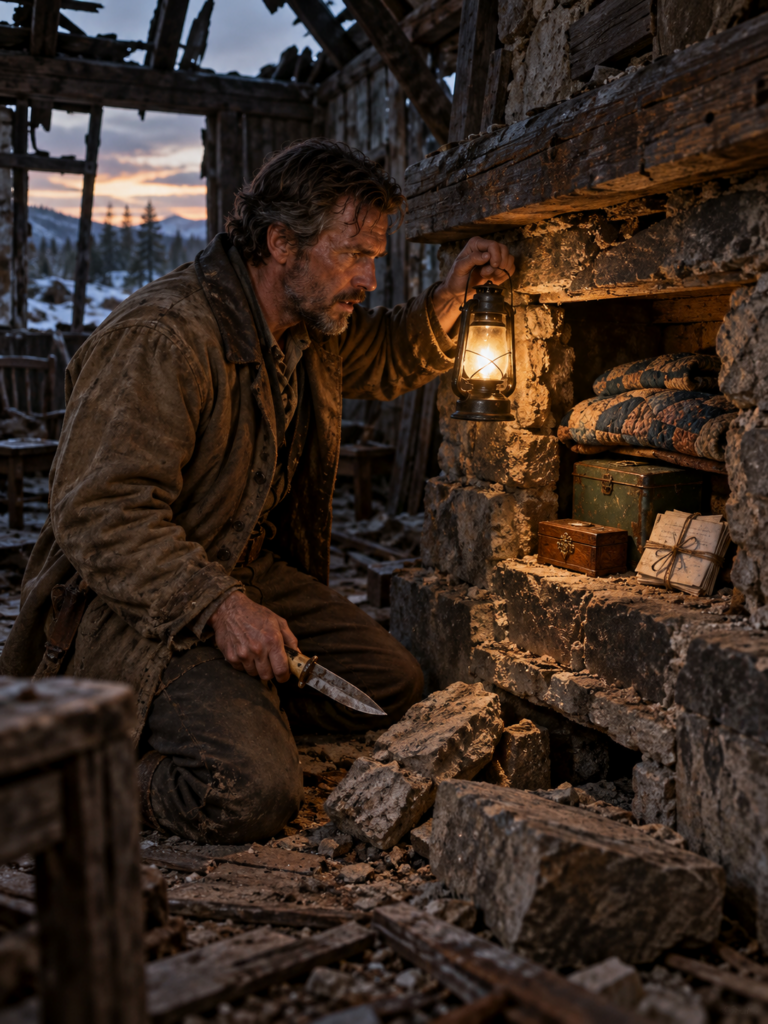
The quilt came free without resistance, still carrying the faint dry scent of cedar after decades inside the sealed chamber.
Walter held it across both forearms.
The stitches were small and regular.
Some squares had been cut from printed cloth. Others were plain brown or faded blue. One corner had been repaired by hand with thread slightly darker than the original.
A practical repair.
Not decoration.
Walter ran one finger over it.
Thomas Marlow had slept beneath this when he was three.
A year later he was gone.
Walter looked toward the north wall again.
The largest pine stood somewhere behind it.
He folded the quilt exactly as he had found it and placed it on the table.
He did not sleep under it.
Not yet.
Instead, before doing anything else, he returned to the fireplace.
One by one, Walter rebuilt the inner stonework.
He left the lowest stone loose enough that an arm could reach the hidden room if necessary, but restored the rest with fresh mortar.
He was not trying to erase Hetty’s hiding place.
He was protecting it.
When daylight came, Walter put the letter beneath the green tin box so no draft could carry it.
Then he went outside and inventoried his new life.
One pound of nails.
One hand ax.
One small crosscut saw.
Lamp oil.
Two horses, only one of which belonged to him.
A corral he could repair.
A shed he could probably save.
A cabin with sound walls beneath a failing roof.
$23.60 of his own money.
And $142 belonging to a dead woman’s promise to whoever stayed.
Walter stood in the yard and ordered the work the way Ansel had taught him.
What kills you first comes first.
Roof.
Chinking.
Stovepipe.
Then shed.
Corral.
Water lot.
The following morning he rode toward Partridge’s Mill carrying eleven dollars.
He returned three days later with cedar shakes, ridge poles, wire, clay, and three sections of stovepipe wrapped against the road.
The mill owner, Orin Partridge, had asked where Walter was living.
“Cold Creek place.”
Orin’s expression changed.
“Marlow cabin?”
Walter nodded.
Orin threw two ridge poles onto the load without charging him.
“Hetty Marlow delivered my oldest boy in a winter nobody should’ve been traveling.”
Walter almost mentioned the hidden room.
He did not.
Not because he meant to conceal Hetty.
Because the letter was hers before it became the valley’s.
He wanted to understand it first.
Walter stripped the damaged roof alone.
Every trip up the ladder made his knee complain.
He stopped pretending otherwise.
That was another change.
At the ranch outfit he had hidden weakness because weakness threatened employment.
Here, there was nobody to impress.
If the knee hurt, Walter climbed slower.
If a ridge pole required more leverage, he built leverage rather than proving strength against it.
On the fourth day, while he was fastening cedar shakes along the windward slope, another shadow crossed the roof.
Walter looked down.
A boy of about fourteen stood in the yard holding a covered pot.
A wagon waited behind him.
A woman sat on the bench with the reins loose in her hands.
She introduced herself as Merritt Doss, a widow with a dairy place two miles down Cold Creek.
The boy was her son, Jud.
“We brought supper,” she said.
Walter climbed down carefully.
“Much obliged.”
Jud carried the pot inside.
Then returned for a crock of buttermilk and a paper twist of salt.
Walter looked toward Merritt.
“What do I owe you?”
“Nothing.”
“I can—”
“The pot comes back when it comes back.”
She turned the wagon before he could turn kindness into an account.
That night Walter ate beef stew and potatoes beside Hetty Marlow’s tin box.
He looked at the $142 again.
For the first time, he understood that the money was only one thing Hetty had left behind.
Her name was doing work too.
A mill owner had remembered her.
A widow had sent food to the man repairing her cabin.
Cold Creek itself seemed to remember what the courthouse ledger had forgotten.
The next morning Walter climbed onto the roof before sunrise.
By noon the northern pitch was tight.
By sunset he had laid the last full course beneath the ridge.
Snow began as he drove the final nail.
Walter sat astride the roof for a moment with the hammer loose in his hand.
The flakes struck new cedar and stayed there.
No water would come through tonight.
He climbed down.
Inside, the letter remained under the tin box.
Walter touched it once.
Then he set a match to the first proper fire the cabin had held in fifteen years.
Flame caught.
Smoke rose cleanly.
Heat moved across the room.
And when Walter looked toward the folded quilt on the pine table, he realized something uncomfortable.
For the first time in more years than he could count, there was nowhere else he needed to ride tomorrow.
He lowered himself into his bedroll beneath the repaired roof.
Outside, snow thickened over Cold Creek.
And before sleep took him, Walter heard wheels on the distant wagon road—someone else coming toward the cabin Hetty Marlow had left behind.
The wagon wheels came nearer through the snowfall, crunching slowly over the frozen track until they stopped outside Walter’s repaired corral.
Walter was already on his feet.
He opened the cabin door.
A freight wagon stood beyond the yard, lantern swinging beneath its seat.
The driver climbed down stiffly.
Walter recognized him from the Bowers Ford road: Alder Fen, a fifty-one-year-old freighter whose face always seemed to have been recently shaved with a dull blade.
Fen went to the wagon bed and wrestled down a short barrel.
“What’ve you got there?”
“Clay.”
Walter stepped outside.
“I didn’t order clay.”
“Good. Saves an argument about the bill.”
Fen rolled the barrel toward him.
“Got more chinking clay than I need.”
Walter looked at the man.
Then at the barrel.
“Why?”
Fen rested both hands on the rim.
“Hetty Marlow sat with my wife two nights during the diphtheria year.”
Walter said nothing.
“My wife lived.”
Fen looked toward the cabin.
“Never got square with Hetty for it.”
He pushed the barrel forward.
“This’ll do for now.”
Walter accepted it.
Not because he had stopped valuing independence.
Because he was beginning to understand that receiving kindness was not always the same as owing obedience.
Fen drank one cup of coffee before leaving.
He did not ask to see the hidden money.
Walter did not mention it.
But he did tell him about the letter.
Fen stared at the stove for a while.
“Sounds like her.”
“You knew her well?”
“No.”
A pause.
“Didn’t have to.”
That answer stayed with Walter.
Others came.
Not crowds.
Cold Creek was not that sort of place.
People arrived one at a time, usually carrying something they insisted was ordinary.
Josie Renick, an older woman living above the North Fork, sent a dozen eggs with a boy hired for the day.
The note in the basket said only: Welcome to the valley.
Bertram Alt, a traveling farrier, came to reset two shoes on Walter’s buckskin.
Walter offered money.
Bertram accepted beans and coffee instead.
Then he stayed another hour and helped Walter finish the leeward edge of the roof.
“I’ll come back in spring,” Bertram said, inspecting the gelding’s off hind. “Want to see how that grows.”
“You don’t have to.”
“I know.”
Walter was hearing those words often.
He knew what conditional help sounded like.
He had lived long enough among employers, creditors, traders, and men who kept ledgers in their heads.
This was different.
People were not purchasing a claim on him.
They were closing old balances with Hetty Marlow.
That distinction made him uncomfortable at first.
Then humbled.
He began the chinking in November.
The cabin’s middle logs had opened in places wide enough to admit wind.
Walter mixed Fen’s clay with wet sawdust and chopped grass, pressed it between the timbers, then beveled the surface with his thumb so rain would shed.
His hands cracked.
His knee swelled.
He adjusted.
That was perhaps the hardest lesson of his new life.
For twenty-three years, value had been measured by whether Walter could do the same work as the younger man beside him.
At Cold Creek there was no younger man.
There was only the work and the body available to perform it.
Walter discovered that intelligence could replace force more often than pride admitted.
He built lower work platforms.
Used ropes to raise materials.
Cut jobs into shorter stretches.
Rested before his knee failed rather than afterward.
Nothing important went unfinished because he stopped pretending he was thirty.
The cabin improved.
He fitted the stovepipe through the roof and flashed it with tin.
Bought a secondhand sheet-iron stove for four dollars.
Repaired the bedstead with green rawhide Jud Doss brought from his mother’s place.
Restrung it with new rope.
The blue-and-brown quilt remained folded across the foot.
Walter still did not sleep beneath it.
He could not have explained why.
Perhaps because owning the property had required only a county stamp.
Belonging inside it seemed to require more time.
By December, smoke rose from the cabin every morning.
The neighbors could see it from down the creek.
One afternoon Jud arrived with a crock of butter.
He leaned against the door while Walter scraped an old hinge.
“Ma said bring that up to Weaver’s place.”
Walter’s hand stopped.
“What?”
Jud looked alarmed.
“The butter?”
“No. Before that.”
The boy thought.
“Weaver’s place?”
Walter stared at the open doorway.
For years, every place he slept had belonged to somebody else in ordinary speech.
Ansel’s place.
The Double M.
Hollis’s winter camp.
The Bar T line shack.
Now somewhere down the creek, people had begun naming this ground for him.
Walter returned to the hinge.
“All right.”
Jud waited, apparently expecting more.
Walter had none.
But that evening, while splitting wood beneath the shed roof, he found himself looking toward the cabin differently.
He did not change Hetty’s name in his own mind.
He would not erase her simply because the deed had changed.
In February he rode to the county seat.
The same clerk in the green eyeshade recognized him only after Walter placed the deed on the counter.
“Problem?”
“No.”
“What do you need?”
“I want something added.”
The clerk frowned.
“To the deed?”
“If it can be.”
Walter pointed above his own name.
“Put ‘The Marlow Place, so called.’”
The clerk looked at him.
“That a legal requirement?”
“No.”
“Then why?”
“Because it was.”
The clerk apparently decided forty-two-year-old former ranch hands were free to waste ink however they pleased.
He added the words.
Stamped the paper.
Returned it.
Walter folded the deed and put it inside his shirt beside his mother’s daguerreotype.
It remained his land.
But his ownership did not require pretending nobody had mattered before him.
That evening Walter took Hetty’s letter from beneath the green tin box.
He drove a small nail above the pine table and placed the folded paper there.
Not hidden.
Not displayed for spectacle.
Available.
If someone asked, he would tell them.
Merritt Doss was the first person who did not need to ask.
She came inside the cabin in March carrying eggs for a hen Walter had recently acquired in trade.
She noticed the letter.
Walter said, “Hetty Marlow wrote it.”
Merritt looked at him.
“You found something?”
“Behind the fireplace.”
Her eyes moved toward the stonework.
Walter did not hide the truth.
“Money. Quilt. Ring. Letter.”
“How much money?”
“One hundred forty-two dollars.”
“You kept it?”
“She told the finder to.”
Merritt considered that.
“Then why do you sound like you stole it?”
Walter looked at the stove.
“I spent some on the place.”
“Good.”
“She meant it for her boy.”
“Her boy was dead forty years before you found it.”
“That doesn’t change what she meant when she saved it.”
Merritt’s expression softened without becoming pity.
“No. But the letter changed what she meant afterward.”
Walter looked at her.
Merritt walked to the wall and read.
She took her time.
When she finished, she did not touch the page.
“She was a good woman.”
“I believe she was.”
“That quilt Thomas’s?”
“Yes.”
“You using it?”
“No.”
Merritt turned.
“Why?”
Walter did not have a convincing answer.
“Doesn’t seem mine.”
“She left it in your wall with a letter saying it was.”
“That isn’t the same.”
“No?”
Walter almost smiled.
“You always argue with a man in his own house?”
“When he gives me poor material.”
He looked at the quilt.
Merritt did not continue.
She gathered her empty egg basket and stepped outside.
Before leaving she paused.
“My husband died six years ago.”
Walter waited.
“For the first year, I wouldn’t use his coffee cup.”
Walter glanced at her.
“Thought using it meant I was taking his place away.”
She looked toward the quilt.
“One morning Jud used it without knowing. Cup survived. So did the memory.”
Then she left.
Walter stood in the doorway watching her walk down the track.
There was no flirtation in the exchange.
No promise.
Only one widowed neighbor giving another solitary person a fact she had learned sooner.
That night Walter unfolded the quilt.
He spread it across the bed.
He still did not climb under it.
Not yet.
But the distance had changed.
Winter loosened.
The Cold Creek ice began thinning along the edges.
Walter’s weekly routine settled into something that felt astonishingly like permanence.
Monday, wood.
Tuesday, splitting and stacking.
Wednesday, fence.
Thursday, corral.
Friday, half a day helping at Merritt Doss’s dairy place in exchange for milk or butter.
Saturday, tools and leather.
Sunday evening, the Barlow knife.
He sharpened it exactly as Ansel had taught him twenty-seven years earlier.
Stone.
Oil.
Steady angle.
No hurry.
One Sunday Jud sat at the table watching.
“Why sharpen it when you didn’t use it?”
Walter stopped.
For a moment he heard Ansel’s voice so clearly it hurt.
“So it’s ready before I need it.”
Jud nodded as if accepting a law of physics.
Walter resumed.
The words passed on.
That startled him.
He had spent years thinking of inheritance as something other people received.
Land.
Cattle.
Money.
Family names.
Yet the most valuable things Walter possessed had never appeared in a will.
Ansel’s way of setting work in order.
His insistence on caring for tools.
His patience with frightened horses.
His understanding that soundness mattered more than appearance.
Walter had carried those things across twenty-three years of borrowed ground.
Now Jud Doss was carrying one sentence home.
By early April, the creek had begun speaking beneath the ice.
The sound came first at night.
Low pressure.
Cracks.
Water moving under frozen skin.
Walter walked down each morning to inspect the water lot.
Then, one warm afternoon, the creek broke free.
Ice plates shifted.
Water surged between them.
The sound filled Cold Creek.
Walter stood at the edge of his quarter section with wet grass around his boots.
Behind him, the repaired roof ran straight against the sky.
The buckskin stood inside a mended corral.
Smoke rose from the stovepipe.
Water moved over pale stones on ground whose taxes had once made it unwanted.
Walter remembered Hollis Meade staring at his coffee.
Too old for winter camp.
Hollis had been right.
That truth no longer felt like defeat.
Walter had made the mistake of hearing “too old for this work” as “too old to have useful work.”
The two statements had never been the same.
He watched the creek run.
Then wagon wheels sounded on the road above.
Walter turned.
Merritt Doss and Jud were coming up the track.
Jud had the old stew pot between his boots.
Walter realized it had traveled between their houses all winter.
Full one direction.
Empty the other.
Then full again.
An object could become a relationship without anybody announcing it.
Merritt lifted one hand.
Walter returned the gesture.
He climbed the bank toward the cabin.
As he reached the porch, Jud jumped down.
“Ma says you still haven’t shown us the room.”
Merritt gave her son a look.
Walter stopped.
The hidden chamber had remained his private knowledge except for what he had told her.
He considered the repaired fireplace.
Then the letter.
Then the boy.
“You want to see it?”
Jud nodded immediately.
Merritt said, “Only if you mean to show him.”
Walter walked inside.
He knelt at the hearth.
Found the one stone he had intentionally left loose.
Put his fingers beneath its edge.
And pulled.
The loose stone slid forward into Walter’s hands.
Jud crouched immediately.
Merritt remained standing behind him.
Walter removed the stone and held the lantern toward the narrow opening.
“There?”
Jud leaned closer.
“That’s it?”
“That’s it.”
“No door?”
“No.”
“How’d she get things inside?”
“Before the stones were set.”
Jud looked disappointed by the lack of machinery.
Walter almost smiled.
Merritt asked, “You put the wall back?”
“Yes.”
“Why?”
“Fireplace needed repairing.”
“That all?”
Walter considered.
“No.”
He rested one forearm against his knee.
“Didn’t want the hiding place turned into a hole.”
Merritt understood before Jud did.
There was a difference between preserving a secret and destroying it once discovered.
Walter had chosen preservation.
He handed Jud the lantern.
“Hold that steady.”
The boy did.
Walter reached into the cavity and took out nothing.
The tin box, ring, quilt, and letter were all outside now.
The chamber itself was empty.
Still, Walter had kept it.
Jud peered inside.
“Think there’s anything else?”
“No.”
“How do you know?”
“I looked.”
“Maybe another room.”
Walter glanced at Merritt.
She was suppressing a smile.
“You find one, you can repair the chimney afterward.”
Jud reconsidered his enthusiasm.
Walter replaced the stone.
They ate stew at the pine table.
The conversation stayed ordinary.
Weather.
A calf Merritt expected to lose but did not.
Fence damage down creek.
The possibility of planting potatoes once the soil dried.
Walter had once believed a home revealed itself through possession.
A deed.
A key.
A fence.
Now he suspected it was built from repetition.
The same people crossing the threshold often enough that nobody remembered the first invitation.
The same pot moving between kitchens.
A boy knowing where the coffee cups were.
A neighbor adding wood to the stove without asking.
Nothing dramatic.
That made it more convincing.
After Merritt and Jud left, Walter sat at the table.
The silver ring rested in its wooden box.
The Barlow knife lay beside it.
Walter opened Hetty’s letter again.
He knew most of it by memory.
Yet one sentence kept changing.
I am leaving this cabin to whoever comes and stays.
Legally, she had not.
The county took the property.
Taxes accumulated.
Years passed.
Then Walter purchased it.
But in another sense, Hetty’s wish had survived the law.
Not through magic.
Through ordinary continuity.
Orin remembered her.
Fen remembered her.
People farther up Cold Creek remembered her.
The generosity they offered Walter was not because they knew him yet.
It was because they knew what kind of place Hetty had once made.
Walter had inherited not only hidden money.
He had inherited expectation.
That realization frightened him more than the winter had.
He knew how to mend roofs.
A reputation left by a good person was more difficult.
It could not be copied.
Only answered.
So Walter answered it in the only language he trusted.
Work.
When Alder Fen’s wagon broke a reach three miles down the road, Walter spent half a day helping fit a temporary repair and accepted no money.
Fen objected.
Walter said, “There’s still some clay in my wall that belonged to you.”
“That clay belonged to Hetty.”
“So did the favor you were paying.”
Fen stared at him.
Then laughed.
“All right. We’ll call the ledger confused.”
Walter preferred that.
When Josie Renick’s chicken house lost half its roof during a spring wind, Walter rode up with scrap lumber from Partridge’s mill.
She paid him in eggs anyway.
When Bertram Alt returned to inspect the buckskin’s hind foot, Walter had coffee ready before the man asked.
None of it made Walter Hetty Marlow.
He did not want it to.
But it made the place continue in the same direction.
That mattered.
By May, Walter planted potatoes, onions, beans, and a short row of carrots in ground near the water lot.
His farming knowledge was poor.
Merritt laughed at his first irrigation ditch.
Not cruelly.
Accurately.
“You trying to water those vegetables or relocate the creek?”
Walter stood with a shovel.
“Thought I was doing well.”
“You’re digging a canal.”
“You want the shovel?”
“Yes.”
She showed him how shallow the channel could be.
Walter watched carefully.
Years earlier he might have been embarrassed to learn from a woman about work he did not understand.
Age had stripped some useless pride out of him.
Competence mattered more than who supplied it.
Merritt handed back the shovel.
“Your turn.”
Walter copied the angle.
The water moved exactly where intended.
“That?”
“Better.”
No romance declared itself between them.
The source of their connection was simpler.
Two people who had survived losses without wanting to become burdens on anyone were discovering that independence and isolation were not the same thing.
Walter never asked Merritt to rescue him from loneliness.
She never treated him as a project.
When she needed help setting a heavy gate, she asked.
When Walter needed advice about a cow he eventually considered buying, he asked.
Neither owed the other more than the help freely given.
That suited them.
In June, Walter bought two milk calves cheaply from a rancher headed east.
He began improving the pasture fence.
His knee limited the hours he could work.
It no longer defined whether the work counted.
He developed a habit of stopping at midday beneath the largest pine behind the cabin.
Thomas Marlow’s tree.
The first time Walter searched beneath it, he found no carved marker.
Only a shallow stone partly swallowed by roots.
He cleared needles away.
No name remained.
Perhaps there had never been one.
Walter stood there a long time.
Then he went to the shed.
He selected a piece of cedar.
Not large.
Nothing ornamental.
He planed its surface smooth and burned one name into it with a heated iron.
THOMAS.
No dates.
He did not know them precisely.
No claim about who the boy had been.
He knew even less.
Only the name.
Walter placed the marker beside the stone.
Merritt noticed it weeks later.
She did not comment until they were walking back toward the cabin.
“That was kind.”
Walter shook his head.
“It was accurate.”
“What?”
“Remembering a name you know.”
She looked toward him.
Walter continued.
“Anything else would’ve been guessing.”
Merritt smiled.
“You really were a tally man.”
“Sometimes.”
“No. I mean in your bones.”
Walter considered that description acceptable.
Summer transformed Cold Creek.
The grass came back green where Walter had looked at it brown.
The water lot filled.
The roof weathered from bright new cedar toward gray.
The corral posts remained straight.
His potatoes survived despite the irrigation ditch.
One July evening Walter sat outside sharpening the Barlow knife while Jud repaired a halter nearby.
The boy said, “You ever miss riding outfits?”
“Yes.”
Jud looked surprised.
“You do?”
“Of course.”
“But you like it here.”
“Yes.”
“Then why miss it?”
Walter tested the blade.
“Because one good thing doesn’t have to make the old thing bad.”
Jud frowned, working that over.
Walter understood.
At fourteen, the boy wanted clean answers.
At forty-two, Walter had begun accepting that lives rarely supplied them.
The saddle work had been good to him.
It had fed him.
Given him skills.
Friends.
Country he still remembered when he closed his eyes.
It had also ended before Walter wanted.
Both could be true.
Hollis Meade had not betrayed him.
He had simply told Walter the limits of one life.
Walter had mistaken those limits for the limits of himself.
That was the wound Cold Creek repaired.
Not by proving Hollis wrong.
By proving the conclusion Walter had drawn was wrong.
In August, a rider appeared on the wagon road late in the afternoon.
Walter recognized the sorrel before he recognized the man.
His old horse from the last outfit.
Hollis Meade rode him into the yard.
Walter came out of the shed wiping his hands.
For a second, neither man spoke.
Hollis dismounted.
“Walter.”
“Hollis.”
The sorrel stretched its neck toward Walter.
He laughed quietly and scratched the familiar place beneath its jaw.
“Still doing that.”
“He’s missed you.”
“Horse doesn’t know enough to miss anybody.”
Hollis looked at him.
“Sure.”
Walter glanced at the saddle.
“What brings you this way?”
“Moving cattle north. Heard you were here.”
Hollis looked around.
His gaze took in the roof.
Corral.
Shed.
Garden.
Smoke from the stovepipe despite the warm evening because Walter had bread baking.
“You did all this?”
“Some people helped.”
Hollis nodded.
Walter could see something complicated in the older man’s expression.
Regret, perhaps.
Embarrassment.
He spared him the need to guess.
“You were right.”
Hollis frowned.
“About what?”
“My knee.”
“Walter—”
“I couldn’t have done another winter camp.”
Hollis looked toward the repaired cabin.
“Maybe I should’ve found something else for you.”
“Maybe.”
Walter was not going to make dishonesty into kindness merely to ease him.
The foreman accepted that.
“I’m sorry anyway.”
Walter nodded.
“So am I.”
That was enough.
Hollis stayed for coffee.
Walter showed him the letter.
Not the money.
The money had become nails, stovepipe, seed, repairs, and winter survival. Its accounting was no longer interesting.
Hollis read slowly.
When he finished, he touched one finger to the final paragraph.
“Good place to be tired.”
Walter leaned back.
“Turned out to be.”
Hollis looked at him.
“You staying?”
Walter almost laughed.
“That’s the idea.”
The next morning Hollis rode out.
The sorrel turned his head once toward Walter at the road.
Walter lifted a hand.
Then returned to work.
He did not follow the horse with his eyes until it disappeared.
He no longer needed not-looking-back as proof that he could endure leaving.
Some things were safe to watch go.
Autumn came around again.
A full year since Walter had been told his usefulness to the high-country outfit was ending.
He counted his money one evening.
The figure remained modest.
The ranch had not made him wealthy.
That had never been promised.
He owned one sound horse outright.
Two calves.
Several hens.
Tools.
Stored vegetables.
Winter hay contracted from Merritt.
Firewood stacked beneath the shed.
No employer could dismiss him from the cabin.
But taxes would return.
Repairs would always return.
Age would keep coming.
Walter was not living inside a miracle.
He was living inside work he could continue doing.
That was better.
On the first cold Sunday evening of October, he sat at the pine table.
The lantern burned beside him.
He took out the Barlow knife.
Opened it.
Sharpened the blade.
The motion remained exactly as Ansel had taught him.
When Walter finished, he wiped the blade clean and laid the knife on the table.
Then he opened Hetty’s wooden box.
The plain silver ring rested inside.
He placed it beside the knife.
A hand’s width separated them.
Walter looked at the two objects.
The knife had traveled through his family before reaching him.
The ring had stayed behind in Hetty’s.
Different histories.
Same weight.
Ansel had buried a wife and two sons before taking in a boy who needed somewhere to go.
Hetty had buried a husband and a four-year-old son before spending decades helping other women bring children safely into the world.
Neither had been given the life they might have chosen.
Neither had stopped making themselves useful.
Walter understood them differently now.
For much of his life, he had judged usefulness by endurance.
How many hours could he ride?
How much cold could he tolerate?
How much pain could he hide?
How little could he need?
Cold Creek had taught him another measure.
Could he preserve something worth preserving?
Could he accept help without surrendering himself?
Could he return help without purchasing authority over someone else?
Could he make a place more livable than he found it?
Could he leave accurate evidence that somebody had been here before him?
Those questions suited forty-two better than the ones that suited twenty.
Walter put the ring away.
Then he took his mother’s daguerreotype from inside his shirt.
She was young in it.
Not yet exhausted.
Almost smiling.
Walter had seen her only four times after being sent away at nine.
He had carried resentment for years without naming it.
Now he looked at the small image and saw something harder than innocence or guilt.
A woman with several children.
A dead husband.
Little money.
A decision that saved some parts of a family by separating another.
He did not know whether sending him to Ansel had been right.
He knew what came from it.
That was not forgiveness exactly.
But it was no longer accusation either.
Walter placed the image beside the deed.
The deed still bore the addition he had requested:
The Marlow Place, so called.
His name beneath it.
Not hers erased by his.
Not his erased by hers.
Continuity.
Outside, wagon wheels approached.
Walter recognized them.
Merritt and Jud.
The stew pot was probably coming again.
It had traveled up and down Cold Creek so often that winter no one remembered whose kitchen currently had legitimate possession.
Walter stood.
Before opening the door, he glanced toward the quilt.
It no longer lay folded at the bed’s foot.
He had finally slept beneath it on the first freezing night of autumn.
Nothing terrible happened.
Thomas was not forgotten.
Hetty was not diminished.
A worn quilt simply kept another tired person warm.
Walter smiled at the simplicity of that.
He opened the door.
Cold air entered first.
Then Jud’s voice.
“We brought supper.”
“You always do.”
Merritt stepped down from the wagon.
“This time you can complain if you’d rather cook.”
Walter looked at the pot.
“What is it?”
“Beef stew.”
“No complaint.”
Jud carried it inside.
Merritt followed after tying the team.
Nobody asked permission anymore.
Not because boundaries had disappeared.
Because trust had replaced ceremony.
Walter added wood to the stove.
Jud began setting bowls out without being told where they were.
Merritt noticed the knife on the table.
“Sunday?”
Walter nodded.
She touched nothing.
Her eyes moved toward the ring box.
“You ever decide what to do with that?”
“No.”
“You could sell it.”
“Hetty said it wasn’t worth much.”
“Then that solves that.”
Walter looked at her.
“I thought maybe it should go to someone.”
“Who?”
“Don’t know.”
Merritt shrugged.
“Then you don’t know yet.”
Walter recognized wisdom in that.
He returned the wooden box to its place.
Not every inheritance required immediate use.
Some things could simply be kept until their meaning became clear.
They ate while wind moved through the pines.
After supper Jud fell asleep in the chair he had once watched Walter make.
Merritt looked toward him.
“He’ll wake when we move.”
Walter poured more coffee.
She accepted it.
Neither spoke for a while.
There was ease between them now.
The sort that could become many things or remain exactly what it was.
Walter did not force it into a future merely because loneliness had once made him think every human connection required a name.
If something grew, it would grow because both of them chose it.
If nothing did, he still had neighbors.
Friends.
Work.
Ground.
A life.
That knowledge freed the moment from needing to become anything else.
Merritt eventually said, “People down creek don’t call it the Marlow place much anymore.”
“I know.”
“Bother you?”
Walter considered.
“No.”
“Thought it might.”
“Why?”
“You had the clerk put her name back on the deed.”
“I did.”
“And now everyone says Weaver’s place.”
Walter looked around the cabin.
“The deed remembers her.”
He glanced toward the window, beyond which the largest pine stood dark against the night.
“The tree remembers Thomas.”
Then toward the repaired fireplace.
“I remember the room.”
Finally he looked at the table around which they sat.
“They can call the rest whatever helps them find it.”
Merritt smiled.
Walter had no need to say more.
Spring came again after another winter.
On the afternoon the creek finally broke free, Walter walked down through wet grass.
The sound was louder than he remembered.
Ice shifted.
Water flashed beneath it.
The buckskin stood behind the corral rails.
His calves had grown.
Smoke rose from the north gable.
The roof Walter built remained straight.
His knee hurt.
That too remained.
Walter placed both hands on the top rail and listened to his own water moving through his own ground.
A year and a half earlier, he had sat in Hollis Meade’s cook shack and heard that his old life was ending.
He had believed the sentence meant he had become less.
He understood now that usefulness was not a single road a man rode until someone told him to dismount.
It could change shape.
Walter had been a good ranch hand.
He could be proud of that without requiring himself to remain one forever.
He walked back uphill.
The cabin door swung easily on the iron straps Orin Partridge had given him.
Inside, the pine table stood beneath Hetty Marlow’s letter.
Walter sat.
He removed the old Barlow knife from his right trouser pocket and laid it on the boards.
Then the wooden ring box.
Knife and ring.
Ansel and Hetty.
Two people who had loved children they did not get to watch grow all the way.
Their lives had reached Walter anyway.
He rested his hand between the objects.
The county clerk had seen a delinquent quarter section.
The storekeeper had seen ruined land.
The last ranch owners had seen a worker aging out of winter camps.
None of them had exactly been wrong.
The quarter section had been delinquent.
The cabin had been ruined.
Walter had been aging.
They had simply measured incomplete things.
A bad roof could cover square walls.
Brown grass could return green.
A bad knee could end one kind of work without ending a man.
A hidden room could hold money.
But money was not the deepest thing Walter found behind the fireplace.
He found evidence that somebody before him had also stayed after life gave her reasons to leave.
That she had lost people and kept working.
That she had used her hands until they failed.
That when she could no longer remain, she thought about the stranger who might come next.
Walter closed the ring box.
Put the knife in his pocket.
Then he went outside.
A wagon was turning onto the track.
Merritt held the reins.
Jud, taller now, sat beside her.
The old stew pot was between them.
Walter descended the step and walked toward the yard.
Behind him, smoke rose from the cabin.
The fireplace drew clean.
The hidden chamber remained behind its carefully reset stones.
The blue-and-brown quilt lay across Walter’s bed.
Hetty Marlow’s letter remained where any guest who asked could read it.
And beneath the largest pine, a small cedar marker carried Thomas’s name.
Walter had not erased the people who came before him.
He had joined them.
At forty-two, after spending most of his life believing a man’s place existed only while somebody else found him useful, Walter Weaver finally learned what it meant to stay somewhere by choice.
The ranch was not valuable because nobody else wanted it.
It was valuable because Walter had looked at what was still sound beneath everything broken.
He had done the same with himself.
And that was the part no courthouse deed could measure.

