Part 1
The laughter started before the boy even raised his hand.
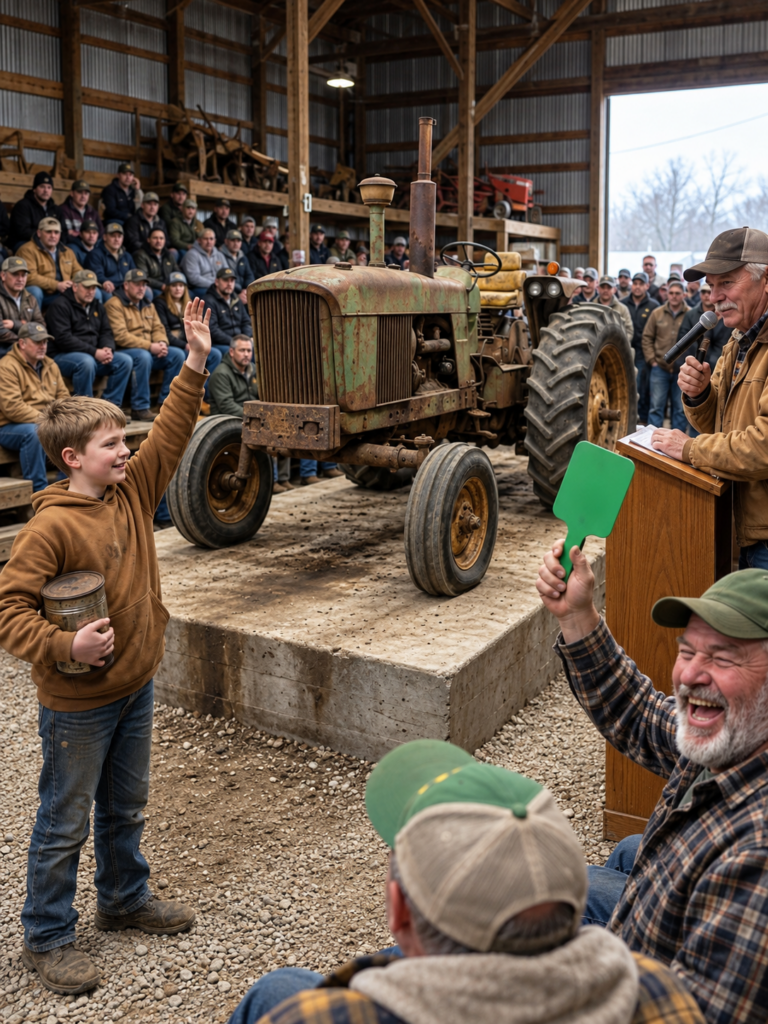
It was a cold Saturday morning in October, and nearly two hundred farmers, mechanics, and equipment dealers had gathered inside an old livestock auction barn in Harmon County, Kansas.
Rain tapped against the corrugated metal roof. Mud clung to work boots. The smell of diesel fuel, damp hay, and burnt coffee hung in the chilly air.
At the center of the auction floor sat a rust-covered 1967 John Deere 4020 tractor.
Its once-bright green paint had faded to a dull, peeling gray. One rear tire was almost flat. A bird had built a nest beneath the hood, and the steering wheel was cracked from years of exposure to the sun.
According to the auction listing, the engine hadn’t turned over in twenty years.
Most men in the barn considered it scrap metal.
Floyd Meeker, a broad-shouldered equipment dealer with a thick gray mustache, stood beside the tractor and shook his head.
“Well, gentlemen,” Floyd announced, loud enough for everyone to hear, “if anybody’s looking for a fine place to grow weeds, here’s your opportunity.”
Several men laughed.
Floyd slapped the rusty hood.
“Engine’s seized tighter than a banker’s wallet. Transmission’s anybody’s guess. The tires are shot, and I’d bet half my retirement this thing hasn’t moved under its own power since Bill Clinton was president.”
The auctioneer, Gary Sims, smiled and adjusted his microphone.
“All right, folks. Lot number seven. Nineteen sixty-seven John Deere 4020. Sold as-is, where-is. No guarantees. Who’ll give me two hundred dollars?”
Floyd raised his bidding card.
“Two hundred. Figure I’ll haul it off and sell the iron.”
Gary nodded.
“Two hundred dollars. Do I hear two-fifty?”
For several seconds, nobody moved.
Then a small hand rose near the back of the barn.
“Two hundred and fifty.”
Every head turned.
Standing between two tall farmers was a skinny twelve-year-old boy wearing a faded brown jacket, oversized work boots, and a green baseball cap that had seen better days.
His name was Noah Price.
He was holding a dented blue tin can.
And he had just offered more money for a worthless tractor than anyone in that room thought reasonable.
Floyd stared at him.
Then he burst out laughing.
“Son, did you get separated from your daddy?”
Noah didn’t answer.
Floyd looked around at the crowd.
“Somebody better come collect this kid before he spends his lunch money on a pile of junk.”
The laughter grew louder.
Noah’s cheeks burned, but he kept his hand raised.
Gary leaned forward.
“Young man, are you bidding seriously?”
“Yes, sir.”
“Your guardian here with you?”
Noah pointed toward the side of the barn.
An elderly woman stood near the entrance, clutching her purse with both hands.
She had silver hair pinned beneath a scarf and wore a quilted blue coat that was too thin for the October weather.
“That’s my grandma. She registered me. She’s paying on my behalf.”
Gary glanced at the woman.
She nodded.
Floyd shook his head.
“Ma’am, somebody ought to explain to this boy what a seized engine means.”
The woman opened her mouth, but Noah spoke first.
“I know what seized means, Mr. Meeker.”
Floyd turned back toward him.
“Oh, you do?”
“Yes, sir.”
“Then you ought to know that tractor’s finished.”
Noah looked at the rusted machine.
For a moment, his expression changed.
He wasn’t looking at the ruined paint or the flat tire.
He was remembering a different barn, a different tractor, and a man whose hands had smelled of motor oil and peppermint candy.
Then Noah looked Floyd straight in the eye.
“I know why that tractor won’t run,” he said quietly. “And I know how to make it run again.”
The laughter stopped.
Near the back wall, a tall Black man wearing a charcoal coat lowered his coffee cup.
James Okafor, director of the Harmon County Farm Bureau, had been listening to the auction with only half his attention.
Now he was watching the boy.
Because there was something unusual about the way Noah had spoken.
He hadn’t sounded boastful.
He hadn’t sounded frightened.
He had sounded like someone stating a fact.
And James knew enough about farming to recognize the difference.
Four months earlier, Noah Price’s world had fallen apart.
His grandfather, Earl Price, had died at seventy-three after suffering a heart attack while repairing a fence along the eastern pasture.
For fifty years, Earl had worked ninety-five acres of farmland outside the small community of Miller’s Creek.
It wasn’t a wealthy farm.
The farmhouse leaned slightly toward the north. The barn roof leaked above the old hayloft. Their pickup truck had more than three hundred thousand miles on the odometer.
But the land belonged to the Price family.
Earl’s father had purchased the first forty acres after returning from World War II. Over the following decades, Earl had added more land whenever he could afford it.
He planted wheat, soybeans, and feed corn. He repaired his own machinery. He rarely borrowed money.
And every morning, before sunrise, he drank his coffee at the kitchen table while watching the eastern fields turn gold.
His wife, Ruth, had spent forty-six years beside him.
Now she was sixty-eight, widowed, and facing the possibility of losing everything they had built.
The week after Earl’s funeral, their only working tractor—a battered 1982 Case—had broken down while Ruth was preparing a field for planting.
The mechanic delivered the estimate three days later.
Three thousand four hundred dollars.
Ruth had four hundred and seventeen dollars left in the farm checking account.
The number was written in red ink on a sheet of notebook paper beside the kitchen telephone.
Noah remembered finding her staring at it one evening.
“Grandma?”
She quickly turned the paper facedown.
“What’s the matter, sweetheart?”
“Are we going to lose the farm?”
Ruth smiled.
But the smile didn’t reach her eyes.
“Your grandpa and I made it through plenty of hard years.”
“That’s not what I asked.”
She looked at him for a long moment.
Then she pulled out the chair beside her.
“Come sit down.”
Noah sat.
Ruth folded her hands.
“The farm needs equipment, honey. We can’t pay the mechanic, and we’ve got land that has to be worked. I can sell a few things, maybe rent out some acreage, but that only buys us a little time.”
“How much time?”
She glanced toward the dark kitchen window.
“I don’t know.”
Noah looked at the photograph hanging above the counter.
Earl stood beside a green tractor, grinning beneath the brim of his old cap.
Noah had taken that picture when he was nine.
“Grandpa would’ve fixed it,” he whispered.
Ruth’s face tightened.
“Your grandpa could fix almost anything.”
“Then I’ll fix something.”
She reached across the table and covered his small hand with hers.
“You’re twelve years old.”
“I know.”
“You ought to be worrying about school and baseball. Not keeping an old woman’s farm alive.”
Noah looked down.
But he didn’t withdraw his hand.
“Grandpa said this was my home, too.”
Ruth closed her eyes.
The next morning, she found him in the machine shed at six o’clock, studying an engine manual beneath a bare lightbulb.
It was the beginning of a plan she didn’t understand.
And one she was afraid to trust.
Because Noah had inherited more from Earl Price than his stubbornness.
He had inherited his patience.
His curiosity.
And a way of listening to broken machines that made him believe they were trying to tell him something.
Earl had started teaching Noah about engines when he was nine.
First came a push mower that wouldn’t start.
Then a generator with a fouled spark plug.
Then a chainsaw whose carburetor had become clogged with old fuel.
Earl never simply handed Noah a wrench and told him what to turn.
He made him understand why something had failed.
“Anybody can replace a part,” Earl used to say. “A real mechanic finds out why that part stopped doing its job.”
Sometimes they spent entire Saturday afternoons at a workbench covered with greasy rags, coffee cans full of bolts, and diagrams drawn on brown cardboard.
The summer before Earl died, he brought home an old service manual for a John Deere 4020.
The cover was torn.
Several pages were stained with oil.
Earl placed it in front of Noah.
“Now, this one’s special.”
Noah frowned.
“Why?”
“Because these old tractors built half the farms in this county. Strong engines, good bones. But people get impatient with them.”
“What do you mean?”
“They see a machine sitting dead for twenty years and figure it ain’t worth saving.”
Earl tapped the manual.
“But sometimes, being forgotten isn’t the same as being finished.”
For six weeks, they studied that tractor’s engine.
Earl explained the wet cylinder sleeves, the cooling system, the fuel injection pump, the pistons and crankshaft, and the careful measurements necessary to rebuild an engine properly.
Noah learned that a long-abandoned diesel could suffer water intrusion, corrosion, damaged fuel components, and seized pistons.
He learned that an engine could appear ruined even when its basic structure remained salvageable.
Most importantly, he learned never to guess.
“Measure twice,” Earl would say.
“Fix once,” Noah answered.
It became their little saying.
Then Earl died.
And the manual was all Noah had left of those afternoons.
One Thursday evening in October, Noah was using the public library computer when he found the auction listing.
Lot Seven.
1967 John Deere 4020.
Nonrunning.
Engine seized.
Stored outdoors for approximately twenty years.
Parts or restoration project only.
Noah read the description three times.
Then he printed it.
When he got home, Ruth was sitting at the kitchen table sorting overdue bills.
He placed the paper beside her coffee cup.
“Grandma, I need to go to this auction.”
She studied the photograph.
“Noah, that thing looks like it’s been buried in a field.”
“I know.”
“The engine doesn’t even run.”
“I know that, too.”
She looked at him.
“Then why?”
Noah opened his grandfather’s manual to a page marked with a folded piece of paper.
“Because I think everybody’s looking at the wrong problem.”
Ruth stared at the diagrams.
“How much?”
“The opening bid might be two hundred dollars.”
She sighed.
“We don’t have two hundred dollars to gamble.”
“I do.”
He disappeared into his bedroom.
A moment later, he returned carrying a blue tin can.
He poured its contents onto the table.
There were five-dollar bills from mowing lawns, crumpled tens from cleaning chicken coops, and a few twenties he had earned stacking firewood for neighbors.
Two hundred and sixty-three dollars.
His entire savings.
Ruth stared at the money.
Then at her grandson.
“Sweetheart, your grandpa would’ve been proud that you saved this.”
Noah swallowed.
“He taught me how.”
“But he also taught you not to throw good money after bad.”
“I’m not throwing it away.”
“How can you know?”
Noah glanced toward the photograph above the counter.
“Because I can find out.”
Ruth didn’t sleep much that night.
Before dawn, she rose, made biscuits, and placed Earl’s old cap beside Noah’s plate.
When he came downstairs, she slid it toward him.
“He would’ve wanted you to wear it.”
Noah touched the brim.
The fabric still held a faint smell of the workshop.
Then Ruth added something that surprised him.
“I’ll take you.”
And that was how a twelve-year-old boy with a tin can full of savings ended up standing in a room full of grown men who thought they knew more than he did.
None of them understood what he had found.
Not yet.
Part 2
Two hours before the auction began, Noah walked slowly around the abandoned John Deere.
The machine stood at the end of a muddy equipment row, beyond a line of combines and hay balers.
Its rear wheels were enormous compared with Noah’s narrow shoulders.
The left fender had been bent inward. The exhaust pipe was corroded. Beneath the hood, years of dust and insect nests covered the engine.
Ruth stood nearby holding two paper cups of coffee.
“Does it look like you thought?”
Noah didn’t answer immediately.
He ran his fingers along a rusted engine panel.
“Maybe.”
“That’s not a very reassuring answer.”
“Grandpa said never diagnose a machine from the paint.”
Ruth almost smiled.
“That sounds like him.”
Noah had received permission from the auction supervisor to conduct a basic visual inspection. He was not allowed to disassemble anything or force the engine to turn.
So he did what he could safely do.
He checked the oil dipstick.
He inspected visible fuel lines and fittings.
He studied corrosion around the injector pump.
He removed a loose inspection cover with the supervisor’s approval and examined what was visible through the opening.
The engine had clearly been neglected.
But one detail caught his attention.
There was heavy corrosion around the fuel system, yet the oil wasn’t the milky sludge he had feared.
That didn’t prove the engine was healthy.
It did suggest that the damage might not be as catastrophic as everyone assumed.
Noah took a small notebook from his jacket.
He wrote several observations.
Ruth leaned over.
“What do all those numbers mean?”
“Things I’ll need to check once the engine’s opened.”
“You still think it can run?”
“I think there’s a chance.”
Ruth looked at the machinery.
The tractor seemed impossibly large.
Her grandson seemed impossibly small.
“How much work?”
“A lot.”
“How much money?”
“More than I have.”
She lowered her coffee.
“Noah.”
“I know.”
“Then why are we here?”
He shut the notebook.
“Because if we don’t try something, we’ll have to sell the farm anyway.”
The words struck harder than he intended.
Ruth looked away.
Across the equipment yard, a pickup truck pulled in beside a livestock trailer.
Floyd Meeker stepped out.
He owned Meeker Equipment Salvage, one of the largest used machinery businesses within fifty miles.
Floyd had known Earl Price for decades.
They weren’t friends.
Years earlier, Earl had refused to sell Floyd an old grain truck for scrap because he believed the vehicle could be repaired.
Floyd had laughed then, too.
Three months later, Earl drove that same truck through the annual county harvest parade.
Floyd never mentioned the incident again.
Now he spotted Ruth beside the tractor.
“Well, Ruth Price. Haven’t seen you since Earl’s funeral.”
“Morning, Floyd.”
He glanced at Noah.
“Who’s the little mechanic?”
“My grandson.”
Floyd peered at the tractor.
“You aren’t thinking of buying this wreck, are you?”
Noah spoke before Ruth could answer.
“Maybe.”
Floyd gave a short laugh.
“Son, I’ve been dealing in farm equipment for thirty years. That engine’s locked solid.”
“Have you opened it?”
Floyd blinked.
“What?”
“Have you taken the head off? Inspected the sleeves? Checked whether the crankshaft is damaged?”
Floyd’s expression hardened.
“I don’t need to tear an engine apart to know when it’s dead.”
Noah looked back at the tractor.
“Grandpa said that was how people threw away good machines.”
For a second, Floyd looked offended.
Then he laughed again.
“Well, I wish you luck.”
He turned toward Ruth.
“But I wouldn’t let him waste your money.”
After Floyd walked away, Ruth touched Noah’s shoulder.
“You didn’t have to argue.”
“I wasn’t arguing.”
“You were a little.”
Noah considered that.
“Grandpa would’ve asked the same questions.”
Ruth looked toward the field beyond the fence.
“Yes,” she said softly. “He would’ve.”
By ten o’clock, the auction barn was crowded.
Farmers had come from three surrounding counties. Some were looking for replacement equipment. Others were hunting cheap parts.
A few had simply come for the coffee and conversation.
Noah sat beside Ruth near the end of the third row.
The blue tin can rested between his knees.
Every few minutes, he opened it to count his money.
Two hundred and sixty-three dollars.
He knew that amount couldn’t buy a running tractor.
But he hoped it might buy a chance.
The first six lots went quickly.
A disc harrow sold for eight hundred dollars.
An old grain auger brought four hundred.
A broken hay rake fetched one hundred and seventy-five.
Then Gary Sims called Lot Seven.
The tractor was rolled into position using a tow vehicle.
The crowd began to murmur.
Floyd stood near the front.
He had no serious interest in restoring the machine.
But he knew scrap values, and he figured the steel alone might justify a low bid.
Gary opened at two hundred.
Floyd raised his card.
Noah’s heart began hammering.
He looked at Ruth.
She nodded once.
Noah raised his hand.
“Two-fifty.”
That was when Floyd laughed.
That was when the crowd turned.
And that was when Noah told everyone he knew why the tractor wasn’t running.
But the bidding was far from finished.
Floyd raised his card.
“Three hundred.”
Noah froze.
Three hundred was more than he had.
Gary looked across the crowd.
“Three hundred. Looking for three-fifty.”
Noah lowered his hand.
His stomach sank.
He had expected the price might rise.
He had not expected to lose so quickly.
Ruth leaned toward him.
“We can go home, sweetheart.”
Noah stared at the tractor.
“Grandma, I—”
She placed a hand over his.
“Your grandfather and I kept a little emergency money in the kitchen tin. I brought it just in case.”
Noah looked up.
“How much?”
“Two hundred dollars.”
His eyes widened.
“Grandma, that’s your grocery money.”
“It’s money we saved together. And I’ve been thinking about what you said last night.”
She glanced toward the tractor.
“We’re not buying a certainty. We’re buying a chance.”
Noah shook his head.
“I can’t take that.”
“You’re not taking it. If we win, we’re making a decision together.”
The auctioneer called again.
“Three hundred. Any advance?”
Ruth squeezed Noah’s hand.
“Only bid what we can afford to lose.”
Noah nodded.
Then slowly raised his hand.
“Three-fifty.”
Floyd turned around.
His smile disappeared.
He lifted his card again.
“Three seventy-five.”
Noah swallowed.
“Four hundred.”
The room quieted.
Floyd stared at him.
“Boy, you’re making a mistake.”
Noah didn’t answer.
“Four hundred and twenty-five,” Floyd said sharply.
Gary’s voice rose.
“Four twenty-five. Do I hear four-fifty?”
Noah counted what he and Ruth had together.
Four hundred and sixty-three dollars.
If he bid four hundred and fifty, they would have thirteen dollars remaining from the cash they’d brought.
He looked at his grandmother.
Her eyes were wet.
But she nodded.
“Your choice.”
Noah raised his hand.
“Four hundred and fifty.”
Silence spread across the barn.
Floyd lifted his card.
Held it there.
Then glanced toward Ruth.
Perhaps he saw something in her face.
Perhaps he realized the bidding had stopped being a game.
Or perhaps he simply decided an old tractor wasn’t worth another dollar.
Whatever the reason, his hand dropped.
Gary looked around the room.
“Four hundred and fifty dollars. Going once.”
Noah gripped the tin can.
“Going twice.”
Floyd looked away.
“Sold!”
The auctioneer’s gavel struck the block.
“Lot Seven. Four hundred and fifty dollars to the young gentleman in the green cap.”
For a moment, nobody moved.
Then someone clapped.
Another person joined.
Within seconds, half the barn was applauding.
Noah sat perfectly still.
His face had gone pale.
Ruth wrapped her arm around his shoulders.
“You did it.”
Noah stared at the old machine.
“No, Grandma.”
“What?”
“We bought it.”
The difference mattered.
He hadn’t repaired anything yet.
He hadn’t saved their land.
He had simply purchased a tractor that might still turn out to be worthless.
And now the responsibility felt heavier than the machine itself.
After they completed the paperwork, Ruth arranged for a local hauler to bring the tractor to their farm, with payment deferred until the following week.
Noah walked outside carrying the empty tin can.
The rain had stopped, but the parking lot was still wet.
A voice called behind him.
“Noah Price?”
He turned.
The tall man in the charcoal coat approached.
“My name’s James Okafor.”
He extended his hand.
Noah shook it.
“I work with the county Farm Bureau.”
“Yes, sir.”
“I heard what you said about that engine.”
Noah shifted his weight.
“Most people did.”
James smiled slightly.
“Most people laughed. I listened.”
He glanced toward the tractor.
“Mind showing me what you noticed?”
Noah hesitated.
Then he looked at Ruth.
She nodded.
The three of them walked back to Lot Seven.
James stood beside the hood.
“All right. Tell me why you think it’s worth saving.”
Noah opened his worn notebook.
And began.
He explained that the tractor had almost certainly suffered serious damage from long exposure and neglect.
He pointed out the corrosion around the fuel injection components.
He described possible sleeve and piston seizure.
He explained how he would first establish whether the crankshaft, block, and other major components were structurally sound.
James interrupted.
“And if the crankshaft is ruined?”
“Then the repair could cost too much.”
“So you don’t actually know it’ll run.”
Noah looked uncomfortable.
“No, sir.”
James folded his arms.
“Then why did you tell that man you knew how to fix it?”
Noah thought carefully.
“Because I know what to check. And if the parts Grandpa taught me about are the ones that failed, I know how the repair is supposed to be done.”
James studied him.
Noah added, more quietly, “I just can’t promise what we haven’t opened.”
For several seconds, James said nothing.
Then he smiled.
“That’s the first answer you’ve given me that makes me think you’re a real mechanic.”
Noah frowned.
“Why?”
“Because you know the difference between confidence and guessing.”
They spent another fifteen minutes discussing the tractor.
Noah identified components from memory, described repair sequences, and showed James the handwritten notes Earl had left inside the manual.
James asked about the farm.
Ruth explained their situation.
She told him about Earl’s death.
The broken Case tractor.
The unpaid bills.
The planting they could no longer afford to postpone.
When she finished, James looked at the old John Deere.
Then back at Noah.
“We run youth agricultural projects through the county. Some connect young people with equipment restoration mentors and help them apply for financial support.”
Noah blinked.
“Kids my age?”
“Sometimes. Depends on the program, the project, and who’s willing to sponsor it.”
Ruth straightened.
“Are you saying he could get help?”
“I’m saying I’d like to see whether we can put together a legitimate project.”
He took a business card from his wallet.
“Come see me Monday. Bring that notebook and your grandfather’s manual.”
Noah accepted it.
“Why?”
James looked him in the eye.
“Because someone taught you something valuable. And I’d hate to see it disappear just because nobody bothered to listen.”
That evening, the tractor arrived at the Price farm.
The driver backed it into the machine shed while Noah stood beside the barn door.
When the hauler left, Noah walked around the John Deere.
It looked even worse beneath the dim yellow light.
Ruth stood beside him.
“Still think we made the right decision?”
Noah took a long breath.
“I don’t know yet.”
Ruth nodded.
“Neither do I.”
Then she reached into her coat pocket.
And handed him Earl’s old pocket watch.
Noah stared at it.
“Grandma?”
“Your grandpa carried this when he repaired machinery. Said it reminded him not to rush.”
Noah opened the tarnished silver case.
The watch had stopped at 4:17.
The exact time Earl had fallen beside the eastern pasture fence.
Noah felt a sharp ache in his chest.
“I miss him.”
Ruth pulled him close.
“I know, honey.”
Outside, the wind pushed against the old barn.
Inside, a rusted tractor stood silent.
And for the first time since Earl’s funeral, Noah and his grandmother had something neither had felt in months.
A reason to hope.
Part 3
On Monday morning, Noah wore his best button-down shirt to the Farm Bureau office.
It had belonged to his older cousin and was still too large across the shoulders.
Ruth had ironed it twice.
The county office occupied a brick building beside the courthouse, with a faded American flag hanging over the entrance.
James Okafor met them in the lobby.
“Good morning, Noah.”
“Morning, sir.”
“You bring the manual?”
Noah held up a canvas bag.
“And my notes.”
James smiled.
“Good. Come on in.”
His office was filled with farm photographs, plaques from youth agricultural fairs, and maps of the surrounding counties.
He pulled two chairs beside his desk.
Then he explained the situation.
There was no magic government check waiting for them.
No program that simply bought machinery for struggling families.
But several organizations supported supervised youth agricultural education and restoration projects. James believed Noah’s work might qualify for a combination of sponsorship, donated parts, and mentorship.
He had already spoken with two local businesses.
One was willing to donate shop supplies.
Another might contribute toward replacement parts.
And a retired diesel mechanic had agreed to inspect the tractor.
“His name’s Earl Pittman,” James said.
Noah looked up sharply.
“Earl?”
James nodded.
“Same name as your grandfather.”
Ruth smiled sadly.
“Well, that seems fitting.”
Earl Pittman was seventy-one, broad across the shoulders, with a stiff right knee and hands permanently darkened by decades of engine work.
He had repaired agricultural equipment for more than forty years before retiring.
When James told him about a twelve-year-old who had purchased a seized John Deere at auction, Earl had laughed.
Not cruelly.
In disbelief.
Then James showed him Noah’s notes.
Earl had grown quiet.
And agreed to visit.
He arrived at the Price farm the following Wednesday in a red pickup with a dented tailgate.
Noah was already waiting outside the machine shed.
Earl climbed down slowly.
“You the boy who bought that four-fifty tractor?”
“Yes, sir.”
“Well, let’s see what kind of trouble you’ve gotten yourself into.”
They walked inside.
Earl circled the tractor.
He inspected the obvious damage.
Then he looked at Noah.
“What do you think?”
Noah explained his preliminary diagnosis.
Earl listened without interrupting.
When Noah finished, the mechanic scratched his chin.
“Could be. Could also be a whole lot worse.”
“I know.”
“Good. First rule of fixing old machinery?”
Noah answered immediately.
“Don’t force something just because you’re impatient.”
Earl’s eyebrows rose.
“Who taught you that?”
“My grandpa.”
“Smart man.”
They began with a careful inspection.
Before any engine work, Earl made sure Noah understood the safety risks.
The tractor had to be secured against movement.
Stored fuel needed to be handled properly.
Heavy components required appropriate lifting equipment.
And every critical measurement would be checked by an experienced mechanic before reassembly.
Noah didn’t complain about supervision.
He welcomed it.
He wanted to do the work himself.
But he wanted even more to do it correctly.
Over the following days, the machine shed became their classroom.
Noah organized bolts in labeled containers.
He photographed parts before removal.
He wrote down measurements.
He learned how to use precision tools that Earl brought from his retirement workshop.
When they finally removed the cylinder head, the damage was worse than Noah had hoped.
Two cylinders showed serious rust.
Several components were badly corroded.
The fuel injection pump needed professional rebuilding.
There was also evidence that water had entered the engine during the years it had stood outdoors.
Noah stared at the exposed engine.
Earl Pittman stood beside him.
“Well?”
Noah swallowed.
“Bad.”
“Yep.”
“Really bad.”
“Yep.”
Noah looked down.
“Did I make a mistake?”
Earl rested a hand on the workbench.
“Depends.”
“On what?”
“On whether the block and the bottom end can be saved.”
The next inspection was painstaking.
They checked critical internal components.
They evaluated the condition of the crankshaft and bearings.
They examined the block for obvious damage.
Then Earl called a machine shop to arrange proper testing and measurements.
A week later, they received the results.
The engine was badly neglected.
But the major castings appeared usable.
The crankshaft could be retained after professional inspection and the required corrective work.
The cylinder sleeves and associated components would need replacement.
The injection pump required a specialist.
It would not be cheap.
But it was possible.
When Earl delivered the news, Noah had to sit down.
“You mean we can fix it?”
Earl smiled.
“I mean we’ve got a reasonable repair plan.”
Noah grinned.
Then he laughed.
Then, unexpectedly, his eyes filled with tears.
Earl pretended not to notice.
He simply reached for the service manual.
“All right, young man. Let’s get to work.”
The work quickly became harder than anything Noah had imagined.
After school, he changed into coveralls and went straight to the barn.
He worked on his homework at the kitchen table after supper, then checked his measurements before bed.
On Saturdays, Earl Pittman arrived before sunrise.
Sometimes they spent three hours cleaning one assembly.
Sometimes a single stubborn bolt delayed an entire afternoon.
Sometimes Noah made mistakes.
One evening, he placed a cleaned component on the wrong section of the workbench.
Earl caught the error before it caused trouble.
“What happened?”
Noah looked embarrassed.
“I got tired.”
“That’s not an excuse.”
“I know.”
“Then what do we do?”
Noah sighed.
“Stop. Check everything. Start again.”
“Exactly.”
Earl didn’t yell.
He didn’t humiliate the boy.
But he refused to let Noah take shortcuts.
“That machine weighs several tons,” he reminded him. “A mistake out in the field can hurt somebody. Pride doesn’t get a vote.”
Noah never forgot it.
As the weeks passed, donations began arriving.
A local parts supplier provided replacement components at reduced cost.
A neighboring farmer gave them a usable seat assembly.
A tire shop helped with the damaged rear tire.
The machine shop discounted its inspection and machining work.
James coordinated the support through the youth restoration project and made sure every expense was documented.
Ruth kept the receipts in a flour tin beside the kitchen telephone.
She watched the total carefully.
Some costs still came from the farm’s scarce funds.
But it was no longer the impossible bill she had feared.
For the first time, help was coming from people who wanted something other than their land.
Not everyone approved.
One afternoon, Floyd Meeker drove past the farm and saw the tractor standing beneath the shed lights, partially disassembled.
He stopped his pickup.
Noah was cleaning a component at the workbench.
Floyd stepped inside.
“Heard you got yourself a charity project going.”
Noah looked up.
“Mr. Meeker.”
Floyd examined the rows of labeled parts.
“That’s a lot of work for something you could’ve bought running if you’d saved your money.”
Noah wiped his hands.
“A running one costs several thousand dollars.”
“So does fixing a dead one sometimes.”
“Yes, sir.”
Floyd glanced toward Ruth, who had come from the house.
“Ma’am, I don’t mean to tell you your business. But I hate seeing people put good money into something that won’t pay.”
Ruth folded her arms.
“Then it’s fortunate you’re not paying for it.”
Floyd’s face reddened.
He looked back at the tractor.
“I worked on these things when they were new. They’re not toys.”
Noah’s voice remained steady.
“I know.”
Floyd shook his head.
“Well. Don’t say nobody warned you.”
He left without another word.
But his visit unsettled Ruth more than she admitted.
That night, she sat alone at the kitchen table.
The utility bill was overdue.
The land taxes would come due again before spring.
They still had to purchase seed and fuel.
And even if Noah repaired the tractor perfectly, the farm wouldn’t suddenly become profitable.
She looked through the window toward the barn.
A small light glowed above the workbench.
Noah was still inside, cleaning tools.
Ruth thought of Earl.
How he had sometimes stayed awake until midnight repairing equipment.
How she had complained about his long hours.
How she would now give anything to hear his footsteps across the porch one more time.
She pressed both hands over her face.
And cried.
She hadn’t cried much at the funeral.
There had been too many decisions.
Too many papers to sign.
Too many bills.
But now, with her grandson risking everything he had saved, grief arrived all at once.
After a while, the back door opened.
Noah stepped inside.
He stopped when he saw her.
“Grandma?”
She hurriedly wiped her cheeks.
“Just tired.”
Noah pulled out a chair.
“Is it the money?”
Ruth didn’t answer.
He looked down.
“I can stop.”
She stared at him.
“What?”
“If it’s too much. We can sell the tractor for parts. Maybe get some of it back.”
Ruth reached across the table.
“Is that what you want?”
“No.”
“Then why would you stop?”
“Because I don’t want to make things worse.”
Ruth squeezed his hand.
“Oh, Noah.”
He looked at her.
“Your grandfather and I made a promise when we married. We said we wouldn’t let fear make all our decisions.”
Her voice trembled.
“Sometimes I forgot that after he died.”
Noah stared at her.
She continued.
“I’m scared every morning when I open the bills. I’m scared when I look at those fields. I’m scared because I don’t know how to do this without him.”
“Me too,” Noah whispered.
Ruth nodded.
“I know.”
For a moment, neither spoke.
Then Ruth straightened.
“But being afraid doesn’t mean we quit.”
Noah nodded slowly.
She wiped her eyes.
“Now. Have you eaten?”
He shook his head.
“Then wash your hands. I made chicken and dumplings.”
He smiled.
“Grandpa’s favorite.”
“Yes,” she said. “It was.”
The next morning brought a new problem.
James called with news from the county agricultural office.
A substantial portion of the Price farm’s spring planting would need to begin within a narrow weather window.
Forecasts suggested an unusually wet season.
If they missed the opportunity, the fields could remain too muddy for equipment for weeks.
Ruth needed working machinery.
And she needed it before the planting season—not simply whenever the restoration happened to finish.
James had arranged to ask neighboring farmers about temporary equipment assistance.
But several were facing their own problems.
Noah listened to Ruth’s side of the telephone conversation.
Then he looked toward the barn.
The tractor was still in pieces.
There was so much work left.
And for the first time, he wondered whether saving the machine and saving the farm might be two very different things.
Part 4
By the seventh week, the temperature had dropped below freezing.
Frost covered the fields each morning.
The creek behind the pasture carried thin sheets of ice along its banks.
Inside the machine shed, Noah wore two sweatshirts beneath his coveralls.
His fingers became stiff in the cold.
Earl Pittman brought a portable heater, keeping it positioned safely away from fuel and solvents.
They worked under bright lamps, checking each piece before assembly.
The engine was beginning to resemble a working machine again.
But a major expense remained.
The fuel injection pump.
The original unit had suffered extensive corrosion, and a specialist had confirmed that it required more than a simple cleaning.
A properly rebuilt replacement was available.
But the price exceeded the remaining project funds.
James had already contacted several sponsors.
Most had given what they could.
The farm account had little room for another expense.
For four days, progress slowed.
Noah cleaned the workshop.
He organized tools.
He reread the manual.
He made lists of things he could do while waiting.
But every time he walked past the tractor, he felt the same tightening in his chest.
They were so close.
And still so far away.
Then came a Friday afternoon Noah would never forget.
Ruth was standing in the kitchen when a white pickup turned into the driveway.
A man in a brown jacket climbed out.
His name was Calvin Rusk.
He operated a grain and land management business in a neighboring county.
He had known Earl Price for years, mostly through equipment purchases and grain contracts.
Ruth met him on the porch.
“Calvin.”
“Afternoon, Ruth.”
He removed his hat.
“Hope I’m not catching you at a bad time.”
She glanced at his truck.
“What can I do for you?”
Calvin handed her an envelope.
“I wanted to speak with you about the land.”
Ruth didn’t open it.
“What about it?”
“I’ve heard things have been difficult since Earl passed.”
She stiffened.
“We’re managing.”
“I understand. But ninety-five acres can be a burden without equipment or reliable income.”
Ruth stared at him.
Calvin cleared his throat.
“I’m prepared to make you an offer. Cash. No waiting on a bank.”
He quoted a figure.
It was substantial money.
Enough to pay the bills, settle obligations, and leave Ruth with some savings.
But far below what she believed the family’s land was worth.
Ruth looked toward the eastern field.
Earl had planted the old oak tree near the fence line when their daughter was born.
His father had built the first barn.
Their family’s history was buried in every fencepost.
“No, thank you,” she said.
Calvin sighed.
“Ruth, I’m not trying to take advantage.”
“Then you should know that answer is final.”
He shifted his hat.
“Land doesn’t pay the bills by itself.”
“No,” she replied. “But neither does selling it cheap.”
Calvin glanced toward the barn.
“That old tractor project isn’t going to solve everything.”
Ruth’s eyes narrowed.
“Who told you about that?”
“Small county. People talk.”
“Then perhaps they ought to find better things to discuss.”
Calvin looked uncomfortable.
“Think about the offer.”
He left the envelope on the porch rail and drove away.
Ruth stood there long after his truck disappeared.
When Noah arrived home from school, she was still sitting at the kitchen table with the unopened envelope in front of her.
He read the name printed on the corner.
“Who was here?”
“A man who wants to buy the farm.”
Noah’s face went white.
“Are you going to sell?”
“No.”
He sat down slowly.
“Even if the tractor doesn’t work?”
Ruth studied him.
“We may have to make hard decisions someday. But not because someone comes to our porch hoping we’re desperate enough to accept a bad offer.”
Noah stared at the envelope.
“What would Grandpa say?”
Ruth looked toward the window.
“He’d say we ought to know what our land is worth before we let somebody else decide.”
She took the envelope and placed it in a drawer.
Then she stood.
“Come on. Let’s see what you’ve been working on.”
That evening, Noah and Earl Pittman were examining the fuel system when an unexpected visitor arrived.
Floyd Meeker.
He stood at the barn entrance carrying a cardboard box.
Earl looked up.
“Well, I’ll be.”
Floyd nodded.
“Pittman.”
“Haven’t seen you in a while.”
“Same.”
Floyd’s gaze moved to the tractor.
The exposed engine components were cleaner than he expected.
The workbench was organized.
The repair records lay open beside a torque wrench.
He walked closer.
“You’ve gotten farther than I figured.”
Noah remained silent.
Floyd looked at the engine.
“Who’s doing the assembly?”
“The boy,” Earl answered. “Under my supervision.”
Floyd glanced at him.
“You trust him with that?”
Earl’s expression hardened.
“I trust him to listen, measure, and ask questions. That’s more than I can say for some grown mechanics.”
Floyd looked down.
For a moment, nobody spoke.
Then he placed the cardboard box on the bench.
“Had some parts sitting in the shop.”
Noah frowned.
“What parts?”
“Old stock. Nothing fancy.”
Inside were several useful fittings, gaskets, and service items.
Floyd shifted his weight.
“Not sure all of it’s what you need. Thought you could sort through it.”
Noah stared at the box.
“Why?”
Floyd looked uncomfortable.
“Your grandpa helped me once.”
Ruth, who had just entered the barn, stopped.
“What?”
Floyd glanced at her.
“Years ago. During that ice storm. My truck broke down on County Road Nine.”
Ruth remembered the storm.
Power had been out for three days.
Earl had spent half the night helping stranded neighbors.
Floyd continued.
“I was hauling feed. Had a delivery I couldn’t miss. Earl came out in the freezing rain and helped me get the truck running.”
He swallowed.
“Wouldn’t take a dime.”
Ruth’s expression softened slightly.
“He did things like that.”
Floyd nodded.
“He did.”
Noah looked into the box again.
“Thank you, Mr. Meeker.”
Floyd waved a hand.
“Don’t thank me yet. Half that stuff might be useless.”
He turned to leave.
Then paused.
“Boy.”
Noah looked up.
Floyd stared at the tractor.
“I was wrong to laugh at you.”
The words seemed to cost him.
He cleared his throat.
“Doesn’t mean that engine will run. But you earned the right to find out.”
Then he walked outside.
Noah watched his truck disappear into the darkness.
Earl Pittman leaned against the bench.
“Well, son.”
“What?”
“People can surprise you.”
Noah thought about that.
Then reached for his notebook.
The following week, James secured the remaining support needed for the injection pump.
A diesel specialist completed the rebuild.
The replacement components were inspected and installed according to the service information.
Earl supervised the critical adjustments.
Noah checked every connection.
By the tenth week, the engine was nearly assembled.
The barn smelled of fresh paint, cleaned steel, grease, and diesel.
Noah had repaired the seat brackets and cleaned the operator’s platform.
The rusted hood had been carefully prepared and repainted, though several dents remained.
Ruth insisted they leave one scratch on the right fender.
Earl had once told Noah that machines, like people, were allowed to carry evidence of their lives.
Noah agreed.
Then, three days before they planned to attempt a start, disaster struck.
A winter storm swept across Harmon County.
Heavy winds tore a section of roofing from the old machine shed.
Rain and sleet blew inside.
Ruth woke at two in the morning to the sound of metal banging against the barn.
She hurried into the hallway.
“Noah!”
He was already pulling on his boots.
They reached the shed with flashlights.
Water was pouring through the damaged roof.
The workbench was wet.
Several cardboard containers had been knocked to the floor.
Noah stared at the tractor.
“No. No, no.”
Earl’s manual lay on a table near the opening.
Rain had soaked through several pages.
Noah grabbed it.
The cover was wet.
Ink from some of Earl’s handwritten notes had begun to run.
He stood frozen.
Ruth touched his shoulder.
“Sweetheart, we need to get out of this wind.”
Noah looked at the book.
“Grandpa’s writing.”
His voice broke.
Ruth pulled him toward the door.
“We can save what we can in the morning.”
“But—”
“Now, Noah.”
They went back to the house.
All night, the wind screamed across the fields.
Noah sat on the kitchen floor beside the heating vent, carefully separating damp pages with Ruth’s help.
The manual was damaged.
But much of it could still be saved.
He stared at a faded note written in Earl’s familiar handwriting.
Never rush what matters.
Noah began to cry.
Quietly at first.
Then with all the grief he had held inside since June.
“I can’t do this without him.”
Ruth lowered herself beside him.
“You already have been.”
He shook his head.
“I keep forgetting things. I keep needing help. Grandpa would’ve known what to do.”
Ruth held his face between her hands.
“Your grandfather needed help plenty of times.”
Noah looked at her.
“He did?”
“Of course he did. He called neighbors. Borrowed tools. Asked questions. Made mistakes. Got things wrong.”
She smiled through her tears.
“He once spent three days trying to fix a baler before discovering he’d overlooked a broken little spring.”
Noah gave a weak laugh.
Ruth continued.
“He wasn’t a great man because he knew everything.”
Her voice grew firmer.
“He was a great man because he never stopped learning. And he never let pride keep him from asking for help.”
Noah looked down at the manual.
Ruth rested her hand over his.
“You’re more like him than you know.”
The next morning, neighbors arrived.
James brought tarps and supplies.
Earl Pittman came with tools.
Two farmers helped secure the damaged roof.
Floyd Meeker arrived carrying a ladder and a box of fasteners.
Nobody made speeches.
Nobody talked about charity.
They simply worked.
By sunset, the shed was dry enough to protect the tractor.
The damaged manual had been carefully dried, and James had arranged for its important pages to be copied.
The engine’s open systems had been protected before the storm, and Earl inspected everything for moisture before they continued.
Noah stood beside the John Deere as the last truck left.
He had spent months believing that saving the farm rested on his shoulders alone.
Now he understood something different.
His grandfather had spent a lifetime helping neighbors.
And those neighbors had not forgotten.
Still, one question remained.
Would the tractor actually start?
After eleven weeks of work, the answer was finally close.
And on Friday evening, Earl Pittman made an announcement.
“Tomorrow morning,” he said, “we find out.”
Noah barely slept.
Part 5
Saturday arrived clear and cold.
Frost covered the pasture.
The eastern sky glowed pale orange.
At seven-thirty, Noah stood inside the machine shed wearing Earl’s green cap.
The John Deere 4020 sat beneath the lights.
Its hood was freshly painted.
Its fuel system had been serviced.
The engine had been carefully rebuilt and inspected.
The tires were properly inflated.
Every major repair had been documented.
But the tractor was still silent.
Earl Pittman stood beside the workbench, reviewing the final checklist.
James Okafor arrived carrying coffee.
Ruth came from the house with a plate of biscuits.
A few neighbors gathered outside the barn.
Floyd Meeker parked his pickup near the fence and stood quietly beside it.
Nobody had come to laugh.
They had come to see whether a boy’s faith in an abandoned machine had been justified.
Noah checked the final items with Earl.
The fluid levels were correct.
The battery was charged.
The fuel system had been prepared.
The tractor had been secured, with the transmission in neutral and the area clear.
Earl checked the work once more.
Then stepped aside.
“All right, Noah.”
Noah stared at him.
“Now?”
Earl nodded.
“Now.”
The boy climbed into the driver’s seat.
For a moment, he simply sat there.
His boots barely looked big enough for the pedals.
He rested his hands on the steering wheel.
It was still the original wheel, cleaned but cracked.
He could feel the worn places beneath his fingers.
And suddenly he remembered sitting beside his grandfather in another tractor.
He remembered Earl’s voice.
“Don’t listen for what you want to hear, son. Listen for what the machine is telling you.”
Noah closed his eyes.
“All right, Grandpa,” he whispered.
Then he turned the key.
The starter engaged.
The engine cranked.
Once.
Twice.
Then stopped.
Noah released the key.
The barn fell silent.
Ruth’s hands tightened around her coffee cup.
Earl raised one hand.
“Easy. Give it a moment.”
Noah waited.
They reviewed what the engine had done.
Earl checked the relevant readings and confirmed that another controlled attempt was appropriate.
Noah drew a slow breath.
Turned the key again.
The starter spun.
The engine cranked.
There was a cough.
A brief sputter.
Then silence.
Noah’s heart sank.
For one terrible second, he heard Floyd’s laughter from the auction.
That tractor hasn’t run in twenty years.
He looked toward Earl.
The mechanic’s expression was thoughtful.
Not worried.
“She’s trying,” Earl said.
Noah swallowed.
“You think?”
“I know what I heard.”
After another careful check, Earl nodded.
“One more attempt.”
Noah looked toward Ruth.
She stood near the barn door, her silver hair catching the morning light.
She gave him a small, trembling smile.
Noah turned the key.
The engine cranked.
Coughed.
Caught.
And suddenly the old John Deere came alive.
A deep diesel rumble filled the barn.
The exhaust stack trembled.
The machine vibrated beneath Noah’s hands.
The engine settled into a steady idle.
For several seconds, nobody moved.
Nobody even spoke.
It was as if everyone needed time to understand what they were hearing.
Then Earl Pittman threw his cap into the air.
“That’s it!”
James laughed.
One of the neighboring farmers shouted.
Another began clapping.
Floyd Meeker stood beside his truck, staring at the tractor.
Ruth remained motionless.
Her hands were pressed against her mouth.
Tears ran down her cheeks.
Noah sat in the driver’s seat, gripping the steering wheel.
He wasn’t laughing.
He wasn’t shouting.
He was listening.
Twenty years of silence had ended.
The old tractor was running.
And somewhere inside the sound of that engine, Noah could almost hear his grandfather.
He looked toward the barn door.
“Grandma!”
Ruth walked forward slowly.
James helped her around a stack of tools.
She approached the tractor and placed both hands against its warm green hood.
Then she bowed her head.
For a long moment, she didn’t say anything.
Noah shut down the engine according to Earl’s instructions.
The sudden silence felt almost as powerful as the noise.
He climbed down.
Ruth pulled him into her arms.
“You did it,” she whispered.
Noah buried his face against her coat.
“We did it, Grandma.”
She held him tighter.
And then she said the words he had needed to hear for four long months.
“Your grandpa would’ve been so proud.”
Noah began to cry.
Not because he was ashamed.
Not because he was frightened.
But because, for the first time since Earl’s funeral, he felt that something his grandfather had loved was still alive.
Not only the machine.
The knowledge.
The patience.
The belief that broken things deserved a chance.
James stepped forward after giving them a moment.
“Noah, I want you to understand something.”
The boy wiped his face.
“Sir?”
“You didn’t just fix a tractor.”
Noah looked embarrassed.
“It’s not completely finished. Earl says we still need to do operating checks before we put it to work.”
James smiled.
“That right there is why I’m saying this.”
He gestured toward the tractor.
“You studied. You asked for help. You kept records. You worked through setbacks. And you never confused determination with doing something recklessly.”
Earl Pittman nodded.
“That’s exactly right.”
James continued.
“I’d like to enter your project in the state agricultural youth competition.”
Noah stared at him.
“Me?”
“Yes, you.”
“But I’m only twelve.”
James smiled.
“Funny. That doesn’t seem to have stopped you so far.”
Over the following weeks, the tractor underwent its remaining checks.
Earl and Noah inspected the machine during controlled operation.
They verified that the systems worked properly and corrected several minor issues that appeared once it was running.
The first short drive took place on a level stretch of the Price farm with Earl supervising and Ruth watching from the fence.
Only after the equipment was judged ready did they begin using it for appropriate farm work.
The restoration had not been a miracle that erased every financial problem.
The land still needed seed.
The bills still arrived.
Fences still broke.
And fuel still cost money.
But the biggest obstacle had changed.
They now had a dependable machine and a community willing to help them make a realistic plan for the growing season.
James connected Ruth with a farm business adviser.
Together, they reviewed operating expenses, planting schedules, equipment needs, and the possibility of contracting some fieldwork to reduce costs.
Ruth decided to plant the acreage she could responsibly manage and lease part of the remaining land for one season.
It wasn’t the way Earl had farmed.
But it was a way to keep the property.
And it allowed her to make decisions without desperation.
When Calvin Rusk called again about buying the land, Ruth answered politely.
“Thank you, Calvin. But the farm isn’t for sale.”
He paused.
“I heard you got that tractor running.”
“We did.”
“That doesn’t solve everything.”
“No,” Ruth said. “But it means we can decide what happens next.”
She ended the call.
And for the first time in months, she smiled afterward.
In March, James took Noah to the state youth agricultural competition.
They loaded photographs, repair records, expense summaries, and the restored service manual into the truck.
The competition hall was filled with projects.
Some students had built irrigation systems.
Others had restored engines, designed farm equipment, or conducted livestock research.
Noah looked around nervously.
He had never spoken before a group of judges.
Earl Pittman adjusted the boy’s collar.
“Remember what I told you.”
Noah nodded.
“Tell them what I know. Don’t pretend I know what I don’t.”
“Good.”
Ruth stood nearby wearing her best blue dress.
She had polished Earl’s pocket watch that morning.
Now it rested in Noah’s jacket pocket.
When his turn came, Noah stepped before the judges.
He explained why he had bought the tractor.
He described the initial inspection and its limitations.
He showed photographs of the corroded components.
He explained the repair plan, the professional work required, the donated parts, and the safety procedures followed under supervision.
He discussed the mistakes.
The delays.
The storm.
And the lessons he had learned.
One judge, an older man with wire-rimmed glasses, leaned forward.
“Noah, what was the hardest part of the restoration?”
The boy thought carefully.
“Not knowing if it was going to work.”
The judge nodded.
“How did you handle that?”
Noah looked toward Ruth.
“At first, I thought I had to do everything myself.”
He paused.
“Then I figured out that knowing how to ask for help is part of knowing how to do the job.”
The room grew quiet.
Another judge asked, “Who taught you that?”
Noah touched the pocket watch.
“My grandpa started teaching me. Mr. Pittman helped me understand it.”
The judges exchanged looks.
Then one asked a final question.
“If you could go back to the auction and make the decision again, would you still bid four hundred and fifty dollars?”
Noah smiled slightly.
“Only after checking what I could, and only if Grandma agreed.”
The judges laughed.
Noah continued.
“But yes, sir. I think I would.”
“Why?”
He glanced toward his display board.
“Because nobody else wanted to find out whether it could be fixed.”
Later that afternoon, the awards were announced.
Noah stood beside Ruth, holding her hand.
Third place was called.
Then second.
He looked down at his shoes.
He told himself that simply participating was enough.
Then the announcer spoke.
“First place in the youth equipment restoration category—Noah Price, Harmon County, for the restoration of a 1967 John Deere 4020 tractor.”
For a moment, Noah didn’t move.
Ruth gasped.
James clapped him on the shoulder.
Earl Pittman grinned.
“Go on, boy.”
Noah walked to the front.
The judges handed him a plaque.
A photographer took his picture.
The crowd applauded.
But Noah barely heard it.
He was thinking about the auction barn.
The laughter.
The rusty tractor.
The blue tin can.
And the grandfather who had believed that old machines deserved to be understood before they were discarded.
When he returned to Ruth, she was crying again.
He handed her the plaque.
“Here.”
She shook her head.
“Noah, that’s yours.”
He looked at her.
“No, Grandma. I want you to keep it in the house.”
“Why?”
“Because Grandpa should’ve seen it.”
Ruth held the plaque against her chest.
Then she kissed his forehead.
“Oh, sweetheart. In every way that matters, he did.”
Spring arrived slowly that year.
The fields softened beneath warm rain.
Green wheat pushed through the soil.
The creek rose along its banks.
The old oak tree beside the eastern pasture began to leaf out.
One Saturday morning, Noah climbed into the restored John Deere.
Earl Pittman had come to inspect the tractor before the day’s work.
Ruth stood on the porch holding a cup of coffee.
James had stopped by to discuss the farm’s progress.
The diesel engine started cleanly.
Its steady rumble carried across the fields.
Noah looked toward his grandmother.
She lifted her hand.
He waved back.
Then, under the agreed supervision and safety arrangements, he guided the tractor along the farm lane toward the field where their work would begin.
James watched from the yard.
“That boy’s going to be one of the finest mechanics in this county someday.”
Ruth smiled.
“Maybe.”
James looked at her.
“You don’t sound surprised.”
“I’m not.”
She glanced toward the barn.
“His grandpa always said Noah had good hands.”
James nodded.
“Well, Earl Price certainly taught him right.”
Ruth watched the green tractor moving slowly along the edge of the field.
“No,” she said softly. “He taught him more than that.”
James waited.
She continued.
“He taught him that you don’t give up on something just because everybody else says it’s worthless.”
Her voice trembled.
“That includes land. Old machines. And sometimes people.”
James looked toward the field again.
For a while, neither spoke.
Then Ruth said something he never forgot.
“After Earl died, I thought everything we’d worked for was ending. I looked at this farm and saw nothing but bills and broken equipment.”
She paused.
“But Noah looked at a tractor everybody had thrown away, and he saw something worth saving.”
James nodded.
“Sometimes that’s all it takes to start.”
Ruth smiled through her tears.
“Yes. Sometimes it is.”
That evening, after the work was finished, Noah washed his hands at the outdoor faucet.
The water ran dark with grease and dirt.
He walked into the kitchen, where Ruth had set two plates on the table.
Fried chicken.
Mashed potatoes.
Green beans from the garden.
And fresh biscuits.
Grandpa Earl’s favorite meal.
Noah sat in his usual chair.
Ruth placed a small framed photograph beside his plate.
It was the picture taken at the competition.
Noah stood holding his first-place plaque.
James and Earl Pittman smiled beside him.
Ruth stood at the edge of the photograph, her hand resting on his shoulder.
Noah studied it.
Then he looked across the room.
Above the kitchen counter hung the older photograph of his grandfather.
Earl stood beside a green tractor, smiling beneath his worn cap.
For a moment, Noah imagined the two pictures side by side.
Two generations.
Two machines.
One farm.
And a lesson that had survived death itself.
“Grandma?”
“Yes, sweetheart?”
“Do you think Grandpa knew I’d be able to fix that tractor?”
Ruth sat across from him.
She thought about the question.
Then she shook her head.
“No, honey.”
Noah looked disappointed.
Ruth reached for his hand.
“I don’t think he knew you’d find that exact tractor. I don’t think he knew what would happen at the auction, or who would help you, or how hard the work would be.”
She smiled.
“But I think he knew you’d keep trying to understand things. And I think that mattered more to him than whether any particular engine ever started.”
Noah looked toward the window.
Outside, the restored John Deere stood beneath the barn light.
Its green paint reflected softly against the darkening sky.
“Grandpa used to say something about old machines,” Noah whispered.
Ruth nodded.
“I remember.”
He smiled.
“They don’t always die. Sometimes they just get left behind.”
Ruth’s eyes filled with tears.
“That’s right.”
Noah looked around the kitchen.
At the worn table.
The family photographs.
The cracked plaster above the doorway.
The land outside that had belonged to the Prices for generations.
Then he said quietly, “I’m glad we didn’t leave that one behind.”
Ruth squeezed his hand.
“So am I, sweetheart.”
Years later, people in Harmon County would still remember the auction.
They would remember Floyd Meeker laughing at a twelve-year-old boy.
They would remember the ridiculous-looking tractor, rusted and abandoned for twenty years.
They would remember the blue tin can and the four-hundred-and-fifty-dollar bid.
Some would tell the story as a lesson about machinery.
Others would tell it as a story about determination.
But Ruth Price always told it differently.
Whenever a visitor asked about the green tractor working the family fields, she would smile and say:
“That machine didn’t save our farm by itself. A good boy, some good neighbors, and a lifetime of lessons helped us save it together.”
And if the visitor asked what she was proudest of, Ruth never mentioned the competition plaque or the money they had saved.
She would point toward the old barn.
Where a faded service manual rested safely in a cabinet.
Where a boy had spent countless evenings learning to turn grief into useful work.
And where an abandoned tractor had come roaring back to life.
Then she would say:
“My grandson learned that something can be broken without being worthless. And he reminded the rest of us, when we needed it most.”
Because the greatest thing Earl Price left behind wasn’t his land.
It wasn’t his tools.
It wasn’t even the knowledge of how to rebuild an engine.
It was the belief that a person should never measure the value of something—or someone—by how little the world expects from it.
And on one cold Saturday morning, when a room full of grown men laughed at a twelve-year-old boy, Noah Price had quietly proved his grandfather right.
The end.