Part 1
The first truck came up the dirt road a little after sunrise, its engine growling against the stillness of the fields.
The boy was carrying feed toward the barn when he heard it. He stopped halfway across the yard, shifted the weight in his arms, and looked toward the bend beyond the farmhouse.
A heavy truck appeared through the morning haze.
At first, he thought the driver might be lost. Trucks that size rarely came all the way down their road unless someone had ordered something substantial, and his family hadn’t ordered much of anything lately.
But the driver didn’t hesitate.
He rolled past the farmhouse, turned sharply, and began backing toward the open ground beside the barn.
The boy set down the feed.
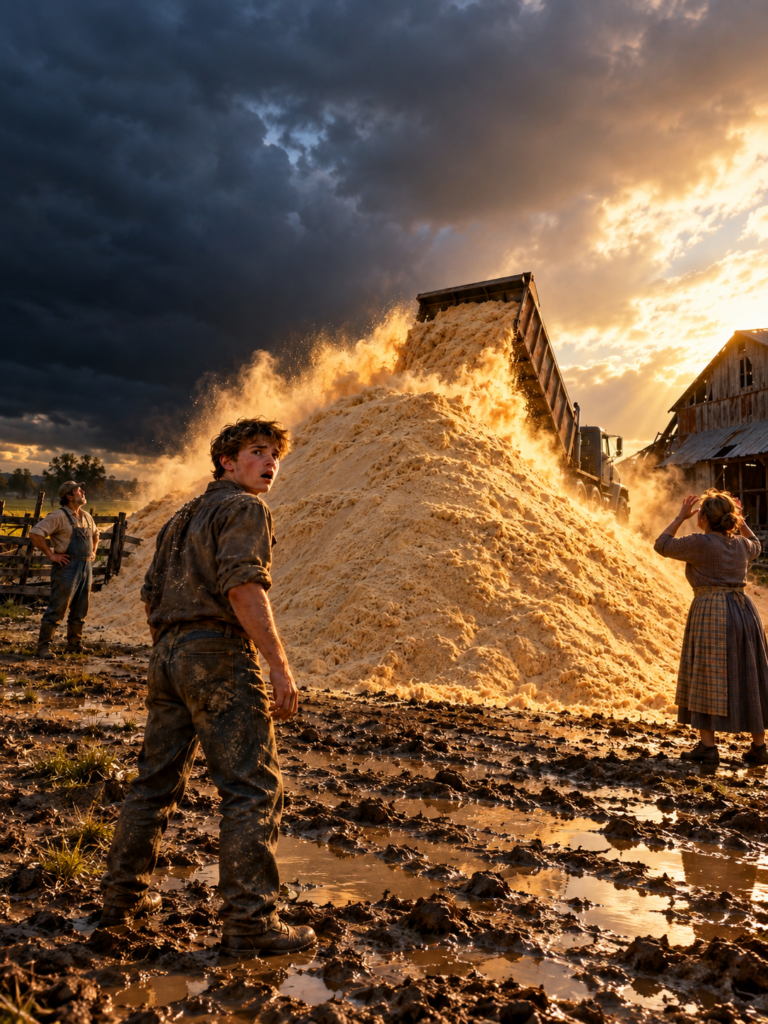
The driver climbed out, walked to the rear of the truck, and released the tailgate. A moment later, the enormous bed began rising.
A thick avalanche of pale brown sawdust thundered onto the ground.
It fell in heavy, rolling waves, throwing fine particles into the morning sunlight. The air filled with the sharp, clean smell of freshly cut timber.
The boy watched as the mound spread across the dirt.
He was still trying to understand what had happened when a second truck came around the bend.
Then a third.
By late morning, nearly thirty tons of sawdust had been dumped beside the barn.
The pile rose higher than the fence and spread across ground the family normally used for equipment and feed storage. From the farmhouse, it looked like a strange new hill had appeared overnight.
His father stood in the yard, staring at it with his hands planted on his hips.
His mother came outside and stopped beside him.
“What are we supposed to do with all that?”
His father didn’t answer immediately.
He had known the nearby sawmill had some leftover sawdust. Someone had mentioned that the family could use a little around the farm, perhaps to cover muddy patches or replace some of the bedding in the animal stalls.
A little would have been welcome.
Thirty tons was something else entirely.
“I don’t know,” his father finally said.
The boy looked between his parents and the trucks disappearing down the road.
Nobody seemed particularly pleased with the delivery.
By afternoon, the neighbors had noticed.
Passing vehicles slowed. Drivers turned their heads toward the enormous mound. One neighbor stopped beside the fence and laughed.
“Looks like the mill found somebody to take its garbage.”
Another man shook his head.
“You’ll be shoveling that stuff until winter.”
The boy heard every word.
So did his father.
Ordinarily, a few jokes from the neighbors might not have mattered. Farm people learned to put up with one another’s opinions. But there was little room for humor in a household already struggling to get through the year.
The barn roof leaked.
Several fence posts had rotted near the ground. A piece of farm equipment had broken down, and feed prices seemed to climb every time his father went to buy more.
Inside the farmhouse, unpaid bills gathered on the kitchen table.
His parents had been postponing repairs for months, shifting money from one necessity to another. Every time they managed to cover one expense, something else demanded attention.
The worst problem was the barn.
Its roof had been repaired so many times that the metal sheets no longer matched. Some were rusted. Others had been fastened over older, broken boards. Timber braces supported one corner where the structure had begun to weaken.
When the wind crossed the fields, the building creaked.
When rain came, water found its way inside.
The boy knew every leak. There was one above the feed area, another near the back wall, and a particularly troublesome one above the stalls.
His father had promised to repair the roof before winter.
But winter was approaching, and the money wasn’t there.
At night, the boy sometimes heard his parents talking in the kitchen after they believed he was asleep.
“If we fix the roof now,” his mother would say, “what are we going to do about feed?”
His father rarely had a satisfying answer.
The boy understood enough to know that the farm couldn’t survive indefinitely on promises and patches.
He had tried to help.
He carried supplies for neighbors, cleaned stalls, worked during harvest, and took whatever small jobs people offered. He saved his earnings carefully, just as his parents had taught him.
But a few dollars might buy nails or a small length of lumber.
They wouldn’t buy a new roof.
And now, standing between the failing barn and thirty tons of unwanted wood dust, he wondered whether the sawmill had given his family something they simply couldn’t afford to deal with.
Later that afternoon, while his parents discussed asking the mill to take some of the material back, the boy walked toward the mound.
He crouched and picked up a handful.
The sawdust was soft and dry. Fine grains slipped between his fingers, leaving a light coating across his palm.
He held it close enough to smell the timber.
There was nothing especially unpleasant about it.
Nothing visibly broken.
Nothing that looked like garbage.
He raised his eyes toward the road.
The sawmill had used trucks to bring this material here. Drivers had been paid to haul it. Fuel had been burned. Workers had spent time loading it.
All to get rid of something the mill didn’t want.
That struck him as strange.
If a company was willing to spend money making something disappear, then getting rid of it must be a problem.
And if getting rid of it was a problem, perhaps there was an opportunity hidden somewhere inside that problem.
He looked down at the sawdust again.
Maybe the question wasn’t how to throw it away.
Maybe the question was who could use it.
That evening, the family ate with the mound still visible through the kitchen window.
His father worried about moving it before the weather changed.
His mother wondered how heavy it would become after a good rain.
The boy listened, saying very little.
He didn’t have an answer worth arguing about yet.
All he had was an idea.
And even he wasn’t sure whether it would amount to anything.
The following morning, he went outside before breakfast.
Mist lay over the fields, and the sawdust looked almost white in the gray light.
He stood beside the pile, then turned toward the barn.
Inside, one of the stalls was damp.
Old straw had mixed with mud on the floor. The smell of wet bedding lingered in the enclosed space.
The boy glanced toward the doorway.
Then he went back outside and fetched his wheelbarrow.
He shoveled dry sawdust into it until it was full, pushed it into the barn, and began spreading the material across the muddy floor.
Almost immediately, the stall looked different.
The pale sawdust covered the wet ground, absorbed the surface moisture, and formed a softer layer for the animals.
Later, when he cleaned the stall, the work seemed easier.
The next morning, the floor was still noticeably drier.
He tried another stall.
Then another.
After several days, the results had become difficult to ignore.
His father noticed the changed bedding while checking the animals.
“What’s all this?”
“Sawdust.”
“I can see that.”
His father stepped inside and pushed his boot across the floor.
“You think it’s better than straw?”
“So far, it seems to be.”
His father pressed his heel into the bedding, then looked toward the giant pile outside.
For the first time since the trucks arrived, his expression softened.
The boy didn’t mistake that small success for a solution to the family’s problems.
The roof still leaked. The bills remained. Winter was still on its way.
But one thing had changed.
Something that had been treated as worthless had made their barn easier to manage.
If it helped their animals, why wouldn’t it help somebody else’s?
A few days later, his father needed to visit the sawmill.
The boy asked to come along.
The moment they reached the mill, he realized how little he understood about the place.
Logs rolled toward cutting machines. Long blades screamed through timber. Fresh boards were stacked in orderly rows while workers moved between piles of lumber.
And everywhere, sawdust accumulated.
It gathered beneath the machinery, along the floor, and inside large collection bins. Even as workers cleared it away, the saws continued producing more.
The boy stopped beside a bin that was nearly full.
A worker noticed him watching.
“Never seen sawdust before?”
“Not this much.”
The worker laughed.
The boy pointed toward the bin.
“How long does it take to fill?”
“Depends how busy we are.”
“A month?”
“Sometimes less than a week.”
The boy stared at him.
Less than a week.
Back at the farm, thirty tons had seemed like an impossible amount of material. Here, the machines were producing more every hour.
Nearby, his father was speaking with the mill manager.
The boy moved closer and listened.
When the bins became full, somebody had to empty them. That meant workers, trucks, fuel, lost space, and sometimes disposal fees.
“So you actually pay to get rid of it?” the boy asked.
The manager glanced at him.
“Sometimes. If nobody wants it.”
That answer followed the boy all the way home.
The mill wasn’t throwing away sawdust because it could never be useful.
The mill was throwing it away because the mill itself had no use for it.
There was an important difference.
That evening, the boy found an empty feed sack in the barn.
He filled it with the cleanest, driest material he could gather. He removed pieces of bark and larger wood chips by hand, checked the contents, and tied the sack closed.
Then he stood it against the wall.
For a moment, he studied what he had made.
It wasn’t a mountain of waste anymore.
It was a bag of usable bedding.
Something another farmer could carry home.
Something somebody might even pay for.
The following afternoon, Mr. Harris stopped by to speak with the boy’s father.
Mr. Harris lived down the road and kept horses, goats, and several other animals. He knew what it meant to clean stalls and replace bedding, and he had already seen the enormous mound beside the barn.
As he approached the building, he glanced toward it and smiled.
“Still trying to figure out what to do with all that?”
“Actually,” the boy said, “I’ve been using it.”
Mr. Harris raised an eyebrow.
“For what?”
“Come see.”
Inside the barn, the boy showed him the stalls.
The older farmer examined the floor, nudged the sawdust with his boot, and crouched to pick up a handful.
“This came out of that pile?”
“Yes, sir.”
“Does it stay dry?”
“Better than the old bedding has been.”
Mr. Harris rubbed the material between his fingers.
The boy watched closely.
He had no idea whether the man would be impressed, but he knew Mr. Harris understood animals. If the bedding worked for him, that would mean more than a dozen guesses.
The boy brought out the sack he had prepared.
“Take this home and try it.”
Mr. Harris looked at him.
“How much?”
“Nothing. I just want to know whether it works for yours.”
“You’re giving it away?”
“Just the first bag.”
Mr. Harris considered that, then nodded.
“Fair enough.”
The boy helped load the sack into his wagon.
Then he waited.
The first day passed.
The second passed.
By the third morning, he had begun wondering whether the whole idea had failed.
Perhaps the bedding hadn’t worked on another farm. Perhaps Mr. Harris had found it troublesome. Perhaps something that seemed useful to a boy trying to solve his family’s problems wasn’t worth anybody else’s money.
Then he heard wagon wheels coming up the road.
Mr. Harris climbed down and walked toward the barn.
“That stuff works.”
The boy straightened.
“For the horses?”
“The horses, the goats. Even that muddy corner near my gate.”
He glanced toward the pile.
“You got any more ready?”
The boy tried to keep his voice steady.
“I think I can find some.”
They filled three sacks together.
When the work was finished, Mr. Harris reached into his pocket and brought out several folded bills.
The boy hesitated.
“You don’t have to pay me.”
Mr. Harris put the money into his hand.
“First bag was free. These aren’t.”
For a moment, the boy only stared at the bills.
He had earned money before.
But every dollar had come from doing work for somebody else.
This was different.
A customer had paid him for a product.
And that product had arrived on his family’s land because another business wanted to get rid of it.
That night, he placed the money on the kitchen table.
His father looked at it.
“Where’d that come from?”
“Mr. Harris bought some sawdust.”
His mother stopped what she was doing.
“He paid you for it?”
The boy nodded.
His father turned toward the window.
The mound outside was still enormous, still blocking part of the yard.
But somehow it no longer looked quite the same.
The next morning, the boy prepared five more bags.
He worked slowly, removing bark and larger pieces, choosing the driest material, and trying to put roughly the same amount into every sack.
A few days later, another farmer arrived.
“Mr. Harris told me you’ve got bedding for sale.”
The boy looked toward the road, then toward the bags waiting beside the barn.
He understood what had happened.
Mr. Harris hadn’t simply become his first paying customer.
He had sent another one.
That farmer bought two bags.
Then somebody came looking for chicken bedding.
Another wanted material for a muddy animal pen.
By the end of the week, more than a dozen sacks had left the property.
The mound barely appeared smaller.
But the boy had stopped judging his progress by how much sawdust remained.
He judged it by how often customers came back.
Soon, the work began to change.
He built a screening frame from scrap boards and old wire mesh, shoveling sawdust through it to separate finer material from bark and larger chips.
It was slow, tiring work.
His shoulders ached from lifting the shovel, and fine dust clung to his clothes.
But the material that passed through the screen looked cleaner and more consistent.
He filled the sacks carefully.
Ten finished bags stood beside the barn.
Then thirty.
He knew he couldn’t keep relying entirely on Mr. Harris and the neighbors.
So he found an old wooden plank and painted a simple message across it.
DRY SAWDUST FOR BARNS AND ANIMALS.
Below the words, he painted a price.
His father watched him carry the sign toward the road.
“You really think strangers are going to stop?”
The boy drove the post into the ground.
“We’ll find out.”
Nobody stopped the first day.
The second was nearly as discouraging.
Vehicles passed, and a few drivers slowed enough to read the sign, but no one turned into the yard.
By late afternoon, the boy had spent so much time looking toward the road that his mother reminded him he still had farm chores to finish.
Then an old pickup passed the sign.
Its brake lights came on.
The truck stopped, reversed, and turned into the driveway.
A farmer climbed out.
“You selling bedding?”
“Yes, sir.”
“Dry?”
The boy opened a sack.
“See for yourself.”
The man checked the sawdust with his hand.
“Clean?”
“I screen it myself.”
The farmer looked at the bags lined up beside the barn.
“How many you got?”
“Thirty.”
“I’ll take ten.”
The boy felt his pulse quicken.
Ten bags.
More than any customer had purchased at once.
He helped load the pickup and counted the payment carefully when the farmer handed it over.
That evening, he spread the money across the kitchen table.
Then he separated it into three piles.
His father pointed toward the first.
“More sacks?”
“Yes.”
“And that one?”
“For the house.”
His father nodded toward the remaining money.
“What about the rest?”
The boy glanced toward the barn.
“That goes back into the business.”
“So you’re saving it.”
“Not exactly.”
He looked down at the bills.
“I’m going to use it to grow.”
From that day forward, he carried a notebook.
He recorded customers’ names, the number of bags they purchased, and how they used the material.
He wrote down complaints as carefully as compliments.
Horse owners wanted especially clean bedding. Chicken farmers preferred smaller sacks. Some customers liked fine sawdust, while others wanted larger shavings mixed in.
The boy began sorting accordingly.
He covered the best material, changed the size of certain bags, and adjusted his prices to match what customers needed.
His business was still little more than a boy working beside an old barn.
But the pattern was becoming clear.
He wasn’t simply selling sawdust.
He was learning to prepare different materials for different customers.
And each satisfied customer made the next sale a little more likely.
One evening, he stood outside with his notebook open.
The mountain had finally begun to shrink.
Behind him, the old barn creaked as the wind moved across the fields.
For the first time in months, the family had a reason to believe that something good might come out of their troubles.
Then he looked toward the distant horizon.
Dark clouds were gathering beyond the fields.
He closed the notebook.
The wind was beginning to rise.
Part 2
The storm arrived faster than anyone expected.
By late afternoon, the sky had turned dark, and the wind was pushing hard across the fields. Loose boards rattled against the barn. Dust lifted from the road in short, twisting clouds.
His father stepped outside and studied the approaching weather.
“Storm’s coming.”
The boy’s first thought was the sawdust.
He had stacked most of the finished bags beneath a small lean-to, but the main pile remained exposed. He had covered part of it with old tarps, holding the edges down with whatever boards and ropes he could find.
There wasn’t enough covering for thirty tons.
Not even close.
The first drops struck the ground as he hurried toward the pile.
Within minutes, rain was falling in sheets.
Wind caught the edge of one tarp and ripped it loose. The boy grabbed a rope, pulled against the gusts, and tried to secure the covering before more of it blew away.
Water ran down his face and soaked through his clothes.
His father called from the barn.
“Get inside!”
“Just one more minute!”
Another gust lifted the tarp.
The boy struggled to hold it down, but the rain was now so heavy he could barely see across the yard.
His father shouted again.
This time, the boy let go.
By morning, the damage was everywhere.
The mound that had once looked pale and light had turned dark brown. Parts of its surface had collapsed. Water had soaked through the outer layers, leaving heavy clumps that stuck together when he tried to shovel them.
He dug into the pile, searching for dry material.
The deeper sections were better, but much of the sawdust was already saturated.
He stood there with the shovel in his hands, trying to calculate how much he had lost.
The business depended on one simple promise.
Dry bedding.
Now the very material he sold to absorb moisture had absorbed so much rain that it couldn’t do its job.
That afternoon, a customer arrived for six bags.
The boy selected sawdust from a section that appeared dry enough and filled the order.
He wanted to believe he had avoided the worst damage.
Two days later, the customer returned.
The man climbed down from his vehicle and dropped a sack beside the barn.
“This isn’t like the last batch.”
The boy opened it.
The outside material seemed acceptable, but the center was damp.
A sour smell rose from the bag.
He reached inside and felt the moisture himself.
The customer folded his arms.
“I can’t put this in my stalls. I bought it to keep them dry.”
The boy looked at the sack, then at the man.
“You’re right.”
He returned the money.
The following day, another customer complained.
Then another.
The boy began opening finished bags one by one, checking the material and setting questionable sacks aside.
Every damp bag felt like another failure.
He had worked for weeks to convince people that they could rely on him. Now a single storm threatened to undo it.
His father found him sorting through the bags.
“You need to stop selling until you know what’s good.”
The boy kept working.
“If I stop, they’ll buy somewhere else.”
His father watched him for a moment.
“Better they go somewhere else because you’re out of stock than because they don’t trust what you’re selling.”
The boy stopped.
He wanted to argue.
He couldn’t.
The customers had come back because the first bags worked. If he continued selling damaged bedding, they might never come back again.
That afternoon, he walked to the road and took down the wooden sign.
The yard became quiet.
No pickups stopping.
No customers asking how many bags were ready.
No new money on the kitchen table.
Just a wet mountain beside a leaking barn.
For several days, the boy worked to salvage whatever he could.
Whenever the sun appeared, he spread thin layers of sawdust across open ground to dry.
He built rough racks using scrap lumber and wire. He sorted the material into piles, keeping anything that showed signs of mold or decay away from usable bedding.
The process was exhausting.
Each time he thought he had rescued enough for several sacks, he found another damp section.
He no longer felt as though he was building a business.
He felt as though he was trying to recover the pieces of one.
Then, while working behind the barn, he noticed something unusual.
Some of the wet sawdust had mixed with old animal bedding, manure, and grass.
He pushed his shovel into the heap.
Warm air rose from the center.
He frowned and touched the material.
It was hot.
Not merely warm from the afternoon sun. The heat was coming from inside the pile.
“Pa!”
His father came around the barn.
The boy pointed with the shovel.
“Why is this getting hot?”
His father dug into the mixture and examined it.
“It’s breaking down.”
The boy looked at the dark material.
“So it’s ruined?”
“Not necessarily.”
His father let a handful fall back into the pile.
“Give it enough time, and you might have compost.”
The boy had heard of compost, of course.
But until that moment, he had never thought of deliberately making it.
For days, he had considered the wet sawdust a total loss.
Now he wondered whether the ruined material could become something useful in a different form.
He began experimenting again.
He divided the wet sawdust into smaller piles.
One contained mostly sawdust. Another included manure. A third held a mixture of sawdust, old bedding, grass clippings, and other organic material from around the farm.
He checked them regularly.
The first results were discouraging.
One pile stayed cold and heavy.
Another developed such a foul smell that he moved it farther from the barn.
A third became so wet that it sagged into a muddy mass.
He wrote down what happened.
Too much water.
Too much manure.
Not enough air.
He turned the piles with his shovel every few days. When material became too dry, he added moisture. When it smelled sour, he mixed in more sawdust and loosened the heap.
There was nothing glamorous about the work.
It took time, patience, and a willingness to keep trying when nothing looked promising.
Then one of the piles began changing.
Its sharp odor faded.
The material darkened, and the recognizable wood particles slowly lost their rough appearance.
When he pushed the shovel into the center, heat still rose from within, but the mixture had begun to resemble rich, dark earth.
The boy crouched beside it.
He had begun with something nobody wanted.
Now he was watching it become something else.
He carried a bucket of the finished-looking compost behind the house and spread some around one row of vegetables, leaving another row untreated for comparison.
At first, there was little difference.
He checked again.
And again.
Gradually, the treated soil appeared to hold moisture longer. The plants in that row looked stronger, their leaves darker than those growing nearby.
His mother noticed.
“What did you put on these?”
The boy pointed toward the compost piles.
“That sawdust from the storm.”
She looked at him.
“The ruined sawdust?”
“Some of it.”
His mother studied the plants again.
The boy could see that she was beginning to understand.
He had learned to sell sawdust by cleaning and bagging it.
Now he was learning to change the material itself.
A few days later, a local gardener stopped by looking for bedding.
The boy showed him the compost.
The man crouched, took a handful, and rubbed it between his fingers.
“This came from that wet pile?”
“Part of it.”
The gardener examined the texture again.
“How much are you asking?”
The boy named a price higher than he charged for ordinary sawdust.
The man hesitated before purchasing two bags.
A week later, he returned for six more.
That second purchase told the boy something important.
This was more than a clever way to salvage damaged inventory.
It was another product.
He opened his notebook to a clean page and wrote a single word.
COMPOST.
Below it, he began recording the other uses he had discovered.
Animal bedding.
Garden mulch.
Path material.
Soil improvement.
For the first time, he understood that different grades of sawdust could serve different purposes.
The cleanest, driest material belonged in animal stalls.
Coarser pieces could be used around paths and gardens.
Lower-grade material could be directed into carefully managed compost piles instead of being wasted.
The pile beside the barn was no longer one mountain with one possible use.
It was raw material for several products.
And suddenly, he faced a problem he would never have imagined a few months earlier.
He was beginning to run out.
Bedding customers were returning.
Gardeners wanted compost.
Word about the business had traveled beyond the farms closest to his home.
Then a nursery owner came to the property.
The man examined the finished compost, opened several bags, and asked questions about how the material was prepared.
Finally, he looked at the boy.
“How much of this can you supply?”
The boy glanced toward the remaining piles.
“How much do you need?”
The nursery owner explained that he wanted a substantial quantity for planting beds, young trees, and several growing areas.
The first delivery would have to arrive before the end of the month.
The boy felt excitement rising in his chest.
A large customer.
A possible source of regular business.
Exactly the opportunity he had been working toward.
But when he considered his actual inventory, the excitement became more complicated.
Some compost was ready.
Some needed more time.
Other piles were still too wet.
And the original sawdust mountain had shrunk considerably.
“Can you handle it?” the nursery owner asked.
The boy almost said yes.
The answer was sitting on his tongue when he remembered the damp bedding bags, the angry customers, and the afternoon he had removed his sign.
He couldn’t afford another promise he wasn’t able to keep.
“I can make the first delivery,” he said. “But I’ll need more time for the rest.”
The nursery owner considered him.
“Bring me one good load by the deadline. If the quality’s right, we can talk about more.”
Then his expression grew serious.
“If it isn’t, I’ll have to get it somewhere else.”
The boy nodded.
After the man left, he counted everything.
Finished compost.
Nearly finished compost.
Dry sawdust.
Material still waiting to be processed.
He checked the figures twice.
They could probably manage the first delivery.
After that, they would run short.
His father found him standing beside the remaining mound.
“How much do you need?”
The boy looked at his notebook.
“More than we’ve got.”
For months, thirty tons had seemed impossible to use.
Now it wasn’t enough.
That night, he thought about every possible place he could get more material.
His pencil stopped over one word.
Sawmill.
The next morning, he returned to the place where the whole strange adventure had begun.
The manager recognized him.
“Back for more?”
The boy nodded toward the collection bins.
“I want to start taking it regularly.”
“How regularly?”
“As often as you need it cleared.”
The manager gave him his full attention.
The boy explained that he had customers buying bedding, compost, and garden material. He needed a dependable supply, and the mill needed a dependable way to empty its bins.
“If I haul it away myself, can I keep coming?”
The manager looked toward the accumulating sawdust.
“If you keep those bins from overflowing, you can take plenty.”
The agreement was simple.
Transporting the material was not.
The family didn’t own a truck capable of hauling the quantities he needed.
So the boy used part of his savings to rent an old farm trailer.
His father helped with the first trip.
A neighbor loaned them another wagon.
Together, they hauled load after load to the farm.
But this time, the boy refused to let the sawdust become one enormous, unprotected pile.
Clean, dry material went under cover.
Coarser pieces were separated.
Lower-grade sawdust went to the composting area.
Everything had a purpose, and each kind of material had its own place.
For the next two weeks, the family worked relentlessly.
Fresh loads arrived.
Compost was turned.
Bags were filled after dark.
Every evening, the boy checked the nursery deadline in his notebook.
He had never faced an order this important.
Finally, the first shipment was ready.
He traveled with the delivery and watched the nursery owner cut open a bag.
Dark compost spilled onto the ground.
The man scooped some into his hand, examined the texture, and let the material run between his fingers.
The boy stood quietly.
He had learned not to interrupt a customer judging the quality of his work.
At last, the nursery owner looked up.
“This is good.”
The boy felt his shoulders relax.
The nursery accepted the shipment.
A few days later, another order arrived.
Then another.
The nursery had given the business something more valuable than one large sale.
A reason to keep producing.
Back at the farm, the boy looked toward the sawdust deliveries and understood that the original thirty tons had never been his true supply.
They had only been the beginning.
The real supply was being produced continuously at the mills.
If one mill could provide so much, others probably had the same problem.
He made a list of sawmills within driving distance.
The following week, he visited the first.
The manager listened to his explanation and pointed toward a large collection bin.
“If you haul it away, you can have it.”
The second mill gave him almost the same answer.
At the third, the manager laughed when he realized the boy was deliberately searching for sawdust.
“You actually want this stuff?”
“Yes, sir.”
“For what?”
“Bedding. Compost. Garden material.”
The manager glanced at the overflowing pile behind the building.
“Then you came to the right place.”
The boy discovered that he wasn’t asking the mills to do him a favor.
He was offering them a service.
Every load he collected freed storage space, reduced handling, and saved the mills the trouble of arranging removal themselves.
Some managers gave him the material freely.
Others helped load the trailer.
Soon, he had access to more sawdust than the original thirty tons that had once overwhelmed his family.
But the work became more complicated.
One mill produced fine, dry material.
Another sent larger shavings.
Some loads were suitable for animal bedding; others belonged in compost.
When a wet load was dumped too close to stored dry bedding and ruined part of it, the boy knew he needed a better system.
He reorganized the yard.
Dry bedding material stayed undercover. Coarse material had a separate space. Compost ingredients were kept apart from finished products.
Then he changed his notebook.
Alongside customer names and prices, he began recording which mill supplied each load, how much arrived, what condition it was in, and how quickly it moved through the business.
Collection became a routine.
Monday belonged to one mill.
Wednesday to another.
Friday to the largest supplier.
The mills knew when someone would arrive to empty their bins.
The boy knew what materials would be available for the coming orders.
And customers no longer had to wonder whether he would have enough to sell.
One morning, a mill manager contacted him before the scheduled collection.
“Our bin’s almost full. Can you come early?”
The boy glanced toward the trailer.
Months ago, trucks had brought unwanted material to his family’s land because the sawmill wanted it gone.
Now the mill was calling him because it depended on his collections.
He hitched the trailer and set out.
That afternoon, he returned carrying another load.
As he pulled into the farmyard, a customer was preparing to leave with finished compost.
The boy stopped and watched.
One vehicle had brought in something somebody wanted to get rid of.
Another was leaving with something somebody had paid to receive.
He looked from one to the other.
It was the same material, transformed through work, sorting, time, and care.
For the first time, he could see the whole business moving around him.
Raw material arrived.
Finished products left.
Then the cycle began again.
There were several suppliers now, several different products, and customers who returned regularly.
The old barn was no longer large enough for all the activity. More land had to be cleared for storage, and a neighbor began helping fill bags.
His father spent increasing amounts of time collecting material from the mills.
Some customers no longer wanted a sack or two.
They wanted entire trailer loads.
The boy watched another delivery leave the yard one evening and felt something he hadn’t expected.
Not relief.
Concern.
Because the business had finally grown beyond the original sawdust pile.
And it was beginning to grow beyond what he could manage alone.
Part 3
The morning that finally convinced the boy he needed help began with three customers arriving almost at once.
A horse owner wanted bedding.
A nursery truck had come to collect compost.
Another customer needed an entire trailer of mulch.
While the boy was trying to organize those orders, one of the sawmills contacted him. Its collection bin was nearly overflowing, and the manager wanted the next load removed early.
The boy stood in the middle of the yard, looking from one vehicle to another.
Everybody needed something.
And everybody expected him to have it ready.
For months, he had handled almost everything himself.
He collected sawdust, screened it, filled bags, turned compost, spoke with customers, arranged deliveries, and recorded sales in his notebook.
In the beginning, working longer hours had solved most problems.
Now there simply weren’t enough hours.
One delivery left late.
Another customer had to wait because the bags weren’t ready.
A compost pile that needed turning sat untouched for two days.
His father found him working beside the barn after another exhausting day.
“You can’t keep doing all this yourself.”
The boy wiped his hands on his trousers.
“I’m managing.”
His father looked across the yard.
“You’re falling behind.”
“I just need to get caught up.”
“And what happens when another ten orders come in?”
The boy didn’t answer.
His father nodded toward the unfinished bags.
“You need somebody here full-time.”
The suggestion troubled him.
Hiring help meant paying wages.
Every dollar spent on another worker was money he couldn’t use to purchase bags, repair equipment, or improve the barn.
He had built the business by doing nearly everything with his own hands. Paying someone else to do work he knew how to do felt like surrendering part of the money he had worked so hard to earn.
But another order was delayed.
Then he watched a customer waiting in the yard while material sat ready to be packed.
The problem wasn’t a lack of customers anymore.
It was that the business couldn’t serve them fast enough.
He hired a young farmhand from nearby.
At first, the new worker handled straightforward tasks: sorting material, filling sacks, stacking finished products, and keeping the storage areas organized.
The difference was immediate.
While the helper filled bags, the boy could make deliveries.
While the boy collected material from the mills, someone remained behind to prepare orders.
For the first time, work continued even when he wasn’t standing in the yard.
That realization stayed with him.
The business no longer depended entirely on his own two hands.
But hiring help solved only one problem.
Storage became the next.
A large shipment from a mill filled nearly every protected space around the barn. Finished compost sat too close to exposed ground, and the dry bedding area was becoming crowded.
The boy remembered the first storm.
He remembered the sour smell inside the damp sacks and the customers waiting for their money back.
He wasn’t going to let the same mistake destroy his business again.
Using inexpensive lumber and salvaged sheets of metal, the family built another covered storage area.
It wasn’t an impressive structure.
The boards were plain, the roof was patched together, and nothing about it looked like a building constructed by people with money to spare.
But rain could no longer fall directly on the finished bags.
There was room to separate different materials.
And the boy could look at the covered stacks without feeling the same dread he had felt when the first storm rolled across the fields.
His notebook changed again.
The early pages had been simple.
Mr. Harris. Three bags.
Another farmer. Two bags.
Ten bags from the roadside sign.
Now the boy was recording fuel costs, wages, equipment repairs, replacement sacks, and delivery distances.
The figures taught him a lesson that surprised him.
A large sale didn’t always mean a large profit.
One customer ordered an entire trailer, but the delivery was so far away that fuel and travel time consumed much of the payment.
Another customer purchased fewer bags and collected them directly from the farm.
That smaller transaction left more money behind.
The boy began looking at sales differently.
He adjusted delivery charges according to distance, grouped customers along the same routes, and paid closer attention to how much money remained after expenses.
A busy day didn’t necessarily mean a profitable one.
And a profitable business needed more than a growing pile of orders.
It needed control.
Gradually, regular customers made the work easier to predict.
A horse farm wanted bedding every two weeks.
The nursery scheduled compost deliveries.
Another buyer began purchasing mulch by the trailer rather than by the sack.
The boy could open his notebook on an ordinary evening and see much of the coming week’s work.
Which mill needed collecting.
How many bags had to be filled.
Which compost piles were approaching readiness.
Which customers expected their deliveries first.
The yard still looked busy, but the activity was becoming less chaotic.
One evening, he stood outside the barn watching the workers.
A trailer of fresh sawdust had arrived from a mill. One worker was sorting the material while another filled bags beneath the covered shelter.
His father was preparing the next morning’s collection and delivery work.
The boy studied the scene.
Only months earlier, he had wondered whether anyone would pay for sawdust.
Now customers were ordering faster than his equipment could process it.
Then came the opportunity that would test everything he had built.
A regional agricultural supplier contacted him.
The company wanted regular shipments of his products.
Not a single delivery.
Not an occasional trailer.
Shipments every week, continuing for months.
The boy listened carefully and wrote down the requirements.
The potential order was larger than anything he had handled.
To accept it, he would need faster screening equipment, more covered storage, better transportation, additional supplies, and enough labor to keep everything moving.
The supplier gave him three weeks to prepare.
If the first large delivery met its requirements, regular orders could follow.
If not, it would find someone else.
That night, the boy sat at the kitchen table with his notebook open.
He listed everything the operation would need.
A screening machine.
A larger trailer.
Additional storage.
More bags.
Fuel.
Labor.
Money for repairs.
He added the figures carefully.
Then he added them again.
The total was almost everything he had saved.
His father sat across from him and studied the numbers.
For a while, neither spoke.
Finally, his father pointed toward the total.
“If this doesn’t work, what happens?”
The boy looked down.
“We keep going.”
His father shook his head.
“With less money. And more bills.”
The room fell silent.
The boy knew his father wasn’t trying to discourage him.
His father had spent too many years watching the family struggle to cover basic expenses. He understood what could happen when money disappeared into something that didn’t work.
The old barn had taught them that lesson.
So had broken farm equipment.
So had every bill that waited on the kitchen table while they tried to decide what could be paid first.
Until now, the business had grown through relatively small decisions.
More sacks.
A rented trailer.
A helper.
A storage shelter built from salvaged materials.
This decision was different.
He would be putting nearly all his savings into equipment and capacity he couldn’t be certain the business would use profitably.
The safer choice was obvious.
Keep the customers they already had.
Stay small.
Grow a little each season.
The family was already in a better position than it had been when the trucks first arrived.
There was nothing shameful about protecting what they had managed to build.
But the boy kept thinking about the suppliers and customers.
The sawmills were producing more material than he could process.
Customers wanted more products than he could prepare.
The demand was there.
The supply was there.
What stood between them was his ability to handle the work.
He closed the notebook.
The following morning, he made his decision.
He spent the money.
Two days later, a secondhand screening machine arrived at the farm.
It was old and battered.
Rust marked the frame. The engine showed years of use, and several parts looked as though they hadn’t received proper attention in a long time.
But it was the machine they could afford.
The boy stood beside it while his father inspected the engine.
They had paid for it.
There was no simple way to undo the purchase.
His father tried to start it.
The engine coughed.
Then died.
He tried again.
Nothing.
The boy stared at the machine.
Almost all the money he had saved was tied up in a piece of equipment that wouldn’t run.
His father opened the engine housing.
A drive belt was badly worn.
One fuel line was clogged.
Another component was cracked.
They began working through the problems.
Hours passed.
The afternoon light shifted across the yard, and the machine remained silent.
Every lost hour brought the supplier’s deadline closer.
The boy could feel the pressure mounting.
He thought about the first thirty tons.
The wet bedding bags.
The failed compost mixtures.
The first nursery delivery that had seemed impossible to fill.
Every new stage of the business had presented some problem he hadn’t anticipated.
But this was different because so much money depended on getting the machine running.
His father continued examining the damaged parts.
Finally, he found a way to adapt a replacement from old farm equipment.
They fitted it into place and checked the other repairs.
Then his father tried the engine again.
It turned.
Coughed.
Hesitated.
And roared to life.
The boy stepped back as the machine began vibrating.
The screen shook, and sawdust moved through it at a speed he had never been able to match with his homemade wooden frame.
Fine material fell through.
Larger pieces separated.
What had once required hours of shoveling could now be processed in a fraction of the time.
The boy stood watching the machine work.
Then he smiled.
He knew they still had a great deal to do.
But for the first time since making the investment, he could see what it might accomplish.
Over the next two weeks, the farm barely stopped moving.
Loads arrived from the mills early in the morning.
Workers sorted material throughout the day.
The screening machine processed sawdust while finished products were packed and moved beneath the storage roofs.
Compost piles were turned on schedule.
Trailers were loaded.
Bags were counted.
Each evening, the boy opened his notebook and compared the finished inventory with the supplier’s order.
The numbers gradually improved.
They were getting closer.
Two days before the delivery deadline, the sky darkened.
Wind swept across the fields.
Rain began hammering the roofs.
The boy stopped beneath the storage shelter and looked toward the storm.
For a moment, he remembered the first time.
The tarps tearing loose.
The heavy, dripping sawdust.
The spoiled bags.
The angry customers.
His sign coming down beside the road.
He turned toward the finished inventory.
But this time, everything was different.
The dry material was stacked beneath proper cover.
The finished bags were protected.
Drainage channels carried rainwater away from the storage areas.
Lower-grade sawdust remained separated from bedding products.
Workers could continue handling material beneath the shelters without exposing finished stock to the downpour.
The boy stood listening to the rain on the metal roof.
The storm had come again.
But the business hadn’t stopped.
And as he looked around, he understood what his investment had really purchased.
Not simply a machine.
Not simply another roof.
It had given the operation a greater measure of control over the things that had once threatened to destroy it.
On delivery morning, the first large shipment departed before sunrise.
The boy rode with it.
He had checked the bags and counted the order, but he remained tense throughout the trip.
A breakdown, a quality complaint, or a missed requirement could still cost him the contract.
At the supplier’s warehouse, a manager came out to inspect the shipment.
He didn’t simply glance at the bags and wave the truck through.
He selected several at random.
One was opened.
Then another.
The manager checked moisture, texture, and consistency.
The boy watched without speaking.
He remembered the nursery owner examining that first large compost shipment.
He remembered standing in the same uncertain silence while somebody else decided whether his work was good enough.
The manager rubbed a sample between his fingers.
He examined another bag.
Finally, he looked up.
“This will work.”
The boy felt the tension leave his chest.
Then the manager handed him a sheet of paper.
It was a delivery schedule.
Next week.
The week after that.
And the week after that.
Regular shipments, extending into the coming months.
The boy looked down at the dates.
For so long, the family had lived from one urgent problem to another.
One repair.
One bill.
One difficult season.
Now he was holding a schedule for work that customers had already committed to giving him.
The risk had paid off.
And the operation had reached a scale he could barely have imagined when he first filled an empty feed sack beside the barn.
One year after the first truck arrived, the family property looked almost unrecognizable.
The farmhouse still stood beside the dirt road.
The old barn remained behind it.
But covered storage sheds now lined part of the yard, protecting finished bags of bedding, mulch, compost, and other soil products.
Rows of compost occupied another section of land.
A loading area had been cleared near the road.
Trucks came and went regularly.
Some arrived carrying sawdust from mills in the surrounding area.
Others left with products bound for horse farms, nurseries, garden centers, and agricultural suppliers across several towns.
The boy no longer filled every bag himself.
Workers handled much of the screening, sorting, packing, and loading.
His father helped coordinate collections from the sawmills.
Deliveries followed regular routes, and customers placed advance orders.
Three mills were supplying material on a dependable basis.
In a single month, the business could handle more sawdust than the original thirty-ton mountain that had once seemed impossible to use.
The farm itself had changed.
The barn roof had finally been repaired.
The rotten fence posts were gone.
Broken equipment had been fixed or replaced.
Inside the farmhouse, unpaid bills no longer dominated every conversation at the kitchen table.
For the first time in years, the family wasn’t simply trying to survive until the next season.
They had something that produced income beyond the farm’s ordinary work.
Something they had built themselves.
And it had begun with a problem nobody wanted.
One afternoon, Mr. Harris drove into the yard.
He climbed out of his vehicle and stood looking around.
A trailer was being loaded near the storage sheds. Workers were processing fresh material, and another truck waited near the gate.
Mr. Harris gave a low laugh.
“Hard to believe this all started with one free bag.”
The boy smiled.
He remembered the bag.
He remembered filling it with carefully selected sawdust and wondering whether Mr. Harris would think it worth using.
He remembered waiting three days for an answer.
Then the sight of the older farmer returning up the road.
He remembered the first folded bills pressed into his hand.
Back then, three paid bags had seemed like an enormous victory.
Now customers placed recurring orders that stretched weeks into the future.
But the boy hadn’t forgotten the failures.
The storm that soaked his inventory.
The refunds.
The humiliating afternoon when he took down his roadside sign.
The compost piles that smelled so bad he had to move them away from the barn.
The nursery order he almost couldn’t fill.
The worn-out screening machine that refused to start after he had spent nearly everything he owned.
None of those moments had felt like progress while they were happening.
They had felt like mistakes.
Like the kind of trouble that could make a person wish he had never begun.
Yet each had taught him something he needed later.
The wet bedding taught him to protect quality.
The storm led him to compost.
The first large order taught him to build dependable supply.
The overflowing yard taught him to organize the work.
The delayed deliveries taught him to hire help.
The expensive routes taught him to calculate profit instead of simply counting sales.
And the second storm proved how much those lessons mattered.
That evening, after the last truck left, the farm grew quiet.
The boy walked away from the storage sheds and crossed the yard toward the old barn.
He stopped at the place where the original sawdust mountain had stood.
There was nothing there now except hard-packed earth marked by truck tires.
He looked down at the ground.
A year earlier, the pile had towered above the fence.
Neighbors had slowed their vehicles to laugh at it.
His mother had wondered how the family would ever get rid of so much material.
His father had worried about the winter and a leaking barn roof he couldn’t afford to repair.
And the boy had stood in this same place with a handful of sawdust slipping between his fingers.
He remembered the question that had troubled him.
Why would a business spend money getting rid of something?
Back then, he hadn’t known what to do with the answer.
He didn’t have a screening machine.
He didn’t have customers.
He didn’t have workers, delivery routes, covered storage buildings, or arrangements with several sawmills.
He didn’t even have a finished product.
He had an old shovel, a wheelbarrow, an empty feed sack, and a family that desperately needed things to improve.
He had no guarantee that anybody would pay him a dollar.
But he had been willing to try.
Now, behind him, tomorrow’s orders were stacked beneath the roofs.
Workers would return in the morning.
The mills had more material waiting.
Customers in several towns were expecting deliveries.
And the repaired barn stood solidly against the evening breeze.
The boy looked toward the road where the trucks had appeared a year earlier.
Those drivers had believed they were hauling waste away from the sawmill.
The neighbors had believed somebody had dumped a mountain of garbage on a struggling farm.
Even his parents had feared the delivery was another burden they couldn’t afford.
Nobody had recognized what was sitting beside the barn.
Not at first.
The boy hadn’t recognized it completely, either.
He had discovered its value one experiment, one customer, one failure, and one difficult decision at a time.
Thirty tons had once seemed like more sawdust than a family could use in a lifetime.
Now the business handled more than that in an ordinary month.
And perhaps that was the strangest part of all.
The sawdust itself hadn’t changed.
What changed was what the boy learned to do with it.
He hadn’t found a treasure buried beneath the farm.
He hadn’t inherited money or stumbled into some miraculous fortune.
He had taken something other people considered worthless, discovered who needed it, and learned how to make it useful.
Then he had done it again.
And again.
Until the entire yard became the center of a thriving rural business.
The boy stood quietly for another moment before turning toward the farmhouse.
The sun had dropped low beyond the fields, casting long shadows from the repaired barn and the storage sheds.
Behind him, the spot where the mountain had once stood was empty.
But the business that had grown from it was still moving.
And for the family that had once struggled to pay for a roof, that was worth more than the neighbors could ever have imagined.