Part 1
The auctioneer’s gavel struck the wooden block with a sharp crack.
“Sold! Sixty-five dollars!”
For a moment, nobody moved.
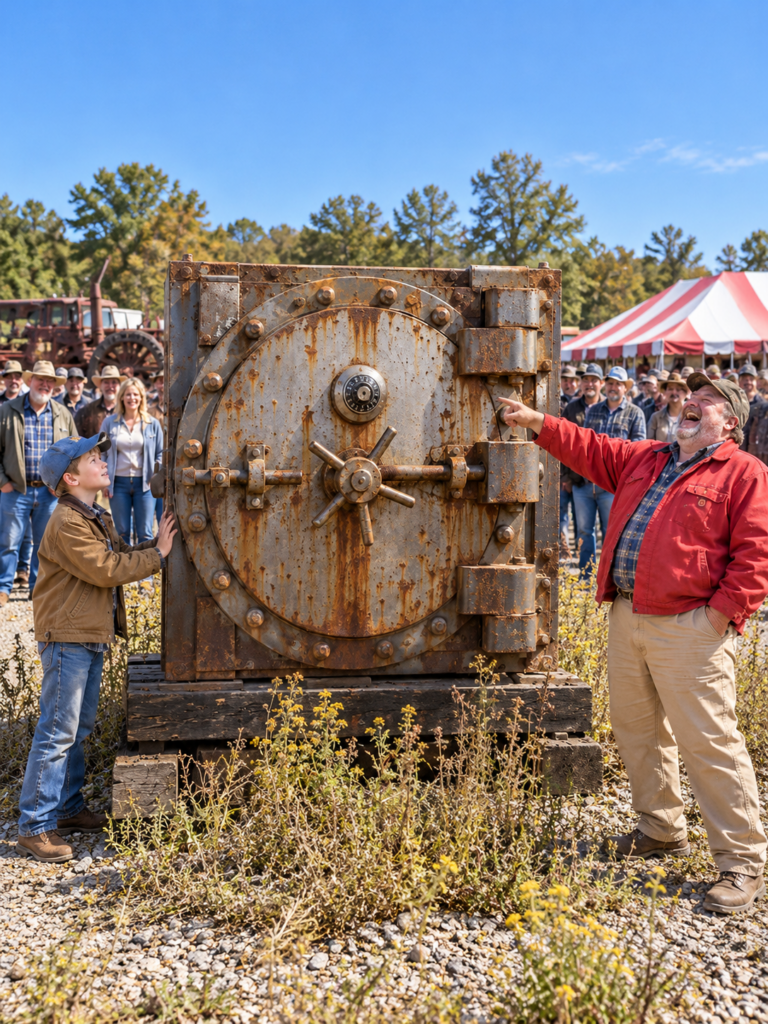
Then Royce Tolliver threw back his head and laughed so loudly that a flock of pigeons scattered from the roof of the old sale barn.
“Well, I’ll be damned,” he shouted. “That boy just bought himself six tons of worthless iron!”
Laughter rolled through the crowd.
Thirty farmers, machinery dealers, and scrap buyers stood beneath the gray Indiana sky, staring toward a rusted bank vault door half buried in weeds behind the Voorhies demolition yard.
The buyer was twelve years old.
His name was Ezra Kettleman.
He wore a faded blue baseball cap, a brown canvas jacket with fraying cuffs, and boots that had belonged to somebody else before his mother found them at a church rummage sale.
His hands were small, his shoulders narrow, and his face still had the softness of childhood.
But he wasn’t laughing.
He stood beside the enormous steel door with both palms pressed against its cold surface.
Sixty-five dollars.
Every penny he had earned mowing lawns since spring.
Gone.
And judging by the faces around him, everybody thought he had lost his mind.
“Somebody find his mama!” Royce called. “Tell her the boy bought the biggest paperweight in Indiana!”
Another round of laughter followed.
Ezra lowered his eyes, but he didn’t remove his hands from the steel.
Because he could still hear his grandfather’s voice.
If that door ever comes up for sale, son, don’t let anybody cut it.
Those had been among the last words Walter Kettleman had spoken to him.
And Ezra had made a promise.
The morning had started before sunrise.
A cold October wind swept across the cornfields outside Tullick, Indiana, rattling the loose shutters of the small white farmhouse where Ezra lived with his mother.
Lena Kettleman stood at the kitchen sink, washing two coffee mugs while a pot of oatmeal simmered on the stove.
She was thirty-eight, though the lines around her eyes sometimes made her look older.
For eleven years, she had worked in the cafeteria at Tullick Middle School, starting before most families woke and returning home smelling faintly of dish soap and baked bread.
Her husband had left when Ezra was four.
There had been no dramatic argument, no broken furniture, no final explanation worth remembering.
Just a packed suitcase, a promise to send money, and a pickup truck disappearing down the driveway.
After that, Walter Kettleman had become the closest thing Ezra had to a father.
Walter had taught him to fish in Miller’s Creek, repair a fence without wasting wire, and sharpen a pocketknife without cutting his fingers.
More importantly, he had taught the boy to understand things other people dismissed.
Old clocks.
Broken machinery.
Seized bolts.
Stubborn locks.
“Most things ain’t useless just because somebody doesn’t understand them,” Walter used to say.
He had spent fifty-one years repairing safes, bank vaults, and mechanical locks across three Indiana counties.
People called him when combinations were forgotten, when fire damaged a safe, or when somebody died leaving a locked steel box behind.
Walter rarely talked about money.
He talked about trust.
“A locksmith gets invited into other people’s secrets,” he told Ezra. “You remember that. Knowing how to open something doesn’t always mean you’ve got the right to look inside.”
Ezra listened carefully.
Every summer, he sat on a tall wooden stool in Walter’s workshop, wearing oversized safety glasses while his grandfather dismantled locks beneath a brass desk lamp.
The old workshop stood behind Walter’s house on Poplar Street.
It smelled of machine oil, tobacco, wood dust, and the strong black coffee Walter drank from a chipped green mug.
On one wall hung dozens of carefully labeled tools.
On another stood shelves of clothbound ledgers, each recording decades of work.
Ezra loved that place more than anywhere in the world.
Then February came.
And Walter died.
One Wednesday morning, Lena found him sitting in his kitchen chair, his glasses resting on his nose and a half-disassembled lock beside a cold cup of coffee.
There was no suffering, the doctor said.
His heart had simply stopped.
But to Ezra, the whole world seemed to stop with it.
For weeks, he walked past the workshop without entering.
Sometimes he stood outside its locked door, remembering the soft click of his grandfather’s tools and the low humming Walter made whenever he concentrated.
And sometimes, late at night, Ezra remembered one particular conversation.
It had happened the previous summer.
Walter had been cleaning an old brass combination dial when Ezra asked him about the enormous vault door standing in the Voorhies demolition yard.
Everybody in Tullick knew that door.
It had once belonged to the Tullick Farmers Savings Bank, a small institution that closed in 1959.
When the bank building was demolished, the vault door had been transported to Dale Voorhies’s salvage property.
There it remained for decades.
Rain washed over it.
Snow piled against its frame.
Weeds grew through the rotting wooden supports beneath it.
People tried to open it.
Nobody succeeded.
Walter had visited it several times.
Ezra remembered his grandfather running one weathered hand over its rusted surface.
“Finest door I ever worked on,” Walter said quietly.
“Why?”
“Because somebody built it to last.”
“Can you open it, Grandpa?”
Walter smiled.
“I shut it myself.”
Ezra stared.
“You did?”
“Summer of 1959.”
“Then why doesn’t anybody know the combination?”
Walter looked away toward the fields.
“Some things are worth waiting for.”
Ezra frowned.
“That doesn’t answer my question.”
“No,” Walter admitted. “I reckon it doesn’t.”
Then the old man placed a hand on his grandson’s shoulder.
“Listen carefully, Ezra. If that door ever comes up for sale, don’t let anybody put a torch to it. Promise me.”
“Why?”
“Because you don’t destroy something just because you haven’t figured out how to open it.”
Ezra promised.
Walter died seven months later.
And now the door was his.
“Ezra!”
His mother’s voice cut through the laughter.
Lena hurried across the gravel auction yard, carrying a folded receipt for the cafeteria tables she had come to purchase.
“What did you do?”
Ezra turned toward her.
“I bought it, Mom.”
She looked past him at the massive door.
Then back at her son.
“You bought that?”
“Yes, ma’am.”
“How much?”
“Sixty-five dollars.”
Lena closed her eyes.
“All your mowing money?”
He nodded.
“Every bit.”
The door towered over them, more than seven feet across, mounted within a thick steel frame.
Orange rust streaked down its circular face.
The combination dial had lost its shine.
Five heavy spokes extended from the central handle.
Lena had seen farm tractors smaller than the enormous piece of machinery.
She lowered her voice.
“Sweetheart, how are we supposed to get this home?”
Ezra swallowed.
“I don’t know.”
“Then why did you buy it?”
He looked up at her.
“Because Grandpa asked me to.”
Lena went still.
There it was.
The reason she couldn’t bring herself to scold him.
She remembered her father’s final months.
She remembered the way Walter spoke about that door.
And she remembered standing beside Ezra when the old man made him promise.
Before she could answer, Royce Tolliver approached.
Royce owned Tolliver Salvage and Iron, the largest scrap operation in the county.
He was fifty-four, broad-shouldered, and almost always dressed in a faded red work jacket.
He had spent thirty years buying machinery cheaply from people who needed money and selling it to people who needed parts.
He knew engines, steel prices, farm equipment, and the value of an abandoned property.
He also knew how to embarrass someone in public.
“Well, Lena,” he said pleasantly, “your boy’s got himself a business investment.”
The men behind him chuckled.
Lena straightened.
“Good morning, Royce.”
“Morning. Now, I don’t want to interfere with a family’s financial decisions, but I’ve got to ask.”
He pointed at the door.
“What’s he planning to do with it?”
Ezra answered before his mother could.
“Keep it.”
“Keep it?”
“Yes, sir.”
“Where? In his bedroom?”
More laughter.
Royce shook his head.
“Son, that bank closed nearly seventy years ago. Whatever money was inside got carried away a long time ago.”
Ezra remained silent.
“And even if there was something inside, nobody’s opening that thing. Dale Voorhies paid me to work on it years back. Four torches, three different crews, and not a single one got through.”
He leaned closer.
“What makes you think you can?”
Ezra looked him directly in the eye.
“My grandfather knew how.”
For the first time, Royce’s grin weakened.
“Walter Kettleman?”
Ezra nodded.
Royce glanced toward the vault.
Then he laughed again.
“Walter was a good locksmith, boy. But Walter’s gone.”
The words struck harder than the laughter.
Ezra’s jaw tightened.
Lena placed one hand on his shoulder.
Royce continued.
“Tell you what. I’ll haul this junk off for a hundred and twenty dollars. Save you the embarrassment.”
“No, thank you.”
“Boy, that’s a bargain.”
“I said no, sir.”
Royce shrugged.
“Your funeral.”
Then the auctioneer, Gus Barlow, approached holding his clipboard.
“Ezra, you understand the sale terms?”
“Yes, sir.”
“Buyer removes the property. You’ve got until next Saturday.”
The boy nodded.
Gus hesitated.
“And that door weighs close to six tons.”
“I know.”
“You got somebody with a trailer?”
Ezra said nothing.
Royce smiled.
“I’ll be buying this whole yard next week. If the door’s still here, I’ll own it whether the boy likes it or not.”
He tapped the steel with his knuckles.
“Six tons. No truck. No crane. Six days.”
Then he walked away.
The crowd followed him toward the tractors.
Soon, only Ezra and Lena remained beside the rusted door.
A wind moved through the weeds.
Somewhere beyond the fence, a crow called.
Lena looked at her son.
“We don’t have money for a crane, Ezra.”
“I know.”
“And our truck can’t haul that.”
“I know.”
She crouched beside him.
“Then tell me what you’re thinking.”
Ezra looked at the huge steel door.
For a moment, he looked much younger than twelve.
“I keep thinking about Grandpa.”
His voice trembled.
“He never asked me for much. Not after he got sick. Not ever.”
Lena felt her throat tighten.
“He asked me to save this one thing,” Ezra whispered. “And I don’t want to be the kind of person who makes a promise and forgets it when things get hard.”
Lena pulled him into her arms.
She could feel him shaking.
For a long moment, neither spoke.
Then a diesel engine rumbled across the gravel.
An old blue Ford flatbed turned through the gate, its exhaust coughing white smoke into the cold air.
A small lifting boom rested behind the cab.
A weathered winch was bolted to the bed.
The driver climbed down slowly.
He was tall, thin, and white-bearded, with green coveralls and a canvas hat darkened by years of rain.
Lena recognized him immediately.
“Amos?”
Amos Reddick took off his hat.
“Morning, Lena.”
He glanced at Ezra.
“Heard Walter’s grandson bought the Brandt door.”
Lena frowned.
“The what?”
Amos looked toward the steel.
“That there’s what your daddy always called it.”
He walked closer.
Ran one broad hand along its rusted edge.
Then he looked at Ezra.
“Your grandpa would have been mighty pleased.”
Ezra’s eyes widened.
“You knew he wanted it?”
“Son, he talked about that door for thirty years.”
Amos nodded toward his flatbed.
“Now, that little boom won’t lift six tons. But if I borrow a lowboy trailer, bring some cribbing timber, and get my nephews to help, we might just be able to move her.”
Lena stared.
“Amos, we can’t afford—”
He raised a hand.
“Didn’t ask for money.”
“It’s too much work.”
“Walter opened my grandmother’s safe in 1971. We thought her burial savings were gone forever. He worked eight hours and wouldn’t take a nickel.”
His eyes softened.
“Some debts ain’t written on paper.”
Ezra stepped forward.
“Mr. Reddick?”
“Yes, son?”
“Will you really help me?”
Amos looked at the enormous rusted door.
Then back at the boy.
“I surely will.”
And for the first time that morning, Ezra smiled.
But none of them noticed Royce Tolliver watching from the other side of the yard.
His laughter had stopped.
He was studying the old door again.
And the more he watched Amos examine it, the less certain he seemed that it was worthless.
Part 2
On Tuesday morning, frost covered the Kettleman pasture.
Amos arrived at the demolition yard shortly after seven, followed by his nephews, Daniel and Pete, in a battered pickup loaded with oak blocks, steel rollers, chains, hydraulic jacks, and thick wooden planks.
The job looked almost impossible.
The vault door stood tilted slightly forward in its rectangular frame, its bottom sunk into decades of mud and rotten timber.
Six tons of iron and steel had settled unevenly.
One careless movement could crush a hand, break a chain, or overturn the load.
Amos walked around it three times before touching anything.
He studied the ground.
Measured the slope.
Examined the frame.
Then he knelt beside Ezra.
“You ever helped move something this big?”
“No, sir.”
“Good. Then you won’t have any bad habits to unlearn.”
Ezra almost smiled.
Amos pointed toward the winch cable.
“That line can kill a man if it snaps. So you stay behind the truck with your mother while we’re pulling. Understand?”
“Yes, sir.”
“Your job is to watch the cribbing. If you see anything move that shouldn’t, you holler.”
Ezra nodded solemnly.
Amos laid a pair of old work gloves in his hands.
“That’s real work, too.”
For two hours, the men dug beneath the steel frame.
Mud coated their boots.
The smell of wet leaves and rusty iron filled the cold air.
Daniel slid a hydraulic jack beneath one corner.
Pete positioned oak cribbing under the opposite side.
Amos called instructions in a steady voice.
“Easy.”
“Hold there.”
“Another inch.”
“Stop.”
The steel groaned as it rose.
Ezra watched every movement.
By noon, vehicles lined both sides of the county road.
Word had spread through Tullick.
People came to see whether old Amos Reddick could move the monstrosity that a twelve-year-old boy had foolishly bought.
Some brought coffee.
Others brought sandwiches.
Most came for the entertainment.
Royce Tolliver arrived in his polished black pickup shortly before one.
He climbed onto the hood, opened a thermos, and began offering commentary.
“Careful, boys! If that thing falls over, the county’ll need a new map!”
Several men laughed.
Amos ignored him.
Royce pointed toward Ezra.
“Hey, safecracker! You charging admission yet?”
Ezra kept watching the timber supports.
“Maybe you ought to open a bank,” Royce called. “First National Bank of Nothing!”
More laughter.
A few people looked uncomfortable.
But nobody challenged him.
Ezra’s cheeks burned.
He wanted to say something.
He wanted to tell Royce that his grandfather had been a better man than anyone standing there.
He wanted to tell the whole crowd to go home.
Instead, he remembered Walter’s voice.
When a man wants you angry, son, the strongest thing you can do is make him wait.
So Ezra stood silently, holding his work gloves.
By late afternoon, the enormous vault door had been winched onto the lowboy trailer.
Amos and his nephews secured it with heavy chains and blocking.
The trailer groaned beneath the load.
Then Amos climbed into his truck and started the engine.
The procession moved through Tullick at walking speed.
People stepped outside the feed store.
The diner waitress came out holding a dish towel.
Two boys on bicycles followed from the gas station to the railroad crossing.
Somebody shouted, “There’s the millionaire’s bank!”
Another voice yelled, “Hey, Ezra! Got any spare change?”
Ezra sat beside his mother in their old pickup.
He stared straight ahead.
Lena reached across the seat and took his hand.
“Don’t listen to them.”
“I wasn’t.”
But she could tell he was.
By Wednesday evening, the vault door stood upright inside the Kettleman pole barn.
The building had once housed hay equipment and an old combine, but now its concrete floor held something stranger than anything the farm had ever seen.
Amos switched off his truck.
The diesel engine settled into silence.
Under the yellow barn lights, the door seemed enormous.
Orange rust covered its outer surface.
The combination dial sat above the central handle.
The hinges were thick as fence posts.
Amos wiped his forehead.
“Well, there she is.”
Ezra stood before it.
He reached out and touched the steel.
“Thank you, Mr. Reddick.”
Amos nodded.
“What now?”
“I leave it shut.”
Amos studied him.
“For how long?”
Ezra looked at the dial.
“Until I know how Grandpa wanted me to open it.”
The old man smiled faintly.
“Sounds like Walter.”
That night, after Amos left, Ezra remained in the barn.
A cold wind rattled the siding.
Beyond the open door, the cornfields lay dark and silent.
He pulled an overturned feed bucket near the vault and sat down.
For a long time, he simply looked at it.
He imagined Walter standing beside him.
The old man’s broad fingers guiding his small hands across a brass lock.
His quiet voice explaining why forcing a mechanism often destroyed the very thing a person wanted to preserve.
Ezra whispered into the empty barn.
“I got it home, Grandpa.”
There was no answer.
“Don’t know what to do next.”
The barn creaked.
Ezra lowered his head.
“I wish you were here.”
At school the next morning, someone had taped a drawing to his locker.
It showed a stick-figure boy standing beside a giant vault door, trying to open it with a spoon.
Underneath, somebody had written:
THE WORLD’S DUMBEST BANK ROBBER.
Several boys laughed when Ezra found it.
He pulled the paper down.
Folded it.
Put it in his pocket.
He didn’t cry until he reached the boys’ restroom.
Even then, he made certain nobody could hear.
During lunch, two older students sat across from him.
One spun an imaginary combination dial in the air.
The other made clicking sounds with his tongue.
“Hey, Ezra,” one said, “what’s the combination?”
Ezra kept eating.
“Zero, zero, zero?” the boy suggested.
His friend laughed.
“That’s how much money’s inside!”
Ezra stood, carried his tray to the dishwashing window, and walked away.
His mother was working behind the counter.
She saw his face.
“Ezra?”
“I’m fine.”
He wasn’t.
And that frightened Lena more than anything.
At home, the teasing continued.
A neighbor called to ask whether Ezra wanted to sell tickets for people to look at the door.
A scrap dealer from the next county offered forty dollars to cut it open.
Two men drove up the lane one evening and asked whether there were any gold bars inside.
Then Royce called.
Lena answered the telephone.
“Good evening.”
“Lena, Royce Tolliver here. Is the boy around?”
She hesitated.
“What do you need?”
“I’ve got an offer for him.”
Ezra was doing homework at the kitchen table.
He looked up.
Lena handed him the receiver.
“Hello?”
“Ezra, son. I’ve been thinking.”
“Yes, sir?”
“Everybody’s had their fun, but I’m not a cruel man. I’ll give you a hundred and fifty dollars for that door.”
Ezra held the receiver tighter.
“Why?”
Royce paused.
“Why what?”
“Why would you pay that much for junk?”
A faint chuckle came through the line.
“Because I’ve got buyers for heavy steel. And because your mama could use the money.”
Ezra glanced toward Lena.
She stood at the sink, pretending not to listen.
He knew the truth.
Their refrigerator had been making a grinding noise for months.
The furnace needed repair.
Lena sometimes skipped buying new shoes so he could have school supplies.
One hundred and fifty dollars was not nothing.
It was more than twice what he’d paid.
For a moment, temptation moved through him.
He could sell the door.
Give his mother the money.
Stop the laughing.
Stop feeling foolish every time someone said his name.
Then he remembered Walter’s hand resting over his.
Don’t let anybody cut it.
“No, thank you, Mr. Tolliver.”
Royce’s voice hardened.
“Boy, don’t let pride make you stupid.”
Ezra swallowed.
“Good night, sir.”
He hung up.
For several seconds, he stood motionless.
Then Lena quietly asked, “Was that Royce?”
Ezra nodded.
“How much?”
“One hundred and fifty.”
Lena looked toward the window.
Beyond it, the barn stood beneath the darkening sky.
She thought about the electric bill waiting on the counter.
The old tires on her truck.
The extra hours she had worked that month.
Then she looked at her son.
“Are you sure?”
Ezra’s eyes filled.
“No.”
The answer surprised her.
He sat down heavily.
“I’m not sure about anything anymore, Mom.”
Lena pulled out the chair across from him.
Ezra stared at his hands.
“Everybody thinks I’m stupid.”
“Not everybody.”
“Almost everybody.”
He wiped his face with his sleeve.
“I don’t even know if Grandpa was right.”
Lena felt something painful twist inside her chest.
Because she had begun wondering the same thing.
Walter had been brilliant with locks.
But he had also been stubborn.
Sometimes he held onto things long after others would have let them go.
Maybe the door was simply an old man’s unfinished obsession.
Maybe Ezra had mistaken a memory for a mission.
But she couldn’t say that.
Not to the child still grieving the one man who had never abandoned him.
Instead, she asked, “What do you remember your grandfather saying?”
Ezra thought.
“He said he shut it himself.”
“And?”
“He said there was an honest way to open it.”
Lena leaned back.
“Then perhaps we should look for that way.”
Ezra stared at her.
“What?”
“Your grandfather kept records of everything.”
His breathing changed.
“The ledgers?”
She nodded.
For months, Lena had avoided entering Walter’s workshop.
She couldn’t bear seeing his tools exactly where he had left them.
His coat still hanging from a peg.
His unfinished cup of coffee still sitting beside the lamp.
But now she looked toward the dark kitchen window and realized something.
Her father had left more than memories.
He had left a lifetime of knowledge.
And perhaps, somewhere in those green clothbound books, he had left something for Ezra.
“We’ll go tomorrow,” she said.
Ezra nodded slowly.
Then he asked the question that hurt her most.
“Mom?”
“Yes?”
“Do you think Grandpa knew I’d be the one who bought it?”
Lena reached for his hand.
“I don’t know, sweetheart.”
She squeezed his fingers.
“But I think he knew you’d be the one who listened.”
Outside, the wind shook the porch screen.
Inside the barn, the six-ton vault door stood silent.
And across town, Royce Tolliver sat in his salvage office staring at a photograph he’d taken of the door years earlier.
He didn’t know why Amos Reddick had been so eager to save it.
But there was something about that old steel frame.
Something about the unusual hinges and the five-spoke handle.
Something that had bothered him ever since the auction.
He leaned toward the photograph.
Then opened his desk drawer and pulled out an old machinery catalog.
For the first time, he began wondering whether the boy had bought more than scrap.
Part 3
Walter Kettleman’s workshop had been locked for eight months.
On Saturday morning, Lena stood outside its door holding the small brass key.
Autumn leaves covered the steps.
A spiderweb stretched between the porch railing and a cracked flowerpot.
Ezra waited beside her.
Neither spoke.
Lena’s hand trembled when she inserted the key.
The lock turned with a familiar little click.
And suddenly she was eleven years old again, standing beside her father while he opened a stubborn kitchen cupboard.
Every lock has a language, Lena. You’ve just got to learn how to listen.
She pushed the door inward.
The smell struck her first.
Pipe tobacco.
Machine oil.
Old wood.
Cold iron.
It smelled exactly like her father.
Lena stopped in the doorway.
Ezra glanced up.
“Mom?”
“Just give me a second.”
She pressed her lips together.
On the workbench sat Walter’s green coffee mug.
Beside it lay a disassembled lock mechanism arranged neatly on a dish towel.
A pair of safety glasses hung from a nail.
And on the shelf above the bench stood the ledgers.
Dozens of them.
Dark green cloth covers.
Worn corners.
Small white labels showing the years.
Ezra stepped inside slowly.
He touched the wooden stool where he used to sit.
“Grandpa never liked anybody moving his tools.”
Lena smiled sadly.
“No, he didn’t.”
She walked to the shelf.
“Where do we start?”
Ezra thought for a moment.
“1959.”
They pulled down the ledger covering the late 1950s.
Its pages were yellowed and smelled faintly of dust.
Walter’s handwriting filled them in small, precise lines.
June 3: Union Feed Mill, damaged combination spindle.
June 8: Marlow Drug Company, fireproof safe inspection.
June 12: Tipton Funeral Home, replacement lock mechanism.
Ezra turned the pages carefully.
His grandfather had recorded every job.
The customer’s name.
The model of the lock.
The tools used.
The work performed.
Sometimes he added notes in the margins.
Customer worried about cost. Reduced charge.
Owner recently widowed. No charge.
Old safe belonged to customer’s father. Preserve original dial.
Lena read those little comments silently.
Her father had never been rich.
But everywhere in the ledger she saw evidence of the man she remembered.
Then Ezra turned another page.
A red pencil line surrounded an entire entry.
June 27, 1959.
Tullick Farmers Savings Bank.
Lena leaned closer.
Ezra read aloud.
“Borchardt round exhibition vault door. Serial number two of three. Final service before bank closure.”
He stopped.
“Mom.”
“I see it.”
Below the heading, Walter had written several paragraphs.
The bank had closed after paying every depositor in full.
Its cashier, Elias Brandt, had personally supervised the final locking of the vault.
Walter had inspected the bolt mechanism, verified the time lock, and set a new combination.
Then came a sentence that made Ezra’s skin prickle.
By Mr. Brandt’s request, this door is not to be drilled, burned, or cut.
Underneath were four numbers.
Written out in words.
Ezra stared.
His mother covered her mouth.
“The combination.”
For several seconds, they said nothing.
Then Lena reached for the ledger.
“Ezra, we can go to the barn right now.”
He didn’t move.
“Sweetheart?”
Ezra looked at the entry again.
“There must be a reason Grandpa kept telling me not to cut it.”
“Of course.”
“And a reason he never told anybody the numbers.”
Lena hesitated.
“Maybe he forgot.”
Ezra shook his head.
“Grandpa didn’t forget things like that.”
He closed the ledger gently.
Lena frowned.
“Why are you closing it?”
“Because I’m not opening that door today.”
“Ezra—”
“I need to understand what it is first.”
She stared at him.
“Don’t you want to know what’s inside?”
“More than anything.”
“Then why wait?”
Ezra thought about the boys laughing in the school cafeteria.
Royce standing at the auction.
His grandfather’s reputation being treated like another old thing nobody valued.
Then he remembered a lesson from Walter.
Doing a thing right matters more than doing it quickly.
“I don’t want to ruin it,” he said.
His mother studied him.
And suddenly she saw something of her father in the boy’s face.
Not his gray eyes or his broad nose.
His patience.
His stubborn sense of responsibility.
The same quiet refusal to do something simply because everybody else demanded it.
“All right,” she said.
“We’ll do it right.”
They continued searching.
Near the back of the ledger, a folded envelope slipped from between two pages and fell onto the workbench.
Ezra picked it up.
The paper was soft with age.
In the upper-left corner was the name of an Ohio museum.
Lena unfolded the letter.
It was dated April 1998.
A curator at the Ohio Valley Museum of Industry had written to Walter asking about a rare exhibition vault door manufactured in Cincinnati in 1915.
According to factory records, three such doors had been produced for a major industrial exhibition.
Two were destroyed during World War II scrap drives.
The third had disappeared after being sold to a bank somewhere in Indiana.
The museum wanted to know whether Walter had encountered anything resembling it.
Lena read the letter twice.
Then Ezra noticed handwriting at the bottom.
Walter’s handwriting.
Know exactly where it is. Dale still won’t sell.
Ezra looked up.
“Mom?”
Lena sat down on the wooden stool.
Her father had known.
For nearly thirty years, he’d known that the forgotten vault door in the weeds might be important.
And he had tried to save it.
Suddenly his repeated visits to the Voorhies yard made sense.
His insistence that nobody cut the steel.
His strange promise.
His final request.
Lena pressed the letter flat against the workbench.
“We need to call this museum.”
The following Monday, she made the call during her lunch break.
The cafeteria office was small and noisy.
An old refrigerator hummed beneath the window.
Outside, children shouted on the playground.
Lena dialed the number printed on the letter.
A receptionist answered.
After several transfers, she reached Dr. Miriam Castellanos, a curator responsible for industrial machinery and historical mechanical systems.
Lena explained the auction.
The vault door.
Her father’s ledgers.
Ezra’s promise.
The curator listened without interrupting.
Then she asked a question.
“Mrs. Kettleman, has anybody opened the door?”
“No, ma’am.”
“Has anyone drilled into it?”
“Not since my son bought it.”
A pause followed.
“How about cutting or welding?”
“Some scrap workers tried years ago, but as far as I can see, they never got very far.”
Another silence.
Then Dr. Castellanos spoke more slowly.
“Would you describe the handle?”
Lena glanced at her handwritten notes.
“Five spokes.”
“And the door?”
“Round. About seven feet across.”
“Is there a rectangular steel frame surrounding it?”
“Yes.”
“Mrs. Kettleman, I need you to listen carefully.”
Lena sat straighter.
“Please don’t let anyone cut, grind, or dismantle that door.”
Her heart began beating faster.
“Why?”
“Because there is a possibility that your son has found a mechanical artifact historians have been searching for since the middle of the twentieth century.”
Lena gripped the telephone.
“Are you saying it’s valuable?”
“I haven’t examined it. I won’t speculate about its value.”
The curator paused.
“But I can tell you that if it is the door I suspect, its historical significance may be extraordinary.”
Lena stared at the cafeteria wall.
Outside, the lunch bell rang.
“Can you come look at it?”
“Yes,” Dr. Castellanos answered. “And there’s something else.”
“What?”
“Ask your son who he wants present when we inspect and open it.”
That evening, Lena told Ezra everything.
He listened without blinking.
Then he went to Walter’s workshop and found a stack of blank index cards.
He sat at the workbench beneath the brass lamp.
Carefully, in his best handwriting, he began writing invitations.
The first went to Amos Reddick.
The second went to auctioneer Gus Barlow.
The third went to Pastor Samuel Hale, who had conducted Walter’s funeral.
Two went to Ezra’s teachers.
Another went to Ruth Brandt, the eighty-three-year-old daughter of Elias Brandt, the bank cashier who had supervised the vault’s closure.
Ruth lived in a small brick house behind the public library.
Her husband had died twelve years earlier.
Her knees hurt when the weather changed.
She grew roses along her front fence and still made apple pie using a recipe written on an index card by her mother.
When Ezra arrived, she invited him inside.
He handed her the card.
She read it slowly.
You are invited to the opening of the Brandt vault door.
Her hands began to tremble.
“Where did you get this?”
“At the Voorhies auction, ma’am.”
Ruth lowered herself into a chair.
“The old bank door?”
“Yes, ma’am.”
“My daddy’s bank?”
Ezra nodded.
Ruth stared at the card.
For a long moment, she seemed very far away.
Then she looked toward a framed photograph on the mantel.
It showed a thin man in a dark suit standing beneath a bank sign.
“My father spent his whole life protecting other people’s money,” she said quietly.
Ezra sat across from her.
“Was he a good man?”
Ruth looked surprised.
Then her face softened.
“He was the most honest man I ever knew.”
She smiled sadly.
“But not everybody believed that.”
Ezra waited.
“When the bank closed, people said terrible things. They said he had lost their savings. Said he’d hidden money. Said the bank failed because he couldn’t be trusted.”
“Did it?”
“No.”
Her voice became firm.
“He paid every account. Every penny. I watched him do it.”
Ruth looked down at the invitation.
“But people remember rumors longer than they remember facts.”
Ezra thought about the laughter at the auction.
He understood that feeling.
“Will you come Saturday?” he asked.
Ruth folded the card carefully.
“Yes, young man.”
Then she smiled.
“And I’ll bring a pie.”
The last invitation was the hardest.
On Wednesday afternoon, Ezra rode his bicycle four miles to Tolliver Salvage and Iron.
The road stretched between harvested cornfields.
Cold air burned his cheeks.
Cars passed, lifting dust from the shoulder.
By the time he reached the salvage yard, his legs ached.
He parked near the office and walked past rows of crushed cars, rusted engines, and stripped farm tractors.
Royce Tolliver sat behind a desk covered with invoices.
Two workers drank coffee near the window.
Royce looked up.
“Well, if it isn’t the banker.”
Ezra took the card from his pocket.
“I came to invite you, Mr. Tolliver.”
Royce accepted it.
He read the words aloud.
“A public opening of the Brandt vault door. Saturday. Seven o’clock. Kettleman pole barn. Museum curator attending.”
He looked at the workers.
“A museum curator!”
The men laughed.
Royce leaned forward.
“Son, did you invent that part?”
“No, sir.”
“An actual museum lady is coming to see your rusty old paperweight?”
“Yes, sir.”
Royce studied his face.
Then smiled.
“Well, I wouldn’t miss it.”
Ezra nodded.
“Thank you.”
Royce held up a finger.
“One condition.”
Ezra stopped.
“What’s that?”
“If the door doesn’t open, you let me cut it up.”
The workers chuckled.
Ezra shook his head.
“No, sir.”
Royce’s smile disappeared.
“You sure are a stubborn little thing.”
Ezra met his gaze.
“My grandfather said some things are worth protecting even when nobody else understands why.”
The room grew quiet.
Then Royce waved him toward the door.
“Saturday, then.”
Ezra walked outside.
Mounted his bicycle.
And pedaled home against the cold wind.
Behind him, Royce sat staring at the invitation.
When the workers returned to their jobs, he picked up the old machinery catalog again.
This time he found the page he had been searching for.
A photograph from 1915.
A circular exhibition vault door.
Five-spoke handle.
Glass-covered internal bolt mechanism.
And beside it, a description mentioning a gold medal.
Royce leaned closer.
His mouth went dry.
For the first time in many years, he felt the uncomfortable sensation that someone else might know more than he did.
Part 4
Saturday came beneath a sky heavy with rain.
At six in the morning, Ezra was already awake.
He lay in bed listening to water strike the farmhouse roof.
His stomach hurt.
He had practiced the combination every evening on an old training lock from Walter’s workshop.
Four turns in one direction.
Three in the other.
Two back again.
Then the final number.
He knew the sequence.
He knew how to clear the dial.
He knew how to feel for the delicate resistance that sometimes marked the final movement.
But the real vault had been sitting untouched for sixty-seven years.
Its internal parts might be seized.
The combination might have changed.
His grandfather’s notes might contain an error.
Or the locking mechanism might simply be broken.
For weeks, Ezra had imagined the moment the door opened.
Now that the moment was near, he imagined something else.
The handle refusing to turn.
Royce laughing.
Everybody going home.
And his grandfather’s name becoming another joke.
He rolled onto his side and covered his face.
A light knock came at the door.
“Ezra?”
His mother stepped inside carrying a plate of toast.
“You’ve been awake awhile?”
He nodded.
She sat on the edge of the bed.
“Scared?”
“Yes, ma’am.”
“Good.”
He looked at her.
“Good?”
Lena brushed the hair from his forehead.
“Means it matters to you.”
Ezra stared at the ceiling.
“What if it doesn’t open?”
“Then it doesn’t.”
“What if everybody laughs again?”
“Then they’ll laugh.”
He turned toward her.
“How can you say that?”
“Because whether it opens or not, you kept your promise.”
Ezra’s eyes filled.
“That’s not enough.”
Lena sighed.
“Maybe it isn’t enough for them.”
She took his hand.
“But it was enough for your grandfather.”
The rain continued through the morning.
By noon, Amos and his nephews arrived to clean the barn.
They swept the floor.
Checked the supporting timbers beneath the vault.
Hung additional work lights from the rafters.
Then they arranged three rows of folding chairs borrowed from Pastor Hale’s church.
Ruth Brandt arrived early with two apple pies.
She wore a navy-blue coat, white gloves, and a small silver brooch shaped like a flower.
Amos helped her from her grandson’s car.
“Well, Ruth,” he said, “you look like you’re going to Sunday service.”
She smiled.
“Feels like something important.”
Her grandson carried the pies inside.
Ruth stopped before the great steel door.
For several seconds, she didn’t speak.
Then she reached out and touched the rust.
“My daddy used to stand beside this,” she whispered.
Amos removed his hat.
Ruth looked up at the dial.
“I was sixteen when the bank closed. Daddy came home that night so tired he could barely climb the porch steps.”
Her eyes glistened.
“He said, ‘Ruthie, we did it right. That’s all that matters.’”
She pressed her palm more firmly against the steel.
“People never understood what he meant.”
By six-thirty, cars began arriving.
Farmers.
Teachers.
Neighbors.
Former bank customers’ children and grandchildren.
People who remembered Walter Kettleman.
People who had mocked Ezra.
People who simply wanted to see whether something extraordinary might happen.
The barn filled with the smell of coffee, damp jackets, and warm apple pie.
Rain tapped against the metal roof.
Ezra stood beside the door wearing his cleanest flannel shirt.
He kept rubbing his hands against his jeans.
Gus Barlow approached.
The auctioneer wore a fresh white shirt and the same straw hat he’d worn at the sale.
“Evening, Ezra.”
“Evening, Mr. Barlow.”
Gus looked at the vault.
“Never thought I’d see this thing standing in a barn.”
“Neither did I.”
Gus chuckled.
Then his expression grew serious.
“Listen, son. I want you to know something.”
Ezra waited.
“I’ve sold machinery for forty years. Sometimes I get things wrong.”
Ezra glanced up.
Gus nodded toward the door.
“Maybe I got this one wrong.”
Before Ezra could answer, another vehicle pulled into the yard.
A black pickup.
Royce Tolliver climbed out wearing his red canvas jacket.
Two employees followed him.
He entered the barn with his usual confident stride.
“Well, good evening, folks!”
A few people nodded.
Royce looked toward Ezra.
“Evening, safecracker.”
Ezra said nothing.
Royce scanned the chairs.
“Where’s the museum lady? Get lost on the way from the nineteenth century?”
One of his workers laughed.
Most people remained silent.
Royce noticed.
He frowned slightly, then folded his arms and leaned against the back wall.
At six forty-five, headlights swept across the barn entrance.
A white van turned into the driveway.
Its doors carried the emblem of the Ohio Valley Museum of Industry.
A woman in a charcoal wool blazer stepped out holding a leather document case.
Her short gray hair moved in the wind.
Reading glasses hung from a thin cord around her neck.
Dr. Miriam Castellanos had arrived.
Lena hurried outside to greet her.
Ezra followed.
The curator shook his hand firmly.
“You must be Ezra.”
“Yes, ma’am.”
“I hear you’ve been taking good care of something very old.”
“I tried.”
She smiled.
“That’s an excellent start.”
Inside the barn, people stepped aside as she approached the vault.
Dr. Castellanos stopped several feet away.
Her expression changed.
For a moment, she seemed to forget everyone watching.
She slowly walked around the steel frame.
Examined the hinges.
Studied the unusual handle.
Then put on her glasses and leaned toward the dial.
She inspected the surface with a small flashlight.
Ran one finger along the seam.
Looked closely at the maker’s markings.
Then she stepped backward.
“Extraordinary,” she whispered.
The barn fell quiet.
Royce pushed away from the wall.
“Well?” he called. “Is it worth something?”
Dr. Castellanos ignored the question.
She turned toward Ezra.
“Your grandfather closed this in 1959?”
“Yes, ma’am.”
“And you have his original service records?”
Ezra handed her a carefully protected copy of the ledger entry.
She read it.
Then looked at the door again.
“My goodness.”
Gus Barlow shifted in his chair.
“What is it, Doctor?”
The curator took a slow breath.
“I believe we are looking at one of the rarest surviving examples of American mechanical vault engineering.”
A murmur spread through the barn.
Royce stepped forward.
“Believe?”
Dr. Castellanos faced him.
“Proper identification requires examining the complete mechanism.”
Royce smiled.
“So it could still be nothing.”
“It could,” she answered evenly.
Then she turned back to Ezra.
“But I don’t think it is.”
Ezra’s pulse hammered.
Dr. Castellanos removed her glasses.
“Would you like to open it?”
Ezra looked at his mother.
Lena nodded.
He looked at Amos.
The old mover gave him an encouraging smile.
Then Ezra stepped toward the steel door.
He climbed onto a low wooden platform Amos had built so he could comfortably reach the dial.
His hands trembled.
He remembered Walter standing behind him at the workshop bench.
Never fight the dial. Listen to it.
Ezra cleared the mechanism.
Then began turning.
Slowly.
Carefully.
Four rotations left.
Three right.
Two left.
The final movement.
He stopped.
Reached down.
Gripped the five-spoke handle.
And pulled.
Nothing.
He tried again.
The handle refused to move.
Silence filled the barn.
Then came a quiet chuckle.
Royce Tolliver.
“Well,” he said brightly, “who wants pie?”
A few nervous laughs followed.
Ezra’s face burned.
He looked down at his hands.
The room seemed to tilt.
All the embarrassment of the past weeks came rushing back.
The auction.
The school cafeteria.
The drawing on his locker.
The telephone offer.
The laughter.
He had brought everyone together.
And now he couldn’t open the door.
His eyes filled.
“I did it right,” he whispered.
Dr. Castellanos stepped beside him.
“Ezra.”
He shook his head.
“I did everything Grandpa taught me.”
“I believe you.”
“Then why won’t it open?”
She looked at the dial.
“Because it’s old. And because sometimes an old mechanism needs patience.”
She leaned closer.
“Clear the lock completely. Try again.”
Ezra wiped his palms on his jeans.
Royce sighed loudly.
“Here we go.”
Amos turned toward him.
“Royce.”
Something in the old man’s voice stopped him.
Amos stood perfectly still.
“Let the boy work.”
Royce opened his mouth.
Then closed it.
Ezra drew a deep breath.
He closed his eyes.
And suddenly he was eight years old again, standing beside his grandfather’s workbench.
Walter had placed a small brass practice lock in front of him.
Ezra had rushed through the combination.
The mechanism jammed.
He had grown frustrated.
“It’s broken, Grandpa!”
Walter laughed softly.
“No, son. You’re rushing.”
“But I know the numbers.”
“Knowing the numbers ain’t the same as understanding the lock.”
Walter placed his hand over Ezra’s.
“Slow on the last one. Feel that little give?”
Ezra remembered.
The faintest movement beneath his fingertip.
The lock tells you when.
He opened his eyes.
Then cleared the dial again.
Four turns.
Three.
Two.
And finally, the last number.
Slower.
Even slower.
The barn seemed to hold its breath.
Then Ezra felt it.
A tiny movement.
Barely more than a vibration beneath his fingertips.
His eyes widened.
He reached for the handle.
Gripped it with both hands.
Turned.
Something moved.
Deep inside the steel came a heavy metallic click.
Then another.
And another.
A series of enormous bolts began retracting around the circumference of the door.
The sound echoed through the barn like distant machinery waking after a lifetime of sleep.
Ruth Brandt gasped.
Amos stood up.
Dr. Castellanos leaned forward.
Ezra stared at the handle.
It was turning.
The vault was unlocked.
But the door itself remained closed.
Ezra looked toward Amos.
“Mr. Reddick?”
The old man stepped forward.
“I’m right here, son.”
“Will you help me?”
Amos placed one broad hand against the steel.
“Your grandpa would have wanted that.”
Together, the old man and the boy pulled.
At first, the door resisted.
Then the enormous hinges shifted.
Slowly.
Smoothly.
The massive circular steel door began swinging outward.
For sixty-seven years, nobody had seen what lay behind it.
Now, inch by inch, the darkness beyond the steel gave way to light.
The first thing Ezra saw was a flash of gold.
Then polished silver.
Then something so beautiful that even Dr. Castellanos raised one hand to her mouth.
Royce Tolliver stepped away from the wall.
And the entire barn fell silent.
Part 5
The inside of the vault door shone like a machine that had been built yesterday.
The outside was covered in rust, but the inward-facing mechanism had been sealed away from rain, dust, and weather for sixty-seven years.
Behind thick beveled glass lay an intricate network of nickel-plated bolts, polished steel bars, brass gears, and carefully machined linkages.
Twenty-four enormous locking bolts surrounded the circular door.
Each connected to a central mechanism designed with extraordinary precision.
At the center sat a four-movement time lock inside an engraved brass housing.
And above it was a gold medal nearly the size of a dinner plate.
No one laughed.
Nobody even whispered.
Work lights reflected off the polished metal, scattering bright streaks across the concrete floor.
Ezra stood motionless.
He had imagined many things behind the steel.
Old money.
Forgotten documents.
Perhaps a hidden compartment.
But he had never imagined this.
Dr. Castellanos stepped forward.
Her eyes glistened.
“Ladies and gentlemen,” she began, then paused to steady her voice.
“This is the Borchardt exhibition vault door, number two.”
She turned toward the crowd.
“It was manufactured in Cincinnati in 1915 for the Panama-Pacific International Exposition in San Francisco.”
People leaned forward.
“The company produced only three examples of this design. Two were later destroyed for scrap during the Second World War.”
She gestured toward the brilliant mechanism.
“This is the last known surviving example.”
Ezra looked up at her.
“You mean Grandpa saved it?”
Dr. Castellanos smiled.
“Yes, Ezra.”
She examined the glass-covered boltwork.
“And because your grandfather closed it properly, and because you refused to let anyone cut into it, the original mechanism appears to have survived in remarkable condition.”
She pointed toward the time lock.
“This configuration is exceptionally rare.”
Then she gestured toward the medal.
“And that is the original exhibition medal for mechanical achievement.”
Gus Barlow slowly removed his straw hat.
Amos let out a long breath.
Lena stood beside her son, unable to speak.
At the back of the barn, Royce Tolliver stared at the shining steel.
He remembered four separate attempts to cut it open.
The wasted cutting torches.
The men who had called it impossible.
The scrap bids.
The mocking jokes.
And the twelve-year-old boy who had refused to sell.
For once, Royce had nothing to say.
But Ezra barely noticed him.
Because something else had caught his attention.
Behind the glass, near the edge of the mechanism, was a yellowed envelope.
A single name had been written across the front.
Ruth.
Ezra pointed.
“Doctor?”
Dr. Castellanos followed his gaze.
She studied the envelope.
Then looked toward Ruth Brandt.
“I believe this may belong to you.”
Ruth rose unsteadily from her chair.
Her grandson helped her forward.
Ezra carefully removed the envelope from its holder.
The paper was brittle.
The ink had faded slightly.
He placed it in Ruth’s hands.
She stared at the handwriting.
Then made a small, broken sound.
“That’s my daddy’s writing.”
The barn grew quiet again.
Ruth opened the envelope.
Inside was a single sheet of bank stationery.
Her hands trembled so badly that she had to hold the paper with both hands.
She began reading silently.
Then she stopped.
Pressed the page against her chest.
And closed her eyes.
Ezra waited beside her.
“Mrs. Brandt?”
She looked at him.
Tears ran down her cheeks.
“My father,” she whispered. “He left this for me.”
Her grandson placed a comforting hand on her shoulder.
“Do you want to sit down, Grandma?”
Ruth shook her head.
“No.”
She looked toward the people gathered in the barn.
“I want them to hear it.”
Her voice trembled as she began.
“My dearest Ruthie,
“When this bank first opened, the farmers of this county trusted us with the money they earned through droughts, hard winters, failed crops, and years of labor.
“When the time came to close, I made certain every depositor received what belonged to them.
“Not one account was left unpaid.
“Not one family’s savings were taken.
“We closed honestly, and I want you to remember that, even if others forget.
“Your loving father,
“Elias Brandt.”
Ruth lowered the letter.
For a moment, she could not speak.
Then she turned toward the crowd.
“People said my father was a thief.”
Her voice was soft, but everyone heard.
“They said the bank closed because he had stolen from his customers.”
She wiped her eyes.
“He never defended himself. He said the records would speak for him someday.”
She looked at the open vault.
“But the records disappeared. And the people who knew the truth grew old and passed away.”
A tear slid down her cheek.
“For almost seventy years, that lie followed our family.”
She looked at Ezra.
“And this boy brought my daddy’s words home.”
Ezra swallowed hard.
He wasn’t sure what to say.
So he did what his grandfather would have done.
He took Ruth’s hand.
She squeezed it.
Dr. Castellanos opened her document case.
“There is one more matter we should discuss.”
Every face turned toward her.
She looked at Lena.
“Mrs. Kettleman, before coming here, our museum reviewed the historical production records, comparable industrial artifacts, surviving exhibition equipment, and the known significance of this particular design.”
She paused.
“Now that I’ve seen the original mechanism, I can confirm its identity.”
Royce stepped forward slightly.
“What are you saying?”
The curator looked directly at him.
“I’m saying this is not scrap metal.”
A murmur passed through the room.
Dr. Castellanos continued.
“For insurance purposes, my preliminary appraisal of the complete surviving assembly, including the door, locking mechanism, time lock, accompanying gate, and documented provenance, is two hundred seventy-two thousand dollars.”
Silence.
Then Gus Barlow whispered, “Lord have mercy.”
Lena stared at the curator.
“Two hundred and seventy-two thousand?”
“Yes.”
Amos began laughing.
Not the sharp, humiliating laughter Ezra had heard at the auction.
This was different.
Deep.
Joyful.
Almost disbelieving.
He slapped one hand against his knee.
“Well, Walter,” he whispered, “you old rascal.”
Ezra stood frozen.
He looked from the curator to his mother.
Then back at the steel.
“Does that mean it’s worth more than sixty-five dollars?”
The whole barn laughed.
But this time, everyone laughed with him.
Lena sank into a folding chair and covered her face.
Her shoulders shook.
Ezra hurried to her.
“Mom?”
She pulled him into her arms.
And then he realized she was crying.
Not because something had gone wrong.
Because for the first time in years, she could imagine a future without constant worry.
The furnace could be repaired.
The truck could get new tires.
The electric bills could be paid without counting grocery money first.
Ezra could go to college.
He would have choices Lena had never been able to give him.
And all of it had begun with sixty-five dollars and a promise to a dead grandfather.
Dr. Castellanos approached them.
“The museum would be interested in acquiring the door,” she said.
Lena looked up.
“But we would need to discuss the terms carefully. There are legal and conservation matters to consider, and I would encourage you to obtain independent advice.”
Ezra nodded.
He had learned enough from Walter to know that valuable things deserved careful handling.
Then he looked across the barn.
Royce Tolliver stood near the back wall.
His face had lost its color.
The men who had come with him were staring at the open door.
One slowly turned toward Royce.
“Didn’t you say you tried cutting that thing four times?”
Royce didn’t answer.
The man continued.
“You almost destroyed it.”
Royce looked down.
For the first time since Ezra had known him, he appeared smaller than the people around him.
Not because he had lost money.
Because everyone had seen how easily he had mistaken ignorance for expertise.
Gus Barlow approached.
“Royce.”
Royce looked up.
Gus pointed toward Ezra.
“You owe that boy something.”
Royce’s jaw tightened.
A younger man might have argued.
Royce might have argued on any other day.
But he had spent weeks making jokes about the Kettleman family.
He had insulted Walter’s memory.
He had offered money to get the door back.
And now the whole town understood why Ezra had refused.
Royce took a slow breath.
He walked toward the boy.
Ezra watched him approach.
His stomach tightened instinctively.
Royce stopped a few feet away.
“Well,” the salvage dealer said, “looks like I got this one wrong.”
Ezra said nothing.
Royce glanced at the beautiful mechanism.
Then down at his boots.
“I shouldn’t have laughed at you.”
The words sounded uncomfortable in his mouth.
But they were sincere enough.
Ezra looked toward his mother.
Then back at Royce.
“My grandpa used to say everybody gets something wrong sometimes.”
Royce nodded.
“Sounds like Walter.”
“But he said the important part was what you did after.”
Royce stared at him.
Then extended his hand.
Ezra shook it.
No applause followed.
No dramatic speech.
Just an older man admitting he’d been wrong to a child who had given him every reason to feel ashamed.
For Ezra, that was enough.
Over the next week, life in Tullick changed in small, unexpected ways.
People who had laughed at the auction stopped by the farmhouse with congratulations.
Ezra’s science teacher asked whether he would speak to the class about old mechanical locks.
The school principal removed the mocking cartoon from the hallway bulletin board after discovering another copy had been posted.
At the diner, people talked about Walter Kettleman’s skill with a new kind of respect.
And Ruth Brandt began receiving visitors.
Older residents remembered their parents discussing the bank closure.
A retired county clerk helped locate surviving financial records.
Several documents supported the account that the bank’s remaining depositors had been paid when it closed.
For Ruth, the discovery meant more than money ever could.
At eighty-three, she finally heard her father spoken of without suspicion.
One afternoon, Ezra visited her.
She was sitting on the porch beneath a wool blanket.
The October sunlight warmed the red bricks.
He handed her a small wooden frame.
Inside was a photograph of her father’s letter.
Ruth held it carefully.
“Oh, Ezra.”
He smiled.
“Mom helped me make it.”
She looked at the picture.
Then at the boy.
“You know what your grandfather gave you?”
Ezra thought.
“The combination?”
Ruth shook her head.
“No, sweetheart.”
She took his hand.
“He gave you the courage to trust what you knew, even when everyone else thought you were wrong.”
Ezra stared toward the street.
“Sometimes I almost gave up.”
“Of course you did.”
She smiled.
“Being brave doesn’t mean you never want to quit.”
She squeezed his hand.
“It means you remember why you started.”
A week later, after independent advice and discussions with the museum, Lena and Ezra agreed to sell the historic vault door to the Ohio Valley Museum of Industry.
But Ezra insisted on three conditions.
First, Amos Reddick would be paid the full commercial rate for transporting the door, despite his refusal to accept money.
Second, the museum exhibit would prominently name Elias Brandt, the banker who closed the institution honestly, and Walter Kettleman, the locksmith who preserved the door.
Third, Ruth would keep her father’s original letter.
The museum agreed.
When Amos learned about the transportation payment, he protested.
“Boy, I told you I wasn’t charging.”
Ezra smiled.
“I know.”
“Then why’d you do it?”
“Because Grandpa said a man should always pay an honest debt.”
Amos stared at him.
Then laughed.
“Walter taught you too well.”
After the sale, Lena placed most of Ezra’s proceeds into protected savings for his future, including college.
They repaired the furnace.
Bought new tires.
Paid the bills that had worried her for years.
But Ezra asked for one thing before any of it.
Sixty-five dollars in cash.
He took the money to Walter’s workshop.
Placed it in an old coffee can.
And set it beside the green ledgers on the shelf.
Lena watched from the doorway.
“Why there?”
Ezra smiled.
“Because that’s where it started.”
She walked over and stood beside him.
For a moment, both looked at Walter’s unfinished lock lying on the workbench.
Then Lena picked up her father’s old green mug.
She ran her thumb along the chipped handle.
“You know,” she said softly, “he would have been proud of you.”
Ezra shook his head.
“He’d probably say I turned the dial too fast the first time.”
Lena laughed through her tears.
“Yes,” she whispered. “He probably would.”
Two weeks later, another auction took place outside Marlow.
An elderly widow bid twenty dollars on a damaged church organ that nobody believed could be repaired.
Royce Tolliver stood near the back of the crowd.
He opened his mouth to make a joke.
But before he could speak, Gus Barlow looked directly at him.
“Careful, Royce.”
A ripple of laughter moved across the crowd.
Royce looked toward the widow.
Then at the organ.
And closed his mouth.
For once, he chose silence.
The museum’s transport crew arrived at the Kettleman farm on the first cold morning of November.
The sky was pale.
Frost coated the pasture.
Half of Tullick seemed to have gathered along the road.
The same people who had watched the rusted door arrive behind Amos’s old truck now watched it being prepared for its final journey.
Only this time, nobody called it junk.
Nobody mocked the boy.
Nobody laughed at the old machine.
Amos supervised the loading.
Dr. Castellanos checked the protective supports.
Ruth Brandt sat in her grandson’s car, wrapped in a blanket, watching through the open window.
And Ezra stood before the vault door one last time.
He approached slowly.
Placed both palms against the cold steel.
Exactly as he had done on the morning of the auction.
For a moment, the world around him disappeared.
He remembered the weeds.
The laughter.
Royce’s voice.
His mother’s frightened expression.
The six-ton burden nobody believed he could carry home.
Then he remembered Walter.
His grandfather’s rough hands.
The smell of the workshop.
The green ledgers.
The lessons about patience.
About honesty.
About refusing to destroy something simply because other people couldn’t see its worth.
Ezra closed his eyes.
“Did it, Grandpa,” he whispered.
The wind moved softly through the pasture grass.
He opened his eyes.
Stepped backward.
And nodded to Amos.
The crew carefully lifted the enormous steel door onto the museum transporter.
The chains tightened.
The machinery groaned.
Then the door settled gently into its supports.
As the truck pulled away, Ezra stood beside Lena and watched it disappear down the county road.
His mother wrapped an arm around his shoulders.
“Going to miss it?”
“A little.”
She smiled.
“Me too.”
They remained there until the truck was gone.
Then Ezra looked up at her.
“Mom?”
“Yes, sweetheart?”
“Can we go to Grandpa’s workshop?”
“Of course.”
He smiled.
“I think I’m ready to finish that lock he was working on.”
Lena bent down and kissed his forehead.
“I think he’d like that.”
Months later, the Borchardt vault door stood inside a specially designed museum gallery in Cincinnati.
Its polished mechanism was displayed openly, allowing visitors to see the extraordinary system of bolts, gears, and time-lock movements.
Beside it stood a plaque.
It told the story of Elias Brandt, whose reputation had been restored.
Of Walter Kettleman, who had protected the door when others wanted to destroy it.
And of Ezra Kettleman, the twelve-year-old boy who spent his entire savings on something the world had already thrown away.
Thousands of visitors would eventually stand before that remarkable machine.
They would admire the craftsmanship.
The polished metal.
The intricate engineering.
The gold medal.
Some would marvel at its monetary value.
Others would shake their heads at the thought of such an artifact sitting forgotten in a field for decades.
But the people of Tullick remembered something different.
They remembered a skinny boy in a worn canvas jacket.
They remembered how loudly they’d laughed.
And they remembered the moment the impossible door finally opened.
Because the greatest thing Ezra found wasn’t hidden behind six tons of steel.
It wasn’t gold.
It wasn’t money.
It wasn’t even the extraordinary machine.
It was the truth his grandfather had spent a lifetime teaching him.
That being forgotten does not make something worthless.
That being laughed at does not make someone foolish.
And that sometimes the things most deserving of protection are the very things everybody else has stopped believing in.
All it took was sixty-five dollars.
A promise kept.
And a little boy who refused to let the world cut apart what his grandfather knew was worth saving.