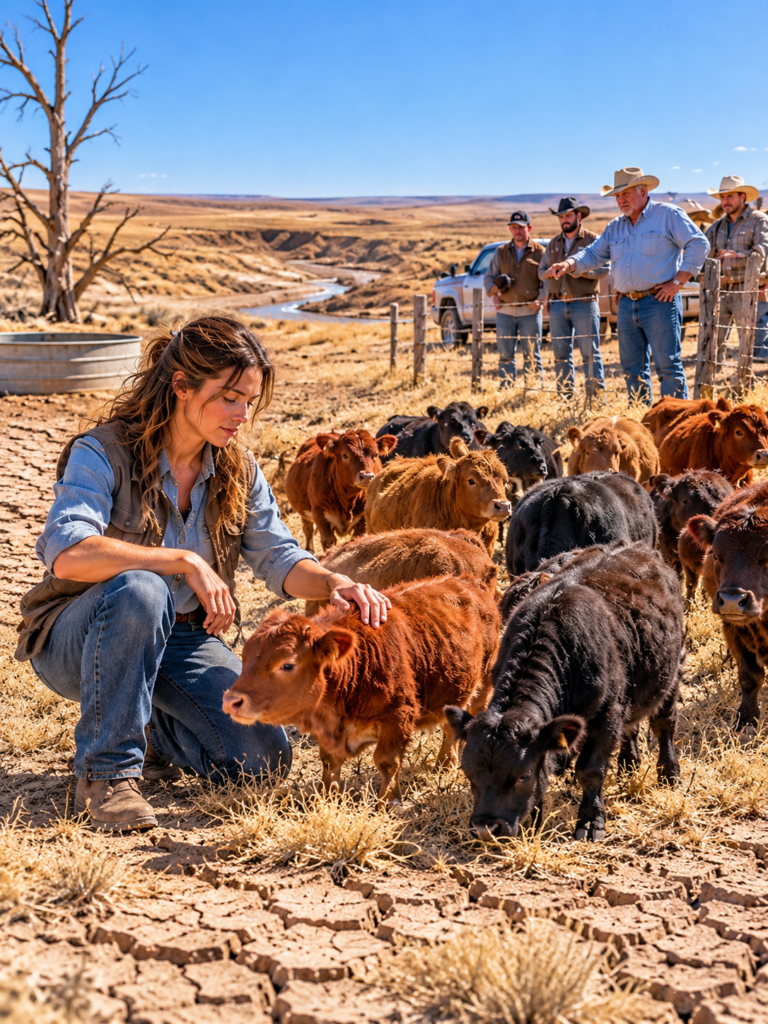
Part 1
The first laugh came from a boy standing beside the cattle pen.
The second came from his father.
By the time Willa Hensley led her little red cow into the show ring at the Rollins County Fair, half the men gathered along the wooden rail were smiling as though somebody had arranged a comedy show just for them.
Willa kept her eyes on the animal.
“Easy, Rosie,” she whispered, tightening her grip on the lead rope. “Just keep walking.”
The little Dexter cow stood barely higher than a grown man’s waist. Her coat was brushed until it shone, her hooves were clean, and a narrow white marking ran down the center of her forehead.
Beside the massive Angus cattle waiting in the adjoining pens, Rosie looked almost ridiculous.
Willa knew that.
She had known it when she loaded the trailer before sunrise, when she drove the forty-seven miles into town, and when she backed her father’s rusted livestock trailer into the least desirable parking space at the fairgrounds.
But knowing people might laugh and hearing them laugh were two different things.
“Well, I’ll be damned.”
The voice came from behind her.
Willa didn’t have to turn around.
Everybody in three counties knew Preston Whitmore’s voice.
He owned six thousand acres of grazing land, hundreds of commercial cattle, and enough influence that men who disliked him still took off their hats when he entered a room.
Preston stopped beside the ring, folded his arms across his expensive western shirt, and examined Rosie with exaggerated seriousness.
“Willa Hensley,” he announced. “I heard Earl’s daughter was bringing cattle today. Nobody told me you were opening a petting zoo.”
The laughter spread.
Willa felt her face grow warm.
“They’re Dexter cattle, Mr. Whitmore.”
“Dexter?”
“Irish breed. Registered. Dual-purpose.”
Preston leaned closer.
“Well, I suppose they’re mighty useful if you’re short on pasture and long on grandchildren.”
Another laugh.
A man behind him called, “You reckon twelve of those would make one decent steak?”
Willa said nothing.
Preston looked along the row of eleven other small cattle standing quietly in her pen.
“How much you hoping to get for these little things?”
“Depends on the animal.”
“That’s the trouble with little cattle, sweetheart. Buyers don’t pay for depends. They pay for pounds.”
He glanced toward the enormous black Angus steers behind him.
“One of my yearlings weighs more than two of yours put together.”
“Probably does.”
“And that’s all you’ve got? Twelve?”
“Twelve.”
Preston shook his head.
“Your father was a good man, Willa. But he never understood that farming’s supposed to make money.”
He smiled as though he’d just offered fatherly advice.
Then he turned away.
The crowd followed him.
Willa stood holding the rope, listening to their boots scrape across the packed dirt.
For a moment she wanted to call after them.
She wanted to explain that Dexters weren’t simply smaller versions of commercial cattle. They needed less feed, placed a lighter burden on fragile pasture, and could be useful on land that couldn’t support large herds.
She wanted to tell them her father had spent decades learning how to manage that exact kind of land.
But the explanations stayed behind her teeth.
Because the truth was that she hadn’t sold a single cow.
And she desperately needed to sell one.
The pump that supplied water to her father’s ranch had been failing since February. A repairman had written an estimate for eighteen hundred dollars, circled the total, and told her she was fortunate the motor was still running.
That estimate had been sitting beneath the sugar bowl on her kitchen table for three weeks.
Her county taxes were overdue.
Her pickup needed transmission work.
Her daughter would be leaving for college in August.
And Earl Hensley, the man who had taught her everything she knew about those little cattle, had been dead for less than two months.
Willa swallowed hard.
“Come on, Rosie.”
She led the cow back into her pen.
By afternoon, somebody had taken a black marker and written two words across her display card.
MINIATURE PETS.
Willa stared at the words.
Then she walked to the wash station, soaked a rag, and scrubbed until the ink faded.
She didn’t cry.
Not there.
Not where anybody could see.
She waited until the cattle were loaded, the trailer door was latched, and she was sitting alone behind the steering wheel.
Then she rested her forehead against the worn leather and closed her eyes.
“Dad,” she whispered, “I don’t know how much longer I can do this.”
Nobody answered.
Outside, the fair continued.
Music floated across the parking lot. Children shouted. A tractor engine started somewhere near the equipment displays.
Life moved on without noticing the woman crying in an old truck.
At sixty-one, Willa had imagined she’d finally be enjoying something resembling peace.
Instead, she had inherited seventy-four acres of struggling Wyoming pasture, twelve small cows nobody wanted, and debts that seemed to multiply every time she opened the mailbox.
Her husband, Daniel, had died seven years earlier after a heart attack while repairing a combine for a neighboring farmer.
Her mother had been gone almost twenty years.
And now her father was gone too.
The ranch was the last place where all three of them still seemed close enough to touch.
She couldn’t imagine selling it.
But increasingly, she couldn’t imagine keeping it either.
When Willa reached home that evening, her seventeen-year-old daughter was waiting on the porch.
June wore basketball shorts, an oversized sweatshirt, and the serious expression she’d inherited from her grandfather.
“How many did you sell?”
Willa climbed out of the truck.
“None.”
June looked toward the trailer.
“Not even one?”
“No.”
“Mom.”
“Don’t start.”
“I’m not starting anything. I’m asking.”
Willa walked past her toward the house.
June followed.
“The pump’s still broken. The electric bill came. And somebody from the county called about the taxes.”
“I know.”
“Then why won’t you sell four of them?”
Willa stopped in the doorway.
“Because those aren’t just four cows.”
June folded her arms.
“Grandpa’s dead, Mom.”
The words landed like a slap.
June saw it immediately.
“I didn’t mean—”
“I know what you meant.”
“No, you don’t. I’m saying you don’t have to keep everything exactly the way he left it.”
Willa turned toward the kitchen.
On the wall beside the pantry hung a photograph of Earl Hensley standing in front of his first three Dexter cattle in 1984.
He had been a thin man with big hands, a stubborn jaw, and an old straw hat that never seemed to fit properly.
He was smiling in the picture.
Earl rarely smiled for photographs.
But he had smiled that day.
Because those three cows represented something he had believed in when almost nobody else did.
“Grandpa worked his whole life for this place,” Willa said quietly.
June softened.
“I know.”
“He used to tell me a man ought to count his grass before he counted his cattle.”
“I know that too.”
“Then maybe we should listen.”
June looked through the kitchen window at the dry pasture.
“Maybe he didn’t know we’d end up like this.”
Willa had no answer.
After dinner, June went upstairs.
Willa remained at the kitchen table, surrounded by bills and bank statements.
The house was quiet except for the humming refrigerator and an occasional creak from the old floorboards.
She opened the drawer where her father kept warranty papers, searching again for the well pump documents.
Behind a stack of receipts, she found a thick, clothbound ledger.
It was faded green, with corners worn almost white.
Inside, every page was covered in Earl’s cramped handwriting.
Rainfall.
Grass production.
Hay purchases.
Livestock weights.
Breeding records.
Water consumption.
Year after year of numbers.
The first entry was dated 1984.
Willa turned pages slowly.
Her father had recorded everything, even the years when the ranch lost money.
Especially those years.
On one page from 2012, he’d listed four cattle that had died during a particularly brutal dry spell.
Beside the final animal, he’d written one word.
Wrong.
Willa traced the word with her finger.
She remembered that summer.
She remembered her father sitting on the back steps with his hat in his lap, staring at pasture that had turned brown weeks too early.
She’d thought he was grieving the cattle.
Now she wondered whether he’d been blaming himself.
Near the back of the ledger, a note caught her attention.
It had been written in blue ink, unlike the black used for most of the records.
Whitmore. 1998. Trial refused.
Willa frowned.
Whitmore?
She read it again.
Her father had never told her about any business dealings with Preston Whitmore’s family.
She turned the page.
Nothing.
No explanation.
Only thirty years of painstaking figures and six mysterious words.
Willa closed the ledger.
Outside, the wind scraped dry grass against the porch steps.
She glanced at her father’s photograph.
“What were you trying to prove, Dad?”
The old man smiled silently from the wall.
And somewhere beyond the dark window, twelve small cows grazed the thin pasture that everyone else considered worthless.
Nine days later, Preston Whitmore drove up her gravel road.
He didn’t come to apologize.
He came to buy the ranch.
And the offer he placed on Willa’s kitchen table was large enough to change her daughter’s future.
Part 2
Preston Whitmore didn’t bother removing his expensive sunglasses when Willa met him at the gate.
His new pickup idled behind him, throwing a haze of diesel exhaust into the already hot morning air.
“Beautiful day,” he said.
Willa looked toward the pale sky.
“Depends on whether you’re waiting for rain.”
Preston chuckled.
“You always did have Earl’s disposition.”
“What can I do for you?”
He glanced past her toward the house.
The white paint was peeling along the porch rail. One shutter hung crooked. The equipment shed had needed a new roof for at least five years.
Beyond it stretched seventy-four acres of uneven pasture, a narrow creek bed, and a low ridge covered with struggling sagebrush.
To Preston, the land looked unimpressive.
To Willa, every acre held a memory.
He took a folded document from his shirt pocket.
“I’ll get straight to it. My operation’s expanding. We’ve leased new ground east of here, and your property sits right between two transportation routes.”
Willa said nothing.
“If we owned this section, we’d save considerable time moving equipment and livestock.”
“Good for you.”
Preston smiled.
“I’m prepared to make you a generous offer.”
He handed her the paper.
Willa opened it.
For several seconds, she couldn’t breathe.
The figure was more than she had expected.
Enough to eliminate the ranch debts.
Enough to repair the truck.
Enough to send June to college without worrying about tuition or living expenses.
Enough to buy a small house in town.
Perhaps even enough to live without lying awake every night calculating what she could afford to lose.
“That’s a fair price,” Preston said.
“It is.”
“Then we have something to discuss.”
Willa looked toward the old cottonwood tree beside the house.
Her father had planted it in 1981.
She remembered watching him dig the hole while her mother held a bucket of water.
Daniel had proposed to her beneath that tree.
June had learned to ride a bicycle on the packed dirt beside it.
“No,” Willa said.
Preston blinked.
“Excuse me?”
“I’m not selling.”
He studied her.
“Willa, there’s nothing shameful about knowing when a thing has run its course.”
“This place hasn’t.”
“Seventy-four acres won’t support a commercial operation.”
“It doesn’t have to be your kind of operation.”
“Your father believed that too.”
Willa stiffened.
Preston noticed.
He softened his voice.
“Listen, I’m not trying to disrespect Earl. He was a decent man. But stubbornness isn’t a business plan.”
“My answer’s no.”
He folded the paper and handed it back.
“Keep the offer. Think on it.”
“I’m not going to change my mind.”
“Maybe not today.”
He walked toward his truck.
Then he stopped.
“One more thing. The weather outlook’s worse than people realize. My consultants say we’re headed into a serious drought.”
Willa looked across the ranch.
The grass was already turning yellow.
“How serious?”
Preston removed his sunglasses.
“Serious enough that I’d rather have money in the bank than livestock standing on dry ground.”
He drove away.
Willa remained at the gate long after the dust settled.
That afternoon, the county extension agent called.
Nora Ellison had known Earl for years.
She was a sturdy, practical woman in her early fifties who had little patience for ranching folklore unsupported by measurements.
“Willa, how much rain have you had since April?”
“Not enough.”
“Thirty-eight percent of normal across your area.”
Willa closed her eyes.
“That bad?”
“Worse in some sections. The reservoir committee’s already discussing restrictions.”
Nora paused.
“You need a plan. Sell what you can’t support while there’s still a market.”
“I’ve only got twelve head.”
“What kind?”
“Dexters.”
There was a brief silence.
Then Nora said something Willa hadn’t heard from anyone at the fair.
“That might work in your favor.”
Willa sat upright.
“What?”
“I’d like to come look at your pasture.”
Nora arrived the following Tuesday carrying a clipboard, a measuring hoop, and several paper bags.
They walked the ranch under a sun that seemed determined to burn every remaining drop of moisture from the soil.
At the creek bed, Nora crouched beside a crack in the clay.
She pushed a pencil into it.
The pencil disappeared nearly halfway.
“That’s not good,” she murmured.
They continued.
Nora clipped grass samples, examined root crowns, and asked Willa about rotation schedules.
By noon, they were sitting beneath the cottonwood tree with two glasses of water.
“Your pasture production could be down forty percent this year,” Nora said.
Willa stared at her.
“Forty?”
“Maybe more.”
“Then I’ll have to sell half the herd.”
“Not necessarily.”
Nora opened her notebook.
“What’s the average weight of your mature cows?”
“Seven hundred to seven hundred fifty pounds.”
“My brother’s Angus cows average thirteen hundred.”
She wrote two figures.
“Your twelve Dexters represent a much smaller total body weight than twelve large commercial cows.”
“I know.”
“Knowing it and managing around it are different things.”
Nora drew several squares on the page.
“You’re grazing three main pastures now?”
“Yes.”
“What if we divide them into nine?”
Willa frowned.
“With what fencing?”
“Temporary electric wire. Step-in posts. A small solar charger.”
“That costs money.”
“So does buying hay in August.”
Nora explained the idea carefully.
Instead of allowing the cattle to graze large areas continuously, Willa could move them every few days.
Each section would then have several weeks to recover.
She would also reserve the poorest ten acres, giving the land a chance to hold whatever growth remained.
“That’s ten acres I won’t be using,” Willa protested.
“Exactly.”
“How am I supposed to afford that?”
Nora met her eyes.
“By remembering that keeping grass alive is more important than having cattle on every acre.”
For the first time in weeks, Willa felt something besides fear.
A possibility.
Not certainty.
Certainly not a miracle.
Just a possibility.
That weekend, she and June drove thirty miles to buy used fencing supplies.
They spent Saturday afternoon hammering posts into stubborn ground.
By evening, Willa’s hands were blistered and June had a sunburn across both shoulders.
“Grandpa would’ve hated this,” June said, dragging another coil of wire.
“He’d have complained about the price.”
“He would’ve complained about the crooked posts.”
“Then he’d have helped us straighten them.”
June laughed.
Willa did too.
For a few minutes, the ranch felt almost like it had before Earl died.
But the drought deepened.
By June, the cattle market was crowded with ranchers selling animals they could no longer feed.
Hay prices began climbing.
Willa took nearly every dollar left in her father’s account and purchased thirty-one tons of grass hay at a price that made her stomach tighten.
The supplier asked how many cattle she ran.
“Twelve.”
He looked at the enormous stack being loaded onto the delivery trailer.
“Twelve? Lady, you’re buying enough feed for an army.”
Willa didn’t argue.
She only signed the invoice.
Two weeks later, hay prices climbed again.
By August, the same hay would cost more than twice what she’d paid.
And many ranchers wouldn’t be able to find it at any price.
The third Monday in June brought the county cattlemen’s meeting.
Willa almost stayed home.
Her father had attended those meetings for decades, sitting quietly near the back and speaking only when someone asked him a direct question.
She decided to go.
The church basement was crowded.
Men discussed failing wells, emergency grazing permits, and long-distance livestock transportation.
Preston Whitmore stood near the front explaining his plans to move more than a thousand cattle to leased pasture in Nebraska.
He was confident, organized, and clearly worried.
When the discussion turned to stocking rates, an older rancher named Clem Hadlock raised his hand.
“Maybe we’re all thinking backward. Maybe we ought to start raising smaller cows.”
Several men laughed.
Preston grinned.
“I saw smaller cows at the fair. Earl Hensley’s daughter had twelve of them.”
Willa felt every eye in the room turn toward her.
Preston continued.
“Now, no offense to Willa, but a hobby herd won’t keep a commercial ranch in business.”
A man near the coffee urn muttered, “Might keep the grandchildren entertained.”
More laughter.
Willa stared at her folded hands.
She could have stood up.
She could have explained what Nora had discovered.
But she knew how the men would look at her.
A widow defending a sentimental mistake.
A struggling woman too stubborn to accept what everyone else understood.
So she remained seated.
Afterward, Clem approached her in the parking lot.
“Didn’t mean anything by it, Willa.”
She gave him a tired smile.
“I know.”
He looked uncomfortable.
“Your dad was a good man.”
“Yes, he was.”
“Sure miss him.”
“So do I.”
That night, Willa opened Earl’s ledger and started a fresh page.
She recorded the date.
Rainfall.
Hay used.
Water pumped.
Pasture condition.
Weight and physical condition of every cow.
Forage left in each paddock.
She wrote down every expense, including the ones that embarrassed her.
Because that was what her father had done.
And gradually, as the summer worsened, the numbers began telling a story that nobody in Rollins County expected.
Her little cattle weren’t immune to drought.
They still needed water.
They still needed feed.
But their smaller bodies required less of both.
And the pasture management she and June had struggled to implement was preserving grass that neighboring ranches had already lost.
By mid-July, the hills had turned the color of rust.
Dust rolled across the county roads.
The creek stopped flowing.
Neighbors began hauling cattle away.
One afternoon, Willa drove past Merle Euler’s ranch and saw three livestock trailers waiting beside an emptying corral.
Merle had been raising cattle for thirty-one years.
He stood at the loading chute with his hat in his hands.
“Had to sell everything,” he told her.
Willa looked toward the last trailer.
“I’m sorry.”
Merle’s face tightened.
“Kept waiting for rain. Kept telling myself another three weeks.”
He looked at her truck.
“You still got Earl’s little cattle?”
“All twelve.”
He nodded.
“Then don’t let anybody talk you into getting greedy.”
“What do you mean?”
“Don’t buy more just because yours are surviving. That’s how a man loses the thing that was working.”
Willa carried those words home.
That evening, she moved the cattle into their next paddock.
Twelve small shapes walked through the gate.
Their ribs were still covered.
Their coats still shone.
And beyond the fence, the reserved sandy pasture held several inches of grass that would not have survived continuous grazing.
Willa stood there a long time.
Then she walked into the house.
June was at the kitchen table with her college paperwork.
“Mom,” she said, “I’ve been thinking.”
Willa recognized the tone immediately.
“About what?”
“I called the school.”
Willa pulled out a chair.
June took a breath.
“They said I could defer until January. My scholarship would still be there.”
“No.”
“Just listen.”
“No, June.”
“We could save four thousand dollars. I could work at the co-op until then.”
“You’re going to college in August.”
“Mom, we can barely afford feed!”
Willa flinched.
June pushed the papers across the table.
“I’m trying to help.”
“I don’t need you sacrificing your education for this ranch.”
“Then stop pretending the ranch isn’t costing us anything!”
Silence fell between them.
June’s eyes filled.
“You keep saying you’re doing all this for Grandpa. But what about me?”
Willa stared at her daughter.
June stood.
“I loved him too, Mom.”
Then she went upstairs.
Willa sat alone at the table.
For the first time, she wondered whether saving her father’s ranch might cost her the one person she still couldn’t bear to lose.
And three weeks later, the well pump stopped working.
Part 3
The pump failed on August eighth.
It was the hottest day of the summer.
By noon, the thermometer outside Willa’s kitchen window read one hundred and three degrees.
The wind had vanished.
Not a leaf moved on the cottonwood tree.
Even the grasshoppers seemed too exhausted to make noise.
Willa noticed the problem when she checked the far watering trough.
The water level was four inches below normal.
She lifted the float valve.
Nothing happened.
She walked to the wellhead, knelt beside the control box, and listened.
Silence.
For a woman who depended on a well to keep twelve animals alive, silence was the worst sound in the world.
She opened the box.
A sharp smell of burned insulation rose into the heat.
“No,” she whispered.
She checked the breaker.
Then the pressure switch.
Then the wiring.
She tried again.
Nothing.
Her father had installed much of the system himself.
It had been patched, repaired, and coaxed along for years.
Now it had finally reached the end.
Willa called the pump company in Wheatland.
Eleven days.
She called another contractor.
Nobody answered.
She called a third.
Their next opening was two weeks away.
Finally, she called Graham Bellamy, the veterinarian who had examined her cattle at the fair.
“Graham, I need help.”
He listened while she explained.
“Call Russ Okafor in Glendo,” he said. “Tell him you’ve got livestock depending on the well. He’ll come out if he can.”
“How much will it cost?”
“More than you’d like.”
That evening, Russ arrived in a battered service truck and worked beneath portable lights.
At midnight, he climbed out of the pump house carrying a section of damaged wiring.
“Motor’s gone,” he said.
Willa felt her knees weaken.
“Can you fix it?”
“Replace the motor, wiring, control box, and pressure switch. Three days if I can get the parts.”
“How much?”
Russ hesitated.
“Thirty-eight hundred.”
Willa stared at him.
Thirty-eight hundred dollars.
Nearly everything left in her checking account was already committed to feed, utilities, and taxes.
“I don’t have that kind of money.”
Russ looked toward the cattle standing beyond the shed.
“Then you’ve got a harder problem than a broken pump.”
He wasn’t cruel.
He was telling her the truth.
That night, Willa borrowed a fifteen-hundred-gallon water tank from the agricultural cooperative.
She filled it at the town station and hauled it home behind her struggling pickup.
The transmission shuddered every time she climbed the hill.
She made four trips the next day.
And four more the day after.
Her shoulders burned.
Her hands cramped around the steering wheel.
Twice she had to pull onto the shoulder because the truck was overheating.
Every mile frightened her.
If the transmission failed, the cattle would have no water.
She moved the herd into the small shaded pasture behind the equipment shed.
The ground was already worn down.
She gave up on grazing and fed hay from the precious stack she’d bought in June.
Each flake she pulled apart represented money she didn’t have.
On the second afternoon, Hazel stopped eating.
Hazel was the oldest cow on the ranch.
A fourteen-year-old deep-red Dexter with a white muzzle and a crooked left horn.
Earl had brought her home as a calf in 2011.
When June was little, she’d sit beside Hazel in the pasture and read children’s books aloud.
Hazel had never seemed to mind.
Now the old cow stood apart from the others, her head lowered, her ears hanging.
Willa approached slowly.
“Come on, sweetheart.”
Hazel didn’t move.
Willa offered hay.
The cow turned away.
Fear rose in Willa’s throat.
She called Graham.
He arrived at six.
After examining Hazel, he wiped his forehead and closed his medical bag.
“She’s dehydrated and heat-stressed.”
“Is she going to die?”
“Not if we can turn this around.”
He explained how to keep her cool and encourage drinking, and arranged appropriate supportive treatment.
Willa knelt beside the cow.
“I thought these animals handled drought better.”
Graham crouched across from her.
“They can be efficient animals. But don’t confuse efficiency with invincibility.”
He looked toward the parched pasture.
“Small cattle still need water. They still suffer in heat. The breed doesn’t save them from poor management.”
Willa lowered her head.
“Maybe I’ve been fooling myself.”
“No,” Graham said firmly. “You’ve been managing better than most people around here. That’s different.”
He rested a hand on Hazel’s shoulder.
“But don’t make a religion out of these cows. They’re animals, Willa. Good animals. Not miracles.”
After he left, Willa remained beside Hazel.
The old cow’s breathing was shallow.
Willa brought fresh water and followed Graham’s instructions.
Then she sat on an overturned bucket and waited.
Night settled over the ranch.
The air remained hot.
A coyote cried beyond the ridge.
Willa remembered her father sitting with a sick calf years earlier.
He had stayed awake two nights, refusing to leave the animal.
When she asked why he didn’t go to bed, he’d answered, “Because being responsible for something doesn’t end when it’s inconvenient.”
At four in the morning, Hazel lowered her head to the water.
Willa heard the quiet sound of drinking.
She raised her face.
The cow drank again.
Then again.
Willa covered her mouth with both hands.
Tears spilled down her cheeks.
She stayed beside Hazel until the sun rose.
Three days later, Russ finished installing the new pump.
Willa paid him with a cashier’s check.
The money came from an account Earl had opened years earlier in June’s name.
It was supposed to be for college.
Willa stood at the bank counter for several minutes before signing the withdrawal paperwork.
She told herself she would replace it.
She told herself there had been no choice.
But when she drove home, the receipt in her pocket felt heavier than the wrench in her toolbox.
June found it two days later.
Willa was washing dishes when her daughter entered the kitchen.
“Mom.”
Something in her voice made Willa turn.
June held the bank receipt.
“Where did this come from?”
Willa closed the faucet.
“June—”
“That’s my college account.”
“I know.”
“You took thirty-eight hundred dollars.”
“The well failed. You know that.”
“You told me Grandpa’s account was protected.”
“I’ll pay it back.”
“With what?”
Willa said nothing.
June looked as though she’d been struck.
“You wouldn’t let me delay school to help you.”
“I didn’t want you giving up your future.”
“But you took the money anyway.”
“I had to save the cattle.”
June’s eyes filled.
“And what about me?”
Willa reached for her.
June stepped back.
“I could’ve helped for free, Mom. I could’ve worked. I could’ve stayed home until January.”
“June—”
“But you wouldn’t even discuss it.”
Her voice broke.
“You’d rather spend my college money than admit you can’t do everything yourself.”
Willa gripped the edge of the sink.
Her daughter continued, quieter now.
“Grandpa let you help him.”
Willa looked up.
“He trusted you, didn’t he?”
“Yes.”
“Then why don’t you trust me?”
The question hung between them.
Willa could think of no answer that wasn’t another excuse.
June placed the receipt on the table.
“I don’t hate the ranch, Mom.”
“I know.”
“I hate feeling like it matters more than I do.”
She walked out.
Willa heard her bedroom door close.
And for the first time since Earl’s death, Willa seriously considered calling Preston Whitmore and accepting his offer.
She went outside after dark and stood beneath the cottonwood tree.
The ranch was quiet.
The house glowed behind her.
Beyond the fence, twelve small cattle lay resting.
She thought about the debts.
June’s hurt.
Her father’s grave on the hill beside the Methodist cemetery.
The future stretching ahead, uncertain and expensive.
“Maybe everybody’s right,” she whispered.
Maybe the ranch was too small.
Maybe the cattle were impractical.
Maybe her father had spent decades proving something that simply wasn’t true.
The next morning, she went looking for the old well permit.
She opened the bottom drawer of Earl’s desk and pulled out a stack of property maps.
Beneath them lay a yellowed envelope.
A cracked rubber band held it shut.
Across the front, in Earl’s handwriting, were three words.
Whitmore correspondence, 1998.
Willa’s heart began beating faster.
She sat down.
Carefully, she opened the envelope.
Inside were four letters.
And by the time she’d finished reading them, she understood that her father’s little herd had never been merely an old man’s sentimental hobby.
It had been part of an experiment that the most powerful ranching family in the county had refused to consider.
Part 4
The first letter was dated March 1998.
Earl Hensley had typed it on the old Smith Corona typewriter that Willa remembered from childhood.
It was addressed to Preston Whitmore Jr., father of the current ranch owner.
Earl had proposed a grazing trial.
Not a business partnership.
Not a request for money.
A controlled comparison.
He wanted two parcels of similar pasture.
On one, conventional commercial cattle.
On the other, his registered Dexters.
Both groups would be managed using comparable rotation schedules.
Rainfall would be recorded.
Grass production measured.
Water consumption documented.
Animal weights monitored.
Operating costs tracked.
And the results would be published regardless of which system performed better.
Willa read the letter slowly.
Her father’s words were careful.
Respectful.
Almost painfully modest.
He wasn’t claiming his cattle were superior.
He was asking a question.
What happened to different cattle systems when dry land stopped producing enough grass?
One paragraph made Willa stop breathing.
I am not suggesting that your animals are wrong for this country. They have done well for your family for many years. But I believe we ought to understand what happens when the dry years come together. I would rather discover our mistakes with eighty cattle than with eight hundred.
Willa read it again.
Then she unfolded the reply.
Whitmore Cattle Holdings had declined.
The letter explained that the family operation was organized around commercial carcass-weight markets.
There was insufficient demand for small cattle.
A trial would consume valuable land, labor, and resources without a clear financial return.
The rejection was polite.
Professional.
Final.
Willa found a second letter from Earl, thanking the Whitmores for their consideration.
He stated that he intended to continue collecting data on his own property.
His records would remain available to anyone interested in studying them.
Willa sat motionless.
For nearly three decades, her father had been answering a question the largest ranching family in the county considered unworthy of asking.
She remembered the ledger.
The rainfall figures.
The dead cattle in 2012.
The painstaking pasture notes.
The old man standing at the window whenever thunderstorms passed north of the ranch.
He hadn’t been preserving twelve little cows because he was too stubborn to change.
He’d been trying to understand something.
And he’d kept trying even after nobody wanted to listen.
Willa picked up the phone.
“Nora?”
“Morning, Willa.”
“I found something in Dad’s papers.”
“What kind of something?”
“Twenty-seven years of an experiment nobody knew he was running.”
There was a pause.
“Tell me more.”
Nora arrived the following afternoon.
They carried all six of Earl’s ledgers to the kitchen table.
The books stretched back to 1984.
Nora turned the pages carefully.
An hour passed.
Then two.
Outside, the hot wind rattled the windows.
Finally, Nora removed her glasses.
“Willa, do you understand what your father kept?”
“Records.”
“No. Consistent records on the same piece of ground across wet years, dry years, and everything in between.”
“Is that unusual?”
“It’s extremely useful. Especially because he recorded his mistakes.”
Nora tapped a page from 2012.
“Most people remember how many calves they sold. Your father recorded exactly when he overgrazed this pasture and what it cost him.”
Willa looked at the page.
“He thought he’d failed.”
“He did fail that year.”
The words hurt.
Nora continued.
“And he learned. Look what he changed afterward.”
She showed Willa the revised stocking rates.
The longer rest periods.
The reduced herd size.
The increased feed reserves.
Earl had changed his methods as the evidence changed.
“He wasn’t trying to prove he was always right,” Nora said. “He was trying to stop being wrong.”
Willa lowered her head.
For years, she’d imagined her father’s persistence as stubbornness.
Now she saw something else.
Humility.
Discipline.
The courage to write down a failure and try again.
Nora looked toward the window.
“Your father may have left you something more valuable than you realize.”
Willa glanced around the worn kitchen.
“That’d be a first.”
Nora smiled sadly.
“Value doesn’t always show up as money.”
A week later, a young man drove into the yard.
He wore a dusty work shirt and a black cowboy hat.
Willa recognized him immediately.
Caleb Whitmore.
Preston’s twenty-nine-year-old son.
He managed much of the family’s daily ranch operations and had a reputation for asking questions his father considered unnecessary.
Willa met him beside the gate.
“If you’re here about buying the land, the answer’s still no.”
Caleb shook his head.
“I’m not here to buy anything.”
“Then why are you here?”
He nodded toward the cattle.
“I want to know how they’re still in that condition.”
Willa studied him.
He wasn’t smiling.
He wasn’t looking for a joke.
For the first time since the fair, somebody connected to the Whitmore operation appeared genuinely interested in her animals.
“Come on,” she said.
They walked the property for nearly two hours.
Willa showed him the temporary fencing.
The resting paddocks.
The ten acres she’d fenced away from grazing.
The water meter.
The hay inventory.
And the ledgers.
Caleb listened.
He asked about daily forage intake, supplemental feeding, and animal condition.
He took notes.
At the sandy pasture, he stopped.
Six inches of standing grass remained behind the wire.
On the other side, the grazed land was nearly bare.
“You held this all summer?”
“Since May.”
“Didn’t graze it once?”
“No.”
“That must have been hard.”
“It still is.”
Caleb looked over the fence.
“We’ve got eleven hundred head on leased grass in Nebraska.”
“I heard.”
“Freight and pasture costs are eating us alive.”
Willa said nothing.
Caleb knelt and touched the grass.
“My father believes a ranch has to stay big enough to support its overhead.”
“Sometimes it does.”
“But those numbers become a trap.”
He stood.
“You borrow money against a certain herd size. Then you need enough grass to carry that herd. And when the grass disappears, you can’t shrink quickly without losing money.”
Willa nodded.
“I’ve had to sell cattle before.”
Caleb studied the twelve Dexters grazing nearby.
“You could adjust by selling two animals.”
“Yes.”
“We have to adjust by selling hundreds.”
He removed his hat.
“Would you mind if I filmed them?”
“What for?”
“To show a few people.”
Willa hesitated.
Then she nodded.
Caleb recorded forty seconds of the small red and black cattle grazing quietly under the August sun.
He captured their healthy condition, the modest pasture, and the simple fencing.
Then he left.
Willa thought little more about it.
Until the telephone started ringing.
First one call.
Then three.
Then ten.
A rancher from Casper wanted to know the breed.
Another from Scottsbluff asked about mature weights.
A woman in Nebraska wanted breeding stock.
A man in Colorado asked how much water they needed.
Willa answered honestly.
No, the cattle hadn’t survived on dry grass alone.
Yes, she’d purchased hay.
Yes, smaller animals could reduce total feed demand, depending on how many were stocked.
No, the breed wasn’t some magical solution.
And no, she wouldn’t sell animals into pastures that couldn’t support them.
One caller offered four thousand dollars for a breeding pair.
It was almost exactly what she’d taken from June’s college account.
Willa stood beside the kitchen table, gripping the telephone.
The man wanted the cattle delivered immediately.
She asked about his pasture.
He admitted the property was badly drought-stricken.
His water situation was uncertain.
His hay supplies were limited.
Willa closed her eyes.
Four thousand dollars.
June’s money.
The damaged trust between them.
A chance to make one terrible decision disappear.
But she remembered Hazel standing beneath the cottonwood tree, too weak to eat.
“I’m sorry,” Willa said. “I can’t sell them to you right now.”
“I’ll pay more.”
“It’s not about the price.”
“Then what is it about?”
“Those animals can’t live on promises. They need grass and water. And you don’t have enough of either.”
The man became angry.
He accused her of acting superior.
Willa listened.
Then she said, “Call me in October. If your pasture’s recovered and the cattle are ready, we’ll talk.”
She hung up.
For several minutes, she stood perfectly still.
Then she went upstairs.
June was packing her college clothes into a duffel bag.
Willa knocked.
“Can we talk?”
June looked up cautiously.
Willa sat on the edge of the bed.
“I need to tell you something.”
She explained the offer.
The money.
Why she’d refused it.
June listened without interrupting.
When Willa finished, her daughter looked down at the folded shirts in her lap.
“Four thousand dollars?”
“Yes.”
“That’s almost what you owe my account.”
“I know.”
June was quiet.
Then she asked, “Why didn’t you take it?”
“Because those cows might’ve died.”
June nodded slowly.
Willa reached for her hand.
“And because I finally understand something your grandfather was trying to teach me.”
“What?”
“Being responsible doesn’t mean controlling everything by yourself.”
Her voice trembled.
“I should’ve told you about the money before I took it. I should’ve listened when you offered to help.”
June’s eyes filled.
Willa continued.
“I’m sorry, sweetheart.”
For a long moment, June didn’t move.
Then she leaned forward and rested her head against her mother’s shoulder.
Willa held her tightly.
Outside, the wind swept dust against the windows.
The ranch was still struggling.
The bills still existed.
Nothing had been fixed by that conversation.
But the silence between mother and daughter finally broke.
In September, a livestock marketing company offered Willa enough money to buy her entire herd, including the breeding records.
She considered it for nine days.
The offer would clear every debt.
Pay back June’s account.
Secure her education.
And give Willa a chance to start over.
But accepting it meant surrendering the herd her father had spent decades developing.
The company wanted exclusive control of the breeding stock and related records.
Willa wondered whether the price was simply too good to refuse.
Then, on September fifteenth, Preston Whitmore returned.
This time, Caleb was beside him.
And Preston had come with an offer that was even more complicated than the first.
Part 5
Preston Whitmore stood at Willa’s fence without speaking.
He watched the twelve little cattle moving through the morning grass.
His hat was pushed back.
His shirt was clean.
For once, he wasn’t smiling.
Willa walked down from the porch.
“Morning, Mr. Whitmore.”
He nodded.
“Morning.”
Caleb stepped out of the truck.
Preston studied the cattle a moment longer.
“Those are the same twelve from the fair?”
“They are.”
“All of them?”
“Every one.”
He looked toward Hazel, whose red coat gleamed in the sunlight.
“Even that old cow?”
“Especially that one.”
Preston exhaled.
Then he turned.
“Willa, I believe we need to talk.”
They sat at the kitchen table.
Willa poured coffee into three mismatched mugs.
Earl’s ledgers were stacked against the wall.
Preston noticed them immediately.
He presented his proposal.
Whitmore Cattle Holdings wanted to purchase six breeding animals that fall.
He also wanted first consideration on future calves.
In addition, he offered Willa a paid consulting contract to help redesign grazing rotations on two sections of his ranch.
The daily consulting rate was more than Willa had earned in a week at the cooperative.
But there was another condition.
Exclusivity.
For five years, Willa would be prohibited from selling Hensley breeding stock to other producers in the surrounding counties.
She read the contract twice.
Then she placed it on the table.
“No.”
Preston leaned back.
“Which part?”
“The exclusivity.”
“It’s important to our investment.”
“Then you’ll have to invest differently.”
“Willa, I’m offering a substantial amount of money.”
“I can see that.”
“And commercial access you couldn’t build on your own in ten years.”
“I understand.”
“Then what’s the problem?”
Willa rested her hands on the ledger.
“My father spent twenty-seven years studying this land and these cattle. He never asked anybody to keep the information to themselves.”
Preston frowned.
“Your father didn’t operate in a commercial environment like mine.”
Willa opened the envelope from 1998.
“Actually, he tried.”
She placed the letters between them.
Preston stared at the Whitmore letterhead.
For several seconds, he didn’t move.
Then he picked up the first letter.
His expression changed as he read.
“My father handled most of this correspondence,” he said.
“He rejected the trial.”
Preston continued reading.
Caleb leaned forward.
“I remember seeing a box labeled Hensley in the records room,” he said quietly.
Preston lowered the letter.
“Earl used to come by during branding season.”
Willa waited.
“He’d ask questions about grass production, cattle weights, and water use.”
Preston looked toward the window.
“I thought he was just making conversation.”
“He wanted to know whether the smaller cattle system could reduce drought risk.”
Preston nodded slowly.
“I remember.”
“He wasn’t claiming his cattle were better,” Willa continued. “He was asking what happened when the grass failed.”
Preston looked down at the page.
“He asked my father to find out.”
“And your father said the answer wasn’t worth the expense.”
For a long time, nobody spoke.
Then Caleb broke the silence.
“What if we held a meeting?”
Preston turned toward him.
“A meeting?”
“Open to everybody. Let Nora Ellison explain the numbers. Let the ranchers ask questions.”
Preston frowned.
“They’ll think we’re endorsing miniature cattle.”
Caleb looked steadily at his father.
“Dad, half the county already knows we’re asking questions about them.”
Willa said nothing.
Caleb continued.
“Wouldn’t it be better to hear the truth than keep pretending there’s nothing to learn?”
Preston looked toward Earl’s photograph on the wall.
Finally, he nodded.
“All right.”
The meeting took place on the first Saturday in October.
Sixty-one people crowded into the Methodist Church basement.
More than had attended any cattlemen’s gathering there in years.
Willa entered carrying two of Earl’s ledgers.
Nora brought charts and a projector.
Caleb helped set up the folding tables.
Preston sat in the front row.
Willa noticed several men who had laughed at the fair.
Clem Hadlock was there.
So was Merle Euler, who had sold his entire herd during the worst weeks of the drought.
The room buzzed with curiosity.
Nora began without ceremony.
“Before we discuss anything else, I want to make one point clear.”
She looked around.
“Dexter cattle are not a miracle breed.”
A few people laughed uncertainly.
Nora continued.
“They need proper nutrition, water, veterinary care, and responsible stocking rates, just like any other cattle.”
She projected the first chart.
It compared the approximate feed requirements of twelve small Dexter cows averaging seven hundred forty pounds with twelve commercial cows averaging thirteen hundred pounds.
“The smaller herd required substantially less total feed.”
She showed another chart.
“This reduced demand helped Mrs. Hensley preserve her feed reserves.”
Then came the figures nobody expected.
The smaller cattle had not produced more pounds of beef per acre than the county’s conventional cattle systems in an ordinary year.
In favorable conditions, larger commercial cattle often provided better economic returns in the existing market.
A man raised his hand.
“So you’re telling us they’re not better?”
Nora nodded.
“That’s exactly what I’m telling you.”
Confusion moved through the room.
She continued.
“They aren’t universally better. They represent a different balance of production, costs, and risk.”
She pointed to the screen.
“Mrs. Hensley could support a lower total feed demand while maintaining a breeding herd on limited acreage. But that advantage depended on careful management.”
Nora changed the slide.
“She divided her pastures into smaller paddocks. She adjusted grazing pressure. She protected reserve forage. She bought hay early. She recorded animal condition and changed her decisions when the data told her to.”
She paused.
“Any rancher here could apply many of those practices with other breeds.”
A few men nodded.
“The cattle helped,” Nora said. “The management was what kept the operation going.”
Willa felt her throat tighten.
That was what her father had been trying to understand.
Not which breed deserved bragging rights.
Not which rancher was smarter.
How a small operation might survive unpredictable years without taking on risks it couldn’t recover from.
Nora brought up the final slide.
A photograph of one of Earl’s handwritten ledger pages.
Then she unfolded his 1998 letter.
She read the passage about testing different systems before a severe drought made mistakes expensive.
When she finished, she looked toward Preston.
“This letter was written nearly three decades ago.”
The room went quiet.
Preston stared at the floor.
Then he stood.
The movement drew every eye.
He removed his hat.
“I need to say something.”
Willa’s heart began beating faster.
Preston looked around the room.
“At the county fair in April, I asked Willa Hensley whether she was opening a petting zoo.”
Nobody laughed this time.
“I thought twelve little cows on seventy-four acres were a waste of time.”
He paused.
“I was wrong to dismiss her.”
A chair creaked in the silence.
Preston continued.
“My operation spent more than a hundred thousand dollars on emergency leased grass and transportation this summer.”
Several men exchanged glances.
“We also sold hundreds of cattle at a loss.”
He looked toward Merle Euler.
“And I know plenty of folks in this room had it worse.”
Merle lowered his eyes.
Preston turned back toward Willa.
“I can’t say these smaller cattle would’ve saved my operation. That wouldn’t be true.”
He glanced at Nora’s charts.
“But there are things Earl Hensley was trying to understand that we should’ve taken seriously.”
His voice grew quieter.
“My family was given an opportunity to study this question back in 1998. We declined because we didn’t believe there was enough money in the answer.”
He swallowed.
“This summer has been a costly education.”
Preston walked to the front of the room.
Then he faced Willa.
“Mrs. Hensley, I’d like to ask you something.”
She stood slowly.
He held his hat in both hands.
“If a man had six thousand acres, a bank note, and more cattle than his dry ground ought to support, where would you tell him to start?”
Willa looked at him.
The entire room waited.
For one brief moment, she remembered the fair.
The laughter.
The words petting zoo.
The way she had scrubbed the insult off her display card while pretending it didn’t hurt.
She remembered standing beside her father’s grave, wondering whether she’d failed him.
She remembered the night Hazel nearly died.
And June asking why her mother trusted a herd of cattle more than her own daughter.
Willa looked down at Earl’s ledger.
Then she lifted her head.
“Start with ten.”
Preston frowned slightly.
“Ten?”
“Not a hundred. Ten.”
She walked toward the projector screen.
“Choose the poorest section of ground you own. The kind you’ve always thought wasn’t worth much.”
She pointed toward the chart.
“Measure the grass. Watch the water. Record the costs. And don’t assume a good year proves the system works.”
Preston nodded.
Willa continued.
“When you have a bad year, write it down. Especially if it’s your fault.”
A low murmur moved through the room.
She placed her hand on the old ledger.
“My father wrote down every mistake he made.”
Her voice trembled.
“I used to think that meant he was hard on himself.”
She looked toward the photograph Nora had displayed.
“Now I think he was trying to make sure the next person didn’t have to make the same mistakes.”
For several seconds, nobody spoke.
Then Merle Euler began clapping.
Slowly.
Deliberately.
Clem joined him.
Then another man.
Then another.
The applause spread through the basement.
Willa stood with her hands at her sides.
She wasn’t accustomed to applause.
She didn’t know what to do with it.
So she looked down.
And cried.
Not because the ranch was suddenly successful.
Not because every hardship had vanished.
But because, after nearly thirty years, somebody had finally listened to her father.
And because she had managed to keep his work alive long enough for that to happen.
The rains arrived in the third week of October.
At first, only a light shower drifted across the county.
Then heavier rain came near Halloween, soaking the dusty roads and darkening the bare fields.
Willa stood on the porch and breathed in the smell of wet earth.
June stood beside her.
“It smells like Grandpa’s old work boots,” she said.
Willa laughed.
“It does, doesn’t it?”
They watched the water drip from the cottonwood branches.
The rain couldn’t undo the summer.
It couldn’t restore every lost herd or erase the debts ranchers had accumulated.
The pastures would need years of careful recovery.
But it was a beginning.
In November, Willa sold six breeding females to Whitmore Cattle Holdings under an agreement that left her free to work with other ranchers.
The purchase price allowed her to settle urgent bills and begin repaying June’s education account.
She kept the foundation breeding stock and continued her father’s herd records.
She also accepted twelve days of consulting work with Preston.
On the first day, he drove her to a section of poor grazing land in the southwest corner of his property.
Caleb was already there.
“We’re starting with ten,” Caleb said, pointing toward a newly fenced pasture.
Willa smiled.
“Good.”
Preston looked at her.
“You’re going to tell me everything we’re doing wrong, aren’t you?”
“Probably.”
He laughed.
This time, she laughed with him.
There was still business between them.
There were still disagreements.
But the old contempt was gone.
Over the following spring, Willa and Nora organized free pasture-management workshops.
The first meeting attracted thirty ranchers.
The second attracted fifty.
By the third, ninety people crowded into the same church basement where Earl Hensley had once sat quietly at the back.
Many raised Angus.
Some raised Herefords.
Others had small mixed herds.
They came not to hear that one breed was superior, but to learn how to evaluate grazing pressure, protect forage reserves, and make decisions based on conditions rather than pride.
Willa brought her father’s ledgers.
She always opened to the page from 2012.
The one with four dead cattle and a single word beside the last name.
Wrong.
Then she told them why she considered it the most important page in the collection.
By January, she had replaced the thirty-eight hundred dollars taken from June’s college account.
In March, she added another twelve hundred.
This time, she told June every amount she deposited.
No secrets.
No quiet sacrifices disguised as protection.
And no pretending the ranch could survive without both of them understanding its finances.
June left for college in August.
Willa drove her the two hundred ten miles.
They talked nearly the entire way.
About classes.
Roommates.
Cattle.
And Earl.
When they arrived, June carried her bags into the dormitory, then returned to the truck.
“Mom?”
“Yes?”
She pulled a folded photocopy from her pocket.
It was the page from Earl’s ledger.
The one from 2012.
Willa stared at it.
“You brought that?”
June nodded.
“Grandpa kept records so he could learn from mistakes.”
She smiled through tears.
“Seems like a pretty good thing to remember.”
Willa hugged her.
For a long time, neither let go.
The ranch did not make Willa wealthy.
It never became a vast operation.
She still drove an aging pickup, although the transmission finally got repaired.
She still wore the same work boots until the soles were nearly smooth.
And there were still mornings when the wind came cold across the ridge and she missed her father so deeply she had to stop what she was doing.
But the ranch survived.
Hazel lived through another winter and delivered a healthy calf the following March.
The pasture recovered slowly.
The cattle remained small.
And Willa continued recording everything.
Two years after the fair, Preston Whitmore stopped by one autumn morning.
He climbed out of his truck carrying a brown envelope.
Inside were photographs of Caleb’s trial pasture.
Ten small cattle grazing on ground the family had previously considered marginal.
The project was still young.
The results were mixed.
One wet year had made meaningful comparisons difficult.
Caleb was continuing the records.
Preston pointed toward a photograph of his son kneeling beside a measuring hoop.
“He’s getting as bad as Earl used to be.”
Willa smiled.
“That supposed to be an insult?”
“No, ma’am.”
Preston looked toward the little herd near her house.
“Your father ever tell you why he kept those cattle all those years?”
Willa considered the question.
“He told me to count the grass before the cattle.”
Preston nodded.
“He said that to me once.”
“Did you listen?”
Preston looked down.
“Not well enough.”
They stood together beside the fence.
A cool breeze moved through the pasture.
Hazel grazed near the shade.
A young calf followed its mother between the remaining cattle.
Preston put on his hat.
“Your dad was a good rancher, Willa.”
Her eyes filled.
“I know.”
He looked toward the old farmhouse.
“And he raised a good one.”
After he drove away, Willa stayed beside the fence.
The afternoon sun rested on the hills.
The cottonwood leaves had begun turning gold.
She could hear the quiet chewing of cattle and the distant rattle of a truck crossing the county road.
Nothing about the place looked impressive.
Seventy-four acres.
An old house.
A weather-beaten barn.
A modest herd of little red and black cattle.
But Willa no longer saw what the ranch lacked.
She saw the years her father had worked beneath that sky.
The mistakes he’d admitted.
The lessons he’d preserved.
The daughter who would carry those lessons into another generation.
And the life she had nearly surrendered because strangers had convinced her that small things couldn’t have much value.
She rested her hands on the fence.
“Well, Dad,” she whispered, “they finally listened.”
A breeze stirred the dry leaves overhead.
For a moment, she could almost hear his familiar voice.
Don’t count your cattle till you’ve counted your grass.
Willa smiled.
Then she opened the gate, called the cattle toward their next pasture, and walked out beneath the wide Wyoming sky.
She had not proved that her cattle were the best in the world.
She had proved something more important.
That a small ranch could have a future when its owner was willing to learn, adapt, and endure.
That the work of an overlooked man could become a gift to people who had once dismissed him.
And that dignity did not depend on how many acres you owned, how much money you earned, or how loudly the world applauded.
Sometimes dignity was twelve small cows standing on dry land.
Sometimes it was a daughter who finally understood her mother’s struggle.
Sometimes it was a worn ledger filled with mistakes, still valuable decades after the hands that wrote them had grown still.
And sometimes, the greatest victory was simply being able to stand on the land you loved, look toward the home your family built, and know that you had not given up.
The end.
Bạn có thích tính cách này không?