
Part 1
Carol Mercer stared at the deed as though the words might rearrange themselves if she waited long enough.
They did not.
MERCER-HOLLOWAY FAMILY TRUST.
Her mouth opened, but nothing came out.
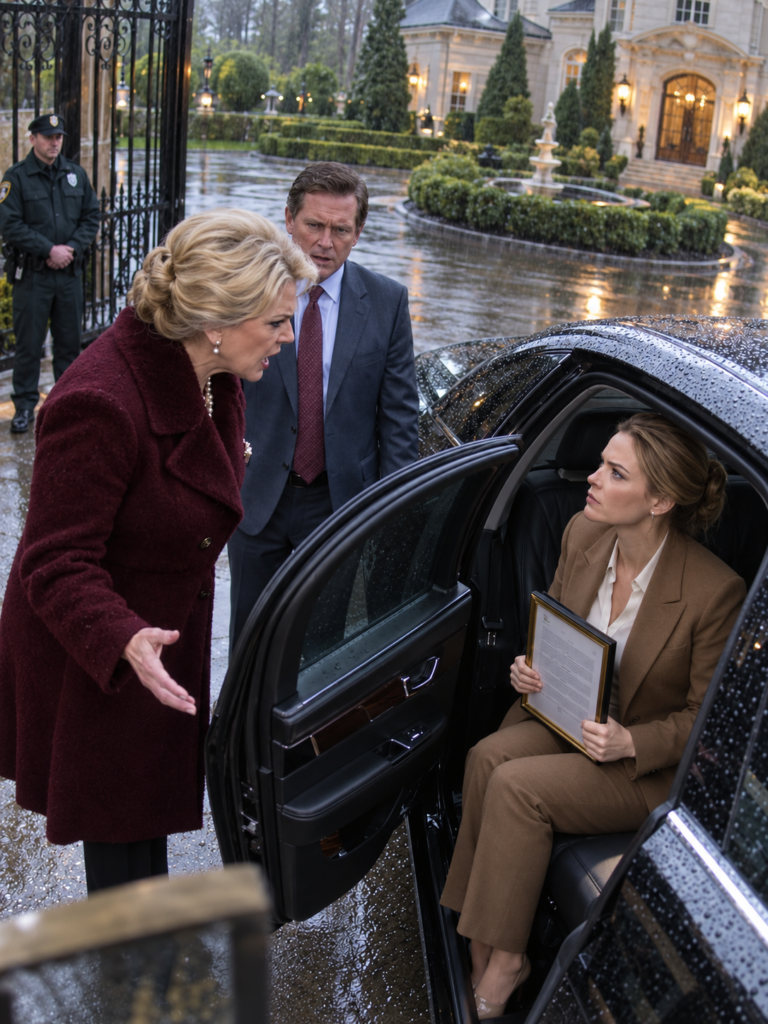
Behind her, beyond the black iron gates, a long drive curved through cedar and maple trees toward Hawthorne Hill, the house my grandmother had loved more than any other place she owned. Gray stone walls rose above the October mist. Copper gutters caught the thin morning light. From where we stood, you could see only part of the house, but it was enough.
Carol had spent years calling me “the little office girl.”
That morning, the little office girl apparently had a gatehouse.
“This is ridiculous,” she finally said.
She looked at the uniformed security officer beside me as if he were an actor I had hired.
“You can’t keep family off family property.”
I closed the folder.
“We aren’t family anymore.”
Her face hardened.
“You married my son.”
“Past tense.”
“You don’t get to erase seven years because you got angry.”
I almost smiled at that.
Angry.
That was the word Carol used whenever a woman stopped cooperating.
Daniel had learned it from her.
When I objected to Carol borrowing money, I was angry.
When I asked her not to use the emergency key to let herself into our house, I was angry.
When I wanted Christmas morning with my husband before driving forty minutes to her place, I was difficult and angry.
When I accepted the promotion that required relocating from Portland to Seattle, apparently I had become so irrational that my marriage had no choice but to collapse beneath the weight of my ambition.
A vehicle came up the road behind Carol.
I recognized Daniel’s charcoal SUV before it stopped.
He climbed out wearing the brown wool coat I had given him on our last married Christmas.
For one absurd second, seeing it hurt.
Then he looked through the gate.
He saw Hawthorne Hill.
He saw the grounds.
He saw me holding the folder.
And he stopped walking.
Daniel had always had an expressive face when he forgot to control it. That morning, disbelief moved across it first, then confusion, then something I recognized immediately.
Calculation.
Carol hurried toward him.
“Tell her,” she said. “Tell her she can’t pull this.”
Daniel barely looked at his mother.
His eyes stayed on the house.
“Mara,” he said.
I hated how familiar my name sounded in his voice.
“What is this?”
“My home.”
“You bought this?”
“No.”
Carol spun toward me triumphantly, as though she had caught me.
“There. See?”
I looked at Daniel.
“My grandmother’s trust owns it.”
He knew about the trust.
That was what changed his expression.
Years earlier, when we had completed our first mortgage application, I had listed a small trust distribution among my assets. Daniel had asked whether I came from money.
“Not really,” I told him.
That answer had been true in every way that mattered to me.
My grandfather and grandmother, Walter and Evelyn Holloway, had built a regional packaging company over forty years. They had lived comfortably, but neither of them believed in raising children or grandchildren who expected money simply because it existed.
The trust paid certain educational expenses. It held family land. It made conservative investments. Occasionally it helped when something serious happened.
It had never paid my rent.
It had never bought me a car.
It had never funded the Portland bungalow Daniel and I owned together.
I had worked for every promotion I received and contributed exactly half the down payment on our marital home.
Daniel knew there was family money somewhere.
He had simply never been interested in the details.
Until now.
Carol stepped close enough that the security officer shifted his weight.
“Show him the deed.”
I looked at her.
“You just spent ten minutes telling me the deed was fake.”
“Show him.”
I reopened the folder and turned the first page toward Daniel.
He read the trust name.
His eyes dropped to the parcel description.
Then to the trustee certification attached behind it.
His face went pale.
“When did this happen?”
“My grandmother bought the property twenty-two years ago.”
“No, I mean when did it become yours?”
“It didn’t become mine. The trust still holds title.”
He looked past me toward the house.
“But you live here?”
“I have exclusive occupancy rights.”
Carol made a sound of disgust.
“That’s ownership with fancy paperwork.”
“No,” said a voice from the gatehouse.
The security officer had not spoken except to ask Carol to keep her car clear of the entrance.
Now he looked at her evenly.
“It means Ms. Holloway is authorized to enter and you are not.”
Carol’s cheeks reddened.
She hated being corrected by anyone she considered service staff.
That habit had embarrassed me in restaurants, hotels, hospitals, and once at a funeral home.
She turned back to Daniel.
“You need to call your lawyer.”
Daniel still watched me.
“Our settlement is already final.”
“Then reopen it.”
My stomach tightened.
There it was.
Not How long have you been living here?
Not Why didn’t you tell me?
Not Are you all right?
Money had entered the conversation, and within sixty seconds Carol was discussing how Daniel might get some.
I glanced at him.
“Is that why you came?”
He hesitated.
“I came because Mom called me hysterical and said you were trying to have her arrested.”
“I said no such thing,” Carol snapped.
I raised an eyebrow.
The officer looked away, but I saw the corner of his mouth move.
Daniel exhaled.
“What happened?”
“She drove around the service barrier after being told she wasn’t on the visitor list.”
“I thought there had been a mistake.”
“There wasn’t.”
Carol crossed her arms.
“I wanted to talk to you privately.”
“You called me a gold-digging fraud through the intercom.”
“I was upset.”
Of course.
Carol’s emotions were explanations.
Mine had always been evidence against me.
Daniel rubbed the bridge of his nose.
“Mara, can we go inside and talk?”
“No.”
His hand dropped.
“No?”
“This is my home.”
“I was your husband.”
“Yes.”
The single word landed harder than any speech I could have given.
Carol stepped toward me again.
“You listen to me. Daniel gave you seven years. If you were sitting on all of this while he was paying half the mortgage and worrying about retirement, you owe him an explanation.”
I looked at Daniel.
He did not correct her.
That hurt more than I expected.
Even after the divorce papers.
Even after mediation.
Even after the empty rooms in our Portland house.
Some foolish piece of me had still hoped he would eventually hear his mother reduce our marriage to an investment and say, Enough.
Instead, he looked at the folder.
“What else is in there?”
The question was quiet.
I studied him.
Then I pulled the second document halfway out.
His signature showed at the bottom.
Daniel stepped closer.
“What is that?”
“You signed it nineteen months ago.”
He frowned.
Carol stopped moving entirely.
That interested me more than Daniel’s confusion.
I looked at her.
She knew exactly what the document was.
“Mom?” Daniel said.
Carol’s gaze snapped toward him.
“Don’t let her turn this into something else.”
I almost laughed.
The security officer glanced toward the gatehouse.
“Ms. Holloway, Ms. Park called from the main residence. Your attorney has arrived.”
Daniel looked at me sharply.
“Your attorney is here?”
“Yes.”
Carol’s face changed.
Not fear.
Not yet.
But the first shadow of it.
I returned the papers to the folder.
“I have a meeting.”
Daniel caught the gate before it began to close.
The officer stepped forward immediately.
“Sir.”
Daniel released it.
“Mara, please.”
I looked at the man I had once expected to grow old beside.
Six months earlier, we had been sitting at our kitchen table when he told me that accepting the Seattle position would be selfish.
Three months before that, Carol had cried at Thanksgiving because I refused to cancel a work trip to take her to a medical appointment she could easily attend alone.
A year before that, she had borrowed our second car for “two days” and kept it nearly six weeks.
Every fight had ended the same way.
Daniel would tell me she was lonely.
That she had sacrificed everything raising him.
That I should be patient.
That I knew how she was.
That being right was less important than keeping peace.
Peace, I eventually learned, was simply the name he gave to my surrender.
“I’ll talk to you tomorrow,” I said.
“Without your mother.”
Carol gasped.
Daniel stared at me for several seconds.
Then he nodded.
I got into my car.
As the gates opened, Carol called after me.
“You think that house makes you better than us?”
I lowered the window.
“No.”
She looked almost disappointed.
“I think leaving made me free of you.”
Then I drove through.
Hawthorne Hill had never looked like freedom when I was a child.
It had been Grandma Evelyn’s rainy-weather house.
That was how I thought of it.
Thanksgiving dinners with twelve people squeezing into the breakfast room because Grandma thought the formal dining room was “too gloomy.”
Wet boots lined beneath the back stairs.
My grandfather napping in the library with a newspaper on his chest.
Cinnamon rolls on Christmas morning.
After Grandpa died, Grandma visited less often.
The property became quiet.
Then, eight months before my marriage ended, she died.
I had been holding her hand.
Her last clear conversation with me had nothing to do with money.
We were sitting beside a hospital window while rain scratched faintly against the glass.
“You apologize before you disagree with people,” she told me.
I laughed.
“Do I?”
“You just did.”
Even sick, she could still make me feel twelve.
“I like peace.”
“So did I at your age.”
She watched the rain.
“Then I learned some people call it peace only when everyone else is obeying them.”
I thought about those words often after she was gone.
I thought about them constantly during the last months of my marriage.
My attorney, Rachel Kim, was waiting in the library when I entered.
She had spread three files across Grandma’s old walnut table and moved her coffee far from all of them.
Rachel believed beverages and legal documents should never occupy the same zip code.
She looked over my shoulder.
“Was that Daniel at the gate?”
“And his mother.”
“You showed them?”
“The deed.”
Rachel leaned back.
“Only the deed?”
“Only the first page.”
A small smile.
“I’m impressed.”
“I’m exhausted.”
“That I believe.”
I sat opposite her.
Morning light fell across the carpet.
For days, I had imagined this moment as vindication.
Carol discovering the truth.
Daniel understanding what he had lost.
Me standing on one side of an iron gate while they remained outside.
But triumph was not what I felt.
Mostly, I felt tired.
Rachel opened the first file.
“Then let’s finish what needs finishing.”
The documents had nothing to do with punishing Daniel.
Our divorce was already complete.
He kept the Portland house after refinancing my share out of it.
I kept my retirement accounts.
We split savings.
Neither of us asked for support.
The trust was disclosed during mediation because legally it needed to be.
Daniel’s attorney had received the relevant documents and recommended that both of us sign a mutual waiver covering separate inheritances and family trusts.
Daniel had signed.
So had I.
The document Carol had glimpsed beneath the deed was something else.
A loan acknowledgment.
Her loan acknowledgment.
Nineteen months earlier, our phone had rung at 12:17 a.m.
I remembered the exact time because I had a budget meeting at seven the next morning.
Daniel answered.
Within seconds he was out of bed.
“What?”
He paced beside the dresser.
“How much?”
A pause.
“No, Mom, don’t panic.”
That phrase had been the soundtrack of our marriage.
Don’t panic, Mom.
We’ll handle it, Mom.
I’ll come over, Mom.
Mara won’t mind.
Carol had refinanced her townhouse twice after Daniel’s father died. First, she said, to replace the roof. Then to consolidate credit cards.
That night, she claimed she had fallen behind because of a bank error.
The bank, unfortunately for her story, had records.
There was no error.
There were simply four missed payments.
Daniel was frantic.
“We can’t let her lose the house.”
I sat on the edge of the bed.
“We can’t cover that amount from checking.”
“We have savings.”
“Not enough unless we empty the emergency account.”
“She’s my mother.”
Three words.
He always said them as though they settled every question.
I contacted the trust administrator the next morning.
Not because Carol deserved another rescue.
Because foreclosure was serious, and despite everything between us, I did not want Daniel watching his mother lose her home.
The trust agreed to make her a temporary secured loan on favorable terms.
There were conditions.
There were signatures.
There was an acknowledgment stating exactly where the money came from.
Daniel attended the signing.
So did Carol.
The administrator explained every page.
Daniel spent half the meeting answering emails.
When the papers reached him, he glanced at me.
“Anything weird?”
“No.”
“Where do I sign?”
He signed.
Carol signed.
The loan was funded.
At Christmas she told relatives Daniel had “saved the house.”
I said nothing.
I had gotten good at saying nothing.
Now Rachel placed a payment history in front of me.
Carol had made three payments.
Then stopped.
I read the page twice.
“That’s it?”
“Three.”
“She told Daniel she was almost finished paying it back.”
“Then Daniel has been misinformed.”
I closed my eyes.
Of course he had.
“What happens now?”
“The trust sent the required notices. She has until Monday to cure the default.”
“And if she doesn’t?”
“The trustee exercises the remedies in the agreement.”
I looked toward the rain-darkened windows.
“I don’t want her house.”
“The trust doesn’t want her house either. It wants repayment according to a contract she signed.”
“Can we extend it?”
Rachel was quiet.
That told me she already knew the answer.
“You requested an extension for her last winter.”
I remembered.
Carol had called me privately and begged me not to tell Daniel.
He was under pressure at work, she said.
She would catch up within thirty days.
She swore.
I persuaded the trustee to allow ninety.
Daniel never knew.
“She already had her extension,” Rachel said.
I nodded.
Something inside me settled.
For years I had confused compassion with removing consequences.
Grandma never had.
My phone began vibrating.
Daniel.
A few seconds later, Carol.
Then Daniel again.
I turned it facedown.
Rachel closed the loan file and opened another.
“You know he may ask whether the divorce agreement can be challenged.”
“He already looked like he was doing the math.”
“It would be difficult. The trust was disclosed. He had independent counsel. The waiver applies equally to both of you.”
“He wanted the divorce finished quickly.”
“Yes.”
I remembered why.
Because he believed I would come back.
That was the part I had never told Rachel.
The night I packed my suitcase, Daniel stood in our bedroom doorway and watched.
He had not believed I was truly leaving.
Not even then.
Three weeks earlier, I had been offered a vice president position in Seattle.
It was the opportunity I had worked toward for eleven years.
Daniel’s first reaction had been silence.
His second was, “What about Mom?”
Not us.
Mom.
I suggested we discuss options.
A temporary commute.
Selling the Portland house.
Daniel looking for work farther north.
Seeing Carol on weekends.
She lived independently.
She drove.
She had friends.
She belonged to two social clubs and volunteered at a hospital gift shop.
Daniel acted as though moving three hours away would abandon a helpless widow in the wilderness.
Then Carol came over.
She placed my offer letter on the kitchen counter.
“This is what all of this is about?”
“All of what?”
“You being dissatisfied.”
“I’m not dissatisfied. I earned a promotion.”
“At your age, shouldn’t family matter more than titles?”
I was thirty-eight.
Daniel stared into his coffee.
I waited for him.
He said nothing.
Carol continued.
“You knew Daniel had responsibilities when you married him.”
“To you?”
“To his family.”
“I am his family.”
She laughed.
Actually laughed.
“You’re his wife.”
The way she said it made wife sound temporary.
I looked at Daniel.
“Are you going to say anything?”
He finally raised his eyes.
And then he said it.
“If the job matters that much, maybe you should go.”
Carol became very still.
So did I.
Daniel later claimed he had meant we needed time apart.
Maybe that was true.
But something inside me heard the sentence exactly as it was spoken.
Maybe you should go.
So I did.
Now, sitting at Grandma’s table months later, my phone lit again.
This time Daniel sent a message.
Can we meet tomorrow? Just us. Please.
I stared at it.
Then typed:
Rachel’s office. Ten.
His answer came immediately.
Okay.
I expected that meeting to be difficult.
I did not know it would be the first time Daniel finally saw his mother clearly.
Part 2
Daniel arrived early.
When Rachel brought me into the conference room, he was already sitting at the table with untouched coffee in front of him.
He looked older than he had at the gate.
Maybe it was only exhaustion.
Maybe it was because I was finally seeing him without the soft focus of marriage.
His wedding ring was gone.
Mine had been removed the night I signed the settlement.
Still, seeing his bare hand touched a quiet bruise.
He stood.
“Mara.”
I sat across from him.
Rachel took the chair at the end of the table.
Daniel looked at her.
“I thought Mara said just us.”
“I said without your mother.”
His mouth tightened.
Fair enough, his expression seemed to say.
For once, he did not argue.
He looked at me.
“So the house really belonged to your grandparents?”
“My grandmother bought it through the trust.”
“And now?”
“The trust still owns it. I have the right to live there and certain authority over what eventually happens to the property.”
“How much is it worth?”
Rachel answered before I could.
“Daniel, valuation of trust assets isn’t relevant to your divorce settlement.”
“I was married to her.”
“You were also represented by counsel.”
“I didn’t know there was a house.”
“You knew a trust existed.”
He turned to me.
“You made it sound like nothing.”
“No.”
My voice came out calmer than I felt.
“You decided it was nothing.”
He stared.
“You used to joke about Grandma’s old trust.”
“I joked about the annual paperwork.”
“You never said there was an estate outside Seattle.”
“I told you my grandmother had property.”
“You said family property.”
“That is what it is.”
He leaned back, frustrated.
“Mara, come on.”
There it was.
The tone that used to make me surrender.
As though reasonable people agreed with him, and all he needed to do was wait for me to join them.
I folded my hands on the table.
“What exactly are you asking me?”
He looked toward Rachel, then back at me.
“Whether the settlement can be reconsidered.”
“No.”
“I’m asking you, not her.”
“And I answered.”
His jaw worked.
“After seven years?”
“After seven years, you received exactly what you negotiated for.”
“That’s not what I mean.”
“I know.”
Silence grew between us.
Daniel finally looked down.
“Mom thinks you planned it.”
“Of course she does.”
“She thinks you kept the trust quiet so if we divorced—”
“Daniel.”
He stopped.
“Your mother thinks every decision I make is secretly about defeating her.”
He rubbed his forehead.
“She said you were waiting for Grandma to die.”
Something cold moved through me.
Rachel shifted in her chair.
I looked at Daniel.
“And you repeated that to me?”
His face changed.
He understood too late.
“I’m telling you what she said.”
“No. You chose to carry it into this room.”
“Mara—”
“My grandmother held my hand while she died.”
He looked down.
For several seconds nobody spoke.
Then Daniel whispered, “I’m sorry.”
I believed he regretted saying it.
That did not make the words disappear.
Rachel opened a file.
“We should discuss the second document you saw yesterday.”
Daniel looked up.
She slid a photocopy across the table.
His signature was on the final page.
He frowned.
Then recognition came slowly.
“Mom’s mortgage.”
“Yes,” Rachel said.
He read the first page.
Then the second.
His brow furrowed.
“How much was the loan?”
Rachel told him.
He looked at me.
“No.”
“Yes.”
“She said it was maybe fifteen thousand.”
“It wasn’t.”
He read again.
“You loaned her that?”
“The trust did.”
“But you arranged it.”
“Yes.”
His eyes moved down the page.
“You never told me.”
“I was sitting beside you when the administrator explained it.”
“I thought…”
He stopped.
“What?”
“I thought the trust was basically acting as guarantor.”
“You signed an acknowledgment stating it was the lender.”
His face flushed.
“I didn’t read everything.”
“I know.”
That sentence hurt him.
I could see it.
Daniel turned another page.
“Where are the repayment records?”
Rachel passed them over.
He scanned the dates.
Then again.
“There are payments missing.”
“No,” she said. “Those are all the payments received.”
He stared at her.
“What do you mean?”
“Your mother made three.”
Daniel went completely still.
“She’s been paying every month.”
“No.”
“She told me she was.”
Rachel pushed the notice file toward him.
“The trustee sent repeated notices.”
He looked at the address.
“That’s her townhouse.”
“Yes.”
“She said she never got anything.”
Rachel removed three certified-mail receipts.
Daniel’s face drained of color.
For the first time in years, I watched him confront evidence that Carol could not explain away simply by sounding offended.
He picked up the receipt bearing her signature.
“This is hers.”
“Yes.”
He sat back.
I did not feel victorious.
Mostly I felt sad.
Daniel had defended his mother so automatically that learning she had lied to him seemed to damage something structural inside him.
“Why would she lie about this?”
I almost answered.
Then stopped.
That was a question he needed to ask himself.
Rachel closed the file.
“The loan is now in default.”
Daniel looked at me.
“What happens?”
“She cures it or the trustee proceeds under the agreement.”
“You’d let them take her house?”
The old reflex surfaced so quickly I almost missed the change in him.
Before, I would have panicked.
Explained.
Apologized.
Now I simply looked at him.
“I didn’t make her stop paying.”
“She might not have the money.”
“She had nineteen months to tell us that.”
“Us?”
I paused.
“I mean the trustee.”
His eyes narrowed.
There was another truth in the room.
I decided he had earned it.
“She already received one extension.”
Daniel frowned.
“When?”
“Last winter.”
“Why?”
“She called me.”
“She called you?”
“Yes.”
“What did she say?”
“That you were overwhelmed at work and she didn’t want to worry you. She promised she would catch up.”
He stared at me as though I had switched languages.
“You never told me.”
“She begged me not to.”
“And you agreed?”
“I thought I was helping you.”
He pushed back from the table.
His chair scraped loudly.
“She told me you refused to help her.”
I said nothing.
He looked at me.
“When she needed the roof work. She told me you said you were done bailing her out.”
“I paid the contractor’s deposit from our joint account.”
His breathing changed.
“What?”
“You knew about it.”
“I thought that was two thousand.”
“It was eight.”
His face hardened.
“Why didn’t you tell me?”
“I did.”
“No, you didn’t.”
“Yes, Daniel. I did. You were standing in our laundry room. You said, ‘Whatever Mom needs, just handle it because I can’t deal with this today.’”
He remembered.
I saw it happen.
A knock sounded at the conference-room door.
Rachel’s assistant entered looking deeply uncomfortable.
“Ms. Kim, I’m sorry. There is a woman in reception saying she has to speak with Mr. Mercer immediately.”
Daniel closed his eyes.
“Of course.”
Carol pushed through the door before anyone could stop her.
She carried a white mailing envelope and wore the expression she reserved for situations where reality had failed to consult her.
“You.”
She pointed at me.
Rachel stood.
“Mrs. Mercer, this is a private legal conference.”
“This concerns my home.”
“It concerns a contract.”
Carol tossed the envelope onto the table.
“These threats need to stop.”
Daniel picked it up.
He read the first page.
Then looked at his mother.
“You signed for three notices.”
Carol blinked.
“What?”
“You told me you never received them.”
“I never said that.”
“Yes, you did.”
“Well, not properly.”
“What does that mean?”
She waved a hand.
“They send all kinds of confusing papers.”
Daniel held up the certified receipt.
“This is your signature.”
Carol looked at me.
“This is exactly what she wants.”
“What?”
“To turn you against your own mother.”
Daniel’s expression tightened.
“No one is turning me against anybody. I’m asking why you told me you were making payments when you weren’t.”
Carol straightened.
“I had expenses.”
“So you lied.”
“I protected you.”
He laughed once.
There was nothing amused in it.
“From what? Math?”
Her face hardened.
“You have no idea what I gave up for you.”
And there it was.
The sentence that ended every disagreement.
Daniel had been nine when his father began traveling constantly for work.
Twelve when the marriage ended.
Carol made sure he understood every sacrifice she claimed to have made afterward.
She had stayed in the same school district for him.
Worked extra shifts for him.
Never remarried because of him.
Given up vacations because of him.
Whether those choices were truly for Daniel had stopped mattering years ago.
They had become debts he could never fully repay.
Carol turned toward me.
“She has always resented how close we are.”
“No,” I said. “I resented paying for it.”
Her eyes widened.
Daniel looked at me.
Rachel remained standing.
I reached for the file.
“Do you want to know how much we spent helping your mother during our marriage?”
Daniel hesitated.
Carol answered for him.
“This is disgusting.”
“Do you?”
Daniel looked at me.
“Yes.”
I passed him the ledger Rachel had helped me prepare during the divorce.
Not because I planned to use it against Carol.
Because untangling our marriage had required understanding where our money had gone.
There were forty-three entries.
Car repairs.
Property taxes.
Credit-card balances.
A replacement furnace.
Dental work.
Homeowners insurance.
A cruise deposit Carol promised to reimburse and never did.
I watched Daniel turn the pages.
His face became quieter with each one.
Finally he reached the total.
He stared.
“That can’t be right.”
“I checked every transaction.”
Carol scoffed.
“So now keeping receipts makes you a saint?”
“No.”
I met her eyes.
“It makes me somebody who finally stopped believing your version.”
Daniel turned toward his mother.
“You told Aunt Susan you paid for that dental surgery yourself.”
“I paid some.”
“The whole payment came from our account.”
“Mara offered.”
“I did not.”
Carol looked at me sharply.
I continued.
“Daniel told me you needed help. I agreed because he was worried.”
He looked at his mother.
“And the car?”
She folded her arms.
“I raised you alone.”
He stared.
It was almost painful to watch him realize she had no answer.
Carol’s voice rose.
“She could afford it! Look at what she has!”
“That isn’t the point,” Daniel said.
Something shifted in the room.
Carol heard it too.
She turned toward him slowly.
“What did you say?”
He swallowed.
“I said that isn’t the point.”
Her face went blank with disbelief.
For years Daniel had managed conflict by translating between us.
Mom didn’t mean it that way.
Mara is stressed.
Mom’s lonely.
Mara needs space.
He had acted as if every dispute were a misunderstanding requiring him to soften the edges.
Now there was nothing to translate.
Paper did not have a tone of voice.
Bank statements did not hold grudges.
Certified-mail receipts were not jealous of his mother.
Carol pointed at me.
“She sat on a fortune while we struggled.”
Daniel looked at the ledger.
“You didn’t struggle.”
She recoiled.
“How dare you?”
“Mara and I paid half your expenses.”
“I am your mother.”
“And she was my wife.”
The sentence hit me harder than it should have.
Because it was true too late.
Carol’s eyes filled instantly.
For years I had wondered whether her tears were calculated.
That day I realized the answer did not matter.
Even sincere tears can become weapons if everyone else is trained to surrender to them.
“I can’t believe you’re choosing her.”
Daniel looked tired.
“I’m not.”
He glanced at me.
“Mara already chose herself.”
The room went quiet.
For the first time, he seemed to understand that I was no longer standing opposite Carol asking him to decide between us.
I had left the triangle entirely.
Carol gathered the notices.
“This family has been poisoned.”
I stood.
“No, Carol. It has been documented.”
She glared at me.
Rachel moved toward the door.
“The trustee’s deadline remains Monday.”
Carol faced me.
“You could stop this.”
“No. You can.”
“I don’t have that kind of money sitting around.”
“Then speak to a lender.”
She laughed bitterly.
“Easy for you to say from your mansion.”
I did not answer.
She wanted me guilty.
That had always been her safest version of me.
If I was selfish, Carol never had to wonder whether she had taken too much.
If I was ambitious, Daniel never had to wonder whether he had asked me to become smaller.
If I was secretive, neither of them had to examine how rarely they had shown curiosity about anything that did not involve their needs.
Carol left.
The office door closed behind her.
Daniel remained seated.
For a long time he looked at the final page of the ledger.
Then he said, “I didn’t know.”
I believed him.
That was the tragedy.
He had not known because he had spent seven years choosing not to look.
Part 3
Carol did not lose her townhouse.
Three days before the deadline, she obtained financing through a local credit union using the remaining equity in the property and paid the trust the amount required to bring the loan current and satisfy the agreed payoff.
Daniel helped her organize the paperwork.
He did not call me.
For the first time since I had known him, he solved one of his mother’s problems without turning me into part of the solution.
I considered that progress.
Carol did not.
She called Hawthorne Hill twice during my first month there.
The first time, she told the property manager she was my former mother-in-law and had been “accidentally omitted” from the visitor list.
The second time, she claimed Daniel had authorized her entry.
The property manager knew better.
I received one brief email afterward asking whether I wished to change the standing instruction.
I replied with a single sentence.
No entry without my direct approval.
I never heard about another attempt.
Seattle consumed me.
The promotion I had nearly sacrificed turned out to be more demanding than I had imagined and more satisfying than I had dared hope.
My first quarter was chaos.
I inherited a department that had lost two senior managers in six months.
A software transition was behind schedule.
Three major clients wanted answers.
I spent days moving from meetings to spreadsheets to difficult conversations and back again.
And I loved it.
Not every minute.
Some nights I drove home so tired that I sat in the garage for five minutes gathering enough energy to carry my laptop inside.
But the exhaustion felt clean.
It belonged to work I had chosen.
For years, I had finished stressful days only to find Carol’s latest emergency waiting on my phone.
A leaking dishwasher.
A neighbor parking too close to her mailbox.
A bill she did not understand.
A cousin who had offended her.
A doctor who was “not taking her seriously.”
Every incident arrived at maximum volume.
Daniel would drop everything.
Eventually he expected me to drop everything too.
At Hawthorne Hill, my phone could ring without tightening my chest.
That seemed like a small thing until I experienced it.
I began sleeping through the night.
I stopped checking our bank account each morning for surprise transfers.
I bought groceries without calculating which expense Carol might suddenly consider Daniel’s responsibility.
On Sundays, I made coffee and carried it into Grandma’s library.
For months after she died, I had avoided that room.
Now I opened the curtains.
Dust had collected along the shelves.
I spent weekends sorting books, photographs, and boxes of family letters.
One afternoon I found an envelope with my name in Grandma’s handwriting.
Inside was not a secret trust amendment.
Not another property document.
Not a dramatic revelation.
It was a birthday card she had apparently bought and forgotten to send.
On the front was an old-fashioned watercolor of a garden.
Inside, beneath the printed greeting, she had written:
Mara—
A good life should have doors you choose to open, not cages you learn to decorate.
Love,
Grandma
I sat on the library floor and cried.
Not because the sentence solved anything.
Because I finally understood how many years I had spent decorating a cage.
Daniel and I spoke rarely.
There were still practical matters after a divorce.
A final utility bill.
Tax documents.
A package addressed to me that arrived at the Portland house.
He kept his messages brief.
So did I.
Then, in February, he wrote:
Would you meet me for coffee sometime? No paperwork. No Mom. I owe you an apology.
I stared at the message.
Old instincts surfaced.
What does he want?
Is Carol in trouble again?
Is this another negotiation?
Then I realized I was allowed to say no.
Knowing that made it possible to say yes.
We met at a café in Centralia, roughly halfway between Portland and Seattle.
It was raining when I arrived.
Daniel was already there.
He stood when he saw me.
Something about him had changed.
Not dramatically.
He had not become a different man.
He simply seemed less defended.
We ordered coffee.
For several minutes we talked about neutral things.
Work.
Traffic.
The Portland house.
Then Daniel placed both hands around his cup.
“I started therapy.”
I nodded.
“I’m glad.”
“Mom hates it.”
That almost made me smile.
“I imagine she does.”
“She thinks my therapist is turning me against her.”
“Your mother has a consistent theory of personal growth.”
He laughed quietly.
Then his expression sobered.
“I found more things.”
“What kind of things?”
“Bills.”
He looked embarrassed.
“She had a credit card I didn’t know about. She’d used my address on some paperwork years ago. There were late notices.”
I waited.
“She also borrowed money from Aunt Susan.”
That surprised me.
“How much?”
“A lot.”
“Did Susan know about the trust loan?”
“No.”
He rubbed his thumb over the edge of the cup.
“Mom told her you refused to help and that I was covering everything alone.”
I looked out the window.
Rain ran down the glass.
A year earlier, that information would have made me furious.
Now it mostly made me tired.
“She needed a villain.”
“I know.”
I looked back at him.
“Do you?”
He accepted the question without flinching.
“I think I do now.”
He took a breath.
“I spent most of my life believing that if Mom was upset, something had gone wrong and I had to fix it.”
I said nothing.
He continued.
“When my dad left, she told me I was the man of the house.”
“How old were you?”
“Twelve.”
I knew the answer.
I wanted him to hear it himself.
He shook his head.
“Twelve.”
His eyes lowered.
“She’d cry about bills. About being alone. About Dad’s new girlfriend. If I wanted to go somewhere with friends, she’d say she understood and then sit in the dark when I came home.”
I remembered.
Our second year of marriage, Daniel and I had booked an anniversary weekend on the Oregon coast.
Carol developed chest pain the morning we left.
We rushed her to urgent care.
Nothing was wrong.
The following year, she developed a plumbing emergency.
The year after that, her dog became “despondent.”
We never celebrated an anniversary out of town.
Daniel looked at me.
“I thought loyalty meant never letting her feel abandoned.”
“And what did loyalty to me mean?”
His eyes filled.
“That you would understand.”
There it was.
Seven years condensed into four words.
I would understand.
I would wait.
I would accommodate.
I would forgive.
I would adjust.
Because I was stable.
Because I was capable.
Because I did not cry loudly enough.
Because my pain arrived in complete sentences instead of emergencies.
Daniel looked down.
“I treated your strength like it meant you needed less from me.”
I swallowed.
For months, I had wanted him to understand that.
Now that he did, it did not repair anything.
But it mattered.
He continued.
“When Mom got upset, I acted like her feelings were facts. If you got upset, I acted like yours were a problem to manage.”
“Yes.”
“I’m sorry.”
I looked at him.
There had been a time when those words would have saved our marriage.
That knowledge hurt.
“I believe you.”
His eyes lifted.
“You do?”
“Yes.”
A little hope entered his face.
I hated that I had to remove it.
“Believing you’re sorry doesn’t mean I want to come back.”
The hope disappeared.
He nodded.
“I know.”
For once, he did not argue with a boundary.
We sat quietly.
Then he smiled faintly.
“You know what the worst part is?”
“What?”
“I really thought you’d come back.”
“I know.”
“I thought once the Seattle job got hard, you’d decide it wasn’t worth it.”
That should have insulted me.
Instead, I felt strangely peaceful.
“You believed I would fail.”
“No.”
He looked embarrassed.
“I believed you would miss me enough to choose the marriage.”
“Even though you didn’t choose it.”
He closed his eyes briefly.
“Yes.”
Outside, a truck hissed across the wet pavement.
Daniel opened his eyes.
“I keep replaying that morning in the kitchen.”
“So do I.”
“When I told you to go.”
“You said maybe I should.”
“I wanted you to fight me.”
I stared at him.
He gave a helpless shake of his head.
“I wanted you to say no. I wanted you to force me to admit I didn’t actually want the marriage to end.”
“Daniel, I spent seven years fighting for space in that marriage.”
“I know.”
“No. Listen.”
He stopped.
“I asked for Christmas mornings. I asked for weekends without your mother dropping in. I asked you not to give her money without discussing it. I asked you to stop giving her a key after she walked into our bedroom while I was changing. I asked you to come to counseling.”
His face tightened.
“I know.”
“When you told me to go, I didn’t suddenly give up.”
My voice trembled, but I continued.
“I finally believed you.”
Tears filled his eyes.
I had rarely seen Daniel cry.
He looked toward the window.
“I should have gone with you.”
I shook my head.
“No.”
He turned back.
“I would have.”
“That’s not what I mean.”
I leaned forward.
“You should have wanted a life with me before there was a mansion behind the decision.”
He went very still.
“That house had nothing to do with why I left.”
“I know.”
“But when you saw it, part of you started calculating what you had lost.”
He did not deny it.
“That’s why I couldn’t talk to you that day.”
He swallowed.
“I’m ashamed of that.”
“I’m not saying it to punish you.”
“I know.”
“And I’m not saying your mother destroyed our marriage by herself.”
Daniel looked surprised.
“She didn’t?”
“No.”
I had thought about this often.
“Carol pushed. She manipulated. She lied. She made herself the center of every room she entered.”
He gave a humorless smile.
“That sounds familiar.”
“But she wasn’t my husband.”
His eyes fell.
“You were.”
That was the truth beneath everything.
Carol had been difficult.
Daniel had been responsible for how much power her difficulty held inside our marriage.
I could forgive a difficult mother-in-law.
I could not remain married to a man who repeatedly made her comfort more important than my dignity.
Daniel nodded slowly.
“Therapy has been unpleasant.”
I laughed despite myself.
“That usually means you’re getting your money’s worth.”
He smiled.
For a few seconds, I saw the man I had loved.
The man who made pancakes shaped like animals for my nieces.
Who danced badly in the kitchen.
Who brought me soup when I had pneumonia.
Who once drove six hours overnight because my grandfather had fallen and I was too upset to travel alone.
The good had been real.
So had the bad.
That was what made leaving difficult.
If Daniel had been cruel every day, I would have left years earlier.
Instead, he had been kind in every situation that did not require him to disappoint his mother.
Eventually, that exception consumed the marriage.
He looked at me.
“Is there any version of this where we try again?”
I let the question settle.
“No.”
His mouth tightened.
But he nodded.
“Because of what happened with the promotion?”
“Because the promotion showed me what had already happened.”
He waited.
“I had spent years making myself smaller to keep everyone comfortable. When that job came, I finally reached something I couldn’t shrink without disappearing.”
Daniel looked down.
“I’m sorry.”
“I know.”
This time, the words did not sound like a door opening.
They sounded like one closing gently.
We finished our coffee.
In the parking lot, Daniel stopped beside my car.
“Mom asked about you last week.”
I almost groaned.
He smiled faintly.
“I told her it was none of her business.”
I stared at him.
“That must have gone well.”
“She didn’t speak to me for four days.”
“And?”
“And they were surprisingly peaceful.”
I laughed.
So did he.
Then his expression softened.
“I really did love you.”
“I know.”
“You believe that too?”
“Yes.”
I opened my car door.
“Love just wasn’t the only thing our marriage needed.”
He nodded.
Rain collected on his shoulders.
“Goodbye, Mara.”
“Goodbye, Daniel.”
I drove north.
By the time I reached Hawthorne Hill, dusk had settled over the trees.
The gates recognized my vehicle and opened.
A security officer I knew as Marcus lifted one hand from inside the gatehouse.
“Evening, Ms. Holloway.”
I waved.
The drive curved upward.
Warm lights glowed through the windows.
For months, people had assumed the satisfying part of my story was that Carol discovered I had money.
It wasn’t.
Money had not saved me.
The house had not saved me.
The trust had not saved me.
In fact, if the promotion had never come, I might still have been in Portland, sitting quietly at a kitchen table while Carol explained why my needs should wait.
That thought stayed with me as I entered the library.
Grandma’s old desk stood beneath the window.
I opened the bottom drawer and removed the leather folder.
The deed was still there.
So was the trust amendment.
The loan papers.
The signed divorce agreement.
Documents that, together, had frightened Carol and shocked Daniel.
I placed them at the bottom of the drawer.
Then I took out another sheet of paper.
My original Seattle offer letter.
The page had been folded once across the middle.
Carol had made that crease the morning she slapped it onto our kitchen counter and asked if a job title mattered more than family.
For months, I had kept the letter because it reminded me of the worst day of my marriage.
Now I understood it differently.
I laid it on top of the deed.
Carol had believed the surprise was that I possessed something valuable she had not known about.
Daniel had believed the surprise was that he had signed away a claim to a home he had never seen.
They were both wrong.
The real surprise was that when they finally told me my future required their permission, I discovered I could stop asking for it.
Outside, rain began tapping against the library windows.
I switched off the desk lamp and stood in the doorway for a moment.
The house was quiet.
No unexpected key turned in the lock.
No phone rang with a manufactured emergency.
No one waited in the kitchen to explain why my plans were inconvenient.
I had once thought freedom would feel dramatic.
It did not.
It felt like rain on an old roof.
A locked front door.
A phone resting silently on the table.
And a home where I no longer had to make myself smaller for someone else to feel important.


