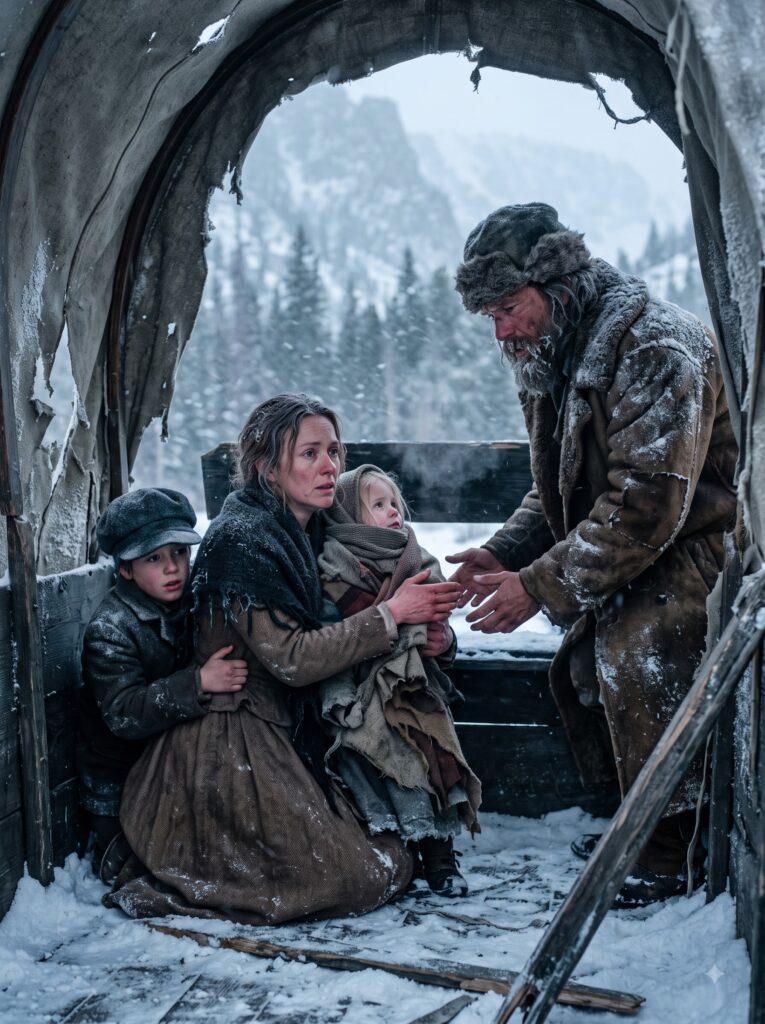
Gideon’s fingers worked beneath the frozen fastening, but the leather would not bend.
Cora watched his knife lying beside the basin.
“Will you have to cut it?”
“Likely.”
She closed her eyes briefly.
Those boots were among the last useful things she owned.
“Do what you must,” she whispered.
Gideon explained where he intended to cut and waited for her nod.
Then he sliced the stiff leather away, carefully avoiding her skin.
Sam came closer.
“Is Mama going to lose her feet?”
Gideon looked at Cora before answering.
“I can’t tell yet. She’s badly chilled, and we’ll need to watch how the skin fares.”
Cora appreciated the truth, though it frightened her.
Gideon helped her remove the remaining frozen clothing from her feet, using clean cloth and gentle warmth rather than exposing injured skin to the fire.
He wrapped them loosely and placed dry blankets around her.
The pain slowly returned.
It was sharp enough to make her grip the edge of the chair.
Sam reached for her hand.
She squeezed his fingers.
“I’m here, sweetheart.”
Across the room, Lottie stirred beneath her blanket.
Gideon approached the little girl and crouched beside the cot.
“May I check her?” he asked.
Cora nodded.
He spoke softly to Lottie, watched her breathing, and helped her sip a little warm broth once she was alert enough to swallow.
The child opened her eyes.
“Mama?”
Cora’s face crumpled.
“Right here, darling.”
Gideon moved aside so she could see her daughter.
For several moments, the family spoke quietly together.
Then he returned to the hearth and prepared more broth.
Sam ate first.
Lottie managed a little.
Cora accepted her cup with shaking hands.
The warmth settled into her body gradually.
She had nearly forgotten what it felt like not to be fighting the cold every second.
“Where is your family?” Sam asked suddenly.
Gideon stopped stirring the pot.
Cora looked toward her son.
“Sam—”
“It’s all right,” Gideon said.
He looked around the single-room cabin.
“Just me here.”
“Always?”
“For a long while.”
Sam considered that.
“Don’t you get lonely?”
Gideon set the ladle down.
“Sometimes.”
The answer seemed to surprise him.
He had not spoken to another person in months.
His cabin had been a refuge from a world he no longer wished to face.
Yet now a little boy was asking him questions beside the hearth, and a girl was breathing peacefully on his cot.
Cora studied him.
“You saved us,” she said.
Gideon shook his head slightly.
“We’ve still got to get you well.”
“But you could have walked past.”
He looked toward the fire.
“I couldn’t have.”
She sensed a history beneath those words.
But exhaustion kept her from asking.
Gideon prepared a sleeping place near the hearth for himself, leaving the cot and the warmest corner for Cora and the children.
He explained where the water and supplies were kept.
He showed Sam the latch on the door.
Then he moved his rifle to a place safely beyond the children’s reach.
Cora watched each small action.
No grand declarations.
No demands for gratitude.
Only a man making room in a home designed for solitude.
Near midnight, the wind grew louder.
Snow struck the cabin walls in heavy gusts.
Gideon rose to inspect the door, then checked the firewood.
Cora lifted her head.
“Is the storm worsening?”
“Yes.”
“Can we leave when morning comes?”
He paused.
“Not on those feet.”
“I mean after they’re better.”
Gideon looked toward the window.
The mountain pass had already been dangerous before the latest snowfall.
Now the trail was disappearing beneath deep drifts.
He could not tell how long it would remain blocked.
“I’ll check the route after the weather settles,” he said.
Cora studied him.
“How far is the nearest town?”
“Far enough that we can’t make the journey in this weather.”
She looked toward her children.
Her own feet throbbed beneath the blankets.
She understood what his answer meant.
The three of them might be staying longer than anyone had expected.
“Gideon,” she said, “I must ask something.”
He waited.
“If we cannot travel, will you let us stay until we safely can?”
“Yes.”
“Without expecting anything from me?”
His expression tightened with something like hurt.
Then he seemed to understand why she had asked.
“Yes, Cora. Without expecting anything.”
She nodded.
“Thank you.”
He returned to the hearth.
Outside, another heavy gust struck the roof.
The window disappeared behind blowing snow.
Gideon listened to the storm and counted the hours until daylight.
Then he reached for the lantern, put on his coat, and moved toward the door to examine the drift gathering against it.
Cora watched him lift the iron bar.
Cora watched Gideon lift the iron bar.
The door resisted when he pushed it.
Snow had piled against the outside, sealing the lower half of the entrance.
He tested it again, then stopped.
“No use forcing it tonight.”
He returned the bar to its brackets and brushed frost from his sleeves.
Cora raised herself on one elbow.
“Are we trapped?”
“For the night.”
“And tomorrow?”
“We’ll see what daylight brings.”
She looked toward her children.
Sam had fallen asleep with one hand resting on Lottie’s blanket.
The sight gave her enough courage to ask another question.
“How long could we stay here if the pass doesn’t open?”
Gideon examined the stacked firewood.
“I’ve provisions put by. Meat, potatoes, flour, beans. A spring nearby. Wood enough for a hard winter if we use it properly.”
“That isn’t what I asked.”
He turned.
Cora held his gaze.
“How long would you let us stay?”
Gideon considered her.
“As long as the mountain makes traveling dangerous.”
She looked down.
“I don’t want my children to be a burden.”
“They aren’t.”
“You don’t know what it means to feed three more mouths.”
“I know what I’ve stored.”
His answer was practical, not dismissive.
He continued more gently.
“We’ll count the supplies together when you’re feeling better. If anything runs short, we’ll plan around it.”
Cora nodded.
It was the first time since her husband’s death that someone had spoken about the future as a problem to be solved rather than a disaster already decided.
***
Morning came with startling silence.
The wind had stopped.
Sunlight struck the snow outside so fiercely that the cabin window seemed filled with white fire.
Gideon cleared enough of the doorway to step outside.
When he returned, his beard was dusted with frost.
“Three feet of new snow in places,” he said.
Cora lowered her cup.
“And the pass?”
“Buried.”
“For how long?”
He looked at the hearth.
“Could be spring before the wagon road is safe.”
Cora felt the blood drain from her face.
“Spring?”
Gideon nodded.
She looked around the room.
One cot.
One chair.
One small table.
Four people who had been strangers only yesterday.
The thought of spending months in this place frightened her almost as much as the wrecked wagon had.
She tried to rise.
Pain shot through her feet.
Gideon moved to help, but stopped when she raised her hand.
“Please. Let me try.”
He stepped back.
She managed to sit upright, breathing hard.
“Thank you.”
He nodded.
For several minutes she sat looking toward the window.
Then she spoke.
“If we stay, I want the children to have routines. Lessons. Work they can manage. Something that keeps them from thinking only about the snow.”
“Sounds sensible.”
“And I want to know what we have to eat.”
“Then we’ll count it.”
She looked up.
“Today?”
“Today.”
***
They began with the root cellar.
Gideon brought out small portions of the stores so Cora could examine them without standing.
He described what remained below.
Potatoes.
Beans.
Flour.
Salted meat.
Dried herbs.
A modest supply of preserved fruit.
Enough for winter if they were careful and supplemented it when weather permitted.
Cora worked out portions aloud.
Gideon listened.
He knew how to store supplies for one man.
She had experience keeping children fed with little to spare.
They discovered that the same provisions could be managed differently when meals were planned for four.
It was a beginning.
In the days that followed, Cora slowly recovered strength.
Her feet remained painful, and some areas of skin needed continued care.
She avoided unnecessary walking until the damage improved.
Gideon never promised quick recovery.
He explained that severe cold injuries could have lasting consequences.
Cora accepted the uncertainty with difficulty.
But she refused to let fear decide how she lived.
When she could sit comfortably for longer periods, she began repairing torn clothing.
Gideon brought her a wool shirt that had been hanging unused on a peg.
The shoulder seam was nearly gone.
She examined it.
“Do you mend anything?”
“When it won’t stay together another winter.”
“That explains the state of this.”
He looked almost amused.
“Can it be saved?”
“With patience.”
“Got some of that.”
“We shall see.”
Sam laughed.
It was the first easy laughter Cora had heard from her son since his father’s death.
She looked down quickly so he would not see her tears.
***
Winter settled over the cabin.
Outside, the mountains stood white and silent.
Inside, days developed a rhythm.
Gideon kept the hearth supplied and checked the roof after heavy snow.
Cora managed meals as her strength allowed, repaired clothing, and taught the children reading and arithmetic.
Sam wanted to help with everything.
He carried kindling, swept the floor, and learned to recognize tracks in the snow when it was safe to accompany Gideon near the cabin.
Gideon gave him small tasks and clear instructions.
He did not expect an eight-year-old boy to do a grown man’s labor.
But he treated Sam’s efforts seriously.
The boy flourished under that attention.
Lottie remained quieter.
She often sat beside Gideon’s chair while he carved small wooden animals.
At first, she only watched.
Then one day she held up a little bear he had finished.
“For me?”
He nodded.
She hugged it against her chest.
“Thank you, Mr. Gideon.”
He lowered his eyes.
“You’re welcome.”
Cora saw his expression.
There was affection in it.
But also pain.
She began to wonder what sort of sorrow could make a man hide for ten years in a cabin above the snowline.
***
One evening, after the children had fallen asleep, Cora sat beside the fire mending Gideon’s shirt.
He was cleaning his knife on the opposite side of the hearth.
The cabin had grown familiar enough that silence no longer felt threatening.
Still, there were things she wished to understand.
“Do you spend every winter here?” she asked.
“Yes.”
“Alone?”
“Until this one.”
She looked down at her sewing.
“That must be difficult.”
“Not always.”
“Do you ever wish you had someone to speak with?”
Gideon considered.
“Used to think speaking only made things worse.”
Cora waited.
He set the knife aside.
“My wife was named Sarah.”
Her needle stopped.
“We had a son.”
She looked up.
Gideon stared into the fire.
“Diphtheria took them both in a mining settlement outside Denver. Ten years back.”
Cora’s heart tightened.
“I’m sorry.”
He nodded once.
“I buried them. Came into the mountains afterward.”
“You’ve been here ever since?”
“Mostly.”
She studied his face.
The hard lines.
The deep weariness.
The way he seemed to listen even when he did not answer.
“You loved them very much.”
“Yes.”
He said nothing more.
Cora looked toward Sam and Lottie.
She knew what it meant to lose a husband.
She knew the terrible silence after the burial.
But she had still had her children.
Gideon had lost everyone.
“I don’t know how you endured it,” she whispered.
He looked at her.
“Some days I didn’t do much more than endure.”
She lowered her eyes.
After a moment she said, “I thought I would die in that wagon.”
“I know.”
“I was ready to let you take the children without me.”
Gideon leaned forward.
“Cora…”
“I know now how close we came.”
She took a breath.
“But I don’t want their lives, or mine, to be only about what we’ve lost.”
He watched her quietly.
“Neither do I,” he said.
It was a small confession.
But it changed something.
***
As the weeks passed, Cora became steadier on her feet.
She could move about the cabin, though prolonged standing still caused pain.
She began taking more responsibility for household work by choice.
Gideon continued carrying water, hauling wood, and doing the tasks she could not yet manage.
They argued occasionally.
Usually about how much she should attempt.
Once, when she tried to carry a heavy bucket despite her aching feet, Gideon reached for it.
“I can manage,” she said.
“It’s heavy.”
“I know.”
He stopped.
She looked at him.
“I need to do things for myself.”
“I understand.”
“Do you?”
He considered the question.
Then he lowered his hand.
“I’ll be here if you need help.”
Cora managed the bucket as far as the table before deciding to set it down.
Gideon said nothing.
Later, she asked him to move it the rest of the way.
He did so without smiling or making a point of it.
That mattered to her.
***
By late February, the cabin had become something neither of them expected.
There were four cups beside the stove instead of one.
Lottie’s wooden animals lined a shelf.
Sam’s small collection of interesting stones occupied a corner of the table.
Cora’s mending lay in a neat basket near the hearth.
The place still belonged to Gideon.
But he was no longer the only person whose habits shaped it.
Then the wolves came.
They had been hunting through the upper timber, driven toward the stored meat by hunger and the harsh winter.
Gideon heard them near the shed after midnight.
He rose quietly and approached the window.
Outside, gray shapes moved between the trees.
Cora woke when he reached for his rifle.
“What is it?”
“Wolves near the meat shed.”
She sat upright.
“How many?”
“More than one.”
He checked the door.
“We need to keep them out of the stores.”
Cora moved toward the table.
“What do you want me to do?”
“Keep the children inside. Bar the door after me.”
She looked at the rifle.
“Must you go?”
“If they break into the shed, we’ll lose too much food.”
She considered the danger.
“Then take the lantern. I want you to see where you’re stepping.”
He accepted it.
She could tell he was surprised.
Then she touched his arm.
“Come back.”
Gideon looked at her hand.
“I mean to.”
He stepped outside.
Cora lowered the iron bar.
The darkness beyond the door filled with movement.
A rifle shot sounded.
Then another.
The wolves scattered, then returned toward the shed.
Cora heard wood splinter.
She heard Gideon shout.
And then a gunshot sounded so close to the cabin that the cups rattled on their shelf.
Sam woke.
“Mama?”
“Stay with your sister.”
She moved toward the door, listening.
A heavy impact struck the outside wall.
Then silence.
Cora felt her heart hammering.
“Gideon?”
No answer.
She waited.
The seconds seemed to lengthen without end.
Then a voice came from the other side.
“Cora. It’s me.”
She lifted the bar and opened the door.
Gideon stumbled inside.
His buffalo coat was torn across the shoulder.
Blood darkened his sleeve.
She caught his arm before he fell.
“Sam,” she said sharply, “bring clean cloth and light the other lamp.”
The boy obeyed.
Gideon sat heavily beside the hearth.
Cora knelt to examine him.
The wounds were deep enough to frighten her.
She remembered the first night in the cabin.
How Gideon had worked beside her without panic.
How he had explained what he was doing.
Now he was the one needing help.
“May I cut the sleeve?” she asked.
He nodded.
She carefully opened the damaged fabric and examined the injury.
The wound needed cleaning and proper medical attention as soon as travel became possible.
She used the clean supplies available and dressed it as carefully as she could.
Gideon winced but remained still.
“There’s risk of infection,” she told him.
“I know.”
“Then you will not pretend this is nothing.”
He looked at her.
“No.”
She secured the bandage.
Sam stood nearby, frightened but trying to be brave.
“Is he going to die?”
Cora turned.
“We’re doing what we can to keep him well. We must watch him closely.”
Gideon reached toward the boy with his uninjured hand.
“Your mama knows what she’s doing.”
Sam nodded.
Cora looked back at Gideon.
Her hands were trembling.
“You frightened me.”
“I know.”
“I thought…”
She could not finish.
Gideon studied her face.
Then he said softly, “I’m here.”
Cora closed her eyes.
She had spent months learning that being rescued did not make her helpless.
Now, as she held the wounded man’s hand, she understood the other half of the truth.
Being strong did not mean never needing someone.
***
Over the following days, Gideon developed a fever.
Cora monitored him carefully and changed the dressings as needed.
The cabin’s isolation made the illness more dangerous.
She knew there was no certainty in the remedies available to them.
Sam helped with the fire and brought water.
Lottie remained close but was kept away from the wound.
During his worst nights, Gideon spoke in fragments.
Sometimes he called Sarah’s name.
Sometimes he asked after his son.
Cora listened without correcting him harshly.
She reminded him where he was whenever he became lucid enough to understand.
There were moments when she feared the fever would take him.
She did not sleep much.
Then, after several difficult days, his condition began to improve.
The fever eased.
He could drink comfortably.
The wound gradually showed signs of healing.
Cora remained cautious.
Recovery would take time.
But for the first time since the injury, she allowed herself to imagine him standing outside in the spring sunlight.
One afternoon, Gideon opened his eyes and found her sitting beside him.
“You look tired,” he said.
She laughed once, almost angrily.
“You have a talent for noticing obvious things.”
He managed a faint smile.
She leaned forward.
“Don’t ever do that to me again.”
He looked at her.
“Can’t promise wolves won’t come.”
“That’s not what I mean.”
He waited.
“I mean don’t pretend you’re the only person allowed to take risks or make decisions. We share the danger now.”
Gideon studied her.
Then nodded.
“All right.”
She took his hand.
Neither spoke for a long time.
But something between them had changed.
Not because he had rescued her.
Not because she had nursed him.
Because each now understood that the other could choose to stay, care, and contribute.
And that neither needed to owe the other a life in exchange.
***
Spring came slowly.
The snow softened around the cabin.
Water began running beneath the ice.
Sam and Lottie spent more time outside near the doorway, watching the first patches of earth appear.
Gideon’s shoulder remained stiff, but he recovered enough to resume lighter work.
Cora’s feet had healed, though cold mornings and long walks still caused discomfort.
Together, they began planning what would happen when the pass reopened.
At first, the conversation was practical.
Red Rock lay down the western slope.
It had a mercantile, boardinghouse, work opportunities, and access to services the high cabin could never offer.
Gideon described the route.
He spoke of the people Cora might approach for work.
He offered to help transport their belongings.
Cora listened.
Then she asked the question he had been avoiding.
“Is that what you want?”
Gideon stopped speaking.
“What?”
“For us to leave.”
He looked toward the window.
“It’s safer down there.”
“That wasn’t my question.”
He remained silent.
Cora folded her hands.
“I know my children need schooling. I know they need access to people and help when they’re ill. I’ve thought about those things every day.”
Gideon nodded.
“But I’ve also thought about this cabin. About what we’ve made here. About you.”
His jaw tightened.
“Cora…”
“I am not asking you to promise we will never suffer again.”
He looked at her.
“I don’t know if I can lose another family.”
The words came so quietly she barely heard them.
She understood at once.
He was not simply arranging their future because he believed town life would be better.
He was trying to protect himself from loving them too deeply.
Cora rose from her chair.
She came around the table and stopped beside him.
“You have already begun to care for us.”
“Yes.”
“And we care for you.”
He lowered his eyes.
“That doesn’t make the mountain safe.”
“No.”
She spoke gently.
“But sending us away will not make your memories disappear.”
Gideon looked toward the children’s little collection of wooden animals.
For ten years, he had kept his cabin almost unchanged.
Now it held things that belonged to other people.
Things he had grown accustomed to seeing.
Things he did not want to lose.
Cora touched the back of his chair.
“I will not ask you to keep us here if you truly want us gone.”
He turned sharply.
“That isn’t what I want.”
“Then tell me what is.”
Gideon stared at her.
For once, his silence was not enough.
Finally he said, “I want you here. All three of you.”
Cora felt tears rise.
“Then we must decide what kind of life is possible. Not pretend that wanting each other answers every difficulty.”
Gideon nodded.
“We’ll talk about it.”
She sat beside him.
And together they began considering the cabin, the town, the children’s future, and the possibility of a home built by choice rather than necessity.
By the time the mountain trail became passable, they had agreed on one thing.
They would go down to Red Rock together and see what opportunities existed.
After that, Cora would decide where she and her children belonged.
Gideon would tell her plainly what he hoped for.
Neither would use the rescue as a reason to demand the other’s answer.
On the morning they departed, Gideon led the pack mule toward the trail.
Sam carried a small bag.
Lottie clutched her wooden bear.
Cora looked back at the cabin.
Then she followed them downhill.
A few hours later, the broken wagon appeared beside the trail.
She stopped.
The place where she had nearly surrendered her life stood before her again.
And this time, she was walking toward it on her own feet.
Cora walked toward the ruined wagon and stopped beside its shattered wheel.
The broken axle lay half buried in the mud.
The torn canvas hung in faded strips.
Beyond the wreckage, the mountain road curved downward toward Red Rock.
She remembered the last time she had seen this place.
Snow driving through the canvas.
Sam shaking beneath a quilt.
Lottie barely breathing against her chest.
And herself, so exhausted that she had believed her children could survive only if she gave them away.
Now the spring air smelled of damp earth and pine.
Sam stood nearby, healthy and strong.
Lottie held her wooden bear against her coat.
Gideon waited beside the pack mule, allowing Cora time.
She touched the wagon wheel.
“I thought this was where everything ended,” she said quietly.
Gideon stepped closer.
“I know.”
She looked at him.
“You came here because of an elk.”
He nodded.
“That’s right.”
“And you found us instead.”
“Yes.”
She studied his face.
There were still deep lines beside his eyes.
His shoulder remained stiff after the winter injury.
He was not a man transformed into someone younger or untouched by suffering.
But his expression had softened in ways she recognized now.
He no longer seemed to be searching every silence for a reason to retreat.
“Why didn’t you leave me?” she asked.
Gideon looked toward the wagon.
“Because you were alive.”
She smiled faintly.
“Is that the whole answer?”
“No.”
He paused.
“I suppose I couldn’t bear to leave a family in the snow when I knew I might get them somewhere warm.”
Cora nodded.
Then she said something that made him look up.
“You saved us. But I don’t want the rest of our lives to be about that day.”
He listened.
“I want Sam to remember the lessons he learned. I want Lottie to remember laughing by the fire. I want to remember helping mend your shirts and arguing about the cooking.”
A small smile touched Gideon’s mouth.
“You argued about more than cooking.”
“Yes,” she replied. “And I expect to do so again.”
He almost laughed.
Then his expression grew serious.
“What are you saying, Cora?”
She looked toward her children.
“I am saying we have a life worth choosing. But we must choose it with our eyes open.”
Gideon lowered his gaze.
“I’ve been afraid to ask you to stay.”
“I know.”
“Afraid I’d be asking you to give up too much.”
“You would be, if staying meant the children had no schooling, no doctor within reach, and no way of knowing anyone beyond these mountains.”
He nodded.
She continued.
“But there may be another way.”
He looked up.
“We could stay near the cabin during the warmer months. You know the trails. You can trade and guide. The children could spend part of the year nearer town where there is schooling.”
Gideon considered her words.
“And winter?”
“We would have to plan for it. Perhaps spend the hardest months lower down when travel is safer. Perhaps build connections in Red Rock before another storm closes the road.”
He looked toward the distant valley.
“That would mean I couldn’t hide up here all year.”
“No.”
She smiled gently.
“It would mean being part of the world again.”
He stood silent.
For ten years, that thought had frightened him.
Not because he disliked people.
But because people could become dear.
And dear people could be lost.
He looked toward Sam.
The boy was helping Lottie examine a smooth stone beside the trail.
Gideon felt the old fear stir.
Then he looked back at Cora.
“I don’t know how to do all of that.”
“Neither do I.”
She held his gaze.
“But we can learn.”
***
They continued toward Red Rock.
The descent took much of the day.
Gideon kept the mule’s pace slow enough for Cora’s feet.
Sam walked beside him for part of the journey, asking questions about the trail.
Lottie grew tired and was carried for the steepest sections.
By afternoon, the rough mountain road began to widen.
Buildings appeared in the valley below.
For Cora, the sight brought relief and fear in equal measure.
A town meant work.
A place where her children could learn.
A chance to begin again.
But it also meant strangers, costs, and decisions she could no longer postpone.
Gideon noticed her silence.
“You don’t have to decide everything today.”
“I know.”
He looked toward the buildings.
“There’s a boardinghouse near the mercantile. We can get rooms there while you look around.”
Cora nodded.
“And you?”
“I’ll stay close enough to help. If that’s welcome.”
She turned toward him.
“It is.”
He smiled.
The admission came easily now.
***
In Red Rock, Cora discovered that possibilities existed beyond the narrow choices she had imagined while stranded in the wagon.
The boardinghouse needed sewing and washing done.
A family near the mercantile wanted help mending work clothes.
The settlement had a modest school where Sam could continue his lessons when sessions were held.
There were other children for Lottie to play with.
And there were people who knew Gideon.
Some remembered him from years earlier.
Others knew him only as the large trapper who occasionally appeared with pelts and disappeared before anyone could invite him to supper.
For Gideon, walking through Red Rock with Cora and the children felt stranger than crossing a dangerous mountain pass.
People spoke to him.
They asked about his winter.
They noticed the children beside him.
Once, an older storekeeper looked from Gideon to Cora and said, “Didn’t reckon we’d ever see you keeping company again.”
Gideon shifted uncomfortably.
Cora answered before he could retreat.
“Neither did he.”
The storekeeper chuckled.
Gideon looked at her.
She smiled.
He shook his head, but she could see he was pleased.
***
Over the following weeks, they worked out a practical arrangement.
Cora earned money through sewing and other household work in town.
Gideon traded his remaining pelts and arranged seasonal guiding work.
He was skilled at reading weather, selecting safe trails, and navigating mountain terrain.
Those abilities had value beyond his own survival.
Together they began saving toward a sturdier future.
They did not pretend life would be easy.
Cora still worried about the children’s schooling and the cost of winter lodging.
Gideon worried about leaving the cabin unattended during long absences.
They discussed those problems openly.
Sometimes they disagreed.
But the conversations no longer ended with one of them walking away.
One evening, they sat outside the boardinghouse while Sam and Lottie played nearby.
The air was warm.
The snowline had retreated high above the valley.
Cora was mending a shirt.
Gideon watched the mountains.
“Do you miss the cabin?” she asked.
“Yes.”
“Do you miss being alone?”
He thought for a moment.
“Sometimes I miss the quiet.”
She smiled.
“So do I.”
He turned toward her.
“But I don’t miss having nobody to speak to.”
Cora lowered her sewing.
Gideon looked down at his hands.
“I used to think loving someone meant giving the world another chance to hurt me.”
She waited.
“Then I met you.”
Her throat tightened.
“And?”
He looked toward the children.
“And I found out keeping everyone away didn’t stop the hurt. It only kept anything good from happening afterward.”
Cora reached for his hand.
He took hers.
For several moments they watched Sam help Lottie balance along a fallen log.
Then Gideon spoke.
“Would you still like a home with me?”
Cora looked at him.
“Yes.”
He drew a breath.
“Not because I carried you down that mountain?”
“No.”
“Not because you feel beholden?”
She smiled softly.
“Gideon, you know me better than that.”
He nodded.
“I do.”
She leaned closer.
“I want a home with you because we have learned how to work together. Because you listen when I disagree. Because you care for the children without trying to replace their father.”
He lowered his eyes.
“And because,” she added, “I have come to love you.”
Gideon looked up.
For a moment, the guarded man who had spent ten years alone seemed unable to speak.
Then he said, “I love you too.”
There was no grand declaration.
No audience.
Only two adults on a porch, saying aloud what their actions had been building toward for months.
Cora smiled through her tears.
“Then we should decide how to live it.”
Gideon laughed softly.
“Always planning.”
“Someone must.”
He squeezed her hand.
“Glad it’s you.”
***
By early summer, they returned to the mountain cabin.
This time the journey was planned carefully.
The mule carried supplies.
The weather was settled.
They had arranged what they would do when autumn approached.
Sam was delighted to see the familiar clearing.
Lottie ran toward the doorstep, holding her wooden bear.
Cora stood beside Gideon and looked at the little cabin beneath its sod-covered roof.
It had once seemed an impossible place to survive.
Then it had become a refuge.
Now it represented something different.
A home they could shape together.
But it was still too small.
Gideon examined the space beside the original walls.
“Could add a second room.”
Cora considered the ground.
“If we make it properly.”
He glanced at her.
“Reckon I know how to build one.”
“Yes,” she replied. “And I know how to tell you when the shelves are in the wrong place.”
He laughed.
“Then we’d best begin.”
The work took weeks.
Gideon felled and shaped the needed timber.
Sam helped strip loose bark and carried lighter pieces under supervision.
Cora worked out where the new room would be most useful and organized the materials they had brought from town.
Lottie collected smooth stones near the creek and insisted that some of them belonged beside the new hearth.
Gideon accepted her contribution solemnly.
The addition rose slowly.
A wall.
A doorway.
A sturdy roof.
A window that caught the morning sunlight.
Cora wanted a place where the children could sleep with room to grow.
Gideon wanted the new structure strong enough to endure heavy snow.
They compromised where necessary.
And each learned to appreciate the other’s reasoning.
Once, when Gideon proposed placing a shelf too high for Cora to reach comfortably, she stood beneath it with her hands on her hips.
“Am I meant to climb a ladder every time I want flour?”
He looked at the shelf.
Then at her.
“Reckon not.”
He lowered it.
She smiled.
Small moments like that became the ordinary shape of their life.
***
Sam continued learning from Gideon.
He was fascinated by animal tracks, weather signs, and the difference between a safe route and a dangerous one.
Gideon taught him to observe before acting.
He also reminded the boy that knowledge did not make a person invincible.
“The mountain doesn’t care how proud you are,” he told Sam one afternoon.
The boy nodded.
“So I should be careful.”
“That’s a good beginning.”
“And ask for help?”
Gideon looked at him.
“Yes.”
Sam grinned.
“Even you?”
Gideon smiled.
“Especially me.”
Cora overheard the conversation from the doorway.
She remembered the man who had once spoken as though every problem could be solved through endurance and strength.
Now he was teaching a boy that caution and asking for help were part of courage.
She loved him for that change.
***
Lottie grew more talkative as the seasons passed.
She kept the wooden animals Gideon carved for her on a shelf near her sleeping place.
Sometimes she asked about her father.
Cora answered.
She told stories of his kindness, his laughter, and the way he had loved his children.
Gideon listened without discomfort.
Once, Lottie asked him whether he minded hearing about Papa.
He crouched beside her.
“No, little one.”
“Because Mama says we must remember him.”
“She’s right.”
Lottie considered that.
“Did you have a little boy?”
Gideon grew still.
Then he nodded.
“Yes.”
“Do you remember him?”
“Every day.”
She placed her wooden bear in his hand.
“You can hold this when you do.”
Gideon stared at the little carving.
Then he looked at Cora.
Her eyes were wet.
He carefully handed the bear back.
“Thank you, Lottie. You keep him safe for me.”
The little girl nodded solemnly.
That night, Gideon told Cora more about Sarah and their son.
He spoke of ordinary memories.
A laugh.
A favorite meal.
The way the boy once tried to imitate his father’s walk.
Cora listened.
She never asked him to forget.
And Gideon never expected her to erase David from the home they were building.
Their love was not a replacement for the people they had lost.
It was proof that life could still hold something good after terrible sorrow.
***
As autumn approached, they prepared to return to Red Rock for the coldest months.
Gideon had once believed leaving his mountain cabin meant abandoning the only life he knew.
Now he understood that a home was not merely the place where a man stored his tools.
It was also the people with whom he made plans.
The cabin remained theirs to return to in the warmer seasons.
Red Rock offered the children schooling and closer access to help during winter.
Neither choice had to erase the other.
One evening, as they packed for the journey, Cora stood outside the new room.
The roof was finished.
The walls were sound.
Inside, Sam’s and Lottie’s belongings occupied their own places.
Gideon joined her.
“Thinking about the wagon?” he asked.
She shook her head.
“Thinking about the day we came here.”
He looked toward the trail.
“You could barely stand.”
“I remember.”
She turned toward him.
“I thought you’d take the children and leave me.”
Gideon’s expression softened.
“I remember that too.”
“And you said we were all coming with you.”
He nodded.
Cora took his hand.
“I didn’t understand then that coming with you would eventually mean having a choice about where we went next.”
He looked at her.
“I’m glad you made that choice.”
“So am I.”
She rested her forehead briefly against his shoulder.
For a long while they stood listening to the wind move through the pines.
The mountains remained beautiful and dangerous.
Winter would return.
There would be uncertain harvests, difficult journeys, and days when old grief rose unexpectedly.
But Gideon no longer believed he could prevent sorrow by refusing to love.
And Cora no longer believed needing help meant surrendering her future.
They had learned something harder and more enduring.
A family was not made only by blood, marriage, or the terrible things people survived together.
It was made through the ordinary decisions that followed.
The promise to listen.
The willingness to change.
The work shared at the table and beside the hearth.
The courage to allow another person to remain free.
***
Years later, Cora would sometimes tell Sam and Lottie about the broken wagon.
She never described herself as helpless.
She told them she had been afraid.
That she had made a desperate choice because she loved them.
And that a stranger had offered help when they needed it most.
Sam remembered walking behind Gideon through the snow.
Lottie remembered only the warmth of the buffalo coat and the little wooden bear she still kept.
Gideon remembered everything.
The frozen canvas.
The woman’s trembling hands.
The boy standing between his mother and a stranger.
And the moment he had answered that they would all leave the ridge together.
He had not known then what those words would mean.
He had believed he was simply guiding three people out of a storm.
Instead, their arrival had drawn him back toward a world he had spent a decade avoiding.
Cora had taught him that love was not a promise against loss.
It was a choice made despite the knowledge that nothing living could be guaranteed forever.
And he had taught her that accepting shelter did not diminish her strength.
That a helping hand could remain open rather than become a claim.
Their days were not always easy.
But they were theirs.
One summer evening, with the mountains glowing gold beyond the cabin, Sam and Lottie played near the creek while Cora and Gideon sat together outside.
The second room stood completed beside the original cabin.
Smoke drifted from the chimney.
A small garden grew near the sunny wall.
Gideon looked at the woman beside him.
“Do you ever regret staying?”
Cora considered the question.
Then she smiled.
“We didn’t simply stay, Gideon.”
He raised an eyebrow.
“No?”
“We built a life.”
He looked toward the children.
Then toward the cabin.
At last he nodded.
“Yes,” he said softly. “We did.”
Cora slipped her hand into his.
Far below them, the old mountain pass stretched toward the place where the wagon had broken.
Once, it had seemed to mark the end of everything.
Now it was only part of the road that had brought them here.
And when the evening wind rose among the pines, Gideon no longer heard only the loneliness of the mountain.
He heard the children laughing.
Cora calling them home.
The crackle of wood waiting in the hearth.
And the simple, extraordinary sound of a life he had freely chosen to share.