Part 1
“You really don’t remember me?”
The question came so softly that Ryan Mitchell almost missed it beneath the music.
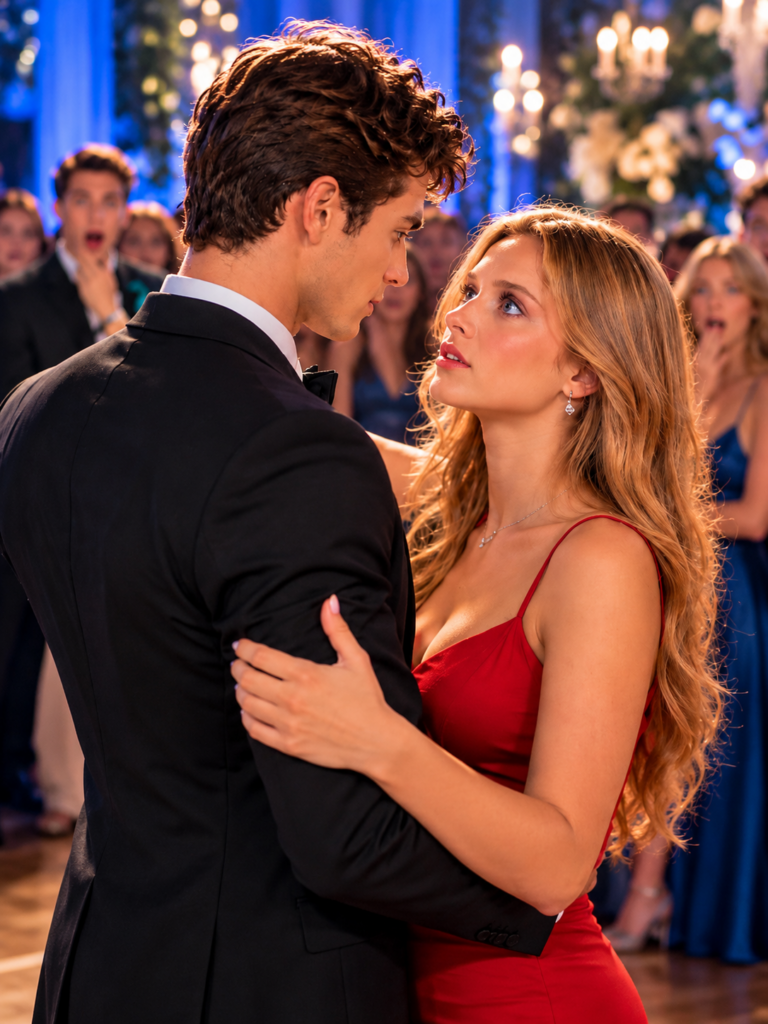
One moment, he was dancing with a beautiful girl in a black dress, wondering why she looked at him as though she might cry.
The next, his stomach dropped.
Because there was something in her eyes.
Something familiar.
Something he should have recognized.
“I’m sorry,” he said, slowing his steps. “Have we met before?”
The girl’s fingers tightened around his hand.
For a heartbeat, she seemed to consider telling him everything.
Then she gave a small, heartbreaking smile.
“I guess some promises are easier to forget than others.”
Ryan stared at her.
“What promises?”
Her smile disappeared.
And suddenly, the girl his friends had dared him to dance with looked as though coming to that party had been the biggest mistake of her life.
But to understand why those few words changed everything, you have to understand what Ryan had almost forgotten—and what Emily Parker had spent eleven years trying to remember.
Three hours earlier, Ryan had been standing behind the counter at Miller’s Diner, wondering whether he could afford to replace the brakes on his car.
His phone buzzed beside the register.
Account balance: $143.62.
He looked at the number, then at the mechanic’s estimate folded inside his wallet.
Four hundred and eighty dollars.
That was before rent.
Before groceries.
Before the eighty dollars he had promised to send his mother.
“Something wrong?”
Ryan looked up.
Mrs. Miller, the diner’s sixty-eight-year-old owner, stood beside the coffee machine holding a dish towel.
“Just calculating how many pancakes I need to sell before my car decides to become a permanent lawn ornament.”
She gave him the look she reserved for customers who claimed they weren’t hungry and then stole fries from someone else’s plate.
“That car has been threatening to die since September.”
“And I’ve been threatening to graduate since freshman year. We’re both still here.”
Mrs. Miller chuckled.
But she didn’t miss the tiredness around his eyes.
Ryan was twenty-three, finishing his business degree at Briarwood University while working close to thirty hours a week at the diner.
His father had died during his sophomore year.
A sudden heart attack.
One ordinary Tuesday morning, his father had been complaining about the price of coffee.
By dinner, he was gone.
After that, Ryan’s mother struggled to keep the small house where he’d grown up, and Ryan quietly took on whatever expenses he could.
He didn’t talk much about it.
His friends knew he worked.
They didn’t know he sometimes ate the diner’s leftover soup because it meant buying fewer groceries.
They didn’t know he had stopped replacing his worn-out sneakers.
And they certainly didn’t know he’d turned down an unpaid summer internship because his family couldn’t afford three months without his wages.
Ryan had become very good at making everything sound like a joke.
“Go home,” Mrs. Miller told him. “You’ve been here since six.”
“I could stay another hour.”
“You could also sleep.”
“Overrated.”
She pointed the towel at him.
“Ryan.”
He lifted both hands.
“Fine. I surrender.”
As he untied his apron, the bell above the diner door jingled.
An elderly man entered, followed by a gust of cold spring wind.
Mr. Dawson.
Seventy-four.
Retired mail carrier.
Widower.
He came every Friday for coffee and a slice of apple pie.
Tonight, though, he stood near the entrance studying the small handful of coins in his palm.
Ryan knew that look.
He had worn it himself at grocery stores.
“Evening, Mr. Dawson.”
“Evening, son.” The older man cleared his throat. “Coffee tonight, I think. Just coffee.”
Ryan glanced at the coins.
Then at the untouched apple pie in the display case.
“Actually, you’re in luck.”
Mr. Dawson raised his eyebrows.
“Oh?”
“Mrs. Miller says we’re testing a new Friday special. Coffee comes with pie.”
From behind the counter, Mrs. Miller looked at Ryan.
Ryan looked back.
A silent conversation passed between them.
She sighed dramatically.
“Terrible business idea,” she announced. “But apparently my employee has become the management.”
Mr. Dawson smiled.
“Well, I wouldn’t want to interfere with a promotion.”
Ryan poured his coffee and brought him the biggest slice of pie left.
When the man wasn’t looking, Ryan slipped six dollars into the register.
Mrs. Miller waited until he had gone to the kitchen.
“You know I would have covered that.”
“I know.”
“Then why didn’t you let me?”
Ryan shrugged.
“Because sometimes I like pretending I’m rich.”
She shook her head.
“Go enjoy yourself tonight, kid. You’re allowed to be twenty-three.”
He grinned.
“Is that an official medical diagnosis?”
“It’s an order.”
By eight thirty, Ryan was standing outside his apartment, staring at the passenger seat of his battered Honda.
His best friend, Jake Sullivan, leaned against the open door.
“Tell me you’re not seriously thinking about skipping.”
“I have laundry.”
“You always have laundry.”
“Exactly. It’s a very demanding relationship.”
Jake grabbed the keys from his hand.
“Final exams are over. We passed. In six weeks, we graduate. Tonight, you are coming to the party.”
“Jake—”
“No excuses.”
Ryan glanced toward the stairs leading to his second-floor apartment.
He could be inside in five minutes.
He could shower, heat leftover pasta, and sleep.
Instead, he saw his father’s face in an old memory.
You work hard, Ry. Just remember to live a little while you’re doing it.
Ryan exhaled.
“One hour.”
Jake grinned.
“That’s the spirit.”
“I mean it.”
“Absolutely.”
“Jake.”
“Two hours, maximum.”
Ryan climbed into the car.
They both knew he had already lost.
The party was being held in the university’s renovated student ballroom.
Warm lights hung above the dance floor.
Someone had filled enormous glass bowls with floating candles.
Music rolled through the room as students celebrated the end of their final exams.
Ryan recognized almost everyone.
His friends were already gathered around a table near the dance floor.
There was Marcus, who had changed majors three times and still insisted he had a five-year plan.
There was Tyler, whose wealthy parents had purchased him a new car because he complained that his old one didn’t match his shoes.
And there was Vanessa Cole, an ambitious marketing student who had once dated Ryan for six weeks before deciding he was “too busy for anything serious.”
She was probably right.
Ryan had liked her.
But he couldn’t afford expensive dinners, weekend trips, or the kind of carefree relationship she wanted.
Afterward, Vanessa had told everyone they were better as friends.
Ryan had agreed.
He’d learned that sometimes agreeing was easier than explaining.
“Look who finally arrived!” Marcus shouted.
Jake pushed Ryan toward the table.
“The hardest-working man in Briarwood.”
Ryan raised his plastic cup.
“To unemployment after graduation.”
Everyone laughed.
For a while, he managed to forget about his bills.
He danced badly.
He argued with Marcus about basketball.
He listened to Jake explain why a girl from his economics class was definitely interested in him because she had borrowed a pen.
Then Tyler started talking about dares.
It began innocently.
Marcus had to ask a professor’s daughter for her phone number.
Jake had to dance with the student council president.
Vanessa had to approach a stranger and convince him they had attended kindergarten together.
Then Tyler pointed toward the far corner of the ballroom.
“What about her?”
Ryan followed his gaze.
A girl sat alone beside the tall windows.
She wore a simple black dress with long sleeves, her dark hair falling over one shoulder.
A small silver necklace rested against her collarbone.
She held a glass of orange juice but wasn’t drinking it.
While the rest of the room laughed, shouted, and danced, she watched quietly from her chair.
Ryan had seen her around campus before.
Maybe in the library.
Maybe outside the art building.
He wasn’t sure.
“She’s been sitting there all night,” Tyler said. “I don’t think she’s said five words.”
“So?” Ryan asked.
“So, Jake should go ask her to dance.”
Jake shook his head.
“No chance. She looks like she’d rather be anywhere else.”
Tyler grinned.
“Then Ryan can do it.”
Ryan frowned.
“Why me?”
“Because you never turn down a challenge.”
Vanessa leaned forward.
“Twenty bucks says she says no.”
Ryan looked back at the girl.
She was staring through the glass into the dark courtyard.
Something about her expression unsettled him.
She didn’t look arrogant.
She didn’t look unfriendly.
She looked lonely.
“Don’t make her into a joke,” Ryan said.
Tyler held up his hands.
“Relax. It’s just a dance.”
“Then ask her yourself.”
“Oh, come on, man. Afraid?”
Jake laughed.
“Ryan Mitchell has never been afraid of a girl.”
Ryan shot him a look.
But his pride had already been touched.
And pride, he would later realize, was a terrible reason to approach someone whose feelings mattered.
“Fine,” he said.
Tyler slapped the table.
“There we go!”
Ryan stood.
But as he walked toward the window, his friends’ laughter seemed to grow quieter.
The girl looked up when his shadow fell across the table.
Up close, she was even prettier than he’d realized.
She had deep brown eyes, delicate features, and a face that seemed strangely familiar.
“Hi,” Ryan said.
She studied him.
Not with the polite curiosity of someone meeting a stranger.
With surprise.
Almost disbelief.
“Hi,” she answered.
“I’m Ryan.”
A flicker passed through her expression.
“I know.”
Ryan laughed lightly.
“Right. I guess everybody knows everybody around here.”
She didn’t smile.
He gestured toward the dance floor.
“I was wondering if you’d like to dance.”
For several seconds, she said nothing.
Her gaze moved past him.
Toward the table where Tyler, Marcus, Jake, and Vanessa were watching.
Ryan felt his face grow warm.
She had noticed.
Of course she had.
He suddenly wished he could walk backward through the last thirty seconds.
“You don’t have to,” he said quickly. “I didn’t mean to interrupt your evening.”
Something shifted in her eyes.
“Why did you ask me?”
The question caught him off guard.
“Because…”
He stopped.
He could say she looked beautiful.
That was true.
He could say she seemed interesting.
Also true.
But neither was the complete answer.
He glanced toward his friends.
And she understood.
Her expression went still.
“Oh.”
Ryan swallowed.
“Look, I’m sorry. My friends were being idiots.”
“And you agreed?”
He had no defense.
“Yes.”
She looked down at her untouched drink.
For a moment, Ryan thought she might ask him to leave.
Instead, she did something unexpected.
She stood.
“All right.”
He blinked.
“Really?”
“One dance.”
Her voice trembled slightly.
“Just one.”
Ryan offered his hand.
She looked at it for a moment before placing hers inside.
And as they walked toward the dance floor, Ryan had the strange feeling that he was being led toward something much larger than a college party.
The music changed.
A slow song began playing.
Couples moved together beneath the warm lights.
Ryan rested one hand lightly against the girl’s waist.
She placed her hand on his shoulder.
For the first few seconds, neither spoke.
Then Ryan smiled.
“So, what’s your name?”
She looked into his face.
“You don’t know?”
He hesitated.
“Should I?”
Her fingers tightened around his hand.
“Maybe.”
Ryan studied her.
Her eyes.
Her smile.
The little silver necklace.
Something tugged at the edge of his memory.
A sunny afternoon.
A bicycle.
Laughter.
But the images disappeared before he could catch them.
“I’m sorry,” he said. “You look familiar, but I can’t place you.”
She drew a shaky breath.
Then she asked the question that would haunt him for the rest of the night.
“You really don’t remember me?”
Ryan stopped dancing.
“What?”
“Look at me, Ryan.”
He did.
“Look carefully.”
Her eyes shimmered beneath the lights.
“Don’t you remember?”
And for one impossible second, he saw a little girl sitting beneath an oak tree, holding a blue notebook against her chest.
Then the vision vanished.
He shook his head.
“I don’t understand.”
The girl stepped away.
A tear slipped down her cheek.
“I shouldn’t have come.”
She turned toward the exit.
“Wait!”
She stopped.
Ryan could hear his friends laughing somewhere behind him, but suddenly he didn’t care.
“Please,” he said. “Tell me who you are.”
The girl looked over her shoulder.
“My name,” she whispered, “is Emily.”
And something inside him cracked open.
Emily.
The name struck like a bell in a silent room.
A little girl in yellow rain boots.
A scratched bicycle.
A creek behind a row of houses.
A blue notebook filled with drawings.
A promise beneath an old oak tree.
“Emily Parker?” he whispered.
Her lips parted.
For the first time that night, hope flashed across her face.
“You remember?”
Ryan felt the floor shift beneath him.
“Maple Street?”
She nodded.
“Three houses down from yours.”
His heart began pounding.
“Oh my God.”
Emily gave a small, trembling laugh.
“Hello, Ryan.”
He stared at her.
The last time he’d seen Emily Parker, they had both been twelve years old.
She’d had crooked bangs, scraped knees, and a stubborn determination to beat him at everything.
He had known her for less than two years.
And somehow, during those two years, she had become the most important person in his childhood.
“You’re…”
He couldn’t finish.
Emily wiped her cheek.
“Older?”
He laughed helplessly.
“A little.”
“So are you.”
They stood facing each other while the party continued around them.
Then Ryan said the only thing he could think of.
“I can’t believe it’s you.”
Her smile faded.
“I almost didn’t believe it was you either.”
“Why?”
“Because I thought you’d remember.”
And the guilt hit him.
Hard.
When Ryan was eleven, his family moved to Maple Street in a small Ohio town called Fairhaven.
His father worked for a regional equipment company.
His mother was a substitute teacher.
Money had always been tight, but the house had a big backyard and an enormous oak tree near the fence.
Ryan hated the move.
He missed his old school.
His old friends.
The familiar streets.
For the first two weeks, he spent most afternoons sitting beneath the oak tree, throwing pebbles at the wooden fence.
Then one Tuesday, a girl appeared on the other side.
She had a ponytail and an oversized blue sweatshirt.
“Are you the new boy?”
Ryan looked up.
“Maybe.”
“That’s a weird answer.”
“That’s a weird question.”
She considered this.
Then she climbed over the fence.
Ryan stared.
“You can’t just come into somebody’s yard.”
“Why not?”
“Because it’s my yard.”
She shrugged.
“Then tell me to leave.”
Ryan opened his mouth.
But she sat down beside him before he could speak.
“My name’s Emily.”
“Ryan.”
“I know. My mom told me.”
She opened a small blue notebook.
Inside were drawings.
Houses.
Flowers.
Dogs.
People.
And a surprisingly detailed picture of the oak tree above them.
Ryan leaned closer.
“You drew that?”
“Yep.”
“It’s pretty good.”
“Pretty good?”
He glanced at her.
She was grinning.
He smiled despite himself.
“Okay. Really good.”
“Better.”
She closed the notebook.
“Do you want to ride bikes?”
Ryan hesitated.
Then nodded.
That afternoon, they raced down Maple Street.
Emily won.
She celebrated so loudly that Mrs. Parker came outside to make sure nobody had been injured.
The next day, Ryan demanded a rematch.
Emily won again.
By the end of the summer, they were inseparable.
They built a crooked treehouse with scrap wood Mr. Parker found in the garage.
They caught fireflies in jars and released them before bedtime.
They invented an imaginary country called Blueberry Kingdom, with an oak tree as its capital.
And whenever Ryan felt like the world was changing too quickly, Emily made it feel manageable.
She had a way of listening.
Not simply waiting for her turn to speak.
Actually listening.
When Ryan admitted he was afraid his parents would move again, she drew him a map of the neighborhood.
Then she circled three places.
Her house.
His house.
The oak tree.
“Even if you get lost,” she said, “you can always find your way back.”
He kept that map beneath his pillow for months.
Then came the summer dance.
The neighborhood association organized one in the community center.
Emily wanted to go.
Ryan did not.
“Dancing is stupid,” he declared.
Emily crossed her arms.
“You only think it’s stupid because you’re bad at it.”
“I’m excellent at it.”
“Prove it.”
He couldn’t.
She spent three afternoons teaching him basic steps beneath the oak tree.
She would count softly.
“One, two, three. One, two, three.”
Ryan stepped on her feet.
She threatened to never speak to him again.
Then he made her laugh by bowing like a prince.
On the night of the dance, Emily wore a pale blue dress.
Ryan wore a shirt his mother had ironed twice.
He stood beside her for nearly an hour, too embarrassed to ask her to dance.
Finally, Emily whispered, “You promised.”
He looked at her.
“Promised what?”
“That you’d dance with me.”
He sighed dramatically.
Then offered his hand.
And beneath the community center’s colored lights, two awkward twelve-year-olds danced while their parents smiled from folding chairs.
Afterward, Emily announced that when they were older, they should dance together again.
“At a real dance,” she said.
“With fancy clothes.”
Ryan laughed.
“Fine.”
“And no stepping on my feet.”
“No promises.”
She held out her pinkie.
“Promise me you’ll remember.”
Ryan hooked his finger around hers.
“I promise.”
Three months later, his father announced that the family was moving.
Again.
This time, nearly four hundred miles away.
On their last afternoon together, Emily sat beneath the oak tree with her blue notebook in her lap.
She didn’t cry until Ryan told her he didn’t know when he’d come back.
Then she cried so hard that he didn’t know what to do.
Finally, he tore a page from his school notebook.
He wrote a letter.
A promise.
And when he handed it to her, he said, “I’ll find you again.”
Emily held the paper against her chest.
“You better.”
“I will.”
“And when you do…”
“I’ll ask you to dance.”
She nodded.
“Promise?”
Ryan smiled.
“Promise.”
At twelve years old, he believed promises could survive anything.
Distance.
Time.
Growing up.
He didn’t yet understand how easily life could bury even the things that once mattered most.
Part 2
Ryan and Emily left the ballroom through a side entrance.
Outside, the air was cool and smelled faintly of rain.
A fountain stood at the center of the courtyard, its water glimmering beneath the campus lights.
Emily sat on a stone bench.
Ryan remained standing for a moment before sitting beside her.
Eleven years.
He couldn’t understand how a person could disappear from his life for eleven years and then suddenly sit within arm’s reach as though no time had passed at all.
“You kept the necklace,” he said.
Emily looked down.
The silver pendant was shaped like a small star.
Ryan remembered buying it at the county fair.
He had spent almost all his allowance on it after Emily lost the necklace her grandmother had given her.
It wasn’t expensive.
The metal had been cheap.
The clasp had broken twice.
But Emily had worn it for the rest of that summer.
“I didn’t know you’d remember that,” she said.
“Apparently, I remember more than I thought.”
She gave a bittersweet smile.
“Just not me.”
Ryan winced.
“Emily…”
“I’m sorry.” She shook her head. “That wasn’t fair.”
“No. It was.”
She looked across the courtyard.
For a while, they listened to the fountain.
Finally, Ryan asked, “How long have you been at Briarwood?”
“Two years.”
His head turned.
“Two years?”
She nodded.
“I transferred after community college.”
“We’ve been going to the same university for two years?”
“Apparently.”
Ryan rubbed his forehead.
“How did I never see you?”
“You did.”
He stared.
Emily gave a small shrug.
“A few times.”
“When?”
“The library. The coffee shop near the science building. Once outside the registrar’s office.”
Ryan searched his memory.
Fragments surfaced.
A girl carrying a portfolio.
Dark hair.
A familiar face disappearing into a crowd.
“Why didn’t you say something?”
Emily studied her hands.
“At first, I wasn’t sure it was you.”
“And then?”
“Then I was.”
Ryan waited.
She looked up.
“And I got scared.”
“Of me?”
“Of finding out I mattered less to you than you did to me.”
He didn’t know what to say.
Emily folded her hands tightly in her lap.
“That’s a terrible thing to admit, isn’t it?”
“No.”
“It sounds childish.”
“It sounds honest.”
She breathed out slowly.
“I used to think about what I’d say if I ever saw you again. I’d imagine all these dramatic reunions. I’d walk up and say, ‘Took you long enough,’ and you’d laugh, and somehow it would feel like we were twelve again.”
Ryan smiled faintly.
“That does sound like you.”
“But then I actually saw you.”
She glanced at him.
“You were outside the student center, talking to three people. You looked happy. Confident. Like you had this whole life.”
“Looks can be deceiving.”
“I know that now.”
She picked at a loose thread on her dress.
“I was working two campus jobs, trying to keep my scholarship, and helping my mom with medical bills. I didn’t feel like the girl you’d remember.”
Ryan turned fully toward her.
“Medical bills?”
“My mom had surgery last year. She’s doing better now.”
“Why didn’t you tell me?”
Emily gave him a look.
“Ryan.”
He closed his eyes.
“Right. Stupid question.”
She smiled despite herself.
For a moment, it almost felt easy.
Then she said, “I didn’t plan to come tonight.”
“What changed your mind?”
“My roommate practically dragged me here.”
“And then?”
Emily looked toward the ballroom doors.
“I saw you.”
Ryan’s chest tightened.
“I stood there for almost an hour trying to decide whether to walk over. Then I saw your friends pointing at me.”
His stomach dropped.
“Emily—”
“I know it was a dare.”
“I shouldn’t have done it.”
She nodded.
“No. You shouldn’t have.”
“I wasn’t trying to embarrass you.”
“I believe that.”
“But I did.”
She didn’t argue.
Ryan leaned forward, resting his elbows on his knees.
“You know what’s awful?”
“What?”
“I’ve spent the last four years trying to become the kind of person my dad would be proud of. And tonight, I let a bunch of idiots convince me to treat someone like a joke.”
Emily looked at him.
“Your dad?”
Ryan swallowed.
“He passed away two years ago.”
Her expression changed instantly.
“Oh, Ryan.”
He stared at the fountain.
“Heart attack. No warning.”
Emily moved closer.
“I’m so sorry.”
He nodded.
“Thanks.”
For a moment, she seemed unsure what to do.
Then she placed her hand over his.
It was such a familiar gesture that he nearly lost his composure.
When they were children, Emily had done the same thing whenever he was frightened or upset.
No speeches.
No attempts to fix everything.
Just her hand over his.
Ryan squeezed her fingers.
“He would have remembered you,” he said.
Emily’s eyes filled.
“I remember him.”
He looked up.
“He taught me how to ride without training wheels,” she continued. “And he always called me Em.”
Ryan smiled through the ache in his chest.
“He called everyone by nicknames.”
“He told me once that you talked about me at dinner so much your mother felt like she had two children.”
Ryan laughed softly.
“That sounds right.”
Emily was quiet for a moment.
Then she reached into her small black purse.
“I brought something.”
She unfolded a worn piece of paper.
The edges had yellowed.
The creases were nearly transparent from being opened and closed so many times.
Ryan recognized the handwriting immediately.
His own.
The crooked letters of a twelve-year-old boy.
At the top, written in blue ink, were five words.
For Emily, my best friend.
His breath caught.
Emily placed it in his hands.
He unfolded it carefully.
Dear Emily,
Even if we live far away, you’ll always be my best friend.
When we’re older, I’ll find you again.
And when I do, I’ll ask you to dance. A real dance, with a real song. You can wear your blue dress, and I’ll try not to step on your feet.
I promise I won’t forget you.
Your best friend forever, Ryan.
He read it twice.
Then a third time.
The last sentence blurred.
“I wrote this.”
Emily nodded.
“Under the oak tree.”
He pressed his lips together.
“I remember.”
“I know we were kids,” she said. “I know people grow up.”
Ryan looked at her.
“Then why did you keep it?”
Emily’s voice was barely audible.
“Because it was the last thing you gave me.”
Ryan didn’t sleep much that night.
After Emily left the courtyard, he’d gone back inside to collect his jacket.
Tyler was waiting with a grin.
“Well? Did you win the dare?”
Ryan stopped.
The words landed differently now.
He remembered Emily standing alone.
Her expression when she’d realized his friends were watching.
The note she had carried for eleven years.
“Don’t talk about her like that.”
Tyler blinked.
“Dude, relax.”
“No.”
The table grew quiet.
Ryan looked at the faces around him.
“She’s a person. Not a punch line.”
Jake shifted uncomfortably.
“Ryan, we were just messing around.”
“Yeah. And I went along with it.”
Vanessa studied him.
“What happened?”
Ryan shook his head.
“Nothing you need to know.”
He picked up his jacket.
Then looked at Tyler.
“Keep your twenty bucks.”
He walked out before anyone could answer.
At home, he sat on the edge of his bed staring at Emily’s phone number.
She had given it to him before leaving.
Not because he’d asked for a date.
Because he’d said he wanted the chance to apologize properly.
He typed a message.
Deleted it.
Typed another.
Deleted that too.
Finally, he sent something simple.
I’m sorry about tonight. Not just the dare. Everything. Thank you for talking to me.
A few minutes passed.
Then his phone lit up.
Thank you for telling me the truth.
He stared at the message.
He wanted to say more.
He wanted to promise that he’d make things right.
But the memory of that faded letter stopped him.
He had already made a promise once.
He had meant it.
And he’d still failed to keep it.
So instead, he typed:
Would you like to get coffee tomorrow? No expectations. Just two old friends catching up.
Emily took nearly fifteen minutes to answer.
10:30. Willow Street Café.
He smiled.
I’ll be there.
Another message appeared.
And Ryan?
Yeah?
Please don’t bring your friends.
He laughed aloud.
Then, for the first time in a very long while, he cried.
Not loudly.
Not dramatically.
Just a few quiet tears in a dark bedroom.
He missed his father.
He missed being twelve.
He missed a version of himself who had believed that friendship could survive anything.
And he was terrified that he had discovered Emily again only to lose her a second time.
The next morning, Ryan arrived at Willow Street Café twenty minutes early.
He wore clean jeans, the least wrinkled shirt he owned, and shoes he had carefully polished to hide their age.
He had checked his bank account before leaving.
One hundred and thirty-seven dollars.
After paying for groceries and gas, that number would shrink considerably.
Still, he had enough for coffee.
Maybe breakfast.
He sat by the window.
At exactly ten twenty-eight, Emily walked through the door.
She wore a pale blue dress beneath a cream-colored cardigan.
Her hair was tied back loosely.
And tucked beneath her arm was a blue notebook.
Ryan stood.
Emily smiled.
“You’re early.”
“So are you.”
“I wanted to make sure you weren’t planning to escape.”
“Considering my car, I wouldn’t get very far.”
Her smile widened.
He pulled out her chair.
She raised an eyebrow.
“Look at you. Gentleman.”
“My mother raised me better than my friends would suggest.”
They laughed.
And just like that, some of the awkwardness disappeared.
Over coffee, they began filling in eleven years.
Emily told him about Fairhaven.
How her family had moved into a smaller house after her parents divorced.
How she had spent years helping her mother run a small alterations shop.
How drawing had become the one thing she could always rely on.
Ryan told her about school.
His father’s job transfers.
His mother’s stubborn refusal to ask anyone for help.
His own decision to study business because he wanted to understand how to keep small businesses alive.
“That’s why you work at Miller’s?” Emily asked.
“Partly.”
“What’s the other part?”
“Rent.”
She laughed.
Ryan smiled.
Then hesitated.
“What do you want to do after graduation?”
Emily glanced down at her notebook.
“Illustration. Maybe children’s books. Maybe graphic design for a nonprofit.”
“Why nonprofits?”
She shrugged.
“My mom used to volunteer at the library. When I was little, they’d give us donated books. Some of them were falling apart, but I loved the pictures.”
She opened the notebook.
Ryan leaned closer.
The first page showed a small child sitting beneath an enormous tree.
Its branches stretched across a blue sky.
At its base were two bicycles.
Ryan went still.
“Emily…”
She turned the page quickly.
“That’s an old drawing.”
“It’s us.”
“Yes.”
“Did you draw it recently?”
She hesitated.
“Last year.”
Ryan studied her.
He had forgotten how talented she was.
Or perhaps he had never fully understood it as a child.
“These are incredible.”
Emily smiled politely.
“Thanks.”
“No, I mean it.”
He turned another page.
A drawing of an old woman reading to a child.
A rainy street.
A small café with yellow windows.
Every image seemed to contain a story.
“Why haven’t you shown these to anyone?”
“I have.”
“Publishers?”
“Professors. A few agencies. Mostly I get polite rejections.”
“Have you tried independent presses?”
“Ryan.”
“What?”
“Please don’t turn my sketchbook into a business project.”
He raised both hands.
“Sorry.”
She smiled.
“Some things haven’t changed.”
“What things?”
“You still want to solve everything.”
Ryan leaned back.
“That’s unfair.”
“Remember when my bicycle chain broke?”
“You cried for an hour.”
“I cried because you tried fixing it with chewing gum.”
“It was an innovative solution.”
“It took my dad two hours to clean off.”
They burst out laughing.
For a while, neither mentioned the party.
Then Emily noticed the small tear near the seam of Ryan’s jacket.
“You work a lot, don’t you?”
He glanced down.
“Normal amount.”
“Ryan.”
He sighed.
“About thirty hours a week. Sometimes more.”
“And classes?”
“Thankfully, almost finished.”
“That’s a lot.”
“I manage.”
She didn’t push.
But she understood more than he realized.
Because Emily had become an expert at managing, too.
Over the following weeks, their friendship slowly returned.
Not as an instant miracle.
Not as a perfect continuation of childhood.
They were adults now.
With responsibilities.
Disappointments.
Different habits.
Different fears.
But beneath those differences, they began recognizing each other.
Ryan discovered that Emily still hated mushrooms.
Emily learned that Ryan had become a coffee addict.
He remembered how she used to hum while drawing.
She remembered that he always pretended not to care when he was worried.
Sometimes they studied together at the library.
Sometimes they walked around campus after class.
Sometimes their conversations lasted until midnight.
One evening, Emily visited Miller’s Diner while Ryan was working.
He was carrying three plates when he noticed her sitting in a booth.
He nearly dropped a basket of fries.
“What are you doing here?”
“Eating.”
“Very suspicious.”
“I heard the service was terrible.”
“Absolutely. Especially on Tuesdays.”
She grinned.
Mrs. Miller appeared from the kitchen.
“Who’s your friend?”
Ryan hesitated.
Emily looked up.
“I’m Emily.”
Mrs. Miller glanced between them.
Then smiled knowingly.
“Well, Emily, anyone who can get this boy to smile during a dinner rush deserves free pie.”
Ryan groaned.
“Please don’t.”
Mrs. Miller ignored him.
“Apple or cherry?”
Emily laughed.
“Apple, please.”
As Ryan returned to work, he could hear the two women talking.
By the end of the evening, Mrs. Miller had learned that Emily loved drawing, volunteered at the children’s library, and had known Ryan when he was little.
When Emily finally left, Mrs. Miller leaned against the counter.
“So.”
Ryan kept wiping the same table.
“So what?”
“She’s lovely.”
“She’s my friend.”
“Didn’t say she wasn’t.”
He frowned.
Mrs. Miller smiled.
“Young people are exhausting.”
But life outside their growing friendship remained complicated.
In early May, the diner’s refrigeration system failed.
Mrs. Miller had to close for two days.
Then a delivery arrived late, forcing her to reduce several shifts.
Ryan lost almost a week’s wages.
Two days later, the Honda finally gave up.
He was driving home when the brakes began grinding so loudly that he pulled into a gas station and called a tow truck.
The mechanic confirmed the bad news.
Four hundred and eighty dollars.
And he should replace the rear tires soon.
Ryan stood beside the car, staring at the estimate.
He had enough to pay for the brakes.
Barely.
But not enough for rent afterward.
That evening, his mother called.
“Sweetheart, can I ask you something?”
He closed his eyes.
“Of course.”
“The water heater’s acting up again.”
Ryan pressed his thumb against his forehead.
“How bad?”
“It’s probably nothing.”
His mother always said that.
Probably nothing.
Usually meaning something expensive.
“Mom.”
She sighed.
“The repairman says we need a new valve. Maybe more.”
“How much?”
“Don’t worry about it.”
“How much?”
“Two hundred and sixty.”
Ryan stared at the dark ceiling of his apartment.
“Okay.”
“Ryan, I wasn’t calling to ask for money.”
“I know.”
“I just needed to talk to someone.”
“I know, Mom.”
They discussed her day.
Her neighbor’s new dog.
The tomatoes she was growing.
The graduation ceremony she was determined to attend.
After hanging up, Ryan opened his banking app.
He calculated everything twice.
Then a third time.
No matter how he arranged the numbers, the result was the same.
Something had to wait.
Rent.
The car.
Or his mother’s repair.
He transferred two hundred dollars to her account.
Then texted Jake asking whether he could borrow a ride to work for a few days.
Emily noticed the change before Ryan said anything.
He was quieter.
More tired.
He stopped ordering food when they met for coffee.
And when she suggested going to a movie, he told her he wasn’t much of a movie person.
She knew that wasn’t true.
As children, Ryan had been obsessed with superhero films.
One afternoon, she found him sitting outside the library, staring at his phone.
“Hey.”
He looked up too quickly.
“Hey.”
“Everything okay?”
“Yeah.”
She sat beside him.
“What happened?”
“Nothing.”
Emily folded her arms.
Ryan sighed.
“My car needs some work.”
“How much?”
“Not terrible.”
“Ryan.”
He looked at her.
“What?”
“You realize I knew you when you lied about breaking Mrs. Henderson’s flowerpot.”
He laughed weakly.
“I didn’t lie.”
“You blamed a squirrel.”
“It was an unusually aggressive squirrel.”
She waited.
Finally, Ryan told her about the brakes.
The lost hours.
His mother’s water heater.
Not everything.
But enough.
Emily listened.
Then said, “I can help.”
Ryan immediately shook his head.
“No.”
“I didn’t even say how.”
“Doesn’t matter.”
She gave him a patient look.
“I was going to offer you my old bicycle.”
He blinked.
“Oh.”
“Although watching you pedal six miles to work might be entertaining.”
Ryan laughed.
Then rubbed his face.
“Sorry.”
“Why are you sorry?”
“Because I don’t want you thinking I’m…”
He stopped.
Emily waited.
“Struggling?”
Ryan looked away.
She spoke gently.
“You don’t have to perform being okay around me.”
His throat tightened.
He didn’t answer.
Emily leaned back against the bench.
“My mom once worked three jobs after my dad left. We lived on canned soup for almost a month. You know what she hated most?”
Ryan shook his head.
“When people looked at her like she was something broken.”
He turned toward Emily.
“So I’m not going to do that to you.”
“Thank you.”
“But I’m also not going to pretend you don’t need a ride.”
He smiled.
“That’s fair.”
She pulled out her phone.
“I can take you to work on Thursday.”
“Emily—”
“Thursday, Ryan.”
“Yes, ma’am.”
“And if you’re late, I’m charging a waiting fee.”
He laughed.
“How much?”
“One embarrassing childhood story per minute.”
Ryan groaned.
“That’s extortion.”
“Transportation isn’t free.”
And for the first time in days, the knot in his chest loosened.
As graduation approached, the pressure on both of them increased.
Emily’s final portfolio was due.
She had applied for a paid design fellowship in Chicago.
Hundreds of applicants.
Only twelve openings.
It was the kind of opportunity that could change her career.
But she was terrified of accepting it if she was chosen.
Her mother still needed help.
Her savings were thin.
And Chicago felt very far away.
Ryan had his own decision.
Mrs. Miller had offered him a full-time position managing the diner.
The salary was modest, but the hours were reliable.
At the same time, a regional restaurant group had invited him to interview for an operations trainee position in Indianapolis.
Better pay.
Benefits.
A genuine career path.
But another move.
Another goodbye.
Ryan hadn’t told Emily about the interview.
He didn’t know why.
Perhaps because some part of him was still afraid of being the boy who left.
One night, they sat beside the fountain where they had spoken after the party.
Emily was sketching.
Ryan held a paper cup of coffee.
“Can I ask you something?” she said.
“Sure.”
“Are you ever afraid of starting over?”
He looked at her.
“Constantly.”
She smiled faintly.
“Good. I thought it was just me.”
“What’s going on?”
She hesitated.
Then told him about the Chicago fellowship.
Ryan’s face brightened.
“Emily, that’s amazing.”
“I haven’t gotten it.”
“But you might.”
“Maybe.”
“You should be proud.”
She looked at her notebook.
“What if I get it and can’t go?”
“Why wouldn’t you?”
“My mom. Money. Everything.”
Ryan understood too well.
He stared at the fountain.
“Sometimes I think adulthood is just making decisions where every option costs something.”
Emily laughed softly.
“That’s depressing.”
“It’s also why nobody asks me to give graduation speeches.”
She closed her notebook.
“What would you do?”
“If I were you?”
“Yes.”
Ryan considered his answer.
Then spoke carefully.
“I’d make sure your mom has what she needs. I’d figure out the finances. And if you can make it work…”
He looked at her.
“I’d go.”
Emily studied his face.
“Even if it means leaving?”
Ryan swallowed.
“Especially if it means doing something you’ve worked this hard for.”
Her eyes softened.
For a moment, he thought she might reach for his hand.
Instead, she looked away.
“And what if there’s something here I don’t want to leave?”
His heartbeat changed.
“Like what?”
Emily looked back at him.
Something unspoken passed between them.
Then her phone rang.
She glanced at the screen.
“My mom.”
The moment disappeared.
Ryan told himself it hadn’t meant anything.
But he thought about it all night.
Two days before graduation, everything nearly fell apart.
Ryan was closing the diner when Mrs. Miller asked him to stay.
She sat in a booth with a stack of invoices spread across the table.
Her face looked unusually tired.
“Ryan, I need to talk to you.”
He sat across from her.
“What’s wrong?”
She folded her hands.
“The landlord raised the rent on the building.”
“How much?”
“Enough.”
He looked at the invoices.
“Can we negotiate?”
“I’ve tried.”
“Maybe adjust the menu. Reduce waste. The breakfast special has a better margin than—”
“Ryan.”
He stopped.
Mrs. Miller smiled sadly.
“I know what you’re going to say. And I appreciate it.”
He felt cold.
“Are we closing?”
“Not yet.”
“Then what?”
She sighed.
“I can’t afford to hire you full-time after graduation.”
He stared at her.
The diner had been his safety net.
His fallback plan.
The one thing he thought he could count on.
“You’ve done nothing wrong,” she said quickly. “You’re the best employee I’ve had in years.”
Ryan looked down.
“Okay.”
“I’ll give you a recommendation.”
“Thank you.”
“I wish I could do more.”
He managed a smile.
“You’ve done plenty.”
He meant it.
But when he stepped outside, his hands were shaking.
His phone buzzed.
An email from the restaurant group.
Dear Mr. Mitchell,
Thank you for your interest in our Operations Development Program. We would like to invite you to a final interview next Wednesday at our Indianapolis headquarters.
Ryan stared at the message.
Indianapolis.
A better salary.
A chance to help his mother.
A future he had worked years to reach.
And possibly another goodbye.
He looked at Emily’s name in his contacts.
For one moment, he wanted to call her.
Instead, he put the phone away.
He needed to figure out what he wanted before asking anyone else to care.
The following evening, Jake found Ryan sitting on his apartment floor, sorting bills into separate piles.
“Man, this looks like the world’s saddest board game.”
Ryan didn’t look up.
“Rent wins again.”
Jake sat beside him.
“You okay?”
“Depends. You offering to buy me a new car?”
“Best I can do is a half-empty bag of chips.”
Ryan took it.
“Generous.”
For a while, they sat quietly.
Then Jake said, “I owe you an apology.”
Ryan looked up.
“For what?”
“The party.”
His expression changed.
Jake rubbed the back of his neck.
“I didn’t know who Emily was. But that doesn’t make it okay.”
Ryan said nothing.
Jake continued.
“I’ve been acting like everything’s a joke lately. Graduation, jobs, girls. All of it.”
“You have your own stuff going on.”
“Yeah, but that’s not an excuse.”
Ryan nodded.
“I appreciate it.”
Jake looked at the bills.
“You need help?”
Ryan shook his head automatically.
Jake sighed.
“Of course you do that.”
“Do what?”
“Act like accepting help would cause the earth to stop spinning.”
Ryan smiled faintly.
“Wouldn’t it?”
“No. It’d just mean you’re human.”
He leaned back against the couch.
“I can drive you to Indianapolis for the interview.”
Ryan stared.
“How did you know?”
“You left your email open on the laptop.”
“Jake.”
“Sorry. Privacy violation. But the offer stands.”
Ryan looked at him for a long moment.
Then nodded.
“Thanks.”
Jake smiled.
“And for the record?”
“What?”
“Emily’s great.”
Ryan glanced down.
“Yeah.”
Jake studied him.
“You love her?”
Ryan froze.
“What?”
“You heard me.”
He looked toward the window.
“I don’t know.”
Jake laughed softly.
“That’s a yes.”
Ryan shook his head.
“No. It’s complicated.”
“Why?”
“Because the last time I made her a promise, I disappeared for eleven years.”
Jake’s expression softened.
“Ryan, you were twelve.”
“I know.”
“Then maybe stop trying to make up for being twelve and start being honest about being twenty-three.”
Ryan didn’t answer.
But the words stayed with him.
On graduation morning, the university lawns were crowded with families.
Parents carried flowers.
Graduates posed beneath banners.
Someone played music from a portable speaker.
Ryan wore his cap and gown over a shirt he’d bought on clearance.
His mother arrived with a camera that had belonged to his father.
She cried when she saw him.
“Mom.”
“I’m allowed.”
“You haven’t even watched me graduate yet.”
“I’m practicing.”
He hugged her tightly.
For one quiet moment, he imagined his father standing beside them.
The ache was sharp.
Then his mother reached into her purse.
“I brought something.”
She handed him a small envelope.
Inside was a photograph.
Twelve-year-old Ryan standing beneath an oak tree beside a girl in a blue dress.
Emily.
His father had taken the picture.
Ryan stared at it.
“Where did you find this?”
“In an old box when I was looking for your birth certificate.”
He brushed his thumb over the photograph.
His mother watched him.
“You’ve been seeing Emily again?”
Ryan looked up.
“How did you know?”
“You mentioned her three times on the phone last week.”
He smiled.
“Did I?”
“Four, if you count the story about the bicycle.”
He laughed.
His mother touched his cheek.
“Your father would have been happy.”
Ryan looked at the photograph.
“Why?”
“Because he always said that little girl brought out the best in you.”
Ryan swallowed.
Before he could answer, someone called his name.
“Ryan!”
He turned.
Emily stood a few yards away.
She wore her graduation gown, and her dark hair moved gently in the breeze.
She was smiling.
But something in her expression made him uneasy.
He walked toward her.
“Hey.”
“Hey.”
“You look amazing.”
She blushed.
“Thanks.”
He showed her the photograph.
Emily gasped.
“Oh my goodness.”
She took it carefully.
“Your dad took this.”
Ryan nodded.
“I know.”
For a moment, her eyes shimmered.
Then she reached into her bag.
“I have something to tell you.”
Ryan’s stomach tightened.
“What is it?”
She drew a breath.
“I got the fellowship.”
He stared at her.
Then smiled broadly.
“Emily!”
He hugged her.
She laughed against his shoulder.
“You did it!”
When he stepped back, he saw the uncertainty in her eyes.
“What’s wrong?”
“They want me in Chicago by June fifteenth.”
His smile faltered.
June fifteenth.
Less than three weeks away.
Emily looked at him.
“I haven’t accepted yet.”
Ryan glanced toward the crowds of graduates.
All around them, people were celebrating new beginnings.
And he suddenly felt twelve years old again.
Standing beneath an oak tree.
Watching a moving truck pull away.
But this time, the person who might leave was Emily.
And he couldn’t bring himself to tell her that he was afraid.
Instead, he said, “You should accept.”
She searched his face.
“That’s what you think?”
“Absolutely.”
“Ryan…”
“It’s your dream, Em.”
Her eyes filled.
He hadn’t called her that in years.
She swallowed.
“And what about us?”
Ryan’s heart hammered.
“Us?”
Emily nodded slowly.
“Whatever this is.”
He looked at her.
He wanted to tell her.
That he thought about her every morning.
That her laugh had become his favorite sound.
That he had started imagining ordinary things with her—grocery shopping, rainy Sundays, arguments about terrible movies.
That he didn’t want to lose her.
But fear made him careful.
Too careful.
“You shouldn’t make a career decision because of me,” he said.
Emily’s face changed.
“That’s not what I asked.”
“I know.”
“Then what are we doing, Ryan?”
He opened his mouth.
Nothing came.
She waited.
Then nodded.
“Okay.”
“Emily—”
“No. It’s okay.”
But it wasn’t.
He could see that.
And still, he couldn’t make himself say the words.
Finally, someone called her name.
Her mother was waving from across the lawn.
Emily stepped backward.
“Congratulations, Ryan.”
He stared at her.
“You too.”
She turned and walked away.
And Ryan stood among hundreds of celebrating graduates feeling as though he’d made the same mistake twice.
Three days later, Emily stopped answering his messages.
Not completely.
She replied politely.
Briefly.
But the warmth was gone.
Ryan didn’t blame her.
He had spent weeks rebuilding their friendship.
Then, when she’d asked him whether it meant something more, he’d hidden behind practical advice.
On Tuesday evening, Mrs. Miller found him cleaning the diner’s empty tables.
“You’ve wiped that one four times.”
Ryan stopped.
“Sorry.”
She sat in a booth.
“Sit down.”
He did.
She studied him.
“Emily?”
He nodded.
Mrs. Miller sighed.
“Ah.”
Ryan looked toward the kitchen.
“She’s moving to Chicago.”
“Good for her.”
“Yeah.”
“You don’t sound happy.”
“I am.”
Mrs. Miller raised an eyebrow.
Ryan exhaled.
“I don’t want her to leave.”
“Have you told her?”
“No.”
“Why?”
“Because I don’t want her to choose me over her career.”
Mrs. Miller folded her arms.
“Did she ask you to make that choice for her?”
Ryan frowned.
“No.”
“Then why are you making it?”
He was quiet.
She leaned forward.
“Ryan, there’s a difference between loving someone enough to let them go and being too scared to tell them you want them to stay in your life.”
His throat tightened.
“I don’t even know what I can offer her.”
Mrs. Miller looked around the diner.
Then back at him.
“Do you think people fall in love with bank accounts?”
He gave a humorless laugh.
“Some do.”
“Some people also put ketchup on pancakes. That doesn’t make it right.”
He smiled despite himself.
She reached across the table.
“You’re a decent young man. You’re hardworking. You’re kind. You make mistakes, but you own them. And you care about that girl.”
Ryan looked down.
“What if it doesn’t work?”
Mrs. Miller squeezed his hand.
“Then you’ll have told the truth.”
That night, Ryan went home and opened his laptop.
He had an interview in Indianapolis the next morning.
Emily had a fellowship in Chicago.
Their lives were pulling in different directions.
He couldn’t promise that everything would be easy.
He couldn’t promise a perfect future.
But perhaps he could promise something better.
That this time, he wouldn’t simply disappear.
He began writing.
Not a text.
Not an email.
A letter.
On plain notebook paper.
Just as he’d done beneath an oak tree eleven years earlier.
The next morning, Jake drove Ryan to Indianapolis.
The interview lasted nearly two hours.
Ryan answered questions about inventory, labor costs, customer service, and managing difficult employees.
He spoke honestly about Miller’s Diner.
About the refrigeration failure.
About helping Mrs. Miller redesign her ordering process to reduce waste.
About covering shifts when coworkers had emergencies.
When the interviewer asked why he wanted the position, Ryan thought carefully.
“Because I’ve seen what happens when good people work hard and still can’t keep a business alive,” he said. “I want to learn how to change that.”
The interviewer’s expression softened.
“That’s a good answer, Mr. Mitchell.”
Ryan shook his head.
“It’s the real answer.”
By the time he left, he felt cautiously hopeful.
Then his phone buzzed.
A message from Emily.
Can we talk tonight?
His stomach tightened.
He typed back immediately.
Of course.
Her next message appeared.
Meet me at the old oak tree. 7 PM.
Ryan stopped walking.
The old oak tree.
He stared at the words.
He hadn’t been back to Fairhaven in years.
It was nearly two hours from Briarwood.
Jake watched his expression.
“What happened?”
Ryan showed him the message.
Jake read it.
Then looked up.
“Well?”
Ryan swallowed.
“I think I might be about to lose her.”
Jake opened the car door.
“Then we’d better make sure you get there on time.”
Part 3
The oak tree was larger than Ryan remembered.
Its branches stretched over the old backyard like enormous arms.
The houses along Maple Street had changed.
Some had fresh paint.
Others had new fences.
The sidewalk was cracked in places.
But the tree remained.
Ryan stood at the edge of the yard, holding his folded letter.
He had called the current homeowners before coming.
Mrs. Henderson’s grandson now lived there, and he’d kindly agreed to let them visit.
The old treehouse was gone.
Only two rusty nails remained in the trunk.
Ryan ran his fingers over the rough bark.
He remembered being twelve.
Emily laughing.
Her blue dress.
Her tears.
His promise.
Then a voice came from behind him.
“You’re early.”
Ryan turned.
Emily stood near the fence wearing jeans, a white blouse, and the same silver necklace.
She was carrying her blue notebook.
For a moment, neither moved.
Then Ryan smiled faintly.
“Didn’t want to miss the dance.”
Emily’s lips trembled.
She stepped closer.
“I wasn’t sure you’d come.”
He looked at her.
“I know.”
She glanced around the yard.
“It’s strange, isn’t it?”
“What?”
“How everything looks smaller.”
Ryan nodded.
“The whole neighborhood used to feel enormous.”
She smiled.
“And that tree was practically a mountain.”
They walked slowly toward the trunk.
Emily touched the bark.
“My mom told me they almost cut it down after a storm.”
Ryan looked up sharply.
“What?”
“Two years ago. One of the branches broke. But the arborist said the rest was healthy.”
“Good.”
She smiled.
“You always did worry about this tree.”
“It was the capital of Blueberry Kingdom.”
Emily laughed.
For a moment, the years fell away.
Then silence settled between them.
Emily lowered her hand.
“Ryan, I asked you here because I need to tell you something.”
He nodded.
“Okay.”
She took a breath.
“I accepted the fellowship.”
His chest tightened.
But he smiled.
“I’m proud of you.”
“Thank you.”
“And I’m sorry about graduation.”
Emily looked at him.
He continued.
“You asked me what we were doing. And I gave you an answer to a completely different question.”
She nodded slowly.
“You did.”
“I was scared.”
“Of what?”
He looked toward the road.
“Of letting you matter too much.”
Emily went still.
Ryan swallowed.
“When we were kids, you were the first person who made me feel like I belonged somewhere. And when my family moved away, I told myself we’d stay friends forever.”
He looked at her.
“Then we didn’t.”
“We tried,” she said softly.
“I know. But after a while, I stopped trying.”
Emily looked down.
Ryan continued.
“And when I found you again, I felt like I’d been given something I didn’t deserve.”
She shook her head.
“Ryan—”
“Please. Let me finish.”
She nodded.
He took a breath.
“When my dad died, I learned how fast life can change. I stopped making plans too far ahead. I worked. Paid bills. Kept moving.”
His voice grew rough.
“And then there you were, standing in front of me at a party, reminding me of a time when I used to believe the future could be wonderful.”
Emily’s eyes filled.
“I didn’t know how to handle that.”
She stepped closer.
“Ryan, I never expected you to spend eleven years waiting for me.”
“I know.”
“I didn’t spend every day waiting for you either.”
He looked at her.
She smiled through her tears.
“I had friends. Relationships. A life. I grew up.”
Ryan nodded.
“But there was always this little part of me that remembered a boy who made me feel brave when I was shy.”
Her voice trembled.
“And when I saw you again, I wanted to know whether that boy was still there.”
Ryan looked down.
“And then my friends dared me to dance with you.”
Emily gave a quiet laugh.
“Terrible timing.”
“Worst timing in history.”
She shook her head.
“Not entirely.”
He looked up.
She took a step closer.
“Because you could have laughed at me. You could have pretended it was nothing. But you told me the truth.”
Ryan swallowed.
“After I’d already hurt you.”
“Yes.”
She held his gaze.
“But you stayed. You listened. You apologized. And over the next few weeks, I got to know the man you became.”
Her eyes softened.
“And I liked him.”
Ryan felt his heart pounding.
“Emily…”
She looked away.
“But then, at graduation, when I asked you about us…”
“I know.”
“I thought maybe I’d imagined everything.”
He shook his head.
“You didn’t.”
She looked at him.
He stepped closer.
“I love you, Emily.”
The words came out quietly.
Without a speech.
Without an elaborate confession.
Just the truth.
Her breath caught.
Ryan continued.
“I don’t know exactly when it happened. Maybe when you laughed about the bicycle races. Maybe when you sat with me after I told you about my dad.”
He smiled faintly.
“Maybe some part of me has loved you since I was twelve.”
Emily covered her mouth.
Tears slipped down her cheeks.
“But I love who you are now,” he said. “Not just the girl I remember. The woman who works hard, takes care of her mother, draws beautiful pictures, and still somehow thinks mushrooms are an acceptable reason to reject an entire meal.”
She laughed through her tears.
“They are.”
“They’re not.”
“They absolutely are.”
He smiled.
Then grew serious.
“I love you. And I don’t want you to give up Chicago.”
Emily stared at him.
“I don’t?”
“No.”
He took her hand.
“I want you to go. I want you to build the career you’ve dreamed about.”
“What about you?”
“I had an interview in Indianapolis today.”
Her eyes widened.
“You did?”
He nodded.
“I don’t know whether I’ll get the job.”
“Ryan…”
“But I know I’m not going to disappear again.”
He reached into his jacket pocket.
And pulled out the letter.
Emily looked at it.
“What is that?”
“A new promise.”
She stared.
Ryan unfolded the page.
“I know I gave you one eleven years ago. And I know I didn’t keep it the way I thought I would.”
His hands trembled slightly.
“So this one is different.”
Emily watched him.
He began reading.
Dear Emily,
When I was twelve, I promised I would find you again.
I thought that meant showing up one day and picking up exactly where we left off.
I didn’t understand that people grow, change, hurt, heal, and become someone new.
I understand that now.
I can’t promise we’ll never be apart.
I can’t promise we’ll never argue, or that life won’t get complicated.
I can’t promise I’ll always know the right thing to say.
But I can promise that I won’t stop choosing to know you.
I’ll call when I say I will.
I’ll listen when something matters to you.
I’ll tell you the truth, even when I’m scared.
And whether we’re in the same city or hundreds of miles apart, I won’t make you wonder whether you’ve been forgotten.
Because you haven’t.
You never really were.
Love, Ryan.
By the time he finished, Emily was crying.
Ryan folded the paper.
“That’s all I’ve got.”
She looked at him for a long moment.
Then laughed through her tears.
“That’s not all you’ve got, idiot.”
He blinked.
“What?”
She stepped forward and wrapped her arms around him.
Ryan held her tightly.
Emily pressed her face against his shoulder.
“I love you too.”
He closed his eyes.
For several seconds, he couldn’t speak.
The evening breeze moved through the oak branches above them.
Somewhere down the street, a dog barked.
A car passed slowly.
Ordinary sounds.
An ordinary neighborhood.
And yet Ryan felt as though the world had changed.
Emily pulled back just enough to look at him.
“You know,” she whispered, “you could have told me that three days ago.”
He laughed.
“I know.”
“Would have saved us both a lot of trouble.”
“I’m starting to think you enjoy making me nervous.”
She smiled.
“Only a little.”
Then she kissed him.
It wasn’t dramatic.
There were no fireworks.
No cheering crowd.
Just two people standing beneath a tree that had once held all their childhood promises.
And for Ryan, it was enough.
Two weeks later, Ryan received a job offer.
The restaurant group wanted him in Indianapolis.
The salary was better than he’d expected.
Health insurance.
Paid vacation.
Tuition assistance for future professional courses.
And a training program that could eventually lead to district management.
Ryan read the offer three times.
Then called his mother.
She cried.
Then he called Mrs. Miller.
She cried too, though she insisted it was because she’d been chopping onions.
Then he called Emily.
She screamed so loudly he had to pull the phone away from his ear.
“You got it!”
“I got it.”
“Ryan!”
He laughed.
“I know.”
“I’m so proud of you.”
He sat on the edge of his bed.
For once, he let himself believe things might work out.
Not perfectly.
Not easily.
But enough.
The new salary wouldn’t make him wealthy.
He would still need to budget carefully.
He would still drive a used car.
He would still help his mother.
But he could breathe.
And that mattered.
Emily moved to Chicago on June fifteenth.
Ryan helped load her boxes into a rented van.
Her mother cried.
Emily cried.
Ryan pretended not to cry until Emily found him standing beside the van, wiping his face with his sleeve.
“Are you crying?”
“No.”
“Ryan.”
“Dust.”
She looked around the spotless driveway.
“A lot of dust?”
“Unbelievable amount.”
She laughed and kissed him.
Then grew quiet.
“Are we really doing this?”
Ryan nodded.
“We are.”
“Long distance?”
“For now.”
She looked worried.
“What if it’s hard?”
“It will be.”
“What if we’re busy?”
“We will be.”
“What if we miss each other?”
He smiled.
“We definitely will.”
Emily exhaled.
“That’s not very reassuring.”
Ryan took her hands.
“Then here’s the reassuring part.”
She waited.
“We’re going to call. We’re going to visit when we can afford it. We’re going to have bad days and stupid arguments. And we’re going to keep talking.”
She studied his face.
“You make it sound simple.”
“It isn’t.”
He brushed a strand of hair behind her ear.
“But it’s worth trying.”
Emily smiled.
“Okay.”
Then she reached into her purse.
“I have something for you.”
She handed him a small blue notebook.
Ryan looked at it.
“Emily…”
“Open it.”
He did.
The first page contained a drawing of the oak tree.
Two bicycles leaned against the trunk.
Beneath it, she’d written:
Some places are worth finding again.
He turned the page.
Another drawing.
Two adults dancing beneath warm lights.
A girl in a black dress.
A boy in a white shirt.
Ryan recognized the ballroom immediately.
But something was different.
In the drawing, the crowd had faded into the background.
Only the two of them remained.
At the bottom, Emily had written:
The dance that brought us home.
Ryan looked up.
“This is beautiful.”
Emily smiled.
“Keep it.”
“Are you sure?”
“I have another one.”
He laughed.
“Of course you do.”
She kissed his cheek.
“And Ryan?”
“Yeah?”
“Don’t forget me.”
He pulled her close.
“Not a chance.”
The first months apart were harder than either expected.
Ryan worked long days learning restaurant operations.
Some weeks, he visited three locations.
He studied payroll systems, food costs, employee scheduling, and safety inspections.
He discovered that managing a restaurant involved considerably more paperwork than he had imagined.
Emily’s fellowship was demanding.
She spent long hours working on design concepts, attending workshops, and developing illustrations for children’s educational programs.
Sometimes she called Ryan at midnight, exhausted and discouraged.
Sometimes he called her after a difficult shift, needing to hear a familiar voice.
They missed calls.
They misunderstood messages.
Once, they had a terrible argument because Ryan forgot the date of Emily’s first public portfolio presentation.
She had waited all evening for him to call.
He’d been dealing with a plumbing emergency at a restaurant and hadn’t checked his calendar.
When he finally called, she was furious.
“You promised you’d remember things that matter to me.”
Ryan sat in his car, exhausted.
“Emily, I had a disaster at work.”
“I know. But you could have sent one message.”
He wanted to defend himself.
He wanted to explain everything he’d been dealing with.
Instead, he remembered the letter.
I’ll tell you the truth, even when I’m scared.
“You’re right,” he said.
Emily went quiet.
“I should have remembered. And when things got bad, I should have told you what was happening instead of disappearing.”
She sighed.
“I don’t need you to be perfect.”
“I know.”
“I just need to know we’re both trying.”
Ryan closed his eyes.
“I am.”
“I know you are.”
They talked for another hour.
Not because everything was suddenly fine.
Because they were learning how to stay.
The next morning, Ryan mailed her a small package.
Inside was a printed photograph of her portfolio display, which she’d sent him earlier.
He’d placed it in a simple frame.
On the back, he’d written:
I missed the presentation. But I never want you to think I missed how hard you worked to get there.
Emily called him when it arrived.
She wasn’t crying.
She was smiling.
“That was a pretty good apology, Mitchell.”
He grinned.
“Do I get points?”
“A few.”
“How many?”
“Enough to keep you in the running.”
And they laughed.
By autumn, Ryan had saved enough to replace his Honda with a reliable used sedan.
It wasn’t impressive.
The paint was faded.
The upholstery had a small tear.
But the brakes worked beautifully.
He drove to Chicago on a Friday evening with a grocery bag full of snacks and a bouquet of inexpensive flowers.
Emily met him outside her apartment.
She ran down the steps before he had even parked properly.
He caught her in his arms.
“Careful,” he laughed.
“I missed you.”
“I missed you too.”
She stepped back and studied the car.
“New wheels?”
“Very fancy.”
She walked around it.
“Does it have air-conditioning?”
“Yes.”
“Working seat belts?”
“Yes.”
“Brakes?”
“Four of them.”
She gasped dramatically.
“Ryan Mitchell, you’ve become a millionaire.”
He laughed.
“Don’t tell my bank account.”
They spent the weekend doing ordinary things.
Shopping at a farmers market.
Cooking spaghetti in her tiny apartment.
Walking beside the lake.
On Sunday afternoon, Emily took him to the studio where she worked.
Her illustrations were pinned across a large wall.
Ryan recognized several images from her blue notebook.
But there were new ones.
A little boy fixing a bicycle.
A girl reading beneath a tree.
An elderly woman serving pie in a diner.
Ryan stopped in front of the last one.
“Is that Mrs. Miller?”
Emily smiled.
“Maybe.”
“She’d love this.”
“I know.”
Ryan looked around.
“You’re really doing it.”
Emily stepped beside him.
“Trying to.”
“No.”
He took her hand.
“Doing it.”
She leaned against his shoulder.
For a moment, he remembered the girl sitting alone at the college party.
The girl whose talent he had nearly walked past without noticing.
And he felt grateful beyond words that he’d gotten another chance.
That winter, something unexpected happened.
Emily’s fellowship program selected one of her illustrated stories for publication through a regional children’s literacy initiative.
It wasn’t a major publishing contract.
She wouldn’t become famous overnight.
The initial print run was small.
But her name would appear on the cover.
Her artwork would reach hundreds of children.
And she would be paid.
When she called Ryan with the news, she could barely speak.
“They picked it.”
Ryan stood in his apartment kitchen.
“What?”
“My book. They picked my book.”
He gripped the counter.
“Emily!”
She laughed.
“I know!”
“That’s incredible!”
She grew quiet.
Then said, “I wish you were here.”
Ryan looked at the calendar.
He had already arranged something.
“I know.”
“It’s okay,” she said quickly. “I know you’re working this weekend.”
He smiled.
“Actually…”
“What?”
“I might have asked for two days off.”
Silence.
Then Emily whispered, “Ryan?”
“And I might have booked a train ticket.”
“You didn’t.”
“I did.”
She laughed through her tears.
“You idiot.”
“Your idiot.”
She was quiet for a moment.
Then she said, “Yeah.”
He could hear the smile in her voice.
“Mine.”
The book was called The Little Tree That Remembered.
It told the story of two children who planted a tiny sapling together.
One moved away.
The other stayed.
Years passed.
Seasons changed.
The children grew into adults.
And when they eventually returned, the tree had become large enough to shelter them both.
On the final page, the characters sat beneath its branches.
Not because their lives had stopped changing.
But because they had found a place where they could meet again.
At the book’s small launch event, Ryan stood near the back while Emily signed copies.
Her mother sat in the front row.
Mrs. Miller had driven in from Briarwood.
Jake and Marcus had come too.
Even Mr. Dawson, the retired mail carrier, had mailed Emily a handwritten congratulatory card after Mrs. Miller told him about the book.
Ryan watched Emily kneeling beside a little girl who wanted to know whether the tree in the story was real.
Emily smiled.
“It’s based on a real one.”
The girl looked fascinated.
“Can trees remember people?”
Emily considered the question.
“I don’t think they remember the way we do.”
“Then how?”
She smiled.
“Sometimes they grow around the things people leave behind.”
The little girl nodded solemnly.
Then hugged her new book.
Ryan stood there with a lump in his throat.
His father would have loved this.
He would have loved Emily’s kindness.
Her quiet determination.
Her courage.
And Ryan wished, suddenly and fiercely, that he could call him.
Later that evening, after everyone had gone, Emily found him sitting alone near the studio window.
“Hey.”
He looked up.
“Hey.”
“You okay?”
He nodded.
“Yeah.”
She sat beside him.
“Thinking about your dad?”
Ryan turned.
“How did you know?”
She smiled gently.
“I remember you.”
He laughed softly.
Then leaned his head against hers.
“He would have been proud of you.”
Emily took his hand.
“I hope so.”
Ryan shook his head.
“I know so.”
The following spring, nearly a year after the college party, Ryan made another trip to Fairhaven.
This time, Emily came with him.
They drove through the familiar streets.
Past the old elementary school.
Past the park where they had raced bicycles.
Past the corner store where Ryan once spent every penny of his allowance buying Emily a replacement necklace.
Finally, they reached Maple Street.
The oak tree was blooming.
Its branches were covered in fresh green leaves.
The homeowners had placed a bench beneath it.
Ryan and Emily sat together in the afternoon sunlight.
For a while, neither spoke.
Then Emily reached into her bag.
She pulled out the old letter.
The original.
The one Ryan had written at twelve.
He smiled.
“You still carry that?”
“Not every day.”
She unfolded it carefully.
“But today felt right.”
Ryan read the words again.
When we’re older, I’ll find you again.
He shook his head.
“It’s amazing how certain I was.”
Emily smiled.
“You were a very confident twelve-year-old.”
“I was a terrible dancer.”
“You still are.”
He laughed.
Then looked at her.
“Can I ask you something?”
“Of course.”
“If I hadn’t gone to that party…”
Emily waited.
“If Jake hadn’t dared me…”
She looked down at the letter.
Ryan continued.
“Do you think we would have found each other?”
Emily thought about it.
“Maybe.”
“Maybe?”
She nodded.
“We were going to the same university. Eventually, I might have found the courage to talk to you.”
“And if you hadn’t?”
She looked up at the oak branches.
“Then perhaps we’d have found each other somewhere else.”
Ryan smiled faintly.
“You really believe that?”
Emily turned toward him.
“I believe we got lucky.”
He laughed softly.
“That doesn’t sound very romantic.”
She smiled.
“Then here’s the romantic part.”
She took his hand.
“We got lucky once. Everything after that was a choice.”
Ryan studied her.
She continued.
“You chose to apologize. I chose to forgive you. We chose to try again. We chose to keep calling and visiting and working through things when it would’ve been easier to give up.”
She smiled.
“That’s more romantic to me than destiny.”
Ryan felt something warm settle in his chest.
He leaned forward and kissed her forehead.
“You know, you were always the smart one.”
“I know.”
“The modest one, too.”
“Obviously.”
They laughed.
Then Ryan stood.
Emily looked up.
“Where are you going?”
He offered his hand.
“Would you like to dance?”
She glanced around.
“Here?”
“Why not?”
“There’s no music.”
Ryan took out his phone.
He found a song.
A slow, gentle melody began playing through the tiny speaker.
Emily looked at him.
“Are you serious?”
“Completely.”
She smiled.
Then placed her hand in his.
They stepped onto the grass beneath the oak tree.
Ryan rested a hand around her waist.
Emily placed hers on his shoulder.
And they began to dance.
Slowly.
Awkwardly.
Just as they had when they were twelve.
After a few steps, Ryan accidentally brushed her foot.
Emily gasped.
“You stepped on me!”
He groaned.
“It’s tradition.”
“You promised you wouldn’t.”
“I specifically said I’d try.”
She laughed.
Then leaned her head against his chest.
They swayed beneath the branches as the afternoon sunlight filtered through the leaves.
There was no audience.
No dare.
No one watching from across a ballroom.
Just Ryan and Emily.
And the tree that had witnessed their first promise.
After a while, Emily lifted her face.
“Ryan?”
“Yeah?”
“Do you remember me?”
He smiled.
The question that had once shattered him now filled him with a kind of happiness he couldn’t quite describe.
He looked into her brown eyes.
He saw the girl with the blue notebook.
The teenager he’d never known.
The woman who had worked two jobs, cared for her mother, chased an impossible dream, and found the courage to open her heart again.
He saw all of her.
Not just the past.
Not just the promise.
The person standing in his arms.
“Yeah, Em,” he whispered.
“I remember you.”
She smiled.
And they kept dancing.
Five years later, a little girl with dark hair and bright brown eyes sat beneath that same oak tree.
She was holding a blue notebook.
Her father sat beside her, trying to repair the chain on a small pink bicycle.
“Daddy?”
“Yes, sweetheart?”
“Did you really forget Mommy?”
Ryan looked up.
His four-year-old daughter, Lily, stared at him with enormous curiosity.
From the nearby porch, Emily laughed.
Ryan sighed dramatically.
“Your mother has been telling stories again.”
Lily nodded.
“She said you forgot her for a million years.”
“Eleven.”
“That’s almost a million.”
“Feels like it sometimes.”
Lily considered this.
Then asked, “Were you bad?”
Ryan smiled gently.
“I made a mistake.”
“Did you say sorry?”
“I did.”
“Did Mommy forgive you?”
He looked toward Emily.
She was standing in the sunlight, smiling at them.
“Yes,” Ryan said softly. “She did.”
Lily looked relieved.
“Good.”
She opened her notebook.
“Because if you didn’t say sorry, I wouldn’t be here.”
Ryan laughed.
“That’s a pretty good point.”
Emily walked across the lawn and sat beside them.
“What are we talking about?”
“Daddy forgetting you.”
Emily raised an eyebrow.
“Oh, that old story.”
Ryan groaned.
“Can we retire it?”
“Never.”
Lily giggled.
Then held up her notebook.
“I drew us.”
Ryan looked.
Three stick figures stood beneath an enormous green tree.
A little girl.
A woman.
A man.
Their hands were joined.
At the bottom, Lily had written her name in large, uneven letters.
Ryan studied the picture.
Then looked at Emily.
His wife.
His best friend.
The quiet girl from the party.
The person he had almost let walk away.
He remembered how frightened he’d been of making another promise.
How afraid he’d been of not having enough money, enough time, or enough certainty to offer anyone a future.
But life hadn’t given him certainty.
It had given him opportunities to keep showing up.
To apologize.
To listen.
To work.
To love.
And gradually, those ordinary choices had become a family.
He wrapped an arm around Emily and pulled Lily close with the other.
“It’s beautiful, sweetheart.”
Lily beamed.
“I’m going to keep it forever.”
Emily smiled.
“Forever is a long time.”
Lily nodded seriously.
“I know.”
She looked at her parents.
“But some things are worth keeping.”
Ryan felt Emily’s fingers slip into his.
Their eyes met.
And without a word, they both remembered a yellowed piece of notebook paper.
A little boy’s handwriting.
A promise beneath an oak tree.
And a single dance that had changed their lives.
That evening, after Lily had fallen asleep, Ryan and Emily stood together on the back porch.
The yard was quiet.
Fireflies floated above the grass.
Through the windows, the warm lights of their little home glowed.
Ryan wrapped his arms around Emily from behind.
She leaned against him.
“Do you ever think about that night?” he asked.
“The party?”
“Yeah.”
She smiled.
“Sometimes.”
“I still feel awful about the dare.”
Emily turned in his arms.
“I know.”
“I was such an idiot.”
“You were.”
He laughed.
“No argument?”
“Not a chance.”
Then her expression softened.
“But you know something?”
“What?”
“I don’t love you because you were perfect that night.”
Ryan looked at her.
“I love you because you weren’t.”
He frowned.
Emily smiled.
“You were careless. You made a mistake. Then you realized you’d hurt someone, and you chose to be better.”
She touched his cheek.
“And you’ve kept choosing that, Ryan.”
He swallowed.
She continued.
“That’s the man I fell in love with.”
Ryan kissed her forehead.
For a while, they stood quietly.
Then he reached for his phone.
A familiar melody began playing.
Emily looked up.
“Oh, no.”
He grinned.
“Oh, yes.”
“Ryan, we danced under that tree this afternoon.”
“Then we need more practice.”
She laughed.
He offered his hand.
“May I have this dance, Mrs. Mitchell?”
Emily pretended to consider it.
Then placed her hand in his.
“Only if you promise not to step on my feet.”
Ryan smiled.
“No promises.”
And beneath the warm porch lights, they began to dance.
Just two people who had once been children.
Two people who had gotten lost in the years between.
Two people who had found each other again.
Not because life was simple.
Not because love erased every hardship.
But because a second chance had appeared, and this time, they had chosen not to let it pass them by.
As the music played, Emily rested her head against Ryan’s chest.
“Hey, Ryan?”
“Yeah?”
“I’m glad you asked me to dance.”
He held her a little tighter.
“Me too, Em.”
And as the night settled around their little home, Ryan thought of the question she had asked him all those years ago.
You really don’t remember me?
He smiled.
Because now he knew the answer was bigger than remembering a name, a face, or a childhood promise.
It meant remembering to call.
Remembering to listen.
Remembering that the person beside you had dreams, fears, disappointments, and hopes of their own.
Remembering to choose them, even on ordinary days when there were no flowers, no celebrations, and no music.
And above all, remembering that love wasn’t simply a promise made once beneath an oak tree.
It was a promise kept in a thousand small ways afterward.
Ryan kissed his wife’s hair.
And they danced until the song ended.
Then, because neither wanted to let go, they played it again.
The End.