Part 1
The front door opened at 11:47 p.m.
I knew the exact time because I’d checked the clock seventeen times in the previous hour.
Not that I was waiting.
At least, that was what I kept telling myself.
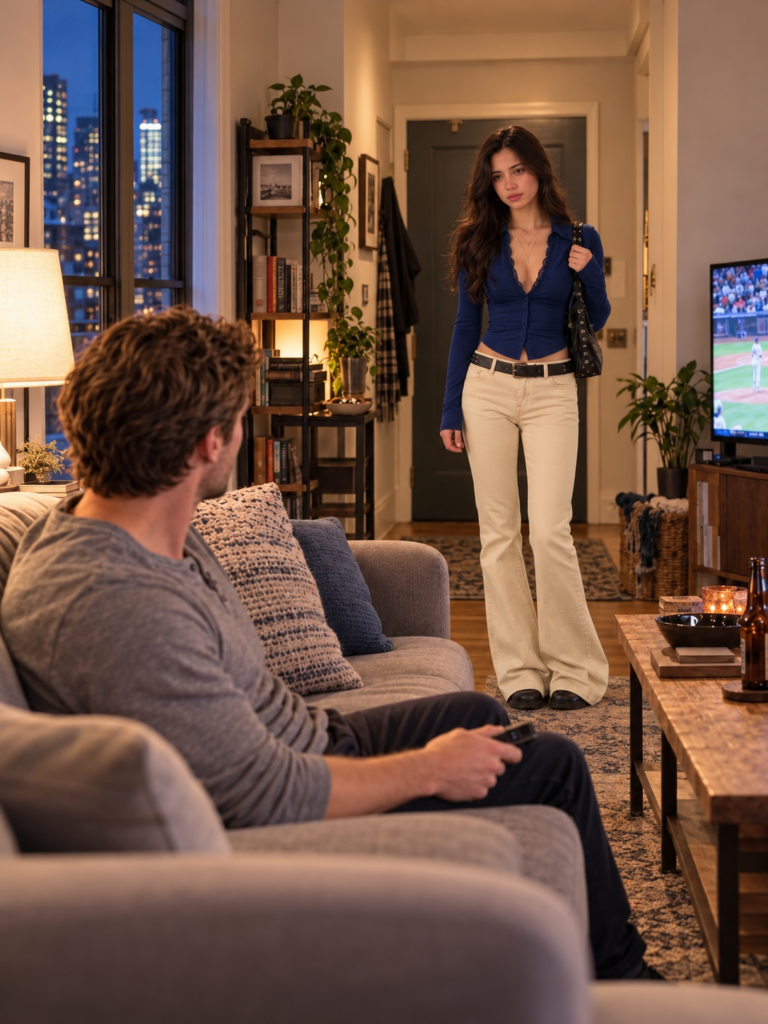
I was sitting on our living room couch in Chicago, wearing an old gray sweatshirt and pretending to watch a documentary about people renovating houses they could never afford. The television flickered against the walls of our small apartment. An untouched mug of coffee sat on the table beside me.
Then came the familiar sound of keys dropping into the ceramic bowl near the entrance.
Emily was home.
And judging by the silence that followed, something had gone wrong.
Usually, Emily Bennett entered a room like a marching band.
She complained about the weather, kicked off her shoes, asked whether I’d eaten dinner, and somehow managed to tell me three unrelated stories before removing her coat.
Tonight, she said nothing.
I turned toward the hallway.
She stood just inside the doorway, one hand resting against the wall.
Her dark brown hair fell in soft waves over her shoulders. The navy-blue dress she’d borrowed from her sister hugged her figure beautifully. Her makeup was perfect, her earrings caught the hallway light, and she’d spent nearly forty minutes deciding which shoes would make the best impression.
She looked absolutely stunning.
She also looked as though someone had taken something important away from her.
“Hey,” I said.
She glanced up.
“Hey.”
“How was the big date?”
Emily stared at me for a moment.
Then she bent down, removed one high heel, and dropped it onto the floor.
The second followed.
“Fine.”
I muted the television.
“Fine?”
“That’s what I said.”
“You spent three hours getting ready. You made me smell four different perfumes. You asked whether your earrings looked sophisticated or desperate. And now all I get is ‘fine’?”
One corner of her mouth lifted.
“They were sophisticated.”
“They were definitely desperate.”
She threw a shoe at me.
I caught it.
For a second, everything felt normal.
Then her smile disappeared.
She walked toward the couch and sat beside me, leaving barely six inches between us.
I noticed she was twisting the silver ring on her right hand.
She only did that when she was nervous.
“Was he rude?” I asked.
“No.”
“Bad manners?”
“No.”
“Did he spend the entire evening talking about cryptocurrency?”
That earned a small laugh.
“No, Daniel.”
“Then what happened?”
Emily looked toward the television.
“He was nice.”
“That’s what people say when a date is terrible.”
“He was more than nice.”
I waited.
“He was handsome. Funny. Successful. He remembered everything I told him about myself. He asked about my job, my sister, my plans for the future.”
“Sounds awful.”
“Daniel.”
“What?”
She turned toward me.
Her eyes were shining.
“He wasn’t you.”
I frowned.
“What?”
She swallowed.
“He wasn’t you. And I hated that.”
For several seconds, I couldn’t move.
The refrigerator hummed in the kitchen.
Somewhere outside, a police siren passed through the late-night streets.
Emily looked down at her hands.
“Every time he did something sweet, I kept thinking about what you would have done instead.”
I stared at her.
“When he opened the restaurant door, I imagined you making some stupid joke about royalty.”
“Well, you do have expensive taste.”
“When he complimented my dress, I wondered what you’d say.”
I tried to laugh.
“Probably that your sister should start charging rental fees.”
Emily didn’t smile.
“And when he reached across the table and held my hand…”
Her voice broke.
“I wished it was yours.”
Something inside my chest seemed to stop working.
I had imagined Emily saying those words hundreds of times.
Usually late at night.
Usually when she was asleep in the bedroom across the hall.
Usually during those brief, dangerous moments when hope was stronger than common sense.
But imagination hadn’t prepared me for the real thing.
“Emily,” I said carefully, “are you sure you’re not just disappointed?”
She shook her head.
“That’s what I’ve been telling myself for months.”
I looked away.
Because if I kept looking at her, I was going to say something I couldn’t take back.
My name is Daniel Carter.
I was twenty-nine years old, a graphic designer whose freelance income sometimes disappeared faster than my grocery money, and I’d been sharing an apartment with Emily Bennett for almost two years.
We met through a mutual friend named Sarah.
At the time, neither of us could afford Chicago rent alone.
Emily needed a roommate after her previous apartment building raised its prices. I needed someone to take the spare bedroom after my college friend moved to Denver.
We met at a coffee shop.
She arrived fourteen minutes late, carrying a broken umbrella and apologizing to everyone within hearing distance.
“I promise I’m usually more organized,” she told me.
Five minutes later, she spilled coffee on her application paperwork.
I should have taken that as a warning.
Instead, I laughed.
Three weeks later, she moved in with six cardboard boxes, eleven houseplants, and an unreasonable number of coffee mugs.
Within a month, she had rearranged the kitchen.
Within three months, she knew my favorite food, my mother’s birthday, and exactly how to make me laugh when I’d had a terrible day.
Within six months, I was hopelessly in love with her.
And I never told her.
At first, I convinced myself it was temporary.
She was beautiful, funny, generous, and easy to talk to. Of course, living together could create confusing feelings.
But it wasn’t just her appearance.
It was the little things.
The way she sang terribly while making pancakes.
The way she gave names to the neighborhood stray cats.
The way she always remembered when someone had an important interview or medical appointment.
The way she left sticky notes on the refrigerator.
Don’t forget your lunch, idiot.
Bought more milk. You’re welcome.
Good luck with the presentation. You’re going to crush it.
I kept every note.
They were hidden in a shoebox beneath my bed.
Pathetic, maybe.
But love makes ordinary people do ridiculous things.
Then my father died.
It happened on a Tuesday morning, completely without warning.
A heart attack.
One phone call from my mother, and the entire world became something I no longer recognized.
I barely remembered driving to the hospital.
I barely remembered the funeral.
What I remembered was coming home afterward, sitting on our kitchen floor, and realizing I would never hear my father’s voice again.
Emily found me there.
She didn’t ask why I wasn’t in bed.
She didn’t tell me to be strong.
She just sat beside me.
For hours, we said almost nothing.
Eventually, I started crying.
The kind of crying that embarrasses you afterward because you can’t control it.
Emily took my hand.
And she didn’t let go.
When the sun came up, we were still sitting there.
That was the night I realized I didn’t simply have feelings for her.
I loved her.
Completely.
Terrifyingly.
And I had no idea what to do about it.
Because she was my best friend.
My family.
My home.
If I told her and she didn’t feel the same way, I’d lose more than a possible girlfriend.
I’d lose the person who made coming home worthwhile.
So I stayed quiet.
I dated other women occasionally.
A teacher named Rachel.
A nurse named Olivia.
A woman from my gym who somehow managed to turn every dinner conversation into an argument about personality types.
None of those relationships lasted.
And every time they ended, Emily would appear with takeout and an old movie.
“You’ll find someone,” she’d tell me.
I’d look at her and think, I already did.
Three months before that Friday night, she announced she was tired of being single.
We were eating Chinese food on the couch.
“I want something real,” she said.
I kept my attention on the television.
“Define real.”
“Someone who chooses me. Someone who notices the little things. Someone who makes ordinary days feel special.”
I almost told her.
The words rose into my throat.
I choose you every morning.
I notice everything.
I would spend the rest of my life making ordinary days special if you’d let me.
Instead, I handed her another spring roll.
“Then we’ll find you someone amazing.”
She leaned over and hugged me.
I closed my eyes.
It was one of the worst decisions I’d ever made.
Because once Emily started dating, I discovered a special kind of misery.
Watching the person you love get ready for someone else.
Helping her choose an outfit.
Telling her she looked beautiful.
And smiling when she walked out the door.
It hurt in ways I couldn’t explain.
But I did it.
Because being a good friend meant wanting her to be happy.
Even if that happiness had nothing to do with me.
Now, sitting beside her at almost midnight, I could barely recognize my own thoughts.
“He really was wonderful,” Emily whispered.
“Marcus?”
She nodded.
“Then why are you upset?”
“Because I wanted to enjoy it.”
She rubbed her hands together.
“I wanted to sit across from him and feel excited. I wanted to imagine another date. Another dinner. Maybe something serious.”
“And?”
“And all I could think about was coming home.”
She turned toward me.
“Coming home to you.”
I took a shaky breath.
“Emily—”
“Please don’t make a joke.”
That silenced me.
She looked down.
“I know you use humor when you’re uncomfortable.”
I gave a weak smile.
“Am I that obvious?”
“To me? Yes.”
She stood and walked into the kitchen.
I followed.
She filled a glass with water but didn’t drink.
“Do you know why I agreed to go out with Marcus?”
“Because you liked him?”
“Because I wanted to stop thinking about you.”
The words landed between us.
I gripped the edge of the counter.
“What?”
She looked at me.
“I thought if I met someone good enough, whatever this is would go away.”
“Whatever what is?”
Her eyes filled with tears.
“Daniel, please.”
My heart was pounding.
“Say it.”
She set down the glass.
“I think I’m in love with you.”
The apartment went completely silent.
I had dreamed about those words for almost eighteen months.
And now that she’d finally said them, I couldn’t speak.
Emily mistook my silence for rejection.
Of course she did.
Her expression crumpled.
“I’m sorry,” she whispered. “I shouldn’t have said anything.”
She moved toward the hallway.
I stepped in front of her.
“Wait.”
“Daniel, it’s okay.”
“No, it’s not.”
She stared at me.
I took a breath.
“I’ve been in love with you since the first year you moved in.”
She blinked.
“What?”
“I didn’t tell you because I was afraid.”
“Afraid of what?”
“Losing you.”
Her lips parted.
I continued before courage abandoned me.
“When Dad died, you sat with me all night. You were the only person who didn’t make me feel like I needed to pretend I was okay.”
A tear slipped down her cheek.
“And somewhere along the way, you became the first person I wanted to tell everything to.”
“Daniel…”
“I love you, Emily.”
Her hand rose to cover her mouth.
“I’ve loved you for a long time.”
She stepped closer.
“So why didn’t you say something?”
I laughed without humor.
“Because this apartment is too small to survive one of us getting rejected.”
That made her laugh through her tears.
Then she looked up at me.
“Can I ask you something?”
“Anything.”
“Were you jealous tonight?”
I looked at her.
“Painfully.”
She smiled.
“Good.”
“Good?”
“Because I was jealous every time you went on a date, too.”
I stared.
“Seriously?”
“Do you remember Rachel?”
“The teacher?”
“I hated Rachel.”
“She was nice.”
“She was too nice.”
I laughed.
Emily laughed, too.
And suddenly the tension between us softened into something almost unbearable.
We stood only inches apart.
I could smell her perfume.
Vanilla and something floral.
The same perfume she’d asked me to help choose earlier that evening.
“Daniel,” she whispered.
“Yeah?”
“Are you going to kiss me?”
My heart jumped.
“Do you want me to?”
She smiled.
“I’ve been waiting a very long time.”
I lifted my hand toward her cheek.
She closed her eyes.
And just before our lips met, her phone started ringing.
We both froze.
It was on the kitchen counter.
The screen lit up.
MARCUS CALLING.
Emily opened her eyes.
I looked at the phone.
She looked at me.
Neither of us moved.
Finally, the call ended.
A message appeared.
I had an amazing time tonight. I’d really like to see you again.
Emily stared at it.
Then she slowly stepped back.
“I need to think,” she whispered.
The sudden distance between us felt enormous.
“About Marcus?”
“About everything.”
I nodded.
Because what else could I do?
She took her phone.
“Good night, Daniel.”
“Good night.”
I watched her disappear into the hallway.
Her bedroom door closed softly.
I stood alone in the kitchen for several minutes.
Then I turned off the light and walked toward my room.
For the first time in two years, Emily knew I loved her.
For the first time, she’d admitted she loved me.
And somehow, I was more frightened than I’d ever been.
Because just when I thought we were finally finding our way toward each other, another man was still waiting for her answer.
And he had done absolutely nothing wrong.
Part 2
The next morning, I burned the toast.
Not slightly.
Completely.
The kitchen smelled like an electrical fire.
I stood beside the toaster holding a piece of blackened bread, wondering whether my life had become a romantic comedy written by someone who hated me.
“Wow.”
I turned.
Emily stood in the doorway wearing an oversized gray sweatshirt and black leggings.
Her hair was tied in a messy bun.
She looked tired.
Beautiful, but tired.
“Breakfast?” she asked.
“I was going for something sophisticated.”
“Charcoal is very expensive in some restaurants.”
“Exactly.”
She smiled.
Then her eyes met mine.
The smile faded.
We both remembered the night before.
“Coffee?” I asked.
“Please.”
I reached for her favorite mug.
The yellow one with the chipped handle.
She watched me.
“You always remember which mug I like.”
“Well, you threatened to disown me the last time I used it.”
“I did not.”
“You said I was dead to you.”
“That was different.”
I placed the coffee in front of her.
She sat at the table.
I sat opposite her.
For a while, neither of us spoke.
Finally, Emily sighed.
“Daniel, there’s something about Marcus you need to know.”
I put down my cup.
“Okay.”
“He wants to see me again.”
I nodded.
“I figured.”
“And I told him I’d think about it.”
My stomach tightened.
“Why?”
She looked into her coffee.
“Because last night was confusing.”
I tried not to show how much that hurt.
“Confusing?”
“Not my feelings,” she said quickly. “Those aren’t confusing anymore.”
“Then what is?”
“Everything that happens after we admit them.”
She looked around the kitchen.
“We live together. We split rent. We share groceries. You know my family. I know yours.”
“Isn’t that a good thing?”
“It is. Until something goes wrong.”
I looked at her.
“You’re thinking about breaking up before we’ve even had a first date?”
She gave a small, sad laugh.
“I know how ridiculous that sounds.”
“It sounds like you’re scared.”
“I am.”
“So am I.”
She twisted her ring.
“What if we try this and realize we’re better as friends?”
I didn’t answer immediately.
Because I’d wondered the same thing.
What if the thing we’d spent years imagining was better in our heads than in real life?
What if dating exposed parts of us we couldn’t accept?
What if one argument destroyed the home we’d carefully built?
Emily leaned forward.
“There’s something else.”
I waited.
“Marcus was very clear about what he wanted.”
“Which is?”
“A serious relationship.”
I looked away.
“And you?”
“I want that, too.”
“With him?”
She hesitated.
“No.”
The word was quiet but firm.
I looked back.
“Then why are we talking about him?”
“Because he’s a real person, Daniel. Not a backup plan. Not some convenient test to figure out how I feel about you.”
I said nothing.
“And I owe him an honest answer.”
That was the Emily I loved.
Even in the middle of something complicated, she was worrying about hurting someone who’d treated her kindly.
“Then give him one,” I said.
She studied my face.
“You’re not angry?”
“I’m scared. There’s a difference.”
Her expression softened.
“I don’t want to lose you.”
“You won’t lose me because you tell someone the truth.”
She reached across the table.
Her fingers touched mine.
“That’s not the part I’m afraid of.”
I looked at our hands.
“What are you afraid of?”
She swallowed.
“That one day you’ll regret choosing me.”
I stared at her.
For a moment, I couldn’t understand the words.
Emily was brilliant.
She was funny.
She remembered birthdays, rescued dying houseplants, and somehow made every miserable winter feel less miserable.
The idea that she might believe I could regret loving her seemed impossible.
“Why would you think that?”
She glanced down.
“Because you’ve seen the best parts of me.”
“I’ve also seen you eat cereal directly out of the box.”
“Daniel.”
“And I’ve seen you cry because a fictional dog died.”
“That dog deserved better.”
“And I’ve watched you threaten a parking meter.”
“It stole my money.”
I smiled.
Then I reached for her hand properly.
“Emily, I know you.”
She looked at me.
“I know you leave your clothes in the dryer for three days. I know you get anxious before work meetings. I know you hate admitting when you’re wrong.”
“I’m working on that.”
“I know.”
My thumb brushed across her knuckles.
“And I know you stayed awake all night with me when my entire world fell apart.”
Her eyes filled.
“I’m not choosing some perfect version of you.”
I held her gaze.
“I’m choosing the person who’s already been here.”
She took a shaky breath.
“That’s a pretty good answer.”
“I’ve had two years to practice.”
She laughed.
Then she squeezed my hand.
“I need to call Marcus.”
“Okay.”
“And I think we should take things slowly.”
“How slowly?”
She considered.
“One date.”
I smiled.
“Just one?”
“One official date. No pretending. No hiding behind the roommate excuse.”
“Deal.”
She stood.
Then hesitated.
“Can I hug you?”
I opened my arms.
“Emily, you’ve been hugging me for two years.”
“I know. It feels different now.”
She stepped into my embrace.
And she was right.
It did feel different.
Her arms circled my waist.
Mine settled around her shoulders.
Neither of us moved away.
For the first time, there was no pretending that the moment meant nothing.
Emily called Marcus that afternoon.
I didn’t listen.
I went to my bedroom, closed the door, and attempted to finish a design project for a local restaurant.
The client wanted a new logo.
I’d already sent six versions.
They hated all of them.
Apparently, they wanted something “more modern but also traditional.”
Which, in graphic design, usually means nobody knows what they want.
I was adjusting a font when someone knocked.
“Come in.”
Emily appeared.
“Hey.”
“Hey.”
“I talked to him.”
I closed my laptop.
“How’d it go?”
She sat on the edge of my bed.
“He was disappointed.”
I nodded.
“He asked if he’d done something wrong.”
“What did you say?”
“That he’d done everything right.”
I waited.
“And that I realized my feelings were somewhere else.”
She looked down at her hands.
“He asked whether there was someone else.”
My stomach tightened.
“And?”
“I told him there was.”
I exhaled.
Emily glanced up.
“He was kind about it. More kind than he needed to be.”
“Sounds like a good guy.”
“He is.”
She looked toward the window.
“Which made it harder.”
I understood.
Sometimes, a person can be wonderful and still not be right for you.
That doesn’t make anyone a villain.
It just makes the situation painful.
“He deserves someone who’s excited to see him,” I said.
Emily nodded.
“That’s what he said.”
She went quiet.
Then she smiled faintly.
“He also said he hoped the guy knew how lucky he was.”
I stared at her.
“Really?”
“Really.”
I leaned back.
“Well, the guy sounds incredibly handsome.”
Emily rolled her eyes.
“There he is.”
“What?”
“The man who ruins every emotional moment with a joke.”
“It’s a gift.”
She laughed.
Then she looked at me differently.
“Daniel?”
“Yeah?”
“Are we really doing this?”
I took her hand.
“I think we are.”
For the next week, we became the two most awkward adults in Chicago.
Nothing in our apartment had changed.
And everything had changed.
We still argued about the thermostat.
We still ate dinner on the couch.
Emily still stole my sweatshirts.
But suddenly, every ordinary interaction carried a new meaning.
When our hands touched while reaching for the same plate, we’d both stop.
When she came home from work, I’d wonder whether I should hug her differently.
When we watched television, neither of us knew whether sitting close was normal or romantic.
On Wednesday night, I tried holding her hand during a movie.
She looked down.
Then looked at me.
“Are you asking permission with your fingers?”
I immediately pulled away.
“No.”
She laughed.
“Daniel.”
“What?”
“Just hold my hand.”
So I did.
It should have been simple.
It wasn’t.
My heart raced like I was fifteen.
Emily squeezed my fingers.
“You’re nervous.”
“No.”
“Your hand is sweating.”
“It’s unusually warm in here.”
“It’s November.”
“Climate change.”
She burst out laughing.
And just like that, the awkwardness became something sweet.
We were learning a new language using words we’d known for years.
But outside our little apartment, life didn’t become easier just because we’d admitted our feelings.
I had money problems.
Real ones.
The small design agency I’d contracted with for nearly eighteen months had lost two major clients. My hours were reduced, and several freelance invoices were still unpaid.
I was behind on my savings goal.
My car needed new brake pads.
And the rent had increased again.
Emily had her own worries.
Her marketing department was being reorganized after a company merger. Nobody had officially announced layoffs, but everyone had started speaking in careful sentences.
That Thursday, she came home unusually quiet.
I was at the kitchen table, staring at an overdue invoice.
“Bad day?” I asked.
She dropped her bag.
“Wonderful. Absolutely magical.”
“That bad?”
“My manager called a meeting and used the phrase ‘streamlining team resources’ seven times.”
I winced.
“That’s never good.”
“Three people are being moved to other departments. Two positions might disappear.”
“Yours?”
“I don’t know.”
She sat opposite me.
For the first time, I noticed how exhausted she looked.
“Emily…”
“I’m okay.”
“You don’t look okay.”
She rubbed her forehead.
“I just hate not knowing.”
I reached across the table.
She took my hand.
And for several minutes, we sat quietly.
Then she noticed the papers beside my laptop.
“What’s that?”
“Nothing.”
“Daniel.”
I sighed.
“One of my clients hasn’t paid me.”
“How much?”
“Enough.”
“How much?”
“Twelve hundred.”
Her eyes widened.
“Dollars?”
“No, jelly beans.”
She didn’t smile.
“That’s serious.”
“I know.”
“Are you going to be okay?”
“Yeah.”
She looked at me carefully.
“Are you saying that because it’s true or because you don’t want me to worry?”
I hesitated.
She sighed.
“See? We already have a problem.”
“What problem?”
“We’re still pretending we’re fine when we’re not.”
I leaned back.
She was right.
We’d spent years protecting our friendship by hiding the deepest parts of ourselves.
Now we were trying to build something more honest.
And honesty, I was discovering, wasn’t always romantic.
Sometimes it meant admitting you were worried about paying bills.
Sometimes it meant saying you were scared your job would disappear.
Sometimes it meant letting someone see that you didn’t have everything under control.
“I’ll manage,” I said. “But I’m worried.”
Emily nodded.
“Me too.”
We sat there, holding hands across a table covered in unpaid invoices and grocery receipts.
It wasn’t the kind of romantic scene people put in movies.
But it felt important.
Maybe more important than flowers.
Maybe more important than candlelight.
Because for the first time, neither of us was pretending.
On Friday evening, Emily came home carrying two movie tickets and a paper bag filled with popcorn.
“I have a proposal,” she announced.
I looked up from my laptop.
“That sounds dangerous.”
“Let’s go on a date.”
I blinked.
“With you?”
“No, Daniel. With the man hiding behind your laptop.”
I looked over my shoulder.
Nobody was there.
Emily laughed.
“You’re an idiot.”
“You’re the one who asked me out.”
“And I’m already reconsidering.”
I stood.
“Where are we going?”
“There’s a little Italian restaurant downtown.”
I frowned.
“The one near the theater?”
She nodded.
“The one you said you wanted to try.”
I stared.
“I mentioned that months ago.”
“Eleven months.”
“You remember?”
She shrugged.
“I listen when you talk.”
I smiled.
“You usually pretend not to.”
“That’s because half the time you’re talking about fonts.”
“Typography is fascinating.”
“Of course it is.”
She walked toward her room.
“Be ready at seven.”
“Do I need a suit?”
“Clean jeans will be a miracle.”
Our first official date was a disaster.
At least, that’s what I thought during the first twenty minutes.
I arrived at the restaurant before Emily, even though we’d left the same apartment.
We’d agreed that I would go ahead and wait for her outside.
It seemed romantic in theory.
In practice, it made us both feel ridiculous.
When she arrived, she was wearing a soft green dress and a black coat.
I forgot what I was going to say.
She stopped in front of me.
“Well?”
“Well what?”
“Are you going to compliment me?”
I blinked.
“You look…”
She smiled.
“Yes?”
“Really beautiful.”
Her expression changed.
Because I’d told her she looked beautiful before.
Dozens of times.
But now I wasn’t pretending it was casual.
“Thank you,” she whispered.
I opened the restaurant door.
She grinned.
“Wow. Such a gentleman.”
“Your Majesty.”
She laughed.
And for one wonderful second, I remembered what she’d said about Marcus.
That when he opened the door for her, she’d imagined me making a stupid joke.
Now I was making it.
And she was here.
With me.
Inside, however, everything became awkward again.
We didn’t know whether to hold hands across the table.
I accidentally called her “dude.”
She spilled water on the menu.
Then the waiter asked how long we’d been together.
“Two years,” Emily said.
“One week,” I said at the same time.
The waiter looked confused.
Emily covered her face.
“It’s complicated.”
The man nodded solemnly.
“I understand.”
I’m fairly certain he did not understand.
By dessert, though, we’d relaxed.
We talked about our first meeting.
About Sarah.
About the apartment.
About the stupid fights we’d had over dishes and laundry.
And eventually, about our biggest fears.
“Can I ask something serious?” Emily said.
“Of course.”
“Why didn’t you ever tell me?”
I stared at my plate.
“I thought about it.”
“When?”
“All the time.”
She looked surprised.
“Really?”
I nodded.
“Your birthday last year. That night we watched the fireworks at Navy Pier. When you came with me to Dad’s memorial.”
Emily’s expression softened.
“Daniel…”
“I always found a reason not to.”
“What stopped you?”
I looked at her.
“You were the best thing in my life. I didn’t want to be selfish and risk losing that.”
She was quiet for a long moment.
Then she reached across the table.
“I wish you’d told me.”
“Me too.”
She squeezed my hand.
“But maybe we weren’t ready.”
I considered that.
Maybe she was right.
Two years earlier, I wouldn’t have known how to handle the fear I was feeling.
And Emily was still learning to trust that someone could love her without eventually walking away.
“Can I ask you something?” I said.
She nodded.
“When did you start feeling something?”
She looked embarrassed.
“Remember the snowstorm last February?”
“The one where the trains stopped running?”
She nodded.
I remembered.
Emily had gotten stranded at work after a long afternoon meeting.
Her phone was almost dead.
It was below freezing.
I drove across the city to pick her up, even though the roads were terrible and my windshield wipers barely worked.
When she climbed into the car, she found a blanket on the passenger seat and a thermos of hot chocolate in the cup holder.
“You remembered I hate being cold,” she’d said.
I shrugged.
“Hard to forget when you complain about it every eleven minutes.”
Now, sitting across from me at the restaurant, she smiled.
“That night, I realized something.”
“What?”
“I’d spent years thinking love was supposed to be dramatic.”
She glanced down.
“Big gestures. Perfect dates. Someone sweeping me off my feet.”
“And?”
“And then there you were, driving through a snowstorm in a car that made terrifying noises just because I needed a ride.”
I laughed softly.
“That car still makes terrifying noises.”
“I know.”
She smiled.
“But I remember looking at you and thinking, ‘This is what I want.'”
My chest tightened.
“Why didn’t you tell me?”
She gave me a look.
“For the same stupid reason you didn’t tell me.”
We sat in silence.
Then we both started laughing.
Two adults.
Two years.
Both in love.
Both terrified.
And neither brave enough to say anything.
The first month was beautiful.
And difficult.
We discovered that friendship had made some things easier but had hidden other problems.
Emily expected me to communicate more openly.
I expected her to understand when I needed quiet after a stressful day.
Sometimes, she thought my silence meant I was angry.
Sometimes, I thought her questions meant she didn’t trust me.
We argued about things that suddenly felt bigger than they should.
One Saturday, I canceled dinner with her sister because a client demanded last-minute revisions.
Emily was furious.
“You could have told me earlier.”
“I didn’t know earlier.”
“You knew you were behind on the project.”
“Emily, I need the money.”
“And I understand that. But you promised me.”
I snapped.
“Not everything can revolve around us.”
The moment the words left my mouth, I regretted them.
Emily went silent.
“That’s not what I meant,” I said.
She took her coat.
“I need some air.”
The door closed.
I stood in the apartment feeling sick.
For years, our disagreements had been small.
Roommate disagreements.
Now there were expectations.
Promises.
Feelings that could be hurt in deeper ways.
I waited twenty minutes.
Then I put on my coat and went looking for her.
I found her sitting on a bench near the little park two blocks away.
The air was freezing.
“Hey,” I said.
She didn’t look up.
“Hey.”
I sat beside her.
“I’m sorry.”
She rubbed her hands together.
“I know work is stressful.”
“That’s not an excuse.”
She looked at me.
“I don’t need you to be perfect, Daniel.”
“I know.”
“I just need you to remember that your decisions affect me now, too.”
I nodded.
“You’re right.”
She exhaled.
“And I’m sorry I acted like you could just ignore a client. I know things are tight.”
For a moment, we sat quietly.
Then I reached for her hand.
“Can we make a rule?”
“What rule?”
“No walking away without telling the other person where we’re going.”
She considered.
“Okay.”
“And no pretending we’re fine when we’re not.”
She smiled faintly.
“That’s two rules.”
“I’m an ambitious man.”
She laughed.
Then she leaned against my shoulder.
“I’m scared,” she admitted.
“Of what?”
“Messing this up.”
I kissed the top of her head.
“Me too.”
“What if we’re terrible at this?”
“Then we learn.”
She looked up.
“Together?”
“Together.”
Two weeks later, my biggest design contract ended.
The client had been struggling financially.
They weren’t renewing.
I read the email three times.
Then I sat in my car outside the grocery store, staring at the screen.
Losing that contract meant losing almost a third of my monthly income.
Christmas was approaching.
Rent was due.
And my savings account was already thinner than I wanted to admit.
I didn’t tell Emily immediately.
That was my mistake.
Again.
For three days, I acted normal.
I made coffee.
I cooked dinner.
I kissed her goodbye before work.
And every night, I stayed awake searching for jobs.
Emily noticed.
Of course she noticed.
On Thursday, she came into my room carrying two mugs of tea.
“What’s going on?”
“Nothing.”
She looked at my laptop.
Dozens of job listings filled the screen.
“Daniel.”
I closed my eyes.
“I lost the restaurant contract.”
She sat beside me.
“When?”
“Monday.”
Her face fell.
“Why didn’t you tell me?”
“Because you’re dealing with enough at work.”
“That’s not an answer.”
I rubbed my face.
“I didn’t want you to think I couldn’t handle my responsibilities.”
Emily set down the tea.
“Do you think I’d love you less because you lost a client?”
“No.”
“Then what?”
I couldn’t answer.
Because the truth was embarrassing.
I wanted to be someone she could depend on.
Someone stable.
Someone who could take her to nice restaurants and buy her Christmas presents without checking his bank account first.
I didn’t want to be the guy worrying about whether he could afford new tires.
Emily waited.
Finally, I whispered, “I’m afraid I’m not enough.”
Her expression changed.
“Daniel.”
I looked away.
She moved closer.
“Look at me.”
I did.
“I fell in love with you when you were eating cereal for dinner and complaining about your student loans.”
Despite myself, I laughed.
“I still complain about those.”
“Exactly.”
She took my hand.
“I didn’t fall in love with your paycheck.”
My throat tightened.
“I fell in love with the man who remembers my coffee. The man who drove through a snowstorm to pick me up. The man who sat with me when I thought my career was falling apart.”
She paused.
“And the man who’s been there for me even when nobody was watching.”
I swallowed.
“What if things get worse?”
“Then we’ll deal with them.”
“Emily—”
“Together, Daniel.”
She squeezed my hand.
“That’s what being together means.”
I looked at her.
And for the first time, I understood something I’d missed during all those years of silent longing.
Loving Emily wasn’t just about wanting to protect her.
It was about trusting her enough to let her stand beside me.
Even when life was messy.
Even when I was afraid.
Even when I didn’t have a solution.
I pulled her into my arms.
She held me tightly.
Then she whispered, “Besides, your portfolio is better than half the designers at my company.”
I laughed.
“You’re biased.”
“Completely.”
She leaned back.
“But I’m also right.”
A week later, Emily’s company announced layoffs.
Her position survived.
But her closest coworker, a woman named Natalie who’d been with the company for eight years, lost her job.
Emily came home devastated.
“They treated her like a number,” she said.
I held her while she cried.
The next morning, she began helping Natalie update her résumé.
I volunteered to redesign her portfolio.
Neither of us had much extra time.
But we knew what it felt like to be afraid of losing everything you’d worked for.
Over the following weeks, I took small freelance projects.
Restaurant menus.
Business cards.
Holiday advertisements.
A logo for a neighborhood bakery.
None paid particularly well.
But each helped.
Emily picked up additional responsibilities at work.
We started cooking at home more often.
We canceled unnecessary subscriptions.
And instead of exchanging expensive Christmas gifts, we agreed to spend no more than thirty dollars each.
“Romantic,” I said.
“Extremely,” Emily replied.
Then she kissed me.
And somehow, it was.
Christmas Eve arrived with snow drifting across the windows.
Our apartment smelled like cinnamon.
Emily had insisted on baking cookies, despite having no particular talent for baking.
I had burned the first batch.
She’d burned the second.
By the third, we’d accepted that the grocery-store bakery was better equipped for the job.
We sat on the living room floor beside our tiny Christmas tree.
The lights blinked unevenly.
Half the ornaments came from Emily’s childhood.
The others were cheap decorations we’d collected over the years.
One of them was a little wooden house.
My father had given it to me when I first moved to Chicago.
Emily noticed me looking at it.
“Thinking about him?”
I nodded.
“He would’ve liked you.”
She leaned against me.
“I wish I’d met him.”
“He would’ve made terrible jokes.”
“Sounds familiar.”
“And he would’ve pretended to dislike you for about ten minutes.”
She smiled.
“Then what?”
“Then he would’ve asked whether you were planning to marry me.”
Emily went completely still.
I noticed.
“Sorry. That came out weird.”
She shook her head.
“No.”
She looked at the ornament.
“It’s just strange.”
“What is?”
“How much has changed.”
I smiled.
“Three months ago, you were getting ready for a date with Marcus.”
“And you were pretending not to care.”
“I was very convincing.”
“You were terrible.”
We laughed.
Then she reached for my hand.
“Daniel?”
“Yeah?”
“I used to think the hard part would be finding someone I loved.”
“And now?”
She looked at me.
“Now I think the hard part is learning how to let someone love me.”
I kissed her forehead.
“You’re doing pretty well.”
She smiled.
“So are you.”
We exchanged presents.
I gave her a little silver necklace with a tiny star pendant.
It had cost twenty-eight dollars.
I’d spent three days deciding whether she would like it.
She opened the box and went silent.
“Daniel…”
“It’s not much.”
She shook her head.
“Don’t say that.”
She lifted the necklace.
“It’s beautiful.”
I fastened it around her neck.
She touched the pendant.
Then she handed me a small envelope.
Inside was a photograph.
It showed us standing outside the Italian restaurant on our first date.
We were laughing.
My hair was a mess.
Emily’s eyes were closed.
Neither of us looked particularly sophisticated.
Beneath the picture, she’d written:
To the person who felt like home before I understood what home really meant.
I stared at the words.
For a long time, I couldn’t speak.
Emily watched me nervously.
“Do you like it?”
I looked at her.
“I love it.”
She smiled.
Then she leaned forward and kissed me.
And for the first time in years, Christmas didn’t feel like a holiday I was merely trying to survive without my father.
It felt like the beginning of something.
But a few weeks later, just when life seemed to be settling into a beautiful new rhythm, Emily came home holding a letter.
She stood in the doorway without removing her coat.
Her face was pale.
“Daniel,” she said.
I looked up.
“What’s wrong?”
She handed me the envelope.
I recognized the company logo.
It belonged to a marketing firm in New York.
A company Emily had admired for years.
I unfolded the letter.
And as I read the first paragraph, I felt my heart begin to sink.
Emily had been offered a promotion.
A remarkable one.
A position she’d dreamed about.
A salary that would change her financial future.
There was just one problem.
She would have to move.
In six weeks.
And the letter required her decision by Monday.
I looked up.
Emily’s eyes filled with tears.
“I don’t know what to do,” she whispered.
Because suddenly, the future we’d only just begun imagining together was standing at another crossroads.
And this time, love alone might not be enough to tell us which direction to take.
Part 3
For a long time, I stared at the letter.
New York.
Senior marketing manager.
A salary almost twice what Emily was earning.
Health benefits.
Relocation assistance.
A clear path toward the kind of career she’d spent years working to build.
It was everything she wanted.
Or at least, everything she’d wanted before us.
“That’s incredible,” I finally said.
Emily looked at me.
“Daniel.”
“What?”
“Don’t do that.”
“Do what?”
“Pretend this is simple.”
I put the letter down.
“It is incredible.”
“I know.”
“You should be proud.”
“I am.”
She removed her coat slowly.
“But?”
I swallowed.
“But New York is far away.”
She gave a small, humorless laugh.
“Yes.”
We sat at the kitchen table.
The same table where we’d shared breakfasts for two years.
The same table where she’d admitted she was jealous of the women I’d dated.
The same table where I’d confessed my fear that I wasn’t enough.
Now it held a letter that could change everything.
“When did you apply?” I asked.
“Before we started dating.”
I looked up.
“Before Marcus?”
She nodded.
“Almost four months ago.”
“Why didn’t you tell me?”
“I didn’t think anything would come of it.”
I waited.
“And when they contacted me for another interview, I didn’t want to say anything until I knew it was real.”
“How many interviews?”
“Three.”
My chest tightened.
“Three?”
She looked away.
“Daniel, I wasn’t hiding it to hurt you.”
“I know.”
But I was hurt.
Not because she’d applied.
Not because she’d been offered the job.
Because she’d been carrying this enormous possibility alone.
And somehow, despite everything we’d promised each other, neither of us had completely learned how to stop doing that.
Emily folded her hands.
“I thought if I got the offer, I’d know what I wanted.”
“And?”
She shook her head.
“I don’t.”
I looked toward the living room.
Our Christmas tree was still standing near the window.
Its lights were turned off.
The apartment felt strangely quiet.
“Do you want to go?” I asked.
She stared at me.
“That’s not fair.”
“Why?”
“Because you’re asking me to answer as if you don’t matter.”
I leaned forward.
“Emily, I matter. But your career matters, too.”
Tears filled her eyes.
“I know.”
“You worked hard for this.”
“I know.”
“And I don’t want to be the reason you turn down something you’ve dreamed about.”
She wiped her cheeks.
“Then what are you saying?”
I took a breath.
“I’m saying you should think about what you want.”
She looked at me for a long moment.
Then she whispered, “What if what I want is you?”
I couldn’t answer.
Because the words I’d once prayed to hear now came with a terrifying price.
We barely slept that night.
Emily stayed in her room.
I sat in the living room with my laptop, pretending to work.
Around two in the morning, I found an old email from my father.
He’d sent it shortly after I moved to Chicago.
I’d been complaining about how difficult it was to find a decent job.
His message was short.
Don’t confuse being afraid with making the wrong decision. Sometimes the things worth having scare you the most.
I read it three times.
Then I closed my laptop.
I thought about Emily.
About the woman who had spent years trying to build a career in marketing.
About how excited she’d been when she got her first promotion.
About the night she’d stayed awake preparing for a presentation.
About how proud she’d looked when her manager praised her campaign.
I loved all of those things about her.
So how could I ask her to give them up?
But there was another truth I couldn’t ignore.
I had spent almost two years being afraid to tell Emily how I felt.
Now, after finally finding the courage, I was terrified of losing her again.
I went to bed with no answers.
Saturday morning, Emily was already in the kitchen when I woke up.
She had made pancakes.
Actual pancakes.
Not cereal.
Not toast.
Pancakes.
That was how I knew she was nervous.
“Morning,” I said.
She smiled faintly.
“Morning.”
I sat down.
She placed a plate in front of me.
One pancake was shaped vaguely like a heart.
Or possibly a potato.
“What is that?” I asked.
“A romantic gesture.”
“Looks like Idaho.”
She laughed.
Then she sat down across from me.
“Can we talk?”
I nodded.
“Of course.”
She took a breath.
“I want the job.”
The words hurt.
But I nodded.
“You should.”
She watched my expression.
“I also want us.”
I set down my fork.
“Emily…”
“No, let me finish.”
She straightened.
“I spent years thinking I had to choose between being independent and being loved.”
I listened.
“Every relationship I’ve had made me feel like one part of my life needed to shrink to make room for another.”
She looked at me.
“And I don’t want that with you.”
“Neither do I.”
She swallowed.
“But I don’t know how to make both things work.”
I reached across the table.
“Then we figure it out.”
“How?”
I took a breath.
“Maybe long distance.”
Her face changed.
“Daniel…”
“Maybe I visit. Maybe you come back on weekends when you can. Maybe we see how it goes.”
She looked miserable.
“And what if we hate it?”
“Then we talk about it.”
“What if it’s too hard?”
“Then we talk about that, too.”
She stared at me.
“You’re making this sound easy.”
I shook my head.
“No. I’m saying I’m willing to try.”
Her eyes filled.
“I don’t want you to spend your life waiting for me.”
I smiled sadly.
“Emily, I already spent two years doing that.”
She laughed through her tears.
“That’s not funny.”
“A little funny.”
She wiped her cheeks.
Then her expression turned serious.
“Would you ever consider moving?”
The question surprised me.
“To New York?”
She nodded.
I leaned back.
For years, Chicago had been my home.
My friends were here.
My clients were here.
My mother lived only an hour away.
And my father’s grave was here.
Moving hadn’t crossed my mind.
But then I looked at Emily.
And I remembered something she’d written beneath our Christmas photograph.
To the person who felt like home before I understood what home really meant.
I wasn’t ready to promise anything.
Not yet.
But for the first time, I realized that staying in Chicago wasn’t the only possible future.
“I’d consider it,” I said.
Emily stared.
“Really?”
“Really.”
“But your work…”
“I’m a graphic designer. Some of my work can be done remotely.”
“And your mom?”
“I’d have to talk to her.”
She shook her head.
“I don’t want you to uproot your entire life for me.”
“And I don’t want you to give up your dream job for me.”
We looked at each other.
Then I smiled faintly.
“Look at us.”
“What?”
“Two people trying so hard not to hurt each other that we’re making ourselves miserable.”
Emily laughed.
“That’s pretty accurate.”
I stood.
Then I walked around the table and knelt beside her chair.
“Listen to me.”
She looked down.
“I love you.”
Her eyes softened.
“And I’m not going to ask you to become smaller so I can feel more secure.”
A tear slipped down her cheek.
“But I also need to be honest. I’m scared.”
“Me too.”
“I don’t know what happens next.”
“Neither do I.”
I took her hands.
“But I’d rather figure it out with you than spend another two years pretending I don’t care.”
She leaned forward and wrapped her arms around my neck.
I held her.
And we stayed like that until the pancakes got cold.
The following Monday, Emily accepted the job.
It was the right decision.
We both knew it.
That didn’t make it painless.
The next six weeks passed quickly.
Emily worked through her notice period.
She packed.
She met with moving companies.
She searched for apartments.
I helped her sort through two years of belongings.
We discovered she owned thirty-seven coffee mugs.
Thirty-seven.
“Emily,” I said, standing beside a box labeled KITCHEN.
“What?”
“Are you opening a café?”
She looked offended.
“Some of those are sentimental.”
“This one says World’s Okayest Employee.”
“Exactly. Very meaningful.”
I laughed.
But later that night, when I walked past the open boxes in the hallway, I felt a sharp ache in my chest.
She was really leaving.
Our apartment was slowly becoming something unfamiliar.
Her books disappeared from the shelves.
Her shoes vanished from the entrance.
The yellow coffee mug was wrapped carefully in newspaper.
Every empty space reminded me that love didn’t stop time.
My mother came to visit two weeks before Emily’s move.
She brought a casserole.
As usual.
Mom believed every emotional crisis could be improved by baked pasta.
We sat in the kitchen while Emily was at work.
“So,” Mom said.
“So.”
“New York.”
I nodded.
“Big change.”
“Yep.”
She watched me.
“Are you going with her?”
“I don’t know.”
Mom stirred her coffee.
“Do you want to?”
I hesitated.
“I want to be with her.”
“That’s not exactly what I asked.”
I looked at her.
She smiled gently.
“Your father and I spent the first year of our marriage living in different cities.”
I frowned.
“You did?”
She nodded.
“He got a job in Milwaukee. I was finishing my nursing program.”
“You never told me that.”
“It wasn’t particularly glamorous.”
“What happened?”
“We drove back and forth. Called whenever we could. Argued about who was making more sacrifices.”
I smiled.
“Sounds familiar.”
“It wasn’t easy.”
She looked toward the window.
“But we learned something important.”
“What?”
“You can love someone very much and still need to make decisions as two separate people.”
I thought about that.
Mom continued.
“The question isn’t whether you can survive being apart for a while.”
She looked at me.
“The question is whether you’re both working toward a future that makes sense for you.”
I nodded slowly.
“And Daniel?”
“Yeah?”
“Don’t stay in Chicago just because you’re afraid of changing your life.”
I looked up.
She smiled sadly.
“But don’t move to New York just because you’re afraid she’ll stop loving you.”
I sat with those words for a long time.
Then Mom reached across the table.
“Your father would be proud of you.”
My throat tightened.
“Why?”
“Because you’re finally learning that loving someone doesn’t mean holding on so tightly that neither of you can breathe.”
Emily moved to New York on a rainy Saturday morning.
We loaded her boxes into a rented moving truck.
Sarah came to help.
So did two friends from work.
The apartment looked empty.
Too empty.
When the last box disappeared, Emily stood in the living room and stared around.
“Wow.”
I stood beside her.
“Yeah.”
She looked toward the kitchen.
“Remember when I first moved in?”
“You spilled coffee on the floor before you even unpacked.”
She laughed.
“And you told me it was fine.”
“It was a lie.”
“I know.”
She looked toward the couch.
“That’s where you were sitting when I came home from Marcus’s date.”
I smiled.
“The most stressful Friday of my life.”
She turned toward me.
“Mine too.”
We stood in silence.
Then she reached for my hands.
“I don’t want this to feel like goodbye.”
“It isn’t.”
She swallowed.
“Promise?”
I looked into her eyes.
“I promise we’ll try.”
She nodded.
It wasn’t the grand declaration she’d asked for.
But it was the truest one I could give.
We kissed.
Then I helped her into the truck.
I watched the vehicle disappear down the street.
And for the first time in two years, I walked back into an apartment that felt completely empty.
Long distance was harder than either of us expected.
At first, we were optimistic.
We scheduled video calls.
We sent photographs.
We watched movies together online.
Emily showed me her new apartment.
It was small.
Expensive.
And barely large enough for her beloved coffee mugs.
I teased her about it.
She teased me about the mountain of laundry behind my desk.
For a few weeks, we managed.
Then real life interfered.
Emily’s new position was demanding.
She worked long days.
Sometimes she came home too exhausted to talk.
My freelance work became busier.
I landed a major client with complicated deadlines.
Our schedules stopped lining up.
One evening, I waited for our planned video call.
Emily didn’t answer.
Twenty minutes later, she sent a message.
I’m so sorry. Emergency meeting. Can we talk tomorrow?
I stared at the screen.
Then typed:
Of course.
I meant it.
Mostly.
But after I put down my phone, I sat alone on the couch and wondered whether this was how people slowly drifted apart.
Not through betrayal.
Not through a terrible argument.
Just through missed calls.
Exhaustion.
Distance.
And two lives moving in different directions.
Three months after Emily moved, we had our first serious long-distance argument.
She’d promised to visit Chicago for the weekend.
I’d arranged to take Friday afternoon off.
I bought groceries.
Cleaned the apartment.
Even purchased flowers.
Then, Thursday evening, she called.
Her face appeared on my laptop screen.
I knew immediately.
“What’s wrong?”
She bit her lip.
“Daniel…”
I closed my eyes.
“You can’t come.”
She shook her head.
“My team has a campaign launch Monday. Something went wrong with the client presentation.”
I stared at her.
“You’ve known about this visit for a month.”
“I know.”
“I rearranged work.”
“I know.”
I ran a hand through my hair.
“Emily, when are we supposed to see each other?”
She looked hurt.
“I’m trying.”
“So am I.”
“Do you think I want to cancel?”
“I don’t know what you want anymore.”
The words came out sharper than I intended.
Emily went still.
“What does that mean?”
I looked away.
“It means every time we make plans, something happens.”
“Because I have a job, Daniel.”
“I have a job, too.”
“I know that.”
“Then you know I can’t keep rearranging everything.”
She inhaled shakily.
“I never asked you to.”
I was silent.
Then she said something that hurt more than anything else.
“Maybe we should talk when we’re both calmer.”
The screen went dark a minute later.
I sat alone for a long time.
The flowers stood on the table.
Bright yellow tulips.
Her favorite.
I wanted to be angry.
It was easier than admitting how lonely I felt.
But eventually, I understood that Emily wasn’t choosing work over me.
She was trying to build a life we’d both agreed was worth building.
And I was allowing fear to turn ordinary disappointment into something much bigger.
I called her back.
She answered on the third ring.
Her eyes were red.
“Hey,” I said.
“Hey.”
“I’m sorry.”
She swallowed.
“Me too.”
I leaned toward the camera.
“I miss you.”
Her face crumpled.
“I miss you so much.”
“I know you’re trying.”
“So are you.”
We sat quietly.
Then I said, “I think we need an actual plan.”
She nodded.
“Not just visits whenever we can fit them in.”
“Okay.”
“A plan for where this is going.”
She wiped her cheeks.
“Daniel, I’ve been wanting to talk about that.”
I frowned.
“You have?”
She nodded.
“There’s something I haven’t told you.”
My stomach tightened.
“What?”
“I’ve been looking at design jobs in New York.”
I stared.
“What?”
Her expression was nervous.
“Not applying for you. Just looking at what might be possible.”
I leaned back.
“Emily…”
“I know you have clients in Chicago. I know your mom is there. I know it’s complicated.”
She took a breath.
“But I wanted to understand your options before we talked about moving.”
I stared at the screen.
Then I started laughing.
She blinked.
“What’s funny?”
I shook my head.
“I’ve been doing the same thing.”
Her mouth fell open.
“What?”
“I’ve been applying for remote contracts.”
She stared.
“Daniel!”
“I wanted to find something stable before telling you.”
For a moment, neither of us spoke.
Then she covered her face and laughed.
“We’re idiots.”
“Apparently.”
“We keep trying to solve things separately.”
“While pretending we’re protecting each other.”
She shook her head.
“We are so bad at this.”
I smiled.
“We’re getting better.”
A month later, everything changed.
I received an email from a design studio headquartered in Brooklyn.
They’d seen my portfolio.
They liked my work.
And they wanted to interview me for a senior designer position.
It wasn’t a guaranteed job.
It wasn’t an extraordinary salary.
But it was stable, with benefits and room to grow.
Most importantly, it was work I genuinely wanted to do.
I told Emily immediately.
She screamed so loudly through the phone that I had to move it away from my ear.
“Daniel!”
“Emily, my hearing.”
“Oh my God!”
“It’s just an interview.”
“I know!”
“Nothing’s decided.”
“I know!”
She took a breath.
Then grinned.
“I’m proud of you.”
I smiled.
“Thank you.”
And for the first time since she’d moved, I felt hope that wasn’t dependent on ignoring reality.
Maybe we could build a future together.
Not because one of us had sacrificed everything.
But because we’d both found a way forward.
The interview went well.
Then came a second.
Then a practical design assignment.
Then a final conversation with the creative director.
Two weeks later, I received an offer.
I called Emily.
She answered immediately.
“Well?”
I tried to sound serious.
“They offered me the position.”
For a second, she was silent.
Then she burst into tears.
“Daniel!”
I laughed.
“You’re crying?”
“Shut up.”
“Very supportive.”
“I’m so happy.”
I smiled.
“Me too.”
Then her expression changed.
“Does this mean…?”
I nodded.
“It means I’m moving to New York.”
She covered her mouth.
I watched her struggle to speak.
Finally, she whispered, “You’re coming home.”
I felt tears sting my eyes.
Because that was exactly what it felt like.
Not leaving home.
Coming home.
Moving wasn’t easy.
I had to finish projects.
Sell my old car.
Help find someone to take over the apartment lease.
Say goodbye to friends.
And most difficult of all, tell my mother I was leaving Chicago.
But she smiled when I told her.
“Good,” she said.
“Good?”
“You’re making a decision because you want the life it offers.”
I nodded.
“Yeah.”
“And not just because you’re afraid?”
I thought about it.
Then smiled.
“No.”
She hugged me.
“Then your father would tell you to go.”
I swallowed.
“I wish I could tell him.”
Mom touched my cheek.
“I think he’d already know.”
I arrived in New York on a sunny Saturday afternoon.
Emily met me outside my temporary apartment.
The second I stepped out of the car, she ran toward me.
I barely had time to drop my bag before she threw her arms around my neck.
I lifted her off the ground.
She laughed.
Then cried.
Then laughed again.
“You’re here,” she whispered.
“I’m here.”
“Really here.”
“Unless this is an extremely convincing dream.”
She pulled back and looked at me.
“Daniel?”
“Yeah?”
“Are you ever going to stop making stupid jokes?”
I smiled.
“Absolutely not.”
She kissed me.
And somehow, with traffic roaring nearby and strangers hurrying past us, the entire city seemed to disappear.
We were together.
Not for a weekend.
Not for a scheduled video call.
Not until someone’s flight home.
Together.
For real.
We didn’t move in together immediately.
That surprised some people.
After all, we’d already spent two years sharing an apartment.
But we wanted to build our relationship intentionally.
Not just fall back into old habits.
So I rented a small studio near my new office.
Emily stayed in her apartment.
We went on dates.
Real dates.
We explored the city.
We discovered little restaurants.
We argued about subway directions.
We took walks through Central Park.
And slowly, the city became familiar.
There were still difficult days.
My new job had a steep learning curve.
Emily sometimes worked late.
We still misunderstood each other occasionally.
But now, instead of letting silence become resentment, we talked.
When she was upset, she told me.
When I was afraid, I said so.
We learned to apologize before arguments became battles.
We learned that loving someone didn’t mean agreeing about everything.
It meant being willing to listen.
Even when listening was uncomfortable.
Especially then.
Three months after I moved, Emily invited me to dinner at a small Italian restaurant in Manhattan.
“Why here?” I asked.
She smiled.
“Good reviews.”
I looked around.
Warm lights.
White tablecloths.
Soft music.
The kind of restaurant she would have chosen for a special occasion.
“Something going on?” I asked.
“Nope.”
She smiled too innocently.
I knew better.
After dinner, she reached into her purse and took out a small envelope.
My heart began racing.
“Emily…”
“Relax. It’s not what you think.”
I laughed.
“You have no idea what I’m thinking.”
“You’re wondering whether I’m about to propose.”
I nearly choked on my water.
She burst out laughing.
“Oh, your face!”
“Very funny.”
She slid the envelope across the table.
“Open it.”
Inside was a photograph.
Another one.
This time, it showed us standing outside my new apartment on the day I arrived in New York.
I was holding her.
She was laughing.
Our eyes were closed.
Beneath the picture, she’d written:
We spent two years afraid of losing what we had. Then we spent months learning how to build what we wanted.
I looked up.
Emily was watching me.
“There’s something else,” she said.
She reached across the table and took my hand.
“I used to think love was supposed to make everything easy.”
I smiled.
“It definitely doesn’t.”
She laughed.
“No.”
Then her expression softened.
“But it makes the hard things worth working through.”
My throat tightened.
She continued.
“When I went on that date with Marcus, I thought I was looking for someone new.”
I nodded.
“But I was really trying to stop wanting the person I’d already fallen in love with.”
I looked at her.
“And when I moved to New York, I was terrified that choosing my career meant losing you.”
“You didn’t.”
“I know.”
She squeezed my hand.
“Because you didn’t ask me to choose between being loved and being myself.”
For a moment, I couldn’t speak.
Then I reached across the table and touched her cheek.
“Emily, I didn’t fall in love with you because you needed me.”
Her eyes shone.
“I fell in love with you because life was better when you were in it.”
She smiled through her tears.
“Even with all the coffee mugs?”
I laughed.
“Especially with the coffee mugs.”
A year after that first terrible date with Marcus, Emily and I moved into a new apartment together.
Not because we couldn’t afford separate places.
Not because it was convenient.
Because we wanted to.
We chose a two-bedroom apartment with large windows, a small balcony, and a kitchen just big enough for both of us to cook without arguing over counter space.
Although we still argued.
Mostly about coffee mugs.
On moving day, we unpacked until midnight.
Cardboard boxes covered the floor.
The couch was in the wrong position.
The internet wasn’t working.
And we’d somehow lost the screws for the kitchen table.
At 11:47 p.m., I heard the front door open.
Emily had gone downstairs to retrieve the last bag from the car.
I was sitting on the couch.
Exactly where I’d been one year earlier.
She stepped inside.
Her hair was messy.
She wore old jeans and one of my sweatshirts.
Her face was tired.
But when she saw me, she smiled.
“Hey.”
I smiled back.
“Hey.”
She dropped her keys into a ceramic bowl near the entrance.
The same bowl we’d used in Chicago.
Then she walked toward me.
“Long day,” she said.
“Terrible.”
“My feet hurt.”
“Mine too.”
“I think we forgot the coffee maker.”
I stared.
“Emily.”
She burst out laughing.
“I’m kidding.”
“That is not funny.”
She sat beside me.
Only a few inches away.
Just like that night.
For a moment, neither of us spoke.
Then she leaned against my shoulder.
“Do you remember what I said when I came home from Marcus’s date?”
I smiled.
“Every word.”
She looked up.
“Really?”
I nodded.
“‘He wasn’t you. I hated that.'”
She laughed softly.
“I can’t believe I said that.”
“I’m glad you did.”
She grew quiet.
Then she whispered, “I almost didn’t.”
I looked down.
“What?”
“I almost came home, said the date was wonderful, and went straight to bed.”
I stared at her.
“Why?”
“Because I was scared.”
I smiled sadly.
“Me too.”
She took my hand.
“Do you ever wonder what would have happened if I’d never gone on that date?”
I thought for a moment.
“Probably.”
She smiled.
“Probably what?”
“We would’ve kept pretending.”
“For how long?”
“Knowing us? Another two years.”
She laughed.
Then I shook my head.
“But eventually, I think one of us would’ve found the courage.”
She looked at me.
“You really think so?”
“I hope so.”
I kissed her forehead.
“Because losing the chance to love you would’ve been the biggest mistake of my life.”
Her eyes filled with tears.
She leaned closer.
“Daniel?”
“Yeah?”
“I’m glad you were waiting for me that night.”
I smiled.
“I was pretending to watch television.”
“I know.”
She laughed.
“You’ve always been a terrible liar.”
Then she kissed me.
Outside, the city continued moving.
Cars passed.
People hurried home.
Somewhere, a siren echoed between buildings.
But inside our apartment, everything felt still.
Safe.
Familiar.
Home.
A few months later, we hosted our first holiday dinner in New York.
My mother came from Chicago.
Emily’s sister arrived with her husband.
Sarah visited for the weekend.
We squeezed around our little dining table, eating too much food and laughing about stories we’d told a hundred times.
At one point, Emily disappeared into the kitchen.
I followed her.
She was standing beside the sink, looking overwhelmed.
“Hey,” I said.
She smiled.
“Hey.”
“Everything okay?”
She nodded.
“Yeah.”
I stood beside her.
“What are you thinking about?”
She looked through the doorway toward the people laughing around our table.
Then she turned to me.
“Just how lucky we are.”
I slipped an arm around her waist.
“Yeah.”
She leaned against me.
“Daniel?”
“Hmm?”
“Thank you for never making me feel guilty about wanting more from my life.”
I kissed her temple.
“Thank you for teaching me I don’t have to be afraid of needing someone.”
She smiled.
Then she looked up at me with that familiar mischievous expression.
“Also, you left your coffee mug in the bathroom.”
I sighed.
“That’s different.”
“How?”
“I’m a very busy man.”
She laughed.
And suddenly, I realized something.
For years, I’d believed love was about waiting for the perfect moment.
The perfect confession.
The perfect date.
The perfect circumstances.
But nothing about our story had been perfect.
We’d wasted years being afraid.
We’d misunderstood each other.
We’d struggled with money.
We’d spent months living hundreds of miles apart.
We’d disappointed each other, apologized, and tried again.
Yet somehow, all those imperfect moments had brought us here.
To a crowded apartment.
A kitchen full of dishes.
People we loved laughing in the next room.
And the woman I’d once been too afraid to tell the truth.
Emily rested her head against my chest.
“I love you,” she whispered.
I held her a little tighter.
“I love you, too.”
Then she looked up.
“Even when I leave coffee cups everywhere?”
I pretended to consider.
“That’s a difficult question.”
“Daniel.”
“I may need several business days.”
She laughed and hit my shoulder gently.
Then I kissed her.
And as I stood there holding her, I thought about the night she’d come home from that date.
A date with a kind, handsome man who’d done everything right.
A date that should have been perfect.
Except that something was missing.
Not excitement.
Not attraction.
Not charm.
Something quieter.
Something she’d already found in countless ordinary moments.
Someone who knew how she liked her coffee.
Someone who remembered when she’d had a difficult day.
Someone who made terrible jokes when she was nervous.
Someone who would drive through a snowstorm to bring her home.
And as much as I loved the memory of her finally choosing me, I’d come to understand that our real love story hadn’t begun with that confession.
It had begun much earlier.
In grocery-store aisles and shared meals.
In quiet mornings and difficult nights.
In the moments when we helped each other without expecting anything in return.
The confession had simply given us permission to see what had been growing all along.
I looked down at Emily.
She was smiling.
“What?” she asked.
“Nothing.”
She raised an eyebrow.
“Daniel.”
I laughed.
“I was just thinking.”
“About?”
I brushed a strand of hair away from her face.
“How glad I am that you came home that night.”
She smiled softly.
Then she stood on her toes and kissed me.
And for once, I didn’t have a joke ready.
Because some moments don’t need one.
Sometimes, love doesn’t arrive with fireworks, a dramatic proposal, or a stranger who takes your breath away.
Sometimes it arrives quietly.
It sits beside you on the couch.
It leaves coffee cups on the counter.
It helps you through grief, celebrates your victories, and stays when life becomes difficult.
And sometimes, you spend years searching for the person you’re meant to love, only to discover that the person you’ve been searching for has been sharing your home all along.
Emily squeezed my hand.
“Come on,” she said. “Everyone’s waiting.”
I followed her into the dining room.
And this time, I wasn’t waiting for love to find me.
I was walking beside it.
The End.