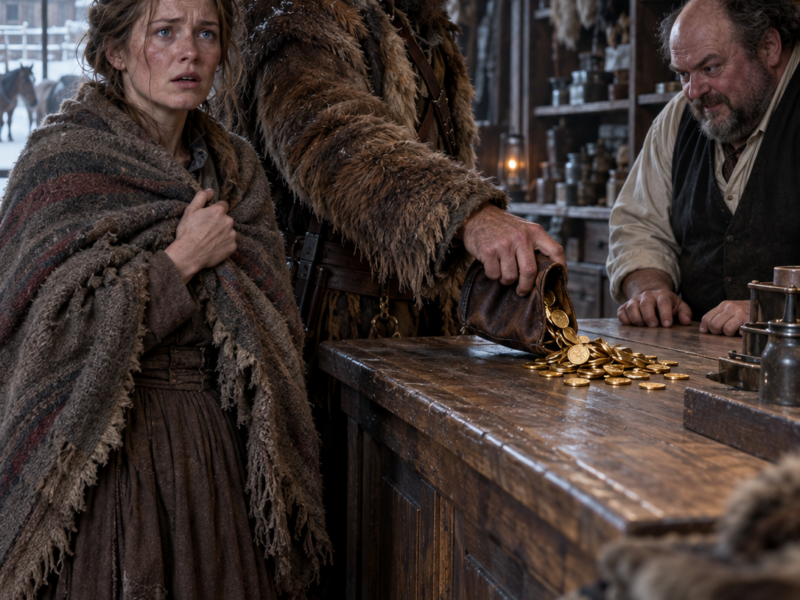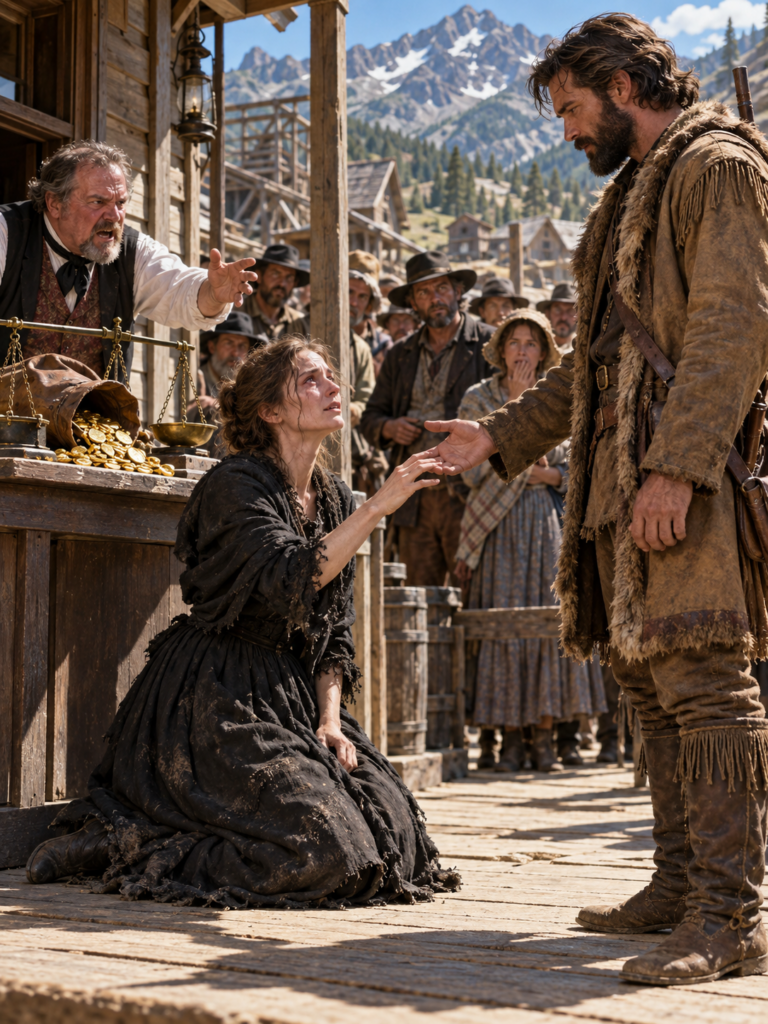
Clara leaned over the assayer’s table as Cross dipped his pen into the inkwell.
Her legs were still trembling from the ordeal, but she forced herself to remain standing.
The merchant scratched out a brief statement acknowledging payment and relinquishing his claim to her service.
When he finished, he tried to slide it toward Cole.
Clara held out her hand.
“It’s my name on the account.”
Cross’s expression tightened.
Cole remained silent.
After a moment, the merchant gave her the paper.
Clara read it slowly.
She had learned her letters from her mother, and although her father had rarely encouraged her education, she could recognize a promise written in plain English.
“Sign it,” she said.
Cross did.
At her request, the assayer witnessed it.
Only then did Clara fold the paper and tuck it inside her dress.
Cole picked up the original contract.
“Now,” he said quietly, “shall we get your belongings?”
Clara nodded.
The men in the square moved out of their path.
Nobody laughed.
Behind the livery stable, her carpetbag rested beside a watering trough.
It contained a spare apron, two pairs of mended stockings, a hairbrush, and her mother’s silver comb.
That was all she had saved.
Cole reached for the bag, then paused.
“Want me to carry it?”
“Please.”
He lifted it without comment.
At the hitching rail waited two sturdy horses, one carrying supplies.
Cole checked the saddle on the second animal.
“Can you ride?”
“Some.”
“We’ve several hours of mountain trail ahead. If you’re too tired, we can arrange a place in town for tonight.”
Clara looked back toward the square.
The thought of sleeping within Cross’s reach made her stomach tighten.
“I’d rather leave.”
Cole nodded.
“Then we’ll go slowly.”
She mounted without help.
He adjusted the pack load, mounted his own horse, and guided them toward the north trail.
Ridge Creek disappeared behind them.
At first the road climbed through dry foothills.
Then the ground steepened, and pine trees crowded the narrow track.
The air grew cooler.
Clara’s back began to ache.
Her legs trembled from holding herself in the saddle.
But she said nothing.
She had learned that complaining rarely improved a difficult situation.
Near a creek, Cole stopped.
“Rest the horses.”
Clara tried to dismount.
Her cramped leg failed to clear the saddle properly.
She tipped sideways.
Cole caught her before she struck the rocky ground, steadied her, and stepped away.
“You’re worn out.”
“I’m sorry.”
“Nothing to be sorry for.”
He offered her water and gave the animals time to drink.
Clara sat on a flat stone.
“How much farther?”
“Another stretch of climbing. We can take it easy.”
She rubbed her aching hands.
“Mr. Halloway?”
“Cole will do.”
“Why did you really pay Cross?”
He studied the running water.
“Because somebody should’ve stopped him before he put you on that platform.”
“But five hundred forty dollars—”
“Was the price he named. Not the measure of your worth.”
Clara looked at him.
Nobody had ever made that distinction for her.
“What if I cannot repay it?”
“I’m not asking you to.”
“What if I cannot work?”
“You’ll still need supper.”
A strange, painful feeling rose in her throat.
She looked away.
After a while, they mounted again.
By evening, the trail opened onto a high clearing beneath a granite ridge.
A large log cabin stood there, solidly built, with a stone chimney and a covered porch stacked with firewood.
A barn and smokehouse occupied the ground behind it.
Clara stared.
She had expected a hut scarcely better than the one she had left.
Cole dismounted.
“There’s the house.”
He helped her unload the small amount she carried.
“Door’s unlocked.”
Clara climbed the porch steps.
Inside, the cabin was clean, quiet, and orderly.
The kitchen held a substantial stove, hanging cookware, and shelves of supplies.
A bed stood near the far wall.
Cole entered carrying flour and provisions.
He lit the fire.
Then he noticed Clara still standing beside the door.
“You can put your bag down.”
She obeyed.
After a moment, she whispered, “I can begin supper.”
“I’ll see to it.”
“I can wash your clothes tomorrow.”
“No need tonight.”
“I know how to work hard. I won’t be a burden.”
Cole stopped what he was doing.
He saw how frightened she was of being useless.
“Clara,” he said, keeping his voice level, “you’ve had a miserable day. Sit down if you want. The food isn’t something you have to earn.”
Her eyes filled.
“But Cross said—”
“Cross has had his money. His claim ends there.”
He went to the stove and began preparing a meal.
Clara watched him cut bacon and set a skillet over the heat.
She had never seen a man offer supper without first demanding something in return.
“Where will I sleep?” she asked.
“You can take the bed. I’ll make up a place by the hearth until we arrange something better.”
“Are you sure?”
“It’s my offer.”
He set a plate before her.
Clara stared at the hot food.
Then, very carefully, she picked up her fork.
But before she took the first bite, she reached inside her dress and unfolded the paper Cross had signed.
“Will you help me make certain this means what he said it means?”
Cole put down his own fork.
“Yes.”
“And afterward, will you help me find out what kind of life I can make for myself?”
He looked at her across the table.
“That choice belongs to you.”
Clara set the paper between them and began reading it aloud.
Clara read the acknowledgment slowly, pausing over words that seemed to carry more weight than all the gold Cole had put on the assayer’s scale.
When she finished, she looked up.
“Does it mean he cannot send someone after me?”
“It means he’s declared the account settled and given up his claim. I wouldn’t trust him not to make trouble, but we’ve got his signature and a witness.”
She ran her thumb over the folded edge.
“And the other paper?”
Cole took the original contract from his coat.
“This is the one he tried to sell.”
“Will you destroy it?”
“After we’ve made certain there’s no use for it as evidence.”
Clara nodded.
It was not the answer she would have expected from a man who had just spent a fortune on a stranger.
But it was an answer that treated her as capable of understanding her own affairs.
She placed both papers inside her carpetbag.
Then she ate.
The bacon was salty.
The bread was thick and warm.
She was so hungry that her first few bites made her stomach ache.
Cole ate quietly across from her.
He asked no questions about her father.
He made no demands concerning her past.
When she had finished, he poured her another cup of water and showed her where the washbasin stood.
“There’s a latch on the door,” he said. “You can close it from inside. If you need anything during the night, call out.”
Clara glanced at the bed.
“And you’ll sleep by the hearth?”
“For now.”
She was too tired to argue.
Yet even after she lay beneath the heavy quilt, sleep came reluctantly.
The cabin creaked in the cooling mountain air.
A horse shifted in the barn.
The fire settled into its embers.
Every sound reminded her that she was far from town, alone with a man she scarcely knew.
At last, exhaustion overcame fear.
***
Morning light woke her.
For a moment, Clara believed she was back in her father’s shack.
She sat upright in alarm.
At home, sleeping after sunrise had meant angry words and sometimes punishment.
She climbed from the bed and dressed hurriedly.
Cole was already outside.
She found two used plates beside the washbasin and began cleaning them.
Then she swept the floor.
Then she took the hearth rug onto the porch and beat the dust from it.
The cabin was already remarkably clean.
There was very little to improve.
But Clara could not bear to be idle.
Near the door, she found several work shirts waiting to be washed.
She carried them outside.
The morning air was cold at that elevation.
Water from the pump chilled her hands as she filled a wooden tub.
She found soap and a washboard and knelt beside them.
She scrubbed until her fingers reddened.
Then she scrubbed harder.
By the time Cole returned from cutting wood, her knuckles were raw.
He stopped beside the porch.
“Clara?”
She flinched at the sound of her name.
“I was washing your shirts.”
“I see that.”
“I’ve swept and cleaned the dishes, too.”
He looked at the tub, then at her hands.
“That water’s cold enough to hurt you.”
“I’m used to washing.”
“Doesn’t mean you ought to freeze yourself doing it.”
Her face flushed.
“I thought you’d expect me to work.”
Cole set his axe safely against the porch.
“We talked about that.”
“You paid so much money.”
“To settle Cross’s claim.”
“Still, somebody must repay you.”
He crouched a short distance away so she did not have to look up at him.
“Not you.”
Clara stared at her hands.
The skin across her knuckles had begun to crack.
“I don’t know what I’m supposed to do if I’m not working for somebody.”
Cole considered that.
“Then perhaps the first thing is to find out what you’d choose to do.”
She gave a small, uncertain laugh.
“I don’t even know where to begin.”
“Could begin with getting warm.”
He carried the tub away from the cold yard and told her where to find a little grease for her chapped skin.
When Clara returned to the doorway, she saw him washing the shirts himself.
Not angrily.
Not to prove a point.
Simply because they were his shirts and the work needed doing.
It was a small sight.
Yet it unsettled nearly everything Clara believed about men.
***
Over the following weeks, she began to understand the rhythms of the mountain holding.
Cole rose early.
Some days he tended his traps.
On others, he worked timber, checked his horses, or repaired equipment.
His income came from years of hard work, trading, and careful management of the resources he used.
He had no great manor hidden in the mountains.
His wealth had not come without cost.
The cabin, barn, and supplies represented years of deliberate effort.
Clara learned which chores needed doing and which could wait.
She began preparing some meals, not because Cole demanded them, but because she enjoyed seeing good food made from simple provisions.
She mended a tear in his coat.
He showed her how the stove drew best and where the winter wood was stored.
When she expressed an interest in preserving food, he brought dried fruit from the storehouse and asked whether she knew how to use it.
She did.
She had spent years stretching limited supplies through uncertain seasons.
For the first time, that knowledge felt like competence rather than desperation.
They worked without crowding one another.
Sometimes Cole spoke only a few sentences over supper.
At other times, Clara found herself telling him about the things she had wanted when she was younger.
A small garden.
A room where she could keep her own belongings.
A place where she could sleep without listening for someone approaching in anger.
Cole listened.
He did not promise all those things.
But he began asking sensible questions.
What vegetables did she know how to grow?
What kind of ground did they require?
Would she prefer a place in town or somewhere farther from the streets?
The questions made her think seriously about her future.
***
The mountain air grew sharper.
Aspen leaves began turning yellow in sheltered hollows.
One afternoon, Clara found Cole studying the roofline from the yard.
“Something wrong?” she asked.
“Need to look at the chimney flashing before winter.”
“Can I help?”
“You can hand me tools, if you care to.”
She did.
He explained what he was doing, and she asked questions until she understood.
They worked together for much of the afternoon.
When they finished, Clara looked at the cabin with satisfaction.
She had helped protect a place she was beginning to care about.
That evening, she asked whether she might plant a small garden come spring if she remained.
Cole looked surprised.
“Reckon there’s ground enough.”
“I wouldn’t want to change your property without asking.”
“I’d rather you told me what you wanted than guessed what might please me.”
She smiled.
“Then I will.”
***
The thunderstorm came several weeks later.
By noon, dark clouds were piling against the upper peaks.
Cole returned early and began securing the horses.
Clara helped close the shutters.
The storm struck with fierce wind and driving hail.
Thunder shook the cabin.
At the first great crash, Clara dropped a tin cup.
It struck the floor and rolled beneath the table.
She backed toward the stove.
Another thunderclap followed.
Her breath caught.
The noise brought back memories of her father’s drinking.
Storms had often kept him indoors, and confinement had made his temper worse.
Cole saw her crouched beside the wall.
He set aside the piece of harness he was repairing and placed a chair several feet from her.
“Would you rather I stayed over here?” he asked.
Clara nodded.
He sat.
The lantern cast warm light across the floor.
For a while, he said nothing.
Then he spoke about his own childhood.
His father had been a preacher in Missouri, a man who preached loudly about righteousness while ruling his household through fear.
Cole had left young.
He had traveled west with freight outfits, worked around mining camps, and gradually learned the trades that allowed him to make a living in the mountains.
“Town wasn’t always kind,” he said.
Clara listened.
“Is that why you live alone?”
“Part of it.”
He looked at the lantern.
“I got tired of men who used rules to excuse cruelty. Out here, the work’s hard, but I generally know what I’m dealing with.”
“Do you ever get lonely?”
“Sometimes.”
“Then why stay?”
“Because I didn’t know I wanted much else.”
The answer surprised her.
It was more honest than a speech about loving solitude.
She looked toward the shuttered window.
Another clap of thunder rolled over the ridge.
This time, she did not cover her ears.
Cole remained where he was.
After a while, she said, “I don’t want to spend the rest of my life frightened.”
“Then don’t let what your father did decide every part of it.”
“That sounds simpler than it is.”
“It is simpler to say.”
She laughed softly.
He smiled.
And the storm passed while they sat talking beside the stove.
***
As autumn approached, their companionship became easier.
Clara began to recognize the difference between quietness and anger.
When Cole was silent, she no longer assumed she had done something wrong.
When she needed something, she learned to ask.
He did the same.
One afternoon, she told him plainly that she wanted to know the route back to Ridge Creek.
Cole did not question her motives.
He drew the trail on a piece of paper, marking the creek crossing and the safer resting places.
“Will you take me down when I ask?”
“Yes.”
“Even if I decide not to come back?”
“Yes.”
She folded the map carefully.
It was the first time anyone had helped her understand how to leave without treating her departure as an insult.
That night, she put the map beside her mother’s silver comb.
The two objects reminded her of different things.
One of where she had come from.
The other of a future that remained hers to choose.
***
In October, the first snow reached the higher slopes.
It dusted the roof and lay thinly beneath the pines.
The cabin was well supplied.
Cole had prepared for mountain winters for years, but there remained work to do.
One morning, he set out with the horses to bring in a felled cedar from a distant ravine.
Clara remained at the cabin baking bread.
She had the dough beneath her hands when the horses in the corral began calling sharply.
She wiped flour from her fingers.
Then she looked through the window.
Two riders had entered the clearing.
Their animals were tired and sweating despite the cold.
Clara recognized one of the men.
A prospector with a damaged ear.
He had stood near the auction platform in Ridge Creek and laughed at her.
The second man was younger and wore a revolver.
They dismounted.
“Halloway!” the older man shouted.
Clara stepped back from the window.
Her first instinct was to hide.
She could almost hear her father’s voice telling her that the safest woman was the one nobody noticed.
But this was not her father’s house.
And the men had arrived without invitation.
She crossed the room and checked that the door was barred.
The older prospector came up the porch steps.
“We know you’re in there!”
Clara stayed beside the window.
“What do you want?”
“Business with Halloway.”
“He’s away.”
“Then open up.”
“What business?”
“Town taxes. Cross says there’s money owing.”
Clara knew the claim was suspicious.
Whatever Cole might owe, two rough men arriving without official papers were hardly proper collectors.
“You can take your business to him when he comes to town,” she answered.
The younger man struck the door with his boot.
Clara stepped away.
Her heart hammered.
She knew the Winchester hung on the wall, and Cole had shown her how to handle it safely.
But she did not want a fight.
“Leave the porch,” she called.
The men ignored her.
Another blow shook the door.
Clara took down the rifle.
She moved to the side of the doorway, keeping herself out of its direct line.
Outside, the younger man cursed and reached toward his revolver.
Clara’s fear rose sharply.
Then she steadied her breathing.
She had survived the auction.
She had learned the way off the mountain.
She had been making decisions for herself for weeks.
She was not going to surrender that freedom to two men with a false story.
She moved to the door and lifted the heavy bar.
The latch began to turn.
The latch turned beneath Clara’s hand.
For one suspended instant, she could hear nothing except the wind moving through the pines and the restless stamping of horses in the yard.
Then she pulled the door open.
Both men stopped.
They had expected an empty cabin or a frightened woman willing to obey them.
Instead, Clara stood inside the threshold with Cole’s Winchester held ready.
The younger man stared at the rifle.
The older prospector recognized her.
“Well, I’ll be. The Dawson girl.”
Clara kept her voice steady.
“You need to leave.”
The prospector gave a crooked smile.
“We’re only here for a little business.”
“You said taxes. Where are your papers?”
The smile faded.
“That ain’t your concern.”
“Then you haven’t any business with me.”
The younger man moved forward.
“Put that thing down.”
Clara remained where she was.
“No.”
He glanced at his companion.
“She’s bluffing.”
She saw his hand shift toward the revolver at his side.
“Don’t come any closer,” she warned.
He took another step.
The rifle fired.
The report struck the clearing like a hammer.
Wood splintered from the porch post beside the younger man.
He stumbled backward into the snow, startled and frightened.
The horses jerked against their reins.
Clara felt the recoil through her shoulder.
For a heartbeat, she was stunned by what she had done.
Then she steadied the rifle again.
“Get off the porch.”
The older prospector raised both hands.
“All right. Easy now.”
“You came here to frighten me.”
“We only wanted Halloway.”
“Then you’ll speak to him another day.”
The younger man scrambled to his feet.
His face had gone pale beneath the dirt.
Neither man argued further.
They retreated toward their horses, mounted, and rode down the trail without looking back.
Clara remained in the doorway until the sound of hoofbeats faded.
Then she lowered the rifle.
Her arms began trembling so badly she had difficulty holding it.
She looked at the damaged porch post.
The splintered wood made the danger suddenly real.
She had frightened the men away.
But a few inches of difference could have meant a death.
She had never wanted to kill anyone.
She had wanted only to be left alone.
***
A figure appeared among the trees.
Cole stepped into the clearing.
He had heard the shot while returning from the ravine.
His revolver was in his hand.
He stopped when he saw Clara standing beside the open door.
Then he saw the damaged porch post.
The fresh horse tracks.
The rifle in her hands.
He holstered his revolver.
“Clara?”
“I’m all right.”
He climbed the steps.
“Are you hurt?”
“No.”
“Did they hurt you?”
“No.”
He glanced toward the trail.
“Who was here?”
She told him.
The old prospector from Ridge Creek.
The younger man with the revolver.
The story about collecting taxes for Cross.
The attempt to force their way inside.
And the shot she had fired when one of them stepped toward her with his hand near his weapon.
Cole listened without interrupting.
When she finished, he looked again at the damaged post.
“Could’ve gone badly.”
“I know.”
Clara swallowed.
“I didn’t want to shoot him.”
“I believe you.”
“He kept coming.”
Cole lowered his gaze to the rifle.
“Let me take that. Your arms are shaking.”
She gave it to him.
He checked it carefully and set it aside.
Then he turned back to her.
“You held them off.”
“I was frightened.”
“Most people would be.”
“I nearly killed a man.”
“Yes.”
His answer was quiet.
Clara appreciated that he did not make the shot sound like a grand achievement.
He did not congratulate her for coming close to taking a life.
But neither did he shame her for defending herself when she believed she was in danger.
“What if they return?” she asked.
“Then we’ll have to deal with it properly. They’ll not be welcome here, and I won’t leave their story about taxes unanswered.”
He looked toward the trail.
“I’ll make inquiries when I next go down.”
Clara nodded.
Only then did Cole notice the way her fingers were trembling.
“Come inside. You’re freezing.”
She stepped back into the cabin.
He followed.
And when the door closed, she realized how much had changed since the night she first crossed that threshold.
Then, the sound of the latch had made her feel trapped.
Now it meant she had chosen to shut two threatening strangers out.
***
Cole repaired the damaged porch post over the following days.
He also made a journey toward Ridge Creek to learn why the men had come.
Clara accompanied him part of the way to the lower trail before returning to the cabin.
She had been clear about one thing.
“I want to know what happens concerning Cross.”
“You will.”
“And I don’t want you deciding for me whether I ought to be worried.”
“Fair.”
When Cole returned, he brought news rather than another threat.
The men had apparently been drawn toward his mountain holding by talk of the gold he had used to settle Clara’s debt.
Cross had been among those discussing his wealth.
But there was no proper authority behind their attempt to collect money.
They had used the language of taxes to justify forcing an encounter.
Cole had made it known that the men were not to return to his holding without legitimate business.
He could not guarantee that every dishonest man would stay away.
But he had no intention of pretending that their visit had been harmless.
Clara listened.
Then she took the signed acknowledgment of her father’s debt from her carpetbag.
“Could Cross still try to claim something from me?”
“He’s made his declaration in writing.”
“I know. But I’d like a proper opinion before I depend upon his word forever.”
Cole nodded.
“That’s sensible.”
They agreed to obtain independent advice when travel was practical.
The money he had paid Cross had settled the merchant’s immediate demand.
But Clara deserved to know that her freedom did not depend on a private understanding between powerful men.
She wanted the record clear.
In her own name.
***
The first heavy snowfall of the season arrived before the mountains were ready to release their autumn colors.
Snow settled against the barn and softened the outlines of the clearing.
The trail remained passable at times, but travel required greater care.
Inside the cabin, Clara and Cole continued the routines they had established.
She prepared food and kept her sewing in a basket beside the hearth.
Cole tended the horses, maintained the buildings, and checked his supplies.
But the labor no longer fell into divisions either of them had inherited unquestioningly.
Clara learned to split smaller pieces of kindling safely.
Cole learned how she preferred the pantry arranged so preserved food could be used without waste.
He showed her how to recognize signs of changing mountain weather.
She showed him how to mend seams that would otherwise tear under winter work.
They sometimes disagreed.
Once, Cole moved a basket of her belongings without asking.
Clara told him she wanted her things left where she placed them.
He apologized and returned the basket.
Another time, Clara spent an entire afternoon repairing a coat she was too tired to finish.
Cole pointed out that the garment could wait.
She reminded him that she was capable of deciding how to use her time.
He accepted that.
Neither treated an ordinary disagreement as proof the other ought to leave.
That, too, was new for Clara.
She had spent most of her life believing that peace required silence.
Now she began discovering that peace could also come from being heard.
***
One evening, she sat beside the hearth with her mother’s silver comb resting in her lap.
Cole was repairing a leather strap at the table.
“Do you ever think of going back to Missouri?” she asked.
“Occasionally.”
“Would you?”
“Not much waiting for me there.”
She considered that.
“Do you have any family living?”
“None I’ve kept close company with.”
“That sounds lonely.”
“Sometimes it is.”
He set down the strap.
“I used to believe being alone was the easiest way to keep other people’s cruelty from finding me.”
Clara ran a finger along the comb.
“Did it work?”
“Kept some people away.”
“Did it keep you happy?”
Cole smiled without much humor.
“Didn’t think happiness had much to do with the arrangement.”
She looked at him across the firelight.
“Perhaps you and I have both mistaken safety for the whole of living.”
He considered her words.
“Could be.”
Clara returned the comb to its cloth wrapping.
“I used to believe being useful was the only thing that made me worth keeping.”
“And now?”
She looked around the cabin.
“I like to cook. I like mending things. I like making a room pleasant. But I don’t want to do those things because I’m frightened someone will send me away if I stop.”
“Then don’t.”
She smiled.
“It’s a little harder than that.”
“I know.”
After a moment, she added, “And I think I would like a garden.”
Cole glanced toward the window.
“Ground’s frozen now.”
“In spring.”
He studied her.
“You thinking of staying that long?”
Clara did not answer immediately.
She had been asking herself the same question.
***
During the winter, they discussed it often.
Not as a demand.
Not as a promise made in a moment of fear.
But as something worth understanding.
Cole told her that the cabin and holding were his livelihood.
She was welcome to remain as a guest while she recovered and made plans.
If she wanted paid work helping with the household or stores, they could agree on wages and responsibilities.
If she wanted a place of her own, he would help her look without treating her departure as a betrayal.
Clara insisted that whatever she chose must leave her with money and freedom to travel.
Cole agreed.
They began keeping separate accounts of the work she chose to do.
He did not charge her for the food and shelter he had already offered in kindness.
She did not pretend that her time and skill had no value.
It was a practical arrangement.
And it gave Clara something she had never possessed before.
A future she could describe without using the language of debt.
***
As winter deepened, affection grew between them.
It came without great declarations.
Cole learned that Clara preferred her coffee weak.
She learned that he liked to read by the fire before sleeping.
He began leaving space on the table for her sewing.
She began asking him to sit with her when the evening work was finished.
Sometimes they spoke for hours.
Sometimes they said very little.
But their silence no longer belonged to fear.
One night, after a long conversation about their childhoods, Clara noticed Cole looking at her across the table.
“What is it?”
“Nothing troubling.”
“Then tell me.”
He took a moment.
“I’ve grown fond of having you here.”
Clara’s heart quickened.
She did not look away.
“I’ve grown fond of being here.”
Cole rested his hands on the table.
“I don’t want you confusing that with owing me something.”
“I don’t.”
“And I won’t ask you to stay because I paid Cross.”
“I know.”
She smiled faintly.
“That may be the first thing you taught me.”
He shook his head.
“Think you learned it for yourself.”
She reached across the table and placed her hand near his.
Not touching.
Not yet.
“I’d like us to keep getting to know each other,” she said.
Cole looked down at the small distance between their hands.
“So would I.”
He waited.
Clara moved her fingers the rest of the way.
Their hands met.
For once, she was not reaching for someone because she feared falling.
She was reaching because she wanted to.
***
When the mountain trails opened again in spring, Cole accompanied Clara to Ridge Creek.
They brought Cross’s signed acknowledgment and the original disputed contract.
Clara sought independent confirmation that no claim over her service remained outstanding.
The written record established that Cross had accepted payment and renounced his demand.
The coercive arrangement he had tried to impose was not something Clara intended ever to recognize as giving another person ownership of her.
She kept the acknowledgment.
The other paper became evidence of an ordeal she no longer permitted to define her.
They also visited the general store.
Clara purchased seeds.
Beans.
Cabbage.
A few flowers.
She paid from the money she had earned and saved.
Cole carried the parcel without comment.
As they passed the place where the auction platform had once stood, Clara stopped.
The wooden boards were gone.
The street looked ordinary.
Wagons rolled past.
Men talked beside the saloon.
The assayer’s office stood open for business.
Clara stared at the empty space.
Cole waited a little behind her.
“Want to leave?” he asked.
“In a moment.”
She remembered herself kneeling there.
Her father’s dress.
The laughter.
The feeling that her whole life had been reduced to a sum of money no one wanted to pay.
Then she remembered the stranger who had stepped forward.
Not to claim her.
But to stop the transaction.
“I thought I was worthless,” she said.
Cole did not answer.
“I believed it because everybody around me seemed to believe it.”
She turned toward him.
“But the strange thing is, even when you paid all that gold, I still thought I had become somebody’s property.”
“Couldn’t blame you for thinking it.”
“It took me a long while to believe the opposite.”
Cole nodded.
She looked once more at the empty stage.
Then she turned away.
“I’m ready.”
***
Back at the cabin, Clara planted her garden in a sheltered patch near the house.
Cole helped turn the earth.
She decided where each row would go.
They argued amiably over the placement of the beans.
She won the argument because she had thought more carefully about the sunlight.
He admitted as much.
Over the next several weeks, the first green shoots appeared.
Clara watched them with a satisfaction she had never found in simply making herself useful to others.
They were hers to tend.
Her choices.
Her work.
Her small beginning.
When the young plants were well established, she and Cole sat on the porch one evening and spoke plainly about the future.
“I don’t want to leave because I’m frightened of loving someone,” Clara said.
Cole turned toward her.
“But I don’t want to stay merely because this is the first safe place I’ve known.”
“Neither do I.”
She looked at him steadily.
“I’ve thought about it all winter. I could live elsewhere. I have money enough to begin, and I know the way down. I could find work.”
“You could.”
“But I want to build something here.”
Cole waited.
“With you,” she added.
His expression softened.
“Then I’d like that, Clara.”
She took his hand.
“I want a proper say in what we build.”
“You’ll have it.”
“I want to keep earning and saving.”
“Good.”
“And if we disagree, I want us to talk instead of making the house a place to be afraid.”
Cole’s grip tightened gently around her fingers.
“That’s the sort of home I’d want, too.”
It was not a wedding.
It was not an extravagant promise.
It was the beginning of a partnership freely chosen.
***
The summer brought steady work.
Clara tended her garden and helped plan stores for the coming winter.
Cole continued his trapping, timber work, and trade.
Their household became more comfortable, not because a woman had arrived to do all the chores, but because two people had begun making decisions together.
Clara kept a small worktable beneath the window.
Her mother’s silver comb rested in a wooden box beside it.
Cole made a shelf for her books and papers.
She helped him keep clearer accounts of household provisions.
When visitors came, she was no longer introduced as the poor woman rescued from Ridge Creek.
She was Clara Dawson.
A capable woman who had chosen to remain on the mountain.
And Cole was no longer merely the silent, forbidding stranger who came down to town twice a year.
He was a man who listened when Clara spoke.
Who had learned that offering someone a home meant making room for their choices.
Who had stopped believing that solitude was the only honest way to live.
***
One evening, nearly a year after the auction, Clara stood on the porch watching the last sunlight touch the granite peaks.
Cole came out carrying two cups of coffee.
He handed her one.
The air smelled of pine resin and turned earth.
Beyond the porch, the garden was growing.
The repaired post stood firm beside the steps.
Clara remembered the day two men had ridden into the clearing and tried to frighten her back into submission.
She remembered the rifle’s recoil.
The shaking afterward.
And Cole’s refusal to pretend that courage made danger harmless.
That day had taught her something important.
She could defend herself.
But she did not have to prove her worth by being fearless.
She could choose a peaceful life without surrendering her strength.
Cole leaned against the porch rail.
“Thinking about something?”
“The auction.”
He waited.
“I remember what I said when nobody would bid.”
She looked toward him.
“I said nobody wanted me.”
Cole’s face grew serious.
“Clara—”
She shook her head gently.
“I don’t say it now because I still believe it.”
She looked out across the clearing.
“I say it because I want to remember how wrong I was.”
For a while, neither spoke.
Then Cole asked, “What do you believe now?”
Clara smiled.
“That I was a person worth caring for before anyone paid a cent.”
He nodded.
“That’s true.”
“And that what matters about this place isn’t how much land you own or how strong the walls are.”
“What matters, then?”
She took his hand.
“That I can stay without being kept.”
Cole looked down at their joined hands.
Then he looked toward the cabin, the garden, and the valley stretching far below them.
“I hope you always can.”
Clara rested her shoulder lightly against his arm.
She had come to the mountains believing she had been purchased by a stranger.
She remained because she had discovered what it meant to choose.
The cabin was no longer a hiding place.
The work was no longer payment for her existence.
And the man beside her was no longer her rescuer standing above an auction platform.
He was someone who had learned to make room for her freedom.
Clara looked at the growing garden and the home they were shaping together.
Then she smiled as the evening wind moved softly through the pines.
She had not been bought.
She had been given the chance to reclaim herself.
And this time, she knew the difference.