Part 1
“All you deserve is a fifty-dollar cabin, Margaret. At least you finally found a house that matches what you’ve made of your life.”
The words came from Margaret Ellis’s younger sister, Diane, across a dining room table that Margaret had helped their father build forty years earlier.
For a moment, nobody moved.
Their mother lowered her fork. Diane’s husband, Richard, stared into his plate, a small smile pulling at the corner of his mouth. Outside the kitchen window, October rain tapped against the glass.
Margaret sat quietly, her hands folded in her lap.
She was forty-three years old, had twenty-eight hundred dollars in savings, and lived in a rented bedroom in a house shared with three strangers.
And she had just purchased three-quarters of an acre of mountain land in southern West Virginia for fifty dollars.
The land came with a log cabin.
Or what remained of one.
“I haven’t even seen it in person yet,” Margaret said.
Diane gave a short laugh.
“That makes it worse.”
“Diane,” their mother warned.
“What? Somebody ought to tell her the truth. She spent twenty years doing books for other people’s businesses, and now she’s buying condemned houses in the middle of nowhere. That’s not independence. That’s desperation.”
Margaret looked down at the faded tablecloth.
She had spent most of her adult life being useful to other people.
When their father developed heart trouble, Margaret was the daughter who drove him to appointments. When their mother needed help paying the heating bill, Margaret quietly transferred money from her savings. When Diane needed someone to watch her two children during school holidays, Margaret rearranged her work schedule.
And when the small accounting firm where Margaret worked closed two years earlier, those same people began treating her as though she had somehow failed them.
She had found freelance bookkeeping work, but her income was unpredictable. Some months were comfortable. Others were frightening.
An apartment that had once rented for seven hundred dollars now cost more than twelve hundred.
Her rented bedroom cost five hundred and sixty dollars monthly, plus utilities.
Every payment made her feel as though she was purchasing another thirty days of permission to exist.
The cabin, ugly as it appeared in the county auction photograph, represented something different.
Ownership.
A door she could close without worrying about a landlord.
A place where she would not have to apologize for taking up space.
“I paid fifty dollars,” Margaret said. “Not my life savings.”
Richard finally looked up.
“The purchase price isn’t the problem. What are you going to do when you discover the land is contaminated? Those mountains are full of old mine workings. Could cost you a fortune just to make the place safe.”
“I checked the county records.”
“You checked paperwork,” he said. “There’s a difference.”
Margaret held his gaze.
“I know.”
Diane pushed back her chair.
“Well, don’t come asking us to rescue you when you’re freezing in a broken-down shed.”
Margaret’s mother looked at her daughter with tired, worried eyes.
“Is there even a road up there, sweetheart?”
“Yes, Mama. A gravel road. The county maintains it most of the year.”
“Most of the year?”
“April through October.”
Her mother’s expression fell.
Margaret said nothing more.
She had already learned that explaining herself to people determined to misunderstand her only made her feel smaller.
That night, she returned to her rented room, shut the door, and opened the auction listing again.
One photograph.
A collapsed wooden porch lay like scattered bones beneath a sagging roof. Vines climbed over blackened log walls. Trees crowded the building so closely that their branches seemed to be pulling it back into the forest.
The property description contained four words that concerned her.
Structure sold as-is.
Below that was the price.
$50.
Margaret zoomed in on the photograph.
Something about the cabin’s corners caught her attention.
The logs had been notched together in an unusually precise pattern. Even beneath the vines, the joints appeared tight.
Her father had been a carpenter before his heart began failing. He had taught her to recognize sound wood by its weight, its grain, and the way it resisted a knife blade.
“Old doesn’t always mean finished, Maggie,” he used to say.
She could almost hear him now.
He had died six years earlier, leaving behind a workshop full of tools and a daughter who still reached for the telephone whenever something needed fixing.
Margaret looked at the cabin for another twenty minutes.
Then she whispered into the empty room, “Maybe you’re still standing.”
The following Saturday, she packed a flashlight, work gloves, bottled water, a pry bar, and her father’s old folding knife into the back of her twelve-year-old Subaru.
She left before sunrise.
The highway gave way to a state road, then to a narrow county route that followed a creek through hills covered in red and gold autumn leaves.
Eventually, the pavement ended.
A weathered sign read:
SEASONAL MAINTENANCE ENDS OCTOBER 31.
Margaret stopped the car.
Ahead of her, the gravel road climbed sharply between two wooded ridges.
She could turn around.
The thought came with surprising force.
Fifty dollars was nothing compared with the cost of repairing a collapsed building. She could abandon the project and still have enough money for rent next month.
Nobody would know except the people already laughing at her.
Then she remembered Diane’s voice.
All you deserve is a fifty-dollar cabin.
Margaret shifted into low gear.
The Subaru climbed.
Loose stones rattled beneath its tires. Twice, she had to stop and move fallen branches. At one steep curve, the rear wheels slipped enough to send her heart pounding.
Forty minutes after leaving the pavement, she reached a narrow clearing.
A nearly invisible footpath disappeared uphill through blackberry brambles.
The cabin stood two hundred feet beyond it.
Margaret saw the roof first.
It sagged in the middle like the back of an exhausted animal.
Then the walls appeared.
Dark logs. Missing porch. Broken windows. A door hanging slightly crooked.
No chimney smoke.
No electricity.
No water.
No sign that anybody had lived there in decades.
She stood beside the car for several minutes, listening to the wind moving through the hardwood trees.
Finally, she picked up her bag and climbed the path.
At the cabin, she tested the first corner joint with her father’s knife.
The blade barely entered.
She tried another.
The wood was hard.
Not dry and crumbling, as she had feared.
Hard.
She pressed against the wall.
Nothing shifted.
She examined a log near the rear corner and brushed away a patch of moss.
Beneath the weathered surface lay a deep reddish-brown grain unlike the pine she had expected.
Margaret frowned.
She couldn’t identify the species, but she knew quality timber when she saw it.
The porch was beyond saving.
Several feet of flooring just inside the doorway had rotted through, leaving an opening to the earth beneath.
Above it, daylight entered through a gap in the roof.
Yet farther inside, the floorboards appeared intact.
Margaret carefully tested them from the doorway with a long branch before moving along a solid section beside the wall.
The little cabin smelled of damp leaves, old wood, and forgotten winters.
Against the back wall stood a narrow wooden shelf.
On it sat a rusted coffee tin and a broken ceramic cup.
A single nail had been driven into a nearby log.
Someone had once hung a coat there.
Perhaps every evening for thirty years.
Margaret touched the nail.
For reasons she couldn’t explain, that small sign of ordinary life affected her more than the ruined roof.
This had not always been an abandoned building.
It had been somebody’s home.
She turned slowly, imagining a stove in one corner, a wooden table near the window, and rain tapping against a sound roof.
For the first time, she could picture herself there.
Then her foot slipped against a damp board.
She caught the doorframe just before losing her balance.
Her pulse raced.
The cabin might be worth saving, but wanting it to be safe would not make it so.
She backed outside and sat on a fallen log.
Looking at the roof, she remembered something her father used to tell customers who wanted to tear down old barns.
“Check the bones before you bury the building.”
Margaret studied the cabin’s corners.
The logs were still level enough that the walls had not spread apart.
The ridge beam appeared to be the primary source of the roof’s sag.
Repairing it would require help, equipment, and money.
But rebuilding an entire house would require far more.
She took photographs from every angle, measured what she could safely reach, and wrote observations in a small notebook.
Before leaving, she walked around the rear of the cabin.
A thick curtain of kudzu covered the hillside.
Underneath the vines, she noticed what looked like the corner of a rectangular sandstone block.
It seemed too straight to be natural.
She pulled at one vine.
The roots resisted.
Another strand came loose, revealing more stone.
Margaret leaned closer.
The sandstone continued beneath the earth, disappearing behind a wall of tangled vegetation.
She looked toward the declining sun.
The mountain road would become dangerous after dark.
She had to leave.
But as she walked back to her car, she kept thinking about those stones.
Someone had put them there.
And whatever they belonged to was hidden beneath the hillside behind her fifty-dollar cabin.
Part 2
On Monday morning, Margaret called a local sawmill.
The owner, a sixty-seven-year-old man named Walter Boone, listened patiently as she described the cabin.
“Hand-hewn logs?” he asked.
“Yes.”
“Dovetail corners?”
“That’s right.”
“Near an old creek crossing?”
Margaret hesitated.
“About half a mile above one.”
Walter became quiet.
“Could be older than you think. Bring me a photograph.”
She drove to his mill on Wednesday afternoon.
The building smelled of fresh-cut oak and machine oil. Lumber was stacked beneath a long metal awning, and a yellow dog slept beside the office heater.
Walter studied her photographs for several minutes.
Then he removed his glasses.
“Miss Ellis, I wouldn’t start tearing anything apart until somebody who knows timber has looked at it.”
“Is it dangerous?”
“Roof sure looks dangerous. But those walls…” He leaned closer. “Those might be American chestnut.”
Margaret had heard of chestnut trees.
She knew they had once covered Appalachian mountainsides before disease destroyed most of them.
But she knew little about the wood.
Walter explained that old-growth American chestnut was prized for its durability, appearance, and resistance to decay.
“Most of what you find now comes out of old barns and houses,” he said. “You can’t just order a truckload of new chestnut logs.”
Margaret stared at the photograph.
“So the wood might be valuable?”
“Could be. But don’t start counting money. Salvage value depends on condition, dimensions, and how much it costs to recover. And you’re not buying that place to pull the walls down, are you?”
“No.”
“Good. A sound old house is worth more standing than chopped into pieces.”
He handed the photograph back.
“Get the structure inspected before working inside. Especially that roof.”
Margaret promised she would.
Back at her rented room, she opened her notebook.
A professional assessment, roof repairs, transportation, and tools would consume money quickly.
She had twenty-seven hundred dollars left.
That figure frightened her.
Her freelance bookkeeping contracts averaged roughly seventeen hundred dollars monthly, but some clients paid late. After rent, insurance, groceries, fuel, and other expenses, very little remained.
She couldn’t afford a serious mistake.
That evening, Diane called.
“Mom says you’ve actually been up there.”
“I have.”
“And?”
“The walls are better than I expected.”
Diane laughed.
“You sound like Dad when he brought home those busted lawnmowers.”
Margaret smiled faintly.
“He usually fixed them.”
“That’s not the point.”
“What is the point, Diane?”
A silence followed.
Then Diane said, “You’re forty-three years old. You should be thinking about retirement savings, not pretending you’re a pioneer.”
“I’m trying to own a home.”
“Then get a real job and buy a real home.”
Margaret looked at her laptop.
Three unpaid invoices sat open on the screen.
“I’m working.”
“Freelance bookkeeping in a bedroom isn’t a career.”
The words landed harder than Margaret expected.
She remembered covering three thousand dollars in repairs to Diane’s roof after an insurance dispute eight years earlier.
At the time, Diane had cried and called her the best sister anyone could have.
Margaret had never asked for the money back.
Now she wondered whether generosity became invisible once people grew accustomed to it.
“Diane,” she said, “I’m not asking you to approve.”
“Fine. Just don’t make this Mom’s problem.”
The call ended.
Margaret sat motionless for a long time.
Then she opened another invoice and began working.
The next Saturday, Walter drove up to the property with a retired builder named Calvin Price.
Calvin moved slowly because of an old knee injury, but his eyes missed very little.
He examined the exterior first, then used temporary supports and careful access to inspect the damaged areas without putting anyone beneath the failing roof.
After nearly two hours, he gave Margaret his opinion.
“The walls are remarkably good. Foundation needs checking in a couple places. You’ve got floor rot by the entrance, and that ridge beam has bowed badly. I wouldn’t occupy it until the roof is rebuilt and the rest is properly evaluated.”
“Can it be repaired?”
“I think so.”
Margaret felt her shoulders loosen.
Calvin pointed to the roof.
“But listen to me. Don’t try lifting that beam alone. You need bracing, jacks, and somebody who understands how these structures carry weight. This isn’t a weekend ladder job.”
She nodded.
“Understood.”
Walter examined an exposed patch of wood.
“Chestnut,” he said. “Pretty sure of it.”
Calvin touched the corner joint.
“Whoever cut these logs knew exactly what he was doing.”
The men walked around the building.
At the rear, Margaret showed them the sandstone she had uncovered.
Calvin crouched and brushed away some leaves.
“Well, now.”
“What?”
He pointed along the slope.
“That’s a wall. And it doesn’t belong to the cabin foundation.”
Walter stepped closer.
“Old root cellar, maybe.”
Margaret looked from one man to the other.
“A cellar?”
“Mountain families built them into hillsides,” Calvin explained. “Kept potatoes, apples, preserves, whatever they needed through winter. Earth keeps the temperature steady.”
“Could there be one here?”
“Could be. Or an old retaining wall. Only one way to find out.”
He glanced at the tangled kudzu.
“But not today. You’ll need to clear that mess before anybody gets close.”
After the men left, Margaret remained beside the cabin until the afternoon grew cold.
She imagined an old storage room beneath the hill.
It might be collapsed.
It might be filled with water.
But for the first time since purchasing the property, she felt something stronger than anxiety.
Curiosity.
She returned the following weekend with heavy gloves, loppers, a pruning saw, and a borrowed brush cutter.
The vegetation was worse than she expected.
Kudzu vines wrapped around saplings and climbed twenty feet into the trees. Wild grape tangled through dead branches. Blackberry canes tore at her sleeves.
She worked slowly, cutting the plants in manageable sections.
By noon, her shoulders burned.
By two, blisters had formed beneath her gloves.
She stopped to eat a peanut butter sandwich on a stump.
There was nobody to talk to.
No passing cars.
No neighbors calling across a fence.
Only the occasional cry of a crow and the distant sound of moving water.
For a moment, loneliness swept over her so suddenly that she nearly cried.
What if Diane was right?
What if she spent everything she had on a building no one could reasonably live in?
She pictured the room she rented, with its thin walls and a kitchen shared by people who barely knew one another.
Then she looked at the cabin.
Even broken, it was hers.
Margaret finished her sandwich and returned to work.
Near sunset, a large mat of vines came loose from the hillside.
Behind it stood a wall of fitted sandstone.
Margaret stepped backward.
The stones extended several feet in each direction.
She cleared another section.
Then another.
Slowly, a dark rectangular opening appeared.
A low doorway.
Four feet tall, perhaps three feet wide.
Its frame was built from carefully cut sandstone blocks. A heavy timber crossed the top.
Beyond it lay darkness.
Margaret stood perfectly still.
She had expected more foundation stones.
Maybe an abandoned shed.
Not a doorway leading straight into the mountain.
She aimed her flashlight inside.
The beam disappeared into a room much deeper than she anticipated.
Along one wall, something reflected the light.
Glass.
Margaret took one step toward the entrance.
Then she stopped.
The room had been sealed off by vegetation for years. There could be loose masonry, animals, unsafe air, or a damaged ceiling.
She was alone.
For once, excitement would have to wait for caution.
She photographed the opening, marked the location, and stepped away.
But that night, in her rented bedroom, Margaret could not sleep.
She kept seeing the flashlight beam catching something in the darkness.
Someone had built a stone chamber behind her cabin.
Someone had stocked it.
And whatever remained inside had been waiting through decades of silence.
Part 3
Calvin returned the next weekend with Walter and a friend who had experience inspecting old masonry structures.
After checking the entrance and the accessible portions of the chamber, they decided it was stable enough for a careful initial examination, though further work would be needed before regular use.
Margaret waited outside while the men checked the ceiling and walls.
Finally, Calvin emerged.
“Come have a look.”
She ducked beneath the timber lintel.
The air immediately turned cold.
It smelled of mineral-rich earth and old stone rather than the damp rot she had expected.
Her flashlight moved across a flagstone floor.
The chamber was about twelve feet wide and sixteen feet deep, with a curved ceiling just over six feet high at its center.
Its walls were built from dry-stacked sandstone, each stone fitted against the next without visible mortar.
And along the back stood three long shelves made from slabs embedded directly into the masonry.
On those shelves were glass jars.
Dozens of them.
Margaret stepped closer.
Some were clear.
Others carried a faint blue or green tint.
Several had zinc lids. Others used glass lids secured by wire clasps.
The contents had darkened almost beyond recognition.
She counted twenty jars on the first shelf before losing track.
“My goodness,” she whispered.
Walter lifted his flashlight.
“Some of those are old.”
Calvin examined the wall joints.
“Look at this craftsmanship.”
Margaret ran her hand along a smooth sandstone shelf.
The stone felt cool and dry.
She had seen modern basements that developed water problems after only a few years.
This room had survived generations.
Near the doorway, Calvin pointed out a narrow drainage channel cut into the floor.
The channel followed the walls and sloped toward an outlet beyond the entrance.
“That’s why the place hasn’t filled with water,” he said. “Whoever built it planned for seepage.”
Margaret crouched beside the channel.
She imagined a man working by lantern light, carefully cutting stone and setting it in place.
Maybe his wife had stood where Margaret stood now, counting jars of applesauce and green beans before winter.
Maybe children had run down the hillside carrying potatoes in burlap sacks.
The room had once been part of a family’s daily survival.
Now it belonged to her.
“What’s it worth?” Margaret asked.
Calvin shook his head.
“Hard to say. Rebuilding something like this today wouldn’t be cheap. But don’t confuse replacement cost with market value.”
“Would five thousand dollars build it?”
“Not likely, if you hired excavation and skilled stonework. Could be considerably more.”
Margaret looked around the chamber.
She had paid fifty dollars for the entire property.
A strange, disbelieving laugh escaped her.
Then she began crying.
She covered her mouth, embarrassed.
Walter quietly looked away.
Calvin waited.
“I’m sorry,” she said.
“Nothing to apologize for.”
Margaret wiped her cheeks.
“My sister said this was all I deserved.”
Calvin looked at the ancient stonework.
“Well,” he said, “whoever built this place thought it deserved a lot of care.”
They left the jars undisturbed until Margaret could research their age and arrange for safe handling. Their contents were far too old to consume.
Over the next several weeks, she carefully documented the chamber.
There were 123 jars.
Some were ordinary canning jars, but several had old closure mechanisms and unusual colors.
An antiques dealer in a nearby town explained that certain jars might sell for only a few dollars, while uncommon examples could bring considerably more.
The whole collection might be worth hundreds, perhaps more than a thousand dollars if the better pieces were authentic and undamaged.
Margaret wrote the figures in her notebook.
But selling the jars wasn’t her first thought.
Her attention kept returning to the cellar.
Fifty-three degrees.
That was the temperature she measured inside after placing a thermometer there.
The temperature remained remarkably steady.
She began reading about traditional root cellars and how mountain families stored vegetables through winter without electricity.
Apples.
Potatoes.
Winter squash.
Carrots.
Preserves.
For people who lived thirty miles from a grocery store, storage had been essential.
And it could be essential again.
Margaret began designing a plan for the property.
Not an expensive modern house.
Not a picture-perfect vacation cabin.
A simple home that matched her actual needs.
She needed a sound roof, safe floor, adequate heat, dependable water, sanitary facilities, and enough electricity to work on her laptop.
Everything beyond that could come later.
She reduced her belongings to what would fit inside the six-hundred-square-foot cabin.
She sold an unused television.
She canceled two subscriptions.
She took on additional bookkeeping work for a regional feed supplier.
Each time she received payment, she transferred a small amount into a savings account labeled CABIN.
Her notebook filled with numbers.
Roofing materials.
Floor repairs.
Insulation.
Water storage.
Transportation.
Inspection fees.
A small emergency reserve.
Every dollar mattered.
Winter arrived before she was ready to begin major repairs.
The gravel road became icy in late November.
A snowfall in December blocked it completely.
Margaret continued living in her rented room, working, saving, and making plans.
On Christmas Eve, she visited her mother.
Diane and Richard were already there.
At dinner, Richard asked whether her “mountain investment” had appreciated yet.
Diane laughed.
“Maybe the termites have increased its value.”
Margaret quietly passed the mashed potatoes to her mother.
Then Diane said, “Seriously, Maggie, aren’t you embarrassed?”
Margaret stopped.
“About what?”
“Living like this. Being your age and not having anything real to show for it.”
Margaret looked around the dining room.
On the sideboard sat a photograph of their father, smiling in his carpenter’s apron.
She remembered how he had worked through freezing winters, his hands cracked and bleeding, so his daughters could attend college.
She remembered paying the property taxes on their mother’s house when medical bills had swallowed the family savings.
She remembered Diane crying in her kitchen, begging for help after Richard lost a job years earlier.
And she realized that none of those things were visible in the way her family measured success.
For a long moment, she considered telling them everything.
The rare wood.
The stone cellar.
The jars.
The potential value.
But she stopped.
She wasn’t required to present evidence of her worth at Christmas dinner.
“I’m not embarrassed,” she said.
Diane frowned.
“Well, maybe you should be.”
Margaret put down her fork.
“Mama, thank you for dinner.”
Her mother looked alarmed.
“You’re leaving?”
“I have work in the morning.”
Outside, freezing rain coated the sidewalk.
Margaret sat in her car with both hands gripping the steering wheel.
She cried harder than she had cried in the cellar.
Not because she believed her sister.
Because some part of her had spent years waiting for Diane to say she was proud of her.
And she was beginning to understand that waiting might last forever.
When she returned home, she opened her notebook.
On the last page, beneath a list of expenses, she wrote a sentence.
I am building a home, not proving a point.
Then she closed it and went to sleep.
By late February, the snow began to melt.
Margaret drove back toward the ridge.
The road was muddy, and she left her car at the bottom rather than risk the climb.
She carried her supplies uphill in a backpack.
When she reached the cabin, everything looked exactly as she remembered.
The damaged roof.
The dark logs.
The silent trees.
But beneath the brush, the stone cellar remained.
Strong.
Patient.
Unmoved by winter.
Margaret stood outside the doorway and whispered, “We’re going to make it.”
That spring, the real work began.
Part 4
The first major expense nearly ended the project.
Calvin called Margaret after inspecting the roof more thoroughly with a structural specialist.
The ridge beam needed replacement, eight rafters required major work, and the damaged portion of the floor needed rebuilding.
There were also foundation drainage issues to address.
“Don’t hide from the numbers,” Calvin told her.
Margaret spread her receipts across the kitchen table in her rented house.
“I don’t intend to.”
“The good news is those log walls are sound enough to work with. The bad news is getting everything safe will take more than a few boards.”
Margaret had saved enough for materials and limited professional assistance, but only if she did much of the nonstructural labor herself.
She paid for the specialized work that required trained hands and proper equipment.
Calvin and his crew stabilized the building, replaced the damaged ridge beam, repaired the roof framing, and helped ensure that the structure could safely carry the new roofing.
The replacement beam and eight rafters cost approximately six hundred dollars in lumber from Walter’s mill.
Metal roofing panels added roughly eight hundred.
Margaret stared at the figures.
Fourteen hundred dollars before counting fasteners, labor, transport, and repairs to the floor.
It felt impossible.
She picked up her phone twice, considering calling Diane.
Then she set it down.
She was not going to ask the people who mocked her dream to finance it.
Instead, she worked evenings.
She accepted a bookkeeping contract from a small trucking company.
For six weeks, she spent her mornings managing regular clients, her afternoons reconciling invoices, and her evenings entering expenses until her vision blurred.
Every Saturday, she drove toward the mountains.
Once the structural work was complete and the cabin was safe to enter, Margaret cleaned.
She pulled ruined flooring from the front room.
She removed years of dirt and leaf litter.
She scraped mud from the spaces between logs and carefully brushed the wood to expose its natural grain.
The logs were extraordinary.
Beneath decades of weathering, they glowed a warm reddish brown.
Each ax mark remained visible.
Every mark represented a blow delivered by a person who had stood on that hillside long before Margaret was born.
She wondered whether the original builder had imagined his work lasting a hundred years.
Sometimes she talked to him while she worked.
“Whoever you were,” she said one afternoon, “you certainly knew what you were doing.”
A few days later, Walter found her salvaged oak planks from an old barn being demolished ten miles down the valley.
The owner was glad someone could use them.
Margaret sorted the usable pieces, cleaned them, and helped prepare them for installation.
She learned to work slowly.
Measure twice.
Check for rot.
Reject lumber that looked good on the surface but had been weakened inside.
Her father’s lessons returned one by one.
A month later, she installed a salvaged six-panel door that had cost fifteen dollars at a Habitat for Humanity ReStore.
She sanded its chipped paint, repaired the hinges, and fitted a new lock.
The first time she closed it, the latch clicked firmly into place.
Margaret stood inside the quiet cabin.
For the first time, it felt like a house again.
But the biggest problem remained.
Water.
There was no municipal supply.
No well.
No plumbing.
And extending electric service up the mountain would have required far more money than she could afford.
One afternoon, while inspecting the terrain beyond the cellar, Margaret noticed a patch of unusually bright green moss.
Even after several rainless days, the ground nearby remained damp.
She followed the wet soil uphill.
Behind a fallen tree, water seeped from a narrow fracture in the sandstone.
Someone had lined the opening with flat rocks, forming a shallow catchment basin.
Margaret knelt.
A thin stream of clear water slipped over the stones.
She watched it for several minutes.
Then she laughed aloud.
“Well, would you look at that?”
It was a spring.
Small, but apparently persistent.
Over the next several weeks, Margaret measured its flow and arranged testing to determine what treatment would be required before using it for household water.
The average collection rate appeared to be between one and two gallons an hour, depending on recent rainfall.
Not enough for careless consumption.
But potentially sufficient for one person living simply.
She studied gravity-fed systems.
The spring sat about fifteen feet above the cabin floor, providing enough elevation for a modest gravity supply.
She purchased a food-grade storage tank, pipe, fittings, and a utility sink.
She installed appropriate filtration and treatment for drinking water, using the system conservatively and keeping separate reserves for emergencies.
The basic tank, piping, faucet, and sink components cost under three hundred and fifty dollars, although testing and treatment added further expense.
She positioned the tank on a properly prepared platform near the spring.
Black polyethylene pipe followed the hillside down to the cabin.
When the final connections were ready, Margaret opened the faucet.
At first, nothing happened.
She frowned.
Then a rush of trapped air escaped.
A thin stream followed.
Within seconds, clean treated water flowed steadily into the sink.
Margaret held her hands underneath it.
Water.
In her own house.
Without a monthly utility bill.
She began laughing and crying at the same time.
The next project was electricity.
She started with a modest solar arrangement: a one-hundred-watt panel, a charge controller, a deep-cycle battery, and a small inverter.
It was not sufficient for heavy appliances.
Cloudy weather would require strict rationing.
But it could help power LED lighting, charge her phone, and support her laptop with careful management.
The initial equipment cost approximately two hundred and sixty dollars.
She mounted the panel where it could receive dependable sunlight, following safety guidance for the battery and electrical connections.
Then she switched on a small LED lamp.
Warm light filled the room.
Margaret sat down on the floor.
She had lived through layoffs, unpaid invoices, humiliating family dinners, and years of feeling as though she was falling behind everyone she knew.
Now she sat inside a cabin most people had dismissed as worthless.
And the light was hers.
But independence still had a price.
That summer brought heavy rain.
For three days, thunderstorms moved across the ridge.
Water rushed through the drainage ditches beside the gravel road.
On the fourth morning, Margaret discovered that runoff had carved a channel toward the rear of the cabin.
The soil beside one foundation area was saturated.
She spent two miserable days redirecting surface water, laying drainage material, and protecting vulnerable areas.
Her back ached so badly that she could barely straighten.
By evening, mud covered her boots and trousers.
She sat on the porch steps, too tired to move.
For one terrible moment, she wondered if the mountain would simply reclaim everything she had repaired.
She imagined going back to her rented room and telling Diane that she had finally given up.
The thought made her feel sick.
Then Walter’s truck appeared on the access road.
He stepped out carrying a shovel.
Calvin followed in another vehicle.
“We heard about the washout,” Walter said.
Margaret tried to stand.
“I’ve nearly got it.”
Calvin looked at the muddy trench.
“Looks like you’ve done three people’s work already. Let us help with the rest.”
For the first time in months, Margaret didn’t argue.
They worked until sunset.
They improved the drainage and checked the hillside for signs of further erosion.
When the men finally left, Margaret stood on her repaired porch watching the evening fog settle into the valley.
She realized that accepting help from people who respected her was not the same as surrendering control to people who belittled her.
That distinction mattered.
Later that month, while cleaning the cellar, she found a small rusted tin beneath a loose wooden board near the entrance.
Inside were several brittle papers wrapped in oilcloth.
Most were too damaged to read.
But one contained a carefully drawn sketch of the property.
The cabin.
The root cellar.
The spring.
A garden plot.
A handwritten note at the bottom read:
For whoever comes after us, keep the water running and the roof sound. This place will take care of you if you take care of it.
The note was signed:
Thomas W. Bell, 1921.
Margaret sat on the cellar floor holding the paper.
A hundred years earlier, a stranger had written a message to the future.
And somehow, through weather, abandonment, and generations of neglect, it had reached her.
She carefully preserved the papers and began researching the Bell family through local historical records.
Thomas Bell had been a carpenter and small farmer.
He and his wife, Clara, had raised four children on the ridge.
During the Depression, the family survived by growing vegetables, keeping chickens, preserving fruit, and trading with neighbors.
Clara died in 1948.
Thomas lived another eleven years.
The children moved away, and eventually the property passed through several owners before unpaid taxes sent it to auction.
Margaret found an old photograph of Thomas standing beside the cabin.
The porch was intact.
A garden stretched across the clearing.
Clara stood near the doorway holding a basket.
Behind them, the mountain rose in a thick wall of trees.
Margaret stared at the picture for a long time.
She wasn’t merely repairing a building.
She was continuing somebody’s unfinished promise.
That night, she placed the photograph beside her father’s picture on the cabin shelf.
Two men who had never met.
Two men who understood the dignity of building something meant to outlast them.
And between them stood Margaret, exhausted, frightened of running out of money, yet more certain of her purpose than she had been in years.
By early autumn, she had moved most of her belongings into the cabin.
She had a safe roof, a repaired floor, a small used woodstove installed with appropriate clearances and chimney work, and a functioning, if limited, water and power supply.
Sanitation remained simple, with an approved arrangement suited to the remote property.
She had planted a garden and begun learning to preserve its harvest.
The cellar shelves now held potatoes, apples, onions, canned tomatoes, pickled green beans, and jars of apple butter.
The old jars had been cleaned and stored separately as artifacts, never used for food.
One evening, her mother called.
“Diane says you want us to come see the place.”
Margaret looked around her little cabin.
“Yes, Mama. I think it’s time.”
“Is it safe?”
“It is now.”
Her mother hesitated.
“Your sister is coming too.”
Margaret closed her eyes.
For a moment, she felt the old dread rise.
Then she looked toward the stone hearth and the warm chestnut walls.
“That’s all right,” she said.
“Are you sure?”
Margaret smiled.
“Yes. I’m sure.”
She had something she wanted them to see.
But more importantly, she had something she no longer needed them to give her.
Permission to be proud of herself.
Part 5
Diane arrived in a silver SUV on a bright Saturday morning.
Richard drove.
Margaret’s mother sat in the back seat, holding a paper bag containing homemade biscuits.
The road was rough enough that Richard complained three times before they reached the upper clearing.
“This is ridiculous,” he muttered.
Diane looked through the windshield.
“She really expects us to believe she lives up here?”
Her mother said nothing.
Then the cabin came into view.
Richard slowed.
The broken porch was gone.
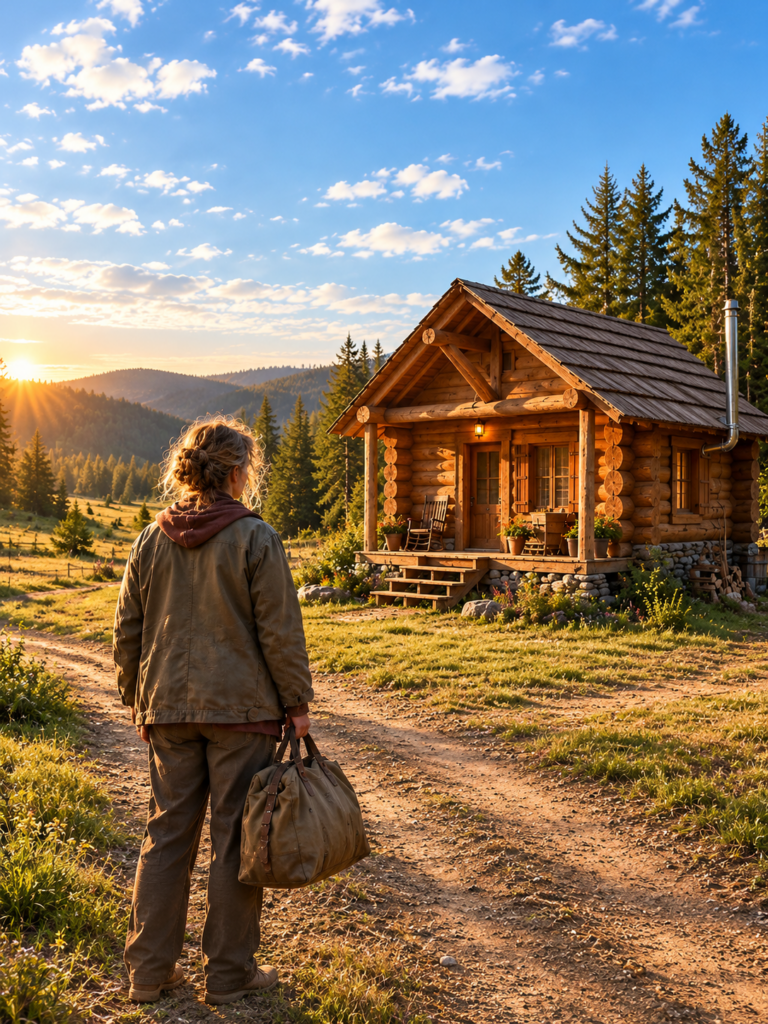
In its place stood a strong wooden deck supported by four posts, with a handmade railing fashioned from locust branches.
The roof was straight and covered in clean corrugated metal that flashed silver in the morning sunlight.
The clearing had been opened, the drainage improved, and a narrow garden stretched behind the house.
Smoke drifted gently from the stove chimney.
Diane leaned forward.
“Is that it?”
Richard stopped the SUV.
For several seconds, nobody opened a door.
Margaret stood on the porch wearing faded jeans, a blue flannel shirt, and her father’s old work boots.
She smiled.
“Morning.”
Her mother stepped out first.
“Oh, Maggie.”
She looked around slowly.
The little home stood beneath the changing autumn trees, with the valley falling away beyond the ridge.
“It’s beautiful.”
Margaret came down the steps and embraced her.
“I’m glad you came.”
Diane climbed out of the vehicle.
She stared at the roof.
“You had all this done?”
“Most of it. Calvin helped with the structural work. Walter helped me find materials.”
Richard walked toward the cabin, examining the joints between the logs.
“These are the original walls?”
“Every one of them.”
He touched the timber.
“That’s not pine.”
“No.”
Margaret waited.
“It’s American chestnut.”
Richard looked surprised.
“You’re sure?”
“Walter identified it, and I had it independently checked.”
Richard studied the wood again.
He knew enough about construction to understand the significance.
American chestnut lumber, once common, had become scarce after disease devastated the species.
Old reclaimed pieces could command high prices.
He ran his fingers over the ax marks.
“Well, I’ll be damned.”
Margaret opened the door.
“Come inside.”
Her mother entered first.
The room was simple.
A small wooden table stood near the window. A narrow couch faced the stone hearth. Shelves held books, dishes, and a few treasured photographs.
The original chestnut walls glowed warmly in the daylight.
There was no fancy furniture.
No marble countertop.
No expensive decoration.
But everything was clean, carefully placed, and clearly loved.
Diane stood just inside the doorway.
Margaret watched her sister’s expression change.
Confusion first.
Then surprise.
Then something Margaret had not seen in a very long time.
Uncertainty.
“This is actually nice,” Diane said.
Margaret smiled.
“Thank you.”
Their mother walked to the shelf.
She picked up their father’s photograph.
“Oh, Maggie. You brought him.”
“Of course.”
Her mother touched the frame.
“He would have loved this.”
Margaret swallowed.
“I think so too.”
Richard examined the solar equipment, the water sink, and the woodstove.
“How much did it cost to run power up here?”
“I didn’t.”
He frowned.
“What do you mean?”
“I use a small solar system.”
“For the whole house?”
“For what I need. I work on a laptop. I don’t need a large electrical setup.”
“And water?”
“Gravity-fed from a spring. Tested, treated, and stored.”
Richard stared.
“A spring?”
Margaret nodded.
“There’s something else I want to show you.”
She led them behind the cabin.
The old curtain of kudzu was gone.
A neatly cleared path curved around the hillside toward a low sandstone doorway.
Her mother stopped.
“What is that?”
“A root cellar.”
Diane looked skeptical.
“Under the hill?”
“Yes.”
Margaret switched on a flashlight and led them inside.
The temperature dropped immediately.
Their footsteps echoed softly against the flagstone floor.
Richard lifted his own flashlight toward the walls.
He moved slowly along the fitted sandstone, studying the joints and the embedded shelving.
“This is dry-stacked,” he said.
Margaret nodded.
“Built without mortar.”
“How old?”
“Likely around a hundred years. I found records connected to the original builder.”
Richard crouched beside the drainage channel.
He followed it toward the doorway, then examined the stone shelf supports.
Minutes passed.
Nobody spoke.
Finally, he stood.
“This is solid.”
His voice carried an unfamiliar note.
Respect.
Diane looked around.
“How did you know this was here?”
“I didn’t. The entrance was buried under vines.”
“And all those jars?”
“Some were here when I found it. I kept the old ones separately. The food on these shelves is from my garden and local produce.”
Her mother touched a jar of apple butter.
“You made this?”
Margaret smiled.
“Last month.”
Diane stared at the rows of preserved food.
For a woman accustomed to shopping twice a week at a supermarket, the shelves represented something she had never considered.
Preparation.
Security.
The ability to survive difficult seasons without depending entirely on a paycheck or store deliveries.
Margaret led them outside to the spring.
She explained the storage tank and the gravity-fed pipe running downhill.
Richard listened without interrupting.
Then he asked the question she had expected.
“What did all of this cost?”
Margaret reached into her coat pocket and unfolded a paper.
She had prepared it the previous night.
It was a summary of the property’s purchase and improvement expenses.
The fifty-dollar purchase.
Lumber.
Roofing.
Plumbing components.
Solar equipment.
Stove.
Salvaged materials.
Tools, transportation, required inspections, and the remaining repair costs.
Her documented direct spending over the ten-month project totaled $3,420, excluding the substantial value of her own unpaid labor and the help she had received.
Richard read the final figure twice.
“Three thousand four hundred and twenty?”
“Yes.”
“For the property and all those materials and expenses?”
“That’s what came out of my pocket.”
He looked back toward the cabin.
“No mortgage?”
“No mortgage.”
“Rent?”
“No rent.”
Diane crossed her arms.
“Well, that’s nice, but it still isn’t worth much. You’re in the middle of nowhere.”
Margaret folded the paper.
She had anticipated that response too.
“The county reassessed it after the improvements.”
Richard looked up.
“What did they say?”
“Thirty-eight thousand dollars.”
Diane blinked.
“What?”
“Thirty-eight thousand.”
Richard took off his sunglasses.
“For that cabin?”
“For the property and documented improvements. That’s the assessed value, not a guaranteed selling price.”
He let out a slow breath.
Margaret watched her sister.
Diane looked as though she wanted to argue, but the numbers had left her momentarily speechless.
Margaret could have enjoyed that silence.
A year earlier, she might have spent hours imagining the moment when Diane finally admitted she had been wrong.
But standing there on the hillside, Margaret found that the satisfaction felt smaller than she had expected.
The cabin had already given her something more important.
She didn’t need her sister to be humiliated.
She needed her sister to understand.
“Diane,” she said gently, “do you remember what you told me at Mama’s dinner table?”
Diane looked away.
“Margaret…”
“You said all I deserved was a fifty-dollar cabin.”
Their mother turned toward Diane.
Richard remained silent.
“I was hurt,” Margaret continued. “Not because I thought you were right, but because I had spent so many years trying to be someone you could respect.”
Diane’s face tightened.
“I was worried about you.”
“I know you were.”
“I didn’t want you throwing your money away.”
“I understand that too.”
Margaret looked toward the house.
“But you didn’t ask what I saw in this place. You didn’t ask what it meant to me. You looked at the price and decided it told you everything about its worth.”
The wind moved through the leaves above them.
Diane stared down at the gravel.
For once, she had no immediate reply.
Their mother stepped closer to Margaret.
“I think your father would be very proud.”
Margaret’s eyes filled.
Her mother took her hands.
“All those years, you looked after everybody else. Your father. Me. Even your sister when she needed help.”
Diane’s expression changed.
Her mother continued quietly.
“And I think somewhere along the way, we forgot to ask who was looking after you.”
Margaret couldn’t speak.
Her mother squeezed her hands.
“I’m sorry, sweetheart.”
That apology reached a place inside Margaret that the financial figures never could.
She embraced her mother.
For a long time, they stood together beneath the autumn trees.
Then Diane stepped forward.
“I didn’t know you felt that way.”
Margaret looked at her.
“You never asked.”
Diane swallowed.
She glanced toward the cabin, then back at her sister.
“I thought you were making a mistake. I kept thinking about how hard Dad worked, how he always wanted better for us. And I was scared you were going to end up stuck somewhere nobody could help you.”
Margaret listened.
The explanation did not excuse the cruelty.
But it sounded more honest than the mockery she had heard for so long.
“I shouldn’t have said those things,” Diane admitted.
“No,” Margaret replied. “You shouldn’t have.”
“I’m sorry.”
Margaret nodded.
“Thank you.”
She did not pretend that one apology erased years of judgment.
And Diane did not ask her to.
Instead, they walked back toward the porch together.
Margaret’s mother sat in a wooden chair facing the valley.
Richard returned to the cellar for another look.
Diane lingered at the doorway.
“Did you really do most of this yourself?”
“Most of what I safely could. I had help with the roof and the work I wasn’t qualified to do.”
Diane looked at the walls.
“How did you learn?”
“Dad taught me more than I realized.”
Her sister smiled faintly.
“He always let you stay in his workshop.”
“He let you stay too.”
“I never wanted to.”
Margaret laughed.
“No. You didn’t.”
For a moment, they were children again.
Two girls in a house filled with sawdust and the sound of their father’s hammer.
Diane stepped closer to the wall.
She traced one of the old ax marks.
“Those were made by hand?”
“Every one.”
“That’s amazing.”
Margaret nodded.
“It is.”
Later that afternoon, they drank coffee on the porch.
Their mother had brought biscuits and a jar of strawberry jam.
Margaret served apple butter she had made herself.
The valley below glowed gold in the autumn sunlight.
For several minutes, nobody spoke.
The silence felt comfortable.
Then her mother asked, “Are you happy here, Maggie?”
Margaret looked out across the mountains.
She thought about the rented room where she had cried after Christmas dinner.
The long evenings working on invoices.
The muddy road.
The blistered hands.
The frightening expenses.
The first stream of water from her sink.
The first light glowing from her solar-powered lamp.
She thought about the day she discovered the cellar, and the old man’s handwritten note that had waited nearly a century for somebody to read it.
And she thought about her father.
His tired hands.
His patient voice.
Check the bones before you bury the building.
“Yes, Mama,” Margaret said.
She smiled.
“I really am.”
As the sun began to drop behind the ridge, Richard offered to help build a small woodshed before winter.
Margaret thanked him.
Diane asked whether she could visit again.
“Of course,” Margaret said.
“Maybe next time I’ll bring groceries.”
Margaret laughed.
“Bring yourself. That’s enough.”
After they left, the mountain returned to its usual quiet.
Margaret watched their taillights disappear between the trees.
Then she walked around the cabin, checking the door, the firewood, and the water system before evening.
Inside, she placed the empty coffee cups in her sink.
A small lamp illuminated the warm chestnut walls.
She opened her expense notebook and turned to the last page.
There, beneath the old sentence about building a home rather than proving a point, she wrote another.
Some things are worth more than anyone knows until somebody gives them a chance.
She sat quietly for a while, listening to the stove crackle.
The cabin had cost fifty dollars.
The repairs had cost months of savings, hard work, and painful uncertainty.
The stone cellar had been hidden for decades.
The spring had flowed unnoticed.
The chestnut logs had stood through storms, changing seasons, and generations of human lives.
But Margaret finally understood that the greatest discovery had not been underground.
It wasn’t the antique jars.
It wasn’t the rare timber.
It wasn’t even the reassessed property value.
It was the realization that she could begin again without asking anyone’s permission.
The family who once laughed at her had finally seen what she had built.
But by then, their approval was no longer the foundation of her happiness.
She had built that foundation herself.
Outside, the first stars appeared over the West Virginia mountains.
Margaret closed her notebook, turned down the lamp, and looked around the little house.
There was enough wood stacked for the night.
Enough food downstairs for the coming weeks.
Enough water in storage.
Enough light to finish her work in the morning.
And for the first time in many years, she felt she had enough.
Not because she had become wealthy.
Not because she had proved her sister wrong.
But because she had found a place where her effort, her judgment, and her quiet determination had finally taken root.
She touched the old chestnut wall beside the door.
“Thank you, Thomas,” she whispered.
Then, after a moment, she added, “Thank you, Dad.”
The house settled gently around her.
The wind brushed the branches outside.
And high above the sleeping valley, in a cabin everybody had dismissed as worthless, Margaret Ellis finally felt at home.