Miriam placed one worn shoe on the wagon step, then stopped when Toby refused to release her hand.
The boy was staring past Ezra toward the road.
“Will he come with papers?” Toby asked. “Like the sheriff did?”
Ezra remained beside the wagon.
“I can’t promise he won’t.”
Miriam’s face tightened.
“But if somebody comes asking questions,” Ezra continued, “your mother has the right to answer them. I’ll not be making decisions in her place.”
Toby considered that.
“Even Uncle Garrett?”
“Even him.”
The boy finally climbed into the wagon.
Miriam followed, arranging their small bundle beneath the seat.
Ezra climbed up front and gathered the reins.
The journey to his place was quiet.
His property lay among broad pastures, low fences, and stands of cottonwood that followed a narrow creek. His cattle grazed beyond the buildings.
The room attached to the barn was plain but serviceable.
A cot stood beneath the window, another narrow bed against the opposite wall. There was a small table, two chairs, a washbasin, and a cast-iron stove.
Miriam examined the door first.
Ezra noticed.
“Latch works from inside.”
She tested it.
Then she looked at the beds.
“This will do.”
“I’ll bring fresh water.”
He left them alone.
That evening, after Toby fell asleep, Miriam sat beside the stove with her husband’s last letter spread across her knees.
Thomas had written from Lansing.
He asked after Toby’s schooling. He wondered whether the spring planting had begun. He reminded her not to sell her sewing machine unless there was no other way.
And at the bottom, in cramped handwriting, he had promised that he was still trying to come home.
Miriam touched the page.
She was not waiting for a new husband.
She was fighting to keep the family she already had.
Outside, Ezra finished watering the horses.
He heard the soft scrape of Miriam’s chair through the barn wall, then her voice speaking to Toby.
“Your father loves you. Whatever anybody says about him, remember that.”
“I know, Mama.”
Ezra moved away.
Some words were not meant for a stranger.
The following morning, Miriam found him repairing a harness strap.
“I’ve been thinking,” she said.
“About the room?”
“About what you told me yesterday. That hiding won’t stop the hearing.”
Ezra set the strap aside.
“I don’t reckon it will.”
“Then I need to make a living. Even a little one. I can sew. Mend shirts, mend coats, darn stockings. I’ve done it before.”
“Mrs. Pruitt’s been wanting someone to do her mending.”
“Would she employ a woman whose husband is in prison?”
“She might employ one who can sew.”
Miriam almost smiled.
“I’d rather people know who I am before they decide what I am.”
“That sounds sensible.”
“And Toby needs school.”
Ezra nodded.
“There’s a schoolhouse in the hollow.”
She hesitated.
“I need you to understand something, Mr. Colton. I am grateful for the shelter. But I won’t have you speaking for me in court, making promises on my behalf, or deciding what happens to my son.”
“Wasn’t planning on it.”
“If I ask for help, I’ll ask plainly.”
“Fair enough.”
“And if I can pay for the room someday, I will.”
Ezra studied her for a moment.
“Money’s yours to keep until you have enough to stand on. We can discuss rent when you aren’t deciding between supper and a roof.”
She looked away before answering.
“Thank you.”
Within two days, Miriam had swept the room, patched a draft beside the window, and put Toby to work collecting small pieces of kindling.
Ezra supplied fuel without making a ceremony of it.
One afternoon, as Miriam sorted her husband’s letters, he returned from the mercantile with troubling news.
The guardianship hearing had been scheduled.
The third week of June.
Five weeks away.
Garrett had retained a lawyer from Topeka.
Miriam read the notice Ezra had copied down for her and pressed her thumb against its edge.
Five weeks.
That was all the time she had to persuade a court that her poverty did not make her an unfit mother.
“Mr. Colton,” she said, “will you tell me something plainly?”
“If I can.”
“Do you think I have a chance?”
Ezra considered his answer.
“I think you’ve got work to do. And I think people ought to hear what you have to say.”
Miriam folded the paper.
Then she turned to the little desk beside the window, opened her sewing box, and took out the best needle she owned.
“Then I’ll start tomorrow.”
But before Ezra reached the barn door, she stopped him.
“There’s one more thing.”
He turned.
“Garrett’s been telling people I ran because I’ve something shameful to hide.”
“Have you?”
“No.”
“Then tell them why you ran.”
Miriam looked toward Toby, sleeping peacefully in the other bed.
For the first time, the answer frightened her less than the thought of remaining silent.
“Very well,” she said. “I’ll tell them myself.”
Ezra rested his hand on the barn door.
“Then the first thing you’ll need,” he told Miriam, “is someone willing to listen.”
She looked down at the needle resting between her fingers.
“People generally listen more closely when a woman has money.”
“Then we’ll find you work.”
“No,” she said, lifting her head. “I’ll find the work. You may introduce me to Mrs. Pruitt.”
Ezra’s mouth moved beneath his mustache.
It was almost a smile.
“Tomorrow morning, then.”
Miriam did not sleep easily that night.
She lay awake listening to the ordinary sounds of the ranch: a horse shifting in its stall, the wind touching the barn boards, Toby breathing beneath his blanket.
For months, every plan had begun with a question of where they could hide next.
Now she had made a different kind of plan.
One that required being seen.
The following morning, Ezra took her and Toby to the Pruitt place.
Otis’s wife, Martha, answered the door with a dish towel over her shoulder.
Her gaze moved briefly from Miriam’s worn dress to the child standing beside her.
Ezra made the introduction.
“Mrs. Hale’s looking for sewing work. Thought you might have some.”
Martha Pruitt was no fool.
She had already heard enough about the Hale family to know why a woman with a little boy might be living on Ezra Colton’s property.
But her eyes were failing, and she had three shirts needing repair.
“Can you make a seam hold?” she asked.
Miriam accepted the first shirt.
“I can make it hold longer than the cloth around it, if the cloth’s worth saving.”
Martha laughed.
“Then come inside.”
Ezra took Toby out to see Otis’s steers while the women discussed prices.
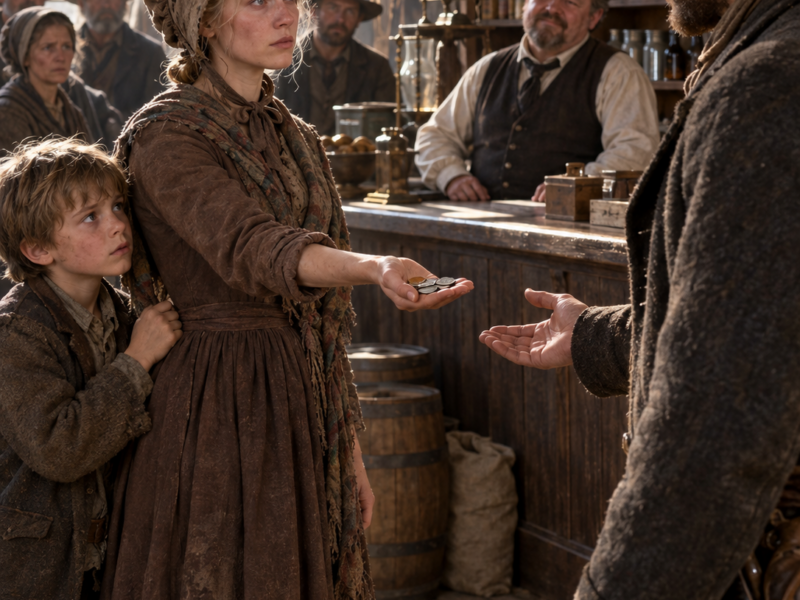
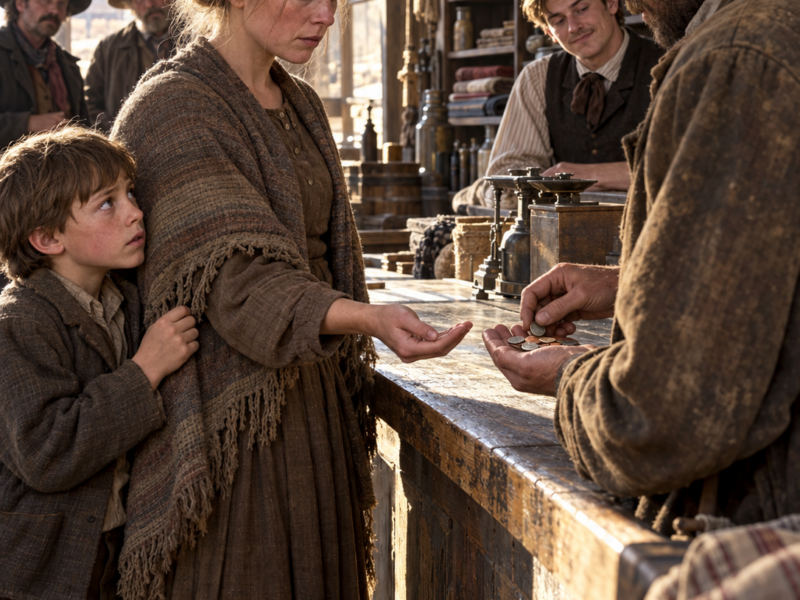
Miriam refused charity.
Martha refused to pay less than a fair rate.
By the time Ezra returned, they had an agreement.
Three shirts, two pairs of stockings, and a winter coat that needed new lining before the cold came again.
Miriam carried the garments home as carefully as if they were treasure.
That evening, she worked beside the stove.
Toby sat at the table practicing letters Ezra had written on a piece of scrap paper.
“Why do we need school if you can teach me?” Toby asked.
“Because there’s more to learn than I have time to teach.”
“Can Mr. Colton teach me cattle?”
“If Mr. Colton wishes.”
Ezra, standing in the doorway with a bucket of fresh water, answered before Miriam could finish.
“A boy who learns to count cattle ought to learn to count properly first.”
Toby grinned.
It was the first grin Ezra had seen from him.
The next Sunday, Miriam walked into the little church in Larkspur Hollow.
She wore the same brown dress she had worn beside the broken fence, but it was washed and carefully pressed. Toby’s collar was clean.
Ezra walked with them as far as the steps.
Then he gave them room to enter on their own.
Miriam could feel the congregation looking.
Some eyes held curiosity.
Some held suspicion.
Others looked away because they did not know what kindness might demand of them.
Miriam chose a pew near the middle.
She kept her back straight.
During the final hymn, Toby slipped his hand into hers.
“Mama,” he whispered, “people are watching.”
“I know.”
“Should we go?”
“No, darling. We came to worship. We’ll finish what we came for.”
When the service ended, Martha Pruitt crossed the aisle and asked Miriam whether she could help put up preserves later that week.
Another woman asked about having a dress altered.
The pastor shook Toby’s hand and told him the schoolmaster had been expecting him.
Nobody promised to stand beside Miriam in court.
But nobody told her to leave.
For that Sunday, it was enough.
***
Over the following weeks, Miriam built a life out of tasks small enough to complete before supper.
She stitched torn sleeves.
She darned stockings.
She earned modest wages from sewing and helped Martha preserve the season’s first vegetables.
Toby began attending the one-room schoolhouse.
His first day was difficult.
One boy asked whether his father really wore prison clothes.
Toby came home furious and humiliated.
Miriam sat beside him.
“What did you say?”
“That Papa never stole anything.”
“And did the boy believe you?”
“No.”
“Then you’ve told him what you know. You don’t need to fight him for the right to believe your own father.”
The next day, Toby returned to school.
Within another week, he had found children more interested in marbles and spelling than in his father’s imprisonment.
Ezra continued his ranch work.
He repaired fences, tended his cattle, and made trips to the mercantile for feed and supplies.
He was careful not to make Miriam the subject of public gossip.
A woman whose husband was imprisoned did not need her reputation made worse by speculation about the man sheltering her.
When Toby once asked whether Ezra meant to marry his mother, Ezra answered without embarrassment.
“No, son. Your mother has a husband.”
“But you’re helping us.”
“That doesn’t make me your father.”
Toby thought about it.
“Then what does it make you?”
Ezra leaned back in his chair.
“A neighbor doing what he can.”
Miriam, standing by the stove, turned away so the boy would not see the tears gathering in her eyes.
Thomas remained her husband.
Nothing Ezra had done required her to surrender that truth.
And for that reason, she trusted him more than she had expected to trust another man.
***
One evening, Miriam finally explained why Garrett frightened her so badly.
She and Ezra were sitting on the porch while Toby worked his sums.
“Garrett believes Thomas was given what should have belonged to him,” she said.
Ezra rested his forearms on his knees.
“The family land?”
She nodded.
“Thomas was favored by their father. Garrett worked on the place before trying to establish his own holding, and he never stopped counting what he thought he’d been denied.”
“Does he want the boy or the property?”
Miriam looked toward the window.
“I believe he thinks one will give him a claim to the other. But I think he believes he ought to raise Toby as well.”
Ezra considered that.
“A man can believe he’s right and still do something cruel.”
“That’s what makes him dangerous. He doesn’t think he’s punishing us.”
“Then the hearing won’t be settled by showing he’s unpleasant.”
“I know.”
“It’ll be settled by showing the judge what kind of mother you are.”
Miriam folded her hands.
“That means facing every question I’ve been running from.”
“Likely.”
She looked at him.
“Will you come?”
“To the courthouse?”
“Yes.”
“If you want me there.”
“I do.”
“Then I’ll be there.”
***
Three weeks before the hearing, Ezra rode to the rail stop at Coils Crossing.
From there, he took the train to Topeka.
He told Miriam only that he had business concerning Thomas’s lawyer.
She did not know what to expect.
When Ezra returned, he carried a letter from a man named Prescott.
Prescott had been quietly examining the cattle theft case.
The evidence against Thomas had never satisfied him.
The missing thirty head had disappeared during a drive operated by the Kessler outfit.
Thomas, exhausted from repeated watch duty, had been blamed because he was responsible for the cattle when the loss was discovered.
But Prescott had found something worth investigating.
A stock buyer’s bill of sale from a Dodge City commission house.
Two animals connected to the missing cattle had apparently been sold under a different brand.
The seller was a man named Silas Rock.
Rock had ridden with the Kessler outfit and departed soon after the cattle disappeared.
Miriam read the letter twice.
Then a third time.
“Does this prove Thomas didn’t steal them?”
“No,” Ezra said. “Prescott was careful about that.”
“But another man sold some of those cattle.”
“That’s what the record may show.”
“Then somebody has to explain it.”
“That’s what Prescott intends to pursue.”
Miriam covered her mouth.
For eight months, nearly everything concerning Thomas had consisted of accusation, conviction, and shame.
Now there was a name.
A transaction.
A written reason to question the version of events that had sent her husband to prison.
It did not bring him home.
But it gave her something she had almost forgotten how to recognize.
Hope supported by more than faith alone.
Ezra had brought another piece of news.
Prescott had obtained a report concerning Thomas’s conduct at Lansing.
He had no disciplinary infractions.
He had worked steadily in the prison vegetable plots and had earned favorable remarks from those supervising him.
“Why would the judge care about that?” Miriam asked.
“Your brother-in-law means to make your family sound unfit from one end to the other. This shows Thomas is still conducting himself honorably in the circumstances he’s been given.”
Miriam lowered her eyes to the letter.
“You went all the way to Topeka for this.”
“Prescott needed someone to bring the papers.”
“You spent your own money.”
Ezra shrugged.
“Could afford the fare.”
“That isn’t an answer.”
“No,” he admitted. “Suppose it isn’t.”
She sat very still.
“Why are you doing so much?”
He looked toward the window, where Toby was chasing a grasshopper through the yard.
“Because I don’t care to watch a family lose more than it’s already lost when there’s something useful I can do.”
She wanted to thank him properly.
Instead, she cried.
Not loudly.
Not dramatically.
Just a few helpless tears falling onto the letter she held so carefully.
Ezra rose.
“I’ll check the horses.”
And he left her in peace.
***
Ten days before the hearing, Ezra came around the barn after sunset to settle a mare.
He was carrying her lead rope when he heard Miriam’s voice through the wall of the little room.
At first he thought she was speaking to Toby.
Then he glanced toward the window and saw the boy asleep.
Miriam was praying.
Her words were low and uneven.
“Lord, I’ve tried to do everything I know. I’ve worked, and I’ve written letters, and I’ve brought him to school. I’ve tried to show everyone that he’s cared for.”
A long silence followed.
Ezra stood still.
He knew he should leave.
Then he heard her say:
“Please don’t take him, too.”
Her voice broke.
“Thomas is still alive, but he’s so far away I can’t help him. I don’t know how many more months or years they’ll keep him there. If they take Toby as well, I don’t know what I’ll have left.”
Ezra lowered his gaze.
Miriam went on.
“I know I was wrong to run. I know fear made me foolish. Please give me enough courage to stand before that judge and tell the truth.”
Then, after another pause:
“And if help has already been sent, Lord, teach me to recognize it without being ashamed.”
Ezra turned away.
He led the mare into her stall and finished his work.
He told no one what he had heard.
But he remembered a verse his mother had read to him when he was young, during years when his own father was often absent.
Words about the Lord receiving those who felt forsaken.
Ezra had never been a man given to elaborate declarations of faith.
He believed a promise ought to be visible in what a person did.
And that night, he understood something.
He could not bring Thomas home.
He could not command the judge.
He could not remove the fear Miriam carried.
But he could refuse to leave her standing entirely alone.
***
On the morning of the hearing, Miriam rose before dawn.
She pressed her one good dress.
She cleaned Toby’s shoes and checked the buttons on his shirt.
She placed Prescott’s letter inside a small cloth satchel.
Her hands shook as she fastened the clasp.
When Ezra arrived with the wagon, she was waiting outside.
“Ready?” he asked.
Miriam looked at Toby.
Then toward the distant road.
“Yes.”
They traveled to the county courthouse at Coils Crossing.
The squat brick building stood beneath a pale June sky.
People had already gathered on the steps.
Garrett Hale stood among them, dressed neatly beside his attorney, Aldis Finn.
His expression hardened when he saw Miriam.
Toby moved closer to his mother.
She squeezed his hand.
“Remember what I told you,” she whispered.
“Tell the truth?”
“Exactly.”
At the courthouse door, she paused.
Ezra came to a stop behind her.
“You don’t have to prove you aren’t frightened,” he said.
Miriam stared at the doorway.
“Then what must I prove?”
“That you’re his mother. And that you’ve been doing the work of one.”
She drew a long breath.
Then she stepped inside.
For the first time since Thomas’s conviction, Miriam Hale was going to let the whole county hear her story.
The courthouse door closed behind Miriam, and the murmuring from the gathered townspeople seemed to grow louder.
She kept walking.
Toby held her left hand.
In her right, she carried the satchel containing the letters that had become the most important papers in her life.
Ezra followed several paces behind.
He had promised to attend.
He had not promised to rescue her from every uncomfortable question, and Miriam had not asked him to.
This was her family.
Her answer to the court would have to come from her.
The courtroom was already crowded.
Garrett Hale sat near the front beside Aldis Finn, the lawyer he had hired in Topeka.
Across the aisle, several familiar faces caught Miriam’s eye.
Martha Pruitt.
The schoolmaster.
The pastor from Larkspur Hollow.
She had not known whether they would come.
Martha gave her a small nod.
It was enough to help her take the next step.
Judge Calvert Ames entered, and the room rose.
When everyone was seated, the proceeding began.
***
Aldis Finn spoke first.
He was a careful man with a practiced voice, and he presented Garrett’s petition as though it were merely a question of giving a child the best possible home.
Thomas Hale was imprisoned after a cattle-theft conviction.
His family had lost its principal means of support.
Miriam had no established household of her own.
She had fled after receiving notice of the guardianship proceedings.
She had hidden with her son in an abandoned line shack.
Garrett, Finn argued, could offer the boy an orderly household, financial security, and the steady influence of relatives whose reputation remained intact.
Miriam listened without lowering her head.
The most painful part was how much of it was true.
Thomas was imprisoned.
She had been destitute.
She had slept with Toby in an abandoned shack.
She had run.
Finn had taken the hardest weeks of her life and arranged them into a picture of a woman incapable of raising her child.
But that picture left out the reason she had been afraid.
It left out the work she had done afterward.
And it left out the person Toby had become under her care.
When Miriam was called forward, she placed her satchel on the table and waited for the questions.
Finn began with her flight.
“Mrs. Hale, you understood that a hearing concerning your son’s guardianship had been requested?”
“Yes.”
“And you left before the matter could be heard?”
“I did.”
“Taking the child with you?”
“Yes.”
“Would you describe that as responsible conduct?”
Miriam felt the room watching her.
She could have made excuses.
She could have accused Garrett of frightening her.
She could have explained how little sleep she’d had or how impossible everything had seemed after Thomas was taken away.
Instead, she answered the question.
“No, sir. I would not.”
Finn paused.
“You admit you behaved irresponsibly?”
“I admit that fear led me to make a poor choice.”
“And why should the court believe your judgment has improved?”
Miriam looked at the judge.
“Because I stopped running.”
The room quieted.
She continued.
“I came back among people. I found work. I arranged for my son to attend school. I have kept him fed and clothed, and I have sought a proper place for us to live.”
“You are living on another man’s property.”
“Yes.”
“A man who is not related to you.”
“Yes.”
“And you expect this court to accept that arrangement as suitable?”
Miriam held his gaze.
“Mr. Colton offered us temporary shelter when we had none. There has been no improper arrangement. I have my own room, my own work, and my own decisions to make.”
Finn shifted his weight.
“And when his charity ends?”
“I will find another room.”
“With what money?”
“The wages I earn.”
“Will those wages be sufficient?”
“I cannot promise wealth, Mr. Finn. I can promise that I know my child’s needs and have been working to meet them.”
There was a brief movement among the spectators.
Judge Ames raised his hand for quiet.
Miriam continued before Finn could interrupt.
“I have never claimed that running was wise. I have never claimed that our circumstances were easy. But being poor is not the same as being unwilling or unable to care for a child.”
She glanced toward Toby.
“Everything I have done since my husband was imprisoned has been to keep my son safe.”
Finn asked about Thomas.
Did she believe a convicted cattle thief was a suitable father?
Miriam drew a breath.
“My husband was convicted. I cannot change that by saying I believe him innocent.”
“And yet you dispute the conviction?”
“I do.”
“On what basis?”
“On the basis of what I know of his character, and on information his lawyer has since obtained.”
Prescott’s letter was produced.
Finn objected to its use.
The judge considered the matter, allowing it to be read into the record in connection with the family’s circumstances while making clear that the guardianship hearing would not determine Thomas’s guilt or innocence.
The letter described the stock buyer’s bill of sale, the animals sold under another brand, and Silas Rock’s connection to the cattle drive.
It did not prove Thomas innocent.
But it showed that his conviction was being questioned on grounds more substantial than family loyalty.
When Miriam sat down, she was exhausted.
Yet she felt something she had not felt in months.
She had told the truth without fleeing from it.
***
The witnesses from Larkspur Hollow followed.
Martha Pruitt described Miriam’s sewing.
She spoke of a woman who arrived promptly, worked carefully, charged fairly, and treated her son with patient attention.
The schoolmaster testified that Toby attended regularly, came prepared, and was making sound progress.
The pastor spoke about Miriam’s conduct in the community.
None of them claimed she was without faults.
None pretended that a few weeks erased the hardships she had endured.
They simply described what they had seen.
A mother working.
A child learning.
A family trying to recover.
Ezra was called afterward.
Finn studied him with open skepticism.
“Mr. Colton, how long have you known Mrs. Hale?”
“Several weeks.”
“And you provided a room for her and her son?”
“Yes.”
“Without payment?”
“That’s right.”
“Why?”
Ezra considered the question as though he were being asked why a rail needed replacing when it had rotted.
“They needed shelter. I had a room.”
Finn waited.
“Is that all?”
“That’s what happened.”
“Do you have any personal interest in Mrs. Hale?”
Ezra’s expression remained unchanged.
“I have an interest in seeing the boy properly cared for and his mother treated fairly.”
“Would you describe your relationship as affectionate?”
“I’d describe it as respectful.”
“And you expect the court to believe you have asked nothing of her in return for shelter?”
“You may ask Mrs. Hale what I’ve asked of her.”
Finn glanced toward the judge.
Ezra went on.
“She can leave whenever she chooses. I’ve never told her otherwise.”
There was nothing theatrical in his answers.
No grand speech.
No declaration that he alone understood Miriam’s suffering.
He told the court what he knew firsthand and refused to pretend he knew more.
It was precisely what Miriam had hoped he would do.
***
Then Judge Ames asked to hear from Toby.
The boy stood beside his mother, very small beneath the high courtroom windows.
Miriam brushed his collar straight.
“Only tell what you know,” she whispered.
Toby nodded.
He went forward.
The judge spoke gently.
“Do you understand why these people have gathered today?”
Toby looked across the room at his uncle.
“Uncle Garrett wants me to live with him.”
“And what do you think about that?”
“I want to live with Mama.”
“Can you tell me why?”
Toby stared at his shoes.
Miriam felt her heart tighten.
She wished she could spare him the burden of speaking about matters grown people should have settled without making him afraid.
But Toby raised his head.
“Mama takes care of me.”
The judge waited.
“She makes sure I have enough to eat. She teaches me my letters. She makes me wash behind my ears even when I don’t want to.”
A few people smiled.
Toby continued.
“She says Papa didn’t steal those cattle. She reads me his letters so I won’t forget the sound of the things he says.”
“And your uncle?”
“Uncle Garrett didn’t use to come see me much.”
Toby looked toward Garrett again.
“Then Papa went away, and he started saying I belonged in his house.”
He hesitated.
“I don’t want to forget Papa.”
Miriam pressed her hand over her mouth.
Toby looked back at the judge.
“And Mama works hard. Sometimes I hear her crying when she thinks I’m asleep. But she gets up in the morning anyway.”
A heavy silence settled over the room.
The child had offered no argument about property.
No opinion about legal rights.
No elaborate accusation against Garrett.
He had simply described his life.
And in that description was the heart of everything Miriam had been trying to explain.
She was his mother.
He knew her love.
And he wanted to remain with her.
***
Judge Ames did not deliver an immediate ruling.
He said he would consider the testimony and issue his decision.
The family returned to Ezra’s place.
For the next week, Miriam lived with uncertainty.
She sewed because her hands needed occupation.
She made Toby practice his sums.
She went to church.
She worked beside Martha Pruitt when work was offered.
And sometimes, late at night, she found herself standing beside the little barn-room window, looking toward the road as though an answer might appear there.
Ezra did not tell her everything would be fine.
He knew too much about hard times to make promises he could not keep.
Instead, he kept a place for her and Toby at supper whenever they wanted company.
He made certain the horses were ready when a trip to town was necessary.
And when Miriam spoke of the hearing, he listened.
One evening, she asked him a question.
“What if the judge believes Garrett?”
Ezra set down his cup.
“Then you’ll need to find out what can be done next.”
“That sounds terribly uncertain.”
“It is.”
Miriam looked toward Toby, who was reading at the far end of the table.
“I used to believe courage meant not being afraid.”
“What do you believe now?”
She considered it.
“Perhaps it means going where you’re frightened to go because the people you love need you there.”
Ezra nodded.
“Reckon that’s nearer the mark.”
***
The decision came one week after the hearing.
Miriam returned to the courthouse with Toby.
Ezra accompanied them.
Judge Ames had prepared his ruling carefully.
Garrett Hale’s petition for guardianship was denied.
The court found insufficient grounds to remove Toby from his mother’s care.
Miriam’s earlier flight had been ill-advised, the judge acknowledged, but her subsequent conduct, her employment, and the testimony concerning Toby’s welfare supported her fitness as a parent.
Her husband’s imprisonment did not, by itself, justify taking the child from her.
Miriam gripped the back of the bench.
For an instant, she thought she had misunderstood.
Then Toby whispered:
“Mama?”
She turned toward him.
“You’re staying with me,” she said.
His face crumpled.
He threw his arms around her waist.
Miriam held him while she wept.
There was no shame in those tears.
She had spent months imagining the sound of footsteps coming to take her son away.
Now a judge had declared that Garrett could not simply claim him.
She could scarcely believe the relief.
The judge had more to say.
He explained that his court could not overturn Thomas Hale’s criminal conviction.
That matter would require different proceedings or consideration by the appropriate authorities.
But the information gathered by Prescott deserved further examination.
The judge urged that the documented concerns be presented through the proper channels in Topeka.
It was not a pardon.
It was not a promise of Thomas’s return.
Miriam understood the difference.
She also understood that, for the first time in months, someone with authority had acknowledged that her husband’s case was not necessarily beyond further inquiry.
One battle had ended.
The other remained.
***
Garrett Hale rose abruptly.
He began protesting about the family property.
About the years he had worked beside Thomas.
About what his father had intended and what had supposedly been denied him.
Judge Ames stopped him.
A dispute over compensation for labor or an interest in land, he explained, was separate from the question of Toby’s guardianship.
If Garrett believed he possessed a lawful claim, he would have to pursue it through the appropriate proceedings.
It did not entitle him to take his brother’s child.
Garrett’s face darkened.
For a moment, Miriam thought he might turn on her.
Instead, he gathered his things.
He left without speaking to Toby.
Miriam watched him go.
She had feared him so long that seeing him walk out of a room without taking anything from her felt almost impossible.
She did not mistake his silence for repentance.
But she no longer needed to make herself disappear because of his anger.
***
The weeks afterward were not suddenly easy.
The world had not become generous overnight.
Thomas was still imprisoned.
There were bills to pay.
There was work to find.
Miriam still woke some nights with fear tightening her chest before she remembered that the hearing was over.
But one essential thing had changed.
She could make plans.
Not plans to hide.
Plans to live.
She took on additional mending.
She began setting aside coins for a room nearer the schoolhouse.
Toby grew comfortable enough at school to complain about arithmetic and boast about his marbles.
Martha Pruitt invited Miriam to help with preserving.
The pastor asked whether Toby might read aloud during a church gathering.
Small things.
Ordinary things.
Precisely the kind of ordinary life Miriam had feared they might never have again.
Ezra remained a friend.
He did not treat the court’s decision as a reason to claim special importance in the Hale family.
Nor did he pretend that helping Miriam had cost him nothing.
He had spent time and money, neglected some of his own work, and made himself the subject of occasional gossip.
Yet whenever Miriam tried to turn her gratitude into a debt, he would gently refuse.
“You don’t owe me a lifetime for a few weeks of help.”
“It was more than a few weeks.”
“Then say a few months.”
She would shake her head.
He would return to his work.
It became a familiar disagreement.
And eventually Miriam learned to accept that his kindness did not require repayment.
***
Nearly six weeks after the decision, another letter arrived from Prescott.
Miriam read it at the little table beside the barn-room window.
The petition asking for executive consideration of Thomas’s conviction had been submitted to the governor’s office.
The records concerning Silas Rock and the sale of the cattle were attracting attention.
Further details had been requested.
There was no assurance of a pardon.
No release date.
No certainty that Thomas would ever be vindicated.
But the papers were receiving serious examination.
That evening, Miriam walked toward the Pruitt boundary fence.
The rails Ezra had repaired months earlier stood firm beneath the warm summer sky.
Fireflies flickered above the grass.
Ezra was sitting on the upper rail, resting after his day’s work.
He saw her approaching and climbed down.
“News?” he asked.
She handed him the letter.
He read it carefully.
Then he returned it.
“That’s encouraging.”
“It is.”
She stood beside him, watching the grass move in the evening breeze.
“I keep thinking about Thomas reading a letter from me and learning the court let Toby stay.”
“Reckon he’ll be glad.”
“I wish I could see his face.”
Ezra said nothing.
There were no words he could offer that would shorten the distance to Lansing.
Miriam folded Prescott’s letter.
“I’ve saved some money.”
“That’s good.”
“Enough to begin looking for a little place of our own. Nothing grand. Somewhere nearer the school.”
Ezra nodded.
“There’s likely something suitable in the hollow.”
“I won’t be able to pay much.”
“You’ve time to look.”
She turned toward him.
“I want you to know that leaving your room won’t mean I’m ungrateful.”
“I know that.”
“And staying longer wouldn’t mean I’ve given up trying to support myself.”
“I know that, too.”
She smiled faintly.
“You make it difficult to argue with you.”
“Been told the opposite.”
For a moment, she laughed.
It was a soft laugh.
But real.
Ezra had heard her speak through fear, exhaustion, anger, and grief.
He had seldom heard her laugh.
He found he liked the sound.
***
They stood together as the evening deepened.
After a while, Miriam said, “Toby asked me something the other day.”
Ezra looked over.
“He asked whether you were going to marry me.”
Ezra’s expression became solemn.
“I hope you told him that’s not what I’m here for.”
“I did.”
She tucked Prescott’s letter beneath her arm.
“I told him I have a husband. And that you have been our friend.”
Ezra nodded.
“That’s the truth.”
Miriam studied him.
“I suppose people think every kindness between a man and woman must be the beginning of some romance.”
“People enjoy making stories.”
“But some kindnesses are important precisely because they don’t ask to become anything else.”
Ezra looked toward the repaired rails.
“I’d agree with that.”
Miriam drew a breath.
“Thomas is my husband. Whatever happens with the petition, I intend to keep working to clear his name.”
“You ought to.”
“And if he comes home, I want him to find that Toby and I kept faith with him.”
“I believe he will.”
She turned fully toward Ezra.
“You helped me do that.”
He lowered his eyes for a moment.
“Your courage did the harder work.”
“Not all of it.”
“No,” he admitted. “Not all.”
***
Then Miriam told him something she had not expected to tell anyone.
“Before you found us by this fence, I prayed.”
Ezra looked up.
“I was so afraid Garrett would take Toby. I asked the Lord not to let me lose my son as well as my husband.”
She touched the rough rail.
“At the time, I thought an answer to prayer would mean Thomas coming home, or Garrett changing his mind, or somebody arriving with a paper that settled everything.”
She looked across the field.
“Instead, a man came out to repair a fence.”
Ezra’s expression softened.
“I remember that morning.”
“I was terrified of you.”
“Had some notion of it.”
“And then you let us sit in the grass without pressing us. You gave Toby half your bread when you had barely enough for yourself.”
“He looked hungry.”
“He was.”
Her voice grew quiet.
“I was hungry, too. But more than that, I was tired of being treated as though there was something wrong with me simply because my husband had been convicted.”
Ezra said nothing.
“You didn’t tell me I was foolish to be frightened.”
“I told you running wouldn’t settle things.”
“You did. And you were right. But you also showed me somewhere I could stop long enough to think.”
She looked toward the barn, visible in the distance.
“I believe that mattered more than you knew.”
Ezra shifted his hat in his hands.
He remembered the prayer he had overheard beside the barn.
He remembered standing with the mare’s lead rope in his hand while Miriam begged not to lose her son.
And he felt it would be dishonest to let her believe he knew nothing of it.
“Mrs. Hale,” he said, “there’s something I ought to tell you.”
She waited.
“One evening, when I was settling the mare, I heard you praying through the barn wall.”
Miriam’s eyes widened.
“You heard me?”
“Didn’t set out to listen. Should’ve walked away sooner than I did.”
He looked at her steadily.
“I heard enough to understand how frightened you were.”
She lowered her eyes.
For a moment, neither spoke.
Then she asked, “Why didn’t you tell me?”
“Because it was a private matter. You weren’t speaking to me.”
Miriam considered that answer.
Then she nodded.
“Thank you for leaving it private.”
“I hope you don’t think I pitied you.”
“No.”
She looked up.
“I think you understood.”
***
The sun had fallen behind the low ridge.
From somewhere near the barn, they could hear Toby practicing his spelling aloud.
His voice carried across the yard.
Strong.
Clear.
Unhurried.
For the first time in many months, the boy sounded like someone with nothing urgent to fear.
Miriam turned toward that familiar voice.
“I used to think I had to be brave every minute,” she said. “That if Toby saw me frightened, he’d be frightened, too.”
“And now?”
“Now I think he needs to see that being afraid doesn’t mean we stop doing what must be done.”
Ezra nodded.
“That’s something worth teaching.”
She stood a little straighter.
“I’ll find a room in the hollow. I’ll keep sewing. I’ll keep writing to Prescott and to Thomas. And when Thomas’s case comes before anyone willing to reconsider it, I intend to be ready.”
“You will be.”
“If the pardon comes, we’ll meet whatever follows. If it doesn’t, we’ll keep doing what we can.”
Ezra extended his hand.
“You know where to find me if you need help.”
Miriam took it.
For a brief moment, they stood beside the fence that had brought them together.
There was no romantic promise between them.
No proposal.
No imagined future that required Thomas Hale to disappear from his own family’s story.
Instead, there was something quieter and equally valuable.
The trust of two adults who had come to respect one another without confusing kindness with possession.
Miriam released his hand.
“Good night, Ezra.”
“Good night, Miriam.”
She walked toward the barn room.
Halfway there, Toby came running out to meet her.
“Mama! I finished every spelling word!”
“Every one?”
“Even the hard ones!”
She laughed and reached for him.
He took her hand.
Together, they disappeared through the little doorway beneath the barn roof.
Ezra remained beside the fence until the light in their window glowed against the gathering darkness.
***
Before autumn, Miriam found a modest room nearer the schoolhouse.
She rented it with money earned from her own work.
Ezra helped transport the belongings she and Toby had gathered during their stay, but Miriam arranged the terms herself and paid the first rent from her savings.
There was scarcely enough furniture to fill the place.
A table.
Two chairs.
Two beds.
Her sewing things.
Thomas’s letters.
And a small wooden box containing the coins she intended to set aside for travel and legal expenses.
To Miriam, it was beautiful.
Not because it was comfortable.
Not because it was impressive.
Because its door opened onto a life she was choosing rather than a place where she had been forced to hide.
Toby began walking to school without having to ride the several miles from Ezra’s ranch.
Miriam continued taking in sewing.
She wrote regularly to Thomas.
And she followed every development Prescott sent concerning the petition.
The matter remained unresolved.
No letter arrived announcing Thomas’s release.
No judge suddenly appeared to erase the conviction.
Miriam knew the struggle could be long.
But her husband was no longer forgotten by everyone who might help him.
And her son was still hers to raise.
Those facts gave her strength enough for the next day.
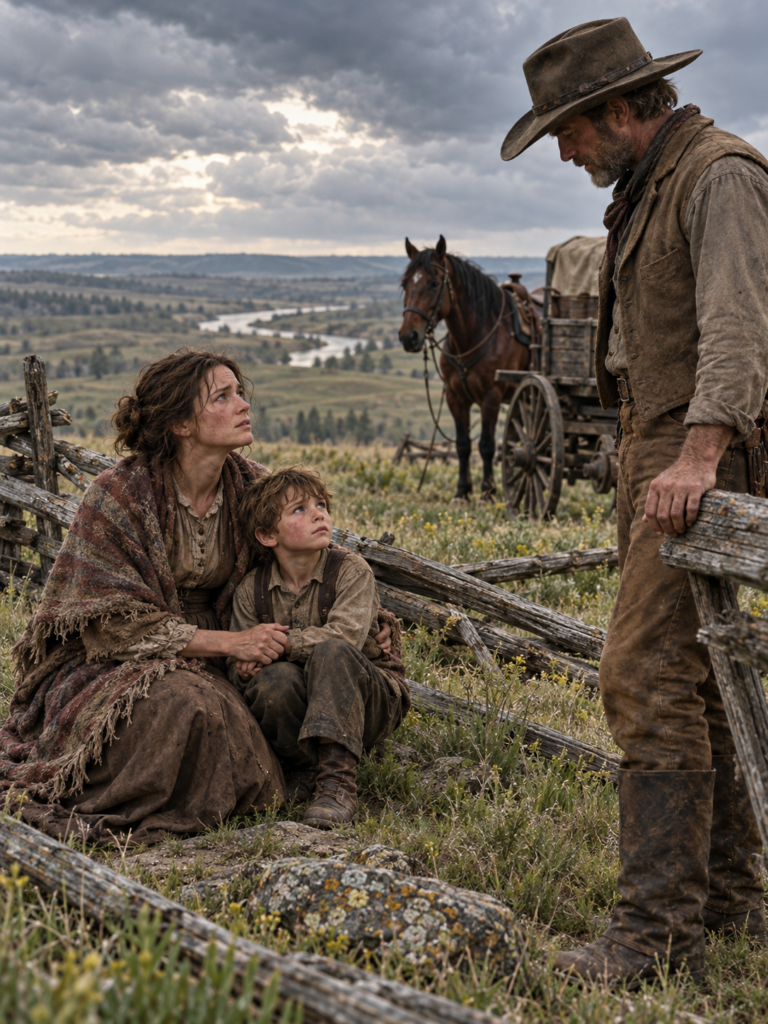
One afternoon, when she visited Martha Pruitt with finished sewing, she passed the repaired fence.
She stopped the wagon and looked at the place where she had once crouched in the grass, desperately trying to keep Toby silent.
She remembered the sound of hooves.
The terror in her throat.
The stranger dismounting with his hat in his hand.
And how he had turned back to his work instead of demanding that she explain herself.
She could not have known then how far that small courtesy would reach.
It had led to shelter.
Shelter had given her time.
Time had allowed her to work, gather witnesses, and stand before the court.
And in standing before the court, she had found the courage she had believed was gone.
Miriam climbed down from the wagon.
She placed her hand on one of the rails.
The fence still held.
Beyond it, Otis Pruitt’s cattle grazed peacefully.
The broken place had been repaired so thoroughly that a stranger passing by might never have guessed anything had happened there.
Miriam smiled.
Then she returned to the wagon.
There were garments to deliver, supper to prepare, a letter to write to Thomas, and a boy waiting to tell her everything he had learned that day.
She had no promise that the future would be kind.
But she knew what she would do when the next difficulty came.
She would seek the truth.
She would ask for help when help was needed.
She would stand where she could be seen.
And she would keep faith with the family she loved.
Because the greatest gift Ezra Colton had given Miriam Hale was not a room, a wagon ride, or even his willingness to appear in court.
It was the chance to discover that accepting help did not make her weak.
And that a woman could be frightened, exhausted, uncertain, and still possess the courage to build a life worth defending.
She drove toward home as the afternoon sun warmed the Kansas grass.
Behind her, the repaired fence stood firm.
Ahead of her waited Toby, her work, her husband’s letters, and all the unfinished possibilities of tomorrow.
For Miriam Hale, that was enough.
Not because every hardship had ended.
But because she was no longer running from the life she meant to protect.