Part 1
The county tax assessor had assigned the cabin a value of zero dollars.
Not a reduced value. Not a figure adjusted for age or damage. Zero.
The eleven acres surrounding it, a steep stretch of West Virginia mountain land covered in spruce, stone, and stubborn undergrowth, were assessed at three hundred ten dollars. The sagging log cabin, the crooked chimney, and the rusted fire tower standing behind it were considered practically worthless.
It was the only property Glenn Hartwell had not bothered to fight for during the divorce.
Della Hartwell was forty-one years old when she learned just how little sixteen years of marriage could leave a woman with.
One thousand one hundred fourteen dollars in her checking account. A worn GMC pickup with 191,000 miles on its odometer. A cardboard box containing a few belongings her husband had decided she could keep.
And a mountain cabin she had not visited since her father’s funeral.
She sat across from two attorneys in a conference room that smelled of stale coffee and recently installed carpeting.
Glenn had not come.
His younger attorney, a neatly dressed man who kept checking his phone, explained that Glenn had another commitment.
“He sends his regards,” the man added.
Della looked at him.
“His regards?”
The attorney shifted his attention to the paperwork.
“If you’ll initial these pages, we can finish everything today.”
The settlement gave Glenn the house on Halford Street, the savings, the retirement account, and the newer truck. Della had spent years following his career from one city to another, leaving her own employment behind and slowly losing contact with anyone who had not first been Glenn’s friend.
She had once believed those sacrifices were temporary.
Now they were simply history.
Near the bottom of the property schedule, the attorney pointed to a final entry.
“Real property in Pendry County. Eleven acres and a cabin. That remains yours.”
“What’s it worth?”
He consulted the document.
“The buildings have no assessed value. The land is listed at three hundred ten dollars.”
Then, with a brief smile, he added, “Mr. Hartwell didn’t consider it worth contesting.”
Della signed the final page.
Sixteen years ended with the scratch of a pen.
Outside, she placed her cardboard box in the pickup bed. Inside were her mother’s chipped mixing bowl, a photograph of her father wearing his forest warden’s coat, and an old wristwatch that had stopped keeping time.
She sat behind the steering wheel for several minutes.
There was no apartment waiting for her. No job to return to. No particular place where she was expected.
On the passenger seat lay the deed to Saddle Knob.
Her father, Asa Webb Hartwell, had left her the property when he died fourteen months earlier.
Della had attended his funeral, spent two nights at a motel near the interstate, locked the old cabin, and driven back to Glenn. She had told herself she would eventually sort through her father’s things.
Glenn had called the property a liability.
She had agreed because disagreeing with Glenn usually made an ordinary evening difficult.
Now, with nothing left to protect by keeping quiet, she unfolded the deed and examined the familiar name.
Saddle Knob.
She remembered summers there. The smell of wet timber. The wind pushing against the fire tower. Her father teaching her how to identify trees and judge the weather by watching distant ridgelines.
Perhaps she could sell the property to a hunting club or timber buyer.
Even a few thousand dollars might give her enough to start over.
She turned the ignition.
Five hours later, the highway had narrowed into a mountain road so broken and overgrown that it seemed to be disappearing back into the forest.
The Alleghenies rose around her in dark folds.
Red spruce crowded the slopes. Hemlocks stretched over the road. Here and there, the last autumn leaves burned copper and yellow against the evergreens.
Della lowered her window.
Cold air rushed inside, carrying the smell of damp earth, balsam, and distant wood smoke.
She had forgotten that smell.
Her body recognized it immediately.
As a child, she had accompanied Asa into the fire tower, where he watched miles of forest for the faintest sign of smoke.
“Most folks can see a fire once it’s big,” he had told her. “The important thing is noticing it while somebody can still stop it.”
She had been eight years old and assumed he was talking only about trees.
At the final switchback, the forest opened.
Saddle Knob appeared ahead.
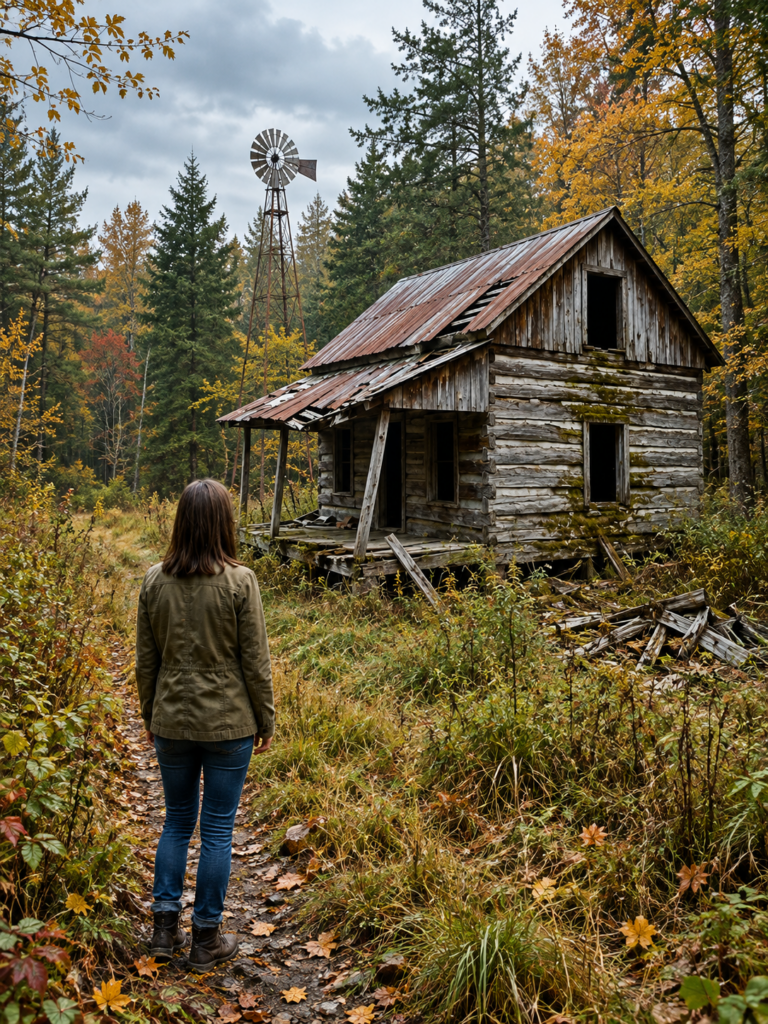
The cabin stood between two rounded rises in the summit, its dark logs weathered almost black. The tin roof was deeply rusted, one window had been covered with plywood, and the porch sagged where a support post had rotted.
Behind the building, the old steel fire tower rose above the spruce.
Della stopped her truck in the clearing.
The cabin looked smaller than it had in her memory.
For a moment she wondered whether she had made a mistake coming all this way.
Then she noticed that the roof was still intact. The walls remained upright. The stone chimney, although slightly crooked, had not collapsed.
Her father had always taken care of what belonged to him.
She found the correct key on her third attempt.
The door opened reluctantly.
Inside, the air smelled of cedar, cold ashes, dust, and something she recognized before she could name it.
Home.
The cabin consisted of one main room, a sleeping loft, and a small kitchen built onto the back. A cast-iron wood stove occupied the center, surrounded by flat stones from the creek.
Against the window stood a plank table with two mismatched chairs.
Her father’s shelves still held battered field guides, jars of nails, a transistor radio, rope, and tools.
His canvas warden’s coat hung beside the door.
Della crossed the room and took the coat down.
She held it against her face.
The fabric still carried a faint trace of smoke and pipe tobacco.
For a long time, she stood without moving.
She had spent so much of the previous year learning to control her feelings that grief had become something she treated like an inconvenience.
Here, alone in her father’s cabin, she did not need to control anything.
Yet she did not cry.
She simply put the coat back carefully.
On the table sat an unfinished wooden bird. Asa had been carving it when he died. Its rounded breast was smooth, but the wings remained rough, and the tail had never been shaped.
Della held it in her palm.
Then she forced herself to think practically.
The stove might be worth selling. The contents could be cleared out. Someone might buy the acreage.
She would spend one night, photograph everything in the morning, and contact a realtor.
That was the plan.
As darkness settled, however, the temperature dropped sharply, and the forest road became invisible beyond the clearing.
Della decided to stay until morning.
She carried in her sleeping bag and cardboard box, gathered kindling, and built a fire in the stove the way Asa had taught her.
Soon the iron began radiating warmth.
On one shelf stood an old kerosene lamp.
Della checked the reservoir, found enough fuel remaining, and lit the wick.
Without thinking, she placed the lamp on the table beside the window.
A small yellow light appeared against the darkness outside.
She did not know that Asa had placed that same lamp in that same window almost every evening for thirty years.
Nor did she understand why.
She made coffee in the dented percolator and sat quietly while wind rattled the roof.
For the first time in years, nobody expected her to explain where she was, what she was doing, or when she would return.
She slept in the loft beneath an old wool blanket.
Just before sunrise, unfamiliar sounds woke her.
Footsteps.
Someone was crossing the clearing.
Then came a metallic clink and the heavy thud of wood being placed on the porch.
Della climbed down, picked up the iron stove poker, and cautiously looked through the gap beside the patched window.
A young man stood at the edge of the trees.
He was tall and thin, perhaps nineteen, wearing an oversized canvas coat and a knitted cap. A battered backpack hung from his shoulders.
Freshly split firewood lay stacked beside the porch.
The young man was staring at the smoke rising from the chimney.
Della opened the door.
“Who are you?”
He turned immediately but did not approach.
“I bring the wood.”
“Why?”
He glanced at the stack.
“Somebody’s got to.”
“To a cabin nobody lives in?”
The young man hesitated.
“Asa told me to keep it from falling down.”
The name caught her.
“You knew my father?”
He nodded.
“He let me stay here.”
His voice was guarded, but Della noticed something else. His eyes kept moving between the truck, the road, and the surrounding trees.
He was looking for escape routes.
“What’s your name?”
“Wade.”
After another pause, he added, “Wade Tolliver.”
Della lowered the poker.
“Would you like some coffee?”
He looked at the open doorway.
“I can stay out here.”
She brought two cups onto the porch.
They sat on the steps, watching the gray morning slowly brighten the spruce.
Wade held his cup with both hands.
It took several minutes before he spoke again.
“I didn’t know anybody was coming back.”
“Neither did I,” Della answered.
Eventually, she learned that Wade had grown up in foster care.
Eleven different homes before he turned eighteen.
When he aged out of the system, he had been given his belongings and a list of numbers to call. Most of those numbers led nowhere.
For a while, he survived wherever he could find shelter.
Church basements. Gas stations. Places where nobody chased him away immediately.
Then, one rainy night, he saw a light shining from a window high on Saddle Knob.
“I could see it from the last bend in the road,” he said.
“So you came up?”
“Not right away.”
“Why not?”
Wade examined his coffee.
“Figured there had to be a catch.”
He had watched the cabin for three nights before finding the courage to knock.
Asa had opened the door.
He had put a bowl of beans on the table and told Wade the loft was available.
“He didn’t ask me what I’d done,” Wade said. “Didn’t ask why I was there. Just fed me.”
Della looked through the open doorway at the old stove.
“That’s how he was.”
Wade shook his head slightly.
“Most people want you to owe them something when they help.”
“And my father?”
“He acted like I’d done him a favor by showing up.”
Della had no answer.
That afternoon, she intended to take photographs for the realtor.
Instead, she noticed the rotting porch post.
She found a tape measure among Asa’s tools and began assessing the damage.
Wade returned the next morning with more firewood.
He saw her studying the porch.
“That post needs replacing.”
“I noticed.”
“There’s a straight spruce down past the spring.”
Della looked at him.
“Think we can manage it?”
Wade considered her for a moment.
Then he nodded.
They spent the day cutting, measuring, and notching the replacement.
Della worked until her palms were sore.
When the post finally stood firmly beneath the porch beam, she stepped back and felt a satisfaction she had not experienced in years.
Nobody had told her how to do it.
Nobody had suggested she wait for a man with more experience.
She and Wade had simply done what needed doing.
Over the following days, she cleaned the stovepipe, repaired the damaged window, and helped Wade close gaps between the cabin logs.
He began talking more freely, mostly about Asa.
Asa had taught him to read deer trails, identify dangerous weather, and understand how fire traveled through spruce-covered slopes.
Sometimes the old man had climbed the tower at dawn and spoken into its radio, even when no one was scheduled to listen.
Wade remembered asking him why.
“He told me somebody out there might need to hear another human voice.”
Della stopped working.
That sounded exactly like her father.
Little things about the cabin began to trouble her.
Three mugs sat on a shelf, although Asa had lived alone.
Several hooks hung from a porch beam at different heights, as though intended for people carrying differently sized backpacks.
A second mattress lay rolled up in the loft.
The cabin had been arranged for more people than one.
But Asa had never mentioned guests.
On the seventh evening, Wade surprised her by asking whether she wanted to climb the fire tower.
Della had not climbed it since childhood.
Together they crossed the frosted clearing and ascended the zigzag steel stairs.
The tower trembled faintly in the wind.
At the top, the small glass observation room was almost exactly as she remembered.
A map table occupied one side. Her father’s fire finder remained positioned beside the window. An old stool stood bolted to the floor.
And above the table hung a faded child’s drawing.
Two stick figures stood beneath a yellow sun beside a mountain.
At the bottom, written in uneven capital letters, was one name.
DELLA.
She remembered neither drawing it nor giving it to him.
Asa had kept it there for thirty-five years.
She touched the paper gently.
Below them, the forest stretched into the darkness.
Far beneath the tower, one point of warm yellow light shone from the cabin window.
Wade stood beside her.
“He never lit that lamp just for himself,” he said.
Della looked at him.
“What do you mean?”
“He said you don’t light it because somebody’s coming tonight.”
Wade paused, remembering the words.
“You light it every night, so it’ll already be burning when somebody finally needs it.”
Della watched the tiny light.
She thought of Wade walking up the dark road in the rain.
She thought of her father opening the door.
And she wondered how many other people had found their way to Saddle Knob.
Two days later, while shifting the heavy wood stove a few inches to straighten the hearth, she discovered something beneath the floor.
Her broom caught on a narrow line between two planks.
At first she thought it was an ordinary crack.
Then she knelt to examine it.
The edges were unusually straight.
There were no visible nails.
She worked her pocketknife into the seam and lifted.
The plank rose easily.
Beneath it was a hidden compartment between the floor joists.
Inside were three thick leather-bound ledgers, a green metal cashbox, and a large coffee tin sealed with tape.
Della set the objects beside her and lifted the first ledger.
The leather cover was worn smooth from years of handling.
She opened it.
On the first page, in her father’s small, careful handwriting, was a date.
October 9, 1979.
Below it, Asa had recorded the arrival of a miner named Del Rucker, a man who had walked away from work carrying memories of something that happened underground years before.
Asa had fed him, listened until two in the morning, and sent him home with a thermos.
At the bottom of the entry were five words.
The lamp stays lit.
Della turned the page.
There was another name.
And another.
She sank onto the floor beside the stove.
Her father had left her something far more complicated than an abandoned cabin.
And she was only beginning to understand what it was.
Part 2
Della spent the rest of that morning sitting on the cabin floor with the ledgers spread around her.
Outside, Wade was cutting firewood.
The steady sound of his axe carried through the walls, followed by the soft collapse of split logs.
Inside, time seemed to move differently.
Her father had recorded names, dates, and brief accounts of people who had come to Saddle Knob.
Some had arrived hungry.
Others were frightened, desperate, injured, or simply unable to face another night alone.
A logger’s wife had appeared with two children and a bruise she refused to explain. Asa gave them the loft for the night and enough gasoline money to reach her sister in Ohio.
A seventeen-year-old runaway had spent three days traveling from a troubled home in Elkins. Asa fed him, let him sleep, and eventually drove him to a sheriff he trusted to handle the situation gently.
There were unemployed miners, people stranded on mountain roads, and others whose circumstances were described only in a few restrained sentences.
Asa rarely wrote about his own feelings.
He recorded what a person needed, what he could provide, and whether they had somewhere safe to go next.
At the end of entry after entry, the same promise appeared.
The lamp stays lit.
The door isn’t locked.
They can come back.
Della touched the pages.
She remembered her father as a quiet, capable man who rarely volunteered information about himself.
He had been a forest warden for most of his working life. He could repair a roof, predict bad weather, and recognize a person by the way they walked up the path.
But she had never imagined him keeping such records.
For thirty years, he had been sheltering people on this mountain.
Without publicity.
Without recognition.
Without telling his own daughter.
When Wade came inside, he found her sitting with the first ledger in her lap.
“What are those?”
“Your records, I think. And a lot of other people’s.”
She showed him one of the books.
Wade remained near the doorway.
Della read a few entries aloud, choosing the ones that revealed the least about their visitors.
Then she reached a short entry identified only by initials.
A young person had needed somewhere to stay.
At the bottom, Asa had written that the visitor was grateful not to have been questioned.
Wade’s expression changed.
He turned and went back outside.
Della let him.
For the first time, she understood how much trust her father had carried without ever asking anyone to explain or defend it.
She opened the green cashbox.
Inside were two hundred seventeen dollars in old bills, a folded hardware-store receipt dated 1981 for two cots and a kerosene heater, and a brass key she did not recognize.
The key was smaller than the cabin keys.
She turned it between her fingers, wondering what lock it had once opened.
Then she picked up the coffee tin.
It was unexpectedly heavy.
The lid had been sealed with a strip of old friction tape. Della carefully peeled it away.
Inside were letters.
Dozens of them.
She spread them across the plank table and counted.
Sixty-one.
Some were written on proper stationery. Others used notebook paper, church bulletins, scraps of cardboard, and old receipts.
Every one was addressed, in some way, to Asa Hartwell.
One letter came from a woman named Carla.
She had driven up Saddle Knob in 1994 intending to end her life. The yellow light in Asa’s window had drawn her toward the cabin instead.
Years later, she wrote that because he had opened his door, she had lived long enough to have grandchildren.
Another letter came from a man named Pruitt.
When a local plant closed, Asa had given him forty dollars and a full tank of gas.
Pruitt had tried to repay him.
Asa refused.
Instead, he told the man to help someone else when the opportunity came.
Pruitt wrote that he had done so eleven times.
One letter contained only a single sentence of thanks for being allowed to stay without answering questions.
The handwriting was young and careful.
Della recognized the initials from the ledger.
She looked toward the window.
Wade was still outside.
Suddenly the extra mattress, the three mugs, and the hooks beneath the porch beam made sense.
They were not clutter left by an old man who disliked throwing things away.
They were evidence of a life that had been deliberately arranged to make room for other people.
And the lamp was not a sentimental habit.
It was an invitation.
By late afternoon, the light outside had turned gray.
Della lit the kerosene lamp and set it in the window.
Then she continued reading.
Wade returned near dusk.
He stopped when he saw the open books.
“Did he write about me?”
Della nodded.
“I found your name.”
He approached slowly.
She opened the third ledger to the proper page and turned it toward him.
Wade read in silence.
His finger rested briefly on a line in the middle.
After a long while, he said, “I keep it where I can find it.”
Della understood that Wade had already discovered the entry and had returned to it more than once.
He needed the written record.
Not because he doubted that Asa had fed him or offered him shelter.
But because after eleven foster homes and years of uncertainty, it mattered that someone had considered him worth remembering.
Della left him alone with the book.
When she returned, Wade had closed it carefully.
He did not explain what he had read.
She did not ask.
Later that night, Della continued through the final pages of the third ledger.
She was almost finished when she saw a familiar name.
Her own.
She stopped breathing for a moment.
The entry was dated a little over a year before Asa died.
He had written about a telephone conversation with his daughter.
Della remembered that call.
She had been standing in Glenn’s kitchen, trying to speak quietly while her husband worked nearby.
Her father had asked how she was doing.
She had told him everything was fine.
She always told him that.
Now, in the ledger, she read his private observations.
He had noticed that her voice sounded thin.
He believed Glenn had taken up so much room in her life that even when he was absent, Della seemed to measure her words around him.
Asa had written that she was becoming quieter, more cautious, less like the girl who once climbed mountains without thinking about whether anyone approved.
He wished she would visit.
He wished she would sit with him in the tower again and remember the person she had been before she became somebody’s wife.
And then came the words that undid her.
I keep the lamp lit for my daughter, too.
Just in case.
The door’s not locked, Dell. It never was.
Della read the passage again.
And again.
For sixteen years, she had believed that her father’s quietness meant he did not understand what was happening to her.
But he had understood more than she knew.
He had been waiting without forcing her to admit anything.
Leaving an opening without demanding that she take it.
Her fingers tightened around the ledger.
She remembered all the times she had almost called him after an argument with Glenn.
All the visits she had postponed.
All the evenings she had thought about driving toward the mountains and then decided it would be too much trouble.
Asa had died without knowing whether she would ever come home.
Yet the light had continued burning for her.
Della held the book against her chest and finally cried.
Not because Glenn had left her.
Not because the settlement had been unfair.
She cried for the years she could not reclaim with her father and for the love that had remained available even when she did not know how to accept it.
She stayed on the floor until the fire burned low.
Then she stood, placed the ledgers carefully on the table, and looked around the cabin.
She would not sell it.
There was no longer any question.
Two mornings later, she drove down the mountain for supplies.
The little town beneath Saddle Knob had hardly changed.
There was a diner on the main street, a hardware store, a Methodist church, and a gas station that also served as the post office.
Della stopped at the diner.
She intended to buy breakfast, ask about propane, and return before dark.
The woman behind the counter looked at her for several seconds.
“You’re Asa Hartwell’s girl.”
Della nodded.
“I’m Della.”
“You’ve got his eyes.”
The woman said it loudly enough that several customers turned around.
An elderly man rose from his booth and came toward her.
“Pruitt,” he introduced himself, taking her hand. “Your daddy helped me when the plant closed in eighty-six.”
Della remembered his letter.
“The forty dollars?”
Pruitt’s eyes widened.
“You know about that?”
“I found some things he kept.”
The older man smiled faintly.
“Then you know he wouldn’t take his money back.”
He told her he had helped eleven other people since then.
“I’m still counting,” he said.
Others approached.
A nurse named Carla sat across from her but struggled to speak.
She took Della’s hand and held it for a while.
A soft-spoken deputy named Hollis told her about the late-night calls he used to receive from Asa.
Sometimes the old warden would ask him to drive up Saddle Knob because a visitor needed help getting home.
“He always told me to come slowly,” Hollis recalled. “And come alone. He didn’t want anybody frightened.”
Della listened as the stories accumulated.
There were people Asa had helped with money, shelter, transportation, or a little company during terrible nights.
Some of them had never met one another.
Some had lived in the same town for decades without knowing they shared a connection to the man on Saddle Knob.
The cabin had become the center of an invisible community.
Della thought she had inherited an isolated building on a forgotten mountain.
Instead, she had walked into a family larger than anything she had known.
At Setzer’s Hardware, she bought supplies for the stove and lamp.
The owner, a wiry older man, refused payment for the stovepipe and replacement wicks.
“Your father carried a tab for me back in seventy-nine,” Setzer explained. “Took me until ninety-one to pay it.”
“Then you don’t owe him anything.”
Setzer pushed the supplies across the counter.
“That’s what I told him. Didn’t make any difference.”
Della tried to insist.
Setzer shook his head.
“Sometimes you have to let somebody do something decent for you.”
She took the supplies.
When she returned to Saddle Knob, Wade was splitting logs beside the cabin.
Della carried the groceries inside, then unfolded the quilt Carla had given her at the diner.
She spread it over the second mattress in the loft.
When Wade came in, she showed him.
“That bed’s yours as long as you need it.”
He looked at the quilt.
“You’re staying?”
“Yes.”
“For how long?”
Della considered the question.
“I don’t have a reason to leave.”
Wade glanced at her, then at the bed.
Finally, he nodded.
“Okay.”
That evening, he slept on the mattress instead of using his backpack as a pillow near the ladder.
Della noticed.
She said nothing.
Eleven days later, a silver pickup climbed the forest road.
Della heard its expensive, powerful engine long before it appeared.
The truck emerged into the clearing and parked directly in front of the porch.
A man in his mid-fifties stepped out.
His boots were spotless.
His quilted vest looked new.
He surveyed the property with the confidence of someone inspecting an investment.
“Royce Vandermeer,” he said. “Highland Reserve Development.”
He offered his hand.
Della did not take it.
“Della Hartwell. This is private property.”
Vandermeer lowered his hand.
“Of course. I knew your father.”
She waited.
“I offered to purchase this parcel four times over nine years. He refused every offer.”
“He could be stubborn.”
“That’s one way of putting it.”
Vandermeer turned toward the valley.
“I have eighty acres under contract around this summit. We’re planning a thirty-one-room lodge, a restaurant, and a destination resort.”
Della watched him.
“This is the only suitable summit in the area with a view and road access,” he continued. “Your eleven acres are essential.”
“Then you have a problem.”
Vandermeer smiled.
“Not necessarily.”
He offered nine thousand dollars.
Della said nothing.
“Forty thousand,” he amended. “For a parcel the county considers nearly worthless.”
She thought about what forty thousand dollars could mean.
A dependable truck.
An apartment.
Enough money to look for work without counting every grocery purchase.
And she thought about the sixty-one letters hidden beneath the floor.
“The property isn’t for sale.”
Vandermeer studied her.
“I understand you’re going through a difficult period.”
Della felt something unpleasant tighten inside her.
That phrasing was familiar.
Glenn had always described her difficulties as temporary personal shortcomings.
“Who told you that?” she asked.
Vandermeer avoided answering.
“I’m offering you a clean start.”
“I already have one.”
His pleasant expression faded.
He mentioned the cabin’s aging stove and potential fire-code violations.
He questioned the legality of the road easement.
He suggested that lawyers could make keeping the property extremely expensive.
“My attorneys can keep this tied up for years,” he said. “You could spend more defending it than it’s worth.”
Then he placed a business card on the porch rail.
“Think about the offer.”
He drove away.
Della remained standing long after the truck disappeared.
Wade came to the porch.
“That’s the lodge man.”
“You’ve met him?”
“He sent surveyors here before. Asa made them leave.”
Della looked at the card.
For the first time since deciding to remain on Saddle Knob, she felt genuinely afraid.
She had barely enough money for repairs and groceries.
Forty thousand dollars was more than she could hope to earn quickly.
Vandermeer had attorneys.
She did not.
That night, she lay awake imagining notices arriving at the cabin, court fees she could not pay, and a legal fight that could consume the little independence she had regained.
Before going to bed, she lit the lamp.
Whatever happened, she decided, she would not extinguish it simply because someone had made keeping it difficult.
The next afternoon, an old blue sedan appeared in the clearing.
A tall woman in her late sixties stepped out wearing a wool coat, reading glasses on a chain, and carrying a worn leather case.
She introduced herself as Bett Aldridge.
“I used to practice law at the county seat,” she said. “Before retirement improved my judgment.”
Della almost smiled.
Bett explained that Hollis Pruitt had told her Asa’s daughter was back on the mountain.
She had also heard about Vandermeer’s inquiries at the courthouse.
“May I come in?”
Della made coffee.
At the plank table, Bett held her cup for a moment without drinking.
“I sat at this table twenty-six years ago,” she said.
Della waited.
“My son was nineteen. He was in terrible trouble, and I didn’t know how to reach him.”
Bett removed her glasses.
“A hospital janitor told him about an old man on Saddle Knob who would listen without making decisions for you.”
Her son had driven up the mountain in darkness.
Asa let him stay three days.
He fed him, walked the forest with him, and gave him time to recover enough to face the life waiting below.
Bett looked toward the window.
“My son is forty-five now. He’s an engineer in Roanoke. Married, with two children.”
She put her glasses back on.
“Your father gave me years with my son that I might not otherwise have had.”
Della swallowed.
Bett opened her leather case.
“So I intend to help you keep this place.”
Della showed her the ledgers, letters, cashbox, and unfamiliar brass key.
Bett examined everything carefully.
Then she listened to Vandermeer’s threats.
“The cabin can be inspected,” she said. “We’ll arrange for a certified chimney sweep and get the stove checked. He doesn’t get to declare the property a hazard just because he’d rather own it.”
“And the road?”
“The access easement is recorded. We’ll verify the details, but I doubt he has much of a case there.”
Della felt her shoulders relax slightly.
Then Bett asked an unexpected question.
“Did your father ever sign anything concerning development rights? A conservation agreement, perhaps? Anything involving a land trust?”
Della began shaking her head.
Then a memory returned.
She was a teenager again, sitting in the fire tower on a summer afternoon.
A woman wearing a green vest had climbed the stairs carrying a clipboard.
Asa had spoken with her about documents.
Della remembered hearing the word recorded.
She also remembered her father shaking the woman’s hand.
He had said something about the matter being settled.
Something nobody could change, even after he was gone.
Bett set down her coffee.
“A green vest?”
“Yes.”
“That may have been someone from the Allegheny Highlands Land Trust.”
Della looked toward the table where the brass key lay beside her father’s ledgers.
Bett stood.
“Get your coat.”
“Where are we going?”
“The courthouse.”
Della glanced at the darkening sky beyond the window.
For the first time, she realized that her father might have left more than an account of the people he had helped.
He might also have left a way to protect the place where he helped them.
Part 3
The county courthouse in Craugh was an old stone building with narrow windows, worn wooden floors, and filing cabinets that seemed to hold a century of forgotten arguments.
Della had spent much of her married life signing documents she barely understood.
Now she was searching for one that might determine whether she could keep her home.
Bett Aldridge knew the building well.
She greeted the clerks by name, asked for the property records relating to Saddle Knob, and began tracing the chain of recorded documents.
A clerk named Earline remembered Asa.
When Bett explained what they were looking for, the older woman immediately offered to help.
It took two days.
They examined deed indexes, earlier property transfers, and references to agreements Della had never seen.
At last, Earline brought out a heavy volume.
“Deed Book 214,” she announced. “Page eighty-eight.”
Bett pulled the book closer.
Della stood beside her.
There, beneath the official recording information, was her father’s name.
Asa Webb Hartwell.
The document was a conservation easement.
It had been recorded on June nineteenth, nineteen years before Asa died.
Della leaned closer as Bett began explaining.
Her father had granted the development rights to all eleven acres of Saddle Knob to the Allegheny Highlands Land Trust in perpetuity.
The agreement restricted the land from subdivision and commercial lodging development.
The existing cabin could remain.
But the property could not be transformed into the resort Vandermeer had described.
The restrictions ran with the land, binding future owners as well.
Della read the relevant passages several times.
“So even if I wanted to build a hotel up there, I couldn’t?”
“Not under this agreement.”
“And if I sold it?”
“The buyer would take the property subject to these recorded restrictions.”
Della stared at the document.
For years, her father had watched over those mountains from the fire tower.
He had witnessed fires, storms, and the slow advance of roads into places that once seemed unreachable.
Apparently, he had also understood what would happen when developers discovered the view.
Rather than leave the decision entirely to future owners, he had placed lasting restrictions on the land.
Bett pointed to the recording information.
“He protected this place long before your divorce. Long before Vandermeer came to your porch.”
Della felt a strange mixture of relief and sadness.
Her father had planned for a future he would never see.
He had known that whoever inherited the cabin might be tempted, pressured, or frightened into selling it.
He could not prevent every threat.
But he had made the land’s purpose much harder to change.
Then Della asked the question that had been troubling her.
“Vandermeer owns a development company. Wouldn’t his lawyers have discovered this?”
Bett looked at her over her glasses.
“A routine title search should have revealed it.”
“Then why offer me forty thousand dollars?”
Bett closed the deed book.
“Because purchasing the land might have been only the first step.”
She explained that a conservation easement and ownership of the underlying land were separate interests.
If Vandermeer acquired the property, he might try to persuade the land trust to agree to changes through whatever legal process was available.
He might offer substitute conservation land, financial assistance, or another arrangement attractive enough to make the trust reconsider.
Bett was careful not to claim that such an effort would necessarily succeed.
But the possibility explained why a developer might pursue land he could not presently build on.
“He was hoping you didn’t understand what you owned,” she said. “And that you needed the money badly enough to sign before you asked the right questions.”
Della remembered Vandermeer’s confidence.
The polished boots.
The business card on the porch.
The way he had described her circumstances as though she were a problem waiting to be solved by his money.
“He knew I was vulnerable.”
“At the very least, he was counting on you feeling that way.”
Della glanced again at her father’s signature.
“What about the trust?”
Bett smiled faintly.
“That’s where this gets interesting.”
The Allegheny Highlands Land Trust was a small organization with an office in Elkins.
Its volunteer director was a woman named Carla Reese.
Della recognized the name.
The nurse at the diner.
The woman whose letter described driving toward Saddle Knob in 1994, uncertain whether she intended to survive the night.
The woman whose grandchildren existed, in part, because Asa had opened his door.
Bett examined the brass key from the cashbox when Della mentioned it again.
There was something about the key’s age and size that made her curious.
She suggested they contact the trust directly.
The answer led them to Elkins.
Bett drove the hour and forty minutes herself.
The trust occupied a modest office above a feed store.
Two desks, a coffee maker, a filing cabinet, and shelves crowded with conservation records filled the room.
Carla Reese came out to meet them.
She stopped when she saw Della standing beside Bett.
Then her attention fell on the brass key.
“Where did you get that?”
“It was in my father’s cabin.”
Carla pressed a hand against her mouth.
“I knew Asa had made arrangements for the property. I didn’t know he’d left you a key.”
She led them to a small lockbox.
The key fit.
Inside was the original signed conservation agreement.
Attached to it was a note written in Asa’s familiar hand.
For Della, when the time comes. She’ll understand.
Della held the note carefully.
She had spent years believing her father was a man who lived mostly in the present, concerned with tomorrow’s weather, the next loose roof panel, and whether the forest needed watching.
Yet here was proof that he had thought deeply about what would happen after his death.
He had protected the land’s purpose, but he had still left Della the choice of whether to live there and continue his work.
Carla brought them coffee.
Then she told them something neither Della nor Bett had known.
Vandermeer’s representatives had already approached the land trust.
Twice.
They had proposed transferring a forty-acre tract near Dolly Sods in exchange for releasing the restrictions on Saddle Knob.
The representatives argued that the larger property would offer greater conservation value.
Carla had listened.
Then she refused.
“They thought forty acres should be worth more to us than eleven,” she said.
“Why wasn’t it?” Della asked quietly.
Carla looked toward the window.
“Your father pulled my truck out of a ditch during a snowstorm. It was two in the morning. He brought me somewhere warm and never made me feel foolish for needing help.”
She folded her hands.
“That mountain isn’t just acreage to me.”
Della remembered the letter.
The grandchildren.
The decades of life that had followed.
Carla continued.
“This trust agreed to protect Saddle Knob for a reason. I’m not interested in trading away that promise.”
Bett nodded.
The trust’s refusal did not make every possible legal challenge disappear.
But with the recorded agreement, the trust’s support, and Bett’s help, Vandermeer’s threats no longer seemed nearly as powerful.
Della had arrived in Elkins frightened that one wealthy man might be able to take everything she had begun rebuilding.
She left knowing that her father had created a legal protection and that other people were determined to uphold it.
Before they closed the lockbox, Della noticed a second envelope beneath the agreement.
Her name was written across the front.
The paper was old.
She recognized her father’s slightly upward-slanting handwriting immediately.
Carla handed it to her without asking what it contained.
Della did not open it in the office.
She carried it back to Saddle Knob.
That night, after Wade went to bed, she sat alone in the loft with the kerosene lamp beside her.
She opened the envelope and read her father’s letter.
Nobody ever learned exactly what it said.
Della never read it aloud.
She never told Wade or Bett what her father had written.
Whatever was inside belonged to the private relationship between a father and daughter who had not always known how to speak openly to one another.
When she finished, she folded the letter along its original creases.
She held it for a while, looking toward the dark window.
Then she placed it safely inside the cover of a blank ledger she intended to begin.
Something she could return to.
Something she could find whenever she needed reminding.
Eight days later, Royce Vandermeer’s silver pickup came up the mountain again.
This time, he remained behind the wheel.
Della stood on the porch while Bett Aldridge walked down to the driver’s window.
The retired attorney carried a manila envelope.
She passed it into the truck.
Inside was a copy of the recorded conservation easement, along with the documentation Bett had prepared concerning the property.
Della could not hear the conversation.
She watched Vandermeer pull out the papers and examine them.
His expression hardened.
He said something sharply.
Bett replied without raising her voice.
The discussion lasted only a few minutes.
Then Vandermeer pushed the documents back into the envelope.
His face had turned red.
Bett stepped away.
The window closed.
The silver truck backed carefully out of the clearing and disappeared down the road.
Della never saw it on Saddle Knob again.
Bett returned to the porch.
“What did you say to him?”
“Nothing he particularly enjoyed hearing.”
“Is it over?”
“He knows the easement is recorded, the trust intends to defend it, and you have counsel who understands the property.”
Bett looked toward the mountains.
“That changes his arithmetic.”
Della laughed unexpectedly.
It was the first time in months that laughter had come without effort.
Bett glanced at her.
“Your father did something remarkable here.”
“The easement?”
“That, too.”
She looked at the cabin, the tower, and the lamp visible through the window.
“He built something people wanted to protect.”
Della understood.
The legal document had helped stop Vandermeer.
But the reason Bett had come out of retirement, Carla had rejected the development proposal, and the town had rallied around the cabin was not the market value of eleven acres.
It was the memory of a man who had helped people without keeping score.
Asa had spent much of his life giving away small things.
A hot meal.
A place to sleep.
Forty dollars.
A ride down a mountain road.
An evening of patient listening.
None of it had made him wealthy.
But it had created relationships strong enough to survive him.
By spring, people throughout Pendry County had heard that Asa Hartwell’s daughter had returned.
Some learned about the ledgers and the sixty-one letters.
Others remembered their own experiences on Saddle Knob and came up the forest road to see whether the cabin was still there.
They rarely arrived empty-handed.
A logger left a cord of split oak beside the porch.
Pruitt brought an envelope of cash for the next person who needed help.
He said it was his twelfth time passing forward Asa’s original gift.
Hollis visited on his day off and helped Wade repair the porch gutter.
He stayed for coffee afterward.
When he told a story about Asa losing an argument with a stubborn piece of machinery, Della laughed so hard that she had to put down her cup.
Wade laughed, too.
The sound filled the cabin.
Della realized that the building had probably heard plenty of crying over the years.
It deserved laughter as well.
She took a part-time job at Setzer’s Hardware to help pay for propane, food, repairs, and ordinary living expenses.
The pay was modest, but the work was steady.
Setzer showed her the ordering system and let her take responsibility for customers who needed advice about stoves, tools, and small repairs.
For the first time in years, Della felt that her knowledge had a place in the world.
She knew how to mend a window, maintain a stove, and repair a porch.
She knew how to split firewood and find water on the mountain.
There had been a time when she considered those skills unimportant because Glenn had treated them that way.
Now people came to her for help.
Wade began working with younger visitors who accompanied their parents up the mountain.
He showed them how to split wood safely and how to recognize the grain in a difficult log.
One afternoon, Della watched him patiently explain the same thing three times to a boy who could not get his axe to strike straight.
“You’re good at teaching,” she told him afterward.
Wade looked uncomfortable.
“I’m just showing him.”
“That’s what teaching is.”
He shrugged.
She did not press the point.
Wade had begun sleeping through the night.
His coat fit him now.
His backpack no longer remained packed beside the ladder.
Sometimes he forgot to watch the door when somebody entered.
Della noticed those changes as carefully as her father had once watched the forest for smoke.
She understood that healing rarely announced itself.
More often, it appeared in ordinary moments.
A young man leaving his belongings on a shelf because he expected to be there tomorrow.
A conversation continuing after a stranger entered the room.
A full night’s sleep.
Della also learned to operate the old tower radio.
On summer mornings, she sometimes climbed the stairs at dawn and read the weather across the district in a steady voice.
She knew that the channel might be empty.
She spoke anyway.
Her father had believed there should always be a human voice available to someone who might need to hear one.
Della found comfort in continuing that habit.
And every evening, before the light disappeared behind the western ridge, she filled the kerosene lamp.
She trimmed the wick.
Cleaned the glass.
Then placed it in the window.
Not because she expected someone to arrive.
Because someone might.
Eventually, she purchased a new leather-bound ledger from Setzer’s store.
It was the closest she could find to her father’s old books.
She placed his private letter inside the front cover and set the ledger on the shelf beside the other three.
The fourth volume.
For a while, the pages remained blank.
Then, on a cold evening in early May, rain swept across the ridge with enough force to rattle the porch windows.
Della was washing dishes when headlights appeared through the trees.
A car moved slowly around the final switchback.
It stopped in the clearing.
Della wiped her hands and went to the door.
A young woman, perhaps thirty, stepped from the driver’s seat.
Her jacket was soaked.
She opened the back door, carefully lifted a sleeping child into her arms, and held him against her shoulder.
For a moment, she simply stood in the rain, looking at the cabin.
Then at the smoke rising from the chimney.
Then at the lamp in the window.
Della recognized something in the woman’s expression.
It was the look of someone who had been holding herself together for so long that she no longer trusted her ability to keep doing it.
“I’m sorry,” the woman said.
Her voice trembled.
“I saw the light. I didn’t think—”
She stopped.
“I shouldn’t have come.”
Della stepped down onto the porch.
“It’s raining too hard for you to be driving that road.”
The woman adjusted the sleeping child against her shoulder.
“We can find somewhere else.”
“Not tonight.”
Della opened the door wider.
“There’s a fire inside. I’ve got beans on the stove. The loft is made up.”
The woman stared at her.
“Why?”
Della thought of Wade standing at the tree line with a load of firewood.
She thought of the sixty-one letters.
She thought of her father sitting at the same table, listening to people who had forgotten what it felt like to be treated gently.
“My father used to get asked that question,” she said.
The young woman did not move.
Della smiled.
“Come inside.”
The child was still asleep when Della helped them into the warm cabin.
She found dry clothes and blankets.
She made coffee and served supper.
She asked only what was necessary to help them through the night.
When the woman seemed ready to talk, Della listened.
When she fell quiet, Della let the silence remain.
Wade brought extra wood inside without being asked.
Later, he prepared the loft while Della cleared the dishes.
There was no ceremony to it.
No expectation of gratitude.
They simply made room.
In the morning, the storm had passed.
The woman explained that she was trying to reach her sister in Ohio.
Della helped her with gasoline and placed forty dollars in her coat pocket.
The woman tried to refuse.
Della gently closed her fingers around the money.
“Use it for the road.”
Before leaving, the woman looked back at the cabin.
“Can I come here again?”
Della nodded.
“Of course.”
The car disappeared down the forest road.
Wade stood beside Della on the porch until the engine could no longer be heard.
Then he went back to his chores.
Della entered the cabin and sat at the plank table.
She took the new ledger from the shelf.
Opening to the first blank page, she wrote the date.
Then the woman’s name.
Then a short account of the visit, recording only what needed to be remembered.
Her handwriting leaned slightly upward across the paper, as Asa’s had.
At the bottom, she wrote:
The lamp stays lit.
The door’s not locked.
Told her she could come back.
Wade came in while she was finishing.
He read the entry over her shoulder.
A year earlier, he would never have approached anyone so casually.
Now he stood beside her, looking at the words.
After a moment, he said, “Asa would’ve liked that you kept it going.”
Della looked at him.
“He would’ve liked that you stayed.”
Wade grew quiet.
He gave a small nod, then carried the empty wood basket outside.
Through the window, Della watched him cross the clearing.
He was no longer the frightened young man who had watched every doorway and treated every kindness as a possible trap.
He belonged here.
Perhaps he was still learning to believe it.
So was she.
Della looked around the cabin.
The walls had been repaired.
The porch was sound.
The stove burned steadily.
There was food in the kitchen, a little money in the cashbox, and room in the loft for someone who needed shelter.
She had arrived on Saddle Knob with one thousand one hundred fourteen dollars, an exhausted truck, and a plan to sell everything.
She had believed she was coming to the end of her life as she knew it.
Instead, she had found a place where she could begin living as herself again.
She understood now that Glenn had measured worth in the things he could accumulate.
The better house.
The newer vehicle.
The larger accounts.
Royce Vandermeer had measured it in acreage, development rights, and the view that wealthy guests would pay to admire.
Even the county assessor had calculated the value of Saddle Knob and arrived at almost nothing.
But her father had used a different measure.
He had counted people.
Sixty-one letters were proof that his little mountain cabin had mattered.
The ledgers recorded lives that might have taken different directions if there had been no lamp in the window.
And the conservation easement ensured that the summit would remain protected from the commercial development Asa had never wanted.
Della knew the agreement would not solve every difficulty.
The cabin would always need repairs.
Winter would remain cold.
Money would sometimes be short.
But she no longer mistook those practical problems for evidence that her life had little value.
She had work.
She had a home.
She had Wade.
And she had a reason to get up in the morning.
On clear evenings, she climbed the fire tower and sat in the glass observation room where her father had spent so many years.
The same map table stood beneath the window.
The same stool remained bolted to the floor.
And the faded drawing of two stick figures beneath a yellow sun still hung on the wall.
Sometimes Della sat there until dusk settled over the mountains.
The forest stretched for miles in every direction, folding into distant ridges that turned blue, then purple, then nearly black.
She remembered her father’s lesson about watching for smoke before a fire became impossible to stop.
As a child, she had thought he was teaching her to protect trees.
Now she understood he had been teaching her something about people.
A person could be struggling long before anyone noticed.
Long before the trouble became obvious.
Long before they found the courage to ask for help.
Her father had understood that.
He had never waited until someone was desperate enough to beg.
He had simply left a light where they could see it.
Della rested her hands on the windowsill.
Far below, the cabin stood between the two rises of Saddle Knob.
A warm yellow glow appeared in the window as the evening deepened.
It was a small light.
From the tower, it looked almost insignificant against the vast darkness surrounding it.
But Della knew what that light could mean to someone traveling the forest road.
To a young man carrying everything he owned in a backpack.
To a mother holding a sleeping child in the rain.
To a daughter who had spent sixteen years forgetting that she had somewhere to return.
The cabin had never been worth much money.
The land would never become the luxury resort Vandermeer imagined.
The fire tower would continue to weather beneath the mountain winds.
And Della’s old GMC would probably need another repair before winter.
None of that troubled her the way it once would have.
Her father had not left her a fortune.
He had left her a responsibility, a record of quiet generosity, and the chance to become the person she had almost forgotten.
Below her, the lamp shone steadily.
The road still climbed the mountain.
The door was still unlocked.
And Della Hartwell, forty-one years old when she arrived with a cardboard box and nowhere else to go, finally understood that she had not inherited the ending of her father’s story.
She had inherited the opportunity to continue it.
The light would remain in the window.
For all the nights nobody came.
And especially for the one night somebody did.