Part 1
“Fifty dollars? You paid fifty dollars for a seven-ton pile of junk?”
Garrett Voss laughed so hard he had to grab the tailgate of the auctioneer’s truck to keep himself upright.
The men standing around him joined in.
Some shook their heads. Others pointed toward the enormous wooden crate sitting beneath the sagging roof of the abandoned slate mill.
And in the middle of their laughter stood a twelve-year-old boy named Evan Probert.
His cheeks burned.
His hands trembled.
But he didn’t step away from what he’d just purchased.
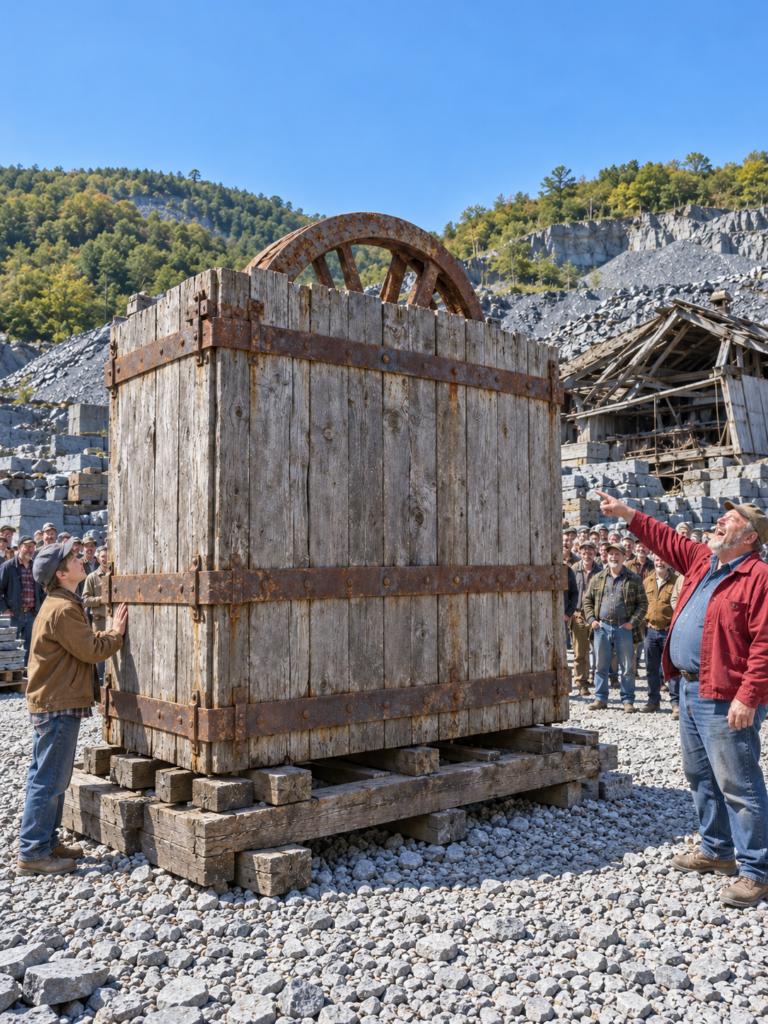
The crate was taller than any man in the yard, nearly as long as a pickup truck, and bound with iron straps so badly rusted they looked like dried blood against the weathered oak.
A great iron wheel protruded from the top.
Nobody knew exactly what was inside.
Nobody except Evan’s grandmother.
And she had been waiting nearly seventy years for someone to believe her story.
Garrett Voss walked toward the boy.
Voss owned the largest scrap-metal business in three counties of rural Vermont. He had spent thirty years buying abandoned machinery, weighing old iron, and selling it to foundries.
He believed there was nothing made of metal that he couldn’t put a price on.
And he was especially proud of knowing when something was worthless.
“Son, do you even understand what you bought?”
Evan swallowed.
“Yes, sir.”
“No, you don’t.”
Voss slapped the side of the crate.
The hollow thud echoed beneath the damaged mill roof.
“That’s a broken slate saw. Somebody probably cracked the frame eighty years ago and boxed it up so nobody would notice.”
A few men nodded.
Voss continued.
“Seven tons of useless iron. Costs more to haul than it’s worth.”
He looked around at the crowd.
“Somebody should’ve stopped this kid from throwing away his money.”
Evan stared at the wooden planks.
Faded white letters ran down one side.
The words were written in a language most people in Pen Hollow couldn’t read.
But Evan had seen them before.
In an old photograph.
Hanging beside his grandmother’s kitchen stove.
Voss walked to his truck and returned with a long pry bar.
He held it out.
“Here, boy. Go ahead.”
Evan didn’t move.
“Open one board. Let’s see what fifty dollars bought you.”
More than sixty people were watching.
Some had their phones raised.
The county auctioneer, Walter Kimbro, stood nearby with his clipboard tucked beneath one arm.
Evan looked at the pry bar.
Then he placed both palms flat against the old oak.
“No, sir.”
Voss blinked.
“What?”
“I’m not opening her.”
For a moment, nobody spoke.
Then Voss threw back his head and laughed.
“Her?”
The crowd erupted.
“He calls a box of rusty iron her!”
A teenager whistled.
Someone shouted that Evan ought to give the thing a name and take it to the county fair.
Evan’s ears burned.
But he kept his hands against the crate.
“She stays closed,” he said, his voice cracking slightly, “until somebody who knows what she is can be here.”
Voss’s smile widened.
“Well, you’d better find that somebody quickly.”
Walter Kimbro approached.
“Evan, I need you to understand the terms of the sale.”
The boy looked up.
Walter was sixty-eight, with silver hair, a lined face, and the quiet manner of a man who had spent forty years selling farm equipment, estate property, and machinery nobody wanted anymore.
“The buyer has ten days to remove the lot. After that, anything left on the property becomes part of the salvage agreement.”
Evan looked toward Voss.
“Who has that agreement?”
Walter hesitated.
Voss answered for him.
“I do.”
His smile returned.
“And when those ten days are up, I’ll bring my cutting torch down here and turn your precious girl into scrap.”
He leaned closer.
“Forty dollars a ton. I might even mail you a check.”
The laughter followed Evan all the way out of the auction yard.
But nobody there knew why he’d spent his money.
Nobody knew about the summer he had worked stacking firewood for Ruth Ellery, the widow who lived two miles down the county road.
Nobody knew that every one of those fifty dollars had come from hours of splitting, carrying, and stacking wood beneath the hot Vermont sun.
And nobody knew what his grandmother had told him about the mysterious machine.
The Blue Ledge Slate Company had closed long before Evan was born.
Its quarry had filled with green water.
The old mill roof had collapsed in several places.
Weeds grew through the gravel where trucks once carried slate toward the railroad.
For decades, the property had remained untouched.
Then a developer bought the land.
Everything had to go.
Old carts.
Broken equipment.
Rail sections.
Rusting machinery.
And one enormous wooden crate that had been nailed shut since the Second World War.
The sale notice listed it simply as an old industrial saw, approximate weight seven tons, sold as found, buyer responsible for removal.
Most bidders ignored it.
When Walter asked for a hundred dollars, nobody raised a hand.
When he dropped the opening bid to fifty, Evan raised his.
Voss had started laughing before the auctioneer’s hammer came down.
Now, as the crowd disappeared and pickup trucks rolled toward the county road, Evan stood alone beside the crate.
He took his mother’s old phone from his jacket.
He photographed the faded white writing.
Then he touched the wood one final time.
“I don’t know how yet,” he whispered. “But I’m getting you out.”
He walked home beneath a sky turning gray with approaching autumn.
The road was lined with maples beginning to change color.
Dry leaves scraped against the pavement.
Beyond the stone walls, fields sloped toward wooded hills, and the old farmhouses stood far apart beneath the mountains.
Evan lived in one of those houses with his mother and grandmother.
The roof needed repairing.
The kitchen linoleum had been patched twice.
His bedroom window rattled whenever the wind blew from the north.
His father had left when Evan was five.
The last time Evan remembered seeing him, he’d been loading suitcases into a blue pickup truck while his mother stood on the porch crying.
For years, Evan wondered whether he’d done something wrong.
Eventually, his grandmother told him that grown people sometimes made selfish decisions children couldn’t understand.
That answer hadn’t made his father come home.
But it had helped Evan stop waiting at the window.
His mother, Dana Probert, worked long shifts at the county hospital.
Some weeks, she worked so many hours that Evan saw her only at breakfast.
His grandmother, Gwen Probert, had raised him almost as much as his mother had.
She was seventy-seven years old, with silver hair, sharp blue eyes, and a stubborn streak that had survived poverty, widowhood, and a hip replacement.
She was sitting at the kitchen table when Evan arrived.
Her cane leaned against the chair.
A cup of tea stood untouched beside her.
And the moment he entered, he knew she had already heard.
“Ruth Ellery called,” she said.
Evan stopped.
“Na, I—”
“Walter called too.”
He lowered his eyes.
“I’m sorry.”
Gwen looked at him.
“For what?”
“For spending all my money.”
She said nothing.
“And everybody thinks I’m stupid.”
“Sit down, Evan.”
He sat across from her.
The kitchen was quiet except for the old refrigerator humming near the back door.
Gwen studied his face.
Then she asked one question.
“Did you open it?”
Evan shook his head.
“No.”
“Did anybody else?”
“No. Mr. Voss tried to make me. He handed me a pry bar.”
Gwen’s hands tightened around her teacup.
“And?”
“I told him she stays closed until somebody who knows her can be there.”
His grandmother closed her eyes.
When she opened them, there were tears in them.
But she was smiling.
“Then you did exactly right.”
Evan looked up.
“You’re not mad?”
“No, sweetheart.”
She slowly pushed herself to her feet.
Her hip troubled her when she first stood, and Evan moved to help her.
She waved him back.
“I’m old, not made of glass.”
She walked toward the stove.
On the wall hung an old photograph in a simple wooden frame.
Evan had seen it every day of his life.
Seven men in work clothes stood beside an enormous iron machine.
The photograph was so faded that the faces were little more than shadows.
Gwen carefully removed it from the wall.
She placed it beneath the kitchen lamp.
“Look closely.”
Evan leaned forward.
There was a long iron bed.
A great wheel.
A heavy frame.
And along one side, a shape he recognized.
His breath caught.
“That’s her.”
Gwen nodded.
“That is the machine you bought today.”
She touched the photograph.
“And the man standing in the middle was your great-great-grandfather.”
Evan stared at the stern-faced man with the thick mustache.
“David Probert?”
“Yes.”
Gwen sat slowly.
Then she took Evan’s hand.
“I think it’s time you heard the whole story.”
And what she told him that night was something no one at the auction could have imagined.
Part 2
David Probert had been born in North Wales, in a valley where mountains were carved open for slate.
His father, Hugh, worked as a pattern maker in an iron foundry.
A pattern maker was not simply a carpenter.
He shaped wood into exact forms that would be used to create molds for enormous iron castings.
Every curve mattered.
Every measurement had to be right.
One small mistake could ruin a piece of machinery weighing thousands of pounds.
Hugh was known for careful hands and an extraordinary eye.
When the Glaslin Works began developing a new kind of slate-cutting saw, he was given the task of preparing its original patterns.
The machine was enormous.
Its iron bed extended longer than a horse-drawn wagon.
A massive wheel drove the cutting mechanism.
It was designed to slice slate blocks cleanly and consistently, reducing the waste that had troubled quarry workers for generations.
And when the first machine was completed, Hugh did something unusual.
He placed two small initials into the wooden pattern.
H.P.
They appeared in the finished iron casting.
Not prominently.
Not where a foreman would notice.
But there, near the base of the frame.
A quiet signature.
His work had a name.
For years, the machine operated in Wales.
Then the slate industry began changing.
Labor disputes, financial pressure, and industrial upheaval forced companies to sell equipment.
An American slate operation purchased the great saw.
But the owners had a problem.
They didn’t know how to set it up properly.
David Probert, Hugh’s son, had grown up watching the machine take shape.
He understood its construction, its adjustments, and its peculiar habits.
So at twenty-three, he crossed the Atlantic with it.
He arrived in Vermont with a small suitcase, a pocket watch, and a folded photograph of his father.
He helped install the saw at the Blue Ledge Slate Mill.
And there it worked for decades.
Slate from that machine covered houses, barns, churches, and schools throughout the valley.
Gwen paused.
Evan looked at the photograph.
“So he came all that way just for the saw?”
“He came because he knew how to care for it.”
She smiled faintly.
“And because America offered him a chance to build something of his own.”
David married.
Raised children.
Bought a small home.
And never forgot the mountains he’d left behind.
But as the years passed, newer machinery arrived.
The old saw became slow by comparison.
Parts were difficult to obtain.
Eventually, the Blue Ledge company stopped using it.
Then came 1942.
The United States had entered the Second World War.
Across the country, communities organized scrap drives.
Old machinery and unused iron were collected for wartime production.
The president of Blue Ledge decided the abandoned saw would be donated.
Seven tons of cast iron.
A patriotic contribution.
Good publicity for the company.
But to David Probert, it was something else entirely.
It was the last surviving evidence of his father’s finest work.
Gwen’s voice grew softer.
“David begged them not to destroy it.”
“What did they say?”
“They laughed at him.”
Evan looked up.
Gwen nodded.
“Just like those men laughed at you today.”
She described the meeting as the story had been passed down through her family.
David had gone to the company office wearing his best coat.
He’d explained what the machine meant.
He’d spoken about his father.
About the original patterns.
About the workers who had depended on it.
But the company president, Mr. Ashcroft, had dismissed him.
Old machinery was old machinery.
Iron was iron.
Sentiment had no place in business.
David returned home devastated.
That evening, he sat at his kitchen table long after supper.
His wife found him staring at the photograph of the saw.
He had no legal claim to the machine.
It belonged to the company.
And once it was melted down, there would be nothing left.
Then two Welsh friends from the chapel came to see him.
They listened.
And together, they made a decision that would keep a secret for more than eighty years.
One night, the three men entered the mill.
They worked by lantern light.
They coated the old machine in heavy protective grease.
Wrapped its vulnerable surfaces in treated canvas.
And built an enormous wooden casing around it.
They used thick oak planks, iron bands, and heavy fasteners.
By morning, the machine had disappeared inside a box that looked like an oversized industrial shipment.
David told the foreman it was a crate of damaged slate being held for a future chapel project.
According to the family story, no one questioned the explanation.
The scrap trucks came.
Other machinery disappeared.
But the great saw remained untouched.
When the war ended, David never opened the crate.
He was growing old.
The company had moved on.
And the people who still remembered the original machine were disappearing one by one.
So David painted a message in Welsh along the side of the oak.
Gwen stopped speaking.
Evan took out his mother’s phone.
He opened the photograph he’d taken at the auction.
The faded writing filled the screen.
Gwen leaned close.
Her lips moved slowly.
Then she translated.
“Do not open her. She is waiting to go home.”
Evan looked at the words.
A strange feeling moved through his chest.
For the first time, the crate wasn’t simply something he’d bought.
It felt like a promise passed from one generation to another.
“Did David ever see Wales again?” he asked.
Gwen shook her head.
“He wanted to. But there was always something. Money. Work. Family.”
She looked toward the dark kitchen window.
“Life doesn’t always give us enough time for the journeys we think we’ll take someday.”
Evan stayed quiet.
Gwen touched the photograph.
“When I was five, David sat me on his knee beside this stove.”
She smiled sadly.
“He told me the saw was only sleeping. He said someone who understood her would come one day, and she would go home.”
“Did you promise him?”
“Yes.”
“What did you promise?”
“That I’d remember.”
Tears gathered in her eyes.
“For seventy years, that’s what I’ve done.”
The kitchen clock ticked.
Outside, wind moved through the maple branches.
Evan reached across the table.
“Then we’re going to get her home.”
Gwen looked at him.
“Sweetheart, I hope so.”
His mother came home just before midnight.
Dana was forty-one, exhausted, and still wearing her blue hospital scrubs.
She set her bag beside the refrigerator and listened while Evan and Gwen explained the auction.
At first, she said nothing.
Then she looked at the photograph.
Then at Evan.
Then at the faded writing on his phone.
Finally, she asked the question nobody had answered.
“How are we supposed to move seven tons in ten days?”
Evan looked down.
He had spent his last fifty dollars.
His mother had almost nothing left after the mortgage, utilities, groceries, and Gwen’s medical expenses.
A heavy equipment hauler could cost thousands.
And the mill property would be turned over to the demolition and salvage crews as soon as the deadline passed.
Nobody at the table had a solution.
Dana rubbed her tired face.
“Evan, I love that you want to honor our family. But wanting something badly doesn’t make it possible.”
Evan swallowed.
“I know.”
She sat beside him.
“You should’ve talked to me before spending all your money.”
“I thought somebody else might buy her.”
Dana looked toward Gwen.
Gwen’s expression was full of guilt.
“I told him the stories.”
Dana sighed.
“I know, Mom.”
For a moment, the three sat in silence.
Then Evan straightened.
“I’ll find a way to move her.”
Dana looked at him.
“With what money?”
“I don’t know yet.”
She almost argued.
But the look on his face stopped her.
It was the same expression she’d seen on her father’s face before he died.
The same stubborn determination Gwen carried through years of hardship.
Dana reached for Evan’s hand.
“Then tomorrow, we start making calls.”
But by Monday morning, the auction story had spread through every corner of Pen Hollow.
And Evan discovered that keeping a promise could hurt more than he had imagined.
At school, the jokes began before first period.
“Hey, Saw Boy!”
A boy in the eighth grade made a buzzing noise as Evan walked past.
Two girls giggled beside the lockers.
By lunchtime, somebody had posted a video from the auction.
It showed Garrett Voss laughing.
It showed Evan standing beside the enormous crate.
And it showed the moment Voss announced to the crowd that the boy had called the machine her.
The video spread through the school.
Students replayed it while Evan sat alone with his lunch.
He tried to ignore them.
But when one boy shouted that Evan should marry his rusty saw, he stood up so suddenly that his chair scraped across the floor.
For one terrible second, he wanted to throw his tray.
Instead, he picked it up and walked away.
He ate the rest of his lunch outside near the gym.
That afternoon, he began calling heavy equipment transport companies.
The first told him the job would cost far more than he had.
The second thought he was making a prank call.
The third asked whether an adult owned the machine.
Evan explained that he’d bought it legally at auction and that his mother could help arrange the move.
The dispatcher gave him an estimate.
It was more money than his family had saved for the entire winter.
By Wednesday, Evan had called nineteen businesses.
By Thursday, he’d crossed out every name.
Some couldn’t handle seven tons.
Some were already booked.
Others weren’t interested in dealing with a child.
One operator, a man named Doyle, finally told him something that frightened him.
“Son, most of the haulers around here do business with Garrett Voss.”
Evan gripped the telephone.
“What does that have to do with me?”
Doyle hesitated.
“Garrett’s been telling everybody about your purchase.”
“So?”
“He says he’s taking that machine for scrap when the deadline passes.”
“But I own it.”
“I know.”
“Then why won’t anybody help?”
Doyle sighed.
“Sometimes people don’t want to upset somebody they depend on for work.”
Evan didn’t know what to say.
Finally, he thanked the man and ended the call.
That evening, he sat at the kitchen table staring at the crossed-out names.
His grandmother watched him from across the room.
“Any luck?”
“No.”
“Try again tomorrow.”
“There’s nobody left.”
Gwen looked at the list.
Then she looked at her grandson.
“Your great-great-grandfather waited more than eighty years for somebody to remember that machine.”
Evan’s eyes filled.
“I know.”
She reached for his hand.
“And whatever happens, I’m proud that you did.”
But Evan wasn’t ready to give up.
Not while the deadline remained.
Not while the crate sat beneath the broken mill roof, waiting.
Part 3
The man who finally came to help didn’t own a large trucking company.
He didn’t have a fleet of trailers.
And he wasn’t wealthy.
His name was Hector Ruiz.
He was forty-four years old, with broad shoulders, grease-darkened hands, and a small towing business he’d started after moving to Pen Hollow that spring.
He owned one heavy tow truck.
One aging lowboy trailer.
And very little else.
On Thursday evening, he knocked on Gwen Probert’s screen door.
Evan opened it.
Hector stood on the porch holding his baseball cap.
“Are you the boy who bought the old saw?”
Evan’s shoulders tightened.
“Yes, sir.”
Hector noticed.
He smiled gently.
“Don’t worry. I didn’t come to laugh.”
Evan studied him.
“Then why are you here?”
“I heard you need something moved.”
From the kitchen, Gwen called, “Invite the man inside, Evan.”
Hector stepped through the doorway.
He declined coffee at first, then accepted when Gwen insisted.
Soon, the four of them sat around the kitchen table.
Hector listened while Evan explained the crate, the deadline, and the failed calls.
He didn’t interrupt.
When Evan finished, Hector looked toward the old photograph beside the stove.
“My grandfather was a blacksmith in Sonora, Mexico,” he said.
“He came north with almost nothing. But he brought his anvil.”
Evan listened.
“People told him to leave it behind. Said it was too heavy and he’d find another.”
Hector smiled.
“He told them that tools remember the hands that worked them.”
Gwen’s eyes softened.
“That sounds like something my grandfather would have said.”
Hector looked at Evan.
“I’ve got a trailer and a winch. If the site is safe and the load can be properly rigged, I can arrange the move.”
Evan’s heart jumped.
“Really?”
“Really.”
Then his face fell.
“I can’t pay you.”
Hector shrugged.
“Pay me when you can.”
“But what if I never can?”
“You stacked firewood all summer to buy that thing, right?”
Evan nodded.
“Then you can stack mine next winter.”
For the first time in days, Evan laughed.
Hector smiled.
“Fair enough?”
“More than fair.”
Dana looked at Hector carefully.
“You understand how heavy the machine is?”
“I do. I’ll need the right lifting and rigging help, and I won’t move it if the structure isn’t safe.”
He looked toward Gwen.
“This won’t be a job for guessing.”
Gwen nodded.
“Good.”
But there was one problem.
Hector’s lowboy trailer was currently on a job in New Hampshire.
He wouldn’t get it back until Monday night.
The deadline was Tuesday at noon.
They would have only one morning.
Evan looked frightened.
“Can we do it?”
Hector considered the question.
“I won’t promise what I can’t guarantee. But I’ll inspect the site beforehand and make a plan.”
He leaned forward.
“And if we’re going to try, we do it properly.”
The following morning, Evan went to the school library.
He carried his phone and the photograph from his grandmother’s kitchen.
The librarian, Mr. Kessler, was a quiet man with half-moon glasses and a habit of speaking softly.
Unlike the other adults who had heard the auction story, he didn’t smile when Evan explained it.
He studied the photographs carefully.
Then he pointed toward the rusted wheel visible above the casing.
“What’s that lettering?”
Evan enlarged the image.
Five raised letters could be seen beneath the corrosion.
G-L-A-S-L.
Mr. Kessler leaned closer.
“Could that be part of a manufacturer’s name?”
Evan nodded eagerly.
“My grandmother says the machine came from a foundry called the Glaslin Works in Wales.”
The librarian turned toward his computer.
“Then let’s see what we can find.”
They searched historical records and museum collections.
Some references led nowhere.
Others mentioned former slate foundries and industrial equipment.
Then Mr. Kessler found a museum in North Wales dedicated to the history of slate quarrying.
Its collection included old photographs, machinery records, and equipment recovered from abandoned industrial sites.
The museum had a curator specializing in quarry machinery.
Dr. Rhiannon Morgan.
Evan stared at the contact information.
“Do you think she’d answer?”
Mr. Kessler looked at the photographs again.
“If your grandmother’s story is accurate, she may be very interested.”
“Can you write to her?”
The librarian shook his head.
“I’ll help you with the spelling, but it should come from you.”
“Why?”
“Because you’re the owner.”
Evan looked surprised.
Mr. Kessler smiled.
“And because this is your family’s story.”
So Evan began typing.
It took him most of his lunch period.
He explained his age.
The Vermont auction.
The fifty dollars.
His great-great-grandfather David Probert.
The machine that had been enclosed in 1942.
The painted Welsh message.
He attached the photographs.
And at the end, he wrote that he had not opened the casing because his grandmother believed someone who understood the machine should be present.
He read the email three times.
Then he pressed send.
Nothing happened.
No answer that evening.
No answer the next morning.
Saturday passed.
Then Sunday.
Evan checked his email so often that Dana finally asked him to put the phone away during supper.
“People need time to answer, honey.”
“But what if she never sees it?”
“Then we’ll try again.”
Evan stared at his plate.
Outside, the temperature was dropping.
The maple leaves had begun falling heavily.
Winter would come quickly in the hills.
He wondered how long the old crate could survive outdoors if they managed to move it.
And for the first time, he wondered whether his grandmother had been wrong.
Maybe the machine really was broken.
Maybe the story had grown more beautiful every time someone told it.
Maybe Garrett Voss was right.
That night, Evan went to his grandmother’s room.
She was sitting beside the window, knitting.
“Na?”
“Yes?”
“What if it’s just scrap?”
Gwen set down her knitting.
Evan stared at the floor.
“What if I spent all my money on something that isn’t what you think it is?”
She was quiet for a moment.
Then she said, “Come here.”
He sat beside her.
Gwen took his hand.
“When I was a girl, your great-great-grandfather told me that machine was special.”
Evan nodded.
“I remember.”
“But he never told me it was valuable.”
Evan looked up.
“He didn’t?”
“No.”
She smiled sadly.
“He told me his father made it. He told me men worked beside it for decades. And he told me it should never have been thrown away without somebody remembering what it was.”
She squeezed his hand.
“If it’s broken, then it’s broken. If it’s worth nothing, then it’s worth nothing.”
Evan’s throat tightened.
“But that doesn’t make you foolish for trying to save it.”
He leaned against her shoulder.
For a while, neither spoke.
Then Gwen said quietly, “I wish I could’ve gone to that auction with you.”
“Your hip wasn’t ready.”
“I know.”
She brushed his hair away from his forehead.
“But when you told that man she wasn’t going to be opened, you gave an old woman something she hadn’t felt in years.”
“What?”
“Hope.”
Evan closed his eyes.
And silently, he promised himself he would not stop trying.
On Monday morning, Garrett Voss heard about the email to Wales.
By noon, he was telling the story at the gas station.
“The boy wrote to a museum overseas,” he announced, grinning.
A customer laughed.
“What for?”
“Maybe the king of Wales is going to send a battleship for that old crate.”
The men chuckled.
Voss continued.
“I’ve seen children with imaginary friends, but this is the first one I’ve seen with an imaginary museum collection.”
Someone recorded the joke.
By afternoon, Evan heard it at school.
He pretended it didn’t matter.
But when the final bell rang, he walked home with his hood pulled over his head.
He didn’t want anyone to see the tears in his eyes.
That evening, Hector called.
His trailer was on the way back.
He’d already inspected the mill with a qualified rigging operator and arranged for the needed equipment.
They would begin before sunrise.
“If the load can be moved safely, we’ll get her out,” he said.
Evan thanked him.
After the call, Dana found her son standing by the kitchen window.
She placed a hand on his shoulder.
“Are you scared?”
He nodded.
“Me too,” she admitted.
Evan looked at her.
“You are?”
“Of course.”
She glanced toward Gwen’s photograph on the wall.
“I’ve been worrying about the money, the house, and what people are saying. But I know this matters to your grandmother.”
Evan swallowed.
“She says it’s the last thing David asked her to remember.”
Dana nodded.
“I know.”
For a moment, she looked older than forty-one.
Then she straightened.
“Tomorrow morning, I’ll be there.”
Evan looked surprised.
“But your shift?”
“I traded with another nurse.”
“Mom—”
She hugged him.
“Whatever happens, you’re not facing that crowd alone.”
That night, Evan barely slept.
The wind rattled his bedroom window.
Branches scraped against the siding.
He lay awake imagining the crate breaking apart.
The heavy machine falling.
Garrett Voss laughing.
His grandmother watching from the porch as the last piece of her childhood disappeared.
At four-thirty in the morning, he finally climbed out of bed.
He dressed in the darkness.
Then he went downstairs.
His mother was making coffee.
Gwen sat at the table, already dressed.
She looked at him.
“You ready?”
Evan took a deep breath.
“Yes.”
But when the sun rose over the abandoned quarry, Garrett Voss was already waiting at the gate.
And he had brought his cutting torch.
Part 4
Voss sat in a folding lawn chair beside his flatbed truck.
A thermos of coffee rested near his boots.
The cutting equipment was secured in the truck bed.
Several other pickups were parked along the road.
Word had spread that the Probert boy was making one final attempt to move his seven-ton purchase before the deadline.
Nearly thirty people had come to watch.
Some were curious.
Some hoped Evan would succeed.
Others had arrived because Garrett Voss had promised them a good laugh.
When Hector’s truck and trailer rumbled through the gate, Voss stood and raised his coffee cup.
“Morning, Saw Boy!”
Evan stared straight ahead.
Voss grinned.
“Deadline’s noon. I’ve got my torch ready.”
Hector slowed beside the gate.
He lowered his window.
“Then keep it in your truck.”
Voss’s smile faltered.
Hector continued.
“We’re working today. Not putting on a show.”
He drove forward.
Dana followed in her small car.
The old mill stood ahead, its roof sagging beneath decades of neglect.
Inside, the giant crate remained exactly where Evan had left it.
For several minutes, he stood beside the oak planks.
He touched the faded Welsh writing.
Then he stepped away so the adults could work.
Hector and the rigging crew examined the supports, the damaged roof, and the available access.
They had brought additional equipment to manage the weight safely.
Loose roof timbers had to be stabilized and removed before the crate could be approached.
The machine was too valuable—or too dangerous—to move carelessly.
Evan watched every minute.
When a worker reached toward one of the iron straps, Evan stepped forward.
“Please don’t take that off.”
The worker looked toward Hector.
Hector nodded.
“We’re supporting the load from beneath. The casing stays intact.”
Evan moved back.
Hours passed.
The workers used suitable lifting equipment and heavy timber supports to raise the crate carefully enough to position it for loading.
The oak groaned.
The iron bands creaked.
Dust shook loose.
But the casing held.
At the gate, Voss checked his watch.
“You boys running a museum restoration or a moving job?”
Nobody answered.
By late morning, the crate was positioned for the final loading operation.
The trailer waited nearby.
Hector checked the rigging and gave instructions to the crew.
Evan stood well outside the work area beside his mother.
He held her hand.
The enormous box began moving.
Slowly.
Inches at a time.
Its weight pressed against the equipment.
The old wood creaked under shifting forces.
Then the movement stopped.
One of the workers signaled.
The crew paused to inspect a binding point and adjust the load support.
From the gate, Voss laughed.
“That’s it! Told you it’d never move!”
Evan’s stomach dropped.
He looked at the clock on Hector’s dashboard.
Less than an hour.
The salvage deadline was approaching.
Hector climbed down.
He checked the equipment with his crew.
They adjusted the rigging and verified the load was stable.
Then the operation resumed.
The massive crate moved again.
Slowly.
Carefully.
The front edge reached the trailer deck.
Then the rest followed.
At last, the entire seven-ton weight settled securely into place.
Hector exhaled.
The crew installed the proper restraints and inspected every connection.
Evan stood motionless.
He could hardly believe it.
The crate had left the mill floor.
After more than eight decades.
After generations of standing in darkness.
It was finally moving.
Hector checked his watch.
11:40 a.m.
Twenty minutes before noon.
He turned toward Evan.
“She’s on.”
Evan’s eyes filled.
“Really?”
Hector smiled.
“Really.”
Dana began crying.
She covered her face with one hand.
Evan wrapped his arms around her.
For a moment, the noise at the gate disappeared.
The crowd.
The laughter.
Garrett Voss.
All of it.
Then Hector called, “We’ve still got to get through that gate.”
He climbed into the cab.
The truck moved slowly along the gravel.
Evan rode in the passenger seat, turning repeatedly to look through the rear window.
The crate was secured behind them.
The white Welsh letters faced the road.
As they passed Voss, the scrap dealer raised his coffee cup.
“Enjoy your lawn ornament, son.”
A few men laughed.
But not many.
One elderly farmer removed his cap.
Another nodded toward Evan.
A woman near the fence began clapping.
Soon several others joined her.
Voss looked around, irritated.
Hector kept driving.
They reached the Probert farm shortly after noon.
The crate was placed on prepared heavy timber supports beside the barn, with a weatherproof covering arranged to protect it until specialists could examine it.
Gwen came outside slowly.
Her cane tapped against the porch steps.
Dana hurried to help her.
But Gwen was determined to walk the last few yards herself.
Evan stood beside the crate.
When his grandmother reached it, she stopped.
She looked up at the weathered oak.
At the iron straps.
At the faded writing.
For a long moment, she did not speak.
Then she lifted one trembling hand and rested it against the wood.
“Hello, old girl,” she whispered.
A tear slipped down her cheek.
“You’re almost home.”
Evan put his arm around her waist.
“We did it, Na.”
Gwen looked at him.
“No, sweetheart.”
She smiled through her tears.
“You did something your great-great-grandfather hoped would happen long after he was gone.”
That evening, a message arrived.
Dana was checking her email at the kitchen table when she suddenly stopped moving.
“Evan.”
He looked up from his homework.
“What?”
“Come here.”
Something in her voice made him hurry.
She turned the screen toward him.
The message was from Wales.
Dr. Rhiannon Morgan.
Evan read the first line.
Then the second.
His eyes widened.
The curator explained that she had spent nearly twenty years researching the early Glaslin Works saws.
The original machine was believed to have been destroyed during wartime scrap collections.
But Evan’s photographs showed details that matched historical drawings.
The wheel.
The frame.
The old lettering.
And the extraordinary Welsh message on the casing.
She asked him not to open the crate.
She wanted to examine it personally, with an independent industrial antiques appraiser present.
And she was arranging to travel to Vermont.
Gwen sat down heavily.
Dana read the email again.
Evan stared at the screen.
“She’s coming?”
Dana nodded.
“She’s coming.”
For a moment, none of them spoke.
Then Gwen began crying.
Not loudly.
Not dramatically.
She simply covered her face and wept like someone who had carried a secret for too many years.
Evan knelt beside her chair.
“Na?”
She took his hand.
“I never thought I’d live to see this.”
He hugged her.
And for the first time since the auction, he began to believe the impossible might actually happen.
But the news traveled quickly.
By Wednesday afternoon, Garrett Voss knew a museum curator was coming from Wales.
And suddenly, the man who had spent days calling Evan’s purchase worthless wanted to buy it himself.
His truck pulled into the Probert driveway while Evan was raking leaves.
Voss climbed out.
He wasn’t laughing this time.
“Afternoon, son.”
Evan stopped raking.
“Hello, Mr. Voss.”
Voss looked toward the crate.
“Still got your old box.”
“Yes, sir.”
“I hear somebody from overseas is coming to look at it.”
Evan nodded.
“A curator.”
Voss studied the casing.
Then he reached into his jacket.
He removed a thick fold of bills.
“I’ve got an offer for you.”
Evan said nothing.
Voss counted the money.
“Five hundred dollars.”
Evan stared.
It was ten times what he’d paid.
More money than he’d ever seen in one person’s hand.
Voss held it out.
“Cash. Right now. I’ll haul that thing away tonight.”
Evan didn’t move.
Voss glanced toward the farmhouse.
“Your grandmother could use some help fixing this place.”
Evan’s face tightened.
Voss continued.
“Roof looks rough. Winter’s coming. Five hundred dollars would be a lot more useful than seven tons of iron.”
The boy looked at the money.
He thought of the leak above his grandmother’s bedroom.
The draft beneath the kitchen door.
His mother’s tired face after twelve-hour shifts.
Five hundred dollars could buy groceries.
Pay bills.
Help with repairs.
But then he looked at the faded words on the crate.
She is waiting to go home.
Evan took a breath.
“No, sir.”
Voss frowned.
“Think about it.”
“I have.”
“You’re going to turn down ten times what you paid?”
“Yes.”
Voss’s face reddened.
“Son, I know scrap. I’ve made my living from it. If that crate contains a broken frame, you’re going to have an expensive problem.”
Evan nodded.
“Maybe.”
“Then take the money.”
“No, thank you.”
Voss stared at him.
Evan set down his rake.
“But I’d like to invite you here Saturday.”
Voss blinked.
“Invite me?”
“The curator’s coming. We’re opening the crate with witnesses.”
Voss looked toward the machine.
Evan continued.
“You told everybody it was scrap. I think you should be here when we find out.”
For several seconds, Voss said nothing.
Then he folded the bills and returned them to his pocket.
“I wouldn’t miss it.”
He climbed into his truck.
As the engine started, he called through the window.
“I’ll bring my torch, just in case.”
He drove away.
Evan stood in the yard watching the dust settle.
He was frightened.
Not because Voss might be right.
But because Saturday was coming.
And after eighty years of waiting, the old machine would finally be opened.
What lay beneath those boards would either prove his grandmother’s story—or break her heart.
Part 5
Saturday morning arrived cold and clear.
Frost silvered the grass.
The maple trees stood bright red and gold beneath the Vermont mountains.
A thin mist rose from the fields beyond the barn.
Evan had barely slept.
He woke before sunrise, pulled on his jeans and flannel shirt, and went downstairs.
His grandmother was already at the kitchen table.
She wore her best blue dress beneath a heavy cardigan.
Her silver hair was carefully pinned.
On the table lay the old photograph of David Probert and the great saw.
Gwen had placed it in a clean envelope.
Evan sat beside her.
“Are you nervous?”
She smiled.
“Terribly.”
He swallowed.
“Me too.”
Gwen took his hand.
“Whatever happens today, remember something.”
“What?”
“You kept your promise.”
Evan nodded.
Then Dana entered with coffee and toast.
“Both of you need breakfast.”
Neither was hungry.
But Dana insisted.
By nine-thirty, the visitors had begun arriving.
Walter Kimbro came wearing a dark jacket and carrying his old auction notebook.
Hector Ruiz arrived with his work gloves and a carefully organized tool bag.
Ruth Ellery, the widow whose firewood had paid for the purchase, brought a plate of Welsh cakes she’d made from Gwen’s recipe.
Mr. Kessler came from the school carrying copies of the historical records he’d found.
Six folding chairs from the chapel hall had been arranged in a half circle near the barn.
Gwen sat in the center.
Dana sat beside her.
The others took their places.
And at the edge of the yard, Garrett Voss leaned against his pickup.
He had brought coffee.
And the cutting equipment remained in his truck bed.
At ten o’clock, a rented car pulled into the driveway.
Two women stepped out.
The first was Dr. Rhiannon Morgan, a gray-haired Welsh curator in a dark rain jacket.
She carried a canvas tool bag and a folder of historical photographs.
The second was Marjorie Keel, an independent appraiser from Albany who specialized in historic industrial machinery.
Marjorie carried measuring equipment, a camera, and a clipboard.
Evan approached nervously.
“Dr. Morgan?”
The curator smiled.
“You must be Evan.”
He nodded.
She shook his hand.
“I’ve come a long way to meet you.”
Evan glanced toward the crate.
“It’s right there.”
“I see.”
But Dr. Morgan didn’t hurry.
She walked slowly around the enormous wooden casing.
She studied the iron bands.
The planks.
The exposed wheel.
The construction details.
Finally, she reached the faded white writing.
She stopped.
For several seconds, she simply stared.
Then she lifted one hand and touched the old oak.
Her lips began moving.
She read the Welsh words aloud.
Her voice caught on the final phrase.
Gwen was watching from her chair.
Dr. Morgan turned toward her.
“Your grandfather wrote this?”
Gwen nodded.
“Yes.”
The curator’s eyes filled.
“I’ve read about this machine since I was a young researcher. I believed it was lost.”
She looked toward Evan.
“And you refused to open it?”
He nodded.
“Na said someone who understood it should be here.”
Dr. Morgan smiled.
“She gave you very wise advice.”
Evan glanced at his grandmother.
Gwen smiled back.
Then Dr. Morgan said something that made everyone fall silent.
“Evan, the machine belongs to you. I won’t remove a single board without your permission.”
The boy looked at the crate.
Then at Gwen.
His grandmother nodded.
“Go ahead, sweetheart.”
Evan took a deep breath.
“You can open her.”
Hector and the specialists began carefully dismantling the protective casing.
They worked slowly.
Every board was documented.
The old iron straps were removed without unnecessary damage.
The oak planks came away one by one.
Evan carried each released board to the barn wall, where they were placed in order.
Dr. Morgan insisted that the casing was part of the machine’s history.
Especially the board bearing the Welsh message.
Beneath the oak lay heavy canvas.
The fabric had hardened with age.
Underneath was a thick coating of protective grease.
It looked like old candle wax.
The smell of aged oil rose into the cold morning air.
Marjorie photographed every stage.
Dr. Morgan knelt beside an exposed section.
Using a small tool, she carefully cleared a patch of grease.
Black iron appeared.
Clean.
Smooth.
Protected from decades of moisture.
She stared.
Then she cleared another small area.
No deep corrosion.
No obvious damage.
The protective packing had worked far better than anyone expected.
Evan watched from beside his grandmother.
“Is that good?” he whispered.
Gwen squeezed his hand.
“I think so.”
The specialists continued.
As the canvas was removed, the machine’s full shape gradually emerged.
A long cast-iron bed.
An enormous drive wheel.
Heavy supports.
Precision-machined surfaces.
Original fittings.
It was almost exactly as it appeared in the photograph hanging beside Gwen’s stove.
Dr. Morgan moved toward the end of the frame.
Something had caught her attention.
She knelt.
Marjorie brought a flashlight.
Raised letters appeared beneath the remaining grease.
GLASLIN WORKS.
Below that:
NO. 1.
And beneath the number were two tiny initials.
H.P.
Dr. Morgan stopped breathing for a moment.
Then she pressed a hand over her mouth.
“Hugh Probert.”
The yard was completely silent.
Evan looked at her.
“What?”
She turned toward him.
“Your ancestor signed his pattern.”
Gwen began to cry.
Dr. Morgan stood slowly.
She opened her folder and removed a historical drawing.
The drawing showed an enormous iron saw.
The same wheel.
The same bed.
The same arrangement of castings.
She held it beside the machine.
Then she produced an old foundry record.
“This,” she explained, “was the first slate saw table manufactured by the Glaslin Works.”
She looked around at the witnesses.
“We have photographs of later machines. We have order books. We have surviving drawings.”
Her voice trembled.
“But the original machine disappeared from the historical record.”
Evan stared at the iron.
Dr. Morgan continued.
“For decades, we believed it had been scrapped.”
She stepped closer to the frame.
“What your great-great-grandfather preserved may be the only surviving example of the first model.”
Garrett Voss shifted beside his truck.
“It’s still just an old saw,” he muttered.
Nobody answered.
Dr. Morgan looked toward the appraiser.
“Marjorie?”
Marjorie nodded.
“I’ll need time.”
For the next hour, she examined the machine.
She measured the major castings.
Photographed the identifying marks.
Compared the construction with the historical documentation.
Inspected the condition of the preserved surfaces.
She asked Hector to assist while she checked a nonpowered mechanical movement under controlled conditions.
The heavy wheel turned smoothly.
Its old bearings had been protected.
The machine was not ready to operate, and no one attempted to power it.
But the surviving condition was remarkable.
Marjorie made several notes.
Then she stepped back.
Evan stood beside his mother.
His heart was pounding.
He’d stopped thinking about money.
All he wanted was to know whether his grandmother had been right.
Marjorie looked at Dr. Morgan.
Then at the witnesses.
“I’ve completed a preliminary appraisal supported by the available records and the condition we’ve documented today.”
She paused.
“For insurance purposes, assuming final verification of the historical records, my valuation of this machine is ninety-six thousand dollars.”
Nobody moved.
The morning wind whispered through the maple leaves.
Somewhere near the barn, a chickadee called.
Walter Kimbro’s hat slipped from his knees onto the grass.
Ruth Ellery covered her mouth.
“Oh, my Lord.”
Dana gripped Evan’s shoulder.
Evan stared at Marjorie.
“Ninety-six thousand?”
She nodded.
“That’s the estimated value in its documented condition.”
Gwen was crying openly now.
But she wasn’t looking at the appraiser.
She was looking at the machine.
At the great iron wheel.
At the work her grandfather had protected.
At the evidence that the story she’d carried all her life had been true.
Dr. Morgan walked toward Evan.
“Before I left Wales, our museum trustees discussed what we might do if this proved to be the machine we hoped.”
Evan listened.
“They authorized me to make an acquisition offer, subject to authentication and final documentation.”
She paused.
“We would like to purchase the saw at its appraised value.”
Dana’s eyes widened.
Dr. Morgan continued.
“Ninety-six thousand dollars, with the museum responsible for the professional transport to Wales.”
Evan looked toward his grandmother.
Gwen stared at him.
He whispered, “Na?”
She took his hand.
“It’s your saw, Evan.”
“But David wanted her to go home.”
Gwen smiled through her tears.
“Yes, sweetheart.”
Evan turned back toward Dr. Morgan.
“Can I ask something?”
“Of course.”
“Can the boards go with her?”
Dr. Morgan nodded.
“Absolutely.”
“Especially the one with the writing.”
“Yes.”
“And can you put the names of the men who saved her somewhere people can read them?”
The curator’s expression softened.
“We would be honored to.”
Evan swallowed.
“And can my grandmother come see her?”
Dr. Morgan looked toward Gwen.
Then back at Evan.
“I’ll personally help arrange her visit.”
Evan glanced at the great wheel.
He thought about the auction.
The laughter.
The fifty dollars.
The boys at school calling him Saw Boy.
The long nights worrying about transport.
Hector’s truck rolling through the quarry gate with twenty minutes remaining.
And his grandmother whispering to the old crate that it was almost home.
He looked at Dr. Morgan.
“Then she should go home.”
Gwen covered her face.
Dana wrapped both arms around her son.
Hector turned away for a moment and wiped his eyes.
Walter Kimbro shook his head slowly.
“I’ve been an auctioneer forty years,” he whispered. “Never seen anything like it.”
At the edge of the yard, Garrett Voss stood motionless.
His coffee had gone cold.
He looked at the machine.
Then at the boy.
Then at the old woman crying in her chair.
For perhaps the first time in his adult life, he had nothing to say.
He set his cup on the truck fender.
Climbed into the cab.
And drove away.
His cutting torch never left the truck.
The sale took time to complete properly.
There were ownership documents, authentication work, transport arrangements, and the legal protections needed because Evan was a minor.
Dana helped manage the process on her son’s behalf.
When the funds were finally received, the first person Evan insisted on paying was Hector Ruiz.
Hector tried to refuse.
“I told you firewood would do.”
Evan shook his head.
“You moved her when nobody else would.”
Hector smiled.
“I did.”
“And you believed me.”
The older man looked at him for a long moment.
Then he accepted the payment.
But only after Evan promised to visit the towing shop whenever he wanted to learn about trucks.
Gwen’s farmhouse received a new roof.
The drafty windows were repaired.
The old heating system was serviced before winter.
Dana paid the overdue household bills and arranged for the remaining money to be held safely for Evan’s future.
They didn’t buy a new car.
They didn’t move into a larger house.
They didn’t forget where the money had come from.
Evan still went to school.
He still stacked firewood.
And he still helped his grandmother carry groceries from the car.
But something had changed in Pen Hollow.
At the diner, the men who had laughed at the auction now spoke about the Probert family with a different kind of respect.
Walter Kimbro kept a photograph of the saw beside his auction desk.
Mr. Kessler invited Evan to speak to the school history club about local industrial heritage.
And Ruth Ellery told anyone who would listen that the boy who carried her firewood had brought a piece of history back to life.
As for Garrett Voss, he continued buying and selling scrap.
But the story followed him.
One morning at the diner, someone asked how much forty dollars a ton would have brought for a machine worth ninety-six thousand dollars.
Voss set down his fork.
He looked toward the window.
Then quietly paid for his eggs and left.
Nobody laughed.
The following spring, Evan and Gwen boarded a plane for Wales.
It was Gwen’s first journey across the Atlantic.
She was frightened of flying.
Her hip still troubled her.
And she worried about leaving the farmhouse unattended.
But when the plane descended over the green Welsh countryside, she pressed her face to the window.
Mountains rose beneath a gray sky.
Stone villages clustered along narrow roads.
Beyond them, old quarries marked the hillsides.
Gwen stared through tears.
“My grandfather used to tell me about these mountains.”
Evan reached for her hand.
“Now you get to see them.”
The museum stood among old industrial buildings near a historic slate quarry.
Its stone walls were dark with rain.
Inside were tools, photographs, machinery, and stories of men who had worked underground and in the mills for generations.
Dr. Morgan met them at the entrance.
“Welcome to Wales.”
She led them down a long stone hall.
Rain moved softly against the windows.
Then they entered a spacious exhibition room.
And there, beneath a skylight, stood the great Glaslin saw.
Its cast-iron frame had been conserved.
The enormous wheel rose above Evan’s head.
The long bed stretched across the slate floor.
Visitors walked slowly around it, reading the historical information displayed nearby.
On the wall hung the original oak planks.
Including the board with the faded Welsh writing.
Do not open her. She is waiting to go home.
Gwen stopped walking.
Her cane trembled.
Evan placed a hand beneath her elbow.
For a long moment, she couldn’t speak.
Then she moved toward the machine.
She reached out and touched a permitted section of the iron frame.
“Hello, old girl,” she whispered.
Her voice broke.
“You made it.”
Evan stood beside her.
Dr. Morgan gave them space.
On the wall was a new plaque.
It explained how Hugh Probert had helped create the original machine.
How David Probert had traveled with it to America.
How three Welsh workers had protected it during the wartime scrap drives.
And how, generations later, a twelve-year-old boy had purchased the sealed machine at a rural Vermont auction.
At the bottom were three lines.
Made by Hugh Probert.
Preserved by David Probert and his companions.
Brought home by Evan Probert, age twelve.
Gwen read the words slowly.
Then she looked at her grandson.
“Fifty dollars,” she whispered.
Evan smiled.
“Fifty dollars.”
“From stacking firewood.”
He nodded.
Gwen began laughing.
It was a soft, trembling laugh, full of tears.
She reached for him.
Evan wrapped his arms around his grandmother.
And there, in a stone hall thousands of miles from the little Vermont farmhouse, they held each other beside the machine their family had protected for generations.
After a while, Gwen stepped back.
She looked at the great iron wheel.
Then she spoke quietly.
“My grandfather told me she’d go home someday.”
Evan looked up at her.
“You believed him.”
Gwen shook her head.
“Some years I did. Some years I wondered if I’d only imagined it.”
She touched his cheek.
“But you believed me.”
Evan swallowed.
“Of course I did, Na.”
She smiled.
“That means more to me than all the money in the world.”
Outside, the rain continued falling across the Welsh mountains.
Inside, visitors moved past the great saw, learning about the workers who built it and the family who had refused to let its story disappear.
Evan studied the two small initials cast into the iron.
H.P.
His ancestor’s signature.
A mark left by a craftsman who could never have imagined that his work would cross an ocean twice, survive wars and abandonment, and finally return home because a boy refused to listen when grown men laughed.
Evan reached into his pocket.
He still carried the original auction receipt.
The paper had become soft from being folded and unfolded.
He opened it.
Lot 63.
Industrial saw.
Fifty dollars.
He looked at it for a moment.
Then he folded it carefully and placed it back in his pocket.
Someday, he thought, he might frame it.
Not because it showed how little he’d paid for something valuable.
But because it reminded him of the day he’d learned that the worth of something couldn’t always be measured by the people willing to laugh at it.
His grandmother held out her hand.
“Ready to go, sweetheart?”
Evan looked at the machine one last time.
The giant wheel stood silent beneath the skylight.
The oak boards hung safely on the wall.
The names of forgotten workers were written where people could see them.
The long journey was over.
He took Gwen’s hand.
“Yes, Na.”
Together, they walked toward the museum doors.
And behind them stood the seven-ton machine that a whole town had once called scrap.
It had never been worthless.
It had only been waiting for someone who knew what it meant to remember.