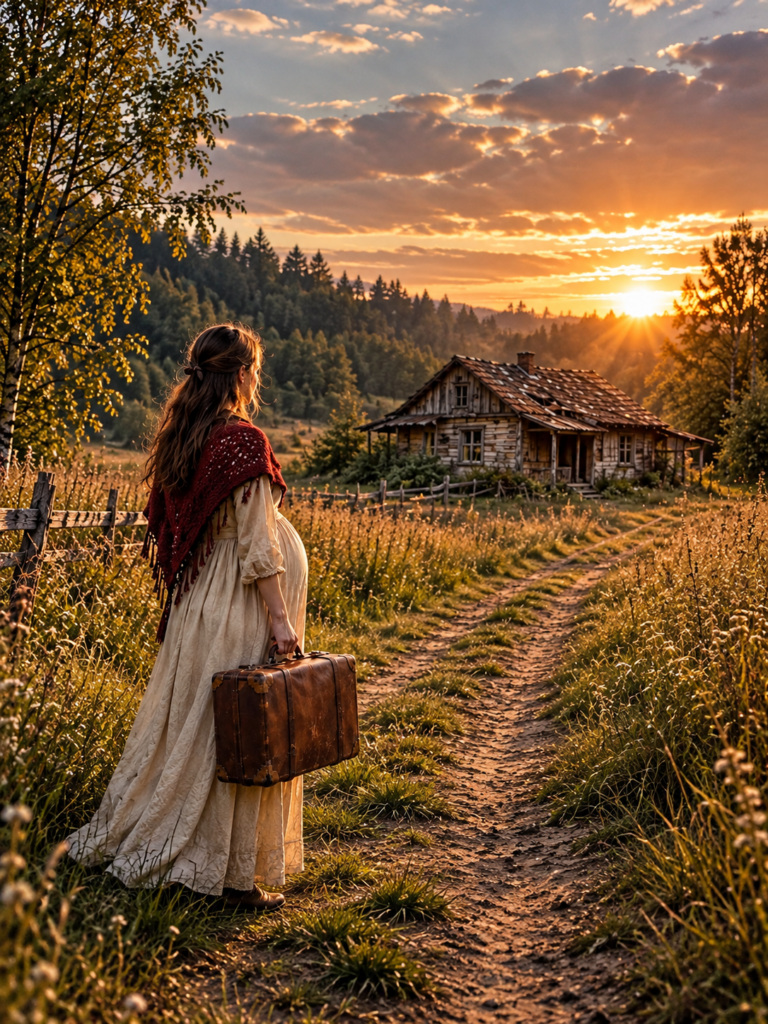
Part 1 — The House Nobody Wanted
The screen door slammed behind Marian Ellis at five-thirty on a Tuesday morning.
She was twenty-five years old, eight months pregnant, and standing on the gravel driveway of the only home she had ever known, holding a battered brown suitcase with a broken handle.
Behind the screen door, her stepmother watched her through the mesh.
“Don’t come back expecting me to change my mind,” Vera Ellis said. “I’ve already put up with more than any decent woman should.”
Marian said nothing.
She had learned long ago that answering Vera only made things worse.
A few feet behind her stepmother stood Marian’s father, Arthur. He was still wearing the suspenders and faded work shirt he had slept in. His gray hair stuck up on one side, and his hands hung loosely beside him.
He looked at his daughter.
Then he looked away.
“Dad?”
The word came out so quietly that Marian almost didn’t recognize her own voice.
Arthur shifted his weight.
“Your stepmother thinks it’s best, sweetheart.”
Marian stared at him.
“Best for who?”
He didn’t answer.
Vera reached past him and pulled the inner door shut.
A moment later, the lock clicked.
That small metallic sound would remain in Marian’s memory longer than anything her stepmother had said.
It was August 1937, in a farming community near Virginia’s Shenandoah Valley. The Great Depression had left families counting every dollar, and in towns where everybody knew everybody else’s business, a young unmarried woman expecting a child could find herself judged before she had a chance to explain anything.
Marian stood motionless in the driveway.
One hand held her suitcase. The other rested beneath her swollen belly.
The baby moved.
She looked down.
“Well, little one,” she whispered, “I guess it’s you and me.”
Then she started walking.
She had no money worth mentioning. No husband. No relatives willing to take her in.
And she had absolutely nowhere to go.
Marian’s mother, Evelyn, had died shortly after giving birth to her.
For the first twelve years of her life, Marian had been raised by a father who was kind in small, ordinary ways but hopeless whenever kindness required courage.
Arthur hauled supplies between nearby farms and the market town with an old wagon and two tired horses. His work brought in enough to keep food on the table, though never much more.
He remembered Marian’s birthday. He brought her apples from neighboring orchards. Sometimes, when business had been good, he returned with a ribbon or a secondhand book.
But whenever trouble came, Arthur retreated into silence.
He had been alone for years when he married Vera Whitcomb, a widow with careful manners and a particular talent for making people feel unwelcome without ever raising her voice.
At first, Marian had hoped Vera might become the mother she had never known.
That hope lasted less than a year.
Vera believed children should be useful, quiet, and grateful.
Marian cooked, cleaned, washed clothes, mended torn work shirts, and kept the household accounts while her stepmother decided how everything should be done.
At seventeen, she had stopped asking why Vera treated her differently.
At twenty, she had stopped expecting affection.
By twenty-five, she had become so skilled at staying out of the way that she sometimes felt like a visitor in her own home.
Then Daniel Price came into her life.
Daniel was the son of a prosperous landowner from a neighboring county. He drove a smart automobile, wore tailored jackets, and spoke as though every future he described was already waiting for him.
He took Marian to a summer dance. He brought her flowers. He listened when she spoke.
For the first time, a man appeared genuinely interested in what she thought.
Marian had not been foolish enough to believe every promise.
But she had been lonely enough to believe the important ones.
When she told Daniel she was expecting his child, he promised to return after attending to business in Richmond.
He never did.
A letter sent to the address he left came back unopened.
Another was never answered.
Within weeks, Vera had heard the news.
The whispers began in church, at the general store, and wherever women gathered long enough to exchange opinions about other people’s lives.
By Marian’s sixth month, Vera stopped inviting her to sit at the supper table when company visited.
By the seventh, she referred to Marian’s baby as “that problem.”
And by the eighth, she had made her decision.
Marian must leave before the child arrived.
Arthur had known for weeks.
He had said nothing.
Now Marian was walking away with three dresses, a pair of worn shoes, her mother’s handkerchief, and every possession Vera had decided belonged to her.
The morning grew hot before Marian reached the county road.
Her shoes rubbed painfully against her heels. Her swollen ankles ached. The suitcase pulled at her shoulder, and each passing mile seemed longer than the one before.
She stopped at the first farmhouse she saw.
A woman opened the door, looked at Marian’s belly, and tightened her lips.
“We haven’t got room.”
At the second house, no one answered.
At the third, an elderly man told her to try the church in town.
At the fourth, a woman offered a dipper of water and two biscuits wrapped in newspaper.
“I’m sorry, honey,” the woman said. “My husband’s away, and I can’t have a stranger staying.”
Marian thanked her.
She ate the biscuits beneath a tree and continued.
By afternoon, heat shimmered above the gravel road.
Her feet felt as though they had been rubbed raw. She had to stop every few hundred yards, leaning against fence posts or resting on stones beside the road.
Several times, she considered turning around.
But she knew what waited behind her.
Not home.
Only the same locked door.
She kept walking.
As the sun lowered, the farms became more scattered. Fences gave way to overgrown pastures and patches of woodland.
Then, through the trees, she noticed a roof.
It was barely visible behind tangled vines and overhanging branches.
Marian stopped.
She could see the upper portion of a two-story farmhouse, its weathered boards almost silver beneath decades of rain and sun.
The roof sagged on one side.
The yard was overgrown.
No smoke came from the chimney.
There was no wagon outside, no laundry hanging on a line, and no sign that anyone had lived there recently.
But the house had walls.
And a front door.
At that moment, it was enough.
Marian pushed through the tall grass toward it.
An old wooden gate lay half-buried beneath blackberry vines.
Beyond it stood a farmhouse that time seemed to have forgotten.
The front porch sagged slightly. White paint had peeled away from the clapboard walls, revealing gray wood underneath. One upstairs window was broken, and weeds pushed through cracks between the porch steps.
An enormous apple tree grew near the house.
Its branches bent beneath the weight of ripening fruit.
Behind it stood a pear tree, and farther along the fence Marian noticed wild plum bushes.
There was also a stone well beneath a canopy of tangled vines.
For a moment, she simply looked around.
It had been a working farm once.
She could see it in the arrangement of the outbuildings, the straight rows of old fence posts, and the patches of darker earth where someone had planted vegetables.
Whoever had lived here had cared about this place.
Then something had happened.
Something that had left it empty.
Marian climbed the porch steps and pushed the front door.
It opened with a long, complaining creak.
The smell of old wood and damp plaster met her immediately.
Inside, dust lay thick over everything. A broken chair rested against one wall. Leaves had blown across the kitchen floor, and cobwebs stretched between the ceiling beams.
There was an old cast-iron cookstove, a rough wooden table, and a narrow cupboard with a missing door.
But the walls were still solid.
The kitchen floor felt firm beneath her feet.
And a small bedroom at the back of the house appeared reasonably dry.
An iron bed frame stood against the wall, its springs rusted but intact.
Marian lowered herself onto the edge.
For the first time that day, she allowed herself to cry.
She cried for the child who would never know Daniel.
For the father who had watched her walk away.
For the years she had spent trying to deserve a place in a house that had never truly welcomed her.
And for the simple fact that she was frightened.
After a while, the tears stopped.
She wiped her face with her mother’s handkerchief and looked around the little room.
“Well,” she said softly, “I’ve slept in worse places.”
She hadn’t.
But saying it made her smile.
Only a little.
Still, it was something.
Outside, the last sunlight glowed through the apple tree.
Marian gathered three apples from a low branch, rubbed them against her dress, and ate them slowly.
They were sweet, with a sharpness that made her mouth water.
She had never tasted anything better.
At the stone well, she found an old bucket attached to a rope. She lowered it carefully and heard the splash of water below.
The bucket came up heavy and cold.
The water looked clear, though Marian knew better than to trust an abandoned well without boiling it.
She carried some into the kitchen, found a dented kettle, and set it aside until she could make a safe fire.
That night, she spread her spare dress over the old mattressless bed frame and lay down as carefully as she could.
Through a gap in the roof above the hallway, she could see a strip of darkening sky.
Crickets sang beyond the window.
An owl called somewhere in the trees.
The baby shifted beneath her hands.
“I know,” Marian whispered. “It’s not much.”
She watched the branches moving against the stars.
“But nobody’s shouting at us.”
A little later, she added, “And nobody’s telling us to leave.”
She slept before she could finish another thought.
When morning came, Marian woke stiff and sore.
For several seconds, she could not remember where she was.
Then she saw the cracked plaster, the dusty window, and the apple branches moving outside.
She had not dreamed the house.
It was real.
She sat up slowly.
There were problems everywhere she looked.
The roof needed repairing. The floor needed cleaning. The kitchen window had a broken latch. The pantry was empty, and she still did not know whether anyone owned the property.
But the light coming through the bedroom window was beautiful.
And there were apples outside.
She decided to begin with what she could manage.
First, she swept the bedroom with a makeshift broom of bundled twigs.
Then she cleared the leaves from the kitchen and opened the windows to let in fresh air.
The stove was dirty but not beyond saving. A stack of old firewood beneath the shed overhang had stayed mostly dry, and she found matches in a tin inside a drawer.
She checked the flue as best she could before lighting a small fire.
By noon, water was boiling in the kettle.
Marian washed her face, cleaned her feet, and drank a cup of water after it had cooled.
She felt almost human again.
Later, while exploring the backyard, she found something that made her stop.
Behind the plum bushes was an abandoned vegetable garden.
Most of it had disappeared beneath weeds, but its original shape remained visible. Stones outlined narrow planting beds, and a few determined plants had survived without attention.
Green onions.
Dill.
A clump of lemon balm.
Marian knelt carefully beside them.
She brushed the dirt away from a small green shoot.
Something about the sight touched her deeply.
The house had been left to rot.
The garden had been swallowed by weeds.
Yet these small plants were still growing.
Nobody had asked them to survive.
Nobody had helped them.
They had simply found a way.
Marian sat back on her heels and placed a hand against her belly.
“Maybe we can do that too,” she whispered.
On the third morning, a stranger appeared in the yard.
Marian was standing beside the kitchen stove when she heard footsteps on the porch.
She turned.
An older woman stood in the doorway.
She was short and wiry, with silver hair pinned neatly beneath a faded blue scarf. Her boots were muddy, and a canvas shopping bag hung from her shoulder.
She looked at Marian.
Then she looked at Marian’s belly.
“Well,” the woman said, “you aren’t who I expected to find here.”
Marian tightened her grip on the dishcloth.
“I’m sorry. I didn’t mean to trespass.”
The woman raised an eyebrow.
“Didn’t say you did.”
“My name’s Marian Ellis.”
“Elsie Bell. I live about two miles down the creek.”
Mrs. Bell stepped into the kitchen and examined the swept floor, the little fire in the stove, and the apples laid out along the windowsill.
“Saw smoke yesterday,” she explained. “Thought the place might’ve caught fire. Decided to come have a look.”
Marian swallowed.
“I’ve only been here three days.”
“Where’d you come from?”
Marian hesitated.
Then, because she was too tired to invent a story, she told the truth.
She explained about her stepmother, her father’s silence, the baby, and the long walk that had brought her here.
Mrs. Bell listened without interruption.
When Marian finished, the older woman looked toward the open back door.
“Well,” she said finally, “first thing we need to do is get some proper food into you.”
Before Marian could protest, Mrs. Bell opened her bag.
Out came a loaf of homemade bread, a jar of peach preserves, two eggs wrapped in a cloth, and a small piece of cured ham.
Marian stared.
“I can’t pay you.”
“Who asked you to?”
“I don’t want charity.”
Mrs. Bell regarded her for a moment.
“Then don’t call it charity. Call it supper from a neighbor.”
Marian lowered her eyes.
She had forgotten what it felt like to receive kindness without being made to apologize for it.
Mrs. Bell stayed the afternoon.
She showed Marian how to manage the stove properly, helped clean the kitchen, and inspected the bedroom.
When she noticed the old bed frame, she shook her head.
“We’ll find something better than that for a woman in your condition.”
She also promised to send word to the local nurse about Marian’s pregnancy.
Only when they sat outside beneath the apple tree did she explain the farmhouse.
“This place belongs to Caleb Rowan,” she said.
Marian’s stomach tightened.
“There’s an owner?”
“Certainly is. Owns the house, the orchard, and the surrounding fields.”
“Does he live nearby?”
“About fifteen miles from here, these days.”
Mrs. Bell hesitated.
“Caleb used to live right here with his wife.”
“What happened?”
The older woman watched a fallen apple roll across the grass.
“His wife died four years ago. After that, he couldn’t bear to come back.”
Marian looked toward the house.
“And he’s left it empty all this time?”
“More or less. Pays the taxes. Doesn’t visit. Won’t sell.”
Mrs. Bell folded her hands.
“He’s a decent man underneath all that grief. But he doesn’t like surprises.”
Marian felt the fragile safety of the past three days begin to slip away.
“What if he tells me to leave?”
Mrs. Bell looked at her for a long moment.
“Then we’ll figure something out.”
It wasn’t a promise that everything would be all right.
But it was the first time in months that anyone had used the word we when talking about Marian’s troubles.
During the next two weeks, Marian worked a little each day.
Mrs. Bell visited regularly, bringing food, clean linens, and news from the village.
She had helped deliver babies for much of her adult life and knew nearly every family in the valley. Though she was no substitute for a doctor when serious trouble came, her experience gave Marian a measure of comfort.
Together, they made the farmhouse livable.
They scrubbed the kitchen, patched gaps in the walls, and cleared the path between the house and the well.
Marian repaired a loose door latch and cleaned the surviving kitchen utensils.
She learned to boil the well water and keep it in covered pitchers.
One afternoon, she found an old hoe buried beneath the weeds.
Its handle was cracked, but she wrapped it with wire and managed to make it usable.
She began clearing one small vegetable bed at a time.
The work was slow.
She could only bend for a few minutes before her back protested, and Mrs. Bell scolded her whenever she attempted to lift anything heavy.
But each morning, the garden looked a little better.
The weeds receded.
The onions stood straighter.
The house began to smell of clean wood, warm bread, and lemon balm instead of dampness and decay.
Then, one afternoon, Marian heard hoofbeats.
She straightened from the garden and turned toward the driveway.
A tall man on a dark horse was approaching through the trees.
He wore worn riding boots, a brown jacket, and a hat pulled low over his forehead.
His face was weathered, his shoulders broad, and his expression unreadable.
He stopped in the middle of the yard.
For several seconds, he looked around.
His gaze moved from the cleared path to the repaired door, then to the neatly stacked wood beside the house.
Finally, his eyes settled on Marian.
He dismounted.
“Who are you?”
His voice was deep and controlled.
“Marian Ellis.”
He glanced toward the open farmhouse door.
“And what exactly are you doing on my property?”
Marian felt the blood drain from her face.
“You’re Mr. Rowan?”
“I am.”
She set the hoe down.
“I’m sorry, sir. I didn’t know who owned the place when I came.”
Caleb Rowan looked at her rounded belly.
Then at the suitcase resting just inside the doorway.
“That’s not an answer.”
Marian lifted her chin.
“I needed somewhere to stay. Your house was empty. I haven’t taken anything that wasn’t already here, and I’ve been trying to fix what I can.”
Caleb said nothing.
He walked past her and entered the house.
Marian waited beside the garden.
She heard his footsteps moving slowly across the kitchen floor.
He paused.
Then walked into the bedroom.
After several minutes, he returned.
His expression had not softened.
But something in his eyes had changed.
“You cleaned the kitchen.”
“Yes, sir.”
“And fixed that door.”
“I tried.”
He studied the garden.
“Those beds haven’t been cleared in years.”
Marian nodded.
Caleb looked toward the apple tree.
For a moment, she thought he might say something more.
Instead, he walked to his horse.
“You can stay for now.”
Marian barely breathed.
“For how long?”
He tightened the saddle strap.
“I’ll think about it.”
Then he mounted and rode away.
Marian stood alone in the yard, watching until the trees swallowed him.
She had no idea whether his answer meant one day, one week, or another month.
But he had not told her to leave.
For the moment, that was enough.
Three days later, Caleb returned.
He found Marian working beside the garden.
“I’ve made up my mind,” he said.
She rested both hands on the hoe.
“You can stay here until the baby comes. I won’t charge you rent.”
Relief rose so quickly that she nearly thanked him before he finished.
“But once the child is born, you’ll need to find somewhere else.”
Marian looked down at her belly.
The baby gave a gentle kick.
She looked back at Caleb.
“I understand.”
He studied her face.
“You’re not going to argue?”
“Would it change your mind?”
“No.”
“Then I won’t waste your time.”
Something close to surprise crossed his face.
He nodded.
As he turned to leave, Marian called after him.
“Mr. Rowan?”
He stopped.
“There’s an old shed behind the house. Is there anything in it I could use?”
Caleb glanced toward the sagging outbuilding.
“Tools. Some rope. A few things my father kept. Use what you need, so long as you don’t hurt yourself.”
He rode away.
That evening, Marian opened the shed.
Inside she found a shovel, a hammer, rusted nails, two lengths of rope, a small toolbox, and an old canvas hammock folded beneath a dusty blanket.
She carried the hammock into the bedroom, cleaned it, and fastened it securely between two heavy posts near the bed.
For the first time since arriving, she had somewhere comfortable to rest during the day.
She lay back, listening to the apple tree brushing the window.
The farm was still not hers.
The arrangement was temporary.
And the future remained uncertain.
But at least her child would not be born beside a roadside ditch.
Marian rested her hand on her stomach.
“We’ve got a few more weeks,” she whispered.
Outside, the first stars appeared over the orchard.
She did not yet understand how much those weeks would change all their lives.
Part 2 — The Man Who Couldn’t Let Go
The following morning, Mrs. Bell arrived carrying a basket of white beans, fresh eggs, and several tomato plants wrapped in damp newspaper.
She found Marian sitting beneath the apple tree, carefully sorting the tools Caleb had allowed her to use.
“Well, I heard our landlord finally decided to make an appearance,” she said.
Marian looked up.
“Who told you?”
“Caleb stopped by my place yesterday evening.”
Marian set down the hammer.
“What did he say?”
Mrs. Bell gave her a knowing look.
“Not much. Which, for Caleb Rowan, is practically a conversation.”
Despite herself, Marian laughed.
“He said I can stay until the baby comes.”
“And after?”
“I have to leave.”
Mrs. Bell’s expression darkened.
“That man can be as stubborn as a fence post.”
“He doesn’t owe me anything.”
“No,” Mrs. Bell agreed. “But owing somebody and doing what’s right aren’t always the same thing.”
She took the tomato plants from her basket.
“Now, these are late-season seedlings. We might get a little something from them before the cold weather comes.”
They spent the morning working in the garden.
Mrs. Bell showed Marian how to plant beans and how to dry herbs for winter. They cleared another narrow section of ground, leaving the heavier digging for someone stronger.
As they worked, Marian found herself talking.
At first, she spoke about ordinary things: the farmhouse, the stove, the apples.
Then, little by little, she began telling Mrs. Bell about her childhood.
How Vera had made her feel like an unwanted guest.
How her father had stood aside whenever his wife was cruel.
How Daniel had promised her a future and disappeared when she needed him most.
Mrs. Bell listened while pressing soil around a tomato plant.
When Marian finished, she said, “You know what strikes me about all that?”
Marian shook her head.
“Every single one of those people had a choice. And every one of them expected you to carry the consequences.”
Marian stared at the ground.
“I suppose they did.”
“Well, this little one didn’t choose any of it.”
Mrs. Bell nodded toward Marian’s belly.
“And neither did you choose to be treated the way you were.”
Marian felt tears gathering but forced them back.
“I don’t want to spend the rest of my life feeling sorry for myself.”
“Good. Then don’t.”
Mrs. Bell handed her the watering can.
“Build something better.”
A few days later, Marian learned that Caleb Rowan was not the only man interested in the farm.
Mrs. Bell brought the news while helping her gather fallen apples.
“Walter Hale’s been asking questions.”
Marian frowned.
“Who’s Walter Hale?”
“Owns the feed store, two other shops, and the old gristmill outside town. He’s been buying up land wherever he can get it cheap.”
“Why would he care about this place?”
“Because Caleb won’t sell it to him.”
Mrs. Bell examined an apple before placing it in her basket.
“He’s offered to buy this farm twice. Caleb turned him down both times.”
“Maybe he wants the orchard.”
“Walter wants anything that somebody else has decided to keep.”
She paused.
“And now he’s heard there’s a young woman living here without a lease.”
Marian’s hands stopped moving.
“Does he know Caleb said I could stay?”
“I doubt he’s bothered finding out.”
Marian looked toward the road.
She had survived Vera’s contempt and Daniel’s abandonment.
She could survive the opinions of a stranger.
At least, that was what she told herself.
Caleb returned the following Saturday.
He arrived shortly before noon and found Marian kneeling beside a loose floorboard inside the kitchen.
She was holding a hammer in one hand and trying to keep the board in position with the other.
He stood in the doorway.
“That won’t work.”
Marian looked up.
“Good afternoon to you too.”
Caleb blinked.
Then he stepped forward and pointed to the board.
“It’s warped. You’ll never get it flat like that.”
“I was making some progress.”
“You’ll break it before you fix it.”
Marian sat back.
“Would you like to show me how?”
He studied her for a moment.
Then, without another word, took off his jacket and knelt beside her.
He shifted the board into place, braced it against the floor joist, and held it steady.
“Now.”
Marian drove in the first nail.
“Not so hard. You’ll split the wood.”
She eased her grip.
“Better?”
“Better.”
They worked together for nearly an hour.
Caleb spoke only when necessary.
He told her which nails to use, where to place them, and how to recognize wood that had become too rotten to repair.
Marian asked questions.
He answered.
There was something strangely comfortable about it.
At her father’s house, silence had always meant danger. If Vera stopped speaking, everyone understood that some punishment was coming.
But Caleb’s silence felt different.
He did not use it to make Marian nervous.
He simply seemed to be a man who had forgotten how to speak unless there was a practical reason.
When the floor was finished, he ran a hand across the boards.
“That’s solid.”
Marian smiled.
“Then perhaps you were useful after all.”
Caleb looked at her.
To her surprise, the corner of his mouth moved.
It was barely a smile.
But it was there.
Later, they sat beneath the apple tree drinking weak coffee Marian had made from the last of Mrs. Bell’s supplies.
Caleb looked around the property.
The yard was cleaner than it had been during his last visit.
The kitchen window stood open.
The garden had begun taking shape again.
The old farm no longer looked entirely deserted.
“My wife planted that lemon balm,” he said suddenly.
Marian followed his gaze toward the patch beside the house.
“She did?”
“Her name was Margaret.”
He rubbed his thumb along the handle of his coffee cup.
“She loved this place. Always said the orchard was the prettiest part of the valley.”
Marian waited.
“She planted flowers beside the porch too. There used to be roses near the fence.”
“I found some old roots there,” Marian said. “I thought they might be roses.”
“They probably are.”
Caleb stared toward the house.
“We were married eleven years.”
Marian set down her cup.
“I didn’t know.”
He gave a small nod.
“Four years ago, she went into labor right here.”
The words came slowly.
“The doctor had been called, but the roads were bad after heavy rain. Mrs. Bell was with her.”
Caleb stopped.
Marian understood what he was struggling to say.
“She and the baby both died,” he said.
The orchard seemed impossibly quiet.
Marian looked at his weathered hands.
“I’m so sorry.”
Caleb gave a short, humorless breath.
“Everybody said that.”
“I know it doesn’t help.”
“No.”
He looked toward the bedroom window.
“I couldn’t stay here afterward. Every room reminded me of something. Her sewing by the stove. Her singing in the kitchen. The flowers she planted.”
He rubbed his face.
“So I left. Figured I’d sell eventually.”
“But you didn’t.”
“No.”
“Why?”
Caleb considered the question.
“I suppose selling felt too much like admitting she was gone.”
Marian looked at the little farmhouse.
Until that moment, she had thought of it as an abandoned place waiting for someone to rescue it.
Now she understood.
It had been abandoned because someone loved it too much to bear returning.
And the man beside her had been carrying his grief for four long years.
After a while, Caleb stood.
He looked at Marian’s belly.
“Mrs. Bell knows what she’s doing. But she said she’s arranged for a nurse to check on you too.”
“She did.”
“Good.”
He collected his jacket.
Before leaving, he glanced once more toward the farmhouse.
“Margaret would have liked seeing those windows open again.”
Then he rode away.
Marian remained beneath the tree long after the sound of his horse had faded.
Walter Hale arrived on a Wednesday afternoon in a polished black Buick.
He was a heavyset man in his late forties, wearing an expensive gray suit and a hat that looked completely unsuited to a farmyard.
Another man climbed out of the passenger side carrying a leather briefcase.
Walter approached the porch with the confidence of someone accustomed to being welcomed.
“Miss Ellis, I presume?”
Marian was mending a torn work shirt Mrs. Bell had brought her.
“Yes.”
“Walter Hale. I own a few businesses in town.”
He took off his hat.
“Lovely old property, isn’t it?”
“It is.”
“Shame it’s been neglected so long.”
Marian said nothing.
Walter looked toward the garden.
“Though I see you’ve been doing a bit of work.”
“A little.”
“Quite a lot for a woman in your condition.”
His smile was polite.
His eyes were not.
He leaned against the porch railing.
“I expect Mr. Rowan has told you he’s considering selling.”
Marian folded the shirt.
“He hasn’t mentioned it.”
“Well, these things take time. But we’ve had discussions, and I’m prepared to offer him a very generous price.”
He paused.
“Once the sale goes through, naturally, the house will need to be vacated.”
Marian looked directly at him.
“Has Mr. Rowan actually agreed to sell?”
Walter’s smile faltered.
“We’re working toward an understanding.”
“That wasn’t my question.”
The man with the briefcase shifted uncomfortably.
Walter’s expression hardened.
“Look here, young lady. I’m trying to be reasonable.”
“So am I.”
“You’re living on land you don’t own.”
“With the owner’s permission.”
Walter straightened.
“I’d advise you not to get too comfortable.”
Marian placed the folded shirt beside her.
“When Mr. Rowan tells me to leave, I’ll discuss it with him. Until then, I don’t believe we have anything more to talk about.”
For several seconds, Walter simply stared at her.
Then he replaced his hat.
“You’ve got an extraordinary amount of nerve for someone with nothing.”
Marian met his gaze.
“I have enough to know when a man isn’t telling me the truth.”
Walter turned sharply and walked back to his car.
The Buick disappeared down the road in a cloud of dust.
Only after it was gone did Marian notice that her hands were shaking.
The following evening, Caleb arrived looking angrier than Marian had ever seen him.
He found her carrying a small bucket of water toward the kitchen.
“Walter Hale came here?”
Marian set down the bucket.
“Yes.”
“What did he tell you?”
“That you were selling the farm.”
Caleb swore under his breath.
“I’m not selling him anything.”
“He said you’d already discussed a price.”
“Walter’s been discussing prices for five years. Mostly with himself.”
Marian almost smiled.
Caleb walked toward the fence, then turned back.
“He came to see me yesterday. Offered twice what he offered before.”
“That sounds like a great deal of money.”
“It is.”
“Then why not sell?”
Caleb looked at the house.
Marian regretted the question almost immediately.
But he answered.
“Because I’d rather see it standing than torn apart for whatever Walter thinks he can make from it.”
He stared at the old apple tree.
“Margaret loved that orchard. My father planted half those trees before I was born.”
Marian moved closer.
“There’s nothing wrong with keeping something because it matters to you.”
Caleb looked at her.
“No. I suppose there isn’t.”
His eyes moved to the cleared garden beds.
“You’ve done more with this place in a few weeks than I’ve managed in four years.”
“You’ve been grieving.”
“That doesn’t make the roof less broken.”
“No,” she said. “But perhaps it means you can start fixing it now.”
Caleb considered her words.
Then, for the first time, he looked at the farmhouse not with sorrow, but with something approaching possibility.
Walter Hale did not take rejection well.
Within days, rumors spread through the valley.
Some people said Caleb had fallen behind on his property taxes.
Others claimed the farm had already been sold.
A few repeated Walter’s story that an unmarried pregnant woman had moved into the house without permission and was refusing to leave.
Mrs. Bell reported the gossip with increasing irritation.
“That man would spread a lie about the weather if he thought it would earn him a nickel.”
Marian tried to ignore it.
But then she found a deep cut in the wooden gate.
Someone had struck it with a sharp tool.
The mark was too deliberate to be accidental.
That evening, Caleb inspected the damage.
He ran his fingers over the splintered wood.
“Walter’s getting desperate.”
“Can he make trouble for us?”
“He can try.”
Caleb looked toward the road.
“I’ll speak to the county clerk about making sure everything’s in order. And I want you to tell Mrs. Bell if anyone comes around again.”
He stayed until sunset repairing the fence.
Marian helped by handing him nails and holding the lighter boards in place.
Neither spoke very much.
But something had shifted between them.
They were no longer simply a landowner and a stranger seeking shelter.
They had begun to care about the same place.
And neither wanted to see it destroyed.
The real trouble came on Thursday afternoon.
Marian was sitting on the porch peeling apples when she heard a car approaching.
Walter Hale’s Buick stopped beyond the gate.
This time, two large men climbed out behind him.
Neither looked particularly friendly.
Walter marched into the yard.
“Miss Ellis!”
Marian set down her knife.
“Mr. Hale.”
“I’ve been patient with you.”
“I haven’t asked you to be.”
His face darkened.
“I’ve filed a complaint with the authorities. You’ve got one week to get yourself off this property.”
Marian’s heart began to pound.
“Mr. Rowan hasn’t asked me to leave.”
“That won’t matter once the sheriff gets involved.”
Walter stepped closer.
“This house is going to be mine. You can make things easy on yourself, or you can be dragged out.”
Marian rose carefully.
She could feel the baby pressing low against her pelvis.
“Then you’d better bring the proper papers.”
Walter laughed.
“You think you’re in a position to demand anything?”
Before Marian could answer, another voice came from the path.
“Walter Hale, I suggest you get back in that automobile.”
Mrs. Bell stood beside the gate, carrying her familiar canvas bag.
Walter turned.
“This doesn’t concern you, Elsie.”
“Funny. I heard you threatening a pregnant woman all the way from the road. Sounded like everybody’s business to me.”
The two men exchanged glances.
Mrs. Bell walked straight to Marian’s side.
“Caleb Rowan owns this property,” she said. “And until he tells me otherwise, Marian has his permission to be here.”
Walter’s face flushed.
“You don’t know what you’re talking about.”
“I know the county sheriff. I know the clerk. And I know you’ve got no signed order in that briefcase of yours.”
Walter stared at her.
Then he spat into the dirt.
“You people will regret making a fool of me.”
Mrs. Bell didn’t move.
Walter turned and strode back to his car.
The two men followed.
The Buick roared away.
Marian stood rigid on the porch.
Mrs. Bell touched her arm.
“Come inside, honey.”
Marian tried to answer.
But a sudden tightening gripped her lower abdomen.
She bent forward.
Mrs. Bell caught her elbow.
“Marian?”
“It’s nothing. I think I just got frightened.”
The pain eased.
Then, several minutes later, it returned.
Stronger.
Mrs. Bell looked at her carefully.
“How far apart are those pains?”
Marian swallowed.
“I don’t know.”
“Has your water broken?”
“Not yet.”
Mrs. Bell took her hand.
“Look at me, sweetheart.”
Marian raised her eyes.
“I think this baby’s decided she’s had enough waiting.”
By early evening, Marian’s contractions had become regular.
Mrs. Bell had already sent a neighbor’s boy to fetch the nurse and notify Caleb.
She made up the bed with clean linens and prepared the supplies she kept for births.
Outside, clouds gathered over the mountains.
Inside, Marian paced slowly across the bedroom floor.
Each contraction made her stop and grip the edge of the bed.
Mrs. Bell stayed close.
“Easy now. Breathe through it.”
Marian shook her head.
“I’m not ready.”
“Nobody ever feels quite ready.”
“What if something goes wrong?”
Mrs. Bell paused.
She knew exactly what Marian was thinking.
Caleb’s wife.
The baby who had never taken a breath.
The room that had held so much grief.
“We’ve sent for help,” she said steadily. “And I’m going to watch you closely. Right now, we’re taking this one step at a time.”
Marian nodded.
Another contraction came.
She gripped Mrs. Bell’s hand.
Outside, thunder rolled through the valley.
Caleb arrived shortly after dark.
He entered the kitchen with rain on his jacket and mud on his boots.
Mrs. Bell met him at the bedroom door.
“How is she?”
“Working hard. Nurse Whitaker’s on her way.”
Caleb glanced toward the bedroom.
A low cry came from inside.
His face went pale.
For an instant, he was no longer standing in a farmhouse in 1937.
He was back in that terrible night four years earlier, hearing Margaret cry out from the same room.
Mrs. Bell noticed.
“Caleb.”
He looked at her.
“This isn’t that night.”
He tried to speak.
Nothing came out.
“I need you here,” Mrs. Bell continued. “There’s water to heat, towels to gather, and a frightened young woman who needs to know she’s not alone.”
Caleb removed his jacket.
“What should I do?”
“Start with the stove.”
He obeyed.
For the next several hours, Caleb kept the fire going, carried clean water, and brought whatever Mrs. Bell or the nurse requested.
He did not enter the bedroom unless asked.
But every time Marian cried out, his hands stopped moving.
At one point, he stood beside the kitchen table, staring toward the closed door.
Mrs. Bell came out to collect another towel.
“Caleb?”
He looked at her.
“I can’t go through that again.”
Mrs. Bell stepped closer.
“I know.”
“I couldn’t do anything for Margaret.”
“You did what you could.”
“It wasn’t enough.”
The older woman’s face softened.
“No. It wasn’t enough to save her. But that doesn’t mean you failed her.”
Caleb closed his eyes.
For four years, he had blamed himself for a tragedy he could neither understand nor undo.
Now another woman was laboring in the room he had spent years avoiding.
And all he could do was remain.
So he did.
The labor continued through the night.
Nurse Whitaker arrived despite the worsening rain and worked beside Mrs. Bell.
Marian was exhausted.
Her hair clung to her forehead. Her hands trembled. At times, she thought she had reached the limit of what her body could endure.
Mrs. Bell wiped her face with a cool cloth.
“That’s it, sweetheart. You’re doing well.”
Marian shook her head.
“I can’t.”
“You’re closer than you think.”
“I can’t do any more.”
Mrs. Bell held her hand firmly.
“Then just do the next thing. Don’t worry about anything after that.”
Marian thought of the morning Vera had locked the door.
She thought of the long road, her blistered feet, the abandoned farmhouse hidden beneath the trees.
She remembered the first apples she had eaten in the garden.
She remembered Caleb holding a floorboard steady while she hammered in the nails.
And she thought of the little person she had carried through every terrible mile.
“I’ve got you,” she whispered.
Another contraction came.
Marian gripped the bed.
And just as pale morning light began to appear beyond the curtains, a baby’s cry filled the room.
For a moment, Marian could only stare.
Then Mrs. Bell smiled.
“A little girl.”
Nurse Whitaker checked the baby and wrapped her warmly before placing her against Marian’s chest.
Marian looked down at the tiny face.
Dark hair.
Closed eyes.
A small mouth opening and closing in protest.
Her daughter was alive.
Marian laughed and cried at the same time.
“Oh, sweetheart.”
She touched the baby’s cheek.
“Hello.”
Mrs. Bell watched quietly.
“What are you going to call her?”
Marian had chosen the name weeks earlier, but had been too frightened to say it aloud.
“Clara,” she whispered.
“Clara Evelyn Ellis.”
Evelyn.
Her mother’s name.
Mrs. Bell nodded.
“That’s a beautiful name.”
When Caleb was finally invited into the bedroom, he stopped in the doorway.
The morning light had begun to brighten the walls.
Marian lay against the pillows, pale and tired but smiling.
In her arms was a little bundle wrapped in white.
“Come in,” she said.
Caleb approached slowly.
Mrs. Bell quietly stepped outside.
“She’s beautiful,” he said.
Marian looked down.
“I think so too.”
Caleb stood beside the bed.
For a moment, he seemed unable to move.
Then Marian lifted the baby’s tiny hand toward him.
“You can touch her.”
Caleb hesitated.
He extended one rough finger.
Clara’s hand closed around it.
Such a small movement.
Nothing more than a newborn’s instinct.
But Caleb stared at those tiny fingers as though they had reached into a place inside him that had been locked for years.
His eyes filled with tears.
Marian said nothing.
There was no need.
After a long moment, Caleb whispered, “Welcome home, little Clara.”
And for the first time in four years, the farmhouse held the sound of a newborn child.
Not a memory of loss.
Not an echo of grief.
A living, breathing child.
A beginning.
Part 3 — A Place to Call Home
The first week after Clara’s birth was the busiest the old farmhouse had been in years.
Mrs. Bell visited every morning.
Nurse Whitaker returned to check on Marian and the baby, and Caleb appeared almost daily with groceries, firewood, or another reason to repair something.
One morning, he brought a wooden cradle.
It was small and carefully made, with rounded edges and a smooth finish.
Marian stared at it.
“Where did you get this?”
Caleb placed it beside the bed.
“It was in storage.”
She ran her fingertips along the wood.
“Did it belong to Margaret?”
He nodded.
“My father made it when we learned we were expecting.”
Marian looked at him.
“Caleb, are you sure?”
He stood quietly for a moment.
“It’s a good cradle. It ought to be used.”
Marian smiled through sudden tears.
“Thank you.”
He nodded and stepped toward the door.
But Marian stopped him.
“Would you like to hold her?”
Caleb turned.
Clara was sleeping against her mother’s shoulder.
He hesitated.
Then he sat in the wooden chair beside the bed.
Marian placed the baby carefully in his arms.
Caleb looked down at her, his large hands supporting her tiny body with extraordinary gentleness.
For several minutes, he did not speak.
Then Clara opened her eyes.
Caleb smiled.
A real smile this time.
Marian watched him.
In that moment, she began to understand that grief did not always disappear when life offered someone a second chance.
Sometimes it simply made room for something new.
But Walter Hale had not forgotten the farm.
Two weeks after Clara’s birth, Mrs. Bell arrived carrying troubling news.
Walter had been telling people that Caleb’s decision to let Marian stay was temporary and that the property would eventually be sold.
“He thinks if he keeps talking long enough, Caleb will give in,” Mrs. Bell said.
Marian was sitting by the kitchen window feeding Clara.
“Does he ever get tired?”
“Not when there’s money involved.”
That evening, Caleb came to the farmhouse.
He found Marian sitting beside the cradle.
“Mrs. Bell told me about Walter,” she said.
Caleb nodded.
“I’m taking care of it.”
“How?”
He pulled a chair away from the table.
“I’m going into the county seat tomorrow. I need to see an attorney and have some papers prepared.”
Marian frowned.
“What papers?”
“Property papers.”
She waited.
Caleb folded his hands.
“I want to put your name on the deed.”
For several seconds, Marian could only stare at him.
“What?”
“The farm. I want us both to own it.”
“Caleb, you can’t just give me half your land.”
“I can transfer an interest in it, if it’s properly done.”
“But why would you?”
He looked toward the window.
Outside, the apple branches moved in the afternoon breeze.
“Because I left this place to fall apart. You brought it back to life.”
Marian shook her head.
“I’ve only been here a few weeks.”
“You’ve done more in those weeks than I could bring myself to do in four years.”
He leaned forward.
“I don’t want Walter threatening you again. And I don’t want you wondering whether someone can put you and that baby back on the road.”
Marian looked down at Clara.
There had been a time when she would have accepted any kindness without question, terrified that asking too much might cause it to disappear.
But something in her had changed.
“I don’t want you doing this because you feel sorry for me.”
Caleb answered immediately.
“I don’t.”
“And I don’t want to owe you my whole life.”
“You won’t.”
He looked around the kitchen.
“This house belongs to the person who cared enough to bring it back. Whatever the records have said until now, you’ve earned a place here.”
Marian was quiet.
Then she asked, “And what about you?”
Caleb looked surprised.
“What about me?”
“Where does that leave you?”
He glanced toward Clara.
“That’s something I’m still trying to figure out.”
Caleb traveled to the county seat the following morning.
He met with an attorney, had the ownership documents prepared, and arranged for the deed to be properly signed and recorded with the county clerk.
Several days later, he returned with the paperwork.
Marian sat at the kitchen table reading every line.
For the first time in her life, her name appeared on a document identifying her as an owner of something more substantial than the clothes she wore.
Marian Evelyn Ellis.
Co-owner of the farmhouse, orchard, and surrounding acreage.
She read the words again.
Then again.
Caleb waited without interrupting.
Finally, she looked up.
“It’s real?”
“It’s recorded. Walter can’t wish it away.”
Marian pressed her fingers against the page.
She thought of Vera sorting through her possessions, deciding what Marian was permitted to take.
She remembered Arthur standing motionless while she carried her suitcase down the driveway.
And now, in a kitchen she had helped restore, a deed bore her name.
Nobody had demanded that she marry.
Nobody had asked her to surrender her independence.
For once, someone had offered her security without first asking her to become smaller.
She covered her face.
Caleb moved toward her.
“Marian?”
She shook her head.
“I’m all right.”
But tears ran between her fingers.
“I’ve just never had anything that was truly mine before.”
Caleb stood beside her until she was ready to look up.
Then he said quietly, “You do now.”
Walter learned about the recorded deed the following week.
He was furious.
He complained to anyone willing to listen, accusing Caleb of foolishness and Marian of taking advantage of a grieving widower.
But there was little he could do.
The property belonged legally to Caleb and Marian.
Walter had no purchase agreement, no claim to the land, and no authority to remove either of them.
Mrs. Bell made certain the truth traveled through the valley just as quickly as Walter’s lies.
At the general store, she corrected a farmer who claimed the property was about to be sold.
At church, she told an acquaintance that Marian was a lawful owner.
And when Walter himself complained about the situation outside the feed store, Mrs. Bell looked him directly in the eye.
“Seems to me you ought to spend more time minding your own property, Walter.”
People talked about that exchange for days.
Marian heard the story and laughed until Clara stirred in her cradle.
For the first time in months, Walter’s name no longer frightened her.
By the time Clara was a month old, the farmhouse had settled into a different rhythm.
Marian woke early to feed the baby.
Mrs. Bell continued visiting, though less often now that Marian had recovered.
Caleb worked on the roof and repaired the fences.
Sometimes he spent the afternoon fixing tools in the shed.
Other times, he sat beneath the apple tree holding Clara while Marian tended the vegetables.
He had a particular way of carrying the baby against his chest, one hand resting gently across her back.
Clara seemed to like the steady sound of his voice.
Whenever he spoke, she often stopped fussing to listen.
One afternoon, Marian watched from the garden as Caleb sat on the porch with Clara asleep in his arms.
He was talking to her.
Marian couldn’t hear the words.
But she saw the softness in his face.
The man who had first appeared on horseback demanding to know why she was on his land now held her daughter as though there were nothing more important in the world.
Marian leaned on her hoe.
A feeling she had spent most of her life trying not to want began growing inside her.
She recognized it.
But she was afraid to give it a name.
The conversation came on a cool September evening.
Clara was sleeping safely in her cradle near the open bedroom door.
Marian and Caleb sat together on the porch, each holding a cup of coffee.
Beyond the garden, the mountains were dark against the moonlit sky.
Caleb had been unusually quiet all evening.
Finally, he spoke.
“Marian, I’ve been thinking about something.”
She smiled slightly.
“You do that quite a lot.”
He looked at her.
“Would you consider staying here?”
Marian glanced toward the farmhouse.
“I’m already staying here.”
“I mean permanently.”
She turned toward him.
Caleb set down his cup.
“I don’t mean as someone I’m helping. And I don’t mean because you feel you owe me anything.”
He paused.
“I’d like us to make a life here. Together.”
Marian’s heart began beating faster.
“Caleb…”
“I’m not asking you to forget what happened before. Or to pretend we’re people who haven’t been hurt.”
He looked out over the orchard.
“I loved Margaret. I’ll always love the memory of her.”
Marian nodded.
“I know.”
“But for four years, I thought the best part of my life was finished.”
He turned back to her.
“Then I came here and found you repairing a house I’d given up on.”
Marian’s eyes filled.
Caleb continued.
“I started looking forward to coming back. First I told myself it was because the roof needed fixing. Then because you could use some help with the garden.”
He gave a small smile.
“Eventually, I ran out of excuses.”
Marian laughed softly.
Caleb reached for her hand.
“I care about you, Marian. And I love that little girl. I don’t know exactly what our future will look like, but I’d like to find out.”
Marian looked down at their hands.
She thought about Daniel.
About believing promises too easily.
About being treated as someone whose feelings were less important than everyone else’s comfort.
She had promised herself never to live that way again.
“If I stay,” she said carefully, “I need you to understand something.”
Caleb waited.
“I won’t go back to the way things were with my stepmother. I won’t live in a house where one person makes every decision and the other is expected to be grateful.”
“You won’t have to.”
“I want a say in this farm. In how we raise Clara. In the work we do and the future we build.”
Caleb nodded.
“That’s what I want too.”
“And if we disagree?”
“Then we’ll talk about it.”
Marian looked at him.
He smiled.
“I can’t promise I’ll always be right.”
“That would be an impressive promise.”
“But I can promise I’ll listen.”
Marian studied his face.
She had spent years learning to recognize dishonesty.
She saw none in him.
At last, she squeezed his hand.
“Then yes,” she whispered.
“I’d like to stay.”
Caleb leaned toward her and kissed her gently.
Inside, Clara stirred and made a small sleepy sound.
They both turned toward the bedroom.
Then they laughed.
And the farmhouse, which had held so many years of silence, began filling with the ordinary sounds of a family.
That autumn, Caleb moved back into the farmhouse for good.
He brought his tools, farming equipment, spare furniture, and several boxes of belongings he had not opened since Margaret’s death.
Together, he and Marian repaired the roof.
They replaced broken windows, straightened the porch steps, and rebuilt the fence around the vegetable garden.
Caleb hired help for the heaviest work.
Marian organized the household, planned the planting beds, and began preparing produce to sell.
Their first harvest was modest.
Beans.
Tomatoes.
Green onions.
Herbs.
Apples and pears from the old trees.
But when they took their produce to the autumn market, people bought nearly everything.
Marian returned home with money she had earned herself.
She placed the coins in a small ceramic jar on the kitchen shelf.
Caleb watched her count them.
“Not a fortune,” he said.
Marian smiled.
“No.”
She put the final coin inside.
“But it’s a beginning.”
Walter Hale made one final visit after the first cold weather arrived.
A thin dusting of snow had settled along the fences.
He drove into the yard, climbed out of his Buick, and found Caleb repairing the cellar door while Marian sorted apples nearby.
Mrs. Bell sat on the porch with Clara.
Walter looked around the property.
The broken gate was gone.
The porch had been repaired.
Freshly painted window frames brightened the farmhouse.
Smoke rose from the chimney.
The land he had expected to purchase cheaply now looked like a working farm again.
“I’ve come to make one final offer,” he announced.
Caleb set down his hammer.
“I’m not interested.”
“You haven’t even heard the price.”
“Don’t need to.”
Walter glanced toward Marian.
“Surely you can see reason.”
Marian continued placing apples into a wooden crate.
“The property isn’t for sale, Mr. Hale.”
Walter stared at her.
Caleb stood beside her.
“She’s right.”
For a moment, Walter seemed ready to argue.
Then he looked from Caleb to Marian, to the farmhouse, and finally to the baby sleeping peacefully in Mrs. Bell’s arms.
He put his hat back on.
Without another word, he returned to his car.
They never saw him at the farm again.
The months passed.
Clara grew into a bright-eyed, determined little girl who regarded every room as a territory waiting to be explored.
She crawled across the clean wooden floors, reached for anything within her grasp, and laughed whenever Caleb lifted her onto his shoulders.
He became her father in every way that mattered.
He taught her to recognize the sounds of birds in the orchard.
He carried her through the garden while Marian worked.
And whenever Clara cried in the night, he was often the first to rise.
The farmhouse continued changing.
Marian hung flowered curtains in the kitchen.
Caleb built a sturdy oak bench beside the porch.
Mrs. Bell brought pots of mint, rosemary, and lemon balm for the windows.
In the spring, the surviving rosebushes near the fence began producing new shoots.
Marian tended them carefully.
By early summer, small pink blossoms appeared.
When Caleb saw them, he stood quietly for a long time.
Then he touched one of the flowers.
“Margaret would have liked this.”
Marian stepped beside him.
“I think she would have.”
He slipped his arm around her.
They stood together looking at the roses.
There was no jealousy in Marian’s heart.
The woman Caleb had lost belonged to the history of the house.
And Marian had come to understand that loving someone new did not require erasing the people who had come before.
One Sunday morning, almost a year after Marian had been forced out of her father’s home, a visitor appeared at the gate.
Marian was hanging laundry when she noticed an elderly-looking man standing beside the fence.
He wore a faded brown cap and carried a small cloth bag.
At first, she barely recognized him.
Then he raised his head.
“Marian?”
She froze.
“Dad?”
Arthur Ellis stood motionless.
He had grown thinner. His shoulders were stooped, and his face looked older than she remembered.
Marian slowly set down the sheet she was holding.
“How did you find me?”
“Someone at the market told me about the farm.”
Arthur looked toward the house.
“I’ve been meaning to come for months.”
Marian said nothing.
He lowered his eyes.
“Vera left.”
Marian looked at him.
“She went to stay with relatives in Richmond. Took most of what money we had.”
His voice trembled.
“I suppose I should’ve seen it coming.”
Marian’s expression remained still.
Arthur twisted his cap between his hands.
“I didn’t come to complain about her.”
“Then why did you come?”
He looked up.
“Because I owe you an apology.”
Marian felt something tighten inside her.
For months, she had imagined seeing her father again.
Sometimes she pictured shouting at him.
Other times she thought she would simply turn her back.
But now he stood before her, and none of those imagined conversations seemed quite right.
Arthur swallowed.
“I should’ve stopped her.”
Marian looked away.
“Yes,” she said.
“I should’ve told her you were my daughter. That you belonged in that house as much as anyone.”
“Yes.”
His eyes filled.
“I was afraid of losing her. Afraid of being alone again.”
Marian looked directly at him.
“So you let me be alone instead.”
Arthur lowered his head.
The words seemed to strike him harder than anything else she could have said.
“I know.”
His voice broke.
“I’ve lived with that morning every day.”
Marian thought of the gravel driveway.
The suitcase.
The screen door.
Her father standing behind Vera, unable to find the courage to speak.
She had carried that memory through every day of her daughter’s life.
Arthur wiped his eyes.
“I don’t expect you to forgive me.”
Marian remained quiet.
“I just wanted to see that you were all right.”
She looked toward the farmhouse.
The clean windows.
The flowerbeds.
The vegetable garden.
The apple tree shading the porch.
Then she looked back at her father.
“I am all right.”
Arthur nodded, tears running down his cheeks.
“I can see that.”
Marian took a breath.
“Things weren’t all right for a long time, Dad.”
“I know.”
“And I can’t pretend that morning didn’t happen.”
“I wouldn’t ask you to.”
She studied him.
The father she remembered had always been kind when kindness was easy.
Now, for the first time, he was standing before her and facing something difficult.
It did not erase the past.
But it meant something.
A small sound came from the porch.
Clara had awakened from her nap.
Caleb stood in the doorway holding her.
Arthur looked up.
His eyes widened.
“Is that…?”
Marian turned.
Clara reached both hands toward her mother.
“Yes,” Marian said.
“That’s your granddaughter.”
Arthur covered his mouth.
“Oh, Marian.”
She walked to the gate.
For a long moment, she looked at the man who had failed her.
Then she lifted the latch.
“Come inside, Dad.”
His eyes filled again.
“Are you sure?”
Marian nodded toward the house.
“There’s coffee on the stove.”
She paused.
“And I think it’s time you met Clara.”
Arthur stepped through the gate.
Not as a man who had been forgiven for everything.
But as a grandfather being offered the chance to become better than he had been.
That evening, the sun spread a warm golden light across the farm.
Mrs. Bell sat beneath the apple tree, shelling beans into a wooden bowl.
Arthur helped Caleb repair a section of fence.
And Clara, who had recently learned to take a few unsteady steps, toddled between her mother and the porch bench.
Marian watched her daughter stumble, laugh, and try again.
Everything around her had once seemed impossible.
The farmhouse had been nearly unlivable.
The garden had disappeared beneath weeds.
The owner had been trapped in grief.
And Marian herself had arrived with nothing but a suitcase and an unborn child.
Now the windows glowed in the evening sunlight.
The kitchen smelled of fresh bread.
The garden was full.
The people she loved were nearby.
Marian lifted Clara into her arms and sat beside Caleb on the porch.
He slipped an arm around her shoulders.
“You’re quiet tonight,” he said.
“Just thinking.”
“About what?”
She looked toward the road beyond the gate.
“I remembered the day I found this place.”
Caleb smiled.
“You looked scared to death the first time I saw you.”
“I was.”
“You stood your ground anyway.”
“I thought you’d throw me out.”
“I nearly did.”
Marian turned toward him.
“Really?”
He nodded.
“Then I walked into the kitchen and saw what you’d done. The clean floor. The fire in the stove. Those ridiculous little vegetable beds.”
“They weren’t ridiculous.”
“They were barely bigger than a handkerchief.”
Marian laughed.
Caleb smiled.
“I hadn’t seen this place look alive in years.”
He glanced toward the orchard.
“And I realized I didn’t want to be the man who made it empty again.”
Marian rested her head against his shoulder.
For a while, they watched the last sunlight moving through the branches.
Then Caleb said, “You saved this farm.”
Marian shook her head.
“No.”
She looked at the house.
At the roses beside the fence.
At Mrs. Bell laughing over something Arthur had said.
At little Clara reaching for an apple that had fallen into the grass.
“We saved each other.”
Caleb kissed the top of her head.
The sun slipped behind the mountains.
A cool breeze moved through the trees, carrying the scent of ripe apples and freshly turned earth.
Marian remembered another morning, almost a year earlier.
The weight of the suitcase.
The pain in her feet.
The locked door behind her.
She remembered thinking that her life was over.
But it hadn’t been.
She had lost the only home she had known.
And in the process, she had found something she had never truly possessed before.
A place where she belonged.
A family that chose her.
And a future no one could take away simply by closing a door.
Marian held Clara a little closer.
Beyond the orchard, the road stretched into the gathering dusk.
Somewhere out there, another person might be walking away from a life that had become unbearable, believing there was nowhere left to go.
Marian knew what that felt like.
She also knew something she hadn’t known then.
A house could be abandoned without being worthless.
A heart could be broken without being finished.
And a person could lose everything familiar and still discover that the most meaningful part of life had not yet begun.
The old farmhouse stood beneath the evening sky, its windows bright with lamplight.
For years, it had waited in silence.
Now a little girl’s laughter drifted through the open door.
And Marian Ellis, who had once believed she had nowhere in the world to call home, knew she would never again mistake a locked door for the end of her story.
The End.