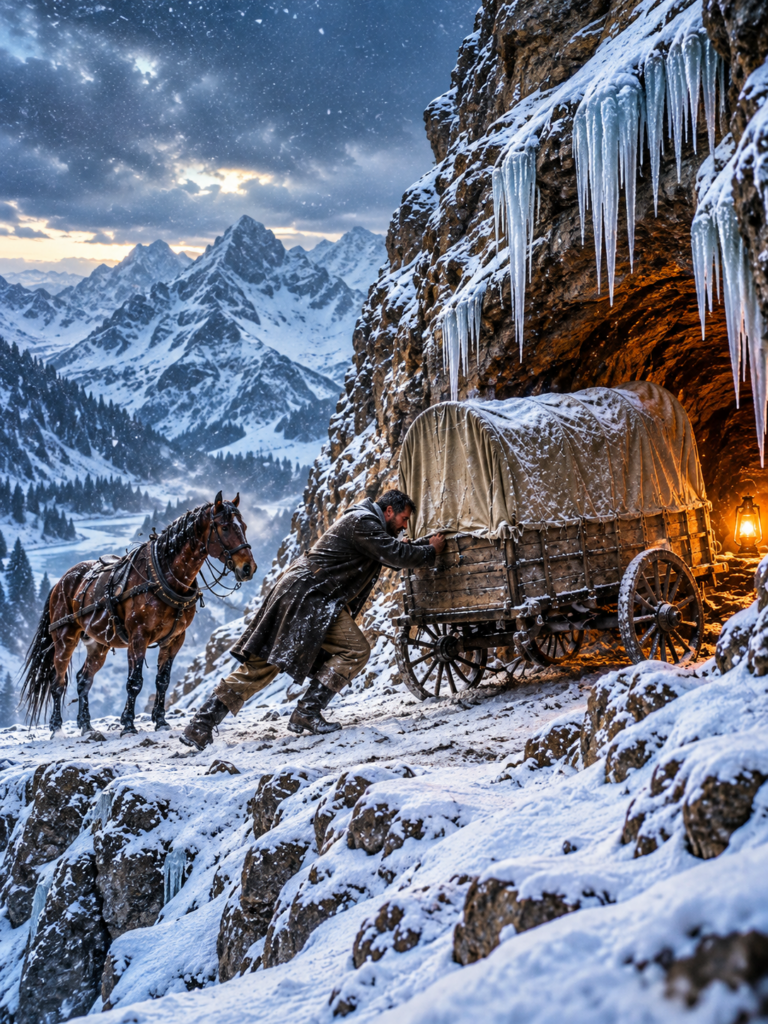
Part 1
By the winter of 1891, the freight trails east of the Bitterroot Mountains had become dangerous places for men who made their living moving goods between settlements. Snow covered the old wagon ruts, mountain passes disappeared beneath drifting ice, and a traveler caught in the wrong stretch of country could vanish without leaving anything behind but a frozen horse and a few broken pieces of equipment.
Pierce Holbrook knew those dangers better than most.
At thirty-eight, he had spent enough winters hauling freight through mountain country to understand how quickly a familiar road could turn into a place where no one would find you until spring. He knew the difference between snow that merely slowed a wagon and weather that could kill a man before he had time to unhitch his horse.
Yet on that particular afternoon, as he guided his battered wagon along an exposed ridge, all his experience seemed suddenly smaller than the country surrounding him.
Five days earlier, Pierce had left Garnet Basin, a declining silver camp where he had once believed he might build a decent future. He had departed with little money, few provisions, and no particular desire to look back.
His wife, Clara, was buried there.
For months, Pierce had spent whatever he could earn trying to keep her alive. Medicine, doctors, fuel, food, and the ordinary expenses of caring for someone who grew weaker every week had consumed nearly everything they owned.
He had sold useful equipment, given up work he could no longer afford to pursue, and watched their savings disappear one payment at a time.
None of it had changed the outcome.
The last winter had been especially cruel. Clara’s coughing had continued through the nights, and there had come a point when even the small sound of her drawing breath made Pierce listen carefully, afraid of what he might hear next.
He could still remember sitting beside her bed, unable to do anything useful, while the stove lost its heat and the mountain wind worked its way through the walls.
The helplessness of those nights had stayed with him longer than the funeral.
Now, traveling south, he carried almost nothing from that life.
There was Brim, an aging horse whose best working years were well behind him. There was a torn oil tarp, a few tools, a little food, and the wagon itself.
The wagon was barely fit for the journey.
Its left axle had developed a crack near Deer Lodge Crossing. The sideboards were warped, the frame had loosened in several places, and one wheel leaned at an angle that made Pierce watch it whenever he crossed uneven ground.
He had made repairs where he could, tightening what would tighten and wedging bits of wood into places that had begun to move.
But he knew the truth.
The wagon was falling apart.
At the freight yard in Garnet Basin, Eli Mercer had looked at the battered vehicle and laughed.
“That thing isn’t a wagon anymore, Pierce. It’s firewood waiting to fall down.”
Pierce had said nothing.
He had stood beside Brim, one hand resting on the old horse’s harness, and let the remark pass.
There had been a time when he might have laughed back. There had also been a time when he could have bought a replacement axle without calculating how much food the money represented.
That time was gone.
A cousin living on a ranch in the southern valley had offered him a place to stay, and the invitation was the only certain destination Pierce had left.
Another fifty miles, he told himself.
Fifty miles of bad country, and then perhaps he could put the wagon somewhere out of the weather, find regular work, and begin figuring out what remained of his life.
He was thinking about the distance when Brim stopped.
It happened so abruptly that Pierce leaned forward on the wagon seat.
The old horse had planted all four hooves in the frozen grass. His head came up, nostrils widening as he stared toward the northern horizon.
“Come on, boy.”
Pierce gave the reins a gentle pull.
Brim did not move.
His ears pointed forward, then folded back, and his muscles tightened beneath the harness.
Pierce had known the horse too long to dismiss the warning.
Brim could be stubborn about steep grades and difficult crossings, but he did not ordinarily refuse an open trail.
Pierce looked north.
At first, nothing seemed especially unusual. The light was flat and gray, and the distant mountains had begun to disappear beneath low cloud.
Then he noticed the silence.
The wind had stopped.
Not gradually. Not the way an ordinary breeze weakened when the sun went behind a hill.
One moment, cold air had been moving across the ridge, tugging at his coat and scraping loose snow over the frozen ground.
The next, the air was perfectly still.
Pierce sat motionless.
He had encountered that stillness before, and he knew it was not a good sign.
It meant the wind was changing somewhere beyond the horizon, gathering into something much larger than the small currents that usually moved through the valleys.
He climbed down from the wagon.
“Easy, Brim.”
The horse shifted his weight and breathed heavily through his nostrils.
Pierce put a gloved hand against the animal’s neck, waited until he stopped trembling, and climbed onto the wagon step for a better look.
The northern sky had changed shape.
A dark wall stretched across the horizon, nearly black along its upper edge and dirty gray beneath. Far below the clouds, powder snow was already moving sideways over the distant ground.
Pierce narrowed his eyes.
He knew that appearance.
A blizzard was coming.
Not an ordinary mountain snowstorm, but one of the hard northern blows that could overwhelm a freight team before the driver found a place to stop.
He judged the distance, studied the exposed ridgeline, and considered how quickly the approaching weather was moving.
Two hours, perhaps.
Maybe considerably less.
He looked down the trail.
There was no cabin nearby. No ranch fence, smoke from a chimney, or stand of timber large enough to offer dependable shelter.
The southern valley was still much too far away.
For one brief moment, Pierce considered urging Brim forward and trying to cover as much distance as possible.
Then he looked at the broken axle.
He knew what would happen if the wagon failed in deep snow with the wind blowing hard enough to hide the trail.
He would have to abandon it in the open. Brim would struggle against the weather, and Pierce would be left with nothing between himself and the wind.
He turned away from the freight trace and examined the surrounding country.
Low slopes. Old drifts. Scattered sagebrush. A ridge running southwest toward several dark basalt outcrops.
He was not searching for a perfect hiding place.
There was no time for that.
He needed a space that could be closed off from the wind.
He remembered something an older freight-bridge repairman named Amos Vaughn had taught him years earlier.
Pierce had worked under Amos before he settled at Garnet Basin, repairing mountain freight bridges where swollen streams, winter ice, and heavy wagon loads wore down wooden structures faster than crews could rebuild them.
One winter evening near Elk Creek Pass, the men had sheltered beneath a bridge deck patched with canvas and old pine planks.
Snow had been blowing across the canyon overhead.
Amos had carried a lantern beneath the boards and held it close to a narrow crack.
The flame barely moved.
But the smoke bent sideways and slipped through the opening.
Amos had pointed at it.
“See that?”
Pierce remembered nodding.
“Cold ain’t the only thing killing men,” the old foreman had said. “Moving air is. A room don’t freeze all at once. It leaks to death.”
At the time, Pierce had been young enough to think the lesson was merely another piece of practical advice.
Now, standing on an exposed ridge with a blizzard approaching, he understood exactly what Amos had meant.
A roof would be useful.
A fire would be better.
But neither would help much if the wind could pass freely through the shelter and carry away every little bit of warmth inside.
He needed walls.
Pierce took Brim by the reins and led him off the freight trail toward the basalt bluffs.
The first hollow he examined was deep enough for a man to crouch inside, but its entrance faced north.
That would be a disaster.
The storm would strike it directly, forcing snow and moving air into every corner.
He moved on.
The second recess was deeper, but its mouth spread too widely across the rock face. Closing an opening that large would require materials he did not have.
Pierce glanced back at the northern sky.
The dark front had grown noticeably larger.
He could no longer distinguish individual cloud layers. They had become one enormous surface pressing toward the mountains.
“Come on,” he murmured to Brim.
They continued along the bluff.
The third hollow stopped him.
It lay low in the basalt face, partly sheltered beneath an overhang, with thick black walls curving inward on either side.
The entrance measured roughly fifteen feet across, though the usable space narrowed toward the back.
Pierce stepped inside.
The floor was stone and hard earth. It was surprisingly dry, with none of the deep snow that had collected in more exposed places.
He studied the overhang overhead, looking for loose shelves or cracked sections that might collapse under the weight of fresh snow.
The rock appeared solid.
Most important, the hollow angled slightly away from the northwestern wind that would soon sweep over the ridge.
Pierce stood quietly for several moments, tracing the shape of the opening with his eyes.
It was not a cave.
There was no deep chamber or natural passage leading back into the mountain.
A man caught inside without protection would still be exposed to the cold.
But the recess had something more valuable than depth.
Three sides were already enclosed by stone.
Pierce looked over his shoulder toward the wagon.
He could close the fourth.
The thought came so simply that he almost dismissed it.
Then he began studying the dimensions.
The wagon bed could cover the center of the opening. The sideboards could face outward. The frame might be wedged against the rock, while the tarp could cover the space remaining above it.
There would be gaps on either side.
He could fill those with whatever materials he found nearby.
Sagebrush. Old hide. Frozen mud. Snow.
The plan would destroy the wagon as a working vehicle.
Pierce knew that immediately.
The axle would have to come loose. The tongue brace would need to be removed. The frame might not survive being dragged over frozen ground.
Even if he lived through the storm, he could be stranded without transportation.
He turned and looked at Brim.
The horse stood quietly outside the hollow, still facing north.
Pierce’s hand tightened around the reins.
That wagon was the last substantial possession remaining from the years when he and Clara had been together.
He remembered her sitting on its seat one autumn afternoon, bundled in a wool blanket as Brim pulled them along a road lined with fallen leaves outside Garnet Basin.
The wagon had been sound then.
The boards had not rattled with every movement, and Brim had still been strong enough to take the hills at an easy pace.
Clara had rested one hand on the seat beside her and smiled at something Pierce had said.
He could no longer remember his own words.
He remembered only her smile and the leaves turning in the wagon’s wake.
For a moment, he felt the terrible unfairness of what he was about to do.
He had already lost the woman he loved.
Now he was preparing to break apart the last thing that had carried them through their life together.
Then a faint gust touched his cheek.
The wind was returning.
Pierce went back to the wagon.
He had no time to mourn a piece of equipment.
He began with the front axle.
The iron fastenings were stiff with cold and rust, and his fingers were already losing some of their feeling inside his gloves.
He worked the pins loose one at a time.
The rear fastenings came next, followed by the tongue brace.
One cotter pin refused to move.
Pierce struck it with the hammer.
Nothing.
He changed the angle and struck again.
The metal rang sharply in the silent air.
He worked at the pin for nearly three minutes before it finally shifted.
By then, his right hand had begun to ache so deeply that he could feel the pain through his wrist.
He pried the pin free, pulled the brace loose, and stepped backward as the wagon frame dropped into the snow with an ugly crack.
The noise echoed against the basalt bluff.
Brim jerked his head toward it.
“Easy, boy. It’s all right.”
Pierce had no way of knowing whether that was true.
He worked quickly, freeing the wagon bed from what remained of its undercarriage.
With each loosened fitting, the vehicle became less recognizable.
Pieces lay scattered in the snow, and the twisted running gear looked more useless than ever.
Pierce could almost hear Eli Mercer’s laughter.
Firewood waiting to collapse.
Perhaps Mercer had been right.
But Pierce no longer needed the wagon to travel.
He needed it to stand between him and the storm.
He unfastened a length of rawhide rope, secured it to the wagon bed, and pulled the loop across his shoulders.
The first attempt barely moved the load.
He planted his boots more firmly, leaned forward, and pulled again.
The boards scraped a few inches over frozen ground.
Then the broken edge caught against a buried stone and stopped.
Pierce went back, lifted the corner, shifted it sideways, and tried again.
The weight resisted him every inch.
It was not merely heavy. The damaged frame twisted as he dragged it, turning unevenly and catching against hard ridges of snow.
He had to stop repeatedly to straighten it.
At first, Brim tried helping.
Pierce had left enough harness in place for the old horse to pull beside him, and for a few yards they managed to move the awkward wooden mass together.
Then a deep rumble rolled through the approaching storm.
Thunder.
Not a summer thunderstorm, but a low, distant sound buried in the freezing clouds.
Brim shied hard.
The horse lunged backward, pulling the traces sideways and dragging the wagon frame toward a dangerous angle.
Pierce dropped the rope and hurried to the harness.
“Easy! Brim, easy!”
But the animal was frightened now.
His eyes showed white, and his breath came in quick bursts.
Pierce knew another violent movement could overturn the entire load or wrench the horse’s legs beneath him.
He unfastened the traces.
“You’ve done enough.”
Brim stepped away, trembling.
Pierce returned to the rope.
He would have to drag the wagon alone.
He pulled until the leather dug through his coat and began tearing the skin beneath. His legs shook from the effort, and every few yards he stopped with his hands on his knees, breathing hard in the thinning mountain air.
Once, the frame caught so suddenly that the rope wrenched him sideways.
He fell against the crusted snow, striking one knee on hidden rock.
For several seconds, he lay still.
Above him, the northern sky had become nearly black.
He could hear the wind now, not yet across the ridge where he stood, but somewhere beyond it.
He forced himself upright.
The wagon moved again.
Foot by foot, with the rope cutting into his shoulders and the cold burning deeper through his clothes, he hauled the broken structure toward the basalt hollow.
By the time it reached the overhang, Pierce was coughing from the effort.
There was a metallic taste in the back of his throat.
He stood with both hands braced against the wagon boards, struggling to steady his breathing.
The opening waited in front of him.
The wagon bed lay at his feet.
For a few seconds, everything seemed impossible.
The frame was too heavy, his hands were becoming useless, and the weather was closing faster than he could work.
But then he looked at the curved stone walls.
He imagined the wagon standing across their opening.
Three sides of rock.
One side of wood.
It could work.
He bent down, took hold of the frame, and began turning it into position.
The warped sideboards faced outward. The strongest surviving edge pressed toward one side of the entrance while the opposite edge reached nearly to the other.
The fit was poor, but it covered the deepest part of the recess.
Pierce braced the frame against the rock and pushed until it settled into a position that seemed capable of resisting an outward pull.
He stepped back.
The fourth wall had begun to take shape.
Then the first serious gust came over the ridge.
It struck the wagon boards with a hollow boom.
Loose snow lifted from the ground and raced past the entrance.
Brim snorted sharply behind him.
Pierce looked up.
The approaching storm had swallowed the remaining daylight, leaving the mountains beneath a dull iron-gray sky.
He had found his shelter.
He had dragged the wagon into place.
But large openings still remained along both sides of the frame, and a ragged strip of empty space ran beneath the overhang.
If the blizzard reached full force before he closed them, the hollow would not protect him.
The wagon would simply turn the opening into a narrow passage that concentrated the wind.
Pierce grabbed the torn oil tarp and climbed onto the frame.
He stretched the canvas toward the rock overhead, pulled an old leather strap tight, and drove a wagon peg into place with the butt of his hammer.
He reached for another strap.
A stronger gust struck.
The tarp snapped outward with a report like a rifle shot.
One fastening tore loose.
The canvas whipped above him, jerking against the remaining ties, and the entire wagon wall shuddered.
Pierce threw his weight forward and caught the flapping material before it could rip away completely.
For one terrible moment, he found himself balanced on top of the broken frame, holding a piece of frozen canvas while the wind strengthened around him.
He looked down into the dark hollow.
If the wall failed now, everything he had done would be wasted.
And the blizzard was almost upon him.
Part 2
Pierce caught the loose tarp with his left hand and dragged it back toward the rock.
The canvas pulled against him so violently that he nearly lost his balance.
His right fingers were stiff, and the cold had made the leather strap difficult to bend. He held the material against the overhang with his shoulder, worked a new loop through the fastening, and pulled until the knot tightened.
Another gust shook the structure.
This time, the fastening held.
Pierce remained where he was for a moment, listening.
The wagon boards rattled, but the frame did not shift.
He worked his way across the upper edge, securing the remaining tarp wherever he could find a solid place to anchor it. He drove wagon pegs through old leather straps and wedged heavy pieces of basalt against the canvas beneath the overhang.
There was no time to make anything neat.
The tarp hung unevenly, its torn edge overlapping the wagon boards in some places while leaving narrow openings in others.
Pierce climbed down and inspected the wall from inside.
Thin streaks of gray light showed through the gaps.
He could feel air moving across his face.
The sight troubled him more than the loose boards.
He remembered Amos holding the lantern beneath the bridge, the smoke slipping through a crack no wider than a man’s finger.
A shelter could look solid and still be useless.
Pierce began filling the seams.
He gathered dry sagebrush from beneath the rocks and pushed it into the larger openings, twisting the brittle stems together to make them hold.
Then he found an old buffalo-hide harness blanket among his remaining equipment.
The blanket was already worn through in places. He cut strips from it and folded them into the gaps between the wagon frame and the stone.
Where the wood met the uneven ground, he scraped loose earth from beneath the basalt wall and mixed it with crusted snow.
He packed the material into the openings with his hands.
It was slow, miserable work.
His gloves had become stiff and wet, and the fingers beneath them were swollen from the cold.
Whenever he tried to push the frozen mixture into a narrow crack, it broke apart and fell back toward him.
He worked it again, pressing harder, forcing the mud and snow between wood and stone until it stayed in place.
Outside, the wind gathered strength.
Loose snow hissed against the wagon boards.
Something struck the tarp overhead, making the canvas jump against its fastenings.
Pierce did not look up.
He moved along the lower edge of the wall, checking each section by touch.
A gap near the left corner admitted a narrow stream of cold air.
He stuffed more sagebrush into it.
A seam above the right sideboard allowed powder snow to drift inward.
He folded another strip of hide and forced it behind the leather fastening.
Then, as he crouched near the middle of the wagon bed, a sudden current touched the side of his neck.
Pierce stopped moving.
It was a small draft, barely noticeable compared with the wind outside.
But the exposed skin above his collar went cold almost immediately.
He turned slowly, feeling along the boards until he found the source.
Beneath the wagon bed, the ground dipped slightly.
The uneven hollow had left a space no wider than two fingers.
Air was forcing its way through that small opening with surprising strength.
Pierce put his hand over it.
The current struck his palm like water flowing through a narrow pipe.
He pulled his hand away and examined the gap.
It was too low for him to reach comfortably with his tools.
He lowered himself onto his knees, removed one glove, and began scraping frozen dirt loose with his fingers.
The earth was hard enough to tear the skin near his nails.
He felt the first sharp sting, then a spreading numbness.
Still, he continued.
He gathered a handful of dirt and snow crust, pressed it beneath the warped wood, and shoved sagebrush against it.
The mixture collapsed.
He tried again.
More earth.
More snow.
Another strip of old hide.
He pressed the material against the wagon edge until it filled the depression in the ground.
Then he waited.
No moving air touched his hand.
He moved his face closer.
The draft was gone.
Pierce sat back on his heels.
The hollow was still bitterly cold.
His breath hung white in the fading light, and the stone beneath his knees seemed to pull warmth straight through his clothing.
But the air was no longer moving.
That difference was everything.
He had not made the mountain warmer.
He had made a small part of it separate from the wind.
For the first time since Brim had stopped on the ridge, Pierce allowed himself to believe the plan might work.
Then he heard the horse.
Brim had been standing outside the shelter, shifting nervously whenever the wind rose.
Now another gust came over the bluff with enough force to send loose snow swirling around the entrance.
The old animal threw up his head and pulled against the reins.
Pierce hurried outside.
He had delayed bringing Brim into the hollow because space was limited and the frightened horse could easily destroy the unfinished wall.
But the storm was nearly there.
He could not leave the animal exposed.
“Come along, old boy.”
He took the reins and guided Brim toward the narrow opening left beside the wagon frame.
Brim approached reluctantly.
The horse could smell the enclosed space. He could see the dark stone walls and the strange wooden barrier that had appeared across the entrance.
His nostrils widened.
Pierce laid a hand against his shoulder.
“It’s all right. There’s room.”
Brim took another step.
A heavy gust struck the ridge overhead.
The horse startled and lunged sideways.
His shoulder hit the wagon bed with a tremendous thump.
The frame shifted.
One of the leather ties stretched tight, and Pierce heard the sickening snap of a fastening beginning to tear.
“Brim!”
The animal struggled to turn away from the opening.
For several seconds, Pierce feared the horse would panic completely.
A frightened animal of Brim’s size could break a man’s bones or destroy a fragile shelter without meaning to.
Pierce stepped close, caught the horse’s head, and wrapped both arms around it.
“Easy now.”
Brim tossed his head.
Pierce held on.
“Easy, boy. Easy now.”
The words came naturally, spoken in the quiet voice he had used with the animal for years.
And suddenly, without warning, he remembered Clara.
She had said those same words almost every winter morning when she brushed frost from Brim’s mane beside the stable fence at Garnet Basin.
Easy now.
She had never raised her voice when the horse became restless. She would simply stand close to him, her hand moving slowly over his neck until he settled.
Pierce could almost see her there.
The old stable fence.
The white frost on the horse’s mane.
Clara smiling faintly as Brim leaned into her hand.
The memory hurt more sharply than he expected.
For months, he had been remembering her sick.
Her thin face against the pillow. The medicine bottles. The endless coughing.
Now, for one brief moment, he remembered her healthy enough to stand outside in the winter morning, speaking softly to a horse.
Pierce pressed his forehead against Brim’s neck.
“Easy now,” he whispered again.
The old horse trembled beneath his hands.
Gradually, his breathing slowed.
His head lowered.
Pierce waited until the panic passed, then gently turned him toward the opening.
This time, Brim followed.
The horse stepped into the basalt recess, careful and reluctant, his hooves scraping against the stone floor.
Pierce guided him toward the back, where the walls curved inward.
There was just enough room for them both.
The horse’s body filled much of the available space, leaving Pierce a narrow area between the animal and the wagon wall.
It was crowded, dark, and uncomfortable.
But Brim was inside.
Pierce turned toward the remaining opening.
He stretched an old saddle blanket across the lower gap, packed sagebrush into the corners, and pressed snow crust against the edges.
He checked the leather fastenings one last time.
Then he pulled the final covering into place.
The world outside disappeared.
For a moment, Pierce could barely see his own hands.
The thin light that had been coming through the entrance was gone, and the only sounds were Brim’s breathing, the faint creaking of leather, and the growing wind beyond the rocks.
Pierce stood still.
The shelter was finished.
Not comfortable.
Not particularly strong.
But closed against the drafts he had been fighting.
He moved carefully toward the back of the hollow and lowered himself against the stone wall.
The smells inside were close and heavy: damp leather, horse sweat, cold earth, and the sharp mineral scent of basalt.
Brim shifted beside him.
A warm cloud of breath rose from the horse’s nostrils and disappeared into the darkness.
Pierce rested his aching hands against his knees.
He had spent so long working that he had almost forgotten how exhausted he was.
His shoulders throbbed where the rope had cut through his clothing.
His fingertips were raw.
The knee he had struck while dragging the wagon had begun to stiffen.
He closed his eyes.
There was nothing more he could build.
Whatever happened next would depend on whether the shelter held.
The first full impact of the blizzard came without warning.
The ridge shook beneath him.
A tremendous roar swept over the basalt bluff, followed by a crash of wind against the wagon boards.
The tarp snapped so sharply that Pierce instinctively raised his arms.
Brim stamped against the stone floor.
Another gust followed, then another, each one pushing against the shelter as though some enormous weight were being thrown repeatedly against the entrance.
Pierce had heard violent mountain storms before.
He had been caught in drifting snow, had watched wagon covers tear loose, and had seen loaded freight teams forced backward by crosswinds.
But inside the hollow, with no view of the outside world, the storm sounded different.
It was no longer weather moving across open country.
It seemed to be happening directly against the walls surrounding him.
A low roar filled the rock recess.
The wagon boards shuddered.
Dust fell from the basalt overhead.
For several seconds, Pierce could not distinguish one sound from another.
Then the noise changed.
The wind began searching along the seams.
He heard it whistle through a narrow opening near the tarp, pause as the pressure shifted, then howl against the wagon boards.
A fine stream of powder snow appeared in the darkness.
Pierce reached toward it.
The snow was blowing through a gap near the upper edge of the frame.
He climbed onto the wooden brace and felt around the seam.
One of the ties had loosened.
He tried tightening it, but his stiff fingers could not grip the knot.
The leather slipped once.
Then again.
A gust struck the tarp hard enough to pull his arm forward.
Pierce braced one boot against the wagon frame and hauled the strap toward himself with both hands.
He caught the loop, turned it, and forced the fastening tight.
The canvas settled.
The stream of snow stopped.
He climbed down.
Almost immediately, Brim kicked against the lower boards.
The horse had been startled by another deep impact of wind.
The entire structure jerked.
A fresh ribbon of powder snow swept across the floor.
Pierce crouched and searched for the opening.
He found it near the base of the wall, where the movement had disturbed the frozen packing.
He pushed snow into the crack.
Then mud.
Then a piece of hide.
He worked until the current vanished.
Afterward, he remained crouched with one hand pressed against the boards, listening for another leak.
He could no longer see the outline of the entrance.
The darkness had become complete.
Pierce returned to Brim and placed a hand against the horse’s neck.
The animal was trembling.
“I know,” he murmured. “I know.”
There was nothing else to say.
The blizzard continued.
The cold deepened inside the shelter as the hours passed.
Frost formed along the wagon boards, and moisture from their breathing gathered against the surrounding surfaces.
The stone floor remained painfully cold beneath Pierce’s boots.
He shifted whenever he could, trying to keep his feet from going numb.
But there was something important about the air around him.
It remained mostly still.
The wind was battering the ridge with tremendous force, yet only small drafts reached the hollow when an occasional seam loosened.
Pierce could feel warmth coming from Brim’s body, slight but unmistakable in the confined space.
The horse was not a stove.
He could not make the shelter comfortable.
But his living warmth helped Pierce endure the cold, and the sealed openings prevented the wind from immediately carrying it away.
Pierce thought again of Amos Vaughn beneath the freight bridge.
A room don’t freeze all at once. It leaks to death.
The old foreman had been right.
A man could have thick timber walls and still freeze if the wind passed through them.
Here, surrounded by rough boards, torn canvas, and broken harness leather, Pierce had managed to do something better than build a strong-looking structure.
He had stopped the moving air.
That did not mean the danger had passed.
The storm continued changing direction and pressure.
Sometimes the wind struck from above, making the tarp snap against the rock.
Sometimes it swept across the entrance and pulled at the outer edges of the wagon frame.
Occasionally, the pressure dropped so suddenly that Pierce wondered whether the storm was weakening.
Then another violent gust would slam against the ridge and remind him how much remained outside.
During one of those bursts, the upper seam failed again.
Freezing air poured across his shoulder.
Pierce climbed back onto the frame in complete darkness, found the loose strap, and fought to secure it.
His right hand barely obeyed him.
He had to work by touch, identifying the leather and wood through fingers that could hardly distinguish one surface from another.
When the knot finally held, he slid down the boards and rested with his forehead against the cold wood.
He wanted to sleep.
The desire was becoming difficult to resist.
Every muscle in his body seemed to have reached the end of its strength.
But he knew he could not ignore the shelter while air continued leaking through it.
He forced himself to listen.
The next minutes passed slowly.
Then he noticed something strange.
A seam that had been whistling near the lower left corner had gone quiet.
He reached toward it.
The crack was packed with fresh snow.
Wind blowing against the rock face had driven powder into the opening, where it accumulated around the rough packing he had already forced into place.
Pierce examined another seam.
It, too, had begun filling with snow.
The blizzard was doing some of the work for him.
Outside, drifts were gathering against the wagon wall.
The snow pressed into the cracks, covering the irregular spaces where wood met stone and tarp overlapped the boards.
As more snow accumulated, the shelter became increasingly protected from the direct force of the wind.
The same storm that threatened to destroy him was slowly burying the surface it had been trying to break.
Pierce sat beside Brim and listened.
The roaring outside continued, but the sound began to change.
It became deeper and less sharp.
The violent snapping of the tarp grew less frequent.
The wagon frame still creaked beneath the pressure, but the hard bursts of moving air were no longer reaching so easily into the hollow.
Snow was gathering between Pierce and the storm.
Layer after layer.
The weight against the wagon wall increased, yet the basalt on either side supported the shelter’s position.
The overhang protected the canvas above, and the drifts pressed against the lower boards.
Pierce could hear the wind sweeping somewhere beyond the buried structure.
But inside, the air was quiet.
Brim lowered his head.
The old horse’s breathing settled into a slow, steady rhythm.
Pierce rested his hand against the animal’s flank.
He had been afraid the broken wagon would collapse at the first serious impact.
Now, buried beneath snow, it seemed more firmly held in place than when he had first dragged it across the opening.
He remembered standing beside Clara’s grave in Garnet Basin.
At the time, he had felt that nothing remained worth protecting.
He had spent months trying to keep his wife alive and failed, despite everything he had sold and every hour he had worked.
After she died, the future had appeared empty.
He had been traveling toward his cousin’s ranch not because he expected happiness there, but because he could think of nowhere else to go.
Yet here he was, crouched beneath a mountain ridge, using the wreckage of that old life to keep himself and Brim alive.
He looked toward the hidden wagon wall.
It had carried him and Clara through easier years.
Now it was carrying him through one more night, though it no longer had wheels beneath it.
Pierce pulled his coat more tightly around himself.
The cold was still severe.
His hands hurt.
His shoulders ached.
He had no way to know whether another gust would tear the tarp loose or shift the frame.
But he could hear Brim breathing.
And he could feel that the air around them was no longer moving.
Hours passed.
Pierce could not say how many.
There was no visible sky to mark the passage of the night, no clock, and no daylight coming through the buried entrance.
Time became a sequence of sounds.
The wind rising.
The wagon creaking.
Brim shifting his weight.
The long silence between gusts.
Eventually, the blizzard’s roar began to fade.
The change was so gradual that Pierce almost failed to notice it.
The enormous violence beyond the rock no longer seemed to be striking directly against the shelter.
What remained was a distant, muffled movement, as though the storm were passing somewhere high above him.
The snow had nearly swallowed the wagon wall.
The hollow felt less like an exposed opening in a mountainside and more like a small chamber buried deep within it.
Pierce had not beaten the blizzard.
He had built a place where it could not easily reach him.
He leaned against Brim’s warm side.
His eyelids grew heavy.
For the first time since leaving the freight trace, he allowed himself to rest.
Somewhere beyond the buried entrance, the storm continued moving across the mountain.
But Pierce no longer heard it clearly.
And at last, exhausted beyond resistance, he fell asleep.
Part 3
Pierce did not know how long he had been asleep.
He woke slowly, without understanding where he was.
For a moment, the darkness seemed no different from the darkness he remembered in the small room at Garnet Basin, where he had spent so many nights listening to Clara struggle for breath.
Then something large shifted beside him.
Brim.
The horse moved one hoof across the stone floor, and the sound brought Pierce fully awake.
He opened his eyes.
Nothing.
The hollow remained almost completely dark.
He reached toward the wagon wall and touched frozen wood, then stiff canvas, then the rough basalt behind his shoulder.
Everything was still in place.
For several seconds, he remained motionless, listening.
The roaring had stopped.
Not every sound had vanished. Somewhere above the ridge, a faint wind still moved across the snow. The mountain occasionally creaked beneath the accumulated weight.
But the violent, continuous hammering of the blizzard was gone.
Pierce pressed his palm against the wagon boards.
Cold.
Solid.
Unbroken.
The fourth wall had survived.
He closed his eyes again, this time not from exhaustion.
He was alive.
Brim was alive.
And somewhere beyond the buried entrance, morning might already have arrived.
Pierce shifted carefully, testing his legs before trying to stand.
Every movement hurt.
His shoulders were stiff where the rope had torn into them. His right hand throbbed beneath the glove, and his knee protested when he put weight on it.
He had spent much of the night pressed against cold stone, sleeping in a cramped position beside a horse.
But the pain was something he could understand.
It belonged to a living body.
He reached inside his coat and found the strip of jerky he had saved from his small supply of food.
The meat had frozen almost as hard as bark.
He held it in his hands for a moment before biting off a piece.
Chewing was difficult, but he forced himself to eat slowly.
Then he reached for the canteen he had kept close to his body through the night.
A little water remained unfrozen inside.
He took several careful mouthfuls.
Brim stirred again.
Pierce placed a hand against the horse’s neck.
“We made it, old boy.”
His voice sounded rough in the confined space.
The animal lowered his head slightly.
Pierce stayed beside him, listening to the quiet.
It was then that he realized something else.
He had slept.
Not merely closed his eyes for a few moments.
He had fallen into a deep, exhausted sleep without once waking to the memories that had pursued him since Clara died.
There had been no dream of the little room in Garnet Basin.
No coal smoke drifting from the stove.
No medicine bottles standing beside the bed.
No terrible sound of her coughing through the winter night.
For the first time in months, his mind had given him a few hours of rest.
He did not know what to make of that.
He still missed her.
The grief had not changed simply because he had survived a storm.
But something inside him felt less tightly closed than it had when he left Garnet Basin.
He sat quietly until a faint line of pale light appeared near the upper edge of the tarp.
At first, he thought his eyes were deceiving him.
He leaned forward.
The light remained.
A tiny opening had formed where the frozen canvas met the snow.
Pierce stared at it.
Daylight.
The storm had passed.
He pushed himself upright and moved toward the buried entrance.
The wagon wall was almost completely covered from outside, and the snow had hardened around its edges.
He searched for a place where he could begin opening a passage without pulling the whole covering loose.
Near one side, he found a section of frozen packing that yielded slightly beneath his hand.
He dug into it.
The snow broke away in small, hard pieces.
He cleared enough to make a narrow hole, but the drift beyond remained thick.
He tried digging faster.
His injured fingers began aching almost immediately.
Pierce stopped and felt around for the remains of his tools.
Among them was the broken handle of his old shovel.
It was not much, but its splintered end was firm enough to loosen the packed snow.
He pushed it into the drift, twisted, and pulled out a frozen chunk.
Then another.
He worked patiently, clearing the loose snow away from the entrance so it would not immediately collapse back into the opening.
Gradually, the pale line of light widened.
A little cold air entered.
Pierce stopped and felt it against his face.
The air was sharp enough to sting his skin.
But it was not rushing through the shelter.
There was no violent wind behind it.
He dug again.
The opening grew large enough for his shoulders.
Pierce pushed the loosened snow aside, lowered himself, and crawled through.
For an instant, the light blinded him.
He remained on his hands and knees beneath the basalt overhang, blinking into the white brightness.
Then he slowly raised his head.
The world he had entered was almost unrecognizable.
The freight trail had vanished.
The wagon ruts were gone, buried beneath smooth drifts that stretched across the slope.
Sagebrush that had stood above the ground the afternoon before was now hidden beneath deep snow.
Even the ridgeline had changed shape.
Sharp edges had softened into long, pale curves.
The sky above was clear enough to admit a weak winter light, and the air seemed strangely motionless.
Pierce stood slowly.
He looked toward the north, where the black storm wall had come from.
There was nothing there now except mountains and snow.
He turned back toward the hollow.
The shelter had almost disappeared.
The wagon bed was buried nearly to its upper edge. The tarp had frozen against the drift, its rough surface blending into the surrounding white.
Snow filled the spaces between the frame and the basalt, creating a thick covering over the makeshift wall.
From a distance, the structure would have been difficult to recognize as something built by human hands.
It looked like part of the mountain.
Pierce examined it carefully.
He could see where the snow had packed around the wooden frame and filled the gaps he had struggled to seal during the night.
The drifts had protected the shelter from the strongest wind, turning the exposed wagon wall into a barrier beneath the snow.
He had spent hours fighting to close those openings.
Then the blizzard itself had finished burying them.
Pierce shook his head.
The thought was almost too strange to believe.
He had expected the storm to tear the shelter apart.
Instead, the accumulating snow had helped hold the remaining drafts at bay.
Behind him, Brim made a soft noise.
Pierce turned.
The old horse was standing just inside the entrance, uncertain about stepping through the newly opened passage.
Pierce cleared more snow away, widening the exit until Brim could move safely.
“Come on, boy.”
The horse lowered his head, stepped forward, and emerged beneath the overhang.
His winter coat was damp in places, and frost clung to the hair around his nostrils.
He looked tired.
But he stood steadily on all four legs.
Pierce guided him out onto the snow-covered ground.
Brim stopped and breathed into the cold morning.
A thick white cloud rose from his nostrils and hung briefly in the motionless air.
Pierce stood beside him.
For several moments, neither moved.
The silence was unlike anything Pierce had heard during the previous day.
Before the storm, the ridge had been quiet with anticipation.
During the night, it had seemed to shake beneath an endless assault.
Now the silence felt empty and immense.
The blizzard had passed.
And the mountain was still standing.
Pierce walked back toward the buried wagon wall.
He brushed loose snow from one of the exposed boards and rested his gloved hand against the wood.
It was frozen solid.
He could feel the rough grain beneath the ice.
He remembered Eli Mercer standing in the Garnet Basin freight yard, laughing at the broken vehicle.
Firewood waiting to collapse.
The remark no longer bothered him.
Eli had judged the wagon by what it could no longer do.
It could barely carry a load.
Its axle was cracked.
Its wheel leaned crookedly.
The tarp was torn, and the boards had begun coming loose.
As a freight wagon, it was almost worthless.
But those same boards had stood between Pierce and a storm that had killed men across the mountain country.
He looked at the warped sideboard beneath his hand.
He could remember Clara touching that very wood while sitting beside him on the wagon seat.
He remembered the last autumn before her illness became severe, when Brim had pulled them slowly through the fallen leaves outside Garnet Basin.
Clara had been wrapped in a wool blanket.
The afternoon had been cool, but not yet cold enough to keep them indoors.
She had leaned slightly against Pierce as the wagon rolled along the road.
He remembered feeling her shoulder against his arm.
Nothing remarkable had happened that day.
They had simply traveled together.
At the time, Pierce had not understood how precious such ordinary moments would become.
Now the wagon was broken beyond repair, half buried in a mountainside, and Clara was gone.
He stood with his hand against the wood for a long time.
Then he lowered it.
He could not take the wagon with him.
There was no practical way to rebuild its running gear or drag the heavy frame out of the hollow.
And even if he could, the deep snow would make the journey nearly impossible.
He had already taken from it everything it could give.
Pierce returned to Brim, gathered the equipment and provisions he could still carry, and prepared to continue south.
He looked once more at the shelter.
Then he took the horse’s reins and began walking.
The first miles were painfully slow.
Snow had erased the familiar trail, and Pierce had to judge his direction from the surrounding ridges and the shape of the country.
He avoided steep drifts where Brim might sink too deeply.
At times, they were forced to turn away from the most direct route and follow higher ground where the wind had scoured the snow into a firmer surface.
The horse moved carefully.
Pierce could tell he was tired, but the old animal continued whenever the ground allowed.
They traveled that way through the ruined winter landscape.
As the hours passed, Pierce began seeing what the blizzard had left behind.
An abandoned freight sled lay tilted beside a drift, part of its frame barely visible beneath the snow.
Farther along, another vehicle stood half buried near a stretch of trail that had disappeared completely.
There was no one beside either one.
Pierce did not stop to investigate every piece of wreckage.
He had little food, no proper wagon, and many miles still to travel.
But he understood what the abandoned equipment meant.
Other men had been caught in the storm.
Some had not found shelter.
On one stretch of the route, he came upon a dead horse beside a split-rail snow fence.
The animal stood frozen, its mane locked in ice, its head lowered as though it had been searching for the ground beneath the drift.
Pierce stopped.
Brim lifted his head and watched the motionless animal.
For a long moment, Pierce could not bring himself to move.
The sight was too close to what might have happened beneath the ridge.
He thought of Brim panicking outside the hollow.
He remembered the horse striking the wagon frame and nearly pulling the shelter apart.
If Pierce had left him exposed, the old animal might have ended the same way.
He reached for Brim’s neck.
“Come along.”
They continued south.
Over the next several days, Pierce encountered signs of the recovery crews working the mountain routes.
He saw tracks where sleds had been used to bring bodies down from the higher passes.
Word of the disaster was already traveling toward the settlements.
Freight men had been killed along the exposed ridges.
Teams had been lost.
Some wagons had broken apart; others had simply been abandoned when their drivers could no longer move through the snow.
Pierce learned enough to understand how fortunate he had been.
The storm had not merely threatened him.
It had devastated the routes across the mountain country.
He had survived because he found the basalt hollow before the strongest winds arrived, because the wagon bed could be dragged into position, and because the seams had held long enough for the snow to bury them.
He did not pretend that he had controlled every part of what happened.
Too many things could have gone wrong.
A loose slab of rock might have fallen from the overhang.
The wagon frame might have shifted.
Brim might have kicked through the boards.
Pierce himself might have become too exhausted to finish sealing the openings.
He had survived because his experience had shown him what to do, because he had kept working, and because the small shelter had held when it mattered.
Four days after leaving the buried hollow, he reached the southern valley.
By then, his coat was stiff with accumulated frost, his hands were badly chapped, and every step seemed to require more effort than the one before.
Brim had grown thinner.
The outline of his ribs showed faintly beneath his thick winter coat.
But the horse was still walking.
Near dusk, Pierce entered his cousin’s ranch yard.
The familiar shapes of the barn and house emerged through the fading light.
Smoke rose from the chimney.
For the first time in days, Pierce could smell wood burning in a stove.
His cousin came out of the barn.
He had clearly heard the horse approaching, but the moment he recognized Pierce, he stopped.
He stood staring at him.
“Pierce?”
Pierce tried to answer immediately.
His throat was dry, and the words came out rough.
“It’s me.”
His cousin crossed the yard, looking from Pierce to Brim and back again.
For several seconds, he seemed unable to decide what to say.
The news from the mountain passes had reached the valley ahead of the survivors.
Men had been reported missing.
Some were already known to be dead.
A freighter traveling alone with a failing wagon would have had little chance of coming through the storm.
And yet Pierce was standing in the ranch yard.
His cousin finally reached for Brim’s reins.
“Get inside,” he said. “We’ll take care of him.”
Pierce hesitated.
He looked at the horse.
His cousin understood.
“He’s made it this far. We’ll see to him.”
Only then did Pierce let go of the reins.
Inside the ranch house, the stove gave off a steady warmth that seemed almost overwhelming after the cold of the trail.
Pierce sat near it, holding his aching hands toward the heat.
For a while, he did little more than drink, eat, and allow the feeling to return slowly to his fingers.
His cousin waited until he was ready to speak.
Then he asked what had happened.
Pierce began at the ridge.
He told him about Brim stopping on the trail before the storm arrived.
He described the strange silence, the black wall of weather approaching from the north, and his decision not to drive the damaged wagon farther into the open.
He explained how he had examined the basalt bluffs.
The first hollow facing the wrong direction.
The second one opening too widely toward the wind.
The third recess, with its curved stone walls and shallow overhang.
His cousin listened without interrupting.
Pierce described dismantling the wagon.
He told him about the frozen cotter pin, the rawhide rope cutting into his shoulders, and Brim panicking when the thunder rolled through the snow clouds.
He explained how he had dragged the wagon bed across the entrance, covered the upper opening with the torn oil tarp, and packed the remaining seams with sagebrush, hide, frozen mud, and snow.
As he spoke, his cousin occasionally looked toward the stove, where Brim’s frost-covered harness lay drying near the warmth.
Pierce continued.
He described bringing the horse inside, the blizzard striking the ridge, and the long hours spent repairing leaks while the shelter shook around them.
Then he explained how the drifting snow had gradually buried the wagon wall.
The blizzard, he said, had pressed snow into the remaining cracks.
The drifts had formed a barrier around the wood and canvas.
Once the drafts stopped, the air inside remained still enough for them to endure the night.
When Pierce finished, his cousin sat quietly for some time.
The stove cracked softly between them.
Finally, he leaned back.
“How did you know it would hold?”
Pierce looked down at his damaged hands.
He remembered Amos Vaughn standing beneath the freight bridge at Elk Creek Pass.
The lantern light.
The narrow crack between the boards.
The stream of smoke slipping away into the darkness.
He thought about the countless winter roads he had traveled since then, the frozen men he had heard about, and the long hours he had spent trying to keep Clara warm in their little room at Garnet Basin.
He had not known whether the wagon would hold.
He had known only what would happen if the wind kept moving through the shelter.
Pierce looked toward Brim’s harness by the stove.
“Didn’t need it strong,” he said.
He paused.
“Just needed it closed.”
His cousin said nothing.
But he looked at Pierce differently after that.
The story spread through the southern valleys.
It was not written down in a newspaper, recorded by a railroad company, or preserved in a county ledger.
It traveled the way much of the useful knowledge of the frontier traveled: from one person to another, passed along during winter evenings and remembered when the weather turned dangerous again.
Freight drivers told it beside trading posts while warming their hands around coffee tins.
Ranch families repeated it after church suppers when heavy snow began falling over the mountains.
Older teamsters shared it with younger men preparing to cross the Bitterroot trails.
They spoke about the freighter who had taken a wrecked wagon into a basalt hollow and survived a blizzard by keeping the wind outside.
Over the years, the details changed.
Some claimed Pierce had used heavy mining canvas instead of a torn oil tarp.
Others said the hollow had been an abandoned trapper’s shelter, known to men who had crossed the ridge decades earlier.
A few insisted the snow had buried him for three full days before he finally broke his way out.
Those versions were not what Pierce had described.
But the most important part of the story remained.
A man had entered the mountains with a broken wagon, a worn-out horse, and almost nothing left of his former life.
When the storm came, he did not have the strength to outrun it or the materials to build a proper cabin.
He used the shelter the rocks provided.
He made a wall from the vehicle that had ceased to be useful on the road.
He filled the cracks with whatever he could find.
And when the blizzard struck, he survived inside that rough enclosure while stronger men and better-equipped teams were lost across the exposed mountain routes.
For Pierce, the memory carried a meaning that went beyond winter survival.
He had left Garnet Basin believing that his life had already fallen apart.
He had lost Clara despite every effort to save her.
His savings were gone.
His equipment was failing.
The future he had worked toward had disappeared, leaving him with a wagon that barely moved and a horse growing too old for the demands of mountain freight.
He could not restore those things simply by surviving a storm.
Clara would not return.
The money he had spent on her care was still gone.
And the wagon remained buried beneath the basalt ridge, its wheels and fittings scattered in the snow.
But he had discovered that something broken could still be useful.
The warped boards had not needed to carry another load.
The torn tarp had not needed to become whole again.
The shelter had not needed to be beautiful, comfortable, or built according to any plan a carpenter would recognize.
It had needed to keep the wind from reaching the two living creatures inside.
And for that one terrible night, it had done enough.
In the years that followed, the tale of Pierce Holbrook endured longer than the precise details of his journey.
People remembered the snow, the dark basalt, the old horse, and the fourth wall made from a wrecked wagon.
They remembered that the blizzard had buried the shelter instead of destroying it.
Most of all, they remembered the answer Pierce gave his cousin beside the ranch-house stove.
He had not needed the wagon to be strong.
He had needed it closed.
And somewhere beneath the snow on that Bitterroot ridge, the broken boards that had once carried Pierce and Clara through happier days remained a reminder of one final journey.
The wagon had lost its wheels, its usefulness, and nearly all its value.
But it had not lost its ability to protect the man who owned it.
The mountain had taken his road, hidden his shelter, and buried nearly everything he left behind.
It had not taken his life.
For one night, Pierce had built a small pocket of stillness inside a storm powerful enough to kill men across the mountain passes.
He could not stop the wind.
He could not command the snow.
He could not undo the loss that had brought him there.
But he could take what remained of his broken life and put the pieces where they were needed.
And when morning came, the wind had passed around him.
It had never found a way through.