The handle rotated slowly.
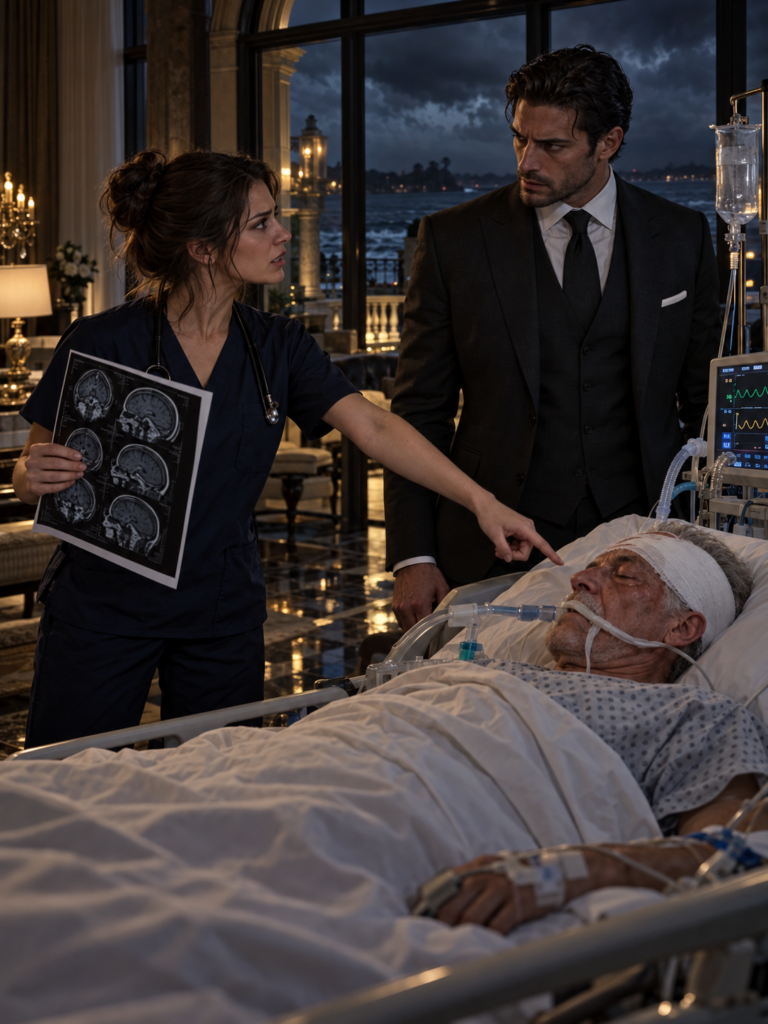
Isabella slipped the folded note beneath the medical photographs before the door opened.
Vittorio Caruso entered wearing a dark suit and the effortless smile of a man who expected every room to welcome him.
“Am I interrupting something important?”
Mateo moved away from the desk.
“A medical discussion.”
“Excellent. Perhaps our doctor can finally give us some encouraging news.”
Isabella kept her voice controlled.
“Your brother remains seriously ill. His condition requires ongoing monitoring.”
“And the possibility of waking?”
“It’s too early to promise anything.”
Vittorio sighed.
“A terrible uncertainty for the family.”
His gaze drifted toward the photographs.
Isabella placed her hand over them.
“These are confidential medical records.”
“Of course.”
He smiled again.
“But surely family deserves to know.”
“His medical team will share appropriate updates.”
For a moment, Vittorio looked almost amused.
Then he turned toward Mateo.
“Your fiancée is arriving soon. Bianca has been anxious about Alessandro.”
Isabella noticed Mateo’s expression change.
Not affection.
Resignation.
“I’m aware.”
Vittorio left after another polite exchange.
When the door closed, Isabella turned sharply.
“Fiancée?”
Mateo looked at her.
“Yes.”
“You’re engaged?”
“To Bianca Salerno.”
Isabella remembered the empty seat beside Mateo at dinner.
The arrangement was longstanding, he explained. The Salerno family was an important ally, and the marriage had been promised when he was a child.
It was an alliance he had inherited rather than chosen.
Isabella stared.
“You kidnapped me into a family where your father is unconscious, your uncle is threatening your authority, and your marriage is a business agreement?”
Mateo gave a humorless smile.
“When you put it that way.”
“How else would you put it?”
He had no answer.
She pointed toward the desk.
“I am your father’s doctor, Mateo. Whatever your family expects of you is your business. But I will not become part of anyone’s private arrangement.”
“You won’t.”
“And you need to stop deciding things for me.”
His gaze lowered.
“I know.”
The admission surprised her.
Before she could answer, a monitor alarm sounded from the adjoining room.
Isabella was moving before Mateo reached the door.
Alessandro’s readings had changed.
Renato was already checking the equipment.
Together they assessed the patient, reviewed his condition, and adjusted the care plan.
The disturbance passed.
When Isabella finally straightened, Mateo was watching her.
“Is he all right?”
“Stable for now.”
“Thank you.”
She removed her gloves.
“I didn’t do it for your gratitude.”
“I know.”
Something vulnerable appeared in his face.
“That’s one of the reasons I trust you.”
Isabella looked away.
Trust was a dangerous word between captor and captive.
She would not mistake his admiration for restitution.
Later that night, Mateo returned to the sick room alone.
His father lay motionless between them.
“I’m going to tell you something,” he said.
Isabella waited.
“I believed that if I could control every person around my father, I could keep him alive.”
“And?”
“I brought you here without considering what that would do to your life.”
“You considered it,” she said quietly. “You simply decided your need mattered more.”
The statement struck him harder than anger would have.
“Yes,” he admitted.
“Then you understand why I can’t trust you just because you’ve started telling me the truth.”
He nodded.
Outside, the water was black beneath the moon.
“Who did you write on that note?” he asked.
Isabella looked toward the desk.
“I didn’t accuse anyone. I recorded a name.”
“Whose?”
“Bianca Salerno.”
Mateo went still.
Isabella continued before he could speak.
“Renato said she has been asking about your father’s consciousness. That doesn’t establish guilt. But it matters.”
“My fiancée visited him before the shooting.”
“How often?”
“Several times. He was involved in arranging the wedding.”
“Alone?”
“Sometimes.”
Isabella drew a careful breath.
“Then she had access.”
Mateo looked at his father.
The silence between them became almost unbearable.
Isabella knew what he was thinking.
If Bianca was involved, the approaching marriage was not merely an unhappy political obligation.
It could be part of the attack.
But suspicion was not evidence.
And Isabella refused to turn professional observation into a death sentence.
“Don’t confront her because of a theory,” she warned.
Mateo looked at her.
“You’re asking me to wait.”
“I’m asking you to be certain.”
He nodded reluctantly.
Then Isabella said the thing that had been troubling her most.
“If someone wanted Alessandro dead, why didn’t they finish it after he was brought here?”
Mateo’s eyes moved to the machines.
“Because they might not have had access.”
“Or because they were waiting to see whether he would recover.”
His face hardened.
“And now they know you’ve noticed.”
At that exact moment, footsteps hurried along the corridor.
Renato appeared in the doorway.
His expression was grave.
“Doctor,” he said. “There is a problem.”
Isabella stood.
“What kind?”
Renato looked at Mateo before answering.
“Someone has ordered your room moved to the east wing tomorrow morning.”
“Who?”
Renato swallowed.
“Your uncle.”
Mateo took one step toward the door.
But Isabella seized the medical chart from the bedside table and moved in front of him.
“No,” she said. “We don’t confront him without a plan.”
And for the first time in his life, Mateo Caruso stopped because a woman he had taken prisoner told him to.
Mateo stopped with his hand on the doorframe.
Behind Isabella, the medical monitors continued their measured sounds.
Renato stood motionless.
For several seconds, nobody spoke.
Then Mateo turned to Isabella.
“What do you suggest?”
It was such an unexpected question that she almost missed its importance.
Eleven days earlier, this man had decided where she would live, who she could contact, and when she would be allowed to leave.
Now he was asking for her judgment.
“First,” she said, “we establish who has authority over this patient’s medical care. Second, we make certain the people surrounding him are there for his treatment, not because of your family’s succession dispute.”
“My uncle controls the east wing.”
“Then moving me there would separate me from Alessandro and put me under the authority of someone who is already questioning whether he should be kept alive.”
Mateo looked toward Renato.
“Did Vittorio give a medical reason?”
“No.”
“Then the order doesn’t stand.”
Renato exhaled.
Isabella was not satisfied.
“You can cancel one order,” she said. “What happens tomorrow when your uncle finds another excuse?”
Mateo considered that.
“My father’s personal physician has a protected position within the family. Vittorio would have difficulty challenging it publicly.”
“Then make the appointment official. With witnesses.”
He looked at her in surprise.
“You want that?”
“I want to keep treating my patient. But understand something. A title inside your organization is not a substitute for my freedom.”
His expression tightened.
“I understand.”
“Do you?”
“Yes.”
She studied him.
“Then when Alessandro no longer requires my care, you’ll release me. Whether he wakes or not.”
Mateo’s answer took several painful seconds.
“Yes.”
She held his gaze.
“And you’ll stop using my career and reputation as leverage.”
Another pause.
“Yes.”
It was not forgiveness.
But it was the beginning of an agreement with terms Isabella had chosen.
The following evening, Mateo stood before the assembled Caruso family.
Vittorio occupied his familiar place beside the empty chair reserved for Alessandro.
Around the long dining table sat advisers, senior crew leaders, relatives, and trusted associates whose loyalties had become increasingly difficult to read.
Bianca Salerno had arrived that morning.
She sat in a pale silk dress, her engagement ring catching the light.
Isabella had already noticed two things.
Bianca barely acknowledged Mateo unless someone was watching.
And her attention repeatedly returned to Vittorio.
A glance across the room.
A private smile.
The slightest touch upon his sleeve.
None of it proved an affair.
But Isabella had spent years reading subtle human behavior, and she knew when an apparently casual gesture deserved another look.
Mateo rose before dinner ended.
“My father remains under Dr. Conti’s care,” he announced. “As acting head, I am formally recognizing her as his personal physician. No one in this organization is authorized to move her or interfere with his treatment.”
The room fell quiet.
Vittorio smiled.
“A considerable privilege for someone so recently brought into our household.”
Isabella felt the insult beneath the politeness.
Before Mateo could answer, she spoke.
“Your brother’s condition is serious. Changing the physician responsible for his care without a clinical reason could create unnecessary risk.”
Vittorio turned toward her.
“You seem very confident, Doctor.”
“About the importance of continuity of care? Yes.”
Several people lowered their eyes.
Mateo did not interrupt her.
“The arrangement stands,” he said.
Vittorio raised his glass.
“To Alessandro’s recovery.”
Others followed.
Isabella noticed Bianca watching her with an expression that contained no admiration.
Only calculation.
Later, on the terrace, Mateo found Isabella looking over Long Island Sound.
“You handled my uncle well.”
“I answered a medical question.”
“You challenged him in front of the family.”
“He invited the answer.”
Mateo smiled faintly.
“You aren’t frightened of him?”
“I am. Fear doesn’t require me to agree with him.”
He leaned beside the railing.
For a while they listened to the water.
Then Isabella asked, “Why did you tell them so publicly?”
“Because Vittorio needed to know that moving you would mean challenging me.”
“That also makes me more visible.”
“Yes.”
“You protected my position by increasing my value as a target.”
Mateo’s expression changed.
He hadn’t considered how the declaration might feel to her.
“I’m sorry,” he said.
She looked at him.
“I needed the medical authority, Mateo. I didn’t need everyone deciding I’m a symbol of your personal loyalty.”
“I’ll remember that.”
“Please do.”
He stayed beside her.
The night air was cold.
After a while, he said quietly, “I don’t know what to do with someone who sees everything I get wrong.”
“You could try listening.”
He almost smiled.
“I’m discovering that.”
Their connection developed in the hours that followed.
Not through promises.
Through work.
At night, Mateo sometimes sat beside his father’s bed while Isabella reviewed the day’s clinical observations.
She explained what the monitoring results meant and what they did not.
He asked questions.
He learned to tolerate uncertainty.
And, slowly, they began to speak about things unrelated to the injured man between them.
Mateo told her about his mother, who had died of cancer when he was twelve.
About growing up as the heir to a family business that demanded obedience before understanding.
About a childhood engagement to Bianca Salerno that had become a binding alliance between criminal organizations.
“I was expected to inherit my father’s obligations,” he said. “Not choose my own.”
“Everyone gets choices,” Isabella answered. “Sometimes the consequences are terrible. But they’re still choices.”
Mateo considered her.
“You believe that even here?”
“Especially here.”
She told him about her own childhood in Queens.
Her mother, Lucia, had raised her alone.
They had never possessed much money, yet educational opportunities had appeared at crucial moments.
Financial assistance.
Scholarships.
Unexpected support when expensive training threatened to become impossible.
Isabella had worked relentlessly for everything she achieved.
But she had sometimes wondered who had quietly helped open certain doors.
“My mother used to tell me to learn a skill nobody could take away,” she said.
Mateo looked at her strangely.
“Lucia?”
“Yes.”
He was silent.
“Did you know someone by that name?” she asked.
“No one I can speak of with certainty.”
Something in his answer disturbed her.
But before she could question him further, Alessandro’s monitor sounded.
Isabella returned immediately to her patient.
The days continued.
Bianca soon confronted her in the mansion’s conservatory.
“You’re attracting a great deal of attention,” Bianca observed.
Isabella stopped beside a row of orchids.
“I wasn’t aware that doing my job required your approval.”
Bianca smiled.
“Mateo has always been susceptible to people who make themselves indispensable.”
“He’s concerned about his father.”
“Of course.”
Bianca moved closer.
“Whatever you imagine is happening between you and Mateo, remember that our wedding is already arranged.”
“I haven’t asked him to break his engagement.”
“You haven’t needed to.”
Isabella held her gaze.
“Then perhaps you should discuss your relationship with him.”
Bianca’s smile thinned.
“Be careful what you become curious about.”
She walked away.
Isabella watched her leave.
The warning revealed more than Bianca intended.
That night Isabella spoke to Mateo.
“I think your fiancée is emotionally involved with Vittorio.”
He stared at her.
“That’s a serious allegation.”
“I know. I’m not presenting it as proof of anything. I’m telling you what I’ve observed.”
She explained the repeated gestures, the private attention, and Bianca’s strange indifference toward the man she was supposed to marry.
Mateo listened.
Then looked toward the doorway.
“I’ve suspected something for years,” he admitted.
“But never pursued it?”
“Recognizing it would have threatened the alliance.”
“And ignoring it might have helped someone exploit you.”
He turned toward her.
“You understand what that could mean.”
“Yes.”
If Vittorio had influenced Bianca, her marriage to Mateo might have given the older man extraordinary access to his nephew’s decisions.
And if Bianca had been involved in Alessandro’s shooting, the marriage could become a mechanism for consolidating power after the assassination.
Still, Isabella refused to jump from suspicion to certainty.
“We need evidence,” she insisted.
Mateo nodded.
They began reviewing the source-supported details already available.
Renato confirmed Bianca had visited Alessandro’s private study several times before the attack.
A housemaid had reportedly seen Bianca destroying something in the garden incinerator days after the shooting.
The maid had then been paid to remain silent by someone associated with Vittorio.
The wound pattern suggested the shooter had been close.
The circumstances pointed toward someone with trusted access.
But none of it, individually, conclusively identified the person responsible.
And the one man who might remember the attack remained unconscious.
One night, during a storm, the mansion’s power briefly faltered.
The monitors switched to backup operation.
Isabella and Renato checked the equipment while Mateo hurried into the room.
The disturbance lasted only seconds.
But when it ended, Isabella found her hands shaking.
Exhaustion had finally caught up with her.
Mateo moved beside her.
“Are you all right?”
“Yes.”
She wasn’t entirely.
He offered his hand.
For a moment, she accepted it.
Their eyes met.
The attraction between them had become impossible to deny.
But the circumstances surrounding it remained deeply wrong.
Isabella stepped away.
“You’re still the man who kidnapped me.”
Mateo’s face changed.
“I know.”
“And you’re engaged.”
“Yes.”
“And I don’t know whether I’ll ever feel safe enough to trust you outside this room.”
He swallowed.
“I know that too.”
She watched him struggle with the truth.
Then he said something she hadn’t expected.
“I want you to have your life back, Isabella. Even if getting it back means you never want to see me again.”
“Then prove it.”
“How?”
“Stop making my freedom depend on your father’s recovery.”
Mateo stood motionless.
That was the demand he had spent weeks avoiding.
Finally, he nodded.
“You’re right.”
The next morning, he told her that the false explanations sent to her hospital would be corrected through an accountable process, and that she would have the opportunity to seek independent advice.
He could not undo the abduction.
He could not erase the harm to her career or the fear he had caused.
But he could stop adding new conditions.
And Isabella found that this decision, rather than any romantic declaration, changed how she looked at him.
She chose to continue Alessandro’s treatment while arrangements for appropriate specialist care and her own safe departure were considered.
She did it because the patient needed her expertise.
Not because Mateo owned her time.
The following week, Alessandro began showing signs of improved responsiveness.
His condition remained serious.
The outcome was uncertain.
But careful assessment suggested that he might soon regain consciousness.
Isabella told Renato first.
Then Mateo.
His expression filled with something she had never seen so openly.
Hope.
“What happens if he wakes?” he asked.
“We assess him medically. We don’t interrogate him while he’s confused or unstable.”
“And if he remembers?”
“Then we find out what he can reliably tell us.”
Mateo studied her.
“And if what he says destroys everything?”
“Then we deal with the truth.”
She paused.
“Mateo, there’s another question you haven’t answered.”
“What?”
“If your father names someone you love, will you still want him to speak?”
Mateo looked toward the bed.
“Yes.”
“Even if he names you?”
His eyes returned to hers.
“I didn’t shoot my father.”
“I want to believe you.”
“Then let me earn it.”
She considered that.
For the first time, she wanted him to succeed.
But as she turned back toward the patient, Alessandro’s eyelids shifted.
His fingers moved against the sheet.
Isabella leaned forward.
“Mr. Caruso?”
A faint sound escaped his throat.
Mateo stepped closer.
“Dad?”
The older man’s eyes opened.
And Isabella realized that the one witness the entire Caruso family feared was finally coming back.
Alessandro Caruso’s eyes moved slowly across the room.
Isabella was beside him immediately.
“Don’t try to sit up,” she said gently. “You’ve been seriously injured. You’re receiving medical care.”
His gaze struggled to focus.
Mateo stood behind her, motionless.
For weeks, he had imagined hearing his father speak again.
Now that moment had arrived, he seemed afraid even to breathe.
Alessandro looked at Isabella.
His expression softened into bewildered recognition.
“Lucia,” he whispered.
The name struck her harder than any accusation.
She leaned closer.
“My name is Isabella.”
But the older man’s eyes remained fixed on her face.
His hand moved weakly toward hers.
“Lucia.”
It was her mother’s name.
A name he had no reason to know.
Isabella felt the room tilt beneath her.
Before she could ask anything, footsteps sounded in the hall.
Renato entered.
Two guards followed Mateo.
And behind them came Bianca Salerno.
She stopped in the doorway.
“Oh, Alessandro,” she said softly. “You’re awake.”
The patient’s expression changed.
His gaze locked onto Bianca.
Fear passed across his face.
Then anger.
He lifted a shaking hand.
His mouth struggled around the words.
“You.”
Bianca stepped closer.
“Don’t strain yourself.”
Alessandro pointed at her.
“Shot me.”
The room went still.
Isabella’s pulse accelerated, but her training took over.
“Everyone give him space,” she ordered. “He’s medically vulnerable.”
Bianca’s face had lost its color.
“He’s confused,” she said sharply.
Isabella looked toward her.
“Step back.”
Instead, Bianca reached toward the pocket of her robe.
Isabella saw the movement.
“Mateo!”
A small gun appeared.
The weapon pointed toward Alessandro’s bed.
Mateo moved as Isabella pulled back protectively toward her patient.
A shot rang out.
Plaster scattered from the ceiling.
Mateo had caught Bianca’s arm before she could aim properly.
The guards seized her.
Within seconds, the gun was out of her possession.
Bianca struggled furiously.
Alessandro’s monitor alarms sounded.
Isabella turned entirely toward her patient.
His breathing and neurological condition mattered more than the shouting behind her.
“Renato, I need you here.”
He came at once.
They stabilized Alessandro while Mateo ordered the others away from the bedside.
The attempted shooting had confirmed a terrifying reality.
Bianca had been willing to fire at the man whose life Isabella had spent weeks trying to save.
And Alessandro had recognized her.
Later, after the immediate medical crisis passed, Mateo confronted Bianca about the attack.
She answered with contempt.
She claimed he would never be able to move against Vittorio without destroying the organization.
Her words confirmed her loyalty to the older man, though they did not explain every part of the conspiracy.
Before Mateo could determine what to do next, an alarm sounded elsewhere in the mansion.
Vittorio’s loyalists had been alerted.
The struggle that had been hidden behind polite dinners and carefully chosen words was no longer hidden.
Mateo controlled part of the family.
His uncle controlled another.
And Alessandro’s survival had made the conflict unavoidable.
For Isabella, the greatest danger was that the wounded man would become a political instrument before he had recovered enough to make informed decisions.
She refused to let that happen.
For the next several hours, she remained focused on his medical condition.
She insisted on controlling access to his room.
She worked with Renato to keep his care stable.
And when Mateo came to ask whether Alessandro could speak to the family, she refused.
“Not now.”
“Isabella, Vittorio is telling people my father is incapable of recognizing anyone.”
“He may have periods of confusion. That is not a reason to force him into a confrontation.”
“I need him to confirm what happened.”
“He needs rest.”
Mateo’s jaw tightened.
For a moment, she saw the old instinct.
The urge to make everyone else subordinate to his emergency.
Then he looked at his father’s bed.
“You’re right,” he said.
He left the room.
Isabella watched him go.
The difference between the man who abducted her and the man now respecting her medical judgment had never been clearer.
But it did not erase what he had done.
Nor did it resolve the mystery that had appeared when Alessandro spoke her mother’s name.
That question waited until the patient was strong enough to answer.
When Isabella finally raised it, Alessandro looked at her for a long time.
“Lucia,” he said.
“My mother.”
He closed his eyes briefly.
“I knew her.”
“How?”
His answer came slowly.
They had loved each other when they were young.
Before his life became fully consumed by the family.
Before the obligations of his organization made an ordinary future impossible.
Lucia had wanted a life outside that world.
Alessandro had not been willing to leave it.
Eventually, she disappeared from his daily life.
But he had never forgotten her.
Isabella listened without moving.
Then she asked about the financial help that had appeared throughout her childhood.
The scholarships.
The opportunities.
The doors that seemed to open whenever she had almost exhausted every possibility.
Alessandro lowered his eyes.
“I helped.”
Isabella stared.
“You?”
“I wanted her child to have choices.”
A terrible possibility formed in her mind.
“Was she pregnant when you separated?”
Alessandro hesitated.
“I don’t remember the timing clearly.”
His injuries had affected his memory.
The answer wasn’t enough.
But Isabella understood what it might mean.
If Alessandro were her biological father, she and Mateo could be closely related.
She left the room before the fear overwhelmed her.
Mateo found her sitting on the bathroom floor, trembling.
“Isabella?”
She looked up.
“Your father knew my mother.”
He crouched beside her.
“What?”
“They were in love. He helped pay for parts of my education. He knew about me long before you took me here.”
Mateo went pale.
“And you think—”
“He might be my father.”
The silence was devastating.
Everything they had begun to feel suddenly stood beneath a question neither could ignore.
Mateo sat beside her.
For once, he offered no commanding reassurance.
He understood that this required evidence.
Not instinct.
Not desire.
Not the word of a severely injured man whose memory remained unreliable.
“We need a DNA test,” he said.
Isabella nodded.
“An independently handled one.”
“Yes.”
“And until we know—”
“We don’t cross that line.”
She closed her eyes.
It hurt to hear.
It would have hurt more if he had ignored the possibility.
For the following days, they concentrated on Alessandro’s care and the increasingly unstable struggle for control of the family.
Isabella found herself carrying two forms of uncertainty.
One was medical.
Would her patient survive his injuries and recover enough independence to live outside constant care?
The other was intensely personal.
Was the man she had begun loving someone she could ever build a future with?
When the test results finally arrived, she opened them privately.
Alessandro Caruso was not her biological father.
Isabella read the conclusion more than once.
The relief was so immense that she had to sit down.
It answered the question that had threatened her relationship with Mateo.
It did not answer why Alessandro had concealed his support for her.
When she returned to him, he explained as much as he could.
He had loved Lucia.
He had lost her because he would not separate himself from the violent obligations of the Caruso world.
When he learned that Lucia was raising Isabella, he chose to offer assistance from a distance.
He never claimed she owed him affection.
He never revealed himself to her.
He simply arranged opportunities where he could, hoping she might live a life he could not provide.
Isabella felt grief rise inside her.
“You could have told me.”
“I know.”
“My mother died without my understanding any of this.”
Alessandro looked away.
“Yes.”
“Your help mattered,” she said. “But so did the secrecy. I spent years wondering whether I deserved the chances I received.”
He looked at her again.
“You earned everything you became.”
She swallowed.
“Then you should have trusted me with the truth.”
He nodded.
“I should have.”
It was not a reconciliation that erased the past.
But it gave Isabella a clearer understanding of her mother’s choices.
Lucia had loved a dangerous man.
She had left him.
And she had spent the remainder of her life trying to protect the future of her daughter.
Isabella recognized the painful irony.
Her own heart had turned toward the son of that man’s family.
But she was no longer the child whose life had been shaped by secrets she couldn’t question.
She could decide what those secrets would mean now.
Meanwhile, the struggle inside the Caruso organization approached its conclusion.
Vittorio continued gathering support from senior members who doubted Mateo’s authority.
Bianca, after being seized following the attempted shooting, was removed from Mateo’s immediate control through the efforts of men loyal to Vittorio.
News of her death later reached the household alongside a purported confession designed to limit the damage to the older man.
Mateo refused to accept that convenient version of events.
Isabella’s observations had already established a pattern.
Bianca’s trusted access to Alessandro.
The close-range wound.
The reported destruction of evidence.
Her relationship with Vittorio.
The attempt to shoot Alessandro again after he regained consciousness.
Each detail mattered.
Together they made Vittorio’s claim that Bianca had acted entirely alone increasingly difficult to sustain.
But Mateo still needed his father’s authority to confront the men who had begun to support his uncle.
Alessandro, though physically weakened, understood what was happening.
He was determined to speak.
Isabella opposed any appearance before the family until the patient’s condition allowed it.
When he improved sufficiently, she explained the risks.
“You may become exhausted quickly. Your memory may fail. And you should not be forced to make decisions because other people want to use your position.”
Alessandro listened.
Then said, “I want to decide.”
She looked at him.
It was the same principle she had demanded for herself.
A patient’s vulnerability did not erase his right to make an informed choice.
Together, they established the limits of what he could manage.
That evening, Alessandro appeared before the assembled senior members of his organization, supported because of his weakness.
Mateo stood nearby.
Vittorio occupied the center of the room with the confidence of a man who believed he still controlled enough loyalties to survive.
Then he saw Alessandro.
His expression changed.
For the first time, the younger brother seemed uncertain.
Alessandro spoke slowly.
He identified Bianca as the woman who had shot him.
He described what he remembered of the attack.
And he made clear that Vittorio had betrayed him.
The room fell into stunned silence.
Vittorio objected.
He challenged the reliability of a recovering man’s memory.
But Bianca’s attempted second shooting had already exposed the danger.
The evidence surrounding her access and relationship with Vittorio made the account harder to dismiss.
And Alessandro was still the recognized head of the family.
He publicly rejected his brother’s claim to authority.
Then affirmed Mateo as his successor.
One by one, the uncertain members withdrew their support from Vittorio.
The man’s position collapsed.
Several of his loyalists tried to resist.
Mateo’s men disarmed them before the confrontation became an open fight.
For Isabella, the most important fact was that Alessandro had reached the end of what he could safely endure.
She moved to his side.
“That’s enough,” she said.
He looked at her.
For a moment, she saw a faint resemblance between this injured old man and the powerful figure he had once been.
Then he nodded.
She helped him leave.
Behind them, Vittorio’s fate passed into the hands of the organization he had tried to seize.
He did not survive the consequences of his betrayal.
Mateo later told Isabella that the uncle who had helped destroy his family was dead.
He did not ask her to celebrate.
And she did not.
The violence troubled her deeply.
She had devoted her life to preserving people.
He led a world where men sometimes settled conflicts by destroying them.
That difference remained real.
It could not be erased by attraction or gratitude.
Several days after the succession was resolved, Isabella stood with Mateo beside the windows of a Manhattan apartment.
The city spread beneath them.
He had become the head of the Caruso organization.
His father was recovering slowly.
The immediate challenge from Vittorio’s faction had ended.
And the arrangement with Bianca and the Salerno family was no longer a marriage that could proceed.
But one matter remained.
Isabella’s future.
“I have to go back to medicine,” she said.
Mateo looked at her.
“I know.”
“I mean truly go back. Not just appear at the hospital while my life is controlled by people connected to you.”
“You should.”
“And I need to know that I can leave you without being followed or punished.”
His face tightened.
“You can.”
“Not because you permit it,” she said. “Because I have that right.”
He nodded.
“Yes.”
She looked toward the city.
“I need you to acknowledge what happened to me. You took me from my hospital. You made my colleagues believe a false story. You removed my ability to choose. Whatever happened afterward, none of that became acceptable.”
Mateo stood beside her.
“You’re right.”
She turned toward him.
“Say it without explaining why your father needed me.”
He took a slow breath.
“I kidnapped you. I frightened you. I interfered with your career and treated your freedom as something I could bargain with. I was wrong.”
Isabella felt the words settle.
For weeks, she had waited to hear them without qualification.
“What will you do about it?”
“I’ll cooperate with restoring the truth about your absence and accept the consequences of what I did. I won’t ask you to make the harm disappear because of how I feel about you.”
She studied him.
“Do you love me?”
His expression changed.
“Yes.”
“And if I walk away?”
“I will still love you.”
She swallowed.
“Will you let me?”
“Yes.”
That was the answer she needed.
Not a promise that the world would become safe.
Not an offer of money, a mansion, or permanent security.
An admission that he had no claim over her life.
She returned to her professional world on terms she chose, seeking the independent advice and support needed to address what had happened.
Her relationship with Mateo did not become simple.
She struggled with the contrast between her work as a physician and his position in the criminal organization.
He could not promise that his past had become harmless.
She could not pretend she would ever consider violence ordinary.
They argued about those differences.
They questioned one another.
At times, Isabella considered whether love could exist without compromising everything she believed.
Mateo listened when she challenged him.
And the choices he made as the new head of the family began reflecting a determination to reduce the conflicts that had consumed his father and uncle.
He chose negotiation where previous leaders might have preferred retaliation.
He refused to let every slight become a reason for another violent dispute.
He understood that endless bloodshed could destroy the future he wanted.
None of those changes made him innocent.
But they showed Isabella that he was taking responsibility for the consequences of his position.
Alessandro continued recovering, though his injuries left lasting limitations.
On his better days, he spoke with Isabella about Lucia.
He remembered her mother’s laughter.
The arguments they had shared.
The ambitions she held.
And the heartbreak of losing her because he would not choose a life outside the organization.
One afternoon, he gave Isabella something he had kept for decades.
A ring that had once belonged to Lucia.
Isabella held it carefully.
For a long time, she couldn’t speak.
Then she asked why he had never returned it.
“I suppose I was always expecting another chance.”
She looked at the ring.
“And when she didn’t come back?”
“I kept it because I didn’t know how to let go.”
Isabella closed her hand around the small piece of jewelry.
“My mother deserved more than waiting.”
Alessandro nodded.
“Yes.”
She took the ring with her.
Not as proof that she owed the Caruso family anything.
As a piece of her mother’s life that had finally found its way home.
Six weeks after resuming her hospital work, Isabella stood on a terrace above Manhattan, watching evening settle over the city.
Mateo came outside.
“You’ve been quiet.”
“I’ve been thinking.”
“About leaving?”
“About who I am now.”
He stood beside her.
She looked at him.
“I used to believe that if I became skilled enough, careful enough, I could keep my world predictable.”
“And now?”
“Now I know even the best surgeon can’t control every outcome.”
He waited.
“I love medicine,” she continued. “I still want to help people. I don’t want the decisions I’ve made here to take that away.”
“They won’t, if I can help it.”
“And I love you.”
Mateo became very still.
She smiled faintly.
“You don’t have to look so surprised.”
“I spent a long time believing I had lost the right to hear that.”
“You don’t earn love by deciding somebody has to give it to you.”
“I know.”
“You earn trust by how you behave when they might say no.”
He looked at her with something like wonder.
“Isabella.”
“Yes?”
“I want to ask you something.”
He reached into his jacket.
When he opened his hand, her mother’s ring lay against his palm.
Alessandro had told him its history.
Mateo had asked Isabella if she would consider allowing it to become part of their future.
She had told him she needed time to think.
Now he held it without assuming the answer.
“Will you marry me?”
She looked at the ring.
Then at him.
“You know I won’t give up being a surgeon.”
“I wouldn’t ask you to.”
“I won’t become part of your organization.”
“I don’t want you to.”
“And I won’t pretend we have no problems to solve.”
Mateo gave a small, sad smile.
“Neither will I.”
She searched his face.
“Then tell me why.”
“Why I want to marry you?”
“Yes.”
He considered it.
“Because you are the first person who has shown me that being needed is not the same as being loved. Because you told me the truth when it frightened me. Because you refused to let my power decide your worth.”
He paused.
“And because I want to spend my life with someone who can leave and still chooses to come home.”
Isabella’s eyes filled.
For years she had been the woman who made herself indispensable.
She had thought competence was the safest way to deserve a place in the world.
But she was not standing beside Mateo because she could save his father.
Her value no longer depended on what she could do for him.
She had chosen her profession.
She had reclaimed her independence.
And now she could choose a relationship without pretending the harm that preceded it had been romantic.
She held out her hand.
“Yes,” she whispered. “I will marry you.”
Mateo looked at her as though he needed to hear it again.
“Yes?”
She laughed through her tears.
“Yes.”
He slipped Lucia’s ring onto her finger.
It fit.
For a moment, Isabella thought of her mother, a young woman who had loved Alessandro Caruso and chosen a different life.
Lucia’s departure had been an act of courage.
Isabella’s decision to remain with Mateo would have to be courageous in its own way.
Neither woman’s choice made the other wrong.
She reached toward him.
And when they kissed, there were no locked doors between them.
No orders.
No promise of freedom postponed until someone else recovered.
Only two adults choosing an uncertain future together.
They married the following spring.
The ceremony was small.
Renato attended.
Alessandro, still recovering and walking with a cane, was there to see the woman he had helped from a distance become part of the family by her own decision.
There was no political alliance being negotiated.
No arranged marriage between rival organizations.
No criminal advantage Isabella had agreed to provide.
Her work remained hers.
Her professional judgment remained independent.
Mateo continued leading his family, with all the responsibilities and consequences that position carried.
Their relationship remained complicated.
But neither confused complication with permission to control the other.
After the ceremony, Isabella returned to the hospital as Dr. Conti.
She still entered operating rooms where every second mattered.
She still faced difficult cases.
She still understood that medicine offered no guarantees.
And when she came home, Mateo no longer asked how he could make her necessary to his life.
He asked about her day.
He listened.
Sometimes they disagreed.
Sometimes she reminded him of a promise he had made.
And sometimes he changed his decision because she had shown him something he hadn’t considered.
One evening, as the lights of Manhattan appeared beyond their windows, Isabella placed her mother’s ring on the table while washing her hands.
Mateo watched her from the doorway.
“What are you thinking?” he asked.
She dried her hands.
“About the night we met.”
He looked down.
“I wish I’d given you a choice.”
“So do I.”
“I can’t change that.”
“No.”
She walked toward him.
“But I can decide what happens next.”
He took her hand without tightening his grip.
“Then what happens next, Doctor?”
Isabella smiled.
“Tomorrow I go to work.”
“And tonight?”
“Tonight,” she said, “we have dinner together.”
Mateo smiled.
It was a small answer.
For two people whose lives had once been ruled by fear, loyalty, and impossible demands, it was also an extraordinary one.
Because the most important thing Mateo Caruso had learned was not how to keep the woman he loved.
It was how to build a life she was free to choose.
And the most important thing Isabella had learned was that she never had to stop being herself in order to be loved.