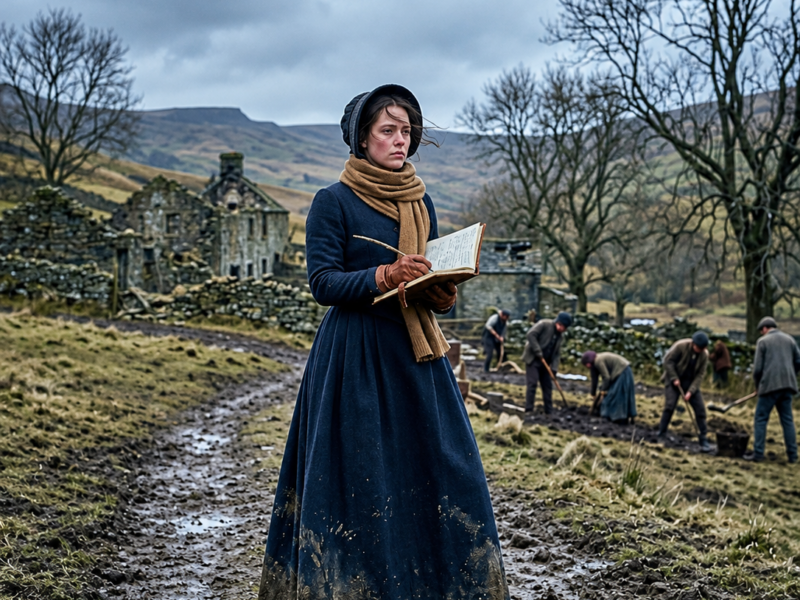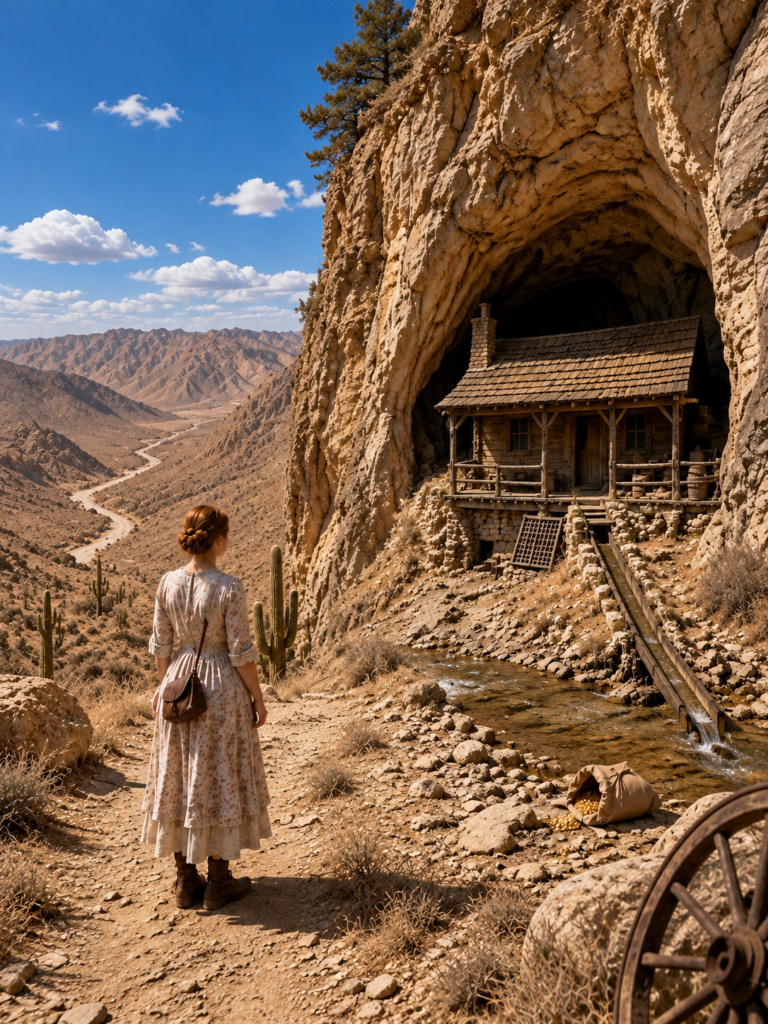
they banished a 19-year-old girl to a freezing desert cave for defending a child—never imagining she would build a home there and uncover a fortune beneath the mountain
Part 1
“Let the rocks be your family now, Sadie Pike. There is no longer a place for you among decent people.”
Preacher Theron Blackwood spoke those words in front of every family in Bitter Creek.
I was nineteen years old.
I had never stolen anything. I had never harmed anyone. I had spent most of my life working in other people’s kitchens, helping with harvests, mending worn clothing, and caring for children whose mothers were too exhausted to manage alone.
But on that October morning, none of it mattered.
I was being driven out of the only home I had ever known.
And my crime was telling the truth.
The meetinghouse smelled of candle wax, damp wool, and the dust that blew through every crack in our little settlement. Nearly sixty people stood shoulder to shoulder along its wooden benches.
Most had known me since I was a baby.
Some had fed me after my mother died.
Others had taught me to read scripture, milk goats, and make bread without wasting a spoonful of flour.
Now they watched me as though I were a dangerous stranger.
Preacher Blackwood stood behind his polished oak pulpit, his black coat hanging straight from his narrow shoulders.
Beside him stood his seventeen-year-old son, Ezekiel.
Ezekiel wouldn’t look at me.
Three days earlier, I had seen him take apples from the community storehouse. When little Martha Prim, a ten-year-old orphan, was accused of stealing one, I spoke up.
I had expected a misunderstanding.
A correction.
Perhaps an apology.
Instead, Blackwood accused me of lying to protect a thief.
When I refused to change my account, he declared I had challenged his authority.
And in Bitter Creek, challenging the preacher meant challenging the entire settlement.
“Do you confess your wrongdoing?” he demanded.
I stood near the front bench, my hands clasped so tightly my fingernails dug into my palms.
“I told you what I saw.”
His eyes narrowed.
“Pride is a dangerous thing in a young woman.”
“Then perhaps your son should admit what he did.”
A murmur moved through the room.
Ezekiel shifted his weight.
Blackwood struck the pulpit.
“Enough!”
Mrs. Gable, who had once held me on her lap when I was sick, lowered her eyes.
Mr. Prim stood near the door with his daughter hidden behind his coat.
Martha was crying.
I looked at the little girl.
Her cheeks were red. Her small hands gripped her father’s sleeve.
She had already apologized for something she hadn’t done.
I could not bear to watch her carry that shame.
“I won’t call that child a thief,” I said.
Blackwood raised one trembling finger toward the western hills.
“Then you will leave us.”
I thought I had misheard.
“Leave?”
“You have chosen rebellion. You will take your pride into the wilderness, where it can trouble no righteous soul.”
Behind him, the windows showed a hard, brilliant blue sky.
Beyond the settlement lay miles of sagebrush, broken limestone ridges, dry washes, and narrow canyons.
Winter was approaching.
A woman alone could disappear out there without leaving a trace.
“You can’t mean that,” I whispered.
“I mean precisely what I say.”
My knees nearly gave way.
I looked around the room, searching for someone willing to speak.
Mrs. Gable turned her face toward the wall.
Mr. Prim stared at the floor.
Ezekiel kept his eyes on his boots.
And Silas Croft, the blacksmith’s son, stood at the back with his jaw clenched and his hands curled into fists.
He looked as though he wanted to say something.
But he didn’t.
That silence hurt almost as much as Blackwood’s judgment.
My father had been buried when I was twelve, beneath a crooked wooden cross on the hill behind our settlement.
My mother had died before I was old enough to remember the sound of her voice.
Bitter Creek was the only family I had left.
And now it was throwing me away.
“You have until sunset,” Blackwood said. “Take only your personal belongings. The settlement’s provisions belong to the faithful.”
I stared at him.
“What am I supposed to do?”
He pointed west again.
“There is a cave in Whisperwind Canyon. You may seek shelter there.”
A frightened whisper passed through the congregation.
Everyone knew that cave.
People called it the Exile’s Cave.
It was where unwanted wanderers, debtors, and those condemned by the settlement had been sent over the years.
Some had returned.
Most had not.
Blackwood leaned forward.
“Perhaps solitude will teach you humility.”
For a long moment, I could barely breathe.
Then I straightened my shoulders.
“If telling the truth makes me unwelcome here, Reverend, I suppose there is nothing left for me to say.”
I turned and walked toward the doors.
No one stopped me.
Outside, the wind carried the smell of wood smoke and drying corn.
I passed the little house where I had lived since childhood.
Its roof sagged in the middle, and the porch steps needed replacing.
There was a blue quilt on my bed that my mother had made before I was born.
I rolled it tightly.
I packed a second dress, two pairs of stockings, a tin cup, my sewing needles, and a small Bible whose pages had softened from years of handling.
Everything fit inside one canvas sack.
I stood in the doorway for a final moment.
On the wall hung a faded photograph of my parents.
My father wore his Sunday coat.
My mother had one hand resting on his shoulder.
I took the picture down and wrapped it inside the quilt.
Then I closed the door.
I did not know whether anyone would ever open it for me again.
At the edge of town, Silas was waiting beside a gray mule.
The animal was old, with a white patch above one eye and ears that turned toward every sound.
Silas held out the lead rope.
“His name’s Jude.”
I stared at him.
“I can’t take your mule.”
“He’s mine to give.”
“Silas—”
“He’s stubborn, but he’ll carry what you need. And he’ll find his way around rough country better than most men.”
Beside his boots lay a small sack of hardtack, salt pork, and dried beans.
There was also a heavy axe.
I looked at the supplies.
“Your father will be angry.”
“My father doesn’t own my conscience.”
His voice broke slightly.
I had known Silas since we were children. He was broad-shouldered, serious, and quiet, with hands permanently marked by soot from the forge.
We had once talked about building a place of our own.
Nothing fancy.
A small house, a vegetable garden, perhaps a few chickens.
But those dreams had never become promises.
Not yet.
Now he was looking at me as though he had lost something he didn’t know how to recover.
“I’m sorry,” he whispered.
I swallowed.
“Why didn’t you speak?”
He lowered his eyes.
“Blackwood threatened to close the forge. My father’s already behind on payments.”
“So you let him send me away?”
Silas flinched.
I immediately regretted the sharpness of my voice.
But the hurt was real.
He nodded once.
“I was afraid.”
There was something terribly honest about those words.
I wanted to forgive him.
I also wanted him to understand what his fear had cost.
So I took the mule’s rope and said, “I was afraid too.”
Neither of us spoke for a while.
Finally, Silas lifted the axe and secured it to Jude’s pack.
“This was my grandfather’s. The handle’s hickory. I sharpened the blade last night.”
I touched the smooth wood.
“Thank you.”
“If you need anything—”
“How would I ask?”
He had no answer.
I led Jude toward the western trail.
After a few hundred yards, I turned.
Silas was still standing beside the road.
He raised one hand.
I raised mine.
Then I kept walking.
A mile beyond the last cornfield stood a small cabin surrounded by sagebrush and medicinal herbs.
It belonged to Ilara, the settlement’s aging midwife.
Most people respected her knowledge but avoided her company.
She had never married.
She sometimes questioned Blackwood’s sermons.
And she knew how to keep a woman alive through childbirth when the nearest doctor was two days away.
She was waiting beside her fence.
Her silver hair was tied beneath a dark scarf.
Without speaking, she took my hand and placed a small black stone in my palm.
It was smooth, heavy, and oddly warm from her fingers.
“Keep this,” she said.
“What is it?”
“A reminder.”
“Of what?”
Ilara looked toward the canyon.
“Stone remembers fire, child.”
I frowned.
“I don’t understand.”
“Not everything that looks cold is dead.”
She pressed my fingers around the stone.
Then she handed me a bundle of dried herbs, a packet of seeds, and a small tin of salve.
“You’ll need these more than you’ll need pity.”
My throat tightened.
“Will I survive out there?”
Ilara studied me.
“You know how to work. You know how to learn. And you’ve got more sense than half the men who sat in judgment of you this morning.”
“That doesn’t answer my question.”
“No,” she said. “It doesn’t.”
She looked into my eyes.
“Survival isn’t a promise. It’s work you do every morning.”
I held her hand a moment longer.
Then I left.
By late afternoon, Bitter Creek had disappeared behind the hills.
The trail narrowed.
Dust covered my skirt.
The land became harsher, broken by dry washes, twisted juniper trees, and limestone outcroppings.
Jude walked patiently beside me.
As the sun lowered, the shadows stretched across the canyon floor.
Then I saw it.
A dark opening in the mountainside.
The Exile’s Cave.
It looked like a wound in the earth.
I stopped.
The entrance rose between two jagged stone ridges. Dry grass grew from cracks in the rock. A cold breeze moved outward, carrying the smell of damp stone.
I looked back toward the trail.
There was no town in sight.
No friendly lamp.
No voice calling me home.
Only the mule.
The canyon.
And a cave where people had been sent to disappear.
I touched the black stone Ilara had given me.
Then I led Jude toward the darkness.
That first night, I sat just inside the entrance, wrapped in my mother’s quilt, listening to coyotes cry somewhere beyond the ridge.
I ate one piece of hardtack.
My hands trembled from cold.
Jude stood nearby, chewing slowly.
I thought about my little house.
About the warm bread Mrs. Gable used to bake.
About Silas watching me leave.
Then I buried my face in the quilt and cried until my throat ached.
Nobody came.
Nobody called my name.
When I finally looked up, the stars were bright above the canyon.
I wiped my cheeks.
“All right,” I whispered to the darkness. “If this is where I’m supposed to die, you’re going to have to work harder than that.”
Jude flicked one ear.
And for the first time that terrible day, I almost smiled.
Part 2
The first morning taught me that courage did not fill an empty stomach.
I woke stiff and aching.
My feet were numb inside my boots.
The cold had settled so deeply into my bones that standing upright took several minutes.
Outside, frost silvered the sagebrush.
Jude nudged my shoulder with his nose.
“I know,” I murmured. “You’re hungry too.”
The mule needed water and forage.
I needed breakfast, shelter, and some way to keep us alive when winter came.
I laid everything I owned on a flat stone.
A sack of hardtack.
Salt pork.
A little dried beans.
The axe.
My sewing kit.
The herbs and seeds Ilara had given me.
One tin cup.
One blanket.
One quilt.
That was my entire fortune.
I divided the food into portions and wrapped each one separately.
If I ate carefully, I might stretch the provisions for two weeks.
After that, I would have to find or grow something.
I began with water.
The canyon floor held an old streambed, but it was dry.
I followed it for nearly a mile, studying the rocks for damp patches and the vegetation for signs of underground moisture.
There were a few cottonwoods farther down the wash, but the soil beneath them was barely damp.
When I returned, Jude was scraping at a patch of sparse grass near the cave.
He looked up as though expecting me to explain myself.
“I’m trying,” I told him.
That afternoon, I explored farther inside the cave.
I did not venture recklessly into the darkness. I stayed close to the entrance at first, marking the route with small piles of stones and using daylight reflected from a polished piece of tin to examine the passages.
In a deeper chamber, I heard something.
A slow, rhythmic sound.
Drip.
Drip.
Drip.
I followed it.
Water fell from a crack in the ceiling into a shallow basin worn into the stone.
I crouched beside it.
The water was clear.
I dipped my fingers into it and brought them to my lips.
Cold.
Mineral-tasting.
Precious.
I did not know whether it was entirely safe, so I collected some and boiled it over a small fire outside the entrance before drinking.
Then I laughed.
It wasn’t a grand discovery.
It wasn’t enough to erase the pain of exile.
But it meant Jude and I had a dependable place to collect water.
And that meant tomorrow was possible.
The following days became a routine.
At sunrise, I watered Jude and led him to a grassy patch along the lower valley.
Then I gathered fallen wood, searched for edible plants I could identify with confidence, and inspected the slopes for safer routes.
I repaired my boots with strips of leather.
I stretched my remaining food.
I dug a small drainage channel near the cave entrance to keep rainwater from washing directly into my sleeping place.
At night, I huddled beside a carefully tended fire in the sheltered mouth of the cave.
The fire warmed my hands.
But the surrounding stone swallowed most of the heat.
I understood that I would not survive winter there without better shelter.
A week after arriving, I tried to climb the northern ridge to see whether any farms lay beyond the canyon.
The climb was steeper than I expected.
Loose shale shifted under my boots.
Halfway up, my foot slipped.
I fell against a rock and scraped my forearm badly.
For several moments, I lay still.
The sky above me was painfully blue.
I could hear Jude braying somewhere below.
I sat up slowly.
Blood ran down my wrist.
The wound wasn’t deep, but my arm throbbed.
I tore a clean strip from my spare petticoat, washed the scrape with boiled water after returning to the cave, and bandaged it.
That evening, I sat staring at the injury.
I had never felt so small.
Back in Bitter Creek, someone would have helped me.
Someone would have brought broth.
Someone would have told me not to worry.
Here, there was no one.
I covered my face and whispered, “Mama, I don’t know how to do this.”
The cave answered with silence.
I thought about the settlement’s meetinghouse.
The preacher’s raised finger.
The faces that turned away.
For a moment, I wanted to return.
I wanted to walk into Bitter Creek, kneel before Blackwood, and tell him whatever he wished to hear.
I could say I had been proud.
I could admit a theft I had never committed.
I could ask to be forgiven.
And perhaps they would let me back inside.
Perhaps Mrs. Gable would open her kitchen door.
Perhaps Silas would look at me without shame.
Then I pictured Martha Prim standing beside her father, crying over that apple.
If I confessed to a lie, I would be teaching her that truth mattered only when powerful people permitted it.
I lowered my hands.
“No,” I said aloud.
Jude looked toward me.
“No, old fellow. We aren’t going back that way.”
I slept badly.
But in the morning, I got up.
And I worked.
The cave gradually became familiar.
I found a dry recess for storing my food.
I discovered a second passage that carried a gentle current of air.
Farther inside, there was a chamber containing an old fire ring and a few pieces of worked flint.
Someone had sheltered there long before me.
I wondered who.
A hunter?
A traveler?
A family fleeing a storm?
The idea comforted me.
I wasn’t the first person who had looked at these rocks and hoped to live.
One afternoon, I noticed something peculiar about the rear wall of the largest chamber.
Most of the cave was pale gray limestone.
But one broad section was darker and unusually smooth.
Its surface was crossed by thin, branching lines.
When I pressed my palm against it, I thought I felt warmth.
I moved my hand to the adjacent rock.
Cold.
Back to the dark wall.
Warmer.
I frowned.
The difference wasn’t dramatic.
But it was there.
I remembered Ilara’s words.
Stone remembers fire.
For several days, I watched the wall.
Some mornings it felt cool.
At other times, especially after the afternoon sun had warmed the cliff above the cave, the stone retained a faint heat.
I wondered whether a deeper fracture allowed warm air to circulate behind it.
Or perhaps a different kind of rock lay beneath the dark surface.
Whatever the explanation, I had more urgent problems.
The first storm arrived in early November.
Rain swept down the canyon so hard that the dry wash briefly became a brown, rushing stream.
Wind drove water into the cave entrance.
My blankets became damp.
The fire sputtered and died.
Jude backed farther inside, frightened by the thunder.
I spent the night sitting upright on a raised ledge, holding my quilt away from the water.
By dawn, I was shivering uncontrollably.
The storm had carried away part of my woodpile.
Several food parcels were soaked.
And the entrance was a mess of mud and debris.
I stared at the destruction and wanted to scream.
Instead, I picked up a branch and began clearing the drainage ditch.
There was no point asking the sky to be fair.
It had never promised to be.
That afternoon, I made a decision.
I would build a cabin.
Not beside the cave.
Against it.
The cave would provide protection from the rear and shelter for Jude.
A small log structure in front could contain a hearth, a sleeping platform, and a sturdy door.
The entrance faced southeast, where it received morning light and some protection from the strongest winter winds.
I had seen cabins built before.
I had helped mix clay chinking.
I knew how to set simple corner notches.
Silas had taught me how to sharpen tools.
And my father, before he died, had shown me how to measure a foundation using rope and stakes.
I would need timber.
I would need patience.
And I would need to make fewer mistakes than I could afford.
I walked out into the afternoon sunlight and studied the nearest stand of pines.
Jude stood beside me.
“You and I,” I told him, “are going to build ourselves a house.”
He gave a long, doubtful snort.
I laughed.
“I didn’t say it was going to be easy.”
Part 3
The first tree took nearly an entire morning.
I selected a small, straight pine growing on a lower slope where it could fall without striking other trees or rolling into the ravine.
I cleared the ground around it.
I checked the direction of the lean.
Then I raised Silas’s axe.
The blade struck the trunk with a sharp crack.
Wood chips flew.
I swung again.
And again.
Within twenty minutes, my shoulders burned.
Within an hour, blisters had formed across both palms.
By noon, I sat on a stump, trembling from exhaustion.
The tree was still standing.
I looked at it with genuine hatred.
“You stubborn old thing.”
The pine stood quietly in the sunlight.
I thought about giving up.
Then I looked toward the cave.
Cold weather was approaching.
No one was coming to build my house for me.
So I wrapped my hands in strips of cloth, stood up, and returned to work.
By late afternoon, the trunk finally fell.
It landed almost exactly where I had intended.
I shouted with triumph.
The sound echoed across the canyon.
Then I realized I still had to remove the branches and drag the log downhill.
Jude watched me from beneath a juniper.
“Don’t look so pleased,” I told him. “Your part comes next.”
I fashioned a simple dragging arrangement using rope and trimmed branches, careful not to overload the old mule.
We moved the log in stages.
Sometimes Jude pulled.
Sometimes I used a wooden lever to help free the trunk from rocks.
Several times we had to stop and rest.
By sunset, the log lay beside the cave entrance.
One log.
My cabin needed many more.
I sat down in the dust and began laughing.
If Blackwood could have seen me, he would have called me foolish.
Perhaps I was.
But for the first time since my banishment, I had spent an entire day thinking more about tomorrow than yesterday.
That felt like progress.
The weeks passed.
I grew stronger.
The blisters hardened into calluses.
I learned which trees gave me the best usable timber and which should remain standing to shelter the slope.
I cut smaller logs for the walls and gathered stone from the dry creek bed for the hearth.
I dug shallow footing trenches and lined them with rock to keep the lowest logs off the wet ground.
Each evening, I measured the corners, checked the roof slope, and planned the next day’s work.
Progress came slowly.
I made mistakes.
One wall leaned so badly that I had to take down three courses of logs and start again.
A poorly tied rope snapped while Jude was dragging timber, sending me sprawling into the dirt.
Another day, the axe handle worked loose, and I spent hours fitting and wedging it properly.
I was learning the hard way.
But I was learning.
Food remained a constant worry.
I set simple snares where I had observed rabbit runs, though some mornings they were empty.
I gathered edible seeds and roots only when I was certain of their identity.
I kept the dried beans for the coldest days.
Once, while checking the lower wash, I discovered an abandoned wagon trail leading toward a small spring-fed meadow.
There were wild grasses there that Jude could graze.
I began taking him every third day.
The journey was tiring, but the meadow kept him in better condition.
I talked to him constantly.
He knew all my worries.
He heard me complain about crooked logs, stubborn knots, and aching shoulders.
Sometimes I told him stories about my parents.
“My father used to sing while he worked,” I said one evening as I brushed burrs from Jude’s coat. “He sang terribly. Mama said the chickens laid fewer eggs when he started.”
Jude flicked his ears.
“And she used to laugh like she’d never heard anything funnier.”
I paused.
Memories of my parents had always been tender.
Now they were also a kind of shelter.
My mother had taught me to make do.
My father had taught me that a poorly built fence needed mending before the cattle discovered the gap.
They had not left me money or land.
But they had left me knowledge.
And out here, knowledge mattered.
By late November, the cabin walls stood shoulder-high.
I had shaped a door opening and begun working on roof supports.
The structure was crude, but firm.
I could stand in its center and imagine a small table, a bed, a warm fire.
I could imagine rain striking a proper roof while I remained dry beneath it.
One evening, I stood inside the unfinished walls and looked through the doorway toward the mountains.
The setting sun made the canyon glow copper and rose.
For a moment, I felt almost happy.
Then I heard hoofbeats.
I grabbed the axe.
A rider appeared on the lower trail.
He wore a brown coat and rode a tired bay horse.
As he approached, I recognized him.
Silas.
My heart gave a painful leap.
He stopped several yards away.
“Sadie.”
I did not move.
“Silas.”
He looked at the half-built cabin.
At the timber pile.
At Jude grazing nearby.
“You built all this?”
“Yes.”
“By yourself?”
“Jude helped.”
Silas looked at the mule and smiled faintly.
Then his face grew serious.
“I’ve been trying to come sooner.”
“Why didn’t you?”
“Blackwood warned anyone who helped you would be cast out as well.”
I tightened my grip on the axe handle.
“And you listened?”
“For a while.”
He removed his hat.
“I’m ashamed of that.”
I looked away.
Part of me wanted to run to him.
Another part remembered standing in the meetinghouse while he remained silent.
“Why are you here now?”
He dismounted slowly.
“Because I couldn’t keep living with the knowledge that I let them do this to you.”
He opened one saddlebag.
Inside were nails, a small saw, a hammer, two wool blankets, and a bag of flour.
From the other, he produced a wrapped parcel.
Elara’s handwriting appeared on the paper.
For Sadie. Do not forget to eat.
My eyes filled.
Silas watched me carefully.
“I don’t expect you to forgive me.”
I swallowed.
“Good.”
He nodded.
“I deserve that.”
For several moments, the only sound was Jude tearing at grass.
Then Silas looked at the cabin again.
“Your roof beams need bracing.”
“I know.”
“You’ve got the angle right, but the joints could use help.”
“I know that too.”
He almost smiled.
“Would you let me work?”
I studied him.
He had crossed twenty miles of difficult country with tools and supplies.
He had risked Blackwood’s anger.
But one journey could not erase his silence.
“You can help with the roof,” I said finally.
Relief passed across his face.
“Thank you.”
“And Silas?”
“Yes?”
“Don’t mistake this for everything being forgiven.”
“I won’t.”
We worked until dark.
Silas showed me how to strengthen the roof connections and improve the door frame.
He listened when I explained why I had placed the cabin against the cave.
He did not laugh at my rough workmanship.
He didn’t try to take over.
When night fell, we ate beans beside the fire.
For a while, the old familiarity returned.
He told me his father had fallen ill.
The forge was struggling.
Blackwood had been pressuring the family to contribute more money to the settlement’s storehouse.
People were beginning to grumble.
“Then why do they keep following him?” I asked.
Silas stared into the fire.
“Because most people are afraid of being the next one sent away.”
I looked toward the dark canyon.
“I know.”
He stayed two days.
By the time he left, the roof was nearly complete.
Before mounting his horse, he handed me a small iron latch he had forged himself.
“For your door.”
I turned it over in my hands.
It was beautifully made.
“Thank you.”
He stood awkwardly.
“May I come back?”
I looked at him for a long moment.
“Yes,” I said. “But come because you want to help. Not because you feel sorry for me.”
He nodded.
“I understand.”
After he left, the cabin felt unusually quiet.
But the silence no longer frightened me as much.
I fitted the latch to the door.
Then I went inside the cave to inspect the dark stone wall where I planned to build my hearth.
I needed to level a small section at its base.
I examined the surface closely.
The branching lines I’d noticed before appeared almost deliberate, like veins beneath skin.
I tapped the stone.
It sounded different from the limestone around it.
Denser.
Harder.
I picked up a pointed hand tool I’d recovered near the old fire ring in the rear chamber.
Then I struck the darker surface gently.
A small piece broke away.
Beneath it was white stone.
I leaned closer.
Quartz.
I had seen small pieces of quartz in the hills before.
But never anything like this.
The exposed surface was milky white, threaded with faint gray markings.
I brushed away the dust.
Then I noticed a thin yellow line.
It crossed the quartz like a tiny streak of sunlight.
I held my breath.
I knew what gold looked like.
My father had once owned a small ring that he sold to buy medicine for my mother.
Its color was unforgettable.
But I did not dare believe this was the same metal.
I scratched the yellow line cautiously with a sharp point.
It was soft.
It did not crumble like ordinary yellow mineral staining.
I stared at it.
Then I covered the exposed spot with a loose flat stone.
Not because I knew its value.
I didn’t.
But because something inside me understood that the wall held a secret.
And I was not yet ready for the world to find it.
Part 4
By the first week of December, my cabin had a roof.
It wasn’t beautiful.
Some of the logs were uneven.
The door scraped slightly against the threshold.
And the chimney, which Silas had helped me construct along the stone side of the cave entrance, needed constant attention.
But the roof kept out the rain.
The walls stopped the worst of the wind.
And the small stone hearth warmed the room enough that I could sleep without waking every hour.
I made a narrow bed from split logs and filled a mattress cover with dry grass.
I fashioned shelves for my food.
I hung my parents’ photograph above the bed.
For Jude, I enclosed a sheltered portion of the outer cave with a simple wooden barrier and stored grass there for him.
One evening, after sweeping the dirt floor and stacking the day’s firewood, I stood in the doorway.
The canyon was quiet.
Smoke rose steadily from the chimney.
A small lamp burned beside my bed.
I touched the doorframe.
For the first time, I had made a home with my own hands.
No preacher had given it to me.
No settlement council could decide whether I was worthy of it.
That thought warmed me almost as much as the fire.
But the mysterious wall continued to trouble me.
I had exposed two more small patches of quartz.
Each contained yellow metallic streaks.
Some were thin as thread.
Others widened into small, irregular patches.
I kept a fragment wrapped in cloth inside my wooden supply box.
Occasionally, I took it out and examined it beside the fire.
Was it gold?
And if it was, what did that mean?
I had no scales.
No assay equipment.
No way to estimate the extent of the formation.
I also knew that a mineral discovery could bring trouble.
Men had fought and killed over much smaller fortunes than the one I feared might be inside the mountain.
I remembered Blackwood’s face.
His anger.
His certainty that anyone who challenged him deserved punishment.
If he learned there might be valuable minerals in the canyon, would he leave me alone?
I doubted it.
A few days before Christmas, the weather turned.
The morning began with a pale, heavy sky.
By noon, the wind had risen.
Thin flakes of snow drifted between the canyon walls.
I brought Jude into his shelter, filled his water container, and carried extra wood inside.
By evening, the snow had become a blizzard.
The wind roared down the ravine.
It struck my door with such force that the wooden latch rattled.
I placed another log against the inner wall for support.
Then I checked the chimney draft and kept the fire controlled.
Snow collected along the lower edges of the door.
The windows were nothing more than small openings covered by wooden shutters, and I could hear ice gathering outside them.
For the first time since completing the cabin, I was truly frightened it might not hold.
I sat beside the hearth wrapped in my mother’s quilt.
Jude shifted restlessly beyond the interior barrier.
“It’s all right,” I told him.
I wasn’t certain I believed it.
During the night, a terrible crash shook the cabin.
I sprang upright.
Something heavy had fallen outside.
For several moments, I imagined the entire roof collapsing.
Then I heard branches scraping against the outer wall.
A dead pine had broken in the wind.
Fortunately, it had fallen short of the roof.
I added wood to the fire and waited for morning.
By the second day, the snow lay deep across the canyon.
The blizzard showed no sign of weakening.
I had enough food for another week if I rationed carefully.
Jude had hay and water.
But I had never experienced weather this severe.
I understood that my careful preparations might still not be enough.
Late that afternoon, beneath the wind’s endless howl, I heard another sound.
A dull thump.
I looked toward the door.
There it was again.
Three knocks.
Then a faint cry.
“Help!”
I stood frozen.
Who could possibly be outside?
I took the iron latch in my hand.
Another voice called.
“Please! We’ve got a child!”
That changed everything.
I pulled the door open.
Snow rushed inside.
A man staggered through the opening, half carrying a small boy wrapped in a coat.
Behind him came a woman whose face was white with exhaustion.
I slammed the door and secured it.
The man sank to his knees.
“Please,” he whispered. “Our wagon broke down. We’ve been walking for hours.”
The woman clutched the child.
His eyes were closed.
His face was flushed.
I crouched beside them.
“How old is he?”
“Five,” she answered. “His name’s Daniel.”
I touched his forehead.
He was burning with fever.
I looked toward the bed.
“Put him there.”
The man hesitated.
“Miss, we don’t want to impose—”
“Put him down before you fall down.”
He obeyed.
I gave the parents dry blankets, helped them remove their wet outer clothing behind a hanging quilt for privacy, and warmed water.
The woman introduced herself as Elspeth Miller.
Her husband was Thomas.
They were traveling toward Dalton to join relatives and seek work.
A wagon wheel had failed on a remote trail.
They had tried to reach shelter before the storm worsened.
Daniel had been ill for two days.
They had run out of safe drinking water hours earlier.
I prepared warm broth from my remaining provisions.
I encouraged the boy to take small sips of water whenever he was awake enough to swallow safely.
I kept him comfortably warm without covering him too heavily.
I remembered Ilara’s lessons about watching a sick child’s breathing and recognizing when fever became dangerous.
Daniel’s breathing worried me.
I told his parents plainly that he needed a doctor as soon as travel became possible.
Elspeth sat beside him, holding his hand.
“I thought we’d lose him,” she whispered.
I placed another piece of wood on the fire.
“He’s here now.”
Thomas glanced around the cabin.
“You live here alone?”
“Yes.”
“Who built this place?”
“I did.”
He studied the log walls.
Then looked toward the cave.
“With only a mule?”
“He’s a better worker than he looks.”
Thomas gave a tired laugh.
For a moment, it broke the fear in the room.
Then his eyes moved toward the exposed quartz near the hearth.
The firelight caught the thin yellow lines running through the white stone.
He leaned forward.
“Miss Pike?”
“Yes?”
“What kind of rock is that?”
My stomach tightened.
“Quartz.”
He stared.
“Is that gold?”
“I don’t know.”
He rose slowly and took a cautious step closer.
“I used to work near a mining camp outside Virginia City. I’ve seen gold-bearing quartz before.”
I said nothing.
He turned toward me.
“If that’s what I think it is, you may have something valuable here.”
I glanced at Daniel.
“Right now, the only thing I’m worried about is your boy.”
Thomas looked ashamed.
“Yes, ma’am.”
He returned to his son’s bedside.
For two days, the storm kept us trapped inside.
Elspeth helped with the cooking when she had recovered enough strength.
Thomas repaired a loose shelf and reinforced the door with a better wooden crossbar.
Daniel slept for long stretches.
At times, his fever frightened us.
But on the third morning, he opened his eyes and asked for bread.
Elspeth covered her face and cried.
Thomas put both hands over his mouth.
I sat on the floor beside the hearth, too relieved to speak.
Outside, the wind had stopped.
Sunlight struck the snow-covered canyon.
The world looked new.
Thomas helped clear a path from the door.
We checked their route and discussed how to reach Dalton safely rather than returning to the damaged wagon without assistance.
Before leaving, Elspeth took my hands.
“You saved our lives.”
I shook my head.
“The cabin saved us all.”
“No,” she said firmly. “You opened the door.”
She pulled me into an embrace.
It had been months since anyone held me like that.
I didn’t realize how badly I needed it until I began crying.
Thomas promised to return with supplies.
He also said he knew a geologist who sometimes worked with mineral claims in Dalton.
“If you’re willing,” he said, “I could ask him to come.”
I looked toward the warm wall.
“I’d appreciate someone who knows what he’s looking at.”
He nodded.
“Then I’ll bring him.”
After the Millers left, the cabin felt strangely empty.
I stood in the doorway watching their tracks disappear into the snow.
For the first time since leaving Bitter Creek, I felt connected to a world beyond my own survival.
I’d helped strangers.
They had helped me.
No one had asked whether I belonged to the right congregation.
No one had demanded a confession.
They had simply needed a door to open.
And I had opened it.
Three weeks later, Thomas returned with supplies and a quiet, gray-bearded geologist named Alister Davies.
Mr. Davies studied the exposed quartz carefully.
He used a small hammer, a magnifying lens, and collected samples from areas that would not damage the cave’s structural integrity.
He asked detailed questions about the surrounding formations.
Then he requested permission to inspect the land outside.
We spent the afternoon walking the ridge and examining rock exposures.
At sunset, he sat at my table, his notebook open.
“Miss Pike, I don’t want to give you false hopes.”
I folded my hands.
“But?”
“The samples are promising. Unusually promising.”
“How promising?”
“I’ll need to assay them in Dalton before I can tell you anything reliable. And we’ll need to establish exactly what land rights you may lawfully claim.”
I thought about the tiny black stone Ilara had given me.
It lay beside my Bible.
For so long, I had believed the canyon was a punishment.
Now I was beginning to wonder whether it contained a future.
But Mr. Davies had one more warning.
“Be very careful whom you tell about this.”
I looked at him.
“Why?”
“Because a valuable mineral discovery attracts men who will smile while trying to take it from you.”
That night, after the men had gone, I checked the latch twice.
And as the fire burned low, I wondered how long it would be before Bitter Creek heard what I had found.
Part 5
The news reached Bitter Creek before spring.
By then, Alister Davies had completed his assays.
The samples confirmed an exceptionally rich gold-bearing quartz formation within the canyon.
Further surveys indicated that the deposit extended beyond the exposed cave wall.
Its full size remained uncertain, but the early findings were remarkable.
Mr. Davies helped me locate the appropriate land office in Dalton, where I filed a mineral claim over the eligible public land, following the surveying and recording procedures required at the time.
The officials examined the records carefully.
There were fees to pay.
Boundary markers to establish.
Notices to post.
Work requirements to understand.
I listened to every explanation.
I signed nothing I could not read.
And when a representative from a mining syndicate offered me a sum of money that seemed almost impossible to imagine, I asked Mr. Davies to review the agreement before I answered.
He read the papers.
Then he quietly pushed them back across the table.
“They’re offering to buy your entire claim before you know what it’s worth.”
I stared at the figures.
It was more money than I had ever seen.
“What should I do?”
“Learn what you own.”
His advice sounded remarkably like something Ilara might have said.
So I waited.
I asked questions.
I learned about ore grades, extraction costs, royalty agreements, surveying, and the risks of poorly managed mining.
I learned that gold in the ground was not the same as money in the bank.
I also learned that the right partners mattered.
A careless mining operation could destroy the very canyon that had sheltered me.
I wanted financial security.
But I did not want to trade my home for it.
Eventually, with legal assistance and Mr. Davies’s guidance, I negotiated an agreement that allowed limited, professionally managed development while preserving the cabin, the cave entrance, the water sources, and much of the surrounding land.
The terms included royalties on production, clear accounting, safety requirements, and a means of ending the arrangement if the operators violated their obligations.
I could scarcely believe I had become a woman who negotiated such things.
Six months earlier, I had been counting pieces of hardtack.
Now men in expensive coats traveled days to seek my signature.
Yet I still woke before sunrise.
I still fed Jude myself.
I still split wood when the weather allowed it.
And I still wore my mother’s old quilt around my shoulders on cold mornings.
The canyon had taught me something money could not replace.
Comfort was precious.
But independence was something deeper.
One afternoon in late April, a wagon arrived at my cabin.
I recognized the driver before he climbed down.
Preacher Theron Blackwood.
He had aged in the months since I last saw him.
His shoulders seemed narrower.
His black coat was dusty from the journey.
Beside him sat Ezekiel.
The boy who had stolen the apple.
The boy whose silence had helped destroy my life.
I stood on the porch.
“Reverend.”
Blackwood removed his hat.
“Sadie.”
I waited.
He looked toward the improved cabin, the neatly stacked firewood, and the fenced pasture where Jude grazed.
Then his eyes moved toward the small outbuildings that had been constructed for the survey crew.
“I hear you’ve done well.”
“I’ve worked hard.”
“Yes.”
He shifted his weight.
“May we come inside?”
I looked at the two men.
For a moment, I could see the meetinghouse again.
The rows of familiar faces.
Blackwood’s raised finger.
The terrible silence.
I stepped aside.
“You may sit on the porch.”
His expression tightened.
But he nodded.
Ezekiel remained standing.
Blackwood folded his hat between his hands.
“Sadie, there have been misunderstandings.”
I stared at him.
“Misunderstandings?”
“Feelings ran high last autumn.”
“You banished me to die.”
He swallowed.
“Our community has rules.”
“Your community accused a child of stealing because your son was too frightened to admit what he’d done.”
Ezekiel flinched.
Blackwood opened his mouth.
But I continued.
“You stood in front of everyone I had ever known and told them I was wicked. You sent me into the mountains with almost no food, no money, and no shelter.”
He lowered his eyes.
I had never seen him do that before.
“And now you call it a misunderstanding?”
The preacher was silent.
At last, Ezekiel spoke.
“She’s right, Father.”
Blackwood turned sharply.
“Ezekiel—”
“No.”
The young man stepped forward.
His face was pale.
“I took the apples.”
The words hung in the afternoon air.
I felt my chest tighten.
Ezekiel looked at me.
“I took three. I was hungry after working in the orchard. I thought no one would notice.”
“Then Martha was blamed,” I said.
He nodded.
“And you let her suffer.”
He swallowed.
“Yes.”
I watched him struggle to continue.
“Then Sadie told the truth. Father asked me whether she’d lied.”
His voice broke.
“And I said she had.”
Blackwood gripped his hat.
“Son, that’s enough.”
“No, Father. It isn’t.”
Ezekiel looked directly at me.
“I’ve been carrying this since the day you left.”
I believed him.
Not because his confession erased what had happened.
But because shame was written across his face.
“I am sorry, Sadie.”
The apology did not give me back the months I’d lost.
It did not erase the hunger, fear, or loneliness.
But it mattered that he had finally said the truth aloud.
I nodded slowly.
“Thank you for admitting it.”
Blackwood stared at his son.
Then he turned toward me.
“Our settlement has struggled since winter. Some families lost livestock. The storehouse is nearly empty.”
I understood immediately why he had come.
“You need money.”
His face reddened.
“We had hoped that, given your good fortune, you might consider helping the people who once cared for you.”
I stared at him.
It was almost unbelievable.
The man who had banished me now wanted my charity.
I thought of turning him away.
I thought of reminding him that he had declared the rocks my only family.
I thought of how satisfying it might feel to make him beg.
Then I remembered Martha.
Mrs. Gable.
The older widows who depended on the community storehouse.
The children who had never made any decision about my exile.
They would be the ones to suffer if I refused.
But I also knew that simply handing Blackwood money would give him another way to control them.
So I said, “I will help the families of Bitter Creek.”
Relief flooded his face.
“Thank the Lord.”
“But not through you.”
He stiffened.
“What do you mean?”
“I will arrange supplies directly with the households that need them. Food, seed, medicine, and tools. Mrs. Gable can help organize the distribution, if she’s willing.”
Blackwood looked offended.
“The settlement council is responsible for—”
“The settlement council condemned me without hearing the truth.”
He fell silent.
I leaned forward.
“I will help hungry people, Reverend. I will not purchase your approval.”
For a moment, the old anger flashed in his eyes.
Then he looked at the canyon.
At the cabin.
At the road where workers and wagons now passed under my authority.
He had no power here.
And he knew it.
At last, he nodded.
“As you wish.”
Before they left, I turned to Ezekiel.
“One thing.”
He stopped.
“Have you apologized to Martha?”
He shook his head.
“Not yet.”
“Then you know where to begin.”
He nodded.
“I do.”
They drove away in silence.
I watched until the wagon disappeared around the bend.
Then I sat in the rocking chair Thomas Miller had built for me.
My hands were trembling.
Not from fear.
From the strange, painful relief of having spoken the truth without having to shout.
A few days later, Silas arrived.
This time he brought news.
Ezekiel had confessed publicly at the Bitter Creek meetinghouse.
He had apologized to Martha and her father.
Several families had demanded that Blackwood step down from his position as the settlement’s sole moral authority.
A new council was being formed with elected representatives.
For the first time in years, people were beginning to speak without waiting for the preacher’s permission.
Silas sat beside me on the porch.
“Your name was mentioned,” he said.
I raised an eyebrow.
“I imagine it was.”
“Mrs. Gable said they owed you a public apology.”
I looked toward the canyon.
For months, I had imagined returning to Bitter Creek and making everyone recognize what they had done.
Now the possibility was real.
And strangely, I no longer wanted to go back.
“I’m glad they’re changing,” I said.
Silas studied me.
“Do you ever think about returning?”
I looked at the cabin.
The small windows with real glass panes.
The sturdy door.
The herbs growing in boxes beside the porch.
Jude sleeping beneath the cottonwood tree.
“No,” I answered.
“Never?”
“I miss some of the people. I miss the sound of the church bell on Sunday mornings. I miss the smell of fresh bread coming from Mrs. Gable’s kitchen.”
I paused.
“But I don’t miss being afraid to tell the truth.”
Silas nodded slowly.
“I understand.”
For a while, we sat watching the afternoon light move across the rocks.
Then he reached into his coat and produced a small box.
My breath caught.
He noticed.
“Don’t worry,” he said quickly. “It’s not what you think.”
I laughed.
Inside was a beautifully forged iron key.
“For your new workshop,” he explained. “Thomas Miller said you’re planning to build one.”
I lifted it.
The metal was dark and smooth.
“You made this?”
“Yes.”
“It’s beautiful.”
He looked down at his hands.
“I thought you might need a better lock than the one I gave you last winter.”
I studied his face.
He had changed too.
Not in some grand, miraculous way.
But slowly, through repeated acts of courage.
He had visited the canyon even when Blackwood forbade it.
He had helped me build without taking credit.
He had stood beside families in Bitter Creek who wanted reform.
And he had learned to speak when silence would have been easier.
“Silas,” I said.
“Yes?”
“Do you remember the little house we talked about building when we were younger?”
He smiled faintly.
“White fence. Vegetable garden. Chickens.”
“And a porch.”
“A porch big enough for two rocking chairs.”
I looked toward my cabin.
“I think I built something better than we imagined.”
He nodded.
“You certainly did.”
I hesitated.
“But I could still use another rocking chair.”
He looked at me.
Then smiled in a way I hadn’t seen since before the exile.
“I think I could make one.”
Spring turned into summer.
The mining operation expanded carefully under the terms of my agreement.
The first royalty payments arrived.
They were more than enough to secure my future.
I bought additional surrounding acreage to protect the spring and grazing land.
I hired workers from Dalton and nearby communities at fair wages.
Thomas Miller became the foreman of the carpentry crew that built new homes for families settling in the valley.
Elspeth organized a small schoolroom.
Mr. Davies continued supervising the geological work.
And Ilara moved into a comfortable cottage near the stream after I invited her to spend her remaining years among friends.
She protested fiercely.
“I’m not some helpless old woman.”
“I know,” I told her. “That’s why I need you. Somebody has to teach the younger women what you taught me.”
She considered that.
Then nodded.
“Well, somebody certainly does.”
Jude retired from hauling logs.
He spent his days wandering the pasture, eating more than his share of grass, and accepting carrots from children who adored him.
The settlement that grew in the canyon became known as Pike’s Hollow.
It started with a few workmen’s cabins.
Then a general store.
A blacksmith shop.
A schoolhouse.
A small medical room where Ilara helped care for mothers and children.
We built a public well near the lower meadow and kept the road clear for wagons.
No one was required to belong to a particular church.
No one was expelled for questioning a leader.
Neighbors disagreed, of course.
They argued over fences, livestock, prices, and whose turn it was to repair the road.
But the rules were written down.
And nobody’s word stood above everyone else’s.
I insisted on that.
One warm evening, a year after my banishment, the people of Pike’s Hollow gathered outside the schoolhouse.
Lanterns hung from the fence posts.
Children ran between the tables carrying slices of apple pie.
A fiddle played beneath the cottonwoods.
Thomas Miller stood beside a newly painted sign.
PIKE’S HOLLOW.
Below it were the words:
Built on courage, sustained by kindness.
He turned toward me.
“We wanted you to see it first.”
I stared at the sign.
For a moment, I couldn’t speak.
Elspeth squeezed my hand.
Little Daniel, healthy and laughing, ran up and threw his arms around my waist.
“Miss Sadie! Papa says you saved us!”
I knelt beside him.
“And you helped save me.”
He looked confused.
“How?”
I brushed the hair from his forehead.
“By reminding me that a home is meant to have people in it.”
He grinned.
Then ran back toward the other children.
As dusk settled, Silas found me standing near the edge of the gathering.
He carried two cups of coffee.
“Thought you might need one.”
I took a cup.
“Thank you.”
We watched lantern light flicker across the new buildings.
He looked toward my cabin high on the slope.
“Do you ever think about that first night?”
“All the time.”
“Were you frightened?”
“Terrified.”
He studied me.
“You never looked frightened when you left town.”
I smiled sadly.
“That’s because I didn’t turn around.”
Silas was quiet.
Then he said, “I wish I had been brave enough to walk beside you.”
I looked at him.
“So do I.”
He nodded.
“But you’ve been walking beside me since,” I added.
His eyes met mine.
And for the first time, I took his hand without remembering the shame of that day.
Farther down the valley, the fiddle began playing a familiar tune.
Silas smiled.
“Would you dance with me?”
I looked at my boots.
My work-worn hands.
The old scar on my arm from the fall on the ridge.
I was not the girl who had once dreamed of a wedding in Bitter Creek.
I was someone stronger.
Someone who had carried fear and loneliness and learned how to live with both.
“Yes,” I said.
“I’d like that.”
We danced beneath the lanterns while children laughed and neighbors clapped along.
Above us, the mountains stood dark against the stars.
The same mountains that had frightened me when I first arrived.
The same stone ridges I had once believed would become my grave.
Now they surrounded a growing community.
My community.
Later that night, after the music had faded, I walked alone up the trail toward my cabin.
Jude raised his head when he heard me.
I scratched behind his ears.
“Getting old, aren’t we?”
He snorted.
I laughed and went inside.
The hearth was warm.
My mother’s photograph hung above the bed.
Ilara’s little black stone rested beside the Bible.
And behind the hearth, the exposed white quartz still caught the firelight.
Its gold veins shimmered softly.
I sat down in my rocking chair and studied it.
Once, the sight had filled me with disbelief.
Now it reminded me of something different.
Blackwood had believed he was sending me into a place where nothing good could grow.
He had wanted the canyon to break me.
Instead, it had taught me to build.
It had taught me that a person could survive loneliness without becoming cruel.
That hard work could turn a shelter into a home.
And that kindness, freely given, could become the foundation of an entire community.
I picked up the black stone Ilara had pressed into my palm on the day I was driven away.
Stone remembers fire.
I finally understood why those words had stayed with me.
The stone itself held no magic.
But fire had shaped the mountain long before any of us were born.
And hardship had shaped me.
I had been cast out with almost nothing.
I had walked through hunger, bitter cold, silence, and despair.
I had nearly surrendered.
Yet every morning, I had risen and done the next necessary thing.
I looked around the cabin.
At the walls I had raised.
At the door Silas had helped me hang.
At the quilt my mother had sewn.
At the warm light glowing through the window toward the homes below.
Then I whispered into the quiet room, “You wanted me to live among the rocks, Reverend.”
I smiled.
“So I did.”
And the rocks had become the foundation of everything I loved.
I was no longer the girl Bitter Creek had thrown away.
I was Sadie Pike.
The woman who built a home where others saw only a grave.
And though the mountain had made me rich, the greatest treasure it gave me was something no man could ever take away again.
A place to belong.
A life built on my own terms.
And the freedom to open my door whenever someone lost and frightened came knocking.