Ida copied the last word of the paragraph, checked the original, and turned the page to make certain she had missed nothing.
A second provision explained how the building’s use would be established.
It required evidence that the roadhouse was being occupied or operated.
That changed everything.
Outside the office, a horse stamped near the corral.
Leif stood beside the doorway, watching the yard.
“Anything wrong?” he asked.
Ida showed him the two pieces of paper.
“The railroad can cancel the lease if this building is closed on inspection day.”
“That makes no sense. Wes bought the place to keep the spring.”
“Exactly.”
She pointed to the date in Sloan’s order.
“Whoever wrote this knew when the inspector would arrive.”
Leif read the words.
His weathered face tightened.
“Then tell Wes.”
“Not yet.”
“Why?”
“Because a suspicious order isn’t proof of a dishonest purpose.”
She replaced the lease in its envelope.
“If Sloan says he was protecting an empty building, what can I answer?”
Leif remained silent.
“Besides,” Ida continued, “your rancher hasn’t yet learned to ask me a question before making up his mind.”
That evening she found Wes working a young horse near the corral.
She waited until he stopped.
“Your men are coming to the Forks every night,” she said.
“I know.”
“Several have decided not to quit.”
“I know that, too.”
“Then let me keep cooking through the roundup.”
Wes studied her.
“I hired you to board the place.”
“Your bookkeeper did. You advertised for a cook.”
He looked down at the rope in his hands.
She went on.
“Forty dollars a month, as promised. The ranch provides beef and flour. I use the room behind the kitchen, not your bunkhouse.”
Wes considered the proposal.
Finally, he agreed.
Ida opened her notebook to a blank page.
“Write it down.”
He gave her a doubtful look.
“You don’t trust a man’s word?”
“I trust a clear agreement more.”
Something softened briefly in his expression.
He wrote the terms and signed his name.
Ida read the page before putting it away.
Then she asked a question.
“Mr. Garrow, why did you buy the Forks?”
“The spring.”
“How important is it?”
“The north herd winters there.”
“How many cattle?”
“About fourteen hundred.”
“And without the spring?”
His expression changed.
“We’d have to sell them before the worst weather.”
Ida nodded.
“Thank you.”
He caught her arm with his gaze rather than his hand.
“Why are you asking?”
“Because I think someone has forgotten how valuable the place is.”
Wes said nothing.
She left him with that thought.
Over the next several days, Ida watched the visitors to the ranch.
One attracted particular attention.
Hollis Prothero, a silver-haired representative of the Northern Plains Land and Cattle Company, arrived from St. Paul.
He came down to the Forks with Sloan.
Instead of examining the kitchen, he walked straight to the spring.
He stood beside it for a long time.
When he returned, Ida offered him coffee.
He declined.
His eyes moved toward the notebook on her worktable.
She closed it.
His expression altered almost imperceptibly.
Then he left.
At Lodgepole siding, the postmistress, Agnes Puit, told Ida something else worth remembering.
Prothero had visited the area repeatedly since May.
And Sloan had been sending regular letters to his company in St. Paul.
Ida purchased paper, ink, and a fresh ledger.
She wrote to the railroad land department in Bismarck, requesting the earlier lease, the standard printed lease form, and the names of anyone who had applied to purchase the section.
She included the required fee.
Then she went back to the roadhouse.
That evening, she placed the new ledger beside the entrance.
“Before you eat,” she told the Cutbank hands, “write your name and the date.”
Olly Brandt stared at the book.
“What for?”
“So I can keep a proper record of the meals served.”
“Never signed for supper before.”
“Then tonight will be your first opportunity.”
The men grumbled.
But they signed.
Some wrote carefully.
Others made marks that Ida identified in her own hand.
The next evening they signed again.
And the next.
The book began filling with names, dates, and proof that the abandoned building was no longer abandoned.
On Saturday, Ida prepared a great Dutch oven of short ribs browned with onions, barley, turnips, and molasses.
The smell traveled down the creek and across the river bottom.
Every Cutbank hand arrived.
Wes joined them.
Halfway through supper, Sloan entered.
He announced that Prothero believed the Forks ought to be closed immediately to save money.
Wes laid down his spoon.
“I agreed to keep Miss Branock through the roundup.”
“The expense, sir—”
“I know what I signed.”
Sloan’s expression hardened.
The bookkeeper left.
Ida watched him go.
Then she looked toward the ledger beside the door.
She had won permission to keep the fire burning.
But the real battle was still ahead.
Because the November inspection was approaching, and somewhere in Bismarck there might already be a paper naming the man who intended to take the Forks away.
After supper, Ida reached for a clean sheet of paper and began preparing the evidence she would need to keep the building open.
Ida drew a line beneath the final figure and set the paper beside the roadhouse ledger.
She had learned something important during nine years of hotel work.
An honest account could protect a person just as surely as a locked door.
But only if it was kept before trouble arrived.
She recorded the price of each meal, the provisions used, the money received, and the men who had eaten.
She kept bills from the Lodgepole store.
She entered every paying customer under his own name.
And she continued feeding the Cutbank hands according to her agreement with Wes.
When the fall roundup began in October, the river bottom filled with wagons.
Outfits arrived from across fifty miles of range.
Spade Bit.
Lazy L.
Rafter J.
Circle Dot.
Tin Cup.
The crews brought horses, bedrolls, cooking equipment, and the appetites of men who spent entire days working cattle in rough country.
Gus Linkfist’s old roadhouse had once been their gathering place.
Now they discovered its chimney smoking again.
The first visiting riders came because they remembered Gus.
The next came because they smelled Ida’s cooking.
Soon the three long tables were crowded every evening.
Ida charged visiting men twenty-five cents for supper.
She made no exceptions merely because somebody wore a good coat or owned cattle.
The Cutbank hands were covered by their ranch agreement.
Everyone else paid.
Everyone signed the book.
One evening Ezra Tol, an elderly roundup boss from the Spade Bit outfit, sat down to a plate of roasted beef.
He examined the meat with the skepticism of a man who had eaten thousands of camp suppers.
“You put salt on this yesterday?”
“Yes.”
“Thought so.”
He tasted it.
Then he took another bite.
The old man’s expression softened.
“Gus would have liked this.”
Ida smiled.
“Then I hope he would have approved of the price.”
Ezra laughed.
When he departed, he promised to tell the other outfits.
By October tenth, Ida’s ledger held 460 names.
The Forks was no longer a deserted building with a fire in the stove.
It was an operating public roadhouse.
But Wes still did not understand why she cared so much about proving it.
One evening he came down after the other guests had gone.
Ida was preparing bread dough.
She set supper before him.
For a while they spoke about the roundup, the horses, and the weather.
Then Wes began talking about the winter of 1880 and 1881.
It had been terrible.
His cattle had suffered badly.
He spent days away from the ranch trying to save the herd.
And his wife, Leah, had fallen ill while he was gone.
By the time he returned, her condition had become grave.
She died that spring.
Wes stared at the table as he spoke.
“I thought if I’d come home sooner, things might have been different.”
Ida stopped working the dough.
There was no answer that could erase such a memory.
So she did not offer one.
After a while, he explained the bank debt.
Eight thousand four hundred dollars still hung over the ranch.
Gideon Sloan had come to keep the books after Leah died.
Wes admitted he had gradually surrendered all the paperwork to him.
“I sign what he puts in front of me,” he said.
“Do you read it?”
“Some.”
“All of it?”
He looked away.
“No.”
Ida felt the lease clause pressing against her conscience.
She wanted to tell him.
But she had only a suspicious alteration and an order bearing Sloan’s signature.
She could not yet prove who had arranged it.
Instead, she told Wes about losing her father’s hotel in Minnesota.
The bank had taken the building.
New owners brought in a male chef from Chicago and offered Ida lesser work.
She had been expected to accept it gratefully.
“I left,” she said.
Wes looked up.
“What do you want now?”
The question surprised her.
For once, a man was asking what she intended to build instead of telling her what she was permitted to do.
“A place with my name above the door.”
He looked around the roadhouse.
“Like this?”
“Perhaps.”
She smiled faintly.
“If I can find a door nobody can close merely because I happen to be a woman.”
Wes looked toward the old sign outside.
He did not make a promise.
But before leaving, he suggested that the sign might someday carry a proper name.
It was the first time he had spoken about her future as though it belonged here.
Several evenings later, Ida prepared a special dinner at the ranch house for Wes, Sloan, Prothero, and Leif.
She roasted beef and made plum pie.
During the meal, Sloan accused her of entering the ranch office and reading private papers.
Prothero added that a cook who interfered with an employer’s documents would be dismissed in St. Paul.
Ida stood beside the sideboard, waiting.
She had a reason for everything she had done.
All Wes had to do was ask.
Instead, he stared at his plate.
Then he told her to stay out of his office.
The words struck harder than he intended.
Ida set the pie before the guests and left.
She walked two miles back to the Forks in the dark.
The following morning, Wes rode down to find her splitting firewood.
He approached with his hat in his hand.
“Leif explained what happened.”
Ida brought the hatchet down through a log.
Two pieces fell apart.
“He didn’t need to explain. I was there.”
“I should have asked why you went into the office.”
“Yes.”
Wes waited.
Ida set the hatchet down.
“You let two men question my honesty while I stood beside your table. You said nothing until you told me what I wasn’t allowed to do.”
“I know.”
“No, Mr. Garrow. I don’t think you do.”
Her voice remained calm.
“I won’t have another man decide what I’m worth because he speaks louder than I do. If you doubt me, ask me yourself.”
Wes stood still.
Then he nodded.
“All right. Why did you read the lease?”
“Because Sloan ordered me to close a building on a particular date, and that date troubled me.”
“What did you discover?”
“Something I am still trying to prove.”
His jaw tightened.
“That’s not much of an answer.”
“It’s the only one I can safely give until the other papers arrive.”
He regarded her for a long moment.
Then he accepted it.
“Fair enough.”
He rode away without another argument.
Ida remained by the woodpile.
Only after he disappeared around the bend did her hands begin to tremble.
She sat down until they steadied.
Then she returned to work.
That week brought another important development.
The roundup had moved north, taking Wes and most of his riding crew forty miles away.
Sloan came down to the Forks carrying a new order.
The ranch would stop supplying provisions.
The roadhouse would close on October twentieth.
A new male cook had arrived to feed the remaining hands at headquarters.
Ida read the paper.
“My agreement lasts through the roundup.”
“The Cutbank’s portion of the roundup has finished here,” Sloan answered.
“But the roundup itself has not.”
“Mr. Garrow left the ranch in my care.”
Ida folded the order.
“Then I shall have to keep my own accounts.”
Sloan seemed pleased with himself.
He departed.
That evening a rider delivered a letter from Agnes Puit at Lodgepole.
Inside was a reply from Orin Haskell, chief clerk of the railroad land department.
The Northern Plains Land and Cattle Company had filed an application to purchase section seventeen on May twenty-eighth.
The amended Cutbank lease had been signed in July.
Ida studied the dates.
The company wanted the land before the new lease clause existed.
Had someone planned the cancellation in advance?
She sent another message asking for certified copies.
Meanwhile, the Forks remained open.
With ranch supplies cut off, Ida used money from her public trade to purchase flour, beans, and meat.
Some evenings only a handful of customers arrived.
On others, riders from several outfits filled the tables.
Every name went into the ledger.
On October twentieth, Sloan arrived with a wagonload of planks.
He brought the new cook, Pettibone, to help him close the building.
But Ida was waiting at the doorway.
Leif and Ansel stood beside her.
Eight visiting cowboys sat inside eating breakfast.
Ida showed Sloan her agreement bearing Wes’s signature.
Then she produced a letter from Ezra Tol confirming that the general roundup would not conclude until October thirty-first.
Sloan looked toward the men at the tables.
He could not pretend the building was vacant.
Nor could he easily force the boards onto it in front of witnesses.
He returned to the wagon.
“When Mr. Garrow comes home, you’ll be gone,” he said.
Ida said nothing.
She watched the wagon depart.
Then she returned to the kitchen and served another plate of biscuits.
The strongest evidence arrived by an unexpected route.
A young surveyor named Wendel Ames had been staying at the Forks while working nearby.
He was employed by Prothero’s company.
Ida noticed that he was quiet, conscientious, and careful with his papers.
One evening she asked him about his survey.
He explained that he had been instructed to prepare section seventeen for purchase once the existing lease expired.
Ida poured him more coffee.
“The company applied to purchase it in May,” she said.
“Yes.”
“But the lease clause that could make it available wasn’t signed until July.”
Wendel stopped moving his spoon.
Ida continued gently.
“How did your employer know in advance?”
The young surveyor looked down.
He admitted he had first been sent to examine the property in June.
He kept copies of all his instructions.
One of those orders, written by Prothero, referred to a lease provision still being prepared.
Wendel produced the paper.
Ida read it carefully.
There it was.
A direct connection between Prothero’s company and the planned alteration.
She did not snatch the letter from him.
She handed it back.
“That belongs to you, Mr. Ames. You must decide what to do with it.”
The following morning, he returned.
He had barely slept.
He wanted to make a sworn statement and surrender the original letter.
Agnes Puit, who was also a notary, recorded his testimony.
Soon afterward, the certified documents arrived from Bismarck.
The original railroad lease and printed form required only that a substantial improvement be maintained.
They contained no clause automatically voiding the lease because the roadhouse was boarded.
The harsher provision had appeared in the renewed lease drafted by Gideon Sloan.
Now Ida possessed the full sequence.
The prior purchase application.
The altered lease.
Sloan’s boarding instructions.
Prothero’s survey order.
Wendel’s sworn statement.
And the roadhouse ledger proving continued public operation.
She sent word for a lawyer named Abel Strand to come from Mandan.
On October twenty-seventh, Wes returned from the roundup.
Sloan reached him first.
He reported that Ida had defied orders, encouraged strangers onto ranch property, and refused to close the Forks.
Wes came down after dark.
Ida was waiting beside the long table.
The lamp was burning.
Her documents were arranged in careful order.
“Sloan says you’ve disregarded his instructions,” Wes began.
“I have.”
He looked at her.
“Why?”
Ida pulled out a chair.
“Sit down.”
Wes sat.
She moved the lamp closer.
Then she placed the lease before him.
“Read.”
He read the first document.
Then the second.
She gave him the original order, the revised closing notice, the railroad correspondence, and Wendel’s sworn statement.
He read slowly.
Ida did not interrupt.
By the time he reached Prothero’s letter, the color had drained from his face.
He read it twice.
Then a third time.
Finally he put both hands flat on the table.
“Sloan wrote the clause.”
“Yes.”
“And Prothero knew about it before I signed the lease.”
“Yes.”
Wes closed his eyes.
“The spring.”
Ida nodded.
“Fourteen hundred cattle.”
His voice roughened.
“If the railroad cancelled the lease, I couldn’t keep them there through winter.”
“And if you sold them now at the lower fall price?”
“The bank would still have its claim. We’d lose too much.”
Wes sat for a long while.
Then he looked at her.
“I handed you the hammer.”
“You did.”
“I dismissed you because you were a woman.”
“Yes.”
“And when Sloan accused you, I let him speak for me.”
Ida waited.
“I’ve been wrong about more than a few things,” he said.
The old clock above the kitchen door ticked.
Wes gathered the papers.
“What do we do?”
“First, we take these to the lawyer. Then we make certain the railroad inspector sees an operating roadhouse on November first.”
He looked around the kitchen.
There were clean tables, stocked shelves, a warm stove, and a ledger holding hundreds of signatures.
“You’ve been preparing for that inspection all along.”
“Almost since the first night.”
Wes looked toward the door.
“And I thought you were simply refusing to leave.”
Ida smiled without much humor.
“I was doing that, too.”
The next morning, they went to Lodgepole together.
Abel Strand examined the documents and agreed that the altered lease and prior correspondence created serious questions requiring action by the land department.
Agnes Puit prepared the necessary statements.
The evidence was sent to the proper officials.
But the November inspection still mattered.
The weather had turned cold.
Snow was approaching.
And Prothero was not yet finished trying to take the Forks.
Back at the roadhouse, Wes stood beside Ida as she prepared the next day’s provisions.
“I’ll put men here to keep Sloan away,” he said.
“I won’t object to help,” she answered. “But I don’t want the building made to look like a defended fort.”
“What do you want?”
“A dining room.”
She glanced around at the benches.
“A proper supper for the inspector. And witnesses who can tell him what this place has become.”
Wes considered her plan.
Then he reached for his coat.
“I’ll ride to the neighboring outfits.”
“Ask them to come because they’ve eaten here, not because you want them to quarrel with Prothero.”
He nodded.
“I understand.”
Before leaving, he hesitated beside the door.
“Ida.”
She looked up.
“I’m sorry I didn’t listen sooner.”
The words were plain.
For that reason, they mattered.
She studied him.
“Then show me what you’ve learned.”
Wes nodded.
He stepped outside, mounted his horse, and rode toward the river road to bring back the men who could testify that the Forks House was a public business.
Ida watched until he passed beyond the cottonwoods.
Then she turned toward the old range.
November first was coming.
And this time, nobody would put the fire out without a fight over the facts.
Ida opened the firebox and laid another piece of wood on the coals.
The flame rose slowly.
She watched it catch.
Outside, the wind rattled the cottonwood branches against the roof.
For the next several days, she worked as carefully as she had ever worked in her father’s hotel.
Everything that mattered had to be ready before the inspector arrived.
The roadhouse needed more than an impressive supper.
It needed records.
It needed paying customers.
It needed witnesses who could say they had been fed there on ordinary days, not merely at a gathering arranged for inspection.
And it needed to remain open despite the efforts of Gideon Sloan and Hollis Prothero.
Wes took responsibility for keeping the ranch’s side of the business steady.
He sent men to repair the approaches to the building, arranged for adequate provisions, and stopped Sloan from issuing any further instructions in his name.
He also contacted the neighboring outfits.
But he did not ask men to invent testimony or attend merely to favor him.
He asked them to tell the truth about a place they had been using for weeks.
Meanwhile, Ida organized the records.
She stacked the store receipts by date.
She checked the cash entries.
She compared the names in the guest ledger against the ranch and public accounts.
She entered the meals served on the final days of October.
Leif brought her coffee when she forgot to drink any.
Ansel swept the dining room and helped carry wood.
Dub Tatum, who had once struggled to cook beans at headquarters, came down to assist with the large kettles.
He had learned to use the soft spring water.
Now he could make beans worth serving.
Ida considered that a small triumph.
A good kitchen ought to teach people something they could carry away.
On the last evening of October, Wes returned from the neighboring ranges.
He looked tired and stiff from riding.
Ida placed a bowl of supper before him.
“Did anyone agree to come?”
“Several.”
“How many?”
He removed his hat.
“Enough to fill your tables.”
She looked relieved.
Then he added, “Possibly twice over.”
She sighed.
“I’ll need more bread.”
“I’ll bring more flour.”
“Have you read the supply order?”
“Every line.”
Ida smiled.
Wes noticed.
For the first time since her arrival, they shared a quiet laugh without either having to explain it.
The next morning, November first, light snow began falling over Cutbank Creek.
Thaddius Kirby, the railroad inspector, arrived from Bismarck.
He was accompanied by company representatives.
Hollis Prothero was also present.
But the scene waiting at the Forks was not what Prothero had expected.
Horses stood along the hitching rail.
Smoke rose from the chimney.
The dining room was warm.
And men from neighboring cattle outfits were gathered inside, eating breakfast and signing Ida’s ledger.
Kirby stepped through the doorway.
He paused and took in the tables.
“Mrs. Branock?”
“Miss Branock,” Ida corrected. “Welcome to the Forks House.”
He removed his hat.
“I’m here to examine the improvement upon section seventeen.”
“Of course.”
She indicated the room.
“Would you care for breakfast before you begin?”
He looked toward Prothero.
The company’s representative seemed displeased.
Kirby sat down.
Ida served him smoked beef, beans, and fresh biscuits.
While he ate, she placed the guest ledger and financial records beside him.
“These are the daily entries,” she said. “I can explain any of them.”
Kirby opened the book.
He studied the dates.
The signatures.
The receipts.
He asked how many men the house had served since September.
Ida answered from her records.
She did not exaggerate.
Then he asked about ownership and occupancy.
Wes explained the ranch’s lease and its use of the spring.
Ida explained the public meals and the agreement under which she had operated the house through the roundup.
Kirby listened.
Then he asked about the boarding order.
Ida produced Sloan’s written instructions.
Wes presented the lease papers and correspondence.
The inspector examined the documents carefully.
Prothero interrupted.
“This is no public establishment. It’s a temporary cattle camp dressed up for your visit.”
Ida said nothing.
She allowed Kirby to examine the evidence.
The inspector looked at the guest ledger again.
Five weeks of dated entries.
Hundreds of names.
Cash accounts.
Supply receipts.
Proof of meals served to travelers from multiple outfits.
He turned toward Prothero.
“Those records appear rather extensive for a single day’s entertainment.”
Prothero stiffened.
“Records can be manufactured.”
“Certainly,” Kirby answered. “That’s why I’m interested in the witnesses.”
Ezra Tol rose from his chair.
He had traveled from the Spade Bit outfit despite the snow.
He explained that he had eaten at the Forks during the roundup, paid for his meals, and watched men from many outfits do the same.
Other riders came forward.
One after another, they described visiting the roadhouse on different dates.
Agnes Puit had brought her notarial supplies.
Forty-one men gave sworn statements.
Not every statement was written in elegant language.
Some men signed with practiced hands.
Others made their marks.
But they all testified to what they had personally seen.
The Forks House had been serving the public.
It had not been an abandoned structure hastily opened for inspection.
Prothero’s face darkened.
He demanded that the inspector consider the original purpose of the building.
Kirby replied that the documents and testimony demonstrated actual use as a public house.
He also noted the troubling evidence concerning the altered lease, which would be addressed separately by the land department.
Then he wrote his report.
Ida watched the pen move across the page.
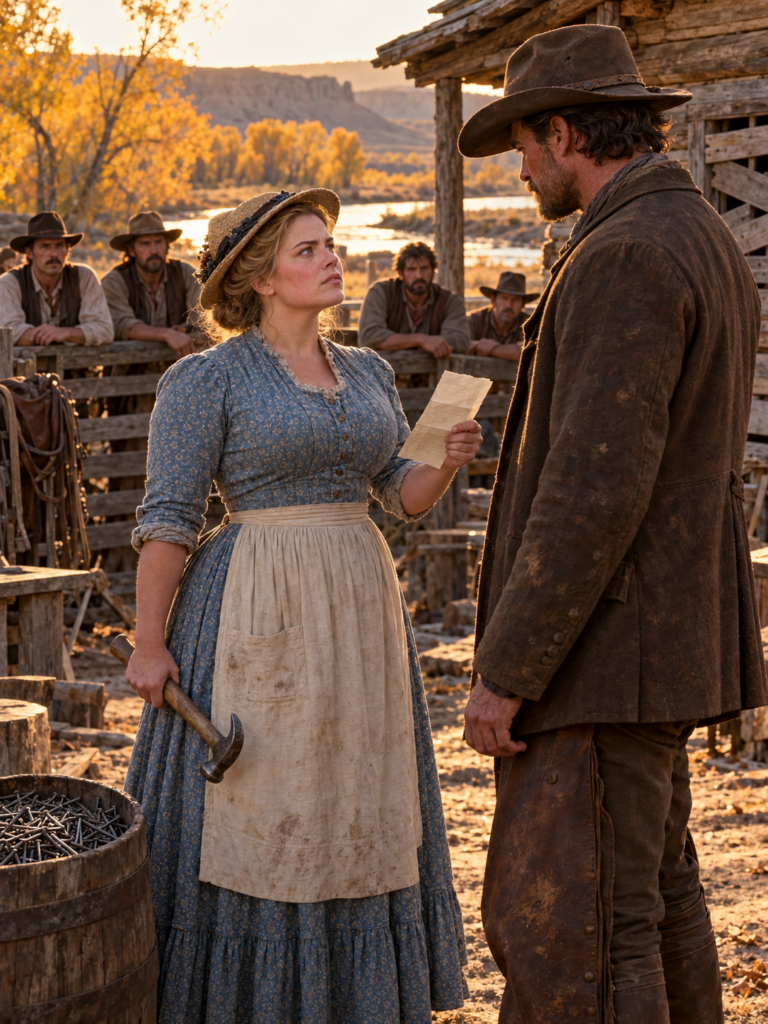
For a moment, she thought of the day she had stood in the Cutbank yard with a hammer in her hand.
Wes had believed she was the wrong person for his kitchen.
Sloan had believed she could be sent away with a written order.
Prothero had believed a cook would never understand the papers controlling the land.
But her years of counting hotel expenses, reading contracts, and keeping business records had brought them all to this moment.
Kirby signed.
He declared the Forks House in actual daily use as a public establishment.
The building satisfied the occupancy condition.
There would be no cancellation on account of its closure.
Wes lowered his head.
For the first time in weeks, the strain left his shoulders.
Prothero turned away.
He walked out into the falling snow without finishing his meal.
Nobody followed him.
The room was silent for a moment.
Then Ezra Tol lifted his coffee cup.
“Well,” he announced, “if the railroad’s finished inspecting dinner, I’d be obliged to have another helping.”
The laughter came quickly.
Ida returned to her range.
She filled another plate.
Then another.
And the supper she had cooked to preserve a building became a celebration among men who had helped preserve an entire ranch’s future.
By dusk, the snow had stopped.
The visiting riders mounted and departed along the river trails.
Ezra Tol was among the last to leave.
He thanked Ida for bringing the old place back to life.
Then he promised to return during the spring roundup.
She told him the ledger would be waiting.
He laughed and rode away.
Wes remained on the porch beside her until the last horses disappeared.
The evening was very still.
Snow rested on the fences and the branches of the three cottonwoods.
The warm spring continued flowing through its stone-lined channel.
Wes looked toward it.
“Fourteen hundred cattle,” he said quietly.
Ida nodded.
“That’s what almost disappeared because of a sentence in a lease.”
He turned toward her.
“No. That’s what stayed because you read the sentence.”
She considered his words.
Then she answered, “Because a great many people decided the truth mattered.”
Wes accepted the correction.
They stood together for another moment.
Then Ida went inside to put away the dishes.
Three weeks later, a letter arrived from Bismarck.
The railroad land department had refused the Northern Plains Land and Cattle Company’s application to purchase section seventeen.
It also removed the unauthorized restrictive wording from the Cutbank lease, restoring the printed terms for the remainder of the ten-year agreement.
The papers concerning Gideon Sloan were referred to the territorial attorney.
The Northern Plains company dismissed Prothero after reviewing the correspondence that implicated him in the scheme.
The local bank, having received the inspector’s report and supporting legal explanation, extended the Cutbank’s note for another year.
The ranch would not be forced into ruin by the loss of its winter water.
And throughout that winter, the fourteen hundred cattle of the north herd came to the Forks spring.
The water continued flowing beneath the frost.
The animals drank there when the creeks farther out were frozen.
They survived the winter thin, but alive.
Ida remained at the roadhouse.
Not because she had nowhere else to go.
Because she had begun to build the place she wanted.
Visitors came whenever weather and travel permitted.
Wendel Ames found new surveying work and continued stopping for meals when he passed through the district.
Dub Tatum sometimes helped with cooking.
Neil Hardesty learned to manage the box elder smoke fire.
Ansel carried provisions and took particular pride in knowing how to judge Ida’s bread.
The old room grew busier.
But one matter remained unsettled.
Wes had promised to discuss Ida’s future once the dispute was resolved.
On the Sunday following the inspection, he came down carrying a folded paper.
Ida was reviewing the week’s accounts at the end of the longest table.
He placed the paper before her.
“I wrote this myself,” he said.
She looked at him.
“Did you read it?”
“Several times.”
“Good.”
He sat while she examined it.
The proposal was generous.
Sixty dollars a month to remain as cook at the Forks.
In addition, she would receive one-third of the profits from public meals.
Employment for as long as she wished to remain.
There were many women who would have been grateful for such an arrangement.
Ida understood that Wes meant well.
But she folded the paper and laid it aside.
“No.”
Wes looked startled.
“Is the wage too low?”
“No.”
“Then what is wrong?”
“It still makes me your hired cook.”
He leaned back.
“That’s what you came here to be.”
“It’s what I came here hoping would lead to something better.”
She brought out her notebook.
Inside were the figures she had been calculating since her first night beneath the cottonwoods.
The cost of provisions.
Expected trade during the spring and fall roundups.
The annual value of an operating public house.
Maintenance expenses.
And the amount she could reasonably pay for ownership.
Wes examined the pages.
Ida turned to the final proposal.
“I want to buy half the building.”
He looked up.
“The Forks?”
“Yes.”
“Why buy it? After what you’ve done, I’d gladly give you a share.”
“I know.”
“Then why spend money you don’t need to spend?”
She rested her hand upon the notebook.
“Because I lost my father’s hotel when other people controlled the papers. I don’t intend to build another business on someone’s generosity alone.”
Wes was quiet.
“A thing you own under a fair agreement can’t simply be withdrawn because a man changes his mind.”
He nodded.
“All right. Tell me the terms.”
She did.
Wes had paid 110 dollars for the old building.
Ida proposed purchasing half for 55 dollars, paid from her trade by the end of the following summer.
The ranch would retain the other half and its interest in maintaining the public establishment.
Ida would operate the roadhouse under her own name.
The Cutbank would sell her dressed beef at an agreed price.
She would feed the ranch hands at cost.
The public trade would belong to her business.
Both parties would contribute to the upkeep of their shared building.
Wes studied the figures carefully.
“Seven cents a pound for dressed beef?”
“Yes.”
“Eight.”
“Seven, and I’ll smoke the ranch’s winter beef without charging for the smokehouse labor.”
He considered the offer.
Then he smiled.
It was the first full, unguarded smile she had ever seen from him.
“You drive a hard bargain, Miss Branock.”
“I know my costs, Mr. Garrow.”
He tapped the page.
“Then I suppose we’re partners.”
Ida held out her hand.
“Equal owners of the building. Separate responsibilities for the trade. And every term in writing.”
Wes shook it.
“Every term.”
They drew up the agreement.
On the following Saturday, they traveled to Lodgepole.
Agnes Puit read the document and witnessed their signatures.
Leif Corbin and Ezra Tol also witnessed it.
When the final page was signed, Ida looked down at her name.
Ida Branock.
Not the abbreviated signature she had once used so merchants would imagine a man.
Her own full name.
Attached to a business she would help own.
For a long moment, she could not speak.
Agnes seemed to understand.
She put away her seal and quietly wished them success.
The following Monday, Wes arrived at the Forks with a large wooden crate in the ranch wagon.
He unloaded it himself.
Ida came out to watch.
“What is that?”
“Something for the kitchen.”
He carried the crate inside and pried it open with the same claw hammer she had been handed in humiliation that first day.
Inside lay a new cast-iron grate made to fit the old range.
Alongside it were twelve joints of stove pipe.
Ida stared.
“The firebox.”
“It needed replacing.”
She knelt beside the crate.
She remembered writing that repair into her notebook on her first night.
The cracked grate had troubled her ever since.
But the equipment was expensive.
She had intended to purchase it once the business made enough money.
Wes handed her the freight bill.
She examined the order date.
September twenty-ninth.
Only ten days after her arrival.
Before the great roundup meals.
Before the land dispute became clear.
Before Wes had publicly defended her.
Before they had become partners.
“You ordered this back in September?”
He nodded.
“Why?”
He looked toward the range.
“I saw your notebook that evening when I brought my plate back.”
“And?”
“You’d written that the stove was worth repairing.”
Ida waited.
“So I ordered the parts.”
She turned the freight bill over.
“Did you charge them to the ranch?”
“No.”
He almost smiled.
“I bought them myself.”
Ida looked at him.
“You hadn’t even decided whether I could stay.”
“That’s true.”
“Then why spend the money?”
Wes thought for a moment.
“Because you saw a future in this place when I could only see an old building.”
The answer settled quietly between them.
He had made many mistakes.
Some had hurt her badly.
But he had also begun to recognize her work long before he found the words to praise it.
Ida rose.
The kitchen was quiet.
Outside, the bare cottonwoods moved against a pale winter sky.
Wes remained beside the crate.
“Ida,” he said.
She turned.
“I’m not asking for anything because of the business. I know what you’ve worked for, and I don’t want you thinking you owe me a place in your life beyond what you’ve chosen.”
She held his gaze.
He continued.
“But if you ever want more than a partner in the Forks House, I’d be grateful to be considered.”
He glanced toward the signed agreement on her desk.
“And I’d read every condition before agreeing.”
Ida felt herself smile.
“In writing?”
“In writing.”
She stepped around the crate.
Then she offered him her hand.
It was not a promise to surrender her business.
Not a decision made from gratitude.
Not an answer to loneliness.
It was simply the first honest gesture toward a future they might choose together.
Wes took her hand gently.
They stood that way for a moment.
Then Ida looked toward the stove.
“That grate isn’t going to put itself in place.”
Wes removed his coat.
“No, ma’am.”
And together they began the work.
Spring came late to the Little Missouri.
When it arrived, the river broke free of ice, the cottonwoods put out their first leaves, and the prairie turned green between the badlands.
The north herd came through winter.
All fourteen hundred animals had survived, though they needed the spring grass to regain their condition.
In April, the Cutbank sold steers at a stronger price than the distressed fall market would have offered.
The proceeds allowed Wes to pay the first half of his bank note a year early.
The ranch was recovering.
The Forks House was thriving.
Above its door hung a new sign.
Ansel had painted it during the winter, taking extraordinary care with the spacing of Ida’s name.
It read Branock’s Forks House.
Gus Linkfist’s old sign was preserved inside above the kitchen entrance.
Ida wanted it there.
The building belonged to a longer story than either of its new partners.
Gus had fed travelers for years.
Wes had preserved the property.
And Ida had restored its purpose.
The tables filled again when the spring roundup riders arrived.
Some came from the Cutbank.
Others rode many miles along the river.
Ezra Tol returned, as promised.
He examined the new sign, signed the guest ledger, and ordered supper with the solemn importance of a man inspecting a cherished tradition.
Ida served him roasted beef, soft beans, and biscuits.
Ezra tasted the meal.
Then he leaned back.
“Reckon Gus would have argued with your prices.”
“He’d have been welcome to,” Ida replied.
The old man laughed.
“But he’d have liked the food.”
“So you keep telling me.”
“And I’ll keep telling you.”
The room filled with conversation.
Neil Hardesty helped bring in wood.
Dub checked the beans.
Ansel carried plates.
Wes arrived from the range and sat near the door, where he had sat on his first visit.
But he did not remain silent this time.
He spoke to the men.
Asked about their cattle.
Laughed at their stories.
And when Ida needed another kettle lifted from the range, he rose to help without being asked.
Later, when the rush eased, he came to stand beside her.
“Busy?”
“Very.”
“Need anything?”
She looked around the kitchen.
The new grate burned evenly.
The stove pipe drew properly.
The shelves were stocked.
Her ledger was balanced.
And above the doorway, her own name told every traveler whose establishment he had entered.
“Another sack of flour tomorrow,” she said.
“I’ll fetch it.”
“And don’t let Sloan’s replacement make the order without checking it.”
Wes smiled.
“I’ve learned that lesson.”
Ida looked toward the long tables.
There was a time when all she had wanted was a kitchen no one could take from her because of her sex.
Now she had something more.
A business she partly owned.
Customers who valued her work.
Friends who had stood beside her.
And a man who had learned that respect was not something to grant when convenient, but something to practice when it was difficult.
Wes reached for her hand.
He did not take it without invitation.
Ida placed hers in his.
Outside, horses shifted along the hitching rail, and the river ran steadily past the cottonwoods.
Inside, another hungry traveler entered.
Ida greeted him.
“There’s a place at the table.”
The man removed his hat.
He had ridden nearly fifty miles.
He had heard that the finest beef supper on the Little Missouri could be found at the Forks.
Ida smiled and turned toward the stove.
She had arrived in Dakota with a crock of sourdough, a notebook, and a hammer she had never asked for.
Now that hammer hung beside the range as a reminder of what she had refused to let others decide.
The roadhouse remained open.
The ranch remained secure.
And the woman once ordered to board up its windows had finally found the door she intended to keep open.
Under her own name.