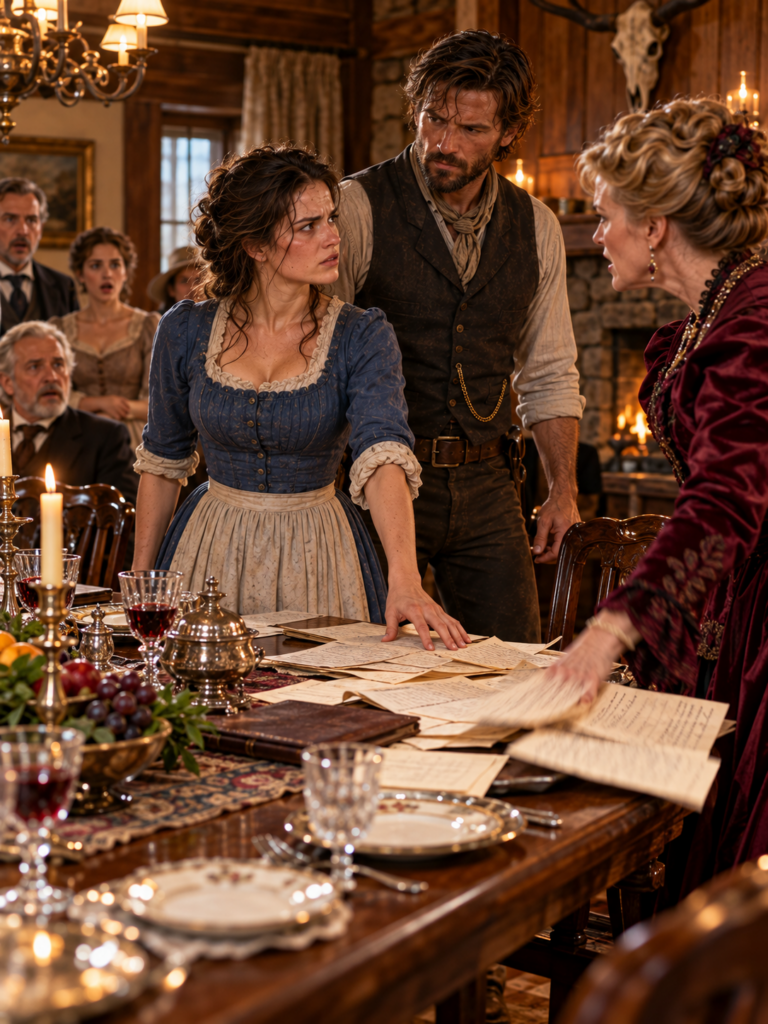
Duncan Pierce stopped with his fingers inches from the receipts beneath Lillian’s hand.
For a moment neither moved.
Then he straightened and looked at her as though she had committed an offense.
“I’ve managed this ranch for eleven years,” he said. “I don’t require permission to handle its records.”
“And I’ve been hired to examine them. Moving the documents before I’ve recorded their order makes that harder.”
His mouth tightened.
“You’ll find these accounts are more complicated than washing sheets.”
“Then I should get back to them.”
Duncan left without another word.
Lillian waited until his footsteps faded before lifting her hand.
She had no proof that he meant to interfere. The man might simply resent having a stranger examine work he had supervised for years.
She would not turn dislike into an accusation.
By afternoon she had separated the delivery records by route and date.
A pattern emerged.
Most western-route entries matched the expected wagon schedule.
But roughly one in five carried a date that did not.
She copied the discrepancies into columns, then compared them with the supplier receipts.
At four o’clock Everett returned.
He found her sitting among stacks of papers, a half-eaten biscuit beside her pencil.
“Have you learned anything?”
“Something worth checking.”
She turned her figures toward him.
Several deliveries had supposedly arrived before the wagon assigned to carry them could have reached the ranch.
Everett examined the dates.
“Bad bookkeeping?”
“Possibly. But bad bookkeeping doesn’t explain why the mistakes keep appearing on the same route.”
“What does explain it?”
“That’s what I intend to discover.”
He studied her.
Then he asked whether the ranch inventory would help.
“Who prepared the last one?” she replied.
Everett hesitated.
“Duncan.”
Lillian made a note.
“Then we’ll compare the inventory with the supplier papers.”
He watched her write.
“You don’t trust my foreman?”
“I haven’t said that.”
“You’re thinking it.”
“I’m thinking your records should answer the question before either of us does.”
Something changed in Everett’s expression.
He had expected competence.
He had not expected such caution from a woman who had every reason to resent the foreman’s treatment of her.
“I’ll tell the men not to disturb the room,” he said.
After he left, Lillian returned to the deliveries.
She worked until the afternoon light faded.
The next morning she arranged the documents across two tables and part of the floor, leaving narrow paths between them.
From the doorway, Gus Mercer, an older ranch hand, watched her studying the rows.
“Looks like you’ve scattered the whole office.”
“I’ve put it where I can see it.”
Gus examined the carefully marked paths.
Then he nodded.
“Mr. Callahan says supper’s in an hour.”
“Thank you. I’ll be going home.”
He disappeared.
An hour later he returned with coffee and set a cup where it wouldn’t touch the documents.
Lillian looked up in surprise.
Gus gave a brief nod and went away.
She smiled despite herself.
Later that day, she found correspondence from a hauling contractor responsible for northern deliveries.
One letter referred to revised contract terms.
Another contained a name altered beneath darker ink.
Only the first letter remained faintly visible.
A P.
She thought immediately of Pierce.
Then she shook her head.
A single letter proved nothing.
She set the document aside for verification.
When Everett appeared that evening, she asked for access to the older supplier contracts.
He took her to a cabinet in his study.
There she found the agreement renegotiating northern-route deliveries fourteen months earlier.
The date matched the beginning of the suspicious entries.
The signatures belonged to Everett and Duncan.
That was important.
But it still didn’t prove theft.
She carried the contract back to her table.
Everett followed.
“What else do you need?”
“Payment records. I want to see whether money left the ranch for goods the suppliers never delivered.”
“Will that take long?”
“Longer than guessing. Less time than repairing an accusation made wrongly.”
He accepted the answer.
The following morning, Lillian began examining disbursements.
Each ordinary-looking entry led her to another receipt.
Each receipt required another comparison.
By late afternoon, she found a payment for two hundred twelve dollars listed as a northern-route supplier adjustment.
It bore Duncan Pierce’s authorization.
She checked the corresponding delivery.
There was no matching receipt for the goods.
Her pulse quickened.
She looked again at the contract.
Then the payment.
Then the date.
Fourteen months.
One altered route.
One authorized withdrawal without a matching delivery.
It was not yet a complete case.
But it was the first solid indication that the irregularities involved more than careless recordkeeping.
Outside, the ranch hands were bringing horses into the corral.
Lillian turned the page carefully and began tracing the next payment.
She had barely reached the following month when Gus appeared in the doorway.
“Miss Avery, there’s something you ought to know.”
She looked up.
He glanced toward the hall.
“Pierce has been asking the men when you come and go.”
Lillian’s pencil stopped.
Gus lowered his voice.
“And whether you’ve been carrying any of those papers home.”
She closed the ledger over her place marker.
Now the question was no longer only what the accounts contained.
Someone responsible for those accounts was watching how closely she examined them.
Lillian kept her hand on the closed ledger.
“Did Mr. Pierce say why he was asking?”
Gus shook his head.
“No. Just thought you ought to know.”
“Thank you.”
After he left, she reopened the book.
She would not allow Duncan’s curiosity to become proof of wrongdoing. But she would take care to preserve her notes and keep Everett informed.
That afternoon, she discovered another questionable withdrawal.
One hundred thirty-seven dollars.
Again, northern-route expenses.
Again, Duncan’s signature.
Again, no corresponding delivery that could justify the payment.
A third entry, ninety-four dollars, appeared in an older expense summary.
Three payments.
Four hundred forty-three dollars.
All linked to the same supply arrangement.
Lillian copied the figures and compared the signatures.
Then she assembled a single page showing the sequence: the revised contract, the inconsistent delivery dates, and the withdrawals.
She carried it to Everett’s study.
He read silently.
“Duncan signed these.”
“Yes.”
“Are you saying he stole the money?”
“I’m saying these payments lack the supporting records they should have. You need to know that before deciding what they mean.”
Everett placed the paper down.
For eleven years Duncan had been his foreman.
He had supervised difficult seasons, settled disputes among hands, and helped make Callahan Ranch a substantial cattle operation.
The amount of money troubled Everett.
But the possibility of betrayed trust troubled him more.
“Why didn’t you come sooner?”
“Because earlier I had mismatched dates. Now I have payments attached to them.”
Everett sat back.
“I need to consider this.”
“Of course.”
She began gathering the papers.
Before she reached the door he spoke again.
“You were right to wait.”
Lillian stopped.
He had not praised her brilliance.
He had recognized her judgment.
That meant far more.
The following morning a notice arrived at her rented rooms.
Tommy was eating breakfast when she opened it.
The letter demanded full payment of the outstanding debt left by their father’s homestead, including the interest claimed by the creditor, within sixty days.
The name of the creditor had changed.
Whitmore Agricultural Holdings.
Lillian read it twice.
Margaret Whitmore’s family now controlled the debt that threatened what little remained of the Averys’ security.
Tommy noticed her expression.
“What’s happened?”
“An account that needs attention.”
“Is it father’s?”
She hesitated.
“Yes.”
He looked toward the schoolbooks beside his plate.
“I could earn more at the livery.”
“Finish your breakfast.”
“Lily—”
“You’re going to school.”
He understood that she would not change her mind.
When he left, Lillian sat alone and calculated the amount demanded.
It exceeded several months of her new wages.
She had been making partial payments faithfully.
Now those efforts seemed suddenly inadequate.
She could not prove Margaret had purchased the debt merely to punish her for working at Callahan Ranch.
But the timing was difficult to ignore.
That afternoon Everett noticed her distraction.
She told him about the letter.
He immediately offered to advance enough money to help.
“No,” she said.
“It would be an advance, not charity.”
“It’s still my obligation.”
“Margaret may be using it against you because of your work here.”
“Then I’ll deal with her on proper terms.”
Everett leaned forward.
“You don’t have to struggle alone.”
Lillian’s eyes grew bright, though her voice remained steady.
“I know what you’re offering. But if you pay my family’s debt, people will say you hired me out of pity. My work must stand on its own.”
He was quiet.
Then he nodded.
“I understand.”
She believed he did.
And because he did, she felt the strange ache of wanting to trust him with more than she had intended.
Over the following days she continued the investigation.
Her notes became a careful account of fourteen months of northern-route transactions.
Seven separate disbursements lacked proper supporting documentation.
The total came to six hundred eleven dollars.
Each individual entry looked ordinary enough when read alone.
Together, they revealed a method.
Delivery dates had been recorded inaccurately.
Payments had been authorized under routine supplier adjustments.
The relevant documents had been spread across separate files, where casual examination would never bring them together.
Duncan’s access had allowed the irregularities to continue.
And now he was asking questions about the woman examining them.
When Lillian finished her eleven-page report, she carried it directly to Everett.
He read every page.
She remained by the window, watching the working yard beyond the glass.
At last he put down the final sheet.
“Six hundred eleven dollars.”
“That’s what the records establish.”
“And every one of those payments bears Duncan’s authorization.”
“Yes.”
Everett closed his eyes briefly.
Then he rang for his foreman.
Lillian returned to the records room while the two men spoke privately.
Their conversation lasted nearly twenty minutes.
She heard raised voices once.
Then the front door closed heavily.
Everett was standing beside his study window when she returned.
“He admitted taking the money,” he said.
Lillian stood still.
“He believed his wages didn’t reflect his importance to the ranch. Instead of asking for an increase, he decided to take what he thought he deserved.”
“I’m sorry.”
Everett shook his head.
“You warned me not to mistake suspicion for proof. You were right.”
He explained that Duncan had been dismissed and given a limited period to arrange repayment before Everett decided whether to involve the sheriff.
The matter was not completely settled.
Trust lost over eleven years could not be restored by a promise.
But the dishonest arrangement had ended.
Everett looked toward the reports on his desk.
“Someone must build a proper system to prevent this happening again.”
“Yes.”
“I want you to do it.”
Lillian studied him.
“On what terms?”
“An ongoing position. Fair pay. Authority to review deliveries and accounts independently.”
“And access to the records without interference?”
“Yes.”
She thought of the rented house.
The unpaid bills.
Tommy’s schooling.
She thought of the years spent washing other people’s clothing while her mind searched for work worth doing.
“I’ll consider it.”
Everett accepted that.
Her continued employment developed from a professional offer, not an obligation.
She helped establish clearer rules for recording actual deliveries, matching quantities to invoices, and requiring the correct authorization for payments.
Gus began checking shipments more carefully.
Calvin learned to maintain the updated delivery log.
The room that had once been nearly impossible to navigate gradually became orderly.
Lillian found genuine satisfaction in teaching others to recognize discrepancies.
She was no longer merely correcting mistakes.
She was helping prevent them.
But the more she worked beside Everett, the harder it became to understand where her professional duties ended and her private feelings began.
One evening he asked about her mother’s teaching.
Lillian told him how her mother had insisted that accepting help could become a dangerous kind of debt.
Everett listened.
“Did you believe her?”
“For a long time.”
“And now?”
“I think she was protecting us the best way she knew.”
He did not press her further.
His restraint made her trust him more.
Margaret Whitmore noticed the growing closeness.
She began telling prominent families that Lillian had gained improper influence over Everett’s household.
At church, conversations stopped when Lillian entered.
At the store, women whispered about the rancher’s new employee.
Then Margaret appeared at Callahan Ranch during a gathering of local business acquaintances.
She watched Lillian discuss the new accounting arrangements with Everett.
Her expression cooled.
“It’s remarkable,” Margaret remarked, “how quickly a girl can improve her position when a wealthy gentleman takes an interest.”
Lillian answered evenly.
“My position depends on the work I’m paid to perform.”
Margaret smiled without warmth.
“Of course it does.”
Everett heard the exchange.
He made clear that Lillian’s authority concerning the accounts came from his decision to employ her and the quality of the work she had completed.
But Margaret did not withdraw.
Instead, she turned to the guests.
“Then perhaps we should all see these extraordinary papers that are apparently worth more than years of experience.”
Before anyone could stop her, she reached across the dining table.
She gathered Lillian’s carefully prepared report and lifted it before the room.
“Ladies and gentlemen,” she announced, “perhaps someone will explain why a laundry girl has been permitted to interfere in a cattleman’s business.”
The papers struck the polished table.
Several guests laughed.
Lillian remained seated.
Across from her, Everett slowly pushed back his chair.
This was the moment she had feared.
Not because she doubted her calculations.
But because she still did not know whether the man who trusted her privately would stand beside that trust before everyone who thought she belonged beneath them.
Everett rose.
He looked first at Margaret.
Then at the scattered papers.
Then at Lillian.
And when he spoke, his voice carried through the suddenly quiet room.
“Miss Whitmore, those are the records of the woman who discovered that my own foreman had been taking money from this ranch for fourteen months.”
Margaret Whitmore’s smile vanished.
Across the dining table, one gentleman slowly lowered his glass.
Everett remained standing.
“Miss Avery found discrepancies that passed unnoticed through years of ordinary review. She traced the deliveries, examined the payments, and brought me evidence I could verify. Duncan Pierce admitted taking the money.”
A murmur moved through the room.
Margaret glanced at the pages she had thrown onto the table.
“Surely that doesn’t mean—”
“It means the papers you dismissed contain work that protected this ranch,” Everett replied.
He did not raise his voice.
That made the words impossible to ignore.
He turned toward Lillian.
“Miss Avery, would you explain the relevant figures?”
She looked at him.
For an instant, the room seemed very far away.
She remembered the forty-one cents on her kitchen table.
Margaret laughing outside Harlland’s.
Duncan ordering her away from the ranch.
And Everett opening the door.
Now he had opened something more difficult.
He had given her the opportunity to speak as the person who knew the work best.
Lillian rose.
She gathered the scattered pages into their correct order.
Her hands were steady.
“The first difficulty was with delivery dates,” she began.
She explained that several recorded receipts did not match the regular wagon schedule.
The discrepancies appeared repeatedly on the northern route rather than being scattered randomly across the records.
When she compared the dates with supplier correspondence, she found that the irregularities began near the time a hauling agreement had been renegotiated.
Further examination uncovered payments entered as routine adjustments, without the necessary supporting receipts.
The entries were ordinary-looking when considered separately.
Together they revealed unauthorized withdrawals.
She placed the relevant page before the guests.
“That’s the evidence I was hired to examine. It wasn’t necessary for anyone to believe me because of who I am. The records could be checked.”
A quiet older gentleman at the far end of the table leaned forward.
“And Mr. Pierce admitted the withdrawals?”
Everett answered.
“He did.”
The gentleman looked at Lillian.
“Then your work deserves recognition.”
“Thank you,” she replied.
She did not look triumphantly toward Margaret.
Her purpose had never been to humiliate another woman.
She wanted her work understood.
Margaret had one final objection.
“Still, there are proper ways of conducting business. It seems unusual to place such trust in someone without a recognized standing in the county.”
Lillian held her gaze.
“My standing won’t change a false delivery date into a true one.”
A few guests smiled.
This time they were not laughing at her.
Margaret’s expression remained composed, but she offered no answer to the arithmetic.
Everett picked up the report and returned it to Lillian.
“These records belong in the office,” he said. “Not in a room where they can be used to embarrass the person who prepared them.”
The gathering continued, though its atmosphere had changed.
Several guests approached Lillian to ask practical questions about the delivery system.
She answered without exaggerating what she had accomplished.
By the time the last visitor departed, Margaret had gone without another confrontation.
Everett found Lillian gathering her coat.
“I’m sorry that happened here.”
“You didn’t arrange it.”
“No. But she was my guest.”
Lillian studied him.
“You stood by the work.”
“I should have done that.”
She shook her head.
“You might have said you trusted me and left the proof on the table. Instead, you let me explain it.”
“Because you knew it better than I did.”
Something warm and painful moved through her chest.
There had been times when she had wanted someone to rescue her from embarrassment.
But what she needed more was the right to be taken seriously.
Everett had understood the difference.
Yet public recognition did not solve every problem.
The debt her father had left remained.
Whitmore Agricultural Holdings still expected payment.
And Margaret’s social influence had not disappeared simply because her attempt to humiliate Lillian had failed.
In the following weeks, further difficulties arose around business relationships connected with Callahan Ranch.
The Whitmore interests applied pressure where their influence reached.
A land-related claim also complicated matters before the relevant agreements were examined.
Lillian studied the documents as carefully as she studied the ranch accounts.
She did not assume that every disagreement was dishonest.
A creditor could enforce a valid obligation.
A business associate could negotiate for more favorable terms.
The question was what each written agreement actually allowed.
That distinction became increasingly important when Everett offered financial help.
He continued to believe that some of the pressure on Lillian existed because she worked for him.
At one point, payments he made helped reduce the immediate debt burden, but the remaining obligation was still hers to address under the arrangements they had accepted.
She never regarded those payments as the price of affection.
Nor did she allow them to become an excuse for abandoning her own financial plans.
She kept accounts of what remained outstanding.
Every dollar mattered.
Meanwhile her work at Callahan Ranch expanded.
The new purchasing controls began producing reliable records.
Delivery dates were checked against wagon schedules rather than merely copied from supplier paperwork.
No single employee could move money through the accounts without leaving a clear record of authority and supporting receipts.
The northern hauling arrangement associated with the earlier irregularities was eventually terminated.
A new route was established through Ridgeline Depot.
The deliveries arrived on a different regular schedule, and Calvin recorded the changes.
Gus took satisfaction in checking quantities against the written receipts.
He sometimes appeared beside Lillian’s table with coffee, as he had during her earliest weeks.
One afternoon he looked over her completed arrangements.
“Never thought I’d see the day I understood this many figures.”
“You’ve always understood what actually arrived,” she replied. “Now the paper will agree with you.”
Gus smiled.
“That sounds sensible.”
For Lillian, his respect mattered as much as that of the wealthier guests.
He knew the work.
He could recognize when it had become better.
But the question of whether she should remain at Callahan Ranch became less simple as the months passed.
Her original assignment had been temporary.
She had agreed to investigate a specific problem.
Now that problem was solved and the new system was in place.
The money was useful.
The work was satisfying.
And Everett had become important to her in a way she had not planned.
She began to fear that she could no longer separate the position she held from the feelings she had developed.
It was not Everett’s conduct that frightened her.
It was her own uncertainty.
If she remained, would she be staying because she had found meaningful work?
Or because she could not bear to leave him?
If she left, would that be a free decision?
Or another example of refusing something good before it had the chance to hurt her?
One evening Gus mentioned that she had been at the ranch nearly six weeks.
The number startled her.
She had promised herself three.
That night she went home and prepared a complete set of instructions for maintaining the records system.
She organized the supplier files, listed outstanding questions, and explained the authorization procedures so that others could continue without her.
Tommy watched from across their kitchen table.
“Are you leaving the ranch?”
“I think it’s time.”
“Did Mr. Callahan do something?”
“No.”
“Then why?”
Lillian looked down at the papers.
“Because I need to know I can choose what comes next without being afraid of losing the place I’ve found.”
Tommy frowned.
“That sounds a little like leaving because you’re afraid.”
She didn’t answer immediately.
Her younger brother had grown up too quickly.
Sometimes he saw through her with uncomfortable accuracy.
“I need to think about that,” she admitted.
The following morning she delivered the handover documents to Everett.
He read them.
Then he looked up.
“Are you giving notice?”
“Yes.”
He set the papers down.
“Is there something wrong with the position?”
“No.”
“The wages?”
“No.”
“Then I’d like to understand.”
Lillian stood beside the desk.
“The work has changed. So has my attachment to it. I need to settle my own affairs and decide what I want without feeling that I must stay because you’ve been good to me.”
Everett watched her carefully.
“You don’t owe me your future because I hired you.”
“I know.”
“Then you may leave knowing the work was valuable.”
Her throat tightened.
He did not persuade her to remain.
He did not make a declaration that would turn her departure into a test of love.
He accepted the choice she had made.
And because he accepted it, leaving became unexpectedly difficult.
The weeks after her departure were quieter.
Lillian returned to the work available in town while arranging her finances and considering better uses for her accounting abilities.
She continued paying what she could toward the remaining Whitmore obligation.
The demand had frightened her, but she would not allow fear to distort the calculations.
She reviewed the terms, sought clarification when necessary, and measured each payment against her actual income.
Tommy continued in school.
He had begun watching surveyors working in the county and asking questions about their trade.
Lillian encouraged him to learn what training was required.
She would not allow their father’s mistakes to become a reason for her brother to surrender his future.
At the ranch, Everett followed the procedures she had established.
He occasionally found himself reaching for an answer he knew she would have supplied immediately.
But instead of asking her to return, he worked through the problem or consulted the handover papers.
The system functioned.
That was the strongest proof that Lillian had done her job properly.
Duncan Pierce began making payments toward the money he had taken.
They were not always as prompt as Everett expected.
But they came.
Later examination of older records revealed two additional withdrawals, raising the known total beyond Lillian’s original finding to seven hundred forty-three dollars.
Everett recorded the amounts carefully.
He had learned the cost of trusting without verification.
He had also learned that accountability need not require needless cruelty.
Duncan’s wrongdoing remained wrongdoing.
His efforts to repay did not erase it.
But they were part of what happened afterward, and Everett chose to record them fairly.
The Whitmore-related land claim eventually reached an end.
Other commercial pressures began easing as the relevant parties returned to the actual agreements governing their dealings.
When a dispute arose over the renewal of a business arrangement, Lillian reviewed the clauses and identified the language that supported continuation on the original terms.
She prepared a precise response.
The other party accepted.
No grand confrontation followed.
The practical problem simply closed.
That was the kind of outcome she preferred.
One afternoon Everett met her in Copper Falls.
He had come about ranch business, but when they spoke, neither pretended that accounts were the only subject between them.
“I’d like you to come to supper Thursday,” he said.
Lillian looked at him.
“At the ranch?”
“Yes. Not for work. Just supper.”
Two women from the Methodist congregation passed along the street.
Lillian noticed them looking straight ahead.
Once she would have spent the rest of the day wondering what they might say.
Now she found she was more interested in the man standing before her.
“Thursday,” she replied.
He nodded.
He did not demand a clearer answer.
She walked away thinking about the difference between an invitation and an obligation.
On Thursday evening she reached Callahan Ranch at half past six.
The familiar buildings looked unchanged.
The barns stood where they always had.
Horses moved behind the corral rails.
A light burned in the kitchen.
Everett was inside when she arrived.
He looked up, and for a brief moment his usual composure deserted him.
“You came.”
“You invited me.”
“I know.”
He took her coat and hung it by the door.
They ate in the kitchen rather than the formal dining room.
Beef stew stood in a covered pot beside the stove.
The room was warm.
There were no guests to impress.
No reports to defend.
No one demanding an explanation for why she had been invited.
Everett asked about Tommy.
She told him of the boy’s growing interest in surveying.
Everett offered to ask an acquaintance in Denver about the schooling required.
This time Lillian did not refuse the information merely because it came through someone else’s kindness.
She thanked him.
They spoke of the changed freight arrangements.
She reminded him that Ridgeline deliveries came on Mondays and Thursdays.
He smiled.
“Calvin has the schedule.”
“Good.”
“And your instructions cover the checks.”
“Of course.”
Everett placed down his spoon.
“Lillian, you can have supper with me without discussing the ranch.”
She looked at him.
A small, unexpected laugh escaped her.
“I seem to have forgotten how.”
“Then we’ll learn.”
The simplicity of the remark made her quiet.
For years she had treated every good thing as a transaction whose true cost had yet to appear.
Here was a man who had offered her employment with clear terms, accepted her refusal of unwanted assistance, trusted her work publicly, and allowed her to leave when she needed to.
Now he offered a meal.
Nothing was demanded in return.
They talked for another hour.
About Copper Falls.
About his early years building the cattle operation.
About her mother’s careful household calculations.
About the way Tommy had begun noticing surveying stakes beside the road.
They did not solve their futures that evening.
They did not pretend affection would remove debt, work, distance, or the opinions of others.
But when Everett walked her to the gate, he held it open.
“Next Thursday?” he asked.
Lillian considered.
“Yes.”
She walked home carrying something she had not possessed during her first journey to the ranch.
Not certainty that nothing could hurt her.
Certainty that she could recognize what was real and make her own choice about it.
At home, she took the little tin containing her mother’s blue ribbon from the shelf.
She held the ribbon in her palm.
Her mother had taught her to be cautious.
That caution had helped them survive difficult years.
But Lillian now understood that refusing every offered hand was not the only way to remain independent.
She returned the ribbon to its tin.
Then she opened her account book and calculated another payment toward the Whitmore debt.
Her obligation had a balance.
It had a schedule.
It would eventually be settled through her own work.
She could make room for affection without confusing it with repayment.
The Thursday suppers continued.
At first they spoke often about the ranch.
Gradually, the conversations became more personal.
Everett learned which ordinary pleasures she had denied herself because money had always been needed elsewhere.
Lillian learned that the composed rancher could be uncertain, dryly amusing, and occasionally wrong.
They discovered they could disagree without one needing to withdraw.
Sometimes she arrived tired from a day’s work.
Sometimes Everett was distracted by cattle or supplies.
Neither demanded a perfect evening.
They built familiarity the way honest businesses were built: through small actions that could be trusted because they were repeated.
When the ranch needed occasional advice about an unfamiliar account, Everett asked whether Lillian wished to take the work.
If she agreed, it was paid.
If she declined, he accepted it.
Their companionship remained separate from the employment relationship she had once feared would define everything.
And her own working prospects grew as people began recognizing the competence that Callahan Ranch had brought into view.
The woman who had once been known mainly for laundry and mending could now point to complex accounts she had reconstructed, losses she had identified, and business procedures she had helped establish.
She had not become someone else.
She had finally found a place where what she already knew had value.
One evening, after another Thursday supper, Everett stood beside her at the gate.
The western sky had faded to violet.
A horse moved quietly in the nearby corral.
“There’s something I’ve wanted to say,” he began.
Lillian turned toward him.
He took his time.
“I care for you. More than I meant to when I first asked you to examine those books.”
She felt her heartbeat quicken.
He continued before she could answer.
“I don’t want you here because you saved my money. And I don’t expect you to return to work or change your life to suit mine.”
He looked at her steadily.
“I’d like to keep seeing you because I value your company. If that’s what you want too.”
She thought of Margaret Whitmore’s words in the dining room.
A laundry girl interfering in a cattleman’s business.
She thought of the papers scattered across the table.
Of Everett standing while everyone watched.
Of the countless quieter moments afterward, when he had demonstrated the same respect without an audience.
“I want that,” she said.
The words were simple.
They were also the most freely chosen words she had spoken in a long time.
Everett held out his hand.
She took it.
There was no need to make the moment grander than it was.
They had not agreed to marriage.
They had not promised away their separate responsibilities.
They had agreed to continue knowing one another openly, honestly, and without pretending their affection gave either person ownership of the other.
For Lillian, that was not an incomplete ending.
It was the beginning of a life in which she could be loved without becoming dependent, useful without being exploited, and independent without remaining alone.
Later, at home, Tommy found her sitting at the kitchen table.
Her account book was open.
The remaining debt had been carefully calculated.
Beside it lay her mother’s blue ribbon.
Tommy glanced at her face.
“You look happy.”
“I had a pleasant evening.”
“At the ranch?”
“Yes.”
He smiled slightly.
“Thought so.”
She returned to her figures.
But she was smiling too.
Outside, Copper Falls settled into darkness.
Its wealthy families still occupied the grand houses.
Its poorer families still worked hard for what they had.
Margaret Whitmore had not become kind simply because she had been contradicted.
And the world had not transformed overnight.
Yet something essential had changed.
Lillian Avery no longer measured her worth by the place others assigned her.
She had examined a set of records that experienced men overlooked.
She had uncovered a theft.
She had protected the honesty of her own work.
She had resisted the temptation to solve every problem through dependence on a wealthier man.
And when that man proved worthy of her trust, she had allowed herself to choose him without surrendering herself.
The following Thursday, she walked through the gate of Callahan Ranch again.
This time she did not stop on the porch steps waiting to be admitted.
Everett was coming across the yard when he saw her.
He smiled.
She walked toward him.
And the gate that had once marked the boundary between a poor working woman and a world that seemed determined to exclude her stood open behind her.
She had entered that world through her own ability.
She remained in it by her own choice.
And the man waiting for her understood the difference.