Etta held the folded account beneath the window, letting the afternoon light fall across the columns of figures.
Thirty-eight.
That was how many cattle the ranch accounts claimed had been slaughtered for the cookhouse since March.
She looked toward the empty plates stacked beside the washing basin.
For months, these men had been eating beans and salted pork.
Thirty-eight head of beef should have kept twenty-nine working cowboys supplied with fresh meat far more often than anyone remembered.
Something was wrong.
But suspicion wasn’t proof.
She folded the paper and slipped it into her apron just as Ignacio entered carrying another armload of dishes.
“Nacho,” she asked, “who keeps the livestock accounts?”
“Virgil Haskett. Came from Trinidad when the loan company arranged the borrowing.”
“And Mr. Fallon trusts him?”
Ignacio gave her a troubled look.
“The patrón trusts the figures he brings.”
That was not quite the same thing.
Etta said nothing more.
The following morning, she served hotcakes from her own sourdough starter.
While Amos ate, she asked whether he’d enjoyed much fresh beef during the summer.
He shook his head.
“A few times. Not enough to remember exactly.”
“Would you remember thirty-eight slaughterings?”
Amos nearly dropped his fork.
“Thirty-eight?”
Etta gave him another hotcake.
“Eat before it cools.”
After breakfast, she walked to the hide shed beside the corral.
Hides from cattle butchered at headquarters were salted and stored there until they could be sold.
She pulled back the covering and counted.
One.
Two.
Three.
By the seventh hide, she had reached the bottom.
She counted again.
Seven hides.
Thirty-eight slaughterings recorded.
Thirty-one animals unaccounted for.
At the autumn market price of twenty-four dollars a head, that represented seven hundred forty-four dollars in cattle.
And Ward Fallon already owed nine thousand four hundred dollars to a company in Trinidad.
Etta stood alone in the shed, smelling salt and old leather.
She understood what a dishonest entry could do to a business.
Her father’s railroad eating house had failed when the railroad moved its trade elsewhere. She had watched creditors examine every pan and chair while her father stood helpless in the doorway.
She had learned that a business could disappear on paper long before the doors were closed.
But she couldn’t yet know whether this was theft, careless bookkeeping, or something else.
That evening Virgil Haskett visited the cookhouse.
He wore a tidy gray suit and boots so clean they seemed foreign to the ranch.
“Mr. Fallon tells me you may remain through shipping,” he said pleasantly.
“That is the arrangement.”
“I’ll bring you the cookhouse figures. Naturally, with the ranch carrying such obligations, expenses must remain reasonable.”
“Then we’ll agree on the importance of accurate figures.”
His smile didn’t falter.
But his eyes rested briefly on her little black notebook.
After he left, Ward appeared in the doorway.
He held his hat low in one hand.
“Four men have withdrawn their notices,” he said.
“Good men need feeding.”
“Yes.”
His gaze moved toward the table where Etta had placed Lena’s old spice jars.
“You used the oregano.”
“It was sound. I hope you don’t object.”
Ward’s expression tightened, not with anger but with something she couldn’t name.
“Lena bought it herself.”
Etta waited.
“She kept the cookhouse accounts too,” he added.
“Then she must have known what every sack and every steer cost.”
Ward looked away.
For an instant, Etta almost asked why he no longer checked them himself.
Instead, she said, “I’d like permission to see the complete kitchen account.”
He considered her.
“Haskett handles that.”
“Then ask him to bring it.”
Ward eventually nodded.
It was a small concession, but Etta knew its worth.
A man who had sent her away on sight was beginning to let her examine his business.
Yet that made her responsibility greater, not smaller.
She had no intention of accusing another employee without proof.
That night, Haskett’s copied account lay across her cot.
She traced the repeated beef entries with her pencil.
Thirty-eight slaughterings.
Seven hides.
Thirty-one missing cattle.
Then she opened her own notebook and wrote the discrepancy in neat figures.
From the main house, a lamp shone through Ward’s office window.
She could walk over and tell him now.
But Haskett had kept his accounts for two years.
She had been there less than a week.
If she made one unsupported accusation, the man could simply change his books before anyone looked again.
Etta carefully closed the notebook.
She would not risk the ranch on a guess.
The next time she confronted Ward Fallon, she would have evidence he could hold in his own hands.
She rose from the cot, took her pencil, and began writing down the names of everyone who might know where thirty-one cattle had gone.
The first name Etta wrote was Ignacio Baca.
The second was Amos Keel.
The third was Adelina Ortiz, a hide dealer in Las Vegas whom she knew by reputation from her father’s railroad trade.
Then she drew a line beneath the names and wrote one instruction to herself.
Find the cattle before accusing the man.
Morning brought another problem.
Desmond Pike arrived from Trinidad in a fine buggy with two handsome horses and the manner of someone inspecting property he expected to acquire.
He was the loan company’s representative, and Virgil Haskett hurried down from the main house to greet him.
Etta watched from the cookhouse.
Pike examined the corrals, questioned Ward about the autumn shipping, and spoke privately with Haskett.
At dinner he ate heartily, praised the food, and then made a joke about the expense of keeping a woman who cooked like a railroad hotel chef.
Etta didn’t answer.
Ignacio quietly defended her work.
Ward remained silent.
His silence hurt more than she expected.
It wasn’t that she needed a rancher’s protection.
She needed him to acknowledge the truth about an employee whose work was saving his crew.
After Pike departed, autumn weather turned bitter.
A norther swept down from the mesa, bringing cold sleet that drove cattle toward the river bottoms.
When the riders returned after dark, they found beef ribs simmering in red chile and hot cornbread waiting beside the range.
Amos took one bite and stopped.
“My mother used to make bread with cracklings.”
“Then write and tell her you remembered,” Etta replied.
He looked embarrassed.
“I haven’t written in months.”
“I have paper. There’s a stamp somewhere in my bag.”
Rufus, sitting beside him, gave the younger man a reassuring pat on the shoulder.
Etta saw it and turned back to the stove.
These men had not needed extravagant meals.
They had needed someone to remember they were people.
Ward remained after the others finished.
He sat at the nearest bench while she cleaned a skillet.
“Haskett says you’ve been spending your own money.”
“On the first hog, yes.”
“Put future supplies on the ranch account.”
“I will, if I can see that account.”
He regarded her.
“Are you always this particular?”
“Only where money belongs to somebody.”
An almost-smile touched his face.
Then she asked about his loan.
He told her about the drought of 1886, the cattle he had lost, and the mortgage he had signed to keep the remaining herd alive.
The loan company required a minimum of sixteen hundred branded, yearling-or-older cattle at the autumn count.
If the herd fell below that figure, the full note could be demanded.
“Haskett tells me we’re above it,” Ward said.
“Have you counted?”
“I know my cattle.”
“That wasn’t my question.”
He grew quiet.
Finally he admitted he had seen the totals but not examined the individual entries.
Etta studied his tired face.
There was something painful beneath his anger whenever accounts were mentioned.
She did not understand it yet.
And she would not use it against him.
Several days later, Haskett brought the kitchen accounts into the cookhouse during dinner.
He read out the costs of oranges, sugar, flour, lard, and fresh pork.
He suggested that nine dollars be withheld from Etta’s wages.
The entire room fell silent.
Etta knew she could explain every charge.
She had recorded the spoiled flour, the purchases made with her own money, and the provisions that had persuaded men to withdraw their notices.
But Haskett wasn’t asking a question.
He was putting her on trial before twenty-nine witnesses.
Etta looked at Ward.
He said nothing.
Haskett left with his papers and his satisfied smile.
That evening, Etta found Ward examining a horse near the corral.
She waited until he set down the animal’s hoof.
“You told me to purchase what was needed.”
“I did.”
“Then your bookkeeper accused me before your men, and you let him.”
Ward looked uncomfortable.
“I didn’t accuse you.”
“You allowed the accusation to stand.”
He lowered his eyes.
Etta took a breath.
“My wages are not his to change without your authority. I can account for every purchase. But I won’t work under a man who publicly questions my honesty and refuses to let me answer.”
Ward said Haskett’s books had always balanced.
“Has anybody checked them?” Etta asked.
The question struck him harder than an accusation would have.
At last he told her to take the supply wagon to Las Vegas and purchase provisions for the drive.
She accepted the responsibility.
But neither of them considered their disagreement settled.
The journey to Las Vegas took her along the river road past farms, cottonwoods, and open grazing country.
Ignacio drove while she reviewed her list.
At the wholesale grocer’s she negotiated prices, inspected the flour, and bought only what the cookhouse needed.
The merchant mentioned that Haskett generally paid the listed prices without question.
Etta wrote that down.
Then she asked Ignacio to take her to Ortiz’s hide warehouse.
Adelina Ortiz was a widow who had managed the business herself for years.
She listened to Etta describe the missing cattle without interrupting.
Then she opened her records.
Nine hides bearing the Broken Ladder brand had been purchased that summer from Obadiah Sabin, a contractor supplying beef to railroad laborers.
Etta asked whether the hides carried vent marks showing that Ward had transferred the cattle.
Adelina led her into the warehouse.
Together they examined the salted hides.
All nine bore the familiar broken ladder on the hip.
None carried the additional mark expected on cattle lawfully transferred through the ordinary ranch trade.
Adelina’s face hardened.
She had documents identifying the seller, dates, and prices.
Etta now had proof that nine Broken Ladder cattle had reached Sabin.
But twenty-two remained unaccounted for.
And the missing vent marks raised a serious question about whether any of them had been sold with Ward’s authority.
Adelina offered to preserve the evidence and introduced Etta to Cyrus Went, a lawyer whose office overlooked the old plaza.
Mr. Went listened, examined the accounts, and explained what documents would matter in establishing title to the cattle.
If the animals remained alive and Ward had never authorized their sale, the ownership question might be decisive.
“Then we must find them,” Etta said.
“Before that mortgage count,” he agreed.
Over a cup of spiced chocolate, Adelina asked why Etta had traveled all the way from Arizona to cook on a ranch.
For the first time since arriving, Etta spoke freely of her own plans.
Her father had operated an eating house serving railroad passengers at Bitter Springs.
The railroad had moved its division point.
The passengers vanished.
The lease ended.
And the little business they had built was lost.
Etta had spent twelve years learning how to feed travelers quickly, preserve food properly, order economically, and keep accounts.
A cook named Refugio Amaya had worked beside her for years and taught her the Sonoran method of preparing pork with oranges.
Now Etta wanted to establish a provisions business of her own.
Potted pork.
Smoked beef.
Good bread for railroad eating houses.
She had saved two hundred twelve dollars.
She needed reliable meat, a working kitchen, customers, and time.
Adelina considered her.
Then she said she knew several people who would be interested in buying honest provisions.
Etta returned to the Broken Ladder with more than supplies.
She carried evidence.
She carried a possible future.
And for the first time, she realized those two things might be connected.
The autumn gather began on October twenty-fourth.
Cold rain turned the river bottoms into heavy mud.
Twenty-nine men rode through the brush, collecting cattle from the mesa and bringing them to the holding ground.
Etta took the chuck wagon to the flats.
She cooked beneath a canvas fly while rain struck the roof and the men worked long hours in wet clothes.
One evening Rufus approached her with a silver dollar.
He confessed that he had bet she would be gone within four days.
“Seems I lost.”
She tried to refuse the money.
He insisted.
Then he admitted his part in ruining the old cook’s sourdough starter months earlier.
“I didn’t know hot water would spoil it.”
“You do now,” Etta answered.
She promised to teach him to care for a new starter when hers was strong enough to share.
That night Ward joined her beside the dying fire.
He ate a bowl of her stew.
Then he told her about Lena.
His wife had kept the ranch accounts from the beginning.
Every Sunday she had written the figures while he worked beside her.
After her death, Ward had found her handwriting still filling the last page of the ledger.
He couldn’t bear to open it.
He had abandoned the books rather than face the empty chair.
When the drought came and Pike recommended Haskett, he had accepted the arrangement without examining it closely.
“I thought I was keeping the ranch alive,” Ward said. “Maybe I was only refusing to see what was happening.”
Etta listened.
She understood loss.
She understood how a person could keep working while refusing to look at the one thing that hurt most.
But she also understood that grief did not excuse neglect.
“You can still look,” she told him.
He stared into the coals.
Then he nodded.
Two days later the loan company announced its count for November fifth.
Ward’s reported herd stood at sixteen hundred forty.
But Etta’s calculations placed it at fifteen hundred ninety-five after recorded losses and slaughterings.
Five animals short of the minimum.
Unless the missing twenty-two could be found.
Late that night, Etta studied the mortgage Ward had allowed her to examine.
One phrase caught her attention.
The cattle had to be owned by the mortgagor wherever they ranged.
Not merely within the holding ground.
Wherever they ranged.
And the witness for the count could not be imposed by Pike alone if the written terms called for an agreed independent party or an authorized stock inspector.
She made a fresh list.
Adelina’s nine hides.
Sabin’s pasture.
The loan agreement.
The territorial inspector.
Then she considered one more possibility.
Lou Dabney, a quiet drover, had been growing uneasy for weeks.
He often left meals unfinished.
He avoided Haskett.
When Etta asked whether he knew anything about cattle moving downriver after dark, his face drained of color.
He said nothing at first.
She didn’t press him before the others.
Later, when they were alone beside the chuck wagon, Lou admitted that he had helped move cattle for Haskett on several nights.
He had been paid five dollars each time.
Haskett had told him the transfers were authorized.
Lou had begun to doubt the explanation.
Etta asked whether he would tell Ward.
The young man looked toward the holding ground.
“I don’t know if he’ll believe me.”
“He deserves to hear it from you.”
She did not promise forgiveness.
That belonged to Ward.
But she promised that Lou would have the opportunity to tell the truth.
The following morning, with the mortgage folded inside her coat and her notebook tucked beneath her arm, Etta walked toward Ward’s office.
She had nine documented hides, a frightened witness, and a location where the remaining cattle might still be standing.
She stopped before his door.
Then she knocked.
“Mr. Fallon,” she said, “I believe I know where your missing cattle have gone. But this time, you’re going to have to look at the evidence yourself.”
Ward opened the office door.
Etta remained on the threshold, holding her notebook against her coat.
He stepped aside.
“Come in.”
She entered, but she did not sit until he had cleared a space on the desk for her papers.
She laid down the cookhouse accounts first.
Then her own records.
Then the details Adelina Ortiz had supplied concerning the nine hides.
Ward read the figures slowly.
Thirty-eight cattle charged to the kitchen.
Seven hides actually kept at the ranch.
Nine more recorded in the warehouse of a Las Vegas dealer.
Twenty-two still missing.
He looked up.
“Haskett wrote all these animals out of the herd?”
“Yes.”
“And the men never received the meat?”
“Not according to anyone I’ve questioned.”
Ward stood and walked to the window.
Across the yard, cattle moved through the holding pens while riders called to one another.
He had spent years building the Broken Ladder.
He knew its horses, its waterholes, its worn trails, and the men who rode for him.
Yet someone had been taking his cattle through entries he never bothered to check.
“Who else knows?” he asked.
“Mrs. Ortiz. Mr. Went. Ignacio knows about the hides. And Lou Dabney has something he needs to tell you.”
Ward turned.
Etta waited.
“Bring him.”
Lou appeared before noon, pale and frightened.
He admitted taking cattle downriver on nine separate nights at Haskett’s direction.
He had accepted the payments.
He had not questioned the instructions until the missing stock became apparent.
Ward listened without interrupting.
When Lou finished, he asked a single question.
“Would you swear to that?”
Lou nodded.
“Yes, sir.”
Ward looked at Etta.
“What do we do?”
It was the first time he had asked rather than instructed.
She felt the difference.
“We find the twenty-two still alive. Then we put the evidence in the hands of people whose word Pike can’t dismiss.”
Ward considered the plan.
Then he reached for his hat.
“Tell Ignacio to saddle the horses.”
They rode with Lou toward the grazing ground used by Obadiah Sabin’s railroad-beef operation south of Las Vegas.
Etta was not an accomplished cowhand, and Ward made no pretense that she was.
He found her a steady gray mare and adjusted the stirrups while she checked the notebook inside her coat.
The ride was long enough to leave her sore, but she refused to waste time complaining.
At Sabin’s place, Ward stated plainly that he was looking for cattle bearing the Broken Ladder brand.
Sabin at first insisted the animals had been purchased from Haskett.
“Where is the bill of sale?” Etta asked.
Sabin searched among his papers.
He had receipts showing payments, but nothing signed by Ward authorizing the transfer.
Ward and Lou examined the cattle in the pasture.
Etta waited at the gate, pencil ready.
One by one, they identified the animals.
Twenty-two steers.
All bearing the Broken Ladder mark.
None showing the expected evidence of a proper ownership transfer.
Etta wrote the count twice.
Twenty-two.
She had scarcely allowed herself to believe they would still be alive.
Now they were standing in front of her, heavy with flesh and feeding on hay purchased by someone else.
Sabin understood the danger to his own contracting business.
He agreed to retain the animals and provide testimony about his dealings with Haskett.
He also agreed to compensate Ward for the nine animals already slaughtered.
The four of them went on to Las Vegas and visited Cyrus Went.
The lawyer examined their evidence and summoned the territorial stock inspector, Hiram Cole.
Went prepared a formal objection to Pike’s proposed witness and arranged for Cole to attend the count.
A message went to the president of the Trinidad Cattle Loan and Trust Company describing the missing cattle, the questionable transfers, and the conduct of the company’s representatives.
Haskett received a written demand to produce the ranch books.
Now the matter had moved beyond Etta’s notebook.
There were warehouse records.
There were live animals.
There were witnesses.
There was a mortgage whose exact words mattered.
And there were men who would have to answer for what they had done.
Pike did not surrender easily.
He argued that the cattle at Sabin’s pasture could not be included in the holding-ground count.
Went answered by presenting the relevant language of the mortgage.
Ward’s ownership was the central issue.
If those cattle had never been lawfully transferred, their location did not erase his claim.
The dispute would have to be examined under the agreement rather than settled by Pike’s preference.
Meanwhile Haskett’s position deteriorated.
His receipts and accounts could no longer explain the missing livestock without implicating him in unauthorized sales.
Lou’s testimony placed him directly in the transfers.
Sabin’s records showed who received the payments.
And Adelina Ortiz’s ledger identified nine cattle already slaughtered.
Ward faced a painful realization.
His trusted bookkeeper had not merely made mistakes.
He had taken advantage of a rancher who could no longer bear to read the accounts his wife once kept.
When Ward finally confronted him, Haskett tried to speak of misunderstandings and difficult accounting practices.
Ward did not raise his voice.
He laid the documents before him.
“Explain these.”
Haskett could not.
The full investigation extended beyond the ranch, but the immediate scheme was exposed.
Pike’s attempt to force a default was undermined by evidence that cattle had been removed and falsely recorded.
The loan company’s president received the reports and was obliged to address the conduct of his own representative.
For Ward, the most important moment came at sunrise on November fifth.
The counting pens filled with cattle.
The drovers worked from horseback while Hiram Cole oversaw the tally.
Pike watched grimly.
Went stood nearby with the necessary documents.
Etta remained beside the holding ground, recording each stage in her notebook.
The cattle physically gathered at the Broken Ladder numbered fifteen hundred ninety-five.
Five short.
Ward’s face tightened.
Then Went presented the evidence identifying twenty-two additional cattle still held at Sabin’s pasture and belonging to the Broken Ladder.
The inspector considered the ownership records and the language of the mortgage.
The resulting total was sixteen hundred seventeen.
Seventeen above the required minimum.
The ranch had not fallen below the threshold.
Pike’s proposed default failed.
For several seconds Ward said nothing.
Then he removed his hat and looked toward the cattle.
He had spent the better part of two years believing that numbers were something he could escape by trusting another man.
Now the numbers had saved him.
And the person who had insisted upon examining them was standing at the edge of the pens in a mud-stained skirt, making certain the final tally was recorded correctly.
Ward walked toward her.
Etta looked up.
“Sixteen hundred seventeen,” she said.
“I heard.”
“You should have your own copy.”
“I’ll keep one.”
She smiled faintly.
“And read it?”
His face softened.
“Every line.”
That was the nearest thing to a celebration they allowed themselves until the men were safely off duty.
Then Rufus insisted that Etta cook something worth remembering.
She prepared pork with oranges.
Twenty-nine men filled the cookhouse again.
This time no one laughed at the fruit.
Lou Dabney sat among them, still ashamed of his part in moving the cattle.
Ward had required him to account for the money he had received.
There would be consequences.
But he did not treat the young man’s confession as worthless simply because it had come late.
Etta noticed Lou finish his supper.
It was the first clean plate she had seen from him in weeks.
The November shipping followed.
Four hundred ten steers went to the Las Vegas pens, and the price held at twenty-four dollars a head.
The ranch made its scheduled payment to the loan company.
There were still debts and difficult years ahead, but the threat of immediate ruin had passed.
On November fourteenth, Ward came to the cookhouse after supper.
Etta was writing in her notebook.
The room had changed.
The old spice jars remained on their shelf.
The iron range was clean and glowing.
New labels had appeared beside Lena’s faded handwriting.
Amos had brought a geranium in a coffee tin for the windowsill.
Ward sat across from Etta.
“I’ve been thinking about your provisions trade.”
She set down her pencil.
“Have you?”
He explained that the ranch could supply beef, that the Trujillo family could provide pork, and that the cookhouse could be enlarged with a curing room.
He proposed making a new business under the Broken Ladder name.
Etta would operate it and receive a share of the profit.
He placed his proposal on the table.
She read it carefully.
Then she declined.
Ward looked surprised.
“Isn’t the share fair?”
“The share is fair. The ownership isn’t.”
She laid her hand on the paper.
“My father worked twelve years in a building he didn’t own. When the railroad took away the trade, he had no place to stand. I’ve saved my wages and learned my business so I could build something that belongs to me.”
Ward listened.
She explained the arrangement she wanted.
The provisions trade would be established in her own name.
Her recipes, customers, accounts, and goods would remain hers.
The ranch would supply beef at an agreed discount, provide the kitchen and oven, and construct the curing room.
In exchange, the ranch would receive thirty percent of the provisions business’s profits for five years.
At the end of the term, the parties could arrange a buyout or renew the agreement.
Her work feeding the drovers would remain separately paid.
Ward considered the terms.
He asked for thirty-five percent.
She refused.
He looked at her for another long moment.
Then he laughed.
It was a rough, startled sound.
Etta had never heard it before.
“All right,” he said. “Thirty.”
They shook hands across the table.
Neither spoke of romance.
What they had agreed upon was more immediate.
They had agreed that her future would be hers to build.
On November twentieth, Cyrus Went prepared their business papers.
Adelina Ortiz witnessed the signatures.
Then she produced two letters from railroad eating houses interested in buying potted pork and smoked beef when production began.
Etta stared at the orders.
For years she had served food beneath someone else’s roof.
Now strangers were placing orders with a business bearing her name.
She signed the agreement.
Henrietta Kincaid.
Her handwriting was steady.
Ward watched her with an expression she could not quite interpret.
But he said nothing that might diminish the moment.
It belonged to her.
December brought snow to the Galinas.
On the first Saturday of the month, Pruitt arrived with the mail and a wooden crate of oranges addressed to Etta.
She had not ordered them.
The driver handed her a freight receipt.
It covered one crate every week through the orange season, already paid for.
Forty-eight dollars.
Etta examined the date of the original order.
October fourteenth.
She remembered that week.
Haskett had publicly criticized her purchases.
Ward had said nothing.
Yet the receipt proved that he had ordered a winter’s supply of oranges from his own money before he had found the courage to defend her.
She carried the paper toward the corral.
Ward was checking the horses.
When he saw the receipt, he knew why she had come.
“Why didn’t you tell me?” she asked.
He rested one hand on the rail.
“I thought you’d be staying.”
“You were still saying I’d leave after shipping.”
“I know.”
Snow settled on the shoulders of his coat.
He looked down.
“I was wrong about you when you came. Then I was wrong again when I let Haskett speak against your work. Buying fruit doesn’t make either thing right.”
Etta studied him.
“No, it doesn’t.”
“I should have defended the agreement I made with you. I should have listened when you asked about the accounts. And I should have opened those books years ago.”
He looked toward the cookhouse chimney.
“I spent so much time trying not to remember Lena that I stopped tending what we’d built.”
Etta waited.
There was no easy reply to that.
Ward took a breath.
“The business papers we signed won’t change because of anything I say next.”
“All right.”
“I’d like to know you beyond the work, Etta. If one day you want the same, I’d be glad of it. But you owe me nothing.”
For once, the quiet between them did not feel like avoidance.
It felt like a man leaving room for an answer.
Etta folded the receipt and put it in her pocket.
She thought about her father.
About Bitter Springs.
About the ranch owner who had tried to send her away.
About the man standing before her now, willing to admit that his greatest mistake had been his own silence.
Then she reached for his hand.
Ward looked down at their joined fingers.
Neither hurried to speak.
She had a business to build.
He had a ranch to keep honest.
There would be enough time to discover what else might grow between them.
That winter the curing room was built behind the cookhouse.
Rufus helped lay the adobe walls.
Lou worked beside him, putting his efforts toward making amends.
Ignacio supervised the supplies, though he occasionally insisted that everybody was doing something the wrong way.
Etta filled the first crocks of potted pork beneath their protective layer of fat.
She prepared smoked beef and arranged shipments with Pruitt.
In January, the first orders traveled to the railroad eating houses.
By February, one customer wanted twice as much.
By spring, several establishments between Raton and Albuquerque were purchasing Kincaid’s Provisions.
Etta kept the records herself.
She knew the cost of every pound of meat, every crock, every delivery.
And she knew that the profits belonged to the business she had established.
Ward did not interfere with her customers or prices.
When a new expense arose, they discussed it as business partners.
Sometimes they disagreed.
Sometimes she won the argument.
Sometimes he did.
But neither mistook disagreement for disloyalty.
One afternoon Obadiah Sabin came to the ranch and asked to buy smoked beef for his railroad workers.
Etta considered him carefully.
Then she agreed to sell at the regular price, cash on delivery, with a proper receipt.
Sabin paid.
The transaction was recorded.
And no animal changed hands without the necessary papers.
Mrs. Ortiz began visiting for Sunday dinners.
Cyrus Went often accompanied her and ate so well that he stopped relying on the soda crackers he once kept in his office.
Amos received a letter from his mother after writing home about the cornbread.
He read portions aloud to the men.
Rufus learned to maintain a sourdough starter of his own, with Etta watching closely the first few mornings.
Ignacio’s birthday brought another pot of orange-braised pork.
He sat beneath the cottonwoods with his sisters and spoke about the food his mother had prepared long ago in Sonora.
What had begun as a strange supper was becoming part of the ranch’s ordinary life.
Ward changed in quieter ways.
Every Sunday evening he opened his own ledgers.
At first he worked slowly.
He had to stop occasionally when he recognized Lena’s beautiful writing on an older page.
But he no longer closed the book.
Etta often sat at the other end of the table, attending to her own accounts.
She did not offer to take his work away from him.
She would answer a question when he asked one.
And if their figures disagreed, they found the reason before going to bed.
Sometimes Ward spoke of Lena.
Etta listened without jealousy.
The woman who had helped build the Broken Ladder belonged to its history.
Her place did not have to be erased for another woman to build a future there.
By April 1888, the cottonwoods beside the Galinas were growing green again.
The herd was healthy.
The curing room was busy.
The cookhouse windows stood open to the spring air.
One bright morning, Pruitt’s mail hack came up the river road carrying a traveling salesman who had been talking since Las Vegas.
The man stopped in the middle of a sentence.
He lifted his head.
“What smells so good?”
Pruitt glanced toward the ranch.
Smoke rose above the cookhouse.
Twenty-nine cowboys were drifting toward the door without anyone calling them.
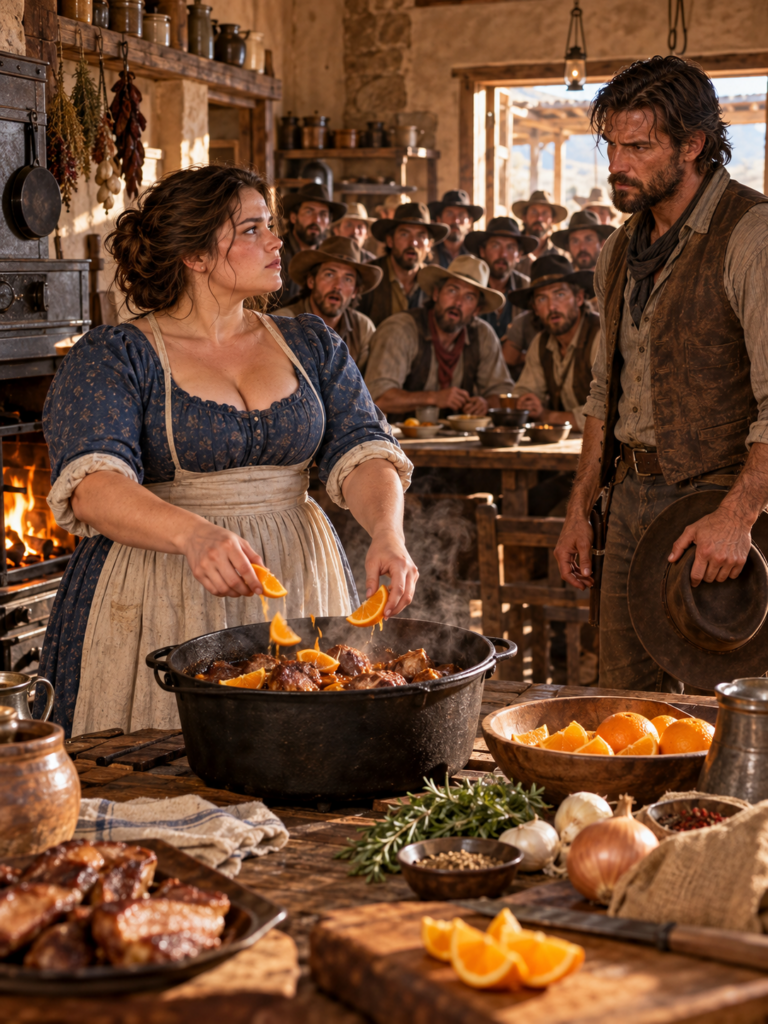
Inside, Etta lifted the lid from her Dutch oven.
The pork had browned beautifully.
A few fresh orange slices rested on top.
Ward entered behind the men, removed his hat, and took his place at the table.
He looked at her.
“Oranges again?”
She smiled.
“Unless you’ve decided to complain.”
“Not with twenty-nine witnesses.”
Rufus laughed.
Ignacio was already reaching for a plate.
Outside, Pruitt’s passenger climbed down and followed the smell toward the cookhouse.
Etta set the first serving on the table.
Then she took her own seat.
The account book lay nearby, ready for the afternoon’s work.
The old spice jars still hung on the wall.
Lena’s handwriting remained where it had always been.
Beside it were Etta’s careful figures and the working records of a business that was now entirely her own.
Ward sat across from her, no longer hiding behind silence.
He had learned to tend his ranch, to speak when fairness required it, and to offer affection without making it a condition of anything.
Etta had found steady work, built her trade, and chosen to remain where she could make a life on her own terms.
They had not needed a wedding to prove that their companionship mattered.
Nor had Etta needed to surrender her name or her business to accept the possibility of love.
She had come to the Broken Ladder with a carpetbag, a cooking pot, a little notebook, and a crate of oranges that everyone thought were foolish.
Now travelers could smell her cooking long before they reached the ranch.
And the woman whom Ward Fallon had once ordered back onto the mail hack stood in the doorway of the cookhouse, welcoming the men to dinner.
Not because she had nowhere else to go.
Because she had built something worth staying for.
And because, at last, staying was entirely her choice.