
Part 1
The first thing Owen Tuttle heard after spending nearly all his savings was the laughter.
It rolled across the gravel lot behind Varner’s old drugstore on a warm September morning, loud enough to drown out the auctioneer and turn the heads of people standing halfway down Main Street.
“Forty-five dollars to the boy in the navy cap!”
The auctioneer’s gavel struck the wooden stand.
And Merl Dunaway, the wealthiest antiques dealer in three counties, threw back his head and laughed like he’d just heard the funniest joke of his life.
“Somebody call that child’s mother!” Merl shouted. “He’s just spent forty-five dollars on a wall full of drawers nobody can open!”
A few men near the auction tent chuckled.
Then more people joined in.
Owen stood beside his purchase, his small right hand resting against a strip of cold, rust-darkened iron.
He was twelve years old, barely five feet tall, with freckles across his nose and a faded navy baseball cap that had belonged to his father.
His brown canvas jacket hung loose around his narrow shoulders. His work boots were scuffed from mowing lawns, cleaning chicken coops, and helping his grandfather mend fences.
That morning, he’d arrived with sixty-one dollars in his pocket.
It represented two summers of work.
Every Saturday from May through August, he had pushed an old gasoline mower across the Methodist churchyard, trimming around gravestones and hauling away grass clippings.
He had worked through afternoons so hot the sweat soaked his shirt, and mornings when the grass was still wet enough to darken his socks.
His grandfather sometimes slipped him an extra five dollars for helping with hay.
His mother occasionally offered him spending money.
Owen had saved nearly every penny.
And now, with one raise of his hand, he had spent forty-five dollars on something nobody else wanted.
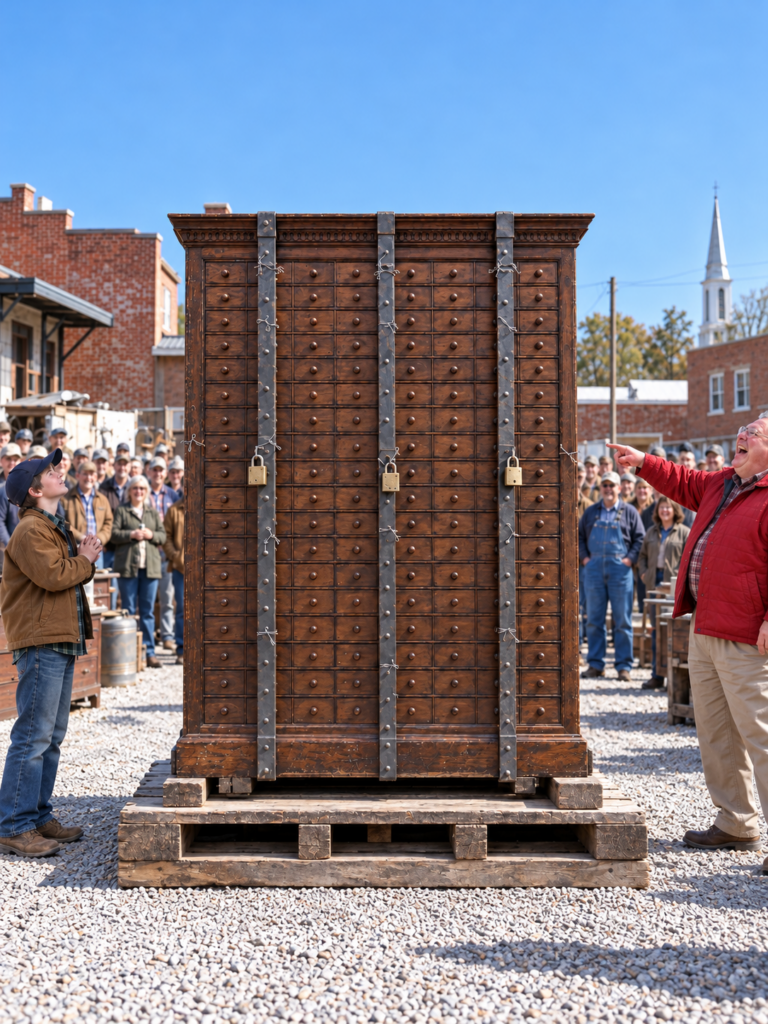
The cabinet stood nine feet tall and nearly ten feet wide.
It was built from dark walnut, its surface dulled by more than a century of dust and neglect. Sixteen rows of narrow wooden drawers stretched across its face, twelve drawers to a row.
One hundred and ninety-two drawers.
Each had a small, carefully turned wooden knob.
Each was secured behind four vertical iron straps bolted from the carved crown at the top to the heavy base below.
Three brass padlocks hung from the straps.
Little loops of wire, sealed with dull gray metal tags, prevented anyone from tampering with the locks without leaving evidence.
The cabinet hadn’t been opened since 1962.
Merl Dunaway had called it firewood during the morning preview.
Now he walked toward Owen with his red quilted jacket stretched over his broad stomach.
“Well, son,” Merl said, smiling down at him, “what exactly are you planning to do with this monstrosity?”
Owen looked up.
“Take it home, sir.”
Merl glanced toward the spectators.
“Take it home! Hear that, folks? Young Mr. Tuttle’s going to put a whole drugstore in his bedroom.”
Another wave of laughter.
Owen felt his ears turning hot.
But he didn’t move his hand from the cabinet.
Merl studied the boy for another moment.
Then his smile changed.
“Tell you what. I’ll give you two hundred dollars cash for it right now. I’ll even haul it away. That’s a hundred and fifty-five dollars profit before lunch.”
Owen stared at him.
He had never held two hundred dollars at one time.
He thought of his grandfather’s old green truck, with its cracked windshield and tires worn nearly smooth.
He thought of the kitchen roof that leaked whenever rain came from the west.
He thought of his mother sitting at the kitchen table after a twelve-hour hospital shift, sorting bills into piles and pretending not to worry.
Two hundred dollars could help.
But Owen had not come to the auction to make a quick profit.
“What would you do with it?” he asked.
Merl grinned.
“Simple. Cut those straps, pull the drawers out, clean them up, and sell them individually. City folks love old wooden boxes. I could get ten or twelve dollars apiece.”
“And the rest?”
“The frame? Burn it. Not worth hauling around.”
Owen’s fingers tightened against the iron.
“No, sir.”
Merl blinked.
“What?”
“Thank you for the offer, but I don’t want to sell it.”
For the first time that morning, Merl’s smile looked forced.
“Boy, you don’t even know what’s inside.”
Owen looked him directly in the eyes.
“No, sir,” he answered quietly. “Neither do you.”
A few people laughed.
But this time, they weren’t laughing at Owen.
Merl’s face reddened.
He turned sharply toward his pickup truck, opened the toolbox behind the cab, and returned carrying a pair of long-handled bolt cutters.
“All right, then,” he announced. “Let’s settle this nonsense.”
He raised the cutters.
“I’ll break one of these locks. Right here, in front of everybody. If there’s anything inside besides dead mice and dust, I’ll give the boy five hundred dollars.”
The crowd moved closer.
Five hundred dollars.
For one moment, Owen could almost hear the money.
But he also remembered something his grandfather had told him years earlier.
Some things survive only because somebody refuses to take them apart.
Merl stepped toward the cabinet.
Owen moved in front of him.
“No.”
Merl stopped.
“Excuse me?”
“Please don’t cut the locks.”
“Son, I’m offering you five hundred dollars.”
“I heard you.”
“Then what’s the problem?”
Owen swallowed.
“I don’t want it opened here.”
Merl’s eyes narrowed.
“You afraid I’m right?”
“Maybe,” Owen said. “But it belongs to me now, and I want it left alone.”
The auctioneer, Lonnie Gaither, climbed down from his platform.
Lonnie was a lean man in his sixties who had known the Tuttle family for decades.
He stepped between Merl and the cabinet.
“The boy paid for it,” Lonnie said. “Put the cutters away.”
Merl looked from Lonnie to Owen.
Then he laughed again.
“Fine. Keep your mouse hotel.”
He turned toward the crowd.
“By Christmas, that boy’ll be begging somebody to haul it off.”
Owen said nothing.
He stood beside the old cabinet while people drifted away to look at tractors, glassware, and boxes of forgotten household belongings.
At noon, Mrs. Opal Fenwick, who owned the diner across the street, stopped to pat his shoulder.
“Well, honey,” she said gently, “that’s certainly a lot of furniture.”
Owen gave her a small smile.
She meant well.
Most people did.
But it was difficult being twelve years old while an entire town seemed convinced you’d made the biggest mistake of your life.
By one o’clock, the auction was nearly over.
Owen was still standing beside the cabinet.
And he had a much bigger problem.
He had no way to get it home.
His grandfather had told him that morning not to buy anything larger than a bread box.
The cabinet was larger than the kitchen wall.
At twelve forty-five, a faded green flatbed truck turned off Main Street.
Its engine rattled as it crossed the gravel.
The truck belonged to Harland Tuttle, Owen’s grandfather.
Harland was seventy-three years old, a retired rural mail carrier with broad hands, a stooped back, and the weathered face of a man who had spent most of his life outdoors.
He climbed from the cab, shut the door, and looked at the cabinet.
Then he looked at Owen.
Then back at the cabinet.
“Well,” he said.
Owen waited.
Harland scratched the back of his neck.
“That’s a mighty big bread box.”
A few people laughed.
Owen lowered his eyes.
“I’m sorry, Grandpa.”
Harland didn’t answer immediately.
He walked closer to the cabinet.
His boots crunched against the gravel.
He reached out and touched one of the iron straps.
Then his gaze moved to the brass padlocks.
And finally to the tiny gray wire seals.
Something changed in his face.
The amused expression disappeared.
He removed his hat.
“Owen,” he said quietly, “is this Adeline Varner’s cabinet?”
Owen nodded.
“The Shaker cabinet?”
“Yes, sir.”
Harland drew a long breath.
For several seconds, he said nothing.
Then he looked across the lot toward Merl Dunaway, who was leaning against his pickup.
“Did Merl offer to take the drawers out?”
Owen nodded again.
“Said he’d sell them for spice boxes and burn the rest.”
Harland closed his eyes briefly.
“His father said almost those exact same words sixty-four years ago.”
Owen stared at him.
“You remember?”
“I remember more than I care to.”
Harland put his hat back on.
Then he turned toward the auction crew.
“Lonnie,” he called, “you still got that skid loader running?”
Lonnie nodded.
Harland rolled up his sleeves.
“Good. Help me get this thing onto my truck.”
Owen stepped forward.
“You’re not angry?”
His grandfather looked down at him.
“Oh, I’m going to have plenty to say about a twelve-year-old spending forty-five dollars without discussing it first.”
Owen’s stomach sank.
“But,” Harland continued, resting one large hand on the boy’s shoulder, “we’ll discuss that after we get her home.”
He glanced at the cabinet again.
“And if this is what I think it is, grandson, those forty-five dollars might be the best money anybody in this family ever spent.”
Owen felt hope rise in his chest.
But his grandfather’s next words were spoken so softly that only the boy could hear them.
“Your great-grandmother waited her whole life for somebody to save this thing.”
And suddenly, the cabinet was no longer just an old piece of furniture.
It was a promise.
One that had been waiting sixty-four years for someone to keep.
Part 2
Getting the cabinet home took nearly four hours.
The auction crew eased the enormous walnut structure onto its back while Harland guided every movement, warning them to keep the weight off the delicate carved crown.
He laid every moving blanket he owned across the flatbed.
Then he used a winch to pull the cabinet slowly aboard.
Merl Dunaway watched from his pickup.
“Careful, Harland,” he shouted. “Wouldn’t want to throw your back out over a hundred and ninety-two mouse nests.”
Harland didn’t look at him.
He tightened another ratchet strap.
Owen stood on the passenger side of the truck, holding the loose end.
He had seen his grandfather lose his temper only twice in his life.
Once when a drunk driver had nearly hit a school bus.
And once when a man at the feed store insulted Owen’s mother for working nights while raising a child alone.
Now Harland’s jaw had that same hard look.
But his voice remained calm.
“Climb in, son.”
They drove slowly through Marlow Creek.
People stopped on the sidewalks to stare at the giant cabinet lying behind the cab.
A group of boys outside the general store pointed and laughed.
Owen recognized two from school.
He pulled the brim of his cap lower.
Harland noticed.
“Something bothering you?”
“No, sir.”
“Don’t lie to me. You’re not good at it.”
Owen stared through the windshield.
“They think I’m stupid.”
Harland considered that.
“Some of them probably do.”
Owen looked up, surprised.
His grandfather continued driving.
“Most people believe the loudest man in the room knows the most. That’s a mistake folks have been making since the beginning of time.”
Owen watched the road.
“Do you think I was stupid?”
Harland took a long moment before answering.
“I think you spent forty-five dollars without knowing for certain what you were buying.”
Owen felt his chest tighten.
“But I also think you saw something everybody else overlooked. And when a man tried to bully you into destroying it, you stood your ground.”
He glanced at his grandson.
“Those are two different things. We’ll find out which one matters more.”
They reached the Tuttle farm shortly before four.
The farmhouse stood at the end of a narrow gravel lane, surrounded by pastureland and fields of late-summer corn.
Its white paint had weathered gray in places.
One porch step sagged.
A rusted windmill stood beside the cattle pond, though it had not pumped water in twenty years.
Behind the house sat a machine shed with wide sliding doors.
Harland had built it with Owen’s father, Daniel, before Daniel died.
Owen was only four when the accident happened.
A truck had crossed the centerline on a rainy county road.
Daniel never made it home.
There were days when Owen could remember his father’s voice perfectly.
Other days, he could remember only the feeling of sitting on his shoulders while they watched tractors move through a distant field.
The navy cap was one of the few things Owen still owned that had belonged to him.
He wore it almost every day.
Together, Harland and Owen used the tractor’s front loader to stand the cabinet upright inside the machine shed.
Once the pallet was settled on the concrete, Harland turned off the tractor.
The sudden silence felt enormous.
The cabinet stood against the far wall, taller than either of them.
Sunlight streamed through the shed’s open doors, revealing floating dust around the dark walnut.
Harland lowered himself onto a hay bale.
Owen sat beside him.
For a long time, neither spoke.
Then Harland said, “Your great-grandmother Ivy worked at Varner’s Drug when she was seventeen.”
Owen nodded.
He knew the beginning of this story.
His grandfather had told it on winter nights when snow rattled against the farmhouse windows.
But today the words sounded different.
Today the cabinet stood directly in front of them.
“She worked the soda fountain,” Harland continued. “Made cherry Cokes and milkshakes for factory workers, schoolchildren, and farmers coming into town.”
He smiled faintly.
“Said old Doc Varner paid a dollar more per week than the hardware store, and that made him a prince among men.”
Owen laughed.
Harland’s smile faded.
“Behind the drugstore was a room nobody went into unless Doc Varner invited them. And in that room stood this cabinet.”
He gestured toward the drawers.
“Your great-grandmother only saw it once.”
“What did she say?”
“That it was the prettiest piece of woodworking she’d ever seen. Said the drawers were arranged so carefully they looked like a wall of little doors. Every one had a name written across it.”
Harland rubbed his hands together.
“The cabinet came from an old Shaker settlement up the river. Those folks were famous for making furniture with their own hands. Tables, chairs, cupboards, tools. Things designed to last.”
Owen leaned forward.
“And medicines.”
“Medicinal herbs,” Harland corrected gently. “They cultivated plants, dried them, packed them, and sold them. Their herb business was known across the region.”
He looked toward the cabinet.
“In the late 1800s, when their community was shrinking, a young druggist named Josiah Varner bought this entire cabinet from their herb house. He brought it downriver and installed it in his store.”
“Why didn’t he sell the herbs?”
Harland shook his head.
“Nobody knows for certain. Family always said he believed the cabinet was something that ought to stay together. Maybe he intended to preserve it. Maybe he couldn’t bear to be the man who broke it apart.”
Owen studied the old wood.
“Then what happened?”
“Josiah died. His son Wendell took over the business. And when Wendell passed in 1962, the antique dealers came calling.”
Harland’s voice hardened.
“One of them was Clyde Dunaway.”
“Merl’s father.”
“That’s right.”
Clyde had offered Wendell’s widow, Adeline, a handsome sum for the cabinet.
But he intended to dismantle it.
He told her the individual drawers would sell more easily than the complete piece.
He said keeping them together was foolish.
Adeline had listened politely.
Then she refused.
Harland remembered the exact words his mother had repeated for decades.
“It came into this store whole,” Adeline told Clyde, “and if it ever leaves, it will leave whole.”
The next morning, Adeline hired the town blacksmith.
He fastened four iron straps across the drawers.
Then he secured them with three heavy padlocks.
Adeline insisted on wire seals, too, so nobody could tamper with the cabinet unnoticed.
According to local legend, she took the three keys down to the creek behind the church and dropped them into the deepest water.
She never opened the cabinet again.
For sixty-four years, it stayed locked.
“Why?” Owen whispered.
Harland looked at his grandson.
“Because she promised her husband she’d protect it. And because she knew once those drawers were separated, nobody would ever put that cabinet back together.”
The shed fell quiet.
Outside, a mourning dove called from the power line.
Owen thought of all the Saturdays he had spent pushing a mower across the church lawn.
He had never imagined his savings might purchase something connected to a woman who had protected a promise for most of her life.
Harland leaned forward.
“Now tell me something, son. How did you know?”
Owen hesitated.
Then he reached into his jacket and withdrew a folded library photocopy.
The paper had been handled so many times the creases were almost white.
He opened it carefully.
It showed a black-and-white photograph of a long nineteenth-century room lined with wooden drawers.
Beneath the photograph was a caption identifying a Shaker herb house.
“I found it in a book at the county library,” Owen explained.
Harland took the paper.
“Two years ago, Mr. Dade assigned us a project about things built in our county before automobiles.”
Owen pointed to the photograph.
“I found a book about Shaker furniture. They made the knobs by hand. See how they’re shaped?”
Harland studied the image.
“Looks like these.”
“Exactly.”
Owen stood and approached the cabinet.
“At the auction preview, I looked under the iron straps. There was writing behind them.”
He crouched near the lower drawers.
“Right there. I could read part of a word. Horehound. And another one looked like boneset.”
Harland’s expression changed.
Owen pointed toward the carved upper corner.
“And there’s a date.”
Harland fetched a flashlight.
Together, they angled its beam across the worn walnut.
At first, nothing appeared.
Then Owen adjusted the light.
A faint line of old stencil lettering emerged.
Beneath it were four numbers.
1841.
Harland lowered the flashlight.
For a moment, he looked as though somebody had taken the strength out of his legs.
“Owen,” he whispered, “do you understand what you’re saying?”
Owen swallowed.
“In the book, it said nobody knew of a complete Shaker herb house cabinet that still had its original contents.”
Harland looked at the one hundred and ninety-two sealed drawers.
“And you think this might be one?”
“I don’t know.”
Owen looked frightened for the first time since the auction.
“I might be wrong.”
Harland rested a hand against the old walnut.
“You might.”
He turned to his grandson.
“But I believe we ought to find somebody who can tell us.”
Inside the farmhouse, the kitchen telephone sat beneath a calendar with a photograph of a red barn.
Owen found the museum’s number in his library notes.
It belonged to a restored Shaker village two hours upriver.
He dialed.
A young man answered.
When Owen asked for Dr. Miriam Holloway, the museum’s curator of Shaker collections, the receptionist explained she didn’t work on Saturdays.
“I can take a message.”
Owen looked toward his grandfather.
Harland nodded.
“My name is Owen Tuttle,” he said. “I’m calling from Marlow Creek. We have a cabinet from the old Varner drugstore.”
The receptionist sounded polite but distracted.
“And what would you like Dr. Holloway to know?”
Owen took a breath.
“Tell her it’s the Shaker herb cabinet. The big one. And please tell her the seals are still on it.”
There was a pause.
“The seals?”
“Yes, sir. Nobody’s opened it since 1962.”
Another pause.
Then the young man’s tone changed.
“I’ll make sure she gets this message.”
Forty minutes later, the kitchen telephone rang.
Owen answered.
“Hello?”
A woman’s voice came through, breathless and urgent.
“Is this Owen Tuttle?”
“Yes, ma’am.”
“This is Dr. Miriam Holloway. I need you to tell me everything you know about that cabinet.”
Owen told her.
He described the walnut, the drawers, the lettering, the brass padlocks, the iron straps, and the wire seals.
He told her about the stencil and the date.
She listened without interrupting.
Then she asked one question.
“Has anyone opened even a single drawer?”
“No, ma’am.”
“Are you absolutely certain?”
“Yes, ma’am. A man wanted to cut a lock at the auction, but I wouldn’t let him.”
The curator exhaled so heavily he could hear it over the phone.
“Good.”
A moment passed.
Then she said something that made Owen’s knees feel weak.
“Don’t touch anything else. Don’t break the seals. Don’t move the cabinet again.”
“Okay.”
“I’m getting in my car.”
Owen stared at the telephone.
“Ma’am?”
“I’ll be at your farm before eight tonight.”
When he hung up, his grandfather was watching him.
“Well?”
Owen spoke slowly.
“She wants to come see it.”
Harland raised his eyebrows.
“Tonight?”
“Yes, sir.”
“From two hours away?”
Owen nodded.
His grandfather looked toward the machine shed through the kitchen window.
Then he sat down.
“Well,” he murmured, “I’ll be.”
At that exact moment, the back door opened.
Renee Tuttle stepped into the kitchen wearing blue hospital scrubs and carrying her lunch bag.
She was thirty-nine, with tired eyes, dark hair pulled into a loose ponytail, and the weary posture of someone who had spent twelve hours caring for people who needed more than she could give.
She looked at her father-in-law.
Then at Owen.
Then through the window toward the machine shed.
She blinked.
“Would somebody like to explain why there’s a wall of drawers in our barn?”
Neither answered immediately.
Renee put down her lunch bag.
“Owen Daniel Tuttle.”
That was never a good sign.
“What did you buy?”
Owen cleared his throat.
“A cabinet.”
“I can see that.”
“At an auction.”
“How much?”
“Forty-five dollars.”
Renee stared at him.
“Your lawn-mowing money?”
He nodded.
She looked at Harland.
Harland shrugged.
“I told him not to buy anything bigger than a bread box.”
Renee closed her eyes.
Then she began laughing.
Not angrily.
Not cruelly.
She laughed until she had to sit down at the kitchen table.
“Oh, sweetheart,” she said, wiping her eyes. “What have you gotten yourself into?”
Owen explained.
He told her about Merl Dunaway and the crowd.
About the Shaker book.
About Adeline Varner.
And finally about the curator coming that evening.
Renee grew serious.
She listened all the way through.
Then she looked at her son with a tenderness that made him uncomfortable.
“You wouldn’t let that man break the locks?”
“No, ma’am.”
“Even when he offered you five hundred dollars?”
Owen shook his head.
Renee reached across the table and squeezed his hand.
“Your daddy would have been proud of that.”
Owen looked down quickly.
He didn’t want her to see his eyes filling.
Renee rose.
“Well,” she said, “if a museum lady is driving two hours to see my son’s forty-five-dollar cabinet, I guess I’d better make coffee.”
Outside, evening shadows were beginning to stretch across the pasture.
And Owen made a decision.
He wanted witnesses.
Not because he wanted to embarrass anyone.
But because the cabinet had waited too long in darkness.
If it was finally going to open, he wanted the people of Marlow Creek to see what had been protected inside.
Including the man who had laughed the loudest.
Part 3
By six o’clock, Owen had made six telephone calls.
The first was to Lonnie Gaither, the auctioneer.
When Owen explained that a museum curator was coming to inspect the cabinet, Lonnie went silent.
Then he let out a low whistle.
“You want me there?”
“Yes, sir.”
“Son, I wouldn’t miss that if the governor came to town.”
The second call was to Pastor Gail Ridley, who had led the Methodist congregation for twenty years.
She listened patiently.
Then she asked, “How many chairs do you need?”
Owen wasn’t sure.
“Maybe ten?”
Pastor Ridley laughed.
“I’ll bring twenty.”
He called Mrs. Opal Fenwick at the diner.
She promised to come and bring pie.
He called his history teacher, Mr. Dade.
Mr. Dade asked whether Owen had preserved the auction receipt.
When Owen said yes, the teacher sounded relieved.
“Keep that safe,” he instructed. “And don’t let anybody tell you it doesn’t matter.”
Owen called a neighbor named Travis Boone, who had helped load the cabinet.
Travis said he’d bring extra work lights.
Then Owen stood beside the kitchen telephone for a long time.
There was one call left.
Harland watched him.
“You don’t have to invite Merl.”
Owen turned the auction receipt over in his fingers.
“I know.”
“He wasn’t kind to you.”
“No, sir.”
“He’ll probably come just to make fun.”
Owen thought about the red jacket, the bolt cutters, and the way people had laughed.
Then he thought about the drawer fronts hidden beneath the iron.
“He was there when everybody thought it was worthless,” Owen said. “I think he ought to be here when we find out.”
Harland studied him.
“You sure?”
Owen nodded.
His grandfather stepped aside.
“Then make the call.”
Merl answered on the fourth ring.
“Dunaway Antiques.”
“Mr. Dunaway? This is Owen Tuttle.”
A pause.
“Well, if it isn’t our young furniture collector.”
Owen swallowed.
“A museum curator is coming to look at the cabinet tonight. We’re going to open it with her.”
Merl chuckled.
“A museum curator?”
“Yes, sir.”
“What museum?”
“The Shaker village museum upriver.”
For several seconds, the line was quiet.
Then Merl laughed loudly.
“Oh, son. You’ve really gotten yourself into something now.”
Owen waited.
“What time is this grand event?”
“Eight o’clock.”
“Well, I’ll be there.”
He lowered his voice as though sharing a private joke.
“I’ll bring a flashlight so we can get a good look at all those mouse droppings.”
Owen thanked him and hung up.
Harland shook his head.
“That man hasn’t changed a bit.”
Renee, who was slicing pie at the kitchen counter, glanced toward the shed.
“Maybe tonight will give him a reason to.”
The hours passed slowly.
By seven, the machine shed looked nothing like the place where Harland usually repaired tractors and sharpened mower blades.
He had moved the hay bales and pushed a broken plow against the wall.
Travis Boone hung extra lights from the rafters.
Pastor Ridley’s folding chairs stood in two neat rows facing the cabinet.
A sawhorse table held a coffee urn, paper cups, and Mrs. Fenwick’s promised pies.
Renee placed a clean towel beside the coffee.
Then she went to find another extension cord.
Owen swept the concrete floor a second time.
There was something almost frightening about preparing the shed for strangers.
The cabinet had seemed safe when it belonged only to him and his grandfather.
Now people would come.
They would watch.
And what happened next might prove Owen right.
Or terribly wrong.
He tried not to think about the second possibility.
At seven fifteen, Lonnie arrived.
He shook Owen’s hand firmly.
“Evening, Mr. Tuttle.”
Owen smiled uncertainly.
Lonnie glanced at the cabinet.
“I’ve sold furniture for forty years,” he said. “Never seen anybody defend an old piece of wood the way you did today.”
Owen looked down.
“I just didn’t want it ruined.”
“That’s what I mean.”
Mr. Dade came next.
He was carrying a notebook and his reading glasses.
He walked around the cabinet twice, crouching near the base to examine the joints.
Then he approached Owen.
“You remember what I told your class about primary evidence?”
“Yes, sir.”
“Remind me.”
“Something that comes directly from the time you’re studying.”
Mr. Dade pointed toward the iron straps.
“And those?”
Owen considered.
“Evidence that somebody tried to keep the cabinet closed.”
“Exactly.”
The teacher smiled.
“And sometimes, Owen, what people choose not to disturb is as important as what they discover.”
Mrs. Fenwick arrived with two pies instead of one.
“Apple and cherry,” she announced. “I couldn’t decide.”
Pastor Ridley brought extra chairs.
By seven forty, most of the seats were occupied.
People spoke quietly, glancing toward the enormous cabinet as though it might move on its own.
Then Merl Dunaway arrived.
His red quilted jacket caught the light as he stepped through the wide doorway.
He carried a yellow flashlight in one hand and a stainless-steel thermos in the other.
“Well, well,” he said loudly. “Look at this. A proper celebration for the biggest mousetrap in the county.”
A few people laughed.
Merl looked pleased.
He took a seat in the center of the front row.
“Where’s the museum lady?”
“On her way,” Owen answered.
Merl unscrewed his thermos.
“Hope she didn’t get lost looking for the Smithsonian.”
Nobody answered.
He poured coffee into the lid.
“I’ve been dealing antiques for thirty years. I know an old spice cabinet when I see one.”
Owen moved closer to the walnut drawers.
He rested his palm against the iron.
His grandfather came to stand beside him.
“Nervous?”
“Yes, sir.”
“Good.”
Owen looked up.
Harland nodded toward the gathered neighbors.
“Means this matters to you.”
“Grandpa?”
“Hmm?”
“What if there’s nothing inside?”
Harland considered the question.
Then he placed his hand over Owen’s.
“Then you own a beautiful old cabinet that you saved from being chopped into pieces.”
“But everyone will laugh again.”
“Some might.”
Owen looked toward Merl.
Harland leaned closer.
“Let me tell you something, boy. Your great-grandmother Ivy kept a little cedar box on her dresser. Inside were letters from her mother, a dried flower from her wedding, and the hospital bracelet from the day I was born.”
Owen listened.
“Wasn’t worth ten dollars to anybody else. But when she died, I wouldn’t have sold it for ten thousand.”
Harland looked at the cabinet.
“Value isn’t always what the loudest man says someone will pay.”
At seven fifty-five, headlights appeared along the farm lane.
An old gray station wagon came slowly toward the shed.
It stopped beside Harland’s truck.
A woman stepped out.
She was in her early sixties, with short silver hair, wire-rimmed glasses, and a navy wool blazer that looked as though it had been worn on hundreds of museum visits.
She carried a camera bag over one shoulder and a cardboard box beneath her arm.
Dr. Miriam Holloway did not pause to admire the farmhouse.
She did not introduce herself to the crowd.
She walked directly into the shed.
Her gaze went immediately to the cabinet.
Then she stopped.
For nearly a minute, she said nothing.
The room grew quiet.
She approached the walnut structure slowly.
Her fingers hovered over one of the wooden drawer knobs.
She did not touch it.
Instead, she drew a small flashlight from her pocket and shone its beam across the upper cornice.
She adjusted the light.
Leaning closer, she studied the faded stencil.
Then her shoulders stiffened.
“Oh,” she whispered.
Owen watched her face.
Dr. Holloway moved the light slightly to the left.
Her lips began forming words.
She read the herb house’s name under her breath.
Then she spoke the date aloud.
“Eighteen forty-one.”
She stepped backward.
For an instant, she looked older than she had when she entered.
“May I see the seals?”
Owen nodded.
“Yes, ma’am.”
Dr. Holloway put down her box and opened her camera case.
She photographed every brass lock.
Every hasp.
Every piece of gray wire.
She photographed the iron straps, the bolts, and the nearly invisible marks around the hardware.
Then she turned to Harland.
“You said these were attached in 1962?”
“Yes, ma’am.”
“By the town blacksmith?”
“That’s right.”
“And no one has opened the cabinet since?”
“Not so much as one drawer.”
She studied his face.
“How can you be certain?”
“My mother watched the seals being installed. She told me how they were made. These are the same seals.”
Dr. Holloway nodded slowly.
Then Merl spoke from the front row.
“Nobody opened it because nobody wanted what’s inside.”
A nervous chuckle came from somewhere near the back.
Dr. Holloway turned toward him.
“And you are?”
“Merl Dunaway. Dunaway Antiques.”
He smiled.
“Thirty years in the business.”
The curator regarded him for a moment.
Then she turned back to the cabinet.
“Well, Mr. Dunaway, I’ve been studying Shaker material culture for thirty-one years.”
Her voice was calm.
“And I’ve never seen anything quite like this.”
Merl’s smile weakened.
Dr. Holloway crouched to inspect the lower joints.
She traced the air beside one corner without touching the wood.
Then she photographed the construction.
“The dovetails,” she murmured. “The hand-planed backs. The proportions.”
She stood.
“Owen?”
“Yes, ma’am?”
“Would you come here, please?”
He approached.
She looked down at him.
“This cabinet belongs to you?”
“Yes, ma’am.”
“You purchased it legally at auction?”
“Yes, ma’am.”
“Do you have the receipt?”
He took the folded paper from his pocket.
She examined it and handed it back.
“Very good.”
Then she asked a question that surprised everyone.
“Would you like to open it yourself?”
Owen stared at her.
“Me?”
“Of course. You’re the owner.”
He glanced toward his grandfather.
Harland nodded.
Owen turned back.
“Could we do it together?”
Dr. Holloway smiled.
It was the first time she had smiled since arriving.
“I would like that very much.”
She opened the cardboard box.
Inside were white cotton gloves, safety glasses, paper envelopes, labels, and small tools.
She handed Owen a pair of gloves.
Then she turned toward the gathering.
“Before we begin, I want everyone to understand something.”
The shed fell completely silent.
“This cabinet may contain historically significant material. We need to proceed carefully, document what we find, and preserve every piece of evidence.”
She looked at Harland.
“Can we remove the locks without damaging the wood?”
“Yes, ma’am.”
“Then let’s begin.”
Harland brought out his bolt cutters.
He fitted the jaws around the first brass shackle.
Owen held his breath.
The handles came together.
A sharp crack echoed through the shed.
Mrs. Fenwick jumped.
The first padlock fell into Harland’s gloved hand.
The second broke easily.
The third resisted.
Lonnie stepped forward to help.
Together, the two older men leaned against the handles.
The final shackle snapped.
Dr. Holloway handed Owen a pair of small wire cutters.
“See these seals? Cut below them. We want to keep each one intact.”
Owen nodded.
His hands trembled.
He made the first cut.
Then another.
Each little gray seal went into a separate paper envelope.
Dr. Holloway labeled them as they worked.
Nobody joked anymore.
Even Merl had stopped drinking coffee.
When the last wire was removed, Harland fetched a socket wrench.
The bolts came loose with slow metallic squeaks.
One by one, the heavy iron straps lifted away.
And beneath them, the hidden writing emerged.
Names.
Dozens upon dozens of handwritten names.
Horehound.
Boneset.
Sage.
Peppermint.
Lobelia.
Slippery elm.
Wild cherry bark.
The ink had faded to brown.
But the lettering remained clear.
Dr. Holloway stood motionless.
Her gloved hand rose slowly toward her mouth.
“Oh, my goodness.”
Owen turned toward her.
“Is that good?”
She looked at him.
Her eyes shone behind her glasses.
“Owen, I think we’re looking at something extraordinary.”
But she did not say what it was worth.
Not yet.
Because the greatest question remained unanswered.
Were the drawers empty?
Or had a piece of American history been waiting behind those locks for more than six decades?
Part 4
The first drawer was harder to choose than Owen expected.
There were one hundred and ninety-two of them.
They stretched from near the concrete floor to a height well above his head, each with a dark wooden knob and a carefully written label.
Dr. Holloway stood beside him.
“Which one would you like to open?”
Owen’s eyes moved across the rows.
He felt every person in the shed watching.
He could hear the electrical hum of the work lights.
Somewhere outside, a cricket chirped.
At last, he pointed to a drawer at chest height.
“Peppermint.”
Dr. Holloway nodded.
“A good choice.”
Owen reached for the knob.
Then he hesitated.
“What if it’s stuck?”
“Don’t force it,” she said. “We’ll work together.”
He curled his gloved fingers around the little turned handle.
And pulled gently.
The drawer moved.
Not with a screech or a crack.
Not with the resistance of swollen wood.
It slid forward as smoothly as if a careful craftsman had fitted it only yesterday.
And before anyone could see what lay inside, a smell drifted into the air.
Faint.
Green.
Cool.
The unmistakable scent of peppermint.
Mrs. Fenwick lifted her head.
“Mercy,” she whispered.
The smell traveled through the shed.
It mingled with coffee, machine oil, old timber, and autumn air.
Owen looked down.
Inside the drawer stood dozens of carefully folded paper packets.
They were arranged upright, like letters in a wooden filing box.
The paper had aged to a warm cream color.
Each packet bore a printed Shaker herb house label.
Each had a name and notation written by hand in faded brown ink.
Peppermint.
Owen stared.
He had spent two years imagining what might be inside the cabinet.
He had pictured empty drawers.
Broken glass.
Old bottles.
Maybe a few forgotten leaves.
He had not imagined this.
Dr. Holloway bent close.
Her expression changed completely.
She was no longer simply curious.
She looked like a woman staring at a familiar face she had been told was dead.
“Please don’t move anything,” she whispered.
She photographed the drawer.
Then photographed it again.
Her hands were shaking.
Mr. Dade leaned forward in his chair.
“What does it mean?”
Dr. Holloway didn’t answer immediately.
She lifted one packet delicately, supporting its fragile edges.
Then she studied the printing.
“An original trade packet,” she said softly. “Still in its original storage drawer.”
She turned toward Owen.
“Would you open another?”
He nodded.
“Horehound?”
“Yes.”
That drawer was full, too.
He opened sage.
Full.
Boneset.
Full.
Lobelia.
More packets.
Each drawer carried the same patient order.
The same handwritten labels.
The same extraordinary sense that someone had carefully arranged everything, closed the drawers at the end of a working day, and expected to return in the morning.
But nobody ever had.
The cabinet had crossed a river, passed through generations, survived deaths and changing businesses, and endured sixty-four years of deliberate confinement.
And now a twelve-year-old boy was bringing it back into daylight.
Pastor Ridley began quietly crying.
Mrs. Fenwick handed her a tissue.
Merl sat rigidly in the front row.
His yellow flashlight lay forgotten across his knees.
Dr. Holloway opened several lower drawers.
They contained tools.
Small tin scoops.
A brass balance scale.
A fitted wooden block holding graduated weights.
Stacks of printed herb catalogs, their pages fragile but legible.
The curator lifted one catalog.
She opened it just enough to examine the cover.
Then she shut it again.
“Original inventories,” she whispered.
Harland stepped closer.
“Does that help?”
“It may help us establish exactly what this cabinet contained when it left the Shaker settlement.”
She looked at the packed drawers.
“And perhaps who filled it.”
Dr. Holloway glanced toward the back of the cabinet.
“I need to examine the rear boards.”
Harland and Lonnie carefully moved the pallet forward a few inches, giving her enough room to pass behind it.
She carried her flashlight.
For several minutes, nobody could see her.
They could hear only an occasional camera shutter and the scrape of her shoes against concrete.
Then the curator went completely silent.
“Owen?” she called.
“Yes, ma’am?”
“Would you ask your grandfather to bring me another light?”
Harland carried one behind the cabinet.
Owen heard him stop.
Then his grandfather made a low sound.
Not quite a gasp.
Not quite a word.
“Lord have mercy.”
Owen wanted to follow.
But Dr. Holloway asked him to remain where he was.
Another minute passed.
Then she emerged.
She walked toward the nearest folding chair and sat down.
She removed her glasses.
Pressed her fingers to her eyes.
And took a long, unsteady breath.
Nobody spoke.
Finally, Mr. Dade asked, “Doctor? What did you find?”
She looked toward the cabinet.
“There are two names written in pencil on the back boards.”
She stopped.
Then continued.
“They belong to two Shaker craftsmen who worked at the herb house in 1841.”
The room remained silent.
“Our surviving records mention two large storage cabinets built for that herb house in the same year.”
She looked up at Owen.
“One of those cabinets was dismantled in the 1930s. Its drawers were sold separately. Our museum owns three of them.”
Owen felt his heartbeat quicken.
“Three drawers?”
She nodded.
“That’s all we’ve ever been able to preserve.”
She looked toward the cabinet again.
“We believed the second cabinet had disappeared. Possibly destroyed. Possibly broken apart like the first.”
Harland rested one hand on the back of a chair.
Dr. Holloway’s voice became quieter.
“I’ve spent thirty-one years studying these collections. I’ve traveled across the country looking at private holdings, estate inventories, auction records, and museum archives.”
Her eyes filled.
“I have never found a complete herb house cabinet with its original contents.”
She paused.
“Until tonight.”
The words seemed to settle over the shed like a blanket.
Owen stared at her.
He knew the cabinet was important.
But he still didn’t understand how important.
Dr. Holloway looked at the drawers.
“This isn’t merely old furniture. It’s a rare surviving record of craftsmanship, commerce, medicine, and community life.”
She gestured toward the packets.
“Every label tells us something about what they cultivated and sold. Every drawer helps us understand how they organized their work. The construction and signatures can teach us about the people who built it.”
She looked directly at Owen.
“And because no one dismantled it, that evidence remains together.”
Owen felt something tighten in his throat.
He thought of Adeline Varner, standing in the drugstore in 1962, refusing to let Clyde Dunaway separate the drawers.
He thought of his great-grandmother Ivy, remembering the cabinet for the rest of her life.
He thought of the folded library photograph he had carried in his pocket.
And he thought of Merl standing on the gravel lot with bolt cutters.
“I almost let him open it,” Owen whispered.
Dr. Holloway shook her head.
“But you didn’t.”
“He offered five hundred dollars.”
The curator held his gaze.
“Owen, what you protected here was not simply something expensive. You protected the information that makes it historically meaningful.”
He lowered his eyes.
“I just didn’t want it ruined.”
“That’s precisely why it survived.”
Merl shifted in his chair.
For the first time all evening, he appeared uncomfortable.
He cleared his throat.
“Now, hold on. We’re talking about a cabinet full of dried weeds. Old, sure, but let’s not pretend it’s some kind of national treasure.”
Dr. Holloway turned toward him.
Her expression remained composed.
“Mr. Dunaway, do you know how many documented, complete examples of this particular kind of herb house cabinet are known to survive with their original stock?”
Merl shrugged.
“No idea.”
“One.”
She pointed toward Owen’s purchase.
“This one.”
Merl opened his mouth.
Then closed it.
Dr. Holloway continued.
“The cabinet’s importance doesn’t come from the age of its wood alone. It comes from its condition, provenance, original contents, and the fact that the entire arrangement has survived intact.”
She looked around at the neighbors.
“That combination is exceptionally rare.”
For once, nobody seemed interested in laughing.
Renee stood near the coffee table with her arms folded across her chest.
She had spent years worrying about her son’s quiet nature.
Owen preferred books to ball games.
He would rather spend an afternoon fixing a birdhouse with his grandfather than attend a crowded birthday party.
Some children at school called him strange.
Now she watched him standing beside a cabinet every expert in town had dismissed.
And something inside her ached.
Daniel should have been here.
His father should have seen this.
He should have been standing beside their boy, one hand on his shoulder, telling him he had done well.
Instead, Renee crossed the shed and put her arm around Owen.
He leaned against her without speaking.
Dr. Holloway watched them.
Then she opened her notebook.
“There is one more matter we need to discuss.”
Harland straightened.
“What would that be?”
“The financial value.”
The room became very still.
Even the crickets outside seemed to have stopped.
Merl leaned forward.
His earlier smile had disappeared.
Dr. Holloway continued carefully.
“A formal appraisal would require additional documentation and assessment. But based on what I’ve seen tonight, I can give you a preliminary insurance valuation.”
Owen looked at his mother.
He did not understand insurance valuations.
He understood forty-five dollars.
He understood two summers of mowing.
He understood how far a paycheck had to stretch when the truck needed tires and the furnace needed repairs.
Dr. Holloway looked at him.
“Owen, are you ready?”
He nodded.
She took a breath.
Then spoke a number that no one in that machine shed would ever forget.
Part 5
“Four hundred and sixty-five thousand dollars.”
Nobody moved.
For a moment, Owen thought he had misunderstood.
Four hundred?
Sixty-five?
Thousand?
His mother gripped his shoulder.
Harland slowly lowered himself into a chair.
Mrs. Fenwick’s mouth fell open.
Lonnie stared at the cabinet as though it had transformed into something living.
Dr. Holloway repeated the amount.
“For insurance purposes, my preliminary valuation would be approximately four hundred and sixty-five thousand dollars. Subject to formal examination, of course.”
The number hung in the air.
Owen’s mind struggled to hold it.
Forty-five dollars.
Four hundred and sixty-five thousand dollars.
He knew one number belonged to his savings.
The other seemed to belong to an entirely different world.
He looked toward the cabinet.
The peppermint drawer remained open.
Its fragile paper packets stood in tidy rows.
They looked exactly as they had a few moments earlier.
Nothing about the walnut had changed.
Nothing about the knobs.
Nothing about the iron straps resting on the concrete.
Only the way everybody saw them.
Mrs. Fenwick slowly turned in her folding chair.
“Merl?”
The antiques dealer sat motionless.
His face had gone pale.
“What was it you offered this boy earlier today?”
Merl said nothing.
Mrs. Fenwick tilted her head.
“I seem to remember something about two hundred dollars.”
Lonnie spoke from the back.
“Two hundred even. I heard him.”
Pastor Ridley looked toward the old walnut frame.
“And he was going to burn the rest?”
Lonnie nodded.
“Sell the drawers separately and use the frame for firewood.”
There was a long silence.
Then Pastor Ridley laughed.
It slipped out before she could stop it.
She covered her mouth.
Mr. Dade smiled.
Mrs. Fenwick began chuckling.
And then the laughter spread through the rows of folding chairs.
Not the careless laughter from the auction lot.
Something different.
Something filled with disbelief and relief.
Merl stared at the cabinet.
Owen looked at him.
For a moment, he remembered the humiliation of standing on that gravel lot while the entire town laughed at him.
He remembered the bolt cutters.
He remembered the hot embarrassment in his cheeks.
Now he could have said anything.
He could have laughed louder than anyone.
He could have reminded Merl of every cruel remark.
Instead, Owen stepped toward the dealer.
“Mr. Dunaway?”
Merl looked at him.
The boy held out his hand.
“I appreciate you offering to help me get it home earlier.”
Merl stared at the small hand.
He seemed unable to speak.
Then he looked away.
After a moment, he rose, took his thermos and flashlight, and walked toward the shed door.
His red jacket disappeared into the darkness.
He left without saying goodbye.
Owen watched him go.
He felt no great satisfaction.
Only a strange sadness.
The man had been so certain he knew everything.
And that certainty had cost him the ability to recognize something extraordinary.
Dr. Holloway approached Owen and his mother.
“The museum would very much like to discuss acquiring this cabinet,” she said. “If your family is willing.”
Renee looked startled.
“You mean buying it?”
“Yes.”
“For that amount?”
“We would need approval, fundraising arrangements, and a complete appraisal. But I believe we can make a strong case.”
Harland looked toward Owen.
“It’s your cabinet, son.”
Owen stared at the long rows of drawers.
He had imagined taking it apart just enough to clean it and perhaps displaying it in the farmhouse someday.
He had imagined opening every drawer with his grandfather.
He had not imagined selling it.
“I don’t want somebody breaking it up,” he said.
Dr. Holloway shook her head.
“Neither do I.”
“I don’t want the drawers separated.”
“They wouldn’t be.”
Owen hesitated.
“And I want people to know about Mrs. Varner.”
The curator listened.
“She kept it locked all those years,” he continued. “Everybody thought that was silly. But if she hadn’t, it wouldn’t be here.”
Dr. Holloway nodded.
“That’s true.”
Owen looked at the straps resting on the floor.
“And those need to stay with it. The locks, too.”
The curator smiled.
“I think we can arrange that.”
Over the following weeks, the museum brought in conservators and specialists to document the cabinet.
They examined the woodwork, original contents, handwritten labels, and historical records.
The two pencil signatures were compared with surviving Shaker documents.
The herb packets were cataloged.
The old iron straps and brass locks were recorded as part of the cabinet’s history.
And the more the specialists learned, the more remarkable the discovery became.
The museum eventually agreed to purchase the cabinet for $465,000.
Owen and his mother insisted on three written conditions.
The cabinet would remain intact.
Adeline Varner’s role in preserving it would be recognized publicly.
And the iron straps, cut padlocks, and wire seals would be displayed so visitors could understand how the cabinet had survived.
The museum accepted every condition.
When the sale became final, Renee sat at the kitchen table with the paperwork spread in front of her.
For years, that table had been where she worried about money.
Hospital bills.
Truck repairs.
School expenses.
Property taxes.
The furnace that rattled every winter.
The roof that needed replacing.
She had worked extra shifts and packed leftovers for lunch.
She had turned down invitations because she couldn’t afford gas and restaurant bills.
She had smiled through exhaustion because Owen needed to believe they were doing fine.
Now she stared at the final documents.
And began to cry.
Owen stood in the doorway.
“Mom?”
She wiped her cheeks.
“Come here, sweetheart.”
He approached.
She pulled him into her arms.
“I’m not crying because of the money,” she whispered.
Owen didn’t believe that entirely.
He knew what the money meant.
But Renee held him tighter.
“I’m crying because your daddy used to say you noticed things other people missed.”
Owen closed his eyes.
“He’d take you outside when you were little and show you bird nests and animal tracks. He said you had the patience to look twice.”
Her voice shook.
“I’ve missed hearing him say that.”
Owen buried his face against her shoulder.
For a long time, neither moved.
The money changed their lives.
But not in the way outsiders expected.
Renee did not buy a mansion.
Harland did not trade his old truck for an expensive new pickup.
They did not leave the farm.
Most of the proceeds were carefully invested in an education fund for Owen, with professional advice and safeguards.
Harland’s green flatbed got four new tires and the repairs it had needed for years.
The farmhouse roof was replaced before winter.
Renee reduced her overtime and began coming home early enough to eat supper with her son several evenings a week.
And Owen made one request nobody expected.
He wanted to buy forty new folding chairs for the Methodist fellowship hall.
Pastor Ridley protested.
“Owen, honey, you don’t need to spend your money on chairs.”
He smiled.
“But you brought yours when I needed them.”
She blinked.
Then she hugged him so hard his cap nearly fell off.
News of the cabinet spread beyond Marlow Creek.
Regional newspapers carried photographs of Owen standing beside the walnut drawers.
The county historical society invited Dr. Holloway to give a presentation on preserving rural artifacts.
At the following society meeting, one member proposed a change.
From that day forward, historically significant objects would be referred to qualified specialists before anyone recommended selling or dismantling them.
The motion passed unanimously.
Merl Dunaway resigned from the historical society board the following week.
He continued operating his antique business.
But for months afterward, customers would walk in, examine his display shelves, and ask with perfectly straight faces whether he had any old spice boxes.
Some did it to embarrass him.
Others were genuinely curious.
Merl rarely laughed at the question.
And although Owen heard these stories, he never repeated them.
His grandfather noticed.
One evening, as they repaired a loose fence rail, Harland asked him why.
Owen considered the question.
Then he shrugged.
“I know what it feels like when everybody laughs at you.”
Harland stopped hammering.
He looked at his grandson for a long moment.
Then he nodded.
“That’s a good answer, son.”
By October, the cabinet had been transported to the restored herb house at the Shaker village museum.
It stood in a long room with tall windows and pale wooden floors.
The light fell across its rows of drawers just as it might have more than a century earlier.
Visitors could walk along a protective barrier and study the handwritten labels.
Interpretive displays explained the cabinet’s construction, its use in the historic herb trade, and its remarkable preservation.
Beside it stood the four old iron straps.
Three cut brass padlocks lay inside a glass case.
The original wire seals were displayed with photographs showing their positions before removal.
And mounted on the wall was a small brass plaque.
It read:
Preserved intact by Adeline Varner, 1962.
Rediscovered and protected by Owen Tuttle, age twelve.
On a bright Saturday morning, Owen visited with his mother and grandfather.
The trees along the river had turned gold and red.
Cold air moved through the village.
Inside the museum, the herb house smelled faintly of old wood and dried plants.
Dr. Holloway greeted them at the door.
She showed them the new exhibit.
Then she led Owen to the cabinet.
“You recognize it?”
He smiled.
“Yes, ma’am.”
“Looks a little different without the straps.”
He nodded.
It was strange seeing all the drawers uncovered.
He had grown used to imagining them hidden.
Now their handwritten labels were available for everyone to study.
His grandfather stood before the plaque.
He read it twice.
Then removed his hat.
Owen watched him.
“Grandpa?”
Harland’s eyes were wet.
“My mother would have loved this.”
He looked at the brass lettering.
“She always believed that old cabinet mattered. Folks told her it was nothing more than a piece of furniture.”
He swallowed.
“She never stopped believing there was a reason it had been protected.”
Dr. Holloway approached.
“Would you like to open one drawer, Owen?”
He looked surprised.
“Am I allowed?”
She smiled.
“Under supervision. And with gloves.”
She handed him a clean pair.
He put them on carefully.
Then reached for the drawer he had opened first.
Peppermint.
The knob was small and smooth beneath his fingers.
He pulled gently.
The drawer slid forward.
And once again, a faint green fragrance rose into the air.
Not strong.
Not dramatic.
Just enough to remind him of summer grass, his mother’s garden, and the cool scent of leaves after rain.
Owen closed his eyes.
He thought of that Saturday morning behind the old drugstore.
The laughter.
The embarrassment.
The heavy iron beneath his palm.
The fear that he had wasted everything he had worked for.
And the moment he had refused to let a grown man destroy something he didn’t understand.
His grandfather stood beside him.
“Forty-five dollars,” Harland said quietly.
Owen smiled.
“Yes, sir.”
Harland looked around the room.
Then down at his grandson.
“Tell me something, Owen. If you had known that cabinet was empty, would you still have bought it?”
Owen thought carefully.
He looked at the tiny drawers, the old handwriting, and the plaque honoring Adeline Varner.
Then he nodded.
“I think so.”
“Why?”
“Because somebody spent a long time making it. And somebody else spent her whole life keeping it safe.”
He looked up.
“I didn’t want to be the person who let it get destroyed.”
Harland’s face softened.
He rested a hand on Owen’s shoulder.
“Well, son,” he said, “I reckon that’s worth more than any price tag.”
Outside, visitors walked along the village paths beneath the autumn trees.
Inside, the cabinet stood whole.
Not because a wealthy dealer recognized its worth.
Not because an expert had been waiting nearby.
But because a widow had once refused to break a promise, a grandfather had carried her story across generations, and a twelve-year-old farm boy had listened closely enough to understand.
The crowd had laughed at the forty-five dollars he spent.
They had laughed at the locks.
They had laughed at the old wood and the forgotten drawers.
But Owen had understood something they hadn’t.
Sometimes the most valuable things in this world are the ones people are quickest to throw away.
And sometimes all it takes to save them is one person brave enough to say no.


