
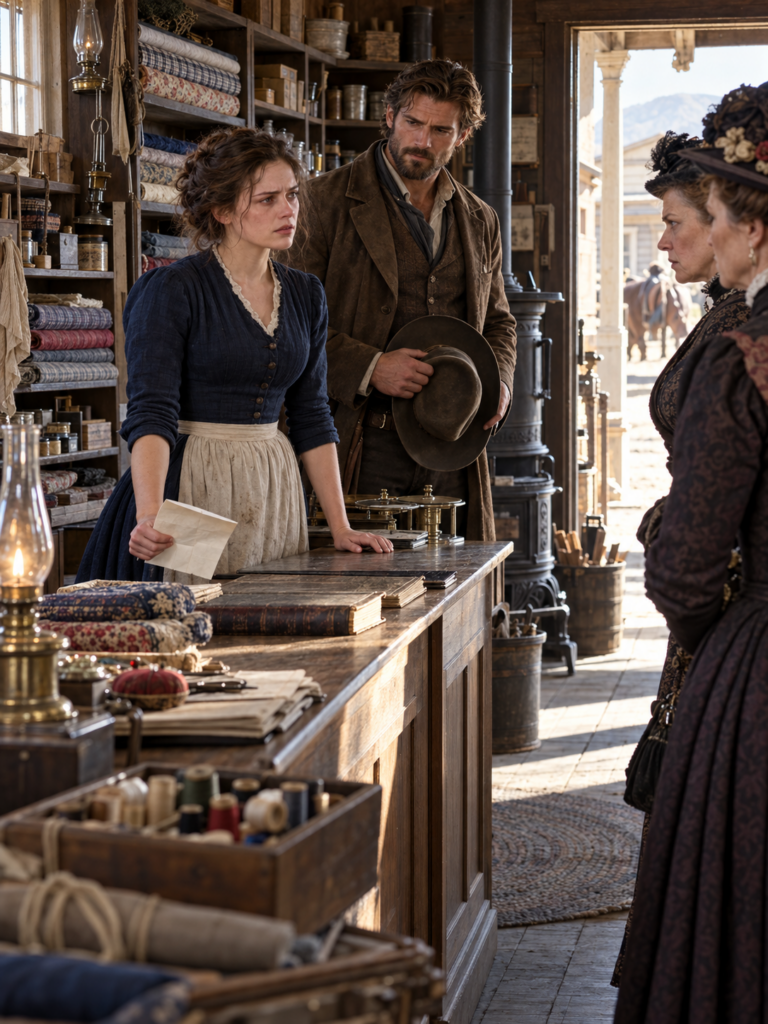
Clara kept the folded document between her fingers while Wyatt leaned toward the table.
“What about Whitaker?”
“He owns the land adjoining your eastern boundary. And he has a habit of taking an interest in property that belongs to someone else.”
Wyatt studied her expression.
“Personal experience?”
“Some.”
She did not elaborate.
He did not demand it.
Instead, he pulled out a chair.
“Tell me what matters to the ranch.”
Clara placed the paper flat.
“This looks like an old inquiry. It doesn’t prove a claim. But before you accept any statement from Whitaker about a boundary, I’d want to compare the original deed with the later surveys.”
“Can you do that?”
“I can compare records. Anything requiring legal judgment belongs with someone qualified to provide it.”
Wyatt nodded.
“Then we’ll find out what the records say.”
The word caught her attention.
We’ll.
For fourteen months, Clara had heard plenty of advice about what she should accept, surrender, or stop wanting.
Very little of it had included anyone offering to share the work.
“You’re remarkably willing to trust a woman you’ve known for three days,” she said.
“I’m trusting the work you’ve done.”
“That’s different?”
“Considerably.”
He pushed the next ledger toward her.
She resumed sorting, grateful for something to occupy her hands.
By late afternoon, she had isolated the disputed entries and made a list of documents Wyatt needed to locate.
He offered to pay her for the full day.
She accepted.
He offered to have someone accompany her home.
She declined.
He accepted that as well.
At the ranch gate, he asked whether she would return Thursday.
“I have customers in town.”
“Then I’ll come to the shop if I need anything.”
“That would be sensible.”
He smiled faintly.
“You’re fond of sensible things.”
“They tend to cost less than foolish ones.”
As Clara rode toward Red Hollow, she found herself thinking about that smile.
It was not a grand expression.
But it had reached his eyes.
And she had noticed.
That troubled her.
At home, she removed her apron and found Dr. Henley’s letter in its pocket.
The paper had softened along its folds.
She opened it.
The doctor’s language remained cautious, explaining that pregnancy appeared unlikely given the complications he had observed.
Yet the town had replaced uncertainty with certainty.
People who had never read the letter spoke as if they understood her body better than she did.
Clara lowered the page.
Her husband had died.
Her hopes of motherhood were uncertain.
Neither fact had made her dishonest, unintelligent, or incapable of love.
But the judgment had begun to influence how she saw herself.
That was the injury she could not bandage.
A knock sounded at her door.
It was Rosie, carrying a forgotten invoice.
The girl noticed the letter.
“Are you all right, Miss Whitmore?”
“Yes.”
Rosie looked unconvinced.
“Is that what everyone keeps talking about?”
Clara folded it.
“It concerns my health.”
“Then it isn’t their business.”
The simplicity of the answer nearly broke her composure.
“No,” Clara said. “It isn’t.”
Rosie hesitated.
“That new rancher asked whether you liked working with the accounts.”
“He did?”
“He came by for another ledger.”
“And?”
“I told him you were the best bookkeeper in Red Hollow.”
Clara raised an eyebrow.
“That was generous.”
“It was accurate.”
Rosie stepped toward the door, then turned.
“He didn’t ask me anything else about you.”
Clara remained quiet after the girl left.
In the weeks that followed, Wyatt returned regularly.
First for supplies.
Then for questions about the books.
Eventually, for conversations that began with ranch business and drifted toward other matters.
Clara recognized his interest.
She also recognized what it might cost them both if she allowed it to grow.
One Thursday, she finally spoke.
“Mr. Dawson, people will tell you things about me.”
“They already have.”
Her stomach tightened.
“About my husband’s death?”
“About your health.”
She gripped the counter.
“And?”
Wyatt removed his hat.
“I’d rather hear what you want me to know from you.”
Clara stared at him.
“You should understand that I may never have children.”
He did not look away.
“I understand that you have been given difficult news.”
“That’s not an answer.”
“No,” he agreed.
He rested his hat on the counter.
“Then here’s one. I’m interested in you, Clara. Not in what the town imagines you might provide.”
Her breath caught.
“But you own a ranch. You must have thought about a family.”
“I have.”
“And?”
Wyatt took a moment before answering.
“I don’t intend to ask you for a future you can’t promise. And I won’t pretend uncertainty is easy.”
Clara stood completely still.
“Then what do you want?”
“To know you better. If you’ll allow it.”
For a moment, her composure failed.
She looked down at the letter concealed beneath her apron.
Then she opened the drawer beneath the counter and placed it inside.
When she looked back up, her decision was not yet complete.
But she had begun to make it.
“Come back Thursday, Wyatt,” she said.
His expression softened.
“I will.”
He picked up his hat and turned toward the door.
Clara reached across the counter before he could leave.
“One more thing.”
He stopped.
“If you’re going to court my company, I want no conversations about me conducted as though I were absent.”
Wyatt turned fully toward her.
“Agreed.”
She extended her hand.
He took it.
And for the first time since Thomas died, Clara let another man hold her hand without immediately preparing herself for the moment he might let go.
Wyatt’s fingers closed gently around Clara’s hand.
He held it just long enough for her to understand that he had heard her.
Then he released it.
“Thursday,” he said.
Clara watched him leave.
The bell above the shop door sounded once.
She remained behind the counter with her palm resting where his hand had been.
Nothing had been promised beyond another visit.
That was precisely why she believed him.
During the following weeks, their friendship developed through work.
Every Monday, Clara went to Dawson Ranch to untangle the previous owner’s accounts.
Every Thursday, Wyatt appeared at Whitmore Trading.
Sometimes he bought supplies.
Sometimes he brought invoices.
Once he purchased a jar of honey despite admitting that his kitchen already held two.
Rosie noticed immediately.
“He’s not buying honey, Miss Whitmore.”
“Then I fear you’ve lost your ability to identify merchandise.”
“He’s finding reasons to see you.”
Clara continued writing.
“Finish the inventory, Rosie.”
But when the girl disappeared into the storeroom, Clara smiled.
She had not allowed herself to imagine being wanted for anything beyond what she could provide.
Now a man seemed to enjoy her company even when there was nothing useful for her to do.
That distinction mattered.
So did the way he treated her work.
He paid her agreed fee without complaint.
He followed her financial recommendations when the evidence supported them.
He questioned decisions when he did not understand them.
And when she disagreed with him, he listened.
Then Red Hollow began interfering.
Len Crawford stopped Wyatt outside the feed store one afternoon.
A council member and established cattleman, Len believed himself responsible for advising younger ranchers.
He spoke of Clara’s diagnosis.
Of the children Wyatt might want.
Of what respectable families expected.
Wyatt listened.
Then he thanked Len for his concern and continued on his way.
When Clara heard about the conversation through Rosie, she was hurt by what Wyatt had not said.
He had not publicly defended her.
That Thursday, she confronted him.
“Did Mr. Crawford speak to you about me?”
“Yes.”
“And you thanked him?”
“I ended the conversation without accepting his judgment.”
“Why not tell him he was wrong?”
Wyatt considered her question.
“Because I hadn’t yet asked you whether you wanted me discussing something private with him.”
Clara’s anger weakened, though it did not vanish.
“I don’t want people assuming your silence means you agree.”
“Then I won’t leave that impression again.”
She examined his face.
He was not trying to win an argument.
He was trying to understand the boundary.
That made forgiveness easier.
But not automatic.
“There’s something else,” Clara said.
“The doctor’s findings weren’t a certainty. He believed pregnancy was unlikely. I need you to understand the difference.”
“I do.”
“And I will not have you spending years waiting for a child you think I owe you.”
Wyatt’s expression became grave.
“I want to build a life with somebody I can trust. Children aren’t something I can demand from another person.”
She looked away.
The simple truth of it hurt more than she expected.
“You’re making this difficult,” she whispered.
“How?”
“Because I keep discovering reasons to believe you.”
He stepped closer.
“Then we’ll take our time.”
That evening, Clara returned home and took the doctor’s letter from her drawer.
She read it one last time.
Then she carried it to the fireplace.
The paper caught slowly.
She watched the edges darken and curl.
She was not denying what Dr. Henley had told her.
The medical uncertainty remained real.
But she no longer wanted the letter to serve as the final authority over every possibility in her life.
When the last fragment became ash, she turned away from the fire.
The following morning, Margaret Holt arrived before the shop opened.
She warned Clara that Wyatt deserved a wife who could give him children.
Then she accused Clara of selfishness for allowing the relationship to continue.
Clara listened until Margaret finished.
“Did you consider what saying this would do to me?” she asked.
Margaret faltered.
“I’m trying to protect him.”
“He’s capable of making his own decisions.”
“But Clara—”
“And so am I.”
She opened the shop ledger.
“I won’t discuss my private health with you again.”
Margaret left offended.
Clara remained steady.
She had spent too many years allowing other people’s certainty to become louder than her own voice.
That evening, Wyatt invited her to dinner.
His ranch house had been cleaned.
The table held proper plates and a cloth that had clearly been placed there for the occasion.
Clara noticed the effort.
They ate, talked about business, and eventually spoke about Thomas.
Clara described her late husband’s kindness.
His stubbornness.
His inability to maintain an orderly ledger.
And the way he trusted her to keep the shop going during his final illness.
Wyatt did not ask her to stop remembering him.
He listened.
When she finished, he said, “You don’t have to choose between honoring him and having another future.”
Clara lowered her eyes.
“I know that in my head.”
“The rest can take longer.”
For the first time, she believed it might.
Their affection grew after that evening.
But so did the danger surrounding Dawson Ranch.
Charles Whitaker learned of the connection between them.
He had once courted Clara after Thomas’s death.
Her refusal had embarrassed him.
Now he saw an opportunity to injure both her reputation and Wyatt’s financial standing.
At a church gathering, he began suggesting that the Dawson property had been purchased under questionable circumstances.
He spoke of poorly maintained records.
Uncertain boundaries.
And an inexperienced rancher receiving advice from a woman whose judgment might be compromised by personal affection.
Clara confronted him before he could finish.
“The accounts are available for proper examination, Mr. Whitaker. If you have a genuine concern, put it in writing.”
His smile tightened.
“And if I do?”
“Then I’ll answer with records.”
The following week, an inquiry reached the county land office.
Whitaker’s attorney claimed that the original property description conflicted with a boundary survey.
Clara went to the office herself.
She examined the referenced survey and immediately noticed its date.
1879.
She remembered seeing a corrected survey from 1882.
The clerk searched the files.
The corrected document confirmed that the supposed discrepancy had already been resolved.
Clara took a copy to Wyatt.
He stared at it.
“You found that without asking me to ride into town?”
“You were working cattle.”
“It’s my ranch.”
“And I was employed to help protect its finances.”
He looked at her.
For a moment, she feared he resented her independence.
Then he smiled.
“Remind me never to argue with you over a set of figures.”
“You may argue. You simply won’t always win.”
Whitaker’s first challenge failed.
He responded by questioning Clara’s management of the ranch accounts before the town council.
At a public meeting, he argued that her personal relationship with Wyatt created grounds for financial scrutiny.
Clara stood before the gathered townspeople and answered him.
She did not deny caring for Wyatt.
She did not apologize for it either.
Instead, she offered the accounts for examination by an independent accountant chosen by the council rather than Whitaker.
“If the concern is honest, an impartial review should satisfy it,” she said.
The council agreed.
Whitaker had little choice but to accept.
An accountant examined the records.
His report found no irregularities or financial misconduct.
When Wyatt brought the findings to Clara’s shop, she read them in silence.
Then she laid the pages down.
“Well,” she said, “that’s settled.”
Wyatt laughed softly.
“You sound disappointed.”
“I expected the conclusion. It would have been nicer if reaching it had required less foolishness.”
He covered her hand with his.
“I’m proud of you.”
She looked at him.
Not because she needed praise.
Because he had spoken without embarrassment.
In her shop.
With Rosie listening.
Where anyone might hear.
Clara turned her hand beneath his and held on.
But Charles Whitaker had not finished.
Twelve days after the clean review, a formal court claim arrived.
This time, he alleged that the previous owner, Hargrove, had verbally promised him forty acres along the ranch’s eastern boundary.
The disputed land contained the cattle operation’s essential water source.
Without reliable access to it, Wyatt’s ranch could not operate as it had been planned.
Whitaker claimed that Wyatt had purchased the property knowing of the promise.
He demanded either the land or a substantial payment.
Clara read the filing carefully.
Then she rode to the ranch.
Wyatt was waiting in the office.
“Can he take the water?” he asked.
“He’s alleging a right to it. Whether he can prove that is another matter.”
“The purchase records were clear.”
“Then we need evidence showing what Hargrove actually promised.”
Wyatt rubbed his forehead.
“I’ve searched the accounts.”
“Not just the accounts. His private papers.”
“There was an old trunk in the storeroom.”
Clara looked up.
“Did you examine everything inside?”
“Most of it.”
“Most?”
“Some letters at the bottom. They appeared personal.”
Clara rose.
“Then show me the trunk.”
They found it beneath a stack of unused supplies.
Wyatt lifted the lid.
Inside were old papers, a Bible, and several bundles of correspondence.
Clara worked carefully through them.
Then she found a letter dated October 1880.
Hargrove had written to his brother about Charles Whitaker.
He explained that Whitaker was misrepresenting a courteous offer to give him first consideration if the eastern land were ever sold.
No debt had been acknowledged.
No promise to transfer the land had been made.
Clara read the passage again.
Then she handed it to Wyatt.
His expression hardened.
“He’s been lying.”
“More importantly, Hargrove wrote down the truth while the disagreement was happening.”
Wyatt looked toward the remaining letters.
“Will that be enough?”
“Not by itself. We need more evidence, and we need a lawyer.”
She lifted the letter.
“We also need Hargrove’s brother.”
Wyatt watched her carefully.
“Can you find him?”
Clara set the letter beside the trunk.
“I intend to try.”
She reached for her coat.
Then she turned toward the door, carrying the name of the one man who might be able to prove what Charles Whitaker had spent years trying to conceal.
Clara carried Hargrove’s letter straight to the telegraph office.
By then, the afternoon light was beginning to fade over Red Hollow.
She placed the letter on the counter and wrote out a message addressed to Edmund Hargrove, the former owner’s brother.
She did not ask for sympathy.
She asked for information.
Had Edmund retained correspondence from his brother concerning Charles Whitaker?
Could he confirm what had actually been offered or denied?
And would he be willing to provide evidence if the dispute reached court?
The operator counted the words.
Clara paid and watched him begin transmitting.
Outside, a wagon rattled past.
She remembered the first time she had entered a business office after Thomas died, carrying invoices she barely knew how she would pay.
Back then, every unanswered question had frightened her.
Now she knew the usefulness of asking one.
Several days later, a reply arrived.
Edmund Hargrove had letters.
More than one.
He would travel to Red Hollow.
Clara read the message twice before showing Wyatt.
“How many?” he asked.
“He hasn’t said.”
“Do you think they’ll help?”
“They may tell us whether this was an isolated misunderstanding or something Whitaker has been doing for years.”
Wyatt nodded.
Then he looked at her.
“You’ve done more for this ranch than I knew to ask.”
“You asked me to organize the accounts.”
“And look where that led.”
She smiled.
“Poor recordkeeping often conceals interesting things.”
He caught her hand.
“Clara.”
Something in his tone made her stop.
“I need you to know that none of this changes why I want you in my life.”
She studied him.
“You mean the lawsuit?”
“I mean all of it. The good days and the difficult ones. Even if we lose the case, I won’t hold you responsible for something Whitaker chose to do.”
Clara’s face softened.
“That matters to me.”
“I know.”
But he did not know everything.
Not yet.
He did not know how deeply she had begun to love him.
Or how frightened she remained of allowing herself to need another person.
She had survived Thomas’s death by turning grief into work.
She had survived the town’s gossip by making herself indispensable.
Now Wyatt was asking her to believe that she could be loved even when there were no accounts to fix, no debts to settle, and no difficult problem requiring her cleverness.
That was harder than defending a property boundary.
When Edmund Hargrove arrived, Clara met him personally.
He was a careful, reserved man carrying a leather satchel.
Inside were eleven letters written by his brother over four years.
Several referred directly to Whitaker.
Six discussed the disputed eastern acreage and the supposed debt.
Together, they described a consistent pattern.
Whitaker had taken a courteous statement and repeatedly represented it as a binding obligation.
Hargrove had disputed that interpretation.
He had grown exhausted by the continuing pressure.
Eventually, he sold the ranch and left.
Edmund had kept the correspondence.
“I should have spoken when my brother was still here,” he admitted.
“Why didn’t you?” Clara asked.
“He wanted the trouble finished. I believed respecting that wish was the kindest thing I could do.”
He looked down at the letters.
“I’ve wondered ever since whether I should have argued.”
Clara understood regret.
She also understood that regret could not recover a wasted yesterday.
“You’re here now,” she told him.
Edmund looked up.
“Yes.”
“Then let’s make use of what you brought.”
They spent hours comparing the letters with the property records.
Wyatt provided every surviving transaction from the original purchase.
Clara assembled a chronology.
They contacted Garrett Fossey, a lawyer from Helena, who agreed to represent the defense.
When Fossey examined the evidence, he was impressed by Clara’s organization.
But he did not pretend the case was simple.
“Whitaker has capable counsel,” he warned. “And he’s relying on a claim about an agreement nobody formally recorded.”
Clara indicated the letters.
“Then these accounts of the dispute become important.”
“Very.”
Edmund agreed to testify concerning his brother’s correspondence and their conversations.
Whitaker’s attorney soon offered a settlement.
Under its terms, Wyatt would grant a permanent easement across the disputed forty acres.
In return, Whitaker would withdraw his claim.
No one would admit wrongdoing.
The case would end privately.
Wyatt read the proposal and handed it to Clara.
She studied it.
“He would still gain access to the water.”
“Yes.”
“And we’d be surrendering something the purchase documents say belongs to you.”
Wyatt leaned back.
“The settlement would end the lawsuit.”
“This lawsuit.”
She looked toward Edmund.
“Your brother left because he was tired of fighting. The Kelner widow gave up her property under similar pressure.”
Edmund lowered his eyes.
Clara continued.
“If every person resolves these demands privately, no one establishes what Whitaker has been doing.”
Wyatt folded the proposal.
“Then we go to court.”
It was not a heroic declaration.
There was no shouting.
Only a rancher choosing to defend what he had lawfully purchased.
And a woman refusing to let fear make the decision for him.
As the hearing approached, Clara spent long days between her shop and the ranch.
Rosie took on more responsibilities at Whitmore Trading.
She handled customers, checked inventory, and brought questions to Clara when necessary.
Clara was proud of her.
She remembered hiring the girl because her family needed income.
Now Rosie was becoming a capable assistant whose judgment Clara genuinely valued.
One evening, Rosie found her employer sitting at the shop’s back table with her forehead resting against her hand.
“Miss Whitmore?”
“I’m thinking.”
“You look tired.”
“An unfortunate side effect of thinking.”
Rosie pulled out a chair.
“Can I ask something?”
“You generally do.”
“Do you love Mr. Dawson?”
Clara lifted her head.
“That is not a business question.”
“No, ma’am.”
“Then why are you asking?”
Rosie considered the matter.
“Because he looks happier when you’re near him. And you look less lonely.”
Clara stared at the girl.
Then she sighed.
“Yes, Rosie. I believe I do.”
Rosie smiled.
“Then I hope you tell him.”
Clara looked toward the shop window.
“So do I.”
She told Wyatt several evenings later.
They were working through the final hearing documents when he made a mistake adding a column.
Clara corrected it.
He rubbed his eyes.
“I thought moving west would simplify my life.”
“You bought a ranch with disordered finances and an argumentative neighbor.”
“And hired a woman who corrects my arithmetic.”
“A serious hardship.”
He smiled.
Then his expression grew thoughtful.
“I wouldn’t change that part.”
Clara set down her pencil.
“Neither would I.”
He looked at her.
She could have returned to the papers.
She could have allowed the moment to pass.
Instead, she folded her hands.
“Wyatt, I love you.”
The room became very quiet.
She had feared the words would make her vulnerable.
They did.
But not in the way she expected.
Wyatt reached across the table.
“I love you too.”
Clara looked at their joined hands.
“I can’t promise you children.”
“I haven’t asked you to.”
“I know. But I need to say it plainly.”
“Then hear me plainly.”
He waited until she met his eyes.
“I want a life with you. Whatever family may or may not come from that, I want the part we can choose.”
For the first time, Clara believed she could accept such a promise without searching for the condition hidden inside it.
She leaned forward.
He met her halfway.
Their first kiss was gentle.
Not a reward for solving his problems.
Not payment for work completed.
Simply a choice both had wanted to make.
They returned to the papers afterward.
But the silence between them had changed.
It was no longer filled with questions they were afraid to ask.
The months of strain began taking their toll on Clara’s health.
She noticed unusual exhaustion.
Then persistent nausea.
At first, she attributed both to long hours and worry.
But as the symptoms continued, she visited Dr. Henley.
He examined her carefully.
When he told her she was pregnant, Clara stared at him.
For several seconds, she said nothing.
Then she asked him to explain exactly what he knew.
The doctor acknowledged that his earlier assessment had described an unlikely outcome, not an impossible one.
He also cautioned that her medical history meant the pregnancy would require careful attention.
Clara listened.
She asked questions.
She insisted upon plain answers.
Then she left his office carrying news she had once believed she might never hear.
She did not go to the shop.
She went to Dawson Ranch.
Wyatt was reviewing the hearing documents with Fossey when she arrived.
The lawyer recognized that she needed to speak privately and stepped outside.
Wyatt rose immediately.
“Clara, what’s wrong?”
“Nothing is wrong.”
She stopped.
“Not exactly.”
He waited.
“I saw Dr. Henley.”
Wyatt’s face tightened with concern.
“Are you ill?”
“No.”
She drew a breath.
“Wyatt, I’m expecting a baby.”
For a moment, he stood motionless.
Then he crossed the room and embraced her.
Clara held him tightly.
The tears she had denied herself for so long finally came.
Not because she had become complete.
She had already been complete.
Not because the town’s judgment had somehow been justified.
It had not.
She cried because something she had feared losing forever had unexpectedly become possible.
Wyatt held her without speaking until she was ready.
Then he stepped back and looked at her.
“How are you feeling?”
“Frightened.”
“Me too.”
That answer made her smile through her tears.
“Dr. Henley says we must be careful.”
“Then we will be.”
She shook her head.
“Not we in the sense of you deciding what I may do.”
Wyatt almost smiled.
“I wouldn’t dare.”
“Good.”
He touched her hand.
“We’ll hear the doctor, and you’ll decide what you can manage. I’ll help however you want me to.”
Clara rested her forehead against his shoulder.
For once, she did not feel the need to argue.
The hearing remained ahead of them.
She intended to finish what she had begun.
When Wyatt asked whether she wanted to withdraw from the preparation, she refused.
“I have spent months helping assemble this case.”
“I know.”
“And I intend to see it through.”
He nodded.
“Then we’ll work out how.”
At the courtroom, the evidence was presented before Judge Alderman.
Whitaker’s lawyer argued that the previous owner had promised the disputed land in exchange for a debt.
Fossey produced the original title documents and the corrected survey.
Then he introduced Edmund Hargrove.
Edmund testified about the letters his brother had sent him.
He explained the repeated dispute and his brother’s insistence that no land transfer had been promised.
The correspondence was admitted for the court’s consideration.
Fossey used it to challenge Whitaker’s account.
He also presented the clean financial records Clara had assembled.
Whitaker’s lawyer attempted to dismiss the letters as personal correspondence.
But their dates and contents directly contradicted the alleged promise.
Judge Alderman questioned the argument carefully.
Then he delivered his ruling.
Whitaker had failed to establish the claimed obligation.
Judgment was entered for Wyatt Dawson.
The action against the ranch was dismissed.
Clara sat very still as the courtroom reacted.
Rosie gripped the back of her chair.
Mrs. Patton wiped her eyes.
Edmund lowered his head with visible relief.
Whitaker gathered his papers and left.
The legal danger that had threatened the ranch’s water and future had finally ended.
Wyatt turned toward Clara.
She rose.
He took her hands.
“We did it,” he said.
She smiled.
“With considerable help.”
“And considerable bookkeeping.”
“Never underestimate good bookkeeping.”
He laughed.
Outside the courtroom, people approached her.
Some had always been kind.
Others had once joined in the gossip.
Len Crawford, who had warned Wyatt away from her, offered a sincere apology.
Clara accepted it.
But she did not pretend that every wound could be erased by one conversation.
Some people had shown themselves capable of change.
Others remained people she preferred to keep at a distance.
She understood the difference now.
The victory also brought another change.
Edmund Hargrove, who had come to Red Hollow carrying his brother’s letters, found a reason to remain.
His sister Ruth joined him, and together they began making plans concerning the old Henderson property.
Ruth sought Clara’s judgment about the land and its business prospects.
Clara welcomed the conversation.
Their friendship began not with gossip or pity but with mutual respect.
That mattered more to Clara than the town’s sudden admiration.
Three weeks after the hearing, Wyatt proposed.
They were alone, away from the crowd that had spent so long discussing their lives.
He asked her to marry him because he loved her.
Not because she was pregnant.
Not because she had saved his ranch.
Not because a wedding would satisfy Red Hollow.
Clara accepted because she loved him too.
And because she had watched him honor her work, her grief, her independence, and her choices.
Their wedding took place on a Saturday morning in late June.
There were twelve guests.
Rosie attended.
So did Mrs. Patton, Edmund Hargrove, and several friends who had stood by them.
Margaret Holt was not invited.
Clara no longer needed to prove she had forgiven every insult by granting everyone a place in her happiest moments.
The ceremony was modest.
The promises were clear.
When Clara signed the register as Clara Dawson, she paused.
Then she added a small acknowledgment of her former name.
Whitmore.
Thomas had been part of her life.
She would not erase him to make room for Wyatt.
Wyatt noticed.
He placed his hand briefly over hers.
Neither needed to explain.
After the wedding, he moved into the house Clara had maintained since Thomas’s death.
He offered to find a larger home.
She refused.
“This one is mine. I know every board that needs repairing and every window that lets in the wind.”
Wyatt looked around.
“Then I suppose I’ll learn them too.”
“You will.”
And he did.
They continued working together while maintaining their separate responsibilities.
Clara remained the owner of Whitmore Trading.
Rosie took on more of the day-to-day management as Clara’s pregnancy progressed.
Wyatt continued running his ranch.
They discussed expenses and plans at the kitchen table.
Sometimes they disagreed.
Sometimes they laughed until neither could remember what the disagreement had been about.
The pregnancy was not effortless.
Clara tired more easily.
Some mornings were difficult.
Dr. Henley monitored her closely and answered her questions without making promises he could not keep.
She learned to accept help before exhaustion forced her to.
That was not a small change.
For years, she had treated constant work as proof that she could survive alone.
Now she was learning that accepting care did not make her less capable.
On nights when worry kept her awake, Wyatt rose with her.
He heated water for tea.
Sat at the table.
Listened.
He never told her that nothing could go wrong.
He knew she would not believe it.
Instead, he reminded her of what was true.
Dr. Henley was attentive.
They were following his advice.
She could rest when she needed to.
And whatever happened, she would not have to face it alone.
One winter evening, Clara opened a drawer looking for a clean sheet of writing paper.
Her fingers touched an old envelope.
For a moment, she did not recognize it.
Then she remembered.
The doctor’s first letter.
The one she had burned.
The envelope was all that remained.
She held it in her hand.
Once, she had believed the letter contained the end of her story.
Now she understood that it had contained only one uncertain medical judgment.
The town had supplied the cruelty.
Her own fear had supplied the finality.
Neither had been entitled to decide her worth.
She closed the drawer.
Outside, snow settled over Red Hollow.
Inside, Wyatt was repairing a loose chair rung near the stove.
He looked up.
“Find what you needed?”
Clara smiled.
“Yes.”
She crossed the room and sat beside him.
He set down his tools and took her hand.
For a while, they listened to the fire.
Then Clara rested her other hand against her growing belly.
“I hope our daughter knows she’s worth more than what people expect of her.”
Wyatt considered this.
“She’ll learn from her mother.”
“And from her father?”
“I expect she’ll learn that a man can be wrong about a great many things and still be willing to correct himself.”
Clara laughed.
“That’s a promising beginning.”
When February arrived, so did their daughter.
Dr. Henley attended the birth.
Wyatt remained close throughout the long hours.
When the baby was finally placed in Clara’s arms, the room seemed to become very still.
She looked down at the tiny face.
All the months of uncertainty were behind her now.
But she did not think of the child as proof that the town had been wrong.
The town had been wrong long before the baby existed.
It had been wrong when it dismissed a grieving widow.
Wrong when it treated a private medical matter as public entertainment.
Wrong when it measured her future by what her body might provide.
Her daughter was a blessing she had not expected.
Not a verdict on her value.
Wyatt sat beside the bed.
“She has your eyes,” he whispered.
“She’s barely been here an hour.”
“I can already see it.”
Clara smiled.
“You are very determined to be right.”
“Married a woman who taught me the habit.”
She laughed softly.
He leaned closer and kissed her forehead.
Then they sat together, looking at their child.
From outside came the faint sounds of Red Hollow going about its business.
Wagons moving.
Horses calling.
Shop doors opening for another day.
Clara thought of Whitmore Trading.
Of Rosie.
Of the accounts she would someday return to.
Of Edmund and Ruth planning their new work.
Of Mrs. Patton and the neighbors who had learned that kindness mattered more than an easy judgment.
And of Wyatt.
The rancher who had walked into her shop, removed his hat, and asked for her help.
He had not arrived to rescue a helpless woman.
He had found a capable one who was tired of being told what her life could become.
They had built something together because each had chosen to trust the other.
And now there was a child in their arms.
A future they welcomed.
A home made through ordinary work and extraordinary patience.
Clara looked down at her daughter.
“Hello, little one,” she whispered.
The baby stirred.
Wyatt smiled.
Clara held her a little closer.
She hoped the girl would grow up knowing how to read a difficult ledger, defend a fair bargain, and recognize a cruel judgment for what it was.
She hoped she would love deeply without ever believing love required her to surrender herself.
Most of all, she hoped her daughter would never need an entire town to change its mind before she understood her own worth.
The fire burned low.
Wyatt reached over to adjust the blanket around them.
And Clara, who had once folded a doctor’s letter against her heart and believed her future was closing, looked at the family beside her and understood that a life could contain grief, love, uncertainty, and joy without any one of them defining all the others.
Tomorrow there would be work.
There would be accounts to settle.
There would be more decisions to make.
But tonight she was exactly where she wanted to be.
Not because the world had finally given her permission.
Because the life she had fought to build was hers.
And she had chosen to share it.


