
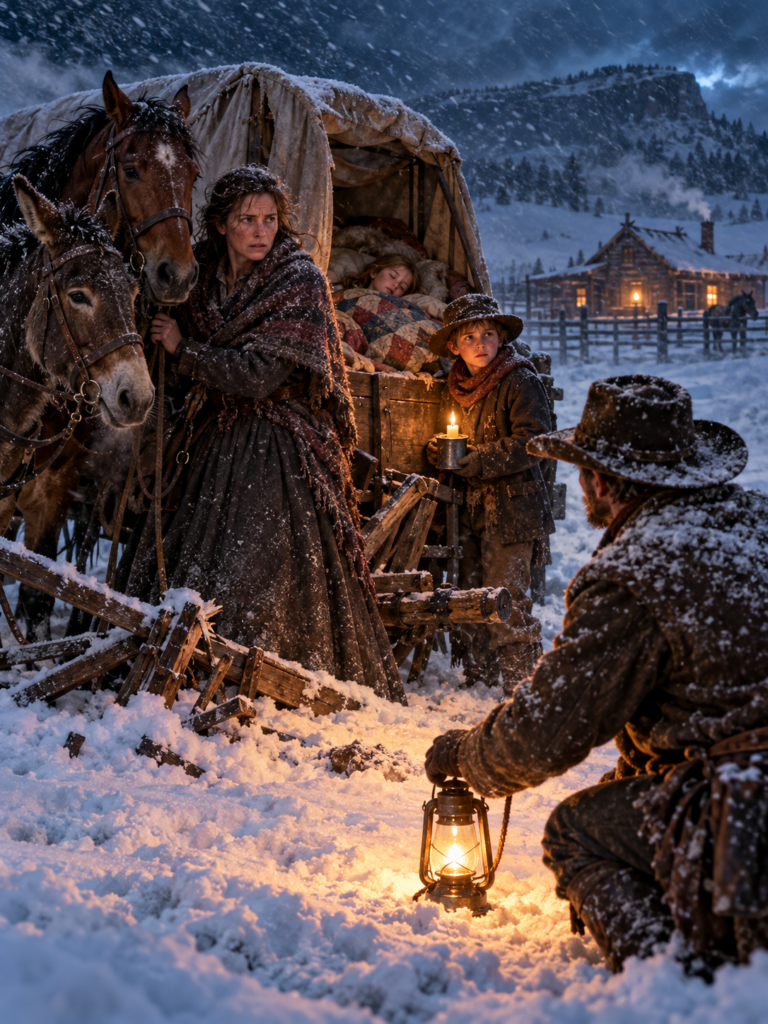
Amos held the gate wide while Rachel passed through, but the wind caught it and drove it back against its leaning post.
The impact echoed down the lane.
Rachel turned sharply.
“That hinge won’t survive many more nights.”
“Probably not.”
“Then it needs repairing.”
Amos lifted the lantern.
“There’s plenty around here that does.”
Something in his tone stopped her from answering.
They returned to the kitchen, where Thomas had awakened and was quietly feeding another stick into the stove.
Kora slept beneath the quilt.
Rachel removed her shawl and hung it near the warmth.
“What was it you wanted to tell me?” she asked.
Amos looked toward the dark hallway.
“This house belonged to my wife and me.”
Rachel waited.
“Her name was Ellen. She died six years ago.”
The room seemed suddenly quieter.
“I’m sorry,” Rachel said.
He nodded once.
“She liked Christmas. Made something of it even when we didn’t have much.”
His eyes moved toward the pan of dried apples.
“Used to make those every year.”
Rachel looked down at the food her daughter had eaten.
“I hope we haven’t disturbed something important.”
“No.”
His answer came too quickly.
Then he corrected himself.
“You’ve disturbed the quiet. That’s not necessarily a bad thing.”
Rachel studied him.
“How long have you lived alone?”
“Since Ellen died.”
“All this time?”
“Had hired riders during the busy months. But yes, mostly alone.”
She glanced toward the table.
One man’s plate at the far end.
The other chairs pushed aside.
The lamp burning in the window.
And the gate that never quite closed.
She began to understand that the house held more than ordinary neglect.
But she did not ask for the rest.
Instead, she opened her ledger.
Amos watched the pencil move.
“You’re still making that account?”
“I need to know what we owe.”
“Your children needed warmth.”
“That doesn’t make the wood free.”
He drew out a chair.
“Mrs. Teague, I have enough wood to see us through the winter.”
“And I have nine dollars and some silver. I must make it carry us to Greeley.”
Amos looked at her.
Nine dollars.
He had already seen the ruined wagon axle.
A replacement alone could consume every cent she had.
“That won’t repair your wagon,” he said.
“I know.”
“Have you considered what happens if it costs more?”
Rachel closed her ledger.
“I’ll speak to the wagon maker myself. Then I’ll decide.”
He respected the answer, though he could see how little room she had for another misfortune.
“Fair enough.”
The next morning, the storm had filled the doorway nearly halfway.
Amos forced it open just far enough to examine the drifts.
Then he shut it.
“Road’s closed.”
“For how long?”
“Two days at least. Maybe three.”
Rachel drew a slow breath.
The hotel work awaiting her was not promised forever.
Every lost day mattered.
Thomas stood beside the table, listening.
“Are we leaving?” he asked.
“Not today,” Rachel answered.
The boy lowered his eyes.
Kora looked up from the hearth rug.
“Will we have apples again?”
Amos glanced toward Rachel.
“I reckon we can manage that.”
Rachel set the ledger on the table.
“If we’re staying, I want an agreement.”
Amos raised his eyebrows.
She turned the book toward him.
“I’ll help with cooking, mending, and the household. I can keep accounts and handle the animals. We can agree on a fair value for that work.”
“You don’t have to earn your supper.”
“I know what you’re saying. But I won’t leave here unable to account for what I’ve accepted.”
Amos considered her words.
Then he took the pencil.
He crossed out the charge she’d written for the barn.
“The barn is already standing,” he said. “And the animals need shelter whether they’re yours or mine.”
Rachel watched him.
He added a line promising that any work she chose to perform would be recorded at a fair rate.
Then he signed.
She examined the entry.
“You understand why I need this?”
“Not all of it.”
“Perhaps you’ll understand later.”
He handed back the pencil.
“Then we’ll leave it there.”
For the first time, Rachel seemed willing to accept the arrangement.
During the next two days, she proved remarkably capable.
She found the source of a draft beneath the kitchen window and stopped it with a narrow strip of cloth.
She organized supplies that Amos had been storing carelessly.
She noticed spoiled flour and showed him how much could still be sifted and saved.
Thomas helped carry hay.
Kora claimed the warmest place on the hearth rug and began asking Amos questions that no grown man could answer quickly enough.
The house changed.
Not because Rachel owed Amos anything.
Because four people were using rooms that had been meant for more than one.
On the third morning, Amos and Rachel reached the damaged wagon.
He knelt beside the front wheel and examined the split timber.
Rachel crouched next to him.
“Can it be mended?”
“Not safely. Needs a new axle.”
“Cost?”
“Maybe fifteen or sixteen dollars with the work.”
Rachel stared at the broken wood.
She had nine dollars.
And the journey ahead was still long.
Amos could almost see her calculating how much food the children would need if the delay stretched into January.
“I know a wheelwright in Pine Bluffs,” he said.
“I’ll negotiate with him myself.”
“I wasn’t proposing otherwise.”
She gave him a brief, tired smile.
Then she placed her hand on the wagon box.
“This isn’t just transportation, Mr. Kell. It’s everything we have left.”
Amos rested his palm against the shattered axle.
He understood more than she knew.
Before he could answer, Rachel opened her ledger again and wrote down the estimated repair cost.
Then she looked at him.
“I must find a way to pay for this without losing the work waiting for me.”
Amos rose beside her.
The road was still buried in snow.
The wagon could not move.
And for reasons he was beginning to understand, simply offering her money might make her trust him less.
Amos brushed the snow from his knees and examined the wagon once more.
Rachel remained beside it, her ledger open in one hand.
“If we get the box into the barn,” he said, “the wheelwright can work on the axle without the weather ruining everything else.”
“Can you move it safely?”
“With the stoneboat and a little care.”
“Then I’ll help.”
He almost told her to return to the house.
Instead, he asked her to hold the lantern while he worked.
They spent much of the morning freeing the wagon from the drift and moving it the short distance to the barn.
Rachel understood how to handle the animals, and Amos trusted her judgment.
Thomas carried the loose straps and tools.
By midday, the wagon stood on blocks beneath the barn roof.
Its broken wheel rested against the wall.
Rachel looked at it with the weary expression of a woman confronting a problem that could not be solved through determination alone.
“The wheelwright is in Pine Bluffs?” she asked.
“Hollis Dunn. Honest enough, provided you know what you’re buying.”
“I’d like to speak with him as soon as the road opens.”
“I’ll take you.”
She studied his face.
“To speak for myself.”
“Of course.”
That answer mattered.
Too many men had offered Rachel help with the understanding that they would then decide how she ought to live.
Amos simply nodded toward the broken axle.
“Best thing we can do now is keep it dry.”
They returned to the house.
Kora ran toward Rachel and wrapped both arms around her skirt.
“Are we leaving today?”
“Not today, sweetheart.”
“Tomorrow?”
“Not tomorrow either.”
Kora accepted this information with a sigh so deep that Amos nearly laughed.
Then the little girl looked at him.
“Will you still have apples?”
“I expect so.”
She appeared satisfied.
Thomas was not.
He stood near the stove, his oversized borrowed hat pulled low.
“When the wagon’s fixed, we’ll go straight to Greeley?”
Rachel glanced at him.
“That’s the plan.”
The boy nodded.
But Amos noticed how carefully he avoided looking toward the barn.
That evening, Thomas helped bring in firewood.
The work was small, but he attacked it with such fierce seriousness that Amos finally stopped him.
“Son, you’ll wear yourself out.”
Thomas lowered the armful.
“I can do more.”
“I know.”
“I’m not afraid of work.”
“Never said you were.”
The boy stared at the floor.
Amos understood then that Thomas wasn’t trying to prove he could carry wood.
He was trying to prove he deserved to remain somewhere warm.
Amos placed a hand against the wood box.
“That’s enough for tonight. Go warm yourself.”
Thomas hesitated.
Then he obeyed.
***
The road opened shortly after Christmas.
A rider from a neighboring ranch brought mail and news from town.
Among the letters was one addressed to Mrs. Henry Teague.
Rachel recognized the handwriting immediately.
Her face changed.
Amos noticed, but he did not ask who had written it.
Later, when he returned from the barn, the envelope lay open beside Rachel’s ledger.
She was outside.
Thomas sat guarding the papers.
“Ma doesn’t want anybody reading it,” the boy said.
“Then nobody will.”
Amos went about his work.
He knew what private grief looked like.
He also knew the danger of demanding an explanation before someone was ready to give it.
On January second, he drove Rachel into Pine Bluffs.
The children stayed with a neighboring family whose mother had offered to watch them.
Rachel carried her ledger inside her coat.
At the wheelwright’s shop, she asked Amos to wait outside.
He did.
Forty minutes later, she emerged.
“Eleven dollars,” she announced.
Amos stared.
“For the axle and fitting?”
“Both.”
“Hollis quoted me more than that for similar work.”
“He has an old length of hickory that’s sound where the axle needs to be cut. I saw it against the back wall.”
Amos looked at her.
“You negotiated him down?”
“I negotiated a fair price.”
He laughed.
The sound surprised them both.
Rachel smiled for nearly half the ride home.
It was the first time Amos had laughed so openly in years.
They were almost back at the ranch when she grew quiet.
“What’s troubling you?” he asked.
She glanced toward the hills.
“Nothing that can be fixed today.”
He accepted the answer.
But the letter from Sidney remained on the kitchen table.
***
The following week, word spread through Pine Bluffs that Rachel Teague and her children were living at Amos Kell’s ranch.
Some neighbors regarded it as a practical arrangement during winter.
Others were less charitable.
A woman from the church asked Rachel whether she had found a proper situation.
Rachel replied that she had found temporary shelter and useful work.
The woman observed that these were not necessarily respectable substitutes for a household of her own.
Rachel paid for her purchases and left.
She did not tell Amos.
But he heard about it from a neighbor.
For the first time, he understood that providing shelter could expose Rachel to a cost he would not be asked to pay.
When he mentioned the conversation, she simply shrugged.
“I’ve heard worse.”
“That doesn’t make it right.”
“No.”
She returned to her sewing.
“But I will not spend my days begging strangers to approve of me.”
He watched her work for a moment.
Then he returned to the barn and repaired a broken latch.
It was not the ranch gate.
He still avoided that one.
***
On January ninth, a rented buggy arrived.
The man who stepped down introduced himself as Ellis Vance, a collection agent from Sidney.
He wore a tidy dark coat and carried a leather case.
Rachel received him in the kitchen.
Amos remained near the stove.
Vance produced two documents.
The first was a note bearing Henry Teague’s signature.
The second was a calculation of interest and additional charges.
“The outstanding amount is a little more than two hundred and sixty dollars,” Vance said.
Rachel read both pages carefully.
“My husband signed this?”
“Yes, ma’am.”
She examined the signature.
“I recognize it.”
Vance smiled.
“Then perhaps we can avoid unnecessary difficulty.”
“What do you propose?”
“My principal is willing to accept your wagon and team in settlement.”
Rachel looked up.
“The mule, the horse, and the wagon?”
“All of it. That would conclude the matter.”
She placed the papers flat on the table.
“And if I refuse?”
“Proceedings may become necessary. I’m certain you’d rather spare yourself the expense.”
Amos felt anger rise.
But Rachel had not asked him to intervene.
He kept still.
She asked Vance several questions concerning the note’s ownership, the date it had been assigned, and the charges added since Henry’s death.
The collector answered some questions.
Others he dismissed as private business.
Rachel recorded every answer.
Finally, she closed the ledger.
“I won’t surrender the team today.”
Vance’s smile became thinner.
“I will return on the twentieth.”
“I heard you.”
He left.
Only when the buggy disappeared did Rachel sit down.
Her hands were trembling.
Amos pulled out the opposite chair.
“Tell me.”
Rachel stared at the table.
“Henry was a good man.”
“I believe you.”
“He was also generous in ways he couldn’t afford.”
She looked toward the children’s room.
“He signed notes for friends. Borrowed money when someone needed help. Trusted people who promised repayment.”
Her voice remained quiet.
“After he died, those promises became my responsibility.”
She explained how she had spent fourteen months paying obligations that appeared after Henry’s death.
She had washed laundry, sewn garments, sold eggs, and kept careful records.
Most of the debts had been settled.
Then another appeared.
“I thought if I reached Greeley, found employment, and began earning wages, I could deal with anything else through proper channels.”
“And now?”
“Now a man wants the wagon and animals before I can even reach my work.”
Amos looked at the papers.
“Have you had anyone examine the note?”
“I cannot afford a lawyer.”
“Then perhaps we can find someone who’ll tell you what it means without taking everything you’ve got.”
Rachel shook her head.
“I won’t ask you to pay my husband’s debts.”
“I’m not offering to.”
She met his eyes.
“What are you offering?”
“Help finding out whether the claim is sound.”
Rachel considered that.
Then she spoke the fear she’d carried since Vance arrived.
“If he returns here, people will say this obligation belongs to you because you’ve sheltered us.”
“They can say what they like.”
“You can afford to say that. I cannot.”
He had no answer.
She was right.
That night, Rachel began packing.
Thomas discovered her folding clothes into the carpetbag.
He said nothing.
Instead, he went to the barn and began carrying hay that the animals did not need.
Amos found him there.
“Enough, Thomas.”
The boy kept working.
“We’ll leave again,” he said.
Amos waited.
“We always leave when things get good.”
“Your mother’s trying to keep you safe.”
“I know.”
The boy’s voice cracked.
“That’s the part I hate.”
Amos gently took the pitchfork from his hands.
“Come inside.”
Thomas wiped his face on his sleeve.
Then he followed.
***
Two days later, Kora developed a cough.
At first, Rachel hoped it would pass.
By the following afternoon, the child had a fever.
She no longer wanted dried apples.
She refused to play on the hearth rug.
Thomas stopped asking when they would leave.
Amos helped Rachel keep Kora comfortable and warm, but the child’s breathing worried them.
He arranged to fetch Dr. Averill.
The doctor lived more than twenty miles away.
The winter road was difficult.
Amos rode through freezing wind, only to discover that Averill had been called to another patient.
He waited.
Hours passed.
Standing beside his horse outside the doctor’s office, Amos remembered the spring of 1881.
He remembered Ellen growing weaker while he waited for a doctor who could not reach the ranch in time.
He remembered the long journey back.
And the silence afterward.
When Dr. Averill finally returned, Amos arranged for him to come at once.
The physician examined Kora carefully.
He believed the child had bronchitis, serious enough to require close attention but not the more dangerous illness Amos had feared.
He recommended warmth, rest, and careful nursing, with instructions to summon him again if her breathing worsened.
Rachel followed his guidance.
Amos stayed awake through the next night so she could sleep.
Near dawn, Kora rested against his shoulder in the rocking chair.
Her breathing had eased.
Rachel stood in the doorway watching them.
For several seconds, she did not speak.
Then she stepped closer.
“You’ve done more than anyone could reasonably expect.”
Amos looked down at the little girl.
“I don’t know about that.”
“Why?”
He raised his eyes.
“Why what?”
“Why have you done all this?”
The fire shifted in the stove.
Amos was tired.
Too tired to hide behind another practical explanation.
He looked toward the window.
“You asked me about the gate.”
Rachel nodded.
“And the lamp?”
“I used to leave it burning because Ellen’s brother sometimes traveled through in winter.”
He swallowed.
“After she died, I kept expecting him. Then he died too.”
Rachel remained still.
“I kept filling the lamp anyway.”
“Why?”
Amos looked around the kitchen.
For six years, he had known every sound in that house.
The ticking stove.
The winter wind beneath the eaves.
His own footsteps.
Now there was a child’s breathing against his shoulder and another child’s boots beside the door.
“I suppose the lamp was the last thing in the house that looked as though somebody might be expected.”
Rachel lowered her eyes.
“And the gate?”
“It warped one September. Never latched properly afterward.”
“You could have fixed it.”
“Yes.”
“Why didn’t you?”
He hesitated.
“Because fixing it felt too much like closing something.”
Rachel looked at him.
For the first time, she understood that the man who had welcomed them out of a storm had been waiting in ways he barely understood himself.
Amos looked down at Kora.
“When your wagon broke, I went out before I thought. I would’ve gone for anyone who needed help.”
“I know.”
“But having you here afterward…”
He stopped.
Rachel waited.
“I didn’t know how lonely I’d become until this house wasn’t quiet anymore.”
She sat down opposite him.
“Amos, my children and I cannot become the answer to something you lost.”
“I know.”
“And if we go to Greeley, you’ll have to let us.”
“Of course.”
He looked at her.
“I don’t want you staying because you feel indebted.”
Rachel’s expression softened.
“Then perhaps we’re beginning to understand each other.”
***
Kora improved slowly.
The fever eased.
Her appetite returned.
One morning, she demanded apples again, and Rachel nearly cried with relief.
But January twentieth was approaching.
Ellis Vance expected an answer.
Rachel had spent several nights examining every paper she possessed.
She found receipts for earlier debts, dates of payments, and a note marked paid in full.
The records gave her an idea.
She asked Amos to sit with her at the table.
“I intend to meet Vance in Pine Bluffs.”
“All right.”
“At the justice of the peace’s office.”
He leaned forward.
“Why there?”
“Because he wants this settled quietly. I want everyone who hears his demand to hear my answer.”
Amos nodded.
“What do you need from me?”
“A witness.”
“I can do that.”
“Not a champion, Amos. I will speak for myself.”
He looked at her steadily.
“Then I’ll listen.”
Rachel held his gaze.
“Thank you.”
She wrote a letter asking Ellis Vance to present his documents before Justice Rule.
Then she wrote several more.
One to Hollis Dunn.
One to Reverend Pike.
One to Ida Brand, a respected woman whose opinion carried considerable weight in town.
She wanted witnesses who would remember exactly what was said.
On January twentieth, Rachel dressed carefully.
She put her ledger inside her coat.
Thomas helped Kora into her warm clothes.
Amos prepared the team.
Before they left, Rachel stood in the kitchen doorway and looked around.
The table was clean.
The hearth rug lay beside the stove.
A child’s mitten hung from a peg.
For the first time, she admitted something that frightened her more than Ellis Vance.
She wanted to return to this house afterward.
Not because she needed its shelter.
Because she had begun to love the life taking shape inside it.
She turned toward Amos.
“If matters go badly today, I may still have to leave.”
“I understand.”
“And if they go well?”
He looked at her.
“Then you’ll have a choice.”
Rachel drew a slow breath.
“Yes,” she said. “That’s exactly what I intend to have.”
Rachel stepped down from the wagon in Pine Bluffs with her ledger held firmly beneath her arm.
The morning was cold, but the sky was clear.
Amos offered his hand as she descended.
She accepted it, then released it once her boots touched the ground.
Across the street stood the office of Justice Rule.
Several people had already gathered outside.
Rachel recognized Hollis Dunn, the wheelwright who had agreed to repair her axle.
Reverend Pike stood beside him.
Ida Brand, her expression severe beneath a neatly tied bonnet, watched Rachel approach.
Word had traveled farther than she expected.
Rachel stopped briefly.
Amos noticed.
“You can still change your mind,” he said.
She shook her head.
“No. I’ve spent too long letting other people decide what should be said about me.”
He nodded.
“Then let’s go inside.”
The office was small.
By the time everyone entered, chairs had been pulled against the walls and several men stood near the door.
Justice Rule occupied the desk at the front.
Ellis Vance arrived shortly afterward, carrying the same leather case he had brought to the ranch.
He looked displeased by the audience.
“Mrs. Teague,” he said, “I understood this was to be a private discussion.”
Rachel opened her ledger.
“I invited witnesses.”
“I fail to see the necessity.”
“Then you should have no objection to answering the same questions in front of them.”
Justice Rule cleared his throat.
“This office is not a court empowered to decide every matter concerning an estate,” he said. “But I can hear what’s presented and preserve a written record.”
“That’s all I ask,” Rachel answered.
Vance laid out his papers.
He repeated the amount allegedly owed by Henry Teague’s estate.
Two hundred and sixty dollars and some cents.
He explained that his principal would accept the wagon and team in settlement.
Rachel listened without interrupting.
When he finished, she stood.
“May I ask a few questions?”
Rule nodded.
“Proceed.”
Rachel turned toward Vance.
“When did my husband sign this note?”
The collector read the date.
“And when did your principal acquire it?”
Vance hesitated, then read the assignment date.
January second.
Rachel looked toward the justice.
“Eighteen days ago.”
Vance shifted his weight.
“That’s correct.”
“Did you purchase the note yourself?”
“I act on behalf of the holder.”
“Do you receive payment if you collect it?”
“That is a private arrangement.”
Rachel nodded.
“And what did your principal pay for the assignment?”
“I am not obliged to disclose that.”
“No,” she answered. “Perhaps not.”
She turned a page in her ledger.
“But I am entitled to know whether the claim is valid before surrendering the means by which my children and I earn our living.”
A murmur passed through the room.
Vance frowned.
“Mrs. Teague, your husband’s signature is genuine.”
“I’ve never denied it.”
“Then you understand the obligation.”
“I understand that a piece of paper exists. I also understand that claims concerning a deceased man’s obligations must be examined properly.”
She raised the ledger.
“After Henry died, I settled several debts he had guaranteed for other people.”
She read the dates aloud.
Fourteen months of payments.
Small amounts made from sewing, washing, and selling what little she could spare.
There was no self-pity in her voice.
Only figures.
Every sum represented labor.
Every entry was proof that she had never been careless about what she owed.
When she finished, she looked directly at Vance.
“I paid those claims because they were properly presented and because I believed them valid.”
Vance straightened.
“This note is also valid.”
“Perhaps. But I want to know why the holder is demanding my wagon and animals before the matter has been examined.”
“They are being accepted generously in settlement.”
“Generously?”
Rachel glanced toward Hollis Dunn.
“Mr. Dunn, would you tell the room what a sound wagon, mule, and horse might reasonably bring?”
Dunn removed his hat.
“Depends on condition. But more than what she’s being offered credit for, I’d reckon.”
Rachel turned back.
“Those animals and that wagon are worth considerably more than the price of the debt you claim.”
Vance’s face reddened.
“The lady is attempting to create a spectacle.”
“No,” Rachel said. “I’m attempting to keep my property.”
She opened her ledger to another marked page.
“And there’s one more thing.”
The room grew still.
“After my husband’s death, I paid a note connected with a man named Corby. I have the receipt showing it was satisfied.”
She held up the paper.
“Would you tell me whether your principal also acquired an interest in that note?”
Vance looked at the receipt.
For the first time, his practiced pleasantness disappeared.
“I would have to investigate.”
“Then I suggest you investigate both claims before demanding anything further.”
Justice Rule asked to inspect the papers.
Rachel handed them over.
The justice studied the receipt, the original note, and the assignment Vance had produced.
He made several entries in his minute book.
Then he addressed the collector.
“The validity and enforceability of the claim are matters for the proper court. Mrs. Teague has made clear that she disputes the demand for immediate surrender of her property.”
Vance pressed his lips together.
“My principal may choose to proceed.”
“That is his right,” Rule answered.
“And mine,” Rachel said, “is to answer through proper proceedings.”
She closed her ledger.
“If a court determines that I lawfully owe the money, I will deal with that judgment. Until then, the team and wagon remain mine.”
For several seconds, the only sound was the movement of a chair near the wall.
Then Vance began collecting his papers.
“In light of the circumstances,” he said stiffly, “I believe further discussion should be postponed.”
Rachel stepped aside.
“Very well.”
He left without shaking anyone’s hand.
Justice Rule retained copies of the documents.
No one declared the debt miraculously erased.
No judge had ruled it invalid.
But Vance had failed to frighten Rachel into surrendering her property without a proper hearing.
And everyone present had witnessed it.
***
Outside, the winter sun had risen above the rooftops.
Hollis Dunn approached Rachel.
“Mrs. Teague, your axle’s ready whenever you want it fitted.”
“Thank you, Mr. Dunn.”
“And I must say, you handled that fellow better than most men would.”
Rachel smiled.
“I wasn’t trying to handle him. I was trying to make him answer.”
Dunn chuckled.
“There’s not much difference sometimes.”
Reverend Pike offered his hand.
“I hope this difficulty is settled soon.”
“So do I.”
Ida Brand waited until the others moved away.
Then she approached Amos.
“Mr. Kell.”
“Mrs. Brand.”
“I’d heard a good deal about the woman staying at your ranch.”
“So had I.”
Ida glanced toward Rachel.
“I suspect we should all have asked better questions before forming opinions.”
Amos nodded.
“That would’ve helped.”
The older woman looked at him thoughtfully.
“You did a decent thing by standing with her.”
“I didn’t do much.”
“No,” Ida replied. “You let her speak. There’s a difference.”
Amos watched Rachel thanking Hollis Dunn.
He knew Ida was right.
The most useful thing he had done in that room was remain quiet when the words belonged to Rachel.
***
The journey back to the ranch was peaceful.
Thomas asked questions about the meeting.
Rachel explained as much as he could understand.
“So Mr. Vance can’t take our wagon?” the boy asked.
“Not simply because he says he can. If the claim continues, it must be dealt with properly.”
Thomas thought about that.
“Does that mean we’re still going to Greeley?”
Rachel glanced toward Amos.
He kept his eyes on the road.
“The wagon will be repaired,” she said. “Then we can decide.”
Thomas nodded.
Kora sat wrapped in a quilt beside her brother.
“I like this house better than wagons,” she announced.
Rachel smiled sadly.
“I know you do.”
“So can we stay?”
Amos tightened his grip on the reins.
Rachel looked toward her daughter.
“We’ll talk about that when we get home.”
For the remainder of the ride, Amos spoke little.
He understood that the broken axle would soon be repaired.
The children’s health was improving.
The immediate debt demand had been resisted.
The roads would eventually open toward Greeley.
There would be no practical reason for Rachel to remain.
And that realization frightened him more than the storm had.
***
The following morning, Amos repaired the ranch gate.
He carried tools and new hardware down the lane.
The warped post required attention, and the damaged hinge had to be replaced.
It took him much of the morning.
When he finished, the gate swung freely and caught the latch with a clean wooden click.
For six years, he had avoided that sound.
Now he stood listening to it.
Rachel came down the lane carrying her shawl over one arm.
“I thought you were checking the south fence.”
“I was. Then I decided this needed doing.”
She examined the gate.
“You’ve finally fixed it.”
“Seems so.”
She pushed it open.
It moved smoothly.
Then she let it close.
The latch caught.
“That will save you trouble in the next storm.”
Amos nodded.
But he did not move away.
Rachel noticed.
“What is it?”
He rested one hand on the top rail.
“I’ve been meaning to speak with you.”
She grew still.
“About the wagon?”
“Partly.”
“Hollis says it can be ready soon.”
“I know.”
“And the roads should be passable.”
“I know that too.”
Rachel folded her shawl carefully.
“Then what troubles you?”
Amos looked toward the house.
Through the window, he could see Thomas carrying wood.
Kora stood beside the table, apparently giving her brother instructions he had not requested.
The sight made his chest ache.
“Rachel, I told myself a good many things this winter.”
She waited.
“That I brought you inside because of the storm. That you stayed because the axle was broken. Then because of the debt and Kora’s illness.”
“Those were good reasons.”
“They were.”
He drew a breath.
“But they stopped being the whole truth.”
Rachel’s hands tightened around her shawl.
Amos looked at her directly.
“I’ve spent six years finding work to do so I wouldn’t have to notice how empty that house had become.”
She said nothing.
“I fed cattle. Repaired fences. Hauled water. Did every job that needed doing and plenty that didn’t.”
His voice lowered.
“But I never fixed this gate.”
“Why not?”
“Because somewhere inside me, I suppose I wanted it to remain easy for somebody to come through.”
Rachel blinked.
He glanced toward the kitchen window.
“And I kept that lamp burning because I wasn’t ready to admit there was nobody left to wait for.”
For a moment, neither spoke.
The wind moved softly along the fence.
Then Amos continued.
“When your wagon broke, I thought the storm had brought trouble to my door.”
Rachel smiled faintly.
“It certainly did.”
“It brought more than that.”
He stepped away from the gate.
“The wagon can go to Greeley. You’ve got work waiting. You’ve got family there. I won’t stand in the way of any of it.”
Her eyes filled.
“But I need to tell you something before you decide.”
“Tell me.”
“I want you to stay.”
Rachel looked at him.
“Not because I need someone to cook. Not because the house looks better or the children make it livelier.”
He swallowed.
“I want you, Rachel. The woman who stood in a storm telling me she knew exactly where she was. The woman who made me put our arrangements in writing. The woman who faced that collector with a ledger and wouldn’t surrender an inch she didn’t owe.”
A tear slipped down her cheek.
He made no move to wipe it away.
“I can’t promise life here will be easy,” he said. “There’ll be bad winters and hard work. But I can promise you won’t have to face them alone unless you choose to.”
Rachel pressed a hand against her mouth.
Amos waited.
At last, she asked, “And my children?”
His expression softened.
“Thomas already works beside me like he owns half the barn. Kora has taken command of the kitchen rug and most of my apples.”
Rachel laughed through her tears.
“They need more than a warm place to sleep.”
“I know.”
“They need someone who won’t turn them away when they’re troublesome.”
“I know that too.”
“And I won’t agree to a marriage merely because you sheltered us.”
“Wouldn’t ask you to.”
Rachel looked at the open road beyond the gate.
For months, she had traveled toward Greeley because work awaited her there.
That plan had kept her family moving when stopping seemed impossible.
But she was no longer the same woman who had begun that journey.
She had faced the collection agent.
She had negotiated the axle repair.
She had kept her children safe through a Wyoming winter.
And now she had a choice she had scarcely allowed herself to imagine.
She could leave.
Or she could stay because she wanted to.
Rachel stepped closer.
“Amos, I’ve been afraid of kindness ever since Henry died.”
He nodded.
“People offered help, then reminded me what it had cost them. Others expected gratitude to excuse everything they asked afterward.”
She glanced toward the house.
“You never asked me to become less than I am.”
“No reason you should.”
“And you let me decide what I could give.”
“Seemed only fair.”
Rachel smiled.
“Fairness is a rarer gift than you seem to understand.”
She extended her hand.
Amos took it.
“I love you,” she said.
His eyes widened slightly.
She laughed.
“Don’t look so astonished.”
“I suppose I wasn’t prepared.”
“Neither was I.”
He drew her hand toward his chest.
“Then will you stay?”
“Yes.”
The word came clearly.
Not from fear.
Not from debt.
Not because the road ahead was difficult.
“Yes, Amos. I will stay.”
He closed his eyes briefly.
When he opened them, she was still standing there.
“Will you marry me?” he asked.
Rachel considered him with an expression that was part tenderness and part familiar determination.
“Provided we keep discussing important matters before either of us makes decisions for the other.”
Amos smiled.
“That seems sensible.”
“And I will continue keeping accounts.”
“I’d be worried if you stopped.”
She laughed and stepped into his arms.
Behind them, the newly repaired gate stood open.
For the first time in six years, Amos no longer needed it that way.
***
They married on February eleventh.
The ceremony took place in the kitchen.
Reverend Pike stood near the table.
Pelton and his wife attended, along with Ida Brand and Hollis Dunn.
Thomas wore the oversized hat he’d borrowed from the barn.
He held the ring so tightly that Amos had to ask him twice to open his hand.
Kora had been instructed to hold Rachel’s gloves.
She managed the responsibility for less than a minute before announcing that she intended to live at the ranch forever.
“And the mule too,” she added.
Reverend Pike lost his place.
Everyone laughed.
Rachel covered her mouth.
Amos looked down at the little girl.
“I reckon the mule can stay.”
Kora beamed.
The reverend resumed the ceremony.
When Rachel promised to share her life with Amos, she spoke without hesitation.
When Amos made the same promise, his voice shook.
Only slightly.
But Rachel heard it.
Afterward, they ate together at the kitchen table.
Four plates stood ready.
Four people belonged at that table now.
And although Amos remembered Ellen with love, he no longer felt that accepting happiness meant betraying her memory.
She had been part of his life.
Rachel was part of it now.
One did not erase the other.
***
Spring returned slowly.
The snow retreated from the pastures.
Water ran along the creek.
The cattle moved toward fresh grass, and Thomas learned to help Amos with increasingly demanding chores.
Rachel taught the boy his figures in the evenings.
She also began keeping more detailed ranch accounts.
Her careful work revealed expenses that could be reduced and supplies that were being purchased unnecessarily.
Amos learned that having a partner did not mean giving up his judgment.
It meant allowing someone else’s judgment to improve it.
Rachel learned something equally important.
She did not have to account for every cup of coffee or every piece of bread to prove she deserved to remain.
The ledger stayed.
But its purpose changed.
It became a record of their business rather than a defense against kindness.
Kora stopped asking when they would leave.
Rachel noticed the absence one afternoon while kneading bread.
For months, the child had asked the question almost every morning.
Now she spoke instead about the garden, the mule, and where she wanted to put her favorite stones beside the porch.
Rachel stood quietly for a moment, her flour-covered hands resting on the dough.
Then she returned to work.
A small question had disappeared from her daughter’s life.
That was worth more than either woman or child could explain.
***
The north room remained closed until March.
Rachel had never asked Amos to open it.
She knew it had belonged to Ellen.
She also knew some memories required more time than others.
One afternoon, Amos stood before the door with a key in his hand.
Rachel was in the kitchen when she heard it open.
She did not follow.
He remained inside for a long while.
When he finally emerged, he carried a small wooden cradle.
Its frame was unfinished.
Rachel looked up from her sewing.
“Amos?”
He set the cradle near the table.
“Ellen and I began making this years ago.”
Rachel rose slowly.
He touched the wooden side.
“Never finished it.”
She approached without touching it.
“It’s beautiful.”
“Needs rockers.”
She nodded.
Amos examined the cradle.
Then he remembered the broken wagon axle.
The old hickory, once repaired, had been strong enough for the journey they no longer needed to make.
He spoke to Hollis Dunn about using suitable pieces for the cradle.
They worked together to shape the rockers.
When it was finished, Amos placed it in the north room.
Not as an attempt to forget Ellen.
As a way of allowing the room to be lived in again.
Months later, Rachel gave birth to a daughter.
They named her Ellen.
The little girl slept in the cradle her father had finally completed.
Thomas adored her.
Kora insisted on helping with everything, whether help was needed or not.
And Amos found himself standing beside the cradle late at night, astonished by the sound of another child breathing in a house he had once believed would remain silent.
***
Years passed.
The ranch prospered through good seasons and endured difficult ones.
Rachel began preparing pies and bread for neighbors on market days.
What began as a practical use of the kitchen became a small business.
By 1890, she was selling regularly.
By 1893, they had arranged proper tables in the front room so travelers and neighbors could sit down to a meal.
Amos helped with the work.
Thomas handled deliveries as he grew older.
Kora learned to measure flour with the seriousness of a banker counting coins.
The venture belonged to Rachel as surely as the cattle work belonged to Amos.
They discussed earnings, expenses, and improvements together.
Rachel kept her ledger.
She never lost her respect for written arrangements.
But she no longer believed a debt waited behind every kindness.
Ida Brand became one of her regular customers.
The woman who had once questioned Rachel’s living arrangements now arrived early on market days and waited patiently for fresh bread.
Rachel never reminded her of the earlier conversation.
She did not need to.
The work, the friendships, and the life she had built spoke plainly enough.
***
Eleven years after the wagon broke, the ranch was a different place.
The house had grown.
The kitchen was busier.
The lamp still burned in the window each night.
But now Rachel filled it.
She made sure it was bright enough for the men returning from distant pastures to see.
In bad weather, the light also guided travelers who knew the road.
More than once, someone arrived at the gate needing shelter.
They were never required to explain their entire misfortune before being invited inside.
Thomas had grown tall.
He understood cattle, horses, and the responsibilities of the ranch.
When he taught younger boys how to feed hay properly, Amos sometimes heard his own patient instructions coming back in Thomas’s voice.
Kora no longer remembered much about the Christmas Eve when their wagon broke.
But she remembered dried apples.
She remembered the warm hearth rug.
And she remembered Amos kneeling to speak to her when she was small.
In time, she came to call him Papa without a second thought.
The first time she did so, Amos simply passed her the salt she had requested.
Only Rachel noticed how long he remained quiet afterward.
Their daughter Ellen grew strong.
Two more children followed.
The cradle was used again.
And later, when Kora had a family of her own, it held another generation.
The broken wagon axle, once a symbol of everything Rachel feared losing, had become part of the wooden cradle that welcomed new life into their home.
***
One winter evening, Rachel found Amos standing beside the ranch gate.
Snow had begun falling again.
Not fiercely.
Just a quiet drift of white beneath the gray sky.
She wrapped her shawl tightly and walked toward him.
“What are you doing out here?”
“Checking the hinge.”
“That hinge has worked perfectly for years.”
“Doesn’t hurt to look.”
She smiled.
“You’re still finding chores that don’t need doing.”
He glanced at her.
“Some habits take longer than others.”
Rachel stood beside him.
The gate swung freely.
Beyond it lay the road toward Pine Bluffs.
She remembered following that road in a broken wagon with two frightened children and nine dollars in her pocket.
She remembered the terrible sound of splintering wood.
The lantern approaching through the snow.
The man who had set it down so she could see his face.
“Do you ever think about that Christmas Eve?” she asked.
“Often.”
“I was certain you’d send us away after breakfast.”
“I thought you might leave before I could get the barn cleared.”
Rachel laughed softly.
“I wanted to.”
“I know.”
“I was afraid of owing you.”
“And I was afraid to admit how much I wanted you to stay.”
She reached for his hand.
They stood looking toward the house.
Warm light filled the kitchen window.
Through the glass, they could see family moving around the table.
Someone laughed.
A child pressed close to the window, then vanished again.
Amos watched the scene.
“For six years,” he said, “I thought keeping that lamp burning meant I hadn’t forgotten Ellen.”
Rachel listened.
“It took me a long time to understand I was also waiting for permission to want another life.”
She squeezed his hand.
“Ellen would still be part of you even if every lamp in this house went dark.”
“I know that now.”
He looked toward the gate.
“And I know something else.”
“What?”
“Fixing a gate doesn’t mean closing it against people.”
Rachel smiled.
“No.”
“It means you can choose when to open it.”
She nodded.
“Exactly.”
Amos opened the gate a little.
Then he swung it shut.
The latch caught with the same clean sound it had made on the January morning when he finally repaired it.
Rachel leaned against him.
For years, she had believed security was something that could only be written down, counted, and defended.
She had been right to protect herself.
She had been right to keep records.
But she had also learned that trust could be built without surrendering the right to say no.
Amos had learned that grief did not require him to remain alone forever.
And together, they had taught their children that a home was more than a roof, a table, or a stretch of land.
It was a place where kindness did not become a debt.
Where work was shared.
Where the truth could be spoken without fear.
And where the people inside chose, day after day, to care for one another.
Rachel looked up at her husband.
“Come inside, Amos. Supper’s ready.”
He glanced toward the window.
“Apples?”
“Of course.”
He smiled.
Then he took her hand, and they walked back toward the house.
Behind them, the gate stood firmly latched against the winter wind.
Ahead of them, the lamp burned bright.
And this time, nobody in that house was waiting to be found.
They had already found one another.


