
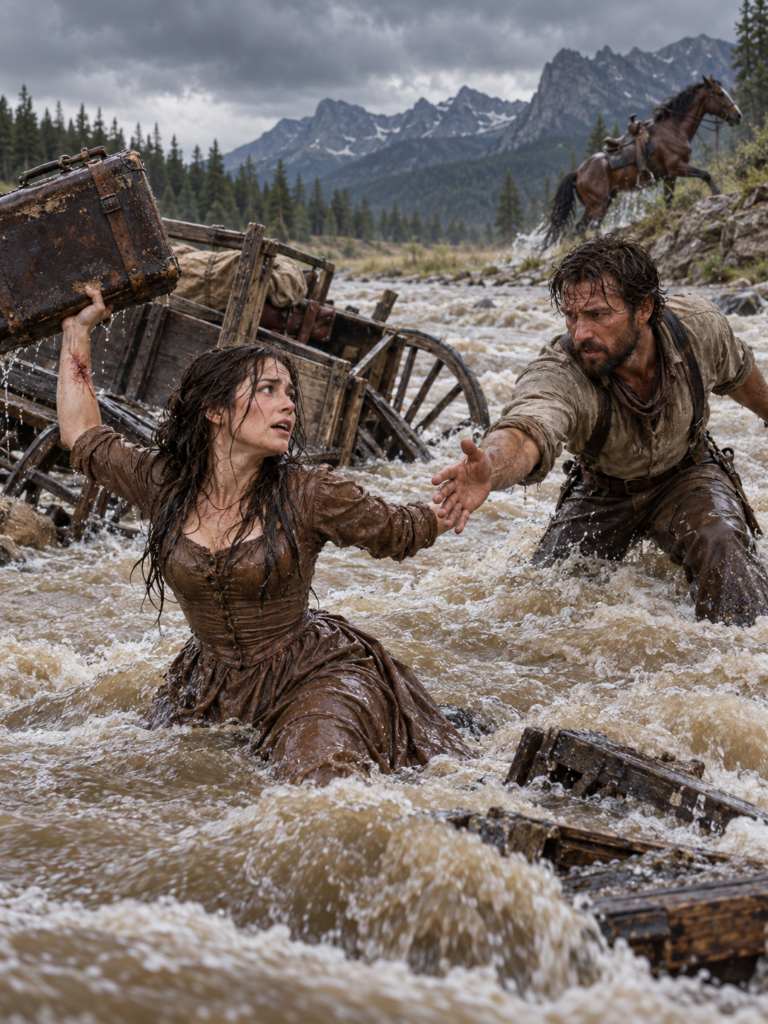
Amelia lifted the papers just far enough to check the oilcloth wrapping, then stopped when she realized Nathan was watching.
He immediately returned his attention to the ledger.
“Those belong to you,” he said. “I don’t need to know what’s inside.”
Her fingers remained beneath the lining.
“You might, eventually.”
“Then tell me when you decide it’s necessary.”
She carefully returned the papers, closed the case, and pushed it beneath the desk.
For a moment, she seemed uncertain what to do with a man who accepted an unanswered question.
Nathan had already resumed examining the cattle expenses.
“Whoever kept these figures before you arrived made a fine mess.”
“You kept them,” she reminded him.
“That would explain it.”
She laughed.
It was a small sound, but Nathan heard it clearly.
He had forgotten how pleasant an unexpected laugh could be.
At supper, the ranch hands were still assessing their new bookkeeper.
James Prior, Nathan’s foreman, treated Amelia with quiet courtesy.
Tom Briggs, a younger hand with more curiosity than discretion, asked whether she had ever worked on a ranch.
“Not one this size,” she answered.
“Then you’ll have a good deal to learn.”
“Probably.”
Tom grinned.
Amelia continued, “I’ve already found three errors in the feed invoices. Perhaps we can teach each other.”
James lowered his coffee cup to conceal a smile.
Even Gustavo, who guarded his kitchen like a kingdom, looked impressed.
Over the next several days, Amelia became a familiar figure moving between the office, the barns, and the yard.
She did not pretend to understand cattle better than James.
Instead, she asked him to explain grazing rotations and winter feed requirements.
She consulted Gustavo about food purchases.
She questioned Nathan about repairs that appeared in his ledgers without descriptions.
Every answer made the ranch’s finances clearer.
But one afternoon, she discovered something Nathan could not explain.
A survey in the office showed the ranch’s northwest boundary extending sixty-three acres farther than an old county record indicated.
“Have you ever checked this?” she asked.
Nathan examined the documents.
“No reason to suspect anything was wrong.”
“There may only be a clerical or survey error,” Amelia said. “But it should be corrected.”
“Then I’ll go to the county office.”
“I’d like to come.”
Nathan looked at her.
“Why?”
“Because I found the discrepancy, and I know which documents we need to compare.”
He nearly objected out of habit.
Instead, he said, “Friday.”
The answer pleased her more than any compliment.
Yet the journey to the county seat brought a problem neither had anticipated.
On the return trip, they stopped in Harland Creek.
Amelia went to mail letters she had prepared for prospective cattle buyers.
Outside the post office, Margaret Hail approached with Florence Cutter.
“Miss Carter,” Margaret said sweetly. “I understand you’ve settled into Mr. Cole’s household.”
“I’m employed at his ranch.”
“Of course. Though such arrangements can be misunderstood.”
Amelia recognized the deliberate pause.
“I suppose they can.”
“And after everything that happened in Missouri, you must be grateful he’s taken you in.”
Amelia went still.
She had never told Margaret about Missouri.
Not about the engagement.
Not about her father’s estate.
Certainly not about the circumstances under which she had left.
“What exactly have you heard?” she asked.
Margaret’s smile faltered.
“Only that your former circumstances were unfortunate.”
“Then I suggest you wait until you know them before discussing them.”
She stepped around the women.
Nathan had heard enough from beside the wagon to understand what Margaret was implying.
He climbed onto the seat after Amelia.
“I should have said something,” he told her.
“You didn’t need to.”
“That doesn’t mean I shouldn’t have.”
Amelia tightened her grip on the folded letters.
“Mr. Cole, I need to know whether I can continue working without being required to defend my character every time I come into town.”
“You can.”
“And if people decide there’s something improper about my employment?”
“They’ll be mistaken.”
She looked at him.
“Then I intend to keep doing the work you hired me for.”
“Good.”
He gathered the reins.
But before he could start the horses, Amelia reached for his sleeve.
“There’s something about Missouri you ought to know.”
Nathan turned toward her.
She glanced once at the street, then back at him.
“The man I was supposed to marry wasn’t interested in me nearly as much as he was interested in what my father left behind.”
Nathan waited.
“And the papers I saved from the river,” she continued, “are the reason I discovered it.”
She released his sleeve.
Then she opened the battered suitcase between them and began unfastening the oilcloth parcel.
The oilcloth unfolded beneath Amelia’s careful fingers.
Nathan kept the horses still while she separated several papers, protecting them from the dust rising off Harland Creek’s main street.
At the top was an old business document. Beneath it lay a letter, folded along creases that had been opened and closed many times.
“His name is William Hart,” she said.
Nathan looked at her rather than the page.
“Your intended husband?”
“Formerly.”
Amelia held the letter but did not yet offer it to him.
“William came from a wealthy Missouri family. He was educated, respectable, and well acquainted with people who mattered in St. Joseph. He courted me for eight months.”
“You loved him?”
“I believed I might.”
The admission cost her something.
Nathan saw it in the way she smoothed the letter against her skirt.
“My father thought highly of him. When Father died, William was very attentive. He helped arrange meetings with the lawyer. He asked questions about the business and the property. At the time, I thought he was concerned about my future.”
She stopped.
“After the will was read, William proposed.”
“And you accepted?”
“Yes.”
Nathan did not interrupt.
“A little later, I found that letter among the business papers. William had written to his brother before my father died. He’d already calculated the value of the land, the stock, and the supply business. He was considering what he might control after marrying me.”
She handed Nathan the page.
He read only as much as necessary to understand.
The references to Amelia’s anticipated inheritance were unmistakable.
“He discussed you like an investment,” Nathan said.
“He discussed the business like one. I was the means of acquiring it.”
Nathan folded the letter and returned it.
“What happened when you confronted him?”
“He told me I had misunderstood. I returned his ring. Two days later, someone went through the files in Father’s office.”
“Did they take anything?”
“Nothing I could identify. I cannot prove William arranged it, but after that, I no longer trusted the situation.”
She returned the letter to its wrapping.
“I had meant to run the business myself. Father left it to me, and I knew it better than anyone. But settling the affairs became costly and difficult. In the end, I sold the business and property, cleared what had to be paid, and came west with what remained.”
“Why Montana?”
“Because I wanted work far enough away that William couldn’t decide what everyone believed about me.”
The horses shifted.
Nathan loosened his hold on the reins.
“And the suitcase?”
“The last money I had, the records I still needed, and proof that I’d understood what happened.”
Nathan looked at the weathered leather case.
At the river, he had thought her stubborn beyond reason.
Now he understood she had been holding the means to defend herself and build another life.
“There’s something I want clear,” Amelia said.
“Go ahead.”
“I told you because I chose to. I didn’t tell you so you could settle anything for me.”
Nathan met her eyes.
“Understood.”
“And I won’t be treated as someone whose affairs must pass through a man before they’re heard.”
“Fair enough.”
She studied him, searching for resentment.
There was none.
He was considering the road ahead.
“If those papers ever need protecting,” he said, “you can keep them wherever you think best. My office is available, but the decision’s yours.”
Amelia returned the suitcase to her feet.
“Thank you.”
He started the horses.
They left Harland Creek behind.
For most of the journey, neither spoke.
But the silence was not the same as before.
Nathan had been entrusted with a truth she could have withheld.
Amelia had offered it without surrendering control of what happened next.
Both understood that distinction.
At Broken River Ranch, the work continued.
The county records indicated the boundary discrepancy likely arose from an older surveying error. Amelia prepared the paperwork for correction, and Nathan signed the required request.
She then returned to the cattle contracts.
Her letters to alternative buyers in Billings had produced a promising response.
Hargrove, a buyer Nathan had once corresponded with but never pursued seriously, offered substantially better terms than Reed, the man who usually purchased the ranch’s cattle.
Nathan read the offer twice.
“Twelve percent more than last year’s price.”
“Subject to the conditions,” Amelia replied.
“They look reasonable.”
“The delivery provisions are. But I want an independent assessment if there’s a dispute about cattle grades.”
Nathan glanced at the document.
“That would spare us considerable trouble.”
“It could.”
He passed her the letter.
“Prepare the reply.”
She raised an eyebrow.
“No argument?”
“Would you like one?”
“Not particularly.”
“Then save us both the trouble.”
James, who had been listening from the office doorway, walked away before either could notice his smile.
Within another week, the ranch’s accounts were accurate enough for Nathan to see precisely where money had been wasted.
Feed purchases could be managed more carefully.
Several expenses had been recorded in misleading categories.
Long-neglected correspondence was moving again.
Amelia’s contribution was no longer a matter of hope.
It was visible in the books, the contracts, and the decisions Nathan could make with better information.
But something else was changing.
Nathan began asking what Amelia thought before making business decisions.
She began bringing difficulties to him without worrying that every disagreement would become a contest.
On quiet evenings, she occupied the second chair on the porch.
Sometimes they discussed cattle prices.
Sometimes Missouri.
Sometimes nothing important at all.
Nathan learned that she liked the stillness beyond the ranch buildings.
Amelia learned that he knew the temperament of every horse he owned and could remember which fence posts his father had set nearly twenty years earlier.
She also learned that he slept badly.
One evening, he found her on the porch with two cups of coffee.
“Do you ever rest?” she asked.
“When the work’s done.”
“Then you must be planning to live forever.”
He gave her a puzzled look.
“The work won’t ever be finished,” she explained.
Nathan sat beside her.
She offered him a cup.
He accepted.
The confession came slowly.
“My parents died twelve years ago,” he said.
Amelia remained quiet.
“There was a blizzard. They went out to look after the cattle. By the time I understood how badly the weather had turned, I couldn’t reach them.”
His eyes remained on the distant fence line.
“I spent a long time thinking about everything I might have done differently.”
“Did you find anything?”
“Nothing that brought them home.”
She waited.
“Afterward, I decided it was easier not to need anybody.”
Amelia looked at the broad fields darkening beneath the evening sky.
“Has it been easier?”
Nathan considered the question.
“Some days.”
“And the others?”
He lowered his cup.
“Long.”
She let that answer remain between them.
There was no need to tell him his grief was foolish.
She had lived with enough loss to know how little such words accomplished.
At last she said, “I don’t think caring less would have saved your parents.”
Nathan turned toward her.
“No.”
“And I don’t think you have to stop caring for them in order to care about anything that comes afterward.”
He looked away.
He had spent twelve years resisting a truth so simple that hearing it spoken made him uncomfortable.
Before he could respond, a noise came from the barn.
A low, heavy movement, followed by the scrape of a hoof.
Nathan rose.
“Calla.”
The old gray mare had been slowing for months.
She had belonged to his mother and carried Nathan when he was a boy.
Together, they went to the barn.
Calla lay in her stall, exhausted but breathing steadily.
Amelia knelt a little distance from her head.
Nathan crouched beside the mare.
“Hello, old girl.”
Calla moved an ear toward his voice.
Amelia observed her breathing, then brought a blanket to cover her lightly.
Nathan rested his hand along the gray neck.
They remained there for a long time.
Neither pretended that age could be argued with.
When dawn began to brighten the barn doorway, Calla died.
Nathan stayed beside her.
Amelia quietly left to give him time alone.
Later, when he entered the kitchen, he found hot coffee and toasted bread waiting.
She was in the office, carrying on with the day’s business.
He stood at her doorway.
“Thank you for staying with us.”
Amelia set down her pen.
“She was dearly loved.”
“She was.”
He hesitated.
“Mother named her.”
“I know.”
“She’d have liked you, I think.”
Amelia’s face softened.
“I wish I could have met her.”
Nathan returned to the barn with an ache he had feared and a strange, unfamiliar comfort beside it.
He had lost Calla.
Someone had witnessed his grief without trying to take possession of it.
For the first time, he wondered whether love and loss always had to be enemies.
The answer mattered sooner than he expected.
By late August, Amelia had been at Broken River Ranch for several weeks.
The new cattle agreement was taking shape.
The boundary correction was proceeding.
Nathan had begun to look forward to evenings on the porch with an anticipation he could no longer mistake for habit.
Then James came to him one afternoon.
“There’s a man in town asking about Miss Carter.”
Nathan set down the hammer he had been using.
“What man?”
“Arrived in a fine black buggy. Missouri connection, from the sound of him.”
Nathan’s expression tightened.
“Name?”
“William Hart.”
For a moment, Nathan said nothing.
James glanced toward the house.
“You ought to tell her.”
“I will.”
But Nathan delayed, uncertain how to break news that might shatter the peace Amelia had worked to establish.
He intended to speak to her the next morning.
Before he could, a buggy came up the ranch road.
William Hart climbed down near the fence.
He wore a dark suit inappropriate for the heat and the measured expression of a man accustomed to people making room for him.
“Nathan Cole?”
“That’s right.”
“I understand Amelia Carter is employed here.”
“She is.”
“I’ve traveled from Missouri to discuss a matter with her.”
Nathan considered him.
“She’ll decide whether she wants that conversation.”
Hart’s mouth tightened.
“I assure you, Mr. Cole, I have every right to explain myself.”
“Then you can explain why you’ve come, and she can decide whether to listen.”
Behind Nathan, the screen door opened.
Amelia stepped onto the porch.
She saw Hart and stopped.
For one terrible instant, the color drained from her face.
Then her shoulders straightened.
“William.”
Hart removed his hat.
“Amelia. I’ve been searching for you.”
“I didn’t ask you to.”
“I’ve come to resolve the matter of your father’s estate.”
“The estate is settled.”
“Not entirely. There are complications you don’t understand.”
Amelia descended the porch steps.
Nathan moved aside.
She would have the conversation on her own terms.
“Then explain them,” she said. “Precisely.”
Hart hesitated.
“A creditor has raised questions about an outstanding note. A man named Drummond.”
Amelia went completely still.
Then she took one step toward him.
“Drummond’s note was released in February, before Father died.”
Hart blinked.
“The circumstances—”
“I have the signed release.”
His expression changed.
“And William,” she continued, “I have the letter you sent him in January asking whether the debt might be brought back into question after the estate passed to me.”
Nathan looked from her to Hart.
Amelia’s voice never rose.
“You knew the note had been settled. You knew the business was mine. And you came all this way hoping I’d be frightened enough to believe otherwise.”
Hart opened his mouth.
She lifted one hand.
“No.”
The single word stopped him.
“I have answered you in Missouri. I’m answering you again. I won’t marry you. I won’t return with you. And I won’t discuss Father’s property as though my refusal has made it yours to manage.”
Hart stared at her.
“You cannot possibly mean to remain here forever.”
“Whether I remain here is not your concern.”
She turned and walked toward the house.
Nathan watched as she climbed the steps and closed the screen door.
Then he faced Hart.
“You’ve heard her decision.”
Hart’s handsome face had hardened.
“She doesn’t understand how exposed her position is.”
“She understands the documents better than you expected.”
Nathan opened the gate toward the road.
“It’s time for you to leave.”
Hart climbed into his buggy.
Before taking the reins, he glanced once more toward the office window.
Nathan followed his gaze.
Amelia stood behind the glass.
She was watching, not hiding.
Hart drove away.
Nathan remained by the gate until the buggy had disappeared.
When he returned to the house, he found Amelia at her desk, hands resting on either side of the open suitcase.
“I should have told you he was in town,” Nathan said.
She looked up.
“You knew?”
“James told me yesterday.”
“Then I wish you’d said something.”
“You’re right.”
She studied him.
He did not attempt to excuse himself.
After a moment, she said, “William won’t necessarily accept this.”
“What do you think he’ll do?”
“He’ll look for someone willing to believe the worst of me.”
Nathan thought of Margaret Hail and Ed Toiver.
He knew how quickly whispers traveled through Harland Creek.
Amelia drew the old papers toward her.
“We need to make certain the records are in order.”
Nathan pulled up a chair.
“Then we’ll start with the records.”
She looked at him.
“There’s one more thing. I don’t want you making decisions about William without telling me.”
He accepted the correction.
“Agreed.”
Together, they spread the letters and financial papers across the desk.
Amelia placed the February release beside the January letter.
Then she opened the ledger that held the details of her father’s estate.
Nathan examined the documents, looked at her, and quietly said, “I think we need a lawyer in Billings.”
Amelia nodded.
“Then let’s write to one.”
Amelia drew a clean sheet of paper from the drawer and placed it between them.
Nathan sat opposite her while she prepared the facts in careful order.
The original debt.
Its release.
The settlement of her father’s estate.
William Hart’s correspondence with Drummond.
The question of whether Hart could continue using an already settled obligation to cast suspicion over her financial affairs.
Nathan supplied the name of a lawyer recommended by a cattle buyer in Billings.
When Amelia finished drafting the message, she passed it across the desk.
“Read it.”
He did.
“You’ve covered everything.”
“Then we’ll send it tomorrow.”
She held out the pen for his signature on the accompanying inquiry from the ranch.
He signed.
For several moments, they worked in companionable silence, folding the papers and arranging the relevant copies.
Then Nathan said, “There’s something I ought to admit.”
Amelia looked up.
“I wanted to handle Hart myself when he came here.”
“I noticed.”
“I thought protecting you meant keeping him away from you.”
Her expression softened slightly.
“And now?”
“Now I think it means making certain you can decide for yourself, with the facts and help you need.”
She considered that.
“That’s a better understanding.”
He almost smiled.
“You don’t spare a man much.”
“I spare you what I think you can manage without.”
“Then you must think highly of me.”
“I do.”
The quiet certainty of her answer left Nathan with nothing clever to say.
The following morning, they rode into Harland Creek and sent their inquiry to Billings.
What happened afterward proved Amelia’s warning correct.
Hart did not immediately leave town.
Instead, he began calling on people who already wondered about the woman living at Broken River Ranch.
His account was carefully arranged.
Amelia, he suggested, had been overwhelmed after her father’s death.
There had been disagreements about the estate.
Some records were uncertain.
He was merely a concerned former suitor attempting to settle matters properly.
He did not need to make a direct accusation.
He allowed listeners to supply the conclusions themselves.
Nathan first learned how far the story had traveled while collecting supplies from the hardware store.
Two men were discussing whether Amelia might have taken money from her father’s business before leaving Missouri.
One mentioned Hart as the source.
Nathan stood still until they noticed him.
Then he said, “Miss Carter maintained those accounts for years. Her records have been examined, and I’ve seen documentation contradicting Hart’s claims.”
The men fell silent.
Nathan did not raise his voice.
He purchased his supplies and left.
But as he walked toward his horse, he realized that facts did not travel as easily as suspicion.
He would need to do more than correct one conversation.
Back at the ranch, he found Amelia reviewing the cattle correspondence.
“Hart is spreading stories about your father’s money,” he told her.
She set down her pen.
“I expected that.”
“There’s no evidence behind them.”
“That won’t prevent people repeating them.”
Nathan waited for her instructions.
Amelia looked toward the locked drawer containing her documents.
“I want the lawyer’s opinion before we answer him publicly. And I want the books ready if anyone makes a formal allegation.”
“All right.”
“You’re not going to suggest I leave town for a while?”
“No.”
“Or tell me to let you take care of it?”
Nathan shook his head.
“This concerns you. I won’t pretend otherwise.”
She lowered her eyes briefly.
“Thank you.”
He leaned against the doorframe.
“For what it’s worth, I don’t believe him.”
Amelia looked up.
“I know.”
Two days later, the lawyer’s preliminary reply arrived.
He had reviewed the copies they had provided.
On the evidence available, the debt in question appeared to have been released properly.
The documents gave no support to Hart’s insinuations about Amelia’s conduct.
The lawyer requested additional certified records to complete his review and provide a more dependable basis for answering any further claims.
Amelia read the letter slowly.
Then she reached for the necessary papers.
Nathan watched her work.
Her hands were steady.
But he remembered those same hands holding a suitcase above a dangerous river.
He had mistaken her determination for stubbornness then.
Now he knew it was something deeper.
She had spent months refusing to allow someone else to define her life.
He would not become another man who tried.
That afternoon, Nathan went into town.
First he visited Dr. Halverson.
The physician listened as Nathan described Hart’s claims and explained the evidence Amelia possessed.
“I remember the young woman when she came here,” Halverson said. “Wet through, hurt, hardly a penny’s worth of belongings left. She paid her way and asked for no favors.”
“She’s done the same at the ranch.”
Halverson nodded.
“If Hart’s asking whether she’s honest, I can speak about what I’ve observed. I won’t pretend to know her accounts.”
“That’s all I’m asking.”
Nathan next visited Margaret Hail.
She received him in her orderly parlor, where polished furniture and carefully arranged ornaments testified to a lifetime spent maintaining appearances.
“I understand you’ve spoken with William Hart,” Nathan said.
Margaret folded her hands.
“He called here, yes.”
“What did he tell you?”
“That Miss Carter’s affairs were more complicated than she’d admitted.”
Nathan placed the lawyer’s preliminary letter on the table.
“Her affairs are being reviewed on the basis of documents, not hearsay. Hart has been repeating allegations he hasn’t substantiated.”
Margaret studied the paper.
“He seemed so sincere.”
“I expect he did.”
She looked uncomfortable.
“Surely you’re not suggesting he came all this distance simply because she refused him?”
“I’m suggesting he has continued interfering after she clearly told him to stop.”
Margaret lowered her eyes.
For a moment, the room was very quiet.
Then she said, “I haven’t been fair to Miss Carter.”
Nathan said nothing.
“I watched her from the day she arrived,” Margaret continued. “I wondered why you’d offered her a place when so many people had tried to get close to you.”
“She’s a capable woman, Margaret.”
“I know that now.”
She looked toward the window.
“Perhaps I knew it before and didn’t care to admit it.”
Nathan retrieved the letter.
“She’s not asking people to admire her. She wants to work without being slandered.”
Margaret nodded.
“I’ll speak to those I’ve discussed her with. They ought to hear that the claims are disputed and the papers are being checked.”
“Thank you.”
As Nathan rose, Margaret studied his face.
“You’re very fond of her.”
He did not answer quickly enough.
Margaret gave a sad, knowing smile.
“I thought so.”
Nathan left without denying it.
By the time he returned to the ranch, the afternoon sun was lowering behind the ridge.
Amelia was helping Gustavo in the kitchen.
They were disagreeing over how much salt belonged in cornbread.
Nathan stopped in the doorway and watched them for a moment.
Gustavo gestured toward the pan.
Amelia shook her head.
They both noticed Nathan.
“Mr. Cole,” Gustavo said, “tell this woman I have been cooking longer than she has been alive.”
Nathan considered the matter.
“How does the cornbread taste?”
“Excellent,” Amelia said.
“Too salty,” Gustavo insisted.
“Then perhaps you’re both right.”
Gustavo muttered something and returned to the stove.
Amelia looked at Nathan.
“How did town go?”
He told her about Halverson and Margaret.
She listened without interruption.
When he finished, she put down the spoon.
“You went to speak on my behalf.”
“I explained what I knew. I didn’t share your private papers or promise anything in your name.”
She studied him.
“Why?”
“Because Hart was spreading rumors among people who know me. I could correct what they were hearing.”
“That’s the practical answer.”
Nathan looked toward Gustavo.
The cook abruptly decided he had urgent work at the far end of the kitchen.
Amelia stepped closer.
“What’s the other answer?”
Nathan had spent twelve years keeping his feelings organized like the ranch accounts he had never bothered to balance.
Work belonged in one place.
Grief in another.
Affection was something best avoided.
But Amelia had come into his life with a suitcase and a wounded arm and quietly dismantled the entire arrangement.
He met her eyes.
“Because you’re important to me.”
She remained still.
“Important how?”
He swallowed.
“As more than someone who works here.”
Amelia’s expression changed.
Not with alarm.
With recognition.
“Then you should know something,” she said.
“I’m listening.”
“I didn’t leave Missouri merely because William was dishonest. I left because I nearly agreed to a life where everything I knew, everything I’d built, and everything I owned would have been treated as though it mattered only because it belonged to the man I married.”
Nathan nodded.
“I understand.”
“If I ever marry, I won’t disappear into someone else’s decisions.”
“I wouldn’t ask you to.”
“And I won’t exchange my independence for safety.”
“You shouldn’t.”
She took a slow breath.
“Then don’t ask me for an answer today.”
Nathan felt the first familiar movement of fear.
The instinct to retreat before something could be taken away.
But he knew what retreat had cost him already.
“Take whatever time you need,” he said.
Amelia searched his face.
“Even if I decide to leave?”
He held her gaze.
“Even then. Your wages are yours. Your work is yours. If you choose another place, I’ll give you a fair reference.”
Her eyes glistened.
She looked away before he could see more.
“That’s the first answer I’ve heard from a man in a long time that makes me believe he means to let me choose.”
Nathan wanted to take her hand.
He did not.
She had asked for time.
He would give it.
The following days were ordinary, which became their own kind of test.
Amelia remained at her desk.
Nathan continued his rounds.
James supervised the hands.
Tom Briggs brought Amelia another letter from his brother, asking for help understanding a land purchase agreement.
Gustavo continued to complain about the cornbread.
Nathan did not begin courting Amelia with gifts or extravagant promises.
He showed up for the work.
When she wanted to inspect an invoice, he found the original.
When she disagreed with a proposed cattle purchase, he heard her reasoning.
When she suggested a change in feed suppliers, they examined the cost together.
She was no longer merely assisting him with decisions.
Her knowledge had become part of the ranch’s daily operation.
Yet she remained a paid employee, with her own room, her own money, and a future she had not surrendered.
And Nathan was learning to care for her without making her responsible for his happiness.
One evening, James joined him at the kitchen table after supper.
“You’ve been quieter than usual,” the foreman observed.
Nathan glanced up.
“I thought you preferred quiet.”
“I do. But this is a different kind.”
Nathan turned his coffee cup.
“I told Amelia how I feel.”
James nodded as though he’d expected the news.
“And?”
“She needs time.”
“Then give it.”
Nathan looked toward the office, where the lamp burned behind the window.
“I’ve spent years convincing myself that wanting nothing was the safest way to live.”
James settled into the opposite chair.
“Hasn’t kept you from caring about the ranch.”
“That’s different.”
“Is it?”
Nathan did not answer.
James continued, “You love this place because your parents built it. You stay because it matters to you. Every fence you repair means you’re still willing to lose something if the year turns against you.”
Nathan looked at his foreman.
“I hadn’t considered it that way.”
“You weren’t avoiding care. You were choosing which things you believed you could bear to care about.”
James rose.
“And now you’ve met a woman who’s made that distinction harder to maintain.”
Nathan sat with those words long after the foreman had gone.
The following morning, he found Amelia in the north pasture.
She was standing beside the fence, one hand resting flat on the top rail.
Beyond it, a young bay horse named Creek watched her cautiously.
The horse had always been nervous around unfamiliar people.
Amelia did not attempt to catch him.
She simply waited.
After several minutes, Creek approached.
He stretched his nose toward her palm, withdrew, then returned.
She held still.
Finally, the horse allowed her to touch his forehead.
Nathan watched from a distance.
Amelia smiled.
It was not a smile meant for an audience.
She seemed entirely content to let the horse discover for himself that her hand was safe.
Nathan turned toward the barn.
He understood something then.
Trust could be invited.
It could not be demanded.
And sometimes the kindest thing a person could do was remain present long enough for another to choose.
Three days later, the final letter from the Billings lawyer arrived.
Nathan carried it to the office.
He placed the envelope beside Amelia’s ledger.
“It’s addressed to you.”
She looked up.
“Have you read it?”
“No.”
She opened it herself.
Nathan stood near the window while she read.
The lawyer’s review had found the estate records consistent with the completed settlement. The documents confirmed that the Drummond obligation had been released. A formal record of the relevant materials had been filed so that any future claims could be answered with the documented facts.
Amelia read the final paragraph twice.
Then she placed the letter on the desk.
“The estate is clear.”
Nathan nodded.
“Yes.”
“William can’t make those old papers mean something they don’t mean.”
“He can say what he likes. The documents will answer him.”
She closed her eyes.
For months she had carried the fear that another accusation would force her to defend every decision she had made since her father’s death.
Now the truth stood in records others could examine.
Nathan waited while she absorbed it.
At last she looked up.
“I want to know whether he’s gone.”
Nathan had spoken to Hart after the lawyer’s findings made the position clear.
He had also made certain Hart understood that continuing to spread unsupported allegations could bring a formal complaint.
“Hart agreed to stop,” he told her. “He was to leave by Friday.”
Amelia studied him.
“You spoke to him?”
“I did. I should have told you first.”
She considered the admission.
“Yes, you should have.”
“I won’t pretend I handled every part of it properly.”
She rose from her chair.
“Next time, I want to know what you’re planning before you go.”
“There won’t be a next time with him, if I can help it.”
“That’s not the point.”
“I know.”
He accepted her correction.
It mattered that he could do so without resentment.
Amelia touched the letter.
“I spent so long believing I might have to keep moving.”
Nathan remained quiet.
“Missouri no longer feels like home. But until now, I wasn’t certain I could make another place mine.”
“You can,” he said.
She looked at him.
“Even if I don’t stay here?”
“Even then.”
A faint smile crossed her face.
“I think I’d like to stay.”
Nathan felt his heart lift.
But he waited.
“Not merely because there’s employment,” she continued. “I’ve come to care for this place. I know the people. I know the work. And I’ve begun to believe I can build something lasting here.”
Nathan stepped closer.
“Amelia, there’s something I want to ask.”
She raised one hand.
“Before you do, I have some questions.”
He almost smiled.
“Of course you do.”
“Would I continue managing the accounts?”
“Yes.”
“Would decisions about contracts and supplies be made with me, rather than simply passed down to me?”
“Where your work and knowledge concern them, absolutely.”
“And if we married, would we discuss what share of this life was legally and fairly mine?”
“We would. I won’t pretend a ceremony settles every practical question. We’d put the arrangements in proper order.”
She considered his answers.
Then she said, “All right. Now ask.”
Nathan took a breath.
He could have told her about the nights he had lain awake since meeting her.
He could have described the warmth she had brought into a house he had treated like another ranch building.
He could have promised that he would never leave her.
But he knew such promises were not his to make.
He could only promise what he intended to do.
“Amelia, I’d like you to marry me.”
She stood very still.
“Not because I need someone to mend my shirts or warm my supper. Gustavo would be offended if I hired you for that.”
She laughed softly.
“Not because I rescued you from the river. You owe me nothing for that.”
Nathan held her gaze.
“I want to be your husband because I love the woman who questions my figures, argues when I’m wrong, and refuses to pretend something is right just because it’s easier.”
His voice lowered.
“I love the woman who sat beside my mother’s horse when there was nothing she could do to change the ending.”
Amelia’s eyes filled.
“And I love the woman who has made me want to share a future instead of merely preserving what remains of the past.”
He offered his hand, palm upward.
“I want us to build that future together. But only if it’s the future you want.”
For several seconds, neither moved.
Then Amelia placed her hand in his.
“Yes, Nathan.”
His fingers closed gently around hers.
“Yes?”
She smiled through her tears.
“Yes. I would like to marry you.”
He let out a breath that seemed to have been waiting twelve years to leave him.
Amelia stepped nearer.
He touched her cheek.
She leaned toward him, and their first kiss was quiet, unhurried, and entirely their own.
Outside the window, ranch hands called to one another.
A horse stamped in the yard.
Someone shut the barn door.
The world continued its ordinary work.
Inside the office, two people who had spent years guarding themselves discovered that love did not require either of them to surrender who they were.
Their wedding took place three weeks later, on a Tuesday morning in September.
Amelia made her own dress.
Dark blue, simply cut, with neat stitching she completed during the evenings.
Nathan offered to arrange someone to accompany her down the church aisle.
She shook her head.
“I’d rather walk myself.”
“Then you shall.”
The small church at Harland Creek held their friends and a modest gathering of townspeople.
James Prior stood with the other ranch hands.
Tom Briggs looked more excited than the groom.
Gustavo wore his good coat and insisted he had no intention of becoming sentimental.
Dr. Halverson and his wife attended.
Margaret Hail sat among the guests, having made a sincere effort to correct the unfair stories she had once entertained about Amelia.
Reverend Mills conducted the brief ceremony Amelia had requested.
When he asked whether she accepted Nathan as her husband, she answered clearly.
“I do.”
When Nathan was asked, he gave the same answer.
No elaborate vows could have conveyed more than the expression on his face.
Afterward, the ranch hands offered congratulations.
Gustavo announced that supper would be ready when they returned, provided nobody interfered with his kitchen.
Amelia asked whether he had finally adjusted the cornbread recipe.
He looked offended.
Tom laughed so loudly that James had to turn away to hide his own amusement.
Nathan and Amelia rode home together.
The afternoon sunlight lay across the familiar pastures.
At the ranch, they put away the horses and walked toward the house.
Amelia stopped at the porch.
“The railing needs repairing.”
Nathan looked at the loose board.
“Yes.”
“And the window in the spare room sticks.”
“I know.”
“The roof above the kitchen ought to be checked before winter.”
Nathan glanced at her.
“I’ve owned this house for years, Amelia.”
“I know.”
“I’ve noticed the repairs.”
“Then why haven’t you done them?”
He looked at the weathered boards and the windows that had remained unchanged since his parents died.
“Because I kept the ranch working. The house was somewhere I slept.”
Amelia slipped her hand into his.
“And now?”
He smiled.
“Now we ought to fix the railing.”
They began making plans the following day.
The household repairs would be done alongside the ordinary needs of the ranch.
Amelia retained responsibility for the accounts and correspondence, and she and Nathan continued discussing the financial and property arrangements that would make their partnership secure.
She examined the cattle contracts while Nathan and James prepared for the autumn work.
Nathan repaired the porch.
Together, they sorted the unused furniture in the spare room, deciding what to keep and what would be useful elsewhere.
They did not attempt to erase Nathan’s parents from the house.
Their belongings and memories remained part of its history.
But the rooms no longer had to stand unchanged merely because the people who had once lived there were gone.
One evening, Nathan found Amelia at the office desk.
The old suitcase rested beside her chair.
Its leather was still worn.
One corner had a long scratch from the river stones.
She was removing the final papers from the lining and placing them in a more secure drawer.
Nathan paused.
“Are you getting rid of it?”
“No.”
She ran her fingers over the handle.
“I think I’ll keep it.”
He looked at the battered case.
“Considering what it cost you to save it, that seems reasonable.”
Amelia smiled.
“It used to contain nearly everything I had left.”
“And now?”
She looked around the office.
There were the ledgers she had rebuilt.
The signed cattle contracts.
The correspondence she had organized.
The records that confirmed the truth about her father’s affairs.
Beyond the window stood the ranch where she had found useful work, friends, independence, and a man who understood that love could not be built on possession.
“Now,” she said, “it reminds me that losing what I had didn’t mean losing what I could become.”
Nathan crossed the room.
He put a hand on the back of her chair.
“I remember thinking you were the most stubborn woman I’d ever seen.”
“I remember thinking you were giving orders to a stranger standing in a river.”
“I was trying to keep you from drowning.”
“And I was trying to keep my papers dry.”
He laughed.
It came easily now.
Amelia stood and took his hand.
Outside, the autumn wind moved through the grass.
Somewhere in the north pasture, Creek lifted his head and looked toward the house.
Nathan thought of Calla, and of his mother, and of the father whose work still shaped the land around him.
He still missed them.
He always would.
But grief was no longer the only thing waiting for him when he opened his door.
That evening, after supper, Nathan helped Amelia put away the dishes while Gustavo pretended not to notice.
They talked about the coming winter, the supplies still to be ordered, and whether Hargrove’s cattle contract could be improved the following spring.
They disagreed about one of the expense categories.
They checked the figures.
Amelia was right.
Nathan admitted it.
When the kitchen was tidy, they went onto the porch and sat side by side.
The repaired railing was smooth beneath Amelia’s hand.
The office lamp shone through the window.
The house behind them was warm.
After a while, Nathan reached for her hand.
“Do you ever think about the river?”
“Sometimes.”
“I thought you were going to drown.”
“I thought I might lose the suitcase.”
He shook his head, smiling.
“Still stubborn.”
“Still inclined to give orders.”
She rested her head lightly against his shoulder.
Nathan looked toward the darkening fields of Broken River Ranch.
For twelve years, he had believed that keeping his heart empty was the only way to protect it.
Then a woman had entered a dangerous river with nearly everything she owned and refused to let the current decide what she would lose.
He had offered her his hand.
She had taken it because she needed help reaching the bank.
Everything that followed had been a choice.
Her choice to work.
His choice to trust.
Their choice to build something neither could have made alone.
Nathan pressed a gentle kiss against her hair.
Amelia squeezed his hand.
And beneath the wide Montana sky, in a house that had finally become a home again, they sat together as the last light left the fields.
The battered suitcase remained safely inside.
It no longer held their future.
They were building that with their own hands.


