
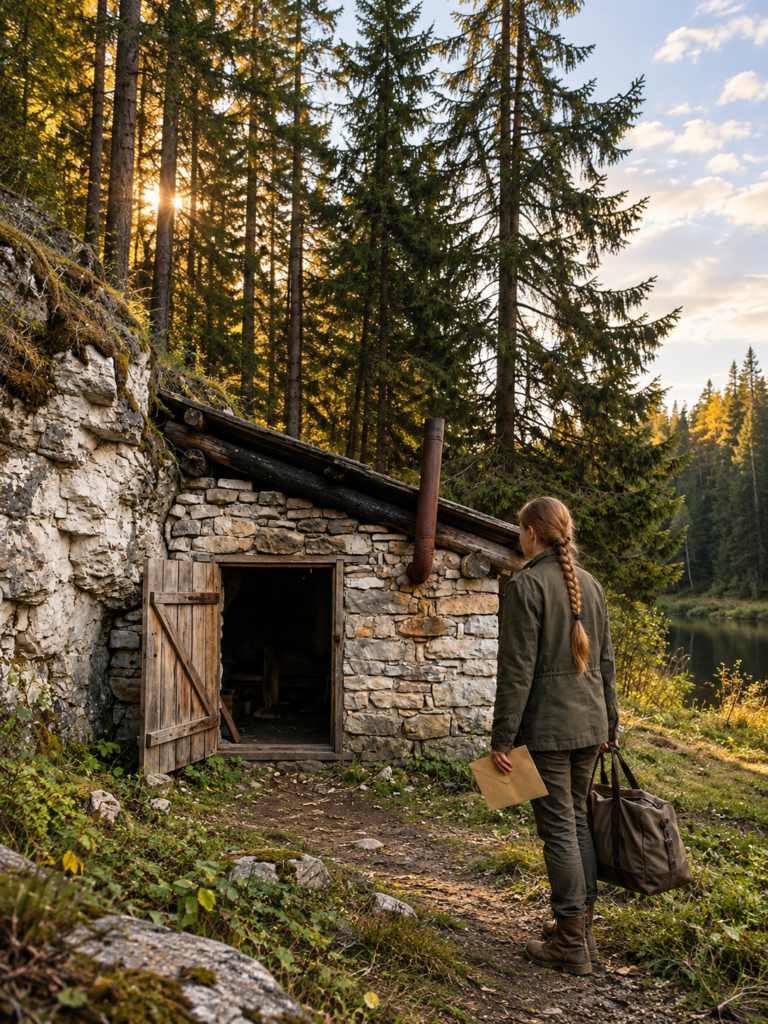
Part 1 — The Place Nobody Wanted
On the morning Hannah Mercer turned eighteen, her uncle refused to give her a place to stay.
By lunchtime, she had inherited a cave.
And before the day was over, her only living relative had laughed about it in front of everyone at the group home.
Hannah didn’t know it then, but the property her uncle considered worthless contained a small house, a hidden underground spring, and something her great-grandfather had spent half his life protecting.
The strangest part was that he had left her a clue.
Four words, written on a scrap of notebook paper.
Let the draft guide you.
At eighteen, Hannah had no idea what that meant.
She was about to find out.
The group home stood on a quiet residential street outside La Crosse, Wisconsin, between a Methodist church and a brick apartment building with peeling window frames.
It wasn’t the kind of place anyone would notice unless they had a reason to be there.
Inside, it smelled of burnt toast, disinfectant, and the industrial laundry detergent the staff bought in enormous plastic containers.
Hannah had lived there for six years.
That morning, she stripped the sheets off the narrow bed beneath her window, folded them, and carried them to the laundry room.
When she returned, another girl was already standing in the doorway.
“Are you really leaving today?” Kelsey asked.
“That’s what they tell me.”
“Where are you going?”
Hannah looked at the duffel bag on her mattress.
“I’ll figure it out.”
Kelsey was sixteen. She had arrived three months earlier and still believed adults when they said things would work out.
Hannah hoped she would be able to keep believing that for a while.
Everything Hannah owned fit into one faded navy duffel bag: two pairs of jeans, three T-shirts, a green winter jacket, a phone charger, a toothbrush, her high school diploma, and a chipped coffee mug someone had given her for Christmas.
Her checking account held $1,600, including the money she had received through her transition-to-adulthood program.
A worker had helped her apply for transitional housing. There was a possible opening in October, but nothing had been approved.
Until then, she needed somewhere to sleep.
Preferably somewhere with a door she could lock.
At nine-thirty, Evelyn Carter called her into the office.
Evelyn was the home’s director, a woman in her late fifties who wore comfortable shoes and kept peppermint candies in a glass jar on her desk.
She had been kinder to Hannah than most people.
That made the man sitting across from her desk even harder to look at.
Grant Mercer.
Hannah’s father’s cousin.
Everyone had always called him Uncle Grant.
He was fifty, broad across the shoulders, with thinning brown hair and a gray sport coat that looked too formal for a Tuesday morning.
Hannah hadn’t seen him in ten years.
The last time had been at her father’s funeral.
She had been eight, standing beside a cemetery fence while adults discussed what would happen to her.
Grant had told someone he already had two children and couldn’t take in another.
Hannah remembered that sentence more clearly than she remembered the service.
Now he looked at her and offered a little nod.
“Hey, kiddo.”
“Hello.”
Evelyn gestured toward the empty chair.
“Have a seat, Hannah.”
Hannah sat with her duffel bag between her feet.
“Mr. Mercer was kind enough to come in,” Evelyn began. “I thought it might be worth discussing whether Hannah could stay with family temporarily. Just until her housing placement comes through.”
Grant exhaled.
“Evelyn, I explained this on the phone.”
“I understand it’s difficult.”
“It’s not just difficult. It’s impossible. We’ve got my mother-in-law staying with us, my daughter and her husband are between apartments, and my wife isn’t doing well.”
He spread his hands.
“Where am I supposed to put another person?”
Hannah studied his shoes.
Brown leather. Freshly polished.
There was a tiny white price sticker stuck to the underside of one heel.
He had taken the trouble to dress properly before coming to say no.
Somehow that bothered her more than the refusal itself.
“I’m not asking you to become her guardian,” Evelyn said. “She’s legally an adult. We’re discussing a few weeks.”
“And I’m telling you I can’t.”
Grant turned toward Hannah with an expression that suggested he expected her to appreciate his honesty.
“Look, sweetheart, you’ve got programs for this sort of thing. People who know how to help.”
Hannah didn’t answer.
He continued.
“You’d probably be uncomfortable at our place anyway.”
She wondered whether he had practiced that sentence in his car.
Evelyn watched him for a moment, then opened the lower drawer of her filing cabinet.
“There’s something else we need to discuss.”
She removed a thick envelope bound with faded red string.
“Hannah, this has been held with your legal records. It was supposed to be given to you when you turned eighteen.”
Hannah looked at the envelope.
Her name was written across the front in large, uneven capital letters.
HANNAH MERCER — TO BE OPENED AT EIGHTEEN
“What is it?”
“Property documents. The legal paperwork has already been reviewed, but these are yours now.”
Hannah untied the string.
Inside were a copy of a will, a recorded property deed, a survey map, and a small square of yellow notebook paper.
The handwriting on the note was shaky.
Hannah, let the draft guide you.
She turned it over.
Nothing on the back.
Evelyn picked up the deed.
“Walter Mercer,” she read. “Your great-grandfather.”
Hannah had heard the name a few times, usually when older relatives talked about people who were no longer alive.
“He left you a parcel of land along a back channel of the Mississippi River. A little north of Prairie du Chien.”
Grant stopped looking at his phone.
“Wait a minute.”
Evelyn continued.
“According to the deed, there’s a structure on the property.”
“What kind of structure?” Hannah asked.
Evelyn adjusted her glasses.
“Well, that’s unusual.”
She read the description again.
“An enclosed limestone cave with attached improvements.”
Grant leaned forward.
“Let me see that.”
He took the map, studied it for several seconds, and then started laughing.
Not a polite chuckle.
A genuine, helpless laugh.
“Oh, you’ve got to be kidding me.”
Evelyn frowned.
“Mr. Mercer.”
“That’s Old Walt’s hole in the bluff.”
He tapped the map.
“I remember that place. The old man used to live up there like some kind of hermit.”
Hannah stared at him.
“Live in a cave?”
“That’s what he called a house.”
Grant shook his head.
“Well, Hannah, congratulations. You’ve inherited a pile of rocks.”
He laughed again.
Evelyn said his name sharply, but he was already on his feet.
“Sorry. I just can’t believe it. All the things a person could leave somebody.”
He walked into the hallway, still laughing.
Hannah heard him tell one of the staff members that his great-uncle had left the girl a cave.
Then she heard another laugh.
She folded the map carefully and returned it to the envelope.
“Do I really own it?” she asked.
Evelyn nodded.
“The property was held for you under a custodial arrangement. It’s been transferred into your name. We should still have someone from legal aid explain the taxes and any restrictions.”
“But it’s mine.”
“Yes.”
Hannah looked down at the papers.
She had never owned anything that couldn’t be taken away or packed into a bag.
Now, apparently, she owned a piece of a riverbank.
And a cave.
Evelyn came around the desk.
“Listen, you do not have to go there. We can work on getting you a temporary room in town. I have a couple of contacts.”
“How long would my money last?”
“A few weeks, maybe longer if we’re careful.”
“And after that?”
Evelyn didn’t answer immediately.
Hannah had become familiar with that silence.
She stood, picked up her bag, and put the envelope inside her jacket.
“Can you tell me how to get to Prairie du Chien?”
The afternoon bus carried Hannah southwest through farming country, past cornfields, roadside churches, and little towns where the old storefronts had become antique shops or stood empty.
She sat beside the window with the property map open across her knees.
The river marked one side of the parcel.
The limestone bluff marked another.
A tiny X showed the cave entrance.
There was no street address.
The nearest road ended almost a mile away.
By the time she reached the little river settlement closest to the property, the sun had started moving toward the western hills.
The settlement was called Bell’s Landing.
It consisted of a few dozen houses, a bait shop, a general store, an abandoned feed warehouse, and a small boat landing.
The buildings were spread along a gravel road beside a sheltered channel of the Mississippi.
Some houses were neat and freshly painted. Others leaned toward the river behind tangled fences.
At the landing, Hannah found an elderly woman bailing rainwater from an aluminum skiff.
She wore rubber boots, a quilted flannel jacket, and a blue knit cap pulled low over her forehead.
“Excuse me,” Hannah said. “Is there any way to get across?”
The woman looked up.
“Depends where you’re going.”
Hannah unfolded the map.
“Here.”
The woman took it.
She read the name at the top of the survey.
Then she looked at Hannah more carefully.
“Mercer?”
“Yes.”
“Walter Mercer’s family?”
“He was my great-grandfather.”
The woman stared at her for a moment.
“Well, I’ll be.”
She sat down on an overturned bucket.
“I’m June Bennett. Your great-granddad and my husband used to know each other.”
Hannah introduced herself.
June kept looking at the map.
“I thought nobody in that family would ever come back.”
“Did you know him well?”
“Well enough. Walt was a strange bird, but he was decent.”
She pointed across the channel.
“See that white patch in the bluff, just past those cottonwoods?”
Hannah followed her finger.
Beyond the dark water, a pale limestone face rose above a narrow strip of shoreline.
Trees clung to the slope.
Partway up the rock, barely visible beneath the shadow of an overhang, was something that looked like a wooden doorway.
“That’s his place,” June said.
Hannah stared.
It was real.
For the first time, the inheritance stopped feeling like a bad joke.
June rested her elbows on her knees.
“Walt came home from the war in forty-six. Had a hard time of it, from what my husband told me. His wife died while he was overseas. The children went to relatives.”
“What happened to him?”
“He came out here. Worked maintaining navigation lights and river markers. Back when they still had a man doing half that work by hand.”
She pointed toward the cave.
“He started building in that bluff. Took him years. Every summer he’d bring over lumber, brick, iron, whatever he could get his hands on. My husband said he even salvaged timber out of the river.”
“What was he building?”
“Nobody knew. Wouldn’t let anybody inside.”
“Why not?”
June considered the question.
“Some folks thought he was crazy. I think he was just done having people around.”
She looked at Hannah’s duffel bag.
“You planning to stay there?”
“I don’t know.”
“Where are you staying tonight?”
Hannah said nothing.
June studied her for a long moment.
Then she stood.
“Get in the boat.”
The engine started on the third pull.
They crossed the channel slowly, passing over dark water that reflected the trees in broken green lines.
As they approached the bluff, Hannah began to make out details.
Rough stone steps climbed from the shoreline to a narrow terrace.
A wall of limestone rubble had been built across the mouth of the cave, mortared together so long ago that moss grew in the joints.
At its center stood a short wooden door with heavy iron hinges.
Above the door, a little overhang had been constructed from thick, weather-darkened beams.
An old metal stovepipe emerged from the masonry nearby.
June cut the engine.
The sudden quiet felt enormous.
“Well,” she said. “There it is.”
Hannah stepped onto the gravel shore.
The rock face rose above her like the wall of a forgotten building.
June handed her a plastic grocery bag.
Inside were two sandwiches, a bottle of water, a small flashlight, and a packet of matches.
“You can come back with me,” she said. “I’ve got a spare bedroom.”
Hannah glanced at the cave.
“Could I at least look inside first?”
June sighed.
“Of course you can.”
She pointed across the river.
“My house is the yellow one with the porch light. If you need help, flash that flashlight three times toward my place. I’ll see it.”
Hannah thanked her.
June climbed back into the boat.
“And don’t light that stove until someone checks the chimney,” she called. “I’m serious.”
“I won’t.”
June started the motor and headed toward the opposite shore.
Hannah watched until the boat became a small silver shape against the dark water.
Then she turned toward the cave.
The steps were slippery with moss, but solid.
At the top stood a stump beside the entrance, its surface polished from years of use.
Someone had sat there often.
Hannah placed her bag on it.
She pulled the wooden peg from the heavy iron latch.
The bolt resisted.
She gripped it with both hands and leaned back.
It shifted with a grinding scrape.
The door swung inward.
A steady current of cold air touched her face.
It smelled of old stone, wood ash, and damp earth.
Hannah switched on her flashlight.
The beam revealed a passage about fifteen feet deep.
Part of the limestone ceiling had collapsed.
Large broken slabs filled one side of the cave. Old pieces of river equipment stood against the other wall: wooden marker frames, rusting chains, cracked lanterns, and piles of rope.
A narrow path led between them.
At the far end, the flashlight beam struck something unexpected.
Wood.
Not a few loose boards.
An entire wall made from heavy, fitted logs.
Hannah moved closer.
The timbers were dark with age but surprisingly sound.
She followed them with her flashlight until she found a corner.
Then another.
Her great-grandfather hadn’t merely used the cave as shelter.
He had built a cabin inside it.
The structure stood free of the cave walls, with a narrow gap around its sides.
A stovepipe ran from its roof through the outer stonework.
There was a wooden door at the front.
Hannah pulled the handle.
It opened without resistance.
Inside was a room barely twelve feet square.
A cast-iron stove stood against one wall, connected to a small brick chimney.
Across from it was a wooden sleeping platform.
There was a table, a chair, two shelves, and a row of hooks holding old tools.
A blue enamel coffee mug sat beside a pencil.
Above the table hung a photograph in a wooden frame.
A young woman wearing a beret smiled at someone outside the picture.
Hannah lowered herself onto the chair.
The room was dusty, but it wasn’t destroyed.
The logs were dry. The shelves were intact. The little stove looked as though someone had cleaned it before leaving.
On the table lay a calendar, still showing August 2008.
Hannah ran her fingers over its yellowed edge.
Somewhere inside the house that had held her entire childhood, a bed was already being prepared for another girl.
Here, eighteen years after someone had closed this little wooden door, the cup was still on the table.
She had an absurd thought.
Maybe this is what it feels like when a place waits for you.
Then she noticed something else.
The air was moving.
Not from the open entrance behind her.
From somewhere deeper inside the bluff.
It was barely noticeable, but when she lit one of June’s matches to examine the stove, the flame bent sideways.
Hannah blew it out.
She listened.
Beyond the back wall came a faint, steady sound.
Almost like water running through a pipe.
She pressed her ear against the wood.
The sound disappeared.
She listened again.
Nothing.
After a while, she stopped trying.
Her phone showed twenty-eight percent battery.
Outside, the September light was fading.
Hannah ate one of the sandwiches, rolled her jacket beneath her head, and stretched out on the sleeping platform.
She kept both doors unlatched and the flashlight beside her.
She knew the cave ceiling needed a professional inspection. She knew the stove might be dangerous. And she knew sleeping there at all was probably a poor decision.
But the weather was mild, June’s house was visible across the water, and for the first time in her life Hannah could stay somewhere without asking permission.
Before closing her eyes, she took the yellow note from her pocket.
Let the draft guide you.
She read it three times.
Then she folded it carefully and placed it beneath her phone.
Somewhere beyond the back wall, water began to murmur again.
Part 2 — The Secret Behind the Wall
June returned the next morning with a thermos of coffee and a brown paper bag containing two egg sandwiches.
She found Hannah sitting on the stump outside the cave, watching fog drift across the channel.
“Well, you’re still breathing,” June said.
“Good morning to you too.”
June smiled.
“How was the hotel?”
“Quiet.”
“That’s one word for it.”
Hannah accepted the coffee.
After breakfast, she showed June the cabin.
The older woman stopped just inside the doorway.
For nearly a minute, she said nothing.
Then she approached the log wall and touched it with her fingertips.
“Walt built all this?”
“Apparently.”
“Good Lord.”
She looked around at the stove, the fitted corners, and the handmade shelves.
“All those years, people said he was dragging junk up here. My husband used to watch him hauling logs across the water and wonder what on earth he was doing.”
June sat in the wooden chair.
“We were wrong about him.”
Hannah looked at the photograph above the table.
“Who is she?”
June leaned closer.
“That’s Eleanor. His wife. She died while he was overseas.”
Hannah studied the faded face.
She had inherited a home from a man she’d never known, and now she was looking at a woman who had died before he began building it.
It seemed strange that two people could shape her life without ever really being part of it.
June stood.
“Now, listen. I’ve got a spare room, and I mean it. You can stay with me while you sort this place out.”
Hannah hesitated.
“I want to try here.”
“With winter coming?”
“Just for a little while.”
June examined her.
“You’re stubborn.”
“I’ve been told.”
“Well, being stubborn doesn’t keep you warm.”
She pointed toward the ceiling outside the cabin.
“And that rockfall needs looking at before you spend much time under it.”
Hannah nodded.
She knew June was right.
But every time she thought of leaving, she remembered Grant laughing.
Not because she wanted to prove him wrong.
Because she wanted to know what Walter Mercer had seen in this place that nobody else had bothered to see.
Hannah spent the next morning at the general store in Bell’s Landing.
The woman behind the counter, Marlene, watched her collect supplies.
Canned soup. Oatmeal. Pasta. Peanut butter. Soap. Batteries. A lantern. Work gloves. A hammer. A pry bar. A folding saw.
“Camping?” Marlene asked.
“Something like that.”
“How long?”
Hannah considered.
“Not sure.”
Marlene scanned the pry bar.
“Well, that sounds promising.”
The total came to $347.62.
Hannah paid with her debit card.
Outside the store, she checked her balance.
$1,252.38.
That was all she had.
No paycheck coming on Friday.
No parents to call.
No uncle who would answer the phone unless he wanted something.
She put the receipt into the envelope with her property documents.
For reasons she couldn’t explain, she wanted to keep track of every dollar spent on the cave.
Back at the landing, June was waiting in the skiff.
When she saw the supplies, she raised an eyebrow.
“Planning to open a hardware store?”
“Not yet.”
“Good. You can start by helping me carry the groceries.”
September settled over the river.
The days remained warm, but the nights turned sharp.
Hannah made the cabin more livable one small job at a time.
She swept the floor, washed the enamel mug, and cleared away the old bedding.
She removed a pile of broken boards from the entrance passage, uncovering rusted navigation lanterns and metal frames painted in faded red and white.
Some were beyond repair.
Others looked as though they might work with new glass and a thorough cleaning.
The fallen stone was a bigger problem.
One slab weighed more than she did.
Hannah tried levering it with a piece of timber, then stopped when she heard gravel shift overhead.
June was not going to hear that she’d been flattened by a rock because she refused to admit she needed help.
Through June, she met a retired maintenance contractor named Hank Dawson.
Hank had grown up around Bell’s Landing. His father had known Walter.
He inspected the passage, looked at the fracture lines in the limestone, and shook his head.
“You can clear the loose timber out, but leave the big stones alone. And don’t stand under that section.”
“Can it be fixed?”
“Probably. Not by guessing, though. You’ll want somebody qualified to look at the rock before you build anything permanent.”
He showed her where Walter had installed two heavy timber supports farther back in the cave.
“Your great-granddad knew his way around a job site,” Hank said. “These are better than half the repairs I’ve seen on old barns.”
He pointed above the entrance.
“That spot’s the trouble.”
Hannah made a note.
It was the first of many.
She couldn’t afford an engineer yet, so she marked off the unsafe section and concentrated on cleaning the parts she could reach.
Each evening, she carried debris outside in small loads, stacked the salvageable wood beneath the overhang, and swept the floor of the little cabin.
The work left blisters across her palms.
At night, her shoulders ached.
But she liked seeing the difference.
A few feet of clear floor.
A repaired shelf.
A working lantern.
They were small improvements.
They were hers.
June started bringing extra food whenever she crossed the channel.
A pot of chili.
Homemade bread.
Leftover chicken and potatoes.
Hannah tried refusing at first.
June ignored her.
One evening, as the boat pulled away, Hannah switched on her flashlight and blinked it three times.
Across the water, June stopped on her porch.
A moment later, her flashlight blinked three times in return.
The next evening, it happened again.
Before long, it became a habit.
Three flashes meant Hannah was all right.
Three flashes back meant someone had seen her.
Hannah had spent much of her childhood being checked on by staff members following written procedures.
This was different.
Nobody had told June she had to look.
She just did.
By late September, the nights were cold enough that Hannah could see her breath inside the cabin.
She had cleaned the stove as well as she could and paid for a local chimney technician to inspect it.
The stovepipe was old but sound enough for a controlled test after some repairs.
He cleared out soot and an abandoned bird’s nest.
The flue was open.
There was no obvious obstruction.
Yet when they tried a small fire, smoke rolled backward into the room.
The technician closed the stove and opened the cabin door.
He tried again.
For a few minutes, it worked.
Then smoke began leaking through the stove door.
“That’s odd,” he muttered.
He checked the chimney again.
“Something’s wrong with the air supply.”
Hannah stood beside the doorway, coughing.
“What does that mean?”
“The fire’s not getting the air it needs. This cabin’s tighter than you’d expect. I wouldn’t use the stove until we work out how Walt designed the ventilation.”
After he left, Hannah sat at the table and stared at the cast-iron stove.
The chimney had been repaired.
The fire still wouldn’t draw properly.
Without heat, the cabin would be impossible to live in once winter arrived.
And she had already spent money she couldn’t replace.
A few days later, the first hard frost whitened the terrace outside.
Hannah woke with stiff fingers and a headache from the cold.
Her water bottle had formed a thin layer of ice near the cap.
That afternoon, June found her wearing both sweaters beneath her jacket.
“Enough,” June said.
Hannah looked up from the table.
“Enough what?”
“This. You’ve given it a fair try. You can’t stay here all winter without heat.”
“I know.”
“Then come across with me.”
Hannah stared toward the stove.
“One more week.”
June sighed.
“Hannah—”
“One week. If I can’t figure it out, I’ll come stay with you.”
June studied her for a long time.
“All right. But you’ll come over at night if it gets too cold. No argument.”
Hannah agreed.
And for the next several nights, when the temperature dropped below freezing, she slept in June’s spare bedroom.
She returned to the cave each morning.
It wasn’t the victory she’d imagined.
But it meant she could keep working.
One gray afternoon, Hannah took out the inheritance envelope again.
The documents had become familiar.
She knew the property description almost by heart.
She had studied the survey until she could picture every boundary.
But the little note still bothered her.
Let the draft guide you.
She placed it beside the stove.
She had assumed Walter meant the chimney draft.
Maybe he had been warning her that the stove needed attention.
But that didn’t quite make sense.
Why would a man leave an eighteen-year-old girl a note about an old chimney?
And why had he written guide instead of fix?
Hannah leaned back in the chair.
She remembered the first night.
The match flame bending toward the wall.
The cold air brushing her ankles.
The faint sound of running water.
She stood.
From her bag, she took a battery-powered lantern and a strip of lightweight paper.
She closed the outer door and moved slowly around the cabin, holding the paper near the gaps between the logs.
At the front wall, it hung straight.
Beside the sleeping platform, nothing.
Near the stove, the paper barely moved.
Then she reached the lower corner of the back wall.
The strip snapped sideways.
Hannah froze.
She lowered it closer to the floor.
It bent sharply into the room.
Cold air was coming through the wall.
She moved the table.
Behind it, almost hidden within the lowest log, was a small wooden panel.
It was no bigger than a hardcover book.
Two dark wooden catches secured it in place.
Hannah knelt.
She turned the first catch.
Then the second.
The panel stuck.
She worked a thin screwdriver into the seam and pulled gently.
It came free with a dry wooden pop.
A rush of cold air struck her face.
And suddenly she heard the water.
Not a distant murmur.
A clear, steady stream, as though a faucet had been opened somewhere behind the wall.
She shone the flashlight into the opening.
About a foot beyond it stood another wooden partition.
The air was flowing beneath that partition.
Hannah sat on the floor, holding the little panel in her lap.
For a long moment, she could only stare.
Someone had built an air passage behind the cabin.
Someone had hidden its entrance carefully enough that she had missed it for weeks.
She looked toward the stove.
Then back at the open panel.
Walter’s note was beginning to make sense.
The next morning, Hannah showed the opening to Hank and the chimney technician.
The technician crouched beside it.
“Well, look at that.”
He held his hand near the opening.
“There’s your air.”
They checked the stove and flue again before testing it.
This time, with the hidden air inlet open, the fire caught cleanly.
The chimney began drawing.
No smoke escaped into the room.
The technician watched the flames for several minutes.
Then he smiled.
“Your great-granddad was clever.”
Hannah stood beside the stove, hardly daring to believe it.
Warm air began gathering around her hands.
Walter had made the cabin unusually airtight, protecting it from the cold stone and river wind.
But a stove needed combustion air.
He had designed a separate passage to bring that air from somewhere behind the cabin.
When the little inlet was closed, the stove struggled.
When it was open, the system worked.
Hannah looked at the four words on the table.
Let the draft guide you.
Her great-grandfather hadn’t left her an instruction to repair the chimney.
He had left her a way to find something.
Something beyond the back wall.
The following day, Hannah walked around the outside of the log cabin.
The right side stood close against the cave rock.
On the left, a narrow passage was filled with broken river-marker frames, ropes, and old wooden oars.
She carried them out one by one.
Behind the last pile, she found a solid wooden partition stretching from the cabin’s back corner to the limestone wall.
It had been built with thick boards and old square nails.
At the bottom, cold air escaped through narrow gaps.
Hannah put her ear against the wood.
Water.
Definitely water.
The sound was stronger here.
She fetched her flashlight and examined the boards.
Someone had intended to close this passage off.
But not permanently.
The top section could be removed without disturbing the log cabin or the stone supports.
Hank came over that afternoon to help her take down the partition safely.
They removed one board.
Then another.
Cold, damp air flowed into the passage.
Behind the boards, a narrow stone staircase descended into the bluff.
Hannah raised her flashlight.
The steps were uneven and worn, but unmistakably handmade.
They turned to the left, disappearing beyond the reach of the beam.
Hank whistled softly.
“I’ll be damned.”
“Did you know this was here?”
“Not a clue.”
He examined the first steps and the stone overhead.
“Don’t go down there alone. Let’s get the rest checked first.”
It took another two days to arrange a basic inspection of the passage.
The rock specialist Hank knew pronounced the visible stairway stable enough for a cautious visit, though he warned them not to disturb any loose sections.
On Saturday morning, Hannah and Hank went down together.
Hannah counted the steps.
Seven.
Twelve.
Nineteen.
Twenty-six.
At the bottom, the staircase opened into a small natural chamber.
The walls gleamed with mineral deposits.
On the far side, a clear stream of water emerged from a crack in the limestone.
It fell into a shallow stone basin before flowing through a narrow channel cut into the floor.
Then it disappeared beneath the opposite wall.
Hannah crouched beside the basin.
The water moved steadily, undisturbed by the weather outside.
“An underground spring,” Hank said.
He examined the channel.
“Walt must’ve worked on this for years.”
The stream didn’t create the chimney draft by itself, but the passage connecting the spring chamber to the cabin provided a constant source of replacement air.
Walter had understood the airflow well enough to make use of it.
And that was only the beginning of what Hannah found.
Shelves lined two walls.
There were old glass jars, fishing gear, coils of rope, metal tools, and a wooden barrel.
Walter had used the chamber as a cool storage cellar.
The water kept the space damp and cold.
The cabin above stayed dry and warm.
Hannah slowly turned her flashlight around the chamber.
Then she noticed something in the far corner.
A rectangular shape sat on a raised stone ledge.
It was covered with a stiff canvas tarp, tied tightly with rope.
“Hank?”
He came over.
“What’s that?”
“I don’t know.”
Together, they loosened the rope and pulled the tarp aside.
Underneath stood a military storage chest.
The metal was painted olive green.
Its corners were reinforced with steel.
The lid had two heavy latches.
Faded white lettering remained on one side, too worn to read.
But beneath it, someone had painted a name by hand.
HANNAH
She stared at the letters.
Hank looked at her.
“That’s your name, isn’t it?”
Hannah nodded.
She knelt beside the chest.
Her heart was beating hard enough that she could hear it.
Walter had died years before she was old enough to remember him.
Yet he had brought this chest down twenty-six stone steps, placed it in a hidden room, covered it, and written her name on the side.
Not his children’s names.
Not Grant’s.
Hers.
“Want to open it?” Hank asked.
Hannah touched the cold metal.
“Yes.”
They carried the chest upstairs together, stopping twice to rest.
Inside the log cabin, Hannah placed it beside the stove.
The latches were stiff.
Hank helped loosen the first, then stepped back.
“This one’s yours.”
Hannah opened the second latch.
She lifted the lid.
Inside were several packages wrapped in oilcloth.
On top lay a thick blue notebook.
Beneath it were four smaller bundles, each surprisingly heavy.
And resting across the notebook was a sealed envelope.
The handwriting on its front matched the note she’d been carrying since her birthday.
For my great-granddaughter Hannah. To be opened by her alone.
Hank quietly excused himself and went outside.
Hannah sat at the table.
The stove hummed softly behind her.
She held the envelope for several minutes before opening it.
Inside were three pages written in pencil.
The first sentence made her stop breathing for a moment.
Dear Hannah,
I’m writing this in August 2008. I’m eighty-six years old, and you’re three weeks old. Your father brought you to see me after you were born.
I held you in my arms.
You won’t remember me.
That’s all right.
Part 3 — What He Left Behind
Hannah read the first paragraph again.
Her father had taken her to see Walter.
She had been three weeks old.
The old man had actually held her.
Her entire life, Hannah had imagined her great-grandfather as a distant, almost mythical figure.
A strange man who lived in a cave and left it to a child he probably never knew.
But he had known her.
For a few minutes, at least.
She continued reading.
I don’t know what kind of life you’ll have, Hannah. I hope it’s a good one. I hope your father gets to see you grow up.
But I’m writing this in case you ever find yourself without a place to go.
I know what that feels like.
When I came home from the war in 1946, your great-grandmother Eleanor was gone. The children were living with relatives, and they barely remembered me.
I’d seen things overseas that I couldn’t explain to anybody. Loud noises made me shake. Sometimes I couldn’t stand being in a room with other people.
I told myself I’d get settled and bring my children home.
I never did.
I sent money. I visited when I could. But I failed them in the way that mattered most.
Hannah looked up at the photograph.
Eleanor was smiling beneath her beret.
She looked young.
Younger than Hannah had imagined a great-grandmother could ever be.
Hannah returned to the letter.
I came to the river because it was quiet.
I built a wall across the cave entrance to keep out the wind. Then I built a cabin inside because wood holds warmth better than bare stone.
I spent twelve years collecting timber. A hundred and fourteen logs. Every one of them is recorded in the blue notebook.
I recovered some of the bricks from an old barge that sank downriver in 1953.
I made mistakes. The first stove smoked so badly I nearly gave up. Then I found the little air passage near the spring. Once I understood the draft, I knew how to make it work.
People laughed at what I was building.
Let them laugh. Laughter doesn’t cost anything unless you let it stop you.
Hannah wiped her eyes with her sleeve.
She hadn’t realized she was crying.
The next paragraph explained the bundles.
I never spent much. Between my work on the river and my veterans’ benefits, I always had enough to live on.
After seeing what happened to people’s savings over the years, I started buying gold coins when I could afford them. American Gold Eagles, mostly. Sometimes one. Sometimes two.
There are thirty-two in the chest.
They are yours.
If you need a roof over your head, use them to get one. If you already have a roof, use them to make something worthwhile.
Don’t tell everyone about them. And don’t waste them trying to impress people.
Hannah lowered the letter.
Thirty-two gold coins.
She had no idea what they were worth.
She carefully unwrapped the first bundle.
Inside were eight coins protected in individual sleeves.
They were heavier than she expected.
Each showed Lady Liberty holding a torch and an olive branch.
She opened the remaining three bundles.
Eight coins in each.
Thirty-two altogether.
Hannah arranged them in four neat rows on the table.
The warm lamplight caught their edges.
Then she returned to the letter.
Grant came to see me once. He asked what the property was worth.
I told him it wasn’t worth much.
He believed me.
He never came back.
Don’t spend your life being angry with him. Some people only understand the value of something when another person puts a price on it.
The ceiling above the entrance needs another support. I never finished that job. Look after it.
And if you find the old river lanterns, there’s an iron hook above the entrance where you can hang one.
I’d like to think someone will see a light there again.
I spent too many years hiding inside this place.
I hope you’ll do something better with it.
Live here, Hannah.
Don’t hide here.
With love,
Your great-grandfather, Walter Mercer.
For a long time, Hannah didn’t move.
The stove burned steadily behind her.
The spring whispered beyond the wall.
She looked at the envelope, the coins, and the photograph.
Walter had built the cave because he had been afraid of the world.
She had come to it because the world had left her nowhere else to go.
They had arrived for different reasons.
But somehow they had found the same shelter.
She opened the blue notebook.
It was filled with dates, measurements, rough diagrams, and lists of materials.
Walter had recorded everything.
June 1951 — Eight logs recovered near the lower bend.
October 1957 — Chimney completed. Draft still poor.
March 1958 — Air passage opened. Stove drawing properly.
Other pages contained drawings of the cave, the cabin, and the underground spring.
There were diagrams showing where the ceiling needed reinforcement.
Then, near the back of the book, Hannah found plans for something he had never built.
A small washhouse beside the river.
A landing dock.
Bunk beds along the cleared entrance passage.
A space for people to dry their clothes and sleep.
Beside the drawings, Walter had written:
Too many people come off this river cold and wet.
They need somewhere to get warm.
Should have thought of that years ago.
Hannah closed the notebook.
She understood something then.
The coins were an inheritance.
The drawings were something else.
They were a chance to finish the work of a man who had finally wanted to open his door.
Hannah told June about the letter the next morning.
She told her about the spring, the chest, and Walter’s plans.
She didn’t reveal how many coins were inside.
June listened without interrupting.
When Hannah finished, the older woman looked across the river.
“Walt was a good man,” she said quietly. “But he was lonely. I think he made himself lonely.”
Hannah nodded.
“He knew that.”
June reached for her coffee.
“Well, maybe you won’t make the same mistake.”
That winter, the temperature dropped well below freezing.
Ice spread across the sheltered channel, and snow settled on the wooded slopes above the cave.
The river crossing became difficult, so Hannah used an old access trail over the ridge when she needed supplies.
She had the stove and ventilation professionally cleared for regular use, installed a carbon monoxide alarm, and continued keeping the unstable section of the entrance closed.
The cabin stayed warm.
It wasn’t spacious.
It wasn’t comfortable by most people’s standards.
But the logs held the heat, and the stove used less firewood than Hannah had expected.
Every evening she sent three flashes across the dark water.
Every evening June answered.
In December, Hannah traveled into town with eight of the gold coins carefully wrapped inside her bag.
First she visited a lawyer who had helped confirm the inheritance.
Then she arranged for the coins to be professionally authenticated and appraised.
When the dealer showed her the written valuation, she read it twice.
The eight coins were worth tens of thousands of dollars.
More money than she had ever imagined having available.
And twenty-four coins remained in the chest.
For a moment, Hannah considered what she could do with the money.
She could rent a good apartment.
Buy a reliable used car.
Move somewhere with better job opportunities.
Start over in a town where nobody knew she had grown up in foster care.
Nobody would blame her.
But during the bus ride home, she opened Walter’s notebook to the drawings at the back.
The dock.
The bunks.
The washhouse.
And the four words she had underlined.
Somewhere to get warm.
She looked out at the winter fields.
An idea began forming.
Not all at once.
Not as some grand business plan.
Just a possibility.
What if Walter’s cave could become the place he’d wanted it to be?
Grant Mercer arrived in late February.
Hannah spotted him climbing the last of the stone steps, his expensive winter coat dusted with snow.
He stopped beside the cave entrance and looked around.
The terrace was clear.
Firewood had been stacked beneath the overhang.
A steady line of smoke rose from the chimney.
He looked confused.
“Well,” he said. “You’ve been busy.”
Hannah stood beside the door.
“Hello, Grant.”
He shifted his weight.
“Mind if I come in? It’s freezing out here.”
She opened the door.
Grant stepped through the passage and ducked into the cabin.
He stopped when he saw the room.
His eyes traveled over the log walls, the stove, the shelves, and the table.
“This was all here?”
“Yes.”
“Your great-granddad built this?”
“Every bit of it.”
Grant ran his hand along one of the logs.
“I had no idea.”
Hannah watched him.
She believed him.
That was the saddest part.
He really hadn’t known.
He sat down.
For a minute, he talked about the weather, the roads, and how difficult it had been to get there.
Then he cleared his throat.
“Listen, Hannah. I’ve heard some things.”
She waited.
“People are saying you found money up here.”
Hannah said nothing.
“I’m not asking how much.”
He leaned forward.
“But you understand Walter was my grandfather too. My mother was his daughter. Your dad wasn’t the only grandchild.”
“I know.”
“Well, it seems like if he left something valuable, maybe the family ought to share it.”
Hannah glanced toward the stove.
The fire was burning cleanly.
She thought about that day in Evelyn’s office.
Grant’s polished shoes.
The little price sticker.
His laughter in the hallway.
“You remember my father’s funeral?” she asked.
Grant looked uncomfortable.
“That was a long time ago.”
“You said you couldn’t take me because you already had two kids.”
He looked at the floor.
“I did have two kids.”
“I know.”
“And things weren’t easy.”
“I’m sure they weren’t.”
Hannah pulled the copy of Walter’s letter from the table drawer.
She didn’t hand it over.
“Walter remembered when you visited him.”
Grant looked up.
“He did?”
“You asked what this place was worth.”
Grant’s face tightened.
“He told me it was just a hole in the rock.”
“Yes.”
“He said it wasn’t worth anything.”
Hannah nodded.
“And you believed him.”
Grant stared at her.
“He left the property to me,” she said. “The deed and the will are clear. I’ve checked with a lawyer.”
“Hannah—”
“I’m not trying to punish you. I don’t want to fight about money.”
She paused.
“But you didn’t come here when I needed a place to stay. You came when you thought I had something you wanted.”
Grant looked away.
For several seconds, neither spoke.
Then he stood.
His gaze moved to the photograph above the table.
He stepped closer.
“That’s Grandma Eleanor.”
Hannah nodded.
“My mother had the same picture,” he said.
His voice had changed.
“She kept it on her dresser for years.”
He stared at the young woman’s face.
“I didn’t know he had one too.”
Hannah didn’t answer.
Grant put on his gloves.
At the door, he stopped.
“Well. Take care of yourself, Hannah.”
“You too.”
He left without another word.
Hannah watched from the terrace as he followed the trail away from the bluff.
She had imagined that confronting him might feel satisfying.
It didn’t.
Mostly, she felt tired.
And a little sad for a man who had spent so many years deciding what things were worth without ever taking the time to look inside them.
By spring, Hannah had made her decision.
She would stay.
And she would finish Walter’s plans.
She couldn’t do the work alone, and she wasn’t going to risk turning an unstable cave into a business without professional help.
So she used part of the money from the eight coins to hire a structural engineer, arrange the necessary inspections, and work through the county’s requirements for a small seasonal lodging operation.
The process took longer than she expected.
There were setbacks.
The engineer required additional rock supports.
The river access needed improvements.
The plans for sleeping accommodation had to meet safety requirements.
The old stove couldn’t serve as the only heating source for paying guests.
More than once, Hannah stared at the bills and wondered whether she’d made a terrible mistake.
But she kept going.
Hank returned to help with the construction.
He brought his brother-in-law, Carl, a quiet carpenter who had spent twenty years repairing old houses.
Hannah paid them properly every Friday.
They rebuilt the entrance supports according to the engineer’s specifications.
They installed new flooring.
They built two rows of sturdy bunks along the safe section of the entrance passage, enough for eight guests.
Outside, they added a landing dock and a small washhouse with hot showers.
Hannah worked alongside them whenever she could.
She hauled lumber, painted walls, carried tools, and cleaned up at the end of each day.
Her hands became rough.
Her shoulders grew stronger.
And the cave slowly became something Walter had only managed to draw.
In early summer, after the final approvals were in place, Hannah climbed onto the old wooden overhang.
Above it, just where Walter’s letter said it would be, she found an iron hook embedded in the limestone.
She had restored one of his navigation lanterns.
The glass was new.
The metal frame had been cleaned and painted.
But the lamp was the same one Walter had once used to guide boats along the river.
Hannah hung it from the hook.
That evening, as the sun disappeared behind the bluffs, she lit it.
A warm yellow light shone against the white limestone.
Across the channel, June stepped onto her porch.
Three flashes appeared.
Hannah answered with three of her own.
The first guests arrived on a rainy evening.
Six paddlers in three canoes came around the bend after a day of miserable weather.
They saw the lantern shining above the river and pulled toward the dock.
A bearded man in a red rain jacket climbed onto the platform.
“Excuse me,” he called. “Is this the place that has shelter?”
Hannah appeared at the entrance.
“Depends what you need.”
“Somewhere dry would be a miracle.”
She smiled.
“Then you’ve found the right place.”
They carried their gear inside.
The visitors stopped when they saw the cabin built within the limestone cave.
One woman touched the log wall.
“Somebody actually lives here?”
“I do.”
“Who built this?”
“My great-grandfather.”
Hannah showed them the sleeping area, the showers, and the drying space.
Then she made a big pot of chili and cornbread.
By morning, the paddlers had warm clothes, dry sleeping bags, and a story they were eager to tell.
When the bearded man asked about the price, Hannah gave him the rate she’d worked out with June.
He paid without argument.
Then he added a generous tip.
“You should put this place online,” he said. “People would love it.”
He told his friends.
His friends told other paddlers.
Soon photographs of the lantern above the cave began appearing in local outdoor groups.
Visitors started arriving from Wisconsin, Iowa, Minnesota, and Illinois.
Some came for the history.
Some came for the oddity of sleeping beside a cabin inside a limestone bluff.
Most came because somebody had told them there was a place on the river where they could get dry, warm, and fed.
By July, the eight bunks were booked most weekends.
Hannah called the place The Lantern at White Bluff.
She hired Hank to help with maintenance.
Carl took care of the dock and occasional repairs.
June started baking hand pies to sell to the guests.
She made apple, cherry, and blackberry.
The blackberry ones sold out first.
For the first time in years, the little river settlement had a reason for visitors to stop instead of simply passing through.
Marlene’s store sold more groceries.
Local drivers earned money transporting paddlers to and from the landing.
Hannah discovered that the work suited her.
She liked making sure every guest had a clean bed, a hot meal, and directions for the next day’s journey.
She particularly liked watching people enter the cave wet and exhausted, then seeing them emerge the next morning rested and laughing.
It reminded her of what Walter had written.
Somewhere to get warm.
A year after Hannah had first arrived at the cave with her duffel bag, the late-summer season began drawing to a close.
The visitors grew fewer.
The nights became cooler.
The trees above the bluff showed their first touches of yellow.
Hannah had earned enough to cover her operating expenses, pay the people who worked with her, and set money aside for winter maintenance.
She had also enrolled in hospitality management classes at a nearby community college.
The twenty-four remaining gold coins stayed safely stored.
She hadn’t needed to sell them.
One evening, after the last guests had gone, Hannah sat at Walter’s table and opened the blue notebook.
She turned past his old measurements.
Past the drawings of the spring.
Past the diagrams showing the supports and the stove.
Then she found the first blank page.
She picked up a pen.
September — First night in the cabin.
October — Found the air inlet and spring passage.
Spring — Rock supports completed. Dock and washhouse constructed.
Summer — First paying guests.
She paused.
Then added:
The lantern is burning again.
Hannah closed the notebook.
There was one more thing she wanted to do.
She took a clean sheet of paper from her desk and began writing.
Dear Ms. Carter,
I hope you’re doing well.
I wanted to let you know that I’m all right. I know you were worried when I left.
I’m still living in the cave my great-grandfather left me.
It sounds strange, but it’s a real home now.
I’ve started a small place for people traveling on the river. We have beds, showers, food, and plenty of work to do during the summer.
I’ve been thinking about the kids who leave the program without much money or anywhere to go.
If someone is aging out and wants a chance to work, learn something, and save for their next step, maybe we could arrange something through the transition program.
I can offer paid seasonal jobs, and we have safe accommodation for adults who need it.
I know I can’t help everyone.
But I might be able to help somebody.
You can give them my number.
Tell them to ask for Hannah.
And tell them the place is called The Lantern at White Bluff.
She signed the letter, folded it, and placed it in an envelope.
The next morning, she mailed it.
Late that evening, Hannah returned to the cave after visiting June.
The river was dark and slow.
Above the water, the old lantern burned steadily.
Hannah climbed the stone steps and sat on the weathered stump beside the entrance.
The same stump that had stood there when she first arrived.
Her green jacket was faded now, but it finally fit her properly.
She thought about the girl who had stepped off the bus with sixteen hundred dollars and nowhere to sleep.
That girl had believed a home was simply a place nobody could make her leave.
She understood it differently now.
A home wasn’t just something you owned.
It was a place where you could build a life.
A place where somebody noticed when your light was missing.
A place where you could open the door when someone else needed shelter.
Hannah looked at the river.
For years, Walter Mercer had lit navigation lanterns to keep boats from running aground.
Then, after the war, he had spent decades hiding in a cave while the world moved past him.
Near the end of his life, he’d drawn plans for a dock, some beds, and a place where strangers could get warm.
He hadn’t lived long enough to build them.
But he had left enough behind for somebody else to try.
Hannah stood.
She climbed onto the little step beneath the lantern and adjusted its wick.
The flame grew brighter.
Across the river, June’s porch light flickered three times.
Hannah lifted her flashlight.
One.
Two.
Three.
Then she went inside.
The cabin was warm.
The blue notebook lay on the table.
Water ran quietly through the hidden chamber beneath the stone.
And outside, above the dark Mississippi, the lantern kept burning.
For the first time in her life, Hannah wasn’t wondering where she would go next.
She was thinking about who might come through her door tomorrow.


