
Part 1
The morning Odessa Vance learned that a dead man had left her everything he owned, she woke up in the back seat of a rusted Buick with four dollars and thirty cents to her name.
She was twenty years old.
The car was parked behind a laundromat in a small farming town in southern Indiana, where the fields stretched flat toward the horizon and the grain elevators stood taller than anything else for miles.
October had brought the first hard frost.
Ice edged the windshield, and Odessa could see her breath inside the car.
The left side of the back seat had a broken spring that pressed through the upholstery. She had learned to curl her body around it while sleeping.
Under her head was a rolled-up sweatshirt. In the passenger footwell sat a plastic bag containing two changes of clothes, a toothbrush, and an unopened hospital bill.
She had been living this way for seven months.
Her job at the poultry processing plant had once given her thirty-two hours a week. Yesterday, the supervisor posted a new schedule.
Nineteen hours.
At fourteen dollars and fifty cents an hour, that meant roughly two hundred and seventy-five dollars before taxes.
Her car needed a wheel bearing.
Her phone bill was overdue.
And she still owed money for an emergency-room visit after an infected tooth made her face swell so badly that she could barely open her mouth.
Odessa counted the coins in the cup holder.
Four dollars and thirty cents.
She already knew the number.
She counted them anyway.
People sometimes imagined homelessness as one terrible night when everything collapsed.
For Odessa, it had happened gradually.
At eighteen, she had aged out of foster care with a duffel bag, a folder of documents, and a caseworker who told her she had a bright future.
She had tried.
She enrolled in cosmetology school.
She rented a room with another girl.
She bought a beautiful pair of professional hair-cutting shears with money saved from cleaning offices after class.
Then her roommate left.
The rent doubled.
Her hours at the grocery store disappeared.
She dropped out of school to work at the poultry plant.
The apartment went next.
By spring, her Buick had become her home.
The laundromat owner, an elderly woman named Mrs. Bell, allowed her to park behind the building for ten dollars a month.
For that, Odessa received a mailing address, access to the back bathroom, and the privilege of sleeping without police officers knocking on her window.
Mrs. Bell never called it charity.
She simply said, “I’ve got an empty parking space. Might as well use it.”
Odessa understood the kindness beneath those words.
She also understood why Mrs. Bell never said more.
Pity could make even a decent breakfast difficult to swallow.
That Tuesday night, Odessa returned from the plant shortly after eleven.
An envelope was taped to her windshield.
Certified mail.
Her name was typed correctly.
ODESSA MARIE VANCE.
She sat in the driver’s seat with the envelope on her knees.
The return address belonged to a law office in nearby Toliver.
Her stomach tightened.
She assumed it was another collection notice.
There had been so many lately that she had stopped opening them immediately.
She put it in the glove compartment.
Two days passed.
On Thursday afternoon, while her work clothes tumbled in a washing machine, she finally opened it.
The letter was short.
A man named Alton Cade had died six months earlier.
His estate had completed probate.
And according to a will executed the previous year, Odessa Vance was his sole beneficiary.
She read the letter three times.
Then she looked around the laundromat.
Nobody was watching.
A dryer rattled against the wall. A television mounted above the folding tables played a daytime courtroom show.
Odessa looked back at the letter.
She had never heard the name Alton Cade.
Not once in her entire life.
The lawyer’s office occupied the second floor above a tax-preparation business on Toliver’s main street.
Mr. Walter Hensley was sixty-six, wore reading glasses on a cord, and had the weary expression of a man who had spent his career explaining unpleasant facts.
He offered Odessa water.
She declined.
He opened a folder.
“Miss Vance, I’m going to explain the situation from beginning to end. Then you can ask whatever you like.”
She folded her hands.
“Okay.”
“Alton Cade passed away on April eleventh. He was eighty-one years old.”
Odessa waited.
“He operated Cade Funeral Home on the northern edge of town for forty-one years. His father owned the business before him.”
“Was he related to me?”
“Not as far as I know.”
“Then why did he leave me anything?”
The lawyer removed his glasses.
“I asked him that very question.”
“And?”
“He told me to mind my own business.”
Odessa stared.
Mr. Hensley gave a tired smile.
“Alton was a stubborn man.”
“Did he know my mother?”
“I don’t know.”
“Did he know me?”
“He certainly knew who you were. He identified you in his will by your full name, date of birth, and identifying information. He was very particular.”
Odessa felt suddenly uncomfortable.
“What exactly did he leave me?”
Mr. Hensley opened another document.
“A two-story brick funeral home. Approximately forty-two hundred square feet. The furnishings, equipment, remaining business assets, and nine hundred and fourteen dollars in a checking account.”
Odessa sat straighter.
For one foolish second, she imagined a house.
A proper bedroom.
A bathroom.
A kitchen where she could make coffee without paying for it.
Then the lawyer continued.
“Unfortunately, the property has substantial liabilities.”
“How substantial?”
“Sixty-one thousand dollars in delinquent taxes and penalties. There’s also a disputed roofing lien of approximately four thousand dollars.”
The room seemed to tilt.
Odessa stared.
“So he left me a bill.”
“I’m afraid that’s one way of looking at it.”
“How much is the building worth?”
“The county assessment is ninety thousand. In its present condition, a private buyer might offer thirty thousand, possibly less.”
She laughed once.
There was no humor in it.
“A man I never met left me a building worth less than what it owes.”
Mr. Hensley leaned forward.
“Miss Vance, you can refuse the inheritance. There is a legal process for disclaiming it. I would strongly recommend that you consider doing so before accepting responsibility for any obligations.”
Odessa looked down at her hands.
The skin around her fingers was cracked from working in cold water at the plant.
“Why would he do that?”
“I wish I knew.”
“Maybe he hated somebody named Odessa Vance.”
The lawyer did not smile.
“He was quite deliberate. He came into this office fourteen months before his death and insisted on rewriting his will.”
“Did he have children?”
“No.”
“A wife?”
“She died many years ago.”
Odessa stared at the folder.
“Can I see the building?”
Mr. Hensley hesitated.
Then he opened a desk drawer and placed a ring of keys on the blotter.
Nine keys.
An old brass tag.
“Take these. Viewing the property doesn’t mean you have to keep it.”
Odessa picked them up.
“Is there electricity?”
“No.”
“Water?”
“Not currently.”
She nodded.
That seemed appropriate.
Even an inherited house apparently came without running water.
She stood.
“One more question.”
“Of course.”
“Was he a good man?”
The lawyer looked out the window.
After a moment, he said, “He was an unusual man.”
Odessa waited.
But that was all he offered.
She drove north out of Toliver in the late afternoon.
The road passed a feed store, a shuttered diner, a grain elevator, and a church whose white paint had begun peeling along the windows.
Beyond the last traffic light stood a large brick building with weathered wooden trim.
CADE FUNERAL HOME.
The lettering had faded.
A covered driveway ran along one side. The front steps were cracked, the windows dusty, and vines climbed halfway up the brickwork.
To the east stood a low stonecutting workshop.
Granite headstones filled the gravel yard.
A compressor hummed inside.
Odessa parked beneath a dying maple tree.
She stayed in the car for several minutes.
Then she took the keys and went inside.
The front door resisted until she put her shoulder against it.
A smell of dust, old wood, and stale carpet greeted her.
The foyer contained a wooden coat rack and a guest-book stand.
To the left was a chapel.
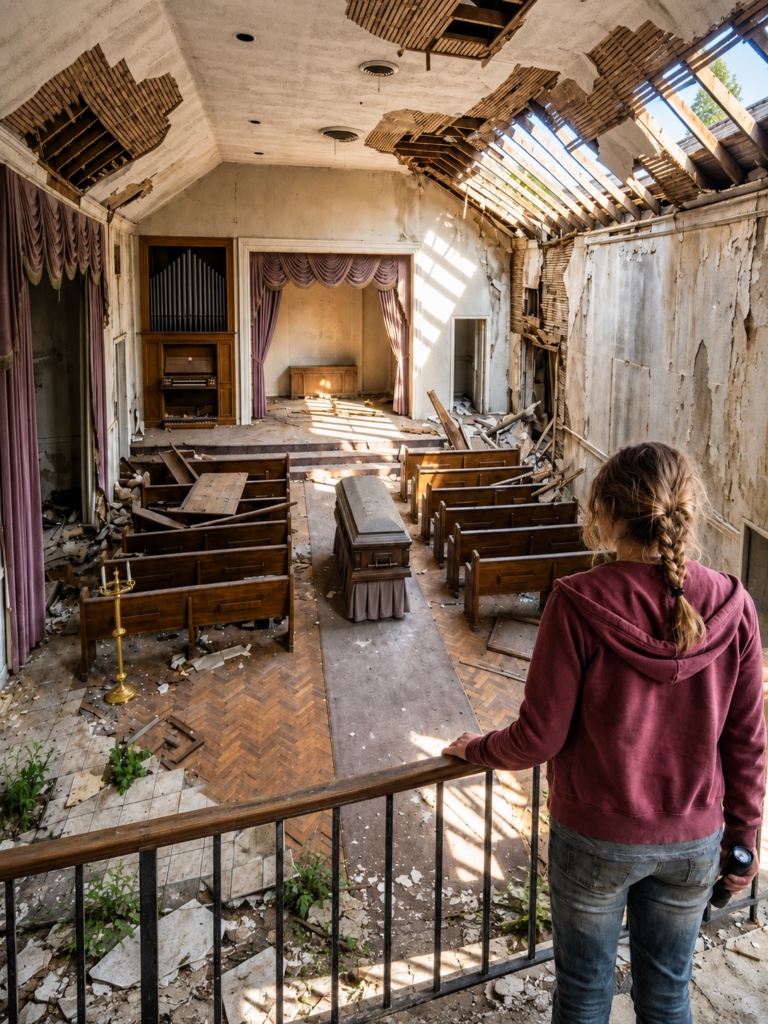
Twenty-two folding chairs stood in neat rows facing a small platform.
Odessa counted them without knowing why.
Twenty-two.
At the front stood a wooden lectern.
The curtains were faded brown.
Somebody had arranged the chairs carefully and then walked away, apparently expecting to return.
Beyond the chapel was an office.
A metal desk.
A filing cabinet.
A rotary telephone.
A calendar still turned to April.
On the desk sat a white coffee mug.
A dry brown ring stained the bottom.
Odessa looked at it longer than she meant to.
For some reason, that cup made the dead man seem real.
She continued down the hallway.
The preparation room frightened her enough that she shut the door almost immediately.
There was a steel table.
A tiled floor.
A large sink.
Shelves holding supplies she didn’t want to examine.
At the far end of the corridor stood another door.
Solid oak.
Unlike the others, it had a brass plate around the lock.
A yellowed card was taped at eye level.
In careful black letters, someone had written two words.
WAITING ROOM.
Odessa tried the knob.
Locked.
She tested every key.
None worked.
She sat down on the cold floor and stared at the door.
The building was silent except for distant traffic and the occasional rattle of equipment from the stone shop.
Finally, she returned to the office.
That was when she noticed the gray wool coat hanging behind the door.
Its cuffs were worn through.
A peppermint wrapper protruded from one pocket.
She reached inside.
There was a receipt.
Two old coins.
And a long brass key tied to a shoelace.
Odessa stood motionless.
Then she walked back down the hall.
The key slid smoothly into the lock.
It turned.
The door opened.
Inside were shelves.
Dozens of them.
Running from floor to ceiling along both walls.
And upon those shelves stood hundreds of containers.
Black plastic boxes.
Brown cardboard cartons.
Old metal cans.
Each bore a strip of tape.
Each tape carried a name.
Odessa raised her phone and swept its weak flashlight across the room.
She looked at the first box.
Then the next.
Then the next.
Slowly, she understood.
They were cremated remains.
People.
Human beings whose families had apparently never collected them.
Odessa began counting.
She counted every shelf twice.
When she finished, her throat had gone dry.
There were 206 containers.
At the back stood a narrow wooden desk.
Above it, covering nearly the entire wall, were small index cards.
Names.
Birth dates.
Death dates.
And beneath each name, a single sentence.
Earl Dean Brisco drove the county school bus and kept peppermints for the children.
Arleta Pence worked at the pharmacy and remembered every customer’s birthday.
Unknown man found near River Road. Wore a wedding ring. Someone must have loved him.
Odessa read until her phone battery nearly died.
Then she noticed a green metal file box on the desk.
Inside were copies of the cards.
One section had a handwritten divider.
CAME FOR THEM.
Behind it were cards with a second date and one additional word.
HOME.
Odessa sat down.
Outside, the October wind moved through the empty trees.
She had spent seven months believing there was no place in the world where she belonged.
Now she sat in a building filled with people who had apparently been waiting years for somebody to remember them.
She did not yet understand why Alton Cade had chosen her.
But she knew she could not sign away the building that night.
Instead, she returned to the chapel.
She spread her coat across the floor between the second and third rows of chairs.
And for the first time in months, Odessa slept beneath a roof that nobody could order her to leave before sunrise.
Part 2
A loud knock woke Odessa the following morning.
For a moment, she forgot where she was.
Then she smelled the dusty carpet and saw the rows of folding chairs.
Her back ached.
Her breath fogged the air.
Outside the glass front door stood an elderly man holding a stainless-steel thermos.
He was broad through the shoulders, with gray stubble, thick work boots, and a canvas jacket covered in pale granite dust.
Odessa opened the door a few inches.
“Can I help you?”
“You the girl Alton left the place to?”
“Who’s asking?”
“Hollis Grier. Own the stone shop next door.”
He lifted the thermos.
“Coffee.”
“I’m okay.”
“Didn’t ask if you were okay.”
He set it on the step.
“There’s a water spigot on the side of my building. Handle sticks. Give it a good whack.”
Then he turned and walked away.
Odessa watched him cross the gravel.
After a moment, she picked up the thermos.
The coffee was hot.
Strong.
And better than anything she’d tasted in weeks.
Hollis returned around noon with a folding chair.
He sat beneath the covered driveway without asking permission.
Odessa eventually joined him.
They watched trucks pass on the county road.
Finally, she asked, “What was Alton Cade like?”
Hollis rubbed his jaw.
“Quiet.”
“That’s all?”
“Cheap about himself. Generous about everybody else.”
He pointed toward the funeral home.
“Man wore the same coat fifteen years. Drove a pickup that should’ve been junked twice. But if somebody died at three in the morning, Alton was the first man at their door.”
“Did he have money?”
“Not by the end.”
“Then why keep a place like this?”
Hollis looked toward the building.
“Because he couldn’t figure out how to quit taking care of people.”
Odessa studied his weathered face.
“Did you know about the room?”
Hollis stopped moving.
“What room?”
“The one at the back.”
He looked away.
“I knew he had something back there. Saw the light on most evenings.”
“Did you ever go inside?”
“No.”
“Why not?”
“Wasn’t my business.”
Odessa stood.
“Come look.”
Hollis followed her down the hallway.
She opened the door.
The old stonecutter stepped inside.
He took off his cap.
For a long time, he said nothing.
Then he walked slowly between the shelves.
Halfway down, he stopped beside a black plastic container.
“Earl Dean Brisco.”
Odessa looked at the label.
“You knew him?”
“Cut his headstone in ninety-eight.”
Hollis touched the box.
“His wife paid me twelve dollars a month for more than two years.”
He looked toward the floor.
“All this time, that stone’s been standing over an empty grave.”
Odessa felt anger rise.
“How could Alton leave people like this?”
Hollis turned.
“You think he wanted them here?”
“Then why didn’t he bury them?”
“Don’t know.”
“Why didn’t he find their families?”
“Maybe he tried.”
“Maybe he didn’t try hard enough.”
Hollis did not argue.
Instead, he moved toward the wall of index cards.
He read several.
Then he removed his glasses.
“Alton used to say something.”
“What?”
“When somebody called asking about an unclaimed body, he’d correct them.”
“Correct them how?”
“He’d say nobody was unclaimed. They were just waiting for somebody slow.”
Odessa looked around the room.
Two hundred and six people.
Some had been there for decades.
She imagined the shelves filled slowly, one container at a time, while the roof leaked and the town moved on.
That afternoon, another visitor arrived.
His name was Neil Tarver.
He owned the modern funeral home beside the highway.
He drove a polished silver sedan and wore an expensive gray coat.
“Miss Vance,” he said pleasantly. “I understand you’ve inherited a difficult situation.”
“That’s one way to describe it.”
“I knew Alton. We weren’t especially close, but I respected his work.”
Odessa folded her arms.
“What do you want?”
Tarver smiled.
“I’d like to make you an offer.”
He explained that his funeral business needed additional land for an access road and future expansion.
The Cade property would suit him.
He would settle the delinquent taxes and the roofing lien.
And pay Odessa ten thousand dollars.
Cash at closing.
Odessa stared.
Ten thousand dollars.
A reliable used car.
A security deposit.
A mattress.
A chance to stop living one paycheck from disaster.
“What happens to the building?”
“We demolish it.”
“And the people inside?”
Tarver paused.
“I assume you’ve discovered the storage room.”
“Yes.”
“Those remains are a county responsibility. They would be transferred and interred in a designated communal section.”
“Would they have markers?”
“Not individual ones.”
“Why?”
“Most have no next of kin.”
“How do you know?”
“Because that’s how indigent cases work, Miss Vance.”
Odessa looked toward the building.
“What if some of them do have families?”
Tarver sighed.
“Then the county can follow the appropriate procedures. But you need to understand something. That building isn’t safe, and those remains have not been maintained under acceptable conditions.”
He handed her a letter of intent.
“I’ll give you until Friday.”
After he left, Odessa went back to the waiting room.
She sat at the desk beneath the wall of names.
For a long time, she considered the offer.
Ten thousand dollars would change her life.
The building might ruin it.
She was twenty years old.
She had no savings, no property experience, and no family willing to help her.
It would be foolish to believe she could save an abandoned funeral home when she could barely save herself.
Then she thought about something Tarver had said.
Most have no next of kin.
Odessa had no next of kin either.
At least nobody who wanted her.
She opened the green file box.
Without quite knowing why, she began searching through the alphabetical cards.
Her finger stopped at V.
Nine cards.
She read them one by one.
On the sixth card, she froze.
VANCE, RENATA MARIE.
Her mother’s name.
The birth date was correct.
So was the date of death.
October.
Eleven years earlier.
Odessa’s hands began trembling.
Her mother had worked at a fabric shop downtown.
She remembered watching her cut cloth with heavy silver scissors.
Remembered her humming while she cooked.
Remembered the smell of laundry soap and the small blue ribbon she sometimes tied in Odessa’s hair.
Most clearly, she remembered the afternoon her mother left for work and never came home.
Odessa had been nine.
A social worker arrived two days later.
Nobody explained much.
Her mother had died suddenly, and there was no relative able to take custody of her.
Odessa was placed with a foster family.
Then another.
Then another.
For years, she imagined her mother somewhere far away.
The truth was too difficult to accept.
Now she stared at the card.
Beneath Renata’s name was a sentence.
Worked at the fabric store and could match thread colors by eye.
Odessa covered her mouth.
That was exactly what her mother could do.
Underneath, in different ink, were two additional lines.
She has a daughter.
Her name is Odessa.
Odessa stood so quickly the chair fell backward.
She searched the shelves.
Found the container.
R. VANCE.
She took it down.
It was heavier than she expected.
For several moments, she held it against her chest.
Then she carried it out to her car.
She drove east.
Past the grain elevator.
Past the county line.
Past fields of harvested corn where blackbirds gathered beneath the fading sunlight.
She drove until she could no longer bear to keep moving.
Then she stopped beside an abandoned roadside produce stand.
Her mother’s remains sat on the passenger seat.
Odessa stared at the box.
Eleven years.
Eleven years her mother had been somewhere in that building.
Eleven years she had wondered where her mother was buried.
She had never visited a grave because nobody had told her where to go.
Her anger came before her tears.
“Why?” she whispered.
She looked at the box.
“Why did he keep you?”
The car was silent.
Odessa gripped the steering wheel.
“He knew about me. He knew I was your daughter.”
She thought of all the birthdays spent in foster homes.
All the Christmas mornings when she watched other children receive phone calls from relatives.
All the nights she dreamed of her mother walking through the door.
“He could’ve told me.”
Her voice broke.
“He could’ve found me.”
She sat there until dark.
Eventually, she understood there was nowhere else to take her mother.
She had no house.
No family cemetery.
No relatives who would answer the phone.
The only place she knew for certain that her mother had been remembered was the room at Cade Funeral Home.
So she drove back.
Carried the container inside.
Placed it on a chapel chair.
And finally began to sob.
“You had her,” she cried into the empty room.
“You had my mother all this time.”
She sank onto the floor.
“I was nine years old.”
Her voice echoed beneath the old ceiling.
“I waited for her.”
There was nobody to answer.
Nobody to defend Alton Cade.
Nobody to explain why he had left her an impossible inheritance instead of simply telling her the truth.
Odessa stayed on the chapel floor until morning.
When Hollis arrived, he found her sitting outside with swollen eyes.
He sat beside her.
Poured coffee into the thermos lid.
And waited.
Finally, Odessa whispered, “My mother’s in there.”
Hollis turned.
“Renata?”
She stared.
“You knew her?”
“Knew of her. My wife bought fabric from her.”
Odessa began crying again.
“I yelled at him last night.”
“Alton?”
She nodded.
“I called him cruel. I said he collected people like junk.”
Hollis watched the empty road.
After a while, he said, “That man didn’t collect people, Odessa.”
“Then what did he do?”
“He kept their names.”
Odessa looked down.
Hollis stood slowly, his knees cracking.
“Come on.”
“Where?”
“We’re opening Alton’s safe.”
Part 3
The safe was built into the concrete floor of a closet behind the office.
Its combination had been written in pencil beneath the desk drawer.
Hollis found it almost immediately.
“Old men have their habits,” he muttered.
Inside were two ledgers, property documents, a lapsed insurance policy, and a shoebox filled with envelopes.
The first ledger was bound in green cloth.
It contained records of county-funded indigent cremations dating back decades.
Names.
Dates.
Expenses.
Reimbursement amounts.
Check numbers.
The second ledger was a cheap spiral notebook.
At first glance, it appeared to contain the same records.
Then Odessa noticed the differences.
Where the official ledger listed reimbursements, the second book recorded what the county had actually paid.
Often nothing.
Beside each entry was the amount Alton had personally spent.
Transportation.
Cremation services.
Paperwork.
Containers.
Hollis read silently.
Then he took a pencil and began adding.
He worked for nearly an hour.
When he finished, he leaned back.
“One hundred ninety-one thousand dollars.”
Odessa stared.
“What?”
“Give or take. That’s what Alton paid over forty years.”
“Out of his own money?”
Hollis nodded.
Odessa looked toward the ceiling.
The leaking roof.
The old carpet.
The broken windows.
The unpaid taxes.
All those years, Alton Cade had been spending money on people nobody else wanted to take responsibility for.
“Why didn’t he just stop?” she whispered.
Hollis closed the ledger.
“Maybe he didn’t know how.”
But there was something troubling about the records.
The green ledger contained reimbursement check numbers that did not correspond to actual payments.
Alton had recorded false information.
Hollis looked at Odessa.
“That’s a serious problem.”
“He wasn’t stealing.”
“I know.”
“Then what’s the problem?”
“Public records don’t become truthful just because a man’s intentions were decent.”
Odessa stared at the books.
She wanted Alton to be a hero.
She wanted a simple explanation.
But the truth was more complicated.
He had tried to help people.
And he had broken rules while doing it.
The consequences had now fallen into her hands.
Then she opened the shoebox.
Inside were eleven returned letters.
All addressed to a state child-welfare agency.
The first was dated the October her mother died.
Alton had written asking for information about Renata Vance’s surviving nine-year-old daughter.
He explained that he held Renata’s remains and wished to contact the child when permitted.
The agency had refused to release information because he was not a legal guardian or relative.
The following October, he wrote again.
And again the year after.
Eleven letters.
Eleven attempts.
The last letter had a note attached in shaky handwriting.
Odessa is eighteen now. Try county records. Maybe she can finally be found.
Odessa read the note.
Then she covered her face.
“He tried.”
Hollis sat beside her.
“He did.”
“For eleven years.”
“Looks that way.”
She held the envelopes against her chest.
For the first time since opening the waiting-room door, Odessa felt something other than anger.
She felt the painful weight of having been remembered.
Then another memory surfaced.
A gas station.
The previous summer.
Her Buick had nearly run out of fuel on the way to work.
A prepaid card had been declined at the pump.
An elderly man driving a battered green pickup stepped around the fuel island.
He paid for her gas.
Filled the tank.
And bought her a cup of coffee.
She remembered his weathered hands.
His faded coat.
His gentle voice.
He asked her name.
She had told him Nikki.
A false name.
Because she had learned not to trust strange men.
He smiled and said it was a pretty name.
Then he drove away.
Odessa looked up.
“Hollis.”
“What?”
“Did Alton drive a green pickup?”
Hollis stared.
“Sure did.”
She pressed both hands to her mouth.
“I met him.”
“When?”
“Last August.”
Her voice shook.
“He bought me gas.”
Hollis went quiet.
“He found me.”
Odessa began crying again.
“He stood right beside me.”
She looked down at the letters.
“He found me, and I didn’t even tell him my real name.”
Hollis reached over and gently took the shoebox from her trembling hands.
“Maybe he already knew.”
“Why didn’t he tell me?”
The old stonecutter thought for a long moment.
“Maybe he didn’t know how to explain eleven years of waiting to a girl who’d already been hurt by too many people.”
Odessa looked toward the hallway.
The little waiting room.
The 206 containers.
The names written carefully in black ink.
An old man had spent decades recording lives the county had forgotten.
And when he finally found the daughter of one of those people, he had not known how to approach her.
So he had done the only thing he understood.
He had written down her name.
And left her the building.
That afternoon, Odessa called Neil Tarver.
“I’m not selling.”
There was a long pause.
“Miss Vance, I think you’re making a mistake.”
“Maybe.”
“Ten thousand dollars could help you start over.”
“I know.”
“The property will probably be condemned.”
“I know that too.”
Tarver sighed.
“My offer stands for thirty days.”
Odessa thanked him.
Then she hung up.
For the first time in years, she had chosen something without knowing how she would survive the consequences.
Her immediate problem was money.
The funeral home had no power.
The roof leaked.
The property taxes remained unpaid.
And the county could begin enforcement proceedings within months.
So Odessa began with what she could control.
She sold the old hearse parked in the side garage.
A collector from Ohio paid eleven hundred dollars for it.
She used the money to restore basic utilities, purchase cleaning supplies, and make the upper-floor rooms habitable enough for temporary shelter, avoiding the areas where structural damage was visible.
Hollis lent her tools and helped her inspect the exterior.
He insisted that she avoid the damaged roof and second-floor sections until professionals could examine them.
During the day, Odessa continued working at the poultry plant.
At night, she cleaned.
She scrubbed the chapel floor.
Washed windows.
Removed ruined carpet.
Sorted office records.
Covered broken panes with temporary sheeting.
There were mornings when she could barely straighten her back.
Her fingers cracked from soap and cold water.
Her shoes wore through at the heels.
Some nights she ate crackers for supper because she had spent the grocery money on utility deposits.
But for the first time in months, she had somewhere to put her clothes.
Somewhere to sleep.
Somewhere to belong, even if the place was falling apart.
Hollis arrived most mornings with coffee.
Sometimes he brought eggs.
Sometimes bread.
He never asked whether she needed food.
He simply placed it on the counter.
Odessa learned that Hollis had lost his wife seven years earlier.
Their only son lived in Arizona and called twice a year.
The stone shop was the only business he still knew how to run.
One evening, while they swept dust from the chapel, Odessa asked why he was helping.
Hollis rested both hands on his broom.
“I spent forty years watching Alton work himself into the ground.”
“Why didn’t you help him?”
The old man’s expression changed.
“Because I thought what he did was his business.”
He looked toward the waiting room.
“And because it’s easier to tell yourself somebody else has things under control.”
Odessa nodded.
She knew that feeling.
For most of her life, people had assumed a state agency or another adult was taking care of her.
That assumption had never kept her warm in the Buick.
Nine days into cleaning, a woman appeared at the front door.
She was in her forties, wearing a neatly pressed blouse.
Her hair was carefully curled.
Her hands shook as she held her purse.
“Are you open?”
Odessa set down her mop.
“I’m sorry. I’m not a licensed funeral director.”
The woman nodded but did not leave.
“My son died Friday.”
Odessa went still.
“He was seventeen.”
The woman swallowed.
“Car accident. Coming home from work.”
Odessa stepped closer.
“I’m so sorry.”
“His name was Sheridan Ivy.”
She explained that the modern funeral home had quoted thousands of dollars for services.
The family could afford a basic cremation but wanted one final opportunity to see the boy.
“His grandmother is ninety-one,” the woman whispered. “She keeps asking to see his face.”
Odessa thought about the professional shears wrapped in a sock inside her Buick.
The last thing she had been able to save from cosmetology school.
She asked the woman to wait.
Then she called Tarver.
He said no.
Immediately.
Odessa listened while he explained licensing requirements, liability, and the risk to his business.
She did not argue.
When he finished, she said, “I’m not asking to run the funeral. I’m asking whether the family can authorize me to help with his hair and appearance under licensed supervision.”
There was a long silence.
Finally, Tarver explained that he would have to verify what was legally permitted and obtain the appropriate family authorization.
After consulting his licensed staff, he agreed to a limited arrangement.
Odessa would work only under direct supervision.
She would not handle regulated procedures.
And she would stop immediately if the supervising professional instructed her to.
The following morning, Odessa arrived at Tarver Funeral Services carrying her shears.
The preparation room was spotless.
A licensed embalmer named Ruth waited beside the counter.
Ruth was sixty-two, with silver hair and the serious expression of someone who had seen more grief than she cared to discuss.
“You’re the young woman from Cade’s place?”
“Yes, ma’am.”
“You understand you’re here to assist, not to improvise?”
“Yes, ma’am.”
Ruth studied her.
“Then show me your hands.”
Odessa held them out.
Ruth noticed the cracked skin.
“Hard work?”
“Poultry plant.”
The older woman nodded.
“All right. Let’s begin.”
Under Ruth’s direction, Odessa helped arrange Sheridan’s hair and appearance.
She worked slowly.
Carefully.
Remembering the lessons from cosmetology school.
When she finished, Ruth stepped back.
For a long moment, she said nothing.
Then she looked at Odessa.
“You’ve got a gift for this.”
Odessa swallowed.
“Thank you.”
Later that morning, Sheridan’s mother entered the viewing room.
She stopped beside her son.
Her hand rose to her mouth.
For several seconds, she could not speak.
Then she whispered, “He looks like himself.”
She sat beside him.
Touched his hair.
And began telling him about the ordinary things he would never do again.
His unfinished truck project.
His grandmother’s birthday.
The graduation gown waiting in his closet.
Odessa quietly stepped outside.
She reached her Buick before she began crying.
By Friday, people across Toliver were talking about the young woman at the old funeral home.
Not because she had inherited a building.
But because she had helped a grieving mother see her son one final time.
For the first time in years, someone mentioned Odessa’s name with respect.
Then, on Monday morning, a certified letter arrived.
It came from the county government.
A public hearing had been scheduled to determine whether Cade Funeral Home should be declared a public nuisance and demolished.
The petition also proposed transferring the remains stored inside to a county interment plot.
At the bottom of the document was the petitioner’s name.
Neil Tarver.
Odessa read it twice.
Then she carried the letter to the waiting room.
She looked at the 206 names.
And understood that she had eleven days to give them something Alton Cade had spent forty years trying to preserve.
A chance to be remembered.
Part 4
Hollis found Odessa at the waiting-room desk with the green metal box open.
Beside it lay a telephone directory, a yellow legal pad, and a map of the surrounding counties.
He picked up the hearing notice.
“Eleven days.”
Odessa nodded.
“You’re going to fight the building report?”
“No.”
“Why not?”
“Because the roof is dangerous. They’re right about that.”
Hollis looked at her.
“Then what’s your plan?”
Odessa turned the legal pad toward him.
She had drawn three columns.
NAME.
POSSIBLE FAMILY.
CONTACTED.
“They’re going to say nobody wants these people.”
Hollis pulled up a chair.
“Some don’t have families.”
“I know.”
“Some families won’t come.”
“I know that too.”
“Then what are you hoping to prove?”
Odessa touched the first index card.
“That somebody bothered to ask.”
Hollis looked at the box.
Then he took the telephone directory.
“Well,” he said, “we’d better start.”
They began making calls.
It was slow, discouraging work.
Some telephone numbers were disconnected.
Others belonged to strangers.
Several families refused to speak with them.
One man slammed his front door when Odessa mentioned his estranged brother.
A woman in Kentucky hung up after saying she wanted nothing to do with a father who had abandoned her as a child.
Odessa did not argue.
She marked the cards carefully.
Contact attempted.
No response.
Declined.
For every conversation, she wrote down the date and what had been said.
On the third day, Hollis drove her to a trailer outside town.
A wheelchair ramp led to the front porch.
An elderly woman named Verly Doss answered the door.
She was seventy-three, with white hair, tired blue eyes, and a dish towel draped across one shoulder.
“Mrs. Doss?”
“That’s me.”
“My name is Odessa Vance. I own the old Cade Funeral Home.”
The woman’s expression softened.
“You’re the girl who helped that Ivy boy’s mother.”
“Yes, ma’am.”
“Come in.”
The trailer smelled of coffee and cinnamon.
A television played silently in the corner.
Photographs of children and grandchildren covered the mantel.
Verly offered Odessa a chair.
Odessa sat down carefully.
“Mrs. Doss, I need to ask you something personal.”
The older woman folded her hands.
“Go ahead.”
“In 1979, you had two baby girls.”
Verly stopped breathing for a moment.
Then she nodded.
“Twins.”
“They died the day they were born?”
“Yes.”
Odessa opened the green box.
“The records say the county arranged for their remains.”
Verly looked at her.
“The hospital told me they would take care of everything.”
Her voice grew quiet.
“I was twenty-six. My husband and I didn’t have money for a funeral.”
She stared toward the window.
“They told me the county would handle it. I asked later where they’d been buried, but nobody could tell me.”
She swallowed.
“After a while, I stopped asking. Every call made it hurt all over again.”
Odessa took out two cards.
DOSS, INFANT GIRL.
DOSS, INFANT GIRL.
Same date.
Beneath each was a sentence written in Alton’s careful hand.
Mother was never told where. If she asks, they are here together.
Verly stared at the cards.
Her hands began to shake.
“They’re there?”
Odessa nodded.
“Yes, ma’am.”
“Both of them?”
“Together.”
Verly covered her face.
For several minutes, she cried.
Odessa sat beside her without speaking.
At last, the older woman lowered her hands.
“They had names.”
Odessa looked up.
“The county records didn’t include them.”
“I named them before they took them away.”
Verly reached for a pen.
“Leona.”
She wrote the first name on one card.
“Leavonne.”
She wrote the second.
The letters were crooked.
Her hand trembled.
But when she finished, she sat back and stared at the cards.
“There,” she whispered.
“Now somebody knows.”
Odessa felt tears burning behind her own eyes.
Verly took her hand.
“Can I bring them home?”
“We’ll work with the proper authorities to arrange it.”
The older woman nodded.
Then she stood, crossed to the kitchen, and picked up the telephone.
“Who are you calling?” Odessa asked.
Verly looked back.
“Everybody.”
By the following morning, Odessa’s telephone was ringing constantly.
Verly had contacted her church.
The church contacted other families.
A retired teacher recognized several names.
A minister shared the information with neighboring congregations.
A man drove four hours from Indianapolis after learning that his father’s remains might still be at Cade Funeral Home.
Two sisters came together to claim their mother.
They argued for twenty minutes about where she should be buried.
Then they went outside, sat in their cars, and cried.
They returned the following day.
A grandmother arrived with her grown grandson and asked him to carry the container containing his great-grandfather.
“Hold him properly,” she whispered. “He’s been waiting a long time.”
Odessa stood in the chapel and watched families reclaim people they had believed were lost forever.
Every release required records and authorized arrangements through the appropriate licensed professionals.
Odessa kept careful notes.
She refused to rush.
She had learned from Alton’s ledgers what could happen when good intentions replaced proper documentation.
Eight days later, nineteen people had been reunited with their families.
Nineteen.
Of the original 206.
Odessa wrote HOME on each completed record.
But the victory was small compared with the danger approaching.
The county solicitor had obtained historical reimbursement documents.
The discrepancies in Alton’s ledgers were now under review.
Odessa received another letter.
This one mentioned possible falsification of public records.
Hollis read it at the kitchen table.
“They found the problem.”
Odessa nodded.
“They were always going to.”
“If you defend Alton at the hearing, they’ll bring this up.”
“I know.”
“They’ll say he falsified government paperwork for forty years.”
Odessa looked toward the waiting room.
“He did.”
Hollis frowned.
“You aren’t going to argue?”
“No.”
“Then what are you going to say?”
Odessa did not answer immediately.
That night, she sat alone with the green file box.
She pulled out every card.
Read each name.
Checked each date.
Then she came across a card that made her stop.
TARVER, WENDELL.
Born 1939.
Died 2004.
Beneath his name was a sentence.
Worked twenty-six seasons at the quarry. Died nine miles from the son who owned a funeral home.
Odessa read it again.
Then she looked at the name.
Tarver.
Neil Tarver.
The man who wanted her building demolished.
The following morning, she drove to his funeral home.
He met her in the lobby.
“Miss Vance, I really don’t think we should be speaking with the hearing pending.”
“I need five minutes.”
He hesitated.
Then opened his office door.
Odessa remained standing.
“I’ve reunited nineteen families with people they thought were gone.”
Tarver nodded.
“I’m glad.”
“But you still want the building torn down.”
“It’s unsafe.”
“I know.”
“And those remains are being stored in conditions that cannot continue.”
“I know that too.”
Tarver sighed.
“Then what are we discussing?”
Odessa reached into her coat.
She placed Wendell Tarver’s card on his desk.
Neil looked down.
The color drained from his face.
For a long moment, he did not move.
“Where did you get this?”
“Third shelf on the left.”
His jaw tightened.
“Miss Vance—”
“His remains are still there.”
“Get out.”
Odessa stood still.
“He worked twenty-six seasons at the quarry.”
Tarver looked toward the window.
“Please leave.”
“Alton wrote one sentence about everybody in that room.”
She touched the card.
“He didn’t write anything cruel about your father.”
Neil closed his eyes.
Odessa continued quietly.
“He just wrote how far away you lived.”
Tarver opened the office door.
“Get out.”
Odessa picked up her purse.
She did not take the card.
She left it on his desk.
Outside, she sat in the Buick for several minutes.
She had no idea whether she had helped or made everything worse.
But she knew something important.
People could disappear from their own families long before they died.
Sometimes through abandonment.
Sometimes through pride.
Sometimes because nobody knew how to apologize.
That evening, Odessa crossed the gravel yard and found Hollis working late.
The stone shop doors were open.
Fine gray dust filled the air.
On the workbench stood dozens of small granite markers.
Each carried a name.
Odessa stared.
“Hollis?”
He shut off the compressor.
“What?”
“How many have you made?”
“Sixty-one.”
She picked up one of the stones.
EARL DEAN BRISCO.
Born 1931.
Died 1996.
“Hollis, this must have cost you a fortune.”
The old man wiped his hands.
“My stone.”
“But—”
“My shop. My tools. My back.”
He looked away.
“I cut markers for Alton for forty years. Sometimes I knew the graves were empty.”
Odessa said nothing.
“I told myself it wasn’t my business.”
His voice roughened.
“Well, it should’ve been.”
He picked up another marker.
“Paper gets lost. People forget. Stone stays where you put it.”
Odessa touched his arm.
“Thank you.”
Hollis shook his head.
“Don’t thank me. I’ve got forty years to make up for.”
The hearing was the next evening.
Odessa slept badly.
She lay in the upstairs room listening to the wind press against the old windows.
The building creaked.
Rain tapped the damaged roof.
At three in the morning, she sat up and opened the envelope containing Tarver’s original offer.
Ten thousand dollars.
All she had to do was agree.
She imagined leaving Toliver.
Buying a car.
Renting a small apartment somewhere nobody knew her.
Finding a salon willing to hire her while she finished her qualifications.
A quiet, ordinary life.
Then she thought of Verly Doss writing her daughters’ names for the first time in forty-seven years.
She thought of the nineteen families.
Of Hollis cutting granite late into the night.
Of the eleven letters Alton had written about her.
And of her mother, whose card still waited on the desk.
Odessa folded the offer.
Placed it back in the envelope.
And turned off the light.
Tomorrow, she would stand before the county board.
She had no money to repair the building.
No certainty that she could save it.
And no way to make Alton’s false records disappear.
All she possessed was a green metal box filled with names.
For the first time in her life, she hoped that would be enough to make people listen.
Part 5
The county hearing began at six on a Tuesday evening.
The meeting room had thirty chairs.
Nearly ninety people arrived.
Families stood along the walls and crowded into the hallway.
Some carried photographs.
Others held old funeral programs.
Verly Doss sat in the second row with her church friends.
Hollis stood near the back.
Odessa entered carrying the green metal box.
Her best blouse was freshly washed.
Her shoes were worn.
She had not eaten since breakfast.
At the front sat five county board members.
Neil Tarver occupied a chair near the aisle.
He looked tired.
The county engineer spoke first.
He described roof damage, compromised supports, deteriorated electrical systems, and the hazards associated with continuing to occupy the property.
His estimated repair cost was thirty-one thousand dollars, subject to further inspection.
Odessa listened.
Every fact hurt.
But she knew he was right.
Then the county solicitor described the irregularities in Alton’s reimbursement records.
False check numbers.
Unsupported entries.
Potential violations.
A woman near the back whispered the word fraud.
Odessa stared at her hands.
For a moment, she wanted to stand up and defend Alton.
To explain the money he had spent.
The families he had helped.
The way he had searched for her for eleven years.
But defending his intentions would not erase the mistakes in his records.
The chairman adjusted his microphone.
“Miss Vance, would you like to speak?”
Odessa rose.
The green box felt heavy beneath her arm.
She walked to the front table.
Set it down.
And opened the lid.
“I’m not going to tell you the roof is safe.”
The room became quiet.
“It’s not. I know that.”
She took a breath.
“And I’m not going to tell you Alton Cade kept perfect records. He didn’t. I found both ledgers. The discrepancies are real.”
She looked toward the board.
“I’m twenty years old. I don’t have thirty-one thousand dollars. I don’t even have thirty-one hundred.”
A few people shifted in their seats.
Odessa touched the first card.
“But I have this.”
She lifted it.
“DENNIS RAY AKERLY. Born 1942. Died 1999.”
She read the sentence beneath.
“He pumped gas at the station near the bridge and never shortchanged a customer.”
She placed the card on the table.
Then read another.
“KARINE BELL. Born 1928. Died 1991. Sang alto at church and grew tomatoes in soil nobody else could make useful.”
Another.
“EARL DEAN BRISCO. Drove the school bus and kept peppermints for the little children.”
She continued.
A carpenter.
A waitress.
A retired farmer.
A woman who cared for her disabled sister.
A man who repaired tractors without charging struggling neighbors.
On the seventh card, a woman stood near the back.
“That’s my brother.”
Odessa stopped.
The woman’s voice shook.
“That’s my brother you’re talking about.”
The chairman leaned forward.
“Ma’am, please—”
“My mother died thinking nobody knew where he was.”
The woman began crying.
A man raised his hand.
“Would you read that last name again?”
Odessa did.
Another person stood.
Then another.
By the twenty-second card, the room was full of voices.
Some angry.
Some grief-stricken.
Some asking questions they had been unable to ask for decades.
Odessa closed the box.
“There were 206 people in that room when I found it.”
She looked across the crowd.
“Nineteen have been reunited with their families in the past eight days.”
She swallowed.
“That leaves 187.”
A deep silence settled.
“I’m not asking you to forgive Alton Cade for breaking the rules.”
She looked directly at the board.
“I’m asking you not to bury these people together in an unmarked county plot simply because it’s easier.”
Her voice trembled.
“Some of them have families who don’t even know where they are. Some have families who have been looking for them for forty years.”
Odessa touched the green box.
“I know what that’s like.”
She looked down.
“My mother was one of them.”
No one moved.
“For eleven years, I didn’t know where she was. And for eleven years, Alton Cade wrote letters trying to find me.”
Tears slid down her cheeks.
“He didn’t do everything right. But he remembered her when nobody else did.”
She lifted the card bearing her mother’s name.
“He remembered me.”
Then she set it down.
“That’s all I’m asking you to give these people. A little more time to be remembered.”
Odessa returned to her seat.
For several seconds, nobody spoke.
Then the chairman turned toward Neil Tarver.
“Mr. Tarver, as the petitioner, would you care to respond?”
Neil rose.
He straightened his jacket.
“The engineering report is accurate.”
Odessa lowered her eyes.
“The building is unsafe. These concerns are serious, and the county cannot ignore them because the circumstances are emotional.”
Several people murmured.
Neil continued.
“Proper documentation matters. Licensing matters. Safe storage matters.”
He paused.
Then reached into his coat.
“But there’s something else I need to say.”
He removed a small index card.
Odessa stopped breathing.
“WENDELL TARVER.”
He read the dates.
Then the sentence.
“Worked twenty-six seasons at the quarry. Died nine miles from a son who owned a funeral home.”
Neil’s voice changed.
He looked across the room.
“My father died in 2004.”
A long silence followed.
“We hadn’t spoken in seventeen years.”
He gripped the edge of the table.
“He wasn’t a good father to me. There were reasons I left home. Reasons I believed were justified.”
He swallowed.
“When the county called after his death, they asked whether I wanted to make arrangements.”
Neil looked down.
“I said no.”
A woman near the back began crying softly.
“I hung up. I went back to work. And I told myself I’d done nothing wrong.”
His hands trembled.
“For twenty-two years, I’ve driven past Cade Funeral Home almost every day.”
He looked toward Odessa.
“I didn’t know my father was in that room.”
He paused.
“But I knew what I’d said on that telephone.”
The chairman sat motionless.
Neil folded the card, then quickly flattened it again.
“I filed this petition because I believed the building should be demolished. I also wanted the property cleared.”
He took a long breath.
“The safety concerns remain. But I’m withdrawing my petition and asking the board to consider a supervised extension so the remains can be properly documented and families contacted.”
He sat down.
Nobody applauded.
It would have seemed wrong.
Instead, the room remained silent while a man who had spent twenty-two years refusing to grieve finally allowed himself to do so.
The board deliberated.
The decision was not a miracle.
Nobody erased the debts.
Nobody pretended the building was safe.
But the county agreed to defer demolition for 180 days, conditional upon certified roof repairs, inspection requirements, and a progress report after ninety days.
The records were referred for legal review.
The county treasurer later approved available hardship relief for part of the accumulated penalties and interest.
The outstanding tax amount fell from approximately sixty-one thousand dollars to nineteen thousand two hundred.
It was still more money than Odessa had ever possessed.
She left the hearing with forty-six dollars in her pocket.
But she also left with 180 days.
And for the first time, she did not leave alone.
Verly Doss hugged her outside.
Hollis carried the green box.
A local pastor offered to help locate families.
Others asked how they could contribute.
The money arrived slowly.
A church collection raised a little over two thousand dollars.
The man from Indianapolis sent eleven hundred.
A woman who had reclaimed her mother’s remains mailed forty dollars every month.
Tarver’s company purchased a surveyed portion of the side property for a fair appraised price, subject to legal approval, providing another nine thousand dollars.
A roofing contractor donated part of his labor.
Eleven volunteers spent a weekend helping repair the structure under professional supervision.
Hollis brought his truck.
Verly organized a fish fry.
People who could not contribute money cooked meals or made telephone calls.
The legal and financial work took months.
There were documents to review, permits to obtain, bills to negotiate, and inspections to pass.
Odessa learned that saving a building was not a single act of courage.
It was dozens of small, exhausting decisions made every day.
And she learned that accepting help did not mean she had failed to survive on her own.
One morning in late April, Neil Tarver arrived at the funeral home before sunrise.
Odessa opened the door wearing a sweatshirt.
“Mr. Tarver?”
He held his hat.
“I’ve come for my father.”
She stepped aside.
Together, they walked down the corridor.
Odessa opened the waiting room.
The little desk lamp illuminated the shelves.
Neil went directly to the third shelf on the left.
He found the metal container.
Held it carefully.
And stood without speaking.
After a while, Odessa asked, “Would you like help arranging a service?”
Neil shook his head.
“No.”
He looked at the container.
“I’m going to bury him beside my mother.”
His voice broke.
“That’s where he should’ve been all along.”
At the front door, he paused.
“May I keep his card?”
Odessa nodded.
“It’s yours.”
Neil took it.
Then looked at her.
“Miss Vance, have you considered finishing your education?”
She glanced down.
“I can’t afford cosmetology school right now.”
“Not cosmetology.”
He gestured toward the building.
“Funeral service.”
Odessa stared.
Neil continued.
“You have a talent for working with families. I’ve seen it.”
She said nothing.
“If you’re interested, my firm can offer you a supervised apprenticeship pathway once the licensing board’s requirements are met.”
“Why?”
“Because you have something this profession needs.”
“What’s that?”
Neil looked toward the waiting room.
“You remember that every name belongs to somebody.”
Odessa accepted.
She began working at Tarver Funeral Services while taking evening classes and completing the required training.
Neil was demanding.
He corrected her paperwork.
Insisted on precise documentation.
Made her repeat procedures until she understood not only what to do but why.
He never excused a mistake because her intentions were good.
Odessa came to appreciate that.
Especially after seeing what Alton’s failures had cost.
Meanwhile, the waiting room slowly emptied.
Families continued arriving.
Some came from neighboring counties.
Others traveled across the country.
Not everyone wanted to claim a relative.
Some refused.
Some had complicated histories Odessa could not repair.
She learned to respect those decisions without pretending they did not hurt.
By early summer, ninety-four people had been reunited with relatives.
Odessa transferred each completed card into the section marked CAME FOR THEM.
She added the date.
Then the word Alton had used.
HOME.
By late summer, only forty-one remained without a family willing or able to claim them.
Odessa and Hollis searched records one final time.
They contacted officials.
Reviewed available documents.
Verified that every possible effort had been made.
Then they arranged for those forty-one people to be respectfully interred in a cemetery plot Alton had purchased decades earlier.
The plot had always seemed strangely large.
Now they understood why.
On a clear September Sunday, sixty people gathered near the cemetery fence.
The pastor spoke.
Verly Doss stood beside Odessa.
Neil Tarver attended quietly.
Hollis had carved a single black granite memorial.
Forty-one names were engraved in three columns.
Where a person’s identity remained unknown, he included the description Alton had recorded.
At the top were the words:
they were waiting on somebody slow.
Odessa touched the stone.
For the first time since entering that room, she felt the weight of what Alton Cade had tried to do.
He had not been able to save everyone.
He had made mistakes.
Serious ones.
But he had refused to let forgotten people become numbers in a file.
And because he had written their names down, forty-one lives would now be remembered in a place where neighbors could visit.
The following month, Odessa finally made arrangements for her mother.
She chose a quiet Monday morning.
Hollis drove her to the cemetery.
Verly brought flowers.
Neil helped with the arrangements.
Only four people stood beside the grave.
Odessa had decided to bury Renata Vance near Alton Cade.
Hollis had asked whether she was certain.
“Your mother could have her own place,” he told her gently.
Odessa nodded.
“I know.”
“Then why here?”
She looked toward Alton’s headstone.
“Because he was the only person who never stopped looking for me.”
Her voice shook.
“He drove miles to collect a woman he had never met. Then he wrote eleven letters about a little girl nobody would tell him how to find.”
She looked at the small urn.
“And when he finally found me, I was too frightened to tell him my name.”
Hollis put an arm around her shoulders.
“You didn’t know.”
“I know.”
Odessa wiped her cheeks.
“But I wish I could’ve thanked him.”
Before the burial, she had taken her mother’s card from the green box.
Beneath Alton’s careful handwriting, she added one final sentence.
Her daughter came.
Then she placed a copy beside the flowers.
The original stayed with her.
By November, the funeral home had a sound roof and had passed its required occupancy inspections for limited non-funeral use.
It was not yet a licensed funeral establishment.
Odessa was still training.
She refused to pretend otherwise.
For now, the chapel served as a meeting room where families could sit while records and lawful arrangements were coordinated through licensed professionals.
Upstairs, she lived in two modest rooms.
She had a bed.
A kitchen table.
A lamp.
Her old Buick still sat beneath the maple tree, but the wheel bearing had been replaced.
Sometimes, late at night, she looked out the window toward the road and remembered sleeping behind the laundromat.
She remembered counting coins.
Wondering whether the next paycheck would buy enough gasoline to reach work.
She was still far from wealthy.
Her education would take time.
The building still required repairs.
And some months, money remained painfully tight.
But there were people who would notice if she disappeared.
Hollis knocked every morning.
Verly called on Sundays.
Neil expected her at work.
And the families she had helped sent cards at Christmas.
She had spent most of her childhood waiting for somebody to choose her.
Now she had found something more important than being chosen.
She had learned how to build a life where people chose to care for one another.
One cold November morning, Odessa was drinking coffee on the front steps when a teenage girl walked up the driveway.
She was seventeen.
Her backpack hung from one shoulder.
Her coat was too thin for the weather.
“Are you the lady who helps people?” the girl asked.
Odessa set down her cup.
“What kind of help do you need?”
The girl’s chin trembled.
“My dad died Thursday.”
Odessa stood.
“I’m sorry.”
“It’s just me. There’s nobody else.”
The girl looked toward the old sign.
“The funeral place I called said I need six hundred dollars before they can start anything.”
Her voice broke.
“I don’t have six hundred dollars.”
Odessa felt the memory of four dollars and thirty cents sitting in a Buick’s cup holder.
She remembered the day a lawyer handed her nine keys and told her the sensible thing was to walk away.
She remembered the old man with a green pickup who had filled her tank and never asked for anything in return.
She opened the door.
“Come inside where it’s warm.”
The girl hesitated.
“Can you help me?”
Odessa nodded toward the chapel.
“I can help you find out what your options are. But first, I need to tell you the truth.”
She sat beside the girl.
“I’m not licensed to conduct a funeral. I’m still completing my training. I won’t lie to you about that.”
The girl nodded.
“But I work with someone who can handle the legal arrangements, and we’ll find out what assistance is available.”
Tears began sliding down the girl’s cheeks.
Odessa reached for a box of tissues.
“And your father won’t just become a number in somebody’s file. We’ll make sure his name is recorded properly.”
The girl covered her face.
Odessa sat quietly beside her until she could speak again.
Then she called Neil.
He grumbled about the early hour.
Asked several practical questions.
And agreed to review the family’s options.
While they waited, Odessa made breakfast for the girl.
Toast.
Scrambled eggs.
Hot coffee with plenty of milk.
The girl ate slowly.
Afterward, she fell asleep sitting upright in one of the chapel chairs, her backpack still clutched against her chest.
Odessa watched her for a moment.
Then she walked down the hallway.
Opened the waiting room.
And switched on the little desk lamp.
Most of the shelves were empty now.
The green metal box remained on the desk.
She took out a blank index card.
Wrote the father’s name.
His dates.
Then returned to the chapel.
She gently woke the girl.
“Can I ask you something?”
The girl rubbed her eyes.
“What?”
“Tell me one true thing about your dad.”
The girl thought for a long moment.
Then a small smile appeared.
“He could fix anything with a motor.”
Odessa waited.
“He fixed our neighbor’s lawn mower once. The man tried to give him twenty dollars, but Dad wouldn’t take it.”
Her eyes filled again.
“He said neighbors shouldn’t have to pay each other for every little kindness.”
Odessa nodded.
“That’s a good thing to remember.”
She returned to the waiting room.
Beneath the man’s name, she wrote:
He could fix anything with a motor and never charged a neighbor who needed help.
Then she placed the card in the green metal box.
Outside, the morning sun rose over the grain elevator.
Frost glittered on the gravel.
A pickup truck rumbled toward the stone shop.
Odessa heard Hollis unlocking his door.
She stood beside the little desk for another moment.
Once, she had believed Alton Cade had left her nothing but debt.
A condemned building.
A room full of strangers.
An impossible responsibility.
But he had left her something that did not appear in his will.
The knowledge that being forgotten was not the same as being worthless.
That a name mattered.
That a life mattered.
And that sometimes the person who finally came looking for you was someone you had never met.
Odessa turned off the lamp and went back to the chapel.
There was a frightened girl waiting for her.
And this time, Odessa knew exactly what to do.
She pulled up a chair beside her.
And stayed.


