Part 1
The morning Darcy Slade lost the last place she could afford to live, she had ten dollars in her pocket, a canvas saddlebag over her shoulder, and a letter from her dead grandmother that she had read so many times the paper was beginning to tear along its folds.
She was twenty years old.
She had no parents to call, no savings account to empty, and no car to sleep in.
The woman standing in the doorway of her rented room looked almost as miserable as Darcy felt.
“I’m sorry, honey,” Mrs. Bell said. “If it were just me, I’d give you another week. But the building owner says I can’t carry anybody who’s two months behind.”
Darcy looked past her at the narrow hallway above the hardware store in Eminence, Missouri.
For two years, this room had been hers.
It had a crooked window, a radiator that knocked through the winter, and a water stain on the ceiling shaped vaguely like Kentucky. There was hardly room for a bed and a dresser, but nobody had told her when to turn out the lights.
Nobody had counted how long she stayed in the bathroom.
Nobody had called her by a case number.
She had loved it.
“I understand,” Darcy said.
Mrs. Bell looked at the saddlebag.
“That’s everything?”
“Everything that matters.”
The older woman reached into her apron pocket and pulled out two twenty-dollar bills.
“At least take this.”
Darcy’s throat tightened.
“I can’t.”
“Don’t be stubborn.”
“I already owe you enough.”
Mrs. Bell looked as though she might argue. Instead, she folded the bills and slipped them beneath a chipped flowerpot on the windowsill.
“If you change your mind, they’ll be there.”
Darcy nodded because speaking would have made her cry.
She went down the stairs, crossed the empty sidewalk, and walked toward the feed store as the early sun rose over the wooded hills of Shannon County.
The saddlebag was heavy.
Inside were three shirts, two pairs of jeans, a photograph, a spool of waxed linen thread, two curved needles, a stitching awl, and a round knife wrapped carefully in an old dish towel.
The knife had belonged to her grandmother, Ida Slade.
Before Ida, it had belonged to Ida’s father.
Darcy owned no jewelry.
She owned no family silver.
But she would have walked barefoot through the Ozarks before she sold that knife.
Ida had been the only person in Darcy’s life who ever made her feel she belonged somewhere.
Her father, Curtis Slade, had died from an overdose when Darcy was three. Her mother, Tammy, had struggled with addiction until the state placed Darcy in foster care at five.
Darcy remembered almost nothing about her father.
She remembered her mother crying beside a kitchen sink, an apartment that smelled of stale cigarettes, and one winter evening when she had waited in a dark room for someone who never came home.
After that came the group home in West Plains.
It wasn’t a terrible place.
The beds were clean. The meals were regular. Most of the staff were kind.
But twelve children and a rotating schedule of caretakers didn’t leave much room for belonging.
Darcy learned to keep her things in a narrow drawer, finish meals before anyone complained, and never ask for something twice.
Every other Saturday, however, she traveled to Ida’s homestead near the Jacks Fork River.
Those visits had been the brightest hours of her childhood.
Ida lived in a log house that smelled of wood smoke, strong coffee, and leather oil.
She repaired saddles and harnesses at a heavy oak kitchen table built by her late husband, Hollis.
The table was scarred by decades of work.
There were knife marks along its edges, dark oil stains beneath the window, and little holes where Ida had once secured pieces of leather.
Darcy first sat beside that table when she was five.
By seven, she was threading needles.
By nine, she could cut leather cleanly.
By eleven, she understood the difference between a weak seam and one that might hold a rider safely in the saddle.
Ida never treated the lessons as charity.
She treated Darcy as an apprentice.
“Watch my hands,” she would say.
Then she demonstrated the saddle stitch, pulling two needles through the same hole from opposite directions.
“Why two needles, Grandma?”
“Because one thread alone can fail.”
“But if both threads break?”
Ida would smile.
“Then somebody didn’t take care of the leather.”
Once, when Darcy was twelve, she asked why her grandmother kept repairing old saddles instead of buying new ones.
Ida placed a cracked bridle on the table.
“This belonged to Mr. Jessup’s father. The leather’s worn, but the memories aren’t.”
“Memories can’t hold a horse.”
“No,” Ida said. “But good stitching can keep the memories riding.”
Darcy had laughed.
Ida’s expression softened.
“Don’t ever let somebody tell you that work done with your hands is beneath you. The world needs people who can mend what other folks throw away.”
Those words became Darcy’s inheritance long before Ida died.
On a freezing January morning when Darcy was sixteen, the caseworker drove her up the familiar ridge road for a scheduled visit.
There was smoke rising from Ida’s chimney.
The front door was unlocked.
Ida sat at her kitchen table with a half-finished stirrup leather in her lap.
Her eyes were closed.
The needle remained threaded.
Darcy knew something was wrong before anyone spoke.
Her grandmother had suffered a fatal heart attack.
The caseworker called for help.
Darcy sat opposite Ida and stared at the unfinished seam.
Then she picked up the leather and began stitching.
One hole.
Two needles.
Pull tight.
Another hole.
She finished the repair while the caseworker stood silently near the door.
It was the last thing she ever made in Ida’s kitchen.
After the funeral, the homestead passed into a complicated estate settlement involving debts and distant relatives. Darcy, still a minor in state care, had neither the authority nor the money to protect it.
The house was eventually sold.
She never saw Ida’s oak table again.
When Darcy turned eighteen, she left the group home with a small allowance, her clothes, and her grandmother’s tools.
She found work at a trail-riding outfitter near Eminence.
Roy Tillett, the owner, paid her eleven dollars an hour to groom horses, clean stalls, and maintain tack.
One afternoon, he watched her examine a worn breast collar.
“You checking every stitch?”
“Yes, sir.”
“Why?”
“Because that one’s splitting.”
Roy bent down.
“Well, I’ll be.”
He handed her another broken piece of tack.
“Think you can repair this?”
“Yes, sir.”
“If it holds, I’ll pay you forty dollars.”
Darcy worked on it that evening.
The repair held.
Soon, Roy brought her every torn strap and broken seam on the property.
For a while, things improved.
Then spring flooding drove tourists away. The Jacks Fork ran too high for safe trail crossings, bookings fell, and Roy reduced her hours.
Darcy tried to make the rent.
She skipped meals.
She took whatever odd work she could find.
But by the end of April, she was two months behind.
And that was how she came to be standing outside the Eminence Feed Store at twenty years old, homeless again, with ten dollars in her pocket.
She had stopped to see whether Roy needed help tending the horses.
Inside, two elderly ranchers were talking near the sacks of feed.
“County’s still trying to get rid of that old saddlemaker’s place,” one said.
“Orin Tull’s shop?”
“That’s the one. Down Creek Road.”
“Nobody’s worked there since Orin died.”
“Nobody wants it, either. Roof’s bad, porch is worse. County says ten dollars will cover the transfer if somebody agrees to take it.”
Darcy turned.
“Excuse me, sir.”
The men looked at her.
“That shop belonged to Orin Tull?”
The older rancher nodded.
“Sure did.”
Darcy felt something move inside her chest.
She knew the name.
Ida had spoken of Orin Tull almost as often as she spoke of the weather.
He had made saddles for the working horsemen of southern Missouri from 1920 until his death in 1966.
His work had been plain and strong.
No fancy silver.
No unnecessary decoration.
Just leather, wood, and stitching that lasted.
“Where is it?” Darcy asked.
The man studied her worn jacket and the saddlebag.
“Three miles past the old creek bridge. Why?”
“I’d like to see it.”
He shook his head.
“Miss, that building’s been empty nearly sixty years.”
“I understand.”
“No electricity. No running water. Probably more raccoons than floorboards.”
Darcy tightened her grip on the saddlebag.
“Is it still ten dollars?”
The two men exchanged a look.
Then one said quietly, “I believe it is.”
An hour later, Darcy stood at the county clerk’s counter.
Mrs. Holt, a woman with gray hair and reading glasses hanging from a chain, examined the paperwork.
“You’re taking responsibility for the building as-is,” she explained. “There are conditions attached to the surplus transfer, and you’ll be responsible for securing and maintaining it.”
Darcy nodded.
“Yes, ma’am.”
“Have you inspected it?”
“Not inside.”
Mrs. Holt sighed.
“Sweetheart, most people wouldn’t pay ten dollars for the trouble.”
Darcy placed her money on the counter.
“It’s all I have.”
The clerk looked at the bills.
Then at Darcy.
“Are you sure?”
Darcy thought of Ida’s kitchen table.
The tools in her bag.
The room she had lost that morning.
“Yes, ma’am.”
Mrs. Holt completed the transfer documents and handed Darcy an old iron key.
“Orin left this with the county before he died. They kept it with the property records.”
Darcy took it.
The key was heavy and cold.
“Thank you.”
Mrs. Holt watched her carefully.
“Can I ask you something?”
“Yes.”
“What do you intend to do with that place?”
Darcy looked at the key in her palm.
“Make saddles.”
Mrs. Holt smiled faintly.
“Well, I suppose there’s something to be said for knowing what you want.”
By late afternoon, Darcy reached the bend in Creek Road.
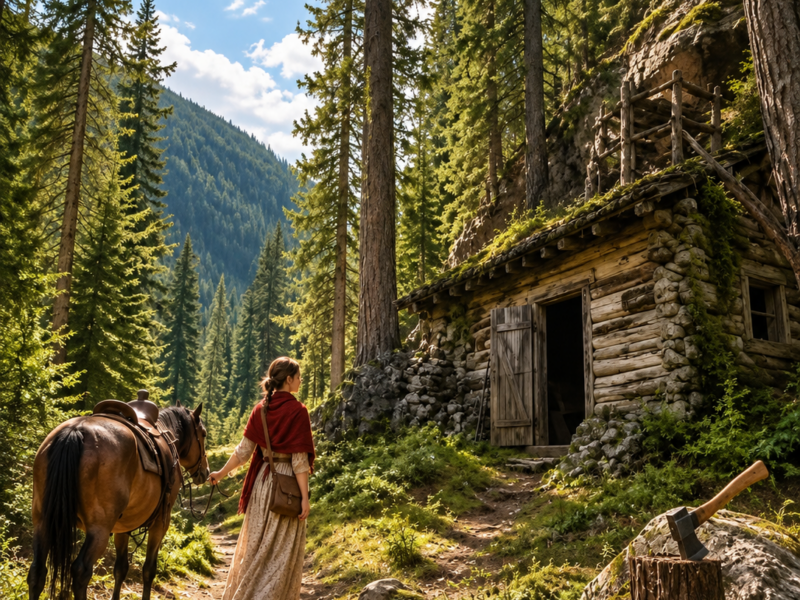
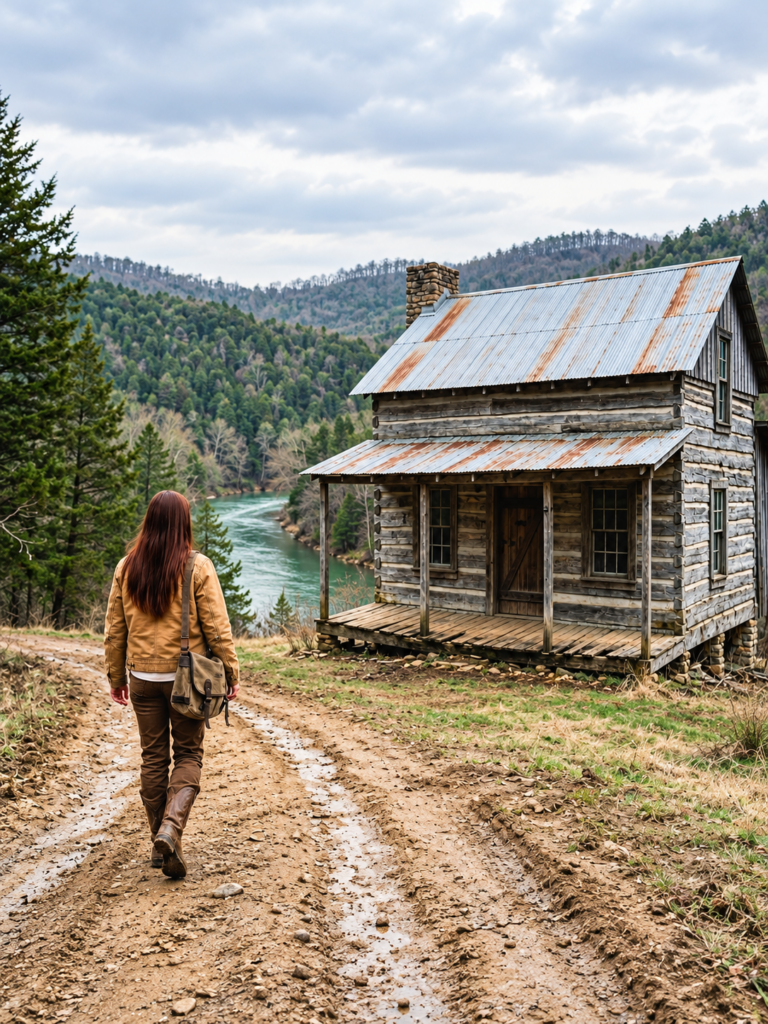
The old shop stood among oak trees above the Jacks Fork River.
Its log walls had weathered silver-gray.
The porch sagged.
Weeds grew through the steps.
A stone chimney rose crookedly against the roof.
The building looked abandoned by everyone except time.
Darcy approached slowly.
Her boots sank into damp earth.
The river murmured beyond the trees.
She climbed the porch with care, avoiding the worst boards, and slipped the iron key into the lock.
It turned.
The door opened with a long wooden groan.
Inside was a single room.
Dust covered the floor.
A stone fireplace stood against one wall.
And beneath a narrow window along the south side was the largest leatherworking bench Darcy had ever seen.
Eight feet long.
Three feet deep.
Hand-hewn oak.
A heavy vise at one end.
Drawers beneath.
Knife scars across its darkened surface.
Darcy slowly crossed the room.
She laid her saddlebag on the floor and placed both hands on the bench.
The wood was cold.
But beneath the dust, the familiar smell remained.
Old leather.
Neatsfoot oil.
Beeswax.
She closed her eyes.
For one impossible moment, she was nine years old again, sitting beside Ida with two needles and a scrap of leather.
“Grandma,” she whispered, “I found a table.”
Then she knelt on the dusty floor and cried.
Not because she had bought anything valuable.
Not because she believed her troubles were over.
But because, for the first time since Ida died, she was standing in a place where her grandmother’s work still seemed alive.
Outside, the shadows lengthened.
Darcy looked around at the broken windows, the unsafe fireplace, and the roof that needed more repairs than she could afford.
She had no food.
No money.
No bed.
And no way of knowing whether she could keep this place through the winter.
But she had a key.
And for the first time in two years, nobody could tell her to leave at the end of the month.
Part 2
The first night in Orin Tull’s shop was the coldest night Darcy could remember since leaving the group home.
The roof leaked.
The fireplace couldn’t be used because the chimney was blocked.
Wind entered through gaps between the logs.
She spread her jacket over the cleanest section of floor and used her saddlebag as a pillow.
Above her, the rafters creaked.
Something small moved behind the wall.
She hoped it was a mouse.
Around midnight, rain began striking the roof.
A thin stream of water appeared near the fireplace and traveled across the floor.
Darcy sat up and moved her bag.
Then another leak appeared beside the door.
She found an old bucket beneath the bench and placed it under the worst drip.
For an hour, she listened to the water striking metal.
Plink.
Plink.
Plink.
She remembered Ida’s house during thunderstorms.
The old woman would sit beside the stove and drink coffee, saying that rain sounded worse on a tin roof than it usually was.
But Ida always had a dry bed.
Darcy had a cold floor and a roof she didn’t know how to repair.
By morning, her back hurt so badly she struggled to stand.
She walked down to the creek, washed her face in the cold water, and returned to inspect the building.
The porch required major repairs.
Two windows had broken panes.
The doorframe was sound, but the lower hinge had loosened.
The chimney needed professional attention before she could use it.
The roof had several damaged areas.
The bench, however, appeared remarkably strong.
Darcy cleaned the top with a damp cloth.
She opened the drawers.
Empty.
She checked the vise.
Its iron screw turned stiffly but still worked.
Beneath the bench, she noticed a loose floorboard.
One end sat slightly higher than the others.
She touched it, then withdrew her hand.
At the moment, she had more urgent concerns.
There was no food in the building.
And her ten dollars were gone.
She walked into town that morning.
At Roy Tillett’s riding stable, she found him carrying a bale of hay into the barn.
He stopped when he saw her.
“Darcy? Thought you were working at the hardware store today.”
“Lost the room yesterday.”
Roy lowered the bale.
His expression changed.
“Where’d you sleep?”
“Down Creek Road.”
“Where?”
“Orin Tull’s old shop.”
Roy stared at her.
“You bought that place?”
“Yes, sir.”
He let out a long breath.
“Lord have mercy.”
Darcy looked down.
“I know it needs work.”
“Needs work? Girl, that place needs somebody to explain why it’s still standing.”
She forced a smile.
“The bench is good.”
Roy studied her for a moment.
Then he leaned against a stall door.
“Look, the river’s still running high. I can’t put you back on full hours.”
“I understand.”
“But I’ve got two damaged saddles and a pile of bridles in the tack room.”
Darcy looked up.
“Need them repaired?”
“Badly.”
“I can do it.”
Roy nodded.
“I know.”
He handed her the first saddle.
“Let’s see what you can make of this.”
The leather was dry and cracked around the rear rigging.
A cheap machine repair had begun separating along one edge.
Darcy inspected the stitching.
“The damaged section needs to be replaced. I wouldn’t trust another patch.”
“How long?”
“If I can use your tools and leather, tomorrow evening.”
Roy considered it.
“Thirty-five dollars labor?”
Darcy swallowed.
That was more money than she had seen in a week.
“Yes, sir.”
“Then get started.”
She worked in the tack room for six hours.
The stable smelled of hay, manure, leather oil, and wet horses.
Through the open door, she could see the green hills rising beyond the paddocks.
Her fingers found the familiar rhythm.
Measure.
Cut.
Mark.
Pierce.
Stitch.
Pull tight.
By sunset, the repair was nearly finished.
Roy brought her a sandwich wrapped in paper.
“Mrs. Tillett packed extra.”
Darcy knew perfectly well Mrs. Tillett had not accidentally packed an extra sandwich.
But she accepted it.
“Thank you.”
Roy sat on an overturned bucket.
“So what are you planning to do with the shop?”
“Repair tack. Make saddles eventually.”
“With what money?”
Darcy kept stitching.
“I haven’t figured that part out.”
Roy watched her hands.
“You know, your grandmother fixed my father’s saddle once.”
Darcy looked up.
“She did?”
“Sure did. Old brown stock saddle. He’d owned it since before I was born.”
Roy smiled.
“Ida told him the tree was still good and he’d be a fool to replace the whole thing.”
Darcy laughed softly.
“Sounds like her.”
“She was right.”
He stood.
“Bring me a list of what you need for the shop. I’ll see what I have lying around.”
Darcy opened her mouth to protest.
Roy raised a hand.
“Not charity. There’s a difference between giving someone a hand and carrying them.”
Those words stayed with her on the long walk back.
The following days were difficult.
Darcy worked at the stable whenever Roy had repairs for her.
In the evenings, she cleaned the old shop.
She removed broken glass, swept years of dust, and sorted the abandoned scraps of wood.
She found an old iron nail and used it to hang Ida’s photograph above the workbench.
In the photograph, Ida sat at her oak kitchen table wearing a blue cotton dress.
Her white hair was tied back.
A half-finished saddle lay before her.
Darcy positioned the picture where the morning light would reach it.
“That’s better,” she whispered.
But the practical problems kept growing.
One afternoon, the sky darkened and a storm moved up the valley.
Darcy had been patching a gap around the door when thunder rolled across the hills.
The rain arrived hard.
Water poured through the damaged roof.
She dragged the few dry scraps of leather away from the wall.
The bucket filled.
Then a second leak appeared over the workbench.
Darcy threw a tarp across the surface and stood beneath the dripping rafters, feeling helpless.
If the bench were ruined, the shop would be little more than a rotten shelter.
She had no savings for lumber.
No way to pay a carpenter.
And no family who could afford to help.
That evening, she returned to town and called her mother’s last known number.
She hadn’t spoken to Tammy in nearly four years.
The call connected.
A tired voice answered.
“Hello?”
“Mom?”
Silence.
Then, “Darcy?”
Darcy swallowed.
“It’s me.”
“Well. Honey. How are you?”
“I’m all right.”
She looked toward the rain gathering along the roadside.
“I’m trying to fix up an old shop. I thought maybe—”
Tammy interrupted.
“I can’t send money, Darcy.”
The words struck harder than she expected.
“I wasn’t asking for money.”
“Then what?”
Darcy closed her eyes.
She had wanted her mother to ask where she was sleeping.
Whether she had eaten.
Whether she was safe.
Instead, she said, “Nothing. I just wanted to hear your voice.”
Tammy sighed.
“I’m dealing with some things right now.”
“Okay.”
“Maybe call another time.”
The line went dead.
Darcy stood beside the payphone outside the gas station until the evening traffic passed.
Then she walked back to the shop.
By the time she arrived, her clothes were wet.
She took the round knife from her saddlebag and placed it on the bench.
Ida had once told her that there would be days when a person had to decide whether to keep working even when nobody was watching.
Darcy picked up a scrap of leather.
She threaded her needles.
And she stitched until her hands stopped trembling.
The next morning, Mrs. Chilton from the general store arrived in an old pickup truck.
She was a broad-shouldered woman in her late sixties, with gray hair beneath a flowered scarf.
She carried a cardboard box.
“Are you Darcy Slade?”
“Yes, ma’am.”
“Ida Slade’s granddaughter?”
Darcy straightened.
“Yes.”
Mrs. Chilton studied her.
Then she set the box on the workbench.
“Your grandmother repaired my mother’s sidesaddle in 1984.”
Darcy blinked.
“She did?”
“Best stitching my mother ever saw.”
Inside the box were flour, dried beans, coffee, canned vegetables, and a jar of blackberry preserves.
Darcy’s face warmed.
“I can’t pay for all this.”
Mrs. Chilton waved the objection away.
“Didn’t ask you to.”
“But—”
“Your grandmother helped half this county at one time or another. Don’t insult an old woman by making her explain why she brought groceries.”
Darcy laughed despite herself.
Mrs. Chilton looked around.
“You’re living here?”
“For now.”
The older woman examined the damaged windows.
“That won’t do come winter.”
“I’m working on it.”
“I can see that.”
She touched the bench.
“Good Lord. Orin’s old workbench.”
Darcy nodded.
“It’s beautiful, isn’t it?”
Mrs. Chilton ran her fingers along the scars.
“My father brought a saddle here when I was a girl. Orin sat right there, cutting leather while we waited.”
She paused.
“I never thought I’d see somebody working at this bench again.”
Darcy looked at the old woman’s face.
For the first time, she understood that this abandoned building meant something to other people, too.
It held pieces of their lives.
The following Sunday, Mrs. Chilton returned with fresh bread.
A week later, Roy arrived with a used window frame and several boards.
He helped secure the broken window and brace the worst section of porch.
They worked through a warm afternoon.
At one point, Roy found Darcy staring at the river.
“What’s wrong?”
She shook her head.
“Nothing.”
“Darcy.”
Her eyes filled.
“I’m just not used to people helping without wanting something back.”
Roy rested his hammer on the railing.
“Well, get used to it. That’s how decent neighbors are supposed to work.”
Darcy looked toward Ida’s photograph inside.
She wanted desperately to believe him.
But life had taught her that people sometimes disappeared just when you needed them most.
She didn’t yet know whether the shop could survive.
And she still hadn’t examined the strange floorboard beneath the workbench.
Part 3
By early June, Darcy had established a routine.
She rose at dawn, washed at Roy’s stable or in town, worked on tack repairs, and returned to the shop in the evening.
Every spare dollar went toward something necessary.
Nails.
Window putty.
Leather scraps.
Food.
A used cot she found at a thrift store.
At night, she listened to the Jacks Fork moving over the stones beyond the trees.
She had begun to recognize its sounds.
A gentle rushing when the river was low.
A deeper roar after heavy rain.
The soft splash of fish near the bank.
But she still worried every time storm clouds gathered.
The roof remained unreliable.
The chimney was unsafe.
And the building grew unbearably cold when rain came through the hills.
One afternoon, a rancher named Mr. Jessup arrived carrying an old bridle.
He was the same man who had once praised Darcy’s stitching at Ida’s kitchen table.
His hair had grown almost completely white.
He stood in the doorway and looked around.
“Well, I’ll be.”
Darcy rose.
“Mr. Jessup?”
He studied her face.
“Darcy Slade?”
“Yes, sir.”
He smiled.
“I haven’t seen you since you were about fourteen.”
She remembered that day clearly.
She had replaced a torn cheek piece while Ida watched.
Mr. Jessup had praised her work.
It was one of the few times during her childhood that an adult outside the group home had looked at her with genuine admiration.
“What brings you here?” Darcy asked.
He raised the bridle.
“Same thing that brought me to your grandmother’s table.”
Darcy laughed.
“Broken leather?”
“Broken leather.”
She examined the headstall.
The old stitching had rotted near the buckle.
“I can fix this.”
“I figured.”
Mr. Jessup walked toward the bench.
He looked at Ida’s photograph.
Then he removed his hat.
“She was a good woman.”
Darcy nodded.
“The best.”
He turned toward her.
“Ida used to say you had the hands for this work.”
Darcy looked away.
“She taught me everything.”
“Not everything. She taught you how to learn.”
The words stayed with Darcy long after he left.
That evening, she worked on the bridle beneath the window.
The sunlight had turned gold.
She was searching for a dropped needle when her hand brushed the unusual floorboard beneath the bench.
It shifted.
Darcy knelt.
She examined the edges.
The board was shorter than the others, and the ends had been beveled carefully.
This was not damage.
Someone had made it removable.
She took Ida’s stitching awl and worked the point gently into the narrow gap.
The board lifted.
Beneath it lay a shallow cavity lined with stone.
Darcy aimed her flashlight inside.
Something wrapped in dark oilcloth rested against the bottom.
She froze.
For several seconds, she simply stared.
Then she reached down.
The bundle was heavier than she expected.
She carefully brought it into the light and placed it on the workbench.
The cloth smelled of old oil and earth.
Inside were three separate objects.
A leather tool roll.
A canvas pouch.
A thick, leather-bound book.
Darcy unfastened the tool roll first.
A beautiful round knife lay inside.
Its blade had been carefully protected.
Beside it were a stitching groover, pricking irons, an edge beveler, a bone folder, and several smaller tools.
Every wooden handle bore the same initials.
O.T.
Orin Tull.
Darcy picked up the round knife.
It felt remarkably similar to Ida’s.
The same curved blade.
The same weight.
The same balance.
She placed the two knives side by side.
One darkened from decades of use.
The other preserved beneath the old floor.
Two tools separated by years, yet made for the same purpose.
Darcy opened the leather-bound book.
Inside were hand-drawn patterns.
Saddle seats.
Skirts.
Fenders.
Stirrup leathers.
Headstalls.
Breast collars.
Forty-one patterns in all.
Each carried measurements, stitching lines, and notes written in an old man’s careful hand.
Darcy turned the pages slowly.
Some designs had been revised several times.
Others included small drawings showing how a piece of leather should bend around a horse’s shoulder or lie against its back.
This wasn’t merely a collection of templates.
It was a lifetime of practical knowledge.
She imagined Orin sitting at the bench during winter evenings, sharpening his knife and recording what experience had taught him.
The canvas pouch remained unopened.
Darcy untied it.
Small metal objects shifted inside.
She poured them carefully onto a clean cloth.
Gold-colored coins.
Thirty-four of them.
She stared.
Then she picked one up.
It was heavier than ordinary change.
An old American gold coin, its surface worn smooth around the edges.
She had never held anything like it.
For a moment, she thought of groceries, lumber, a stove, and a bed.
Then she thought of the unpaid bills that had driven her from Mrs. Bell’s boardinghouse.
She quickly gathered the coins and placed them back inside the pouch.
Her hands shook.
Finally, she noticed a folded paper tucked into the front cover of the pattern book.
She opened it.
The handwriting was old but legible.
To whoever finds these tools:
My name is Orin Tull. I’ve made saddles in this shop since 1920.
My health is failing, and I don’t expect to return.
I have placed my tools, patterns, and savings beneath the bench because this bench has been the heart of my working life.
The patterns represent forty-six years of making saddles for the people of these hills.
The tools are meant to be used.
The money is meant to keep the shop alive.
If you have found these things, I hope you know what they are.
Cut some leather.
Stitch something worth keeping.
Orin Tull.
November 2, 1966.
Darcy read the letter twice.
Then a third time.
She looked toward the photograph of Ida.
Her grandmother had spent years telling her about Orin’s work.
Had taught her the same trade.
Had placed the same tools in her hands.
And now Darcy stood in his old workshop, holding the patterns of a craftsman whose saddles Ida had admired.
It felt almost impossible.
She selected a dry scrap of leather from the bench.
Then she picked up Orin’s round knife.
She positioned the leather on a cutting board.
Remembered Ida’s lessons.
The angle.
The pressure.
The steady movement.
One smooth cut.
The blade passed through the leather without tearing.
Darcy lifted the piece and examined the clean edge.
She began crying.
Not loudly.
Not helplessly.
She simply stood beside the bench with tears running down her cheeks.
“Thank you, Mr. Tull,” she whispered.
Then she looked toward Ida’s photograph.
“I remembered.”
The next morning, Darcy carried the coins to a reputable dealer in West Plains.
The man examined them carefully and explained their gold content, collectible value, and the importance of checking each date and condition.
He estimated that the group could bring approximately twenty-one thousand dollars through a proper sale.
Darcy nearly dropped the edge of the counter.
“Twenty-one thousand?”
“Approximately. Some may carry collector premiums. You’ll want to document the collection and confirm title before selling.”
Darcy nodded.
She left with the coins secured and a written valuation.
On the bus ride home, she stared through the window.
Twenty-one thousand dollars.
It was more money than she had ever possessed.
Enough to make the building safe.
Enough to buy proper leather.
Enough to purchase a used truck.
Enough to build something real.
But the coins were not merely money.
They were the savings of a man who had worked for nearly half a century.
And his letter made clear what he had hoped someone would do with them.
Darcy contacted the county clerk and a local attorney to confirm the legal position before proceeding.
While the matter was reviewed, she continued repairing tack and gathering repair estimates.
One evening, Roy stopped by and found her sitting at the bench.
“You look like you’ve seen a ghost.”
Darcy smiled.
“Maybe I have.”
She showed him Orin’s pattern book.
Roy turned its pages in astonishment.
“Good heavens.”
“He drew every one himself.”
Roy touched the edge of a pattern.
“My daddy talked about these designs.”
Darcy watched him.
“Do you think somebody would still buy saddles made this way?”
Roy looked at her.
“Darcy, people drove fifty miles to buy Orin’s work when he was alive.”
“But times have changed.”
“Sure they have.”
He closed the book carefully.
“But horses haven’t changed nearly as much.”
Darcy laughed.
Then Roy grew serious.
“Just don’t mistake finding old tools for knowing how to run a business. You’ve got a roof to repair, insurance to arrange, customers to find, and enough work to wear out your hands.”
Darcy nodded.
“I know.”
“Good.”
He handed the book back.
“Because I’d hate to see you lose this place.”
Darcy looked around the shop.
So would she.
That night, she wrote out a plan on the back of an old feed invoice.
She listed every necessary repair.
Every tool.
Every supply.
Every dollar she hoped to earn.
At the top, she wrote three words.
Tull Saddlery Workshop.
Then, beneath them:
Repair first. Build later.
She pinned the paper beside Ida’s photograph.
For the first time since leaving the group home, Darcy was not merely trying to survive until tomorrow.
She was preparing for a future.
Part 4
The money did not make the work easier.
It made the work possible.
And those were two very different things.
Once the paperwork concerning the hidden collection had been resolved, Darcy sold the coins through a dealer, keeping careful records of the transaction.
She did not buy expensive clothes.
She did not leave the Ozarks.
She did not spend the money celebrating.
Her first purchase was a proper roof inspection.
The contractor, a broad man named Henry Maddox, climbed into the attic with a flashlight and came down twenty minutes later shaking his head.
“Some of those rafters are still good,” he said. “But the decking has to go in several places.”
Darcy swallowed.
“How much?”
He gave her the estimate.
She looked at the number for a long moment.
It was more than she had expected.
Henry studied her.
“That building has held on longer than most folks would have guessed. But you can’t live under a roof you don’t trust.”
Darcy nodded.
“Do it.”
The following week, she watched workers remove damaged shingles and replace rotted boards.
Every hammer strike sounded like money disappearing.
But when the first hard rain came after the repairs, no water entered the shop.
Darcy stood beneath the ceiling and listened.
For the first time, rain was simply rain.
Not a threat.
Not another bill.
Not a reminder that she had nowhere else to go.
Roy helped her arrange a chimney inspection and safe repairs before she used the fireplace.
She purchased a small cast-iron stove and had it installed with proper clearances and venting.
She bought a used folding cot, a secondhand table, and enough canned food to get through several weeks.
Then she found a battered 1997 Ford F-150 advertised by a retired rancher.
The truck had nearly two hundred thousand miles on it.
Its paint was faded.
The seats smelled of old hay.
But the engine started reliably.
Darcy paid fifteen hundred dollars after a mechanic looked it over.
When she drove it up Creek Road for the first time, she laughed aloud.
She had never owned a vehicle.
She rolled down the window and let the warm air rush through the cab.
At the shop, she parked beneath the oak trees and sat behind the wheel for several minutes.
Then she whispered, “Look at me, Grandma.”
The next task was turning the building into a working business.
Darcy cleaned the old bench until its dark wood emerged from beneath the dust.
She sharpened Orin’s tools.
She oiled Ida’s needles and arranged them carefully in a drawer.
She mounted a clean board beside the window for cutting leather.
She purchased hides, buckles, rivets, thread, and supplies.
And she began accepting repairs.
At first, only a few customers came.
Roy sent his trail riders.
Mr. Jessup brought two more bridles.
Mrs. Chilton told everyone who visited her store that the old saddlemaker’s place was open again.
Then a rancher from Summersville arrived carrying a saddle wrapped in a blanket.
It had belonged to his grandfather.
The cantle binding had torn, and the leather was dry around the edges.
“Can you save it?” he asked.
Darcy examined the saddle carefully.
The tree appeared sound, though she wanted to inspect it thoroughly before promising anything.
“I believe I can repair the binding. But I won’t know what else it needs until I take a closer look.”
The rancher nodded.
“That’s fair.”
She worked on the saddle for three evenings.
The leather was difficult to match.
The old stitching had to be removed without damaging the surrounding material.
She softened the usable leather gradually and cut a replacement strip with Orin’s knife.
Then she stitched it using Ida’s curved needles.
When the rancher returned, Darcy placed the saddle on the bench.
He lifted it toward the window.
Turned it.
Ran his thumb along the repaired seam.
Then he looked at Darcy.
“Where does the old leather end?”
She pointed.
“Right there.”
He examined it again.
“I can’t see it.”
Darcy smiled.
“That’s the idea.”
The man paid her without bargaining.
Before leaving, he looked at the sign she had painted above the door.
“Tull Saddlery Workshop.”
“Yes, sir.”
He nodded.
“My grandfather would be pleased to know this place is working again.”
That night, Darcy counted her earnings.
They weren’t much.
But they were hers.
Over the summer, more customers came.
A torn breast collar.
A broken stirrup leather.
Two worn headstalls.
A cracked saddle skirt.
Darcy learned how to set prices that covered materials and labor without taking advantage of people.
She also learned to say no.
One man wanted her to repair a badly compromised saddle tree using a quick patch.
Darcy refused.
“Somebody could get hurt riding that,” she explained.
The customer complained.
She held firm.
Ida had always said a saddlemaker’s responsibility didn’t end when the customer paid.
The saddle had to be safe when somebody put it on a horse.
One September afternoon, a man named Calvin Vickers arrived from Mountain View.
He owned a custom saddle shop and had worked in the trade for three decades.
Roy had told him about Darcy.
Calvin watched her cutting leather.
She had marked a gentle curve and was working slowly with Orin’s round knife.
“You cut freehand?” he asked.
“When I can.”
“Most people use rotary cutters now.”
“My grandmother taught me with a round knife.”
Calvin watched another cut.
Then he picked up the finished piece.
“That’s clean work.”
“Thank you.”
“How long have you been doing this?”
“Since I was little.”
“Ever made a complete saddle?”
“Not yet.”
Calvin looked around at the old patterns.
“Would you like to?”
Darcy stared.
“Of course.”
“I need help three days a week. Somebody who can cut, stitch, and isn’t afraid of learning.”
Darcy hesitated.
“I have this shop.”
“You can keep it. I’m not asking you to sell.”
He placed his business card on the bench.
“Come work with me part-time. Learn the parts you haven’t learned yet.”
Darcy examined the card.
It was the kind of opportunity she had dreamed about but never expected anyone to offer.
“I’d like that very much.”
Calvin nodded.
“Then start Monday.”
For several weeks, Darcy drove to Mountain View before dawn.
She worked beside experienced saddle makers, learning how to fit trees to different horses, shape seats, balance skirts, and choose materials for specific uses.
Some days, her hands cramped from stitching.
Some evenings, she came home exhausted.
But she loved the work.
Then trouble arrived.
In October, a letter came from an attorney representing a distant relative of Orin Tull.
The man claimed that the tools, patterns, and coins found beneath the workbench might have belonged to Orin’s estate rather than being included in the shop transfer.
Darcy read the letter three times.
Her stomach tightened.
The sender demanded an accounting of the property and the money from the coins.
For several minutes, she couldn’t move.
She had repaired the roof.
Bought tools.
Purchased supplies.
Built a business.
And now someone was questioning whether the discovery belonged to her.
She called the attorney who had helped examine the coin ownership.
He read the letter and explained that the claim needed proper review.
Darcy sat on the edge of her cot.
“Could I lose everything?”
“I can’t answer that until we examine the records.”
Her chest felt hollow.
She had spent her childhood watching adults make decisions about her life.
And now, after finally building something of her own, she was afraid those decisions might begin again.
That night, she walked down to the river.
October leaves floated on the water.
The air smelled of damp earth and wood smoke.
She sat on a flat stone and thought about leaving.
She could sell the truck.
Pack Ida’s tools.
Find work somewhere else.
Maybe it would be easier to stop fighting for things she seemed destined to lose.
But when she returned to the shop, the workbench stood beneath the window exactly where it had stood for generations.
Ida’s photograph remained above it.
Orin’s patterns lay carefully protected in their cabinet.
Darcy placed both hands on the wood.
Then she began gathering the documents.
The county sale records.
The property transfer.
The photographs of the hidden cavity.
Orin’s letter.
Her repair invoices.
Everything she had preserved.
She could not control whether someone challenged her claim.
But she could face the challenge carefully and honestly.
A few days later, the attorney arranged a meeting with the claimant, Franklin Tull, Orin’s grandnephew.
Franklin was in his sixties, with a stiff manner and the tired appearance of a man who had spent much of his life fighting over money.
He looked around the restored shop.
“So this is where it happened.”
Darcy nodded.
“Yes, sir.”
He walked toward the bench.
“My father used to talk about Uncle Orin.”
“Did he?”
Franklin touched the edge of the wood.
“Said he spent his whole life in this building.”
Darcy waited.
Franklin looked at the tools.
“I heard you found gold coins.”
“Yes.”
“And sold them.”
“After getting legal advice and documenting the collection.”
He studied her.
“Seems like a pretty good deal for ten dollars.”
Darcy felt heat rising in her face.
“I didn’t know anything was under the floor when I bought the shop.”
Franklin shrugged.
“That’s what everybody says.”
She wanted to snap back.
Instead, she brought out Orin’s letter.
“Would you read this?”
Franklin hesitated, then took the paper.
He read it slowly.
His expression changed.
But he said nothing.
Finally, Darcy spoke.
“Your uncle wanted someone to use his tools. That’s what I’m doing.”
Franklin looked toward the photograph of Ida.
“Who’s that?”
“My grandmother.”
“She make saddles?”
“She repaired them. For twenty-seven years.”
Franklin examined the two round knives lying on the bench.
Then he looked at Darcy’s hands.
“You really know how to use those?”
Darcy nodded.
“Yes, sir.”
He remained silent.
For the first time since receiving the legal letter, Darcy saw uncertainty in his eyes.
But the claim had not been withdrawn.
And she knew that until the matter was settled, the future of the shop remained uncertain.
Part 5
The answer came three weeks later.
Darcy was repairing a bridle when a truck pulled into the clearing.
Franklin Tull stepped out carrying a cardboard box.
Darcy put down her needle.
“Mr. Tull.”
He nodded.
“Morning.”
She wiped her hands on a cloth.
“Can I help you?”
Franklin looked toward the workbench.
“I’ve been going through my father’s old things.”
He set the box on the table.
“Found some papers.”
Darcy waited.
Franklin removed a faded envelope.
Inside were copies of old correspondence, family notes, and a document concerning the disposition of Orin’s personal workshop property.
Franklin’s attorney had located additional records showing that Orin had intended his tools and working materials to remain with the shop.
The county’s later transfer and the attorney’s title review supported Darcy’s ownership of the discovered collection.
Franklin cleared his throat.
“My lawyer says we don’t have a good claim.”
Darcy held her breath.
“He reviewed the sale documents and what Uncle Orin wrote.”
Franklin looked at the bench.
“Said the best thing would be to withdraw.”
Darcy’s knees suddenly felt weak.
“Are you going to?”
He nodded.
“Already signed the papers.”
For several seconds, Darcy couldn’t speak.
Then she said, “Thank you.”
Franklin looked uncomfortable.
“Don’t thank me yet.”
He opened the box.
Inside lay an old photograph.
A younger Orin Tull stood beside a horse wearing a plain working saddle.
Beside him was a woman Darcy didn’t recognize.
Franklin pointed.
“That’s my grandmother. Orin’s sister.”
He turned the photograph over.
On the back, in faded ink, someone had written the date and the words:
The first saddle Orin made after coming home.
Darcy studied the image.
The saddle was simple.
Strong.
Beautiful in its own practical way.
Franklin watched her.
“My father said Orin never married. Worked all the time. Didn’t know how to do much besides make saddles.”
He gave a faint smile.
“Family thought he was strange.”
Darcy looked around the shop.
“He must have loved the work.”
Franklin nodded slowly.
“Looks that way.”
He walked to the bench.
“My father wanted him to sell this place once. Said there wasn’t any future in making things by hand.”
Darcy looked at him.
“What did Orin say?”
Franklin chuckled.
“Told him a horse didn’t care whether a saddle was fashionable. Just whether it fit.”
Darcy laughed.
That sounded exactly like something Ida would have appreciated.
Franklin reached into his coat pocket and removed a small envelope.
Inside was another photograph.
It showed Orin standing in front of the shop with several saddles hanging from the porch.
“Thought you might want this.”
Darcy accepted it carefully.
“I would.”
Franklin studied her for a moment.
“You know, when I heard some twenty-year-old girl bought the place for ten dollars and found gold underneath, I thought she’d gotten lucky.”
Darcy said nothing.
“I figured she’d sell everything and disappear.”
He glanced toward the roof, the restored windows, the cleaned bench.
“But you’ve done more work on this place in six months than anybody’s done in fifty years.”
Darcy felt her eyes sting.
Franklin cleared his throat.
“I’m sorry I made trouble for you.”
She looked at him.
There was no excuse in his voice.
No attempt to make the accusation sound reasonable.
Just an apology.
“Thank you for saying that.”
He nodded.
Then he pointed toward a torn strap on the workbench.
“What’s that?”
“A breast collar.”
“Can you fix it?”
“Yes, sir.”
He pulled out an old wallet.
“Then maybe I’ll bring you something next week.”
Darcy smiled.
“I’ll be here.”
After he left, she sat down at the bench and covered her face.
She had expected another fight.
Another person telling her she didn’t deserve what she had.
Instead, the shop was still hers.
The tools were still hers.
And the work could continue.
Outside, November wind moved through the oak branches.
She lit the stove and stood beside it until the warmth reached her fingers.
For a long time, she watched the flames.
Then she took Ida’s photograph from the shelf.
“Grandma,” she whispered, “we’re going to be all right.”
The following winter was difficult.
The roads turned icy.
Business slowed.
A January storm knocked out power across parts of Shannon County, and Darcy spent three days keeping the shop warm with carefully rationed firewood.
She carried water from a neighbor’s well when the pipes froze.
She learned how much food to store before heavy snow.
She learned that running a rural business required almost as much attention to weather as it did to customers.
But she no longer faced every hardship alone.
Roy checked on her after storms.
Mrs. Chilton brought soup and jars of preserves.
Mr. Jessup delivered a load of split oak and refused to take payment beyond a repaired set of reins.
Darcy repaired tack for neighbors who couldn’t afford full prices, although she learned to keep careful accounts so generosity did not bankrupt the shop.
And on quiet evenings, she practiced the patterns Orin had left.
Her first complete saddle took months.
She made mistakes.
She wasted leather.
She removed entire seams and stitched them again.
Calvin Vickers inspected her progress whenever he visited.
“This skirt isn’t sitting evenly,” he said one afternoon.
Darcy frowned.
“I thought it was.”
“Look at it from the rear.”
She stepped back.
He was right.
One side hung slightly lower.
Darcy sighed.
“Guess I’m starting over.”
Calvin nodded.
“That’s how you learn.”
She unstitched the section that evening.
Then she cut a replacement.
The second attempt was better.
By spring, the saddle was finished.
It was a plain brown working saddle, built from strong leather over a properly fitted wooden tree.
No silver decorations.
No elaborate carving.
Just the kind of saddle Orin might have recognized.
Darcy placed it on the bench beneath the window.
For several minutes, she simply looked at it.
Then she took a photograph.
She put it beside Ida’s picture.
Her first saddle.
Beside the woman who had taught her how to stitch.
In April, a rancher named Walter Hensley arrived to examine it.
He owned a small cattle operation near Winona and had been searching for a saddle that fit his older gelding properly.
Darcy showed him the construction.
She explained the materials.
The stitching.
The intended fit.
Walter examined every inch.
Finally, he asked, “How much?”
Darcy told him.
He considered the price.
Then nodded.
“Fair.”
She had expected him to bargain.
He didn’t.
Instead, he placed a deposit on the bench and arranged for a proper fitting.
When the saddle was ready to take home, Walter stood beside his horse for a long time after the trial ride.
“Feels right,” he said.
Darcy smiled.
“That’s what I hoped.”
He ran his hand along the leather.
“My dad used to say a good saddle should feel like it belongs on the horse.”
Darcy nodded.
“Orin Tull believed that, too.”
Walter looked toward the shop.
“Old man would be pleased.”
Darcy watched him ride away.
Her first saddle had not made her rich.
But someone would be using something she had made.
Not as a decoration.
Not as a souvenir.
As a working piece of equipment trusted by a rider.
She understood then what Ida had meant when she said the work mattered.
That summer, Darcy hired a local teenager named Emily Brooks to help clean the shop and organize supplies.
Emily was sixteen.
Her father had been injured in a logging accident, and money was tight at home.
On her first day, she stood beside the bench watching Darcy stitch a headstall.
“How do you make it so even?” Emily asked.
“Practice.”
“Could you teach me?”
Darcy looked up.
The question carried her backward almost fourteen years.
She saw Ida’s kitchen table.
The afternoon sunlight.
The old woman’s steady hands.
She smiled.
“Sit down.”
Emily pulled up a stool.
Darcy handed her a scrap of leather, two needles, and a length of waxed thread.
“First thing you need to learn is the saddle stitch.”
“What’s special about it?”
Darcy demonstrated.
“Two needles. One thread. They pass through the same hole from opposite sides.”
Emily leaned closer.
“Why?”
“Because when it’s done properly, the seam stays secure even if one part of the thread is damaged.”
She handed the leather over.
“Now you try.”
Emily pushed the first needle through awkwardly.
The second caught.
She frowned.
“It’s harder than it looks.”
Darcy laughed.
“Everything worth learning usually is.”
For the next hour, they worked together.
Darcy corrected her grip.
Showed her how to pull the thread evenly.
Explained why the holes needed to be spaced correctly.
And as she taught, she heard Ida’s voice in her own words.
“Don’t rush.”
“Keep your hands steady.”
“Let the leather tell you what it needs.”
By the end of the afternoon, Emily had completed a crooked but serviceable seam.
She held it up proudly.
“Look!”
Darcy examined it.
“Not bad for your first one.”
Emily grinned.
“Do you think I could get really good at this?”
Darcy looked at the girl.
“I know you can.”
That evening, after Emily left, Darcy sat alone at the workbench.
The shop smelled of warm leather and fresh wood smoke.
Outside, the Jacks Fork moved peacefully through the valley.
The roof no longer leaked.
The windows were sound.
A stack of repair orders waited in a drawer.
Orin’s pattern book rested safely in a cabinet, brought out whenever Darcy needed to study its old designs.
Ida’s tools hung beside his.
For the first time, the shop looked not like an abandoned building someone had rescued, but like a place that had never stopped being useful.
Darcy thought about the twenty-year-old girl who had walked up Creek Road carrying everything she owned.
She remembered the fear.
The hunger.
The humiliation of losing her rented room.
The nights she had lain awake wondering whether she would spend her entire life being someone people had to look after.
She thought about the people who had helped her.
Mrs. Bell.
Roy.
Mrs. Chilton.
Mr. Jessup.
Calvin.
Franklin, who had finally chosen fairness over a fight.
They had not replaced Ida.
Nobody could.
But they had shown Darcy that losing one home did not mean a person would never belong anywhere again.
The following October, three years after Darcy first entered the shop, the community held a small gathering outside the building.
There was no formal ceremony.
No expensive decorations.
Just folding chairs, homemade food, and neighbors who wanted to celebrate the return of a trade that had nearly disappeared from their valley.
Roy brought two horses.
Mrs. Chilton brought blackberry cobbler.
Mr. Jessup arrived with an old saddle that Ida had repaired many years earlier.
Calvin brought several young apprentices from his workshop.
Emily stood beside Darcy, wearing a leather apron and smiling nervously.
A hand-painted sign hung above the porch.
Tull Saddlery Workshop.
Traditional Saddles and Leather Repair.
Inside, photographs of Orin and Ida stood together above the bench.
Darcy had also placed a small framed copy of Orin’s letter beneath them.
She didn’t display the information about the money.
That had never been the important part.
Instead, she displayed the words:
The tools are meant to be used.
Cut some leather.
Stitch something worth keeping.
When Roy asked Darcy to say a few words, she shook her head.
“I’m no good at speeches.”
Mrs. Chilton folded her arms.
“Nonsense. You’re plenty good at talking when somebody brings you a saddle they’ve ruined.”
Everyone laughed.
Darcy blushed.
Then she stepped onto the porch.
She looked at the people gathered in the clearing.
“I don’t really know what to say.”
She glanced toward the shop.
“When I came here, I didn’t have anywhere to live.”
The laughter faded.
“I’d lost my room. I had ten dollars. And I was carrying the only things my grandmother had left me.”
She took a breath.
“I bought this place because I remembered her telling me about Orin Tull. I thought maybe I could repair a few bridles and keep the rain off my head.”
She looked toward Roy.
“I didn’t know how much work the building needed.”
He smiled.
“More than you thought.”
“Much more.”
A few people chuckled.
Darcy continued.
“I also didn’t know how many people would help me.”
Her eyes moved across the familiar faces.
“Some of you brought food. Some brought tools. Some gave me work when you didn’t really have any extra money.”
She paused.
“And some of you just came by to ask if I was doing all right.”
Her voice trembled.
“That meant more than you probably knew.”
Mrs. Chilton wiped her eyes.
Darcy looked back toward Ida’s photograph.
“My grandmother used to tell me there was no shame in repairing something old. She said people threw away too much because they didn’t want to take the time to understand what could still be saved.”
She swallowed.
“I think she knew that about people, too.”
The clearing grew quiet.
“When I was little, I thought she was teaching me how to repair saddles. Now I think she was also teaching me how to survive.”
Darcy looked toward Emily.
“And I’m grateful I get to teach some of it to somebody else.”
Emily smiled through tears.
Darcy drew a breath.
“So thank you for helping me bring this place back.”
She stepped down from the porch.
The applause was warm and long.
Later, when most of the visitors had gone, Darcy sat beside Mr. Jessup on the porch.
The old rancher watched the sun settle over the river.
“You know,” he said, “your grandmother would have liked this.”
Darcy smiled.
“I hope so.”
“Hope? Girl, Ida would’ve been bragging about you to everybody within fifty miles.”
Darcy laughed.
“She wasn’t much for bragging.”
“About herself, no.”
He looked at her.
“About you, she surely was.”
Darcy turned toward him.
“She was?”
Mr. Jessup nodded.
“Every time she fixed something I brought over, she’d tell me how you were doing.”
He smiled at the memory.
“Said she had a granddaughter who could stitch better than grown men twice her age.”
Darcy felt her throat tighten.
“She never told me that.”
“Of course not. Didn’t want you getting a big head.”
They both laughed.
Then Mr. Jessup grew quiet.
“She worried about what would happen to you after she was gone.”
Darcy looked at her hands.
“So did I.”
“Well,” he said, gesturing toward the shop, “looks like you both got your answer.”
After he left, Darcy remained on the porch.
The evening air smelled of fallen leaves and river water.
Smoke rose from the chimney.
Inside, the lights glowed warmly over the old workbench.
She could hear Emily laughing as she helped Mrs. Chilton collect the last of the dishes.
There was food in the cupboard.
Work waiting for tomorrow.
And a bed beside the window where Darcy could sleep without wondering whether someone would ask her to leave.
She rose and walked inside.
On the bench lay a piece of unfinished leather.
A bridle repair for a rancher who planned to collect it the following morning.
Darcy sat down.
She picked up Ida’s curved needles and threaded them with waxed linen.
Then she began.
One hole.
Two needles.
Pull tight.
Outside, the last light faded from the Ozark hills.
Darcy worked slowly, enjoying the familiar rhythm.
She thought of Earl Slade stitching harness by firelight after long days working with mule teams.
She thought of Ida repairing saddles at her kitchen table while a little girl watched.
She thought of Orin Tull working in this room for forty-six years, making saddles that lasted long after the men who bought them were gone.
And she thought of Emily, who would return tomorrow morning and sit beside this same bench to practice the stitch Ida had taught her.
Darcy had once believed her grandmother left her almost nothing.
An old knife.
A few needles.
Some thread.
A photograph.
But she had been wrong.
Ida had left her the ability to make something useful with her hands.
The patience to keep working when life became difficult.
And the knowledge that being unwanted by one person did not mean she had nothing to offer the world.
Orin had left the tools and the patterns of a lifetime.
The gold had helped Darcy repair the building.
But the tools gave her a trade.
And the people who came through the door gave her something she had spent most of her childhood longing for.
A place in the world.
She finished the last stitch and trimmed the thread.
Then she held the bridle beneath the lamplight.
The seam was straight.
Tight.
Strong.
She smiled.
Above her, Ida’s photograph rested beside Orin’s.
Two craftspeople who had never expected their work to become part of a young woman’s second chance.
Darcy placed the finished bridle on the shelf.
Then she looked at the old bench and whispered the same words she had spoken on the day she found Orin’s tools.
“Thank you.”
She turned down the lamp, leaving the small light by the stove burning.
Outside, the Jacks Fork continued its steady passage through the mountains.
The shop stood warm and secure among the oak trees.
And Darcy Slade, who had arrived at twenty years old with ten dollars and nowhere to sleep, was finally home.
Not because she had discovered gold beneath the floor.
Not because she had bought land for almost nothing.
But because she had found a way to carry forward the work of the people who came before her.
Ida had taught her that a proper saddle stitch could hold when ordinary stitching failed.
Now Darcy understood that the lesson had always been about more than leather.
Some bonds were made through blood.
Others through kindness.
And some were created when one person took the time to teach another how to stand on her own.
Those were the bonds worth protecting.
Those were the things worth mending.
And those were the stitches that held.