Part 1
“Sixty dollars.”
The voice came from somewhere near the back of the auction crowd, small enough that Royce Mabry almost missed it.
He lowered his microphone and looked past a row of men in work jackets and muddy boots. A boy in a faded blue cap stood beside the coffee wagon with one arm raised. He couldn’t have been more than twelve.
For a moment, nobody moved.
Then Dale Puit started laughing.
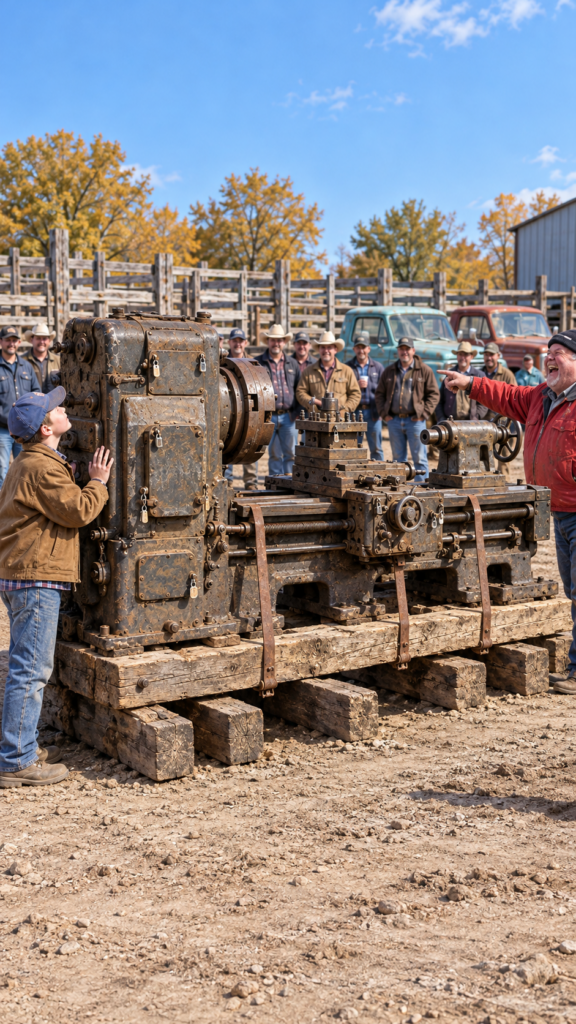
It began as a deep, rolling sound that made his heavy shoulders shake. He caught the tailgate of a nearby pickup to steady himself, pointed at the boy, and laughed harder. Within seconds, nearly thirty people scattered around the Brandt farmyard were laughing with him.
Because the boy had just offered every dollar he owned for fourteen tons of machinery that nobody else wanted.
“Well, would you look at that!” Dale called, wiping at his eyes. “We finally found somebody willing to buy the whole mountain of junk!”
The boy didn’t answer.
His name was Ezra Pel, and he had spent enough afternoons in his grandfather’s machine shop to recognize something the men around him had overlooked.
He lowered his arm and walked toward the machine.
It rested on a massive oak skid in the middle of the farmyard, an enormous gray iron lathe longer than most pickup trucks. Its heavy headstock rose at one end. The tailstock sat at the other, separated by a long, straight bed built to support work far larger than anything found in an ordinary repair garage.
Years of dust covered the iron. Hardened grease clung to its surfaces in thick brown layers. Rust stained the steel straps securing it to the skid. Pieces of straw, old chaff, and the remains of countless mouse nests were packed into the corners.
To most of the people standing there, it looked like something that should have been hauled to a scrapyard decades earlier.
But Ezra wasn’t looking at the rust.
He was looking at the small gray seals fastened to the machine’s covers.
Each seal hung from a short twist of wire. And stamped into every one was the same tiny symbol.
An anchor.
Ezra placed his palm against the cold iron.
Behind him, Dale was still laughing.
“Go on, sailor boy! You’ve got wire cutters, haven’t you? Cut one of those seals and show everybody what you bought!”
Ezra kept his hand where it was.
He knew exactly what those seals might mean.
And he also knew why his grandfather had warned him never to break one just to satisfy somebody else’s curiosity.
Twenty minutes earlier, the auction had seemed nearly over.
The Brandt farm was being cleared after generations in the same family. Old tools, wagons, furniture, equipment, and farm machinery had been spread across the yard for buyers who had driven in from surrounding counties.
Ezra had come with Hollis Granger, an older tow-and-rigging operator who had promised to take him along while he looked at a gooseneck trailer.
Hollis had left Ezra beside the coffee wagon with a cup of cocoa.
“Stay out of trouble,” he’d told him.
Ezra had promised.
Then Royce Mabry started trying to sell lot number 104.
The auction bill described it simply as one large old machine, condition and contents unknown, buyer responsible for removal within seven days.
Royce opened the bidding at five hundred dollars.
Nobody raised a hand.
He dropped to two hundred.
Still nothing.
At one hundred dollars, several men shook their heads and walked away.
Finally, Royce pushed back his white straw hat and announced that he’d accept fifty dollars from anybody willing to take the thing.
That was when Dale Puit stepped forward.
Dale owned Puit Equipment and Salvage, out along the state highway. He had spent two decades buying and selling used tractors, trailers, and agricultural equipment. He sat on the county fair board and knew just about everybody who had ever bought a secondhand machine in Quarters Mill.
He also enjoyed reminding them how much smarter he was about machinery.
“Folks, take a good look at that thing,” Dale announced, planting one boot against the wooden skid. “It’s an old factory lathe. Big, obsolete, and about as useful as a stone boat.”
A few men chuckled.
Dale slapped the iron housing.
“Nobody around here has a shop floor strong enough for it. Nobody’s got the electrical service to run it. You’d spend more getting it moved than you’d ever make selling it for scrap.”
He looked around, pleased to see people listening.
“Cast iron might bring a hundred and ten dollars a ton, but by the time you pay for a crane, a lowboy, and somebody who knows how to haul this monster, you’re three thousand dollars in the hole.”
He spread his hands.
“That’s what I call expensive junk.”
Several buyers nodded.
Dale dealt in heavy equipment. If he said a machine wasn’t worth moving, they believed him.
Royce raised the microphone again.
“Anybody? Fifty dollars?”
Nothing.
Then Ezra lifted his hand.
“Sixty.”
He hadn’t planned to speak so loudly.
He’d been thinking about the anchor stamps, about a cigar box in his grandfather’s garage, and about something Walt Pel had told him years earlier.
But once the number left his mouth, there was no taking it back.
Royce turned toward him.
“Sixty from the young fellow in the blue cap. Anybody give me seventy?”
Nobody did.
“Seventy? Going once. Going twice.”
His gavel came down.
“Sold! Sixty dollars. We’ll put it on Hollis Granger’s bidder number, seeing as he brought the boy.”
The crowd broke into laughter.
Ezra barely heard it.
He was already walking toward the lathe.
By the time Hollis returned from inspecting the trailer, people were pointing at Ezra and telling each other that Walt Pel’s grandson had bought fourteen tons of scrap metal.
Hollis pushed through the crowd.
He was broad through the shoulders, with a white beard, weathered hands, and gray coveralls marked by decades of working around trucks and rigging equipment.
He studied the machine first.
Then he studied Ezra.
“Son,” he said quietly, “what have you done?”
Ezra looked up.
“I bought it.”
“I can see that.”
“With my own money.”
Hollis closed his eyes for a moment.
“Ezra, that’s fourteen tons of iron.”
“I know.”
“It has to be moved within seven days.”
“I know that too.”
Hollis looked down at the boy’s hand resting on the headstock.
“What made you buy it?”
Ezra pointed toward the nearest seal.
“Look at that.”
Hollis bent closer.
The small anchor was still visible beneath the grime.
“Grandpa showed me one just like it,” Ezra explained. “He said Navy inspectors used them on equipment after it was accepted. He said when the seals were still there, you needed to be careful about opening anything.”
Hollis examined the wire.
It appeared untouched.
“What else did Walt tell you?”
“That a sealed machine could have a story nobody knew yet.”
Ezra hesitated.
“And that you shouldn’t destroy the proof just because somebody wants to see what’s inside.”
Hollis stayed crouched for several seconds.
Behind them, Dale shouted something about selling the boy a boat to go with his Navy machine.
More laughter followed.
Hollis rose slowly.
He had known Walt Pel for years. He knew the old machinist wasn’t given to exaggeration or foolishness.
And he knew that Ezra had listened to his grandfather more carefully than most grown men listened to anybody.
Finally, Hollis rested one large hand on the boy’s shoulder.
“Well,” he said, loud enough for those nearby to hear, “a man’s bid is his bid.”
Then he nodded toward the auction clerk’s trailer.
“Go settle up.”
Ezra walked to the trailer and emptied his pockets.
He counted out the money he’d earned mowing lawns through the summer. Ten-dollar bills, five-dollar bills, and folded singles.
Sixty dollars.
Not a penny left.
The clerk wrote him a receipt.
When Ezra returned, Dale was waiting.
“Tell you what, son. I’ll help you out.”
Ezra stopped.
Dale pulled a hundred-dollar bill from his wallet.
“Cut one of those seals. Open the gearbox. If there’s anything in there besides rust and mouse nests, I’ll give you a hundred cash for the whole thing. You make forty dollars without even leaving the farm.”
He smiled toward the audience gathering around them.
“That’s what we call profit.”
Ezra looked from the bill to the seals.
“No, sir.”
Dale’s smile stiffened.
“What’s that?”
“I’m not opening it.”
“Why not? You scared of what you’re going to find?”
Ezra shook his head.
“My grandpa said never to break a Navy seal in a sale yard. He said to do it in front of people who know what they’re looking at. People who can write down what they see.”
For a moment, Dale stopped smiling.
Then he threw back his head.
“Well, gentlemen, you heard him! He’s waiting for the Navy!”
The yard erupted again.
Ezra said nothing.
He folded his receipt carefully and placed it inside his jacket.
By late afternoon, his mother knew.
Carla Pel worked at the county nursing home, often taking double shifts to keep their bills paid. She received three telephone calls before finishing work. The first caller said Ezra had bought an old machine. The second said it weighed more than a loaded dump truck.
The third was laughing too hard to explain much of anything.
Carla drove to the Brandt farm without going home to change.
She still wore her green scrubs, and she’d buttoned her gray cardigan one hole off in her hurry.
Most of the buyers had already left.
She found her son sitting on the corner of a huge wooden skid, beside a machine that looked as if it belonged in a shipbuilding plant.
Hollis stood nearby.
“Ezra Walter Pel.”
The boy looked up.
“Hi, Mom.”
Carla stared at the lathe.
Then at Ezra.
Then back at the lathe.
“Please tell me that’s not what everybody’s been calling me about.”
Ezra shifted on the skid.
“I bought it with my mowing money.”
“How much?”
“Sixty dollars.”
Carla pressed her fingers against her forehead.
“Honey, the sixty dollars isn’t the problem.”
She walked several steps along the machine, looking at its immense length.
“How are we supposed to move this? We don’t have equipment. We don’t have money to hire anybody. Where would we even put it?”
“Beside Grandpa’s garage,” Ezra answered.
She turned toward Hollis.
“Please tell me there’s something I’m not understanding.”
Hollis rubbed his beard.
“The boy saw some inspection seals. Walt apparently taught him something about them.”
“That doesn’t move fourteen tons of machinery.”
“No, ma’am,” Hollis admitted. “But I can.”
Carla stared.
“Hollis, absolutely not. I know what a job like this costs.”
“I’m not charging.”
“You can’t just—”
“I can.”
His voice was gentle but firm.
Then he told her a story Ezra had heard only pieces of before.
During the flood of 1997, Hollis’s son had driven his truck off the ferry road and into the swollen river.
Walt Pel had gone into the water after him.
He’d stood chest-deep in the freezing current, working a tow strap around the truck while the river pushed against his legs. Between Walt’s determination and the men on shore, Hollis’s son had gotten out alive.
When Hollis tried to pay Walt afterward, the machinist refused.
“He told me to do something useful for somebody else someday,” Hollis said.
He looked toward the machine.
“I’ve been carrying that favor around for twenty-nine years.”
Carla’s expression softened.
“That’s a long time.”
“Long enough. I’ve got a wrecker and a lowboy. I’ll bring them Saturday.”
Before Carla could answer, Neil Brandt approached.
Neil was the great-nephew responsible for settling the family estate. He had driven from Louisville for the auction and spent the day watching strangers sort through objects that had belonged to his relatives.
He looked tired, but he smiled at Ezra.
“I’m glad you got it, son.”
Carla gave him a doubtful glance.
“Are you?”
Neil nodded.
“I was about to pay Dale four hundred dollars just to haul it off.”
Hollis turned toward the road where Dale’s white pickup had disappeared.
For the first time that afternoon, he understood why Dale had been quite so eager to make the machine look worthless.
Ezra hadn’t merely bought something Dale considered junk.
He had taken a paid removal job away from him.
And he’d done it in front of half the county.
Ezra asked Neil if he knew where the lathe had come from.
Neil sat beside him on the skid.
“My great-uncle Auggie bought it in 1947. Government surplus auction up in Cincinnati. Paid four hundred dollars, which was a fortune to a farmer back then.”
“What was he going to do with it?” Ezra asked.
“Open a repair business. He thought he could fix tractors and combines for everybody in the valley.”
Neil looked down the length of the machine.
“He hauled it home and put it in the shed. Then the power company never brought the heavy three-phase service out this far.”
“So he couldn’t run it?”
“Never could.”
“Did he open the covers?”
Neil shook his head.
“Not that I ever heard. I asked him about it when I was little. He said he didn’t know enough about a machine like that to go cutting government seals.”
Ezra looked at the anchor nearest his hand.
“How long has it been sitting there?”
“Seventy-nine years.”
That number stayed with him all the way home.
Seventy-nine years beneath a tarp in a farm shed.
No electricity.
No work.
No reason for anybody to open it.
Just a machine waiting through generations of people who either couldn’t use it or didn’t want it.
After supper, Ezra went behind the house to his grandfather’s garage.
Walt Pel had worked at the pump works down by the river for nearly thirty years before the plant closed. He’d operated heavy machinery, repaired broken components, and understood tools by the sounds they made as much as by the measurements written on a drawing.
He had died two winters earlier.
But his shop remained almost exactly as he’d left it.
There was the little bench lathe beneath its dust cover. The drill press stood against the wall. Rows of coffee cans held carefully sorted bolts, washers, nuts, and fittings. Every container carried a label written in Walt’s square handwriting.
Ezra had spent countless afternoons there.
When he was small enough to need an overturned bucket to reach the workbench, his grandfather had taught him the names of the parts.
Chuck.
Carriage.
Tailstock.
Lead screw.
He’d learned to hand Walt the correct wrench before being asked twice. He’d learned why measurements mattered and why a machine could be dangerous to anyone too impatient to understand it.
Most important, he’d learned that a thing’s appearance didn’t always tell you its condition.
Ezra climbed onto the wooden stool beside the workbench.
He reached for a cigar box on the shelf.
Inside lay several small objects Walt had kept for reasons known only to him.
Among them was a gray metal seal threaded onto a short length of old wire.
A tiny anchor marked its surface.
Ezra remembered the afternoon his grandfather had shown it to him.
Walt had held the seal beneath the work light and explained that it had come from a Navy pump.
The machine had been accepted under inspection, he said, and the seal helped establish that its protected parts hadn’t been disturbed afterward.
A seal didn’t make a machine valuable by itself. But sometimes it preserved evidence that could become important to someone who understood the equipment.
And evidence, Walt insisted, wasn’t something you casually destroyed.
Ezra placed the old seal beside the photograph he’d taken of the lathe using his mother’s phone.
The anchor symbols matched.
He sat with both images before him for a long time.
He could almost hear his grandfather correcting him for touching a measured surface with dirty fingers, or reminding him to put a tool back where it belonged.
For the first time since the auction, Ezra let himself imagine that he might have found something genuinely important.
He didn’t know what.
He didn’t know to whom.
But he knew there was a difference between an old machine and an old machine with a history that could still be proved.
The following Saturday, Hollis arrived shortly after seven in the morning.
His big red wrecker rolled up beside the garage, followed by the lowboy trailer.
Moving the lathe took nearly the entire day.
Hollis inspected the skid, positioned the trailer, set the ramps, and rigged his winch carefully. Under his direction, the huge machine began to creep forward, inch after inch, while the cable tightened and the oak timbers groaned.
Ezra watched from a safe distance beside Carla.
He would have liked to help, but Hollis had made one rule very clear: nobody stood near a loaded cable or underneath a shifting piece of machinery.
By lunchtime, a dozen cars had stopped along the road to watch.
A few people had brought coffee. Somebody unfolded a lawn chair.
When Dale drove past around two that afternoon, he slowed his white pickup and leaned out.
“Careful, Hollis! Don’t hurt yourself hauling sixty dollars’ worth of firewood!”
Several spectators laughed.
Hollis continued working without looking toward the road.
By evening, they had the machine secured and were ready to bring it through Quarters Mill.
The convoy moved at roughly eight miles an hour.
People stepped out of the diner and hardware store to watch the enormous shape pass along Main Street. Men sitting outside the bank pointed. Somebody called out that the Navy was sailing through town.
Ezra heard the laughter through the wrecker’s window.
He pulled his blue cap lower.
Hollis glanced at him.
“You doing all right, son?”
“Yes, sir.”
“You sure?”
Ezra looked straight ahead.
“Just want to get it home.”
Hollis nodded and kept driving.
They lowered the lathe onto heavy timber supports on the gravel beside Walt’s old garage.
By dark, it was covered with a blue tarp, tied securely at all four corners.
Carla stood on the back step while Ezra walked around the machine twice with a flashlight.
He checked the ropes.
He checked the skid.
Then he counted the seals.
There were nineteen.
Every single one was still intact.
Later that night, he sat at the kitchen table and copied their numbers into his spiral notebook, carefully separating each set of markings so he could read them again.
Carla watched him from the kitchen counter.
“You’re taking this pretty seriously.”
Ezra didn’t look up.
“Grandpa would.”
She considered that.
Then she set a glass of milk beside his notebook.
The house had been quiet since Walt died. For a long time, Carla had worried that her son was withdrawing into the garage because he didn’t know how else to miss his grandfather.
Now she watched him work.
And though the gigantic machine outside frightened her, she could see something returning to her son’s face that had been missing for two years.
A sense of purpose.
Ezra finished writing the nineteenth seal number.
Then he opened the notebook to a fresh page.
At the top, in careful block letters, he wrote one word.
CONTACTS.
Because finding the machine had been only the beginning.
Now he needed to find somebody who understood what he had bought.
Part 2
By Monday morning, almost everybody in Quarters Mill had heard about Ezra Pel and his sixty-dollar machine.
Unfortunately, very few people were telling the story kindly.
At the feed store, Dale Puit entertained the men gathered around the coffee counter with predictions about how quickly Ezra would lose interest.
“Give him a week,” Dale announced. “He’ll be out there with a hacksaw looking for buried treasure inside the gearbox.”
One man asked what the boy would find.
“Rust,” Dale said. “Maybe a mouse old enough to draw a pension.”
The laughter followed him all the way to the cash register.
By Wednesday, Dale had started telling people that Ezra believed the Navy was going to send a ship to collect his machine.
That afternoon, when Ezra stopped at the gas station for a soda after school, Dale spotted him near the pumps.
“Hey, Admiral!”
Ezra turned.
“Any word from Washington yet? They sending an aircraft carrier to pick up that pile of iron?”
Two men filling their trucks laughed.
Ezra tightened his grip around his bottle.
“No, sir.”
“Well, don’t worry. Maybe they’re still searching for a harbor in your mama’s backyard.”
Ezra walked away without answering.
He’d expected people to make jokes at the auction. What he hadn’t expected was for the jokes to follow him into the rest of his life.
Men he’d known since childhood began saluting him outside the post office. Others called the machine his Navy boat.
Even people who meant no real harm seemed unable to resist smiling when they saw him.
It was the sort of joke a small town could keep alive for years.
Especially when the person being laughed at had no way to defend himself.
At home, Ezra went straight to the garage.
He checked the tarp, walked around the machine, and sat at his grandfather’s old workbench.
On the shelf above the drill press was a stack of machinery auction catalogs Walt had collected over the years.
Ezra remembered seeing his grandfather leaf through them on winter evenings, occasionally circling a machine or making a note in the margin.
He brought the stack down carefully.
Some catalogs were twenty or thirty years old. Their covers had faded, and the pages smelled of paper and machine oil.
He worked through them until he found one from an industrial auction house in Cincinnati.
Near the back was a directory of machinery appraisers.
One name had a small pencil check beside it.
Ruth Anne Vickery.
Accredited Senior Appraiser.
Machinery and Equipment.
Ezra ran his fingertip beneath the name.
His grandfather had marked it for some reason. Ezra couldn’t know whether Walt had ever contacted the woman, but the check mark was enough to give him a place to start.
That evening, Carla found her son writing at the kitchen table.
He had three sheets of notebook paper in front of him, two sharpened pencils, and a photograph of the lathe.
“What are you doing?”
“Writing a letter.”
“To whom?”
“An appraiser.”
Carla pulled out a chair.
“An appraiser?”
“Somebody who knows big machines. Grandpa had her name in one of his catalogs.”
He showed her the page.
Carla looked at the name, then at her son’s first draft.
It was full of crossed-out words and sentences squeezed between the lines.
She sat beside him.
“All right. Tell me what you want her to know.”
Ezra explained about the auction, the seals, the anchor stamps, and the heavy machine that had apparently never been used.
Carla listened without interrupting.
When he finished, she pointed to the photographs.
“These will probably explain more than three pages of guessing.”
Ezra nodded.
Together, they organized the letter.
He described the machine as carefully as he could. He included the markings on the wooden skid, where old stencil lettering began with USN and continued into a long string of identification numbers.
He wrote that all nineteen seals remained intact.
Most importantly, he explained that he wouldn’t open the machine without knowledgeable witnesses.
Carla helped correct the spelling, but the words were Ezra’s.
The following day, she took him to the drugstore to print six photographs.
Ezra examined each one before putting it into the envelope.
One showed the entire lathe.
Another showed the headstock.
The others showed the seals, the markings, and details he thought an expert might need.
Then he prepared a second letter.
This one went to the commanding officer of a large Navy shipyard he had found while searching online.
He didn’t know whether anybody there would read it.
He didn’t even know if he had addressed it to the right department.
But his grandfather had told him that the Navy had once inspected machines like this, and Ezra thought somebody in a Navy machine shop might still recognize what he had found.
On Thursday, mother and son went to the post office.
Ezra watched both envelopes disappear into the outgoing mail.
Then he went home and waited.
The first week passed without an answer.
Every afternoon, he checked the mailbox.
He found the electric bill, advertisements, and a seed catalog addressed to a previous owner of a neighboring property.
Nothing from Cincinnati.
Nothing from Virginia.
The second week was worse.
By then, Ezra knew the walk from the school bus stop to the mailbox so well that he found himself looking toward it before he’d even crossed the yard.
Some afternoons, Carla could tell whether there had been an answer just by the way he came through the kitchen door.
She tried to be encouraging without making promises she couldn’t keep.
“Letters take time, honey.”
“I know.”
“People have other work to do.”
“I know that too.”
But the longer the silence continued, the more Ezra wondered if Dale had been right.
What if the seal meant nothing?
What if the machine had been abandoned because it was broken or incomplete?
What if no one who knew anything about it was still alive?
He had taken his grandfather’s advice as seriously as he knew how. Yet that advice hadn’t guaranteed an answer.
One Saturday afternoon, a white pickup turned into the driveway.
Ezra recognized it before it stopped.
Dale Puit rolled down his window.
Two employees sat in the truck bed, looking toward the tarp-covered machine.
“Afternoon, Admiral.”
“Afternoon, Mr. Puit.”
Dale rested one arm along the open window.
“I’ve been thinking about your situation.”
Ezra waited.
“Your mama works hard. Last thing she needs is a fourteen-ton headache sitting beside the garage.”
Ezra didn’t answer.
“So I’m going to make you another offer.”
Dale pulled out his wallet.
“Two hundred dollars. Cash. I’ll haul it away myself.”
One of the men in the truck bed grinned.
“That’s more than three times what you paid,” Dale continued. “You can buy yourself something useful. And your mother gets her yard back.”
Ezra looked toward the machine.
Under the tarp, it had the shape of a sleeping animal too large for the space around it.
“No, thank you.”
Dale leaned farther out.
“Son, don’t be stubborn just because you’ve already made a mistake.”
“I want to hear from the appraiser first.”
Dale chuckled.
“You haven’t heard back from anybody, have you?”
Ezra hesitated.
Dale saw the answer.
“Listen. The United States Navy doesn’t spend its time answering letters from twelve-year-old boys. Nobody’s coming out here. You’re waiting for something that isn’t going to happen.”
He folded the money and returned it to his wallet.
“Whenever you’re ready to stop being the town joke, you give me a call.”
He paused.
“Just don’t expect the same price.”
The truck backed down the driveway.
The men laughed as they disappeared onto the road.
Ezra stood alone beside the lathe until he couldn’t hear the engine anymore.
That evening, he ate supper without saying much.
Carla watched him move his food around the plate.
She knew Dale’s visits were getting to him. What worried her wasn’t the money he’d spent.
It was the possibility that his grandfather’s memory had become tied to a machine that might disappoint him.
After the dishes were washed, she sat beside him.
“You know you don’t have to prove anything to Dale Puit.”
Ezra stared at his hands.
“I’m not trying to.”
“Then what are you trying to do?”
He thought for a while.
“Find out why Grandpa would have kept those seals.”
Carla rested her hand over his.
“Your grandfather knew a lot about machines. But he didn’t know everything.”
“I know.”
“And even if that thing turns out to be scrap, it doesn’t mean he taught you wrong.”
Ezra looked toward the back window.
From the kitchen, they could see the dark outline of the blue tarp beside the garage.
He wanted to believe her.
But believing became harder when the nights grew longer and no answer arrived.
A storm blew into Quarters Mill that weekend.
Wind swept across the yard, rattling the windows and dragging rain against the house.
Sometime after midnight, Carla woke to a violent snapping sound.
Then another.
She knew immediately what it was.
The tarp.
She hurried into the kitchen and found Ezra already pulling on his boots.
They went outside together with flashlights and rain jackets.
One corner of the tarp had torn loose. The wind caught it like a sail, snapping the heavy fabric against the iron.
Working from the safe side of the machine, they caught the loose ropes and secured the covering again.
Cold water ran down Carla’s sleeves. Her hair stuck against her cheeks.
Ezra’s boots filled with rainwater.
When they finally tightened the last rope, both were exhausted.
Carla started laughing.
It wasn’t because anything was funny.
She was cold, soaked, and standing beside fourteen tons of iron in the middle of the night because her twelve-year-old son had fallen in love with a machine.
For one brief moment, the whole situation seemed completely absurd.
Ezra laughed too.
Then he went quiet.
Carla shone her flashlight toward him.
He was standing beside the headstock with one hand against the iron.
In his other hand were Walt’s old wire cutters.
Carla looked at them.
“Ezra?”
He lowered his eyes.
“I wasn’t going to.”
She waited.
“I just thought about it.”
His voice was barely audible beneath the rain.
“What if everybody’s right, Mom?”
Carla stepped closer.
“What if it’s really nothing? What if nobody writes back and we went through all this for a machine nobody wants?”
He looked up at her.
“What if Grandpa would’ve known that too?”
Carla took the cutters gently from his hand.
She understood then that the boy wasn’t only frightened of losing sixty dollars.
He was afraid he had misunderstood the person whose judgment he trusted most.
She tucked the cutters into her jacket pocket.
“Your grandpa spent his life doing work people hardly noticed,” she said. “He fixed things because they needed fixing. And when he gave somebody his word, he kept it.”
Ezra listened.
“That didn’t make him rich,” Carla continued. “But people knew they could trust him.”
She glanced at the sealed headstock.
“If there’s nothing valuable inside, we’ll deal with that. But don’t let Dale Puit decide when you break a promise to your grandfather.”
Ezra slowly nodded.
Together, they returned to the house.
Carla hung their rain jackets to dry. Then she walked into Walt’s garage and put the wire cutters back in the cigar box.
The next morning, all nineteen seals remained unbroken.
Twenty-three days after the auction, the telephone rang.
It was Tuesday evening.
Carla answered, listened briefly, and looked toward the kitchen table.
“Ezra? It’s for you.”
Ezra put down his pencil.
“Who is it?”
“A woman named Ruth Anne Vickery.”
He was out of his chair so quickly that it tipped backward and struck the floor.
He grabbed the receiver.
“Hello?”
“Is this Ezra Pel?”
“Yes, ma’am.”
“This is Ruth Anne Vickery. I received your letter.”
Ezra could feel his heartbeat in his throat.
She asked several questions about the machine, where he’d found it, and how long it had been stored.
Then she asked him to take the telephone outside and read three of the seal numbers to her.
Carla helped him carry the phone as far as its cord would reach. Ezra used his notebook to read the numbers rather than trying to climb around the machine in the dark.
Ruth Anne listened carefully.
Next, she asked for the identification markings he’d copied from the oak skid.
Ezra read them slowly.
At the other end of the line, Ruth Anne stopped speaking.
He waited.
“Ma’am?”
“I’m here.”
Another pause followed.
Then she asked something that made Ezra’s stomach tighten.
“Has anybody broken one of those seals?”
“No, ma’am.”
“Not even one?”
“No.”
“You’re absolutely certain?”
“Yes, ma’am. I’ve checked all nineteen.”
He heard her breathe out.
“Good.”
She told him she would make a telephone call that evening.
Then she intended to drive down to Quarters Mill.
And she would bring another person with her.
Ezra hardly knew what to say.
Ruth Anne continued.
“In your letter, you said you wanted the machine opened in front of witnesses.”
“Yes, ma’am.”
“Why?”
“Because my grandpa said people needed to know what they were looking at. And somebody had to write down what they saw.”
For the first time, Ruth Anne’s voice softened.
“Your grandfather gave you good advice.”
She paused.
“Choose a Saturday, Ezra. And invite your witnesses.”
After the call, Ezra stood motionless in the kitchen.
Carla was waiting.
“Well?”
He looked at her.
“She’s coming.”
Carla stared.
“Really?”
“And she’s bringing somebody.”
“What kind of somebody?”
“I don’t know yet.”
Ezra looked toward the window.
“But I think she knows what the machine is.”
That night, he made a list in his notebook.
Carla Pel, his mother.
Hollis Granger, who had helped him transport the machine.
Royce Mabry, the auctioneer who had sold it.
Neil Brandt, whose great-uncle had purchased it in 1947.
Mrs. Odum, who wrote for the weekly newspaper.
Mr. Kettering, who taught machine-shop classes at the county career center.
Then Ezra wrote one final name.
Dale Puit.
Carla read the list over his shoulder.
She stopped at the bottom.
“Why would you invite Dale?”
Ezra looked up.
“Because he’s the one who said it was scrap.”
“That’s exactly why I wouldn’t invite him.”
Ezra thought about it.
“He should see what it really is.”
Carla studied her son for a moment.
Then she nodded.
“All right.”
Ezra delivered the invitations himself.
When he handed Dale’s invitation to him at the feed store, the salvage dealer read it aloud in a theatrical voice for the men around the coffee counter.
“Official inspection of the Admiral’s battleship!”
The men laughed.
Dale handed the paper back.
“Wouldn’t miss it for the world, son. I’ll bring my hacksaw in case the Navy forgets theirs.”
Ezra took the invitation.
“You won’t need it, sir.”
He turned and walked out.
The following Saturday arrived clear and cool.
October sunlight stretched across the gravel beside Walt’s garage.
Carla borrowed eight folding chairs from the Methodist church and arranged them in a half circle facing the machine.
Hollis arrived early in clean coveralls and helped remove the blue tarp.
For the first time since 1947, the lathe stood uncovered in the full light of day.
Its great iron bed stretched across the timber supports. The hardened grease was still dark and thick. Rust marked its outer surfaces.
And all nineteen small gray seals remained attached.
Royce Mabry arrived wearing his white straw hat.
Neil Brandt had driven back from Louisville.
Mrs. Odum brought a notebook.
Mr. Kettering arrived with his reading glasses and a measuring tape, though he admitted that he was mostly there to learn.
Dale came last.
He wore the same bright red jacket he’d worn at the auction and carried a bag of sunflower seeds.
Instead of taking a chair, he leaned against his pickup with his arms folded.
At precisely ten o’clock, a white car turned into the driveway.
A woman in her fifties stepped out.
She had short gray hair, a navy blazer, and a camera case in one hand.
Ruth Anne Vickery.
A second car arrived behind her.
A compact, serious-looking man climbed out wearing a khaki shirt. He carried a long protective case containing measuring instruments.
A badge was clipped to his pocket.
Ezra saw the lettering.
It identified a Navy shipyard in Virginia.
Ruth Anne walked over and offered her hand.
“Ezra Pel?”
“Yes, ma’am.”
“It’s good to meet you.”
She shook his hand as though he were another professional attending an inspection.
Then she turned toward the man beside her.
“This is Gil Choa. He runs the heavy machine shop at the shipyard.”
Gil nodded.
“Your letter landed on my desk the same week Ruth Anne called me.”
Ezra glanced toward Carla.
She was watching the two visitors, hardly blinking.
Across the driveway, Dale had stopped eating sunflower seeds.
Ruth Anne set up her camera and explained what she intended to do.
She would document the machine before anything was opened.
First, she photographed it from several angles.
Then she walked along the headstock, bed, and tailstock, recording its condition and reading the identification numbers aloud.
Gil stood beside her with a printed list.
At each seal, he examined the marking and compared it with the information he had brought.
Occasionally, he nodded.
Then he took out his measuring tools.
He checked the bed length, the height of the spindle above the bed, and the distance between centers.
He wrote each measurement carefully.
Mr. Kettering moved a little closer.
He recognized that Gil wasn’t merely estimating the size of the machine.
He appeared to be comparing it against a specific set of dimensions.
Something about that realization made the teacher’s expression change.
Ruth Anne completed her photographs.
She examined the wires once more.
All nineteen remained intact.
Then she turned toward Ezra.
“These covers have been secured for a very long time,” she said. “Once we cut the seals, we can’t put them back in their original condition.”
Ezra nodded.
“I understand.”
“We’ll preserve and label them. Everything we find will be documented.”
Gil placed his instrument case aside.
Hollis stood ready to help remove the heavy cover.
Mrs. Odum held her pen over a fresh page.
Even Dale stepped away from his pickup.
Ruth Anne looked directly at Ezra.
“You’re the owner of this machine. Do we have your permission to break the first seal?”
Ezra looked at the little gray anchor.
He thought of his grandfather’s cigar box.
Of the men laughing in the auction yard.
Of the night he’d almost opened the gearbox in the rain.
And of the promise he’d made to himself that he wouldn’t destroy the evidence before somebody qualified could examine it.
Now those people were standing in front of him.
He took one steady breath.
“Yes, ma’am.”
Ruth Anne lifted her wire cutters.
For seventy-nine years, the machine had waited behind those seals.
At last, somebody was going to see what had been preserved inside.
Part 3
The first seal gave way with a small metallic snap.
Ruth Anne Vickery held the severed wire between two fingers, then placed the gray seal into a labeled evidence bag.
She wrote down its identification number.
Only after she had finished did she move to the next one.
Nobody complained about how long it took.
Even the people who had come expecting a spectacle seemed to understand that something different was happening.
This wasn’t a group of neighbors opening an old machine out of curiosity.
It was a formal inspection.
When the necessary seals had been removed, Hollis and Gil loosened the bolts securing the headstock cover.
The iron was heavy enough that they had to work together, lifting carefully and lowering it onto prepared supports beside the machine.
Ezra stood near his mother.
He had imagined this moment so many times that he thought he knew what he would feel.
Excitement, perhaps.
Or fear.
But as the cover came away, all he could think about was the old photograph in Walt’s garage and the little anchor stamped on the seal in the cigar box.
Gil leaned over the exposed gearbox.
Then he went perfectly still.
Inside, the gears were bright.
Not merely clean beneath the grime.
Bright.
Each tooth was sharply defined beneath a smooth amber coating of preservative. There were no rusted surfaces, no broken teeth, and no visible signs of the years of hard operation the machine’s appearance had suggested.
The enormous headstock had spent decades inside a barn, yet its protected mechanisms looked remarkably close to the condition in which they had left the factory.
Mr. Kettering removed his glasses, wiped them, and put them back on.
“Would you look at that,” he murmured.
Hollis bent closer.
He had spent most of his life moving equipment, including machinery that had sat unused for years. He understood how quickly neglect could ruin exposed metal.
But this was different.
He turned toward Ezra.
“Your grandpa would have enjoyed seeing this.”
Ezra barely heard him.
Gil had noticed something tucked against the inside of the headstock cover.
It was a stiff oilcloth envelope.
He carefully removed it and handed it to Ruth Anne.
She photographed it before opening it.
Inside was a card, folded twice.
The printing had survived.
Gil read the information aloud.
“Strand and Whitam Machine Company. Cincinnati, Ohio.”
He paused.
“Heavy shaft lathe, built to Navy drawing. Inspected and accepted. August 1945. For installation at the Navy yard.”
He looked toward the immense machine.
Then back at the card.
Ruth Anne held the document steady while Mrs. Odum copied the words into her notebook.
Ezra waited.
“Is that good?” he asked.
Gil looked at him.
“Son, this is more than good.”
He examined the gears again.
Then he looked toward Ruth Anne, who gave a small confirming nod.
Gil explained that the machine had been built during the final months of World War II to a specific Navy design.
It had been inspected and accepted, then preserved and sealed for delivery.
But the war ended before it could be installed.
The order had been canceled.
The machine eventually went into government surplus, where Auggie Brandt bought it in 1947.
And because Auggie never obtained the electrical service needed to operate it, the machine remained in storage.
For seventy-nine years.
Untouched.
Unused.
Unopened.
“This lathe has never turned over,” Gil said.
He rested a hand lightly on the outside of the headstock.
“Not once.”
The words settled over the small gathering.
Ezra looked down at the old grease covering the iron.
For weeks, people had seen only that grease.
They’d looked at the rust, the size, and the difficulty of hauling the machine away.
Not one of them had imagined what might be underneath.
All except a boy who had remembered his grandfather’s lesson.
Gil straightened.
“Ezra, I’ve been looking for one of these for eight months.”
Dale shifted his weight beside the pickup.
“What do you mean, looking for one?” he asked.
Gil turned toward him.
“Our shipyard maintains older harbor tugs. They’re the vessels that help move large ships into their berths. Some of those tugs use long, heavy propeller shafts manufactured to an old Navy drawing.”
He gestured toward the lathe.
“For years, we’ve used one specialized machine to produce replacement shafts.”
Mr. Kettering nodded slowly.
“Not the kind of job an ordinary machine shop can take.”
“Exactly,” Gil replied.
He explained that the shipyard’s existing shaft lathe had suffered a cracked bed in April.
Repairing or replacing it wasn’t simple.
The machine had been built for work that modern commercial shops rarely encountered. New equipment of sufficient size was available, but the projected delivery time was two years.
Outside contractors capable of machining the shafts had quoted eighteen months.
Meanwhile, several harbor tugs were sitting idle, waiting for replacement parts.
“A tug tied to a pier because it doesn’t have a propeller shaft isn’t doing anybody much good,” Gil said.
He glanced at the measurements in his notebook.
“That’s why your letter caught my attention.”
Ezra looked toward the lathe.
“This one can make them?”
Gil almost smiled.
“This machine was built to the same Navy drawing. Same purpose. Same era. The dimensions are exactly what we’ve needed.”
He tapped the notebook.
“We couldn’t have specified a better match.”
Carla reached for the back of an empty folding chair.
For weeks, she’d worried about moving costs, scrap values, and the possibility of having to sell the machine just to get it out of her yard.
Now a man from a Navy shipyard was standing beside it and saying that it could solve a problem his facility had spent months trying to overcome.
She looked toward her son.
Ezra stood quietly, listening to every word.
His blue cap shaded his face.
He wasn’t smiling.
He was trying to understand.
Ruth Anne turned to the group and lifted her clipboard.
“I want to put something on the record.”
Mrs. Odum prepared to write.
Ruth Anne spoke carefully.
“The machine has now been identified, and its condition and provenance have been documented. It was sealed before we began the inspection, and the protected mechanisms show no evidence of use.”
She glanced at the acceptance card.
“The original documentation provides unusually strong support for its history.”
Then she gave her appraisal.
“Based on the machine as it stands, its documented condition, and its specialized purpose, my appraisal for insurance is sixteen thousand dollars.”
Nobody spoke.
Carla brought one hand to her mouth.
Sixteen thousand dollars.
A machine her son had bought for sixty.
Ezra stared at Ruth Anne.
“Sixteen thousand?”
She nodded.
“That’s my figure.”
Hollis released a long breath.
Royce Mabry made a low whistling sound beneath his straw hat.
Mr. Kettering stepped closer to the gears, as though he needed another look before he could believe what he’d heard.
And Dale Puit stopped smiling.
He stood beside his truck with his bag of sunflower seeds hanging forgotten in one hand.
Sixteen thousand dollars.
He’d offered the boy one hundred.
Then two hundred.
He’d publicly declared the machine worthless so confidently that nobody at the auction had dared challenge him.
Now an accredited appraiser had placed a value on it nearly a hundred times greater than his highest offer.
But Gil wasn’t finished.
He turned toward Ezra.
“There’s another matter we need to discuss.”
Ezra lifted his eyes.
Gil closed his notebook.
“The Navy would like to make you an offer.”
Carla’s hand tightened around the chair.
Gil continued.
“We don’t need to buy your machine permanently. What we need is to use it.”
He explained the arrangement.
The Navy would arrange transportation to the shipyard in Virginia and cover the cost of moving the lathe.
Once there, the machine would be installed, inspected for safe operation, and insured.
The heavy machine shop would use it to produce eleven replacement propeller shafts.
When the eleventh shaft was completed, the lathe would be returned to Ezra.
It would still belong to him.
Ezra looked toward his mother.
Then he asked the question that had been on Carla’s mind since the man began speaking.
“How much would you pay to use it?”
Gil answered without hesitation.
“For those eleven shafts, I’m authorized to offer two hundred sixty-eight thousand dollars.”
Royce lowered himself into a folding chair.
Mrs. Odum stopped writing.
Hollis looked from Gil to Ezra, then down at the gravel.
Carla felt her knees weaken.
“Two hundred sixty-eight thousand dollars?” she repeated.
“Yes, ma’am,” Gil said. “For the use of the machine under the lease arrangement.”
Carla pressed her fingers against her lips.
For a moment, all she could think about was their house.
The payments she’d struggled to make.
The nights she’d come home exhausted from the nursing home.
The double shifts, the worn shoes, the small repairs postponed because there wasn’t enough money.
She thought about the night she’d stood in the rain beside the machine and wondered whether allowing her son to keep it had been the most irresponsible decision she’d ever made.
Then she looked at Ezra.
He was staring at Gil with the same expression he’d worn when he first saw the anchor stamps.
Not greedy.
Not triumphant.
Simply astonished that something he’d believed might matter had turned out to matter so much.
Across the gravel, Dale remained beside his pickup.
His mouth was open.
Ezra turned toward him.
“Mr. Puit?”
Dale looked up.
“Yes?”
“At the auction, you said if there was anything inside besides rust and mouse nests, you’d give me a hundred dollars for it.”
Royce Mabry began to laugh.
He tried to stop himself.
He couldn’t.
Then Hollis chuckled.
A moment later, laughter moved through the folding chairs.
It wasn’t nearly as loud as the laughter at the auction.
But Dale heard every bit of it.
For perhaps the first time in his life, he was standing in the middle of a county gathering where everybody understood the joke was on him.
His face reddened beneath the collar of his jacket.
He cleared his throat.
“Now, just a minute.”
Ezra waited.
Dale glanced toward Gil and Ruth Anne.
“Look, son, sixteen thousand is a fine appraisal. But government paperwork can take forever. There’ll be all sorts of delays.”
He pulled himself upright.
“I’ll give you fifteen thousand cash, right now. You can be done with the whole thing.”
Carla looked at him in disbelief.
Ezra shook his head.
“No, sir.”
Dale hesitated.
“All right. Thirty thousand.”
That number would have sounded impossible to Ezra a month earlier.
Now it barely made him pause.
“No, thank you.”
Dale spread his hands.
“Son, I’m trying to make you a reasonable offer.”
Ezra looked at the machine.
Then at Gil, standing beside the freshly opened headstock.
“It’s going to the Navy.”
Dale’s expression tightened.
“Why?”
Ezra touched the iron lightly.
“My grandpa served on a Navy repair ship.”
His voice remained quiet.
“I think he’d like knowing it was going there.”
For a moment, even Royce stopped laughing.
Carla looked down at her son.
She remembered Walt coming home from work with grease in the creases of his hands, telling Ezra stories about fixing things other people depended upon.
He’d been proud of his Navy service.
Proud of honest work.
Proud of knowing that a part he’d repaired could keep a machine running long after he was gone.
And now his grandson had found a machine that could do exactly that.
Dale folded his wallet.
He said nothing more.
He climbed into his truck, shut the door, and drove away.
No one tried to stop him.
The inspection continued after he left.
Ruth Anne documented the acceptance card and the removed seals. Gil finished his measurements and discussed the practical details of preparing the lathe for transportation.
There would be contracts and signatures.
There would be arrangements to protect the machine in transit and return it after the work was finished.
And because Ezra was twelve, Carla would have to help manage the agreement on his behalf.
But the fundamental offer was clear.
Ezra owned the lathe.
The Navy needed it.
And its use was worth far more than anyone in Quarters Mill could have imagined.
When the visitors finally departed, the afternoon shadows had begun to stretch across the gravel.
Carla and Ezra stood beside the machine.
Hollis was folding the borrowed chairs.
For a while, neither mother nor son spoke.
Then Carla put her arms around Ezra.
He stood stiffly for a second before hugging her back.
“I’m sorry I scared you, Mom,” he whispered.
She held him a little tighter.
“You certainly did.”
He gave a small laugh.
Carla closed her eyes.
“But I’m glad you listened to your grandpa.”
Three weeks later, a Navy heavy-hauling crew arrived.
This time, the transportation equipment was larger and more specialized than Hollis’s wrecker.
A long, low trailer backed into position, accompanied by a crane truck and a crew experienced in handling enormous industrial machinery.
Ezra watched the preparation with Hollis.
The old rigging operator pointed out how the Navy crew was distributing the weight and securing the lathe for the long journey.
“Take a good look,” Hollis told him. “That’s how professionals move something they can’t afford to damage.”
Ezra watched every step.
The machine was lifted, positioned, secured, and prepared for transport.
By the time the convoy was ready, people had begun arriving along the road.
Word had spread throughout Quarters Mill.
But this time, nobody came to laugh.
As the enormous trailer rolled down Main Street at eight miles an hour, the sidewalks were lined with townspeople.
Some stood outside the diner.
Others gathered near the hardware store.
The men who usually sat on the bench outside the bank rose as the machine passed.
A few removed their hats.
Carla stood beside Ezra and watched the convoy move through the town.
She remembered the first trip, when people had pointed and joked about the boy’s Navy boat.
The same machine was moving along the same street.
Nothing about its size had changed.
The outer iron still carried years of stains and old grease.
Its bed remained just as heavy.
Its headstock was still enormous.
What had changed was that people now knew what it was.
And Ezra had known enough to give them the chance to find out.
Out along the state highway, the convoy passed Puit Equipment and Salvage.
Dale stood alone near the entrance to his lot.
He wore his red jacket and kept both hands in his pockets.
He watched the trailer go by without speaking.
The machine he had dismissed as worthless was on its way to a United States Navy shipyard.
And the boy he’d mocked would be paid two hundred sixty-eight thousand dollars for its use.
There was nothing Dale could say to change that.
All winter, Gil Choa sent photographs.
The first showed the lathe installed on the shipyard floor in Virginia.
It looked different indoors, surrounded by industrial equipment and heavy lifting machinery. The scale of the building finally matched the scale of the enormous iron bed.
Another photograph showed the machine prepared for operation.
Then came the one Ezra had been waiting for.
The headstock was turning.
For the first time since it left the factory in 1945, the great shaft lathe was doing the work it had been built to do.
Ezra studied the photograph at the kitchen table.
He imagined Walt standing beside it, listening to the gears and feeling the faint vibration through the floor.
His grandfather would have wanted to know how smoothly it ran.
Whether the bearings stayed cool.
Whether the machinists could hold the proper tolerances.
He would have been interested in every ordinary, practical detail.
Later photographs showed the first completed propeller shaft, polished and enormous, gleaming beneath the shop lights.
It was nearly as long as a school bus.
Ezra could hardly believe the machine he’d found beneath a barn’s worth of grime had produced something so impressive.
He arranged the photographs on the workbench in Walt’s garage.
Sometimes he sat there looking at them, remembering how his grandfather used to explain the difference between a tool that merely looked impressive and one that performed its job correctly.
The lathe was finally performing its job.
In March, the Navy invited Ezra and Carla to Virginia.
They were flown to the shipyard and escorted into the heavy machine shop.
Ezra wore safety glasses and ear protection.
Gil met them near the entrance and explained where they could safely stand.
A yellow line marked the boundary beyond which visitors weren’t allowed.
Ezra stayed behind it.
He looked across the shop floor.
There stood his lathe.
No blue tarp.
No dusty farmyard.
No wooden skid.
The enormous machine was bolted securely to the floor, surrounded by workers who understood its purpose.
And beside it lay another freshly machined propeller shaft.
Gil pointed toward the lifting equipment.
“You’re just in time.”
A machinist was preparing to remove the completed workpiece.
The crane took the weight.
The workers checked their positions.
Slowly, carefully, the eleventh shaft rose clear of the machine.
Ezra watched without blinking.
Eleven shafts.
Eleven pieces of essential equipment produced by a lathe that had sat unused for nearly eight decades.
The men at the shipyard hadn’t needed a magical discovery.
They’d needed the right tool.
A tool that had already existed.
It had simply been forgotten.
Gil stood beside Ezra as the shaft was moved away.
“That’s the last one,” he said.
Ezra nodded.
He didn’t know what to say.
He’d imagined his grandfather beside him so often in that garage that, for a fleeting moment, he almost turned to share the sight with him.
Instead, he looked toward Carla.
She was smiling through tears.
Ezra reached for her hand.
They stayed there together until the shaft had been safely moved.
The payment arrived in April.
Two hundred sixty-eight thousand dollars.
Carla sat at the kitchen table with the paperwork in front of her, reading the amount more than once.
It was real.
Not an appraisal.
Not a promise.
Not an offer Dale could withdraw or a rumor somebody had started at the feed store.
The money had arrived.
With the lease proceeds, Carla paid off the house.
For the first time in years, she no longer had to calculate every month around a mortgage payment.
She stopped working double shifts at the nursing home.
She still worked, and she still took her responsibilities seriously, but she no longer came home so exhausted that she could barely eat supper before falling asleep.
The remaining money was placed in the bank in Ezra’s name, protected for whatever he might choose to become.
Carla asked him once what he wanted to do with it when he was older.
He thought for a while.
“Maybe something with machines.”
She smiled.
“I had a feeling you’d say that.”
But Ezra didn’t rush to make plans.
He was twelve.
He still had school, chores, homework, and a garage full of things left to learn.
His grandfather had taught him that a person should understand the tool before trying to operate it.
Ezra suspected the same advice applied to having money.
In May, the lathe came home.
But it didn’t return to the gravel beside Walt’s garage.
Ezra had spoken with Mr. Kettering about the machine and what would happen to it after the Navy finished its work.
The teacher explained that the county career center had a floor strong enough to support it.
More importantly, the facility had the electrical service needed to operate it.
Students there were learning practical machining skills.
They studied measurements, tooling, materials, and the precision required to make components fit together.
Ezra liked the idea of the lathe continuing to work.
He liked even more the thought that other young people might learn from it.
So he lent the machine to the county career center.
The big shaft lathe was installed in the machine shop under Mr. Kettering’s supervision.
It was carefully maintained and used for appropriate instruction.
And on the headstock, where the old acceptance markings still belonged, they mounted a small brass plate.
The inscription was simple.
IN MEMORY OF WALT PEL, MACHINIST.
When Carla first saw it, she touched the edge of the plate with one finger.
Walt had spent his life working on machines.
He hadn’t been famous.
He hadn’t owned a large company.
Most of the people who depended on his work had probably never known his name.
But he’d been a good machinist.
A patient teacher.
And a grandfather who believed that knowledge mattered only when somebody took the time to pass it along.
Now his name was fixed to a machine that would help teach others.
Ezra stood beside the headstock, reading the inscription.
Mr. Kettering joined him.
“Your grandfather would be proud of you,” the teacher said.
Ezra thought about that.
“I wish he could’ve seen it run.”
Mr. Kettering looked along the massive bed.
“Well, you’ve made sure other people will.”
On Saturdays, Ezra began spending time at the career center.
He swept the shop, helped with ordinary chores, and watched Mr. Kettering explain the safe operation of the machine.
When the teacher allowed it, Ezra stood beside him wearing safety glasses, learning things Walt hadn’t yet gotten around to teaching him.
He learned how machinists prepared large workpieces.
How tools were positioned.
How measurements were checked.
Why patience mattered.
And why even an enormous machine depended on small details being exactly right.
Sometimes, when the shop was quiet, Ezra rested his hand against the headstock.
It no longer felt like an abandoned piece of iron.
It felt like something with a purpose.
Something that had waited a very long time for the right person to recognize it.
Ezra didn’t pretend he’d known the machine was worth hundreds of thousands of dollars when he raised his hand at the auction.
He hadn’t.
He hadn’t known the Navy needed eleven propeller shafts.
He hadn’t known about the cracked lathe in Virginia, the eighteen-month delays, or the exact match between the old drawings.
He’d only recognized that the seals might be important.
And he’d remembered what his grandfather had told him to do.
He had protected the evidence.
He had asked people who understood it.
And when the whole town laughed, he’d waited long enough to learn the truth.
That was the part he hoped never to forget.
Not the money.
Not Dale’s humiliation.
Not even the day the Navy convoy rolled through Quarters Mill.
It was the simple lesson he’d learned long before the auction, sitting on an overturned bucket in his grandfather’s garage.
Understand what you’re looking at before you decide what it’s worth.
The story of Ezra’s sixty-dollar lathe traveled far beyond the county.
People repeated the numbers because they were extraordinary.
Fourteen tons.
Nineteen seals.
Seventy-nine years.
Sixty dollars at auction.
Two hundred sixty-eight thousand dollars from the Navy.
But in Quarters Mill, people remembered something else.
They remembered a twelve-year-old boy standing beside a filthy old machine while grown men laughed at him.
They remembered how quietly he’d refused to break the seals.
And they remembered how those same men had stood along Main Street months later, watching that machine leave for the shipyard.
As for Dale Puit, the story followed him too.
At the next farm auction in the county, Royce Mabry offered a large wooden crate.
It was old and rusty around the metal fittings, secured with bands, and nobody seemed certain what it contained.
For several minutes, buyers inspected it without making an offer.
Then a hand shot up.
Dale Puit’s.
This time, he wasn’t laughing.
He had remembered the boy who paid sixty dollars for something nobody understood.
He wasn’t going to make the same mistake twice.
Dale bid aggressively and won the crate for four hundred dollars.
People gathered as he had the bands removed.
He stood over it with the satisfied expression of a man certain that he’d finally found his own overlooked treasure.
The lid came off.
Inside were fence staples.
Ordinary fence staples.
Nothing rare.
Nothing remarkable.
Just a large crate of hardware.
Royce Mabry stared into it.
Then he looked at Dale.
A smile slowly spread across his face.
Somebody at the back of the crowd began laughing.
A moment later, half the auction yard joined in.
And somewhere across Quarters Mill, in a clean machine shop with proper lights and enough power to turn an enormous headstock, Ezra Pel was learning how to use the machine everybody had once called worthless.
The brass plate bearing his grandfather’s name shone beneath the shop lights.
The lathe had finally found its place.
And so, in his own way, had the boy who bought it.