
Part 1
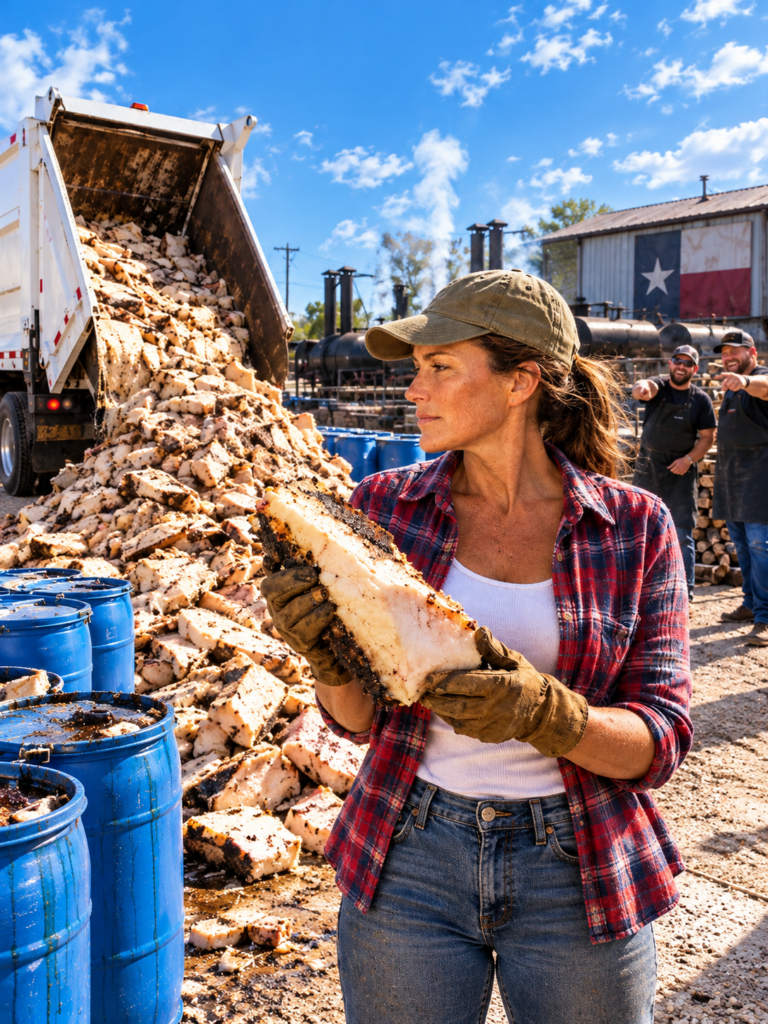
Every Monday, before the sun cleared the low Texas horizon, a delivery truck came rattling down the county road toward Marlene Tate’s farm.
Its tires stirred pale dust from the gravel. Its diesel engine labored through the last stretch of uneven ground, and by the time the truck backed toward the gate beside her old milk house, Marlene was already waiting.
She wore work gloves, faded jeans, and boots that had seen enough years to know the difference between dry dirt and ground softened by an overnight rain. Beside her stood a platform scale, a long stainless-steel thermometer, and a thick ledger with a pencil tucked into its binding.
The driver climbed down, unfastened the load, and began lowering heavy barrels of brisket fat.
The smell arrived before the first barrel touched the ground.
Beef, wood smoke, salt, and the deep richness of fat that had spent fourteen hours above burning post oak. In the warm Texas air, the odor settled over the yard and drifted toward the fence line.
To anyone else, it might have smelled like something that needed hauling away.
Marlene smelled something different.
She eased the thermometer beneath a lid and waited for the reading to settle. Then she checked the stencil on the side of the barrel, made a note, and guided it onto the scale.
Temperature. Weight. Location. Pit number. Wood.
She wrote everything down.
The driver had watched this ritual often enough that he no longer bothered asking questions. He had a route to finish, and Marlene had paperwork she seemed determined to fill.
Once the delivery was complete, she checked the numbers against the slips authorized by Rick Doherty, the operations manager at Ironwood Smokehouse.
Rick had signed those slips without much thought.
As far as he was concerned, Marlene Tate was doing his company a favor. She was accepting material Ironwood had previously paid someone else to remove.
He never seriously wondered why a woman with forty acres outside Luling would want so much brisket fat.
More importantly, he had never considered what she was collecting besides the fat itself.
By the tenth Monday, twenty-five barrels had accumulated along Marlene’s fence line.
Five tons of material that fourteen smokehouse locations had once treated as an expensive disposal problem.
Marlene stood beside the barrels that morning, considering the work they represented. Her back ached from moving the loads. The skin across her knuckles had roughened from hot water, steel handles, and constant washing.
She had not earned enough money to relax.
Not yet.
Inside her kitchen, she opened the ledger to a clean page.
Across the top, in deliberate pencil strokes, she had written:
20,000 LB
Beside it was a date.
MARCH 15
She studied those figures for several seconds.
The first was her goal.
The second was the day the bank could take away everything she had left.
For sixteen years, Marlene had worked at a meat-processing plant in Lockhart.
She had never held an impressive title. She worked on the trim and rendering line, where the hours were long, the equipment was hot, and mistakes could spoil an entire batch before anyone realized what had happened.
She had learned the business with her hands.
She knew what good fat looked like before it entered a kettle and how its texture changed as the temperature climbed. She could recognize a clean render by its scent, identify trouble from the faintest scorched edge, and tell when a batch had been mishandled even if the records claimed otherwise.
At forty degrees, fat behaved one way.
At ninety, it told an entirely different story.
Most people never needed to understand those differences.
Marlene had spent sixteen years depending on them.
Then a larger company purchased the plant.
Management spoke about modernization, efficiency, and improved production. New equipment arrived. The line changed. Jobs that once required experienced workers were absorbed by machinery.
Marlene watched the changes take place until the company no longer needed her.
There had been no dramatic confrontation. No argument that changed anyone’s mind.
One day, she had a job.
Then she didn’t.
What remained was her forty-acre property outside Luling, an aging milk house that had not served its original purpose in years, and a bank loan with a balance of sixty-one thousand dollars.
When she lost her income, the bank agreed to a temporary arrangement.
For one year, she could make interest-only payments.
On March 15, the full balance would become due.
The loan officer explained the terms carefully. He was courteous, almost sympathetic, but he did not pretend the bank could carry her indefinitely.
Marlene understood.
She had spent enough years around production schedules and financial deadlines to know that a date written on paper could become more important than any explanation a person offered afterward.
She left the bank with the agreement folded inside her folder.
That evening, she walked the length of her property.
Forty acres sounded substantial until a person tried to turn them into sixty-one thousand dollars.
The fences needed attention. The land had value, but not the kind of immediate income she needed. The old milk house stood quietly beyond the yard, its usefulness apparently exhausted.
Selling the property would settle part of her trouble, perhaps all of it.
But the farm was the last thing she owned that nobody could tell her to clock out of.
So instead of finding a buyer, she began looking for something other people considered worthless.
She found it about forty minutes up the highway.
Ironwood Smokehouse operated fourteen locations, each with pit crews tending post oak fires through long cooking shifts.
The kitchens were busy. Briskets went into the smokers, stayed there for fourteen hours, rested, and eventually reached the slicing tables.
There, cooks separated the meat customers wanted from the heavy fat caps that had protected it during cooking.
The meat went onto trays.
The fat went into bins.
To the employees, that distinction was ordinary. They were preparing barbecue, not searching for new products.
Across the chain, those bins accumulated roughly a thousand pounds of fat a week.
Ironwood paid a hauling company to collect it and transport it to a rendering yard.
Marlene studied the arrangement with the quiet concentration she once brought to her work in Lockhart.
The smokehouses had already paid for the beef.
They had already paid for the wood, the pit crews, the fuel, and the hours required to cook it.
The fat had absorbed something valuable during that process: the unmistakable flavor of post oak smoke.
And after all that expense, the company paid someone to make it disappear.
Marlene knew how to render fat.
She also knew that properly handled brisket fat could become something much more useful than what the slicing table had left behind.
Smoked beef tallow.
Not ordinary industrial grease, but a cooking fat carrying the character of the meat and wood from which it came.
She assembled a short proposal and drove to Ironwood’s office.
Rick Doherty read it standing beside his desk.
He was a large, agreeable man with a well-kept truck and the manner of someone accustomed to solving practical problems quickly. His calendar was full. His attention moved easily from one responsibility to the next.
When he reached the part explaining that Marlene would take the discarded fat caps without charging Ironwood, he glanced up.
“You want all of it?”
“Every barrel you can send me.”
Rick looked down at the page again.
“And you’re taking responsibility once it leaves our loading dock?”
“That’s right.”
He gave a short laugh, more surprised than mocking.
“Lady, you’d be saving me fourteen hauling bills.”
Marlene did not smile at the arithmetic.
“I’ll need a couple of things from your kitchens.”
That made Rick pause.
She explained that each barrel needed a clear stencil identifying its location, pit number, and wood type.
She also wanted copies of the pit logs, including cook dates and cooking hours for every batch represented in a delivery.
Rick considered the request.
He assumed she was trying to track production yields. It seemed like more paperwork than the job required, but his office already kept the records.
“All right,” he said. “I’ll have my assistant send them.”
Marlene thanked him.
As she was leaving, Rick remembered something.
“One more thing. We’ve got an old steam kettle sitting in the back kitchen. Been paying to store the thing. If you can use it, take it.”
She stopped.
“A working kettle?”
“Needs attention. But it’s yours if you want it.”
Marlene thought of the empty milk house.
“I want it.”
Rick returned to his busy day.
Marlene drove home knowing that the equipment alone had saved her an expense she could scarcely afford.
But getting the kettle was only the beginning.
The old milk house had to become a clean, workable rendering room.
She scrubbed the stainless steel until the surface shone beneath the overhead lights. She repaired the kettle’s steam jacket, cleaned the fittings, and checked the equipment with the careful patience of someone who understood that heat and pressure were not things to improvise around.
The building needed changes, too.
She installed washable wall panels, made room for cleaning and handling the product, and cut a floor drain so the room could be properly washed down.
There were days when she ended her work filthy, sore, and too tired to eat much.
Then she would look at the date on her calendar.
March 15.
And the next morning she returned to the milk house.
When the state inspector arrived, she showed him the equipment and the room she had worked so hard to prepare.
He examined the surfaces, the drainage, the equipment, and the entrance.
Then he found a gap beneath the door.
It was enough to fail the inspection.
For several moments after he left, Marlene stood looking at that narrow strip of daylight.
She had spent weeks building the place, and a small opening near the floor had stopped her.
She could have complained about the unfairness of it.
Instead, she measured the gap, fixed the door, and requested another inspection.
The second time, she passed.
That evening, she wrote six instructions across a section of the wall with a black marker.
WEIGH. CHILL. RENDER. STRAIN. JAR. LOG.
They were simple words.
Marlene intended to live by every one.
The first deliveries arrived.
She recorded when each truck came, which location had produced the fat, the temperature of the load, and the weight of every barrel.
She entered the corresponding pit numbers and cooking information into her ledger.
Every finished batch received another set of entries: input weight, render date, output weight, and the amount of tallow recovered.
She kept the paperwork in order.
Then she added a step the original agreement had not required her to take.
From every batch, she placed one pound of finished tallow into a sealed sample container. She wrote the date and pit number on the lid, noted the wood, and stored it in a freezer.
The samples took up space she could have used for something else.
She kept them anyway.
A batch without a history was just another container of fat.
Marlene wanted to know exactly what she had made, where it came from, and whether she could prove it.
She hired Eli Navarro, a nineteen-year-old from the neighboring farm, to help with the growing workload.
Eli was young enough to move quickly and inexperienced enough to ask questions that older workers sometimes stopped asking.
Marlene showed him how to read the barrel markings, handle the thermometers, and make an entry in the ledger before the details disappeared beneath the next job.
When he asked why every number mattered, she explained that a good product did not become good because somebody said it was.
It had to be made correctly.
And if something went wrong, they had to be able to find out why.
For the first three Mondays, the work went smoothly.
Fat arrived. They weighed it, chilled it, and processed it in the kettle.
The finished tallow came out clean.
Pale. Smooth. Rich with the faint aroma of smoked beef and post oak.
Marlene began to believe her plan might be possible.
Then the fourth Monday came.
The heat had settled across Texas with a brutality that made even the shade feel warm.
By afternoon, the temperature had reached 104 degrees.
The delivery truck was late.
At several Ironwood locations, barrels had been waiting on loading docks since lunchtime.
By the time the load reached Marlene, she was already behind schedule.
She checked the incoming temperatures.
They were too high.
The kettle was hot and ready. Work had piled up. Every hour of delay felt like money leaving her bank account.
She made the decision to process the fat.
It was a mistake.
For ten days, the finished tallow seemed ordinary.
Then the smell changed.
At first it was faint, a sharpness that lingered toward the back of her nose when she opened a container.
Marlene recognized it before the change became obvious.
The color began losing its clean cream appearance, shifting toward an unpleasant gray.
Then the taste turned bitter.
The batch was failing.
By the middle of the month, four and a half barrels, representing eighteen hundred pounds of fat, had been ruined.
Eli stood beside the last bucket with his cap in his hands.
He looked at the spoiled product, then at Marlene.
“What did we do wrong?”
Marlene stared at the bucket.
She knew what eighteen hundred pounds meant.
It meant lost time, propane, labor, cleaning, and the prospect of falling further behind a deadline that had never moved an inch.
More than that, it meant she had made the decision to render a questionable load.
She could not shift that responsibility onto Eli.
“Maybe nothing,” she answered. “Maybe something. We need to find out.”
They carried the records outside and spread them across the tailgate of her truck.
Her intake ledger.
Ironwood’s pit sheets.
Her temperature readings.
Marlene worked down the pages line by line.
She marked the spoiled batches and traced each barrel back to its smokehouse.
Then she compared the arrival times with the temperatures.
A pattern emerged.
Every failed batch included fat that had spent hours sitting on a hot loading dock.
Some barrels had remained in the sun for more than half a day.
The readings at intake had reached ninety-two degrees.
The fat itself had not come from defective cattle or a failed cooking process.
The trouble had begun after the briskets were sliced.
It was the handling.
Marlene sent samples to a food laboratory.
The results confirmed what the records had already shown.
She sat with Eli and examined the paperwork one final time.
“If we hadn’t written this down,” she told him, “we’d still be guessing.”
The following morning, she called Rick.
He sounded distracted but friendly enough.
“Morning, Marlene. Everything going all right?”
“We’ve had a problem with some loads.”
She explained the heat exposure without blaming the cooks.
Then she asked whether his kitchens could keep the fat barrels inside their walk-in coolers until the collection trucks arrived.
“Sure,” Rick replied. “That shouldn’t be a problem.”
He sounded relieved that the issue had such a simple answer.
Marlene thanked him and ended the call.
Then she changed her own procedures.
Insulated transport totes packed with ice.
A thermometer on every lid.
Fat cooled below forty degrees within four hours and rendered within twenty-four.
Every batch strained twice.
She wrote the new rules beneath the first six on the milk-house wall.
Eli read them while she prepared the next kettle.
“Think that’ll do it?”
“It gives us a better chance,” she said. “And if it doesn’t, we’ll know where to look.”
The following deliveries came in colder.
The rendering process stabilized.
The tallow returned to its clean, pale color.
Marlene watched the finished product settle in the containers and felt some of the tension leave her shoulders.
She opened the ledger that evening and deducted the eighteen hundred pounds from her running totals.
She did not hide the loss or soften it with explanations.
It remained there in pencil.
An expensive lesson.
But the records had done exactly what she needed them to do.
They had told her the truth.
And somewhere between the spoiled barrels and the next clean batch, Marlene’s thinking had changed.
At first, she had been trying to rescue something other people threw away.
Now she was beginning to understand how good that discarded material could become.
She was no longer satisfied simply to save the fat.
She wanted to make it worth keeping.
Part 2
By the end of that summer, the old milk house no longer looked like a building waiting to fall out of use.
Its walls were clean. The kettle worked steadily. Thermometers hung where they could be reached, and the shelves held containers with handwritten dates and pit numbers.
The freezer filled slowly with sealed samples.
The ledger grew thicker.
Marlene’s days had settled into a rhythm that was demanding but familiar.
On delivery mornings, she rose before daylight. Eli helped move the barrels, check temperatures, and prepare the batches. They spent long hours in the rendering room, where heat collected around the kettle and the air carried the heavy sweetness of cooking beef fat.
As the tallow clarified, its appearance changed.
The cloudy liquid became cleaner. After straining and cooling, it settled into a soft cream color.
And it held something ordinary tallow did not.
The post oak smoke remained in the flavor, subtle enough not to overwhelm food but present enough to give it a character of its own.
Marlene had tasted rendered fat many times during her years in Lockhart.
This was different.
It had the richness of beef and the faint, unmistakable finish of a properly tended Texas barbecue pit.
One afternoon, she carried a jar to a barbecue joint down the road.
A cook there agreed to try it.
He heated some in a fryer and dropped in a portion of onion rings.
The smell that rose from the hot fat was richer than the familiar odor of ordinary frying oil.
When the rings came out, the cook let them cool just long enough to handle.
He tasted one.
Then another.
By the third, he was reaching for the jar.
“Where’d you say you got this?”
“I made it.”
“From what?”
“Brisket fat. Smoked over post oak.”
He studied the jar, then the onion rings.
“How much of this can you make?”
Marlene smiled a little.
“More than what’s in that jar.”
The cook did not want to give it back.
It was not a large sale, but on the drive home, Marlene found herself thinking about the expression on his face.
She had watched him recognize the difference without needing a long explanation.
The product had spoken for itself.
Soon she began carrying small batches to a Saturday market.
She arranged jars on a table, talked with customers, and explained how smoked brisket fat could be rendered into cooking tallow.
Some people were curious.
Others frowned at the idea until they caught the aroma or heard how it could be used for frying and cooking.
A few bought jars.
Those sales helped cover interest payments and operating expenses.
Not enough to rescue the farm.
But enough to show that the tallow was not merely something she believed had value.
Other people were willing to pay for it.
She wrote down every sale.
She also recorded complaints, questions, and comments about flavor and texture.
If someone said a jar tasted smokier than the previous one, Marlene wanted to know which pit had produced it.
If a batch performed especially well, she wanted to understand the conditions that made it better.
To Eli, the bookkeeping sometimes seemed endless.
“We sold six jars,” he remarked one market afternoon. “You wrote almost a whole page.”
Marlene closed the ledger.
“Six jars today. More later, maybe. I want to know which six they liked.”
She had learned that records mattered most when the stakes were higher than anyone expected.
In August, an ordinary stop at the county extension office changed the way she understood her business.
There was a notice posted on a board among the usual county announcements and agricultural information.
At first, she noticed the name.
Ironwood Smokehouse.
She stepped closer.
The company had filed plans for a central commissary.
The proposed facility would include a fryer line, packaging space, and equipment connected to a new retail product.
Beside the notice, someone had pinned a trade-magazine clipping.
Marlene read it carefully.
Ironwood planned to sell jars of its own smoked pit tallow in grocery stores by the following spring.
A regional grocery chain had already agreed to carry the product.
The packaging would make a specific promise.
The tallow would come from Ironwood’s own pits.
Marlene read that part twice.
Then she stood very still.
For months, she had been collecting precisely that material.
Fat from Ironwood’s own briskets.
Smoked in Ironwood’s own pits.
Handled according to records supplied by Ironwood’s own office.
And Ironwood, as far as she could tell, still regarded those fat caps as a waste product.
She took note of the information and drove home.
That evening, she spread the notice, her calendar, and the ledger across her kitchen table.
Outside, the Texas light faded beyond the farm.
Inside, the figures sat before her in neat rows.
She understood what Ironwood intended to do.
The company wanted to move beyond selling brisket and begin selling a product made from its own cooking process.
That was sensible.
A barbecue chain with fourteen locations had the name recognition, the existing customers, and a story that could sell jars on grocery shelves.
But a story printed on a label did not make the product inside the jar.
And a label promising tallow from Ironwood’s own pits created a problem that ordinary purchased tallow could not solve.
The source had to be genuine.
The batches had to be traceable.
A manufacturer would need records, handling controls, inspections, and enough finished material to meet the launch schedule.
Marlene looked toward the milk house through the dark kitchen window.
She already had a rendering room.
She already had cold storage.
She already had months of production records.
And she had sealed samples from batches originating in Ironwood’s kitchens.
The company could announce a new product whenever it pleased.
Producing that product with a complete paper trail was another matter.
Marlene turned the calendar toward March.
Her bank deadline was March 15.
Ironwood’s launch was planned for the same season.
For the first time, she saw a possible connection between her own deadline and the company’s ambition.
She did not know whether Ironwood would ever need her tallow.
She did not know how much its intended rendering partner could produce, or whether the company had secured enough raw material.
But she knew how long it took to build a reliable production history.
She was already doing the work.
And each Monday, Ironwood continued sending her the very fat its retail plan would eventually require.
A few days later, Rick Doherty stopped at the farm with the remaining paperwork.
He stood near the barrels, looked at the old milk house, and gave Marlene an easy smile.
“Hope all this is keeping you out of trouble.”
“It keeps me busy.”
“Well, that’s something.”
His attention passed over the barrel markings without settling on them.
He did not ask about her customers.
He did not ask what the rendering room contained.
And he certainly did not ask why she kept requesting the pit records.
Marlene answered the questions he actually posed and let him leave.
She had no reason to interfere with Ironwood’s plans.
She had a business of her own to build.
But the visit confirmed something.
Rick understood the arrangement only from the smokehouse’s side.
To him, the barrels represented a hauling expense that no longer appeared on his monthly reports.
He had never needed to consider what happened after they left his dock.
That changed in October.
Rendering yards had begun paying for fat again.
For Ironwood, the shift was welcome news.
Material that previously cost money to remove could now produce revenue.
Rick called Marlene.
“Fat’s got a price now,” he said. “Fifty-five cents a pound.”
Marlene remained quiet.
He continued in a practical tone.
“Can’t keep giving it away when somebody’s paying for it. Sorry, nothing personal.”
She looked at the ledger on her table.
“No,” she said. “I understand.”
Rick seemed pleased that she was taking the news reasonably.
The conversation ended.
For Marlene, it left a dangerous calculation.
Her records showed that she had received fourteen thousand pounds of fat.
The goal she had written at the beginning of the year was twenty thousand.
She still needed another six thousand pounds to reach it.
At fifty-five cents per pound, that additional fat would cost thirty-three hundred dollars.
Most of the money remaining in her checking account.
That figure did not include transportation, fuel, propane, wages, utilities, lab testing, or the interest due to the bank.
She stood at the table for a long time.
The easiest decision would have been to stop.
She had already demonstrated that people wanted her tallow. She could sell what she had and avoid putting more money into inventory that might sit unsold.
But stopping would mean abandoning the possibility she had recognized in August.
It would also leave her with a smaller business just as the largest financial deadline of her life approached.
Marlene turned back through the ledger.
In May, she had begun tracking the rendering yield from individual smokehouse pits.
She had not known whether the differences would matter.
Now they did.
She checked the figures repeatedly.
Four Ironwood locations running fourteen-hour post oak cooks had produced tallow yields of approximately eighty-one percent.
The remaining ten locations averaged sixty-eight percent.
That difference was not a minor detail.
It was the difference between paying for material that became finished product and paying for material that disappeared during processing.
She worked through the figures again.
If she bought the next six thousand pounds indiscriminately, she would spend money on fat that gave her a lower return.
But if she concentrated on the four best-performing locations, approximately five thousand pounds could provide the finished tallow she had expected from six thousand pounds of mixed material.
She called Ironwood and adjusted the collection arrangement.
From then on, she would focus on those four locations.
It solved one problem and created another.
The route was less convenient. Fewer pickup points meant longer distances and a more demanding collection schedule.
She needed another driver for the early runs.
By the time she accounted for additional diesel and labor, the change cost her nineteen hundred dollars.
Marlene wrote the number down.
Eli stood beside her as she checked the new schedule.
“That’s a lot of extra driving.”
“It is.”
“You still think it’s worth it?”
She turned the ledger so he could see the yield figures.
“Look at what we get out of each pound.”
He studied the two columns.
“Eighty-one and sixty-eight.”
“Right. We don’t get paid for how many miles we drive or how much fat we carry. We get paid for what we can make.”
He examined the numbers again.
For the first time, the route looked less like an inconvenience and more like a production decision.
Marlene paid the extra transportation costs and continued.
By November, Ironwood was publicly celebrating its grocery agreement.
Rick bought lunch for the office.
The company had secured a promising new retail opportunity, and the launch was scheduled for the second week of March.
On paper, the project looked straightforward.
Ironwood would supply fat from its own barbecue pits.
Plains Rendering, its selected production partner, would process the material into tallow.
Ironwood would package the product under its own label and deliver it to the grocery chain.
Rick had every reason to believe the arrangement would work.
He had signed agreements, established plans, and a schedule.
What he had not fully considered was how much of Ironwood’s best pit fat had already been leaving the company through Marlene’s collection arrangement.
He had treated her operation as a convenient disposal solution.
Now the company was planning an entire product line around the material it had allowed her to take.
And then, in December, the production plan collapsed.
Plains Rendering failed a state inspection.
Its kettles were shut down for the season.
There would be no immediate production from the facility Ironwood had expected to use.
Rick began calling alternatives.
One plant in Oklahoma.
Another in Kansas.
Other facilities across the region.
The responses were discouraging.
Capacity was short.
Schedules were full.
And Ironwood needed a product that met more conditions than ordinary tallow.
One supplier could deliver eight thousand pounds of plain beef tallow for six dollars and forty cents per pound.
The price was not ideal, but Rick could have managed it.
The larger problem was the source.
The offered tallow was not smoked over Ironwood’s post oak.
Its origin could not be documented as Ironwood’s own pits.
The grocery label already promised that source.
Using untraceable tallow would violate the claim and lead the grocery buyer to reject the product.
Another facility could document the material it produced, but it could not promise delivery before spring.
That was too late.
Ironwood’s contract imposed a penalty of three dollars for every pound it failed to supply.
An eight-thousand-pound shortage would mean twenty-four thousand dollars in penalties.
And even worse, the grocery shelf space could be given to a competing brand.
Rick’s successful retail launch was becoming a deadline he could no longer control.
Forty minutes away, Marlene was facing a different version of the same problem.
Her production had gone well.
Her records were strong.
The milk house contained sealed tallow from months of careful work.
But every additional week cost money.
She had to buy propane for the kettle.
Pay Eli.
Keep the coolers running.
Cover transportation, supplies, and testing.
And continue making the interest payments on the sixty-one-thousand-dollar bank note.
By December, her checking account had fallen below three thousand dollars.
The business held valuable inventory.
But inventory could not pay a bank unless somebody bought it.
Marlene knew the difference better than she cared to admit.
That month, a restaurant supply distributor visited the farm.
He walked through her cooler, examined the finished product, and reviewed the amount available.
Then he made an offer.
Nine thousand pounds of tallow.
Four dollars and fifty cents per pound.
Forty thousand five hundred dollars in cash.
The offer would remain valid until New Year’s Eve.
Marlene read the letter after he left.
Then she read it again.
Forty thousand five hundred dollars.
Enough money to stabilize her accounts.
Enough to cover expenses and relieve the constant pressure of watching her checking balance shrink.
Enough to let her sleep without calculating the next month’s bills before she closed her eyes.
But it was not enough to clear the bank loan.
And accepting it would mean surrendering a large part of the inventory she believed could become much more valuable.
She placed the letter beside the ledger.
Her hand rested on the paper.
The distributor’s offer was real.
The opportunity she had imagined after reading Ironwood’s announcement was still uncertain.
She knew nothing about the trouble at Plains Rendering.
Nobody from Ironwood had called to ask whether she had enough finished tallow for a major order.
For all she knew, its manufacturing arrangements were proceeding exactly as planned.
If Ironwood had already secured its supply, Marlene might be left holding thousands of pounds she could not sell quickly.
She looked at the letter again.
Forty thousand five hundred dollars was not an imaginary amount.
It was a possible escape from immediate financial pressure.
The other possibility had no guarantee attached to it.
Only the product she had made, the records she had preserved, and the date approaching on the calendar.
Eli noticed the letter on the kitchen table one evening.
“That’s a lot of money,” he said after she explained the offer.
“Yes.”
“More than we’ve ever sold at once.”
“Yes.”
He waited.
“Are you going to take it?”
Marlene watched him for a moment.
She understood why he asked. His wages came from the same account she was struggling to protect.
“I’m thinking about it.”
And she was.
There were times during those final days of December when the offer seemed almost impossible to refuse.
She remembered the ruined eighteen hundred pounds.
The failed first inspection.
The expensive collection routes.
The bank officer’s polite explanation of what would happen in March.
She thought about how easily another broken machine or spoiled batch could leave her with even less.
But every time she opened the ledger, she returned to the same conclusion.
She had spent months creating something that could not be replaced by an ordinary shipment of beef tallow.
It was smoked.
It was tested.
It was labeled by source and production date.
And its history could be demonstrated, one batch at a time.
Selling most of it for four dollars and fifty cents a pound might be the safest short-term decision.
It was also a decision she could never reverse.
On the last evening of the year, Marlene sat at her kitchen table with the offer letter before her.
The house was quiet.
She could hear the steady hum of refrigeration equipment through the yard when the wind settled.
In the drawer beside her were the bank statements and payment notices.
She folded the distributor’s letter and placed it with them.
She did not sign.
She did not call.
New Year’s Eve passed.
The offer expired.
In the morning, Marlene returned to the milk house, checked the cooler temperatures, and opened her ledger.
The money had not changed.
The bank still expected payment in March.
And the tallow remained on her shelves.
She had chosen to wait for a buyer who did not yet know he needed her.
Part 3
In January, a quality auditor representing the regional grocery chain arrived at Ironwood Smokehouse.
His purpose was straightforward.
The grocery company wanted to verify that the new retail product could be traced back to the sources promised on its label.
For a product advertised as coming from Ironwood’s own pits, that meant more than examining a finished container.
The auditor needed confidence in the chain of records connecting the original brisket fat to the tallow that would eventually appear on store shelves.
Rick Doherty met him at the smokehouse.
Under ordinary circumstances, Rick would have welcomed the visit. Ironwood had a respected barbecue operation, experienced pit crews, and well-established procedures for its primary business.
But the rendering problem had not been solved.
Plains Rendering was still unavailable, and the replacement suppliers could not provide what the grocery agreement required.
Rick had a launch deadline approaching and no acceptable production solution.
Over coffee, he explained the shortage.
The auditor listened.
Rick described the calls to Oklahoma and Kansas, the capacity problems, and the offered shipment of plain tallow that would not satisfy the product’s origin claim.
The auditor considered what he had heard.
Then he mentioned something that had caught his attention on the way into town.
“Funny thing,” he said. “I passed a farm outside Luling. Saw a stack of barrels behind an old milk house.”
Rick looked up.
“Barrels?”
“Three high, some of them. Had your pit numbers stenciled on the sides.”
Rick set down his coffee.
For a moment, he said nothing.
He knew the farm.
He knew the barrels.
But until that conversation, he had not thought about what Marlene might have done with the material.
“How many did you see?”
The auditor shrugged.
“Looked like a lot.”
Rick’s mind began working through months of delivery slips.
Monday after Monday.
Location after location.
Fat caps that had disappeared from Ironwood’s kitchens while he concentrated on more immediate problems.
Marlene had wanted the barrels marked.
She had insisted on the pit logs.
She had asked for cook dates, wood types, and production information that seemed unnecessarily detailed for someone simply collecting discarded fat.
He remembered all of it.
And suddenly, the paperwork he had authorized months earlier looked very different.
That afternoon, Rick climbed into his truck and drove toward Luling.
The county road was familiar.
So was the farm gate.
He had visited before, when the barrels had seemed like nothing more than a curious collection project.
But as he turned up the lane, he looked at the property with a new sense of urgency.
The old milk house stood beyond the yard.
He parked and got out.
Marlene was there.
She watched him approach without showing surprise.
“Rick.”
“Marlene.”
He glanced toward the milk house.
“I need to ask you something.”
She waited.
“How much tallow have you got?”
For a moment, neither moved.
Then Marlene opened the door.
“Come and see.”
Inside, the room was orderly and cool beyond the active production area.
Sealed pails stood stacked on pallets.
Each carried a date, a pit number, and identifying information.
The containers were clean, their lids secured.
Rick walked slowly between them.
There were far more than he had expected.
He stopped at one pail and turned it toward the light.
The marking identified Pit Four.
Post oak.
The original batch information included handwriting from one of Ironwood’s own cooks.
Rick recognized it.
He checked another pail.
Then another.
The markings led back to the same company.
His company.
He looked toward the far end of the room.
“All of this came from us?”
“From your pits,” Marlene answered.
He stared at the rows of sealed containers.
He remembered the briskets coming off the smokers, the slicing tables, and the bins that filled with fat caps every day.
He remembered the hauling invoices that had once irritated him.
He remembered how pleased he had been when Marlene volunteered to take the waste without charging him.
Now the material stood before him as a finished commercial product.
But Rick knew that finished tallow alone was not enough.
“The grocery people are going to want proof,” he said.
Marlene nodded.
“I know.”
She went to a shelf and lifted a thick binder.
She placed it on the worktable between them.
“Start here.”
Rick opened it.
The first pages contained copies of Ironwood’s pit logs.
His office had supplied them.
Marlene had arranged them by location, date, and batch.
Alongside the original records were intake temperatures, barrel weights, render dates, laboratory reports, and production yields.
A barrel could be followed from a particular pit to a particular rendering batch.
That batch could then be connected to finished containers on her shelves.
Rick turned the pages.
The entries were methodical.
There were corrections where calculations had been adjusted, rejected batches where quality had failed, and references connecting finished product to the records behind it.
Nothing depended on Marlene simply telling him where the tallow came from.
The evidence was already there.
He paused at a laboratory report.
“You’ve been testing this?”
“Yes.”
“All along?”
“From the beginning.”
Rick looked at her.
“Why?”
“Because I needed to know what I was selling.”
She let him absorb that answer before continuing.
“And because if something went wrong, I needed to know which batch it came from.”
She showed him the temperature records from the summer heat wave.
She explained how the mishandled fat had spoiled and how she had traced the failure to barrels that had been left too long on hot loading docks.
Rick remembered her telephone call asking the kitchens to keep the barrels refrigerated.
He had agreed without thinking much about it.
Now he understood that the request had come out of a documented production failure.
Marlene had not simply been fussy about temperatures.
She had been protecting her product.
Rick looked down at the binder again.
“You kept all this?”
“Every batch.”
Then she walked toward the freezer.
“There’s something else.”
She opened the door.
Cold air spilled into the room.
Inside were rows of sealed one-pound samples.
Each container carried a date, pit number, and wood identification.
The samples went back through the months of her operation.
Rick leaned closer.
He saw the regular sequence of dates.
He saw the different pit numbers.
And he recognized that Marlene had kept more than a collection of samples.
She had preserved a history.
A physical record that could be compared with the written records and laboratory results.
He stepped away from the open freezer and looked around the room again.
The pails.
The binder.
The stainless-steel kettle.
He recognized that kettle, too.
It was the old equipment Ironwood had been paying to store.
He had given it to Marlene because it seemed easier than continuing to keep it.
He had also given her the fat.
And he had authorized the transfer of the records that now made her product verifiable.
He had thought he was getting rid of expenses.
Marlene had used those same things to build an operation his company suddenly needed.
Rick turned back toward her.
“Did you know about our grocery deal?”
“I saw the notice in August.”
He absorbed that.
“You knew we were going to need pit tallow?”
“I knew you were planning to sell it.”
“And you just kept making it?”
“I had work to do.”
There was no triumph in her voice.
No need to embarrass him.
She had not caused Plains Rendering to fail its inspection.
She had not interfered with Ironwood’s suppliers.
And she had not forced the grocery chain to require verified ingredients.
She had simply recognized that a product with a documented source might someday be more valuable than a barrel of unprocessed fat.
Rick looked at the stacked pails.
For months, he had been searching for an outside supplier who could give Ironwood what it needed.
The answer had been sitting forty minutes away.
The tallow was already made.
It carried the right smoke.
It came from the right pits.
It had been tested.
And every step of its production could be traced.
What Rick had regarded as Marlene’s strange little recycling business was now the only nearby operation capable of solving his immediate problem.
He shut the binder gently.
“We need to talk.”
Marlene nodded.
“Yes, Rick. We do.”
They sat at her kitchen table.
It was the same table where she had studied the bank agreement, examined her rendering yields, and considered the distributor’s offer on New Year’s Eve.
Her ledger lay nearby.
Rick had his production requirements and the numbers from Ironwood’s grocery agreement.
The conversation began with quantity.
Ironwood needed eight thousand pounds of acceptable tallow for the launch.
Marlene had enough finished product to supply it.
But she was not prepared to sell at the price of ordinary tallow.
Rick knew the distributor market.
He also knew what a general rendering plant might charge.
He had already been offered eight thousand pounds at six dollars and forty cents per pound.
But that offer had a fatal weakness.
The tallow was not traceable to Ironwood’s pits.
Buying it would not fulfill the grocery company’s contract.
Marlene listened as Rick explained the urgency.
Then she opened her ledger to the figures she had already considered.
“I can supply eight thousand pounds,” she said.
Rick leaned forward.
“At what price?”
“Ten dollars and fifty cents a pound.”
He looked at her.
“Ten fifty?”
“That’s right.”
He calculated it.
Eighty-four thousand dollars.
The figure was considerably higher than the price of ordinary tallow.
Rick studied her face.
“Marlene, that’s a serious amount of money.”
“I know.”
“We’re talking about eight thousand pounds.”
“I know exactly how much we’re talking about.”
She turned the ledger toward him.
She showed him the batch records, the testing history, and the cost of keeping the operation running.
The fat had originally come to her free of charge.
But turning it into a dependable food product had required labor, equipment repairs, fuel, refrigeration, handling, laboratory testing, and months of attention.
When the raw material stopped being free, she had paid for the highest-yielding supply and absorbed the additional hauling expense.
She had borne the cost of spoiled batches.
She had carried inventory while waiting for buyers.
And she had done all of it without a guaranteed major customer.
“I’m not selling you a barrel of fat,” she told him.
Rick glanced at the binder.
He could hardly argue with that.
Marlene continued.
“You need tallow from your own pits. You need it tested and documented. And you need it in time for March.”
She rested her hand on the ledger.
“That’s what I have.”
Rick sat quietly.
He was not a cruel man, and he was not foolish.
He had simply spent too long thinking of one part of his business as worthless because another part did not use it.
Now he was looking at the cost of that assumption.
On his side of the table, the alternatives remained ugly.
He could purchase ordinary tallow, knowing the grocery chain would reject the false origin claim.
He could fail to deliver eight thousand pounds and face twenty-four thousand dollars in contractual penalties.
He could risk losing the shelf space that Ironwood had worked to secure.
Or he could purchase Marlene’s product.
The expensive option was also the one that actually solved the problem.
Marlene had another condition.
She would not commit her entire inventory to Ironwood.
The remaining tallow was reserved for her other customers: barbecue joints, farm stores, and online buyers.
She intended to sell that product for six dollars per pound.
Rick considered the terms.
The longer he looked at the situation, the clearer it became.
A company could spend months preparing packaging and advertising.
But none of that put a compliant product into a jar.
Marlene had already done the difficult work.
He looked across the table.
“All right.”
She did not move.
“Eight thousand pounds,” he continued. “Ten fifty a pound.”
“Eighty-four thousand dollars.”
Rick nodded.
They completed the agreement.
When the signing was finished, Marlene placed the papers beside her ledger.
For a moment, she allowed herself to feel the weight of what had happened.
The bank deadline was still approaching.
She had not yet received the money.
The product still had to be delivered.
But for the first time since losing her job in Lockhart, she had a clear route to paying the note without giving up her land.
And that route had come from the very skills her former employer no longer needed.
The following weeks were not an easy celebration.
Marlene still had work to do.
The contracted tallow had to remain properly stored and documented until shipment.
Every container needed to match the delivery records.
She and Eli checked labels, weights, seals, and batch references.
She refused to let the size of the order make them careless.
In February, a late batch failed its laboratory check after a cold snap.
Six hundred pounds did not meet her standards.
The news arrived while she was preparing the final deliveries.
Eli looked at the report.
“That’s six hundred pounds.”
Marlene took the page from him.
She read it once, then checked the batch reference.
“Yes.”
“Can we run it through again?”
She considered the question, but the failed report had already established that the batch was not acceptable for the food product she intended to sell.
She had rules.
Those rules had to matter when the outcome was inconvenient, not merely when everything went well.
“No,” she said. “It doesn’t go out as cooking tallow.”
They separated the failed batch.
The six hundred pounds went to a soap maker for pennies on the dollar.
Eli watched the material leave.
It hurt to see the work produce so little return.
Marlene understood.
But she also understood that one questionable shipment could damage the entire business she had spent a year building.
In Ironwood’s kitchens, cooks trimmed fat away from brisket every day because it did not belong on a customer’s plate.
Marlene had spent months turning that rejected material into something valuable.
Now she was making a similar judgment.
Not by appearance or instinct alone.
By the laboratory evidence.
The batch had failed.
She accepted the loss.
Later that month, the delivery truck returned to the farm.
It was the same kind of truck that had once arrived loaded with barrels of unwanted brisket fat.
The driver backed toward the old milk house.
But this time, the direction of the work was reversed.
Instead of unloading waste, the truck would leave carrying a valuable finished product.
Eli helped prepare the pails.
Marlene stood beside the loading area with the shipping documents.
She checked each container as it moved onto the truck.
Pit number.
Date.
Weight.
Seal.
One by one, the pails disappeared inside.
The pale cream tallow was packed and ready for Ironwood’s new retail operation.
Every container represented hours of cooking in Ironwood’s pits and hours more of Marlene’s work inside the milk house.
Rick had once signed papers to send the fat away.
Now his company had signed papers to bring it back.
Marlene watched the driver secure the load.
She did not make a speech.
She simply completed the count, checked the documents, and signed.
When the truck pulled away, dust rose across the yard.
She stood there until it reached the county road.
Then she returned to the milk house.
There were still customers to supply, shelves to organize, and records to complete.
She had not reached the end of her work.
Only the end of one difficult chapter of it.
On March 8, Ironwood’s payment cleared.
Eighty-four thousand dollars.
Marlene checked the account information carefully.
She had spent too many months relying on promised money to confuse a signed agreement with funds she could actually use.
But this time, the money was there.
Seven days remained before the bank’s March 15 deadline.
She gathered the loan paperwork and arranged payment of the outstanding note.
Sixty-one thousand dollars.
The obligation that had hung over the farm for a year could finally be settled.
When she returned to the bank, the loan officer recognized her.
He remembered their earlier conversation.
He remembered explaining the interest-only arrangement and the full balance due in March.
This time, Marlene did not come to request more time.
She came to pay.
The officer checked the account and completed the necessary paperwork.
Then he looked up.
“Well, Mrs. Tate. Looks like you’ve taken care of it.”
“Yes, sir.”
He handed her the confirmation.
“Seven days early.”
Marlene held the paper.
For a moment, she remembered the day she had walked out of that same bank wondering whether forty acres of land and an empty milk house could keep her from losing everything.
She remembered the first time she had stood inside the building with its old equipment and bare walls.
The failed inspection.
The spoiled barrels.
The summer heat.
The October price increase.
The money draining out of her account in December.
And the offer she had nearly accepted because it seemed safer than waiting.
She folded the document carefully.
The loan officer extended his hand.
She shook it.
This time, he smiled.
Outside, the Texas daylight fell across the parking lot.
Marlene walked to her truck without rushing.
The bank could no longer claim the entire balance on March 15.
Her property was no longer tied to that approaching deadline.
For the first time in a long while, the date on the calendar no longer frightened her.
Back at the farm, she returned to the ledger.
The final accounting of the project was not as simple as saying she had turned free fat into a fortune.
She knew better.
There had been operating costs, damaged product, transportation expenses, labor, testing, utilities, and interest payments.
Her records showed the full production story.
Nineteen thousand pounds of fat received.
Eighteen hundred pounds lost.
Fourteen thousand pounds of finished tallow produced.
Eight thousand pounds sold to Ironwood for ten dollars and fifty cents per pound.
Eighty-four thousand dollars.
The remaining six thousand pounds sold through barbecue joints, farm stores, and online orders at six dollars per pound.
Another thirty-six thousand dollars.
She added the two revenue figures.
Total gross sales: $120,000.
It was not pure profit.
Marlene would never have described it that way.
She had spent too many years around machinery, payroll, and operating costs to confuse revenue with money free of obligations.
But one hundred twenty thousand dollars in gross sales from material that had once been destined for a rendering yard was a result she could scarcely have imagined when she first opened that ledger.
And the more important result was already sitting in the drawer with her bank papers.
The farm was safe.
Her business had customers.
Her equipment worked.
And she had proven that the knowledge she carried from the Lockhart plant still had considerable value.
Ironwood’s March launch was moving forward with tallow the company could trace to its own pits.
Rick Doherty had learned something, too.
The purchase solved his immediate shortage, but it also revealed a better arrangement for the future.
Instead of treating the best fat caps as something to discard, Ironwood could put them into a controlled production process.
The company already had a skilled renderer forty minutes away.
Someone who understood its pit yields, maintained production records, and refused to sell batches that failed quality checks.
A second agreement followed.
Ironwood would send Marlene the fat caps from its best-performing pits.
She would render the material under her established procedures.
And Ironwood would buy back every pound of finished tallow that passed the required laboratory tests at an agreed price.
It gave Ironwood a dependable way to obtain a product connected to its own cooking operation.
It gave Marlene something she had lacked through the hardest months of the previous year.
A continuing customer.
The arrangement did not make her work easy.
There would still be early mornings, temperature checks, machinery maintenance, bad batches, and expenses.
But the uncertainty had changed.
She no longer had to prove that the material was useful.
She had already done that.
A few weeks later, another Monday arrived.
The sky over Luling was only beginning to lighten when the familiar truck came down the road.
Its engine sounded much as it had the first time.
The tires still disturbed the pale gravel.
The smell of smoked brisket fat still drifted across the yard when the barrels were opened.
Marlene stood by the gate, thermometer in hand.
Eli was nearby, preparing the scale.
The truck backed into position.
The driver climbed down and started the unloading process.
For a moment, the scene looked almost identical to the way it had looked a year earlier.
Barrels.
A ledger.
A woman waiting beside an old milk house.
But nearly everything important had changed.
The loan was paid.
The rendering room was a functioning business.
The fat caps were no longer merely a disposal problem that Ironwood wanted removed from its accounts.
They were raw material for a product the company had agreed to buy.
Marlene opened the first barrel and checked the temperature.
She breathed in the familiar aroma of post oak smoke.
Then she turned the barrel until she could read the stencil.
Location.
Pit number.
Wood.
She called the information to Eli, who entered it on the receiving sheet.
She rolled the barrel onto the scale, waited for the reading, and wrote down the weight.
There was nothing theatrical about the work.
No great victory speech.
No crowd gathered to see what she had accomplished.
Only a truck arriving before sunrise and the same careful routine that had carried her through a year of uncertainty.
Marlene glanced toward the milk house.
She remembered the empty building as it had stood when she lost her job.
Back then, it had seemed like another useless thing on a property she might not be able to keep.
Now its doors opened every morning to a business built on experience, patience, and the stubborn refusal to accept that something had no value simply because someone else had stopped looking.
She closed the barrel lid and reached for the next one.
Rick had once seen a hauling bill.
Marlene had seen the possibility of a grocery shelf.
But what ultimately saved her farm was not the fat itself.
It was knowing what to do with it, keeping the evidence of every step, and having the courage to hold on to the value she had created when selling cheaply would have been easier.
She opened her ledger to a fresh page.
There were more barrels to weigh.
And for the first time in a year, March 15 was simply another day on the calendar.

