
Part 1
The laughter started before Walter Hayes had even taken the money out of his pocket.
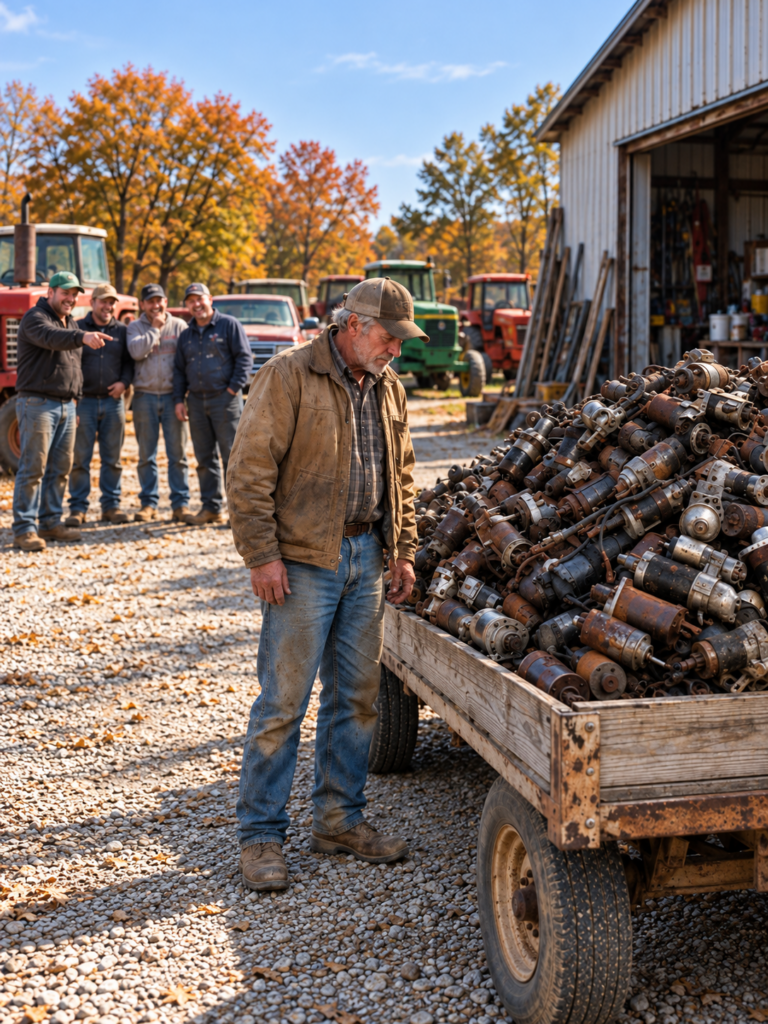
It was a cold October morning in rural Missouri, 1990, and the fifty-eight-year-old farmer stood inside a tractor dealership’s storage shed, looking at a mountain of greasy, rust-stained starter motors that nobody wanted.
There were 270 of them.
Some were stacked in wooden crates. Others lay scattered across the concrete floor. A few still had faded yellow tags tied around their housings, with handwritten words like BAD CORE, NO GOOD, and REPLACE.
The mechanics had spent most of the morning dragging them out of the back of the building.
Now they were waiting for a scrap dealer to haul them away.
Walter had other ideas.
“Forty dollars,” he said.
The service manager, a heavyset man named Frank Dobbins, stopped writing on his clipboard.
“Forty dollars for what?”
Walter pointed toward the pile.
“All of them.”
For a moment, nobody spoke.
Then a young mechanic named Billy Turner burst out laughing.
“You’re kidding.”
Walter shook his head.
Billy looked around at the other mechanics.
“Did everybody hear that? Walter Hayes wants to pay forty bucks for our junk.”
Another mechanic grinned.
“Maybe he’s planning to build himself a new tractor out of garbage.”
“More like a house,” Billy said. “He can stack them up for walls.”
The men laughed again.
Walter stood quietly in his faded brown work jacket, his hands rough from thirty-five years of planting corn, cutting hay, repairing fences, and coaxing another season out of machinery that should have retired a decade earlier.
He had heard laughter before.
He had heard it when he bought his first secondhand tractor. He had heard it when he married a schoolteacher instead of a farmer’s daughter. He had heard it when he refused to sell his land during the difficult years of the 1980s.
He had learned that people who laughed at another man’s choices seldom knew what those choices had cost him.
Frank folded his arms.
“Walter, most of those starters are dead. Some have burned armatures. Some have busted housings. Half of them have been sitting back here longer than Billy’s been working for me.”
“That’s all right.”
“There’s no warranty.”
“Didn’t ask for one.”
“And you haul them yourself.”
Walter nodded.
Frank stared at him for another moment.
Then he shrugged.
“Fine. Forty dollars. But once they’re on your truck, they’re your problem.”
Walter reached into his wallet.
He counted out two twenty-dollar bills.
Billy whistled.
“Well, boys, there goes the worst investment in the history of Missouri agriculture.”
Walter handed Frank the money.
“I hope you’re wrong.”
And without another word, he walked outside to his old blue Ford pickup.
The truck had a dented front fender, one mismatched wheel, and a tailgate held closed with a short length of chain. Its engine had more than 200,000 miles on it, and Walter knew every noise it made.
He pulled a pair of work gloves from behind the seat and began loading the starters.
One by one.
Each motor was heavier than it looked. Grease blackened his gloves. Rust flakes fell onto the truck bed. Twice, he stopped to stretch his aching back.
Behind him, the mechanics continued joking.
“Careful, Walter. Don’t drop one. Might break the rust.”
“Better save a little room in that truck for your common sense.”
Walter kept working.
By the time he finished loading the first trip, sweat had soaked through the collar of his shirt despite the cold.
Frank walked outside.
“You really think you’re going to make money on those things?”
Walter tightened the rope across the load.
“I think there’s something worth finding.”
Frank shook his head.
“You’re a stubborn old man.”
Walter looked at him.
“Been called worse.”
He climbed into the truck and drove away.
The dealership disappeared behind him as he followed the narrow county road toward home.
Golden corn stubble stretched across the fields. The maples along the creek had turned red, and the late-autumn wind swept dry leaves across the pavement.
Walter passed the abandoned dairy barn that had belonged to the Millers, the boarded-up feed store, and the little white church where he had married his wife thirty-four years earlier.
He slowed when he reached the cemetery.
He always did.
His wife, Ruth, had been buried there eleven months earlier.
Cancer had taken her after a long summer of hospital visits, sleepless nights, and bills that arrived in white envelopes thick enough to make Walter’s stomach hurt.
Ruth had been sixty-two.
She had spent most of her life teaching second grade at the county elementary school, and she had believed that nearly everything broken deserved a chance to be repaired.
Machines.
Furniture.
Friendships.
Even people.
Walter could still hear her voice.
“Just because somebody’s given up on a thing doesn’t mean the thing is finished.”
He glanced at the starters in his rearview mirror.
“Well, Ruth,” he murmured, “I reckon we’re about to find out.”
He turned onto the gravel driveway of the farm they had shared.
The white farmhouse stood beyond a row of bare maple trees. Its porch sagged slightly on the eastern side, and one shutter had come loose in a September storm.
The red barn needed another coat of paint.
The pasture fence needed replacing.
And the kitchen window Ruth had always wanted repaired still rattled whenever the wind came from the north.
Walter parked beside the barn.
For a few seconds, he remained behind the wheel.
He looked toward the kitchen.
At this hour, Ruth would once have been standing at the stove, warming leftover soup, with the radio playing softly beside the sink.
There would have been another cup waiting on the table.
Now there was only his.
He swallowed hard.
Then he climbed out and started unloading.
By sunset, the first truckload of starters covered a corner of the barn floor.
It took three trips to bring home the entire pile.
When the last motor finally came off the tailgate, Walter stood with his hands on his hips, staring at what he had purchased.
He hadn’t bought forty dollars’ worth of neatly organized spare parts.
He had bought a mountain of unknown problems.
And for the first time that day, doubt settled over him.
He looked toward the farmhouse, where the kitchen light shone against the growing darkness.
Forty dollars was not a fortune.
But it wasn’t nothing, either.
The property tax bill was coming due. His corn harvest had been poor. The old combine had swallowed nearly six hundred dollars in repairs, and the savings account Ruth had spent years protecting was shrinking faster than Walter wanted to admit.
His daughter, Carolyn, had called from Kansas City the previous Sunday.
“Dad, you can’t keep doing everything yourself.”
“I’ve managed this long.”
“You’re almost sixty.”
“Not quite.”
“That isn’t funny.”
She had paused before adding the words he hated hearing.
“Maybe it’s time to think about selling the farm.”
Walter had changed the subject.
He knew Carolyn meant well.
She worked in a bank, had two children, and worried about him living alone seventeen miles from the nearest hospital.
But selling the farm would mean selling the place where Ruth had planted roses beneath the bedroom window.
It would mean selling the barn where their children had learned to ride bicycles on rainy afternoons.
It would mean handing a lifetime of memories to someone who would see nothing but acreage.
Walter wasn’t ready.
Still, standing before 270 broken starters, he wondered whether he had finally made the foolish mistake everybody believed he had made.
He chose one motor from the pile.
It was coated in black grease, with an old paper tag still attached.
JOHN DEERE—BAD.
He carried it to the workbench.
Above the bench hung Ruth’s old calendar from the previous year.
Walter hadn’t taken it down.
The last page she had marked was November.
A dentist appointment.
A grocery list.
And a little handwritten reminder in the corner.
Walter—don’t forget to eat lunch.
He stared at her handwriting for a long time.
Then he pulled up a chair.
He opened the toolbox.
And he started working.
Part 2
Three mornings later, Earl Benton walked into Walter’s barn and stopped in the doorway.
“Good Lord.”
Walter didn’t look up.
“Morning, Earl.”
“What happened in here?”
“Bought some starters.”
Earl glanced across the floor.
“Some?”
“Two hundred seventy.”
The sixty-six-year-old mechanic removed his cap and scratched his thinning gray hair.
“You bought two hundred seventy starter motors?”
“That’s right.”
“Working ones?”
“Not exactly.”
Earl walked to the nearest table and picked up a starter with a cracked aluminum nose housing.
He turned it over.
“Well, this one’s good for holding down a stack of newspapers.”
Walter smiled.
“That’s one use.”
Earl examined another.
Then another.
His expression changed.
“Where’d these come from?”
“Dobbins Tractor.”
Earl gave a low whistle.
“The dealership cleanout?”
Walter nodded.
“How much?”
“Forty dollars.”
Earl stared at him.
Then he began to laugh.
Walter sighed.
“Not you, too.”
Earl put the starter down.
“No, I’m laughing because I know Frank Dobbins. He wouldn’t sell a thirsty man a glass of water unless he could charge him for the cup.”
Walter chuckled.
Earl looked around again.
“Well. You planning to fix them?”
“Planning to see what can be fixed.”
“That’s a different thing.”
“Suppose it is.”
Earl pulled up a stool.
“Then we’d better get organized.”
The two men had known each other since 1959, when Earl helped Walter rebuild the transmission on his first tractor.
Earl had never owned much land. His father had run a small repair shop near the county line, and Earl had inherited both the shop and the habit of keeping things everyone else threw away.
He knew old farm equipment the way a country doctor knew his patients.
He could identify a bad bearing by listening to it.
He could smell burned insulation before opening a motor.
And he never trusted a replacement part merely because it looked right.
For the next two weeks, Earl came by whenever his own shop was quiet.
Together, they turned Walter’s barn into a rough rebuilding operation.
They carried folding tables out from the farmhouse.
Walter hung bare bulbs above the work area.
They sorted starters by manufacturer.
John Deere.
International Harvester.
Massey Ferguson.
Ford.
Then by voltage.
Then mounting pattern.
Then housing type.
Walter found an old school notebook Ruth had bought but never used.
On the first page, he wrote:
Starter Inventory—October 1990.
He numbered every unit.
By the fourth day, the barn smelled of solvent, old grease, coffee, and the faint sharp odor of electrical insulation.
Their hands stayed black no matter how often they washed.
Some units came apart easily.
Others resisted every wrench.
Several had brushes worn almost to nothing.
Some solenoids were stuck.
One armature had burned so badly that Earl took one look and dropped it into the scrap box.
“No sense wasting good hours on bad metal,” he said.
Walter nodded.
He was learning that restoring something didn’t mean pretending everything could be saved.
Sometimes the useful part of a ruined machine was hidden inside it.
A good shaft.
A working solenoid.
An intact housing.
A set of field coils.
He began separating those pieces into labeled boxes.
As the days passed, his confidence grew.
One rainy Thursday afternoon, Walter finished rebuilding a starter taken from an old International Harvester tractor.
He cleaned the commutator, installed new brushes, checked the bushings, and attached the unit to the bench-testing setup Earl had helped him assemble.
Earl stood beside him.
“Ready?”
Walter nodded.
He made the connection.
The starter spun.
Strong.
Smooth.
Steady.
For one wonderful moment, Walter forgot the unpaid bills, the loneliness, and the laughter at the dealership.
He grinned like a boy.
“Well, look at that.”
Earl listened closely.
“Sounds good.”
Walter switched it off.
“You think somebody would buy it?”
“If it fits what they need.”
Walter looked at the motor.
“First one.”
Earl nodded.
“First one.”
That evening, Walter ate his supper at the kitchen table with a little more appetite than usual.
He even turned on the radio.
For the first time since Ruth’s funeral, the house didn’t feel quite so empty.
Three days later, a farmer named Daniel Price stopped by.
Daniel owned an older tractor that had refused to start that morning.
Earl had told him Walter might have a rebuilt replacement.
Walter brought out the starter.
Daniel examined it.
“Looks almost new.”
“Should work fine.”
They agreed on a modest price.
Daniel paid cash.
Walter placed the money carefully into an envelope labeled PARTS.
After Daniel drove away, Walter stood on the porch smiling.
He had made his first sale.
He went into the kitchen and looked at Ruth’s photograph beside the window.
“Well, honey,” he said, “we’ve got ourselves a customer.”
The phone rang two hours later.
Walter answered.
“Hayes residence.”
Daniel’s voice came through the receiver.
“Walter, I think we’ve got a problem.”
The smile vanished from Walter’s face.
“What kind of problem?”
“That starter won’t turn the engine over right. Sounds like something’s grinding.”
Walter gripped the receiver.
“Did it bolt up?”
“Sure did. Fit right into place. But the drive gear isn’t catching properly.”
Walter closed his eyes.
“I’ll come out.”
“You don’t have to drive all the way—”
“I sold it to you. I’ll come out.”
By the time Walter reached Daniel’s farm, the sun had disappeared behind thick gray clouds.
Daniel had already removed the starter.
Walter inspected it.
The motor itself worked perfectly.
But when he compared its drive assembly with the failed unit Daniel had taken off, he noticed something.
The pinion gears were different.
Not by much.
But enough.
Walter counted the teeth twice.
He checked the diameter.
He held the two motors side by side.
Nearly identical.
Completely wrong for each other.
His stomach sank.
He handed Daniel his money back.
“I made a mistake.”
Daniel looked embarrassed.
“Now, Walter, you did put a lot of work into it.”
“Doesn’t matter. It wasn’t the right part.”
“You can find another?”
“I’ll try.”
Walter drove home with the starter on the passenger-side floor.
He felt more ashamed than he had when the dealership mechanics laughed at him.
Those men hadn’t trusted him.
But Daniel had.
And Walter had let him down.
When Earl arrived the next morning, Walter was sitting at the workbench.
The two starters lay before him.
“Daniel called me,” Earl said.
Walter nodded.
“I figured he might.”
“Know what went wrong?”
Walter pointed toward the drive gears.
“Pinion doesn’t match.”
Earl pulled up a stool.
“Tell me what else.”
Walter examined the mounting arrangement.
“The housings are close.”
“Close isn’t right.”
“Same manufacturer.”
“Doesn’t mean a thing if the application isn’t the same.”
Walter rubbed his eyes.
“I thought if it tested good, that was enough.”
Earl looked at him.
“Testing tells you whether the starter works. It doesn’t tell you whether it belongs on that tractor.”
Walter said nothing.
Earl leaned forward.
“You spent your life farming. You know what happens if a man plants the wrong seed in the wrong field.”
“He gets the wrong crop.”
“Exactly.”
The old mechanic tapped the bench.
“These motors are the same way. You can’t just fix them. You’ve got to know what they fit.”
That afternoon, Walter opened Ruth’s unused notebook.
He tore out several pages filled with his earlier, careless descriptions.
GOOD MOTOR.
OLDER DEERE.
SIX VOLT.
He replaced them with detailed records.
Manufacturer number.
Voltage.
Rotation direction.
Mounting bolt pattern.
Nose housing type.
Pinion tooth count.
Pinion diameter.
Shaft length.
Solenoid arrangement.
Known tractor applications.
He called parts counters in neighboring counties.
He borrowed outdated service catalogs.
He dug through stacks of manuals in Earl’s repair shop.
Some evenings, he remained in the barn until midnight, checking numbers with a magnifying glass.
He learned that two starters could look identical and still be incompatible.
He learned that a seemingly minor difference in the drive housing could make a motor useless for a particular tractor.
And he learned that the most valuable thing he was building wasn’t a pile of repaired machinery.
It was a way to know exactly what each repaired machine could do.
But the work was slower than he had imagined.
By November, his hands were cracked from cleaning solvent.
His left knee hurt whenever he climbed the barn steps.
He had spent additional money on brushes, bushings, cleaning supplies, and replacement solenoids.
The parts envelope was nearly empty.
And his daughter was coming to visit.
Carolyn arrived on the first Sunday of November with her husband, David, and their two children.
She brought a casserole and a bag of groceries.
When she stepped into the barn, she stopped.
“Dad.”
Walter turned around.
“Hello, sweetheart.”
“What is all this?”
“Starter motors.”
“I can see that.”
She looked around at the crowded tables and stacked crates.
“Why are there so many?”
Walter wiped his hands on a rag.
“Got a good deal.”
Carolyn’s eyes narrowed.
“What kind of deal?”
“Forty dollars for the lot.”
She stared at the motors.
“Forty dollars?”
“That’s right.”
“For broken parts?”
“Some are broken.”
“All of them look broken.”
Walter smiled faintly.
“Looks can fool you.”
Carolyn didn’t smile.
“Dad, you’ve got a property tax payment coming up. The porch needs fixing. Your tractor needs tires. And you’re spending money bringing home junk?”
David shifted uncomfortably.
“Carolyn—”
“No. Somebody has to say it.”
Walter’s face tightened.
She continued.
“Mom used to keep you from doing things like this.”
The words struck harder than she intended.
Walter looked toward the open barn doors.
Beyond them, the autumn fields lay brown and quiet.
After a long moment, he said, “Your mother would have understood.”
Carolyn’s expression softened.
“Dad, that’s not what I meant.”
“I know.”
But something had changed.
For the rest of the afternoon, Walter spoke very little.
He played with the grandchildren.
He thanked Carolyn for the groceries.
He sent them home with jars of homemade peach preserves Ruth had put up the previous summer.
And after their car disappeared down the driveway, he returned to the barn.
He sat at the workbench and stared at the unfinished starter before him.
Maybe Carolyn was right.
Maybe he was an old farmer trying to avoid admitting that his best years were behind him.
Maybe the whole county had been right to laugh.
He picked up a clean rag.
Then he put it down again.
For a long while, he sat in silence.
Finally, he looked at Ruth’s handwriting on the calendar.
Don’t forget to eat lunch.
He swallowed the lump in his throat.
“I don’t know if I can make this work,” he whispered.
The barn gave no answer.
Outside, the wind shook the loose metal roofing.
Walter sat another minute.
Then he reached for his magnifying glass.
And began counting pinion teeth.
Part 3
The first hard freeze came to Missouri in the middle of November.
Thin ice formed across the watering trough near Walter’s barn.
The pasture grass turned silver in the mornings.
And every breath rose white in the cold air.
Walter had finished testing thirty-two starters.
Not all were ready to sell.
Some still needed parts.
Others had to be matched to specific tractor applications.
He had also dismantled several hopeless units, sorting useful components into coffee cans and wooden drawers.
His inventory notebooks were growing thicker.
His bank account was not.
One morning, Walter sat at the kitchen table studying the tax statement that had arrived the previous afternoon.
He ran his thumb along the printed amount.
Then he glanced at the old family photograph on the wall.
Ruth stood beside him in front of the farmhouse, smiling beneath a broad-brimmed straw hat.
Carolyn and her younger brother, Michael, were children in the picture.
Michael had been gone for years.
A highway accident at twenty-three.
Ruth had never entirely recovered from losing him.
Neither had Walter.
The farm was filled with reminders of both of them.
Michael’s initials were carved into one of the barn beams.
Ruth’s rose bushes still grew beneath the bedroom window.
Walter lowered the paper.
Selling the farm would mean leaving those things behind.
He couldn’t imagine it.
But imagination wouldn’t pay the taxes.
He folded the statement and slipped it beneath his coffee mug.
Then the telephone rang.
It was Earl.
“Walter, you busy?”
“Depends who’s asking.”
“Got a fellow standing here who needs help.”
“What kind?”
“Starter on an old tractor. Dealership says three days minimum.”
Walter looked toward the barn.
“What tractor?”
Earl told him.
Walter reached for his notebook.
He turned the pages, checking the application numbers.
Then he stopped.
He read the entry again.
“I might have one.”
“Tested?”
“Twice.”
“Application confirmed?”
Walter checked his records.
“Yes.”
Earl paused.
“Then bring it over.”
Walter put on his coat.
He didn’t know it yet, but that cold November morning would change the way he understood everything he had been doing.
The farmer waiting at Earl’s shop was named Roland Spearing.
He was in his early forties, with tired eyes, cracked hands, and mud dried around the cuffs of his jeans.
Walter recognized the look immediately.
Roland was a man who had spent too many hours trying to solve a problem he couldn’t afford to have.
“My tractor died yesterday,” Roland explained.
“What happened?”
“Turned the key. Nothing but a click. Pulled the starter and had Earl check it.”
Earl nodded.
“Armature’s finished.”
Roland took off his cap.
“Dealership says they can order one, but it’ll take three days. Maybe four.”
Walter glanced toward the window.
Dark clouds gathered above the grain elevator across the road.
Roland followed his gaze.
“Weather service says rain by the weekend. I’ve still got fieldwork to finish. If I lose three days, I’ll be working in mud.”
Walter understood.
He had spent enough autumns watching the sky to know that a farmer’s calendar didn’t care when a part arrived.
Three days could mean the difference between finishing a field and watching it become impassable.
He opened his cardboard box.
Inside lay the starter he had rebuilt.
Roland examined it.
“That one fit?”
Walter didn’t answer immediately.
He checked the tractor information again.
He compared the mounting pattern.
He verified the drive gear.
He checked the application number against his notes.
Only then did he nod.
“It should. Let’s make certain.”
The three men carried the rebuilt starter to the tractor sitting behind the shop.
The installation took less than half an hour.
Walter watched every step.
He didn’t say much.
When the cables were connected and the tractor was ready, Roland climbed into the seat.
He looked down at Walter.
“Ready?”
Walter stepped back.
“Go ahead.”
Roland turned the key.
The engine cranked.
Then caught.
A deep, familiar diesel rumble rolled across the cold yard.
For a moment, nobody moved.
Then Roland laughed.
It wasn’t the polite laugh of someone hearing a joke.
It was the exhausted, relieved laugh of a man who had been carrying a weight and suddenly felt it lift.
He shut the engine down, climbed off, and walked straight toward Walter.
“How much do I owe you?”
Walter named the exchange price.
Roland blinked.
“That’s it?”
“That’s it. I keep your old starter.”
Roland looked at Earl.
Then back at Walter.
“The dealership wanted nearly twice that for the new one.”
Walter shrugged.
“Mine’s rebuilt.”
“But it works.”
“That’s the idea.”
Roland reached for his wallet.
Then he stopped.
“Walter, do you know what you just saved me?”
Walter glanced at the tractor.
“A few days, I reckon.”
Roland shook his head.
“My wife and I are already behind on the equipment payment. We’ve got two boys. One needs braces. If the weather turns before I finish that field, I’m looking at another bad month.”
He swallowed.
“I didn’t know what I was going to do.”
Walter looked at the man’s worn coat.
At the mud on his boots.
At the tractor that had come back to life.
Something tightened in his chest.
He remembered nights when Ruth had sat beside him at the kitchen table, working out which bills could wait.
He remembered the terrible silence after the bank refused to extend a loan.
He remembered telling his children everything would be fine, even when he wasn’t certain he believed it himself.
He understood exactly what Roland was saying.
Roland held out his hand.
“Thank you.”
Walter shook it.
“Get your field finished.”
Roland climbed back onto the tractor.
The engine roared again.
As the machine rolled out of the yard, Earl came to stand beside Walter.
“Well?”
Walter kept watching the road.
“Well what?”
“Feel better about those forty dollars?”
Walter didn’t answer immediately.
He watched the tractor disappear around the bend.
Then he said quietly, “It isn’t the starter.”
Earl looked at him.
“What?”
Walter turned.
“It isn’t just the starter we’re selling.”
Earl raised an eyebrow.
“What are we selling, then?”
Walter looked down at his blackened hands.
“Time.”
That night, Walter lay awake thinking about Roland’s tractor.
About the three days he had nearly lost.
About how much those days mattered.
The dealership had looked at 270 broken starters and seen scrap metal.
Walter had first looked at them and seen repairable machinery.
But now he understood something neither view fully captured.
A farmer didn’t need a pretty starter sitting on a shelf.
He needed a tractor that would run when the weather turned.
He needed machinery ready before the planting window closed.
He needed to get home before dark with enough money left to feed his family.
What Walter could offer wasn’t simply a repaired part.
It was the chance to keep working.
The following morning, he changed everything.
He cleared a section of shelves along the western wall of the barn.
He painted the shelf edges white so he could read the labels in dim light.
He made heavy index cards for every tested starter.
At the top of each card, he wrote the manufacturer and application.
Below that came the specifications.
Voltage.
Rotation.
Mounting pattern.
Pinion tooth count.
Nose housing.
Solenoid location.
Date tested.
He created separate areas.
TESTED AND READY.
NEEDS REPAIR.
DONOR PARTS.
SCRAP.
Earl helped him build a more secure testing bench and checked the procedures Walter used.
They also established a simple exchange system.
A farmer could bring in a failed starter.
Walter would identify the unit, confirm the tractor application, and, if he had a matching rebuilt starter ready, sell it at an exchange price.
The farmer would leave with a working unit.
Walter would keep the old one.
Then he would inspect it, repair it if worthwhile, and place another tested starter on the shelf.
It was not a complicated idea.
But doing it properly required a level of care few people had been willing to spend on old starter motors.
By December, word began spreading through the farming community.
Roland told his neighbor.
His neighbor told a cousin.
A feed-store clerk mentioned Walter’s rebuilt starters to a customer.
Someone asked Earl whether the old farmer really had a barn full of parts nobody else could find.
Earl grinned.
“Depends what you’re looking for.”
There were failures.
One starter that tested well began acting up after several days of use. Walter took it back and repaired it without charging again.
Another couldn’t be matched with enough certainty, so he refused to sell it.
A few farmers wanted parts he didn’t have.
Walter learned to say no rather than gamble with somebody else’s livelihood.
That earned him more trust than he expected.
But the work was exhausting.
There were mornings when his fingers were too stiff to turn a small screw.
Afternoons when his back tightened so badly that he had to sit on an overturned bucket.
Evenings when the barn grew cold long before he finished.
One snowy day, he dropped a heavy starter onto his workbench and felt a sharp pain shoot through his wrist.
He sat down and held his arm close to his chest.
For several minutes, he couldn’t move.
He stared across the empty barn.
“What am I doing?” he whispered.
Nobody answered.
He looked toward the shelves.
Twenty-one rebuilt starters sat ready.
Another dozen awaited parts.
There were still more than a hundred units to sort or dismantle.
He was fifty-eight years old.
He was tired.
And he was alone.
The loneliness came hardest when the work stopped.
While he was cleaning parts, he could focus on the task in front of him.
When the tools were silent, he heard the wind outside.
He remembered Ruth humming at the kitchen sink.
He remembered Michael calling from the field.
He remembered a house that used to be full of voices.
That evening, he returned to the kitchen and opened a drawer beside the stove.
Inside was Ruth’s recipe box.
He hadn’t touched it since her death.
He took out a card for chicken-and-dumplings.
Her handwriting slanted slightly to the right.
On the back, she had written a note years earlier.
Walter likes extra pepper.
He sat down.
For the first time in weeks, he allowed himself to cry.
Not loudly.
Not dramatically.
Just an old farmer sitting alone at the table, holding a card written by the woman he missed more than words could describe.
When the tears passed, he turned the card over again.
Then he put water on the stove.
He made the dumplings badly.
Too thick.
Not enough salt.
Far too much flour.
But he ate them.
And the next morning, he went back to work.
By the end of the winter, roughly ninety of the original 270 starters had been rebuilt and tested successfully.
Thirty more had been dismantled for donor parts.
Many of the remaining units were sold as scrap after their useful components were removed.
The forty-dollar purchase had become a genuine inventory.
But it had also cost Walter hundreds of hours of labor, additional parts, and more determination than he had believed he still possessed.
He had not found a shortcut to easy money.
He had built something slowly.
Carefully.
One starter at a time.
And when spring arrived, the farmers began coming.
Part 4
March brought warm rain to southern Missouri.
The creeks rose.
The fields softened.
And tractors that had sat idle through the winter began coughing back to life.
For Walter, the busiest season of the year had also become the busiest season in his barn.
Some mornings, the phone rang before breakfast.
“Walter, you got anything for an older Deere?”
“What model?”
A pause.
“Let me check.”
Walter would wait with his notebook open.
Other callers arrived in pickup trucks, carrying failed starters wrapped in old towels.
Some brought part numbers.
Some brought nothing but the model of their tractor and a desperate expression.
Walter checked every application before making a promise.
He had learned that guessing was expensive.
By April, the exchange shelf had become familiar to farmers across several neighboring communities.
Nearly forty of the original ninety rebuilt units had gone out, and most exchanges brought another failed starter into the system.
Earl helped with the most difficult repairs.
Walter kept the records.
Their friendship had become a partnership neither man had expected in retirement.
One afternoon, Earl walked into the barn and found Walter sitting beside a stack of cards.
“How many went out this week?”
“Seven.”
“Seven?”
“Eight if you count the Ferguson unit that went to Roland’s cousin.”
Earl smiled.
“Not bad for a pile of paperweights.”
Walter laughed.
“Don’t remind me.”
Earl looked at the shelves.
“You ever tell Dobbins what you’ve done?”
“Nope.”
“Why not?”
Walter considered the question.
“Don’t see a reason.”
Earl leaned against the bench.
“After the way those boys laughed at you?”
Walter shrugged.
“They sold me the starters fair and square.”
“That’s not what I asked.”
“I know.”
Earl watched his friend for a moment.
Then he nodded.
“Ruth would’ve liked that answer.”
Walter looked down.
“Maybe.”
But success brought new problems.
The parts shelves needed regular restocking.
Walter spent longer hours on paperwork.
Some applications were so old that replacement components were difficult to find.
And the demands of the little business began interfering with the farm.
One morning, his own tractor broke a hydraulic line while he was preparing a field.
The repair took half a day.
That afternoon, a customer arrived needing a starter.
Then another.
Walter worked until after dark.
The next day, rain moved in.
His planting was delayed.
He stood at the barn door watching water run off the roof.
He had helped other farmers avoid losing valuable days.
Now he was losing his own.
Carolyn called that evening.
“Dad, David says you’ve been fixing tractor parts for half the county.”
Walter smiled.
“Half the county’s an exaggeration.”
“Are you making any money?”
“Some.”
“Enough to keep the place going?”
Walter looked at the stack of bills beside the telephone.
“Working on it.”
There was a pause.
“Dad, I wasn’t trying to hurt you when I visited last fall.”
“I know, sweetheart.”
“I just worry.”
He sat down.
“I know that too.”
She hesitated.
“I drove past the old Miller place last month. Somebody bought it and cleared the barn.”
Walter looked through the window toward his own barn.
“That happens.”
“I don’t want you ending up with nothing because you can’t let go.”
He was quiet for a long time.
Then he said, “Carolyn, your mother and I worked forty years to build what we have. I know you’re trying to protect me. But I’m not holding on because I’m afraid of change.”
“Then why?”
Walter looked at the photograph on the wall.
“Because it still matters.”
Carolyn didn’t answer.
Neither did he.
Finally, she said, “I love you, Dad.”
“I love you too.”
After the call, Walter went into the barn.
He checked the exchange log.
He counted the money in the parts envelope.
He separated what belonged to the business from what could safely go toward the farm bills.
There was enough to help.
Not enough to erase every problem.
But more than he had expected six months earlier.
For the first time, he began to believe that his strange little operation might help him remain on the land without borrowing more money.
Then, one Thursday morning, the telephone rang.
Walter answered from the barn office.
“Hayes.”
A man’s voice replied.
“Is this Walter Hayes?”
“Speaking.”
“This is Frank Dobbins over at Dobbins Tractor.”
Walter paused.
He glanced at Earl, who was working at the next bench.
Earl raised his eyebrows.
Walter returned his attention to the telephone.
“What can I do for you, Frank?”
There was a slight hesitation.
“Well, I’ve got a customer here with an older tractor. Starter’s gone out. We can’t get a replacement.”
Walter waited.
“We’ve checked our suppliers,” Frank continued. “Closest thing we found is a remanufactured unit three states away, and they’re not even sure it’s the right one.”
“What’s the tractor?”
Frank gave him the model and serial-number range.
Walter reached for his notebook.
He turned several pages.
Found the manufacturer section.
Checked the application family.
Then examined the specifications against a card on the shelf.
His pulse quickened.
He had one.
But he didn’t say so immediately.
“Give me a minute.”
He put the receiver down.
Earl watched him cross the barn.
“What’s going on?”
“Dobbins Tractor.”
Earl froze.
“You’re joking.”
Walter shook his head.
“Need an older starter.”
Earl leaned back.
“Well, I’ll be.”
Walter reached the shelf.
He removed a rebuilt unit and carried it to the workbench.
He checked the manufacturer number.
Voltage.
Mounting configuration.
Pinion dimensions.
Rotation.
Everything matched the application details Frank had provided.
He returned to the telephone.
“Frank?”
“Yeah?”
“I’ve got one.”
Silence.
Then Frank said, “You’ve got what?”
“A rebuilt starter for that tractor.”
“Are you certain?”
Walter looked at the card.
“Matches the application. Tested and ready.”
Frank was quiet.
Walter could hear voices in the dealership background.
Finally, Frank asked, “Can you bring it over?”
Walter thought about the afternoon he had spent loading 270 starters while Billy Turner laughed at him.
He remembered the jokes.
The smirks.
The way Frank had called him stubborn.
For one brief moment, he imagined what it would feel like to tell Frank exactly what he thought.
He could have demanded a ridiculous price.
He could have said the dealership should have kept its own junk.
He could have reminded Frank that the same men who had declared those starters worthless were now asking him to save their customer.
But Walter thought about the farmer waiting for that tractor.
He thought about Roland.
About the weather.
About bills that didn’t stop arriving because machinery stopped working.
He looked at the rebuilt starter.
Then he said, “I’ll bring it.”
Earl stared at him after he hung up.
“You really going over there?”
“Yes.”
“After what they said?”
Walter put the starter into a cardboard box.
“They need the part.”
Earl shook his head.
“Walter, sometimes I think you’re too decent for your own good.”
Walter smiled faintly.
“Ruth used to tell me that.”
He carried the box to his pickup.
And drove back to the dealership where the whole thing had begun.
The same gravel parking lot.
The same service doors.
The same storage shed behind the building.
Only the shed was nearly empty now.
Walter parked beside the shop.
Billy Turner was standing near the entrance, wiping his hands on a rag.
He looked at Walter.
Then at the box.
“What’s that?”
“Starter.”
“For who?”
“Frank called.”
Billy’s expression changed.
He opened his mouth.
Then closed it again.
Walter walked past him.
Inside, Frank stood beside an older customer in coveralls.
The farmer’s face showed the strain of someone who had spent most of the day hearing that the part he needed couldn’t be found.
Walter placed the box on the counter.
Frank opened it.
For several seconds, he stared at the rebuilt motor.
Then he looked up.
“You got this out of that pile?”
Walter nodded.
“That’s right.”
Frank turned the starter over.
The housing was clean.
The connections had been checked.
A neatly written identification card was attached.
Frank read the specifications.
Then he looked at Walter again.
“How many of those things did you get working?”
Walter considered the question.
“Quite a few.”
Billy had followed them inside.
He stared at the motor.
“You’re telling me that thing actually works?”
Walter met his eyes.
“Tested it myself.”
Frank cleared his throat.
“Well. We’ll install it and see.”
Walter nodded.
“That’s what it’s for.”
He didn’t stay to watch.
Instead, he returned to his truck and drove home.
Earl was waiting when he arrived.
“Well?”
Walter set the empty box on the bench.
“Sold them a starter.”
Earl leaned forward.
“That’s all?”
“That’s all.”
“Didn’t say anything about the jokes?”
“No.”
“Not even a little?”
Walter smiled.
“Nope.”
Earl stared at him.
Then he laughed so hard he had to sit down.
“You’re a better man than I am.”
Walter turned toward the shelves.
“Don’t know about that.”
That evening, Frank called.
The starter had worked.
The farmer’s tractor was running.
Frank thanked him.
It was an awkward conversation.
The kind two men have when one knows he owes the other an apology but doesn’t quite know how to offer it.
Before hanging up, Frank said quietly, “Walter, I guess we didn’t know what we had in that shed.”
Walter looked toward his notebook.
“No,” he said. “I don’t reckon you did.”
After the call, Walter sat down.
He should have felt triumphant.
He had taken the dealership’s discarded parts and built a business capable of supplying something they couldn’t.
He had proved that the laughter had been misplaced.
But his thoughts went somewhere else.
To Ruth.
To the kitchen table.
To all the evenings she had encouraged him when the farm seemed one bad season away from failure.
He wished she could have heard that telephone call.
He wished she could have seen the shelves.
He wished he could tell her that something good had finally come from a year that had nearly broken him.
He looked toward the farmhouse.
The porch light was on.
The kitchen window glowed.
But Ruth wasn’t there.
He sat in the barn until darkness filled the open doorway.
Then he whispered, “We did it, honey.”
And for the first time since her death, those words didn’t feel entirely lonely.
Part 5
By late May, the countryside had turned green.
Corn pushed through the soil in neat rows.
The trees around Walter’s farmhouse were heavy with leaves.
And the roses Ruth had planted beneath the bedroom window were beginning to bloom.
Walter stood on the porch one morning holding the envelope that had arrived from the county tax office.
Inside was the receipt for the payment he had made.
The farm wasn’t suddenly prosperous.
The fences still needed work.
The old combine would probably break again.
And there would always be another bill.
But the land was his.
The farmhouse was his.
The barn where he had spent the winter working long after dark was still standing.
And for the first time in months, he wasn’t afraid of opening the mailbox.
He folded the receipt carefully and went inside.
On the kitchen table lay his rebuilding records.
He had been reviewing the numbers.
Forty dollars had purchased the original pile of 270 starters.
The rebuilding supplies, replacement parts, transportation, equipment, and countless hours of labor had cost considerably more.
But the operation was now producing steady income.
More importantly, it was providing something farmers in the area had struggled to find.
Affordable, correctly matched replacement starters.
Ready when they were needed.
Walter had learned which older tractor models were common in neighboring counties.
He had learned which parts could be rebuilt economically and which weren’t worth the effort.
He had learned how important it was to keep clear records.
And he had learned that reputation wasn’t built through clever promises.
It was built when a man said a part would work and then stood behind it.
That afternoon, Carolyn arrived unexpectedly.
Walter was in the barn when he heard her car.
He looked up from the workbench.
“Well, this is a surprise.”
She smiled.
“I had the afternoon off.”
“Everything all right?”
“Everything’s fine.”
She glanced around the barn.
It looked nothing like the disorderly mountain of junk she had seen the previous autumn.
The worktables were clear.
Shelves lined the walls.
Every tested unit was labeled.
Boxes of donor components sat neatly beneath the benches.
A large handwritten board listed the week’s completed exchanges.
Carolyn walked slowly along the shelves.
“Dad…”
Walter wiped his hands.
“What?”
“You did all this?”
“Earl helped.”
She picked up one of the inventory cards.
She read it.
Then another.
And another.
“I had no idea.”
Walter shrugged.
“Been keeping busy.”
Carolyn looked at the small desk where his records were arranged.
Then she noticed a framed photograph beside the notebook.
It was Ruth.
She stood in the farmhouse garden, holding a basket of tomatoes and smiling at the camera.
Carolyn touched the frame.
“You brought Mom out here.”
Walter nodded.
“Figured she ought to see what we’re doing.”
Carolyn swallowed.
For a moment, neither spoke.
Then she turned toward him.
“Dad, I’m sorry.”
Walter frowned.
“For what?”
“For what I said last November.”
He looked down.
“Sweetheart—”
“No. I need to say it.”
Her eyes filled.
“I came here, saw a barn full of broken machinery, and decided you’d lost your judgment. I thought you were clinging to anything that would keep you from admitting you were getting older.”
Walter remained quiet.
Carolyn looked around again.
“But you weren’t. You were building something.”
He smiled faintly.
“Trying to.”
She shook her head.
“You were right to try.”
Walter sat on the edge of the bench.
“Wasn’t sure of that for a while.”
Carolyn moved closer.
“Why didn’t you tell me what was happening?”
Walter considered the question.
“Suppose I wanted to know whether it would work before I made anybody else believe in it.”
She sat beside him.
For several minutes, they looked across the barn in silence.
Then Carolyn said, “Mom would have been proud.”
Walter pressed his lips together.
“Hope so.”
“I know so.”
He stared at his hands.
They were rougher now than they had been in October.
The little finger on his right hand was stiff.
A shallow scar ran across one knuckle.
His work had left its mark.
But he felt more useful than he had in years.
Carolyn looked toward the shelves.
“How many starters have you sold?”
Walter told her.
She blinked.
“That many?”
He nodded.
“And the exchange system keeps bringing in more old ones?”
“That’s how it works.”
She laughed softly.
“You’ve turned the whole thing into a little business.”
Walter smiled.
“An old man’s business.”
Carolyn took his hand.
“Don’t call it that.”
He looked at her.
She squeezed his fingers.
“It’s your business. You built it.”
Walter turned away before she could see how much the words affected him.
For months, he had wanted his daughter to understand that he wasn’t simply trying to preserve the past.
He still had something to offer.
He still knew how to work.
How to learn.
How to make something useful.
And he still wanted his children to see him as more than an old man waiting for the farm to be sold.
Now, sitting beside Carolyn, he realized that she finally did.
A truck rolled into the yard.
Walter looked through the open barn door.
A farmer climbed out carrying a heavy starter wrapped in a towel.
Walter stood.
“Looks like I’ve got company.”
Carolyn smiled.
“Need help?”
He glanced at her.
“You know anything about tractor starters?”
“Not a thing.”
“Then you’ve got plenty to learn.”
She laughed.
And for the first time in a long while, the sound reminded Walter of the years when the house had been full.
The farmer introduced himself as Harold Mercer.
His tractor had quit that morning.
He had called two parts suppliers, and neither could locate a replacement.
Someone at the feed store had told him to try Walter.
Walter listened carefully.
Then he opened his notebook.
He checked the model.
Asked for the engine information.
Confirmed the starter specifications.
He walked to the shelf.
Carolyn followed him.
Walter stopped before a row of rebuilt motors.
He read one card.
Then another.
Finally, he lifted a starter from the middle shelf.
He carried it to the workbench.
He placed Harold’s failed unit beside it.
One was greasy and worn.
The other was clean, labeled, and tested.
Walter compared their configurations.
He checked the critical dimensions once more.
Then he nodded.
“This is the one.”
Harold exhaled.
“You sure?”
Walter met his eyes.
“I’m sure it matches the application. It’s been bench-tested, and I’ll stand behind the rebuild.”
Harold studied the starter.
“How soon can I have it?”
Walter smiled.
“Right now.”
The farmer looked almost confused.
“Right now?”
“That’s why it’s on the shelf.”
Harold laughed with relief.
He paid the exchange price, thanked Walter twice, and carried the rebuilt starter to his truck.
Walter watched him drive away.
Carolyn stood beside him.
“That’s what you’ve been doing all winter?”
Walter nodded.
“Pretty much.”
“Helping people get their tractors running?”
“That’s the idea.”
She looked at the organized shelves.
“And all of these came from the pile everybody thought was worthless?”
“Some did. Some are from the exchanges.”
Carolyn smiled.
“I think I understand now.”
Walter looked toward the driveway.
“Most folks don’t care what a starter looks like. They just need their tractor to turn over when they turn the key.”
He paused.
“Out here, one broken machine can put a whole family behind.”
Carolyn nodded slowly.
Walter walked back to the bench and picked up Harold’s failed starter.
It was heavy.
Dirty.
Worn.
It had probably been pulled off a tractor after years of reliable service.
Now it sat in his hands, waiting for someone to decide whether it had anything left to give.
Walter examined the housing.
He turned the shaft.
Then he placed it on the bench.
Carolyn watched him.
“You think you can fix that one?”
Walter smiled.
“Don’t know yet.”
He reached for his tools.
“That’s why we take a look.”
Over the following months, Walter’s little rebuilding operation became a familiar part of the county’s farming community.
He never turned it into a large company.
He never opened a fancy storefront.
He didn’t buy a new truck.
The old blue Ford still sat beside the barn, its tailgate held together with the same chain.
He kept working at the same benches.
He kept the same notebooks.
And Earl still came by several mornings a week, sometimes to help, sometimes just to drink coffee and complain about the weather.
There were difficult days.
Machines failed.
Parts became scarce.
Walter occasionally made mistakes, though he was quicker to recognize and correct them now.
Some units couldn’t be repaired.
Some customers had to wait.
But he refused to promise what he couldn’t deliver.
He checked the application.
Tested the rebuild.
Kept his records.
And treated every failed starter as something worth understanding before discarding.
In early September, nearly a year after he had bought the pile, Walter received a visit from Frank Dobbins.
The dealership manager arrived in a clean pickup and stepped into the barn with an uncertain expression.
Walter looked up.
“Morning, Frank.”
Frank removed his cap.
“Morning.”
He glanced along the shelves.
There were more rebuilt starters than he had expected.
Everything was organized.
Every part had a place.
Frank walked slowly along the worktables.
“I’ve been hearing about what you’re doing.”
Walter nodded.
“Been keeping busy.”
Frank stopped beside the testing bench.
He looked at a rebuilt starter lying next to its identification card.
Then he said, “Billy left the dealership last month.”
Walter looked up.
“That so?”
“Moved to Springfield. Got a job at a bigger service center.”
“Hope it works out for him.”
Frank shifted his cap between his hands.
For several seconds, he said nothing.
Then he turned toward Walter.
“I owe you an apology.”
Walter set down his wrench.
Frank continued.
“That day you bought those starters, I let the boys make a fool out of you.”
Walter remained quiet.
“I figured you were throwing away forty dollars. Truth is, I didn’t give you much credit.”
Walter looked at the man who had once sold him 270 supposedly worthless motors.
Frank glanced around the barn again.
“You saw something we didn’t.”
Walter shook his head.
“Not exactly.”
Frank frowned.
“What do you mean?”
Walter picked up a starter from the bench.
“This one was pulled off a tractor because it wouldn’t crank.”
He removed the inspection cover and pointed to the worn brushes.
“Doesn’t mean the whole thing is ruined.”
He set it down.
“Sometimes it needs a few parts. Sometimes it needs a lot more. Sometimes there’s nothing worth saving except a housing or a solenoid.”
Frank listened.
Walter continued.
“But you won’t know unless you look.”
Frank nodded slowly.
“I guess that’s true.”
Walter smiled.
“And if you do get one running, you’d better know exactly what it fits.”
Frank laughed.
“Fair enough.”
He looked at the shelves.
“You know, I probably could have gotten more than forty dollars from the scrap dealer.”
Walter grinned.
“Probably.”
Frank shook his head.
“Best forty dollars you ever spent.”
Walter considered that.
Then he said, “It was a good start.”
Frank held out his hand.
Walter shook it.
There was no cheering.
No grand announcement.
No crowd gathering to witness the moment.
Just two men standing in an old Missouri barn, understanding something differently than they had a year earlier.
Frank left a few minutes later.
Walter returned to his workbench.
And the day continued.
That evening, after Earl had gone home and the last customer had driven away, Walter turned off the barn lights.
He stood in the doorway as the sun sank behind the western fields.
The air smelled of cut hay and cooling earth.
A flock of blackbirds lifted from the fence line.
Far away, a tractor moved across a field, its engine echoing through the valley.
Walter listened.
He thought about the first night he had brought the starters home.
The doubt.
The loneliness.
The cold winter mornings.
The swollen hands.
The failed first sale.
The countless hours bent over manuals and workbenches.
He thought about Roland’s relieved face when his tractor started.
About the farmers who had arrived worried and driven away smiling.
About Carolyn’s apology.
About Earl’s friendship.
And, more than anything, about Ruth.
He walked toward the farmhouse.
The roses beneath the bedroom window had faded with the season, but their stems were strong.
He stopped beside them and brushed a fallen leaf from the soil.
Ruth had loved those roses.
Every spring, she had trimmed them carefully, removing the dead wood so the living branches could grow.
Walter smiled at the memory.
He had watched her do it for more than thirty years without thinking much about what it meant.
Now he understood.
Not everything that looked finished was truly finished.
Not every worn-out machine had given all it could give.
And not every man nearing sixty had already done the most important work of his life.
Walter stepped onto the porch.
He looked back toward the barn.
Inside were rows of rebuilt starter motors waiting for farmers who might need them tomorrow, next week, or during the next difficult planting season.
They weren’t valuable because they were clean.
They weren’t valuable because they had once been expensive.
They were valuable because somebody had taken the time to discover what they could still do.
Walter unlocked the kitchen door.
He went inside, washed his hands, and put water on for coffee.
Then he took Ruth’s photograph from the windowsill.
He studied her familiar smile.
“Forty dollars,” he said softly.
He chuckled.
“Can you believe it?”
For a moment, he imagined how she would have answered.
She would have teased him for bringing home so much junk.
She would have worried about his back.
She would have reminded him to eat lunch.
And then she would have pulled up a chair beside the workbench and helped him sort the parts.
Walter set her photograph down.
Outside, the last sunlight disappeared from the fields.
The house grew quiet.
But the quiet no longer felt quite as empty.
There was work to do in the morning.
There were neighbors who might need him.
There was a farm still worth caring for.
And there was a reason to get up every day.
Walter poured his coffee and sat at the kitchen table.
Beside him lay his newest inventory notebook, its pages filled with careful handwriting.
He opened it to the last entry.
A starter received that afternoon.
Status: NEEDS INSPECTION.
Walter smiled.
Tomorrow, he would take it apart.
He would check the brushes.
Inspect the armature.
Test the solenoid.
And decide what could be saved.
Because the men at the dealership had once believed they were selling a foolish old farmer 270 dead starters.
But Walter Hayes had purchased something far more important than a pile of worn-out machinery.
He had purchased the chance to learn something new when the world expected him to slow down.
He had found a way to keep his farm, honor his wife’s memory, and help other families hold on to what mattered to them.
And every time an anxious farmer walked through his barn door carrying another broken starter, Walter remembered the lesson that had changed his life.
A thing wasn’t worthless simply because somebody else had stopped believing in it.
Sometimes all it needed was patience.
The right hands.
And one more chance to work.


