
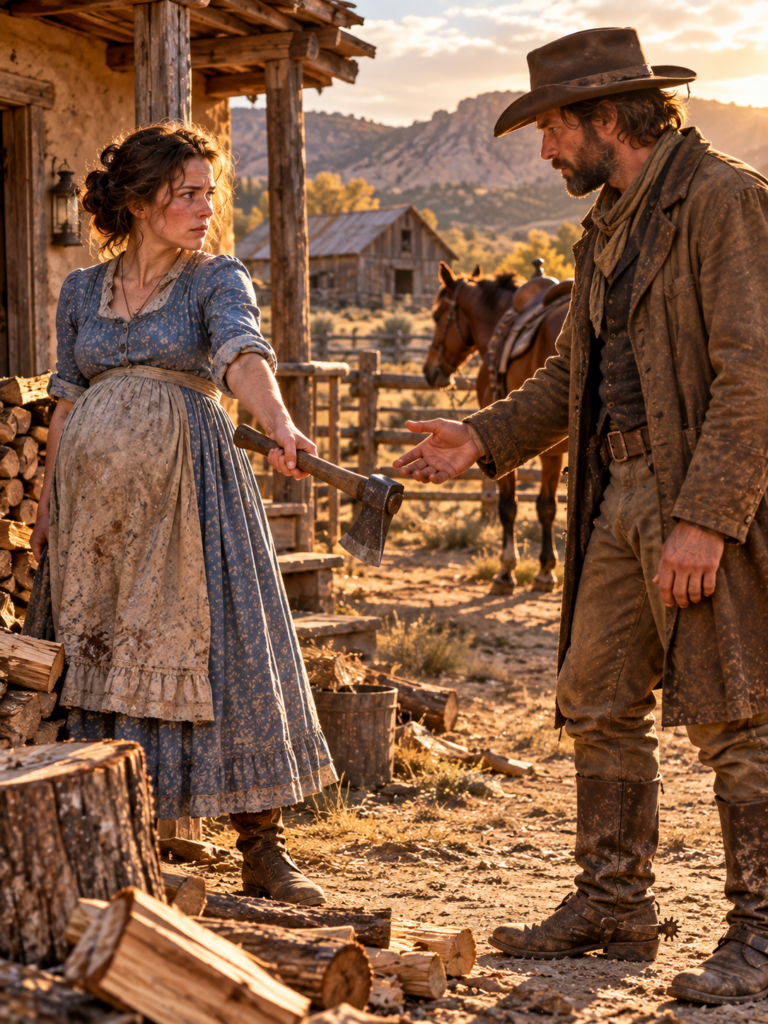
Rebecca opened the Bible, and the folded receipt slipped from between two pages.
She caught it before the autumn wind could carry it away.
Corwin’s eyes followed her hand.
“April fourteenth,” she said, unfolding the paper. “Ninety-two dollars, paid in full. The clerk signed it while my husband and I stood before him.”
She held the receipt where he could see it but not take it.
Corwin leaned closer.
“May I examine the document?”
“You may read it from there.”
His gaze shifted toward Jonah.
“Your hired man appears unusually interested in a private land transaction.”
Jonah remained beside the steps.
“Mrs. Lang asked me to work here. That’s what I’m doing.”
“And defending her interests?”
“She seems capable of speaking for herself.”
Rebecca almost smiled.
Corwin straightened.
“A receipt is one thing, Mrs. Lang. The official ledger is another. The records presently available show no payment.”
“Then someone failed to enter it properly.”
“That is a question for the hearing.”
Rebecca tightened her grip on the paper.
“What hearing?”
“The formal proceeding scheduled under your notice. Of course, the company is still willing to purchase the property and spare you the inconvenience.”
“One hundred dollars for eighty acres?”
“An opportunity to leave without debt.”
“And without a home.”
Corwin did not answer.
Rebecca looked beyond him, toward the dry stretch of land running to the distant road.
For months, surveyors had been measuring the route of a proposed stage road. Neighboring parcels had been purchased one after another.
Her husband’s land lay directly across the surveyed passage.
Suddenly, Corwin’s eagerness made terrible sense.
“You don’t care about ninety-two dollars,” she said.
His expression remained composed.
“You want the road to cross this property.”
“The company has development interests throughout the district.”
“And Thomas wouldn’t sell.”
“Your husband was a difficult negotiator.”
“He was protecting his home.”
Corwin replaced his hat.
“Protecting a home requires more than sentiment, Mrs. Lang.”
Rebecca took one step down from the porch.
“This is not sentiment. This is paid land, worked land, and land my daughter is meant to grow up on.”
For the first time, the agent appeared impatient.
“Then bring your receipt to the hearing.”
He mounted.
“Good day.”
Rebecca waited until he had ridden beyond the gate before sitting heavily on the porch bench.
Jonah did not touch her.
He merely stood nearby while she struggled to steady her breathing.
“Do you think he believes that receipt is false?” she asked.
“No.”
“Then why isn’t he afraid?”
“Because he believes you don’t have enough time or strength to make the truth matter.”
She looked toward the cabin.
The finished cradle stood near the hearth.
Thomas had spent countless evenings dreaming about the child who would sleep there.
Now Rebecca wondered whether she would have a roof beneath which to place it.
“I need this home standing when my baby comes,” she whispered.
Jonah sat at the far end of the bench.
“Then we’ll do what we can to keep it standing.”
She turned toward him.
“Why would you put yourself in the middle of this?”
He rubbed his rough palms together.
“I’ve spent years taking work where I could find it, then riding away when it was done.”
“Why?”
Jonah considered the question.
“After the war, staying anywhere became harder than leaving.”
He offered nothing more, and Rebecca did not press him.
A few moments passed.
“Will you help me get that receipt before someone who can make the record right?” she asked.
“Yes.”
“Even if Corwin makes trouble for you?”
“Yes.”
“Then I need your word on something else. No matter what happens, you won’t decide this fight for me.”
Jonah met her eyes.
“You have it.”
Two mornings later, their neighbor arrived with troubling news.
A company employee had been questioning people about Thomas’s tax payment.
That same afternoon, the general store refused the credit Rebecca had depended upon.
Then another notice arrived.
The hearing had been moved forward.
Instead of the time she expected, Rebecca had barely more than a week to prepare.
She sat at the kitchen table, counting the remaining days.
Jonah placed the Bible beside her.
“We can get witnesses,” he said. “Your neighbor. The clerk. Anyone who remembers.”
“And if Corwin reaches them first?”
“Then we’ll still have the receipt.”
Rebecca shook her head.
“If I lose, I lose Thomas’s land. If I exhaust myself fighting, I may endanger our child.”
Her hand settled over her belly.
Outside, the wind began pushing fine dust beneath the cabin door.
Jonah rose to secure the shutters.
Rebecca folded the receipt and slipped it back into the Bible.
Then she pushed herself to her feet, took the book beneath her arm, and reached for her coat.
Rebecca’s fingers closed around the coat just as Jonah turned from the window.
“Where are you going?”
“Into town.”
He looked at the dust moving across the yard.
“Now?”
“The hearing won’t wait for the weather to suit me.”
Neither would the child, Rebecca thought, though she kept that fear to herself.
Jonah approached the table but stopped short of taking the coat.
“The wind is picking up. We’d be better off leaving at first light.”
“And if the wind is worse tomorrow?”
“Then I’ll take your papers myself, if that’s what you want.”
Rebecca studied him.
He had already proven that he could mend a fence without being told how, finish another man’s careful woodwork without claiming it, and offer help without turning it into an obligation.
But carrying her evidence alone was another matter.
“I want to be there when my case is presented,” she said.
“Then we go together when it’s safe.”
“And if it isn’t?”
“We’ll decide that when we know.”
She allowed herself to sit.
Not because he had ordered it, but because her back had begun to ache and she knew he was right about the wind.
The next morning dawned clear enough for travel.
Jonah harnessed the wagon while Rebecca wrapped the receipt inside a clean cloth and placed it in the Bible.
Before leaving, she checked the cradle.
She had begun making a small bedding cover for it, although the last seam still needed stitching.
She imagined bringing a healthy daughter home after the birth, placing her there, and telling her stories about Thomas.
Then she imagined that same cradle standing in a stranger’s house after the auction.
The thought made her grip the doorframe.
Jonah called from the yard.
“Ready when you are.”
She straightened.
“Coming.”
The road to town took them over dry, uneven ground.
Jonah kept the team at a measured pace, avoiding the deeper ruts whenever he could.
Rebecca held the Bible against her lap.
At one point, he glanced at it.
“You’ve carried that book every time we’ve gone anywhere important.”
“It belonged to Thomas’s family.”
“Must mean a great deal.”
“His mother recorded every birth and death in the front pages. Thomas’s name is there. Ours, too, from the day we married.”
Her thumb moved across the worn leather.
“There’s room for our child’s name.”
Jonah nodded.
“Then we’d best see that it stays where you want it.”
They reached town before noon.
Their first stop was the general store.
The shopkeeper, Mr. Bell, looked uncomfortable when Rebecca entered.
“Mrs. Lang.”
“I’ve come to ask why our account was closed.”
He glanced at Jonah.
“The company has been making inquiries. I thought it best not to extend more credit until things were settled.”
“Thomas and I paid our bills.”
“I know you did.”
“Then why should Corwin’s business change yours?”
Mr. Bell wiped his hands on his apron.
“I’ve supplies coming on terms I can’t afford to lose. I’m sorry.”
Rebecca looked at the familiar shelves.
For two years, she and Thomas had bought flour, lamp oil, and tools there. She had never imagined needing to defend her honesty across the same counter.
“I understand you’ve a living to protect,” she said. “So do I.”
She counted out the coins she had brought, purchased only the necessities she could afford, and accepted the small parcel Jonah carried to the wagon.
Outside, he spoke quietly.
“That cost him something to admit.”
“It’ll cost me more if the account stays closed.”
“I know.”
“No, I don’t think you do. My money won’t last through the winter if I must pay cash for every sack of flour.”
Jonah faced her.
“Then I should tell you something. If it comes to wages or supplies, you can delay paying me.”
She shook her head immediately.
“I hired you honestly. I’ll pay you honestly.”
“I wasn’t asking you to owe me.”
“I know. But I need at least one bargain in my life that stays exactly what we agreed.”
He accepted that.
“Three dollars a week, then.”
“Three dollars.”
“And I’ll keep earning it.”
A small smile escaped her.
From the store, they went to see Mrs. Oay, the midwife who had been attending Rebecca throughout her pregnancy.
The older woman examined her with practical, unsentimental care.
“You’ve been working too hard.”
Rebecca tried to protest.
Mrs. Oay raised one eyebrow.
“You’re not the first determined mother I’ve met, Mrs. Lang. You won’t be the last.”
“There’s a hearing.”
“I’ve heard.”
“Then you understand.”
“I understand that your child needs you living and strong more than that land needs you standing upright every waking hour.”
Rebecca looked away.
Mrs. Oay softened.
“I’m not telling you to abandon your fight. I’m telling you not to lose sight of what you’re fighting for.”
She gave Rebecca instructions for rest and nourishment, then turned toward Jonah.
“You the hired hand?”
“Yes, ma’am.”
“Good. See that she has wood, water, and food without needing to lift everything herself.”
“I’ve been doing my best.”
“Keep doing it. And when the time comes, someone must fetch me. I’m four miles away, but I’ll come.”
Outside the midwife’s house, Rebecca paused beside the wagon.
“She talks as though the baby might arrive tomorrow.”
“Did she say that?”
“No.”
“Then let’s not borrow trouble she hasn’t given us.”
Rebecca gave him a thoughtful look.
“You’re strangely good at keeping your head.”
“Had practice.”
She remembered his brief mention of the war.
This time, she asked directly.
“What happened to you, Jonah?”
He adjusted the harness before answering.
“I served attached to a field hospital for a couple of years before I carried a rifle. There were men who needed hands to bind wounds, carry water, and help surgeons. I had hands.”
“That couldn’t have been easy.”
“It wasn’t.”
“Is that why you kept moving afterward?”
Jonah leaned against the wagon.
“I watched too many people make plans they never got to keep. Afterward, it seemed easier not to make any of my own.”
Rebecca considered him.
“Thomas made plans right up until the morning he died.”
“I’m sorry.”
“For a while, I thought I’d be angry with him forever.”
“Because he went to the river?”
“Because he left me with so much to carry. It made no sense, and I knew it wasn’t fair. But grief doesn’t always care what is fair.”
Jonah looked toward the distant hills.
“I know something of that.”
She did not ask more.
Instead, she climbed carefully onto the wagon seat, and he drove them toward the territorial office.
There they learned that the clerk who had signed Thomas’s receipt was not available that day.
Another official listened while Rebecca explained the payment.
He inspected the receipt and acknowledged that the signature appeared genuine, but said the question would have to be considered at the hearing.
Rebecca pressed him.
“If the clerk signed it, why does the ledger say nothing was paid?”
“I cannot answer without reviewing the records.”
“Can you at least enter my objection?”
“That I can do.”
He recorded her statement.
It was not a victory, but it meant that her protest would stand in writing rather than merely in her own tired voice.
When they left, Rebecca held the Bible more tightly than before.
“Someone knows what happened to that money,” she said.
Jonah nodded.
“And Corwin knows we’re not giving up.”
They returned home near dusk.
The next days were filled with work and preparation.
Jonah reinforced the shutters, secured the loose boards along the barn, and made certain the animals had enough feed close at hand.
Rebecca sorted receipts, noted the names of possible witnesses, and wrote down everything she remembered about the April payment.
They worked together at the kitchen table each evening.
The cradle stood nearby.
One evening Jonah noticed an unfinished seam in its bedding.
“Need me to find better thread?”
“No. I need better light.”
He moved the lamp closer.
She finished the seam while he checked the next day’s tasks.
For a few minutes, neither spoke.
Then Rebecca asked, “Did you ever expect to have a place of your own after the war?”
“I used to.”
“What stopped you?”
“Nothing all at once. I kept finding reasons to leave before anyone could ask me to stay.”
“That sounds lonely.”
“Got used to it.”
“That’s not the same as liking it.”
He looked up.
“No, ma’am. It isn’t.”
Their eyes met longer than either intended.
Rebecca lowered hers first.
She had loved Thomas deeply. She still did.
Yet she was beginning to recognize that the warmth she felt when Jonah entered the room was not merely gratitude for work done.
That realization frightened her.
It seemed disloyal, somehow, to notice another man’s kindness while her husband’s grave was still so new.
Jonah appeared to sense her uneasiness.
He returned his attention to the papers.
“Corwin can’t take what’s yours without a fight,” he said.
It was an ordinary sentence.
She was grateful for its ordinariness.
A few days later, a formal letter arrived questioning whether Rebecca’s living arrangement with an unrelated male employee should influence the court’s consideration of her circumstances.
Rebecca read it twice.
Then she pushed the paper away.
“They’ve begun questioning my character.”
Jonah took the letter only when she passed it to him.
He read it slowly.
“There’s a pastor in town,” he said. “Reverend Whitam. He knows the sort of work I’ve been doing. He could put the truth in writing.”
Rebecca looked up.
“You would do that?”
“If you want me to.”
“I do.”
Jonah rode into town and returned with a signed statement explaining the respectable nature of his employment, including that he lodged separately in the barn.
The court accepted the letter without further objection.
Still, the insult remained.
That night, Rebecca sat near the fire.
“I never imagined people would find something shameful in a widow trying to survive.”
Jonah was quiet.
Then he said, “There’s no shame in needing help.”
“I know that here.”
She touched her chest.
“It’s harder to remember when strangers keep telling me otherwise.”
He moved a chair closer to the table, leaving the space between them undisturbed.
“Then I’ll keep reminding you.”
Outside, the wind rose.
By morning, the horizon had taken on an ugly yellow cast.
Jonah spent hours securing everything that might come loose.
Rebecca prepared water, food, and clean linens inside.
The storm they had heard neighbors discussing for days was finally approaching.
Three days remained before the hearing.
Late that afternoon, the first hard gust struck the cabin.
Dust rattled against the shutters.
Jonah hurried inside and pushed a wet cloth against a gap beneath the door.
Rebecca stood at the table, one hand pressed against her back.
A sudden tightening crossed her belly.
She caught her breath.
Jonah turned.
“Rebecca?”
She tried to answer, but the pain sharpened.
Her fingers closed around the table edge.
The wind screamed outside.
A moment later the pain eased, leaving her frightened and trembling.
“That wasn’t like the others,” she whispered.
Jonah came closer.
“What others?”
“The small pains I’ve had these past days. Mrs. Oay said to watch them.”
Another contraction seized her.
She bent forward, gripping the wood.
Jonah reached out a hand but stopped before touching her.
“May I help you sit?”
Rebecca nodded.
He guided her toward the chair.
The cabin shuddered beneath the storm.
Her eyes filled with fear.
“Jonah,” she whispered, “I think the baby is coming.”
He glanced toward the shuttered window.
Four miles of road lay between them and the midwife.
Outside, the world had disappeared into flying dust.
Rebecca gripped his wrist.
“It’s six weeks too early.”
Jonah knelt in front of her.
For the first time, she saw genuine fear in his face.
Then he took a slow breath and steadied his voice.
“I can help you here if we must. But I need you to tell me what you want.”
Rebecca clung to his hand.
“Stay.”
He nodded.
“I will.”
Another contraction began.
Rebecca gasped, reached for the edge of the chair, and pulled Jonah’s hand toward her as the first true hours of labor began.
Jonah let Rebecca pull his hand into hers.
Her grip tightened until his fingers ached.
Outside, the dust storm struck the cabin with such force that the shutters trembled in their hinges.
Rebecca struggled to breathe through the pain.
“Something’s wrong,” she whispered.
Jonah shook his head gently.
“Something’s happening sooner than anyone expected. That doesn’t mean we know the worst.”
“You don’t know that.”
“No,” he admitted. “I don’t.”
She stared at him.
His honesty steadied her more than a false promise might have.
Another gust struck the roof.
The walls groaned.
Jonah glanced toward the hearth, the water bucket, and the clean linens Rebecca had prepared weeks earlier.
“Mrs. Oay gave you instructions?”
“Inside the drawer.”
“May I look?”
Rebecca nodded.
He retrieved the paper, read it beneath the lamplight, and placed it where he could refer to it.
“I helped in a field hospital,” he told her. “I’ve seen births and assisted when a surgeon needed hands. But I’m not a midwife, Rebecca. I’ll do everything I remember, and I’ll listen to you.”
She closed her eyes.
“I wish Thomas were here.”
Jonah’s throat tightened.
“I know.”
“I thought I could manage everything if I held on long enough. The taxes. The land. The baby.”
She pressed a hand to her belly.
“And now I can’t even get to the woman who promised to help me.”
Jonah rested his hand beside hers on the table.
“You’ve managed more than anyone had a right to ask of you.”
She shook her head.
“That doesn’t bring her here.”
“No.”
The pain rose again.
Rebecca bent forward.
Jonah supported her when she asked, then helped her settle where she felt most comfortable.
Hours passed.
The storm darkened the afternoon until the cabin might have been sitting beneath a night sky.
Dust slipped through cracks in the walls.
Jonah kept the fire going, heated water, and made what preparations he could.
He checked on the animals only when the wind eased enough for him to reach the barn without losing sight of the house.
Each time, he returned quickly.
Rebecca could hear his boots on the floorboards and learned to take comfort in their familiar sound.
During the longest hours, she remembered Thomas.
She remembered the first morning they had stood on the land together, looking at little more than rough ground and a cabin requiring repairs.
He had smiled and said they would build something worth handing down.
She remembered their joy when she learned she was carrying a child.
She remembered him smoothing the first curved piece of oak that would become the cradle.
And she remembered the river.
The wagon turning.
The terrible rush of water.
The men carrying Thomas onto the bank.
Her own hands pressed against her belly while someone told her there was nothing more to be done.
A sob escaped her.
Jonah looked up.
“What is it?”
“I thought of the baby first.”
He moved closer.
“What do you mean?”
“When they pulled Thomas out, I looked at him and knew he was gone. And the first thing I thought was that I might lose our child, too.”
Her voice broke.
“I’ve carried that shame ever since.”
Jonah waited until she could look at him.
“Rebecca, you were trying to protect the one life you still could.”
“But he was my husband.”
“And you loved him.”
“More than anything.”
“Then don’t punish yourself for wanting his child to live.”
She wept quietly.
Jonah did not tell her to stop.
He simply remained beside her until the next contraction demanded all her attention.
Night settled around the cabin.
The wind did not ease.
Jonah helped Rebecca follow the midwife’s preparations as best they could and watched for the changes he remembered from his hospital work.
He was frightened by how small the distance had become between being useful and being helpless.
He had seen enough in wartime to understand how little certainty a person could claim.
But each time Rebecca searched his face, he answered her questions plainly and kept his voice steady.
“Am I doing well?” she asked once.
“You’re doing the hardest work in this room.”
“Then why does it feel as though I’m failing?”
“Because it’s hard, Rebecca. Not because you’re failing.”
She held his hand.
“Don’t leave.”
“I won’t.”
Near midnight, the long labor reached its final struggle.
Rebecca cried out, exhausted almost beyond endurance.
Jonah remembered the instructions he had been given years earlier, but there was no surgeon to call and no midwife within reach.
He did what he could with careful hands and an anxious heart.
Then, shortly after midnight, a small baby girl entered the world.
For one terrible instant, the room seemed completely silent.
Jonah worked quickly to make certain the infant could breathe.
Rebecca raised her head.
“Jonah?”
Then came a cry.
Thin at first.
Then louder.
The sound rose above the wind like a furious protest against every hardship that had surrounded her arrival.
Rebecca began to sob.
“She’s crying.”
Jonah laughed once through his own tears.
“She certainly is.”
He wrapped the child warmly in the clean blanket Rebecca had prepared.
“She’s small,” he said. “Early, as you feared. But she’s breathing.”
“Let me see her.”
He placed the baby carefully into her waiting arms.
Rebecca looked down at the tiny face.
Her daughter.
Thomas’s daughter.
Alive.
The child’s fingers opened against the blanket.
“Emma,” Rebecca whispered.
Jonah lowered himself onto the chair.
“That’s her name?”
“Thomas chose it. We agreed if we had a girl, she would be Emma.”
“Emma Lang,” he said softly.
Rebecca smiled through tears.
“Emma Lang.”
Her eyes moved toward the hearth.
The cradle stood there, its wooden rails catching the wavering firelight.
She could see Thomas’s original carving and Jonah’s matching work joined in one continuous pattern.
A father who had loved his daughter before seeing her.
A stranger who had cared enough to finish what that father had begun.
Rebecca looked back at Jonah.
“Would you bring it closer?”
He moved the cradle beside her resting place.
She touched the smooth rail.
“Thomas would have been so proud of her.”
Jonah nodded.
“I believe he would.”
“And grateful to you.”
Jonah lowered his gaze.
“I hope so.”
For a while, there was nothing to say.
The storm continued outside.
Inside, Rebecca held her daughter against her heart.
Jonah remained awake, checking the fire and attending to whatever the exhausted mother needed.
Neither pretended the danger had entirely passed.
Emma was born too soon.
Rebecca was weak from labor.
They would need Mrs. Oay’s help as soon as the road became passable.
At first light, the wind finally began to subside.
The air remained thick with dust, but the road slowly emerged from the brown haze.
Jonah stepped onto the porch and looked toward town.
Before he could prepare to ride, he heard the unmistakable sound of approaching hooves.
Mrs. Oay appeared through the thinning dust, bent low over her horse.
She had set out as soon as the storm allowed.
Jonah helped her dismount.
“How is she?” the midwife demanded.
“Both alive. Rebecca’s exhausted. The baby’s early and small.”
Mrs. Oay went straight inside.
She examined mother and daughter with practiced hands, asking Jonah about the long night.
Rebecca answered when she could.
The older woman spent a particularly careful time examining Emma.
At last she looked up.
“She’s breathing well at present. We’ll have to watch her closely. A baby this early needs constant care.”
Rebecca held Emma a little nearer.
“Will she live?”
Mrs. Oay’s expression softened.
“I cannot promise what no one can know. But she’s here, she’s fighting, and you’re going to give her every chance.”
She showed Rebecca how to keep Emma warm and feed her carefully, discussed warning signs, and promised to return regularly.
Then she turned to Jonah.
“You helped deliver her?”
“Yes, ma’am.”
“With that storm outside?”
“Wasn’t much choice.”
“There’s always a choice to lose your head. You seem to have kept yours.”
Jonah looked toward Rebecca.
“She did the difficult part.”
Mrs. Oay nodded.
“That she did.”
By late morning, Rebecca was resting while Jonah cleared dust from the cabin.
Emma slept beside her.
Mrs. Oay had just finished gathering her belongings when another horse approached.
This time, the rider was Adley Corwin.
He stopped near the porch.
Jonah went outside to meet him.
Corwin held a folded document.
“I came regarding the hearing.”
“Mrs. Lang gave birth last night,” Jonah said.
The agent paused.
“What?”
“Six weeks early. In the storm.”
Corwin looked toward the cabin.
For once, the practiced certainty disappeared from his face.
“Is the child alive?”
“Yes. The midwife’s with them now.”
The agent removed his hat.
“I didn’t know.”
Jonah stood silently.
Corwin’s gaze remained fixed on the cabin door.
After a long moment he said, “My wife died giving birth six years ago.”
Jonah’s expression changed.
Corwin continued.
“Our child lived three days afterward.”
The words came slowly, as though speaking them required an effort he had not made in years.
“I couldn’t save either of them.”
Jonah waited.
“I’ve spent a considerable part of my life since then trying to secure everything I could. Property. Contracts. Money. As though enough of it might make certain I would never be helpless again.”
He looked at the folded paper in his hand.
“It hasn’t done that.”
Jonah did not offer the comfort of pretending the confession excused anything.
“You’ve made Mrs. Lang suffer for a loss she had no part in.”
Corwin nodded.
“I know.”
“You questioned her honesty. Pressed her when she was carrying a child. Tried to take her husband’s property.”
“I know that, too.”
“And none of what happened to your family changes it.”
“No.”
For a moment, only the diminishing wind could be heard.
Then Corwin spoke again.
“The tax record was altered. The company wanted the parcel. I allowed a false deficiency to stand and used it to press the purchase.”
Jonah watched him closely.
“Will you tell the court?”
Corwin unfolded the paper.
“I’ve prepared a written acknowledgment. I’ll submit it with the original payment information and withdraw the company’s claim.”
“Rebecca needs to hear that herself.”
“Then I should tell her.”
“Mrs. Oay will decide if she’s fit for visitors. And Mrs. Lang will decide if she wants to see you.”
Corwin accepted the boundary without argument.
Mrs. Oay stepped outside a few moments later.
After hearing why the agent had come, she returned to ask Rebecca.
Rebecca agreed to hear him from her resting place, provided the visit was brief.
Corwin entered quietly.
He stood near the doorway, hat in hand.
“Mrs. Lang, I owe you an apology.”
Rebecca studied him over the sleeping baby in her arms.
“For what, exactly?”
“For pressing a false tax claim. For attempting to secure your property by making you believe your husband’s payment had not been received. And for using your circumstances to weaken your position.”
Her expression did not soften.
“Thomas worked for that land.”
“I know.”
“He died believing his daughter would have a home.”
Corwin lowered his eyes.
“I cannot give him back to you. Nor can I restore the peace I’ve taken. But I can put the records right.”
He placed the written acknowledgment on the table.
“The tax deficiency will be withdrawn. The company will pursue a revised stage-road route.”
Rebecca looked toward Jonah.
He said nothing.
The decision belonged to her.
She turned back to Corwin.
“I want the correction entered with the territorial court.”
“It will be.”
“And a copy.”
“You shall have one.”
“I’ll believe the matter settled when I see that.”
Corwin bowed his head.
“That’s fair.”
He looked briefly toward Emma.
“May she have a better welcome to this world than the one I nearly helped take from her.”
Rebecca held her daughter securely.
“That depends on what men like you choose to do after they leave this room.”
Corwin accepted the words.
Then he left.
The hearing never took place.
Corwin submitted the receipt and written acknowledgment, the false tax claim was withdrawn, and the proposed stage road was rerouted around the Lang homestead.
The company bore the cost of changing its plans.
Rebecca received the written confirmation she had demanded.
When Jonah returned from town with the papers, he found her sitting beside the hearth with Emma in her arms.
He placed the documents on the table.
She read them carefully.
Then she read them again.
Only after she was satisfied did she close her eyes.
“It’s over.”
Jonah nodded.
“The land stays yours.”
Rebecca looked toward the cradle.
“And hers.”
“Yes.”
A tear slid down her cheek.
For the first time since Thomas’s death, it was not entirely a tear of grief.
The weeks that followed were slow.
Emma needed warmth, careful feeding, and constant attention.
Mrs. Oay visited faithfully, examining her and guiding Rebecca through the anxious early days.
The little girl remained small, but gradually grew stronger.
Rebecca regained her own strength by degrees.
Jonah carried water, cooked when needed, tended the animals, and kept the homestead operating.
He also learned how to hold Emma without looking as though a single wrong movement might break the world.
One evening, Rebecca watched him sitting near the hearth with the baby resting safely in his arms.
“You’re getting better at that.”
Jonah looked down.
“She’s getting used to me.”
“Or you’re getting used to her.”
“Maybe both.”
Emma moved her tiny fist against his shirt.
Rebecca smiled.
“Thomas would have laughed to see you.”
“Why?”
“He spent half an evening arguing that he didn’t know how to hold a baby. He was certain he’d do it wrong.”
Jonah considered that.
“Would’ve been good to know him.”
Rebecca’s smile became wistful.
“You would have liked him.”
“I believe I would.”
She looked at the completed cradle.
“Sometimes I’m afraid that if I let myself become happy again, I’ll somehow leave him behind.”
Jonah returned Emma carefully to her mother.
“You don’t have to stop loving him.”
Rebecca looked up.
“I know that in my head.”
“Then give the rest of you time to learn it.”
He returned to his work without asking anything of her.
That was the evening Rebecca began to understand what she wanted.
Not because Jonah had saved Emma’s life.
Not because he had helped secure the property.
Not because she needed a man to run the homestead.
She had learned she could fight for her own land, insist upon her own decisions, and survive terrible loss.
What she wanted now was a companion who respected that strength.
Someone who did not regard her grief as an obstacle to affection or her daughter as a burden.
Someone who could stay.
One afternoon, nearly two weeks after Emma’s birth, Rebecca found Jonah beside the woodpile.
He was splitting the last of a stack of logs.
The sound took her back to the afternoon he had appeared at her gate.
She stood watching him for a moment.
Then she spoke.
“Jonah.”
He rested the axe against the chopping block.
“Yes?”
“How long were you planning to stay?”
He seemed surprised.
“Until you don’t need me.”
“That wasn’t what I asked.”
He removed his work gloves.
“I don’t know.”
“Winter is coming.”
“Yes.”
“And I’ve work enough to keep a man occupied through spring.”
“Then I’d be glad to keep doing it.”
She stepped closer.
“I don’t mean merely as a hired hand.”
Jonah became very still.
Rebecca took a breath.
“I loved Thomas. I’ll love him for the rest of my life. I won’t have anyone pretending he never existed.”
“I wouldn’t ask that.”
“And Emma must grow up knowing who her father was.”
“She should.”
Rebecca looked toward the cabin.
“I want her to know you, too.”
Jonah lowered his eyes.
“I’ve grown fond of her.”
“She’s grown fond of you.”
He smiled faintly.
Rebecca reached for his hand.
“And so have I.”
For a long moment, neither moved.
Then Jonah closed his fingers gently around hers.
“I’ve wanted to say something for weeks,” he admitted.
“Then say it.”
“I don’t want to ride away when the weather changes. I want to stay here, Rebecca. Not because you need a laborer, though I’ll work as hard as ever. I want to help build a life with you and Emma.”
Her eyes filled.
Jonah continued.
“But you and Thomas made this home. I won’t step into it pretending I have a right to what he left you. I won’t ask you to forget him.”
Rebecca squeezed his hand.
“Good. Because I intend to remember him.”
“So do I.”
She smiled through her tears.
“Then perhaps we’ve agreed on something important.”
Jonah gave a small, nervous laugh.
“Seems we have.”
Rebecca moved nearer.
“I’d like Emma to grow up knowing you as more than the man who finished her cradle.”
Jonah looked at her with undisguised emotion.
“If that’s truly what you want, I’d be honored.”
“It is.”
“And you?”
“What about me?”
“Do you want me here for your own sake, Rebecca? Not just for Emma’s?”
She looked directly at him.
“Yes.”
He drew a breath.
She added, “But I will not marry simply to give Emma a father. Nor because I’m frightened of another winter. If we marry, it must be because we both want to share the years ahead.”
Jonah nodded.
“Then let me ask properly when you’ve had more time to recover. I don’t want your answer given out of exhaustion.”
Rebecca smiled.
“You may ask. And you should know that I already have an answer in mind.”
He laughed softly.
“Then I’ll try not to keep you waiting too long.”
She stepped into his arms.
Jonah held her with the same gentleness he had shown since the first afternoon at the gate.
Inside, Emma slept in her cradle.
The carved vines ran without interruption along its wooden rail.
Thomas had begun them with a father’s love.
Jonah had finished them with a stranger’s kindness.
Neither part erased the other.
As the weeks passed, Jonah continued working the homestead.
The arrangement between them changed gradually and openly.
Rebecca remained responsible for the land and its records.
They discussed the work that needed doing, the money required for supplies, and the future they hoped to build.
Jonah no longer treated every completed chore as the prelude to another departure.
He began thinking about repairs that would last for years rather than months.
Rebecca noticed.
The porch step was strengthened.
The barn door was properly hung.
A second sturdy chair appeared beside the hearth.
When she asked about it, Jonah looked almost embarrassed.
“Thought we might both like somewhere comfortable to sit.”
She ran her fingers over the smooth wood.
“You made this?”
“Had some boards left.”
Rebecca smiled.
“You’re becoming quite settled for a drifting man.”
He looked across the room at Emma.
“Seems I’ve finally found somewhere worth settling.”
In time, they married before Reverend Whitam, with Mrs. Oay and their neighbors present.
There was no grand celebration.
Rebecca wore her best dress.
Jonah wore a carefully brushed coat.
Emma rested in Mrs. Oay’s arms while her mother and the man who had chosen to help raise her made their promises.
Rebecca did not feel that she was exchanging Thomas’s memory for another life.
She felt she was allowing that memory to remain part of a home that still had room for joy.
Afterward, they returned to the homestead.
The evening light lay softly across the eighty acres.
Jonah paused beside the gate.
Rebecca joined him, holding Emma.
“What’s wrong?” she asked.
“Nothing.”
“You look as though you’ve forgotten something.”
He smiled.
“I was remembering the first day I rode up here.”
“When I nearly chased you off with an axe?”
“You certainly gave it some thought.”
“I thought you were another man coming to tell me what I couldn’t do.”
“You had reason.”
She looked toward the woodpile.
“And I was so tired.”
Jonah took her free hand.
“I know.”
Rebecca gazed across the land Thomas had worked so hard to keep.
The fence stood straight.
The cabin roof was sound.
There was firewood stacked for winter and food preserved for the colder months.
Inside, a finished cradle waited by the hearth.
She thought of the river and all it had taken.
She thought of the terrible letter that had threatened the last home Thomas left behind.
She thought of the storm, the pain, and the first cry of the daughter whose face he had never seen.
And she thought of Jonah, standing at her gate with no grand promises, asking only whether she had work that needed doing.
“I used to pray for a roof that would still belong to Emma when she was born,” Rebecca said.
Jonah looked toward the cabin.
“Looks like your prayer was answered.”
“Yes.”
She turned to him.
“But not quite the way I imagined.”
He smiled.
“No?”
“I thought all I needed was a roof strong enough to keep the weather out.”
She squeezed his hand.
“I didn’t know I’d find someone willing to help me hold up everything beneath it.”
Jonah looked at Emma.
The little girl stirred against her mother’s shoulder.
“I spent years asking God to show me where I belonged,” he said. “Then one afternoon I found a woman who needed firewood and didn’t much want my opinion.”
Rebecca laughed.
“And you stayed anyway.”
“You hired me.”
“For three dollars a week.”
“Best bargain I ever made.”
She leaned against him.
Beyond the fence, the desert stretched beneath the fading New Mexico sky.
The same land that had once seemed empty and unforgiving now held a home shaped by grief, courage, labor, and freely chosen love.
Years afterward, the cradle still stood in the Lang household.
Emma grew old enough to trace the carved vines with her fingers and ask why the pattern looked slightly different halfway along.
Rebecca told her the truth.
Her father, Thomas, had begun the cradle before she was born.
He had loved her without ever seeing her face.
And Jonah, the man who raised her with patient devotion, had finished it because he understood that love did not have to end where another man’s hands had stopped.
Emma learned both men’s names.
She learned that the land had nearly been lost, that her mother had fought to keep it, and that no one had simply handed them the life they came to share.
One quiet evening, Rebecca watched her daughter carefully polish the old cradle rail.
Jonah stood beside her.
“She takes after you,” he murmured.
“In her stubbornness?”
“Especially that.”
Rebecca smiled.
Then she looked toward the open doorway, where the last sunlight warmed the wooden porch.
Once, she had stood there frightened, pregnant, and almost alone, uncertain whether the world would leave her enough to begin again.
Now she could hear Emma laughing.
She could feel Jonah’s hand resting gently over hers.
And she understood something that had taken years to become clear.
Thomas’s love had not been forgotten.
Jonah’s love had not replaced it.
Both had helped make a home where Emma could grow.
The cradle was no longer merely a reminder of an unfinished life.
It was proof that something begun in love could be carried forward by other willing hands.
And the gate where a drifting stranger once stopped looking for three dollars a week had become the entrance to the one place he would never again wish to leave.

