
Part 1
The clerk at the Millport Municipal Building held the deed beneath her hand for a moment, as though giving Weston Hale one last opportunity to reconsider.
“You understand this is one dollar,” Louise Petrakis said. “Not one dollar down. One dollar for the property. Everything that comes afterward is your responsibility.”
Weston looked at the document, then at the woman who had spent the past week explaining why nearly everyone else had walked away from the same offer.
“I understand.”
“Eighteen months to bring it up to code. The county can take it back if you abandon the restoration.”
“I remember.”
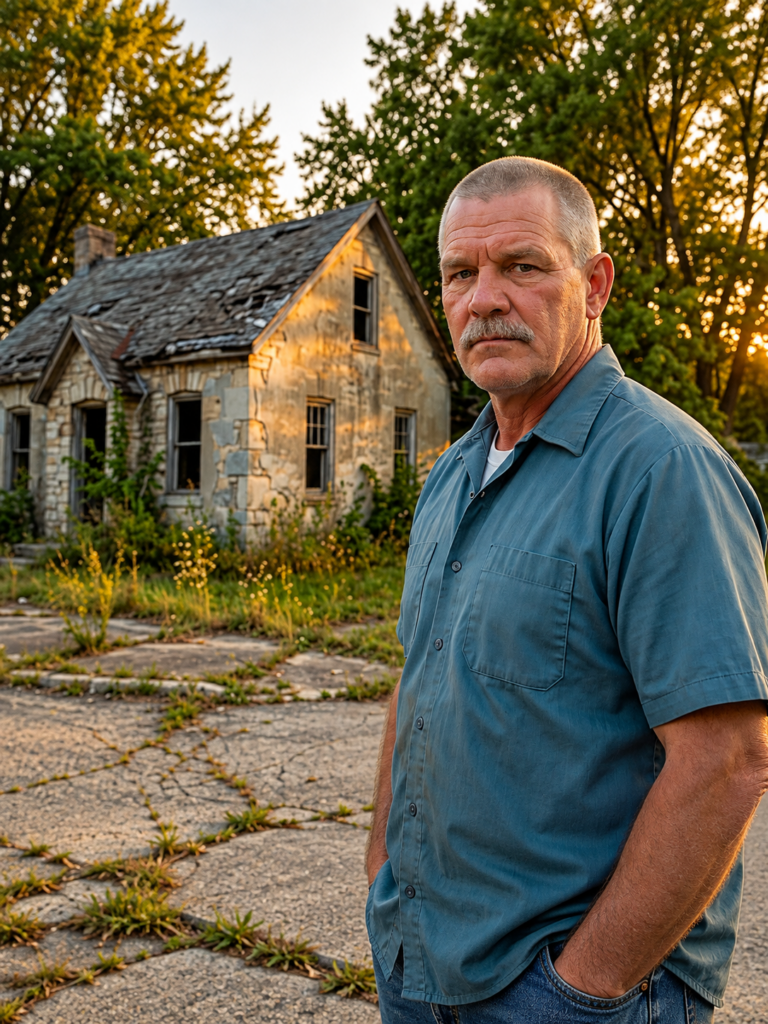
Louise studied his face. At fifty-eight, Weston had the weathered hands of a man who had spent most of his adult life building and repairing things, but his eyes carried an exhaustion that had little to do with physical work.
“You’re certain?”
He removed a crumpled dollar bill from his wallet and placed it on her desk.
“It’s the only house I can afford.”
Louise stamped the paperwork.
And on an August afternoon in 2024, Weston Hale became the owner of a stone cottage that had stood abandoned for roughly half a century.
Outside, his fifteen-year-old Ford pickup waited in the parking lot. Its windshield was cracked, its Ohio registration overdue, and nearly everything he owned was piled beneath a blue tarp in the truck bed.
He had ten thousand dollars reserved for the materials and permits the county required. Beyond that, he had eleven hundred dollars to buy food, fuel, and whatever else life demanded.
He also had a house with a collapsing roof, boarded windows, and a reputation that had frightened away buyers for decades.
Weston climbed into the truck and sat without turning the key.
Six months earlier, he had believed he would retire in the home he shared with his wife.
Now he was preparing to sleep inside a building that half the town considered cursed.
He folded the deed carefully and placed it in the glove compartment.
Then he started the engine.
In February, his life had still looked ordinary.
Weston worked at a machine-parts plant outside Dayton, where he had spent twenty-two years operating and maintaining equipment. He knew which machines required coaxing on cold mornings, which supervisors cared about safety, and which coworkers could repair almost anything with a wrench and a little patience.
He lived in a mortgaged house in a quiet subdivision with his wife, Renata.
They had been married twenty-six years.
Their life wasn’t perfect. They had disagreements about money, long stretches of tired conversation over dinner, and weekends when they barely had enough energy to enjoy the house they were paying for.
But Weston had believed those were the usual difficulties of a long marriage.
One Tuesday afternoon, he came home early from a shortened shift.
The first thing he noticed was the silence.
Then he saw the empty space beside the front door where Renata kept her favorite cabinet.
In the living room, several photographs were missing from the walls. The good dishes were gone from the dining room. Upstairs, half the bedroom closet stood empty.
Nothing had been knocked over. There were no broken objects or signs of an argument.
Someone had removed an entire life with extraordinary care.
On the kitchen table sat a folder containing legal paperwork.
A yellow sticky note rested on top.
We need to talk. Call my lawyer.
Weston read it three times.
He had not known Renata wanted to leave. He had not known she had spoken with an attorney. Most painfully, he had not known she had reached a decision important enough to end their marriage without first sitting across the table from him.
When he finally called, Renata spoke with the composed voice of someone who had already rehearsed the conversation.
She told him she wasn’t happy anymore.
She said they had been growing apart for years.
Weston asked when she had decided their marriage was over.
There was a pause.
“It’s been a while,” she answered.
He stood beside the half-empty kitchen table after the call ended, trying to understand how two people could inhabit the same house while living inside such different versions of their marriage.
Three weeks later, the plant announced a consolidation.
Its parent company was merging production lines to reduce costs. Weston’s line would be eliminated.
Twenty-two years of service ended in a fifteen-minute meeting in a break room.
His severance amounted to three weeks of pay.
The company representative thanked him for his dedication and wished him success in his future endeavors.
Weston carried his tools out to his truck.
For the first time in decades, he had no reason to set an alarm the following morning.
The divorce lasted four months.
Renata’s attorney argued for a larger share of the proceeds from their house, pointing to mortgage payments she had covered after Weston lost his job and money she had contributed from an inheritance.
Weston was told he could challenge the proposed division.
He knew the settlement wasn’t favorable. He knew Renata was receiving considerably more than he was.
But every legal bill reduced the money available to begin another life.
He was exhausted by the negotiations, embarrassed by his unemployment, and increasingly desperate to stop discussing his marriage as though it were a collection of assets waiting to be priced.
He agreed to a settlement that divided the remaining house proceeds approximately seventy-thirty in Renata’s favor.
His retirement savings were divided as well.
The one valuable possession he kept entirely was his pickup, which he had paid off years earlier using money inherited from his father.
When everything was settled, Weston received a check for eighteen thousand dollars.
It looked substantial until he began spending it.
He moved into an extended-stay motel on Route 4. The room contained a narrow bed, a small table, and a microwave that smelled faintly of someone else’s dinners.
Each week brought another bill.
The storage unit holding his furniture cost money. The motel cost money. Gasoline, groceries, laundry, and phone service cost money.
Weston applied for jobs at warehouses, equipment shops, maintenance departments, and manufacturing plants.
Most employers never responded.
A few acknowledged his experience and promised to contact him after reviewing other candidates.
Nobody called.
The worst moments were often small.
At a hardware store, he encountered a former coworker who glanced at the single package of paint rollers in his hand and asked what project he was working on.
Weston couldn’t bring himself to explain that he no longer had a workshop, much less a house.
Another evening, a customer service representative asked whether his spouse should remain listed on an account.
He stared at the motel wall before answering.
“No. There isn’t a spouse anymore.”
Eventually he stopped telling people what had happened.
But he couldn’t stop doing the arithmetic.
At the rate his savings were disappearing, the motel would soon become impossible to afford.
One morning, while eating eggs at Dot’s Diner, he found himself calculating whether sleeping in his truck would save enough money to keep the storage unit another month.
Dot noticed.
She had been serving him breakfast several mornings a week and had learned more about his circumstances from his silences than his conversations.
Without making an announcement, she set a folded newspaper beside his plate.
“Read that.”
Weston glanced at the page.
“What’s this?”
“County’s selling old houses for a dollar. My cousin bought one over on Chestnut a couple summers ago.”
He gave her a skeptical look.
“A dollar?”
“A real dollar. But don’t start thinking somebody’s handing you a free house.”
She tapped the article.
“You’ve got to fix the place yourself. Live in it. Follow their rules. Prove you’ve got money for the repairs.”
Weston read the article while his eggs cooled.
Millport had acquired several abandoned properties after years of unpaid taxes. Rather than continue maintaining vacant buildings, the local government was offering them for a symbolic purchase price to buyers willing to restore them.
The program required the homes to be brought up to code within eighteen months.
He reread the paragraph.
Then he looked at Dot.
“You think they’d let somebody from outside town apply?”
“Only one way to find out.”
The next morning, Weston reached the municipal building before it opened.
Louise Petrakis explained the requirements carefully.
He would need proof of at least ten thousand dollars reserved for materials and permits. Within thirty days, the property had to pass a basic safety review. He would have to arrange inspections, complete necessary repairs, and meet the county’s restoration schedule.
The better houses had already been claimed.
Only one property remained with a realistic chance of receiving temporary occupancy approval.
Louise opened a manila folder.
The photograph showed a stone cottage almost swallowed by ivy. Its chimney leaned, the roof sagged, and plywood covered the windows.
“That’s the Ashgrove place,” she said.
Weston examined the picture.
“What’s wrong with it?”
“Besides what you can see?”
“That bad?”
“Nobody’s lived there since the sixties, as far as anyone remembers. It’s out on Hollow Creek Road. Folks have some stories about it.”
“What kind of stories?”
Louise hesitated.
“Bad luck. Strange things. Some of the older families call it cursed.”
Weston looked down at the photograph again.
He had spent months being quietly judged for circumstances he hadn’t chosen. The prospect of being judged for buying a strange old house didn’t trouble him much.
“Does the roof still have a chance?”
“The inspector thinks so, with work.”
“Then I’ll take a look.”
A few days later, after considering what little money he had left, he returned to sign the deed.
Hollow Creek Road became narrower the farther Weston drove.
The sidewalks disappeared. Houses gave way to open fields, uneven fences, and stretches of woodland.
At the end of the road, beyond a rusted gate and a stand of overgrown lilac bushes, stood his new home.
The photograph had been generous.
A section of roof had sunk inward above the kitchen. The front door hung crooked in its frame, and the porch boards looked too soft to trust.
A faded sign on a fence post read:
KEEP OUT.
Weston stood beside the truck for several minutes.
Then he retrieved his flashlight.
The cottage smelled of damp wood, old stone, and decades of trapped air. Dust coated the mantel. A bird’s nest filled much of the fireplace. Water stains marked the plaster above loose floorboards.
He moved carefully through three small rooms.
The damage was considerable, but the workmanship beneath it caught his attention.
The stone walls had been laid by someone who understood how to make them last. Several floor joists were warped but sound. At the staircase, a hand-carved newel post remained firmly anchored beneath years of grime.
Weston ran his fingers across the carving.
Somebody had cared about this place once.
He could still see it.
In the kitchen, a rectangular section of stonework looked slightly different from the surrounding wall. The mortar appeared newer, and the pattern didn’t quite match.
He examined it briefly, then moved on.
Old houses were full of repairs that nobody remembered making.
By evening, he had unloaded enough supplies to assemble a cot in the front room.
He lay awake listening to branches scrape against the boarded windows.
He was frightened, though not by the stories about curses.
He was afraid he had spent his remaining money on a mistake he was too old and too poor to survive.
The county inspector arrived during the first week.
He examined the roof, checked the stair railing and emergency exits, and ordered the old knob-and-tube electrical wiring disconnected until it could be replaced.
With temporary safety measures in place, he approved partial occupancy.
Weston could legally sleep there while he worked toward the remaining inspections.
The building still had no usable electrical system and no dependable plumbing.
But it was his.
For the first two weeks, he accomplished less than he expected.
Every repair seemed to expose another problem.
A damaged board concealed a rotted support. Loose plaster revealed cracked mortar. A doorway that looked merely crooked turned out to have a badly deteriorated lower frame.
He hauled water in five-gallon jugs from a gas station and heated canned soup on a propane burner. At night, he added numbers on a yellow legal pad, estimating how much lumber, wiring, pipe, and roofing material he could afford.
He slept on his cot, often waking to unfamiliar creaks.
During the second week, a storm arrived after sunset.
Rain hammered the roof. Water began dripping near the chimney, then along the kitchen wall, then through a ceiling seam above his tools.
Weston moved buckets from one leak to another until well past midnight.
By morning, his clothes were damp, his back ached, and a spreading water stain threatened the only corner of the room he had believed was dry.
He sat on the cot and stared at the floor.
For ten minutes, he considered driving back to the motel and surrendering the cottage to the county.
Then he looked at the tools stacked beside him.
He stood up, made coffee, and went outside to secure another tarp over the roof.
Quitting wouldn’t put a roof over his head.
The first neighbor to introduce himself was Gideon Ashworth, a retired mechanic who lived two properties down.
He arrived one Saturday carrying a thermos and stopped near the edge of the yard.
“Heard somebody bought the old Ashgrove house.”
Weston continued scraping rotten paint from a porch rail.
“That would be me.”
“For a dollar?”
“Plus whatever it’ll take to keep it standing.”
Gideon gave a short laugh.
“That second part’s going to be the expensive one.”
He offered Weston coffee.
They stood together looking at the cottage.
“You heard about Delia Ashgrove?” Gideon asked.
“Just that people didn’t care for her.”
“My daddy used to talk about her. Said she stayed to herself and wouldn’t let anybody past the front door. Toward the end, folks thought she’d lost her mind.”
“Did your father know her?”
“Not well. Nobody did, from what he told me.”
Gideon looked toward the dark windows.
“After she died, people said whoever came to handle the estate couldn’t get away fast enough. Then the county ended up with the place for unpaid taxes. Been sitting here ever since.”
Weston waited.
“You believe it’s cursed?”
Gideon considered the question.
“I believe people get used to being afraid of things they don’t understand.”
He drank the last of his coffee.
“Doesn’t mean I’d have bought it.”
Over the following weeks, Gideon returned.
He showed Weston where an old well cap lay hidden beneath blackberry brambles. He diagnosed a stubborn valve on the propane tank, saving Weston a service call he could scarcely afford.
Sometimes he left coffee on the porch before Weston woke.
He never made a ceremony of helping.
One afternoon, while Weston rehung the front door, Gideon leaned against the fence and watched.
“People are talking about you.”
“I assumed they were.”
“Some think you’re crazy.”
“Maybe they’re right.”
“Maybe.” Gideon rubbed his chin. “But I don’t think so.”
Weston glanced toward him.
“What’s the difference?”
“Between crazy and determined?”
“Yeah.”
Gideon looked at the repaired doorway.
“Give it enough time, and you’ll be able to tell by what’s still standing.”
Weston remembered that conversation several days later when the kitchen water line failed.
He had been working to reconnect the old plumbing and wanted to test the supply.
The moment he opened the valve, a hollow knocking sound came from beneath the floor.
Then came a sharp hiss.
He shut the water off and pulled up a loose section of subfloor beside the cast-iron sink.
Water pooled around the joists.
With a flashlight in one hand and a pipe wrench in the other, he lowered himself into the crawl space and traced the damaged galvanized pipe toward the foundation wall.
It disappeared behind the same rectangle of mismatched stone he had noticed on his first day.
Up close, the difference was unmistakable.
The mortar surrounding the rectangle had been applied carelessly compared with the rest of the foundation.
A rusted wooden shelf frame was mounted against it at an awkward angle.
Weston reached for one of the bolts.
It loosened under his wrench.
He removed the second bolt, then pulled on the frame.
Instead of coming free, it swung sideways.
A concealed hinge creaked.
Behind the shelf was an opening.
Weston lowered his flashlight.
Beyond the stonework stretched a narrow passage carved directly into the bedrock.
For a long moment, he remained crouched beneath the kitchen, hearing the occasional drip from the broken pipe.
Someone had deliberately concealed this entrance.
Someone had gone to considerable trouble to make certain it would not be discovered.
He leaned forward and directed the beam into the darkness.
The passage continued beyond the light.
Weston thought about going back for help.
Instead, he checked the ground beneath his boots, adjusted his flashlight, and stepped inside.
The tunnel was narrow enough that his shoulders nearly brushed the rock. The air was cold and dry, carrying a faint mineral smell.
After approximately twenty feet, it opened into a small chamber.
His light moved across a wooden crate filled with dark glass bottles.
Their seals were still intact.
A tarnished copper still stood against another wall, its metal stained green by age.
Weston stopped breathing for a moment.
The cottage had once been something more than a home.
Against the far wall, a metal strongbox rested on a shelf carved into the rock.
It was the one object in the chamber that appeared to have been deliberately protected.
He approached it, examining the rusted hinges.
Then he noticed another opening beyond the still.
A second passage sloped downward, apparently toward the creek behind the property.
He followed it for about ten feet before fallen rock and packed earth blocked the way.
He wasn’t going to attempt clearing a collapsed tunnel by himself.
He returned to the main chamber, lifted the strongbox from the shelf, and carried it through the passage toward daylight.
On the porch, he set the box beside his cot and worked at the rusted lock with a screwdriver and hammer.
After several minutes, the metal finally gave.
Inside lay three small ledger books wrapped in brittle oilcloth.
There were bundles of letters tied with string, yellowed receipts, and columns of handwriting that seemed to combine ordinary numbers with letters arranged in a code.
At the bottom was a folded photograph.
Weston opened it carefully.
A young woman stood before the cottage, her arms crossed, her expression direct and almost defiant.
Behind her, the roof was straight and the stonework clean.
There was no date written on the front.
Weston turned it over, looking for a name.
Nothing.
He studied the woman’s face.
He suspected he knew who she was.
For fifty years, people had avoided the Ashgrove cottage because they believed something terrible had happened there.
Yet someone had spent time, money, and extraordinary effort hiding a chamber beneath its foundations.
Weston looked from the photograph to the strange ledgers.
He had bought the house because he needed somewhere to live.
Now he was holding the remains of a secret that someone had once considered worth burying.
And he had no idea what it meant.
Part 2
Dot was wiping down the counter when Weston entered the diner carrying a canvas bag.
He ordered coffee, but he barely touched it.
“You look like you found something,” she said.
“I did.”
He glanced around before opening the bag enough to show her one of the old ledger books.
“Ever seen writing like that?”
Dot looked at the columns.
“Not unless somebody’s trying to hide how much they owe the bank.”
Weston gave a tired smile.
“I found it under the cottage. There’s a tunnel down there.”
Dot stopped wiping.
“An actual tunnel?”
“Cut into the rock. Leads to a room full of old bottles, a copper still, and a metal box.”
She stared at him for several seconds.
“Well, I’ll be.”
Weston explained the hidden shelf, the passage, and the photograph.
He told her about the second tunnel that had collapsed in the direction of the creek.
Dot listened without interrupting.
When he finished, she set the towel aside.
“You need to talk to Nora Whitfield.”
“Who’s that?”
“Runs the county historical society. Office is above the library. She’s been digging into old Millport history for years.”
“Think she can read this?”
“If anybody around here can figure out what Delia Ashgrove was up to, it’s Nora.”
Nora Whitfield was in her fifties, with a habit of studying documents before studying the people who brought them to her.
Her office was crowded with filing cabinets, local maps, newspaper clippings, and books stacked on every available surface.
Weston placed the ledgers, letters, receipts, and photograph on her desk.
Nora was polite at first.
She asked where he had found the materials and whether he had moved anything else.
Then she picked up the photograph.
Her expression changed.
“Where did you get this?”
“From a strongbox beneath the Ashgrove cottage.”
“You found a strongbox?”
“In a chamber behind a hidden passage.”
Nora sat down.
For a moment she didn’t speak.
Then she turned the photograph toward him.
“Do you know who this is?”
“I’m guessing Delia Ashgrove.”
Nora nodded slowly.
“I’ve spent nine years researching that woman. In all that time, I’ve found one photograph I could confidently identify. A grainy image from a church social in 1929.”
She studied the face again.
“This is her.”
Weston moved closer.
“So what was she doing with a tunnel full of bottles?”
Nora looked toward the ledgers.
“I have a suspicion.”
She opened one book and examined the coded entries.
“But I’d rather know than guess.”
Over the next two weeks, Nora worked on the ledgers nearly every evening.
Weston continued repairing the cottage during the day. Some afternoons he visited the library to help compare names and dates against archived tax records.
The handwriting was consistent, but the letters in the accounting columns made little sense.
Eventually Nora identified a simple substitution cipher.
Once she understood the pattern, the earliest entries began to reveal themselves.
Deliveries.
Cash payments.
Quantities.
Dates.
Names disguised as initials.
The entries began in 1922.
Several referenced a supplier from Cincinnati identified only as R.T.
Others recorded weekly payments to men Nora believed had connections to the county sheriff’s office.
The books contained the ordinary, practical details of an illegal business conducted with remarkable discipline.
One evening, Nora pushed a decoded page toward Weston.
“Your tunnel wasn’t built for storage alone.”
“Then what was it for?”
“Moving liquor.”
She pointed to a series of deliveries that corresponded with coded notes about access to the creek.
“During Prohibition, liquor had to move without attracting attention. A cottage on the edge of town would make a useful operation if the owner had a private route to a drop point.”
Weston pictured the narrow passage beneath his kitchen.
“And Delia ran it?”
“That’s what these records indicate.”
He looked at the photograph resting beside the ledger.
“Everybody around here thought she was some kind of crazy old hermit.”
“Apparently she was also an exceptionally careful businesswoman.”
Nora turned another page.
“Careful enough not to get caught.”
Their research showed that Delia had inherited the cottage from an aunt in 1919, when she was twenty-three years old.
She had never married.
Shortly afterward, Prohibition began, and she built an operation that would continue throughout its thirteen years.
According to the ledgers, she employed only two trusted workers to help move supplies through the tunnels.
Both were paid well.
Both were identified by initials rather than full names.
Even her illegal accounting suggested someone who understood the importance of protecting other people.
Weston found that detail unexpectedly moving.
Delia had been a young woman running a risky enterprise during an era when the people around her had already decided she didn’t fit their expectations.
Yet the records did not show chaos or recklessness.
They showed patience, organization, and control.
Still, something bothered Nora.
The accounts continued after the repeal of Prohibition in December 1933.
At first, she assumed Delia had simply kept operating.
Then she noticed a separate column that had begun appearing around 1927.
It was divided from the ordinary business transactions by a small hand-drawn line.
The amounts in that column were going out rather than coming in.
Some entries contained surnames Nora recognized from old property records.
Others referred to bank notes, farms, and mortgages.
One Thursday evening, Weston arrived at Nora’s office to find her sitting motionless over an open ledger.
“Something wrong?”
“No.”
She looked up.
“I think I’ve been misunderstanding her.”
Weston pulled a chair closer.
Nora pointed to an entry dated March 1934.
She had written the decoded meaning on a separate sheet.
A debt had been paid through someone named Whitcomb. The recipient had been told the money came from an uncle’s estate.
Another note made it clear the family was never supposed to discover the real source.
Weston frowned.
“Why invent an inheritance?”
“Because a family might refuse charity.”
Nora tapped the page.
“Or because questions could expose who paid the debt.”
They turned through more entries.
A mortgage balance paid.
A farm note settled.
Money passed through an intermediary.
A household saved from foreclosure.
During the Great Depression, when families across the region were losing homes and land, Delia Ashgrove had used money from her former liquor operation to relieve their debts.
She had created cover stories.
She had hidden her identity.
And she had kept meticulous records of people who never knew who had helped them.
Nora traced a surname with her finger.
“I know this family. Their descendants still live here.”
She turned a few pages.
“And this one.”
Then another.
Weston watched her recognize the names.
“Are you saying she saved their houses?”
“Some houses. Some farms. Maybe more than we can prove yet.”
Nora sat back, her face pale with concentration.
“For decades, people told stories about Delia being selfish and strange. These families have probably repeated those stories without knowing their own grandparents were among the people she protected.”
Weston thought of the cottage standing empty at the end of Hollow Creek Road.
A woman had lived there for years while her neighbors mistrusted her.
And in secret, she had been helping some of those same neighbors keep the roofs over their heads.
He looked down at the coded pages.
“She never told them.”
“No,” Nora said. “And she wrote everything down anyway.”
Weston understood the significance of that choice.
Delia could have kept no records after the liquor business ended. She could have destroyed the evidence, spent the money, and allowed history to forget her completely.
Instead, she had preserved the details of the people she helped.
Not so she could claim credit during her lifetime.
Perhaps simply because she believed their survival deserved to be remembered.
Weston returned to the cottage with a different feeling about the building.
He still saw the sagging roof, rotten trim, and unfinished wiring.
But when he crossed the kitchen, he sometimes imagined Delia standing at the same window, studying the road before letting anyone approach.
He wondered how often she had heard people whisper about her.
How many times she had walked past families whose mortgage payments she had secretly made.
The cottage had not changed.
What changed was the meaning of the work.
Every board he replaced began to feel connected to a woman whose life had been misunderstood long before his own began to unravel.
That didn’t make the restoration easier.
The county still required him to meet its deadlines.
Money still vanished into lumber, plumbing supplies, wiring, and roofing materials.
During three difficult weekends in early autumn, Weston replaced the roof. Gideon helped carry shingles and equipment, but Weston did much of the work himself, climbing carefully and measuring twice before every cut.
The electrical inspection failed.
The old wiring was too dangerous to patch, and some sections Weston had already closed had to be opened again.
A later plumbing inspection failed because a drain line had been installed at the wrong pitch.
The error cost him another two hundred dollars and a weekend of rework.
He kept a list of failed inspections and required repairs penciled onto the inside of a kitchen cabinet door.
Each time he corrected something, he drew a heavy line through it.
Some evenings he stood in front of that cabinet and counted the crossed-out entries just to remind himself he was making progress.
Gideon saw the list once.
“Quite a collection,” he said.
“County seems determined to give me new ones.”
“Good inspectors usually are.”
Weston grunted.
Gideon pointed to the crossed-out entries.
“That’s the part you ought to be looking at.”
When money ran especially low, Gideon recommended Weston to a contractor who needed help with framing jobs.
Weston spent two weekends working away from the cottage and used the wages to cover a plumbing bill.
The work exhausted him, but it gave him something he hadn’t felt in months.
Someone was paying him because his skills mattered.
Not because they felt sorry for him.
As Nora continued translating the records, Weston asked a local appraiser named Otis Bramwell to examine the bottles and copper still.
Otis specialized in artifacts from the Prohibition era.
He spent an afternoon carefully photographing the collection, recording the condition of the bottles, and inspecting the old equipment.
Some items were potentially valuable to collectors.
The entire collection, kept intact with the ledgers and letters, had considerable historical significance.
Weston listened to the assessment, but the possibility of selling the artifacts troubled him.
The money would solve immediate problems.
He could afford better materials, finish the restoration sooner, and finally stop wondering how long his remaining savings would last.
Otis explained that the sealed spirits could not simply be sold privately.
Ohio’s liquor-control requirements would involve licensed channels and additional legal considerations.
Weston had neither the time nor the inclination to untangle a commercial sale.
He asked Nora whether the historical society could preserve the collection.
She looked at him with surprise.
“You’re considering donating all of it?”
“That’s what I’m thinking.”
“Do you understand what the collection might be worth?”
“I understand.”
“Weston, this could pay for a tremendous amount of work on your house.”
He looked toward the ledgers.
“I’ve got a house because nobody else wanted it. Those things tell people what happened here.”
He paused.
“Feels wrong to split them up.”
Nora studied him.
“Are you certain?”
“I didn’t buy Delia’s house to get rich. I bought it because I needed somewhere to sleep.”
He glanced down at his hands.
“I can still find work to pay for shingles.”
He intended to donate the collection once the legal ownership questions were resolved.
Until then, Nora arranged for the historical society to hold and display the artifacts on loan.
Before the townspeople even learned about the ledgers, however, another visitor appeared at Weston’s gate.
He arrived in a clean vehicle wearing a polo shirt embroidered with the name Larkspur Holdings.
The man introduced himself as Preston Doyle.
“Mr. Hale, I represent a development company acquiring property along Hollow Creek.”
Weston rested a paint scraper on the porch rail.
“What kind of development?”
“A small cluster of short-term rental cabins. Weekend visitors from Columbus. There’s demand for places with creek access and a little privacy.”
Weston waited.
Doyle looked beyond him at the partially repaired cottage.
“We’re offering forty thousand dollars for your parcel. Cash. Closing in thirty days. No contingencies.”
Weston stared at him.
“Forty thousand?”
“That’s right.”
“For this?”
“We’re interested in the land, Mr. Hale. Not the structure.”
Doyle spoke matter-of-factly.
“Frankly, with the condition of the building and the reputation of the property, most buyers wouldn’t consider it. We’re offering more than it would likely bring on the ordinary market.”
Weston thought about the motel.
He thought about the weeks when he had counted every meal against his savings and wondered whether he would end up sleeping in his truck.
Forty thousand dollars could buy him a small place somewhere else.
It could give him a financial cushion for the first time since the divorce.
And perhaps a year earlier, he would have accepted before Doyle finished explaining the offer.
But then he pictured the chamber beneath the kitchen.
The photograph.
The ledgers.
The names of families who had nearly lost everything.
“I appreciate the offer,” Weston said. “But it’s not for sale.”
Doyle seemed surprised.
“Can I ask why?”
“I’m fixing it up.”
“That’s going to be expensive.”
“I know.”
Doyle offered his business card.
“If you reconsider, call me.”
Weston took the card and watched him drive away.
Later, he placed it in a kitchen drawer and returned to work.
By then, word about Delia Ashgrove was beginning to spread.
Dot mentioned the discovery to two customers at the diner.
Those customers told relatives.
Before long, the Millport Gazette heard about the secret chamber.
A reporter named Wallace Turnbridge came to the cottage and asked Weston whether he would agree to an interview.
Weston disliked attention.
He had spent most of his adult life avoiding it.
But Nora persuaded him that the history mattered.
“This isn’t just about an old liquor operation,” she told him. “It’s about people who still live here.”
Wallace interviewed both of them.
He photographed the stone cottage, asked questions about the hidden tunnel, and examined the decoded records Nora was preparing for the historical society.
The article appeared on the front page.
Weston found the headline embarrassingly dramatic.
Still, the essential story was accurate.
An abandoned cottage, long believed cursed, had concealed a Prohibition-era operation and evidence that its former owner had quietly helped local families survive the Depression.
In a town of approximately four thousand people, the news traveled quickly.
People who had avoided Hollow Creek Road began driving past the cottage.
Some stopped to look.
A few asked whether they might see the tunnel.
Weston declined most requests while he was still repairing the entrance and making the property safe.
At the historical society, Nora received calls from families asking whether their grandparents’ names appeared in Delia’s records.
Some were simply curious.
Others were visibly emotional.
The ledgers challenged stories their families had repeated for generations.
Nora presented the research at a public meeting, explaining the tunnel’s connection to the creek and the possibility that the surrounding land had once formed part of Delia’s transportation network.
County officials began considering a Hollow Creek Historic Corridor that could protect more than the cottage itself.
The proposal would recognize the surrounding route as part of the area’s history.
That attracted Preston Doyle’s attention.
He returned to Weston with an offer of fifty thousand dollars.
Weston refused.
Months later, after the newspaper article and the historical corridor discussions had drawn more attention, Doyle arrived again.
This time he offered eighty-five thousand dollars.
Weston stood on the porch while Doyle explained that the company could make the transaction simple.
“The property has become more complicated,” Doyle admitted. “But we still want it.”
“Then you’re going to be disappointed.”
Doyle frowned.
“Eighty-five thousand dollars for a house you bought for one?”
“I’m not selling.”
“You understand that a historic corridor could interfere with development across several parcels we’ve already optioned.”
Weston looked toward the road.
He knew Doyle was doing a job. He also knew that the company had spent months buying land with plans that hadn’t accounted for Delia’s history.
But those plans weren’t a reason for Weston to surrender the only home he had managed to build for himself.
“Maybe your company should have looked into this place before making all those plans,” he said.
Doyle’s expression tightened.
“That’s your final answer?”
“It is.”
For a moment neither man spoke.
Then Doyle returned to his vehicle.
Weston watched him leave, feeling neither wealthy nor victorious.
He still had bills he couldn’t comfortably afford.
He still needed to finish the house.
But for the first time in a long while, he had been offered a way out of hardship and had chosen to stay.
Renata called after the newspaper story appeared.
Weston didn’t recognize the number.
He answered while standing in the kitchen, where fresh mortar was drying along one section of the wall.
“Weston?”
He recognized her voice immediately.
“Renata.”
There was a pause.
“I saw the article.”
He looked toward the strongbox, now empty and set aside near the workbench.
“Oh.”
“The house. Everything you found. It’s incredible.”
“It’s been a surprise.”
“I’ve been thinking about you.”
Weston said nothing.
Renata continued, her voice softening.
“I know things ended badly. And I know I could have handled them differently.”
He leaned against the counter.
“I suppose we both could have.”
“I’m proud of you, Weston.”
He closed his eyes briefly.
During twenty-six years of marriage, he had learned to recognize the rhythm of Renata’s conversations. He knew the moments when she was being sincere, and he knew the careful tone she sometimes adopted before bringing up something difficult.
He couldn’t tell which one he was hearing now.
“Thank you,” he said.
She asked a few more questions about the restoration.
He answered politely.
When the call ended, he stood in the kitchen for several minutes, looking at the telephone.
A small part of him wanted to believe she had called because she was relieved he had found stability.
He had loved her for more than half his adult life.
That history did not disappear simply because a judge had signed a divorce decree.
But he also remembered the empty house and the note telling him to contact her lawyer.
Two weeks later, another letter arrived.
This one came from a Dayton law firm called Halverson and Voss.
Weston opened it at his kitchen table.
It stated that Renata intended to petition for the divorce property settlement to be reopened.
Her attorneys argued that the artifacts discovered beneath the cottage might constitute an undisclosed marital asset connected to the period surrounding the dissolution of their marriage.
He was given thirty days to respond before a formal filing would be pursued.
Weston read the letter once.
Then again.
He set it beside the same yellow legal pad he used to calculate roofing costs.
For twenty-six years, he had helped build a marriage.
He had surrendered most of what remained of that life because he wanted the legal fighting to end.
Now Renata was asking for a share of something he had discovered after they were divorced, in a house she had never entered and had never helped him repair.
He folded the letter.
The next morning, he drove into Millport to see a lawyer.
Part 3
Callaway Reed was one of the few attorneys in Millport who regularly handled disputes beyond simple wills and property transactions.
His office was small and practical, with crowded bookshelves and a desk covered in paperwork.
Weston placed the letter from Halverson and Voss in front of him.
Callaway read it without speaking.
Then he went back to the first page and read it again.
Finally, he removed his glasses.
“When was your divorce finalized?”
Weston gave him the date.
“And when did you purchase the cottage?”
“About two months later.”
“With money awarded to you in the settlement?”
“Yes.”
“And the deed is entirely in your name?”
“Yes.”
Callaway tapped the paper.
“Then the claim they’re making is extremely weak.”
Weston sat rigidly.
“They’re saying what I found might have belonged to us.”
“They can say that. It doesn’t make it true.”
Callaway opened a folder.
“The property was purchased after the marriage legally ended. The money used for the purchase was already yours under the settlement. You discovered these objects on property you acquired independently.”
He looked directly at Weston.
“Renata doesn’t gain a marital-property claim simply because something valuable turned up later.”
Weston exhaled.
He had expected an argument.
Instead, the lawyer was giving him something he hadn’t experienced during the divorce: a clear explanation of where he stood.
“Does that mean everything in the tunnel is legally mine?”
Callaway paused.
“That’s a separate question.”
He leaned back.
“Finding old property doesn’t always establish ownership. We need to consider whether the objects were abandoned, whether Delia Ashgrove left any heirs, and whether there were unresolved claims from her estate.”
Weston frowned.
“Louise told me the county took the house over unpaid taxes decades ago.”
“That helps. But I want to review the title history and probate records before you permanently transfer the collection to the historical society.”
Weston nodded.
He appreciated the distinction.
He didn’t want something that rightfully belonged to someone else’s family.
But neither was he prepared to give Renata money simply because she had seen a newspaper article.
Callaway looked at the letter again.
“My guess is they’re testing whether you’ll pay something to avoid the expense of a fight.”
Weston stared at the desk.
“That’s what happened the first time.”
Callaway waited.
“During the divorce,” Weston continued. “I didn’t have the money to keep arguing. Every week meant another bill. I finally signed because I wanted it over.”
He rubbed a thumb across the rough skin of his palm.
“I don’t want to do that again.”
“You don’t have to agree to a demand just because somebody put it on legal stationery.”
Weston gave a humorless laugh.
“I know that now.”
Callaway reached for a blank sheet of paper.
“We’ll answer them. We’ll give them the dates, the ownership details, and the basis for rejecting the claim. We’ll also make it clear we intend to challenge any unsupported filing.”
He began taking notes.
Weston remained in his chair while the attorney worked.
A few months earlier, he had thought his life had become a sequence of things other people decided for him.
Renata decided to leave.
The company decided to eliminate his position.
The bank, the lawyers, and the motel determined how quickly his savings disappeared.
Now he was sitting in an office discussing something he had chosen to build.
And he intended to protect it.
Renata came to the cottage three days after Callaway sent the response.
Weston heard tires crunching on the newly graveled driveway while he was working near the porch.
He looked up and saw an unfamiliar car.
Renata stepped out.
She wore neat clothes and looked much as he remembered, though he noticed the differences immediately.
There were new lines around her eyes.
Her hair was styled differently.
She surveyed the cottage with an expression he couldn’t quite read.
Weston set down his tool.
“Renata.”
“Hello, Weston.”
For a moment they stood facing each other across the yard.
She looked at the repaired roof, the clean fieldstone, and the new porch railing.
“You’ve done a lot with this place.”
“I’ve been working on it.”
“It looks good.”
“Thank you.”
She moved closer, stopping near the bottom of the steps.
“I didn’t realize how much you’d actually done until I saw it.”
Weston followed her gaze.
The house was still unfinished, but it no longer resembled the ruin in Louise’s photograph.
The front door closed properly.
The roof was sound.
The porch had been rebuilt.
Gideon had helped him move gravel for the driveway, and the worst of the weeds had been cleared from the yard.
Weston knew every repair because he remembered the pain, expense, and frustration that had accompanied it.
Renata saw the finished sections.
He saw the weekends they had cost.
“Did you come to see the cottage?” he asked.
She looked at him.
“I came because I thought we should talk.”
“About the letter?”
“Yes.”
Weston leaned against the porch rail.
“I’m listening.”
Renata took a breath.
“I’m not trying to take your house.”
“That’s good.”
“I just think there should be some acknowledgment of everything that happened between us.”
He waited.
“We were married for twenty-six years, Weston. We built a life together. I know the divorce was painful, but that doesn’t mean those years meant nothing.”
“They didn’t mean nothing.”
“Then surely you can understand why it feels unfair that you found something valuable and I get nothing.”
Weston looked at her for a long moment.
He had imagined this confrontation while driving home from Callaway’s office.
In those imaginary conversations, he had shouted.
He had reminded her of every bill, every unanswered job application, every night he lay awake wondering whether he would lose the motel room.
But standing before her, he did not feel the anger he had expected.
He felt tired of explaining things that should have been obvious.
“Renata, you received most of the house proceeds.”
“That was the settlement.”
“Yes.”
“And we both signed it.”
“We did.”
He straightened.
“That’s my point.”
She frowned.
“You don’t have to talk to me like I’m a stranger.”
“I don’t want to.”
“Then don’t.”
Weston looked toward the driveway, gathering his thoughts.
“When I came home in February, half our house was empty. You’d already spoken to a lawyer. You’d already made arrangements. You left me a note telling me to call someone I didn’t even know existed.”
Renata lowered her eyes briefly.
“I know I handled that badly.”
“You were allowed to decide you didn’t want to be married anymore. I’m not arguing with that.”
His voice remained steady.
“But you wanted the divorce settled, and we settled it. You accepted your share. I accepted mine.”
“Weston—”
“Two months later, I bought this house.”
He gestured toward the cottage.
“For a dollar. Because nobody else wanted it.”
Renata glanced at the building.
“I know.”
“No, I don’t think you do.”
He spoke without raising his voice.
“When I moved in, I didn’t have working electricity or plumbing. The roof leaked. I slept on a cot and carried water in jugs. Some nights I wondered whether I’d be back in my truck before the county deadline came around.”
She said nothing.
“I didn’t know there was anything under the kitchen. I wasn’t expecting to find money or antiques or whatever those bottles turn out to be worth. I needed a place to live.”
He paused.
“And I worked to make one.”
Renata folded her arms.
“But we spent twenty-six years together. Doesn’t that count for something?”
“It counted for twenty-six years.”
The answer came quietly.
“It counted until the day you decided to end it.”
Renata’s face tightened.
“That’s a cold thing to say.”
Weston shook his head.
“I don’t think it is.”
He looked directly at her.
“If you’d come out here because you were glad I found somewhere to live, I would have believed you.”
“I am glad.”
“Then why did I hear from your lawyer before I saw you?”
She opened her mouth, then closed it.
Weston continued.
“You called and told me you were proud of me. Two weeks later, I got a letter threatening to reopen the settlement.”
“I had questions about what was fair.”
“Then you could have asked me.”
“I didn’t think you’d agree.”
“Agree to what?”
She looked away.
The answer was already between them.
Money.
For a moment, Weston remembered the woman he had married, the younger Renata who had once stood beside him while they discussed buying their first house.
He remembered long drives, ordinary dinners, and years of shared responsibilities.
He didn’t need to pretend those memories were worthless.
But he no longer believed they required him to surrender what remained of his independence.
“I don’t want to fight with you,” he said.
Renata looked back at him.
“Neither do I.”
“Then let’s leave the settlement where it belongs.”
She studied his face.
He wondered whether she was waiting for him to soften, to offer a compromise simply to make the uncomfortable conversation end.
He had done that often during their marriage.
He had certainly done it during their divorce.
This time he remained silent.
Finally, Renata nodded once.
“I see.”
She turned toward her car.
Weston didn’t stop her.
He also didn’t take satisfaction in watching her leave.
The gravel crackled beneath her tires as she backed out and drove toward Hollow Creek Road.
When the sound faded, Weston stood alone in the yard.
He looked at the cottage.
The porch railing still needed another coat of finish.
He picked up his tool and returned to work.
Eleven days later, Halverson and Voss sent another letter.
Renata would not pursue the threatened filing.
Callaway’s response had made the dates and ownership circumstances clear enough that her attorneys apparently saw no benefit in continuing.
There was no courtroom confrontation.
No dramatic judgment.
No public apology.
The claim simply ended.
Weston read the letter once and placed it in a folder with the other documents concerning the house.
It was enough.
He never heard from Renata again.
Callaway continued reviewing the history of the cottage and the discovered collection.
A few weeks later, the title and probate research was complete.
There were no surviving Ashgrove heirs identified with an outstanding claim, no unresolved estate preventing the transfer, and no challenge to the county’s old tax forfeiture.
Callaway was satisfied that Weston could proceed with the donation.
When he informed Nora, she almost seemed more relieved than Weston.
“You’re still certain you want the whole collection to go to the historical society?” she asked.
“Every piece that belongs with it.”
“Even the bottles?”
“Yes.”
“The copper still?”
“Yes.”
“The photograph and ledgers?”
Weston smiled.
“Nora, I’ve spent months listening to you explain why those books matter. It would be pretty strange if I changed my mind now.”
She laughed.
Then her expression grew serious.
“I can’t promise a grand museum or an expensive exhibition.”
“I don’t want one.”
“What do you want?”
He considered the question.
“I want the people Delia helped to know her name.”
Nora looked down at the photograph on her desk.
“I think we can do that.”
Weston signed the donation paperwork.
He felt some relief in completing it.
The collection would remain together.
The record of Delia’s life would no longer depend on a private owner keeping an old box safe.
He had found the objects beneath his floor, but he had never believed their history belonged to him alone.
The years between Delia’s death and Weston’s arrival had allowed the cottage to deteriorate into something people used as a warning.
Parents had told children to stay away.
Teenagers had dared one another to approach the door.
Neighbors had treated the old property as a place best forgotten.
That changed gradually.
The historical society began preparing an exhibit using the letters, decoded ledgers, receipts, photograph, and selected objects from the tunnel.
Nora did not want to turn Delia into a sensational character from a gangster story.
The Prohibition operation mattered.
The hidden passages mattered.
The sealed bottles and copper still offered tangible evidence of a remarkable enterprise.
But the deepest significance lay in the names written in the second half of the ledgers.
Those names connected the discovery to living families.
Nora cross-referenced debts and dates with surviving records, carefully distinguishing what the documents established from what remained uncertain.
She explained how Delia had shifted from moving liquor in secrecy to moving money in secrecy.
The same habits that once protected an illegal business had later protected families too proud or frightened to accept help openly.
Weston often visited while the exhibition was being prepared.
Sometimes he recognized a name because someone with the same surname had stopped by the cottage.
Other times Nora explained that a family still owned land that might have been lost during the Depression if an old mortgage had not been settled.
He listened, thinking about the desperation of those years.
He could imagine some of it.
He knew what it felt like to stare at a bill and wonder which necessity could be postponed.
He knew the humiliation of needing help when he had always prided himself on paying his own way.
He also knew how much a quiet act of kindness could mean.
Dot had slid a newspaper across a diner counter.
Gideon had brought coffee and helped him solve problems he couldn’t afford to ignore.
Nora had spent hours deciphering records without asking for anything in return.
None of them had saved Weston with a large sum of money.
They had given him the smaller, necessary kinds of help that allowed a man to keep going.
In that respect, he understood Delia better than he might have before losing his marriage and job.
Still, understanding her history didn’t pay his remaining restoration bills.
Weston continued working.
The months passed through another round of inspections, repairs, and adjustments.
He corrected the drain line.
He finished replacing the unsafe wiring.
He repaired the remaining damaged walls and refinished the staircase, taking particular care with the hand-carved newel post.
When he finally sanded away the last layer of old finish, the wood grain emerged warm and clean beneath his palm.
He stood looking at it for longer than the task required.
He liked knowing that someone more than a century earlier had shaped that piece by hand.
He liked knowing it would remain useful.
By the time the county’s final restoration deadline approached, the long list on the inside of his cabinet door was nearly covered in pencil lines.
Every failed inspection had been corrected.
Every necessary repair had been completed.
The cottage was once again a house a person could live in safely.
Weston finished with weeks to spare.
The historical society opened its Delia Ashgrove exhibit that winter, roughly six weeks before Weston’s eighteen-month restoration deadline.
Nora had arranged the display with care.
A photograph of Delia stood near the entrance.
Two sealed bottles from the old chamber sat inside a protective case.
Beside them lay one of the ledgers, opened to a page whose coded entries had been translated on a nearby placard.
The explanation described Delia’s history without romanticizing the illegal business she had operated.
It also explained how money from that enterprise had been used to pay mortgages and debts for struggling families during the Great Depression.
Weston arrived wearing a jacket he had purchased specifically for the occasion.
He felt uncomfortable standing among people who seemed to expect him to make a speech.
He had spent years working in places where a job well done was usually acknowledged with a nod and the next assignment.
Public attention still felt unnatural.
Nora came over to greet him.
“You look like you’re ready to escape.”
“Is it that obvious?”
“Only to someone who’s been watching you avoid reporters for months.”
He smiled.
“Thought this was supposed to be Delia’s day.”
“It is.”
Nora glanced around the room.
“And you’re the reason we have these things to show people.”
Weston shook his head.
“I’m the reason they came out of the ground. That’s different.”
She didn’t argue.
People began arriving.
Some were local history enthusiasts.
Others were curious neighbors who had followed the newspaper story.
But a significant number came because their families were named in Delia’s records.
Nora had prepared carefully documented explanations showing how individual ledger entries corresponded with old mortgages and financial transactions.
Visitors leaned close to read.
A few exchanged quiet remarks about grandparents and great-grandparents whose names they recognized.
Others stood for a long time before the display.
Weston watched an older couple study one of the translations.
The man traced a finger along the explanatory text, then turned to the woman beside him.
They spoke softly.
Weston couldn’t hear what they said.
He didn’t need to.
Across the room, another visitor pointed toward a surname in the ledger and called a family member over.
Stories that had belonged only to the distant past were suddenly becoming part of people’s understanding of their own lives.
Delia had never asked these families to thank her.
She had gone to considerable trouble to ensure they couldn’t.
And now, decades after her death, they finally knew.
Weston stepped away from the display and stood near the back of the room.
For the first time since he had found the hidden passage, he felt the discovery had reached its proper destination.
The artifacts were not simply valuable objects.
They were evidence that a woman remembered as a curse had quietly helped keep much of the town alive.
By the time the county’s restoration deadline arrived, the Ashgrove cottage barely resembled the property Weston had purchased.
The roof no longer sagged.
The fieldstone had been cleaned and repointed.
The front door opened smoothly and closed squarely in its frame.
Sunlight entered through repaired windows, warming rooms that had spent decades behind weathered plywood.
The kitchen had working plumbing.
The electrical system was safe.
And beneath the floor, the hidden passage remained.
Weston had reinforced its entrance and fitted it with a proper door.
Nora arranged for a small brass plaque explaining the discovery and identifying Delia Ashgrove.
The secondary passage remained blocked by its old collapse; Weston had no interest in risking anyone’s safety to explore beyond it.
The county’s work on the proposed historic corridor continued through its own process.
Weston couldn’t control what officials would eventually decide about every parcel along Hollow Creek.
He was satisfied that Delia’s story had become part of the public record and that the cottage itself would be preserved.
Some Sunday afternoons, people still came to the door.
A few asked about the tunnel.
Others wanted to see the place where the photograph of Delia had been taken.
When it was safe and convenient, Weston gave brief informal tours, explaining what had been found and directing visitors to the historical society for the full collection.
He never charged admission.
He wasn’t interested in becoming a local celebrity.
He wanted to keep living in the house.
Gideon still visited, often with coffee.
Dot still asked about the restoration whenever Weston stopped at the diner.
Louise Petrakis, who had once warned him how difficult the property would be, finally had an example of what her county program could accomplish when someone was determined enough to finish.
Weston took particular satisfaction in that.
He had not failed the county’s requirements.
He had kept the promise he made when he signed the deed.
More importantly, he had kept a promise to himself.
He had begun the restoration because he was running out of places to go.
Somewhere along the way, he had started building a life he actually wanted.
He no longer woke every morning wondering what had been taken from him.
There were still difficult days.
He still had to manage his money carefully.
The divorce had not become a happy memory, and losing a job after twenty-two years still hurt when he thought about it.
He hadn’t become wealthy because of the hidden chamber.
He hadn’t received a fortune.
He had declined the developer’s eighty-five-thousand-dollar offer, and the historical artifacts had gone to the society rather than into his bank account.
But he had a home that he owned and maintained.
He had neighbors who knew him for what he did rather than what he had lost.
He had work he could take pride in.
And he had learned something about the difference between the value of an object and the worth of the life attached to it.
One evening, about a year and a half after purchasing the cottage, Weston sat on the front porch with a cup of coffee.
The lilac bushes along the drive had been trimmed.
The yard was clear enough to see Hollow Creek Road through the trees.
The roof above him was solid, and the door behind him closed properly.
He looked toward the gate where he had first parked his truck on that August afternoon.
He remembered the photograph Louise had pushed across her desk.
The warnings about bad luck.
The damp cot.
The water dripping through the ceiling during his first storm.
He remembered wondering whether he had made the worst decision of his life.
Then he thought about Delia.
She had inherited this cottage when she was young, built a secret business beneath it, and used what she earned to protect people who never knew she had helped them.
The town had misunderstood her for decades.
After her death, it had allowed her home to crumble.
Weston knew what it felt like to have a life reduced to the least flattering version other people could tell.
A divorced man.
An unemployed factory worker.
An aging stranger foolish enough to buy a ruined house.
Those descriptions had all contained some fragment of truth.
None had told the complete story.
He wondered whether Delia had understood that, too.
He liked to think she had.
The cottage had sheltered both of them, separated by generations.
For Delia, it had been a place from which she could help others without being seen.
For Weston, it became the first place where he could begin again without needing anyone else’s approval.
He took another sip of coffee.
The evening light settled on the repaired fieldstone.
Somewhere beneath his kitchen, the tunnel remained quiet and cold, no longer forgotten, no longer an unexplained source of fear.
The woman who had hidden her work there finally had a name people spoke with respect.
And the man who had uncovered it finally had somewhere he belonged.
Weston rested his cup on the porch rail and looked out across the yard.
He had spent one dollar to buy the cottage.
Everything after that had cost him far more than he had expected.
But sitting there, in a house that had survived because he refused to abandon it, he knew the dollar had purchased something no amount of money could have guaranteed.
A place to begin again.

