
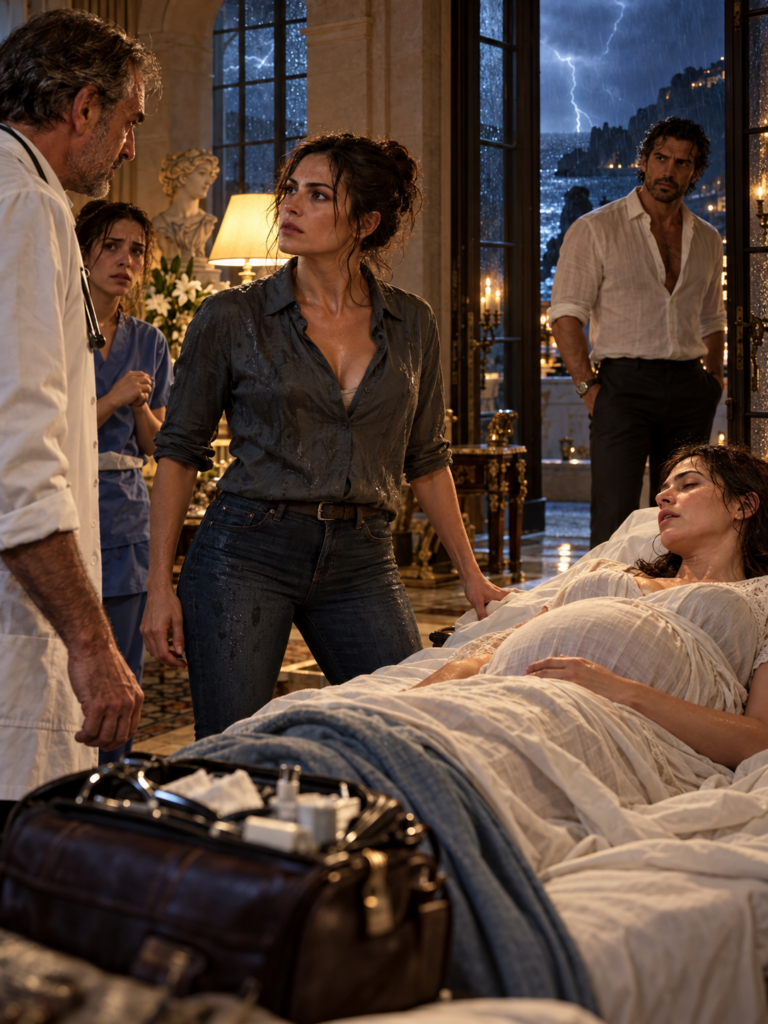
Marco answered while watching the Fiat vanish around the coastal bend.
“Tell me.”
Enzo’s voice was controlled.
“Two of our men were injured during the mainland meeting. The disagreement wasn’t settled.”
Marco looked toward the upper windows of the house.
Lucia and her newborn daughter were resting inside.
“Is anyone coming here?”
“Nothing suggests that.”
“Keep it that way.”
He ended the call.
For twelve years, Marco had managed the Valente family through calculations of loyalty, obligation, and risk.
He understood how disputes spread.
He also understood that the people he loved could become vulnerabilities if he handled those disputes carelessly.
That had never bothered him quite as much as it did this morning.
He thought about Valentina standing beside Lucia’s bed.
She hadn’t asked who controlled the house.
She had asked whether an emergency vehicle could reach it.
That distinction stayed with him.
Three days later, he called Valentina.
She answered while driving along the coast.
“Marco?”
“Your brother arrived safely. He’s with Lucia.”
“Good. He was devastated he missed the delivery.”
“He hasn’t stopped holding the baby.”
Valentina smiled despite herself.
“That sounds like Dante.”
A pause followed.
Then Marco said, “I’d like to formalize Lucia’s postpartum care. Would you consider taking the case?”
“I’ve already told her I’ll visit.”
“I’d prefer consistent professional oversight.”
“With proper backup arrangements?”
“Yes.”
“And clear clinical authority?”
“Yes.”
“And nobody from your household interfering with medical decisions?”
A faint pause.
“That may require educating certain people.”
“Begin with yourself.”
This time he laughed.
It was brief.
Real.
Valentina nearly missed her turn.
They agreed to discuss the arrangements on Tuesday.
When she arrived, Marco was waiting in the entrance hall.
Wearing shoes this time.
She noticed.
He noticed her noticing.
“An improvement?” he asked.
“Substantial.”
Upstairs, Lucia was recovering well.
Her daughter, Alessia, slept peacefully against her chest.
Dante was beside them, looking like a man who had discovered something more important than every bridge he’d ever built.
Valentina conducted her examination, answered Lucia’s questions, and reviewed the follow-up plan.
Only afterward did she meet Marco in his study.
He had prepared the arrangements.
She read them carefully.
“This emergency transfer provision needs to be explicit.”
He passed her a pen.
“Change it.”
“And the nursing support schedule?”
“Whatever is clinically appropriate.”
Valentina looked up.
“You’re surprisingly cooperative.”
“I’ve discovered there are subjects on which I know less than I thought.”
“How uncomfortable for you.”
“Extremely.”
She almost smiled.
But as she reviewed the final page, she noticed something else.
Marco had asked detailed questions about postpartum recovery and continuity of care.
He had taken the time to understand what Lucia needed.
Not merely what equipment could be purchased.
“Why so much effort?” she asked.
He looked at her.
“Because what happened that night should never have reached the point it did.”
The answer was unexpectedly personal.
Valentina closed the folder.
“Then make certain you remember that.”
“I will.”
The weeks developed a rhythm.
Every Tuesday, Valentina drove north.
She cared for Lucia and Alessia.
Sometimes Dante joined them for lunch.
Sometimes the household cook, Giulia, insisted that Valentina stay for dinner.
And increasingly, Marco appeared during her visits.
At first, she considered it coincidence.
Then she stopped believing in coincidence.
He asked about her work.
About the patients she found difficult to forget.
About the years she’d spent training in Florence and Rome.
He listened more closely than most men she’d dated.
And he remembered things.
Her preference for strong coffee.
Her love of old books.
The ridiculous orange cat named Caligula waiting at her apartment.
One evening, as he accompanied her to the courtyard, he asked whether she was happy.
“In general?” she replied.
“In the life you’ve made.”
“Yes.”
He nodded.
“Good.”
She stopped beside her car.
“Is there something you’re trying to ask me?”
He looked toward the olive trees.
“I wonder whether that life has room for someone else.”
Valentina felt the question settle between them.
She had expected ambition from Marco Valente.
Perhaps arrogance.
Perhaps the expectation that any woman he noticed would be flattered into surrender.
She hadn’t expected patience.
“That depends on the someone,” she answered.
He turned back.
“And what would this particular someone need to understand?”
“That I won’t abandon my patients, my home, or my independence because a wealthy man finds me interesting.”
Marco considered her words.
“Reasonable.”
“And I don’t intend to become another person in your house who waits for permission to speak.”
“I’d be disappointed if you did.”
She studied him.
For a moment, the attraction between them became impossible to mistake.
Then she opened her car door.
“Good night, Marco.”
“Good night, Valentina.”
She drove away.
He watched the taillights disappear.
Neither of them noticed Enzo standing at the far end of the courtyard.
But Enzo noticed everything.
Especially the unfamiliar expression on his boss’s face.
Later, Enzo entered Marco’s study with an update about the mainland dispute.
Marco listened.
Then Enzo mentioned the name Ricardo Fabri.
Marco’s expression hardened.
Fabri controlled interests that overlapped the Valente family’s operations.
The disagreement was becoming expensive.
And Fabri had begun asking questions about people close to Marco.
“Does he know about Lucia?” Marco asked.
“Only that she’s your cousin.”
“And Valentina?”
Enzo hesitated.
“Someone mentioned the midwife who attended the birth.”
Marco rose from his chair.
“Make sure the situation stays between us and Fabri.”
Enzo nodded.
But the uncertainty in his face remained.
Because Fabri was not interested merely in business disagreements.
He enjoyed discovering what other men valued.
And Marco Valente had just begun valuing someone he couldn’t bear to endanger.
Marco looked at Enzo for a long moment.
“How much does Fabri know?”
“Not much. That Dr. Greco attended Lucia’s delivery. That she visits the estate.”
“And?”
“He may have noticed your interest.”
Marco turned toward the window.
Below the terrace, the Mediterranean stretched beyond the olive trees.
For years he had protected the Valente family’s interests by keeping his personal life largely inaccessible.
Now one woman with an ancient Fiat and an infuriating habit of asking direct questions had made him reconsider what he wanted from that life.
“Don’t approach her without my approval,” he said.
Enzo nodded.
Then Marco added, “And don’t interfere with her work.”
“Understood.”
Yet even as he spoke, Marco recognized the difficulty.
He was accustomed to controlling risks.
Valentina was accustomed to making her own decisions.
Those instincts were going to collide.
*
The first time she noticed the darker part of his world, it wasn’t through violence.
It was through absence.
On her fifth Tuesday at the estate, there were more security personnel near the entrance.
Two unfamiliar vehicles stood inside the gates.
Giulia’s usually cheerful kitchen had become unusually quiet.
Valentina found Lucia upstairs with Alessia.
“What’s happened?”
Lucia looked toward the door.
“Marco had trouble on the mainland.”
“What kind?”
“Two of his men were hurt.”
“Is he injured?”
“No. He’s home.”
Valentina completed her examination before asking anything else.
Lucia and Alessia were healthy.
That mattered first.
But as she crossed the entrance hall afterward, Marco appeared from a side corridor.
There was a recently closed cut above his eyebrow.
He looked exhausted.
“Your cousin and her daughter are doing beautifully,” Valentina said.
“Thank you.”
“You’re bleeding.”
“Not anymore.”
“That’s not the reassuring distinction you think it is.”
He glanced toward the study.
“Would you like coffee?”
“Only if you’re going to sit down and stop pretending you’re indestructible.”
He looked surprised.
Then, quietly, he answered, “Yes.”
They sat together while afternoon sunlight moved across the bookshelves.
For a long time, Marco said nothing.
Valentina waited.
Finally, he told her his father had built the Valente organization through power, intimidation, and relationships that were not entirely lawful.
When Marco inherited leadership at twenty-six, he had begun expanding legitimate operations while remaining responsible for parts of the organization that could not be described as respectable.
“Some of those responsibilities have consequences,” he said.
“Violent consequences?”
“Sometimes.”
“Have you hurt people?”
He looked at her directly.
“Yes.”
Valentina felt the answer in her stomach.
She had suspected it.
Hearing it was different.
“Have you killed anyone?”
Marco’s silence lasted longer.
Then he answered.
“Yes.”
She looked down at her hands.
Those hands had delivered hundreds of babies.
They had comforted frightened mothers and supported families through grief.
The man opposite her had used his authority in ways she could never treat lightly.
“Why are you telling me?” she asked.
“Because I want you to know who you’re talking to.”
“Some people would lie.”
“I’ve spent enough of my life surrounded by lies.”
She studied his face.
“Does that make your choices acceptable?”
“No.”
The simplicity of his answer unsettled her.
“I won’t ask you to approve of what I am,” he continued.
“Good. Because I haven’t decided what I think.”
“I understand.”
“And I’m not going to pretend your foundation and your schools make the violence disappear.”
“They don’t.”
For the first time, she saw Marco without the illusion of a dangerous man made harmless by private tenderness.
He was capable of tenderness.
He was also responsible for choices that carried moral and legal consequences.
She needed to consider both.
When she left that evening, he didn’t ask her to stay.
He walked her to her Fiat.
At the door, she turned.
“I appreciate the truth.”
“It may have cost me your good opinion.”
“That depends on what you do with it.”
He nodded.
She drove away.
And for three weeks, she thought carefully about what choosing him would mean.
*
Valentina had never been a woman who confused attraction with trust.
She was thirty-one.
She had built her professional life through years of demanding training.
She liked her apartment in Cagliari, her friends, her independence, and the routine of a job that mattered.
Marco was not a missing piece she needed to become complete.
He was a person she might choose to love.
That distinction mattered.
When she finally called him in November, she was standing in her kitchen.
Caligula slept on the radiator.
Outside, the sea was gray beneath a cold sky.
“I’ve been thinking,” she said.
“I know.”
“Have you been counting the days?”
“Yes.”
She smiled.
“Of course you have.”
A pause.
Then she continued.
“I won’t excuse what you’ve done simply because I care about you.”
“I wouldn’t ask you to.”
“But I also won’t pretend I haven’t begun to care.”
The silence changed.
“Valentina.”
“I’m saying I want to find out whether there’s something real between us.”
He drew a slow breath.
“May I come over?”
She looked at her cluttered apartment.
The books.
The half-finished tea.
The ordinary life she had no intention of abandoning.
“Yes.”
He arrived half an hour later.
He wore dark trousers and a jacket without a tie.
Caligula opened one eye from the radiator, considered the visitor, and returned to sleep.
Marco looked offended.
“Does he greet everyone like that?”
“Only people who think they’re important.”
For the first time, she heard Marco laugh without restraint.
They sat together on the small sofa.
He didn’t move closer until she did.
Then he asked what she needed from him.
“Honesty,” she said.
“You have it.”
“The ability to refuse things without having to justify myself.”
“Agreed.”
“And I need to remain myself.”
He studied her.
“You’ve never been anything else.”
“That’s precisely what I intend to keep.”
She reached for his hand.
Marco looked down at their joined fingers.
“Can I kiss you?” he asked.
Valentina smiled.
“Yes.”
Their first kiss was slow.
Not because either lacked desire.
Because there was finally no reason to hurry.
*
By Christmas, they were spending more time together.
Valentina continued working in Cagliari.
Marco divided his time between the coast, the mainland, and his business responsibilities.
They found moments between competing schedules.
Sometimes he came to her apartment.
Sometimes she stayed at the northern estate.
They talked about births, vineyards, family obligations, and difficult choices.
At the Valente family’s Christmas dinner, Marco introduced her to his mother, Giulia Valente.
The older woman regarded Valentina with unmistakable curiosity.
“You’re the midwife.”
“Among other things.”
“What other things?”
Valentina considered the question.
“A woman with a career, a family, and opinions nobody asked me to surrender.”
Giulia looked at her son.
Then she smiled.
“Good. He needs someone who remembers he isn’t always right.”
Marco sighed.
“Mother.”
Lucia laughed.
Dante nearly spilled his wine.
And Valentina felt something unexpected.
Not the suffocating pressure of being absorbed into a powerful family.
The warmth of being welcomed without having to pretend.
Later, on the terrace overlooking Cagliari, Marco asked if she was serious about their relationship.
Valentina turned toward him.
“I wouldn’t be here otherwise.”
He touched her hand.
“Neither would I.”
*
But the mainland dispute had not disappeared.
Ricardo Fabri had begun questioning arrangements connected to Marco’s operations.
He believed certain records and commercial relationships gave him leverage.
Marco’s people considered him opportunistic.
Valentina understood him differently.
Fabri was a man who enjoyed making other people uncomfortable because their uncertainty gave him power.
The first time he approached her, she was leaving a coffee bar near the port.
“Dr. Greco.”
She stopped.
The man was well dressed, with a practiced smile.
“Have we met?”
“Ricardo Fabri.”
The name meant enough.
She kept her expression neutral.
“I know of you.”
“I’m acquainted with Marco Valente.”
“Then you have his number.”
Fabri smiled.
“I’ve heard about the remarkable delivery you attended in July.”
Valentina’s expression cooled.
“I don’t discuss patients.”
“Of course. I simply admire skilled professionals.”
“Then I suggest you let them return to work.”
She stepped past him.
He didn’t physically prevent her from leaving.
But she understood the purpose of the meeting.
He wanted her to know he had discovered her connection to Marco.
She reached her car and called Marco herself.
“Fabri approached me.”
There was a pause.
“Are you safe?”
“Yes.”
“Where?”
“Near the port. Enzo’s car is nearby.”
She had agreed to the discreet security arrangement after Marco explained the specific risk.
But she had also insisted that her movements and conversations remain private unless there was an actual safety concern.
“What did Fabri say?” Marco asked.
“Nothing particularly useful. He mentioned Lucia’s delivery.”
“That’s enough.”
“He wants you to react.”
“I know.”
“Then don’t give him what he wants.”
Marco was quiet.
Then he said, “You’re calmer than I am.”
“I’m irritated, not helpless.”
“I understand.”
“And Marco?”
“Yes?”
“If your business disagreement puts me at risk, I expect to know.”
“You will.”
“Not afterward.”
“Not afterward.”
The tension eased.
A few days later, Marco told her he had reached an arrangement with Fabri.
It had cost money and concessions.
But no new confrontation was necessary.
Valentina was relieved.
Then, on January fifteenth, the agreement collapsed.
*
They were eating dinner in Marco’s Cagliari penthouse when Enzo called.
Marco listened.
His expression changed.
“Fabri,” he said after ending the call.
Valentina put down her fork.
“What now?”
“He’s made a claim to authorities on the mainland. It concerns one of our disputed arrangements.”
“Is the claim legitimate?”
“No. But it will take work to answer.”
“Legal work?”
“First, yes.”
“And after that?”
Marco looked at her.
“I intend to settle it without more violence.”
She held his gaze.
“Good.”
“I need to travel tomorrow.”
“How long?”
“I’m not certain.”
Then he asked her to stay at the northern estate while he was gone.
She frowned.
“Why?”
“Because it’s easier to secure than the apartment here.”
“And my patients?”
“Your schedule doesn’t need to change.”
She thought about it.
The request was inconvenient.
But it was a request.
Not an order.
“All right,” she said. “Temporarily.”
“Thank you.”
“Don’t thank me until you’ve helped me move Caligula.”
Marco glanced toward the cat sleeping on the chair.
“I suspect he’s going to object.”
“Violently.”
Marco smiled.
Then the smile faded.
“I don’t like leaving you while this is unresolved.”
She leaned forward.
“You’re not abandoning me by attending to your responsibilities.”
“I know.”
“And I’m not a helpless woman waiting to be rescued.”
“I know that too.”
She kissed him.
“Then go do what you need to do.”
*
Three days later, a stranger called Valentina at the northern estate.
He said he was contacting her on Fabri’s behalf.
He implied that Marco’s position was more dangerous than she’d been told.
He suggested she reconsider the relationship for her own safety.
Valentina listened.
Then she answered.
“I work with frightened people during some of the most difficult hours of their lives. I recognize pressure when I hear it.”
The caller hesitated.
“Mr. Fabri simply wishes—”
“Tell him I received his message.”
She ended the call.
Then she phoned Marco.
She explained the conversation without embellishment.
“Did he frighten you?” Marco asked.
“He annoyed me.”
A pause.
“Are you certain you’re safe?”
“Yes. But I want a direct answer from you. Is Fabri’s claim serious?”
“The legal exposure is real. We have a response. It will be expensive.”
“And manageable?”
“Yes.”
“Then keep me informed.”
“I will.”
She looked out at the winter sea.
“Marco, I’m not asking you to pretend your life is simple. I’m asking you not to make me guess which parts of it affect mine.”
His answer came quietly.
“Understood.”
*
Marco returned on a Friday evening.
Valentina was in the kitchen with Giulia when she heard his car enter the courtyard.
He stepped through the doorway looking exhausted.
His shirt was rumpled.
His usual precision had given way to the appearance of a man who had spent too many hours negotiating something unpleasant.
Valentina stood.
“Is it finished?”
“Fabri withdrew the claim.”
“And?”
“He’s moving the disputed operations away from Sardinia. We reached an agreement.”
“Without anyone being hurt?”
“Yes.”
She searched his face.
There were details he had not shared, and she would continue asking questions where the consequences affected her.
But the immediate danger was finished.
Marco looked at her.
“I’m sorry his people contacted you.”
“I know.”
“I should have called more.”
“You called every day.”
“It didn’t feel like enough.”
She crossed the kitchen.
“Marco.”
He stopped.
“Come here.”
For once, the man accustomed to issuing instructions simply obeyed.
She put her arms around him.
He held her tightly.
The embrace contained something no expensive gift or declaration could have replaced.
Relief.
He had returned.
She had remained herself.
And they had met again without either asking the other to surrender.
Outside, the wind moved through the olive trees.
Inside, Valentina rested her cheek against his shoulder.
Then she asked the question that had been growing in her heart for months.
“Do you understand why I stayed?”
Marco lifted his head.
He looked into her eyes.
And for once, he didn’t have an answer.
Marco remained silent.
Valentina could hear the wind pressing against the kitchen windows.
Behind them, Giulia quietly collected her book and left, understanding that some conversations required privacy.
“Why do you think I stayed?” Valentina asked again.
Marco looked down at her hands resting against his shirt.
“Because you trust me.”
“Partly.”
“Because I’ve told you the truth.”
“Sometimes.”
He accepted the correction.
“Because you care about me.”
She smiled faintly.
“That’s closer.”
He searched her face.
“Then what am I missing?”
Valentina took his hand and led him toward the sitting room.
The fire was still burning.
Outside, January rain moved across the estate’s terraces.
She sat beside him.
“I stayed because when you came into my apartment in November, you asked what I needed.”
Marco listened.
“You didn’t tell me how you’d arrange my life. You didn’t promise to solve every problem. You asked.”
She looked at him.
“And for a man who’s been giving orders since he was twenty-six, that was extraordinary.”
He gave a quiet, humorless laugh.
“It shouldn’t be extraordinary.”
“No. But it matters that you’re learning.”
For a long moment, Marco said nothing.
Then he told her something he had rarely admitted.
When his father died, every man connected to the family had begun watching him.
Some watched for weakness.
Some for opportunity.
Others wanted to know whether the young successor would protect the arrangements that made them wealthy.
Marco had learned to regard uncertainty as dangerous.
He studied every detail, anticipated every refusal, and made decisions before anyone else had time to make them.
“It kept the organization together,” he said.
“And it cost you?”
“More than I knew.”
Valentina waited.
“When you arrived during Lucia’s labor, I couldn’t solve the problem myself. I couldn’t buy the right outcome. I couldn’t order her body to cooperate.”
His expression tightened at the memory.
“I had hired people who assured me they were the best. Then you walked in and showed me that competence doesn’t need permission from power.”
Valentina smiled gently.
“You did give me room to work.”
“After you demanded it.”
“True.”
He took her hand.
“I remember standing in that doorway and realizing that the only useful thing I could do was listen.”
“And did you?”
“Eventually.”
She laughed.
He brought her fingers to his lips.
“I think I began falling in love with you that night.”
Valentina went very still.
Marco looked up.
He hadn’t planned the confession.
That was evident from the surprise in his own expression.
But he didn’t take it back.
“You were exhausted,” he continued. “You’d driven through a storm for someone you loved. You challenged a doctor I’d hired, confronted me in my own house, and then spent hours making certain Lucia and Alessia were safe.”
He paused.
“And afterward, you asked for eggs.”
Valentina burst out laughing.
“Good eggs.”
“Very specific eggs.”
“Standards matter.”
He smiled.
Then his expression softened.
“I have never known anyone quite like you.”
She moved closer.
“That’s not why I stayed either.”
“What is?”
“Because beneath everything, I found someone willing to be known.”
She kissed him.
This time, neither was afraid of what the kiss meant.
*
February arrived with a storm severe enough to damage parts of the northern estate.
By then, Valentina divided her time between Cagliari and Marco’s house.
Her apartment remained hers.
So did her practice.
She continued seeing patients and attending births, leaving the estate whenever her work required it.
Marco never asked her to abandon either.
That winter morning, the storm struck before dawn.
The windows shook.
The sea below the cliffs disappeared beneath sheets of rain.
A damaged outbuilding lost part of its roof.
Valentina found Marco in the study with two phones, a laptop, and a list of urgent calls.
She placed coffee beside him.
He looked up.
“You should be sleeping.”
“So should you.”
“I have a shipping problem.”
“And I have a book.”
She settled in the chair opposite him.
He smiled.
They spent the next hour together without speaking much.
It was one of the quietest mornings Valentina could remember.
And strangely, one of the happiest.
Marco worked.
She read.
Occasionally, one asked the other a question.
At sunrise, Lucia and Dante joined them with Alessia.
Caligula had claimed a high bookshelf as his refuge from the weather.
Giulia brought breakfast.
Dante began making bread because he couldn’t tolerate standing around without contributing something useful.
The house that had once seemed like a carefully guarded fortress became, for a few hours, an ordinary family home.
Valentina watched Marco lift Alessia from Lucia’s arms.
The little girl studied her older cousin with enormous dark eyes.
He held her carefully.
“She’s judging me,” he announced.
Valentina glanced toward Caligula.
“That makes two of them.”
Dante laughed.
Marco looked toward Valentina, and there was such warmth in his expression that she felt the familiar ache of recognition.
Not infatuation.
Not fascination with danger.
Something steadier.
The joy of watching someone become comfortable enough to be gentle.
*
As spring approached, Valentina began seeing another side of Marco’s life.
He took her to the vineyard in Ogliastra.
It was smaller than his coastal residence, with old stone buildings, terraces of vines, and a view that opened toward distant mountains.
There, his manner changed.
He knew the soil.
The harvest.
The workers.
The old amphorae used for aging some of the wine.
He spoke about his father with more nuance than she’d heard before.
“He wasn’t a good man in every respect,” Marco said. “But he understood this land.”
Valentina looked across the vines.
“Then that’s something good you can preserve.”
“I’ve tried.”
She walked beside him.
“Your foundation has helped schools on the island.”
“Yes.”
“And you have legitimate businesses people depend on.”
“Yes.”
“Then your life isn’t defined by only one kind of decision.”
Marco turned toward her.
“That doesn’t erase the others.”
“No. It doesn’t.”
She touched his arm.
“But it means you still have decisions to make about what comes next.”
He looked toward the vineyard.
For years, he had inherited responsibilities without questioning whether every inherited obligation deserved to survive.
Now he had begun examining that assumption.
There were financial interests he could disentangle.
Relationships he could end.
Parts of the organization he could change without pretending the past had been harmless.
He made no dramatic promise to become a different man overnight.
Valentina wouldn’t have believed one.
Instead, he showed her what he was doing.
What remained difficult.
What still carried risk.
And where he intended to draw boundaries.
Some days, they argued.
She challenged his habit of using secrecy.
He challenged her occasional belief that professional competence made every problem manageable through patience.
Neither always won.
Both learned.
*
By summer, a year had nearly passed since the night Marco first called.
Lucia and Dante were raising Alessia with the bewildered happiness of new parents.
The little girl had begun laughing at almost anything.
A raised eyebrow.
A silly sound.
Caligula walking through a room with unusual dignity.
Valentina attended Alessia’s first birthday celebration at the northern estate.
The same house where she’d once entered during a thunderstorm now glowed beneath the Sardinian sun.
Giulia had prepared far too much food.
Dante insisted that he had helped with the cake, though Lucia loudly disputed how much.
Marco stood near the terrace watching the gathering.
Valentina approached him.
“You’re hiding.”
“I’m observing.”
“That’s what you call it?”
“Usually.”
She slipped her hand into his.
“Come join us.”
He looked at the table.
At Lucia laughing.
At Dante holding their daughter.
At the people who were no longer adjusting their behavior merely because he had entered the room.
Then he followed her.
It was a small action.
But Valentina understood what it represented.
Marco had spent much of his adult life believing affection could be maintained through responsibility alone.
He was beginning to learn that love also required participation.
Not merely providing the house.
But sitting at the table.
Not merely paying for protection.
But asking whether someone wanted help.
Not merely ensuring a future.
But allowing the people in it to choose.
*
Later that afternoon, Valentina and Marco returned to his study.
The room smelled faintly of wood and sea air.
Books lined the walls.
Sunlight fell across the desk.
Valentina paused beside the window.
“I’ve been thinking about last July.”
Marco approached.
“The night you came?”
“Yes.”
“You were furious with my doctor.”
“He deserved it.”
“He did.”
“And you were standing there looking as if you expected me to wait for instructions.”
“I did.”
She turned and smiled.
“How disappointing for you.”
“Life-changing, apparently.”
Her smile softened.
He stopped beside her.
“I remember the moment Alessia cried,” he said. “I thought I understood what relief was.”
“And?”
“I’d never felt it like that before.”
He looked at her.
“Then you came into the corridor. You were tired enough to fall asleep standing, and you still wanted to know whether Lucia had everything she needed.”
“That’s the work.”
“Perhaps. But I remember thinking that the world seemed different with you in it.”
Valentina grew quiet.
Marco continued.
“I didn’t know how to tell you without sounding like a man who had spent his life getting whatever he wanted.”
“Maybe you couldn’t have told me then.”
“Why?”
“Because we didn’t know each other.”
He considered that.
“No.”
“And because you were accustomed to measuring interest by whether you could obtain something.”
“That’s true.”
She took his hand.
“But we’re here now.”
His eyes held hers.
“Yes.”
She stepped closer.
“And what do you see when you look at me?”
Marco was quiet for a long time.
Then he answered.
“Someone I trust to tell me when I’m wrong.”
She smiled.
“Frequently.”
“Someone whose work matters to her as much as mine matters to me.”
“Yes.”
“Someone who can leave when she wishes and whose decision to return means more than any promise I could demand.”
Her throat tightened.
“Marco.”
He brushed a strand of hair away from her face.
“Someone whose presence makes this place feel less like a headquarters and more like a home.”
She reached for him.
For a moment, they stood together without speaking.
Outside, Alessia laughed.
The sound traveled through the open window.
Valentina rested her forehead against Marco’s chest.
And realized she had found something she hadn’t been searching for.
Not someone to complete her.
Someone with whom the life she’d already built could grow.
*
Ten months later, on a mild morning in May, Valentina gave birth to a daughter.
She had spent years helping other women through labor.
Now she understood the experience from the other side.
She had chosen her care arrangements carefully, with a qualified obstetric team available and the support she wanted.
Marco had listened to every decision.
Sometimes he asked questions.
Sometimes he worried.
But he didn’t attempt to turn the birth into something he could command.
When their daughter arrived, healthy and weighing seven pounds, he looked astonished.
The little girl had dark hair and a calm expression.
Marco held her with extraordinary care.
For a long time, he said nothing.
Then he looked toward Valentina.
“She’s so small.”
Valentina laughed tiredly.
“That’s fairly standard.”
He looked back at the baby.
“She’s looking at me.”
“She hears your voice.”
His eyes filled.
Valentina watched him.
The man who had once commanded entire rooms without hesitation was now struggling to find words for seven pounds of new life.
“Does she have a name?” he asked.
Valentina smiled.
They had discussed names for months.
Disagreed about them.
Returned to the same possibilities.
She suspected he had been keeping one favorite to himself.
“You tell me.”
Marco looked at their daughter.
“Giulia.”
Valentina’s expression softened.
For his mother.
For the women who had helped keep the family together.
For the warmth of the household where their relationship had grown.
“Giulia,” she repeated.
Marco looked relieved.
“You like it?”
“I love it.”
He smiled.
Then he looked back at the baby.
“Hello, Giulia.”
The little girl moved one tiny hand.
Marco stared at it with complete fascination.
Valentina had seen countless fathers meet their newborn children.
She had watched confident men become uncertain, serious men cry, and quiet men suddenly discover an endless supply of words.
But watching Marco experience it was something different.
Because she knew what tenderness had cost him.
And she knew it had never required him to become weak.
Only willing to be open.
*
In the months that followed, their daughter grew.
Valentina continued her professional work while she and Marco arranged family life around the care their child needed.
They shared decisions about Giulia.
They shared the ordinary exhaustion of parenthood.
And they continued maintaining boundaries between their home and the unresolved complications of Marco’s professional world.
Marco still had responsibilities.
Some were difficult.
Some carried consequences from choices made long before Valentina entered his life.
He didn’t suddenly become a harmless man.
But fatherhood gave new weight to decisions he had already begun reconsidering.
He wanted his daughter to inherit a life where her surname didn’t dictate her future.
He wanted her to know the vineyards, the coast, her relatives, and the legitimate work that supported people across the island.
He didn’t want her raised to believe fear was respect.
Valentina agreed.
They would teach Giulia what her family had done.
The good and the bad.
They would not turn inheritance into obligation.
And if their daughter eventually chose a life far away from Sardinia, they would love her just as completely.
One evening, after Giulia had fallen asleep, Valentina found Marco standing beside the terrace doors.
The sea was dark.
The olive trees moved softly in the warm air.
He looked toward her as she approached.
“What are you thinking?” she asked.
“About the storm.”
“Which one?”
“The first.”
She smiled.
“Lucia’s delivery?”
“Yes.”
“You were barefoot.”
“You remind me frequently.”
“And extremely demanding.”
“I’ve improved.”
“Somewhat.”
He laughed.
Valentina stood beside him.
She thought of the frightened woman she had found in that delivery room.
The little girl she’d helped bring into the world.
The long drives north.
The Tuesdays that had become something neither of them anticipated.
The conversations that forced them both to confront uncomfortable truths.
The risks they had faced without allowing fear to become the governing principle of their relationship.
Then she looked at Marco.
He was watching her with the same extraordinary attention she’d noticed on the night they met.
But its meaning had changed.
Once, she wondered whether he was assessing her.
Now she understood.
He was present.
Completely.
“You know,” she said, “I almost refused that phone call.”
His expression shifted.
“Why?”
“Because I was exhausted. Because it was two in the morning. And because every story I’d ever heard about you suggested that walking into your house was a terrible idea.”
“And yet you came.”
“Lucia needed me.”
He nodded.
“She did.”
Valentina took his hand.
“And somewhere along the way, I discovered that you needed something too.”
He looked at her.
“What?”
“Someone who wouldn’t mistake your authority for your entire identity.”
Marco was quiet.
Then he answered.
“And you?”
She thought carefully.
“I needed someone who could stand beside me without trying to stand above me.”
He brought her hand to his lips.
“Have I managed it?”
“Most days.”
He smiled.
“I’ll keep working on the others.”
Valentina leaned against him.
From inside the house came the faint sound of their daughter moving in her sleep.
Neither rushed away.
They knew Giulia was safe.
For a moment, they simply watched the sea.
The island had seen generations of storms.
Some destroyed things.
Others revealed which things were built well enough to remain.
Valentina had never believed that love meant finding a person who could keep every danger away.
She believed in the kind of love that remained truthful when fear made lying easier.
The kind that could accept a refusal.
The kind that respected work, family, individuality, and the right to choose.
Marco had once believed protection meant ensuring that nothing happened without his knowledge.
Now he knew that protecting someone also meant trusting her judgment and accepting that she was free.
He rested his cheek lightly against her hair.
“Thank you,” he whispered.
She looked up.
“For what?”
“For coming that night.”
She smiled.
“Your cousin was having a baby, Marco. I was doing my job.”
“I know.”
“And you were extremely fortunate that I answered.”
“I know that too.”
She kissed him.
Inside, Giulia began to cry.
Marco straightened.
“I’ll go.”
Valentina watched him hurry toward the nursery with an expression of such unguarded devotion that she began laughing.
He stopped at the doorway and looked back.
“What?”
“Nothing.”
He narrowed his eyes affectionately.
“Valentina.”
She walked toward him.
“Only that the most feared man in Sardinia is now being summoned by someone who weighs barely more than a bag of flour.”
Marco considered that.
Then he smiled.
“She’s the only person in this house more demanding than her mother.”
Valentina raised an eyebrow.
“Careful.”
He opened the nursery door.
“Yes, ma’am.”
And together they went to their daughter.
Outside, the Mediterranean lay peaceful beneath the moonlight.
Years earlier, Marco Valente had built a life in which people came when he called because they feared what refusal might cost them.
Then, on a stormy night, a midwife came for an entirely different reason.
Someone needed her.
She stayed because she chose to.
And in the home they eventually built together, that difference became the foundation of everything that mattered.

