
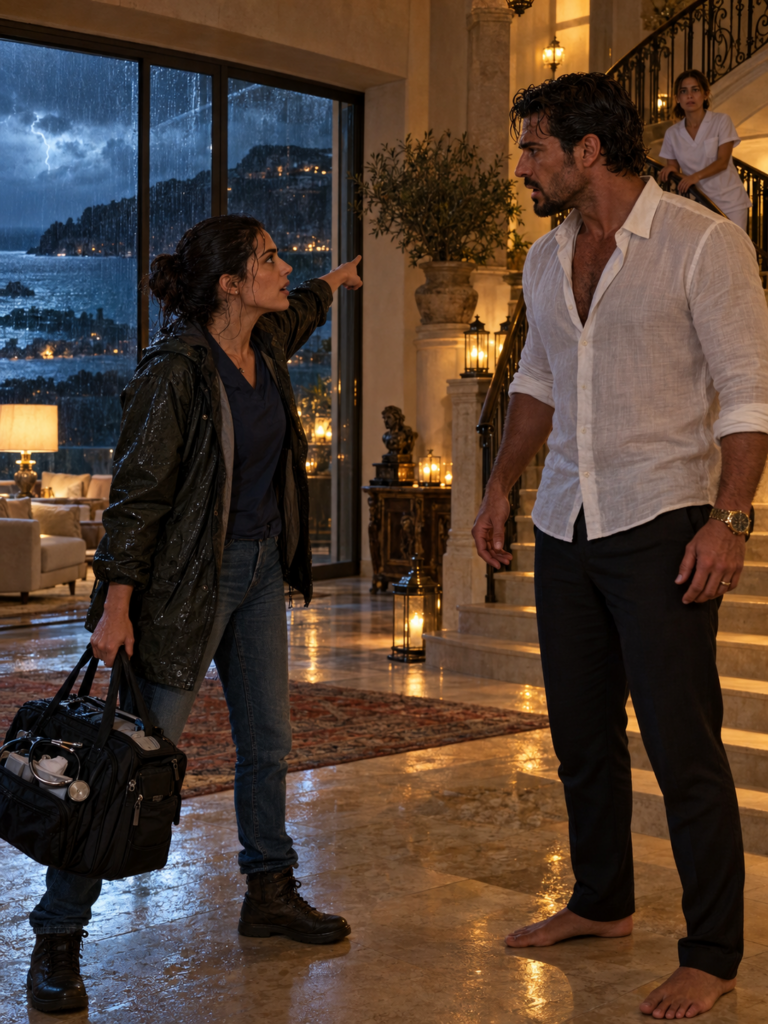
Marco remained in the doorway, waiting for Valentina’s response.
She could have offered him something reassuring.
Instead, she reached for the door herself.
“Then you can begin by letting me sleep.”
His eyebrows rose slightly.
“Of course.”
“Without anyone checking whether I’ve woken up every fifteen minutes.”
“I’ll make that clear.”
“And nobody touches my medical bag.”
“Agreed.”
For a man accustomed to negotiations involving millions, the conversation was surprisingly difficult.
Not because her requests were unreasonable.
Because she expected them to be respected without treating his agreement as a favor.
Marco stepped back.
“Breakfast whenever you’re ready.”
Valentina nodded.
Then closed the door.
He stood outside for several seconds.
A security man approached.
“Signore?”
Marco turned.
“Make certain she isn’t disturbed.”
“Yes, sir.”
“And her belongings stay where she put them.”
The man looked faintly surprised.
Marco walked away before he could ask why.
***
Four hours later, Valentina opened the guest-room curtains.
Beyond the glass, the Sardinian hills descended toward a gray-blue sea.
Olive trees glimmered in the newly returned sunlight.
Her old Fiat stood in the courtyard, apparently brought from the highway junction while she slept.
Someone had also left clean towels and a freshly laundered shirt beside the bathroom.
The room was beautiful.
Almost aggressively beautiful.
But Valentina had seen enough wealthy homes to know that beautiful rooms did not necessarily mean comfortable lives.
She showered, dressed, and followed the smell of coffee downstairs.
In the kitchen, an older woman was preparing breakfast.
Marco sat at the far end of a wooden table.
He rose when Valentina entered.
“You slept?”
“Four hours.”
“Enough?”
“No. But better than nothing.”
He gestured toward the table.
Eggs.
Fresh bread.
Cheese.
Olives.
Tomatoes.
Honey.
A proper pot of coffee.
Valentina smiled despite herself.
“You listened.”
“I do occasionally.”
“Let’s not exaggerate.”
The older woman made a quiet noise that might have been laughter.
Marco glanced toward her.
“Julia has been here since I was twelve.”
Valentina looked at the cook.
“Then she knows everything embarrassing about you.”
“Unfortunately.”
Julia placed a plate before Valentina.
“Eat.”
Valentina obeyed.
After the first bite, she looked up.
“This is excellent.”
Julia nodded once.
Marco watched Valentina over his coffee.
She noticed.
“Something on my face?”
“No.”
“Then why are you staring?”
He considered lying.
For some reason, he didn’t.
“I’m trying to understand you.”
“I’m not especially complicated.”
“I disagree.”
Valentina set down her fork.
“Because I spoke to you without being frightened?”
“Partly.”
“Marco, fear is not a qualification for respecting someone.”
He studied her.
“And respect isn’t something you can purchase with breakfast,” she added.
His mouth curved.
“I wasn’t trying.”
“Good.”
The conversation should have ended there.
Instead, he asked about her work.
Why she had become a midwife.
Where she had trained.
Whether difficult births ever made her consider leaving the profession.
She answered honestly.
She had trained in Florence and Rome before returning to Sardinia.
She had spent nine years caring for women and babies.
She loved the work.
And yes, sometimes it frightened her.
“You didn’t look frightened last night,” Marco said.
“Patients don’t need me to perform my fear for them.”
“But you feel it?”
“Of course.”
He went quiet.
Valentina looked at him.
“Do you?”
“Feel fear?”
“Yes.”
Marco considered the question.
“More often than people believe.”
It was an unexpectedly honest answer.
Before she could respond, a baby’s cry floated faintly from upstairs.
Valentina smiled.
“Your cousin’s daughter has an impressive voice.”
Marco looked toward the ceiling.
“Apparently.”
“Have they chosen a name?”
“Alessia.”
“Beautiful.”
His expression softened.
For a moment, Valentina saw something beneath the carefully controlled man.
Not weakness.
Attachment.
Then he asked another question.
“Will you continue caring for Lucia?”
“If she wants me to.”
“I’d like you to.”
“That’s between Lucia and me.”
Marco nodded.
“Yes.”
She watched him.
He seemed to be learning remarkably quickly.
But she was not foolish enough to confuse good manners over breakfast with a harmless life.
“There’s something else,” she said.
His gaze returned to her.
“I know who you are.”
Marco’s expression became still.
“Do you?”
“I know enough to recognize that your companies aren’t your only source of power.”
A silence passed.
He could have denied it.
Instead, he answered carefully.
“Some parts of my business are difficult.”
“That’s a generous description.”
“Yes.”
Valentina held his gaze.
“I won’t let Lucia’s medical care become part of whatever obligations exist in your family.”
“It won’t.”
“And if I return, I come as her clinician. Not as your employee.”
“Understood.”
She stood.
Marco rose with her.
“Your car is ready.”
“Good.”
“I’d prefer someone drive you. You’ve slept very little.”
Valentina studied him.
“You can prefer whatever you like.”
“I gathered that.”
She smiled.
“I’ll consider help with the drive. But the car stays mine.”
“Agreed.”
At the doorway, he spoke again.
“Valentina.”
She turned.
“Yes?”
“Thank you for telling me the truth last night.”
She regarded him.
“I generally do.”
“That is becoming apparent.”
She walked toward the courtyard.
Marco followed.
Outside, the sunlight had finally broken through the storm clouds.
Valentina unlocked her Fiat.
Then her telephone rang.
It was Lucia.
Valentina answered immediately.
“Tina?”
“I’m downstairs.”
“Before you leave, promise you’ll come back.”
Valentina glanced toward Marco.
He remained several feet away, giving her privacy.
“I’ll come back for your follow-up care.”
Lucia’s voice softened.
“And perhaps you’ll visit when you’re not working?”
Valentina looked at the man standing beside the stone steps.
Marco was watching the sea.
Not her.
Yet she sensed he was listening for her answer.
She said, “Perhaps.”
Then ended the call.
Marco turned toward her.
“Tuesday?” he asked.
Valentina slid into the driver’s seat.
“Tuesday. To see Lucia.”
“Of course.”
She started the engine.
He stepped away.
But as she drove toward the gate, Valentina glanced into her rearview mirror.
Marco Valente was still standing in the courtyard.
Watching her leave.
And for reasons she did not yet want to examine, she knew this was not the last time their lives would meet outside a medical emergency.
The gate opened ahead of Valentina, and she drove out into the Sardinian morning.
Behind her, Marco remained in the courtyard until the Fiat disappeared around the bend.
He had spent twelve years leading the Valente family.
He knew how to recognize a false promise, an unreliable associate, a negotiation designed to conceal a threat.
But he did not know what to make of a woman who had entered his house in the middle of the night, challenged his authority, saved his cousin’s daughter, and left without asking for anything beyond breakfast and basic professional respect.
That troubled him.
More precisely, it interested him.
And Marco Valente was a man who rarely allowed an interest to remain unexplored.
***
On Tuesday, Valentina returned.
This time the roads were dry.
The July sunlight warmed the hills.
The mansion looked less threatening in daylight, although the security men and guarded gates remained.
Marco met her in the foyer.
He was wearing dark trousers and a gray shirt.
And shoes.
Valentina noticed.
“A remarkable improvement.”
He looked down.
“I made an effort.”
“I appreciate it.”
He almost smiled.
“Lucia is upstairs.”
“I know the way.”
“Of course.”
Valentina passed him.
The weekly visits soon settled into a routine.
Lucia was recovering well.
Little Alessia was healthy, alert, and developing normally.
Dante, Valentina’s brother, had arrived shortly after the birth and was now spending much of his time with his wife and daughter.
He was a structural engineer, a practical man who preferred bridges and measurable problems to the complicated influence of the Valente family.
He was also clearly devoted to Lucia.
One afternoon, Valentina found him seated beside the baby’s cradle.
Alessia had wrapped her tiny fingers around his index finger.
He looked up.
“She’s stronger than she looks.”
Valentina smiled.
“Most babies are.”
Dante glanced toward the hallway.
“Marco’s been asking about your visits.”
Her smile disappeared.
“Professionally?”
Dante raised an eyebrow.
“Is that what we’re calling it?”
“Don’t start.”
“I’m your brother. Starting is one of my responsibilities.”
She rolled her eyes.
Dante became serious.
“Tina, he’s not an ordinary man.”
“I know.”
“His family has complicated interests.”
“I know that too.”
“And you?”
“What about me?”
He studied her.
“Are you interested?”
Valentina looked toward Alessia.
Then back at her brother.
“I haven’t decided what to do about it.”
Dante nodded.
He did not offer instructions.
He knew better.
But his concern stayed with her.
***
After the third Tuesday visit, Marco walked Valentina to her car.
The afternoon sun had begun to soften.
Beyond the terrace, the sea stretched toward the horizon.
“Lucia is doing well,” Valentina said.
“She’s happier than I’ve seen her in years.”
“Motherhood suits her.”
Marco nodded.
They reached the Fiat.
Valentina unlocked it.
Then he asked, “Are you happy?”
She looked at him.
“With Lucia’s recovery?”
“With your life.”
The question caught her off guard.
“My life is quite satisfactory.”
“That sounds like a medical report.”
“I’m a medical professional.”
“I’m aware.”
She folded her arms.
“Why do you ask?”
“Because whenever you talk about your work, your entire expression changes.”
Valentina watched him.
Marco continued.
“You come alive.”
“That’s because I love what I do.”
“I can see that.”
Something about his attention made her uneasy.
Not because it felt threatening.
Because it was unusually complete.
She was accustomed to people asking about her profession.
She was less accustomed to being studied as though the answer mattered personally.
“You notice too much,” she said.
“I’ve been told.”
“By whom?”
“People who regret it.”
She laughed before she could stop herself.
Marco smiled.
It was a dangerous smile.
Not because he intended harm.
Because Valentina was beginning to understand why people found him difficult to forget.
She opened the car door.
“Goodbye, Marco.”
“Goodbye, Valentina.”
She drove away.
Twenty minutes later, she pulled off the coast road and called her closest friend.
Sarah answered immediately.
“What’s wrong?”
“Nothing.”
“That sounds suspicious.”
Valentina stared at the sea.
“There’s a man.”
Sarah went silent.
Then she said, “Finally.”
“Don’t.”
“Is he handsome?”
“Yes.”
“Interesting?”
“Very.”
“Kind?”
Valentina hesitated.
“In certain circumstances.”
Sarah became serious.
“Dangerous?”
Valentina considered everything she knew.
The guarded mansion.
The men who obeyed without hesitation.
The rumors about the Valente family.
The old criminal alliances.
The blood on the stories nobody discussed openly.
“Probably.”
Sarah exhaled.
“And are you frightened of him?”
“No.”
“Maybe you should be.”
Valentina looked toward the water.
“That’s what I’m trying to understand.”
***
By the fifth Tuesday, something had changed at the mansion.
Valentina noticed it before she reached the entrance.
Additional security.
Men speaking quietly near the courtyard.
An unfamiliar vehicle beside the garage.
Inside, Lucia seemed unusually tense.
“What happened?”
Lucia hesitated.
“Marco had trouble on the mainland.”
“What sort of trouble?”
“Two of his men were injured.”
Valentina set down her medical bag.
“Is he injured?”
Lucia looked at her carefully.
“Why?”
“Because I know him.”
Lucia’s expression softened.
“He’s all right.”
Valentina continued her medical visit.
But she could not entirely set aside her concern.
When Marco appeared in the entrance hall later that afternoon, she noticed a small cut above his eyebrow.
He looked exhausted.
Not physically incapacitated.
Simply worn down by the responsibility he carried.
“Would you like to sit down?” she asked.
He stopped.
The question seemed to surprise him.
“Yes,” he answered after a moment. “I would.”
They went into his study.
There were books on three walls and a window overlooking the sea.
Julia brought coffee.
Then left them alone.
For several minutes, neither spoke.
Finally, Marco said, “My father believed power was useful only when people feared losing something to you.”
Valentina watched him.
“And do you believe that?”
“I used to.”
“What changed?”
He looked toward the window.
“I’m beginning to question whether some of the things I inherited were worth preserving.”
She considered that.
“Your companies?”
“Parts of them.”
“Your family?”
“Never the people. But perhaps some of the traditions.”
Valentina looked at the cut above his eyebrow.
“Did someone hurt you?”
“Yes.”
“Because of business?”
“Yes.”
She waited.
Marco met her eyes.
“I can’t give you every detail.”
“I didn’t ask for every detail.”
“But you want the truth.”
“Yes.”
He nodded.
“There was a confrontation involving my interests on the mainland. Two men working for me were injured. I have responsibilities I cannot simply abandon, and some of those responsibilities involve people who operate outside the law.”
Valentina absorbed the answer.
“Then your life isn’t simply dangerous because of your reputation.”
“No.”
“People actually get hurt.”
“Yes.”
She looked down at her coffee.
Marco did not interrupt the silence.
He did not attempt to charm his way through it.
He understood that if he wanted Valentina to know him, he had to allow her to know things that might make her walk away.
After a while, she asked, “Why tell me this?”
“Because I’m interested in you.”
She looked up.
His expression remained steady.
“Not because you helped Lucia,” he continued. “That is how we met. It isn’t the reason I keep looking forward to Tuesday.”
Valentina’s breath slowed.
“Marco…”
“I know.”
“You don’t know what I’m going to say.”
“No,” he admitted. “I don’t.”
“Then don’t answer before I speak.”
His mouth curved faintly.
“All right.”
She considered him.
“I have a life in Cagliari. Patients. Friends. My apartment. I have no intention of becoming another person who rearranges everything to fit your world.”
“I haven’t asked you to.”
“Not yet.”
He nodded.
“Then I’ll be clear. If anything develops between us, your work remains yours. Your choices remain yours. I will not ask you to become part of my organization.”
Valentina held his gaze.
“And the danger?”
“I won’t pretend it doesn’t exist.”
That was not comforting.
It was, however, honest.
And she found herself respecting him for it.
“Stay for dinner,” Marco said.
Valentina glanced at her watch.
She had a long drive home.
An early appointment the next morning.
And several excellent reasons to decline.
Then she looked at him.
“All right.”
***
Dinner was informal.
Lucia and Dante joined them.
Little Alessia slept nearby.
Julia served food that tasted as though every ingredient had been chosen with care.
The conversation moved easily.
Dante discussed an engineering project.
Lucia talked about a documentary.
Valentina explained a challenge she had faced in her professional practice.
Marco listened.
Not merely to the facts.
To her reasoning.
When he asked how she handled frightened patients, she explained that reassurance meant very little unless people trusted the person offering it.
“That requires honesty,” Marco observed.
“Yes.”
“Even when honesty causes fear?”
“Especially then. You can help someone manage a truth. You can’t ask them to prepare for a reality you refuse to describe.”
Dante glanced at Marco.
The implication was impossible to miss.
Marco accepted it.
After dinner, he walked Valentina outside.
The stars were bright above the courtyard.
She stopped beside her Fiat.
“Marco?”
“Yes?”
“What exactly are you asking of me?”
He considered the question.
“Nothing tonight.”
“That sounds evasive.”
“Then I’ll be more precise.”
He stepped closer, but left space between them.
“I’d like to know you beyond the time you spend treating Lucia. I’d like to see you when there isn’t a medical reason for you to be here.”
Valentina studied him.
“And if I say no?”
“Then nothing changes about Lucia’s care.”
She looked at him for a long moment.
Then smiled.
“You’re learning.”
“I have an unusually demanding teacher.”
She laughed.
“Goodnight, Marco.”
“Goodnight.”
She drove away.
This time, she did not pretend she wasn’t thinking about him.
***
At the end of August, Marco invited her to his vineyard in Ogliastra.
He collected her himself.
No driver.
No entourage.
Just Marco behind the wheel of a car, looking almost ordinary in the morning sunlight.
Almost.
The vineyard was beautiful.
Rows of Cannonau grapes climbed the hills.
A stone house overlooked the valley.
The air smelled of warm earth and leaves.
Marco seemed different there.
He spoke about the vines with genuine affection.
He showed her the aging vessels and explained how the harvest was handled.
He introduced her to Antonio, the man who had helped tend the estate for years.
Valentina watched how Marco treated him.
There was respect between them.
Not the fearful obedience she had seen elsewhere.
It mattered.
They spent the afternoon talking.
She told him about her training in Florence and Rome.
About a mentor who had taught her to remain steady when circumstances were frightening.
About the emotional weight of difficult births.
Marco listened.
Then he asked, “Were you afraid the night Alessia was born?”
Valentina looked toward the vines.
“Yes.”
“You never showed it.”
“Lucia needed my attention, not my panic.”
He nodded.
Then said something that unsettled her.
“I saw you afterward. In the hallway.”
She turned.
“When?”
“After the birth. You leaned against the wall. Your hands were shaking.”
Valentina remembered.
She had believed herself alone.
“You noticed?”
“Yes.”
“Why didn’t you say anything?”
“Because you had just spent hours taking care of everyone else. I thought you deserved a moment that belonged only to you.”
Valentina fell silent.
Then she said, “Thank you.”
Marco looked at her.
“For what?”
“For not turning my exhaustion into something you needed to manage.”
The afternoon settled around them.
Later, when he drove her home, Valentina found herself wishing the journey were longer.
She understood then that her feelings had changed.
But knowing she wanted him was not the same as knowing she could trust the life he offered.
And that distinction mattered.
***
In September, Lucia invited Valentina to the Vetro, a fashionable nightclub Marco owned near the old harbor district of Cagliari.
Valentina wore a dark red dress.
She arrived with Lucia and Dante.
Marco was speaking with several business associates on the upper level.
Beside him stood an elegant woman named Sophia.
When Marco saw Valentina, he excused himself and came toward her.
“You came.”
“Lucia was persuasive.”
“She usually is.”
His eyes moved over her dress.
Then returned to her face.
“You look beautiful.”
Valentina smiled.
“You managed that without turning it into a business statement.”
“I’m improving.”
He introduced her to Sophia, his director of operations for several mainland clubs.
Sophia was direct, intelligent, and clearly trusted.
She also seemed to find Marco’s interest in Valentina amusing.
“He’s spoken about you,” Sophia said.
Valentina raised an eyebrow.
“Has he?”
“Frequently.”
Marco did not deny it.
Valentina looked at him.
“That’s interesting.”
He smiled.
Then asked whether she wanted to dance.
She stared.
“You dance?”
“Badly.”
“At least you’re honest.”
He held out his hand.
She took it.
On the crowded floor, they moved together beneath the shifting lights.
His hand rested carefully at her back.
She became acutely aware of how easily attraction could begin to obscure judgment.
“Marco?”
“Yes?”
“Have you and Sophia ever been involved?”
“No. She’s married. Her wife and their three dogs would also find the suggestion surprising.”
Valentina laughed.
Marco’s expression softened.
They continued dancing.
And for a few minutes, the complicated world outside the nightclub seemed distant.
But when he walked her to the bar afterward, she asked the question that had been forming for weeks.
“Have you ever killed someone?”
Marco went still.
He could have pretended not to hear.
He could have changed the subject.
Instead, he looked directly at her.
“Yes.”
Valentina felt the answer settle between them.
“Do you regret it?”
He was quiet.
“Some of the things I’ve done, yes. Others I believed were necessary at the time. That doesn’t mean the law would agree, or that those choices were right.”
She looked down.
“And you expect me to accept that?”
“No.”
“What do you expect?”
“For you to decide what it means.”
Valentina studied him.
“I can’t answer tonight.”
“I wasn’t asking you to.”
“Good.”
He stepped back.
Giving her room.
Not because he wanted distance.
Because he understood that closeness without choice was no closeness at all.
***
In October, they had the conversation again.
Not in a nightclub.
Not surrounded by music.
In the quiet sitting room of the northern house, while wind moved against the windows.
Marco spoke about his father.
The criminal organization he had inherited at twenty-six.
The legitimate companies he had expanded.
The illegal activities he remained responsible for.
The decisions he had made to preserve the organization’s power.
He did not ask Valentina to admire those choices.
He did not describe violence as proof of strength.
He admitted that some consequences could never be undone.
She listened.
Then she went home.
For three weeks, she considered what he had told her.
She spoke with Sarah.
She thought about her work.
She thought about Lucia and Alessia.
She thought about Marco’s kindness, his patience, and the clear limits of his moral record.
And she understood that love would not make his past disappear.
Nor should it.
Then, one November afternoon, she called him.
“I’ve made a decision.”
He fell silent.
“Tell me.”
“I want to see where this goes.”
“Valentina…”
“But I have conditions.”
“I’m listening.”
“Honesty. Even when it’s unpleasant. Especially when it concerns my safety or my choices.”
“Yes.”
“My work remains separate from your businesses.”
“Yes.”
“I don’t want you deciding where I live, whom I see, or how I spend my time.”
“Understood.”
“And if I discover something I cannot accept, I need to be free to leave without consequences.”
Marco was quiet.
Then he answered.
“You are free to leave now. You’ll remain free.”
Valentina closed her eyes.
The relief was unexpected.
“I’m at my apartment,” she said.
“May I come?”
“Yes.”
Half an hour later, Marco stood outside her door.
He looked strangely out of place beside the peeling paint and narrow stairwell.
Valentina opened it.
“You found the building.”
“I can read an address.”
“Excellent. Another useful skill.”
He smiled.
Inside, her apartment was cluttered with books, notebooks, and the belongings of an independent woman who had no interest in pretending she lived differently.
Her orange cat, Caligula, inspected Marco with profound suspicion.
Marco looked at him.
“He doesn’t approve.”
“He rarely does.”
They sat on her small sofa.
For a while, they spoke about ordinary things.
Then Marco reached for her hand.
He stopped before touching it.
Valentina noticed.
“You can ask.”
He looked at her.
“May I?”
She placed her hand in his.
“Yes.”
He moved closer.
“May I kiss you?”
This time, she smiled.
“You may.”
Their kiss was gentle at first.
Then warmer.
But when they separated, nothing about Valentina’s life had been surrendered.
She still had her apartment.
Her patients.
Her work.
Her right to disagree.
And Marco, who had spent years confusing responsibility with command, began learning how different devotion felt when it was freely returned.
***
By December, they were spending more time together.
Valentina occasionally stayed at Marco’s penthouse in Cagliari.
He visited her apartment.
Caligula eventually tolerated his presence.
Barely.
Her family knew about the relationship.
Dante remained cautious but no longer tried to disguise his affection for Marco when they sat together at dinner.
Lucia was delighted.
Little Alessia had become the center of everyone’s attention.
At Christmas, the families gathered.
Marco was quieter than usual.
Valentina noticed him watching her mother laugh with Dante.
Later, when they were alone, she asked, “What are you thinking?”
Marco looked at her.
“That I haven’t been part of something this ordinary in a long time.”
“Ordinary?”
“People eating too much. Arguing about dessert. Laughing without checking who is listening.”
Valentina touched his hand.
“It’s allowed, you know.”
“What?”
“To enjoy yourself without controlling the evening.”
He smiled.
“I’ll make an effort.”
She leaned against him.
And for the first time, the future she imagined included the possibility of building a life with Marco without abandoning the one she already loved.
Then January arrived.
And the part of his world she had been trying to understand finally reached into hers.
***
Marco received a call during dinner.
Valentina saw the change in his face.
He answered briefly.
Then set down the phone.
“What happened?” she asked.
“Ricardo Fabri.”
She knew the name.
A mainland associate involved in a disputed arrangement Marco had been negotiating for months.
“The agreement has fallen apart?”
“He’s challenged it. He’s made allegations to authorities on the mainland.”
“Are they true?”
“Not as presented. But there are genuine legal exposures tied to the business.”
Valentina waited.
Marco continued.
“I need to go tomorrow.”
“For how long?”
“I don’t know.”
She nodded.
Then he said, “I’d prefer you stay at the northern house while I’m away.”
Her expression tightened.
“Why?”
“Fabri may use personal pressure. The house has more controlled access than the penthouse.”
“Are you asking or telling?”
Marco paused.
“I’m asking.”
She studied him.
“I won’t stop seeing patients.”
“I know.”
“I won’t surrender my telephone or schedule.”
“I’m not asking that.”
“And I need to know what risk you believe exists.”
He told her what he knew.
Not everything was certain.
But the possibility that Fabri might attempt to frighten her was real.
Valentina considered it.
Then nodded.
“All right. I’ll stay there temporarily.”
Marco looked relieved.
“But I decide when I return home.”
“Agreed.”
***
Three days after he left, Valentina received a call from an unfamiliar number.
A man with a mainland accent spoke.
“Dr. Greco?”
“Yes.”
“I’m calling on behalf of Ricardo Fabri.”
Valentina became still.
The man warned that Marco’s legal problems were more serious than she knew.
He suggested she reconsider her relationship.
He implied that remaining close to Marco could expose her to danger.
Valentina listened without interrupting.
Then she answered.
“Tell Mr. Fabri I understand what he’s trying to do.”
A pause.
“Excuse me?”
“He wants me frightened. He wants me to pressure Marco. And he expects me to behave as though I have no judgment of my own.”
The voice hardened.
“You should take the warning seriously.”
“I do. That’s why I’ll report the call and inform Marco.”
She ended it.
Then she called Marco herself.
He answered immediately.
She told him everything.
His silence was long.
“Are you all right?”
“Yes.”
“Did he threaten you directly?”
“He delivered an implied warning.”
Marco’s voice grew colder.
“I’ll deal with him.”
“You’ll deal with your business. I’ll decide how to respond to someone contacting me.”
He stopped.
Valentina continued.
“I need the facts, Marco. Not reassurance.”
“The legal matter is serious. My lawyers are responding. Fabri’s claims may cause disruption, but they’re contestable.”
“Then tell me when something changes.”
“I will.”
“And Marco?”
“Yes?”
“Don’t start managing what I know.”
Another silence.
Then he answered.
“I won’t.”
She ended the call.
Outside, the January sea rolled beneath a gray sky.
Valentina stood at the window, holding her phone.
She was frightened.
Not by the call itself.
By the knowledge that loving Marco meant facing a world capable of reaching beyond his guarded estates.
She could leave.
He had told her so.
She believed him.
But she did not want to make a permanent decision merely because another man had tried to frighten her.
She wanted to understand the truth first.
And she intended to insist on it.
Valentina placed her phone on the windowsill.
For several minutes, she watched the rough January sea.
Then she returned to the kitchen.
Julia was preparing dinner.
She looked up as Valentina entered.
“Everything all right?”
“Yes.”
Julia examined her expression.
“That’s not the same as everything being easy.”
Valentina smiled faintly.
“No.”
She sat at the wooden table.
The northern house was quiet.
Marco had been gone three days.
His absence had changed the rhythm of the place.
The security men still came and went.
The kitchen still functioned.
Lucia and Dante continued visiting.
But Valentina found herself listening for a car in the courtyard.
That realization unsettled her.
For most of her adult life, she had been comfortable alone.
She had built a professional practice, maintained friendships, and created a home that belonged entirely to her.
She did not want love to make her dependent.
But perhaps, she thought, missing someone was not the same as needing permission to exist without them.
Julia placed a plate before her.
“Eat.”
Valentina looked up.
“You and Marco use the same tone.”
“I taught him.”
That made Valentina laugh.
***
Marco returned on Friday evening.
Valentina heard his car shortly after nine.
She was sitting at the kitchen table with a book when he entered.
He looked exhausted.
His shirt was rumpled.
His hair was disordered.
But his expression changed when he saw her.
“Valentina.”
She stood.
“You’re back.”
“Yes.”
He remained near the doorway.
For a moment, neither moved.
Then she approached him.
“Are you all right?”
“I am now.”
She studied him.
“That isn’t a complete answer.”
“No.”
He took a breath.
“Fabri withdrew the claim. The immediate dispute has been settled, and he’s moving his operations permanently to the mainland.”
“How?”
“A negotiated agreement. My legal advisers handled the formal issues. There were concessions.”
“Are you satisfied with the outcome?”
“It’s workable.”
She nodded.
There were limits to what he had explained.
She understood that.
But she also understood she could not build their relationship around accepting vague answers whenever facts concerned her safety.
“Did you authorize anything violent?”
He looked directly at her.
“No.”
“Did anyone get hurt because of the settlement?”
“Not during the resolution of this dispute.”
She watched him.
Then nodded.
“Thank you for answering.”
He stepped closer.
“I owe you more than answers after someone contacts you with threats.”
“Yes.”
“I should have anticipated that Fabri might try to reach you.”
“You couldn’t necessarily prevent the call.”
“No. But I could have explained the possibility more clearly.”
Valentina’s expression softened.
“That would have helped.”
Marco reached for her hand.
She gave it to him.
“I don’t want my life to become something you manage,” she said.
“I know.”
“But I do want to be part of it.”
He went still.
She smiled gently.
“Your life, Marco. Not your organization.”
“I understand.”
Then she stepped into his arms.
He held her.
Not tightly enough to stop her leaving.
Just closely enough to make clear how much her staying meant.
***
The following morning, a storm moved across the northern coast.
Rain struck the windows.
The wind bent the olive trees.
Valentina and Marco stood on the sheltered terrace, watching the weather.
The sea had become a restless sheet of gray.
It reminded her of the night they met.
“You were barefoot,” she said.
Marco glanced at her.
“You’ve mentioned that several times.”
“It’s difficult to forget.”
“I was distracted.”
“By a woman giving birth?”
“By a woman who was frightened and needed help.”
Valentina nodded.
Then looked at him.
“And by the midwife who arrived afterward?”
His mouth curved.
“Eventually.”
She laughed.
They walked along the covered part of the terrace.
Marco looked toward the sea.
“I spent years believing I had no alternative to the life I inherited.”
Valentina listened.
“I know I did inherit obligations. People depended on my father, and afterward they depended on me.”
“Yes.”
“But I also made decisions. Some of them strengthened that world. Some made it harder to leave behind.”
She studied his face.
“That sounds like something you’ve been thinking about.”
“I have.”
“Because of me?”
“Partly. But I won’t put responsibility for my choices on you.”
Valentina smiled.
“Good.”
He stopped near the terrace wall.
“What about you?”
“What about me?”
“Have you decided what you want?”
She looked at the storm.
Then at him.
“Yes.”
He waited.
“I want to spend more of my life here.”
Marco became very still.
Valentina continued before he could respond.
“Not because the weather is bad. Not because Fabri tried to frighten me. Not because I need protection.”
“I know.”
“I want to be here because I love being with you.”
Something changed in his face.
“You’re certain?”
“Yes.”
She smiled.
“And I am keeping my apartment.”
His expression softened.
“Of course.”
“And my patients.”
“Yes.”
“And Caligula.”
Marco looked almost offended.
“I assumed the cat was nonnegotiable.”
“He is.”
Valentina stepped closer.
“You don’t have to decide what this means immediately.”
Marco took her hands.
“I know what it means to me.”
“Tell me.”
“That you’re choosing to share your life with me.”
“Yes.”
He kissed her.
Outside, the storm continued.
But inside the shelter of his arms, Valentina felt no pressure to surrender who she was.
She was making a choice.
And Marco was receiving it without treating it as ownership.
***
Spring arrived.
Valentina’s life changed gradually.
She continued seeing her patients.
Her apartment in Cagliari remained hers.
Her Tuesday visits to Lucia and Alessia continued.
She spent more nights at the northern house and at Marco’s penthouse, but she did not abandon her professional routine.
Marco, for his part, learned to accommodate a life that did not revolve around him.
Births happened at inconvenient times.
Patients called during dinners.
Plans changed.
Sometimes Valentina canceled an evening because a family needed her.
He did not complain.
He asked whether she needed anything.
Often she didn’t.
Sometimes she did.
He learned the difference.
At the vineyard, he began making decisions that reduced his involvement in activities he no longer wanted to preserve.
He did not pretend such changes were simple.
Old obligations remained.
Legal consequences remained possible.
He had begun the process of separating more of his legitimate businesses from the criminal structures inherited from his father.
It required time, professional advice, and concessions he disliked.
Valentina did not manage that work for him.
She could support the man without assuming responsibility for every moral decision in his life.
And Marco understood that her continued love did not mean she had approved everything he had done.
***
In April, Valentina prepared a birthday surprise for him at the vineyard.
She consulted Antonio, who had known Marco since childhood.
Together, they arranged a small private celebration.
No elaborate guest list.
No business associates.
Just a carefully prepared meal, a gift chosen with thought, and a handwritten card.
Marco arrived expecting a routine visit.
Instead, he found Valentina waiting on the terrace.
“Happy birthday.”
He stopped.
She smiled.
“You look suspicious.”
“I wasn’t expecting this.”
“That’s generally how surprises work.”
Antonio appeared briefly and disappeared again with a knowing smile.
Marco looked at the table.
Then at Valentina.
“You arranged this?”
“Yes.”
“Why?”
She stared.
“Because it’s your birthday.”
“I know that.”
“And because I wanted to do something for you.”
He was quiet.
Valentina stepped closer.
“Marco?”
His expression softened.
“I’m not accustomed to people giving me things without wanting something in return.”
She looked at him.
“I know.”
He picked up the card.
Read it.
Then read it again.
When he looked up, his eyes were brighter than before.
Valentina waited.
Finally, he spoke.
“I love you.”
The words were quiet.
Not theatrical.
Not rehearsed.
But they changed the air between them.
Valentina smiled.
“I was beginning to wonder how long you’d make me wait.”
Marco stared.
Then laughed.
“You knew?”
“I suspected.”
She placed her arms around him.
“I love you too.”
He held her.
For several moments, neither needed to speak.
The vineyard stretched around them.
The air smelled of warming soil and new leaves.
And Marco, who had spent years guarding every vulnerable part of himself, allowed the moment to exist without trying to control it.
***
July returned.
A year had passed since the stormy night when Marco called Valentina for help.
They gathered at the northern house to celebrate Alessia’s first birthday.
Lucia and Dante were there.
Julia prepared the meal.
Sophia visited from the mainland.
Antonio came from the vineyard.
The house that had once seemed forbidding to Valentina now held the familiar chaos of family life.
Alessia was the center of it all.
She had developed a talent for laughing at the most unexpected moments.
Marco, who had once seemed incapable of being surprised, was entirely defenseless against his young cousin’s amusement.
Valentina watched him lift the little girl into his arms.
Alessia immediately grabbed his shirt.
“That’s a very expensive piece of fabric,” Valentina observed.
Marco looked down at the baby.
“She seems unimpressed.”
“She has excellent judgment.”
He smiled.
Later, after dinner, Valentina stepped onto the terrace.
The stars were bright.
The sea was calm.
She stood beside the railing, remembering the previous July.
The telephone ringing at two in the morning.
The drive through heavy rain.
The frightening medical emergency.
And the barefoot man who had opened the door.
She heard footsteps behind her.
Marco approached.
“Are you avoiding the party?”
“I’m recovering from it.”
“Alessia is still awake.”
“Of course she is. She’s decided birthdays are wonderful.”
He stood beside her.
For a while, they watched the water.
Then Marco spoke.
“I’ve been thinking about something.”
Valentina smiled.
“That sounds serious.”
“It is.”
He reached into his pocket.
Her heartbeat changed.
Marco withdrew a small ring box.
Valentina looked at him.
“Marco…”
He opened it.
Inside was a beautiful ring.
But he did not immediately try to place it on her finger.
“I want to ask you to marry me.”
Valentina was silent.
He continued.
“I’m not asking you to give up your apartment, your work, or anything else that matters to you.”
She looked at him.
“I know.”
“And I can’t promise a life without difficulty.”
“I know that too.”
“I can promise that I’ll keep telling you the truth, even when it makes me look worse.”
She gave a faint smile.
“A challenging promise.”
“Yes.”
He took a breath.
“I don’t want a wife who obeys me. I want the woman who walked into my house during a storm and told me exactly what she thought.”
Valentina laughed softly.
“You were very irritating that night.”
“I’ve improved.”
“Somewhat.”
Marco smiled.
Then grew serious again.
“Will you marry me?”
Valentina looked at the ring.
She thought about the year behind them.
The difficult conversations.
The attraction that had grown slowly into trust.
The choices they had made.
And the fact that she could still say no.
That freedom was precisely what made her answer meaningful.
“Yes.”
Marco looked at her.
She smiled through sudden tears.
“Yes, Marco.”
He slipped the ring onto her finger.
Then kissed her.
From inside the house came Alessia’s small, delighted cry.
Valentina laughed against his shoulder.
“She approves.”
Marco smiled.
“She usually does.”
***
The following July, they were still learning the shape of their shared life.
Valentina had continued working.
Marco had continued making difficult choices about his business interests.
The separation between her clinical work and his organization remained an important boundary.
She did not allow her patients to become part of the Valente family’s influence.
He did not treat her professional commitments as appointments that could be moved for his convenience.
They argued occasionally.
Sometimes about schedules.
Sometimes about honesty.
Sometimes because Marco was still inclined to solve problems before asking whether Valentina wanted help.
But the difference was that they could now recognize those moments.
And change them.
One evening, she returned from a birth in Oristano.
A healthy boy named Matteo had arrived after hours of demanding work.
She called Marco from the car.
“How was your day?” he asked.
“Long.”
“Everything all right?”
“Mother and baby are doing well.”
“Good.”
She heard the relief beneath the word.
“Where are you?”
“At the northern house.”
“I’m coming.”
“Drive carefully.”
“I always do.”
Marco made a skeptical sound.
She laughed.
When she arrived, the family had gathered for dinner.
Little Alessia was laughing at something Dante had done.
Lucia looked happier than Valentina had ever seen her.
Julia moved through the kitchen with familiar efficiency.
And Marco stood beside the table, waiting.
He did not look like a man performing power.
He looked like a man who was pleased to see someone he loved come home.
Valentina kissed him.
“Did I miss anything?”
“Only three arguments about dessert.”
“Who won?”
“Julia.”
“Obviously.”
They ate together.
Later, Marco and Valentina retired to the study.
The windows stood open to the warm evening.
Marco sat opposite her.
For a while, they spoke about their days.
Then he asked a question.
“Do you remember the first time you looked at me in the entrance hall?”
Valentina smiled.
“You mean when you were barefoot?”
He sighed.
“I’ll never escape that.”
“No.”
He laughed.
Then became thoughtful.
“I remember realizing you weren’t interested in anything I could offer except access to Lucia.”
“That was why I came.”
“I know.”
“And you kept standing in my way.”
“I was trying to understand what was happening.”
“You were trying to control it.”
Marco nodded.
“Yes.”
She looked at him.
“And now?”
“Now I understand there are things I cannot control and shouldn’t try to.”
Valentina smiled.
“Such as?”
“Your decisions.”
“Correct.”
“Your work.”
“Correct.”
“And whether you stay with me.”
Her expression softened.
She rose from her chair.
Crossed the room.
And stood before him.
“Marco.”
He looked up.
“I stay because I want to.”
He reached for her hand.
She gave it to him.
For a moment, the room was very quiet.
Then he said, “When I watched you after Alessia’s birth, I understood something I’d never experienced before.”
“What?”
“Someone had entered my life without wanting power over me or anything from me.”
Valentina studied him.
“And?”
“You didn’t need to become part of my world to matter.”
She smiled.
“I still don’t.”
“No,” Marco agreed. “You don’t.”
He looked toward the open window.
The Sardinian evening was warm and peaceful.
Somewhere in the house, Alessia laughed again.
Marco turned back to Valentina.
“When you first arrived, I thought I needed someone who could solve a medical emergency.”
“You did.”
“Yes.”
“But?”
He held her gaze.
“I didn’t know I was about to meet the woman who would teach me what it meant to be chosen.”
Valentina leaned forward.
She kissed him.
And for once, Marco Valente did not try to find another word.
***
Ten months later, on a bright May morning, Valentina gave birth to their daughter.
The room at the northern house had been prepared with appropriate medical equipment and qualified attendants.
Valentina’s own care was guided by the professionals supporting her.
For once, she was not the clinician responsible for everyone else.
She was the mother.
And Marco stood beside her, doing what he had learned to do years earlier.
Listening.
Helping when asked.
Not confusing love with authority.
When their daughter was born, the room filled with a newborn’s cry.
Marco stared at the tiny child.
Dark hair.
Small hands.
An expression of extraordinary seriousness.
Valentina, exhausted and smiling, watched him.
“Would you like to hold her?”
Marco looked almost frightened.
“Yes.”
The baby was placed carefully in his arms.
He looked down.
For a man who had faced dangerous negotiations and formidable enemies without showing hesitation, seven pounds of newborn humanity had left him speechless.
Valentina smiled.
“Are you all right?”
Marco nodded slowly.
“She is very small.”
“That’s normal.”
He looked at her.
“She has your eyes.”
“Perhaps.”
He returned his gaze to the baby.
“Does she have a name?”
Valentina watched him.
“We talked about several.”
“I know.”
“Which one feels right?”
Marco looked down at his daughter.
Then toward the doorway, where Julia had been waiting anxiously for news.
He thought about his mother.
His grandmother.
The women who had cared for him before power became the central language of his life.
“Julia,” he said.
Valentina smiled.
“Yes.”
He looked back at her.
“Julia.”
The baby moved slightly in his arms.
Marco’s expression softened.
Valentina reached for his free hand.
He took it.
Outside, the Sardinian sea shone blue beneath the May sunlight.
The olive trees moved gently in the breeze.
For years, Marco had believed the most important measure of his life was what he controlled.
Businesses.
Territory.
Alliances.
Reputation.
But the woman beside him had never been something he could command.
She had remained herself.
A midwife.
A daughter.
A sister.
A friend.
A woman with patients who needed her and a life she had built long before he appeared.
She had challenged him when he was wrong.
Loved him without excusing his past.
And chosen him without surrendering her freedom.
Now their daughter rested in his arms.
Marco looked at Valentina.
“Thank you.”
She smiled.
“For what?”
“For coming that night.”
Valentina looked at the baby.
Then at him.
“Lucia needed me.”
“I know.”
“And you were standing in the doorway looking terribly important.”
He laughed softly.
“I remember.”
“You didn’t even have shoes on.”
Marco closed his eyes.
Valentina laughed.
Then she leaned toward him.
“You know what I remember most?”
He looked at her.
“What?”
“That you eventually moved aside.”
Marco studied her face.
“Yes,” he said.
“I did.”
She squeezed his hand.
“And you learned to keep doing it whenever something mattered more than your pride.”
He looked down at their daughter.
Then back at the woman he loved.
Outside, the island continued its ordinary morning.
Inside, Marco Valente held a child who would never have to mistake obedience for love.
And Valentina Greco, the midwife who had once walked into his mansion during a violent storm, looked at the family they had built and knew that the greatest thing Marco had ever given her was not safety, wealth, or status.
It was the freedom to remain entirely herself.
And be loved anyway.

