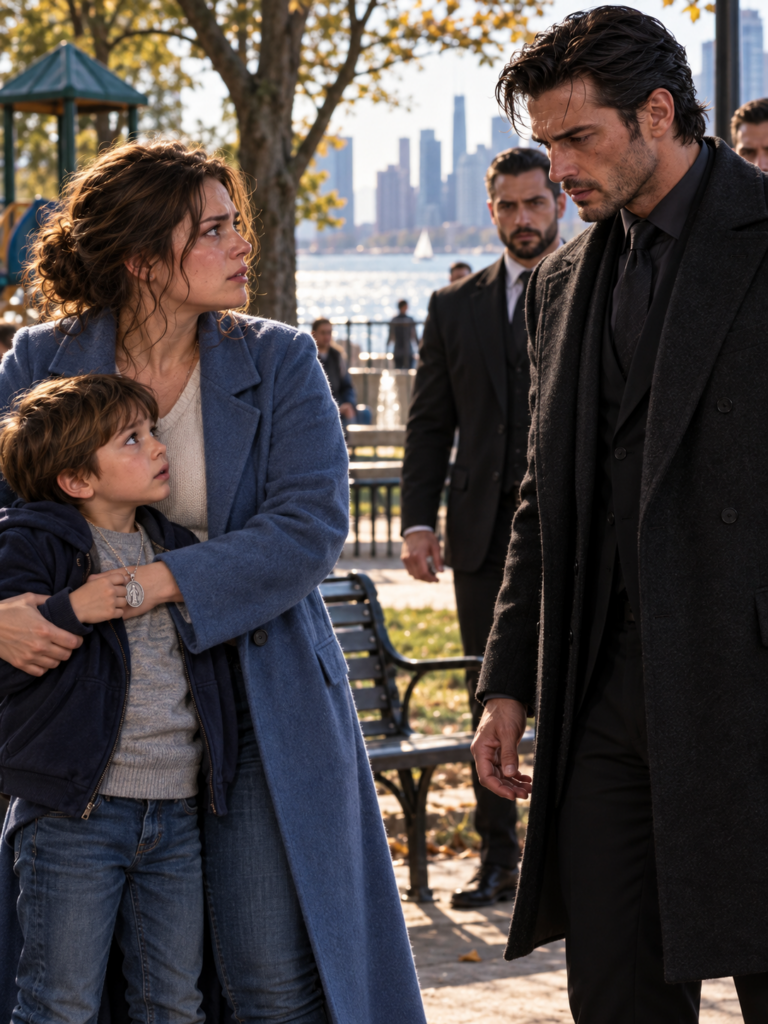
Sophia pulled her phone free while Marco raised his to his ear.
“Don’t take another step toward us,” she warned.
Marco spoke quietly into the receiver.
“Dario. The car near the park. Find out who it belongs to.”
Sophia’s stomach tightened.
“What car?”
“The gray one beyond the fountain.”
She glanced toward the street. A vehicle was moving away through afternoon traffic.
“You think someone followed us?”
“I don’t know.”
It was the first answer he’d given her that sounded entirely honest.
Tommy buried his face against her shoulder.
“Can we go home, Mama?”
“Yes, baby.”
Marco lowered his phone.
“I can have someone drive you.”
“No.”
“Sophia—”
“You used a child who doesn’t exist to get into my office. You watched my son without telling me why. You’ve just explained that your family has enemies who might want him dead.”
She stepped backward.
“Until I know whether you’re one of the people I should fear, you don’t get to arrange anything.”
Marco’s jaw tightened.
But he didn’t follow.
“Call me when you’re somewhere safe.”
She almost laughed.
“You haven’t given me a number.”
He reached into his coat, removed a card, and placed it on the nearest park bench.
Then he walked away.
Only after he disappeared did Sophia retrieve it.
That night, Tommy asked a question she had been dreading.
“Was that really my uncle?”
Sophia sat beside his bed.
“I think so.”
“Does that mean I have to leave?”
Her throat tightened.
“No.”
“Promise?”
She remembered making promises to him when he’d first arrived at the hospital, promises so enormous that she had sometimes lain awake wondering how she could keep them.
She touched his hair.
“I promise I won’t let anybody make that decision without listening to us.”
Tommy thought about that.
“Can I see him again?”
Sophia looked at the little silver medal resting on his pajamas.
“Maybe. When we know more.”
After he fell asleep, she searched for Marco Caruso.
The photographs showed him at business openings, charity functions, and private gatherings with men who had appeared in criminal investigations.
Several articles mentioned Elena Caruso’s death.
One described the disappearance of her young son.
Sophia enlarged a grainy family photograph.
There was Elena.
Dark hair. Gentle eyes.
And a baby in her arms.
Around the child’s neck was the same silver medal.
Sophia covered her mouth.
Marco had told the truth about the family.
But that didn’t prove he was telling the truth about everything else.
At seven the next morning, she found a black car waiting outside St. Agnes.
A man with a narrow scar through one eyebrow stood beside it.
“Dr. Marchetti?”
She stopped.
“My name is Dario.”
“Tell Marco I’m not interested.”
“He would like to speak with you.”
“He can call.”
Dario glanced toward the hospital entrance.
“He’d rather you hear certain things privately.”
“Then he should learn to ask politely.”
The man’s expression shifted, almost approvingly.
“There’s also a matter of custody.”
Sophia felt her pulse jump.
“What about it?”
“Mr. Caruso has no intention of challenging your adoption if you meet with him.”
She stared at Dario.
“So he sent you to threaten me.”
Dario said nothing.
Sophia knew enough about frightened children to recognize a coercive choice when someone offered one.
She looked at her watch. Tommy was at school. Her first appointment was in twenty minutes.
“I’ll listen to him,” she said, “but my son stays where he is. I keep my phone. And nobody from your family approaches his school without my permission.”
Dario opened the car door.
“I’ll convey your conditions.”
“Before I get in.”
He studied her for a moment, then made the call.
Ten minutes later, Sophia was riding through the city toward a glass tower.
She kept her phone in her hand.
When the elevator opened into Marco’s penthouse, she found him standing beside a window overlooking the harbor.
He turned.
“You came.”
“Only because your man implied you could take my child through the courts.”
Marco looked toward Dario.
The silence between them was brief and unpleasant.
Then Marco said, “That should not have been presented as a threat.”
“But it was.”
“Yes.”
Sophia’s anger sharpened at the admission.
“Before you tell me anything else, understand this. I didn’t steal Tomaso from your sister. I didn’t hide him from you. I found a neglected child in the rain and went through every legal procedure required to give him a home.”
“I know.”
“Then stop treating me like an obstacle.”
Marco took a folded photograph from his desk.
He placed it between them.
It showed Sophia carrying Tommy through the hospital entrance on the night she found him.
“This photograph reached me six weeks ago.”
She looked from the picture to his face.
“Who sent it?”
“We haven’t established that.”
“And what do you want?”
“My nephew alive.”
“So do I.”
He nodded.
“Then we have something to discuss.”
Sophia didn’t sit.
“Start by telling me why someone would hurt a little boy just because of his last name.”
Marco opened the folder beside the photograph.
Inside was a picture of Elena Caruso.
And another image, older and badly damaged, of the house where she had died.
Sophia reached toward it.
Marco placed two fingers against the edge of the photograph.
“Before you look at this,” he said, “there is something you need to understand about the man who took Tomaso.”
Sophia drew the photograph toward her.
Sophia drew the photograph closer and saw the blackened remains of a coastal house.
The roof had collapsed. The windows were empty. A child’s bicycle lay on its side near a scorched garden wall.
“My sister died there,” Marco said.
Sophia looked up.
“And Tommy?”
“He was two when someone took him.”
She examined the photograph again.
“Who was responsible?”
“We believed the Amato family.”
“Believed?”
Marco’s expression darkened.
“The families were fighting. Elena had married a man with distant Amato connections, against my advice. When the safe house burned and her son vanished, the explanation appeared obvious.”
“But you don’t have proof.”
“Not enough.”
Sophia remembered Tommy’s old injuries, his terror of raised voices, and the careful way he used to ask permission before taking food.
“Someone kept him alive for four years.”
“Yes.”
“Then left him outside a hospital.”
“Yes.”
“Why?”
Marco looked at the photograph of the ruined house.
“At first, perhaps he was useful as leverage. Whoever held him could bargain with my family. But when the conflict ended, the boy became a problem.”
Sophia swallowed.
“Because he might remember.”
“Exactly.”
For a moment she could hear only the air conditioning.
Then she said, “I need to know whether you’re planning to use him to settle a score.”
Marco looked at her.
“I’m planning to keep him alive.”
“That wasn’t my question.”
He held her gaze for several seconds.
Finally, he admitted, “There are people I would like to answer for what happened to Elena.”
“I won’t let Tommy become the instrument of your revenge.”
“I hear you.”
“Then listen carefully. My son isn’t evidence you can interrogate. He’s a child recovering from years of neglect and violence.”
Marco’s eyes moved to the hospital photograph.
“He has recovered more with you than I imagined possible.”
“He’s still recovering.”
The confession came unexpectedly.
“I saw him laughing in the park,” Marco said. “I had forgotten what a child in my family looked like when he wasn’t afraid.”
Sophia’s anger didn’t disappear.
But she recognized the grief beneath his words.
She sat down.
“Tell me what you actually know.”
They talked for nearly two hours.
She described the boy who had arrived at St. Agnes with old bruises and a badly healed wrist. Marco told her about Elena, the silver medal blessed at Tomaso’s baptism, and the Sicilian lullaby his nephew had somehow retained.
When Sophia finally stood to leave, Marco said, “I’d like to see him again.”
“Then ask Tommy.”
He looked surprised.
“He’s young, Sophia.”
“Young doesn’t mean he has no voice.”
Marco considered that.
“Will you ask him?”
“Yes.”
“And if he says no?”
“Then the answer is no.”
For the first time, Marco Caruso accepted an answer he couldn’t control.
*
Tommy said yes.
At first, the visits were brief.
Marco came to Sophia’s apartment, where the furniture was mismatched and crayons had somehow reached every room.
He arrived looking thoroughly out of place.
Tommy met him at the doorway holding a stuffed rabbit.
“Do you remember me?” Marco asked.
The child nodded uncertainly.
“Can you sing?”
Marco’s composure faltered.
Then he sat on the living-room floor and sang the melody that had survived four terrible years.
Tommy began to cry.
Sophia moved toward him, but he reached for Marco instead.
The man gathered his nephew into his arms.
Sophia watched the reunion from the doorway.
For a painful moment, she wondered whether she was witnessing the beginning of losing her son.
Then Tommy reached one hand toward her.
“Mama, come.”
She sat beside them.
And the boy held both their hands.
That evening, after Tommy had fallen asleep, Sophia found Marco standing by the kitchen window.
“He’s different with you,” she said.
“He remembers more than I expected.”
“He feels safe enough to remember.”
Marco turned.
“You gave him that.”
Sophia looked away.
“I used to think nobody would ever come looking for him.”
“I looked for him every day.”
“I know that now.”
“Does it frighten you?”
“What?”
“That he has another family.”
She took her time answering.
“It frightens me that the family who loves him also belongs to a world where people hurt children to gain power.”
Marco didn’t argue.
“That’s fair.”
It was the first of many evenings when they stopped speaking as enemies.
Sophia learned that Marco’s authority came with constant suspicion. He trusted Dario, his closest lieutenant, more than most of his relatives. His elderly aunt Costanza remained one of the few people who could criticize him without consequences.
Marco learned that Sophia had grown up moving between foster homes, always waiting for an adult to decide she was no longer worth keeping.
Perhaps that was why her greatest fear was not a gunman or an unfamiliar last name.
It was an empty bedroom.
One evening, Marco asked, “What would make you believe I won’t take Tomaso from you?”
“Don’t ask me to believe it,” she answered. “Make certain I don’t have to fear it.”
He nodded slowly.
“Then we’ll make the arrangements clear. You’re his legal mother. That doesn’t change because I discovered where he came from.”
She looked at him for a long moment.
“And you’re his uncle.”
“I am.”
“You can be part of his life.”
“Thank you.”
“But nobody gets to decide his future over his head.”
Marco’s expression softened.
“Not even me?”
“Especially not you.”
He laughed quietly.
It startled them both.
*
Then the first warning arrived.
A vehicle repeatedly passed Sophia’s apartment.
An empty package appeared at the hospital addressed to her.
A stranger approached Tommy’s school and asked about a dark-haired boy whose description matched him.
Marco’s security team confirmed that someone had begun looking for the child.
Sophia understood that the danger Marco described was no longer theoretical.
He brought her and Tommy to the Caruso estate on the coast.
It was an old house enclosed by high walls, its windows looking toward the sea.
Sophia didn’t like the guards.
She liked even less the idea of Tommy growing up surrounded by them.
But for the moment, she agreed that distance and controlled access were necessary.
She made Marco promise she would continue practicing medicine.
He agreed reluctantly.
At the estate, Costanza embraced Tommy with such emotion that Sophia found herself blinking back tears.
The older woman then took Sophia’s hands.
“You brought him home.”
Sophia shook her head.
“I gave him a home when nobody else could.”
Costanza looked at her carefully.
“Then perhaps he has two.”
Not everyone welcomed her.
Marco’s cousin Vincenzo watched her with an unpleasant interest, and a glamorous family acquaintance named Bianca made it clear she considered Sophia unworthy of Marco’s attention.
Sophia refused to compete for approval.
When Bianca suggested that a doctor from an ordinary neighborhood could never belong in the Caruso household, Sophia answered, “I’m not here because I need a place in your family. I’m here because my son needs to be safe.”
Marco overheard.
Later, on the terrace, he found her looking out at the dark water.
“You handled Bianca.”
“I’ve handled worse people before breakfast.”
He smiled.
“I believe you.”
For a moment, neither spoke.
Then Sophia asked, “Do you ever wish you were someone else?”
Marco leaned against the railing.
“Before Elena died, occasionally. Afterward, I didn’t think about anything except finding Tomaso.”
“That’s a lonely way to live.”
“It was.”
She turned toward him.
He looked at her with an openness she had never seen in his office or at the park.
“I’m beginning to want things I stopped allowing myself to want.”
“Such as?”
“A home where nobody is frightened when I enter the room.”
Sophia felt her chest tighten.
“And?”
He looked directly at her.
“You.”
She could have stepped away.
Instead, she kissed him.
It was a choice made in full knowledge that their worlds were unequal, their future uncertain, and her trust still incomplete.
When they parted, Marco rested his forehead gently against hers.
“I don’t want you to feel trapped here.”
“Then never make this house a trap.”
“I won’t.”
“Promises aren’t enough, Marco.”
“I know.”
*
The next breakthrough came from Sister Agata, a nun who ran a shelter near the industrial district.
Dario showed her photographs connected to their investigation.
She identified Thomas Reyes, a former Amato soldier who had disappeared around the time of Elena’s death.
Marco believed Reyes had kept Tommy hidden for years.
But knowing the man’s identity did not tell them where he was now.
Marco proposed asking Tommy about the place where he had lived.
Sophia refused immediately.
“He’s not going to relive four years of terror just because your men can’t find someone.”
Marco argued that the danger was increasing.
She didn’t deny it.
But she knew that forcing a traumatized child to recall frightening events could do more harm.
Eventually, they agreed that Sophia would let Tommy talk only when he wanted, without pressure, suggestion, or demands for details.
One evening, Tommy began drawing while Sophia sat beside him.
He drew a small room.
Then a red door.
Then boats.
“There was a strange bird outside,” he said.
“What kind of bird?” Sophia asked gently.
“A big one. It made the same noise all the time.”
He imitated the sound.
Marco, passing the doorway, stopped.
He recognized it as a foghorn.
The old harbor.
That was the first concrete clue they had.
Marco left before dawn with Dario and several trusted men.
At the harbor, they found a warehouse room matching Tommy’s drawing.
The red door was real.
So were the children’s pictures still taped to the wall.
Reyes was gone.
But on the wall was a recent photograph of Sophia and Tommy leaving school.
A threatening message demanded that the boy be surrendered by Sunday.
Marco knew the deadline might be a distraction.
He also knew Reyes had learned Sophia’s routines.
And that night, while Marco searched the harbor, St. Agnes called Sophia about a critically ill child.
She went to the hospital.
She saved her patient.
Then she entered a stairwell on her way to retrieve her phone.
Thomas Reyes was waiting.
He held a gun.
“Your boy remembers too much,” he said.
Sophia stood near the closed door, thinking of Tommy asleep at Costanza’s house.
Reyes told her to deliver the child the next day.
She understood exactly what would happen if she obeyed.
“No,” she said.
He raised the weapon.
Above him, another stairwell door moved.
Sophia saw Marco appear in the opening.
He had found her.
But Reyes hadn’t seen him.
She kept her eyes fixed on the gunman.
And began speaking to hold his attention.
“You said you only want to disappear,” Sophia told Reyes. “Then why come after a child who can barely remember you?”
Reyes smiled without warmth.
“Because one day he might remember enough.”
Sophia forced herself not to look toward Marco.
She could see him moving behind the gunman, approaching cautiously down the upper stairs.
“Tommy isn’t interested in your secrets,” she said. “He wants to go to school, play in the park, and sleep without nightmares.”
“He belongs to the Carusos.”
“He belongs to himself.”
Reyes lifted the gun higher.
“That’s a pretty idea, Doctor.”
The next seconds happened too quickly for Sophia to separate them.
Marco lunged.
Reyes turned.
A shot cracked through the stairwell.
Then another.
Sophia stumbled backward as the men collided against the railing.
The gun fell and slid down the concrete steps.
She snatched it from the floor, but the struggling figures were too close together.
She couldn’t risk firing.
Then Reyes toppled over the railing.
His body struck the lower landing.
He did not rise.
Marco staggered against the wall.
Dark blood spread across his side.
“Marco!”
Sophia dropped the weapon and rushed to him.
His breathing was shallow. His hand pressed desperately against the wound.
She lowered him carefully to the steps and put pressure on the bleeding.
“Look at me,” she ordered.
He tried to speak.
“Tommy—”
“He’s safe. Costanza has him.”
“Reyes?”
Sophia glanced down.
“He’s not getting up.”
Marco’s eyes closed briefly.
“Good.”
“Don’t you dare lose consciousness.”
His mouth moved in something resembling a smile.
“You’re very demanding.”
“I’m a doctor. It’s practically a qualification.”
Running footsteps sounded above them.
Dario appeared with two men.
For once, the Caruso organization wasn’t what kept Marco alive.
It was Sophia’s medical training.
She directed the immediate care, monitored his condition, and stayed with him during the journey to the private clinic Marco’s men used.
He needed surgery.
The wound was serious.
But he survived.
*
The first thing Marco asked when he woke was whether Sophia had gone back to Tommy.
“I’m here,” she said, sitting beside the bed.
His eyes focused on her.
“You stayed.”
“Where else would I be?”
“You had every reason to leave.”
She considered that.
“Yes. I did.”
Something tightened in his face.
“Are you going to?”
“I’m going to take Tommy home when it’s safe. I’m going back to work. And I’m going to continue being his mother.”
Marco waited.
“And us?”
Sophia took his hand.
“That depends on whether you understand I won’t surrender my life because you happen to be frightened of losing me.”
His gaze dropped to their joined hands.
“I understand it better than I did.”
“You can’t protect me by deciding everything for me.”
“I know.”
“And you owe me an apology for the surveillance, for Dario’s threat, and for making me wonder whether you could take my son.”
Marco closed his eyes.
When he opened them again, there was no practiced authority in his expression.
“I’m sorry, Sophia. I frightened you because I thought being afraid gave me the right to control everything. It didn’t.”
She studied him.
“Thank you.”
“I can’t promise danger will disappear because I wish it gone.”
“I wouldn’t believe you if you did.”
“But I can promise you’ll know what I know, and you’ll have a say in every arrangement affecting you and Tomaso.”
“Then start with that.”
He squeezed her hand.
For the first time, the terms of their relationship sounded like something both of them had agreed to.
*
Two weeks later, Marco had returned to overseeing the family’s affairs.
He was recovering, but his near-fatal injury had exposed how fragile his authority could become when he was vulnerable.
Sophia expected him to be relieved that Reyes was dead.
Instead, she noticed a strange tension whenever the subject came up.
Marco spoke of Reyes as a former Amato soldier.
But Sophia remembered the gunman’s words in the stairwell.
He had talked about Marco with a familiarity that suggested something more personal.
There were other inconsistencies.
Reyes had remained hidden for four years. Someone must have supplied him with money.
And why would an Amato operative continue financing the disappearance of the Caruso heir after the original conflict had ended?
Sophia approached the problem as she would a difficult medical diagnosis.
What did they know?
What were they assuming?
Which details failed to fit?
She remembered the warehouse at the harbor.
Marco’s people had focused on finding Reyes.
But had they fully examined the records he left behind?
Sophia returned to the warehouse before the family’s men finished clearing it.
Inside a neglected filing box, she found payment documents and records that covered several years.
She brought the box back to her apartment.
Then she began following the transactions.
It was unfamiliar work, and she spent two exhausting nights comparing company names, dates, and records.
Eventually, a pattern emerged.
The payments had traveled through several corporate entities connected to a construction firm.
A Caruso construction firm.
Sophia stared at the papers.
If the records were genuine, someone inside Marco’s own organization had funded Reyes.
The Amato connection might have been a convenient disguise.
She reviewed the transactions again.
Then she considered who had benefited from Tomaso’s disappearance.
Marco had no child of his own.
Elena’s son was the family’s heir.
With the boy presumed dead, Marco’s cousin Vincenzo stood to inherit the leadership.
Sophia remembered the way Vincenzo had looked at her during the dinner at the estate.
The excessive charm.
The persistent attention.
The certainty that he could approach her because of his family position.
Her stomach turned.
She needed to tell Marco.
But she also needed to be sure.
At three in the morning, while the documents covered her kitchen table, the apartment door opened.
“You’re awake late, Doctor.”
Sophia looked up.
Vincenzo stood in the doorway.
She rose slowly.
“How did you get in?”
“My cousin’s men know me.”
“You’re not supposed to be here.”
He smiled.
“Then we should probably keep our conversation quiet.”
His eyes moved to the papers.
The smile changed.
“So. You’ve found something.”
Sophia’s pulse accelerated.
“These payments went to Thomas Reyes.”
Vincenzo closed the door behind him.
“You’re a pediatrician, Sophia. You shouldn’t spend your nights studying other people’s finances.”
“Did you hire him?”
He walked closer.
She moved around the table, keeping the furniture between them.
“Did you arrange for Elena’s son to disappear?”
Vincenzo stopped smiling.
“Marco spent years fighting the Amatos while Elena’s child represented a future he couldn’t control.”
“That’s not an answer.”
“It is.”
Sophia’s mouth went dry.
“You wanted to be his successor.”
“I was his successor.”
“Until Tommy came back.”
Vincenzo glanced toward the window.
“That boy should never have survived long enough to be found.”
Sophia felt her fear harden into anger.
“He was two.”
“He was the next Caruso heir.”
“He’s a child.”
“To you.”
Vincenzo’s voice turned cold.
“To this family, he’s a claim. A future leader. A reason for everyone to pass me over.”
“And Elena?”
“Her death wasn’t my instruction.”
The words came so quickly that Sophia realized he’d been rehearsing them for years.
“The fire was Reyes’s mistake. I wanted the boy removed, not the house burned.”
“But you knew she died.”
“Everyone knew.”
“And you watched Marco search for his nephew.”
Vincenzo looked away.
“Marco would never have stepped aside willingly.”
Sophia felt sick.
Four years.
Four years of Marco mourning his sister and believing her child was gone.
Four years of Tommy living with the man Vincenzo had paid to hide him.
All because someone wanted power.
“You’re going to tell Marco,” she said.
Vincenzo laughed.
“No, Doctor. I’m afraid I’m not.”
He reached inside his jacket.
Sophia saw the gun.
She had been quietly calling Marco beneath the table.
The connection opened.
She heard his voice.
“Sophia?”
Vincenzo took another step.
She shouted into the phone.
“It’s Vincenzo! He arranged the kidnapping! Marco, it’s your cousin!”
Vincenzo lunged.
The phone skidded across the floor.
Sophia shoved a chair toward him.
It struck his knees and bought her enough time to scramble behind the kitchen table.
He recovered.
A gunshot shattered the cabinet beside her.
She screamed again.
Not because she expected anyone to appear magically.
Because she needed someone outside to hear.
Vincenzo raised the weapon.
“You should have stayed out of it.”
Sophia reached for a kitchen knife.
Her hands trembled.
She wasn’t trained for this. She was a doctor trying to remain alive long enough to see her son again.
“Don’t come closer.”
Vincenzo moved around the table.
Then voices sounded in the hallway.
He turned.
The apartment door crashed inward.
Marco appeared with Dario behind him.
Vincenzo swung the gun toward them.
There was a violent struggle.
Sophia dropped behind the counter as another shot rang out.
When she looked up, Vincenzo was on the floor.
He was gravely injured and motionless.
Marco stood nearby, one hand pressed against the surgical wound he’d reopened during the confrontation.
For a moment, nobody spoke.
Then Sophia moved to Vincenzo.
She checked for signs of life.
There were none.
Her hands shook as she stood.
She had spent her career trying to save lives.
Now a man was dead in her kitchen.
And the man she loved was the one who had stopped him.
Marco looked toward her.
“Sophia.”
She didn’t move immediately.
He understood.
He gave her space.
Finally, she said, “He admitted it.”
Marco looked down at his cousin.
“The kidnapping?”
“Yes. Reyes kept Tommy because Vincenzo paid him. The payments are in those records.”
She pointed toward the table.
“He said Elena died because Reyes mishandled the operation.”
Marco stared at the documents.
“He told me it was the Amatos.”
“He needed you to believe that.”
“He stood beside me at her funeral.”
Sophia saw the realization settle over his face.
Not a sudden explosive fury.
Something quieter.
The collapse of a belief that had held his life together.
For years, Marco had searched outside the family for the people who destroyed it.
All that time, one of them had eaten at his table.
He sank into a chair.
Sophia approached him.
His shirt was wet with blood.
“Let me see your side.”
He didn’t seem to hear her.
“Elena trusted him.”
“Marco.”
“I trusted him.”
She knelt beside him.
“Look at me.”
He did.
“You were betrayed. But Tommy is alive. He’s safe. And now you know what happened.”
Marco took her hand.
For a moment, he looked nothing like the feared head of the Caruso family.
He looked like a brother who had lost his sister twice.
Once to fire.
And once to the discovery that someone she’d known had arranged the crime that led to her death.
*
Costanza confirmed that Tommy was safe at the estate.
Men associated with Vincenzo had attempted to gain access earlier that evening, but the household security team had stopped them.
The immediate threat was over.
What remained was the damage.
Marco had difficult decisions to make about his family, his businesses, and the organization that had allowed Vincenzo to operate without challenge.
Sophia couldn’t make those decisions for him.
But she made her own position unmistakable.
“Tommy will never inherit this world because someone says it’s his birthright.”
Marco looked at her across the kitchen table several days later.
“I agree.”
She studied him.
“Do you?”
“I spent four years trying to bring him home. I’m not going to spend the next twenty preparing him for the same dangers.”
“What happens to the businesses?”
“The legitimate ones remain. The operations that depend on violence and secrecy need to end.”
“That isn’t something you can accomplish in an afternoon.”
“No.”
“Or without consequences.”
“I know.”
Sophia reached across the table.
“Then don’t make promises you can only keep by lying.”
Marco took her hand.
“I’ll tell you the truth, even when it’s ugly.”
That was a beginning she could believe.
*
In the weeks after Vincenzo’s death, Marco spent more evenings at Sophia’s apartment than at the estate.
It surprised her at first.
He could have stayed in rooms overlooking the sea, behind gates guarded by men who obeyed him without question.
Instead, he seemed happiest on her worn sofa while Tommy explained the rules of a board game he kept changing whenever he lost.
Sometimes Marco cooked badly.
Sometimes Sophia returned from an exhausting shift and found him reading beside the boy’s bed.
Sometimes Tommy woke from a nightmare, and both adults came running.
The nightmares didn’t disappear overnight.
Neither did Marco’s grief.
Sophia never pretended love could fix either one.
But their life slowly became something ordinary enough to trust.
One evening, she found Marco sitting with an old photograph of Elena.
“She would have liked you,” he said.
“How do you know?”
“Because you would have argued with her.”
Sophia smiled.
“That sounds promising.”
“She used to argue with me. Especially when I tried to make decisions for her.”
“Smart woman.”
“The smartest.”
He looked at Elena’s photograph.
“I thought her marriage was a mistake because love made her vulnerable.”
Sophia sat beside him.
“Love wasn’t what hurt her.”
“I know that now.”
He placed the picture carefully on the coffee table.
“Ambition did. Betrayal did. And I couldn’t recognize the threat because I was looking everywhere except home.”
Sophia rested her hand over his.
“You found Tommy.”
“You found him first.”
“We both found our way to him.”
Marco turned toward her.
“And somehow I found you.”
She smiled faintly.
“That part took longer.”
He laughed.
Then his expression grew serious.
“Sophia, I want to ask you something.”
She watched him, suddenly aware that the man who could command an entire room seemed nervous in her little living room.
“I want us to be a family,” he said. “Not two people arranging visits around Tomaso, but a family by choice.”
“We already are in some ways.”
“I know. I want to make a commitment to you.”
He took both her hands.
“Will you marry me?”
Sophia went very still.
Once, those words from Marco Caruso would have terrified her.
They might have meant losing her independence, her career, or her right to make decisions for her son.
But the man sitting beside her had begun changing the things that mattered.
He had stopped making arrangements without consulting her.
He had learned to ask Tommy what he wanted.
He had accepted that Sophia would continue working at St. Agnes.
And he had begun the difficult work of making sure the boy could grow up outside the criminal life into which he had been born.
Still, she needed to say it.
“I won’t give up medicine.”
“I would never ask you to.”
“I won’t become a decoration at your family dinners.”
“I’ve seen what happens when someone tries to make you one.”
“And Tommy will decide what kind of man he wants to become. Not the Caruso organization. Not Costanza. Not you.”
Marco’s expression softened.
“I promise.”
“Even if he doesn’t want the family name?”
“Even then.”
Sophia looked toward the hallway.
On the wall hung one of Tommy’s drawings.
Three people stood together beneath a crooked yellow sun.
The picture had been made several weeks earlier.
Tommy had proudly explained that the tallest figure was Uncle Marco, the one with long hair was Mama, and the smallest was himself.
He had drawn their hands joined.
Sophia looked back at Marco.
“Then yes.”
For several seconds, he didn’t move.
“Yes?”
She laughed through her tears.
“Yes, Marco. I’ll marry you.”
He kissed her.
Not as a man claiming something that belonged to him.
As a man being trusted with something he understood he could never own.
*
Later that night, Tommy called from his bedroom.
“Mama?”
Sophia and Marco went together.
The boy was sitting upright, clutching his stuffed rabbit.
“I had the bad dream again.”
Sophia sat beside him.
“Do you want to talk about it?”
He shook his head.
“Can Uncle Marco sing?”
Marco settled on the other side of the bed.
“Of course.”
He began the old Sicilian lullaby.
The same melody that had once frightened Sophia because she didn’t understand where it came from.
The same melody that had helped Tommy recognize a man he’d almost forgotten.
Now she understood its meaning.
It was one of the few things his birth mother had managed to leave him.
Sophia held his hand while Marco sang.
When the song ended, Tommy touched the silver medal resting against his pajamas.
“Did my other mama give me this?”
Marco nodded.
“She did.”
“Did she love me?”
“Very much.”
Tommy was quiet.
Then he looked at Sophia.
“And you love me?”
“More than I can explain.”
He looked at Marco.
“You too?”
Marco’s eyes shone.
“Always.”
Tommy thought about that for a moment.
“Then I have a lot of family.”
Sophia smiled.
“Yes, sweetheart. You do.”
The boy settled beneath his blanket.
Before closing his eyes, he reached for their hands.
Sophia took one.
Marco took the other.
And in the little bedroom of an ordinary apartment, a feared mafia boss and a woman who had once believed nobody would ever stay sat together until their son fell asleep.
There were still difficult decisions ahead.
There would be grief, consequences, disagreements, and the slow work of building a safer future.
But for the first time, neither of them needed to pretend they could do everything alone.
Sophia had not surrendered her son to the Caruso family.
Marco had not taken him away.
Together, they had made room for the boy to keep the mother who saved him, rediscover the uncle who never stopped searching, and remember the woman who first loved him.
And the silver medal that had once revealed a dangerous secret now rested against the chest of a sleeping child who no longer had to wonder whether someone would come when he called.
He had a family.
Not because blood had demanded it.
Because love had made room for everyone.