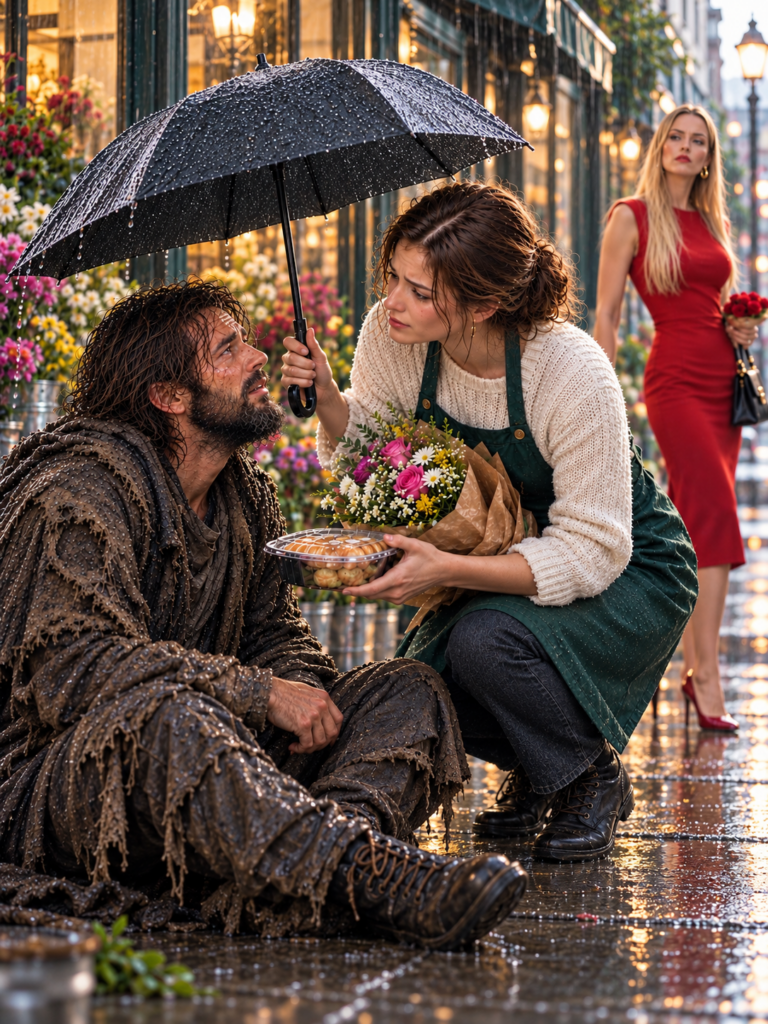
Part 1
The card declined at 6:43 on a Tuesday morning.
Lillian Harper stared at the little payment terminal in the wholesale flower market, willing the red letters to disappear.
“Want to try it again?” the cashier asked.
Lillian managed a smile. “Would you mind?”
The woman pressed a button and slid the terminal back across the counter.
Lillian entered her PIN.
Three seconds passed.
TRANSACTION DECLINED.
Behind her, a delivery driver shifted impatiently, balancing two buckets of roses against his chest.
“Ma’am, I’ve got three stops before seven.”
“I know. I’m sorry.”
Lillian looked at the flowers spread across the counter. White lilies for a funeral arrangement. Yellow roses for a woman celebrating her fiftieth wedding anniversary. Baby’s breath for the bouquets she hoped to sell before the weekend.
She had ordered $186 worth.
Her account contained $142.17.
That was before the electricity payment scheduled to come out at midnight.
“Could you take off the roses?” she asked quietly.
The cashier nodded.
“And the extra greenery.”
Another adjustment.
“And…” Lillian swallowed. “Actually, just leave me the lilies and the baby’s breath.”
The total dropped to $87.40.
This time, the payment went through.
She gathered the flowers into the back of her aging delivery van, where the passenger door no longer opened from the outside and the heater worked only when it felt like cooperating.
Before starting the engine, she checked her phone.
Three missed calls from her younger brother, Eli.
One voicemail.
She pressed play.
“Hey, Lil. Don’t freak out, okay? The hospital called yesterday. Apparently, the insurance company wants more documentation before they’ll approve the procedure. Dr. Patel’s office is working on it. I’m fine. Really. Call me when you get a chance.”
Lillian closed her eyes.
Whenever Eli said don’t freak out, there was usually a very good reason to freak out.
Her brother was twenty-seven, six-foot-two, stubborn as a mule, and living with a heart rhythm disorder that had already put him in the emergency room three times that year.
The doctors believed a cardiac ablation could significantly reduce the episodes. But between the insurance authorization delays, his lost wages, and outstanding medical bills, the treatment had become a maze of phone calls, appeals, and payment notices.
The latest statement showed a balance of $18,640.
Lillian had stared at it for so long the numbers had stopped looking real.
She rested her forehead against the steering wheel.
“Mom,” she whispered, “I could really use one of your miracles right now.”
Her mother had been dead for four years.
The flower shop was almost all she had left of her.
And even that was slipping away.
Across the city, on the forty-eighth floor of a glass mansion overlooking the river, Sebastian Whitmore was being informed of his wedding date.
“The ceremony will be November twenty-first,” his father announced.
Arthur Whitmore placed a cream-colored folder on the breakfast table.
Inside were photographs of a historic cathedral, a reception ballroom, and a seating chart filled with names belonging to some of the wealthiest families in the country.
Sebastian didn’t touch it.
“I never agreed to November.”
Victoria Montrose, sitting opposite him in a pale silk blouse, laughed lightly.
“Oh, Sebastian. Don’t start.”
Arthur continued as if his son hadn’t spoken.
“The Montrose partnership will be announced the week before. Your engagement has already stabilized investor confidence. The wedding will demonstrate that both families are committed to the future.”
“Our companies are negotiating a merger,” Sebastian replied. “We’re not signing a medieval peace treaty.”
Victoria’s smile tightened.
“That’s a little dramatic.”
“Is it?”
Sebastian looked from her to his father.
“Have either of you asked whether I actually want to get married?”
Arthur set down his coffee.
“You’re thirty-eight years old. You know what responsibility looks like.”
“Yes,” Sebastian said. “And it doesn’t look like marrying someone because her father’s investment group controls three board seats.”
Victoria’s face changed.
“Excuse me?”
Sebastian turned toward her.
“When was the last time we had dinner without you bringing up a magazine feature, a charity committee, or what our wedding photographs would do for your family’s reputation?”
“That’s unfair.”
“When was the last time you asked how I was doing?”
She opened her mouth.
Nothing came out.
“Exactly.”
Arthur pushed his chair back.
“Enough.”
“No, Dad. We’ve been avoiding this conversation for two years.”
Sebastian stood.
“I don’t love Victoria. And she doesn’t love me.”
Victoria rose so abruptly her chair scraped against the marble floor.
“You think love is what holds a family like yours together?”
“I think it would be a reasonable place to start.”
“You’re embarrassing yourself.”
“Maybe. But I’d rather embarrass myself today than spend the next thirty years pretending.”
Arthur’s expression hardened.
“You walk away from this arrangement, and you put thousands of employees at risk.”
That stopped Sebastian.
Whitmore Holdings employed more than twelve thousand people across the country.
He had spent years helping build the company after his mother’s death, surviving sleepless nights, hostile negotiations, factory closures, and the relentless demands of being the only son of Arthur Whitmore.
He understood responsibility.
What he no longer understood was why every important choice in his life seemed to belong to someone else.
“If our company can only survive because I marry Victoria,” he said quietly, “then we’ve built the wrong company.”
Arthur stared at him.
“Your mother would be disappointed.”
The words landed harder than either of them expected.
For several seconds, no one moved.
Then Sebastian picked up his jacket.
“Don’t use Mom to win an argument.”
He walked toward the door.
“Sebastian!” Victoria called.
He stopped without turning.
“The wedding is off.”
And then he left.
By that evening, Sebastian had made a decision that would have sounded insane to anyone who knew him.
He was going to disappear.
Not forever.
Long enough to find out whether there was anything left of him without the Whitmore name.
He had spent his entire adult life surrounded by people eager to shake his hand, laugh at his jokes, and agree with whatever he said.
The waiters remembered his favorite wine.
Bankers returned his calls within minutes.
Strangers recognized him in airports.
Even people who disliked him treated him with exaggerated politeness.
He had begun to wonder what would happen if all of it vanished.
With the help of his longtime friend and chief of staff, Nathan Brooks, he rented a tiny room above an old laundromat in a neighborhood he had never visited.
He put his expensive watch, wallet, and phone in Nathan’s care.
He bought secondhand jeans, a faded gray sweatshirt, scuffed boots, and an oversized coat.
He stopped shaving.
A pair of plain glasses and several days of stubble changed his appearance more than he expected.
In the cracked bathroom mirror, Sebastian Whitmore—the billionaire whose face appeared in business magazines—looked like an exhausted man who had been sleeping badly.
Nathan watched him pack.
“Just so we’re clear,” he said, “this is an exceptionally stupid way to deal with a broken engagement.”
Sebastian zipped the duffel bag.
“Probably.”
“You could take a vacation.”
“I’ve been on vacations.”
“Therapy?”
“I’ve done that too.”
“Try therapy without bringing your lawyers.”
Sebastian almost smiled.
Nathan’s tone softened.
“Listen. You can walk away from this whenever you want. People who actually live without money don’t get that choice.”
Sebastian nodded.
“I know.”
Nathan wasn’t convinced.
“No,” he said, “I don’t think you do.”
It was the last thing he said before Sebastian left.
And over the following days, Sebastian began to understand just how right his friend had been.
He discovered that people looked through him when he wore old clothes.
A luxury boutique attendant asked him to move away from the entrance.
A restaurant manager assumed he was looking for free food before Sebastian had even spoken.
One afternoon, he sat on a public bench outside a bank where Whitmore Holdings maintained one of its largest accounts.
A man in a tailored navy suit emerged while shouting into his phone.
“I don’t care what the regional managers say. Close the deal before five.”
The man nearly stepped on Sebastian’s foot.
“Watch it,” he snapped.
Then he looked down at the faded coat.
His expression shifted from irritation to disgust.
“Why don’t you people find somewhere else to hang around?”
Sebastian recognized him.
Gerald Price.
A senior executive from a financial firm Sebastian had worked with for six years.
They had played golf together.
Gerald had once called him one of the smartest businessmen in New York.
Now he didn’t recognize him.
Sebastian said nothing.
Gerald walked away.
For the first time, Sebastian wondered how many people his own company had made feel equally invisible.
But the most painful encounter happened two days later.
He saw Victoria.
She was stepping out of a black luxury SUV outside a fashionable restaurant.
Her driver held the door while she adjusted her sunglasses.
Sebastian was standing nearby, wearing his old coat.
“Excuse me,” he said.
Victoria glanced toward him.
“Could you help me with something?”
She recoiled.
“Absolutely not.”
“It’s just—”
“Do not come any closer.”
Her driver moved between them.
Victoria looked Sebastian up and down.
“Honestly, why does the city allow people to loiter around establishments like this?”
“I’m not trying to hurt anyone,” Sebastian said.
“Then go somewhere else.”
She turned away.
A moment later, she entered the restaurant, laughing into her phone.
Sebastian remained on the sidewalk.
He had always known Victoria could be sharp.
He had never realized how cold she could be when she believed no one important was watching.
By sunset, cold rain was drifting through the city.
Sebastian hadn’t eaten properly all day.
His boots were wet.
His stomach cramped.
And although he knew he could end the experiment with a single call to Nathan, something stubborn kept him walking.
He eventually stopped outside a narrow storefront with a hand-painted wooden sign.
HARPER’S FLOWERS & GIFTS.
Warm yellow light spilled through the windows.
Inside, a woman was sweeping the floor between buckets of carnations and daisies.
Sebastian sat down against the brick wall beside the entrance.
He told himself he’d rest for five minutes.
Only five.
Then the world tilted.
And everything went dark.
Lillian discovered him when she stepped outside to take out the trash.
At first, she thought the man was sleeping.
Then she noticed his pale face and the way one hand lay motionless against the wet pavement.
“Oh, my God.”
She knelt beside him.
“Sir? Can you hear me?”
His eyelids fluttered.
“I’m fine,” he muttered.
“You don’t look fine.”
“Just tired.”
She studied his face.
He looked about forty, with dark hair, a rough beard, and deep shadows beneath his eyes.
There was something strangely refined about his voice.
Not the words.
The way he spoke them.
“Have you eaten today?” she asked.
He hesitated.
“A little.”
Lillian recognized the answer.
She had used it herself too many times.
“Come on.”
He looked up.
“What?”
“Inside. It’s freezing out here.”
“I don’t want to cause trouble.”
“Then don’t. I just swept the floor.”
A faint, reluctant smile crossed his face.
Lillian held out her hand.
After a moment, he took it.
Inside the shop, she settled him into an old wooden chair near the radiator.
She found a clean towel and handed it to him.
Then she went behind the counter.
In the tiny refrigerator, wrapped in brown paper, was the sandwich she had intended to eat for dinner.
Turkey, cheese, and mustard on sourdough bread.
She had made it that morning with the last slices of bread in her kitchen.
Beside it sat a bruised apple.
She stared at the food.
Then at the man shivering near the radiator.
She took out the sandwich and apple.
“Here.”
He blinked.
“What’s this?”
“Dinner.”
“I don’t have money.”
“I didn’t ask for any.”
He looked from the sandwich to her face.
“Is this yours?”
“It was.”
“You should keep it.”
“Listen, mister, I’ve had a very long day. If you make me argue about a sandwich, I might actually lose my mind.”
He laughed unexpectedly.
It was the first genuine laugh he’d managed in days.
Lillian brought him a mug of hot tea.
“Eat.”
He unwrapped the sandwich.
The first bite nearly undid him.
Not because it was extraordinary.
It was an ordinary sandwich, slightly soggy at one corner, with too much mustard.
But he’d spent years attending dinners where a single bottle of wine cost more than most people earned in a week.
And somehow, this was the first meal in a very long time that made him feel cared for.
“Thank you,” he whispered.
Lillian shrugged.
“You looked hungry.”
“You don’t even know me.”
“Doesn’t matter.”
“What if I’m a terrible person?”
She considered him.
“Then I guess a terrible person gets a sandwich tonight.”
He smiled.
“That’s a dangerous philosophy.”
“Probably.”
She sat on the stool behind the counter and rubbed her tired feet.
“My mother used to say you never know what someone is carrying just by looking at them.”
“Your mother sounds wise.”
“She was. Annoyingly wise.”
He noticed the framed photograph on the shelf.
A younger Lillian stood between an older woman holding roses and a teenage boy wearing a crooked baseball cap.
“Is that her?”
Lillian nodded.
“That’s my mom. And my little brother, Eli.”
“Do they help with the shop?”
“Mom started it. Eli helps when he can.”
“And you?”
“I’m the lucky fool trying to keep it running.”
There was no self-pity in her voice.
Just exhaustion wrapped in humor.
“What’s your name?” she asked.
Sebastian hesitated.
For years, his name had opened doors before he reached them.
Now it felt like a burden.
“Sam.”
“Nice to meet you, Sam. I’m Lillian.”
“I know.”
She lifted an eyebrow.
He pointed at the embroidered name on her apron.
“Oh.”
She laughed.
For the next twenty minutes, they talked about unimportant things.
The weather.
The city’s terrible buses.
Why people bought red roses for apologies and yellow roses for celebrations.
“Red roses are overrated,” Lillian told him.
“Really?”
“People think they’re supposed to give red roses because that’s what romance looks like in movies.”
“What would you choose?”
“Depends on the person.”
“For someone you love?”
She considered the question.
“Something they actually like.”
It was such a simple answer that Sebastian found himself remembering it long after he left.
When he stood to go, he set the empty mug on the counter.
“I don’t know how to thank you.”
“You already did.”
“Can I come back sometime?”
Lillian looked at him carefully.
“You can sit outside the shop if you need somewhere safe. But if you’re hungry, come in and tell me. Don’t wait until you fall over.”
He nodded.
At the door, he turned back.
“Lillian?”
“Yeah?”
“Why were you still working so late?”
She glanced at the invoices piled beside the cash register.
“Flowers don’t arrange themselves.”
He followed her gaze.
At the top of the pile sat an envelope marked FINAL RENT REMINDER.
She quickly slipped another paper over it.
Sebastian pretended not to notice.
“Good night, Lillian.”
“Good night, Sam.”
After he left, she locked the door and returned to the counter.
Her stomach growled.
She opened the cupboard.
A handful of crackers.
Two tea bags.
And a nearly empty jar of peanut butter.
“Gourmet dining,” she muttered.
She ate the crackers while finishing a funeral arrangement.
Outside, beneath the streetlight, Sebastian stood quietly across the road.
Through the window, he watched her take a sip of water, press one hand against her stomach, and return to work.
Only then did he understand.
She hadn’t shared her dinner.
She had given him all of it.
The next morning, Sebastian returned.
He brought nothing.
He had promised himself he would not use his money to interfere with anyone’s life while he was trying to understand theirs.
But he had spent most of the night thinking about the woman in the flower shop.
He found her wrestling with a metal display stand outside the entrance.
“Need a hand?”
She looked up.
“Sam! You’re alive.”
“Apparently.”
“Good. That would have been awkward for my customer reviews.”
He lifted the other end of the stand.
Together, they carried it outside.
Lillian brushed the dust from her hands.
“You know, you could make yourself useful around here.”
“I’d like that.”
“Careful. I’ll put you to work.”
“I’m serious.”
She studied him.
“You know anything about flowers?”
“Absolutely nothing.”
“Perfect. Neither do half my customers.”
She showed him how to strip thorns from roses, trim stems at an angle, and fill the buckets without spilling water across the floor.
He was terrible at tying ribbon.
He crushed one carnation by holding it too tightly.
He accidentally put blue dye into a bucket meant for white flowers.
Lillian stared at the mess.
“Oh, Sam.”
“Is that bad?”
“We now have flowers that look like they’ve survived a swimming pool accident.”
He laughed.
She handed him a rag.
“You’re cleaning that.”
For the first time in years, Sebastian spent a morning doing something that didn’t involve a board meeting, a financial report, or someone asking for his signature.
He swept floors.
He carried boxes.
He helped an elderly customer load plants into her car.
And when a woman came in crying because she needed flowers for her husband’s memorial service, he watched Lillian gently guide her toward an affordable arrangement instead of selling her the most expensive one.
“You don’t need twenty-four roses,” Lillian said softly. “Tell me what he liked.”
The woman wiped her cheeks.
“Sunflowers. He always grew sunflowers.”
Lillian smiled.
“Then let’s make something he’d recognize.”
Sebastian watched from behind the counter.
He had negotiated acquisitions worth hundreds of millions of dollars.
Yet he could not remember the last time someone had treated a stranger’s grief with such uncomplicated tenderness.
Later that afternoon, a gray-haired woman entered carrying two coffees.
“Well, well,” she said, eyeing Sebastian. “Who’s the handsome new employee?”
Lillian grinned.
“Temporary help. His name’s Sam.”
The woman extended a hand.
“Mabel Turner. I work here three afternoons a week, whenever this stubborn girl allows it.”
“Nice to meet you,” Sebastian said.
Mabel leaned closer.
“Does she know you’ve got a face under all that hair?”
“Mabel!” Lillian protested.
“What? I’m old, not blind.”
Sebastian laughed.
But the mood changed when Lillian’s phone rang.
She glanced at the screen.
Her smile vanished.
“Excuse me.”
She stepped into the back room.
Sebastian didn’t intend to listen.
The thin walls gave him little choice.
“Yes, this is his sister.”
A pause.
“Another delay?”
Her voice trembled.
“No, I understand the insurance department needs the report. But he was in the ER last month. Dr. Patel said he shouldn’t keep waiting.”
Another silence.
“How much?”
She leaned against the counter.
“Eighteen thousand?”
Her voice dropped.
“I know that’s the balance. I just thought the financial assistance application might…”
Sebastian heard her inhale sharply.
“Please. I’m not asking anyone to do it for free. I’m asking if there’s another option.”
Several minutes later, Lillian emerged.
Her face was composed.
Too composed.
Mabel took one look at her.
“Eli?”
Lillian nodded.
“They’re still working on the authorization.”
“Sweetheart—”
“He’s okay. That’s what matters.”
She reached for a bucket of roses.
Her hands shook.
Sebastian stepped forward.
“Lillian?”
“I’m fine.”
“Are you sure?”
She smiled, but it didn’t reach her eyes.
“Sometimes the whole world just decides to be expensive on the same day.”
She turned back to the flowers.
Sebastian said nothing.
He knew that sentence had been meant to end the conversation.
And for once, he respected it.
But when he returned to his rented room that night, he couldn’t stop thinking about her.
A woman facing bills she could barely comprehend had given her last meal to someone she believed had less than she did.
She had never asked whether he deserved help.
She hadn’t demanded an explanation.
She had simply opened the door.
Sebastian took the emergency phone Nathan had insisted he keep and dialed a familiar number.
Nathan answered immediately.
“Tell me you’re done with this nonsense.”
“Not yet.”
“Your father is threatening to send a private investigator.”
“He probably already has.”
“What do you need?”
Sebastian looked out of the small window toward the city lights.
“There’s a hospital patient assistance program I want you to look into.”
Nathan went quiet.
“Sebastian?”
“Find out how the program works. Properly. I don’t want anyone’s confidential information, and I don’t want anyone moved ahead of another patient.”
“Who are we helping?”
Sebastian hesitated.
“Someone who helped me when she had no reason to.”
Nathan sighed.
“You finally met a nice person, and now you want to buy her a hospital?”
“No.”
Sebastian looked down at the calloused red marks on his hands from carrying flower crates.
“For the first time, Nathan, I want to make sure the money actually goes somewhere it matters.”
He ended the call.
Across the city, Lillian sat at the kitchen table of her small apartment with Eli beside her.
The medical bills were spread between them.
Eli had circled the amount owed in blue pen.
“Lil, you’ve got to stop,” he said.
She looked up.
“Stop what?”
“Trying to pay everything.”
“I’m not trying to pay everything.”
He raised an eyebrow.
“Then why are you staring at my hospital bill like you can scare it into getting smaller?”
She almost laughed.
He reached across the table.
“Mom left you the flower shop. Not a responsibility to fix my entire life.”
“You’re my brother.”
“And you’re my sister. You’re allowed to have a life too.”
Lillian looked away.
The refrigerator hummed.
Rain tapped against the kitchen window.
After a moment, Eli said quietly, “I’m scared, Lil.”
She turned back.
He rarely admitted it.
“Me too,” she whispered.
She took his hand.
“But we’re going to figure this out.”
Neither of them knew how.
And neither knew that, miles away, the man Lillian had fed with her last sandwich was beginning to change everything he thought he understood about wealth, kindness, and love.
Part 2
On Thursday morning, Lillian’s delivery van refused to start.
She turned the key.
Click.
She tried again.
Click. Click.
“No. No, no, no.”
She pressed her forehead against the steering wheel.
In the back were six floral arrangements for a corporate luncheon across town. The client had already paid a deposit, and the balance was supposed to cover part of the shop’s overdue rent.
Lillian checked the time.
8:17 a.m.
The flowers had to arrive by nine.
She climbed out, opened the hood, and stared at an assortment of wires and metal parts she knew absolutely nothing about.
“Need help?”
Sebastian stood on the sidewalk with two coffees.
Lillian looked at him.
“Sam, unless one of those cups contains a working alternator, I’m having a terrible morning.”
He set down the coffees.
“Let me see.”
“You know cars?”
“A little.”
It was another understatement.
At sixteen, Sebastian had spent a summer restoring an old pickup truck with his grandfather. Those had been some of the happiest weeks of his life.
He checked the battery connections and found corrosion around one terminal.
After cleaning and tightening the connection with tools from a battered box beneath the driver’s seat, he asked Lillian to try again.
The engine sputtered.
Then started.
Lillian threw both hands into the air.
“Oh, thank God!”
Sebastian closed the hood.
“I wouldn’t trust it for long. Get the battery and charging system checked.”
She ran around the van and hugged him before she could stop herself.
He froze.
It was only a brief embrace.
A spontaneous expression of relief.
But when she stepped back, something unfamiliar was moving behind his ribs.
“Sorry,” she said, laughing. “I’ve been awake since four.”
“No apology necessary.”
“You just saved my business.”
“I tightened a cable.”
“Today, that’s the same thing.”
She handed him one of the coffees.
“Come on. You’re getting breakfast after I make this delivery.”
He watched her climb into the driver’s seat.
For a man accustomed to receiving expensive gifts from people who wanted something in return, the promise of breakfast from someone who could barely afford it felt impossibly precious.
Over the following week, Sebastian became part of the rhythm of Harper’s Flowers.
He arrived most mornings just after eight.
He swept the storefront, carried deliveries, and fixed a loose hinge on the back door.
Lillian insisted on paying him whenever she had extra cash.
He refused at first.
She wouldn’t hear of it.
“If you’re working,” she told him, “you’re getting paid.”
“Lillian—”
“Don’t argue with your boss.”
He eventually accepted small amounts, setting the money aside untouched.
He began to notice things he would once have overlooked.
The way Lillian turned down the thermostat to save on heating.
How Mabel quietly brought sandwiches on days when she suspected Lillian hadn’t eaten.
How the little shop survived not because it was especially profitable, but because three exhausted people kept refusing to let it disappear.
One afternoon, a man in a charcoal overcoat arrived holding an envelope.
“Ms. Harper?”
Lillian looked up from a bouquet.
“Yes?”
“Daniel Keane. We spoke on Monday.”
Sebastian recognized the careful politeness of a landlord who had rehearsed an unpleasant conversation.
“Mr. Keane. Of course.”
The man glanced around the shop.
“Can we talk privately?”
Lillian led him toward the back counter.
Sebastian kept arranging flowers, though their voices carried.
“I’ve given you two extensions,” Keane said quietly. “I can’t keep doing this.”
“I know.”
“The balance is three thousand six hundred dollars now, including late fees.”
“I can pay eight hundred on Friday.”
“That won’t clear the account.”
“I’m expecting payment from two weddings next week.”
Keane sighed.
“Lillian, I like you. I liked your mother. But I’ve got a mortgage on this building.”
“I understand.”
“I need a firm plan by the end of the month.”
She nodded.
After he left, Lillian stood motionless beside the counter.
Sebastian approached.
“You okay?”
She straightened.
“Wonderful. Nothing like a landlord visit to make the day exciting.”
He didn’t smile.
“Lillian—”
“Please don’t.”
Her voice was gentle, but firm.
He stopped.
She returned to the arrangements.
It was the first time he realized that wanting to help someone and knowing how to help them were two very different things.
Two days later, Eli came to the shop.
Sebastian was replacing a cracked shelf bracket when a tall young man entered carrying a paper bag.
“Delivery for the most stubborn woman in New York.”
Lillian looked up.
“Eli!”
She crossed the room and hugged him.
“You’re supposed to be resting.”
“I’m allowed to walk, Lil. The doctor said so.”
“He said don’t overdo it.”
“And I’m not. I took a cab.”
She gave him a suspicious look.
Eli grinned.
“Okay, the bus. But a very comfortable bus.”
He held up the bag.
“Brought lunch.”
Lillian opened it.
Two containers of homemade chicken soup.
She smiled despite herself.
“You cooked?”
“Don’t sound so shocked.”
Then Eli noticed Sebastian.
“Oh. Hello.”
Lillian gestured between them.
“Eli, this is Sam. He’s been helping at the shop.”
Eli extended a hand.
“So you’re the famous Sam.”
Sebastian shook it.
“Famous?”
“My sister says you can fix anything except a ribbon bow.”
“That is unfortunately accurate.”
Eli laughed.
They sat around the little worktable eating soup from mismatched bowls.
Eli told stories about growing up above the flower shop, helping their mother prepare bouquets for Valentine’s Day, and accidentally delivering funeral flowers to a birthday party.
“Mom nearly killed me,” he said.
Lillian pointed her spoon at him.
“You deserved it.”
“I was fourteen.”
“You put a sympathy card in a box that said Happy Fortieth, Brenda.”
Sebastian laughed so hard he nearly spilled his soup.
For half an hour, the shop felt like a family kitchen.
Then Eli’s smile disappeared.
He set down his spoon.
His fingers moved instinctively toward his chest.
Lillian noticed immediately.
“Eli?”
“I’m okay.”
“What’s happening?”
“Just a little flutter.”
His breathing quickened.
Sebastian stood.
“Should I call someone?”
Lillian moved beside her brother.
“Eli, look at me. Is it the same feeling as last time?”
He nodded.
“I think so.”
She followed the instructions his cardiologist had given them, checking his symptoms and keeping him seated.
When the episode failed to settle promptly and Eli became lightheaded, she called emergency services.
Sebastian retrieved his coat.
He wanted to take control.
To call a private physician.
To order the best specialists in the city.
Instead, he stayed beside Lillian while they waited.
At the hospital, she sat with her hands clasped tightly in her lap.
Sebastian brought her water.
“Drink something.”
She shook her head.
“Lillian.”
She looked at him.
“Please.”
She accepted the cup.
An hour later, the doctor emerged.
Eli was stable.
His rhythm had returned to normal after treatment, but the physician emphasized that his condition required close monitoring while the insurance appeal for the procedure continued.
Lillian nodded through the explanation.
Afterward, when the doctor had gone, she covered her mouth with one hand.
Sebastian sat beside her.
She stared at the floor.
“I keep thinking if I work harder, I can fix it.”
He said nothing.
“My mom was the person who knew what to do. You know? She handled everything. When she got sick, I promised her I’d look after Eli.”
“You have.”
“What if it isn’t enough?”
The question was barely audible.
Sebastian looked at her.
For once, there was no business solution, no clever answer, no contract he could negotiate in five minutes.
So he told her the truth.
“I don’t know.”
She turned toward him.
“But you don’t have to carry every part of it alone.”
Lillian pressed her lips together.
Then she let her head rest briefly against his shoulder.
Neither spoke.
That night, Sebastian called Nathan.
“Tell me what you found.”
Nathan sounded tired.
“The hospital foundation operates a patient hardship fund. It helps eligible patients with uncovered bills and medically necessary expenses. They have an application process, financial counselors, and an independent committee.”
“And?”
“Your friend’s brother has already applied, according to what you told me. But we cannot and should not ask the hospital for his confidential records.”
“Agreed.”
“We can make a contribution to expand the fund. The committee decides how the money is distributed.”
Sebastian looked out at the dark street.
“How much?”
“There’s no fixed ceiling on a charitable donation. But don’t think you can simply purchase somebody a faster procedure.”
“I don’t.”
“Then what are you asking?”
Sebastian remembered Lillian sitting in the hospital corridor, whispering that she didn’t know whether she was enough.
“I want the hospital to have the resources to help families like hers. And I want their existing application reviewed fairly, without any special interference from me.”
Nathan paused.
“That’s something I can arrange.”
“Make the donation anonymous.”
“You’re sure?”
“Yes.”
“Sebastian, sooner or later she’s going to find out who you are.”
“I know.”
“And then?”
Sebastian rubbed his face.
“I haven’t figured that part out.”
Nathan was silent for a moment.
“Be careful. There’s a difference between helping someone and deciding what’s best for them.”
Sebastian looked at the telephone.
He was beginning to think Nathan had become the only person in his life who consistently told him things he didn’t want to hear.
The following Monday, Lillian received an unexpected call.
She was trimming roses when her phone rang.
“Ms. Harper? This is Carolyn from the hospital’s financial assistance office.”
Lillian set down her scissors.
“Yes?”
“I’m calling about your brother’s recent application. We completed the review, and he’s been approved for a hardship grant.”
Lillian gripped the counter.
“I’m sorry. What?”
“The grant will cover the qualifying outstanding balance on his hospital account. Any disputed insurance charges will continue through the normal review process.”
Lillian sat down.
“His entire balance?”
“The eligible patient responsibility currently on the account, yes.”
She closed her eyes.
For a moment, she couldn’t speak.
“Ms. Harper?”
“I’m here.”
“Your brother will receive written confirmation. His physician’s office will continue handling the procedure authorization separately.”
“Can you tell me who approved this?”
“The assistance committee. The fund received additional charitable support recently, which allowed us to clear several pending applications.”
“Do you know who donated?”
“I’m afraid donor information isn’t something we can share.”
Lillian pressed a hand over her mouth.
“Thank you,” she whispered.
After hanging up, she stared at the wall.
Then she called Eli.
He answered on the second ring.
“Hey, Lil.”
“Eli.”
Something in her voice frightened him.
“What happened?”
“Your hospital account.”
“What about it?”
She started laughing and crying at the same time.
“The grant came through.”
He went silent.
“Wait. Seriously?”
“Seriously.”
“Lil…”
“I know.”
For several seconds, they simply listened to each other breathe.
Then Eli whispered, “Mom would’ve loved this.”
Lillian closed her eyes.
“Yeah.”
She looked at the photograph beside the cash register.
“She really would.”
Across the street, Sebastian stood in the doorway of a bakery, holding a paper cup of coffee.
Through the flower shop window, he saw Lillian wipe her cheeks and smile.
He didn’t need to hear the conversation.
He knew.
And for the first time in months, he felt something his business victories had never quite given him.
Relief that had nothing to do with winning.
But the miracle at the hospital didn’t repair the van’s failing battery.
It didn’t reduce the shop’s rent.
And it didn’t restore the wedding order that was canceled three days later when a couple unexpectedly changed venues.
Lillian lost more than a thousand dollars in expected revenue.
On Friday afternoon, she sat behind the counter studying her bank statement.
Mabel pulled up a chair.
“How bad?”
“Not great.”
“That’s not a number.”
Lillian sighed.
“If I pay the wholesaler and the electric bill, I won’t have enough for rent.”
“And if you pay rent?”
“I can’t make the arrangements I’ve already promised.”
Mabel folded her hands.
“Have you thought about selling?”
Lillian looked up sharply.
“Selling what?”
“The shop.”
The words hung between them.
Mabel continued carefully.
“Not because you’ve failed. But because you’re working yourself sick trying to keep something afloat on your own.”
Lillian stared at the familiar walls.
Her mother’s handwritten price list still hung above the worktable.
A dent in the counter marked the place Eli had dropped a toolbox when he was fifteen.
Near the door stood a crooked plant her mother had refused to throw away, even when every customer insisted it was dying.
“I know,” Lillian whispered.
Mabel touched her arm.
“I love this place too.”
Lillian nodded.
That somehow made it worse.
After Mabel left, Sebastian found Lillian alone, rearranging a bouquet that didn’t need rearranging.
“Bad day?”
She didn’t answer immediately.
Then she said, “Have you ever worked so hard for something that you forgot to ask whether it was working?”
He pulled up a stool.
“Yes.”
She looked at him.
“Really?”
“Really.”
“What happened?”
“I kept doing it because everyone expected me to.”
“And?”
“I finally walked away.”
Lillian considered him.
“Did it help?”
He looked around the flower shop.
“More than I expected.”
She leaned against the counter.
“I’m not sure I can walk away from this place.”
“Maybe you don’t need to. Maybe you need a different way of running it.”
She laughed bitterly.
“Great. I’ll just find an extra ten thousand dollars and hire a business consultant.”
“Or start smaller.”
He picked up her price sheet.
“Are you charging enough for delivery?”
“Probably not.”
“Do you know which arrangements are actually profitable?”
“I know which ones sell.”
“That’s not the same thing.”
She studied him.
“Sam, where did you learn this stuff?”
He paused.
“I used to work in business.”
“What kind?”
“A lot of numbers. Meetings. Too much coffee.”
“Accounting?”
“Something like that.”
She narrowed her eyes.
“You’re a very strange homeless man.”
Sebastian looked down at his hands.
The description stung in a way it hadn’t before.
He wasn’t homeless in the way she believed.
He could return to his apartment whenever he wanted.
He had made a temporary choice to live without his usual comforts, while Lillian and Eli had no such escape from their struggles.
“I haven’t been entirely straightforward with you,” he said.
Lillian’s expression changed.
“About what?”
“About my situation.”
She waited.
Before he could continue, the shop door opened.
Victoria Montrose stepped inside.
Sebastian recognized her immediately.
She was wearing a cream-colored coat, diamond earrings, and a look of intense dissatisfaction.
“This is Harper’s Flowers?” she asked.
Lillian stepped behind the counter.
“Yes. How can I help you?”
“I was told you make custom arrangements.”
“We do.”
Victoria glanced around.
Her eyes moved over the mismatched shelves, the older refrigerator, and the faded wallpaper.
“This is smaller than I expected.”
Lillian smiled professionally.
“We make up for it with flowers.”
Victoria didn’t smile back.
“I need something for a private dinner. White orchids, ideally. No cheap filler.”
“Of course. How many tables?”
“Six.”
Lillian began taking notes.
Sebastian turned away, keeping his face lowered.
He heard Victoria’s heels clicking against the floor.
Then she stopped.
“Excuse me.”
Sebastian looked up.
Victoria stared at him.
Her eyes narrowed.
“Have we met?”
He held her gaze.
“Possibly.”
She recoiled slightly.
“Oh, you’re that man from outside the restaurant.”
Lillian looked between them.
“You two know each other?”
“Hardly,” Victoria said.
She turned toward Lillian.
“You allow people like this to work here?”
Lillian’s expression cooled.
“Sam has been helping me with deliveries.”
Victoria looked at his worn coat.
“Is he even insured? I wouldn’t want someone like that handling expensive arrangements.”
“He’s very careful with our flowers,” Lillian replied.
Victoria gave a short laugh.
“You’re far more trusting than I would be.”
“Maybe.”
Victoria slid a business card onto the counter.
“Send me a proposal by five. My assistant will decide whether your work is appropriate.”
She turned toward Sebastian.
“And you should really consider improving your appearance. People might take you more seriously.”
Then she walked out.
The bell above the door rang.
Silence settled over the shop.
Lillian slowly put down her pen.
“Well,” she said.
Sebastian stared at the closed door.
“She’s charming.”
“Like a cactus in an expensive coat.”
He laughed despite himself.
But Lillian was still watching him.
“You looked like you knew her.”
He hesitated.
“I do.”
“How?”
“She comes from the world I used to live in.”
Lillian leaned against the counter.
“Sam, who are you?”
For one terrifying second, Sebastian nearly told her everything.
He imagined the look on her face.
The hurt.
The embarrassment.
The possibility that every honest moment between them would suddenly look like a billionaire’s cruel little game.
“I need to tell you something,” he began.
His phone rang.
Not the cheap prepaid one Lillian had occasionally seen.
The emergency phone Nathan had insisted he keep.
Sebastian glanced at the caller.
Arthur Whitmore.
He ignored it.
It rang again.
And again.
“Important?” Lillian asked.
He swallowed.
“Family.”
“Then answer it.”
He stepped outside.
Arthur’s voice was sharp.
“Where the hell have you been?”
“I’m safe.”
“That’s not an answer.”
“It’s the only one you’re getting right now.”
There was a pause.
Then his father spoke more quietly.
“Your mother left me one son, Sebastian. You can be angry with me, but don’t disappear without telling me you’re alive.”
Sebastian shut his eyes.
His father sounded old.
For the first time in years, genuinely old.
“I’m sorry,” Sebastian said.
Arthur exhaled.
“The foundation gala is Saturday. I need you there.”
“No wedding announcement.”
“There won’t be one.”
Sebastian said nothing.
“Victoria’s father is furious,” Arthur continued. “The merger terms are unraveling.”
“Then let the terms unravel. We shouldn’t tie the company to something we can’t defend.”
“Come and help me find another solution.”
Sebastian looked through the flower shop window.
Lillian was laughing at something Mabel had said.
A simple, unguarded laugh.
He remembered the woman who had given a hungry stranger her dinner.
Then he thought of the executives who treated their workers as numbers.
“Okay,” he said.
“I’ll come.”
When Sebastian returned to the shop, Lillian was organizing the counter.
“Everything all right?”
“Not exactly.”
She gave him a sympathetic look.
“Families are complicated.”
“You have no idea.”
“Oh, I have some idea.”
He smiled faintly.
Then he took a breath.
“Lillian, there’s something I should have told you from the beginning.”
She studied his face.
“Are you in trouble?”
“No.”
“Are you running from someone?”
He almost laughed.
“Not in the way you mean.”
“Are you married?”
The question surprised him.
“No.”
Her shoulders relaxed so slightly that he almost missed it.
“Engaged?”
“Not anymore.”
“Ah.”
A pause.
“Did you break her heart?”
“I don’t think she wanted mine.”
Lillian’s expression softened.
Sebastian looked down.
“My name isn’t really Sam.”
She went still.
He continued.
“It’s Sebastian.”
“Sebastian what?”
He opened his mouth.
At that moment, Eli entered the shop carrying a stack of envelopes.
“Lil, you’ll never guess what came in the mail.”
Lillian turned.
“What?”
He held up a large cream-colored invitation.
“Apparently, my sister has become a very important person.”
She took the envelope.
Embossed across the front was a gold crest.
THE WHITMORE FAMILY FOUNDATION
Inside was an invitation to the annual foundation gala, accompanied by a letter recognizing Harper’s Flowers for its quiet service to the neighborhood.
The letter explained that a local community organization had nominated her shop for its work helping families during difficult times.
Lillian read it twice.
“Is this real?”
Eli whistled.
“That’s a fancy party.”
Mabel appeared from the back room and smiled.
“I might know something about that nomination.”
Lillian turned.
“Mabel?”
“Your mother spent thirty years giving flowers to people who couldn’t afford them. You’ve been doing the same. Someone should notice.”
Lillian shook her head.
“But why would they invite me?”
Sebastian stood completely still.
“Maybe,” he said softly, “because someone finally noticed what you’ve been doing.”
Saturday evening arrived beneath a cold, clear sky.
Lillian stood in front of her bedroom mirror wearing a navy-blue dress she had borrowed from Mabel’s daughter.
It was simple.
Modest neckline.
Soft fabric.
No designer label.
She had sewn one loose seam herself.
Her hair was pinned back, and around her neck hung a small silver necklace that had belonged to her mother.
Eli stood in the doorway.
“Wow.”
She looked over her shoulder.
“What?”
“You look nice.”
“Just nice?”
“Okay, you look like a movie star. Happy?”
She laughed.
Then her smile faded.
“I don’t belong at a place like that.”
Eli stepped closer.
“Why not?”
“Because people there spend more on dinner than I earn in a week.”
“So?”
“So I don’t want to embarrass myself.”
Eli took her hand.
“Lil, you once delivered funeral flowers during a snowstorm because a woman couldn’t afford the express fee.”
She looked at him.
“You spent your last twenty dollars buying sandwiches for people outside the church after Mom’s service.”
“Eli…”
“And you gave some random guy your dinner because he looked hungry.”
Lillian laughed softly.
“Are you going somewhere with this?”
“Yeah.”
He squeezed her hand.
“If those people don’t think you belong there, they’re the ones who should be embarrassed.”
She hugged him.
“Since when did you get so smart?”
“Runs in the family.”
He stepped back.
“Besides, Mabel said she’d handle the shop. You deserve one night off.”
Lillian glanced at her phone.
There was no message from Sebastian.
He had been absent since Friday afternoon.
She had sent one text asking whether everything was okay.
No reply.
She told herself it didn’t matter.
Then she checked her phone again.
The ballroom of the Whitmore Grand Hotel looked like a world Lillian had never been invited to enter.
Crystal chandeliers hung from a ceiling decorated with hand-painted clouds.
Tall arrangements of white orchids rose from silver stands.
Waiters moved between guests carrying trays of sparkling drinks.
Everywhere she looked, people wore clothes that seemed to belong behind museum glass.
Lillian stepped inside and instinctively touched her mother’s necklace.
A woman at the registration table smiled.
“Name, please?”
“Lillian Harper.”
The woman checked her list.
“Of course. Welcome, Ms. Harper. You’re one of our community honorees tonight.”
“Thank you.”
She received a small printed program and entered the ballroom.
For several minutes, she wandered quietly, looking at the art on the walls and the beautiful flowers.
She stopped beside an enormous arrangement of white roses.
They were gorgeous.
Perfectly symmetrical.
And to her trained eye, slightly thirsty.
She almost laughed.
Even billionaires forgot to change the water.
A familiar voice interrupted her thoughts.
“Well, this is surprising.”
Lillian turned.
Victoria Montrose stood several feet away.
She wore a shimmering gold gown and a diamond necklace so brilliant it caught every chandelier in the room.
Her eyes traveled slowly over Lillian’s dress.
“You’re the flower shop girl.”
Lillian felt her cheeks warm.
“Yes. We met a few days ago.”
Victoria glanced at the program in Lillian’s hand.
“How did you get in here?”
“I received an invitation.”
Victoria laughed.
“An invitation?”
“Yes.”
“From whom?”
“The foundation.”
Victoria looked toward the guests surrounding them.
A few had begun listening.
“That’s interesting,” she said. “Because this is an exclusive gathering for major donors and business leaders.”
Lillian stood straighter.
“The invitation mentioned community organizations as well.”
Victoria’s expression sharpened.
“I’m sure it did.”
She stepped closer.
“But there’s a difference between being invited to serve at an event and being invited as a guest.”
Lillian felt the sting of those words.
“I was invited as a guest.”
“Then someone in administration made a very strange decision.”
An older woman nearby shifted uncomfortably.
A waiter paused before moving away.
Victoria lowered her voice, though not enough to keep others from hearing.
“Look, I’m sure you mean well. But people like you don’t understand how these events work.”
Lillian’s fingers tightened around the program.
She remembered all the nights spent arranging flowers until her hands cramped.
The canceled orders.
The hospital calls.
The apartment rent.
The sandwich she had given away.
She had entered the ballroom feeling nervous.
Now she felt foolish.
Maybe she had misunderstood the invitation.
Maybe someone had invited her as a token gesture.
“I don’t want any trouble,” she said.
Victoria smiled coldly.
“Then perhaps you should leave before you create some.”
Lillian’s throat tightened.
She turned toward the exit.
Before she could take a step, a uniformed attendant approached.
“Ms. Harper?”
She stopped.
“Yes?”
“The host has asked to see you.”
Victoria’s smile disappeared.
“The host?”
The attendant nodded politely.
“Mr. Sebastian Whitmore.”
Lillian stared at him.
She had heard the surname all evening, but until that moment she hadn’t connected it to the name Sam had nearly finished telling her.
“I’m sorry,” she whispered. “Who?”
“The chairman of Whitmore Holdings, ma’am. He’s expecting you.”
Victoria stepped forward.
“Sebastian is here?”
The attendant glanced toward the grand staircase at the far end of the ballroom.
“Yes, Ms. Montrose.”
He turned back to Lillian.
“If you’ll come with me.”
The orchestra’s music faded beneath the sound of murmuring voices.
Lillian looked toward the staircase.
A tall man in a perfectly tailored black tuxedo had appeared at the top.
His dark hair was neatly styled.
His beard was trimmed.
His posture was unmistakably confident.
Guests began turning toward him.
And as he descended the staircase, Lillian felt the entire room shift around her.
Because beneath the expensive suit and polished appearance, she recognized something impossible.
Those eyes.
That smile.
The man who had sat hungry in her flower shop.
The man who had repaired her van.
The man she had trusted.
Sebastian stopped at the foot of the stairs.
He looked directly at her.
“Hello, Lillian.”
Her lips parted.
“Sam?”
Part 3
For a moment, Lillian forgot how to breathe.
The man standing before her was impossible to reconcile with the person she knew.
The worn gray coat was gone.
So were the scuffed boots and the unkempt beard.
In their place stood a man whose tailored tuxedo probably cost more than her monthly rent.
But his eyes were the same.
The eyes that had looked at her over a cup of tea.
The eyes that had watched her struggle with the delivery van.
The eyes that had filled with concern in the hospital corridor.
“Sam?” she whispered again.
Sebastian took one step toward her.
“My name is Sebastian Whitmore.”
She stared at him.
“The Sebastian Whitmore?”
He nodded.
“I’m sorry I didn’t tell you sooner.”
Behind her, Victoria made a sharp, disbelieving sound.
“Sebastian, what on earth is going on?”
He glanced at Victoria.
Then he turned back to Lillian.
“I wanted to thank you properly.”
Lillian shook her head.
“Thank me?”
“For everything.”
She looked around.
The chandeliers.
The orchestra.
The rows of elegantly dressed guests.
The gold crest printed on her invitation.
And suddenly, everything began fitting together.
The strange knowledge he had about business.
The expensive vocabulary that sometimes slipped into his conversation.
The phone calls he wouldn’t explain.
The confidence he carried even in an old coat.
“You lied to me,” she said quietly.
Sebastian’s face tightened.
“Yes.”
“You told me you had nowhere to go.”
“I told you I needed somewhere safe to sit.”
“You let me believe you were homeless.”
He lowered his eyes.
“Yes.”
Lillian felt heat rising in her cheeks.
She remembered offering him her sandwich.
The last food in her refrigerator.
She remembered worrying that he might be sleeping outside in the cold.
And now she understood that the man she had been afraid would go hungry could have purchased her entire neighborhood without checking his bank account.
“You let me worry about you,” she whispered.
Sebastian’s expression changed.
Of everything she might have said, that hurt the most.
“I know.”
Victoria stepped between them.
“Sebastian, this is ridiculous. Why are you discussing anything with her?”
He turned.
“Because she’s my guest.”
Victoria blinked.
“Your guest?”
“Yes.”
She lowered her voice.
“Sebastian, think about how this looks.”
He looked at her for a long moment.
Then he asked, “When you came into Lillian’s shop, did you know who I was?”
Victoria’s eyes narrowed.
“What does that have to do with anything?”
“Did you recognize me?”
“No, of course not. You looked—”
She stopped.
Sebastian waited.
Victoria pressed her lips together.
“You deliberately made yourself look like that?”
“Yes.”
“Why?”
“Because I wanted to know how people treated someone they believed couldn’t do anything for them.”
A murmur spread among the guests.
Victoria crossed her arms.
“So you were playing games.”
Sebastian didn’t answer immediately.
He knew she was partly right.
What he had done had started as an experiment, and he’d spent too long pretending there was nothing cruel about having the privilege to walk away from it whenever he chose.
Finally, he said, “I was trying to understand something I should have understood years ago.”
Victoria glanced around.
“Then surely you’ve proved your point. Let’s not make a spectacle.”
Sebastian looked toward Lillian.
“She gave me her dinner when she didn’t have enough food for herself.”
Victoria went still.
“She welcomed me into her shop. She made sure I was warm. She trusted me to help her work.”
He looked back at his former fiancée.
“And you told her she didn’t belong here.”
Victoria’s face flushed.
“I had no idea who she was.”
Sebastian’s voice remained calm.
“That’s the problem, Victoria. You believed you needed to know who someone was before deciding whether they deserved respect.”
Several guests lowered their eyes.
Victoria opened her mouth, then closed it.
Finally, she said, “I will not stand here and be humiliated in front of everyone.”
“You don’t have to.”
Sebastian stepped aside.
Victoria looked toward Arthur Whitmore, who had just joined the gathering.
“Arthur, are you hearing this?”
Arthur glanced at his son.
Then at Lillian.
Then back at Victoria.
“I am,” he said quietly.
Victoria seemed to wait for him to defend her.
He didn’t.
Her expression hardened.
“Your family is making a tremendous mistake.”
Sebastian nodded.
“Maybe we have made quite a few.”
Victoria stared at him.
Then she turned and walked toward the exit.
Her heels struck the marble floor in sharp, angry rhythm.
No one applauded.
No one laughed.
The room simply fell silent as she disappeared through the doors.
Sebastian wanted to follow Lillian when she stepped away from the crowd.
But Arthur caught his arm.
“Son.”
“Not now, Dad.”
“Sebastian.”
There was something unfamiliar in his father’s voice.
Sebastian turned.
Arthur studied him.
For the first time that evening, there was no board chairman in his expression.
Only a tired father looking at a son he had nearly lost.
“I didn’t know about any of this,” Arthur said.
“I know.”
“Your mother used to bring people home.”
Sebastian frowned.
“What?”
“People who needed help. A young housekeeper whose husband had lost his job. A driver whose daughter was sick. Once, a woman she met at the grocery store.”
Sebastian remembered fragments.
His mother laughing in the kitchen with strangers.
Extra plates at Christmas.
Boxes of clothes she quietly delivered somewhere without explaining.
Arthur’s gaze moved toward Lillian.
“I used to tell your mother she was too trusting.”
Sebastian said nothing.
“She always answered the same way. She said that if we had enough to share, we had enough to be grateful for.”
Arthur paused.
“I forgot that.”
Sebastian looked at his father.
For years, Arthur had measured success in mergers, buildings, market capitalization, and the stubborn resilience of the Whitmore name.
Now he seemed smaller.
And somehow more human.
“Dad—”
Arthur shook his head.
“I told you that protecting the company meant marrying Victoria. But when I reviewed the latest merger terms, I finally saw what her father was demanding.”
Sebastian waited.
“Consolidated operations. Staffing reductions. A transfer of control over our manufacturing division.”
“I warned you.”
“I know.”
Arthur looked down.
“I didn’t listen.”
Those three words were more than Sebastian had heard from him in years.
Arthur cleared his throat.
“The employees deserve better than a deal we can’t defend.”
Sebastian nodded.
“We can find another way.”
“Yes,” Arthur said. “I think we can.”
He rested one hand on Sebastian’s shoulder.
“And son?”
“Yeah?”
“Don’t lose that young woman because you’re too proud to admit you made a mistake.”
Sebastian looked toward the far side of the ballroom.
Lillian was standing alone beside a window.
Her arms were folded across her chest.
“I think,” Sebastian said, “I already did.”
The foundation’s director approached Sebastian shortly afterward and reminded him that he was scheduled to speak.
He took the stage.
The ballroom gradually quieted.
“Good evening, everyone.”
He looked across the crowd.
Most of the faces were familiar.
Investors.
Executives.
Philanthropists.
People who had celebrated his achievements for years.
“I had a very different speech prepared tonight,” he began.
A few guests smiled politely.
“But there’s something I need to say first.”
He rested his hands on the lectern.
“A few weeks ago, I walked away from my ordinary life. I wore old clothes. I used another name. I went places where nobody recognized me.”
The room became still.
“I thought I was going to learn something about people. And I did. But I also learned something uncomfortable about myself.”
He paused.
“I could stop whenever I wanted. I could return to a comfortable home, a full refrigerator, and a bank account that made most ordinary problems disappear. I was never truly living the life of someone who had nowhere else to go.”
Several guests shifted in their seats.
“For some of our neighbors, there is no easy way out. No car waiting. No assistant to call. No wealthy family behind them.”
He looked toward Lillian.
“I met someone who had every reason to look away from a stranger in need. She had bills to pay, a sick brother, and a business she was fighting to save.”
Lillian’s eyes filled.
“She didn’t know my real name. And she didn’t ask. She offered me food because she thought I was hungry.”
Sebastian swallowed.
“She didn’t do it for attention. She didn’t do it because she expected anything. She did it because that’s who she is.”
He lowered his gaze to the prepared speech.
Then he moved the pages aside.
“Our foundation has spent years measuring the money we distribute. We have not always spent enough time listening to the people we say we’re helping.”
He explained that the foundation’s next round of grants would include expanded support for hospital hardship programs, community businesses, and workers facing unexpected financial emergencies.
The programs would be administered by independent committees, with published eligibility criteria and oversight.
“We cannot solve every problem with a check,” he said. “But we can make it less difficult for decent people to survive a bad month, an illness, or a piece of bad luck.”
He stepped back from the microphone.
For a moment, no one moved.
Then applause rose through the ballroom.
Arthur stood first.
Others followed.
But Sebastian wasn’t watching the guests.
He was watching Lillian.
And she wasn’t smiling.
He found her on a quiet terrace outside the ballroom.
The city glittered beneath them.
Cold wind moved across the stone floor.
Lillian stood near the railing, looking down at the traffic.
“Can we talk?” he asked.
She didn’t turn.
“You’ve had quite a night.”
“I know.”
“Everybody loves you out there.”
“That isn’t what I wanted.”
She faced him.
“Then what did you want, Sebastian?”
He flinched at the sound of his real name.
It seemed strange coming from her.
“I wanted you to know the truth.”
“You had plenty of chances to tell me.”
“Yes.”
“You came to my shop every day.”
“I know.”
“You sat with me in the hospital.”
He nodded.
“You listened while I talked about rent and bills and my brother’s treatment.”
Her voice cracked.
“And the entire time, you could have fixed all of it without blinking.”
“Lillian—”
“No. You need to hear me.”
He stopped.
She looked at him with an expression more painful than anger.
“I wasn’t ashamed of helping you. I was happy to help you. I thought you were someone having a harder time than I was.”
She swallowed.
“But you made me part of some kind of experiment without asking.”
Sebastian looked down.
“That’s true.”
“I told you things I don’t tell anybody.”
“I know.”
“Was any of it real?”
He looked up immediately.
“Yes.”
Her eyes searched his face.
“Which part?”
He stepped closer, but stopped when she stiffened.
“The part where I loved being in your shop. Where I liked hearing you laugh at my terrible ribbon bows. Where I was scared for Eli. Where I looked forward to seeing you every morning.”
Lillian turned away.
Sebastian continued quietly.
“I left home because I couldn’t recognize the life I was living anymore. I thought getting rid of my name would help me figure out who I was.”
He paused.
“Then I met you. And for the first time in years, I didn’t feel like somebody’s investment, or somebody’s son, or somebody’s business opportunity.”
He took a breath.
“I felt like a person.”
Lillian’s expression softened for an instant.
Then she shook her head.
“That doesn’t make the lying okay.”
“No.”
“Did you have something to do with Eli’s hospital bill?”
Sebastian went still.
She looked at him.
“Tell me the truth.”
He nodded slowly.
“I asked Nathan to research the hospital’s patient hardship fund. I made an anonymous donation to it.”
Lillian stared at him.
“And Eli’s grant?”
“His application was reviewed through the hospital’s normal process. I didn’t have access to his medical records, and I didn’t ask anyone to approve him ahead of somebody else.”
He hesitated.
“But I knew the fund had been short of money. I hoped the contribution would let it help more families, including yours.”
Lillian covered her mouth.
For several seconds, neither spoke.
Then she asked, “Why didn’t you tell me?”
“Because I was afraid you’d feel like you owed me.”
“Sebastian…”
She looked at him, incredulous.
“You don’t get to make that decision for me.”
He lowered his head.
“I know that now.”
She wiped at her cheek.
“I am grateful my brother got help. More grateful than I can explain.”
“I know.”
“But you should have trusted me with the truth.”
“You’re right.”
She looked back toward the ballroom.
“I need time.”
Sebastian felt his chest tighten.
“Okay.”
“I don’t know what this means for us.”
“Neither do I.”
She picked up the small purse she had placed on the railing.
“Good night, Sebastian.”
He wanted to stop her.
To promise anything.
To offer to pay every bill she would ever receive.
But he finally understood that the kindest thing he could do wasn’t always to fix something.
Sometimes it was to let someone choose.
“Good night, Lillian.”
She walked away.
And Sebastian stood alone on the terrace, surrounded by a fortune that suddenly felt powerless.
For three weeks, Lillian didn’t see him.
She returned to work.
The lilies arrived late.
A bride changed her mind about her bouquet.
The refrigerator broke down for half a day.
Nothing in her life became magically easier because she’d met a billionaire.
But something had changed.
People from the neighborhood began stopping by after hearing about her recognition at the gala.
Some simply wanted to congratulate her.
Others placed orders.
A local restaurant asked whether she could supply weekly centerpieces.
And one afternoon, Mabel arrived with an application for a small-business support program sponsored by a coalition of neighborhood organizations.
“Before you say no,” Mabel announced, “I have read the whole thing.”
Lillian looked suspicious.
“That’s never a good opening.”
“They offer business counseling and low-interest working-capital loans to shops with at least three years of trading history.”
“I already have enough debt.”
“Then don’t borrow more than you can repay. But at least find out what your options are.”
Lillian read the application.
For the first time, she wondered whether keeping the shop meant more than simply working longer hours.
Maybe she needed to change the business.
She had been undercharging for deliveries.
Accepting custom orders that barely covered the flowers.
Keeping products that customers loved but that lost money when preparation time was included.
With help from a volunteer adviser, she began rebuilding her pricing.
She reduced waste.
Introduced prepaid weekly subscriptions.
Set minimum orders for delivery.
And, reluctantly, stopped accepting jobs that would cost more to complete than they earned.
One evening, Mabel watched her cross an order off the calendar.
“Your mother would’ve hated turning down business,” she said.
Lillian smiled sadly.
“Mom also would’ve hated losing the shop.”
Mabel nodded.
“Fair point.”
Meanwhile, Sebastian returned to Whitmore Holdings.
But he did not return to business as usual.
He spent his first week meeting with operations managers, staff representatives, and employees in offices he had never personally visited.
He learned how often people worked extra shifts to cover staffing shortages.
How long healthcare reimbursement sometimes took.
How a single breakdown in transportation could cost a warehouse employee their job.
He had believed he understood the company’s workers because he understood its payroll.
Now he knew better.
Arthur joined several of the meetings.
At first, he listened stiffly.
He asked questions that sounded like boardroom interrogations.
But gradually, he began listening without trying to win.
Together, they withdrew from the Montrose merger negotiations and developed a more conservative investment plan that didn’t depend on the proposed large-scale staffing reductions.
It wasn’t simple.
There were difficult decisions.
Some expansion projects were delayed.
Executive bonuses were reduced.
Several departments had to revise their budgets.
But the company remained stable.
One afternoon, Arthur entered Sebastian’s office holding an old photograph.
It showed Sebastian’s mother standing outside a community kitchen, laughing with a woman in an apron.
“I found this in a box,” Arthur said.
Sebastian smiled.
“She used to volunteer there every Thanksgiving.”
Arthur nodded.
“I’d forgotten.”
He placed the photograph on the desk.
“I think we should visit.”
Sebastian looked at him.
“You?”
“I’m not incapable of washing dishes.”
Sebastian grinned.
“That’s debatable.”
Arthur actually laughed.
And for the first time in years, the sound didn’t seem out of place.
The first message Sebastian received from Lillian arrived twenty-six days after the gala.
It was short.
Eli’s procedure has finally been approved. The insurance appeal worked. They’re scheduling it for next week.
Sebastian stared at the screen.
Then he replied.
That’s wonderful news. How is he feeling?
Three minutes passed.
Terrified. Pretending otherwise.
Sebastian smiled.
Sounds like him.
Another pause.
Then:
He asked about you.
Sebastian sat very still.
What did you tell him?
That you’re complicated.
He laughed quietly.
Fair.
A final message appeared.
He’d like you to visit after the procedure, if everything goes well.
Sebastian’s throat tightened.
I’d like that.
Eli’s procedure took place on a rainy Wednesday morning.
The doctors had explained the risks carefully, and no one had promised a perfect result.
Lillian sat in the waiting room with Mabel, clutching a paper coffee cup that had gone cold hours earlier.
The procedure was successful.
Eli recovered steadily, although his doctors emphasized that he would need follow-up appointments and monitoring.
When Sebastian arrived the following afternoon, he brought a small container of homemade soup.
Lillian met him in the hallway.
She stared at the container.
“Did you make that?”
Sebastian looked almost embarrassed.
“I followed a recipe.”
“You cooked?”
“It’s possible.”
“Did anyone supervise you?”
“Nathan called twice.”
She laughed.
It was the first easy laugh they’d shared since the gala.
Sebastian’s expression softened.
“I missed that.”
Lillian looked down.
“So did I.”
Inside the room, Eli was sitting upright in bed, looking pale but considerably more cheerful.
“Well, look who’s here,” he said.
Sebastian approached.
“Hey, Eli.”
Eli looked him up and down.
“Man, you clean up well.”
Sebastian smiled.
“So I’ve heard.”
“I saw the news.”
“I was afraid of that.”
“Turns out my sister was letting a billionaire sweep the floors.”
“Not my finest disguise.”
Eli laughed, then winced.
“Don’t make me laugh too hard.”
Sebastian sat down.
For a while, they talked about ordinary things.
The terrible hospital food.
The basketball games Eli had missed.
Whether Lillian would ever replace the shop’s ancient refrigerator.
Then Eli became serious.
“Hey, Sebastian?”
“Yeah?”
“Thank you.”
Sebastian looked at him.
“You don’t have to—”
“I know about the fund.”
Sebastian went still.
Eli continued.
“My sister told me. I know the grant wasn’t just some favor you could order somebody to hand me.”
Sebastian nodded.
“But you helped make more money available. And that mattered.”
Eli swallowed.
“I’m grateful.”
Sebastian looked at him.
“I’m glad you’re here.”
Eli smiled faintly.
“Me too.”
After a moment, he added, “And just so you know, if you hurt my sister again, I don’t care how much money you’ve got.”
Sebastian laughed.
“Understood.”
Lillian, standing near the doorway, rolled her eyes.
“Eli.”
“What? Somebody has to say it.”
The friendship returned before the romance did.
Sebastian began stopping by the flower shop occasionally.
Sometimes he brought coffee.
Sometimes he helped unload deliveries.
And sometimes he simply sat at the worktable while Lillian finished arrangements.
He no longer pretended he was poor.
He no longer invented explanations for phone calls.
When he made a mistake, he admitted it.
When Lillian was angry, he listened.
One afternoon, he arrived carrying an envelope.
Lillian immediately narrowed her eyes.
“What is that?”
“A bill.”
“Whose?”
“Mine.”
He handed it to her.
She opened it.
Inside was an invoice for three broken vases, damaged ribbon, and a ruined bucket of blue flowers from his first week at the shop.
At the bottom, he had written:
Amount owed: $47.60.
Lillian stared at it.
Then she started laughing.
“You kept track?”
“I was hoping you’d let me make things right.”
She found a pen and wrote across the paper.
PAID IN FULL — FOR SERVICES RENDERED.
He read it.
“Services rendered?”
“You repaired my van.”
“That wasn’t worth forty-seven dollars.”
“To me, it was.”
Their eyes met.
The laughter faded into something quieter.
Sebastian reached across the counter.
“Lillian, I’d like to take you to dinner.”
She looked at his hand.
“Dinner?”
“A real date.”
“Somewhere with six forks and waiters who judge your shoes?”
He shook his head.
“Wherever you want.”
She considered him for a moment.
“There’s a little diner on Oak Street.”
“I know it.”
“They make the best grilled cheese in the city.”
“Then that’s where we’re going.”
She smiled.
“One condition.”
“Anything.”
“No pretending to be somebody else.”
Sebastian nodded.
“No more pretending.”
Their first date lasted four hours.
They ate grilled cheese sandwiches and tomato soup in a booth beside the window.
Sebastian learned that Lillian loved old country songs but couldn’t carry a tune.
Lillian discovered that Sebastian was terrible at bowling, afraid of heights despite living in a skyscraper, and had secretly wanted to become an architect when he was younger.
“Why didn’t you?” she asked.
“My father expected me to join the business.”
“Did you ever tell him you wanted something different?”
“Not until recently.”
She looked at him.
“Maybe there’s still time.”
He smiled.
“Maybe.”
They talked about their mothers.
About grief.
About the things they’d given up.
And the strange loneliness of being surrounded by people but feeling unknown.
When Sebastian walked her home, he stopped outside the entrance to her apartment building.
“Can I see you again?”
Lillian smiled.
“You’re already coming to the shop tomorrow.”
“I mean like this.”
She considered him.
“Yes.”
He stepped closer.
“Can I kiss you?”
She looked into his eyes.
Then she nodded.
The kiss was gentle.
Unhurried.
Nothing like the dramatic romances Lillian had read as a teenager.
And somehow, it meant more.
Over the next year, their relationship grew slowly.
There were disagreements.
Sebastian still sometimes tried to solve problems by spending money.
Lillian still struggled to accept help even when it made practical sense.
When the flower shop needed a new refrigerator, he offered to purchase one.
She refused.
“You can’t keep buying me things.”
“It’s a refrigerator, Lillian. Not a private island.”
“That’s not the point.”
“Then tell me what the point is.”
She took a breath.
“I need to know I can stand on my own.”
Sebastian listened.
The next week, Lillian purchased a refurbished commercial refrigerator through the shop’s new equipment financing plan.
Sebastian helped carry it inside.
He didn’t mention the money again.
As the business improved, Harper’s Flowers secured several new commercial clients.
Later, the Whitmore Family Foundation publicly invited local florists to bid on a year’s worth of event arrangements.
Sebastian disclosed his relationship with Lillian and removed himself from the vendor selection process.
Lillian almost didn’t apply.
Mabel convinced her to submit a proposal.
Her shop won part of the contract after an independent review of its pricing, design samples, and delivery plan.
When the notification arrived, Lillian stared at the email in disbelief.
“We got it,” she whispered.
Mabel leaned over her shoulder.
Then screamed.
By the end of the year, Harper’s Flowers had hired two additional employees, extended its delivery hours, and negotiated a manageable payment arrangement with Mr. Keane.
The shop wasn’t suddenly making millions.
Lillian still worried about cash flow.
Still worked long days before Valentine’s Day and Mother’s Day.
Still occasionally went home with aching feet.
But the bills were being paid.
The employees had predictable schedules.
And for the first time in years, she could imagine the flower shop surviving without sacrificing her entire life to keep it open.
Eli returned to part-time work after his recovery and medical clearance.
He continued attending follow-up appointments.
Every so often, he stopped by with coffee and teased Sebastian about his terrible flower-arranging skills.
Arthur Whitmore became a familiar visitor too.
The first time he entered Harper’s Flowers, Lillian nearly dropped a vase.
“Mr. Whitmore.”
“Arthur, please.”
“What can I do for you?”
He looked around the shop.
Then he smiled faintly.
“I was hoping you could help me choose some flowers.”
“For whom?”
“My wife.”
Lillian’s expression softened.
Arthur looked down.
“It’s the anniversary of her death. I usually send someone else to arrange everything.”
He paused.
“I thought this year I might do it myself.”
Lillian came around the counter.
“What were her favorite flowers?”
“Peonies. Pink ones.”
She smiled.
“Then let’s make something beautiful.”
They spent nearly an hour choosing flowers.
Arthur told stories about his wife, the way she sang while cooking, the way she insisted on bringing stray animals home, and the way she once convinced him to dance in the kitchen during a thunderstorm.
By the time he left, his eyes were damp.
At the door, he turned back.
“Lillian?”
“Yes?”
“Thank you for bringing my son home.”
She smiled gently.
“I think he found his own way back.”
Arthur nodded.
“Perhaps.”
He looked down at the flowers.
“But you helped him remember where he wanted to go.”
Fourteen months after Sebastian first stumbled into Harper’s Flowers, Lillian arrived at work one morning to discover the shop dark.
The lights were off.
The curtains were drawn.
And a handwritten sign hung on the door.
CLOSED FOR A PRIVATE EVENT.
She frowned.
“What on earth?”
She unlocked the door.
Inside, the shop glowed with hundreds of tiny lights.
Flowers filled every shelf.
White lilies.
Yellow roses.
Sunflowers.
And small arrangements of the bright seasonal flowers Lillian had always preferred to extravagant red roses.
Mabel stood behind the counter wearing her best dress.
Eli stood beside her, grinning.
Lillian stopped.
“What is going on?”
Mabel wiped her eyes.
“Oh, sweetheart.”
Then Sebastian stepped out from behind the worktable.
He wasn’t wearing an expensive tuxedo.
Just dark trousers and a simple white shirt with the sleeves rolled up.
In his hands was a single yellow rose.
Lillian looked from him to the others.
“Sebastian?”
He smiled nervously.
“Hi.”
“What did you do?”
“Hopefully something right.”
He approached.
“Do you remember the first night we met?”
She laughed.
“I gave you a sandwich and you nearly passed out on my doorstep.”
“Not my proudest entrance.”
“No.”
He took her hand.
“You told me that if someone was hungry, you fed them. If someone was cold, you let them come inside.”
Lillian’s eyes filled.
“You made me believe I could be something more than the name on my office door,” he continued.
“You challenged me when I was wrong. You forgave me when you didn’t have to. And you never let me forget that love isn’t something you can buy.”
He paused.
“When I think about the life I want, I don’t picture boardrooms or galas.”
He looked around.
“I picture this place. The sound of the bell above the door. Eli showing up with terrible jokes. Mabel telling me I’ve tied another ribbon wrong.”
Mabel laughed through her tears.
“And you,” Sebastian whispered.
“Always you.”
He lowered himself onto one knee.
Lillian covered her mouth.
He opened a small velvet box.
Inside was a simple diamond ring set in a delicate gold band.
Not the enormous stone Victoria had once selected for herself.
Something understated.
Beautiful.
Something Lillian could imagine wearing every day.
“Lillian Harper,” Sebastian said, his voice unsteady, “would you marry me?”
She tried to answer.
No sound came out.
Sebastian smiled nervously.
“I’m hoping that’s a good silence.”
She laughed through her tears.
“Yes.”
His eyes widened.
“Yes?”
“Yes, Sebastian.”
He stood.
She threw her arms around him.
“A million times yes.”
Eli cheered.
Mabel burst into tears.
And when Sebastian kissed her, Lillian heard the little bell above the door ring.
Arthur stepped inside carrying a box of pastries.
He stopped when he saw everyone hugging.
“Did I miss it?”
Eli grinned.
“By about thirty seconds.”
Arthur sighed.
“I knew parking was going to be a problem.”
Everyone laughed.
Then he stepped forward and embraced his son.
For a long moment, he said nothing.
When he finally pulled back, his eyes shone.
“Your mother would be very happy.”
Sebastian nodded.
“I think so too, Dad.”
Their wedding took place the following spring.
Not in the enormous cathedral Arthur had once reserved.
Not in a ballroom filled with strangers chosen for their titles.
They married in a small botanical garden on a bright Saturday afternoon.
The guest list included family, friends, employees from the flower shop, several Whitmore colleagues, and people whose kindness had shaped their lives.
Mabel walked beside Lillian as she prepared to enter the garden.
Her bouquet was made of white lilies, yellow roses, and tiny blue flowers.
Tied around the stems was a piece of ribbon from her mother’s old wedding dress.
Eli waited at the beginning of the aisle.
When he saw her, he pressed a hand against his chest.
“You look beautiful, Lil.”
She smiled.
“How’s the heart?”
“Doing exactly what it should.”
He offered his arm.
“Ready?”
Lillian glanced toward the garden.
Sebastian stood beneath an arch covered with flowers.
Arthur was beside him.
The sunlight touched Sebastian’s dark hair.
His expression changed the moment he saw her.
All the wealth, power, and expectations that had once controlled his life seemed to fall away.
He looked like the man who had sat in her shop with a cup of tea.
The man who had helped her carry buckets of flowers.
The man who had learned that being loved was different from being admired.
Lillian took Eli’s arm.
“I’m ready.”
When they reached the altar, Sebastian held out his hand.
She placed hers in it.
Neither looked away.
During their vows, Sebastian spoke first.
“I can’t promise life will always be easy,” he said. “I can’t promise I’ll never make another mistake.”
A few guests laughed softly.
“But I can promise that I’ll tell you the truth, even when it’s difficult. I’ll listen when you need to be heard. And I’ll never stop being grateful for the day you opened your door to me.”
Lillian smiled through her tears.
When it was her turn, she squeezed his hands.
“I used to think love meant being strong enough to carry everything for the people you cared about.”
She glanced toward Eli.
“Then I learned that sometimes love means letting someone stand beside you.”
She looked back at Sebastian.
“I promise to be your partner. To tell you when you’re being impossible.”
The guests laughed.
“And to remind you that the best things in life aren’t always the most expensive.”
Sebastian smiled.
“I’ll probably need reminding.”
“Frequently.”
They laughed together.
Then she grew serious.
“I promise to choose you, Sebastian. Not because of your name. Not because of what you have. But because of the person you keep choosing to become.”
When they were pronounced husband and wife, Sebastian kissed her beneath the flowers.
The guests rose in applause.
Arthur wiped his eyes.
Mabel pretended not to notice.
And Eli, standing beside the aisle, whispered toward the sky, “We did it, Mom.”
Six months after the wedding, on a cold autumn evening, Lillian and Sebastian returned to Harper’s Flowers after dinner.
The shop had closed an hour earlier.
Lillian noticed a woman standing beneath the awning next door.
She looked to be in her sixties.
Her coat was thin.
She held a small shopping bag in one hand and kept glancing toward the bus stop.
Rain had begun falling.
Lillian slowed.
“Sebastian?”
He followed her gaze.
The woman was shivering.
Without hesitation, Lillian approached.
“Excuse me. Are you waiting for the bus?”
The woman nodded.
“It should be here soon.”
Lillian looked at the darkening street.
“They’ve been running late all evening. Would you like to wait inside where it’s warm?”
“Oh, no. I wouldn’t want to bother you.”
“It’s no bother.”
The woman hesitated.
Lillian smiled.
“We have tea.”
That seemed to settle it.
A few minutes later, the three of them sat inside the flower shop.
Sebastian made tea while Lillian found a blanket.
The woman explained that she’d been visiting her husband at a rehabilitation center and had missed her usual bus.
She spoke about the long days.
The loneliness.
The strange exhaustion of caring for someone you loved while trying not to let them see how frightened you were.
Lillian listened.
Sebastian placed a mug in front of her.
Then he went into the tiny back room.
When he returned, he was carrying two sandwiches from the refrigerator.
He placed one beside the woman’s tea.
“Here,” he said gently. “You should eat something.”
She looked at him.
“Oh, I couldn’t.”
“Of course you can.”
“But you don’t even know me.”
Sebastian glanced toward Lillian.
She was watching him with a soft smile.
He turned back to the woman.
“That’s all right,” he said.
“You looked hungry.”
Outside, the rain continued tapping against the windows.
Inside, the old flower shop glowed with warm light.
And Lillian reached across the table and took her husband’s hand.
The world beyond the glass was still complicated.
There were bills to pay, people to care for, difficult decisions, and days when nothing went according to plan.
But in that little shop, beneath the photograph of Lillian’s mother, something simple had survived every change.
A door that could be opened.
A meal that could be shared.
And the belief that no person had to prove their importance before being treated with kindness.
Sebastian squeezed Lillian’s hand.
He had once walked away from a life worth billions because he feared there was nothing genuine left in it.
He had gone looking for someone who would see him without his money.
Instead, he had found a woman who taught him how to see other people.
And in the end, that changed far more than his own life.
THE