
Part 1
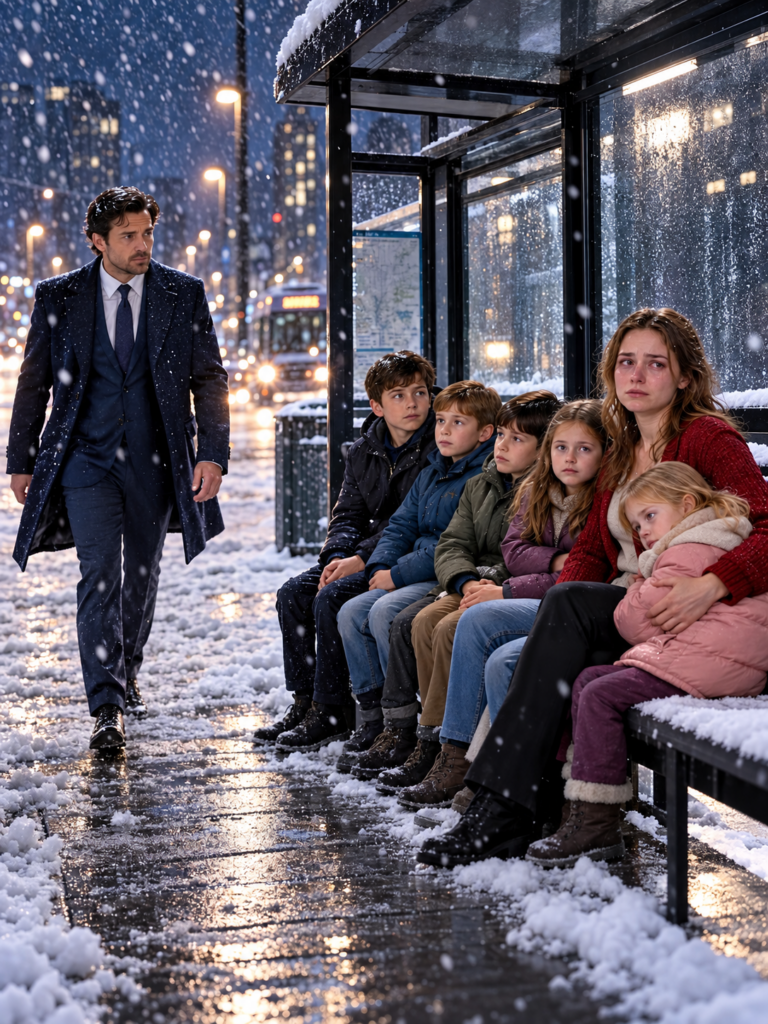
The wind off Lake Erie came at the bus shelter as if it had something personal to settle.
It rattled the glass walls, slipped beneath the metal bench, and searched every weak seam in six worn coats. Allison Brennan pulled Harlow closer against her side and watched the street.
Behind them, the grocery store was dark. Its empty parking lot glowed beneath hard blue-white security lights. Three signs hung on the fence.
NO LOITERING.
NO TRESPASSING.
PRIVATE PROPERTY.
Nobody had needed to read them aloud.
The children understood.
Headlights appeared through the blowing snow.
The bus sighed to the curb, its doors folding open with a rush of warm air.
Allison was on her feet before the driver could look at them too closely.
“Six,” she said, transit card already in hand. “One adult. Five children.”
She tapped the reader.
A dull beep.
Red screen.
INSUFFICIENT BALANCE.
“I have cash.”
She opened her palm. Coins filled it, nickels and quarters and dimes counted so many times that she knew the amount without looking.
“It’s close. It’s almost everything I have.”
The driver was an older man with exhausted eyes. His gaze went from the coins to Nolan, Ryan, Caleb, Harper, and little Harlow pressed together behind her.
“Ma’am, I’m sorry. This route’s on the new pilot system. Cards only.”
“Please. Just to the next stop.”
Something in his expression softened.
“I’m sorry.”
He did not say it a third time.
The doors closed.
The warm air went with him.
An hour earlier, Allison had asked the closing grocery clerk whether they could wait inside the glass entryway until Harlow stopped shivering.
The woman had not been cruel.
That almost made it worse.
She had looked past Allison at the duffel bags, the children’s backpacks, the one with the broken zipper, and said, “I can’t have people waiting in here.”
People.
Not children.
Not a family.
People.
Allison had learned something that winter no one ever said aloud: when you needed help badly enough, adults began looking at a point just beyond your shoulder. They found keys to study. Rules to remember. Reasons the problem belonged to somebody else.
She sat again.
Nolan moved closer to the younger children. He put one hand on Ryan’s knee and another on Caleb’s, steadying them as if he were a grown man bracing a table that might collapse.
Caleb opened his mouth to complain.
Nolan barely shook his head.
Be quiet.
Quiet keeps you safe.
Allison saw it and felt something inside her tear.
He was Sarah’s oldest boy. He was supposed to be arguing about bedtime and leaving wet towels on the bathroom floor.
Instead, he had learned vigilance.
Harper leaned against Allison’s arm.
“Aunt Allie?”
“Yes, honey?”
“I’m hungry.”
“I know.”
Allison pulled the last granola bar from her coat.
Five pieces.
Exactly five.
“Eat slowly.”
Ryan finished his in two bites.
Harlow didn’t eat hers at all. She held it in one mitten like proof that something still existed for later.
Allison folded the wrapper into her pocket beside a wad of gas-station napkins.
Napkins could be tissues.
Napkins could be plates.
She knew things like that now.
Her fingers found the necklace beneath her coat.
A tiny brass house hung from a nearly worn-through cord. Pointed roof. Square door. One side dented inward.
It had belonged to her sister.
Sarah used to joke that it was the only house she owned free and clear.
After Sarah’s husband died, she had raised five children alone and somehow made a cramped apartment feel like the safest place on earth.
Then Sarah was gone too.
And the children had Allison.
When the eviction notice came, followed by men changing the locks, Allison had taken two duffel bags, the children’s backpacks, and whatever she could carry.
That was all.
She rubbed her thumb over the dent.
I’m trying, Sarah.
I’m trying so hard.
Every approaching pair of headlights made her straighten.
Every slowing car made her count.
One.
Two.
Three.
Four.
Five.
Her phone vibrated.
She knew who it was before looking.
Troy.
Four missed calls.
Then messages.
Heard about the apartment.
You don’t have to do this alone.
Let me help you, Allie.
For the kids.
Her stomach hardened.
Sarah had spent two years helping Allison get away from Troy Madden. Changed locks. Blocked numbers. A protection order folded into a kitchen drawer.
A protection order that had expired while Allison was arranging a funeral and trying to keep five grieving children fed.
Harlow’s teeth clicked steadily now.
Allison stared at Troy’s name and the green call button.
For one terrible second, her thumb hovered.
A black SUV glided toward the curb.
No headlights.
Engine running.
The driver’s window lowered.
Click.
Scrape.
A Zippo flame appeared in the darkness.
A man’s voice traveled through the cold.
“Answering the phone wouldn’t have saved you the trouble, Allison.”
Her blood stopped moving.
“I told you I’d find you.”
Half a block away, Logan Ashford had been walking toward the same bus shelter.
He should not have been there.
His penthouse was warm, silent, and intentionally empty. White walls. Gray concrete floors. One chair beside a long glass table. No photographs. Nothing left out. Nothing requiring anyone else’s presence.
At ten-forty that night, he had left it anyway.
Modern Transit Solutions was supposed to stand beside Cleveland’s mayor the following morning and announce the largest contract in the company’s history. New sensors. New fare readers. New infrastructure.
The board chairman’s final instruction had been simple.
“No surprises.”
So Logan had done what he always did when pressure tightened around his ribs.
He went looking for problems before someone else could find them first.
Just him, a tablet, and a list of east-side stops where the new equipment had been installed.
He saw the black SUV before he understood what else he was looking at.
Then the bench.
A woman.
Five children crowded around her as though she were the last warm object left in the city.
The man inside the SUV glanced toward Logan.
For a second, the Zippo flame lit his face.
He looked Logan over.
Then smiled.
Not friendly. Not nervous.
Possessive.
The window rose.
The SUV rolled away.
Logan watched its taillights disappear.
When he turned back, the woman was shaking.
Not from cold.
He knew the difference.
He took out his tablet and opened the transit system’s live transaction log. A habit from the pilot launch. He checked rejected fares after everyone else went home.
11:02 p.m.
Card declined.
Six passengers.
He read it twice.
Cards only.
No cash.
No exceptions.
He had approved the policy himself in a heated conference room while staring at a presentation slide labeled REDUCED DRIVER TRANSACTION TIME.
The slide had not included five freezing children.
Logan looked toward the shelter.
The smallest girl’s lips had lost most of their color. The oldest boy had both arms around two siblings and watched Logan like a guard dog assessing a gate.
Call 211, Logan told himself.
Give them the number.
Walk away.
There was another thought beneath it.
Colder.
Not tonight. Cameras tomorrow. Contract announcement. CEO photographed at midnight with a homeless family.
He took one step back toward his car.
Then the woman shifted.
Something swung from the frayed cord at her throat.
A tiny brass house.
Dented on one side.
Logan stopped.
For one breath, he was eleven again.
Concrete steps outside an apartment in January.
His brother on one side.
His sister on the other.
Three coats that didn’t close properly.
A cheap plastic keychain in his pocket attached to a key that technically opened their apartment, though the place inside was often colder and lonelier than the stairs.
They waited outside because they could see the street from there.
Because if their mother came home, they would see her car first.
Most nights, she didn’t.
Logan still had that keychain.
It sat in a drawer in the penthouse, one of the few useless things he had never thrown away.
He slid the tablet into his coat.
Then he walked back slowly, hands where the woman could see them.
She stood instantly.
All five children moved behind her.
Her arms opened slightly, turning her body into a wall.
Logan stopped several feet away.
“I’m not going to touch you.”
Her stare was fierce, exhausted, suspicious.
“The temperature’s below freezing,” he continued. “And the kids are shaking.”
“We don’t need charity.”
He heard what she meant.
We don’t owe you anything.
So he stayed where he was.
“There’s a diner one block over. Open all night. Or I can order a car to anywhere you want. A hotel. Somewhere clean with a lock on the door.”
“Why?”
“Because it’s cold.”
For a moment she almost laughed.
Nobody did things because it was cold.
Everything had a price.
“No. Thank you. We’re fine.”
Logan looked at the children.
Then nodded.
“All right.”
He walked away.
Caleb whispered, “Is he coming back?”
“No, baby,” Allison said.
Ten minutes later, Logan returned carrying two insulated takeout bags.
He placed them on the far end of the bench.
Then stepped back three full paces.
“Chicken noodle soup. Grilled cheese. Six hot chocolates.”
No one moved.
“They’re paid for. You don’t have to take them. But someone should.”
Nolan watched his hands.
Allison watched Harlow.
The child had stopped shivering.
That frightened her more than anything else had that night.
“All right,” Allison said. “Just to eat.”
The diner smelled like coffee, fryer grease, and heat.
They crowded into a corner booth. Five children on one side. Allison at the outer edge where she could watch the door.
Logan sat at the counter.
Close enough if they needed something.
Far enough that his help did not become occupation.
That mattered.
The children ate like they were borrowing the food.
Fast. Quiet. One arm curved protectively around each bowl.
Ryan finished his sandwich, then stared at Harper’s crust until she pushed it toward him.
Allison did not touch her soup until all five children had finished.
When Harper needed the restroom, Allison walked her there and waited outside.
Every time headlights slowed beyond the window, Allison looked up.
Logan noticed.
He didn’t ask.
Eventually, he approached the booth.
“I’m Logan.”
She hesitated.
“Allison.”
“And they are?”
“Nolan. Ryan. Caleb. Harper. Harlow.”
He repeated each name once, quietly.
Not performatively.
As if putting them somewhere he intended to remember.
“Is there somewhere I can take you tonight?”
Allison looked down at her hands.
“We were somewhere bad.”
He waited.
“And now,” she said, “we’re nowhere.”
Harper leaned around Nolan.
“Thank you for the cocoa.”
Logan gave her a small smile.
“You’re welcome.”
Allison raised her chin.
“We’ll pay you back.”
“Okay.”
The answer startled her.
No insistence that it was nothing.
No making generosity into a favor she was required to accept on his terms.
Okay.
He was accepting hers.
“There’s a carriage house outside the city,” Logan said. “Behind a brick house owned by a retired nurse named Tori Abernathy. I renovated it years ago. I still maintain it for her.”
Allison’s shoulders stiffened.
“One night,” he added. “It’s warm. It’s clean. Good locks. You don’t move in. You don’t owe anyone anything. Just one night when nobody sleeps sitting up.”
“Why are you doing this?”
He was silent long enough that she expected another polished answer.
Instead he said, “Because somebody once did something similar for me.”
She searched his face.
She didn’t find the lie.
That did not mean one wasn’t there.
But Harlow was asleep against Nolan.
Color had returned to her cheeks.
And it was past midnight in January.
“One night,” Allison said.
Outside, Logan loaded their worn bags into his SUV.
Allison buckled every child herself.
One.
Two.
Three.
Four.
Five.
When she straightened, she noticed a dark car across the street.
Parked.
No visible driver.
You’re exhausted, she told herself.
You’re imagining things.
The carriage house smelled faintly of cedar.
Logan showed her the thermostat.
Extra towels.
Both locks.
Then he left.
The children fell asleep in minutes.
Allison stood alone in the dark kitchen and finally allowed her shoulders to drop.
Her hand closed around Sarah’s brass house until its edges marked her palm.
Her phone buzzed.
A photograph from an unknown number.
Logan outside the diner, lifting their luggage into his vehicle.
Timestamped twenty minutes earlier.
Nice car.
Shame he doesn’t know who you really are.
Allison did not sleep in the bed.
She dragged a wooden chair to face the front door and sat in it wearing her coat, keys clenched in one hand.
An hour later, there was a soft knock.
Every muscle in her body locked.
“It’s Logan.”
She opened the door with the security chain still fastened.
He passed a folded paper through the gap.
His phone number.
“Both locks are solid,” he said. “If you need anything, call. Any hour.”
His gaze moved beyond her.
The chair.
Her coat.
The keys cutting into her palm.
He did not say, You should rest.
He did not ask what was wrong.
Instead he said, “Can I sit for a while?”
She should have refused.
Instead, Allison unfastened the chain.
Logan pulled a second chair beside hers.
He faced the door too.
Neither of them spoke.
The heater ticked.
The children slept.
And for the first time in weeks, Allison was not the only person keeping watch.
They sat that way until the windows turned gray.
Part 2
At dawn, Logan’s phone vibrated.
He glanced down.
Then went very still.
“What?” Allison asked.
“Unknown tracker moving with you.”
Her fingers tightened around her keys.
“Since when?”
He scrolled.
“Since the bus shelter.”
They moved slowly through the carriage house, following the signal until it led them to the old backpack beside the kitchen door.
Logan activated the tracker’s sound.
A faint electronic chirp came from inside the lining.
Allison turned the bag over.
One row of stitches didn’t match.
Beneath the fabric was a flat black tracking disc.
Her face drained.
“Troy helped me carry boxes,” she said. “The week of Sarah’s funeral. He was being… helpful.”
She showed Logan the photograph and message.
He read them twice.
Something sharpened in his expression, but his voice remained level.
“We don’t destroy the tracker.”
Allison looked at him.
“We take it to the police. Together. We file a report.”
Together.
Not I’ll handle this.
Not give it to me.
Together.
By nine, they had a report number.
By noon, Logan had installed a doorbell camera.
When he asked whether Allison would stay several more days, only until they understood what Troy might do next, she looked toward the bedroom where five children slept and said yes.
His first grocery delivery arrived at one.
Organic kale.
Almond milk.
A loaf of artisan bread dense enough to stop a door.
Ryan inspected the bags with admirable politeness.
“Um, Mr. Logan?”
“Yes?”
“Do you have peanut butter?”
Logan looked at the kale as if it had betrayed him personally.
“I’ll be right back.”
For the first time, Allison almost smiled.
While he was gone, someone knocked.
Tori Abernathy stood outside, small and silver-haired, carrying a dish of baked chicken under one arm and folded blankets under the other.
She had the calm voice of a woman who had spent forty years telling frightened people they were going to make it through the night.
After setting down the food, Tori glanced toward the driveway.
“Thirty years ago,” she said, “there was a skinny boy who used to sit on the steps across from my house with his little brother and sister.”
Allison looked at her.
“They’d wait for a mother who didn’t come home often enough. So I started bringing them into my kitchen.”
“Logan?”
Tori smiled.
“He’s never forgotten a cold child.”
That evening, Joan Halverson from the corner library arrived with a box of battered picture books and wooden puzzles.
She asked no questions.
She simply knelt beside Harlow and found the puzzle with the bear.
For a little while, the carriage house became noisy.
Not happy exactly.
But approaching it.
Safety, Allison learned, did not erase fear on contact.
That night Nolan lined six pairs of shoes beside the door, toes pointing outward as though they were preparing for evacuation.
Ryan slipped two dinner rolls into his sweatshirt pocket.
Logan saw both things.
He did not tell them they were safe now.
He did not make them surrender habits that had kept them alive emotionally before he arrived.
He installed a night-light in the hall and an extra lock on the door.
Before bed, Allison took Sarah’s brass house from beneath her sweater and placed it on the kitchen table beside Logan’s handwritten phone number.
It was the first time in days she had let go of it.
The next morning Dr. Priscilla Banks arrived.
She paused in the doorway when she saw Allison.
“You brought Caleb into my clinic last week. The fever.”
“He’s better.”
“I’m glad.”
Priscilla checked each child carefully.
Harlow was last.
When she came out, Priscilla closed the bedroom door behind her and lowered her voice.
“Allison, did you renew the protection order after your sister died?”
Allison’s silence answered first.
“It expired in November.”
Priscilla waited.
“I was arranging the funeral. Then the eviction. I kept meaning to go back to court.”
There had been no time.
No money.
No room in her head for one more form, one more office, one more official asking her to prove she was frightened enough to deserve protection.
Priscilla did not scold.
She wrote something down.
“Then we start there.”
The following days slowly acquired shape.
School-registration forms spread across the kitchen table.
Lunch boxes acquired names on strips of masking tape.
Bus schedules appeared on the refrigerator, then came down again when Allison realized public transportation meant waiting in exposed places where Troy might watch them.
Her old car had already been repossessed in December.
So on the third morning, when Logan offered to take the children to school, Allison stood at the door for a long time.
Then said yes.
Not because of his money.
Because every morning that week, at exactly seven-fifteen, he had arrived when he said he would.
And not once had he made punctuality feel like a debt.
Mornings became chaotic.
Cereal spilled.
One sock always disappeared.
A permission slip turned up beneath the sofa thirty seconds before departure.
Logan Ashford, who had spent years eating breakfast alone over financial reports, learned to butter toast while Caleb asked six questions at once and Harlow tried to hang from his arm.
Allison began noticing things she had not wanted to notice.
He always asked before picking up one of the children.
He never entered the carriage house without knocking.
If he bought something, he left the receipt.
When she said no, he did not treat it as the beginning of negotiations.
Trust did not arrive like lightning.
It accumulated.
Quietly.
Receipt by receipt.
Promise by kept promise.
Then came Tuesday at the school office.
Caleb had been fine in the car. But the moment they entered the long hallway filled with unfamiliar adults and slamming locker doors, his hand locked around Allison’s sleeve.
He wasn’t crying.
That made it worse.
He trembled and breathed too fast, eyes wide with a terror too old for his face.
Logan’s phone buzzed.
The board and mayor’s office had postponed the transit announcement until the end of the month, and that morning was the final preparation meeting.
He was supposed to be there in twenty minutes.
His phone buzzed again.
Logan silenced it.
Then he sat on the school floor.
Expensive suit.
Back against the lockers.
Eye level with Caleb.
He did not touch him.
Instead he started talking about Cleveland’s old streetcars.
How tracks used to run under streets Caleb already knew.
How conductors had special tools.
How some cars were painted bright colors.
Slowly, Caleb’s breathing matched the rhythm of Logan’s voice.
Forty minutes later, Caleb walked into his classroom by himself.
Logan listened to the board chairman’s furious two-sentence voicemail in the parking lot.
Then stared through the windshield.
The strangest thought came to him.
I would do it again.
That afternoon, a letter arrived.
The children’s survivor benefits—the only dependable money Allison had—required a court-appointed guardian.
She had to file with Cuyahoga County Probate Court before a firm deadline.
The letter used words like petition and counsel.
Allison had neither a lawyer nor the money for one.
She was still holding it when Logan drove her to pick up the children.
His phone rang through the vehicle speakers before he could stop it.
“Logan, just hear me out,” said his public-relations director. “The family angle could actually help the contract announcement—”
Logan killed the call.
“Not now.”
Silence filled the SUV.
Allison turned toward the window.
Something inside her retreated.
Not dramatically.
Just one careful step.
Like moving away from a stove after discovering the burner was still hot.
Logan saw the movement and understood enough not to chase it with explanations.
At the school, the steps were crowded with parents and buses.
Harper appeared first and waved.
Allison started forward.
Then stopped.
Troy Madden stood beside the flagpole.
Wool coat.
Fresh haircut.
Easy smile.
He looked like a respectable man who had come to help.
“Allison,” he called loudly. “I’ve been worried sick.”
People turned.
A teacher paused on the steps.
Troy held up a folder.
“Their mother put me on the lease, remember? I have every paper she ever signed.”
He shook his head with theatrical sadness.
“These children need stability. Family. Not whatever this is.”
His eyes found Logan.
“Has the court even made you their guardian yet?”
Allison could not move.
Nolan could.
He stepped in front of his siblings without a word.
Logan came from behind them.
Troy studied the expensive suit.
His smile widened.
“Oh,” he said. “So this is your new sponsor.”
The word landed with the phone call.
Family angle.
Sponsor.
Logan’s money suddenly felt visible everywhere.
Troy tipped an imaginary hat and walked away.
That night Allison barely spoke.
At eleven-twenty, three hard knocks shook the front door.
A badge appeared through the window.
“Cuyahoga County Department of Children and Family Services. We received an urgent report involving five minors in the care of an unauthorized guardian.”
The social worker looked exhausted rather than hostile.
A deputy stood behind her.
“We need to see the children and where they sleep.”
Allison’s hands shook so badly she missed the light switch.
The deputy quietly reached around her and turned it on.
They inspected everything.
The full refrigerator.
The beds.
The locks.
Then, according to protocol, the social worker spoke with each child alone at the kitchen table.
Harper went first.
Through the closed door, Allison heard her small voice.
“Where do you sleep, sweetheart?”
“Here.”
A pause.
Then Harper began crying.
“Please don’t make us go somewhere else. We just got here.”
Allison covered her mouth.
When her turn came, she sat opposite the social worker and made a decision.
No pride.
No shortened answers.
No pretending she could solve everything by refusing to look vulnerable.
She told the truth.
Two years with Troy.
How he controlled every dollar she earned.
How he repeated that she was nothing without him until she almost believed it.
How Sarah helped her leave.
The old protection order.
Sarah’s death.
The funeral.
The eviction.
The tracker stitched into the backpack.
The police report.
Allison’s voice never broke.
The effort cost her more than tears would have.
The social worker wrote for a long time.
Finally she looked up.
“The children stay with you tonight.”
Allison closed her eyes.
“There will be an emergency hearing Friday. Bring everything.”
Two days later came Logan’s transit-contract announcement.
Allison went.
She needed to know which version of him existed when the stakes were larger than a school hallway.
With no after-school childcare, she brought all five children and stood at the back of the crowded transit center behind a column.
Logan took the stage beside the mayor.
He barely began speaking before a voice cut through the room.
“Ask him about the children he’s hiding.”
Troy stood in the center aisle holding a file above his head.
“This man is using his money to shelter an unqualified guardian and keep five children away from their family.”
Cameras swung toward him.
Reporters shouted.
Logan’s PR director rushed forward and pressed a prepared statement into his hand.
Deny it.
No comment.
Exit left.
Logan looked down at the paper.
Then set it aside.
“I am helping a family,” he said into the microphone. “As a private citizen, with my own money. My company has no involvement.”
The room erupted.
Logan turned toward the mayor.
“And so no one has reason to question either that family or this deal, I’m asking the city to suspend the contract pending an independent ethics review.”
Two board members stood and walked out.
Behind the column, Allison stared.
The family angle had just been handed to him in front of every camera in Cleveland.
And he had refused to use it.
Then a camera operator spotted the children.
Lenses turned.
Before Allison could react, Logan stepped off the stage and walked directly through the crowd.
He said nothing.
He simply placed himself between the cameras and the five children, arms slightly spread, creating a moving wall as he led them toward the exit.
Allison carried Harlow.
Harper held her hand.
Nolan stayed close to Ryan and Caleb.
Logan kept walking until the car doors closed behind them.
That evening, he hired one of Cleveland’s best family attorneys.
He paid with a personal check.
Allison looked at him across the carriage-house table.
“I’ll repay it.”
“I know.”
Something in her chest shifted.
Not because he had paid.
Because he still remembered the condition under which she could accept help without disappearing inside it.
Friday morning, the courtroom was cold and quiet.
Dr. Priscilla provided medical records documenting consistent, loving care and the children’s condition after the disruption, along with notes concerning Troy’s harassment.
Tori submitted an affidavit describing the carriage house as stable, supervised housing.
The attorney placed the police report about the tracker before the judge.
When Allison was called to speak, she took the brass house from her pocket.
Her hands wanted to close around it.
Instead, she turned to Nolan.
“Hold this for me.”
His fingers closed around the charm as though she had assigned him the most important job in the world.
Allison faced the judge.
And spoke.
The court granted her temporary custody while the formal guardianship case proceeded.
That same morning, she received a renewed protection order against Troy.
A deputy served him before he left the courthouse.
No approaching Allison.
No approaching the children.
No contact.
In the hallway, Troy waited anyway.
Allison saw him first.
The folded order was still in his hand.
When the children appeared, he pushed away from the wall and headed straight toward them.
Logan stepped between them.
“You’re not supposed to come near them.”
Troy grabbed Logan’s arm and tried to shove past.
“You think you can buy them?”
A deputy intercepted him before he reached Allison.
Troy struggled once.
Then froze as handcuffs closed around his wrists.
He had been served less than fifteen minutes earlier.
The children watched in silence as he was taken away.
At nine that night, the attorney called.
“He made bail. Strict no-contact conditions. If he approaches you, he goes back.”
Allison thanked her and checked both locks twice.
Near midnight came a scraping sound at the front door.
Footsteps retreated across the gravel.
Allison waited one full minute.
Then opened the door.
A folded piece of rough paper lay beneath the mat.
Courts don’t stay open forever.
I’ll be waiting when his money runs out.
The doorbell camera had captured everything.
A man in a wool coat coming up the steps.
Looking over his shoulder once.
Sliding the note beneath the mat.
His face plainly visible in the porch light.
The attorney filed the footage at eight the next morning.
By afternoon, Troy Madden’s bail had been revoked.
He returned to custody pending trial.
That night, for the first time since the bus-stop bench, Allison slept in a bed.
She did not wake until sunlight reached the ceiling.
Part 3
Life did not transform all at once.
It began breathing again.
There were doctor visits with Priscilla, who pronounced the children thin but resilient.
School mornings that mostly happened on schedule.
Saturday pancakes that Logan burned twice before producing a third batch worth eating.
Five children cheered as though he had won a championship.
Allison found part-time work at Joan’s library, managing inventory and running Wednesday story hour.
The pay was modest.
But it was hers.
On the first of the month, she went to Tori’s back door carrying an envelope.
“Rent.”
Tori looked at the envelope.
Then at Allison.
She understood.
She accepted it without argument.
That mattered too.
The smallest changes came quietly.
One evening Allison emptied Ryan’s sweatshirt pockets before doing laundry.
No dinner rolls.
No crackers.
Only lint.
She stood in the laundry room and cried for exactly one minute.
Then folded the sweatshirt and put it away.
Nolan stopped arranging everybody’s shoes toward the door.
One morning Allison found one sneaker lying sideways beneath the kitchen table.
She left it there.
The crooked shoe felt like progress.
One night after dinner, Nolan approached Logan holding a school field-trip form.
He turned it over several times.
“It says emergency contact.”
Logan waited.
“Mom’s first.”
Nolan swallowed.
“But there’s space for two.”
Another pause.
“Can I put you?”
Logan’s answer took a second to arrive.
“I’d be proud if you did.”
He looked down at the form afterward for much longer than necessary.
He was changing too.
Peanut butter and apple juice began appearing without anyone asking.
He learned to lower his voice instead of raising it after seeing how sharp tones made Allison’s shoulders pull inward.
When Harlow woke screaming from nightmares, Logan did not try to fix them.
He sat on the floor beside her bed in the dark.
And stayed.
His company’s contract remained suspended during the ethics review.
He had never possessed so much unstructured time.
To his surprise, he did not miss the silence of the penthouse.
Late in February, Joan’s library held family night.
Snow started at four.
By six, side streets were closing.
Allison and the children had arrived early.
Nolan sat in the second row and looked toward the entrance every thirty seconds.
Other parents came in.
Grandparents.
A father still wearing his work uniform.
An older sister carrying a toddler.
Nolan stopped looking at the door.
“He’s not coming,” he said to nobody in particular.
Then, quickly, “It’s okay.”
Across town, Logan’s SUV sat trapped at the end of an unplowed street.
So he walked two blocks to the main road.
Then stood at a bus stop among strangers, stamping snow from his shoes.
When the bus arrived, he pulled out a fare card.
The reader was the same model his company had installed.
The same system that had once refused a woman with five children and a palm full of coins.
Green light.
Beep.
Logan took a seat between a nurse finishing her shift and a teenager wearing headphones.
He crossed Cleveland in silence.
He reached the library twenty minutes late.
Snow melted on his shoulders.
His hair had lost every trace of executive precision.
He slipped onto a folding chair directly behind Nolan.
Nolan did not turn.
But his shoulders lowered.
Afterward, when the room had almost emptied, Nolan handed Logan the crumpled program.
“Keep this for me.”
“Okay.”
Logan held it as carefully as if it were made of glass.
Later that night, after the children slept, Allison and Logan sat on the back steps beneath the porch light.
Their breath clouded in the cold.
Allison had spent weeks wondering when gratitude became obligation, when safety became dependence, when Logan’s presence began to matter for reasons she did not want to name.
She finally said, “I don’t want to be rescued.”
Logan looked at her.
“I need you to know that.”
“I do.”
“No, I mean it. I can’t go from needing one man’s permission for everything to building a life around another man because he happens to be kinder.”
“You shouldn’t.”
She turned toward him.
There was no defensiveness in his face.
“I’m not rescuing anyone, Allison.”
“What are you doing, then?”
He considered the question.
“I want to be here.”
No speech.
No demand.
Just that.
Allison looked at him for a long time.
“Then we go slowly.”
“Slow is good.”
When they went inside, Allison took the brass house from her pocket.
She hung it on the wooden hook beside the kitchen door with the carriage-house keys.
Not hidden beneath her clothes.
Not squeezed in her fist.
Simply there.
The fireplace clicked and settled.
Logan lifted his tea.
Nolan appeared in the hallway in pajamas.
“Mr. Logan?”
“Yes?”
“When can we put our family name on the mailbox outside?”
Logan carefully lowered his cup.
His eyes found Allison.
She crouched in front of Nolan and brushed the hair from his forehead.
“When it’s real for us.”
Nolan frowned.
“It’s real now.”
Her throat tightened.
“I know. But I mean when the judge signs the paper that says I’m your mom now. Not temporary. Not pending. Forever.”
Nolan considered this.
“Okay.”
He yawned.
“I can wait.”
It took ten months.
By spring, Allison had permanent guardianship of all five children and began the adoption process.
Both of their parents were gone. The court verified the necessary records, but there were still background checks, home visits, interviews, documents, and months of waiting between the family they already felt like and the family they would legally become.
Healing needed time.
So did dignity.
Allison attended every hearing.
Filled out every form.
Answered every difficult question without lowering her eyes.
She kept her job at Joan’s library.
She paid her own bills.
She repaid what she could.
Logan never asked her to prove that she could stand without him.
Perhaps because he understood the only way she could freely choose to stand beside him was if he never required her to lean.
In summer, Troy Madden pleaded guilty to stalking, threatening behavior, and violating court orders.
He received a prison sentence.
Allison walked out of court carrying a long-term protection order.
She did not celebrate.
She went home and made dinner.
By September, the city ethics review fully cleared Logan’s transit contract.
The board approved it on its merits.
Before implementation, Logan required one change.
The new system would include cash-loading stations for transit cards and emergency ride vouchers for families unable to cover a fare.
During every meeting about the revision, he remembered a red screen in January.
A woman holding coins.
Five children behind her.
No child, he decided, should stand in freezing weather because a payment device had turned red.
The following week, Logan sold his downtown penthouse.
“Too quiet,” he told Tori.
She laughed so hard she had to sit down.
He remained part of their lives without trying to become their center.
He repaired loose porch steps.
Sat in undersized plastic chairs at parent-teacher conferences.
Learned to read while Harlow climbed into his lap, Ryan and Caleb argued nearby, and Harper practiced the flute badly and enthusiastically in the next room.
Once, noise had made something close around Logan’s chest.
Now it sounded like a house being lived in.
On a gray Tuesday in November, ten months after the night at the bus shelter, a judge signed the adoption papers.
Allison Brennan became the legal mother of Nolan, Ryan, Caleb, Harper, and Harlow.
That evening, the children painted the mailbox beside the house.
Harper did the lettering.
Caleb contributed several drips that were not part of the plan.
When they were finished, one word leaned slightly across the front.
BRENNAN.
One name.
For all of them.
Nolan stood back and stared at it.
Allison watched his face and understood why a mailbox could matter.
That night she took the brass house from its hook.
The frayed cord still looped through it.
She ran her thumb over the dents and scratches.
Her hands no longer shook.
The charm was not proof that everything could be lost.
Not anymore.
It was evidence of distance traveled.
Logan watched from the doorway.
“Can I borrow that?”
Allison looked up.
He nodded toward the charm.
“I’ll bring it back.”
Her instinct was still to close her fingers around it.
Instead, she walked over.
Placed the brass house in his palm.
And let go.
A week later, it waited for her on the kitchen table.
Logan had not polished it until it looked new.
He had not erased its scratches.
He had simply repaired the dent and restored the little house to its proper shape.
Beside it lay a folded note in his neat handwriting.
For whatever door you choose.
Allison read the sentence twice.
Then looked toward Logan.
He was in the living room helping Caleb locate a missing puzzle piece beneath the sofa.
He did not look back to see whether the gesture had worked.
That, more than the repaired charm, was why she smiled.
On Saturday, the seven of them built a key holder from an old oak board.
Their first attempt hung so badly that Ryan declared it looked as though all the keys were trying to escape downhill.
The children laughed until Caleb slid off his chair.
Then Allison brought out a small paper bag.
One by one, she gave each child something they had never owned before.
A house key.
Their own.
Five small hands closed around five keys.
Harlow pressed hers to her chest.
Allison attached the straightened brass house to her own key ring.
For the first time since Sarah’s funeral, the charm hung beside a key that opened a real door.
By the night of the first snowfall, the children were asleep when Logan sat across from Allison at the kitchen table.
He did not kneel.
He did not make a performance of it.
He set a simple ring between them and rested his hand beside it.
Allison stared.
Then looked at him.
He asked quietly.
Her eyes filled.
“I have to ask five people first.”
Logan laughed softly.
“That seems fair.”
The vote occurred the following morning over pancakes.
Two batches burned.
The third survived.
The decision was unanimous.
Caleb voted with both hands.
They married in spring in Tori Abernathy’s garden beneath old oak trees.
Tori arranged rows of folding chairs with the concentration of someone preparing an operating room.
Joan wiped tears from her face and blamed pollen.
Dr. Priscilla sat in the front row smiling like a proud aunt.
Nolan stood straighter than Allison had ever seen him.
Ryan had crumbs on his jacket ten minutes before the ceremony.
Caleb nearly lost something essential twice.
Harper cried openly.
Harlow carried flowers and forgot halfway down the aisle that she was supposed to scatter them.
Nobody cared.
Allison did not marry Logan because she needed a rescuer.
She married him because she had found her footing and, from there, chose the man who had never asked her to surrender it.
Logan chose her for the same reason.
Not because she needed him.
Because she let him belong.
That evening they carried the last boxes into the old brick house beside Tori’s—the home Allison and Logan had bought together.
The crooked oak key holder went beside the front door.
Five colorful backpacks hung from hooks.
Allison’s key ring rested beside them, the small brass house attached.
It no longer meant a bench with no address.
It meant something simpler.
We live here.
Outside, warm air moved through the oak leaves.
The children were falling asleep on the porch after a long day.
Harlow rested her head against Logan’s shoulder.
Her eyes were already half closed.
“Can we leave the porch light on tonight?” she whispered.
Logan looked toward Allison.
Their hands found each other between the chairs.
“Just in case?” Harlow added.
Allison thought of a January bus shelter.
A red fare screen.
A man who had understood that frightened people needed distance before they needed promises.
A chair beside her chair facing the same locked door.
A school hallway.
A folding chair at family night.
A little brass house returned with every scar still showing.
Slowly, she smiled.
Logan squeezed her hand.
“Always, sweetheart,” he said.
Above them, the porch light burned against the dark.
“We’ll leave it on.”

