Part 1
The credit card machine beeped twice, and Maya Brooks felt her stomach drop.
“I’m sorry,” the woman behind the wholesale flower counter said, lowering her voice. “It’s been declined again.”
Maya stared at the little screen.
She had checked her account before leaving the shop. There should have been enough.
Not much. Never much anymore.
But enough.
“Could you try it one more time?”
The woman, Denise, had known Maya since she was seventeen and helping her grandfather unload buckets of carnations from the back of his old pickup.
Denise didn’t sigh. She didn’t roll her eyes.
She simply ran the card again.
Another beep.
Another decline.
Maya looked down at the order sheet in her hand.
Sixty white roses. Twelve stems of eucalyptus. Two bunches of ivory stock. Floral wire.
A wedding order that was supposed to pay the electricity bill and leave enough for a partial rent payment.
“I can put something back,” Maya whispered.
Denise glanced at the roses.
“Not those, honey. You told me they’re for a wedding.”
Maya swallowed.
“Then the eucalyptus.”
“And the stock?”
“Both.”
Denise quietly removed the items.
Maya paid with the last of the cash she’d been saving in the bottom of her purse.
When she walked outside, the morning sky was the color of wet concrete.
Her old hatchback took three attempts to start.
She sat gripping the steering wheel, watching a delivery truck rumble past, and did the same calculation she’d been doing for six months.
Two months of overdue rent.
An electric bill marked FINAL NOTICE.
A refrigerator at home that had started making an expensive-sounding noise.
And the professional floral design certification exam she’d been studying for every night, which would require another payment before the registration deadline.
She had forty-three dollars in checking.
There were people who would have called her irresponsible for continuing to run the shop.
Some days, she almost agreed with them.
Then she looked at the white roses beside her and remembered why she kept trying.
Ruth’s Flowers had been on the corner of Willow Street for forty years.
Her grandfather had opened it with eleven dollars, a borrowed bucket, and a stubborn belief that flowers mattered even to people who couldn’t afford much else.
Her grandmother, Ruth Brooks, had worked beside him through two recessions, three floods, a broken furnace, and the year every neighboring store seemed to close.
Her grandfather had died eight years earlier.
Her parents were gone too, leaving Maya with photographs, a few handwritten recipes, and Nana Ruth, who was now seventy-four and increasingly reluctant to admit when her knees hurt.
The flower shop was the last place that still felt like all of them lived together.
Maya couldn’t lose it.
Not without fighting.
By six that evening, rain was hammering against Willow Street.
The bakery next door had already closed. Mr. Alvarez had turned off the lights in his tailoring shop. Water rushed along the curb, carrying leaves, paper cups, and cigarette butts toward a clogged drain.
Inside Ruth’s Flowers, Maya was counting roses.
“Fifty-eight, fifty-nine, sixty.”
She checked the stems one more time.
Perfect.
The wedding customer was collecting them at nine the next morning.
Upstairs, Nana Ruth called from the apartment above the shop.
“Maya? Honey, are you coming up?”
“In a minute!”
“Don’t forget to lock the back door. That storm is getting worse.”
Maya reached for the front light switch.
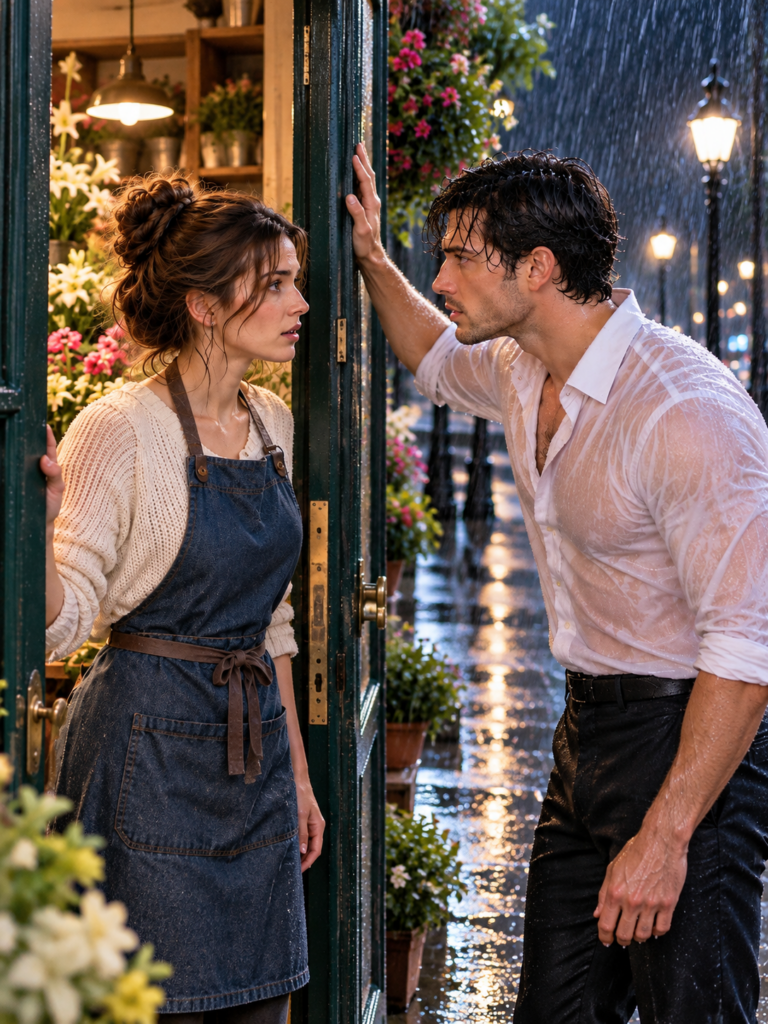
Then she heard a knock.
Not a confident knock.
Three faint taps against the glass.
She turned.
A man stood outside in the rain.
His dark coat clung to his shoulders. Water ran from his hair down his face, and his hands were trembling visibly.
He looked to be in his late thirties.
There was something strangely careful about the way he stood, as though he was trying to make himself smaller so she wouldn’t be afraid.
Maya opened the door a few inches.
“We’re closed.”
“I know.” His voice was hoarse. “I’m sorry.”
He glanced toward the street.
“Could I just stand somewhere dry for a few minutes?”
Maya hesitated.
She had been warned about opening the shop after dark.
Nana Ruth worried about her living above a storefront with an old lock and almost no security.
The man seemed to sense her hesitation.
“I don’t need money,” he said quickly. “Or food. Just somewhere out of the rain.”
“There’s a shelter on Fifth Street.”
“I know.”
“About twelve blocks from here.”
He nodded.
For a moment, Maya thought he was going to leave.
Instead, he looked past her at the buckets of flowers.
His expression changed.
Not dramatically.
Something simply went quiet in his face.
“Are those white roses?”
Maya followed his gaze.
“Yes.”
He pressed his lips together.
“Would you sell me one?”
She almost laughed.
Not because the question was funny.
Because the entire day had been one long exercise in deciding what she couldn’t afford to give away.
“I’m sorry. Those are reserved.”
“Of course.”
He stepped backward.
“Thank you anyway.”
Another gust of wind sent rain across the sidewalk.
Maya watched him pull his wet coat tighter.
“Wait.”
He stopped.
“Why white roses?”
The man stared at the flowers for several seconds.
“My mother loved them.”
Something in his voice made Maya hold the door open.
“Is she sick?”
He shook his head.
“She died.”
“Oh.”
“Today is the anniversary.”
He looked embarrassed by the admission.
“I thought I could bring her some. I don’t know why I thought that would make anything better.”
Maya had heard grief spoken in a hundred different ways.
Some customers ordered elaborate funeral arrangements because they didn’t know what else to do.
Some bought a single flower and stood in the shop for twenty minutes, unable to leave.
But this man wasn’t asking for an elaborate bouquet.
He was standing in the rain, asking for one rose.
“How much money do you have?” she asked gently.
His face tightened.
“Not enough.”
That answer should have ended the conversation.
Instead, Maya stepped aside.
“Come in.”
“Really?”
“Before you freeze to death on my doorstep.”
He entered, leaving a little puddle on the worn wooden floor.
Maya found a clean towel under the counter.
“Here.”
“Thank you.”
She watched him dry his hands.
They were pale and trembling.
Not rough hands, she noticed. Not the hands of someone who had spent years doing manual labor.
But grief didn’t care what kind of hands a person had.
She walked to the wedding roses.
Selected six of the fullest blooms.
Trimmed their stems.
Wrapped them in brown paper.
And tied them with a length of white ribbon.
The man watched silently.
When she placed the bouquet on the counter, he shook his head.
“I only asked for one.”
“Six looks better.”
“I can’t pay for six.”
Maya smiled.
“Flowers for customers cost money. Flowers for a mother cost nothing here.”
His expression changed so suddenly that she wondered if she’d said the wrong thing.
He looked down.
His fingers tightened around the towel.
For a long moment, he couldn’t speak.
Then he whispered, “She used to say something like that.”
“Your mother?”
He nodded.
“She believed every house needed something alive in it.”
Maya handed him the flowers.
“Then she’d probably be happy you remembered.”
He accepted them with both hands.
“My name is Daniel.”
“Maya.”
“Thank you, Maya.”
She took an old umbrella from behind the counter.
It had belonged to her grandfather, and one of the metal spokes bent whenever the wind caught it.
“Here. You’ll need this.”
Daniel looked at the umbrella.
Then at her.
“Can I bring it back?”
“Of course.”
“When?”
“Whenever.”
He gave the smallest smile.
“I’ll bring it back.”
As he stepped outside, she called after him.
“Daniel?”
He turned.
“Be careful out there.”
He nodded.
And disappeared into the rain.
Maya locked the door.
She didn’t see the black sedan parked two streets away.
Didn’t see the driver get out and hurry toward Daniel with a second umbrella.
And didn’t hear the man say, with barely concealed relief, “Thank God. We’ve been looking everywhere for you, sir.”
Daniel glanced at the white roses.
“Keep your voice down.”
“Your father has called nine times.”
“Then he can call a tenth.”
“Shall I arrange to have those delivered tomorrow?”
Daniel held the bouquet closer to his chest.
“No.”
He looked back toward the little flower shop.
“These I carry myself.”
The next morning, Maya lost four hundred dollars.
It happened at exactly 9:17.
The customer arrived wearing a cream-colored wool coat and expensive perfume.
“Good morning. I’m here for the wedding roses.”
Maya felt her throat tighten.
“Mrs. Pritchard, I wanted to talk to you.”
The woman’s smile disappeared.
“About what?”
“Some of the white roses were damaged yesterday.”
Maya hated the lie, even though it came easily.
“I can replace them with ivory peonies. They’re beautiful, and I won’t charge anything extra.”
Mrs. Pritchard stared.
“I ordered sixty white roses.”
“I know.”
“They’re for my daughter’s wedding.”
“I understand.”
“The ceremony is at eleven.”
“I can have the arrangement ready before then.”
“I didn’t order peonies.”
Maya looked down at her hands.
“No, ma’am.”
Mrs. Pritchard’s mouth tightened.
“I paid four hundred dollars in advance because you assured me there wouldn’t be a problem.”
“I can make it right.”
“Then give me my money back.”
Maya lifted her eyes.
“All of it?”
“All of it.”
A silence settled between them.
Mrs. Pritchard wasn’t shouting.
Somehow that made it worse.
“I’ve been told you’re still studying for your certification,” the woman added. “Perhaps you should finish learning the business before taking orders this important.”
Maya flinched.
The woman sighed.
“I don’t mean to be unkind. But this is my daughter’s wedding.”
Maya understood.
That was the terrible part.
The customer had paid for something specific. Maya had promised to deliver it. Whatever her reasons, she’d broken that promise.
“I’ll process the refund.”
“I’d prefer cash.”
Maya opened the register.
Counted what was inside.
Then went upstairs and retrieved the envelope she’d been keeping beneath a folded sweater.
Her exam money.
Six weeks of saving.
She returned to the counter and counted out the remaining amount.
Mrs. Pritchard took it.
“Thank you.”
After she left, Maya stood staring at the empty register.
Then the telephone rang.
“Maya? It’s Frank.”
Her landlord.
She closed her eyes.
“Good morning, Frank.”
“I need to talk about the rent.”
“I know.”
“That’s two months now.”
“I can get you something by Friday.”
“You said that last Friday.”
Maya gripped the receiver.
“I’m working on it.”
Frank sounded tired.
“I’ve carried you longer than I can afford. I have bills too.”
“I understand.”
There was a pause.
“I’m sorry, Maya.”
When the call ended, she sat on the stool behind the counter.
Her grandmother came downstairs a few minutes later.
“What happened?”
“Nothing.”
“Maya.”
“Just a customer.”
Nana Ruth looked at the empty rose buckets.
Then at the register.
Then at her granddaughter.
“You gave some away last night.”
Maya raised her head.
“How did you know?”
“Because you have your grandfather’s terrible habit of giving things away when you can’t afford to.”
“He wanted flowers for his mother.”
“White roses?”
“Yes.”
Ruth slowly sat down.
For a moment, she looked almost startled.
Then she folded her hands.
“And what did it cost you?”
Maya didn’t answer.
Ruth waited.
“Four hundred dollars,” Maya finally whispered.
Her grandmother closed her eyes.
“Oh, honey.”
“I know.”
“Was that the wedding customer?”
Maya nodded.
“And the exam money?”
“Gone.”
Ruth reached for her hand.
Maya pulled it away.
“Don’t.”
“Don’t what?”
“Tell me I’m a good person.”
Ruth looked surprised.
“I’m not going to tell you that.”
“Good.”
“I’m going to tell you that being kind doesn’t excuse keeping promises you can’t fulfill.”
Maya stared at her.
“Thank you. That’s exactly what I needed to hear.”
“But it also doesn’t make what you did meaningless.”
Maya’s eyes filled.
“I can’t keep doing this, Nana. I can’t keep trying to save everybody when I can’t even save our own shop.”
Ruth studied her granddaughter.
Then she looked toward the old photograph hanging above the counter.
It showed a younger Ruth beside her husband on opening day.
One bucket of daisies sat between them.
“Your grandfather opened this place with eleven dollars,” she said.
“I know the story.”
“Do you remember what happened the first winter?”
“Nobody bought anything.”
“Almost nobody.”
Ruth smiled faintly.
“There was a woman who lived three streets over. Husband had died. She came in on Christmas Eve and asked whether we had anything we were throwing away.”
Maya listened.
“Your grandfather gave her our last bunch of carnations. I was furious. We needed the money for heating oil.”
“What happened?”
“We wore sweaters for a week.”
Maya gave a reluctant laugh.
“That’s the inspirational ending?”
“No.”
Ruth reached for her hand again.
“The ending is that she came back every Christmas for nineteen years. Sometimes she bought flowers. Sometimes she brought cookies. When your grandfather died, she was the first person at the funeral.”
Ruth squeezed her fingers.
“Kindness isn’t always a good business decision. That’s why you have to learn to make good business decisions too.”
Maya wiped her cheek.
“I don’t know how.”
“You will.”
Ruth got up slowly.
From the cupboard beneath the register, she took a small blue tin.
Maya recognized it immediately.
“Nana, no.”
Ruth opened the lid.
Inside were carefully folded bills.
Her grandmother’s private savings.
“You’ll need supplies,” Ruth said.
“I can’t take that.”
“Then it’s a loan.”
“Nana—”
“You can pay me back.”
“With what?”
“Tea. And patience when I tell the same stories twice.”
Maya laughed through her tears.
Ruth pushed the tin toward her.
“We’re still in business, aren’t we?”
Maya looked around the shop.
At the worn counter.
The old floorboards.
The buckets waiting to be filled.
“Yes,” she whispered.
“For today, we are.”
Three evenings later, the bell over the door rang just as Maya was sweeping up fallen petals.
“We’re closed,” she called.
“I was hoping you’d make an exception.”
She looked up.
Daniel stood in the doorway.
Dry this time.
Clean-shaven.
Wearing a dark sweater and ordinary jeans.
In his hand was her grandfather’s battered umbrella.
“You came back.”
“I made a promise.”
He held it out.
She took it, smiling despite herself.
“I was beginning to think I’d donated that too.”
Daniel noticed the half-empty shelves.
“Slow day?”
“Something like that.”
He glanced at the broom.
“Can I help?”
Maya laughed.
“With what?”
“Anything.”
“Do you know how to sweep?”
“I’m willing to learn.”
She handed him the broom.
He held it awkwardly.
Maya stared.
“You’re serious.”
“Completely.”
“Daniel, have you ever swept a floor in your life?”
He considered the question.
“Not successfully.”
For the first time in days, Maya laughed without forcing it.
From the staircase, Ruth called, “Maya? Who’s down there?”
“A customer who won’t take no for an answer.”
Ruth appeared.
She stopped when she saw Daniel.
For a second, the expression on her face was impossible to read.
Daniel straightened.
“Good evening, ma’am.”
Ruth stepped closer.
“Have we met?”
“I don’t think so.”
She studied his face.
Especially his eyes.
“Hmm.”
“Nana?” Maya asked.
Ruth shook her head.
“Nothing. You just remind me of somebody.”
Then she looked at the broom.
“You’re holding that like a golf club, young man.”
Daniel smiled.
“So I’ve been told.”
“Well, at least your teachers are telling you the truth.”
She turned toward the stairs.
“And don’t let him touch the peonies, Maya.”
Daniel waited until she was gone.
“Is she always like that?”
“On her good days.”
“And on her bad days?”
“She makes you wash the buckets.”
He looked at the row of buckets.
“How difficult can that be?”
Maya handed him a scrubbing brush.
“Famous last words.”
For two hours, Daniel worked beside her.
Badly at first.
He spilled water.
Confused flower varieties.
Nearly threw out a bundle of dried lavender that Ruth had been saving.
But he listened.
He asked questions.
He didn’t complain.
And when Maya told him a stem needed trimming, he didn’t act as though the instruction was beneath him.
By closing time, the floor was clean, the buckets were organized, and Maya’s shoulders had relaxed for the first time all week.
Daniel washed his hands at the little sink.
“You do this every day?”
“More or less.”
“It’s harder than it looks.”
“Most things are.”
He looked at her.
“Why flowers?”
Maya thought for a moment.
“Because people buy them when words run out.”
Daniel dried his hands slowly.
“My mother would have liked that answer.”
Maya noticed the change in his voice.
“You miss her.”
“Every day.”
“I’m sorry.”
He shook his head.
“It’s strange. Everyone expects grief to get smaller. Mine doesn’t. I’ve just learned where to put it.”
Maya was quiet.
Then she reached beneath the counter and took out one white rose.
It had begun to wilt.
“Do you know how to dry one of these?”
Daniel shook his head.
She removed the lower leaves and showed him how to tie a length of twine around the stem.
“You hang it upside down somewhere dry and dark.”
“Why upside down?”
“So the head stays straight.”
“How long?”
“About two weeks.”
He held the rose carefully.
“And then?”
“Then you can keep it for years.”
Daniel looked at it for a long time.
“My mother bought white roses every Sunday.”
“Every Sunday?”
He nodded.
“She used to say a house needed something alive. I never went with her. Not once.”
“Why not?”
“Too busy.”
His voice turned bitter.
“Always too busy.”
Maya took the twine from his fingers and tightened the knot.
“Well,” she said softly, “you have time now.”
He looked at her.
“For what?”
“To remember her.”
She hung the rose from the wire above the workbench.
It turned gently in the warm air.
Daniel watched it as though she had placed something precious beyond his reach.
“Same time tomorrow?” he asked.
Maya smiled.
“If you promise not to murder any more peonies.”
“I’ll do my best.”
He left just after nine.
And Maya, who hadn’t felt hopeful in weeks, found herself looking forward to tomorrow.
She had no idea that the ordinary-looking man she’d just taught to dry a rose was keeping a secret large enough to change her life.
Or that the secret was already moving toward her little shop.
Because that night, in a glass office high above the city, a property acquisition file was placed on a polished conference table.
Across the top, in neat black letters, were two words.
WILLOW STREET.
And beneath them was a plan to demolish eleven small businesses.
Including Ruth’s Flowers.
Part 2
The eviction notice arrived on a Thursday afternoon.
Maya was arranging pink carnations for a retirement party when the deliveryman walked through the door carrying a certified envelope.
“Miss Brooks?”
“Yes?”
“Signature required.”
She signed without thinking.
Then she noticed the return address.
Ashford Holdings.
A name she’d never heard before.
She tore open the envelope.
Read the first paragraph.
Then read it again.
The property containing Ruth’s Flowers had been included in a commercial real estate acquisition.
The building’s existing lease was approaching termination.
Because the account was in arrears, the new owner was demanding that the premises be surrendered within fourteen days.
Maya felt the blood drain from her face.
Fourteen days.
Two weeks.
She turned the page.
Every storefront on Willow Street had been purchased.
The bakery.
The tailor.
The little diner where Ruth drank coffee every Tuesday.
All eleven businesses.
The company intended to redevelop the block into a modern shopping center.
She stood perfectly still.
Outside, traffic moved along the wet street.
Somewhere, someone was laughing.
A delivery truck reversed with three shrill beeps.
The ordinary sounds of an ordinary afternoon.
Inside the flower shop, Maya’s world was falling apart.
“Maya?”
Ruth appeared at the bottom of the stairs.
“What is it?”
Maya handed her the letter.
Ruth put on her reading glasses.
Her lips moved silently as she read.
Then she lowered the paper.
“They’re selling the street?”
“They already sold it.”
“All of it?”
Maya nodded.
Ruth sat down.
For several seconds, neither woman spoke.
Then her grandmother asked, “Who bought it?”
“Ashford Holdings.”
The bell rang.
Daniel came in carrying two paper cups of coffee.
He stopped when he saw their faces.
“What happened?”
Maya passed him the letter.
“Apparently we’re going out of business.”
Daniel read.
Something changed in his expression.
His jaw tightened.
He read the company name twice.
Then he looked toward the window.
“Have you heard of this company?” Maya asked.
A long silence followed.
“I know the name,” he said.
“Are they big?”
“Yes.”
“How big?”
Daniel looked back at her.
“Big enough that this probably wasn’t a small decision.”
Maya let out a humorless laugh.
“Wonderful. A very large company has decided my grandmother’s entire life is inconvenient.”
Ruth reached for the counter.
“Forty years,” she whispered.
Daniel looked at her.
“Forty?”
“My husband opened this shop forty years ago. We raised our family behind that counter.”
She pointed toward the wall.
“The marks beside the doorway? That’s where we measured Maya growing up.”
Daniel’s eyes followed her finger.
Little pencil lines climbed the wooden frame.
MAYA — AGE 6.
MAYA — AGE 9.
MAYA — AGE 13.
At the highest mark, someone had written:
Finally taller than Nana.
He stared at them.
Maya folded the notice.
“They want us out in fourteen days.”
Daniel spoke carefully.
“Have you talked to an attorney?”
“With what money?”
“There may be protections under your lease.”
“The lease renewal never got finalized. Frank kept letting us stay month to month while I tried to catch up.”
“That doesn’t necessarily mean they can remove you without a legal process.”
“No,” Maya said. “But it means I have to find a lawyer while I’m two months behind on rent and can’t afford to pay my electricity bill.”
Daniel had no answer.
She looked at him.
“Sorry. That wasn’t fair.”
“You don’t have to apologize.”
Ruth stood.
“We’ll call somebody tomorrow.”
Maya stared at the letter again.
“Two weeks,” she said.
Her gaze drifted to the white rose hanging above the workbench.
“Your rose won’t even be dry.”
Daniel looked at it.
Something like shame crossed his face.
“No,” he said quietly.
“It won’t.”
By the following morning, Willow Street looked different.
Nothing had physically changed.
The bakery still smelled of fresh bread.
Mr. Alvarez still opened his tailoring shop at eight.
The diner still had its faded red stools and the handwritten sign advertising bottomless coffee.
But every business owner had received a letter.
And everyone was afraid.
At ten, Maya went next door.
Lila Morgan, who owned the bakery, was standing behind the counter with her teenage son, Caleb.
A half-decorated birthday cake sat between them.
“Did you get one too?” Maya asked.
Lila nodded.
Caleb looked up.
“Mom says they’re tearing everything down.”
“We don’t know that yet,” Lila said.
“That’s what the letter says.”
Maya watched Lila reach across the counter and squeeze her son’s shoulder.
“We’re figuring it out.”
The boy went back to decorating the cake, though his hands had begun to shake.
When he stepped into the kitchen, Lila leaned against the refrigerator.
“I have four employees,” she whispered. “One just had a baby. Another’s paying for his mother’s prescriptions.”
Maya didn’t know what to say.
“If I lose this place, I don’t just lose a bakery.”
“I know.”
Lila rubbed her forehead.
“Do you have any idea what retail rent costs downtown?”
Maya shook her head.
“Neither do I. But I looked last night. I closed the computer before I finished adding up the numbers.”
Across the street, Mr. Alvarez was taping a handwritten notice to his window.
Still open. Please support local businesses.
He caught Maya looking and gave her a tired wave.
She waved back.
It struck her then that eleven storefronts meant more than eleven businesses.
They meant employees.
Families.
Old customers.
Children who came in after school.
Retired neighbors who depended on the diner for company as much as breakfast.
Forty years of ordinary human lives woven together along one street.
And somewhere, in some office, people had reduced all of it to a number.
That afternoon, Maya called Ashford Holdings.
A receptionist answered.
“Thank you for calling. How may I direct your call?”
“I’d like to speak to whoever is handling the Willow Street property.”
“May I have your account reference?”
Maya read it from the letter.
There was a pause.
“I’m sorry, ma’am. That acquisition is being handled by our development department.”
“Could you connect me?”
“They aren’t accepting individual tenant calls at this stage.”
“I own a flower shop on that street.”
“I understand.”
“My grandmother is seventy-four. She’s worked there for forty years.”
Another pause.
“I’m sorry, Miss Brooks.”
“Please. I just need somebody to hear me.”
The receptionist lowered her voice.
“I can record your concern.”
Maya looked at the wall.
At her grandfather’s photograph.
At the pencil marks beside the doorway.
“Can you tell me whether anyone will actually read it?”
The woman hesitated.
“I can’t promise that.”
Maya thanked her and hung up.
The next day she called again.
And the day after that.
Six calls.
Six variations of the same answer.
No appointments.
No tenant meetings.
No promises.
Meanwhile, Daniel kept coming to the shop.
He brought coffee.
Carried heavy flower buckets.
Helped Ruth replace a broken shelf.
He learned that roses needed clean water, that lilies stained everything if you weren’t careful, and that Maya never threw away a ribbon if it could be used again.
For a few hours each evening, he seemed almost happy.
Sometimes he made Maya laugh.
Sometimes they worked in a comfortable silence.
But after the eviction letter, she noticed something different.
Daniel had begun checking his phone constantly.
Calls arrived that he refused to answer.
Once, while arranging tulips, he stepped into the alley and spoke in a low, urgent voice.
Maya heard only fragments.
“Not until I’ve seen the numbers.”
A pause.
“No. They have to be included.”
Another pause.
“Tell him I won’t discuss it over the phone.”
When he returned, he looked exhausted.
“Everything okay?” she asked.
“Work.”
“You have work?”
Daniel gave a rueful smile.
“Apparently quite a lot of it.”
She tilted her head.
“You’ve never actually told me what you do.”
He reached for another bucket.
“Mostly paperwork.”
“That sounds miserable.”
“It can be.”
“Then why do it?”
His hands stopped moving.
“Sometimes you inherit responsibilities you don’t know how to put down.”
Maya studied him.
“That sounds like more than paperwork.”
He didn’t answer.
Instead, he asked whether she wanted the yellow tulips placed beside the window.
And Maya, distracted by the bills waiting in her office, let the subject drop.
On Sunday evening, Ruth found Daniel standing alone beneath the wire where the white rose was drying.
The flower had lost some of its color.
Its petals curled inward.
“Looks terrible, doesn’t it?” Ruth asked.
Daniel turned.
“I thought it was supposed to last.”
“Oh, it will. It’s just changing.”
She came to stand beside him.
For a while, neither spoke.
Then Ruth said, “Your mother had lovely eyes.”
Daniel went still.
“You didn’t tell me you knew her.”
“I didn’t say I did.”
He glanced at her.
Ruth smiled faintly.
“But I’ve seen eyes like yours before.”
He looked back at the rose.
“She used to buy flowers from a little shop somewhere in this city.”
“Did she?”
“White roses. Every Sunday.”
Ruth’s expression softened.
“And you never went with her?”
Daniel shook his head.
“I was always doing something important.”
Ruth reached up and adjusted the twine.
“My husband used to say the worst thing about important work was how easily it could make a person forget important people.”
Daniel swallowed.
“He sounds like a good man.”
“He was stubborn. Messy. Terrible at keeping books.”
She smiled.
“And yes. He was a good man.”
Daniel looked around the shop.
“Do you think Maya can save this place?”
Ruth was quiet for a long moment.
“I don’t know.”
He turned toward her.
“You don’t?”
“Honey, I’ve lived long enough to know that loving something doesn’t always mean you get to keep it.”
She looked toward the kitchen, where Maya was making tea.
“But I also know that giving up too early can become a habit.”
Daniel lowered his eyes.
Ruth studied him.
“Whatever you’re carrying, young man, make sure it doesn’t teach you to leave people waiting too long.”
He looked at her sharply.
But she was already walking toward the stairs.
Three days later, Daniel stopped coming.
At first, Maya assumed something had happened at work.
He had mentioned a difficult meeting.
She sent him a message.
Everything okay?
No reply.
The next afternoon, he called.
“I’m sorry,” he said.
Maya was standing in the back room, trying to repair a leaking cooler.
“You’re alive.”
“I am.”
“Good. I was beginning to think the tulips finally got revenge.”
He laughed, but it sounded tired.
“I can’t come tonight.”
“Oh.”
“Something’s happening at work.”
“Is it serious?”
“Yes.”
“Daniel, you don’t have to explain.”
“I want to.”
“Then explain.”
Silence.
Maya closed her eyes.
“That’s what I thought.”
“Maya—”
“It’s okay.”
“It isn’t.”
She looked through the doorway at the half-packed shelves.
“Look, I’m having a difficult week. I can’t add another mystery to it.”
He spoke quietly.
“Please give me a little time.”
“For what?”
“To make something right.”
Maya frowned.
“What does that mean?”
“I’ll explain soon.”
She stared at the phone.
“Daniel, I don’t need you to fix my life.”
“I know.”
“I don’t even know what you do for a living.”
Another silence.
Then he said, “You deserve to.”
“Then tell me.”
He didn’t.
Maya felt something tighten in her chest.
“I have to go,” she said.
“Maya, wait—”
She ended the call.
For a moment she stood perfectly still.
Then she returned to the cooler, picked up her wrench, and went back to work.
There were only so many things she could afford to worry about.
A man she’d known for less than two weeks shouldn’t have been one of them.
But somehow he was.
That night, behind the windows of a downtown office tower, a young executive stood over a conference table covered with property records.
Forty years of leases.
Eleven businesses.
Renovation estimates.
Projected rental income.
A redevelopment plan promising investors a nine-percent return over six years.
An assistant stood nearby.
“The board meets Friday,” she said.
“I know.”
“They expect you to support the acquisition.”
“I know.”
“The chairman is asking why you’ve requested every historical lease on Willow Street.”
The man turned a page.
“Because I want to know what we’re actually buying.”
“Commercial property, sir.”
He looked up.
“Is that all you see?”
The assistant hesitated.
He softened his voice.
“I’m sorry. That wasn’t fair.”
He picked up a faded photograph copied from one of the neighborhood’s old business records.
Eleven storefronts lined a sunny street.
People stood smiling in doorways.
A young man held a bucket of daisies beside a woman in a floral apron.
The assistant followed his gaze.
“Ruth’s Flowers,” she said.
The man nodded.
“There are places that hold a city together without anyone noticing.”
He looked toward the lights outside.
“Until somebody decides they’re worth more empty.”
He returned to the documents.
“Get me the current tenant records. All eleven.”
“And the projected shopping center?”
“That too.”
“Are you preparing a competing proposal?”
He didn’t answer immediately.
Then he said, “I’m preparing to give them a choice.”
At Ruth’s Flowers, the electricity went out on Monday morning.
Not the whole building.
Just the walk-in flower cooler.
The compressor had been struggling for weeks.
Now it had finally stopped.
Maya stared at the temperature gauge.
Sixty-two degrees.
The flowers wouldn’t last.
She called a repair technician.
He came just after lunch, removed the access panel, and shook his head.
“Compressor’s gone.”
“Can you fix it?”
“I can replace it.”
“How much?”
He gave her an estimate.
Maya felt a familiar coldness settle in her stomach.
She looked at the number.
Then at him.
“Is there anything cheaper?”
He hesitated.
“I could try a temporary repair, but I don’t want to take your money for something that might last two days.”
She thanked him.
After he left, she stood in the empty back room.
Then she started carrying flowers to the bakery.
Lila had offered space in her walk-in refrigerator.
Maya took one bucket at a time.
Across the street.
Through the cold drizzle.
Back again.
By the fifth trip, her shoulders ached.
On the sixth, she dropped a bucket.
Pink carnations scattered across the sidewalk.
She stood looking down at them.
Then she began picking them up.
One by one.
A pair of shoes appeared beside her.
Mr. Alvarez bent down.
“Here.”
“You’ll get wet.”
“So will the flowers.”
He gathered stems with his careful tailor’s hands.
Lila came outside with a towel.
Then Caleb appeared with another bucket.
Nobody asked Maya whether she was okay.
Nobody told her to stay positive.
They simply helped her carry the flowers.
Later, when she returned to the shop, she found an envelope tucked beneath the register.
Inside were sixty-three dollars.
A note in Ruth’s shaky handwriting read:
For the cooler. Don’t argue.
Maya sat on the floor behind the counter.
Held the note against her chest.
And cried.
Not because the money would be enough.
It wouldn’t come close.
But because even after everything, her grandmother was still trying to save her.
That evening, Maya opened the blue tin.
Only a few bills remained.
She spread them across the counter beside the unpaid invoices.
There was no way to make the numbers work.
She could sell the remaining inventory.
Maybe hold a clearance sale.
Pay Clara, the college student who helped on Saturdays, everything she was owed.
Give Lila the money for the refrigerator electricity.
And perhaps leave enough to rent a truck when the time came.
A florist without a flower cooler wasn’t much of a florist.
A florist without a building was even less.
She stared at the little marks beside the doorway.
Then began pulling empty boxes from the storage room.
Ruth appeared halfway down the stairs.
“What are you doing?”
“Packing things we don’t need.”
“Which things?”
“The winter displays. Old vases. The unused ribbon.”
Ruth came closer.
“And after that?”
Maya said nothing.
Her grandmother looked at the boxes.
“You’re packing up my shop.”
“Our shop.”
“Then why am I not being consulted?”
Maya closed the box in front of her.
“Because the walls aren’t ours anymore, Nana.”
Ruth looked toward the dried roses hanging above the workbench.
“Leave those.”
“They’ll get crushed if we don’t pack them properly.”
“Leave them.”
“Nana—”
“Your grandfather hung the first one on that wire forty years ago.”
Maya turned away.
Ruth came beside her.
“Look at me.”
Maya couldn’t.
“Maya.”
She finally raised her eyes.
Ruth took her hands.
“I know you’re tired.”
Maya’s face crumpled.
“I can’t do this.”
“You’re doing it.”
“No. I’m failing at it. Every day I wake up and find another thing I can’t afford.”
Ruth said nothing.
“I lost four hundred dollars because I couldn’t say no to a stranger. I couldn’t fix the cooler. I can’t pay the rent. And now a company I’ve never even heard of is taking the whole street.”
Her voice broke.
“Grandpa trusted me with this place.”
Ruth’s expression changed.
“Oh, baby.”
Maya shook her head.
“He did.”
“He trusted you to care for it. He didn’t ask you to perform miracles.”
Maya wiped her face.
Ruth pointed toward the white rose Daniel had hung.
“Do you know why we keep those?”
“Because people gave them for a reason.”
“Yes.”
“That’s what I told Daniel.”
“Well, you were right.”
Ruth looked toward the window.
“Your grandfather didn’t build this place so you’d spend the rest of your life afraid to lose it.”
“Then why did he build it?”
“So you would have something worth fighting for.”
Maya looked at her.
Ruth squeezed her fingers.
“If they won’t take your calls, they’ll have to take your face.”
“What?”
“Their office. Downtown. That big glass tower.”
“Nana, they won’t let me in.”
“Then make them tell you no while looking at you.”
“I don’t even have an appointment.”
“Neither did your grandfather when he first asked Frank’s father to rent him this building.”
Maya gave a weak smile.
“And what happened?”
“He brought daisies for the man’s wife. Then he sat outside the office until somebody agreed to talk to him.”
Ruth lifted her chin.
“Never walk in empty-handed.”
“Grandpa’s rule?”
“Mine.”
For the first time that evening, Maya laughed.
The next morning, she put on her cleanest jeans.
Her old work boots.
And the green apron with RUTH’S FLOWERS stitched across the front.
She tied her hair back, packed a folder with the lease, photographs, overdue notices, and a petition signed by nearby residents.
Then she arranged a small bouquet.
White roses.
Not perfect ones.
The edges of several petals had begun to soften.
But they were still beautiful.
Ruth stood near the doorway.
“You look ready.”
“I look like a florist who’s about to get thrown out of a corporate office.”
“Good. That’s exactly what you are.”
Maya kissed her grandmother’s cheek.
“I’ll call you.”
“Don’t forget the flowers.”
Maya picked up the bouquet.
Outside, Willow Street was waking up.
Lila waved from the bakery.
Mr. Alvarez lifted a hand from behind his window.
Caleb gave her a thumbs-up.
Maya climbed into her unreliable car.
The engine turned over on the second try.
“Thank you,” she whispered.
Then she drove downtown.
Ashford Tower rose forty stories above the business district.
The entrance was framed by polished stone columns.
Glass doors opened automatically.
Inside, the floor gleamed.
A security guard glanced at Maya’s apron.
“Deliveries go around back, miss.”
“I’m not making a delivery.”
He looked at the flowers.
“I need to speak to someone about Willow Street.”
“Do you have an appointment?”
“No.”
“Then you’ll have to contact the office.”
“I’ve called six times.”
“I’m sorry.”
Maya glanced at the elevators.
“Please. They’re shutting down my grandmother’s flower shop.”
The guard’s expression softened.
But he didn’t move.
“I can’t let you upstairs without authorization.”
She thanked him.
Then sat on a bench near the entrance.
One hour passed.
Then two.
People walked around her.
Men in expensive suits.
Women carrying laptops.
Employees balancing coffee cups and talking about meetings.
Occasionally someone looked at the bouquet.
Mostly, nobody noticed her.
At noon, she ate half a granola bar from her purse.
At one, she called Nana.
“Any luck, baby?”
“Not yet.”
“You coming home?”
Maya looked at the elevators.
“No.”
Ruth was quiet.
Then she said, “All right.”
Maya smiled.
“That’s all?”
“I raised you. I know what stubborn looks like.”
After the call, Maya stood and approached the reception desk again.
“Could you please tell someone I’m here?”
The receptionist looked uncomfortable.
“Miss Brooks, I’ve already sent a message.”
“To who?”
“The executive office.”
“Did they answer?”
“No.”
Maya nodded.
“Then I’ll wait.”
Another half hour passed.
Then the elevators opened.
Several men emerged, talking quietly.
One wore a charcoal suit and carried a leather folder.
An older man beside him said, “Your father is expecting you upstairs.”
The younger man turned toward the reception desk.
Maya wasn’t looking directly at him.
She was gathering her papers, trying to keep them from sliding out of the folder.
The receptionist suddenly stood.
“Mr. Ashford.”
Maya froze.
The name from the eviction letter.
The name she’d been trying to reach for days.
Her pulse quickened.
She stepped forward, clutching the bouquet.
“Mr. Ashford? Please, sir. I need to speak to you about Willow Street.”
The man stopped.
For a moment, there was silence.
Then he turned toward her.
And said her name.
“Maya?”
Part 3
For a moment, Maya couldn’t understand what she was seeing.
Daniel stood in front of her.
But not the Daniel she knew.
Not the man who had appeared in her shop soaked to the skin, asking for shelter.
Not the man who couldn’t tell a peony from a tulip.
Not the man who swept the floor badly, carried buckets, and helped her hang a white rose above the workbench.
This Daniel wore an expensive charcoal suit.
A silver watch rested against his wrist.
Two assistants stood behind him.
And the receptionist was looking at him as though he owned the building.
“Maya,” he said again.
She stared at him.
Then at the receptionist.
Then back at his face.
“Mr. Ashford?”
Daniel took one step closer.
“Please. Let me explain.”
Her fingers tightened around the bouquet.
“Ashford,” she whispered. “Like the company.”
He said nothing.
“Like the name on the letter.”
“Maya—”
“Are you the one who bought our street?”
The security guard glanced toward them.
Daniel lowered his voice.
“It’s complicated.”
Maya laughed once.
A small, broken sound.
“Complicated?”
He reached toward her.
She stepped back.
“You came into my shop. You sat with my grandmother. You watched me cry because I couldn’t pay the rent.”
“I know.”
“You knew they were going to take our building?”
“Not when we first met.”
“But afterward?”
Daniel’s silence answered her.
Maya felt something inside her go cold.
All the evenings he’d spent helping her.
All the conversations.
The questions about her grandfather.
The calls he wouldn’t answer.
The mysterious meetings.
“I told you everything,” she whispered.
Daniel looked stricken.
“I wanted to tell you.”
“But you didn’t.”
“No.”
“You let me talk about losing my family’s shop to a man whose family owns the company taking it.”
“Maya, I was trying to stop it.”
She shook her head.
“No.”
“Please listen.”
“I didn’t ask you to stop anything.”
Her eyes burned.
“I just wanted you to be honest with me.”
The words seemed to strike him harder than anything else she’d said.
For a moment, he couldn’t answer.
Maya looked down at the white roses.
She had carried them all the way downtown because Nana believed people should never walk into a difficult conversation empty-handed.
Now she felt foolish for holding them.
She pressed the bouquet into Daniel’s hands.
“These were for whoever made the decision.”
He looked down.
“Maya—”
“Give them to your father.”
Then she turned and walked toward the doors.
Daniel followed her a few steps.
“Please don’t leave.”
She stopped.
For one hopeful second, he thought she might turn around.
Instead, she said, “You were the first person who made me forget how frightened I was.”
Her voice trembled.
“And now I don’t even know who you are.”
Then she walked out.
Daniel remained in the lobby with the white roses in his hands.
Behind him, his assistant approached quietly.
“Sir? The board is waiting.”
He didn’t move.
“Mr. Ashford?”
Daniel looked toward the glass doors.
Maya was already gone.
Finally, he took a breath.
“Tell them I’m coming.”
The boardroom occupied the thirty-ninth floor.
Floor-to-ceiling windows overlooked the city.
A long polished table reflected the faces of eleven directors.
At the far end sat William Ashford.
Daniel’s father.
Sixty-eight years old.
Silver-haired.
A man who had spent four decades turning a regional property firm into one of the largest privately held real estate investment groups in the state.
He looked at the flowers in his son’s hands.
“Daniel.”
“Dad.”
“We were supposed to start twenty minutes ago.”
“Then we should begin.”
William leaned back.
“Are those flowers?”
“Yes.”
“I asked you to bring numbers.”
Daniel placed the bouquet on the table.
“You’ll get both.”
Several directors exchanged glances.
William’s expression hardened.
“Let’s proceed.”
The development manager stood and began presenting the Willow Street proposal.
Slides appeared on the wall.
Demolition schedule.
Construction budget.
Retail leasing forecasts.
Parking capacity.
Expected investor return.
Nine percent over six years.
The numbers were clean.
The charts were convincing.
The project looked profitable.
When the presentation ended, William turned to his son.
“You’ve been unusually interested in this acquisition. Do you have concerns?”
Daniel opened his folder.
“Yes.”
“Then let’s hear them.”
He stood.
“Willow Street has eleven occupied commercial properties. The development proposal treats existing tenants as a short-term clearance cost.”
The development manager frowned.
“That’s standard for redevelopment.”
“I understand the model.”
Daniel clicked to the next slide.
Photographs appeared.
Ruth’s Flowers.
Lila’s Bakery.
Alvarez Tailoring.
The little diner.
The barber shop.
The bookstore.
All eleven storefronts.
“These businesses have operated for decades. Several have stayed open through recessions, neighborhood decline, and changes in consumer traffic.”
A director interrupted.
“With respect, Daniel, sentiment isn’t a measurable return.”
“I agree.”
Daniel changed slides.
He showed the historical occupancy records.
Rent collections.
Property maintenance estimates.
Local customer activity.
Then he presented an alternative.
“Rather than demolishing the block, I’m proposing a preservation and rehabilitation plan. Updated electrical systems. Improved accessibility. Shared maintenance. Long-term leases that allow businesses to plan and invest.”
The chief financial officer studied the figures.
“The operating yield is lower than the shopping center projections.”
“Initially.”
“And the redevelopment offers greater upside.”
“With greater exposure to construction costs, financing conditions, and future vacancy.”
The room grew quiet.
Daniel continued.
“But I’m not asking the company to absorb the entire difference.”
William narrowed his eyes.
“What are you proposing?”
Daniel looked directly at his father.
“I’ll purchase the Willow Street portfolio from Ashford Holdings personally.”
A murmur ran around the table.
The chief financial officer leaned forward.
“At what price?”
“Full acquisition cost, plus ten percent.”
William stared.
“Daniel.”
“Independent appraisal. Standard closing terms. No company subsidy.”
“That’s a substantial personal commitment.”
“I know.”
The development manager shook his head.
“You’re willing to spend that kind of money to preserve eleven small shops?”
Daniel glanced toward the roses.
Then back at the table.
“Not because they’re small shops.”
He paused.
“Because someone remembered what they were when we didn’t.”
William’s expression remained unreadable.
Daniel picked up the bouquet.
“My mother bought white roses from Willow Street every Sunday.”
The room fell silent.
William’s eyes moved to the flowers.
“What?”
“Every Sunday for twenty years.”
Daniel swallowed.
“She walked into a little shop on the corner. Bought her flowers. Talked to the woman behind the counter. And came home with something she said made the house feel alive.”
William didn’t speak.
“I never went with her.”
Daniel looked down.
“Not once.”
He lifted his eyes again.
“On the anniversary of her death, I walked through the city in the rain because I couldn’t stand being in the house. I couldn’t stand hearing people talk about what she would have wanted.”
His voice tightened.
“I found that shop by accident.”
William slowly lowered his gaze.
“The girl who runs it gave me white roses because I told her they were for my mother.”
The development manager looked uncomfortable.
Daniel continued.
“She thought I had nothing. I had no cash on me, no way to pay, and she never asked who I was.”
He touched the paper wrapping.
“The next morning, she lost a four-hundred-dollar wedding order because she’d given away some of the roses. She was already behind on rent.”
William’s face changed.
“She gave away flowers she needed to sell?”
“Yes.”
“Why?”
Daniel looked at him.
“Because she thought somebody’s mother mattered more than a few dollars.”
Silence filled the room.
William stared at the white roses.
For a long moment, Daniel wondered whether his father would dismiss the story as another example of his son’s inability to separate personal feelings from business.
Instead, William asked quietly, “What is the name of the shop?”
“Ruth’s Flowers.”
Something shifted in the older man’s expression.
He looked toward the windows.
“Ruth Brooks?”
Daniel blinked.
“You know her?”
William didn’t answer immediately.
Then he said, “Your mother talked about Ruth.”
He rubbed his jaw.
“She said the woman always remembered her order. Even when the shop was busy.”
Daniel sat down slowly.
William looked at the bouquet.
“Your mother would ask me to drive her there some Sundays.”
He gave a humorless smile.
“I’d wait in the car. Read the financial papers. Tell her to hurry because we had appointments.”
He looked toward the table.
“She always told me I should come inside.”
Nobody moved.
William reached for the nearest rose.
His fingers rested lightly against a petal.
“She said there were good people in that shop.”
Daniel spoke softly.
“There still are.”
William closed his eyes.
For a moment, he looked less like a powerful businessman and more like an old widower remembering the countless small invitations he’d refused while his wife was alive.
When he opened his eyes, he turned to the directors.
“We’ll vote on the sale.”
The chief financial officer cleared his throat.
“There are procedural conditions. The purchase would need independent review because of the family relationship.”
“Then follow the procedures,” William said.
Daniel nodded.
“Of course.”
The board reviewed the conflict-of-interest requirements, financing arrangements, and valuation process.
Daniel excused himself from voting.
After a lengthy discussion, the independent directors approved proceeding with the proposed sale under the required conditions.
The motion carried.
Daniel didn’t celebrate.
He simply sat with his hands folded, staring at the flowers.
William approached him after the others had left.
“You’ve put a lot of your own money into this.”
“Yes.”
“Your mother left you those assets for your future.”
Daniel looked up.
“She spent twenty years giving me a future.”
William said nothing.
“I spent most of those years thinking I’d have time to thank her.”
The older man’s face softened.
Then he nodded.
“There’s something else you should know.”
Daniel waited.
“Your mother once asked me what would happen to that street when the city started redeveloping the neighborhood.”
“What did you tell her?”
William looked ashamed.
“That we’d do whatever made business sense.”
“And?”
“She said, ‘I hope someday you remember that people live inside your numbers.’”
The room went quiet.
William looked at the bouquet again.
“She was right.”
Daniel stood.
“I have one more request.”
William almost smiled.
“I suspected you might.”
“The corner building. The flower shop.”
“What about it?”
“When the transaction closes, I want to transfer it to Maya Brooks.”
William studied him.
“A gift?”
“Yes.”
“Have you asked her whether she wants it?”
Daniel looked away.
“No.”
“Then perhaps you should.”
He handed the bouquet back to his son.
“And Daniel?”
“Yes?”
“Don’t confuse solving someone’s financial problem with earning their trust.”
Daniel felt the words settle heavily.
His father continued.
“You can buy a building. You can’t buy forgiveness.”
Maya returned to the shop just before dark.
Ruth was waiting.
“Well?”
Maya placed her folder on the counter.
“Nana, I don’t want to talk about it.”
Ruth looked at her granddaughter’s face.
“Did they turn you away?”
“Worse.”
“What could be worse?”
Maya sat down.
“Daniel works there.”
Ruth was very still.
Then she asked, “What kind of work?”
Maya gave a bitter laugh.
“His last name is Ashford.”
Ruth slowly closed her eyes.
For a moment, she seemed almost relieved.
“I thought so.”
Maya stared.
“What?”
“His eyes.”
“Nana.”
“I knew I’d seen them before.”
“You knew?”
“I suspected.”
“Why didn’t you say anything?”
Ruth looked at her.
“Because a resemblance isn’t proof. And because whatever he wanted to tell you should have come from him.”
Maya shook her head.
“He let me think he had nothing.”
“Did he tell you he was poor?”
“No. But he—”
She stopped.
Because the answer was complicated.
Daniel had never said he was homeless.
Never said he was unemployed.
Never asked for money.
He had simply stood in the rain, looking so lost that she’d made assumptions.
But that didn’t excuse everything afterward.
“He knew about the street,” Maya said. “He knew before I understood what was happening.”
Ruth nodded slowly.
“Then he should have told you.”
Maya’s eyes filled.
“I feel stupid.”
“Why?”
“Because I trusted him.”
Ruth reached across the counter.
“Trusting someone doesn’t make you stupid, honey.”
“What if he was just playing with me?”
Ruth considered that.
“Did he act like a man who was playing?”
Maya remembered him kneeling on the floor to scrub spilled flower water.
The way he’d listened when Ruth spoke about her husband.
The careful way he’d tied the drying rose.
The sadness in his eyes when he talked about his mother.
“No,” she whispered.
“Then perhaps there’s more to the story.”
Maya looked away.
“I’m too tired to find out.”
Ruth squeezed her hand.
“Then don’t. Not tonight.”
Daniel called the following morning.
Maya didn’t answer.
He called again that afternoon.
She let it ring.
On Saturday, he left a message.
“Maya, I understand why you’re angry. I should have told you. I was afraid that if I explained who I was before I had a solution, you’d think everything between us had been some kind of game.”
A pause.
“It wasn’t.”
Another silence.
“I know that doesn’t fix anything. But please don’t pack another box yet. That’s all I’m asking.”
Maya listened twice.
Then deleted the message.
She couldn’t afford to build her future on another promise.
Meanwhile, legal work moved through offices she’d never seen.
Appraisers reviewed the properties.
Attorneys prepared the transfer documents.
Daniel’s financial advisers asked whether he understood the cost.
He told them he did.
They discussed a preservation agreement for the street, tenant rehabilitation grants, reasonable lease terms, and a fund to repair aging buildings.
He refused to let the neighborhood become a personal monument.
The bakery needed a safe commercial oven.
The tailor needed electrical upgrades.
The diner needed accessible restrooms.
These were ordinary problems.
They deserved ordinary, workable solutions.
Daniel insisted that each shop owner be allowed to negotiate terms and obtain independent advice.
And Ruth’s Flowers?
That was more complicated.
He wanted Maya to own the building.
Free of the old rent debt.
But after their encounter in the lobby, he understood that placing a deed in her hands wouldn’t automatically make her happy.
It might only make her feel smaller.
So he asked the attorneys to prepare the documents.
Then he waited.
The final day arrived with rain.
Not a violent storm like the night Daniel had first come into the shop.
Just a steady autumn rain that darkened the pavement and softened the city beyond the windows.
Maya stood behind the counter.
The shelves were half empty.
Cardboard boxes lined the wall.
The remaining flowers sat in borrowed refrigerators next door.
Ruth had made tea.
Neither of them drank it.
At ten, the bell above the door rang.
Maya didn’t look up.
“We’re closed.”
“I know.”
She froze.
Daniel stood inside.
No expensive suit this time.
Just the dark sweater he’d worn when he helped clean the shop.
In his hands was a slim leather folder.
Maya stared at him.
“What are you doing here?”
“I needed to see you.”
“You could have called.”
“I did.”
“I know.”
He accepted that.
Ruth stood near the stairs.
“Good morning, Daniel.”
“Good morning, Mrs. Brooks.”
Her gaze dropped to the folder.
Then back to his face.
“Coffee?”
“Thank you, but I don’t want to impose.”
Ruth gave him a look.
“You’ve been coming into my shop for weeks. A cup of coffee isn’t going to ruin us.”
He smiled faintly.
Then Ruth disappeared into the kitchen.
Daniel turned to Maya.
“Before I say anything else, I owe you an apology.”
Maya folded her arms.
“Go ahead.”
“I didn’t know my family’s company had purchased Willow Street when we first met. I found out the day you received the notice.”
She watched him.
“I should have told you right then.”
“Yes.”
“I didn’t because I thought I could change the decision before you ever had to know.”
“Why?”
He hesitated.
“Because I wanted to fix something.”
“Daniel—”
“And because I was afraid you’d stop looking at me the way you did before.”
Maya said nothing.
He looked down.
“When you first opened that door, you didn’t know my name. You didn’t know what I owned or who my father was.”
“No.”
“You just saw somebody who was cold.”
Maya’s expression softened slightly.
“But you let me talk about losing the shop,” she said.
“I know.”
“You sat there and watched me worry.”
“I did.”
“And every time I asked what you were doing, you gave me half an answer.”
Daniel nodded.
“I was wrong.”
The simplicity of his answer caught her off guard.
He wasn’t arguing.
Wasn’t asking her to be grateful.
Wasn’t explaining why his intentions should erase the hurt.
He simply stood there, looking ashamed.
Finally, he held out the folder.
“I have something to show you.”
Maya didn’t take it.
“What is it?”
“Documents.”
“About the eviction?”
“About the building.”
She looked at him.
Daniel opened the folder and placed it on the counter.
“The sale of Willow Street has been approved. I purchased the properties from the company.”
Maya went very still.
“All of them?”
“Yes.”
“Why?”
“To keep the businesses here.”
She stared.
“I don’t understand.”
“The leases are being reviewed. The owners will be offered new agreements, and there will be a preservation fund for repairs.”
Maya looked down at the paperwork.
“That’s wonderful for the street.”
Daniel hesitated.
“There’s more.”
She looked up.
He slid another document toward her.
It was a deed transfer package.
At the top was her name.
MAYA BROOKS.
She read it once.
Then again.
“What is this?”
“The corner building.”
She frowned.
“Our building?”
“Yes.”
“What about it?”
Daniel spoke quietly.
“It’s yours, if you choose to accept it.”
Maya stared at him.
The room seemed to grow strangely quiet.
“Mine?”
“Yes.”
“As in—”
“As in ownership. Not another lease.”
She stepped backward.
“No.”
Daniel remained still.
“The purchase is complete subject to the final transfer documents. Your attorney can review everything before you sign.”
“No,” Maya repeated.
“I don’t expect you to decide today.”
“You can’t do this.”
“I can make the offer.”
“Daniel, that’s a building.”
“I know.”
“A whole building.”
“Yes.”
“Do you understand how much money that is?”
He gave a sad smile.
“Unfortunately, yes.”
Maya shook her head.
“No. I can’t take it.”
He didn’t argue.
She pressed both hands against the counter.
“I don’t want charity.”
“I know.”
“I don’t want people saying I got a building because some rich man felt sorry for me.”
“They don’t have to know anything you don’t want them to.”
“But I’ll know.”
Daniel nodded.
Maya looked toward the framed photograph of her grandfather.
“He worked for forty years to build this place. Nana worked beside him. I’ve spent years trying to keep it alive. And you walk in here and tell me it’s mine because I gave you a few roses?”
Daniel was silent for a moment.
Then he spoke.
“No.”
Maya looked at him.
“Not because of a few roses.”
He glanced around the shop.
“Because your grandfather built something worth protecting. Because your grandmother spent forty years serving this neighborhood. Because you kept showing up when the money stopped working and the equipment broke and the rent became impossible.”
His voice grew quieter.
“The roses were how I found this place. They weren’t the reason it deserved to survive.”
Maya swallowed.
Daniel touched the paperwork.
“Your grandfather never owned the building. Now there’s a chance for you to own the place your family made meaningful. That doesn’t erase what he accomplished. It protects it.”
She looked down.
“Why would you do that for me?”
Daniel’s expression changed.
“Because you gave me something I didn’t know how to ask for.”
“What?”
He looked up at the drying rose.
“Permission to miss my mother.”
Maya said nothing.
He continued.
“For the past year, everyone around me has tried to make grief manageable. My father returned to work. The house was packed up. Her clothes were donated. Her calendar was cleared.”
He swallowed.
“People kept telling me she’d want me to move forward.”
He looked at Maya.
“But you didn’t tell me to move forward. You asked what flowers she loved.”
Maya’s eyes filled.
“And for a few minutes, I got to talk about her like she was still part of the world.”
Daniel looked at the white rose.
“That mattered more than you know.”
Ruth appeared from the kitchen carrying a tray.
Three mugs.
A plate of biscuits.
She placed them on the table.
Then noticed Maya’s face.
“What happened?”
Maya handed her the document.
Ruth read the first page.
Her eyes widened.
She looked at Daniel.
“Oh, young man.”
He lowered his head.
“I know it’s a lot.”
Ruth sat down.
For several moments, nobody spoke.
Then she looked toward the white rose hanging above the workbench.
“May I see that?”
Daniel glanced up.
“The rose?”
“Yes.”
He carefully lifted it from the wire.
Two weeks had passed.
The flower had dried completely.
Its petals were pale and delicate.
But the bloom had kept its shape.
Ruth took it in her hands.
“You know,” she said, “your mother used to come here every Sunday.”
Daniel went still.
Maya looked at her grandmother.
“You knew his mother?”
Ruth nodded.
“Eleanor Ashford.”
She smiled sadly.
“She was a lovely woman.”
Daniel sat down slowly.
“You really knew her?”
“Oh, yes.”
Ruth turned the rose carefully.
“Twenty years. Every Sunday, unless she was out of town.”
His eyes filled.
“She bought white roses?”
“Always.”
Ruth paused.
“But she never bought just one bunch.”
Daniel frowned.
“What do you mean?”
“She bought her regular flowers for the house. And then she asked me to wrap one rose separately.”
Daniel’s breath caught.
“One?”
Ruth nodded.
“She said it was for somebody special.”
Daniel looked down.
“My mother used to leave a white rose beside my bed.”
Maya turned toward him.
“Every Sunday?”
He nodded.
“When I was little, it was on my bedside table. When I grew older, she’d leave it near my study. Even when I moved away, she’d sometimes send one to my office.”
He swallowed.
“I thought she bought those from somewhere else.”
Ruth smiled through her tears.
“No, honey.”
Daniel stared at the dried rose in her hands.
“She always said, ‘One for the living.’”
Ruth nodded.
“Those were her words.”
His face crumpled.
For a moment, the wealthy businessman who had negotiated a multimillion-dollar property deal disappeared.
There was only a son who missed his mother.
A son learning that something he’d barely noticed for years had been an expression of love.
Maya watched him wipe his eyes.
Then she understood something she hadn’t understood before.
Daniel hadn’t needed to be poor to need kindness.
He hadn’t needed to be homeless to be lost.
He hadn’t needed money from her.
He’d needed someone to open a door.
Ruth handed him the rose.
“She loved you very much.”
Daniel held it carefully.
“I know.”
His voice broke.
“I just wish I’d paid more attention.”
Ruth rested her hand on his shoulder.
“We all do, honey. We all wish we’d noticed a little more.”
They sat together for a long time.
Outside, the rain continued.
At last, Maya looked at the deed again.
“Daniel?”
“Yes?”
“I still don’t know if I can accept this.”
He nodded.
“Then don’t decide because I’m standing here.”
“I need legal advice.”
“I’ve arranged for an independent attorney to be available, but you’re free to choose anyone you trust.”
“And the other businesses?”
“They’ll have a chance to remain. There are repairs to make, leases to negotiate, and real costs involved. It won’t all happen overnight.”
Maya looked relieved.
“Good.”
Daniel raised an eyebrow.
“Good?”
“I was afraid you were about to tell me you’d solved every problem on the street before lunch.”
He laughed softly.
“No. I’m afraid your cooler is still broken.”
Maya glanced toward the back room.
“The compressor’s completely dead.”
“I heard.”
She narrowed her eyes.
“From who?”
“Your grandmother may have mentioned it.”
Ruth lifted her tea.
“I mention many things.”
Maya shook her head.
Despite herself, she smiled.
Daniel looked at the floor.
“I can leave you to think about the offer.”
He stood.
Maya watched him.
Then she said, “Daniel?”
He turned.
“If I accept this, I don’t want it to become a monument to you.”
He nodded.
“Neither do I.”
“I want it to stay Ruth’s Flowers.”
“Of course.”
“And I want Nana to have a say in what we do with it.”
“Absolutely.”
“And when the time comes to repair the building, I want to be involved in every decision.”
Daniel smiled.
“I’d expect nothing less.”
Maya was quiet.
Then she looked toward the drying rose.
“One more condition.”
“Anything.”
She handed him the old broom leaning behind the counter.
“You still sweep every Sunday.”
Daniel stared at it.
Ruth burst out laughing.
He took the broom.
“Every Sunday?”
“Every Sunday.”
He looked at Maya.
“Even if I own an entire street?”
“Especially then.”
He smiled.
And for the first time since she’d discovered his secret, Maya smiled back.
The paperwork took time.
Maya refused to sign anything until an independent attorney had explained the transaction, its tax consequences, the building’s maintenance obligations, and the long-term costs of ownership.
Daniel paid the attorneys handling his side of the transaction.
Maya insisted that her own legal adviser answer only to her.
They argued about that for nearly an hour.
In the end, Daniel agreed.
The deed was finalized.
The overdue rent was settled as part of the transaction.
Ruth’s Flowers no longer had a landlord.
For the first time in forty years, the family owned the building beneath their feet.
But the next morning, Maya still woke at six.
She still swept the floor.
Still checked the flowers.
Still answered customer calls.
And the cooler still needed repairing.
The difference was that she could finally make plans beyond the next overdue bill.
She found a reliable contractor.
Scheduled the electrical repairs.
Registered for her certification exam again.
And hired Clara for an extra Saturday shift when sales began recovering.
Across Willow Street, other businesses started making plans too.
Lila received a new lease that gave her enough security to replace her failing oven.
Mr. Alvarez finally repaired the front windows of his tailoring shop.
The diner installed a new entrance ramp.
The bookstore arranged a small weekend reading program for neighborhood children.
None of it happened instantly.
There were meetings.
Invoices.
Contractors who arrived late.
Budgets that needed adjusting.
Arguments over paint colors.
But for the first time in months, the arguments were about building something instead of losing it.
Six months later, Ruth’s Flowers looked much the same from the outside.
The faded green sign was still there.
The brass bell still rang whenever the door opened.
And the marks beside the doorway were carefully protected beneath a new coat of clear varnish.
Inside, the cooler hummed quietly.
Fresh flowers filled the shelves.
White roses stood beside sunflowers, tulips, and buckets of daisies.
Maya had passed her certification exam.
Ruth had insisted on hanging the certificate near the register.
Daniel had suggested a larger frame.
Ruth told him the one she had bought was perfectly adequate.
He hadn’t argued.
He’d learned.
On Sunday mornings, he arrived around eight.
Sometimes he brought coffee.
Sometimes breakfast.
But he always picked up the broom.
And Ruth always found something he’d missed.
“Daniel!”
He looked up.
“Yes, ma’am?”
“Behind the counter.”
He sighed.
“I already swept there.”
“Then you missed it twice.”
Maya laughed from the workbench.
Daniel glanced at her.
“You enjoy this far too much.”
“Immensely.”
He leaned against the broom.
“I’m beginning to suspect your grandmother doesn’t like me.”
Ruth appeared with a plate of warm biscuits.
“If I didn’t like you, young man, I wouldn’t waste time teaching you.”
Daniel grinned.
“Yes, ma’am.”
Outside, a black sedan pulled to the curb.
William Ashford stepped out.
He stood for a moment looking at the sign.
Then he entered.
The bell rang.
Maya looked up.
“Good morning, Mr. Ashford.”
William smiled.
“Good morning, Maya.”
He glanced toward the buckets.
“I’m told this is where one buys white roses.”
Maya nodded.
“Every Sunday.”
He looked around the shop.
His gaze settled on the workbench.
Then on the old photograph above the counter.
“My wife loved this place.”
Ruth came forward.
“She loved talking about her family.”
William smiled sadly.
“She talked too much sometimes.”
Ruth lifted an eyebrow.
“No, William. You listened too little.”
Daniel froze with the broom in his hands.
Maya tried not to laugh.
William stared at Ruth.
Then, to everyone’s surprise, he smiled.
“You’re probably right.”
Ruth went behind the counter.
“White roses?”
“Yes, please.”
“How many?”
William thought for a moment.
“A dozen.”
Ruth began selecting them.
Then she paused.
“One separately?”
William’s eyes filled.
He looked toward his son.
Daniel nodded.
“Yes, Dad.”
William swallowed.
“One separately.”
Ruth wrapped the extra rose in brown paper.
And tied it with white ribbon.
Late that afternoon, Maya and Daniel sat on the steps behind the shop.
The rain had stopped.
The city smelled of damp pavement and fresh bread from Lila’s bakery.
Daniel watched the street.
“Do you ever think about how close we came?”
Maya leaned back against the doorframe.
“To what?”
“Losing all of this.”
She looked toward the rooftops.
“Yes.”
He turned toward her.
“Does it still frighten you?”
“Sometimes.”
“Even now?”
She nodded.
“Things can change quickly. I know that better than I used to.”
Daniel was quiet.
Then he asked, “Do you regret opening the door that night?”
Maya turned toward him.
“The first night?”
“Yes.”
She thought about the four hundred dollars.
The lost wedding order.
The overdue rent.
The broken cooler.
The arguments.
The day she’d discovered his secret.
And everything that had followed.
“No,” she said.
Daniel smiled.
“Really?”
“Really.”
She paused.
“But I’d probably ask a few more questions.”
He laughed.
“Fair enough.”
Maya reached for his hand.
He looked down.
Then slowly closed his fingers around hers.
They sat together without speaking.
Not because there was nothing to say.
But because for once, silence didn’t feel like something either of them needed to fill.
That evening, the sky darkened again.
Ruth was upstairs making tea.
Daniel had gone to help his father with a family dinner.
Maya was closing the shop when she heard the familiar sound.
Three soft knocks against the glass.
She turned.
An elderly man stood outside.
His coat was soaked.
One hand held a small envelope.
The other gripped a worn walking cane.
Maya opened the door.
“Can I help you?”
He looked embarrassed.
“I know you’re closing.”
“That’s all right.”
“I was hoping to buy some flowers.”
“Of course. What kind?”
He glanced toward the buckets.
“Daisies.”
Maya smiled.
“Those are my grandmother’s favorites.”
The man looked relieved.
“My wife loved them too.”
Maya picked up a small bunch.
“How many would you like?”
He opened the envelope.
Inside were a few folded bills.
He counted them carefully.
Then counted again.
His face fell.
“I’m sorry.”
Maya waited.
“It’s our anniversary,” he said. “Forty-one years.”
“That’s wonderful.”
He smiled sadly.
“It was.”
Maya looked at him.
“She passed away last winter.”
“Oh, I’m sorry.”
He nodded.
“I promised I’d bring her daisies every year.”
He looked at the money in his hands.
“I’m three dollars short.”
Maya felt the world grow very still.
Rain tapped against the window.
The flowers glowed beneath the warm shop lights.
And for one extraordinary moment, she was back on that first stormy evening, looking at a stranger who needed something money couldn’t fully buy.
The man began returning the bills to his envelope.
“I shouldn’t have bothered you.”
Maya reached for another bunch of daisies.
“Wait.”
He looked up.
She added the flowers to the first bundle.
Wrapped them in brown paper.
And tied them with a white ribbon.
“Here.”
The man stared.
“Oh, no. I can’t accept all those.”
“Why not?”
“I can’t pay.”
Maya smiled.
“Flowers for customers cost money.”
She placed the bouquet in his hands.
“But flowers for a wife cost nothing here.”
The old man’s eyes filled.
He looked down at the daisies.
Then at Maya.
“Why would you do that?”
She thought about her grandfather.
About Nana.
About Daniel standing in the rain.
About a woman who had bought white roses every Sunday for twenty years and always asked for one extra.
Then she said, “Because somebody once reminded me what flowers are really for.”
The man held the bouquet against his chest.
“Thank you,” he whispered.
Maya reached behind the counter.
And pulled out her grandfather’s old umbrella.
“Take this too.”
He shook his head.
“I couldn’t.”
“Please. It’s supposed to rain harder tonight.”
He accepted it reluctantly.
“Are you sure?”
“Positive.”
He stepped outside.
Then turned.
“I’ll bring it back.”
Maya smiled.
“Whenever you can.”
The man nodded and disappeared down the sidewalk.
For a moment, Maya stood watching the rain.
Then she turned the sign from CLOSED to OPEN.
Upstairs, Ruth called, “Maya? Honey, are you coming up?”
“In a minute, Nana!”
“Storm’s getting worse!”
“I know!”
Maya looked at the rows of flowers.
At her grandfather’s photograph.
At the white rose Daniel had dried so carefully, now resting in a small glass frame beside the register.
Then she smiled.
“I’m leaving the door open a little longer.”
And somewhere in the warm, flower-filled shop, surrounded by everything her family had worked to build, Maya finally understood what her grandfather had known forty years earlier.
A flower could not stop grief.
It couldn’t bring back someone who was gone.
It couldn’t fix every bill, repair every broken heart, or protect a person from every terrible thing that might happen.
But sometimes, at exactly the right moment, it could remind someone that they were not alone.
And sometimes that was enough to help them take the next step.
The bell above the door rang again.
Maya looked up with a smile.
“Come in,” she said. “You’re welcome here.”
The End.