
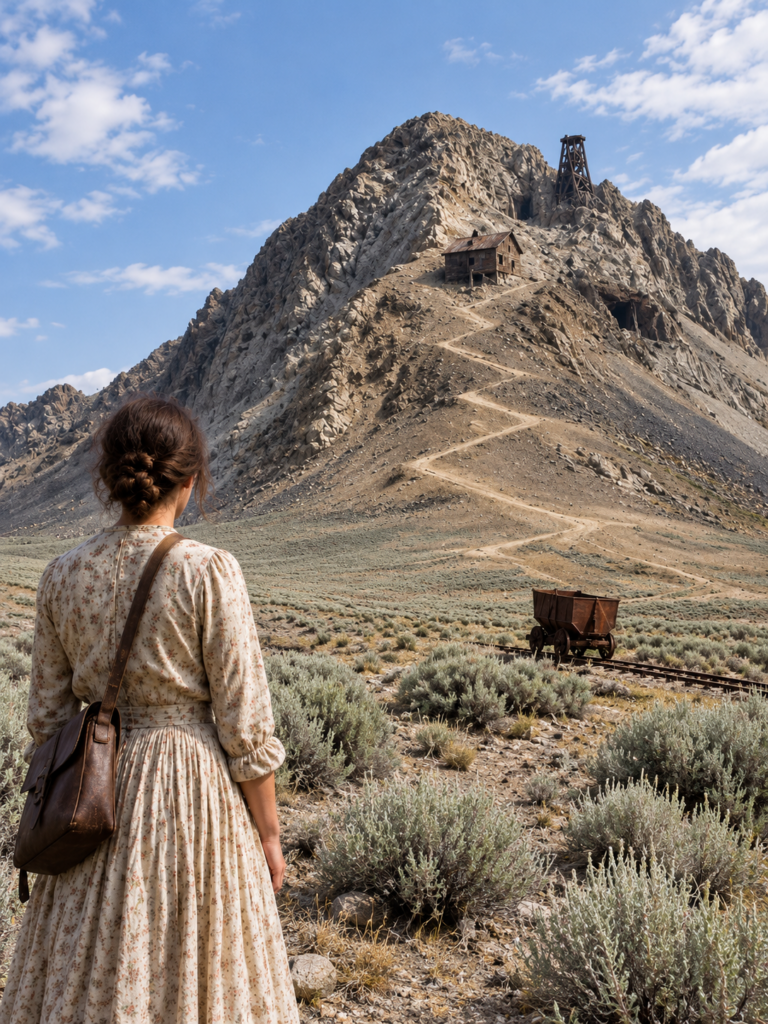
Part 1
The morning Martha Foster traded away her grandmother’s wool coat, the temperature in Granite Run had fallen low enough to freeze water in the horse troughs.
She was eighteen years old, alone in a town where nobody knew her name, with forty-one cents hidden inside a little tin box and everything else she owned packed into a worn canvas satchel.
The coat was the last beautiful thing she possessed.
Her grandmother, Elizabeth Foster, had sewn it by lamplight during a winter when firewood was scarce and money even scarcer. The wool was dark brown, the lining carefully stitched, and the buttons had been salvaged from a coat Elizabeth had worn when she was young.
It had taken nearly three months to finish.
“Good wool outlasts a hard winter,” Elizabeth had told her granddaughter. “And good judgment outlasts almost everything.”
Now Elizabeth was dead, the little farm where Martha had grown up was gone, and Martha stood on a weathered boardwalk in a Colorado mountain town with no job, no family, and nowhere to sleep.
Across the street, men were gathering outside the feed store, stamping their boots against the cold.
One of them was laughing.
“That deed ain’t worth the paper it’s written on, Jesse. You’d have better luck selling a bucket of mountain wind.”
Another man spat tobacco juice into the dirt.
“I wouldn’t give you a dead mule for that property.”
Martha would have continued walking if she hadn’t heard the word deed.
She stopped.
The man holding the paper was thin, sunburned, and perhaps thirty-five. His nose had healed crooked after some long-forgotten injury, and his coat had patches at both elbows.
He looked desperate enough to be dangerous, but he wasn’t watching the men laughing at him.
He was studying the money in the feed-store owner’s hand.
“Forty cents,” he said. “That’s all I’m asking.”
The owner shook his head.
“Not interested.”
Martha stepped closer.
“What kind of property?”
The men turned.
For a moment, nobody answered. Then the thin ranch hand unfolded his paper and looked at her.
“Mountain ground, miss. Seven miles northwest of here. There’s an old line shack, a little timber, and whatever rocks the Lord saw fit to leave behind.”
“How much land?”
“Lot Nine, upper section. Surveyed and recorded.”
“Why are you selling?”
The man hesitated.
“My mother’s dying down in Prescott. My sister sent word. I need money to get there before it’s too late.”
There was something in the way he said mother that made Martha look at him differently.
She had buried hers three years earlier.
Ruth Foster had died of fever when Martha was fifteen. Her father, Amos, had disappeared long before that, supposedly searching for freight work two counties away. Rumor eventually said he’d died of pneumonia, though Martha never learned whether it was true.
After Ruth’s funeral, her grandmother had kept the family alive.
Elizabeth Foster was a small Scottish woman with a white braid down her back, hands roughened by forty years of work, and an iron determination that had survived widowhood, poverty, and every disappointment the frontier could deliver.
She taught Martha to grow vegetables in poor soil, skin rabbits, repair clothing, read the weather, and sharpen an ax.
But the most important thing she taught her was how to recognize something valuable when everybody else dismissed it.
“People can tell you what a thing is worth,” Elizabeth would say, “but until you’ve looked at it yourself, you’re only borrowing their opinion.”
Elizabeth died in her sleep nine months before Martha arrived in Granite Run.
Martha washed her grandmother’s body, helped the neighbors bury her, and sat alone beside the grave until evening.
A month later, a lawyer’s letter arrived.
The farm, which Martha had always believed belonged to her family, legally belonged to a distant cousin in St. Louis.
He intended to sell.
She had until November to leave.
Martha packed her grandmother’s little book of pressed wildflowers, her mother’s tin box, a few clothes, and the wool coat.
For the winter she worked in a boardinghouse kitchen, washing dishes, scrubbing floors, and peeling potatoes until her fingers cracked.
Then the boardinghouse closed.
Her last wages bought a stagecoach ticket west.
The ticket carried her to Granite Run.
And now a stranger was offering land for forty cents.
“May I read that paper?” she asked.
The ranch hand gave a doubtful shrug and handed it over.
His name was Jesse Partardee.
The deed had come to him in a poker game years earlier. He had carried it in his saddlebag ever since, unsuccessfully attempting to sell it whenever money ran short.
Martha read the description carefully.
The property ran from a marked pine near the head of a draw, followed compass bearings along a ridge, and enclosed a section of mountain land with all improvements and natural appurtenances.
She read the final clause twice.
“Has this deed been recorded?”
Jesse pointed at the county stamp.
“Yes, ma’am.”
“Are there any liens against the property?”
“None I know about.”
“Have you ever walked the boundaries?”
“No, ma’am. And from what I’ve heard, I wouldn’t waste my time.”
Martha looked toward the distant mountains.
Snow still clung to the upper ridges, and beneath it stood endless dark forests.
The wind cut straight through the narrow opening at her collar.
She thought of Elizabeth’s voice.
Walk the ground, child. Paper tells you what a man claims to own. The ground tells you what’s actually there.
“Would you trade it for a coat?” Martha asked.
Jesse stared.
“What?”
“This one.”
She touched the dark wool at her shoulder.
The feed-store owner burst out laughing.
“Girl, that’s the first sensible coat I’ve seen on this street all morning!”
Jesse looked from the coat to Martha’s face.
“Miss, you’ll freeze without it.”
“You’ll reach your mother with it. Or sell it for enough to help you get there.”
He was quiet for a long moment.
Then he said, “I’d make that trade.”
Martha slowly unbuttoned the coat.
The cold struck her immediately.
She folded the wool carefully, once across the shoulders and again at the waist, exactly as her grandmother had taught her.
Then she laid it on a wooden barrel.
“I’ll need you to sign the deed over in front of the county clerk.”
Jesse nodded.
They walked together to the whitewashed building that served as courthouse, land office, and jail.
Inside, Horus Bell, a narrow-faced clerk with spectacles and green sleeve garters, examined the document.
“You understand what you’re buying, young lady?”
“I understand what the deed says.”
“That mountain’s worthless.”
“Then it shouldn’t matter who owns it.”
Bell studied her for another moment.
The recording fee was twenty-five cents.
Martha paid it.
When she walked out, she had sixteen cents remaining, a folded deed tucked inside her dress, and no coat.
Jesse stood beside the steps wearing Elizabeth’s wool.
It was slightly small across his shoulders, but he looked warmer already.
“I hope you find something good up there, Miss Foster.”
Martha offered her hand.
“I hope you get to your mother.”
He shook it firmly.
Then he turned south.
She never saw him again.
By afternoon, nearly everyone in Granite Run had heard about the foolish young woman who traded her coat for a useless mountain.
The men laughed at the feed store.
Women shook their heads behind their curtains.
And a wealthy rancher named Rowan Howerin came looking for her.
Howerin owned one of the largest cattle outfits in the valley. He was fifty-five, broad-shouldered, with weathered features and expensive boots polished by someone else’s hands.
He stopped Martha outside the feed store.
“Miss Foster, I understand you’ve purchased a piece of ground adjoining my summer range.”
“That’s correct.”
“That particular mountain has caused nothing but trouble. Difficult access. Poor soil. Dangerous winter weather.”
Martha listened.
“I’d hate to see a young woman lose everything over a bad bargain,” he continued. “I’ll give you five dollars for that deed. Cash.”
Five dollars.
More than thirty times what she had left.
Enough for food, a room, or a stagecoach ticket somewhere warmer.
For a moment, Martha imagined accepting.
Then she remembered how quickly Howerin had appeared.
She looked at his polished boots.
“Have you seen the property yourself, Mr. Howerin?”
“I’ve run cattle near it for eighteen years.”
“Then you know more about it than I do.”
“Exactly.”
“Which means I’ll need to look at it before making another decision.”
His expression tightened.
Only slightly.
But Martha noticed.
“The trail is dangerous this time of year,” he said. “A girl alone could get herself killed.”
“I’ll remember that.”
“And if you’re smart, you’ll reconsider my offer.”
Martha stepped around him.
She walked until she reached the livery at the north end of town.
Inside, a broad man named Aught Peton was fitting a horseshoe.
“I need to borrow a horse,” she said.
Peton looked at her worn boots, thin dress, and empty hands.
“With what money?”
“Sixteen cents.”
He gave a humorless laugh.
“Then you don’t need a horse. You need employment.”
Martha stood straight.
“Do you have work?”
Peton studied her.
Behind the barn stood a henhouse that hadn’t been properly cleaned since winter.
He pointed toward it.
“Clean that place down to the boards. Fresh straw, lime in the corners, the whole business. Do it right, and I’ll lend you old Duff for a day and a night.”
Martha nodded.
“I’ll start now.”
Peton called toward the house.
“Nan! Come look at what the wind blew in!”
His wife appeared in the doorway, wiped her hands on her apron, and looked at Martha’s coatless shoulders.
She said nothing about them.
Instead, she brought the girl into her kitchen and placed a bowl of warm beans and cornbread on the table.
“Eat first.”
Martha hadn’t eaten since the previous morning.
She sat down.
And for the first time since trading her coat, the sight of another woman’s kitchen made her throat tighten.
She lowered her eyes and took up the spoon.
There was still work to do.
And somewhere above Granite Run, a mountain was waiting.
Part 2
Martha cleaned the henhouse until her shoulders burned.
She scraped hardened droppings from the floorboards, hauled wheelbarrow after wheelbarrow of filthy straw to the compost heap, washed the roosts, and scattered lime into the corners where mites gathered.
Her hands blistered.
The odor soaked into her clothes.
She found an old brown hen stubbornly sitting on three eggs and carefully worked around her.
When she finished, the late afternoon sun was already touching the roofs of Granite Run.
Nan Peton came to inspect.
She looked inside the henhouse, then at the exhausted girl.
“Most folks would’ve quit halfway.”
“My grandmother said if you’re going to do unpleasant work, do it properly the first time.”
Nan nodded.
“Your grandmother sounds like a sensible woman.”
“She was.”
The simple answer nearly broke Martha’s composure.
Nan noticed but didn’t press.
Instead, she showed Martha a pallet in the tack room.
“You can sleep here tonight. Lock the door from the inside.”
“How much?”
“Nothing.”
“I don’t want charity.”
“Then think of it as payment for leaving my henhouse cleaner than my husband ever has.”
Martha managed a small smile.
That night, she lay beneath a threadbare blanket listening to horses shifting in their stalls.
The deed rested inside her dress.
She took it out and unfolded it beneath the dim lantern.
Lot Nine, Upper Section.
The words looked ordinary.
Almost foolish.
She thought about the wool coat.
When Elizabeth had given it to her, she had said it would keep Martha warm for many winters.
Now it belonged to a stranger.
Martha wondered whether she had betrayed her grandmother’s memory.
She opened her satchel and removed the little leather-bound book of pressed flowers.
Inside were wild roses, bluebells, violets, and a faded sprig of heather Elizabeth’s own mother had brought from Scotland.
Each flower had a date written beneath it.
Each represented an ordinary day that Elizabeth had decided was worth remembering.
Martha opened to the page containing a white violet.
Her grandmother had once explained that she’d found it on the morning Martha’s father was born.
“He turned out different from what I hoped,” Elizabeth had said quietly. “But it doesn’t make the flower less beautiful.”
Martha touched the edge of the page.
“I don’t know what I’m doing, Grandma,” she whispered.
There was no answer.
Only the restless sound of wind against the barn.
Before dawn, Aught Peton brought out Duff.
The old sorrel gelding had a white mark down his face, a slightly swayed back, and eyes that seemed entirely unimpressed by human ambition.
“He’s sixteen, maybe older,” Aught said. “Don’t run him uphill, don’t let him drink from muddy cattle pools, and don’t expect him to hurry for anything.”
“Sounds like a sensible horse.”
Aught grunted.
Nan appeared carrying a cloth bundle.
Inside were cold potatoes, cornbread, dried beef, and a little salt.
She also handed Martha a filled canteen.
“Water comes out of the rocks clean,” she said. “Downstream from cattle, not necessarily.”
Martha thanked her.
Nan placed a hand briefly on the girl’s shoulder.
“Come back with all your fingers and toes.”
Martha climbed into the saddle.
At the edge of town, she turned once.
Granite Run lay gray beneath the mountains, its chimneys sending thin ribbons of smoke into the early morning sky.
Then she rode north.
The journey was harder than she expected.
The first mile followed a dry wash filled with sand and winter debris. Beyond it, the trail climbed through dense pine forest, where patches of dirty snow remained beneath the trees.
The higher she went, the colder the air became.
Without her coat, the wind found every opening in her dress.
Her fingers stiffened around the reins.
Duff climbed slowly, stopping often to breathe.
Martha dismounted on the steepest stretches and led him.
“Take your time, old boy,” she murmured. “Neither of us can afford to fall.”
At the first ridge, the country opened before her.
A deep valley stretched between two wooded mountains.
Beyond the far slope, sunlight caught the loose sheet of tin covering a small structure.
The abandoned shack.
Martha looked down at the deed tucked against her chest.
For the first time, the words on the paper became real.
She owned a piece of that enormous, silent wilderness.
Or at least she hoped she did.
As she descended into the valley, she saw something that caught her attention.
Water.
A narrow creek ran through the trees, clear enough to see the stones beneath its surface.
She knelt, tested the water, and filled her canteen.
Farther uphill, she found old ax marks cut into the trunks of several pines.
Boundary blazes.
The marks followed a line through the forest.
Martha stopped beside the first and pressed her fingers against the weathered scar.
Someone had surveyed this land carefully.
Someone had taken the trouble to mark it.
A strange feeling stirred in her chest.
Hope was dangerous when a person had lost as much as she had.
But she couldn’t entirely suppress it.
By late afternoon, she reached the shack.
It sat on a narrow shelf of level ground beneath a granite outcrop. Pines sheltered it on three sides, while the fourth overlooked the valley.
The roof sagged.
One corner of tin lifted and clattered in the wind.
The door hung crooked from a single hinge.
Martha tied Duff to a tree and approached slowly.
“This is what everyone was laughing about,” she whispered.
Inside, the cabin was barely twelve feet square.
A stone fireplace stood against one wall. There was a narrow bunk, a wooden shelf, a rusted cooking pot, a chipped plate, and a tin cup.
Mice had shredded the bedding.
Cold air entered through gaps between the logs.
But in one corner Martha found an ax, a shovel, and a crosscut saw.
She inspected the tools.
The ax handle was cracked but usable.
The shovel had been sharpened repeatedly.
The saw needed cleaning but still held its teeth.
Her grandmother had once told her that people who intended to return left behind useful things.
Whoever had occupied this shack hadn’t meant to abandon it forever.
Martha stepped outside and walked around the building.
Behind it, the granite rose like a wall.
A line of deliberately placed stones followed the base of the rock.
She counted seven before the line disappeared into the trees.
Then she noticed something else.
Green moss growing thickly beneath the rocks.
Elizabeth had taught her that certain mosses often marked persistent dampness.
Martha followed it westward, past two enormous pines and a cluster of aspens.
There, hidden in a shallow hollow, water flowed directly from a crack in the granite.
Someone had lined the spring with flat stones, creating a small basin.
The water ran from that basin toward an opening beyond the aspens.
Martha pushed through the trees.
And stopped.
A meadow spread across the valley.
Not a patch of grass.
Not a miserable strip of mountain pasture.
An enormous, sheltered meadow with thick soil, scattered willow growth, and water flowing through its center.
Even in April, green shoots were rising beneath last year’s dried grass.
Martha had grown up around farmers and livestock.
She recognized good grazing land.
She recognized reliable water.
And she recognized something else.
This meadow did not belong in the description of a worthless, wind-scoured mountain.
She knelt and scooped up a handful of earth.
It was dark, damp, and rich.
“Grandma,” she whispered, “I think we found something.”
Then she remembered Rowan Howerin’s five-dollar offer.
And his warning about the dangerous trail.
Martha slowly closed her fingers around the soil.
Perhaps the rancher knew exactly what lay beyond the aspens.
Perhaps he had counted on her never reaching it.
The sun was descending.
She still needed shelter before dark.
Returning to the shack, she noticed a narrow passage between the rear wall and the granite.
At the end of it stood a heavy wooden door set directly into the rock.
Martha stopped.
It was scarcely four feet high, reinforced with old timbers and secured by an iron staple and a wooden peg.
It looked less like a storage closet than an entrance to something deliberately hidden.
She examined the frame.
The wood was weathered but sound.
The door had been made by someone skilled with his hands.
Martha remembered the tools inside the shack.
Then the boundary marks.
Then the carefully lined spring.
Whoever had lived here had spent years building something.
She pulled the wooden peg free.
The door resisted at first.
Then, with a deep wooden groan, it swung outward.
Cold, dry air drifted out of the mountain.
And with it came the faintest scent of apples.
Martha stared into the darkness.
Somewhere deep inside the stone, water dripped once.
Then silence returned.
She had sixteen cents, a borrowed horse, and no idea what lay beyond that opening.
But she had come too far to turn away.
She ducked her head, struck a match, and stepped inside.
Part 3
The chamber behind the wooden door was larger than Martha expected.
Someone had carved it directly into the granite, shaping the walls with a mason’s chisel and laying flat stones across the floor.
Shelves lined one side.
A long wooden bench stood opposite them.
Near the back was a small barrel, a coil of rope, several clay jars, and a lantern carefully wrapped in oiled cloth.
Nothing appeared to have been disturbed in years.
Martha struck another match and examined the lantern.
There was still oil inside.
She lit it.
Warm light spread across the chamber, revealing a space that had been built with extraordinary patience.
The jars were labeled in neat handwriting.
Apples. Pears. Onions. Vinegar. Molasses.
Most were long past their usefulness, but several appeared intact.
There were candles, wire, spare nails, heavy canvas, and a surveyor’s chain hanging from a wooden peg.
Martha ran her hand along the chisel marks in the granite.
One person had done this work.
Perhaps two.
It must have taken years.
On the bench sat a small wooden box.
The corners were carefully joined, and the brass fastening had turned green with age.
Martha set the lantern beside it.
Then she opened the lid.
Inside lay a folded oilcloth, a leather pouch, a sealed letter, a bundle tied with green string, and a thick book covered in dark cloth.
She lifted the pouch first.
It was unexpectedly heavy.
When she loosened the drawstring, something yellow caught the lantern light.
Martha froze.
Gold.
Not a nugget.
Not a single coin left behind by accident.
Gold coins, stacked together inside the leather pouch.
She tipped them gently into her palm.
They were twenty-dollar pieces.
Her fingers began trembling.
She counted them once.
Then again.
Forty-two coins.
Eight hundred and forty dollars.
To a girl who had arrived in Granite Run with forty-one cents, the amount was nearly impossible to comprehend.
She could buy food for years.
She could buy livestock, tools, clothing, and perhaps a wagon.
She could afford the very things that had always stood between her family and security.
But Martha did not shout.
She did not rush outside.
She sat motionless, listening to the wind whistle faintly through the open doorway.
Because she remembered something her grandmother had told her.
“Money found without understanding where it came from can bring more trouble than money earned.”
She returned the coins to their pouch.
Then she opened the letter.
The wax seal broke beneath her thumbnail.
The paper was old, but the handwriting remained clear.
To whoever finds this,
My name is Ansel Whitam.
I came onto this mountain after losing my wife, Hannah, and our daughter, Ellen, to diphtheria.
I had no wish to remain among the people who remembered their funerals, so I traveled west until I found a place where no one knew my name.
Martha stopped reading.
She looked toward the open door.
The lonely shack.
The remote meadow.
The carefully built chamber.
Suddenly, the mountain seemed less like abandoned property and more like the refuge of a grieving man.
She continued.
I was a stonemason before coming west. I built the cabin, cut this chamber into the mountain, lined the spring, and marked the boundaries with my own hands.
The meadow will support good livestock. The spring has never failed, even in the driest summer.
The timber is sound. The ground is better than the valley men believe.
I have left eight hundred and forty dollars in gold. It is every dollar I could spare after years of working and saving.
I leave it here because I have no children to inherit this place.
If you are reading this, I hope you are someone who needs a home.
Martha lowered the letter.
Her eyes filled.
A man she had never met had spent years preparing a place for someone he would never know.
She continued reading.
Use the money wisely. Pay the taxes. Repair the cabin. Build fences. Defend the boundaries.
The book beneath this letter contains my survey notes, records of the spring, and observations about the cattle outfits using the land below.
The proper records are filed in Book D at the county seat.
Do not surrender this ground merely because someone richer tells you it belongs to him.
Martha read that sentence twice.
She thought of Rowan Howerin.
His polished boots.
His smooth voice.
His offer of five dollars.
The letter ended with words written more carefully than the rest.
I hope you are young.
I hope you have useful work in your hands.
I hope you find the spring running clear and the pines still standing.
And more than anything, I hope you stay.
Martha pressed the letter against her chest.
For several minutes she sat without moving.
She had spent months believing that her life had become a long procession of losses.
Her father.
Her mother.
Her grandmother.
The farm.
Her employment.
Her coat.
Now a dead stranger had left behind the possibility of a home.
But when she reached for the small cloth bundle tied with green string, what she found inside affected her even more deeply than the gold.
It was a little leather-bound book.
Inside were pressed wildflowers.
Each specimen rested between thin sheets of waxed paper.
Some were faded almost white.
Others still carried traces of blue, purple, and yellow.
Beside them were dates and names written in a woman’s careful handwriting.
Hannah Whitam.
Martha turned the pages slowly.
Near the back, she found a tiny forget-me-not.
Beneath it was a date.
And one word.
Ellen.
Martha understood.
The flower had been gathered for the daughter Hannah had lost.
She reached into her satchel and removed Elizabeth Foster’s book.
The two volumes were nearly identical in size.
Two women, separated by hundreds of miles, had spent years preserving little flowers to remember the people they loved.
One had left her book to her granddaughter.
The other had left hers to a grieving husband, who had carried it into the mountains and eventually preserved it for a stranger.
Martha placed the books side by side.
At last, the tears came.
She cried for her mother.
For her grandmother.
For the little girl named Ellen.
For Hannah Whitam.
And for the lonely stonemason who had spent fourteen winters making a home he could not bear to share because the people he wanted beside him were gone.
She cried until there was nothing left to cry.
Then she wiped her face with her sleeve.
“Thank you, Mr. Whitam,” she whispered.
Outside, the light was fading.
Martha carefully returned the letter and flower books to the box.
She carried the lantern into the shack and began working.
The chimney was clear enough for a small fire.
She swept away the old ashes, removed the mouse nest, gathered dry kindling, and lit the hearth.
Then she repaired the hanging door with nails she had discovered in an old tin.
She stuffed pine needles and damp clay into the worst gaps between the logs.
She spread fresh pine boughs across the bunk and covered them with the blanket borrowed from the livery.
By the time darkness settled over the mountain, the shack was still shabby, but the wind no longer entered freely.
Martha ate a cold potato and a piece of dried beef.
Her supper was small.
Her hands were aching.
And for the first time in nearly a year, she was eating inside a place she could call her own.
She lay awake a long time watching firelight move across the ceiling.
The gold could change her future.
But only if she kept the land.
And she knew exactly which man might try to prevent that.
The next morning, Martha saddled Duff before sunrise.
She left the more valuable papers secured in the stone chamber and carried the survey book and several gold coins in her satchel.
She rode back toward Granite Run.
When she entered the county office, Horus Bell looked over his spectacles.
“Well, Miss Foster. Did you find your pile of rocks?”
“I found something I’d like you to examine.”
She placed Ansel Whitam’s daybook on the counter.
Bell turned the pages.
The book contained careful measurements, boundary descriptions, dated observations, and sketches.
Martha asked him to compare them against the original land records.
The clerk pulled down Book D.
For nearly an hour, they worked silently.
Then Bell removed his spectacles.
“The measurements agree.”
“All of them?”
“As far as I can determine.”
“And the deed?”
“Recorded and transferred.”
“Can anyone claim the land simply because they’ve grazed cattle there?”
Bell pursed his lips.
“That depends on facts a court would have to examine. But a rancher doesn’t automatically own land because he lets cattle wander onto it.”
Martha looked down at the documents.
“I want certified copies. And I want a surveyor to mark the boundaries again.”
Bell studied her with new interest.
“That’ll cost money.”
Martha set a gold coin on the counter.
Bell stared at it.
Then he looked at her.
“Miss Foster, where exactly did you find that?”
“On my property.”
The clerk slowly reached for his pen.
By evening, Martha had arranged for a surveyor named Emmett Roush to examine the property.
She also visited Judah Metaf’s general store.
She bought flour, cornmeal, coffee, bacon, nails, rope, an ax handle, blankets, and enough supplies to begin repairing the shack properly.
When Judah noticed her bare shoulders, he disappeared into the storeroom.
He returned carrying a wool coat that had remained unsold for two winters.
“Try this.”
It fit perfectly.
Martha stood before the small mirror.
The coat was plain and gray.
It wasn’t the one Elizabeth had sewn.
It never could be.
But it was warm.
And this time, Martha had paid for it with her own money.
That night, people in Granite Run began whispering that the foolish girl with the worthless mountain had somehow come into gold.
Before the next morning, the news had reached Rowan Howerin.
And the rancher who had offered five dollars for her deed was no longer laughing.
Part 4
By the first week of May, Martha’s hands had become so rough that the skin cracked whenever she closed them.
She spent her mornings repairing the shack and her afternoons working around the meadow.
She replaced rotten roof shingles, packed the spaces between the logs with clay and hair, cleared fallen branches from the spring, and cut away brush that threatened to choke the narrow trail.
At night she worked by firelight, sharpening tools, sewing patches onto her clothing, and studying Ansel Whitam’s records.
The loneliness sometimes felt unbearable.
There were evenings when she found herself setting out two cups without thinking.
One for herself.
One for Elizabeth.
Once, after an especially hard day replacing roof shingles, she sat on the doorstep and imagined her grandmother approaching along the trail.
She pictured the little woman with her white braid and stern expression, examining the cabin, finding fault with the chinking, and then quietly asking whether Martha had eaten.
The memory hurt so sharply that Martha bent forward and covered her face.
No amount of money could bring Elizabeth back.
No deed could restore the family she’d lost.
And no mountain, however beautiful, could speak to her in the voice she missed most.
But the following morning, Martha rose again.
There was work to do.
Emmett Roush arrived with his compass, surveyor’s chain, and iron boundary pins.
He was a careful man who talked little and measured twice.
For three days, he and Martha walked the property.
They climbed rocky slopes, crossed streams, pushed through tangled brush, and searched for the old blazes Ansel Whitam had cut into the pines.
The marks were still there.
Dozens of them.
Weathered and partly swallowed by growing bark, but unmistakable.
On the second afternoon, they reached the far edge of the hidden meadow.
Roush stopped.
He studied his compass.
Then he examined Whitam’s old measurements.
“Miss Foster, I want you to understand something.”
Martha looked up.
“This meadow is substantial grazing land.”
“I know.”
“More than sixty acres, by my estimate. Reliable water. Shelter from the worst weather. Access to timber.”
He pointed toward the valley.
“Those big outfits down there would pay good money to control a piece of land like this.”
Martha stood quietly.
“How much?”
“More than five dollars.”
She almost smiled.
Roush continued.
“And the surrounding ground gives you access to a good deal more timber and summer pasture than anyone in town seems willing to admit.”
They followed the boundaries all the way around.
On the third evening, Roush spread his measurements across Martha’s plank table.
His survey confirmed the essential lines recorded in Whitam’s daybook.
The meadow stood inside them.
So did the spring.
So did the cabin and the surrounding timber.
There were no obvious gaps that gave Howerin ownership.
Martha stared at the new survey.
“You’ll file this officially?”
“First thing when I return to town.”
“And make copies?”
“Yes, ma’am.”
She placed her hand over the paper.
“Then perhaps he’ll leave me alone.”
Roush didn’t answer immediately.
Finally, he said, “A man doesn’t build a cattle empire by easily surrendering ground he’s grown accustomed to using.”
Martha understood.
A few days later, Rowan Howerin arrived.
His foreman, Deak Isham, rode beside him.
They stopped their horses at the edge of the cabin yard.
Martha was splitting kindling.
She set her ax down but did not retreat inside.
“Morning, Mr. Howerin.”
“Miss Foster.”
His gaze moved over the repaired cabin, the new stovepipe, the neatly stacked firewood, and the gray coat hanging beside the door.
“I hear you’ve been making improvements.”
“I intend to live here.”
“That’s unfortunate.”
“For whom?”
Howerin looked at her sharply.
Then he pointed toward the meadow.
“My cattle have grazed that ground for eighteen years.”
“I understand.”
“My men have cleared trails, carried salt, and maintained access.”
“I’ve read about that in Mr. Whitam’s records.”
The rancher’s expression changed.
“What records?”
“His daybook.”
Howerin looked toward the cabin.
Martha continued.
“He wrote down the years your cattle came onto his land. He wrote down the names of men who worked for you. He even recorded the condition of the meadow afterward.”
Deak Isham shifted in his saddle.
For the first time, he seemed uncomfortable.
Howerin’s voice hardened.
“You think an old man’s diary means more than eighteen years of actual use?”
“I think the deed, the original survey, the county records, and Mr. Roush’s new measurements deserve consideration.”
“Then perhaps we should let a lawyer decide.”
“Perhaps we should.”
The rancher leaned forward.
“Listen carefully, girl. You have no family here. No business experience. No men to protect your interests. You are trying to establish yourself against people who have worked this country since before you were born.”
Martha felt her stomach tighten.
He wasn’t shouting.
That made the threat worse.
“I don’t want to fight you, Mr. Howerin.”
“Then sell.”
“No.”
“You’re making a serious mistake.”
Martha thought of Elizabeth.
Of Ruth Foster.
Of Ansel Whitam, cutting stone alone after losing everything he loved.
“I’ve already lost one home,” she said. “I’m not giving up another without good reason.”
Howerin stared at her.
Then he turned his horse.
“You’ll hear from my attorney.”
He rode away.
Deak Isham lingered a moment.
His eyes moved toward the cabin and then back to Martha.
He appeared ready to speak.
Instead, he touched his hat and followed his employer.
Martha stood perfectly still until the sound of their horses disappeared.
Then she stepped inside.
Her legs began trembling.
She sat at the table and pressed both palms against the wood.
She had been brave while the men were watching.
Now she was terrified.
A lawyer could cost more than she understood.
A lawsuit could drain the pouch of gold.
A disputed boundary could prevent her from buying livestock or building a proper house.
And Howerin had friends in Granite Run whose influence extended far beyond his ranch.
That evening, she opened the wooden box.
She counted the remaining coins.
Then she read Ansel Whitam’s letter again.
Do not surrender this ground merely because someone richer tells you it belongs to him.
Martha looked toward the little book of pressed flowers.
“I wish you were here, Grandma.”
The fire snapped.
Outside, thunder rolled over the ridge.
A storm had been gathering all afternoon.
Rain began against the roof.
Then came hail.
Martha rushed outside to secure Duff beneath the shelter she’d made beside the cabin.
Lightning flashed above the meadow.
The horse pulled against his rope, frightened by the noise.
“Easy, boy.”
Martha tried to calm him.
Then she heard a violent crack.
A dead pine had split near the upper trail.
The trunk crashed downhill, landing across the narrow path that connected the cabin to the valley.
Martha stared through the rain.
If she needed supplies or legal assistance, that fallen tree could become a serious obstacle.
If another storm struck, she might be trapped for days.
She spent the next morning sawing through branches and dragging them aside.
The crosscut saw was heavy.
Her palms blistered beneath the calluses.
At noon, she sat beside the broken trunk, exhausted, and considered riding down to Granite Run and accepting whatever Howerin offered.
Five dollars had become an insult, but he might offer fifty.
Perhaps a hundred.
She could leave the mountain.
Find employment.
Sleep in a warm room.
Let another person worry about fences, surveys, lawsuits, and winter storms.
The idea was so tempting that she allowed herself to imagine it fully.
Then Duff approached and rested his muzzle against her shoulder.
Martha reached up and stroked his neck.
“You think I’m foolish too, don’t you?”
The old horse breathed against her hair.
She looked at the meadow beyond the aspens.
At the spring.
At the cabin that had already become warmer and stronger beneath her hands.
And she remembered the day she’d been forced from the Piny Fork farm.
There had been no argument.
No chance to stay.
Only a lawyer’s letter telling her she no longer belonged in the home where her mother and grandmother had lived.
This time, she had documents.
This time, she had evidence.
This time, she had something worth defending.
She rose and picked up the saw.
By sunset, the trail was open again.
A week later, a Denver attorney named Prosper Ainsley arrived at the shack.
He wore a black coat and carried a leather satchel.
His boots were suspiciously clean for a man who had supposedly ridden all the way up the mountain.
“I’m representing Mr. Howerin,” he said.
Martha invited him inside.
He examined the deed.
The county records.
The survey.
Ansel Whitam’s daybook.
He read several entries twice.
Then he asked about the original owner’s family.
“Did Mr. Whitam leave any surviving children?”
“His wife and daughter died before he came west. I know of no others.”
“Any partners in the property?”
“None recorded.”
“Has Mr. Howerin ever paid taxes on this parcel?”
“Not according to the records I’ve seen.”
Ainsley made notes.
He studied the surveyor’s measurements for a long time.
Finally, he closed his satchel.
“I’ll need to discuss this with my client.”
“What happens next?”
“You’ll receive correspondence.”
“Will I have to go to court?”
“I can’t answer that today.”
He stood.
Martha accompanied him to the doorway.
Before mounting his horse, the attorney looked back at the cabin.
“Who repaired this place?”
“I did.”
“Alone?”
“Most of it.”
He regarded her for a moment.
Then he nodded.
“Good afternoon, Miss Foster.”
He rode away.
Six days passed.
During those six days, Martha worked as usual, but every sound on the trail made her stop.
Every approaching horse brought a cold feeling to her stomach.
She imagined court summonses.
Legal expenses.
A sheriff arriving with an order she couldn’t understand.
On the sixth afternoon, young Wesley Metaf appeared on his father’s buckboard.
He carried supplies.
And an envelope.
“From Denver,” he said.
Martha recognized the attorney’s handwriting immediately.
Her fingers went cold.
She took the envelope inside.
For a moment, she could not make herself open it.
Then she remembered the county office.
The survey.
The gold.
The lonely man who had hoped someone would stay.
Martha broke the seal.
Part 5
The letter was written on half a sheet of Rowan Howerin’s stationery.
Martha read the first sentence.
Then she read it again.
After review of the recorded title, original survey, subsequent boundary measurements, and supporting historical records, my client withdraws any claim of ownership or adverse possessory interest in Lot Nine of the Upper Section.
Martha sat down slowly.
There was more.
The attorney explained that Howerin’s previous use of the meadow had been considered permissive or otherwise insufficient to overcome the evidence of title presented.
The rancher would make no further claim against Martha’s ownership.
He would also instruct his men to keep cattle outside the marked boundaries unless an arrangement was made with her.
Martha reached the signature.
Prosper Ainsley, Attorney at Law.
She stared at the paper.
For weeks, she had imagined the worst.
Now there was no court order demanding that she leave.
No sheriff coming up the mountain.
No powerful rancher standing between her and the home she was building.
She had defended the property.
And Howerin had withdrawn.
For a long time, Martha did not move.
Then she carried the letter outside.
The wind came softly across the ridge.
The meadow was green.
Birds were calling in the aspens.
She walked to the little spring Ansel Whitam had lined with stones and knelt beside it.
She read the letter once more.
Then she laid it carefully on a dry rock.
“Grandma,” she whispered, “I kept it.”
Her voice broke.
“I kept our home.”
She cried there beside the spring.
Not the helpless tears of a girl who had lost everything.
Not the exhausted tears of a girl who had nearly surrendered.
These were tears of relief, grief, and gratitude mixed so completely that she could no longer separate one from another.
When she finally stood, she washed her face in the cold water.
Then she folded the letter and placed it beside the deed.
That evening, she opened Ansel Whitam’s daybook.
On the first blank page following his final entry, she wrote:
The line has been surveyed again. The corners are marked. Mr. Howerin has withdrawn his claim. The spring is clear, and the meadow is coming green. I intend to stay.
She signed her name.
Martha Foster.
For the first time, the record belonged partly to her.
The following Saturday, Martha rode into Granite Run on Duff.
She went directly to Horus Bell’s office.
She asked him to retain an official copy of the survey and the attorney’s withdrawal.
Bell read the letter, adjusted his spectacles, and looked at her.
“Well, Miss Foster.”
“Well, Mr. Bell.”
A strange expression passed over his face.
It might almost have been a smile.
“Seems that worthless mountain wasn’t entirely worthless after all.”
Martha shook her head.
“It never was.”
Bell lowered his eyes to the documents.
“I suppose not.”
Outside, several men were standing beside the feed store.
Some were the same men who had laughed when she’d traded away her coat.
They fell silent when she passed.
Martha continued down the boardwalk.
She had no desire to embarrass them.
She remembered what it had felt like when the whole town had judged her by what she wore and how little money she carried.
She would not become the sort of person who measured others so carelessly.
At the livery, Aught Peton was repairing a wagon wheel.
He straightened when he saw her.
“How’s old Duff?”
“Sound as ever.”
“He give you trouble?”
“Only when he thinks the trail ought to be shorter.”
Aught chuckled.
Martha placed a small pouch on the workbench.
“I’d like to buy him.”
Aught stopped smiling.
“Buy him?”
“Yes.”
“That old fool?”
“He’s brought me safely home every time I’ve asked.”
Aught rubbed his beard.
Finally, he named a price.
Twenty-two dollars.
Martha paid it.
Aught included the old saddle, a proper bridle, and a currycomb.
When she protested, he waved her off.
“Can’t have a respectable landowner riding about with a rope tied around her horse’s head.”
From the kitchen doorway, Nan Peton laughed.
Martha turned toward her.
“Mrs. Peton, would you mind if I came by on Saturdays? I’d like to bring you something from the mountain once the garden grows.”
Nan considered her.
“Only if you promise to sit down and drink coffee while you’re here.”
Martha smiled.
“I think I can manage that.”
Before she left, Nan pressed a small loaf of bread into her hands.
“Don’t argue,” she said. “I’ve baked too much.”
Martha recognized the lie.
And accepted the bread.
Over the next several weeks, life on the mountain began changing.
Not quickly.
Not magically.
Every improvement demanded labor.
Every dollar had to be considered.
Martha planted a kitchen garden near the spring, turning the earth with the old shovel.
She built a chicken enclosure beside the cabin.
She cleared brush from the meadow and repaired the fence lines where old posts had rotted.
She bought a milk cow from a farmer in the valley.
Then she bought a few young cattle.
The work was more than one person could comfortably manage.
One afternoon, Judah Metaf mentioned a widow named Susanna Kerr.
Her husband had died after falling from a scaffold.
She had two young children, a spinning wheel, and almost no money.
“She can work,” Judah said. “And she doesn’t ask for much.”
Martha rode down to meet her.
Susanna lived in a narrow room behind a boardinghouse.
Her children sat quietly on the floor, sharing a worn picture book.
She was thirty years old and looked considerably older.
When Martha explained the work available on the mountain, Susanna listened without interruption.
“Three dollars a week, food, and a place to stay,” Martha said. “There’s room for the children. Once I can build something better, you’ll have your own quarters.”
Susanna looked toward her children.
“Would they be safe?”
“As safe as I can make them.”
“Would they have enough to eat?”
“Yes.”
Susanna’s eyes filled.
She looked away quickly.
Martha understood that gesture.
She had spent enough nights hiding tears of her own.
“You don’t have to answer today,” she said.
Susanna shook her head.
“I’ll take it.”
The following week, Susanna arrived with her children and her spinning wheel.
At first, they slept in a canvas tent near the aspens.
Then Martha hired Emmett Roush to help build a small plank addition beside the cabin.
It had a narrow window, a stove, a door that latched properly, and enough room for the children to sleep together on a low bed.
The first evening they moved inside, the younger child asked Martha a question.
“Do we have to leave when winter comes?”
Martha crouched beside him.
“No.”
“What if it snows?”
“Then we’ll keep the stove burning.”
“What if it’s a very big snow?”
“Then we’ll make more fires and bake more bread.”
The child considered this.
“And the horses?”
“They’ll have shelter.”
He nodded solemnly.
“Then I think we’ll be all right.”
Martha smiled.
“I think so too.”
By midsummer, the hidden meadow supported eleven young cattle.
The spring continued flowing even when the lower valley grew dry.
The garden produced turnips, onions, beans, and cabbage.
Susanna worked carefully and managed the household with the kind of practical intelligence that poverty often forced a woman to develop.
Her children began laughing more freely.
Sometimes their voices could be heard all the way from the meadow.
Those sounds changed the mountain.
The little shack no longer seemed lonely.
There was bread on the table, washing on the line, fresh milk cooling in a crock, and children’s boots standing beside the door.
Martha began keeping a regular account with Judah Metaf.
She paid her bills on time.
She stored part of the gold for emergencies.
And whenever she could, she used the land’s earnings rather than the money Ansel Whitam had left.
She knew the pouch would not last forever.
The mountain needed to support itself.
In August, she wrote a letter to the woman in Prescott whom Jesse Partardee had named as his sister.
She enclosed a bank draft and a short note explaining that Jesse had once made a fair trade with a girl who badly needed a place to begin again.
She did not know whether he was alive.
She did not know whether he’d reached his mother.
And she never learned whether the letter arrived.
But she sent it anyway.
Because she remembered him standing on the boardwalk, poor and frightened, wearing her grandmother’s coat.
He had needed warmth and a way home.
She had needed land.
Neither had understood the value of what they were exchanging.
But perhaps they both received something important.
In September, Deak Isham rode up the mountain alone.
Martha saw him approaching and stepped outside.
He removed his hat.
“Miss Foster.”
“Mr. Isham.”
He shifted awkwardly.
“Mr. Howerin sent me.”
Martha waited.
“He’d like to know whether you’d consider renting a portion of the meadow next summer. At a fair price.”
Martha studied him.
“Renting?”
“Yes, ma’am.”
“Not claiming it?”
Isham lowered his eyes.
“No, ma’am.”
For a moment, Martha remembered the polished boots and the five-dollar offer.
She could have refused out of pride.
She could have named an outrageous price to humiliate the man who had tried to intimidate her.
But Elizabeth had never taught her to confuse strength with cruelty.
“If he wants to rent pasture, we can discuss it,” she said. “There’ll be a written agreement. The number of cattle will be limited. And he’ll pay for any damage.”
Isham nodded.
“That sounds fair.”
“I also expect his men to respect my fences.”
“Yes, ma’am.”
Martha thought for a moment.
“Then tell him I’ll consider a proper offer.”
Isham touched his hat.
And rode away.
The arrangement they eventually reached provided Martha with a modest but steady income.
It also established something more important.
The Howerin outfit now treated her as the owner of the land.
Not as a foolish girl to be frightened.
Not as an inconvenience.
As someone whose permission mattered.
By October, the place had changed beyond recognition.
The roof was secure.
The chimney drew properly.
A secondhand cast-iron stove warmed the cabin.
A small shed protected Duff from the worst weather.
The garden had been harvested.
The stone chamber contained rows of preserved vegetables, dried apples, jars of honey, and neatly arranged supplies.
The meadow carried the last of the young cattle before they were moved down for winter.
On an evening when the aspens had turned gold, Martha sat on the doorstep holding the two leather-bound flower books.
Elizabeth Foster’s was worn and soft with age.
Hannah Whitam’s had been protected so carefully that its binding still held firm.
Martha opened Elizabeth’s to the sprig of heather.
Then Hannah’s to the forget-me-not.
She laid them together in the fading light.
Behind her, Susanna’s older child was reading aloud inside the plank room.
The younger child interrupted occasionally, asking the meaning of unfamiliar words.
Susanna answered patiently.
Duff stood beneath the pine, shifting his weight.
A kettle rattled softly on the stove.
Martha looked across the meadow.
She remembered the morning she’d arrived in Granite Run.
The men laughing.
The cold striking her shoulders when she removed her coat.
Horus Bell warning her that nothing lay on the mountain.
Rowan Howerin offering five dollars.
And Elizabeth’s voice, insisting that a person must walk the ground before believing anyone else’s judgment.
She thought about Ansel Whitam, working alone through winter after winter.
He had not left his gold behind to reward someone for being lucky.
He had left tools, records, food storage, carefully marked boundaries, and instructions for protecting the land.
He had prepared for a future he would never see.
Elizabeth had done something similar.
She had left Martha with knowledge.
How to read.
How to mend.
How to recognize danger.
How to survive hunger.
How to ask questions.
How to work when the work seemed impossible.
Neither had been able to give Martha an easy life.
But together, without ever meeting, they had given her the means to build one.
Martha closed the books.
That winter, heavy snow fell across the second ridge.
The trail disappeared beneath deep drifts.
The wind roared through the pines.
But the cabin stayed warm.
The children slept safely.
The cattle had sufficient winter feed.
And the spring beneath the granite continued running clear.
In Granite Run, nobody laughed anymore when someone mentioned Lot Nine.
They called it the Foster Place.
And that name remained long after the people who had mocked Martha grew old and disappeared.
Years passed.
Martha eventually married a hardworking man who came up the trail looking for employment and stayed because he admired the woman who owned the mountain.
Together, they raised two children.
The small cabin grew into a proper house.
Fields were cleared carefully, trees were planted along the lower slope, and stronger fences surrounded the meadow.
Martha never sold the mountain.
When her children were grown, she told them how she had acquired it.
She showed them the recorded deed, the old survey book, and the letter from Ansel Whitam.
She showed them the wooden box and the gold pouch, kept long after the last coin had been invested in the property.
And she showed them the two books of pressed flowers.
But she never spoke of the trade as though she had somehow outsmarted Jesse Partardee.
“He needed something,” she would explain. “And so did I. We helped each other with what we had.”
When Martha was an old woman, she sometimes sat on the same doorstep where she had once eaten cold potatoes beside a borrowed horse.
Her hair had turned silver.
Her hands were scarred and rough.
The small white mark near her right thumb, earned while skinning a rabbit as a child, remained visible.
On one autumn evening, her granddaughter sat beside her.
The girl was holding Elizabeth Foster’s flower book.
“Grandma, why did you keep all these old flowers?”
Martha looked toward the meadow.
“Because they belonged to people who loved someone.”
“Even the little ones?”
“Especially the little ones.”
The child examined the faded heather.
“And why did you keep the other book? The one from the man who owned the mountain?”
Martha smiled.
“Because his wife loved her daughter just as much as my grandmother loved me.”
The girl thought for a moment.
“Does that make them family?”
Martha looked at the two books resting together in her granddaughter’s lap.
Then she answered.
“In a way, sweetheart. Yes, it does.”
The little girl leaned against her.
“Will I get to keep them someday?”
Martha placed a hand over the child’s small fingers.
“Yes. And when you do, I want you to remember something.”
“What?”
“Don’t ever let the world tell you something is worthless just because other people have stopped seeing its value.”
The child nodded.
Martha looked across the land.
The spring still flowed.
The meadow still turned green every spring.
The pines Ansel Whitam had marked still stood along much of the boundary.
And beneath the granite, the little stone chamber remained dry and quiet, guarding the record of two families brought together by loss, patience, and an unlikely act of faith.
Martha never saw her grandmother’s wool coat again.
Sometimes she wondered whether Jesse had kept it.
Perhaps he had reached Prescott.
Perhaps he’d placed it over his mother’s shoulders during her final days.
Perhaps he had sold it along the road and used the money to buy the last stagecoach ticket he needed.
She hoped it had served him well.
Because the coat had served her, too.
Not by keeping out the cold.
But by carrying her to a place where she could finally build a life no one could casually take away.
When evening came, Martha’s granddaughter helped her rise.
Together, they walked inside.
The door closed against the mountain wind.
A lamp glowed in the window.
And on the shelf beside the hearth stood a small wooden box containing two books of pressed flowers, an old letter, and a deed that an entire town had once called worthless.
Martha Foster had been eighteen years old when she traded her grandmother’s last wool coat for that deed.
She had spent twenty-five cents recording it.
She had ridden into the mountains with sixteen cents remaining.
And she’d discovered something greater than the eight hundred and forty dollars hidden behind the shack.
She had found a place to belong.
A place to work.
A place where frightened strangers could become family.
A place where the sacrifices of people long gone continued protecting those who came after them.
And in the end, that was the greatest inheritance of all.
Not the gold.
Not the cattle.
Not even the mountain.
But the wisdom of an old woman who had taught a lonely girl to look twice at what everyone else had thrown away.
And the courage of that girl, who had trusted the lesson enough to stay.


