
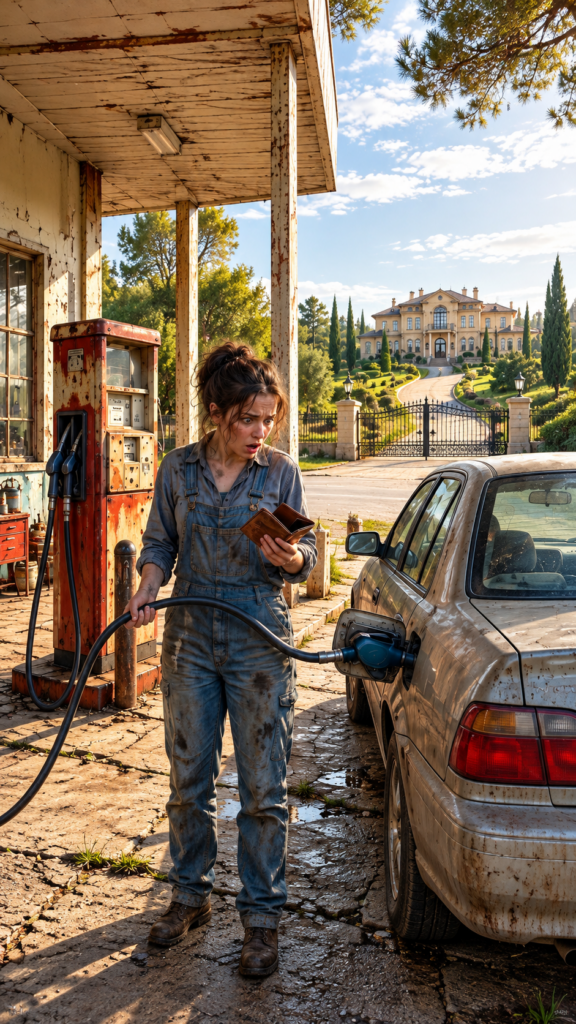
Part 1
The old leather wallet had been sitting beside the gas station register for almost ten minutes before Ren Mabry noticed it.
Outside, the highway was empty. The temperature had dropped well below freezing, and the wind swept across the dark fields hard enough to make the glass doors tremble in their frames.
The old man’s pickup was already gone.
Ren picked up the wallet, intending to find an address so she could return it. But when she opened it, she discovered a thick fold of hundred-dollar bills.
Nearly a thousand dollars.
At nineteen, Ren had exactly eleven dollars to her name, tucked inside an empty Altoids tin. Her clothes fit into a garbage bag, and the closest thing she had to a bedroom was the stockroom behind the gas station.
The money in her hands could change all of that.
There was no security camera watching the register. Nobody had seen the wallet fall. The old man didn’t even know her full name.
For several seconds, she stared at the bills, imagining a motel room with clean sheets, a warm shower, and a door she wouldn’t have to unlock for a delivery truck at five in the morning.
Then she put the money back.
It wasn’t hers.
She slipped a finger behind the driver’s license, looking for an address, and felt something stiff tucked into the leather.
A photograph.
When she pulled it into the fluorescent light, the sight of it made her stop breathing.
A little girl stood on the porch of a white farmhouse, one hand buried in the fur of a large shaggy dog. Beside her stood a man.
Ren knew that porch.
She knew the dog.
And she knew the little girl, because she had carried another copy of that photograph in her coat for seven years.
There was only one difference.
In the photograph she owned, the man’s face had been rubbed away.
In the old man’s wallet, his face was perfectly clear.
And Ren had been pouring coffee for him almost every night for two months.
Three months earlier, Ren’s life had been measured in eight-hour shifts, instant noodles, and the distance between the gas station counter and the stockroom floor.
She worked from ten at night until six in the morning at a little station on the edge of town, where the last streetlights gave way to miles of farmland.
There were two gasoline pumps, a humming cooler full of energy drinks, and a coffee machine that made an irritated hissing sound whenever somebody asked too much of it.
The ceiling lights never stopped buzzing.
Neither did the refrigerator compressors.
Ren had grown so accustomed to the noises that the silence outside sometimes frightened her more.
She had entered foster care at twelve, after her mother died. Over the following years she passed through several homes, learning the particular rules of each kitchen and the different ways adults could make a child feel temporary.
One family kept her belongings in plastic storage bins because they didn’t want her using their furniture. Another expected her to ask before taking food from the refrigerator.
There had been good people, too. She remembered those most clearly.
At fourteen, she had lived with a foster father who repaired small engines. He taught her to recognize loose battery connections, worn belts, bad spark plugs, and the difference between a machine that was broken and one that simply needed somebody patient enough to understand it.
He had been kind without making a performance of being kind.
Then he suffered a heart attack, and Ren was moved again.
She never got to say goodbye.
By eighteen, she had stopped making promises to herself about which homes might last.
When she aged out of foster care that spring, she left with a garbage bag full of clothes and nowhere dependable to go. Eventually she found the overnight job at the station.
The manager was a practical man who preferred not to ask questions that would create paperwork.
He knew she sometimes slept in the stockroom.
As long as her work was done and nothing disappeared from the shelves, he looked the other way.
Ren bought a cheap camping pad and tucked it behind stacked boxes of motor oil. Before each shift, she washed her hair in the utility sink and changed into the cleanest shirt she had.
She counted her money carefully.
She checked the weather every afternoon.
And she kept one possession protected more carefully than the rest.
It was an old photograph sealed inside a sandwich bag, folded into the inner pocket of her coat.
The little girl in the photograph was her mother, Cleo, at about six years old. Ren had always believed that, although her mother rarely spoke about her childhood.
The farmhouse porch and the shaggy dog were the only clues to a life Cleo had never explained.
Where the man’s face should have been, the photograph was almost white from wear. Someone had rubbed that part so often the paper had grown thin.
On the back, written faintly in pencil, was one word.
Home.
Ren used to study that word when she couldn’t sleep.
Her mother had never told her where the farmhouse stood or who the man was. Whenever Ren asked about relatives, Cleo said there wasn’t anybody left worth looking for.
She would go quiet afterward, and Ren had learned not to push.
After Cleo died, the photograph became both a comfort and a question.
It was proof her mother had once been a little girl who belonged somewhere.
Ren sometimes wondered whether she herself had ever belonged anywhere at all.
But she never let that question decide how she treated other people.
One night, shortly before two, a minivan pulled up to the station and stalled beside the pumps.
The driver tried turning the ignition several times. Each attempt produced a weaker clicking sound.
Finally, a woman climbed out with a sleeping baby strapped against her chest.
“Please tell me you know something about cars,” she said when Ren came outside.
“A little.”
“I think the battery’s dead. I don’t have money for a tow truck. I barely have enough to get home.”
Ren asked her to open the hood.
The cold hit her immediately. She held a flashlight between her teeth while she examined the battery and found heavy green corrosion around one terminal.
“There’s your problem,” she said.
“Can you fix it?”
“I can get you started. You’ll need someone to look at it properly tomorrow.”
Ren fetched the battery pack kept beneath the register, cleaned the terminal, tightened the connection, and attached the cables.
On the second try, the engine turned over.
The woman stared at the running vehicle, then covered her mouth.
“How much do I owe you?”
“Nothing.”
“No, really. I can come back Friday.”
Ren shook her head.
“You’ve got a baby to get home. Keep your money.”
The woman began to cry.
Ren pretended not to notice. She checked the connection one more time, closed the hood, and told her to drive carefully.
By the time Ren got back inside, her fingers had gone numb.
She warmed them against a paper cup of coffee she didn’t particularly want, watching the minivan’s taillights disappear.
She had been cold and frightened and stranded enough times to know what that woman’s night might have become.
Helping her had seemed like the only sensible thing to do.
The person who understood that about Ren was Dileia, the older woman who ran the all-night diner next door.
Dileia was in her sixties, with reading glasses hanging from a beaded chain and a laugh that could travel through the wall separating the diner from the gas station.
Her restaurant had six counter stools, a well-used griddle, and coffee so much better than the station’s that Ren considered it an entirely different beverage.
Sometimes Ren slipped next door during a break.
Dileia always found something for her to eat.
“These eggs are going to waste,” she’d say, pushing a plate across the counter.
Ren knew perfectly well that Dileia had cooked them fresh.
One night, with a plate of potatoes cooling in front of her, Ren admitted that she had eleven dollars left until payday.
Dileia stopped wiping the counter.
“You’re still sleeping in that stockroom?”
“Only until I save enough.”
“You said that in October.”
“I’m getting there.”
“Where’s there?”
Ren looked down at her food.
“A place where I don’t have to worry every time the weather changes.”
Dileia sat opposite her.
“Listen, sweetheart. Being broke and being cheap aren’t the same thing.”
Ren glanced up.
“What’s that supposed to mean?”
“Being broke means you don’t have money. That can change. Being cheap means you stop caring what you do to other people because life hasn’t been fair to you.”
Dileia tapped the counter.
“Don’t let anybody turn you into that kind of poor. That one’s harder to come back from.”
Ren remembered those words.
She also remembered Dileia pushing the potatoes closer and ordering her to finish eating before they got cold.
The old man began coming into the gas station sometime in November.
His pickup was a faded brown that reminded Ren of dry autumn leaves. He parked at an angle, even when the lot was empty.
He walked slowly, favoring one leg, and always wore the same battered cap.
He bought one black coffee.
Nothing else.
He counted out exact change from an old leather wallet, nodded his thanks, and left without conversation.
At first, Ren barely noticed him.
The station attracted all kinds of people at night. Truck drivers needing directions. Travelers arguing over fuel prices. Men who wanted an audience for stories nobody at home would listen to.
The old man was different.
He seemed grateful that Ren didn’t ask questions.
Sometimes he stood near the window for several minutes, holding his coffee and looking toward the empty highway.
Ren eventually began pouring his cup when she saw his truck pull in.
The first time she did it, he looked genuinely startled.
“How’d you know?”
“You order the same thing every night.”
He studied her face for an extra moment.
“Thank you,” he said.
After that, he began speaking a little.
They talked about the weather, mostly.
Once he asked how long she’d been working nights.
Another time he wanted to know whether she had grown up nearby.
“Not exactly,” Ren said. “I’ve lived a lot of places.”
He nodded as if the answer meant more than she intended.
“Got family around here?”
“Just me.”
He looked down at his coffee.
“That’s a hard way to go through the world.”
Ren shrugged.
“I’m managing.”
The old man seemed to want to say something else.
Instead, he put on his cap.
“Take care of yourself, young lady.”
She watched him drive away and wondered why he seemed so sad.
She didn’t know that the old man sometimes sat in his truck outside the station for nearly an hour, arguing with himself about whether to go inside.
She didn’t know that the first time he saw her properly, he had nearly driven off the road afterward.
All she knew was that he seemed lonely.
So she made sure his coffee was ready.
Then came the coldest night of the winter.
He arrived later than usual, hunched against the wind, moving even more carefully than before.
“You shouldn’t be driving around in weather like this,” Ren told him.
He gave a small smile.
“Can’t sleep.”
“Coffee probably isn’t helping.”
“Maybe not. But it gives me someplace to go.”
She didn’t have an answer for that.
He counted his coins with unsteady fingers, dropped a quarter into her tip jar, and glanced up at her with an expression she couldn’t understand.
Then he went out to his truck.
Ten minutes later, Ren found his wallet.
And everything she believed about her family began to unravel.
After laying the two photographs side by side, Ren examined them until her eyes hurt.
The farmhouse was identical.
So was the big dog.
A split ran diagonally across one porch board, and the split appeared in precisely the same place in both pictures.
There could be no mistake.
The photograph from the wallet showed the man’s face clearly.
Ren recognized the eyes, the long nose, and the shape of his mouth.
He looked much younger in the picture, but it was unquestionably the customer who bought black coffee from her every night.
She turned his photograph over.
There was faded writing on the back, identifying the little girl and her father.
Ren sat down on a stool behind the counter.
Her mother had grown up in that house.
And the old man who had been standing across from her register for two months might be her grandfather.
She checked his driver’s license.
Hollis Brandt.
His address was on Curran Creek Road, beyond the edge of town.
Ren read the address again and again.
She wanted to call someone, but there was nobody she could call who could tell her whether what she suspected was true.
So she placed both photographs back into their protective coverings, returned Hollis’s belongings to his wallet, and tucked everything into her bag.
Whatever this meant, the wallet still belonged to him.
And she was going to return it.
The following morning, Ren borrowed Dileia’s old hatchback.
Dileia handed over the keys with a suspicious look.
“Where are you headed?”
“Somebody left a wallet at the station. I’m taking it back.”
“Why not wait for him to come in?”
“There’s a lot of money inside.”
Dileia studied her.
“Well, of course you’re returning it.”
She pointed at the car.
“Just bring it home with some gas.”
Ren drove out of town beneath a low gray sky.
The road passed empty pastures and fields stiff with frost. Then the ground began to rise into rolling hills lined with bare apple trees.
She followed Curran Creek Road until she found a leaning mailbox beside an abandoned-looking farm stand.
Its shutters were nailed shut.
A faded sign still advertised cider, pies, and pumpkins.
The driveway was long and rutted, bordered by trees that had clearly been planted in careful rows decades earlier.
At the far end stood a white farmhouse.
The paint was peeling. One side of the barn roof sagged. Above the barn doors hung an old wooden sign.
Brand Orchard — Cider and Apples.
Ren switched off the engine.
For a moment, she couldn’t make herself move.
She had spent years imagining the place in her photograph, never expecting to find it standing in front of her.
Then something large appeared around the corner of the house.
An old shaggy dog came walking across the yard.
He had gray fur around his muzzle and moved stiffly, but he approached the car with remarkable determination.
Ren opened her door cautiously.
The dog pushed his head straight into her lap.
“Oh,” she whispered, surprised. “Hello there.”
She rubbed his ears.
He pressed harder against her knees, then sighed as though a long job had finally been completed.
“Cobb!”
A woman appeared on the porch, wearing an apron beneath a heavy cardigan.
“Cobb, come here!”
The dog ignored her.
The woman stared.
“Well, I’ll be. He doesn’t act like that with strangers.”
Ren slowly stood.
“I’m looking for Hollis Brandt. He left his wallet at the gas station.”
Before the woman could answer, a man came through the screen door.
He was in his forties, broad-shouldered, wearing a flannel shirt with a ring of keys on his belt. He carried a ledger book under one arm.
His expression hardened when he saw Ren’s worn coat and borrowed car.
“You found a wallet?”
“Yes, sir.”
“Where?”
“At the gas station on the highway. I work nights there.”
He came down the steps.
Ren handed it over.
“Everything’s still inside.”
The man opened the wallet and began counting the bills.
Ren watched him do it.
She knew that look. She had seen it on the faces of foster parents who checked her bags before letting her leave.
When he finished counting, he seemed almost disappointed.
“It’s all here.”
“I told you.”
“People don’t normally drive half an hour to return that kind of money.”
“Maybe they should.”
His gaze sharpened.
Before he could respond, a familiar voice came from inside.
“Gideon? Who’s there?”
The man turned.
“Nobody you need to worry about.”
But the screen door opened.
Hollis Brandt stood in the doorway, wearing a robe over his clothes and leaning on a cane.
He looked considerably older in daylight.
When he recognized Ren, his face changed.
“The girl from the coffee station.”
Ren nodded.
“You forgot something.”
Hollis looked at the wallet in Gideon’s hand, then at Ren.
“You came all the way out here?”
“Well, you couldn’t exactly buy your coffee without it.”
He gave a startled laugh.
“There’s close to a thousand dollars in there.”
“I know.”
“And you brought it back?”
“Yes, sir.”
He told Gideon to give her a reward.
Ren refused.
He offered half the money.
She refused again.
“Why?” Hollis asked.
Ren thought of Dileia standing behind her diner counter.
“Because I wanted to do something decent,” she said. “If I take the money, then it starts feeling like I did it for a reward.”
Hollis looked at her for a long time.
His eyes grew wet.
“Then at least come inside and have coffee with me.”
Ren hesitated.
The dog leaned against her leg.
And she followed Hollis into the house where her mother had once lived.
The kitchen smelled of wood smoke, apples, and old furniture.
Pencil marks ran up a doorway, recording a child’s height over many years. There were worn cupboards, a large wooden table, and a stove that had obviously warmed generations of winter evenings.
Hollis settled into a chair at the head of the table.
Gideon remained near the doorway.
The woman from the porch poured coffee and quietly returned to the sink.
On the counter, Ren noticed overdue bills. A calendar beside them had several dates circled in red.
Gideon caught her looking.
“The orchard isn’t doing well,” he said sharply. “In case that’s what you’re wondering.”
“Gideon,” the woman warned.
“What? It’s the truth.”
He explained that a developer wanted to buy all 120 acres. The orchard had been struggling for years, and the bank was losing patience.
Hollis refused to sell.
“My father planted the first forty acres,” Hollis said. “I planted the rest. You can’t put a proper price on that.”
“You can when the bank does,” Gideon muttered.
Ren said nothing.
She knew what it felt like to have someone calculate the value of the only home you had.
Eventually Hollis turned toward her.
“What about you, Ren? You got people nearby?”
“No.”
“Parents?”
“My mother died when I was twelve.”
Hollis’s expression softened.
“I’m sorry.”
“Thank you.”
“And your father?”
“Never knew him.”
He looked at her thoughtfully.
“What was your mother’s name?”
Ren gripped her coffee cup.
The answer was suddenly terrifying.
If she said Cleo, Hollis might recognize the name immediately. Gideon might accuse her of inventing the whole story.
And she had nothing but an old photograph to prove the truth.
“She’s gone,” Ren said quietly. “I don’t talk about her much.”
Hollis nodded and didn’t press her.
After a while, Ren gathered enough courage to ask the question that had brought her there.
“The picture in your wallet.”
Hollis looked up.
“The little girl on the porch,” she continued. “Who is she?”
His face lost its color.
For several seconds, he stared at the coffee between his hands.
“That,” he said, “is my daughter.”
Ren felt her pulse beating in her throat.
“Her name?”
“Cleo.”
The kitchen seemed suddenly too warm.
Hollis looked toward the window.
“She left this house when she was eighteen. We had a terrible argument. I said things a father has no business saying.”
He swallowed.
“She never came home.”
Ren lowered her eyes.
“I’ve been looking for her for twenty years,” he continued. “Letters, people who claimed they could find her, addresses that turned out to be wrong. Nothing.”
He touched the pocket where his wallet usually rested.
“That photograph’s all I’ve had of her.”
Ren wanted to reach across the table.
She wanted to say that Cleo had grown into a beautiful woman who could fix an engine and make pancakes from almost nothing. That she sang badly in the car and loved her daughter fiercely.
She wanted to tell him that Cleo had died seven years earlier.
And that he had a granddaughter sitting directly across from him.
But Gideon was watching her.
Hollis looked so frail, so dangerously hopeful, that Ren couldn’t bear the idea of offering him a miracle she couldn’t yet prove.
So she finished her coffee, thanked him, and went outside.
Cobb followed her to the car.
She knelt and hugged the old dog.
Then she drove back toward town, her hands trembling around the steering wheel.
She had gone to return a stranger’s money.
Instead, she had found her mother’s childhood home.
She had found her grandfather.
And she had discovered that the family she believed had abandoned her might have spent twenty years desperately searching for her mother.
But she had left that kitchen without telling Hollis who she was.
She told herself it would only be until she found proof.
She didn’t yet understand how little time they had left.
Part 2
Hollis called the gas station two nights later.
Ren was refilling the coffee machine when the telephone rang.
“Is this Ren?”
She recognized his voice immediately.
“Mr. Brandt?”
“Hope you don’t mind me calling. Got your number from the manager.”
“No, sir. Is everything all right?”
“Well, that’s something I’m trying to figure out.”
He cleared his throat.
“The orchard’s getting to be too much for me. Press hasn’t worked in three seasons. The barn’s falling apart. I can’t climb ladders anymore, and Gideon’s got more work than one man ought to carry.”
Ren leaned against the counter.
“I remember.”
“There’s a room over the kitchen. Hasn’t been used much in years. I could pay you for helping around the place. Not a fortune, but better than what a gas station pays.”
Ren closed her eyes.
A real room.
A bed.
A chance to live in the house where her mother had grown up.
“Why me?” she whispered.
Hollis took a moment to answer.
“Because you brought my wallet back.”
“That doesn’t mean I know anything about orchards.”
“You know how to work. I can teach you the rest.”
He paused.
“And I figure a girl sleeping in a stockroom could use a proper bed.”
Ren felt embarrassed that he knew.
But there was no judgment in his voice.
Only an offer.
“All right,” she said.
Hollis sounded surprised.
“All right?”
“I’ll come.”
The first night Ren slept in the farmhouse, she lay awake staring at the slanted ceiling.
The room above the kitchen was small, with an old wooden dresser, a narrow window, and a quilt that smelled faintly of lavender.
She had a key.
She turned it in the lock twice just to hear the mechanism work.
Cobb settled on the rug beside her bed without waiting for permission.
Ren laughed softly.
“You live here, too?”
He sighed and closed his eyes.
For the first time in months, she slept without worrying that somebody would unlock the stockroom door before morning.
The work began before sunrise.
Hollis taught her to identify the different apple varieties, which branches needed thinning, and how to recognize wood that had already stopped producing fruit.
He could no longer manage the ladders, so he stood below, bundled in a heavy coat, calling instructions while Ren worked above him.
“Not that one,” he would say. “The smaller branch beside it.”
“This one?”
“That’s it. Give the tree some room to breathe.”
Some mornings, he told her about the first trees his father had planted. Other mornings, he talked about droughts, late frosts, and the years his cider had won ribbons at the county fair.
Ren listened closely.
She had always enjoyed work that demanded attention.
When she turned to the cider press, she discovered that its failure wasn’t as hopeless as Gideon believed.
The shaft had seized, and one bearing had cracked. Years of neglect had allowed rust and old residue to build up inside the mechanism.
She dismantled the press slowly, arranging each component across the concrete floor in the order she removed it.
Hollis sat nearby on a stool, a blanket over his knees.
“You sure you know what you’re doing?”
“Not entirely,” Ren admitted.
He raised his eyebrows.
“That’s reassuring.”
“But I know how to find out.”
Over the following days, she cleaned the components, dealt with the damaged bearing, freed the shaft, and carefully reassembled the machinery.
The first time the wheel spun without binding, Hollis laughed.
It was a rough, astonished sound.
“Well, I’ll be damned.”
Ren wiped her hands on a rag.
“Still needs testing under a proper load.”
Hollis grinned.
“You sound like somebody who taught me a lesson fifty years ago.”
She smiled.
“A foster father taught me engines when I was fourteen.”
“Good man?”
“The best.”
“What happened to him?”
“He had a heart attack. They moved me somewhere else.”
Hollis’s smile faded.
“You never got to say goodbye?”
Ren shook her head.
He looked at the press for a moment.
“Seems you’ve had more than your share of unfinished goodbyes.”
Ren didn’t answer.
She was thinking of her mother.
Life at the orchard developed a rhythm Ren had never experienced before.
She worked during the day and ate supper at the long kitchen table. Hollis told stories while Cobb slept beneath their feet.
The housekeeper, who had spent years caring for the house and its owner, cooked meals and sometimes left enough on the stove for Ren to eat again later.
At first, Ren ate quickly, almost defensively.
One evening, Hollis watched her reach for her plate as though expecting somebody to take it away.
“Slow down, child.”
She looked embarrassed.
“Sorry.”
“Don’t apologize. There’s more on the stove.”
“I’m fine.”
“Ren.”
She looked up.
“There’s always going to be more on the stove.”
He said it simply, but Ren had to put down her fork.
She could repair an engine, climb a ladder, and work until her hands bled.
Accepting the promise of another meal was considerably harder.
Hollis seemed to understand.
He didn’t mention it again.
Gideon, however, made it clear that he didn’t welcome her.
He checked the press after she repaired it, then checked it again. He examined her pruning and questioned her supply purchases.
When Hollis praised her, Gideon often found a reason to leave the room.
Ren tried not to take it personally.
She had seen the ledgers and overdue bills. Gideon had spent decades keeping the orchard functioning, and now a stranger had arrived who appeared to make his stepfather happier than he’d been in years.
Still, she sometimes caught Gideon watching her with an expression that made her want to pack her bag before somebody told her to.
On her day off, Ren drove back to town.
Dileia took one look at her and set down the coffee pot.
“Well. Somebody’s been feeding you.”
Ren laughed.
“It’s a working farm. They feed you because they expect you to work.”
“You look like you’ve been sleeping, too.”
“I have.”
Dileia leaned closer.
“What’s the part you’re not telling me?”
Ren thought of Hollis sitting across the kitchen table. Of the photograph and her mother’s name.
“It’s complicated.”
“That much I figured.”
“I’ll tell you when I can.”
Dileia watched her for another moment.
“Just make sure these people are good to you.”
“They are.”
“All of them?”
Ren hesitated.
“Most of them.”
Dileia nodded.
“Well, most is a start.”
One afternoon, Cobb led Ren to a door at the end of the upstairs hallway.
She was carrying laundry when the old dog stopped in front of it and refused to move.
“What is it?”
He looked at the door.
Ren tried the knob.
The door opened into a bedroom that looked as though somebody had closed it twenty years earlier and never quite found the courage to open it again.
There was a narrow bed with a patchwork quilt, a shelf of horse books, and ribbons pinned across one wall.
Ren stepped closer.
Every ribbon carried the same name.
Cleo Brandt.
She set the laundry basket down.
On the dresser stood an old school photograph of a fifteen-year-old girl.
The dark eyes, the stubborn expression, the familiar shape of her mouth.
Ren recognized her mother instantly.
She touched the edge of the picture frame.
Then she noticed the pencil lines running up the bedroom doorframe.
A child’s height measurements.
They stopped at eighteen.
Ren stood in that room, surrounded by the small things her mother had once loved, and tried to reconcile them with the woman she remembered.
The mother who worked double shifts.
Who fixed broken appliances instead of replacing them.
Who sang badly while driving and made pancakes for dinner when groceries were running low.
Here was proof that Cleo had once been a girl with horse books, ribbons, and a family home.
Ren lowered herself to the floor.
Cobb rested his head against her shoulder.
She buried her face in his fur and cried.
Not because she was unhappy to find the room.
Because her mother had carried so much sadness without ever telling Ren where it came from.
That evening, Ren sat beside Hollis near the wood stove.
“Tell me about Cleo,” she said.
He stared into the fire.
“She was stubborn.”
Ren smiled faintly.
“I’ve heard that can run in families.”
“Bright, too. Couldn’t tell her anything she didn’t want to hear.”
He rubbed his hands together.
“Her mother died when she was little. I had an orchard to keep alive and a daughter who needed more than I knew how to give.”
He spoke slowly, sometimes stopping when a memory became difficult.
He explained how he had tried to protect Cleo by controlling her. He set rules. He worried about her friends and the places she went.
The older she grew, the harder she pushed back.
When she turned eighteen, she told him she intended to leave with a boy he didn’t trust.
They argued on the porch.
Hollis told her that if she walked away, she shouldn’t bother coming back.
“I thought she’d get scared and stay,” he admitted.
Instead, Cleo packed her things.
And left.
“I was too proud to follow,” Hollis said. “By the time I understood what I’d done, she was gone.”
Ren’s eyes burned.
“You tried to find her.”
“For twenty years.”
He looked at her.
“Letters. Calls. People who said they knew where she’d gone. Every lead ended somewhere I couldn’t reach.”
He leaned back in his chair.
“Sometimes I thought she was punishing me. Now I think maybe she was ashamed to come home. Same as I was ashamed to ask her.”
Ren reached into her coat pocket.
Her fingers found the photograph.
This was the moment.
She could tell him.
But before she could speak, Hollis looked at her with an expression she had never seen before.
“There’s something I ought to confess.”
Ren waited.
“The first night you had my coffee ready before I asked, I looked at you properly.”
He swallowed.
“You’ve got my daughter’s face.”
Ren couldn’t move.
“The eyes. The jaw. Even the way you look at a person when you’re deciding whether they’re telling the truth.”
He looked toward the window.
“I kept coming back because, for a little while every night, I could stand across from somebody who reminded me of my girl.”
His hands trembled.
“That night I left my wallet, I didn’t entirely forget it.”
Ren slowly lowered her hand.
“I sat outside in the truck before coming in. I wanted to show you her photograph. Ask whether you knew anything about her.”
“Why didn’t you?”
“I was afraid.”
He smiled sadly.
“So I left the wallet on the counter. Told myself you’d find the picture and maybe ask me about it. Cowardly way of doing things.”
Ren stared at him.
For two months, she had believed she was comforting a lonely stranger.
In truth, he had recognized something of his daughter in her from the beginning.
She almost told him then.
But Gideon’s suspicions weighed on her, and Hollis was a sick old man with an orchard that people were fighting over.
If she told him she was his granddaughter without proof, someone might convince him she was lying.
And Ren could not bear the thought of losing him after finally finding him.
“I think,” she said carefully, “that if a girl knew something like that, she’d want to be absolutely sure before telling you.”
Hollis nodded.
“That’d be a kind girl.”
Ren went upstairs that night determined to find records that could establish her mother’s identity.
She had already lost too many people without saying what needed to be said.
She wasn’t going to let it happen again.
But three days later, Gideon confronted her in the barn.
He found her greasing the cider press.
A folder was clutched in one hand.
“I made some calls,” he said.
Ren straightened.
“About what?”
“You.”
She wiped grease from her fingers.
Gideon opened the folder.
“You aged out of foster care last year. No relatives listed. No father. No family contacts.”
Ren felt exposed.
“So?”
“Your mother’s first name was Cleo.”
She didn’t answer.
“Same as Hollis’s missing daughter.”
Gideon’s voice shook with anger.
“That’s a remarkable coincidence, don’t you think?”
Ren carefully set down the grease gun.
“Gideon—”
“He’s dying.”
The words struck harder than his accusation.
“What?”
“His heart. The doctors give him months. And you’ve come walking into his life with a sad story and a face he wants to believe.”
Ren stared at him.
Gideon stepped closer.
“I’ve spent thirty years working this place. Fixing the trucks. Managing the books. Taking him to doctors. And suddenly you’re here, and he looks at you like you’ve hung the moon.”
For the first time, Ren heard the fear beneath his anger.
“You’re worried about the orchard.”
“I’m worried about everything.”
He pointed toward the house.
“There’s a developer waiting for an answer by Friday. We’ve got a balloon payment on the back forty coming due. If Hollis doesn’t sign, the bank could take the land anyway.”
Ren glanced at the machinery she had just repaired.
“We could make the press work again.”
“That’s not enough!”
He caught himself, breathing hard.
Then he spoke more quietly.
“Walk away, Ren. I’ll give you money. Enough to get started somewhere else. Just leave him alone.”
Ren felt the old familiar urge to gather her things and disappear before somebody made her feel unwanted again.
Then she thought of Hollis promising there would always be more food on the stove.
“I’m not trying to take anything from him.”
“Then prove it.”
Before Ren could respond, the housekeeper appeared in the barn doorway.
Her face was white.
“Gideon! Ren! Come quickly!”
She struggled for breath.
“Hollis is down.”
Ren was already running.
Hollis lay on the kitchen floor near the wood stove.
His skin had turned an awful shade of gray. One hand pressed against his chest.
Ren dropped to her knees.
“Hollis?”
His eyes moved toward her.
She reached for his hand.
“Stay with me.”
The housekeeper called for an ambulance while Ren followed the emergency dispatcher’s instructions.
Gideon stood nearby, trembling.
Eleven minutes passed before the ambulance arrived.
Ren counted every one.
She kept talking to Hollis, telling him that the cider press worked, that the pruning wasn’t finished, and that he still had too much to teach her.
And somewhere in those frantic minutes, as she held his hand and felt it grow cold, the truth escaped her.
“I’m Cleo’s daughter,” she whispered. “Please don’t leave me before I get to tell you everything.”
She didn’t know whether he heard.
At the hospital, the doctors took Hollis through swinging doors.
Ren sat in the waiting room wearing grease-stained coveralls.
Gideon arrived a little later with the housekeeper.
For a long time, neither of them spoke.
Finally, Gideon sat three chairs away.
“They said you kept him breathing until the ambulance arrived.”
Ren looked down.
“Someone taught me what to do.”
Gideon rubbed his face.
“I’ve spent so much time worrying about losing the orchard,” he said, “I forgot the man himself could be taken away.”
Ren looked at him.
“You’re afraid.”
“Terrified.”
“He knows you love him.”
Gideon shook his head.
“I’ve never been sure of that.”
Near midnight, a doctor came into the waiting room.
Hollis had suffered a serious clot. His heart was failing, and treatment could manage his condition but could not cure it.
For now, he was stable.
He was awake.
And he was asking for Ren.
Hollis looked terribly small in the hospital bed.
There were tubes, a heart monitor, and a plastic clip attached to one finger.
Ren pulled a chair beside him.
He reached for her hand.
“You said something,” he whispered.
Ren felt her stomach tighten.
“Before they took me away. I thought I heard something.”
She looked at the man she had been afraid to hurt.
Then she took the photograph from her coat.
“My mother gave me this.”
Hollis stared at it.
The little girl.
The dog.
The farmhouse porch.
And the man’s face, rubbed almost completely away.
His fingers began to shake.
Ren turned the photograph over.
On the back was the word Home.
“That’s Cleo’s handwriting,” he whispered.
Ren nodded.
“She kept it all those years.”
Hollis touched the faded letters.
“She rubbed my face away.”
“But she couldn’t throw the picture out.”
Ren moved closer.
“Her name was Cleo Brandt. She named me Ren Mabry.”
Hollis stared at her.
“She never told me about this place,” Ren continued. “She said our family was gone.”
Tears spilled down her cheeks.
“She got sick when I was eleven. She died when I was twelve. I was there with her.”
Hollis closed his eyes.
He had spent twenty years wondering whether his daughter was alive.
Now he knew she wasn’t.
And in the same moment, he learned that she had left someone behind.
Ren pressed his hand against her cheek.
“I’m your granddaughter,” she said. “I’m Cleo’s daughter.”
Hollis lifted his other hand and touched her face.
He traced her cheekbone with trembling fingers, studying her eyes as though trying to recognize the little girl from his photograph inside the young woman before him.
“You’re real?”
“I’m real.”
“My Cleo had a daughter?”
“She did.”
He began to cry.
Ren leaned forward and held him carefully.
For a long while, neither tried to speak.
Then Hollis asked the question Ren had hoped he would ask.
“Tell me about her.”
So she did.
She told him how Cleo could repair almost anything with a motor, how she sang off-key in the car, and how she worked long hours but still found time to read to Ren every night.
She told him about pancakes made from barely enough ingredients and the way her mother laughed when something finally went right.
She told him how Cleo had been stubborn and proud and sometimes exhausted, but always gentle with her daughter.
Hollis listened as though every small memory was precious.
When Ren finished, he squeezed her hand.
“She raised you right.”
Over the following days, the hospital room became a place where the broken pieces of their family were slowly gathered together.
The housekeeper admitted she had recognized Cleo’s mannerisms in Ren almost immediately, especially the way she stirred coffee with her left hand.
Hollis’s lawyer came with a folder and examined the photographs, the family history, and the available records.
He recommended a cheek-swab DNA test to settle any legal questions.
Ren agreed without hesitation.
She wanted nobody to doubt her identity, least of all Gideon.
But the most painful evidence appeared in an old shoebox.
Cobb had nosed open a low cupboard at the farmhouse, drawing Ren’s attention to a box tucked inside.
It contained dozens of letters.
Every envelope bore Cleo’s name.
Most had been returned with stamps declaring that the recipient no longer lived at the address.
Hollis had kept every one.
When Ren brought the box to the hospital, he laid his hand on its lid.
“You found them.”
She nodded.
“You never stopped writing.”
“No.”
“My mother thought nobody wanted her.”
Hollis looked away.
“She was wrong.”
Gideon stood near the window as they spoke.
Afterward, he found Ren in the hospital corridor.
“I believe you,” he said.
Ren turned.
“The letters. The photographs. The way he looks at you.”
He rubbed his eyes.
“I wanted you to be a fraud.”
Ren said nothing.
“Because if you’re really his granddaughter, then you’re blood.”
His voice cracked.
“And I’m just his stepson.”
For the first time, Gideon told her about his childhood.
His own father had left when he was six. Hollis married his mother when Gideon was twelve.
Ever since, Gideon had tried to make himself indispensable.
He learned the business. He handled the machines, the bank, the bills, and every problem that Hollis could no longer manage.
But he had always feared that being useful wasn’t the same as being wanted.
Ren listened.
She recognized the feeling immediately.
“I spent most of my life waiting for someone to decide I wasn’t worth keeping,” she said.
Gideon looked at her.
“I know what that does to a person. I’m not going to do it to you.”
He gave a bitter little laugh.
“You might not have a choice. The bank certainly doesn’t care about our feelings.”
He explained the financial deadline.
The developer’s offer would clear the debt and leave money afterward. Without it, the balloon payment on the back forty could force the orchard into foreclosure.
Ren thought of the cider press.
The bare trees.
The old farm stand waiting by the driveway.
“What if we didn’t sell?”
Gideon stared.
“What?”
“What if we gave the orchard one more season? The press works now. We could sell cider again.”
“That won’t cover everything.”
“Not immediately.”
He shook his head.
“You don’t understand the numbers.”
“Then teach me.”
Ren took a breath.
“You know the business. I know how to fix things and work with almost nothing. Between us, maybe we can give this place another chance.”
Gideon watched her carefully.
“What about your inheritance?”
“I came here to give Hollis his wallet back. I didn’t know he was my grandfather.”
She held his gaze.
“I don’t need to take the orchard away from you to know I belong to this family.”
Then she held out her hand.
“Partners. Real partners, on paper. We fight for the trees together, and neither one of us gets pushed out.”
Gideon stared at her extended hand.
A few weeks earlier, he had counted the money in Hollis’s wallet because he assumed Ren had stolen some.
Now the girl he had tried to drive away was offering him a permanent place in the family he had spent his life trying to earn.
He reached out.
Their hands met.
And for the first time, saving the orchard no longer meant deciding which one of them deserved to keep it.
Part 3
The loan officer had been expecting Gideon to arrive with a signed agreement from the developer.
Instead, he appeared on a Tuesday morning wearing his only good suit, accompanied by a nineteen-year-old girl in clean work clothes.
Ren carried a folder.
Gideon carried the orchard’s financial records.
They sat across from the loan officer and explained why they wanted more time.
The numbers were not encouraging.
The orchard had struggled for several seasons. Equipment repairs, bad harvests, and the cost of maintaining 120 acres had pushed the business dangerously close to failure.
But Gideon had prepared a realistic accounting of the debt and operating costs.
And Ren had brought a plan.
The cider press was running again. They could reopen the farm stand, sell directly to customers, and use a community festival to attract visitors.
They weren’t asking the bank to forgive what they owed.
They were asking it to extend the payment deadline long enough to demonstrate that the orchard could earn its way back.
The loan officer examined the figures.
“You know this is a substantial risk.”
Gideon nodded.
“I’ve been looking after these accounts for thirty years. I know exactly what we owe.”
“And you?” she asked Ren.
Ren folded her hands.
“I know the machines can run. I know there’s fruit to sell. I know people around here remember this place.”
The woman studied her.
“And you think that’s enough?”
“No, ma’am. That’s why we’ve made a plan for the work it’ll take.”
The loan officer had grown up drinking Brand Orchard cider at the county fair.
She remembered the family business from the years when its products were sold all over the county.
After reviewing their proposal, she agreed to carry the note for another season.
It wasn’t forgiveness.
It wasn’t a gift.
They would still have to produce enough income to satisfy the bank.
But when Gideon and Ren walked out, the orchard still belonged to the family.
For now.
Hollis came home from the hospital weaker than before.
The doctors had been clear about his condition. His heart was failing, and no amount of rest could make him young again.
Ren took care not to let him climb stairs alone.
She brought his meals downstairs and arranged a comfortable chair near the wood stove.
Sometimes he complained.
“I’ve been walking around this house longer than you’ve been alive.”
“And I’d like you to keep doing it.”
He would grumble, but he let her help.
The house felt different now.
Gideon no longer avoided Ren at the supper table. They still argued about purchases and repairs, but their arguments concerned how to run the business rather than whether she belonged there.
He began teaching her the books.
She taught him what she had learned about the press.
They disagreed often and worked hard enough that some evenings neither had much energy left for conversation.
But slowly, respect replaced suspicion.
The first successful pressing gave them enough cider to start selling jars again.
Ren painted signs.
Gideon repaired the farm stand shutters.
They cleared out the old barn and made room for customers.
Then Dileia got involved.
She took a case of cider to the diner and placed it beside her register.
When truckers stopped for breakfast, she told them that Brand Orchard was selling again.
When county workers ordered coffee, she told them how the old man’s granddaughter had returned and helped repair the cider press.
And when anyone mentioned buying cider elsewhere, Dileia pointed toward her hand-painted sign.
“Thirty minutes down the road,” she’d say. “Best cider you’ll find. Go support those people.”
Customers began driving to the orchard.
Some remembered Hollis from the county fair.
Others came because they had heard about Ren.
They bought jars of cider, asked questions about the old trees, and promised to return.
Ren insisted that Gideon’s name appear beside hers on the labels and business materials.
He protested at first.
“You’re the one getting everybody excited.”
“And you’re the one keeping us from spending more than we’re earning.”
He eventually stopped arguing.
For the first time, they were building something together.
One evening, after Hollis had gone to bed, Ren returned to Cleo’s childhood room.
She had begun cleaning it, dusting the shelves and carefully straightening the ribbons.
She still slept in her room above the kitchen.
Her mother’s bedroom felt like a place to visit rather than a place to claim.
In the back of the closet, she found an old diary with a broken clasp.
Most of the entries described ordinary teenage concerns.
School.
Chores.
A horse she loved.
A boy her father didn’t approve of.
Ren read a few pages each night.
Near the end, the handwriting changed.
The entries became angrier and more hurried.
Cleo wrote about wanting to leave and fearing she would fail. She believed her father expected her to return defeated, and she couldn’t bear the thought of proving him right.
In the final entry, she explained why she had kept the photograph from the farmhouse porch.
She had rubbed her father’s face away because looking at him made leaving too difficult.
But she could never bring herself to throw the picture away.
Part of her, she wrote, would always belong on that porch.
Ren sat with the diary open in her lap.
For years, she had believed her mother wanted nothing to do with her past.
Now she understood something different.
Cleo had been homesick.
She had been too proud and too hurt to go back, but the longing had never left her.
Ren thought about the word written on the back of the photograph.
Home.
It had not been a description.
It had been a wish.
A few weeks later, Ren drove to the county where her mother was buried.
The grave was small, with a simple flat marker.
Ren had visited once as a child, shortly after the funeral.
This time she brought a cutting from the oldest apple tree at Brand Orchard.
Hollis had told her that tree still produced some of the sweetest fruit on the property.
Ren knelt beside the grave and planted the cutting carefully in the soil.
“I found it, Mama,” she whispered.
She touched the stone.
“I found our way home.”
Spring came gradually.
The dark, bare branches began to soften with new growth. Green spread across the hillsides, and then the first blossoms opened.
Within a week, the orchard transformed.
White and pale pink flowers covered the trees. Bees moved between the rows, and the air carried the sweet scent of spring.
Ren walked out one morning before breakfast and stood beneath the blossoms.
She had never seen the orchard look like that.
For the first time, she could imagine why Hollis had refused to sell.
It wasn’t simply land.
It was his father’s labor, Cleo’s childhood, Gideon’s decades of work, and the future Ren was only beginning to believe she might have.
Their community festival took place among the flowering trees.
Dileia closed the diner for the day and arrived with pies, folding tables, and enough energy to organize half the county.
Families drove up the repaired driveway.
Children ran between the trees.
A fiddle player performed on the porch, and customers gathered around the working cider press while Gideon explained how it operated.
Ren carried boxes, sold cider, answered questions, and ran back and forth until her legs ached.
Hollis sat wrapped in a blanket beneath the blossoms.
Cobb slept in the grass beside his chair.
The old man watched the people moving through the orchard with an expression Ren would remember for the rest of her life.
Near the middle of the afternoon, Dileia caught Ren by the arm.
“All right,” she said. “Now you’re going to tell me.”
“Tell you what?”
“Whatever you’ve been keeping to yourself since you borrowed my car.”
Ren smiled.
So she told her.
She told Dileia about the wallet, the photograph, Cleo’s childhood bedroom, and Hollis.
She told her about Gideon’s fear, the hospital, and the letters that had never reached her mother.
Dileia listened without interrupting.
When Ren finished, the older woman wiped her eyes with the back of her hand.
“Well,” she said unsteadily. “Would you look at that.”
Ren laughed through her tears.
“You told me not to let anybody make me cheap.”
“And you didn’t.”
Dileia pulled her into a fierce hug.
“Look what you’ve found, honey.”
Later, Ren knelt beside Hollis’s chair.
“Are you warm enough?”
“I’m fine.”
“Need anything?”
He smiled.
“Sit with me a minute.”
She lowered herself onto the grass.
Hollis took her hand.
“I’ve been thinking about what I want to leave you.”
Ren glanced up.
“We’ve already talked about the orchard. Gideon’s my partner. I’m not changing that.”
“I know. And I’m proud of you for it.”
He looked across the flowering trees.
“That’s not what I mean.”
Ren waited.
“I spent most of my life thinking a family was something you inherited. Blood, a name, a piece of land.”
His hand tightened around hers.
“Then I lost my daughter because I was too proud to tell her she could always come home.”
Ren rested her head against his knee.
“Real family,” Hollis continued, “is the people who keep a place for you, even when you’ve been gone a long time.”
He looked down at her.
“You kept mine, Ren. You didn’t even know you were doing it.”
She began to cry.
Hollis stroked her hair.
“I had all these trees, and all those years I would’ve traded every one of them just to know what happened to my girl.”
He smiled sadly.
“And then one winter night, her daughter handed me a cup of coffee.”
Gideon stood a little distance away.
He quietly took a photograph on his phone.
It showed Ren kneeling beside Hollis beneath the blossoms, the old man’s hand resting on her hair.
Later, Gideon had it framed.
He hung it in the kitchen beside the old photographs of Cleo.
Hollis lived through the summer.
He grew weaker, but on his good days he sat on the porch and taught Ren everything he still could about the orchard.
He explained how to judge the weather before frost, which trees needed thinning, and when fruit was ready to pick.
Sometimes Gideon carried a second chair outside, and all three of them sat together while Cobb slept nearby.
They didn’t always talk.
They no longer needed to fill every silence.
In early fall, when the first apples were ripening, Hollis became too weak to leave his downstairs room.
Ren stayed close.
One evening, the window stood open, allowing the smell of the orchard to drift inside.
Hollis lay in bed with Ren holding one hand.
Cobb rested his chin near the other.
Hollis looked toward the open window.
“Leave the porch light on,” he whispered.
Ren squeezed his hand.
“I will.”
He died peacefully that autumn.
He was home.
And he wasn’t alone.
Ren kept her promise.
Every evening, as the light faded across the orchard, she switched on the porch light.
Saving Brand Orchard took more than one successful festival.
The first season allowed Gideon and Ren to pay down the bank note. The following season, after more long days and careful spending, they finally cleared it.
The orchard continued operating.
The trees stayed standing.
The old farm stand became busy again, and the cider press rarely sat idle during the working season.
Gideon handled the books and machinery.
Ren managed the cider business, completed her night classes, and earned a business certificate.
The property was placed in both their names.
Neither could simply push the other out of the home they had saved together.
Gideon began introducing Ren as his partner.
Sometimes, when customers admired the cider press, he told them how she had rebuilt it herself.
Ren never quite knew what to do with that kind of praise.
She had spent so long trying to prove she deserved a place in the world that hearing somebody speak proudly of her still took her by surprise.
By twenty-one, she hardly resembled the girl who had slept on a camping pad behind the gas station.
She ate regular meals.
She slept in a real bed.
She laughed more easily.
And she no longer counted the hours until somebody might tell her it was time to leave.
But she never forgot the life she had come from.
One cold December night, Ren drove back to the gas station at the edge of town with a jar of fresh cider for Dileia.
The lights were still buzzing.
The coffee machine still made the same irritated hiss.
And behind the counter stood a young man, perhaps seventeen or eighteen, wearing a coat far too thin for the weather.
His backpack was tucked beneath the register.
Ren recognized the careful way he watched the door.
“You sleeping in the stockroom?” she asked.
He stiffened.
“I’m not doing anything wrong.”
“I didn’t say you were.”
“I’ll be gone before the manager gets here.”
Ren glanced toward the back hallway.
“There’s a camping pad behind the boxes. Unless somebody moved it.”
The young man stared.
“How do you know?”
“Because I used to sleep there.”
He looked at her more closely.
Ren set the jar of cider on the counter.
“I work at an orchard about thirty minutes from here. We could use another pair of hands.”
The boy said nothing.
“There’s a room with a lock on the door. Heat works. Three meals a day.”
“What’s the catch?”
“You’d have to work. And you’d have to show up when you’re supposed to.”
“Why would you offer that to me?”
Ren took a receipt from the counter and wrote the orchard’s address on the back.
“Because somebody gave me a chance when I needed one.”
She slid it toward him.
“Morning work starts at seven. Come hungry.”
The boy picked up the receipt.
He examined the address as though it might disappear if he looked away.
Three mornings later, Theo arrived at Brand Orchard just before seven.
He was hungry.
He had his backpack with him.
And he looked almost frightened when Ren showed him the room above the kitchen.
It was the room where she had slept when she first came to work for Hollis.
Theo learned to operate the cider press.
He worked hard.
And at supper, Ren sometimes noticed him eating too quickly, one arm curled protectively around his plate.
She would reach for the serving dish and offer him more.
“Slow down,” she’d say.
“Sorry.”
“Nothing to apologize for.”
Then she would tell him what Hollis had once told her.
“There’s always more on the stove.”
Theo didn’t entirely believe her at first.
Ren understood.
Some promises take time to trust.
But she knew he would learn.
One evening, after finishing her work, Ren stood on the farmhouse porch and looked down the long driveway.
The orchard lay quiet beneath the darkening sky.
Inside, Gideon was finishing the accounts.
Theo was helping put away the supper dishes.
Cobb slept near the warm kitchen stove.
Ren could hear ordinary noises through the open door.
Dishes.
Footsteps.
People moving around a house without worrying whether they were welcome.
She thought about the winter when she had eleven dollars in an Altoids tin and a photograph whose meaning she didn’t understand.
She thought about her mother, who had loved this place too much to forget it and had been too hurt to return.
She thought about Hollis sitting in his pickup outside the gas station, gathering the courage to approach a girl who reminded him of the daughter he’d lost.
And she thought about the wallet.
Nearly a thousand dollars.
Enough, at the time, to rent a room and buy herself a little comfort.
She could have kept it.
Nobody would have known.
Instead, she had returned it to a stranger because she couldn’t bear the thought of taking something that wasn’t hers.
That choice had brought her up a long driveway to a farmhouse she had never known existed.
It had given her a grandfather.
A family.
And a chance to become the person who opened a door for someone else.
Ren stepped back into the kitchen.
On the wall hung two photographs in one frame.
The same farmhouse porch.
The same little girl.
The same shaggy dog.
And the man whose face had once been missing.
Beneath the frame was a small handwritten word.
Home.
Outside, the wind moved gently through the apple trees.
Ren checked the porch light before closing the door.
It was still on.
And this time, nobody inside that house was waiting to be sent away.

