
Part 1
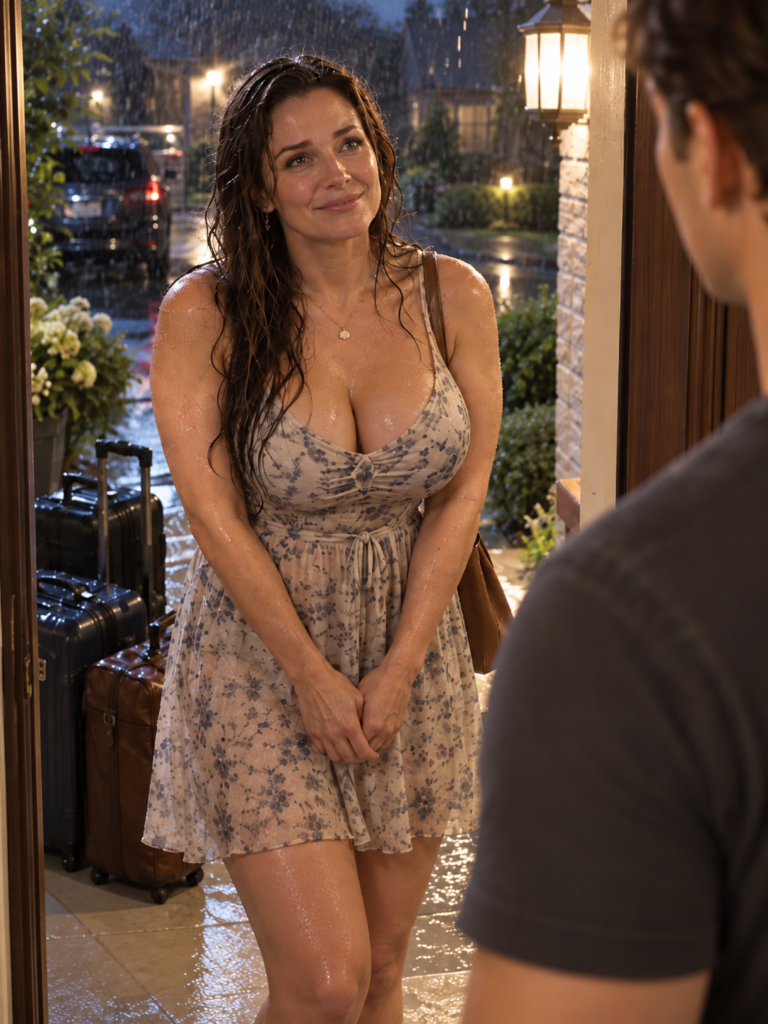
At eleven o’clock on a rainy night, somebody hit my front door hard enough to stop me halfway through washing a plate.
I stood at the kitchen sink, one hand under running water, listening.
Nobody came to my house at eleven.
That was one of the benefits of living alone in a small rental on the edge of Dayton. I worked electrical jobs early, came home tired, ate whatever required the least imagination, and had spent the months since my breakup with Jenna building a life around predictable things.
Work started when it was supposed to.
Bills got paid when they were supposed to.
A quiet house never picked a fight because you answered a question in the wrong tone.
The knock came again.
I shut off the faucet, dried my hands, and checked the peephole.
For a second, I thought the glass was distorting things.
Sarah Whitman stood on my porch.
Jenna’s mother.
I hadn’t seen her in almost a year.
At forty-five, Sarah normally carried herself with the kind of calm that made everyone around her lower their voice without knowing why. I remembered her that way from the years I’d dated Jenna: composed, observant, gracious even when her daughter was turning Thanksgiving dinner into a hostage negotiation.
That woman wasn’t on my porch.
Sarah was soaked through. One hand held a suitcase. Her other arm was tight across her coat. Two more bags sat near the steps in the rain.
I opened the door.
“Sarah?”
She stared at me.
“Mark.”
That was all she managed at first.
Then she swallowed.
“I’m sorry. I didn’t know where else to go.”
I looked at the luggage.
Then at the rain.
Then back at her.
“Come inside.”
“No. I just need to borrow your phone. Maybe sit somewhere dry for a few minutes. I shouldn’t have come here.”
“You brought three bags.”
Her expression tightened.
“That doesn’t mean—”
“It means you’re not standing outside while we debate manners.”
She almost objected again.
Instead, she pulled the suitcase over the threshold.
I brought in the other two.
When I shut the door, she stayed near it as though she expected me to change my mind.
I handed her a towel.
“Kitchen’s warmer.”
“I’m dripping everywhere.”
“It’s tile. It has survived worse.”
That earned the faintest movement at the corner of her mouth.
Good enough.
She sat at my kitchen table while I heated water. Her fingers shook around the mug I gave her.
I pretended not to notice.
For about thirty seconds.
Then I sat across from her.
“What happened?”
Sarah stared into the tea.
“Jenna sold my house.”
I waited.
There are sentences that take a second to enter your head because every word makes sense individually and none of them make sense together.
“What?”
“She sold it. Or tried to. I don’t even know what counts as finished anymore.”
She explained in fragments.
A man had appeared that afternoon with documents showing a property transfer. There were papers she didn’t remember signing, old authorizations Jenna had gained access to when Sarah was helping her organize finances, and signatures Sarah was no longer sure she trusted.
Her accounts had been emptied.
Her phone service had been shut off.
By evening, someone had changed a lock on a side entrance.
She’d taken what she could carry and spent most of her remaining cash getting away.
“Sarah,” I said carefully, “how did Jenna have enough access to do any of that?”
Her face folded inward.
“I trusted her.”
She gave a bitter little laugh.
“It sounds foolish when I say it out loud.”
“No.”
“It does.”
“It sounds like somebody knew exactly which parts of your trust she could use.”
Sarah looked up.
That was the first moment I really saw what was happening underneath the shock.
She wasn’t helpless.
She was humiliated.
There was a difference.
“I shouldn’t have come to you,” she said.
“Why?”
“You and Jenna ended badly.”
“Jenna ends most things badly.”
“Mark.”
“I’m serious.”
She rubbed both hands over the mug.
“Do you have somewhere else you can stay?” I asked.
Silence.
I nodded.
“Spare room’s yours.”
Her head snapped up.
“No.”
“Yes.”
“You cannot possibly think this is a good idea.”
“I don’t think tonight is giving us a lot of good ideas to choose from.”
“You don’t understand. I can’t pay you right now.”
“I didn’t ask you to.”
“I don’t know how long this will take.”
“I didn’t ask that either.”
Her shoulders stiffened.
“And what exactly do you think people will say if they find out I’m living with my daughter’s ex-boyfriend?”
I leaned back.
“People around here think three folding chairs on a driveway counts as a neighborhood council. They’ll survive.”
She stared at me.
Then, against her will, she gave a small breath of laughter.
It disappeared quickly.
“You really mean it.”
“I do.”
“Why?”
That question caught me.
I could have made another joke.
Instead I looked at her sitting in my kitchen in wet clothes, trying to hold herself together while everything she had trusted had been turned against her.
“Because you came to my door,” I said. “And because I know what Jenna is capable of when she decides somebody isn’t useful to her anymore.”
Sarah lowered her eyes.
That was how it began.
Not with attraction.
Not with a confession.
Not with anything a sensible person would call romantic.
It began with rain, three suitcases, and a woman who looked at my spare bedroom as though a clean bed was more kindness than she knew how to accept.
I found an old sweatshirt and sweatpants for her.
“The bathroom handle sticks,” I told her. “Lift it before you turn.”
She stood beside the bed.
“I’ll leave as soon as I figure this out.”
“Don’t figure out your entire future tonight.”
“I hate that you’re seeing me this way.”
I rested one shoulder against the doorframe.
“For what it’s worth, I’ve seen worse.”
She looked at me.
“Really?”
“Your daughter once accused a waiter of disrespecting her because he warned her the soup was hot.”
Sarah stared.
Then she closed her eyes.
“Oh, God. I remember that.”
“She informed him that tone mattered.”
A laugh escaped her.
A real one this time, exhausted and reluctant.
“I raised a hurricane in expensive shoes.”
I didn’t answer.
There were jokes you could join and jokes that were actually grief wearing a hat.
That one belonged to the second category.
“Good night, Mark.”
“Good night, Sarah.”
Three hours earlier, my life had been exactly the way I had arranged it.
Quiet.
Safe.
Empty, though I had stopped using that word.
If I had known what opening that door would eventually cost me, I might have hesitated.
Maybe five seconds.
I still would have opened it.
The first week was practical.
Sarah spent hours making calls from my phone and sorting through documents. I went to work. When I came home, I asked whether she needed anything and tried not to ask twice.
Most nights I found her at the kitchen table with papers spread in front of her.
Sometimes she read the same page for twenty minutes.
I wanted to help.
I also knew the difference between helping and hovering.
So I made myself back off.
Then she started cooking.
The first time, I came home to the smell of roasted chicken and herbs.
I stopped in the doorway.
“What happened in here?”
Sarah glanced over.
“I made too much.”
“You made too much for two people?”
“I needed something to do.”
I set down my tool bag.
“My refrigerator has been begging for adult supervision.”
She put a plate in front of me.
“You don’t have to eat it.”
I picked up my fork.
“I’m not stupid.”
She watched until I took the first bite.
I closed my eyes.
“Well.”
Her eyebrows lifted.
“Well?”
“I’m trying not to make any major life commitments based on chicken.”
She looked down, hiding a smile.
“You’re ridiculous.”
“That’s me exercising restraint.”
One dinner became another.
Then another.
Soon I began expecting the kitchen light to be on when I got home.
Sarah never treated cooking like rent, though I suspected part of her wanted to.
She needed usefulness.
I recognized it because I had done the same thing after Jenna left—filled every spare hour with work so I wouldn’t have to admit how much space somebody had taken up.
Sarah cleaned when she was anxious.
She reorganized cabinets.
She bought groceries with whatever cash she could justify spending.
I noticed things appearing in my house that had never seemed necessary before: decent coffee, lemons, cloth napkins, a bowl on the counter that occasionally contained actual fruit.
The house changed.
So did our conversations.
I told her about electrical jobs, amateur repairs I had been called in to rescue, and homeowners who described three hours of rewiring as “a tiny fix.”
She told me about the bakery where she had managed orders before her life came apart.
“You liked it,” I said one night.
“I liked solving problems before customers knew they existed.”
“You were good at it.”
“I was good at calming people down.”
“You still are.”
She looked at me over her glass.
“You think I’m calm?”
“I think you’re terrified and still remembering I hate peas.”
“That isn’t calm.”
“No. But it’s something.”
She held my eyes a moment longer than usual.
“You notice too much.”
“Occupational hazard.”
“You inspect people now?”
“Bad outlets. Loose wiring. Women reorganizing my kitchen at midnight. Anything suspicious.”
“So I’m a project?”
“Projects come with instructions.”
She laughed.
And something in me shifted.
It wasn’t because she was beautiful, though she was.
It was the ease.
With Jenna, every conversation had eventually become a test I didn’t know I was taking.
With Sarah, silence could simply be silence.
If she was irritated, she said so.
If she needed space, she asked for it.
If she thought I was wrong, she didn’t punish me for failing to guess.
I had forgotten how restful honesty could feel.
One evening I came home and found her standing on a kitchen chair in socks.
“No.”
She turned, cereal box in hand.
“Excuse me?”
“You’re standing on furniture in socks.”
“I’m reaching a shelf.”
“You’re auditioning for an ambulance.”
She stepped down.
“I was reorganizing.”
“You reorganized yesterday.”
“I improved the system.”
“That’s how dictators describe things.”
She pointed at the cupboard.
“Put that up there, tall person.”
I took the box.
When I turned back, she was closer than I expected.
Neither of us moved immediately.
Something passed across her face.
Not fear.
Recognition.
She stepped away first.
“I saved dinner.”
I put the cereal down.
“Sarah.”
“Yes?”
“You don’t have to earn the room.”
Her hands stopped.
“I know.”
“Do you?”
She looked at me then, irritation giving her more life than I’d seen all week.
“Do you have any idea how difficult it is to accept help from somebody I once knew as my daughter’s boyfriend?”
There it was.
The thing we had both avoided.
“Former boyfriend,” I said.
“That distinction does not improve this situation.”
“Improves it for me.”
“Mark.”
I stopped joking.
She folded her arms.
“You’re twenty-four.”
“I’m aware.”
“I’m forty-five.”
“I had noticed.”
Color rose into her face.
The second the words left my mouth, I knew exactly how they sounded.
She knew too.
For once, neither of us rescued the moment.
She looked away.
I didn’t apologize.
After that, nothing dramatic happened.
That was the problem.
Life continued.
We argued about thermostat settings.
She complained about a loose cabinet handle, and I repaired it the next morning before work.
I learned which coffee she liked.
She started waiting until I got home before eating.
She asked how my day went and listened to the answer.
I stopped volunteering for late jobs simply because I dreaded coming back to an empty house.
The shift happened in inches.
That made it harder to dismiss.
One Saturday I drove Sarah to a storage unit where she still had access to old paperwork.
She spent hours making copies.
On the drive home she was silent.
When I parked, she didn’t get out.
“I feel stupid,” she said.
I shut off the engine.
“You aren’t.”
“I signed things I didn’t understand.”
“You trusted your daughter.”
“That sounds kinder.”
“It’s also accurate.”
She rubbed her forehead.
“You don’t have to keep trying to make me feel better.”
“I’m not doing it as a public service.”
Her hand stopped.
“What does that mean?”
That was the moment when I could still have stepped backward.
Made a joke.
Pretended.
Instead, I looked at her.
“It means I care what happens to you.”
Sarah’s face changed.
“Mark.”
“I know.”
“Do you?”
“Age. Jenna. Everything weird about this. Yes.”
“You need to be careful.”
“I am.”
“No. You’re being kind. Kindness is different.”
I held her gaze.
“What if kindness isn’t the only thing happening?”
The truck suddenly felt too small.
Sarah’s hand rested on the door handle.
“You shouldn’t say things like that.”
“I already did.”
“You could regret them.”
“I’ve regretted enough things to recognize the feeling.”
Her eyes searched mine.
“You’re lonely.”
“I’ve been lonely for months. I didn’t start noticing you because I ran out of hobbies.”
Her mouth twitched before she controlled it.
“Noticing me.”
“Yes.”
“How?”
I let out a breath.
“Like I’m making a serious effort to behave.”
That finally made her laugh.
Quietly.
Nervously.
Then she shook her head.
“This is dangerous.”
“Probably.”
“I will not become some confusing chapter you laugh about when you’re thirty.”
“You won’t.”
“You can’t promise that.”
“No. But I can promise I’m not lying to you now.”
She opened the door.
“I need to go inside.”
I nodded.
Sarah stepped out.
Then leaned down to look through the open doorway.
“Mark?”
“Yeah?”
“I don’t hate that you said it.”
She walked toward the house.
And I stayed behind the wheel for another minute, staring at my keys and realizing the quiet life I had worked so hard to protect had already changed.
Part 2
After that afternoon, I stopped pretending I felt nothing.
I also refused to turn Sarah into a target I was pursuing.
There was a difference.
If she cleaned until her shoulders tightened, I took the sponge away.
If I got up before her, I made coffee.
If she looked good, I told her once and let the words stand instead of hiding them under a joke.
We sat closer on the couch.
Not close enough to make promises.
Close enough to notice.
One night she caught me watching her instead of the movie.
“What?”
“Nothing.”
“That was not a nothing expression.”
“I was thinking.”
“That sounds hazardous.”
“It happens occasionally.”
“About?”
I could have looked away.
“You.”
Her posture changed.
I added, “You’re beautiful.”
Sarah stared at the television.
“You say things too easily.”
“That wasn’t easy.”
“I am old enough to know better.”
“And I’m old enough to make my own mistakes.”
She looked at me sharply.
“That is a terrible argument.”
“I have better ones. I didn’t want to overwhelm you on a Tuesday.”
Her laugh disappeared almost as soon as it came.
“I’m scared.”
That made me sit straighter.
“Of Jenna?”
“Not only Jenna. Not only what people would think.”
She folded her hands together.
“I’m afraid I’ll believe you. I’m afraid I’ll start thinking this is real, and then one morning I’ll discover I was just something good you did for a woman having the worst month of her life.”
“You are not charity.”
“You can’t know what you’ll feel later.”
“No.”
I turned my hand palm-up between us.
“But I know what I feel tonight.”
For several seconds she didn’t move.
Then Sarah placed her hand in mine.
That was all.
No kiss.
No dramatic declaration.
Just the quiet weight of her fingers settling against mine.
It felt more dangerous than anything else we had done.
The next morning she became aggressively normal.
She made eggs.
Asked about my schedule.
Reminded me we were low on detergent.
At lunch, I came home for a tool pouch and found her folding towels.
“You’re avoiding me.”
“I’m doing laundry.”
“Classic defense.”
She flattened a towel that was already flat.
“I don’t know what you expect me to say.”
“The truth works.”
Her hands stopped.
“The truth is I barely slept because I kept thinking about holding your hand.”
There was nothing playful in her face.
I leaned against the chair.
“Okay.”
“Okay?”
“I’m trying very hard not to look pleased.”
“Please try harder.”
I failed.
She noticed.
Then her expression sobered.
“If this goes wrong, it won’t only hurt.”
“I know.”
“No, listen to me. People will judge you.”
“People judge lawn height.”
“This is my life.”
That erased my smile.
Sarah stepped closer.
“I will not be treated like something embarrassing because you enjoy the fantasy of wanting me.”
“I’m not embarrassed.”
“You are hiding it.”
I opened my mouth.
Then stopped.
Because she was right.
A few days earlier, Mrs. Alvarez from across the street had waved while Sarah and I unloaded groceries.
I had introduced Sarah as a family friend.
Technically accurate.
Emotionally cowardly.
“You’re right,” I said.
Sarah blinked.
“I am?”
“Yes.”
She looked almost disappointed to lose the argument.
“I had several more points.”
“I ruined your speech.”
“A little.”
I stepped closer but left enough space for her to choose what happened to it.
“I’m not ready to explain us to everybody,” I said. “Mostly because I don’t know what ‘us’ is yet.”
Her eyes stayed on mine.
“But?”
“But I’m finished pretending I don’t want you.”
Her breath slowed.
“What does that mean today?”
“Dinner.”
“We eat dinner every night.”
“Somewhere else. A restaurant. I take you out because I want your company, not because you need a ride or because you’ve been trapped in this house.”
“And if someone sees us?”
“Then they witness two adults eating.”
“How shocking.”
“I expect government intervention.”
Sarah shook her head.
“You really are impossible.”
“I’m building consistency.”
We drove twenty minutes away.
Nothing about the restaurant was special.
That helped.
Sarah wore a dark blouse I hadn’t seen before and carried herself differently once we sat down, as if she were testing whether confidence still fit.
She kept glancing around.
I noticed and said nothing.
When I pulled out her chair, she looked up.
“Careful.”
“Why?”
“I could get used to being treated like this.”
“That’s not exactly discouraging.”
By dessert, she had stopped checking the room.
Outside afterward, she paused beside my truck.
“I had a good time.”
“You sound surprised.”
“I am.”
“My company receives uneven reviews.”
Her smile faded into something softer.
“I had forgotten what this felt like.”
“What?”
“To be looked at without feeling like somebody is calculating what I can do for them.”
Every smart answer I had disappeared.
I wanted to kiss her.
She knew.
I saw it in the way her eyes dropped to my mouth and returned.
But I opened the passenger door instead.
“Let’s go home.”
She looked at me carefully.
Home.
The word had slipped out.
Neither of us corrected it.
The legal problem remained.
And I was starting to hate how powerless Sarah felt whenever another document appeared.
So I did something I believed was helpful.
It turned out to be the first serious mistake I made with her.
A customer gave me the name of a financial attorney named David Keller.
I called him during lunch from my work truck.
I explained the property transfer, the old authorizations, the questionable signatures, the changed locks.
David asked pointed questions.
Finally he said, “There may be defects serious enough to challenge the transfer.”
I sat forward.
“Challenge meaning?”
“Possibly reverse it. I need the paperwork.”
I hired him.
I paid the retainer from savings I had been guarding for years.
And I didn’t tell Sarah.
I told myself I was protecting her from another burden.
The uglier truth was that I wanted to fix something.
Fixing wires made sense.
You found the break. You traced the fault. You restored the circuit.
People were harder.
A few evenings later, the power flickered during a storm.
I went into the garage to check the breaker panel.
Sarah followed with a flashlight.
“I can help.”
“You secretly become an electrician while I was at work?”
“I can hold light.”
“That’s practically an apprenticeship.”
She stood near me while I worked.
After a minute she said, “You’ve been taking a lot of calls.”
My hands slowed.
“Work.”
“Mark.”
I looked at her.
She knew I was holding something back.
Maybe not what.
Enough.
“I don’t like secrets in this house,” she said.
I should have told her.
Instead I said, “It’s nothing bad.”
Her eyebrows lifted.
“That phrase has never improved a secret.”
“You’re not wrong.”
“Tell me soon.”
“I will.”
“Soon is not a date.”
She handed me the flashlight and left.
I stayed in the garage staring at a breaker I had already reset.
I had fixed the wrong problem.
Two nights later, we were doing dishes together.
That had somehow become normal.
Sarah washed.
I dried.
We both reached for the towel.
Our hands touched.
Neither moved away.
She shut off the water.
“Mark.”
“I know.”
“No. You know pieces.”
I put down the plate.
She leaned against the counter.
“You know you want me. You know I don’t hate that you want me. You know I feel safer here than I have in months.”
She looked down.
“But you don’t understand what it costs me to want something back.”
I waited.
“I am ashamed,” she said.
“Of what?”
“Everything. Jenna. The house. Needing help. Living here. Liking this.”
Her eyes met mine.
“Liking the way you look at me.”
I stepped closer.
“Sarah—”
“I keep thinking I’m supposed to rebuild my life somewhere far away from anybody connected to my daughter.”
“Do you think that’s what I am? Something connected to Jenna?”
“You were.”
“Not anymore.”
“That doesn’t erase history.”
“No.”
“And if we make this real, people will have words for it before they ever call it love. They’ll say you took advantage of me. Or I took advantage of you. Or both.”
“People can say whatever they want.”
“That’s easy for you.”
“No.”
I shook my head.
“It isn’t.”
That stopped her.
“I’m scared too.”
“Of what?”
“I spent months believing peace meant nothing could reach me.”
My throat tightened.
“Then you knocked on my door and started putting fruit on my counter and arguing about my thermostat, and now the empty quiet I loved feels exactly like what it was.”
“What was it?”
“Me hiding.”
Sarah didn’t move.
“That scares me,” I said. “Because I care what happens next. With you.”
Her eyes were wet.
“Is this pity?”
“No.”
“Are you trying to rescue me?”
“No.”
“Would you feel this if I hadn’t needed somewhere to stay?”
“I don’t know how we would have gotten here otherwise.”
I reached slowly for her hand.
“But needing the room is not why I stayed interested. You are.”
I touched her fingers.
She could have pulled away.
She didn’t.
“I won’t push you.”
Her hand closed around mine.
“I’m not asking you to.”
Sarah reached up.
I met her halfway.
Our first kiss was quiet.
It didn’t feel like some reckless line finally being crossed.
It felt like both of us admitting we had been standing at that line for weeks.
When we parted, her hand stayed against my chest.
“Don’t make me regret trusting you.”
“I won’t.”
I meant it.
That night she stayed in my room.
The details belong to us.
What mattered was the morning.
I walked into the kitchen and found Sarah in one of my old sweatshirts making coffee with the serious concentration of someone determined to pretend she had not changed both our lives overnight.
“Coffee?” she asked.
“Yes.”
“Cream?”
“You know that.”
“I’m attempting normal.”
“How’s it going?”
“Badly.”
“Good. I’d hate to suffer alone.”
She laughed.
Then fear flickered back into her face.
“What are we doing?”
“Figuring it out.”
“That is not a plan.”
“No.”
I took the mug.
“But it’s true.”
After a moment, she rested her forehead against my shoulder.
For a while, that was enough.
We settled into a private happiness neither of us trusted completely.
She slept beside me most nights.
Sometimes fear won and she returned to the spare room.
I never followed.
Never demanded an explanation.
Once, after two nights apart, I found her reading in the kitchen.
“You avoiding me?”
“A little.”
“Poor strategy. Same address.”
She closed the book.
“I needed to prove to myself I can still stand alone.”
“I’ve never asked you not to.”
“I know.”
Her expression softened.
“That’s why I’m coming back.”
And she did.
More importantly, she began coming back to herself.
Her calls became steadier.
She demanded copies instead of apologizing for requesting them.
She asked questions when people tried to confuse her.
Then David called.
“We found something,” he said.
I sat upright in the work truck.
“What?”
“Inconsistencies in the authorization documents. Missing disclosures. Notarization timing that raises questions. The signature trail does not demonstrate clear consent.”
“Can she get the house back?”
“I won’t promise an outcome. But she has a legitimate basis to seek rescission and emergency review.”
For one bright, stupid second, all I felt was relief.
Then I remembered the garage.
No secrets.
I went home early.
Sarah was sorting papers on the coffee table.
“You’re home.”
“I need to tell you something.”
Her face changed.
“What happened?”
“I talked to David Keller today.”
“Who?”
I sat down across from her.
“He’s an attorney.”
She stared.
“The attorney I hired to look at what happened with your house.”
Sarah rose slowly.
“You hired an attorney.”
“Yes.”
“For me.”
“Yes.”
“When?”
“A few weeks ago.”
Her voice became very calm.
That was worse than anger.
“A few weeks.”
“I should have told you.”
“You think?”
“I thought you had enough to deal with.”
Her eyes sharpened.
“You thought I was too fragile to participate in my own life.”
“No.”
“That may not be what you intended. It is what you did.”
There was no defense that didn’t make it worse.
“You’re right.”
She looked almost thrown by the answer.
Then the anger returned.
“I am grateful you wanted to help me. But I am not a broken appliance you can repair while I’m sleeping.”
“I know.”
“Do you? Because I trusted you. I let you closer than I have let anyone in a very long time, and now I discover you have been making decisions behind my back.”
“I wasn’t trying to control you.”
“But you did.”
I nodded.
“Yes.”
She breathed hard.
“What did he find?”
“Problems with the transfer. Serious ones.”
Her anger faltered.
“He thinks you may be able to reverse the sale.”
Sarah grabbed the couch.
“Say that again.”
“He thinks you have a real case.”
She sat.
“My house?”
“Maybe.”
“My house.”
Tears filled her eyes.
I stayed where I was.
After a moment I asked, “Can I sit beside you?”
She nodded.
I sat without touching her.
She covered her mouth.
“I might get it back.”
“Yes.”
She looked at me.
“I’m still furious.”
“I know.”
“I’m also grateful.”
“I know.”
“I haven’t decided which emotion I want to punish you with first.”
“I vote gratitude. It sounds physically safer.”
A wet laugh escaped her.
Then she put her hand against my chest.
“You should have told me.”
“Yes.”
“No more deciding what I can handle.”
“No more.”
“Promise.”
“I promise.”
She leaned into me.
And for the first time since she had arrived, Sarah cried without apologizing for taking up space.
Part 3
Once David began moving legally, our private life stopped being private.
Letters went out.
Documents were challenged.
People received notices they did not enjoy receiving.
Then Jenna found out.
The first messages came from unfamiliar numbers.
She told me Sarah was manipulating me.
She said I had no idea what her mother had really done.
She demanded we stop.
I blocked every number.
Sarah watched me delete one message.
“Jenna?”
“Yeah.”
“What did she say?”
“Nothing worth keeping.”
I handed over the phone anyway.
Sarah read the last message.
The color left her face.
“She’s scared.”
“She should be concerned.”
“No, Mark. You don’t understand her when she feels cornered.”
“I dated her.”
“You knew the girlfriend version.”
“And you know the family version.”
Sarah looked away.
There it was—the part I could not solve for her.
Jenna was my ex.
For Sarah, she was still a daughter.
Anger didn’t erase grief.
Betrayal didn’t erase memory.
A person could want consequences and still remember holding the person responsible when she was six years old and feverish.
Three days later, Jenna came to the house.
She hit the front door with her fist hard enough to make Sarah freeze in the hallway.
I was in the kitchen.
“Stay back.”
“She knows I’m here.”
“I know.”
Another pounding knock.
“Mark! Open the door.”
I opened it halfway.
Jenna stood on the porch, face tight, damp hair clinging around her temples.
“Move.”
“No.”
“I need to talk to my mother.”
“Not like this.”
“You’re her guard now?”
“If necessary.”
She tried to push forward.
I planted myself in the doorway without touching her.
“Back up.”
“You cannot be serious.”
“Very.”
Behind me, Sarah said, “Jenna, leave.”
Jenna looked past my shoulder.
Her expression twisted.
“There you are. Hiding in his house.”
Sarah flinched.
I felt it without looking.
“You do not come to my door and speak to her that way.”
Jenna’s eyes moved from me to Sarah.
Then comprehension—or the version she wanted—settled across her face.
“Oh.”
“Don’t,” Sarah said.
Jenna laughed.
“So that’s what this is.”
“You sold property that wasn’t yours to sell,” I said. “Don’t turn this into a story about me.”
“You always hated me.”
“I stopped organizing my thoughts around you months ago.”
She tried to look past me again.
“Mom. Get your things. You’re coming with me.”
Sarah’s voice trembled.
“No.”
Jenna stared.
“What?”
“No.”
“You do not get to say no after what you’ve done to me.”
Sarah moved forward.
Not behind me.
Beside me.
“I am done paying for your decisions.”
For the first time since she arrived, Jenna looked genuinely shocked.
Then she turned toward me.
“You think standing there makes you a man?”
“No. Paying my rent and not stealing anyone’s house covers most of that.”
Her eyes hardened.
“You’ll regret choosing her.”
I didn’t have to think.
“I already chose.”
Sarah’s hand found mine.
Jenna saw.
Her face changed.
Then she said things designed to hurt her mother.
Cruel things.
Words meant to turn age into shame, need into dirt, affection into something humiliating.
I felt Sarah’s fingers weaken in mine.
I tightened my grip.
“That’s enough.”
Jenna kept talking.
I stepped fully between them.
“Sarah is not your target anymore.”
She stopped.
“She is not somebody you can throw out and then order around when your plan starts collapsing. She is not a guest you get to reclaim.”
Jenna stared at me.
I continued.
“She is the woman I’m with. She stands beside me because she chooses to. Anything about the property goes through David. Anything personal stops here.”
“You can’t keep me from my mother.”
“I can keep you off my porch.”
Jenna looked at Sarah.
“You’re going to let him speak to me like this?”
Sarah moved enough for Jenna to see her clearly.
“Yes.”
Jenna’s anger cracked around something else.
Fear.
Not fear of me.
Fear of losing control over the version of events she had been telling herself.
“You’re pathetic,” she said.
Sarah lifted her chin.
“No. I trusted you. Those are not the same thing.”
Jenna backed away.
“This isn’t finished.”
I nodded toward the driveway.
“It is at this house.”
She left.
I shut the door.
Sarah stood against the hallway wall.
“Hey.”
She walked past me.
“Sarah?”
“I need a minute.”
I gave it to her.
Twenty minutes later I found her in the spare room.
Both suitcases were open.
She was packing.
“No.”
She didn’t turn.
“Don’t.”
“I’m not arguing with luggage.”
“I can’t stay.”
“You can.”
She folded a sweater with shaking hands.
“You heard her.”
“I heard somebody trying to wound you.”
“You heard what everyone will say.”
“I don’t care.”
“I do.”
She spun around.
Tears stood in her eyes.
“I care because from the outside this looks exactly as complicated as I feared. I’m forty-five. You’re twenty-four. I arrived here homeless, and now you’re fighting my daughter at your front door.”
“I wasn’t fighting.”
“You know what I mean.”
“I do.”
“You put yourself in the middle of a disaster that does not belong to you.”
I stepped into the room.
“It became part of my life when I chose you.”
Her face crumpled with frustration.
“That is what scares me.”
“What?”
“You hear ‘choose me’ and think it means carrying everything. The house. Jenna. My fear. My shame.”
She wiped at her cheek.
“I will not let you destroy your life because I arrived at eleven o’clock with nowhere else to go.”
I almost argued.
Then I understood.
She wasn’t trying to leave because she didn’t love me.
She was trying to protect me from loving her.
I walked to the bed and closed one suitcase.
Sarah stared at my hand.
“Don’t pack while you’re scared.”
“Mark—”
“If you wake up tomorrow and decide leaving is right, I’ll help you go wherever you want. I mean that.”
She went still.
“But don’t let Jenna make the decision tonight.”
Her voice broke.
“Safe places stop being safe when other people discover them.”
“Then we stop hiding.”
Sarah looked at me.
“What does that mean?”
“It means I’m done treating us as temporary just because temporary is easier to explain.”
I took a breath.
“I hired David because I wanted you to have your home back. I held your hand because I wanted you beside me. And I stood at that door because I love you.”
Sarah stopped breathing for a second.
I hadn’t intended to say it in the spare room.
No dinner.
No perfect speech.
Just open luggage and a sweater half folded on the bed.
“Don’t say that because I’m upset,” she whispered.
“I’m saying it because I should have said it before tonight.”
“You can’t know what this is yet.”
“I know enough.”
“That isn’t forever.”
“No.”
I stepped closer.
“Maybe forever isn’t something you know all at once. Maybe you build it by showing up enough times.”
Her eyes dropped.
“I don’t want to make your life harder.”
“My life was already hard sometimes.”
“That isn’t what I mean.”
“I know.”
I smiled faintly.
“It was also boring.”
A laugh escaped through her tears.
I held out my hand.
“You get a choice, Sarah. A real one.”
She looked at it.
“If you leave, I’ll help you leave safely. If you stay, we stop acting ashamed. But don’t walk away because somebody who hurt you thinks she gets to decide what you deserve.”
Sarah stared at me for a long time.
Then she picked up the sweater.
And dropped it back into the suitcase.
“I dislike how calm you sound.”
“I’m not calm.”
“No?”
“I’m concentrating very hard.”
Her mouth trembled.
“You love me?”
“Yes.”
“That is wildly inconvenient.”
“Extremely.”
She closed the distance between us.
“I love you too.”
The words were barely above a whisper.
“And I’m terrified.”
“I can work with both.”
She came into my arms.
Nothing was solved.
The case still existed.
Jenna still existed.
People still had mouths.
But Sarah stopped packing.
After that night, the difference between helping Sarah and taking control became something I paid attention to.
When we met David in person, he directed questions to her.
I stayed quiet.
At one point I started to answer.
David looked at me.
“I need Sarah’s decision.”
I raised both hands.
“I’m furniture today.”
Sarah glanced sideways.
“Useful furniture.”
“Best review I’ve had all week.”
Then she answered for herself.
She asked David to explain what she didn’t understand.
She rejected one option.
Approved another.
Corrected a date in his notes.
Watching her reclaim authority over her own life changed something in me.
I didn’t want to rescue her.
That version of love was too small.
I wanted the woman who could stand on her own and still choose to stand next to me.
After that, Jenna’s communication stayed with the attorneys.
She tried pressure.
She tried guilt.
She tried rewriting history.
Sarah had bad days because of it.
But bad days stopped becoming surrender.
Then, one afternoon, the phone rang in our kitchen.
Sarah answered.
I was repairing a loose outlet near the counter.
“Yes,” she said.
A pause.
“Yes. I understand.”
Another pause.
She sat down.
I put the screwdriver aside.
“Sarah?”
She ended the call.
For a moment she only looked at the phone.
Then at me.
“The transfer is being reversed.”
I stared.
“The house?”
She nodded.
“My house.”
Neither of us moved.
Then she laughed.
One stunned sound.
The laugh broke into tears.
I crouched beside her.
“You got it back.”
“I get to go home.”
The word landed differently this time.
Home.
“Yes.”
She touched my face.
“Are you coming?”
I blinked.
“If you want me there.”
She actually laughed at me.
“Mark, I fought this hard to get that house back. Do you think I plan to sit in it alone?”
“I didn’t want to assume.”
“Good.”
She leaned closer.
“I’m asking.”
“Then yes.”
We didn’t move immediately.
Reality was less cinematic than victory.
There were forms.
Utilities.
Insurance.
Missing belongings.
New locks.
Repairs.
Neighbors pretending they had no idea what happened while knowing approximately everything.
When we finally entered Sarah’s house together, she stopped just inside the door.
The place did not look triumphant.
It looked disturbed.
Boxes had been shifted.
Some furniture was gone.
Mail had accumulated.
There were empty spaces where parts of her life used to sit.
“You okay?” I asked.
“No.”
She breathed in slowly.
“But I’m here.”
I nodded.
“What first?”
“Locks.”
“Already scheduled.”
She glanced at me.
“Of course.”
“Useful furniture has contacts.”
That smile came back.
Then she looked toward the hallway.
“I want the bedroom painted.”
“Any reason?”
“I want it to feel like mine again.”
“Done.”
She walked a few steps, then turned.
“And I want your boots by the back door.”
I smiled.
“That is strangely specific.”
“It means you came home.”
For once, I had no joke.
“Done.”
The months afterward were better.
Not perfect.
Better.
Sarah still had mornings when embarrassment tried to make decisions for her.
I still had days when I mistook distance for safety.
She learned that when I became quiet, I was usually thinking, not leaving.
I learned that when she started cleaning with unnecessary aggression, anxiety was probably losing an argument inside her head.
She returned to work part-time, then took on more hours.
I accepted bigger electrical jobs.
I stopped treating exhaustion as proof I was building a life.
People talked.
Naturally.
One afternoon Mrs. Alvarez watched me carrying boxes from my truck.
“So you’re helping Sarah move back in?”
“I’m moving in too.”
Her eyebrows rose.
Sarah appeared in the doorway behind me.
“He’s excellent with boxes.”
Mrs. Alvarez considered us.
Then pointed at the side of the house.
“He’d better be good with gutters. That one needs work.”
Sarah nodded solemnly.
“He is.”
That was neighborhood acceptance.
Not applause.
A gutter complaint.
I respected it.
As for Jenna, we heard pieces through legal channels and the silence that followed them.
The reversed transfer left consequences she had not planned for.
Money vanished from whatever future she had imagined.
Relationships changed.
Doors closed.
For a while she left the state.
Sarah didn’t celebrate.
Neither did I.
But we also stopped trying to save Jenna from the results of Jenna’s choices.
Nearly a year after the night Sarah knocked on my door, I came home late from work.
My truck went into the driveway.
My tools went into the garage.
My boots sat by the back door exactly where she had asked.
I found Sarah on the porch with two mugs of coffee.
Her plants were lined along the steps.
Some were doing better than others.
So were we.
“You’re late,” she said.
“Job ran long.”
“Convenient.”
“Popular excuse in my profession.”
She handed me a mug.
We stood together in the evening quiet.
After a while she asked, “Do you think about that night?”
“The night you arrived?”
She nodded.
“Sometimes.”
“And?”
“I mostly think I was lucky I put on pants before answering the door.”
She gave me the expression I deserved.
“Mark.”
I smiled.
Then I looked out across the yard.
“I think I had spent a long time trying to make sure nothing could hurt me.”
She stayed quiet.
“And then you arrived with three suitcases and enough trouble to fill a courthouse.”
“Romantic.”
“I’m building toward romantic.”
“You’d better.”
I took her hand.
“You ruined my peace.”
Her eyebrows lifted.
“Excuse me?”
“You did.”
I turned toward her.
“And then you gave me something better.”
Her expression softened.
She looked down at our joined hands.
“Do you ever regret it?”
“No.”
“Even the complicated parts?”
“Those are most of the parts.”
“I’m serious.”
“So am I.”
I set my mug on the railing.
“Sarah, I moved into your house. I changed the locks. I painted the bedroom. I spent two hours arguing with a plumber because he described your water heater as ‘probably fine.’ My position is established.”
She laughed.
Then looked at me with that same combination of strength and vulnerability I had first seen across my kitchen table.
Only now the strength no longer looked borrowed.
“I love you,” she said.
“I love you too.”
There wasn’t a speech after that.
There didn’t need to be.
Opening the door that night changed my life.
Not because love appeared cleanly.
Not because it made immediate sense.
Not because everyone approved.
It changed my life because I learned there was a difference between peace and hiding, between helping someone and deciding for them, between being needed and being chosen.
Sarah rebuilt her life.
I built one with her.
And neither of us had to pretend the complicated parts weren’t real.
A year earlier, she had stood outside my house believing she had nowhere left to go.
Now I stood beside her on the porch of the home she had fought to reclaim, my boots by her back door, my tools in her garage, her hand in mine.
She had knocked because she needed somewhere safe for one night.
I opened the door because leaving her in the rain had never been an option.
Everything after that was a choice.
Hers.
Mine.
Ours.

